EP4481007A1 - Nichtwässrige tintenstrahltintenzusammensetzung und tintenstrahlaufzeichnungsvorrichtung - Google Patents
Nichtwässrige tintenstrahltintenzusammensetzung und tintenstrahlaufzeichnungsvorrichtung Download PDFInfo
- Publication number
- EP4481007A1 EP4481007A1 EP24183608.9A EP24183608A EP4481007A1 EP 4481007 A1 EP4481007 A1 EP 4481007A1 EP 24183608 A EP24183608 A EP 24183608A EP 4481007 A1 EP4481007 A1 EP 4481007A1
- Authority
- EP
- European Patent Office
- Prior art keywords
- mass
- ink composition
- percent
- ink jet
- nonaqueous
- Prior art date
- Legal status (The legal status is an assumption and is not a legal conclusion. Google has not performed a legal analysis and makes no representation as to the accuracy of the status listed.)
- Pending
Links
Images


Classifications
-
- C—CHEMISTRY; METALLURGY
- C09—DYES; PAINTS; POLISHES; NATURAL RESINS; ADHESIVES; COMPOSITIONS NOT OTHERWISE PROVIDED FOR; APPLICATIONS OF MATERIALS NOT OTHERWISE PROVIDED FOR
- C09D—COATING COMPOSITIONS, e.g. PAINTS, VARNISHES OR LACQUERS; FILLING PASTES; CHEMICAL PAINT OR INK REMOVERS; INKS; CORRECTING FLUIDS; WOODSTAINS; PASTES OR SOLIDS FOR COLOURING OR PRINTING; USE OF MATERIALS THEREFOR
- C09D11/00—Inks
- C09D11/02—Printing inks
- C09D11/10—Printing inks based on artificial resins
- C09D11/101—Inks specially adapted for printing processes involving curing by wave energy or particle radiation, e.g. with UV-curing following the printing
-
- B—PERFORMING OPERATIONS; TRANSPORTING
- B41—PRINTING; LINING MACHINES; TYPEWRITERS; STAMPS
- B41J—TYPEWRITERS; SELECTIVE PRINTING MECHANISMS, i.e. MECHANISMS PRINTING OTHERWISE THAN FROM A FORME; CORRECTION OF TYPOGRAPHICAL ERRORS
- B41J2/00—Typewriters or selective printing mechanisms characterised by the printing or marking process for which they are designed
- B41J2/005—Typewriters or selective printing mechanisms characterised by the printing or marking process for which they are designed characterised by bringing liquid or particles selectively into contact with a printing material
- B41J2/01—Ink jet
-
- C—CHEMISTRY; METALLURGY
- C09—DYES; PAINTS; POLISHES; NATURAL RESINS; ADHESIVES; COMPOSITIONS NOT OTHERWISE PROVIDED FOR; APPLICATIONS OF MATERIALS NOT OTHERWISE PROVIDED FOR
- C09D—COATING COMPOSITIONS, e.g. PAINTS, VARNISHES OR LACQUERS; FILLING PASTES; CHEMICAL PAINT OR INK REMOVERS; INKS; CORRECTING FLUIDS; WOODSTAINS; PASTES OR SOLIDS FOR COLOURING OR PRINTING; USE OF MATERIALS THEREFOR
- C09D11/00—Inks
- C09D11/30—Inkjet printing inks
- C09D11/32—Inkjet printing inks characterised by colouring agents
- C09D11/322—Pigment inks
-
- C—CHEMISTRY; METALLURGY
- C09—DYES; PAINTS; POLISHES; NATURAL RESINS; ADHESIVES; COMPOSITIONS NOT OTHERWISE PROVIDED FOR; APPLICATIONS OF MATERIALS NOT OTHERWISE PROVIDED FOR
- C09D—COATING COMPOSITIONS, e.g. PAINTS, VARNISHES OR LACQUERS; FILLING PASTES; CHEMICAL PAINT OR INK REMOVERS; INKS; CORRECTING FLUIDS; WOODSTAINS; PASTES OR SOLIDS FOR COLOURING OR PRINTING; USE OF MATERIALS THEREFOR
- C09D11/00—Inks
- C09D11/30—Inkjet printing inks
- C09D11/36—Inkjet printing inks based on non-aqueous solvents
-
- C—CHEMISTRY; METALLURGY
- C09—DYES; PAINTS; POLISHES; NATURAL RESINS; ADHESIVES; COMPOSITIONS NOT OTHERWISE PROVIDED FOR; APPLICATIONS OF MATERIALS NOT OTHERWISE PROVIDED FOR
- C09D—COATING COMPOSITIONS, e.g. PAINTS, VARNISHES OR LACQUERS; FILLING PASTES; CHEMICAL PAINT OR INK REMOVERS; INKS; CORRECTING FLUIDS; WOODSTAINS; PASTES OR SOLIDS FOR COLOURING OR PRINTING; USE OF MATERIALS THEREFOR
- C09D11/00—Inks
- C09D11/30—Inkjet printing inks
- C09D11/38—Inkjet printing inks characterised by non-macromolecular additives other than solvents, pigments or dyes
-
- B—PERFORMING OPERATIONS; TRANSPORTING
- B41—PRINTING; LINING MACHINES; TYPEWRITERS; STAMPS
- B41J—TYPEWRITERS; SELECTIVE PRINTING MECHANISMS, i.e. MECHANISMS PRINTING OTHERWISE THAN FROM A FORME; CORRECTION OF TYPOGRAPHICAL ERRORS
- B41J2/00—Typewriters or selective printing mechanisms characterised by the printing or marking process for which they are designed
- B41J2/005—Typewriters or selective printing mechanisms characterised by the printing or marking process for which they are designed characterised by bringing liquid or particles selectively into contact with a printing material
- B41J2/0057—Typewriters or selective printing mechanisms characterised by the printing or marking process for which they are designed characterised by bringing liquid or particles selectively into contact with a printing material where an intermediate transfer member receives the ink before transferring it on the printing material
Definitions
- the present disclosure relates to a nonaqueous ink jet ink composition and an ink jet recording apparatus.
- JP-A-2015-199817 has disclosed a radiation curable inkjet composition which contains a polymerizable compound and an acylphosphine oxide-based photopolymerization initiator having at least two functional groups in the form of a solid compound at ordinary temperature, and the composition described above contains dissolved oxygen in an amount of 0 to 8.0 kPa and is received in a composition container.
- a nonaqueous ink jet ink composition used for a recording method which performs a long printing operation without a step of taking measures against nozzle missing
- the nonaqueous ink jet ink composition comprising a polymerizable monomer, a liquid photoinitiator in the form of a liquid at 20°C, and a solid photoinitiator in the form of a solid at 20°C at a content of zero percent by mass or more and 1.5 percent by mass or less with respect to a total mass of the nonaqueous ink jet ink composition.
- a nonaqueous ink jet ink composition according to this embodiment is a nonaqueous ink jet ink composition used for a recording method which performs a long printing operation without a step of taking measures against nozzle missing, the nonaqueous inkjet ink composition containing a polymerizable monomer, a liquid photoinitiator in the form of a liquid at 20°C, and a solid photoinitiator in the form of a solid at 20°C at a content of zero percent by mass or more and 1.5 percent by mass or less with respect to a total mass of the nonaqueous ink jet ink composition.
- the ink jet ink in which the fine air bubbles as described above are generated is not processed by the ultrasonic treatment step, the ink jet ink is ejected from the ink jet head while the fine air bubbles remain therein, and as a result, the number of missing nozzles in the head is believed to increase.
- the nozzle missing indicates a phenomenon in that the ink is not appropriately ejected since air bubbles in the ink are present in the vicinity of nozzles, and as a result, nozzles which are not preferably used for printing are generated.
- a nozzle in the state as described above is called a "missing nozzle" in some cases.
- the reason the number of missing nozzles increases is not limited to that described above.
- the increase in number of missing nozzles of the head tends to be serious.
- the reason for this is believed that when the long printing operation is performed without the step of taking measures against nozzle missing, fine air bubbles remaining in the ink jet ink are liable to be accumulated on the head.
- the reason the increase in number of missing nozzles becomes serious is not limited to that described above.
- the photoinitiator since a liquid photoinitiator in the form of a liquid at 20°C and 1 atmospheric pressure is used, even if the ink composition is not processed by the ultrasonic treatment, the nozzle missing can be suppressed without performing the step of taking measures against nozzle missing.
- the reason for this is believed that since the liquid photoinitiator described above is used, fine air bubbles are not likely to be generated when the ink composition is prepared, the reason the nozzle missing can be suppressed is not only limited thereto.
- the ultrasonic treatment step is not necessary unlike the case in which the solid photoinitiator is used, the degree of freedom in terms of installation location, structure, and the like of the apparatus for manufacturing the ink composition can be improved, and in addition, the time required for manufacturing the ink composition can be shortened.
- the ink composition of this embodiment tends to suppress the nozzle missing of the head.
- the reason for this is believed that when the ink composition is prepared, fine air bubbles are not likely to be generated; however, the reason the nozzle missing can be suppressed even when the long printing operation is performed without the step of taking measures against nozzle missing, that is, without performing the ultrasonic treatment step, is not only limited thereto.
- the ink composition has a viscosity at 25°C of preferably less than 40 mPa ⁇ s, more preferably less than 30 mPa ⁇ s, even more preferably less than 20 mPa ⁇ s, further preferably 3 to 40 mPa ⁇ s, even further preferably 4 to 30 mPa ⁇ s, particularly preferably 5 to 25 mPa ⁇ s, and more particularly preferably 10 to 20 mPa ⁇ s. Since the viscosity of the ink composition is in the range described above, an ink composition suitable for an ink jet recording method tends to be formed.
- the viscosity of the ink composition at 25°C can be measured by a method performed in accordance with JIS Z 8803.
- the viscosity of the ink composition can be adjusted, for example, by changing the type and/or the content of the photoinitiator, the type and/or the content of the polymerizable monomer, the type and/or the content of an oligomer, the type and/or the content of a colorant, and/or the type and/or the content of a surfactant and can also be adjusted by adding a viscosity adjuster functioning as one of other components which will be described later.
- the "photoinitiator” includes, besides a photopolymerization initiator, a sensitizer and a fluorescent whitening agent each of which is used therewith.
- the photoinitiator when being irradiated with radioactive rays, the photoinitiator generates active species, such as radicals, acids, or bases, and a polymerization reaction of the polymerizable monomer which will be described later is promoted by the function of the active species.
- the photoinitiator of this embodiment includes a liquid photoinitiator in the form of a liquid at 20°C and 1 atmospheric pressure (hereinafter, also simply referred to as "liquid photoinitiator”) and a solid photoinitiator in the form of a solid at 20°C and 1 atmospheric pressure (hereinafter, also simply referred to as "solid photoinitiator").
- liquid photoinitiator in the form of a liquid at 20°C and 1 atmospheric pressure
- solid photoinitiator solid photoinitiator
- the photoinitiator is not particularly limited, for example, there may be mentioned an aromatic ketone, a hydroxy ketone, an acylphosphine compound, an aromatic onium salt compound, an organic peroxide, a thio compound, such as a thioxantone-based or a thiophene-based compound, a hexaaryl bisimidazole compound, a ketoxime ester compound, a borate compound, an azinium compound, a metallocene compound, an active ester compound, a compound having a carbon-halogen bond, or an alkylamine compound.
- Those photoinitiators may be used alone, or at least two types thereof may be used in combination.
- a photoinitiator of the present disclosure which is classified in the fluorescent whitening agent
- a naphthalene benzoxazolyl derivative for example, there may be mentioned a naphthalene benzoxazolyl derivative, a thiophene benzoxazolyl derivative, a stilbene benzoxazolyl derivative, a coumarin derivative, a styrene biphenyl derivative, a pyrazolone derivative, a stilbene derivative, a styryl derivative of benzene and biphenyl, a bis(benzazole-2-yl) derivative, a carbostyril, a naphthalimide, a dibenzothiophene-5,5'-dioxide derivative, a pyrene derivative, or a pyridotriazole.
- the ink composition of this embodiment contains a liquid photoinitiator.
- a liquid photoinitiator besides a liquid photopolymerization initiator, a liquid sensitizer and a liquid fluorescent whitening agent may be mentioned and are not particularly limited, and for example, there may be mentioned an aromatic ketone, a hydroxy ketone, an acylphosphine compound, an aromatic onium salt compound, an organic peroxide, a thio compound, such as a thioxantone-based or a thiophene-based compound, a hexaaryl bisimidazole compound, a ketoxime ester compound, a borate compound, an azinium compound, a metallocene compound, an active ester compound, a compound having a carbon-halogen bond, or an alkylamine compound.
- At least one selected from the group consisting of an acylphosphine-based initiator and a thioxantone-based initiator is preferably used, an acylphosphine-based initiator is more preferably used, and an acylphosphine-based initiator and a thioxantone-based initiator are further preferably used in combination.
- Those liquid photoinitiators may be used alone, or at least two types thereof may be used in combination.
- the liquid photoinitiator is present, with respect to the total mass of the ink composition, at a content of preferably 5.0 to 25.0 percent by mass, more preferably 7.0 to 22.5 percent by mass, even more preferably 8.5 to 20.0 percent by mass, and further preferably 10.0 to 17.5 percent by mass. Since the content of the liquid photoinitiator is in the range described above, the curing property and the suppression of nozzle missing of the head tend to be made more excellent.
- the liquid photoinitiator is present, with respect to a total mass of the photoinitiator, at a content of preferably 80.0 to 99.9 percent by mass, more preferably 82.5 to 99.9 percent by mass, and further preferably 85.0 to 99.9 percent by mass.
- the liquid photoinitiator may be present at a content of 100 percent by mass with respect to the total mass of the photoinitiator. Since the content of the liquid photoinitiator is in the range described above, the curing property and the suppression of nozzle missing of the head tend to be made more excellent.
- the ink composition of this embodiment may contain, among the liquid photoinitiators, an acylphosphine-based initiator which is an acylphosphine compound.
- the acylphosphine-based initiator is not particularly limited, and for example, ethyl phenyl(2,4,6-trimethylbenzoyl)phosphinate (hereinafter, also referred to as "TPO-L" in some cases) or its oligomer may be mentioned. Among those mentioned above, ethyl phenyl(2,4,6-trimethylbenzoyl)phosphinate is preferable.
- the acylphosphine-based initiator is present, with respect to the total mass of the ink composition, at a content of preferably 3.0 to 20.0 percent by mass, more preferably 5.0 to 15.0 percent by mass, even more preferably 6.0 to 12.5 percent by mass, and further preferably 6.5 to 11.0 percent by mass. Since the content of the above acylphosphine-based initiator is in the range described above, the curing property and the suppression of nozzle missing of the head tend to be made more excellent.
- the acylphosphine-based initiator is present, with respect to the total mass of the photoinitiator, at a content of preferably 30.0 to 99.0 percent by mass, more preferably 40.0 to 95.0 percent by mass, even more preferably 45.0 to 90.0 percent by mass, further preferably 50.0 to 85.0 percent by mass, and particularly preferably 55.0 to 82.5 percent by mass. Since the content of the above acylphosphine-based initiator is in the range described above, the curing property and the suppression of nozzle missing of the head tend to be made more excellent.
- TPO-L is present, with respect to the total mass of the ink composition, at a content of preferably 7.0 percent by mass or more, more preferably 7.0 to 20.0 percent by mass, even more preferably 7.2 to 15.0 percent by mass, and further preferably 7.4 to 12.5 percent by mass. Since the content of TPO-L is in the range described above, the curing property tends to be made more excellent.
- the ink composition of this embodiment may contain, among the liquid photoinitiators, a thioxantone-based initiator which is a thio compound.
- a thioxantone-based initiator which is a thio compound.
- the thioxantone-based initiator is not particularly limited, and for example, there may be mentioned polybutylene glycol bis(9-oxo-9H-thioxanthenyloxy)acetate ( CAS No.
- the thioxantone-based initiator is present, with respect to the total mass of the ink composition, at a content of preferably 0.1 to 10.0 percent by mass, more preferably 0.5 to 7.5 percent by mass, and further preferably 1.0 to 5.0 percent by mass. Since the content of the thioxantone-based initiator is in the range described above, the curing property and the suppression of nozzle missing of the head tend to be made more excellent.
- the content of the thioxantone-based initiator with respect to a total mass of the clear ink composition is preferably 3.0 percent by mass or less, more preferably 0.1 to 3.0 percent by mass, even more preferably 0.1 to 2.0 percent by mass, and further preferably 0.1 to 1.0 percent by mass. Since the content of the thioxantone-based initiator is in the range described above, the curing property and suppression of yellowing of a coating film tend to be made more excellent.
- the thioxantone-based initiator is present, with respect to the total mass of the photoinitiator, at a content of preferably 1.0 to 40.0 percent by mass, more preferably 5.0 to 35.0 percent by mass, and further preferably 10.0 to 30.0 percent by mass. Since the content of the thioxantone-based initiator is in the range described above, the curing property and the suppression of nozzle missing of the head tend to be made more excellent.
- the content of the thioxantone-based initiator with respect to the total mass of the photoinitiator is preferably 30.0 percent by mass or less, more preferably 1.0 to 30.0 percent by mass, even more preferably 1.0 to 20.0 percent by mass, and further preferably 1.0 to 10.0 percent by mass. Since the content of the thioxantone-based initiator is in the range described above, the curing property, the suppression of nozzle missing of the head, and the suppression of yellowing of the coating film tend to be made more excellent.
- a hydroxy ketone-based photoinitiator may be mentioned.
- the hydroxy ketone-based photoinitiator described above is not particularly limited, and for example, 2-hydroxy-2-methyl-1-[4-(1-methylvinyl)phenyl]propanone or its oligomer may be mentioned.
- a content of the other liquid photoinitiators with respect to the total mass of the ink composition is, for example, preferably 0.1 to 10.0 percent by mass, more preferably 0.5 to 8.0 percent by mass, and further preferably 1.0 to 6.0 percent by mass.
- the other liquid photoinitiators may be allowed not to be contained.
- the content of the other liquid photoinitiators with respect to the total mass of the photoinitiator is not particularly limited, and for example, the content described above is preferably 0.1 to 40.0 percent by mass, more preferably 0.5 to 39.0 percent by mass, and further preferably 1.0 to 38.0 percent by mass.
- the other liquid photoinitiators may be allowed not to be contained.
- a solid photoinitiator besides a solid photopolymerization initiator, a solid sensitizer and a solid fluorescent whitening agent may be mentioned and are not particularly limited, and for example, there may be mentioned an aromatic ketone, a hydroxy ketone, an acylphosphine compound, an aromatic onium salt compound, an organic peroxide, a thio compound, such as a thioxantone-based or a thiophene-based compound, a hexaaryl bisimidazole compound, a ketoxime ester compound, a borate compound, an azinium compound, a metallocene compound, an active ester compound, a compound having a carbon-halogen bond, or an alkylamine compound.
- Those solid photoinitiators may be used alone, or at least two types thereof may be used in combination.
- the acylphosphine-based solid photoinitiator which is an acylphosphine compound is not particularly limited, and for example, phenyl bis(2,4,6-trimethylbenzoyl)phosphine oxide or diphenyl-2,4,6-trimethylbenzoylphosphine oxide (hereinafter, also referred to as "TPO" in some cases) may be mentioned.
- TPO phenyl bis(2,4,6-trimethylbenzoyl)phosphine oxide or diphenyl-2,4,6-trimethylbenzoylphosphine oxide
- TPO diphenyl-2,4,6-trimethylbenzoylphosphine oxide
- the thioxantone-based solid photoinitiator which is a thio compound is not particularly limited, and for example, 2-methyl-[4-(methylthio)phenyl]-2-morpholino-1-propane may be mentioned.
- the solid photoinitiator is present, with respect to the total mass of the ink composition, at a content of 1.50 percent by mass or less, preferably 0.50 percent by mass or less, more preferably 0.01 to 1.50 percent by mass, even more preferably 0.01 to 1.00 percent by mass, further preferably 0.01 to 0.75 percent by mass, even further preferably 0.01 to 0.50 percent by mass, particularly preferably 0.01 to 0.25 percent by mass, and more particularly preferably 0.01 to 0.10 percent by mass.
- the ink composition of this embodiment may be allowed to contain no solid photoinitiator. Since the content of the solid photoinitiator is in the range described above, the suppression of nozzle missing of the head tends to be made more excellent.
- the solid photoinitiator is present, with respect to the total mass of the photoinitiator, at a content of preferably 0.1 to 20.0 percent by mass, more preferably 0.1 to 15.0 percent by mass, even more preferably 0.1 to 12.5 percent by mass, and further preferably 0.1 to 10.0 percent by mass.
- the ink composition of this embodiment may be allowed to contain no solid photoinitiator. Since the content of the solid photoinitiator is in the range described above, the suppression of nozzle missing of the head tends to be made more excellent.
- the photopolymerization initiator of this embodiment When being irradiated with radioactive rays, the photopolymerization initiator of this embodiment generates active species, such as radicals, acids, or bases, and the polymerization reaction of the monomer is promoted by the function of the active species.
- active species such as radicals, acids, or bases
- the liquid or the solid photopolymerization initiator is not particularly limited, and for example, there may be mentioned ethyl phenyl(2,4,6-trimethylbenzoyl)phosphinate, 2-hydroxy-2-methyl-1-[4-(1-methylvinyl)phenyl]propanone or its oligomer, phenyl bis(2,4,6-trimethylbenzoyl)phosphine oxide, or diphenyl-2,4,6-trimethylbenzoylphosphine oxide.
- the photopolymerization initiator may be either a liquid photoinitiator or a solid photoinitiator.
- the photopolymerization initiator may be used alone, or at least two types thereof may be used in combination.
- a content of the photopolymerization initiator with respect to the total mass of the ink composition is, for example, preferably 2.0 to 25.0 percent by mass, more preferably 3.0 to 20.0 percent by mass, even more preferably 4.0 to 17.5 percent by mass, and further preferably 5.0 to 15.0 percent by mass.
- the content of the photopolymerization initiator with respect to the total mass of the photoinitiator is not particularly limited, and for example, the content described above is preferably 60.0 to 100.0 percent by mass, more preferably 65.0 to 97.5 percent by mass, and further preferably 70.0 to 95.0 percent by mass.
- the ink composition of this embodiment may contain, as the photoinitiator, a fluorescent whitening agent.
- the fluorescent whitening agent of this embodiment has a function to absorb ultraviolet rays and to emit pale fluorescence. Furthermore, when the fluorescent whitening agent is used together with at least one of other photoinitiators, a sensitization action is obtained, and hence, when the fluorescent whitening agent is contained, the curing property tends to be made more excellent compared to the case in which the photoinitiator is only contained.
- the liquid or the solid fluorescent whitening agent is not particularly limited, and for example, there may be mentioned a naphthalene benzoxazolyl derivative, a thiophene benzoxazolyl derivative, a stilbene benzoxazolyl derivative, a coumarin derivative, a styrene biphenyl derivative, a pyrazolone derivative, a stilbene derivative, a styryl derivative of benzene and biphenyl, a bis(benzazole-2-yl) derivative, a carbostyril, a naphthalimide, a dibenzothiophene-5,5'-dioxide derivative, a pyrene derivative, or a pyridotriazole.
- Those fluorescent whitening agents may be used alone, or at least two types thereof may be used in combination.
- the fluorescent whitening agent is not particularly limited, and in more detail, there may be mentioned 1,4-bis(2-benzoxazolyl)naphthalene or 2,5-bis(5-tert-butyl-2-benzoxazolyl)thiophene.
- the fluorescent whitening agent may be used as either a liquid photoinitiator or a solid photoinitiator.
- the fluorescent whitening agent may be used alone, or at least two types thereof may be used in combination.
- the fluorescent whitening agent is present, with respect to the total mass of the ink composition, at a content of preferably 1.00 percent by mass or less, more preferably 0.50 percent by mass or less, even more preferably 0.01 to 1.00 percent by mass, further preferably 0.03 to 0.75 percent by mass, and particularly preferably 0.05 to 0.50 percent by mass. Since the content of the fluorescent whitening agent is in the range described above, the curing property and low-temperature precipitability tend to be made more excellent.
- the fluorescent whitening agent is present, with respect to the total mass of the photoinitiator, at a content of preferably 0.1 to 10.0 percent by mass, more preferably 0.3 to 7.5 percent by mass, and further preferably 0.5 to 5.0 percent by mass. Since the content of the fluorescent whitening agent is in the range described above, the curing property tends to be made more excellent.
- the sensitizer of this embodiment Since being placed in an excited state by absorption of radioactive rays and then being brought into contact with the photopolymerization initiator, the sensitizer of this embodiment has a function to promote decomposition the photopolymerization initiator and also to further promote the polymerization reaction of the monomer.
- the liquid or the solid sensitizer is not particularly limited, and for example, there may be mentioned an amine compound (such as an aliphatic amine, an amine having an aromatic ring, piperidine, a reaction product between an epoxy resin and an amine, or triethanolamine triacrylate), an urea compound (such as allylthiourea or o-tolylthiourea), a sulfur compound (such as 2-methyl-[4-(methylthio)phenyl]-2-morpholino-1-propane, sodium diethyl dithiophosphate, or a soluble salt of an aromatic sulfinic acid), a nitrile-based compound (such as N,N-diethyl-p-aminobenzonitrile), a phosphorus compound (such as tri-n-butylphosphine or sodium diethyl dithiophosphide), a nitrogen compound (such as Michler's ketone, an N-nitrosohydroxylamine derivative, an oxazol
- a content of the sensitizer with respect to the total mass of the ink composition is present, for example, preferably 0.5 to 10.0 percent by mass, more preferably 1.0 to 8.0 percent by mass, and further preferably 2.0 to 6.0 percent by mass.
- the sensitizer may be allowed not to be contained.
- the content of the sensitizer is not particularly limited with respect to the total mass of the photoinitiator and is, for example, preferably 1.0 to 40.0 percent by mass, more preferably 5.0 to 35.0 percent by mass, and further preferably 10.0 to 30.0 percent by mass. In addition, the sensitizer may be allowed not to be contained.
- the ink composition of this embodiment contains a polymerizable monomer.
- the polymerizable monomer is not particularly limited and is, for example, a photopolymerizable compound to be solidified by polymerization when being irradiated with light such as ultraviolet rays.
- a monofunctional monomer, a difunctional monomer, and/or a polyfunctional monomer having at least three functional groups may be mentioned.
- the polymerizable monomer may be used alone, or at least two types thereof may be used in combination.
- the polymerizable monomer is present, with respect to the total mass of the ink composition, at a content of preferably 60.0 to 95.0 percent by mass, more preferably 62.5 to 92.5 percent by mass, even more preferably 65.0 to 90.0 percent by mass, and further preferably 67.5 to 87.5 percent by mass. Since the content of the polymerizable monomer is in the range described above, flexibility, adhesion, and the curing property tend to be made more excellent.
- the monofunctional monomer is not particularly limited, and for example, there may be mentioned benzyl(meth)acrylate, isoamyl(meth)acrylate, stearyl(meth)acrylate, lauryl(meth)acrylate, octyl(meth)acrylate, decyl(meth)acrylate, isomyristyl(meth)acrylate, isostearyl(meth)acrylate, 2-ethylhexyl-diglycol (meth)acrylate, 2-hydroxybutyl (meth)acrylate, 4-hydroxybutyl (meth)acrylate, butoxyethyl (meth)acrylate, ethoxy diethylene glycol (meth)acrylate, methoxy diethylene glycol (meth)acrylate, a methoxy polyethylene glycol (meth)acrylate, methoxy propylene glycol (meth)acrylate, phenoxyethyl (meth)acrylate, tetrahydrofurfuryl (
- the monofunctional monomer is present, with respect to the total mass of the ink composition, at a content of preferably 25.0 to 57.5 percent by mass, more preferably 27.5 to 55.0 percent by mass, and further preferably 30.0 to 52.5 percent by mass. Since the content of the monofunctional monomer is in the range described above, the adhesion and the curing property tend to be made more excellent.
- the monofunctional monomer is present, with respect to a total mass of the polymerizable monomer, at a content of preferably 25.0 to 70.0 percent by mass, more preferably 27.5 to 67.5 percent by mass, and further preferably 30.0 to 65.0 percent by mass. Since the content of the monofunctional monomer is in the range described above, the adhesion and the curing property tend to be made more excellent.
- the ink composition of this embodiment preferably contains, as the monofunctional monomer, 30 percent by mass or less of phenoxyethyl (meth)acrylate with respect to the total mass of the ink composition.
- the phenoxyethyl (meth)acrylate is present at a content of preferably 25 percent by mass or less, more preferably 15 percent by mass or less, even more preferably 10 percent by mass or less, and further preferably 5 percent by mass or less.
- the phenoxyethyl (meth)acrylate may be allowed not to be contained.
- a lower limit of the content of the phenoxyethyl (meth)acrylate is, with respect to the total mass of the ink composition, preferably 1 percent by mass or more, more preferably 2 percent by mass or more, and further preferably 3 percent by mass or more. Since the phenoxyethyl (meth)acrylate is present at a content of from 0 to 30 percent by mass, for example, continuous printing stability and the low-temperature precipitability tend to be made excellent. In addition, the coating film of the ink jet ink composition is prevented from being yellowed, the viscosity of the ink jet ink composition is decreased, and the ejection stability tends to be made excellent.
- Vinyl methyl oxazolidinone is present, with respect to the total mass of the ink composition, at a content of preferably 5.0 to 30.0 percent by mass, more preferably 7.5 to 27.5 percent by mass, and further preferably 10.0 to 25.0 percent by mass. Since the content of the vinyl methyl oxazolidinone is 5.0 percent by mass or more, the adhesion is made more excellent, and since the content described above is 30.0 percent by mass or less, the curing property tends to be made more excellent.
- the difunctional monomer is not particularly limited, and for example, there may be mentioned diethylene glycol di(meth)acrylate, dipropylene glycol di(meth)acrylate, triethylene glycol di(meth)acrylate, tetraethylene glycol di(meth)acrylate, a polyethylene glycol di(meth)acrylate, tripropylene glycol di(meth)acrylate, a polypropylene glycol di(meth)acrylate, 1,4-butanediol di(meth)acrylate, 1,6-hexanediol di(meth)acrylate, 1,9-nonanediol di(meth)acrylate, neopentyl glycol di(meth)acrylate, dimethylol tricyclodecane di(meth)acrylate, a bisphenol A-EO (ethylene oxide) adduct di(meth)acrylate, a bisphenol A-PO (propylene oxide) adduct di(meth)acrylate,
- the (meth)acrylate having a vinyl ether group represented by the following formula (1) is preferable.
- Those difunctional monomers may be used alone, or at least two types thereof may be used in combination.
- R 1 represents a hydrogen atom or a methyl group
- R 2 represents a divalent organic residue having 2 to 20 carbon atoms
- R 3 represents a hydrogen atom or a monovalent organic residue having 1 to 11 carbon atoms.
- the divalent organic residue having 2 to 20 carbon atoms represented by R 2 there may be mentioned a linear, branched, or cyclic substituted or unsubstituted alkylene group having 2 to 20 carbon atoms, a substituted or unsubstituted oxyalkylene group having 2 to 20 carbon atoms and also having an oxygen atom derived from an ether bond and/or an ester bond in its structure, or a substituted or unsubstituted divalent aromatic group having 6 to 11 carbon atoms.
- an alkylene group having 2 to 6 carbon atoms such as an ethylene group, an n-propylene group, an isopropylene group, or a butylene group; or an oxyalkylene group having 2 to 9 carbon atoms and also having an oxygen atom derived from an ether bond in its structure, such as an oxyethylene group, an oxy-n-propylene group, an oxyisopropylene group, or an oxybutylene group, may be preferable.
- composition can be made to have a lower viscosity, and the curing property thereof can also be made more preferable
- a compound having a glycol ether chain is more preferable in which R 2 is an oxyalkylene group having 2 to 9 carbon atoms and also having an oxygen atom derived from an ether bond in its structure, such as an oxyethylene group, an oxy-n-propylene group, an oxyisopropylene group, or an oxybutylene group.
- a linear, branched, or cyclic substituted or unsubstituted alkyl group having 1 to 10 carbon atoms or a substituted or unsubstituted aromatic group having 6 to 11 carbon atoms is preferable.
- an alkyl group having 1 to 2 carbon atoms, such as a methyl group or an ethyl group, or an aromatic group having 6 to 8 carbon atoms, such as a phenyl group or a benzyl group is preferably used.
- the substituent thereof is classified into a group containing a carbon atom and a group containing no carbon atom.
- the substituent contains a carbon atom
- the number of carbon atoms thereof is counted as the number of carbon atoms of the organic residue.
- the group containing a carbon atom is not particularly limited, for example, a carboxy group and/or an alkoxy group may be mentioned.
- the group containing no carbon atom is not particularly limited, for example, a hydroxy group and/or a halo group may be mentioned.
- a concrete example of the compound represented by the formula (1) is not particularly limited, and for example, there may be mentioned 2-vinyloxyethyl (meth)acrylate, 3-vinyloxypropyl (meth)acrylate, 1-methyl-2-vinyloxyethyl (meth)acrylate, 2-vinyloxypropyl (meth)acrylate, 4-vinyloxybutyl (meth)acrylate, 1-methyl-3-vinyloxypropyl (meth)acrylate, 1-vinyloxymethylpropyl (meth)acrylate, 2-methyl-3-vinyloxypropyl (meth)acrylate, 1,1-dimethyl-2-vinyloxyethyl (meth)acrylate, 3-vinyloxybutyl (meth)acrylate, 1-methyl-2-vinyloxypropyl (meth)acrylate, 2-vinyloxybutyl (meth)acrylate, 4-vinyloxycyclohexyl (meth)acrylate, 6-vinyloxyhexyl
- 2-(2-vinyloxyethoxy)ethyl acrylate is particularly preferable.
- 2-(2-vinyloxyethoxy)ethyl acrylate is called VEEA in some cases.
- the difunctional monomer is present, with respect to the total mass of the ink composition, at a content of preferably 20.0 to 65.0 percent by mass, more preferably 25.0 to 62.5 percent by mass, and further preferably 30.0 to 60.0 percent by mass. Since the content of the difunctional monomer is in the range described above, the viscosity characteristics, the flexibility, and the curing property tend to be made more excellent.
- the difunctional monomer is present, with respect to the total mass of the polymerizable monomer, at a content of preferably 25.0 to 75.0 percent by mass, more preferably 30.0 to 72.5 percent by mass, and further preferably 35.0 to 70.0 percent by mass. Since the content of the difunctional monomer is in the range described above, the viscosity characteristics, the flexibility, and the curing property tend to be made more excellent.
- 2-(2-vinyloxyethoxy)ethyl acrylate is present, with respect to the total mass of the ink composition, at a content of preferably 10.0 to 40.0 percent by mass, more preferably 12.5 to 37.5 percent by mass, and further preferably 15.0 to 35.0 percent by mass. Since the content of 2-(2-vinyloxyethoxy)ethyl acrylate is 10.0 percent by mass or more, the viscosity characteristics and the curing property are made more excellent, and since the content described above is 40.0 percent by mass or less, the flexibility tends to be made more excellent.
- the polyfunctional monomer having at least three functional groups is not particularly limited, and for example, there may be mentioned trimethylolpropane tri(meth)acrylate, an EO-modified trimethylolpropane tri(meth)acrylate, pentaerythritol tri(meth)acrylate, pentaerythritol tetra(meth)acrylate, dipentaerythritol hexa(meth)acrylate, ditrimethylolpropane tetra(meth)acrylate, glycerin propoxy tri(meth)acrylate, a caprolactone-modified trimethylolpropane tri(meth)acrylate, pentaerythritolethoxy tetra(meth)acrylate, or a caprolactam-modified dipentaerythritol hexa(meth)acrylate.
- Those polyfunctional monomers may be used alone, or at least two types thereof may be used in combination.
- the polyfunctional monomer is present, with respect to the total mass of the ink composition, at a content of preferably 1.0 to 10.0 percent by mass, more preferably 2.0 to 7.5 percent by mass, and further preferably 3.0 to 5.0 percent by mass. Since the content of the polyfunctional monomer is in the range described above, the viscosity characteristics tend to be made more excellent.
- the content of the polyfunctional monomer with respect to the total mass of the polymerizable monomer is preferably 1.0 to 10.0 percent by mass, more preferably 2.0 to 9.0 percent by mass, and further preferably 3.0 to 8.0 percent by mass. Since the content of the polyfunctional monomer is in the range described above, the viscosity characteristics tend to be made more excellent.
- the ink composition of this embodiment may contain an oligomer.
- the oligomer of this embodiment is a multimer, such as a dimer or a trimer, containing a polymerizable compound as a constituent component and is a compound having at least one polymerizable functional group.
- the polymerizable compound is not limited to the monofunctional monomer, the difunctional monomer, and the polyfunctional monomer described above.
- the oligomer as described above is not particularly limited, and for example, an urethane acrylate oligomer having an urethane unit as a repeating structure, a polyester acrylate oligomer having an ester unit as a repeating structure, or an epoxy acrylate oligomer having an epoxy unit as a repeating structure may be mentioned.
- the urethane acrylate oligomer is preferable, an aliphatic urethane acrylate oligomer and an aromatic urethane oligomer are more preferable, and an aliphatic urethane acrylate oligomer is further preferable.
- the urethane acrylate oligomer an urethane acrylate oligomer having four functional groups or less is preferable, and an urethane acrylate oligomer having two functional groups is more preferable.
- the number of functional groups indicates the number of (meth)acryloyl groups.
- the urethane acrylate oligomer is not particularly limited, and for example, a polyether-based urethane acrylate oligomer having an urethane bond and an ether bond, a polyester-based urethane acrylate oligomer having an urethane bond and an ester bond, or a polycarbonate-based urethane acrylate oligomer having an urethane bond and a carbonate bond may be mentioned.
- a commercial product of the urethane oligomer is not particularly limited, and for example, there may be mentioned an aliphatic urethane acrylate oligomer, such as CN929 (polyester-based aliphatic urethane acrylate, number of functional groups: 3), CN962 (polyester-based aliphatic urethane acrylate, number of functional groups: 2), CN963 (polyester-based aliphatic urethane acrylate, number of functional groups: 2), CN964 (polyester-based aliphatic urethane acrylate, number of functional groups: 2), CN965 (polyester-based aliphatic urethane acrylate, number of functional groups: 2), CN968 (polyester-based aliphatic urethane acrylate, number of functional groups: 6), CN980 (polyether-based aliphatic urethane acrylate, number of functional groups: 2), CN981 (pol
- a content of the oligomer with respect to the total mass of the ink composition is, for example, preferably 0.1 to 10.0 percent by mass, more preferably 0.5 to 7.5 percent by mass, and further preferably 1.0 to 7.0 percent by mass.
- a colorant is either contained or not contained.
- a dye and/or a pigment may be mentioned.
- the dye is not particularly limited, and for example, an acidic dye, a direct dye, a reactive dye, or a basic dye may be mentioned.
- an acidic dye for example, there may be mentioned C.I. Acid Yellow 17, 23, 42, 44, 79, or 142; C.I. Acid Red 52, 80, 82, 249, 254, or 289; C.I. Acid Blue 9, 45, or 249; C.I. Acid Black 1, 2, 24, or 94; C.I. Food Black 1 or 2; C.I. Direct Yellow 1, 12, 24, 33, 50, 55, 58, 86, 132, 142, 144, or 173; C.I. Direct Red 1, 4, 9, 80, 81, 225, or 227; C.I.
- Those dyes mentioned above may be used alone, or at least two types thereof may be used in combination.
- the pigment is not particularly limited, for example, an inorganic pigment or an organic pigment may be mentioned.
- the inorganic pigment is not particularly limited, and for example, there may be mentioned a carbon black, such as a furnace black, a lamp black, an acetylene black, or a channel black; an iron oxide, or a titanium oxide.
- an azo pigment such as an insoluble azo pigment, a condensed azo pigment, an azo lake, or a chelate azo pigment
- a polycyclic pigment such as a phthalocyanine pigment, a perylene pigment, a perinone pigment, an anthraquinone pigment, a quinacridone pigment, a dioxane pigment, a thioindigo pigment, an isoindolinone pigment, or a quinophthalone pigment
- a dye chelate a dye lake, a nitro pigment, a nitroso pigment, an aniline black, or a daylight fluorescent pigment.
- Those pigments mentioned above may be used alone, or at least two types thereof may be used in combination.
- the carbon black is not particularly limited, and for example, there may be mentioned No.2300, No.900, MCF88, No.33, No.40, No.45, No.52, MA7, MA8, MA100, or No.2200B (manufactured by Mitsubishi Chemical Corporation); Raven 5750, Raven 5250, Raven 5000, Raven 3500, Raven 1255, or Raven 700 (manufactured by Carbon Columbia); Rega1 400R, Rega1 330R, Rega1 660R, Mogul L, Monarch 700, Monarch 800, Monarch 880, Monarch 900, Monarch 1000, Monarch 1100, Monarch 1300, or Monarch 1400 (manufactured by CABOT JAPAN K.K.); or Color Black FW1, Color Black FW2, Color Black FW2V, Color Black FW18, Color Black FW200, Color Black S150, Color Black S160, Color Black S170, Printex 35, Printex U, Printex V, Printex 140U, Special Black 6, Special Black 5, Special Black 4
- a white pigment is not particularly limited, and for example, C.I. Pigment White 6, 18, or 21 may be mentioned.
- a Yellow pigment is not particularly limited, and for example, there may be mentioned C.I. Pigment Yellow 1, 2, 3, 4, 5, 6, 7, 10, 11, 12, 13, 14, 16, 17, 24, 34, 35, 37, 53, 55, 65, 73, 74, 75, 81, 83, 93, 94, 95, 97, 98, 99, 108, 109, 110, 113, 114, 117, 120, 124, 128, 129, 133, 138, 139, 147, 151, 153, 154, 155, 167, 172, or 180.
- a magenta pigment is not particularly limited, and for example, there may be mentioned C.I. Pigment Red 1, 2, 3, 4, 5, 6, 7, 8, 9,10, 11, 12, 14, 15, 16, 17, 18, 19, 21, 22, 23, 30, 31, 32, 37, 38, 40, 41, 42, 48(Ca), 48(Mn), 57(Ca), 57:1, 88, 112, 114, 122, 123, 144, 146, 149, 150, 166, 168, 170, 171, 175, 176, 177, 178, 179, 184, 185, 187, 202, 209, 219, 224, or 245; or C.I. Pigment Violet 19, 23, 32, 33, 36, 38, 43, or 50.
- a cyan pigment is not particularly limited, and for example, there may be mentioned C.I. Pigment Blue 1, 2, 3, 15, 15:1, 15:2, 15:3, 15:34, 15:4, 16, 18, 22, 25, 60, 65, or 66; or C.I. Vat Blue 4 or 60.
- pigments other than the magenta, the cyan, and the yellow pigments are not particularly limited, and for example, there may be mentioned C.I. Pigment Green 7 or 10; C.I. Pigment Brown 3, 5, 25, or 26; or C.I. Pigment Orange 1, 2, 5, 7, 13, 14, 15, 16, 24, 34, 36, 38, 40, 43, or 63.
- a content of the colorant with respect to the total mass of the ink composition is, for example, 1.0 to 5.0 percent by mass.
- the ink composition of this embodiment may be a clear ink composition.
- the clear ink composition is an ink composition which contains no colorant or substantially contains no colorant.
- the “substantially contains no colorant” is not particularly limited, for example, the content of the colorant with respect to the total mass of the ink composition is preferably 0.50 percent by mass or less, more preferably 0.25 percent by mass or less, even more preferably 0.10 percent by mass or less, still even more preferably 0.05 percent by mass or less, further preferably 0.01 percent by mass or less, even further preferably 0.001 to 0.500 percent by mass or less, still even further preferably 0.001 to 0.250 percent by mass or less, particularly preferably 0.001 to 0.100 percent by mass or less, more particularly preferably 0.001 to 0.050 percent by mass or less, and even more particularly preferably 0.001 to 0.010 percent by mass or less.
- the ink composition of this embodiment is a clear ink composition, since the thioxantone-based initiator and the fluorescent whitening agent each functioning as the above liquid photoinitiator are contained, while the yellowing of the coating film is suppressed, the curing property can be improved.
- a dispersant to disperse the pigment is not particularly limited, and for example, there may be mentioned a dispersant containing, as a primary component, at least one selected from the group consisting of a polyoxyalkylene polyalkylene polyamine, a vinyl-based polymer and its copolymer, an acrylic-based resin and its copolymer, a polyester, a polyamide, a polyimide, a polyurethane, an amino-based polymer, a silicon-containing polymer, a sulfur-containing polymer, a fluorine-containing polymer, and an epoxy resin.
- a dispersant containing as a primary component, at least one selected from the group consisting of a polyoxyalkylene polyalkylene polyamine, a vinyl-based polymer and its copolymer, an acrylic-based resin and its copolymer, a polyester, a polyamide, a polyimide, a polyurethane, an amino-based polymer, a silicon-containing polymer, a sulfur-containing
- Ajispur Series manufactured by Ajinomoto Fine-Techno Co., Inc.
- Solsperse Series such as Solsperse 36000 (acid value: 45) or Solsperse 32000 (acid value: 35)
- Avecia Co. available from Avecia Co.
- DISPERBYK Series such as DISPERBYK 168 or 180, manufactured by BYK Chemie
- Disparlon Series manufactured by Kusumoto Chemicals, Ltd.
- a content of the dispersant with respect to the total mass of the ink composition is, for example, 0.1 to 3.0 percent by mass.
- the surfactant is not particularly limited, and for example, an acetylene glycol-based surfactant, a silicone-based surfactant, or a fluorine-based surfactant may be mentioned, and in order to more effectively and reliably achieve the operational effect of the present disclosure, a silicone-based surfactant is preferable.
- the silicone-based surfactant is not particularly limited, and for example, BYK-UV3500, UV3570, or BYK350 (trade name, manufactured by BYK Japan KK) may be mentioned.
- a content of the surfactant with respect to the total mass of the ink composition is, for example, 0.1 to 1.0 percent by mass.
- a polymerization inhibitor is not particularly limited, and for example, there may be mentioned a hydroquinone, such as hydroquinone, hydroquinone monomethyl ether (MEHQ), 1-o-2,3,5-trimethylhydroquinone, or 2-tert-butylhydroquinone; a catechol, such as catechol, 4-methylcatechol, or 4-tert-butylcatechol; a phenol, such as phenol, butyl hydroxy toluene, butyl hydroxy anisole, p-methoxy phenol, cresol, pyrogallol, 3,5-di-t-butyl-4-hydroxy toluene, 2,2'-methylene bis(4-methyl-6-t-butylphenol), 2,2'-methylene bis(4-ethyl-6-butylphenol), or 4,4'-thio-bis(3-methyl-6-t-butylphenol); or a hindered amine represented by a compound having a 2,2,6,6-tetramethyl
- a content of the polymerization inhibitor with respect to the total mass of the ink composition is, for example, 0.05 to 1.0 percent by mass. Since the content of the polymerization inhibitor is in the range described above, storage stability of the ink tends to be made more excellent.
- the nonaqueous inkjet ink composition according to this embodiment contains no water or substantially contains no water.
- the "substantially contains no water” is not particularly limited, and for example, a content of water with respect to the total mass of the ink composition is preferably 0.50 percent by mass or less, more preferably 0.25 percent by mass or less, even more preferably 0.10 percent by mass or less, further preferably 0.05 percent by mass or less, and even further preferably 0.01 percent by mass or less.
- the content described above is preferably 0.001 to 0.500 percent by mass, more preferably 0.001 to 0.250 percent by mass, even more preferably 0.001 to 0.100 percent by mass, further preferably 0.001 to 0.050 percent by mass, and particularly preferably 0.001 to 0.010 percent by mass.
- water is not particularly limited when being simply called water, for example, ion exchange water, ultrafiltration water, reverse osmosis water, or distilled water may be mentioned.
- the ink composition of this embodiment may also contain known other components which may be used for related ink compositions.
- the above other components are not particularly limited, and for example, there may be mentioned a slipping agent, a solubilizing agent, a viscosity adjuster, a pH adjuster, an antioxidant, an antiseptic agent, and/or a corrosion inhibitor.
- Those other components may be used alone, or at least two types thereof may be used in combination.
- a method for manufacturing the nonaqueous inkjet ink composition of this embodiment is not particularly limited, and for example, a method in which the components described above are mixed together may be mentioned.
- the color dispersion liquid thus obtained may be mixed with the remaining other components described above.
- the monomer is not limited to the polymerizable monomer described above.
- the colorant dispersion liquid may be prepared in advance before the ink composition is prepared or may be prepared in a manner such that when the ink composition is prepared, the colorant and the dispersant are simultaneously mixed and dispersed with the other components.
- a recording medium used for recording by the ink composition of this embodiment is not particularly limited, and for example, an absorbing recording medium, a low-absorbing recording medium, or a non-absorbing recording medium may be mentioned.
- the absorbing recording medium is not particularly limited, and for example, there may be mentioned regular paper such as electrophotographic paper having a high ink permeability; ink jet paper (ink jet exclusive paper having an ink absorbing layer which is formed from silica or alumina particles or a hydrophilic polymer, such as a poly(vinyl alcohol) (PVA) or a poly(vinyl pyrrolidone) (PVP)); or a cloth.
- regular paper such as electrophotographic paper having a high ink permeability
- ink jet paper ink jet exclusive paper having an ink absorbing layer which is formed from silica or alumina particles or a hydrophilic polymer, such as a poly(vinyl alcohol) (PVA) or a poly(vinyl pyrrolidone) (PVP)
- PVA poly(vinyl alcohol)
- PVP poly(vinyl pyrrolidone)
- the low-absorbing recording medium is not particularly limited, and for example, there may be mentioned art paper, coated paper, or cast paper which has a relatively low ink permeability and which is used for general offset printing.
- the non-absorbing recording medium is not particularly limited, and as the recording medium described above, for example, there may be mentioned a film or a plate formed from a plastic, such as a poly(vinyl chloride), a polyethylene, a polypropylene, a polyethylene terephthalate) (PET), a polycarbonate, a polystyrene, or a polyurethane; a plate formed from a metal, such as iron, silver, copper, or aluminum; a metal plate or a plastic-made film manufactured by deposition of at least one of the metals mentioned above; a plate formed from an alloy, such as stainless steel or brass; or a film formed of a plastic adhered (coated) to a substrate formed from paper, the plastic being at least one selected from the group consisting of a poly(vinyl chloride), a polyethylene, a polypropylene, a polyethylene terephthalate) (PET), a polycarbonate, a polystyrene, and a polyurethan
- An inkjet recording method (hereinafter, simply referred to as "recording method" in some cases) of this embodiment includes an ink adhesion step of ejecting the ink composition of this embodiment from an ink jet head so as to be adhered to a recording medium and an irradiation step of irradiating the ink composition adhered to the recording medium with radioactive rays, and if needed, the recording method described above may also include other steps, such as a transport step of transporting the recording medium.
- the recording method of this embodiment includes no step of taking measures against nozzle missing.
- the recording method using the ink composition of this embodiment is a method to perform a long printing operation without the step of taking measures against nozzle missing.
- a general ink containing a solid photoinitiator is used, by a long printing operation performed without the step of taking measures against nozzle missing, although a large volume of recorded matters can be efficiently manufactured, an increase in number of missing nozzles tends to be serious.
- the ink composition of this embodiment is used, when a long printing operation is performed without the step of taking measures against nozzle missing, while a large volume of recorded matters is efficiently manufactured, the nozzle missing of the head tens to be suppressed.
- the reason the "long printing operation" is clearly described is to define, as one example, the case in which as is a line printer, while the recording medium is transported, a printing operation is performed without the step of taking measures against nozzle missing and/or the case in which also in a serial printer, when a carriage mounting the head is transferred to the end of the recording medium, the step of taking measures against nozzle missing is not performed, and a printing operation is performed.
- the "long printing operation” of this embodiment preferably indicates a printing operation performed for 1 minutes or more.
- the "long printing operation” is performed for preferably 10 minutes or more, more preferably 20 minutes or more, even more preferably 30 minutes or more, and further preferably 40 minutes or more, further preferably 50 minutes or more.
- an upper limit of the long printing operation is preferably 24 hours or less, more preferably 18 hours or less, even more preferably 12 hours or less, further preferably 6 hours or less, and particularly preferably 3 hours or less.
- the "printing is performed without the step of taking measures against nozzle missing" is not particularly limited, for example, there may be mentioned a printing operation performed without the step of taking measures against nozzle missing, such as a pressure nozzle cleaning, a suction nozzle cleaning, and/or a brushing, in the printing. Since the printing is performed without the step of taking measures against nozzle missing, although a large volume of recorded matters can be efficiently manufactured, the increase in number of missing nozzles tends to be serious. However, since the ink composition of this embodiment is used, when a printing operation is performed without the step of taking measures against nozzle missing, while a large volume of recorded matters is efficiently manufactured, the nozzle missing of the head tens to be suppressed.
- the ink composition of this embodiment is ejected from the inkjet head and is adhered to the recording medium.
- a pressure generator provided in the ink jet head is driven, and the ink composition filled in the pressure generator in the inkjet head is ejected from the nozzles.
- a line head to perform recording by a line method and a serial head to perform recording by a serial method may be mentioned.
- an ink jet head having a width not less than a recording width of the recording medium is fixed in a recording apparatus.
- the recording medium and the ink jet head are relatively transferred in a sub-scanning direction (transport direction of the recording medium, that is, the direction orthogonal to the width direction of the recording medium), and in conjunction with this transfer, ink droplets are ejected from the nozzles of the ink jet head, so that an image is recorded on the recording medium.
- the ink jet head is mounted on a carriage movable in the width direction of the recording medium.
- the carriage is transferred along a main scanning direction (width direction of the recording medium), and in conjunction with this transfer, ink droplets are ejected from the nozzles of the ink jet head, so that an image is recorded on the recording medium.
- the ink adhesion step of this embodiment may be performed for a long time without the step of taking measures against nozzle missing.
- the long time is not particularly limited and, for example, is similar to that described in the recording method of the ink composition of this embodiment.
- the "ink adhesion step is performed without the step of taking measures against nozzle missing" is not particularly limited and, for example, indicates the case in which the ink composition is adhered to the recording medium without the step of taking measures against nozzle missing.
- a step of decreasing an oxygen concentration may also be performed by introduction of nitrogen.
- the curing property of the ink composition is improved, the adhesion and abrasion resistance of a recorded matter tend to be improved, and odors also tend to be reduced.
- the addition amount of the photoinitiator contained in the ink composition also tends to be decreased in some cases.
- radioactive rays are irradiated to the ink composition adhered to the recording medium.
- the composition is cured, so that the coating film is formed.
- active species such as radicals, acids, or bases, are generated, and the polymerization reaction of the monomer is promoted by the function of the active species described above.
- the radioactive rays for example, ultraviolet rays, infrared rays, visible light rays, and X-rays may be mentioned.
- the radioactive rays are irradiated to the composition by a radiation source provided downstream of the ink jet head.
- the radiation source is not particularly limited, and for example, an UV-LED may be mentioned. Since the radiation source as described above is used, reduction in size and cost of the apparatus can be realized. Since being compact, an UV-LED used as an ultraviolet source can be installed in the inkjet recording apparatus.
- the recording method of this embodiment has no step of taking measures against nozzle missing. Since the ink composition of this embodiment is used, even when the step of taking measures against nozzle missing is not performed, the nozzle missing of the head tends to be suppressed.
- the step of taking measures against nozzle missing is not particularly limited, and for example, a pressure nozzle cleaning, a suction nozzle cleaning, and/or a brushing may be mentioned.
- a pressure nozzle cleaning When bubbles present in the vicinity of the nozzle are exhausted or removed therefrom, the nozzle missing can be prevented.
- a step of wiping an ink ejection surface of the nozzle or the like the effect of the measures against nozzle missing is not likely to be obtained, and hence, the step described above is not included in the step of taking measures against nozzle missing.
- the recording method of this embodiment may also include a transport step.
- the transport step the recording medium is transported in a predetermined direction in the recording apparatus.
- the recording medium is transported from a paper supply portion to a paper discharge portion of the recording apparatus.
- the ink composition ejected from the ink jet head is adhered to the recording medium, so that a recoded matter is formed.
- the order and the timing to perform the ink adhesion step, the irradiation step, the step of taking measures against nozzle missing, and the transport step are not particularly limited, and for example, the four steps described above may be performed simultaneously or alternately. In addition, some of the four steps may be simultaneously performed, and the remaining steps may be performed separately.
- An ink jet recording apparatus of this embodiment is not particularly limited, and for example, a serial type printer may be mentioned.
- a head having a length shorter than the width of the recording medium is provided as the ink jet head, and this head is configured to be transferred, so that recording is performed by a plurality of passes.
- the head is mounted on a carriage to be transferred in a predetermined direction, and in conjunction with the transfer of the carriage, the head is transferred, so that the ink composition is ejected on the recording medium. Accordingly, the recording is performed by at least two passes.
- the pass is also called a main scanning. Between the passes, a sub-scanning to transport the recording medium is performed. That is, the main scanning and the sub-scanning are alternately performed.
- FIG. 1 is a schematic cross-sectional view of a line type printer.
- a line printer 1 includes a supply portion 110, a transport portion 120, a recording portion 130, a drying portion 140, and a discharge portion 150 for the recording medium.
- the supply portion 110 supplies a recording medium F to the transport portion 120
- the transport portion 120 transports the recording medium F supplied from the supply portion 110 to the recording portion 130, the drying portion 140, and the discharge portion 150.
- the transport portion 120 has feed rollers to transport the recording medium F thus transported in a feed direction Y.
- the recording portion 130 includes an inkjet head 131 to eject a radiation curable composition to the recording medium F fed from the transport portion 120 and light sources 132 and 133 to radiate radioactive rays to the adhered composition.
- an inkjet head 131 to eject a radiation curable composition to the recording medium F fed from the transport portion 120 and light sources 132 and 133 to radiate radioactive rays to the adhered composition.
- a line head having a length not less than the width of the recording medium is provided as the ink jet head 131, and while the head is (substantially) not moved, that is, is fixed, the recording is performed by one pass (single pass). The pass is also called a scanning.
- a transport rate of the recording medium and a distance between the ink jet head 131 and the light source 132 are adjusted.
- FIG. 1 although one ink jet head is shown, the structure is not limited thereto, and in accordance with the type of composition, at least two ink jet heads may also be provided.
- the drying portion 140 is used, if needed, to dry the composition adhered to the recording medium and is configured to have a drying section 141 (platen heater) provided to face the recording portion 130 and a drying section 142 provided downstream of the recording portion 130. Furthermore, the discharge portion 150 is provided so as to discharge a recorded matter out of the line printer 1. The drying portion 140 may be allowed not to be provided when drying is not required.
- the ink jet recording apparatus of this embodiment is not limited to the serial type printer described above and may also be the line type printer described above.
- the line type printer has, for example, a line head used as the ink jet head having a length not less than the recording width of the recording medium and a transfer mechanism to relatively transfer the recording medium and the ink jet head in a direction orthogonal to the width direction of the recording medium and is a printer to perform recording on the recording medium by one scanning. Since the line type printer continuously performs a printing operation for a long time as compared to the serial type printer, a large volume of recorded matters can be efficiently manufactured; however, the increase in number of missing nozzles of the head tends to be serious. However, since the ink composition of this embodiment is used, even if the printing is continuously performed for a long time, while a large volume of recorded matters is efficiently manufactured, the nozzle missing of the head tends to be suppressed.
- the ink jet recording apparatus of this embodiment may further include a control portion to execute a recording method which performs a printing operation for a long time (such as 10 minutes or more) without the step of taking measures against nozzle missing.
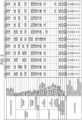
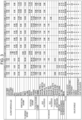
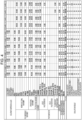
- FIGs. 2 to 5 The abbreviations and the components of the products shown in FIGs. 2 to 5 are as described below.
- the blank column indicates that no component was used.
- "-" represents that no evaluation was performed.
- a line type ink jet printer including an ink jet head was prepared, the ink jet head described above had 360 nozzles each having an ejection nozzle hole of 20 ⁇ m, and the ejection of the ink was adjusted to have one ejection amount of 7 ng at an ejection drive frequency of 15 kHz. From this head (360 nozzles), continuous ejection was performed by the ejection frequency described above. Whether or not the ink was ejected from all the nozzles was checked every five minutes, and the continuous ejection was performed up to a maximum total of 50 minutes. In addition, during the ejection, neither nozzle cleaning nor brushing was performed.
- the irradiation energy [mJ/cm 2 ] was obtained in a manner such that irradiation intensity [mW/cm 2 ] per surface area irradiated by a light source was measured and then multiplied by an irradiation duration time [s].
- the measurement of the irradiation intensity was performed using an ultraviolet intensity meter UM-10 and a light receiver UM-400 (each manufactured by KONICA MINOLTA SENSING, INC.).
- PET film PET50A PL Shin [trade name], manufactured by Lintec Corporation
- PET50A PL Shin [trade name], manufactured by Lintec Corporation PET50A PL Shin [trade name], manufactured by Lintec Corporation
- the film was irradiated with radioactive rays so as to be cured until no scratch was formed under the same conditions as those of the evaluation of the curing property, so that a cured film of each of Examples and Comparative Examples was formed on the PET film.
- This cured film was peeled away from the PET film and was then cut into a rectangular shape having a width of 1 cm and a length of 8 cm, so that a test piece was formed.
- a lattice having 10 ⁇ 10 squares was formed using a cutter in a manner such that a blade of the cutter was brought into contact with the coating film at an angle of 90°C, and the film was then cut to have cut lines with 1 mm intervals.
- a transparent adhesive tape having a length of approximately 75 mm (width: 25 mm) was adhered to the lattice and was rubbed with fingers so that the cured film was transparently observed through the tape.
- the tape was surely peeled away from the cured film for 0.5 to 1.0 second at an angle of approximately 60°, and the state of the lattice was observed by visual inspection.
- the evaluation criteria are as described below.
- a coating film having a thickness of 10 ⁇ m was formed from each of the ink compositions of some of Examples using a bar coater, the film was cured by irradiation with radioactive rays so that energy thereof was twice the curing energy at which no scratch was formed in the evaluation of the curing property. Subsequently, colorimetry was performed on the cured coating film using a colorimeter "Spectrolino" manufactured by GretagMacbeth, and evaluation was performed using the measured b*. As the b* is increased, the yellowing of the coating film is considered to proceed.
Landscapes
- Chemical & Material Sciences (AREA)
- Life Sciences & Earth Sciences (AREA)
- Engineering & Computer Science (AREA)
- Materials Engineering (AREA)
- Wood Science & Technology (AREA)
- Organic Chemistry (AREA)
- Inks, Pencil-Leads, Or Crayons (AREA)
- Ink Jet Recording Methods And Recording Media Thereof (AREA)
- Ink Jet (AREA)
Applications Claiming Priority (1)
| Application Number | Priority Date | Filing Date | Title |
|---|---|---|---|
| JP2023102932A JP2025002622A (ja) | 2023-06-23 | 2023-06-23 | 非水性インクジェットインク組成物及びインクジェット記録装置 |
Publications (1)
| Publication Number | Publication Date |
|---|---|
| EP4481007A1 true EP4481007A1 (de) | 2024-12-25 |
Family
ID=91664137
Family Applications (1)
| Application Number | Title | Priority Date | Filing Date |
|---|---|---|---|
| EP24183608.9A Pending EP4481007A1 (de) | 2023-06-23 | 2024-06-21 | Nichtwässrige tintenstrahltintenzusammensetzung und tintenstrahlaufzeichnungsvorrichtung |
Country Status (4)
| Country | Link |
|---|---|
| US (1) | US20240425713A1 (de) |
| EP (1) | EP4481007A1 (de) |
| JP (1) | JP2025002622A (de) |
| CN (1) | CN119177044A (de) |
Families Citing this family (1)
| Publication number | Priority date | Publication date | Assignee | Title |
|---|---|---|---|---|
| WO2026014236A1 (ja) * | 2024-07-08 | 2026-01-15 | artience株式会社 | 紫外線硬化型インクジェットインキ及び印刷物 |
Citations (11)
| Publication number | Priority date | Publication date | Assignee | Title |
|---|---|---|---|---|
| US20100313782A1 (en) * | 2007-10-24 | 2010-12-16 | Agfa Graphics Nv | Curable liquids and inks for toys and food packaging applications |
| JP2015199817A (ja) | 2014-04-08 | 2015-11-12 | セイコーエプソン株式会社 | 放射線硬化型インクジェット組成物、放射線硬化型インクジェット組成物収容体、及びインクジェット方法 |
| EP3149013B1 (de) * | 2014-05-30 | 2018-10-24 | IGM Resins Italia S.r.l. | Multifunktionelle acylphosphinoxid-fotoinitiatoren |
| JP2019151703A (ja) * | 2018-03-01 | 2019-09-12 | 株式会社リコー | 硬化型組成物、硬化型インク、組成物収容容器、2次元又は3次元の硬化物の製造方法、2次元又は3次元の像形成装置及び硬化物 |
| WO2020210316A1 (en) * | 2019-04-08 | 2020-10-15 | Avery Dennison Corporation | Low migration uv-led curable ink formulations |
| US20200326597A1 (en) * | 2017-10-17 | 2020-10-15 | Kateeva, Inc. | Ink compositions with high quantum dot concentrations for display devices |
| US20210301162A1 (en) * | 2020-03-25 | 2021-09-30 | Seiko Epson Corporation | Radiation Curable Ink Jet Composition And Ink Jet Method |
| WO2022184292A1 (en) * | 2021-03-01 | 2022-09-09 | Arkema France | Type-ii photoinitiators |
| JP7290014B1 (ja) * | 2021-11-29 | 2023-06-13 | 東洋インキScホールディングス株式会社 | 活性エネルギー線硬化型インクジェットインキ及び印刷物 |
| JP2023102932A (ja) | 2022-01-13 | 2023-07-26 | 株式会社リコー | 姿勢調整装置及び姿勢調整システム |
| EP4410907A1 (de) * | 2023-01-31 | 2024-08-07 | Agfa Nv | Dekoriertes naturleder |
Family Cites Families (4)
| Publication number | Priority date | Publication date | Assignee | Title |
|---|---|---|---|---|
| US7192992B2 (en) * | 2004-02-04 | 2007-03-20 | Ecology Coating, Inc. | Environmentally friendly, 100% solids, actinic radiation curable coating compositions for coating thermally sensitive surfaces and/or rusted surfaces and methods, processes and assemblages for coating thereof |
| BRPI1006180A2 (pt) * | 2009-01-14 | 2019-09-24 | Basf Se | mistura líquida homogênea, processa para a preparação da mistura líquida homogênea, composição fotopolimerizável, e, uso da mistura líquida homogênea |
| EP3271429B1 (de) * | 2015-03-20 | 2020-05-06 | Blue Cube IP LLC | Härtbare zusammensetzungen |
| JP7463795B2 (ja) * | 2020-03-25 | 2024-04-09 | セイコーエプソン株式会社 | 放射線硬化型インクジェット組成物及びインクジェット方法 |
-
2023
- 2023-06-23 JP JP2023102932A patent/JP2025002622A/ja active Pending
-
2024
- 2024-06-21 US US18/750,066 patent/US20240425713A1/en active Pending
- 2024-06-21 CN CN202410812075.3A patent/CN119177044A/zh active Pending
- 2024-06-21 EP EP24183608.9A patent/EP4481007A1/de active Pending
Patent Citations (11)
| Publication number | Priority date | Publication date | Assignee | Title |
|---|---|---|---|---|
| US20100313782A1 (en) * | 2007-10-24 | 2010-12-16 | Agfa Graphics Nv | Curable liquids and inks for toys and food packaging applications |
| JP2015199817A (ja) | 2014-04-08 | 2015-11-12 | セイコーエプソン株式会社 | 放射線硬化型インクジェット組成物、放射線硬化型インクジェット組成物収容体、及びインクジェット方法 |
| EP3149013B1 (de) * | 2014-05-30 | 2018-10-24 | IGM Resins Italia S.r.l. | Multifunktionelle acylphosphinoxid-fotoinitiatoren |
| US20200326597A1 (en) * | 2017-10-17 | 2020-10-15 | Kateeva, Inc. | Ink compositions with high quantum dot concentrations for display devices |
| JP2019151703A (ja) * | 2018-03-01 | 2019-09-12 | 株式会社リコー | 硬化型組成物、硬化型インク、組成物収容容器、2次元又は3次元の硬化物の製造方法、2次元又は3次元の像形成装置及び硬化物 |
| WO2020210316A1 (en) * | 2019-04-08 | 2020-10-15 | Avery Dennison Corporation | Low migration uv-led curable ink formulations |
| US20210301162A1 (en) * | 2020-03-25 | 2021-09-30 | Seiko Epson Corporation | Radiation Curable Ink Jet Composition And Ink Jet Method |
| WO2022184292A1 (en) * | 2021-03-01 | 2022-09-09 | Arkema France | Type-ii photoinitiators |
| JP7290014B1 (ja) * | 2021-11-29 | 2023-06-13 | 東洋インキScホールディングス株式会社 | 活性エネルギー線硬化型インクジェットインキ及び印刷物 |
| JP2023102932A (ja) | 2022-01-13 | 2023-07-26 | 株式会社リコー | 姿勢調整装置及び姿勢調整システム |
| EP4410907A1 (de) * | 2023-01-31 | 2024-08-07 | Agfa Nv | Dekoriertes naturleder |
Non-Patent Citations (1)
| Title |
|---|
| no. 1003567-83-6 |
Also Published As
| Publication number | Publication date |
|---|---|
| CN119177044A (zh) | 2024-12-24 |
| US20240425713A1 (en) | 2024-12-26 |
| JP2025002622A (ja) | 2025-01-09 |
Similar Documents
| Publication | Publication Date | Title |
|---|---|---|
| US11898042B2 (en) | Photocurable ink composition for ink jet recording and ink jet recording method | |
| US10322589B2 (en) | Photocurable ink composition, recording method, recording apparatus, photocurable ink jet recording ink composition, and ink jet recording method | |
| EP3885413B1 (de) | Strahlungshärtbare tintenstrahlzusammensetzung und tintenstrahlverfahren | |
| EP3470477B1 (de) | Strahlungshärtbare tintenstrahltintenzusammensetzung und tintenstrahlaufzeichnungsverfahren | |
| EP2644666B1 (de) | Tintenstrahlaufzeichnungsverfahren, UV-härtbare Tinte und Tintenstrahlaufzeichnungsvorrichtung | |
| JP6733697B2 (ja) | 光硬化型インクジェット記録用インク組成物、インクジェット記録方法 | |
| JP6079862B2 (ja) | 光硬化型インク組成物、記録方法及び記録装置 | |
| EP4481007A1 (de) | Nichtwässrige tintenstrahltintenzusammensetzung und tintenstrahlaufzeichnungsvorrichtung | |
| EP4105285B1 (de) | Lichthärtbare tintenzusammensetzung für tintenstrahlaufzeichnung und tintenstrahlaufzeichnungsverfahren | |
| JP5703981B2 (ja) | 光硬化型インクジェット記録用インク組成物、インクジェット記録方法 | |
| JP2025065201A (ja) | インクジェット記録方法及びインクジェット記録装置 | |
| EP4481008A1 (de) | Klare tintenstrahltintenzusammensetzung und aufzeichnungsverfahren | |
| US20260092188A1 (en) | Radiation Curable Ink Composition For Ink Jet And Ink Jet Recording Method | |
| JP2020050760A (ja) | 放射線硬化型インク | |
| JP2025087057A (ja) | インクの製造方法及びインクジェット記録方法 |
Legal Events
| Date | Code | Title | Description |
|---|---|---|---|
| PUAI | Public reference made under article 153(3) epc to a published international application that has entered the european phase |
Free format text: ORIGINAL CODE: 0009012 |
|
| STAA | Information on the status of an ep patent application or granted ep patent |
Free format text: STATUS: THE APPLICATION HAS BEEN PUBLISHED |
|
| AK | Designated contracting states |
Kind code of ref document: A1 Designated state(s): AL AT BE BG CH CY CZ DE DK EE ES FI FR GB GR HR HU IE IS IT LI LT LU LV MC ME MK MT NL NO PL PT RO RS SE SI SK SM TR |
|
| STAA | Information on the status of an ep patent application or granted ep patent |
Free format text: STATUS: REQUEST FOR EXAMINATION WAS MADE |
|
| 17P | Request for examination filed |
Effective date: 20250625 |