EP4478024A1 - Procédé, dispositif de mesure et utilisation d'une plaque chauffante, d'un compteur de particules et d'un capteur de qualité d'aérosol pour déterminer la qualité de particules dans un mélange gazeux - Google Patents
Procédé, dispositif de mesure et utilisation d'une plaque chauffante, d'un compteur de particules et d'un capteur de qualité d'aérosol pour déterminer la qualité de particules dans un mélange gazeux Download PDFInfo
- Publication number
- EP4478024A1 EP4478024A1 EP24181769.1A EP24181769A EP4478024A1 EP 4478024 A1 EP4478024 A1 EP 4478024A1 EP 24181769 A EP24181769 A EP 24181769A EP 4478024 A1 EP4478024 A1 EP 4478024A1
- Authority
- EP
- European Patent Office
- Prior art keywords
- measuring device
- air quality
- gas mixture
- aerosol particles
- quality determination
- Prior art date
- Legal status (The legal status is an assumption and is not a legal conclusion. Google has not performed a legal analysis and makes no representation as to the accuracy of the status listed.)
- Pending
Links
- 239000002245 particle Substances 0.000 title claims abstract description 111
- 239000000203 mixture Substances 0.000 title claims abstract description 94
- 238000010438 heat treatment Methods 0.000 title claims abstract description 87
- 239000000443 aerosol Substances 0.000 title claims abstract description 83
- 238000000034 method Methods 0.000 title claims abstract description 30
- OKTJSMMVPCPJKN-UHFFFAOYSA-N Carbon Chemical compound [C] OKTJSMMVPCPJKN-UHFFFAOYSA-N 0.000 claims description 13
- 239000006096 absorbing agent Substances 0.000 claims description 6
- 230000003197 catalytic effect Effects 0.000 claims description 6
- 239000000463 material Substances 0.000 claims description 6
- 239000004065 semiconductor Substances 0.000 claims description 5
- 238000003380 quartz crystal microbalance Methods 0.000 claims description 4
- 238000011144 upstream manufacturing Methods 0.000 claims description 3
- 239000007789 gas Substances 0.000 description 84
- 150000002894 organic compounds Chemical class 0.000 description 16
- 239000012855 volatile organic compound Substances 0.000 description 14
- 238000005259 measurement Methods 0.000 description 12
- 150000001875 compounds Chemical class 0.000 description 11
- 230000035945 sensitivity Effects 0.000 description 8
- 238000001514 detection method Methods 0.000 description 6
- MWUXSHHQAYIFBG-UHFFFAOYSA-N nitrogen oxide Inorganic materials O=[N] MWUXSHHQAYIFBG-UHFFFAOYSA-N 0.000 description 6
- 238000005299 abrasion Methods 0.000 description 4
- 238000002485 combustion reaction Methods 0.000 description 4
- 230000036541 health Effects 0.000 description 4
- 230000008569 process Effects 0.000 description 3
- 239000004071 soot Substances 0.000 description 3
- UFHFLCQGNIYNRP-UHFFFAOYSA-N Hydrogen Chemical compound [H][H] UFHFLCQGNIYNRP-UHFFFAOYSA-N 0.000 description 2
- 230000008901 benefit Effects 0.000 description 2
- 239000003344 environmental pollutant Substances 0.000 description 2
- 239000001257 hydrogen Substances 0.000 description 2
- 229910052739 hydrogen Inorganic materials 0.000 description 2
- 150000002484 inorganic compounds Chemical class 0.000 description 2
- 229910001872 inorganic gas Inorganic materials 0.000 description 2
- 229910010272 inorganic material Inorganic materials 0.000 description 2
- 239000000314 lubricant Substances 0.000 description 2
- 231100000719 pollutant Toxicity 0.000 description 2
- 230000008439 repair process Effects 0.000 description 2
- 150000003839 salts Chemical class 0.000 description 2
- 239000003566 sealing material Substances 0.000 description 2
- UGFAIRIUMAVXCW-UHFFFAOYSA-N Carbon monoxide Chemical compound [O+]#[C-] UGFAIRIUMAVXCW-UHFFFAOYSA-N 0.000 description 1
- CBENFWSGALASAD-UHFFFAOYSA-N Ozone Chemical compound [O-][O+]=O CBENFWSGALASAD-UHFFFAOYSA-N 0.000 description 1
- -1 PID sensor Chemical class 0.000 description 1
- 230000035508 accumulation Effects 0.000 description 1
- 238000009825 accumulation Methods 0.000 description 1
- 238000013473 artificial intelligence Methods 0.000 description 1
- 230000009286 beneficial effect Effects 0.000 description 1
- 238000009835 boiling Methods 0.000 description 1
- 229910052799 carbon Inorganic materials 0.000 description 1
- 229910002091 carbon monoxide Inorganic materials 0.000 description 1
- 239000000567 combustion gas Substances 0.000 description 1
- 239000012141 concentrate Substances 0.000 description 1
- 238000010276 construction Methods 0.000 description 1
- 239000013078 crystal Substances 0.000 description 1
- 239000000428 dust Substances 0.000 description 1
- 238000010348 incorporation Methods 0.000 description 1
- 238000007373 indentation Methods 0.000 description 1
- 238000010801 machine learning Methods 0.000 description 1
- 238000004519 manufacturing process Methods 0.000 description 1
- 239000011368 organic material Substances 0.000 description 1
- 230000000704 physical effect Effects 0.000 description 1
- 238000001303 quality assessment method Methods 0.000 description 1
- 239000010453 quartz Substances 0.000 description 1
- 230000000630 rising effect Effects 0.000 description 1
- VYPSYNLAJGMNEJ-UHFFFAOYSA-N silicon dioxide Inorganic materials O=[Si]=O VYPSYNLAJGMNEJ-UHFFFAOYSA-N 0.000 description 1
- 239000002023 wood Substances 0.000 description 1
Images

Classifications
-
- G—PHYSICS
- G01—MEASURING; TESTING
- G01N—INVESTIGATING OR ANALYSING MATERIALS BY DETERMINING THEIR CHEMICAL OR PHYSICAL PROPERTIES
- G01N15/00—Investigating characteristics of particles; Investigating permeability, pore-volume or surface-area of porous materials
- G01N15/06—Investigating concentration of particle suspensions
- G01N15/0606—Investigating concentration of particle suspensions by collecting particles on a support
-
- G—PHYSICS
- G01—MEASURING; TESTING
- G01N—INVESTIGATING OR ANALYSING MATERIALS BY DETERMINING THEIR CHEMICAL OR PHYSICAL PROPERTIES
- G01N1/00—Sampling; Preparing specimens for investigation
- G01N1/28—Preparing specimens for investigation including physical details of (bio-)chemical methods covered elsewhere, e.g. G01N33/50, C12Q
- G01N1/40—Concentrating samples
- G01N1/405—Concentrating samples by adsorption or absorption
-
- G—PHYSICS
- G01—MEASURING; TESTING
- G01N—INVESTIGATING OR ANALYSING MATERIALS BY DETERMINING THEIR CHEMICAL OR PHYSICAL PROPERTIES
- G01N33/00—Investigating or analysing materials by specific methods not covered by groups G01N1/00 - G01N31/00
- G01N33/0004—Gaseous mixtures, e.g. polluted air
- G01N33/0009—General constructional details of gas analysers, e.g. portable test equipment
- G01N33/0011—Sample conditioning
- G01N33/0019—Sample conditioning by preconcentration
-
- G—PHYSICS
- G01—MEASURING; TESTING
- G01N—INVESTIGATING OR ANALYSING MATERIALS BY DETERMINING THEIR CHEMICAL OR PHYSICAL PROPERTIES
- G01N5/00—Analysing materials by weighing, e.g. weighing small particles separated from a gas or liquid
- G01N5/04—Analysing materials by weighing, e.g. weighing small particles separated from a gas or liquid by removing a component, e.g. by evaporation, and weighing the remainder
-
- G—PHYSICS
- G01—MEASURING; TESTING
- G01N—INVESTIGATING OR ANALYSING MATERIALS BY DETERMINING THEIR CHEMICAL OR PHYSICAL PROPERTIES
- G01N1/00—Sampling; Preparing specimens for investigation
- G01N1/02—Devices for withdrawing samples
- G01N1/22—Devices for withdrawing samples in the gaseous state
- G01N1/2202—Devices for withdrawing samples in the gaseous state involving separation of sample components during sampling
- G01N2001/222—Other features
- G01N2001/2223—Other features aerosol sampling devices
-
- G—PHYSICS
- G01—MEASURING; TESTING
- G01N—INVESTIGATING OR ANALYSING MATERIALS BY DETERMINING THEIR CHEMICAL OR PHYSICAL PROPERTIES
- G01N15/00—Investigating characteristics of particles; Investigating permeability, pore-volume or surface-area of porous materials
- G01N2015/0042—Investigating dispersion of solids
- G01N2015/0046—Investigating dispersion of solids in gas, e.g. smoke
Definitions
- the invention relates to a method for determining air quality using aerosol particles in a gas mixture.
- gas mixtures e.g. room air
- concentration of gaseous organic compounds and the number of particles are determined in addition to the proportion of CO2 .
- Gaseous organic compounds can be volatile (medium to low vapor pressure) or semi-volatile (very low vapor pressure).
- Semi-volatile organic gaseous compounds are often bound to particles and can be inhaled via them.
- semi-volatile organic gaseous compounds are usually not recorded. Gaseous organic compounds are traditionally recorded and analyzed in a multi-stage and time-consuming process.
- Particles can be inorganic (carbon-free; e.g. salts, dust) or organic (carbon-based; e.g. soot, tire wear) in nature. Particles suspended in a gas mixture are often referred to as aerosol particles.
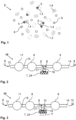
- a schematic representation of a gas mixture is shown in Fig. 1 and will be described in the further course of the description, following the list of figures.
- the inhalation of aerosol particles can be beneficial to health (salts) or harmful to health (soot, tire abrasion).
- the detection of aerosol particles is usually carried out by measuring the number and/or mass of particles per volume of a certain size fraction of a gas mixture to be examined. A distinction between inorganic and organic aerosol particles is usually not made in indoor air quality measurements.
- organic, gaseous compounds and aerosol particles can be determined separately and in different measuring devices.
- the invention further relates to a measuring device for determining air quality with the aid of aerosol particles in a gas mixture.
- the invention further relates to a use of a heating plate, a particle counter and an air quality determination sensor, in particular a VOC sensor, for air quality determination with the aid of aerosol particles in a gas mixture.
- the features of claim 1 are provided according to the invention.
- the invention proposes that aerosol particles are concentrated and heated by a heating element, and a particle counter determines a number of aerosol particles and at least one air quality determination sensor determines at least organic components of the aerosol particles before and after heating. This allows volatile and semi-volatile organic, gaseous compounds and the composition of aerosol particles in a gas mixture can be detected. This allows a quality determination of a gas mixture to be made, which generally improves the analysis of a gas mixture.
- Heating out is understood here as a controlled heating of the aerosol particles of a gas mixture by a heating element over a defined period of time. This advantageously allows the concentrated aerosol particles and/or the semi-volatile gaseous organic compounds adhering to them to evaporate or (partially) oxidize, whereupon their combustion products are analyzed by at least one air quality determination sensor.
- An air quality determination sensor is understood to be any sensor that can detect at least organic compounds (e.g. PID sensor, pellistor, GSS sensor, semiconductor gas sensor).
- a VOC sensor Volatile Organic Compounds
- a VOC sensor is particularly suitable for determining air quality by detecting organic components of the aerosol particles.
- the air quality determination sensor also detects inorganic components of the aerosol particles or inorganic gases before and/or after heating.
- broadband semiconductor gas sensors can detect inorganic gases such as hydrogen and/or carbon monoxide and/or ozone and/or nitrogen oxides. The complexity of the composition of a gas mixture can thus be determined even better, so that air quality determination can be particularly improved.
- the invention can provide that the at least one air quality determination sensor determines a signal pattern of the gas mixture before and/or after heating.
- certain signal patterns for example changes in the concentration of components in the gas mixture, can be detected.
- certain signal patterns can be used to indicate a certain gas mixture, for example a source of pollutants such as diesel exhaust or wood combustion gases.
- An air quality determination is then carried out in particular from the signal pattern. In this way, air determinations can advantageously be carried out in locations that do not allow optimal and stable air quality determinations.
- the determination is particularly advantageous if at least two air quality determination sensors as described herein, preferably a sensor array, are used to determine the air quality.
- This can increase the sensitivity and/or selectivity for certain organic and/or inorganic compounds both when detecting organic, gaseous compounds in particular (in particular semi-volatile organic, gaseous compounds) and when detecting the composition of the aerosol particles and/or the gas components of the gas mixture.
- An air quality determination based on the signal pattern is even more sensitive or selective and thus improved if the air quality determination is carried out using machine learning and/or artificial intelligence, as may be intended. This allows the determined signal patterns to be compared and quickly recognized and used promptly to determine the air quality.
- Air quality determination sensors can be used for quality determination, whereby the sensitivity and/or selectivity to certain organic compounds can be increased both in the detection of organic, gaseous compounds (especially semi-volatile organic, gaseous compounds) and in the detection of the composition of the aerosol particles.
- the aerosol particles can be concentrated in such a way that the sensitivity of the quality determination of the gas mixture is increased, whereby even less abundant organic compounds can be detected.
- a further advantage is that the proportion of inorganic and organic components of the aerosol particles can be determined by comparing the measurement signals of the at least one air quality determination sensor before (determination of a base signal) and after heating.
- a method according to the invention can be carried out on site, which saves time and money, since the measurements do not have to take place in a remote laboratory.
- the aerosol particles are preferably concentrated on the heating element before heating. This can increase the efficiency of heating the aerosol particles, which can advantageously result in more combustion products being produced per time interval. This can further increase the sensitivity for detecting certain organic compounds.
- the heating takes place abruptly or gradually.
- Different boiling points of different organic compounds can thus be used to separate different compounds, which can advantageously increase the sensitivity and/or selectivity in air quality determination using aerosol particles.
- the quality determination of a gas mixture can be further improved by an even increased sensitivity and/or selectivity.
- the gas mixture in order to determine organic components before heating, is fed through a secondary inlet to the at least one air quality determination sensor and that, in order to determine organic components after heating, the gas mixture is fed through an inlet to the at least one air quality determination sensor.
- the gas mixture can be fed behind the heating element. This means that undesirable accumulations of aerosol particles on the heating plate during the measurement of the base signal can be reduced or avoided. This makes the measurements after heating even more precise, which can increase the quality determination of a gas mixture.
- valves can be used to prevent unwanted supply of the gas mixture when detecting the base signal (closed valve on the inlet) or when detecting organic compounds after heating (closed valve on the secondary inlet).
- the inflowing gas mixture can be filtered through a filter construction, in particular through an activated carbon filter. a catalytic heating element or a combination of the elements just mentioned. This determines an even more precise base signal, which can further improve the quality determination of a gas mixture.
- a mass loss of the aerosol particles is determined during and/or after the heating.
- the mass loss of the aerosol particles can thus advantageously be used as an additional parameter for determining the quality of a gas mixture.
- the detection of a mass or a loss of mass can provide information about the purity of the measuring device used, which is particularly important for the accuracy of subsequent measurements.
- a loss of mass of the aerosol particles at the heating element is determined.
- the heating element can be designed directly as a microbalance. This is particularly advantageous if the aerosol particles are concentrated at the heating element.
- a partial quantity or the total quantity of a gas mixture is supplied to the at least one air quality determination sensor.
- a defined quantity of a gas mixture can thus be supplied to the air quality determination sensor. For example, half of the total quantity can be supplied to the air quality determination sensor for determining the base signal and the second half of the total quantity for determining a signal after heating.
- the optimal amount of a gas mixture is supplied to the air quality determination sensor.
- the features of the independent claim directed to a measuring device are provided according to the invention.
- the invention proposes that the measuring device has a heating element, a particle counter and at least one air quality determination sensor, wherein the heating element is arranged upstream of the at least one air quality determination sensor.
- the proportion of gaseous organic compounds, a number of aerosol particles in a gas mixture and a proportion of aerosol particles of organic origin can thus advantageously be recorded simultaneously.
- a measuring device according to the invention can in particular be designed to carry out a method as described above or claimed below.
- a further advantage of a measuring device according to the invention is that organic, gaseous compounds and aerosol particles can be measured and analyzed in one measuring device, whereby the quality of a gas mixture can be determined more quickly and cost-effectively.
- a measuring device can be designed in such a way that a measurement can be taken on site and not in a laboratory. This is particularly advantageous if the indoor air quality of a workshop, a kitchen or another place where organic aerosol particles are generated is to be determined. This makes it possible to react more quickly to excessive aerosol particle or pollutant levels.
- a measuring device according to the invention can be designed inexpensively since it only requires a heating element, a particle counter and at least one air quality determination sensor. A cost-effective measuring device can thus be sold to private customers or small businesses (car repair shop operators, restaurant owners).
- the heating element is located upstream of the air quality determination sensor, as the combustion products can thus be easily transported with the gas flow from the heating element to the air quality determination sensor. This means that aerosol particles are not fed to the air quality determination sensor in an uncontrolled manner before the heating process, which could distort the quality determination of a gas mixture.
- the particle counter is arranged downstream of the heating element and/or the at least one air quality determination sensor. This allows the carryover of organic compounds to the particle counter to be minimized or even prevented, which is advantageous for the longevity of the particle counter or the measuring device.
- the heating element can be equipped with an absorber material.
- the absorber material can lead to a more efficient concentration of the aerosol particles, whereby more organic material can be burned, which can further improve the quality determination of a gas mixture.
- the concentration should additionally or alternatively be carried out at another point of the measuring device, this point can also have an absorber material.
- the heating element can be designed as a microbalance. This makes it possible to advantageously record the loss of mass of the aerosol particles when determining the organic components of the aerosol particles.
- the heating element can be designed as a quartz crystal microbalance. Quartz crystal microbalances can be particularly stable at high temperatures, which means that the measuring device can be designed to last longer. In addition to mass determination, quartz crystal microbalances can also be used as sensors for other parameters.
- the measuring device has at least two air quality determination sensors.
- the sensitivity (when using air quality determination sensors of the same type) and/or the selectivity (when using air quality determination sensors of different types) of organic compounds to be measured can be increased.
- the or a" in particular the second of the at least two air quality determination sensors in particular a VOC sensor and/or a photoionization detector and/or a pellistor and/or a semiconductor gas sensor.
- air quality determination sensors are commercially available and inexpensive for incorporation into a measuring device. Thus, manufacturing and repair costs of a measuring device can be kept low.
- air quality determination sensors are designed to be thermostable so that they can be used without risk for the analysis of gas mixtures under heating.
- the measuring device has at least one pump for supplying the gas mixture to the particle counter.
- the gas mixture can thus be supplied to the particle counter independently by the pump.
- a pump can be used to establish and/or maintain a defined gas flow.
- the pump can supply a defined volume of a gas mixture to the measuring device.
- the pump is downstream of the air quality determination sensor.
- the influence of the pump on the VOC sensor can be reduced or even avoided.
- the entry of lubricants and/or abrasion of sealing material from the pump into the air quality determination sensor can be reduced or even avoided, so that measurements from the air quality determination sensor can be particularly accurate.
- the measuring device has an inlet and a secondary inlet for the gas mixture or a gas mixture.
- the gas mixture can thus be made available to the measuring device via the secondary inlet to determine the base signal.
- the main line (including the inlet) can be blocked in particular by a valve, which increases the measuring accuracy of the measuring device for determining the quality of a gas mixture.
- the secondary inlet preferably has a filter, the filter being particularly preferably designed as a catalytic heating element and/or as an activated carbon filter.
- a gas mixture can be cleaned by means of such filters or other filters known to those skilled in the art, whereby an even more precise determination of the base signal and thus an even better quality determination can be achieved.
- the measuring device can have at least two main lines.
- Each main line has at least one particle counter and one air quality determination sensor.
- only one main line has a heating element for detecting a signal after heating.
- the features of the independent claim directed to a use are provided according to the invention.
- the invention proposes that an aerosol particle number and a proportion of organic components of aerosol particles of a gas mixture are determined preferably simultaneously. This allows the quality of a gas mixture to be determined quickly and inexpensively, which is advantageous.
- Aerosol particles 1 can be inorganic 3 or organic 4, whereby organic aerosol particles 1, 4 (such as soot or tire abrasion) are particularly harmful to health.
- Semi-volatile organic compounds 5 can adhere to aerosol particles 1, 3, 4 and be inhaled via them, also affecting health.
- Highly volatile organic compounds 6 usually float in the gas mixture 2, detached from aerosol particles 1, 3, 4.
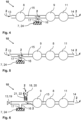
- Fig. 2 and Fig. 3 show an embodiment of a measuring device 10 according to the invention ( Fig. 2 ) and during the heating ( Fig. 3 ) of a gas mixture 2.
- the process shown in these figures can proceed as follows.
- a defined gas mixture 2 for example a defined volume of the gas mixture 2, is led by means of a pump 11 from an inlet 13 through a main line 15 to a particle counter 8, which registers the number of aerosol particles 1, 3, 4 of the gas mixture 2.
- the measuring device 10 has a recess 16 leading to the heating element 7.
- the recess 16 can be designed such that a gas mixture 2, in particular a partial amount of a gas mixture 2, can be supplied to the heating element 7, 24 so that aerosol particles 1, 3, 4 can be concentrated.
- a partial amount or the entire amount of the defined gas mixture 2 is supplied to the heating element 7, 24 so that aerosol particles 1, 3, 4 can adhere to the heating element 7, 24.
- the heating element 7, 24 can be heated as in Fig. 2 and Fig. 3 shown, have an absorber material 17 which further increases the adhesion of the aerosol particles 1, 3, 4.
- a part of the main line 15 can be roughened or designed in such a way that the aerosol particles 1, 3, 4 adhere to it.
- this part of the main line 15 can be designed partially or completely as a heating element 7, 24.
- the microbalance 24 shown here is a quartz crystal balance, but can also be any other microbalance 24 known to the person skilled in the art.
- the gas mixture 2 is guided past at least one air quality determination sensor 9 during or after heating 12 (dashed arrow), where organic components are detected.
- the air quality determination sensors 9 can be in particular a photoionization detector and/or a pellistor and/or a preferably oxidic semiconductor gas sensor can be used.
- At least one VOC sensor is used as air quality determination sensor 9.
- the one in Fig. 2 The method step shown takes place without heating, which is why the at least one air quality determination sensor 9 mainly detects the volatile organic compounds 6 and possibly inorganic compounds. Before heating, this method step determines a base signal which includes, among other things, a number of aerosol particles 1, 3, 4 and a concentration of volatile organic compounds 6.
- the gas mixture 2 is discharged or passed on from the measuring device 10 via an outlet 14.
- the heating element 7 After a certain registration interval (base signal), the heating element 7 is heated ( Fig. 3 ). Over a certain period of time and at rising or increased temperature T, organic compounds of the aerosol particles 1, 4 or the semi-volatile organic compounds 5 of the gas mixture 2 evaporate. Their combustion products are then detected by the at least one air quality determination sensor 9.
- the measuring device 10 can be set up so that the increase in temperature T occurs gradually or abruptly. Due to different physical properties of various organic components, a higher selectivity or sensitivity of the method or of a measuring device 10 can thus be achieved. Signal patterns of the gas mixture can and will also be determined during the method.
- the proportion of organic, gaseous compounds 5 in the aerosol particles 1, 3, 4 can be determined.
- the determination of the organic components of the aerosol particles 1, 3, 4 is determined even more precisely.
- FIG. 4 to 8 are alternative measuring devices 10 to the one in the Figures 2 and 3
- the measuring device 10 shown in FIG. 1 is disclosed in the drawing.
- These alternative measuring devices 10 can also carry out the method just described or the methods previously described or subsequently claimed.
- Components and functional units that are functionally and/or structurally similar or identical to the previous embodiment are designated with the same reference numerals and are not described separately again.
- the explanations for the Figures 2 and 3 are therefore among the Figures 4 to 8 accordingly.
- the embodiment according to Fig. 4 differs from the previous embodiment (the Figures 2 and 3 ) in that the pump 11 is located downstream of the air quality determination sensor 9.
- the heating element 7, 24 is positioned between the particle counter 8 and the air quality determination sensor 9.
- the pump 11 downstream of the air quality determination sensor 9 prevents lubricants and abrasion of sealing material of the pump 11 from entering the air quality determination sensor 9, so that the measurements of the air quality determination sensor 9 are particularly accurate.
- the entrainment of aerosol particles 1, 3, 4 to the particle sensor 8 can be reduced or avoided if the particle counter 8 is located downstream of the heating element 7, 24 ( Fig. 5 ).
- the measuring devices 10 shown offer alternative possibilities for determining a base signal compared to the previously described measuring devices 10.
- the gas mixture 2 is fed to the air quality determination sensor 9 through a secondary inlet 18.
- the secondary inlet 18 is positioned between the heating element 7, 24 and the air quality determination sensor 9.
- the inlet 13 is closed by a main valve 19.
- a valve 20 of the secondary inlet 18 serves to regulate the supply of the gas mixture 2.
- the gas mixture 2 can be cleaned by a filter 21 before heating.
- This filter 21 can have a catalytic heating element 22 ( Fig. 6 ), an activated carbon filter 23 ( Fig. 7 ), a combination of both previously described filters 21, or another filter 21 known to the person skilled in the art.
- Such a filter 21 can also be integrated in measuring devices 10 without a secondary inlet 18, as in the Figures 2 to 5 and Fig. 8 are shown.
- a base signal can also be determined by a measuring device 10 with at least two preferably separated main lines 15, each of which has at least one particle counter 8 and one air quality determination sensor 9 ( Fig. 8 ).
- a first main line 15 is used to determine of the base signal, while a second main line 15 records measurement signals of organic components of the gas mixture 2 after heating has taken place.
- the first main line 15 shown here has no heating element 7, 24, whereby the measuring device 10 can be designed more cost-effectively.
- the signals of the at least one air quality determination sensor 9 positioned in the first main line 15 are compared with that of the at least one air quality determination sensor 9 of the second main line 15.
- a base signal and a signal after heating a gas mixture 2 can be measured in parallel, whereby the quality of a gas mixture 2 can be determined even faster.
- inorganic components of the gas mixture 2 are also measured by the measuring device 10, such as nitrogen oxides and/or hydrogen.
- the invention therefore generally proposes a method and a measuring device 10 for determining the quality of aerosol particles 1 in a gas mixture 2, wherein aerosol particles 1 are concentrated and heated by a heating element 7, and wherein a particle counter 8 determines a number of aerosol particles 1 and at least one air quality determination sensor 9 determines at least organic components of the aerosol particles 1 and/or signal patterns of the gas mixture 2 before and after heating.
- This method and the measuring device are particularly suitable for determining the quality of room air, but are not limited to this application.
Landscapes
- Chemical & Material Sciences (AREA)
- Health & Medical Sciences (AREA)
- Life Sciences & Earth Sciences (AREA)
- Immunology (AREA)
- Analytical Chemistry (AREA)
- Biochemistry (AREA)
- General Health & Medical Sciences (AREA)
- General Physics & Mathematics (AREA)
- Physics & Mathematics (AREA)
- Pathology (AREA)
- Engineering & Computer Science (AREA)
- Combustion & Propulsion (AREA)
- Food Science & Technology (AREA)
- Medicinal Chemistry (AREA)
- Dispersion Chemistry (AREA)
- Sampling And Sample Adjustment (AREA)
Applications Claiming Priority (1)
| Application Number | Priority Date | Filing Date | Title |
|---|---|---|---|
| DE102023115387.0A DE102023115387A1 (de) | 2023-06-13 | 2023-06-13 | Verfahren, Messvorrichtung und Verwendung einer Heizplatte, eines Partikelzählers und eines Luftqualitätsbestimmungs-Sensors zur Luftqualitätsbestimmung mit Hilfe von Aerosolpartikeln in einem Gasgemisch |
Publications (1)
| Publication Number | Publication Date |
|---|---|
| EP4478024A1 true EP4478024A1 (fr) | 2024-12-18 |
Family
ID=91530277
Family Applications (1)
| Application Number | Title | Priority Date | Filing Date |
|---|---|---|---|
| EP24181769.1A Pending EP4478024A1 (fr) | 2023-06-13 | 2024-06-12 | Procédé, dispositif de mesure et utilisation d'une plaque chauffante, d'un compteur de particules et d'un capteur de qualité d'aérosol pour déterminer la qualité de particules dans un mélange gazeux |
Country Status (2)
| Country | Link |
|---|---|
| EP (1) | EP4478024A1 (fr) |
| DE (1) | DE102023115387A1 (fr) |
Citations (1)
| Publication number | Priority date | Publication date | Assignee | Title |
|---|---|---|---|---|
| US20170097255A1 (en) * | 2014-06-10 | 2017-04-06 | Koninklijke Philips N.V. | Aerosol mass sensor and sensing method |
Family Cites Families (5)
| Publication number | Priority date | Publication date | Assignee | Title |
|---|---|---|---|---|
| DE102008001906A1 (de) * | 2008-05-21 | 2009-11-26 | Robert Bosch Gmbh | Verfahren zum Erkennen der Kraftstoffsorte einer Brennkraftmaschine |
| DE102012017185B3 (de) * | 2012-08-30 | 2013-12-24 | Testo Ag | Sensoranordnung |
| DE102015112977B4 (de) * | 2015-08-06 | 2022-05-05 | Ivat Gmbh | Verfahren und Vorrichtung zum Behandeln der Raumluft insbesondere durch geschichtete Filterung |
| US11112395B2 (en) * | 2017-02-24 | 2021-09-07 | Particles Plus, Inc. | Networked air quality monitoring system |
| EP4317938A1 (fr) * | 2022-08-03 | 2024-02-07 | Leibniz-Institut für Troposphärenforschung e.V. | Système mobile et procédé de caractérisation à résolution élevée temporelle et spatiale des polluants atmosphériques particulaires |
-
2023
- 2023-06-13 DE DE102023115387.0A patent/DE102023115387A1/de active Pending
-
2024
- 2024-06-12 EP EP24181769.1A patent/EP4478024A1/fr active Pending
Patent Citations (1)
| Publication number | Priority date | Publication date | Assignee | Title |
|---|---|---|---|---|
| US20170097255A1 (en) * | 2014-06-10 | 2017-04-06 | Koninklijke Philips N.V. | Aerosol mass sensor and sensing method |
Also Published As
| Publication number | Publication date |
|---|---|
| DE102023115387A1 (de) | 2024-12-19 |
Similar Documents
| Publication | Publication Date | Title |
|---|---|---|
| DE69128794T2 (de) | Teilchenüberwachungseinrichtung in dieselabgasen | |
| DE69223160T2 (de) | Russpartikelkontrollvorrichtung | |
| DE102009004278A1 (de) | Messgerät für geringe Kohlenwasserstoffkonzentrationen | |
| EP1502016B1 (fr) | Dispositif et procede permettant de determiner un defaut de fonctionnement d'un filtre | |
| EP2730916B1 (fr) | Procédé et dispositif d'étalonnage d'un capteur de gaz d'échappement | |
| DE2446404C3 (de) | Vorrichtung zur Probenahme in strömenden Abgasen | |
| EP0495804B1 (fr) | Procede et montage de mesure pour la determination de la teneur en particules de suie dans des gaz d'echappement | |
| DE19859788C1 (de) | Vorrichtung und Verfahren zur Anzeige der Erschöpfung eines Gasfilters | |
| EP1100611B1 (fr) | Procede de purification d'un courant gazeux | |
| EP0272507B1 (fr) | Procédé et dispositif de détermination d'au moins un composant d'un gaz à analyser | |
| EP4478024A1 (fr) | Procédé, dispositif de mesure et utilisation d'une plaque chauffante, d'un compteur de particules et d'un capteur de qualité d'aérosol pour déterminer la qualité de particules dans un mélange gazeux | |
| EP3775799B1 (fr) | Procédé d'étalonnage d'un débitmètre massique dans une installation d'analyse de gaz d'échappement par échantillonnage à volume constant (cvs) | |
| DE2261456B2 (de) | Pyrolytische analyse von fluessigkeiten | |
| DE102007012701B4 (de) | Verfahren zur Funktionsüberwachung eines Oxidationskatalysators | |
| DE202004000483U1 (de) | Anordnung zur Bestimmung von Wasserinhaltsstoffen | |
| DE102010020110A1 (de) | Gerät zum Erfassen und Verdünnen für geringe Kohlenwasserstoffkonzentrationen in Druckluft | |
| WO1996001998A1 (fr) | Procede et systeme permettant de traiter des gaz brules, notamment des gaz d'echappement de moteurs a combustion interne | |
| DE102006058051B4 (de) | Verfahren zur Überwachung der Konzentration eines Wasserinhaltsstoffes in einem wässrigen Medium | |
| DE102018220729A1 (de) | Verfahren und Vorrichtung zur Bestimmung einer Partikelbeladung eines Partikelfilters | |
| DE102019102954A1 (de) | Vorrichtung und verfahren zur extraktiven kontinuierlichen messung von partikeln | |
| WO1996012953A1 (fr) | Procede et systeme de traitement de gaz d'echappement, provenant notamment de moteurs a combustion interne, pour analyse | |
| WO2011003720A1 (fr) | Appareil de mesure destiné à la mesure des gaz d'échappement | |
| WO2000047990A2 (fr) | Analyseur de gaz et son utilisation pour etablir des diagnostics medicaux | |
| AT403212B (de) | Verfahren zur entnahme eines teilstromes aus einem abgasstrom und einrichtung zur durchführung des verfahrens | |
| AT525893A4 (de) | Vorrichtung zur kontinuierlichen Herkunftsbestimmung eines aus einem Kraftstoff gewonnenen, durchmischten Prüfgases |
Legal Events
| Date | Code | Title | Description |
|---|---|---|---|
| PUAI | Public reference made under article 153(3) epc to a published international application that has entered the european phase |
Free format text: ORIGINAL CODE: 0009012 |
|
| STAA | Information on the status of an ep patent application or granted ep patent |
Free format text: STATUS: THE APPLICATION HAS BEEN PUBLISHED |
|
| AK | Designated contracting states |
Kind code of ref document: A1 Designated state(s): AL AT BE BG CH CY CZ DE DK EE ES FI FR GB GR HR HU IE IS IT LI LT LU LV MC ME MK MT NL NO PL PT RO RS SE SI SK SM TR |
|
| STAA | Information on the status of an ep patent application or granted ep patent |
Free format text: STATUS: REQUEST FOR EXAMINATION WAS MADE |
|
| 17P | Request for examination filed |
Effective date: 20250124 |