EP4477451A1 - Regenerationssteuerungsverfahren und grätschsitzfahrzeug - Google Patents
Regenerationssteuerungsverfahren und grätschsitzfahrzeug Download PDFInfo
- Publication number
- EP4477451A1 EP4477451A1 EP24180687.6A EP24180687A EP4477451A1 EP 4477451 A1 EP4477451 A1 EP 4477451A1 EP 24180687 A EP24180687 A EP 24180687A EP 4477451 A1 EP4477451 A1 EP 4477451A1
- Authority
- EP
- European Patent Office
- Prior art keywords
- regenerative torque
- regeneration control
- operation amount
- torque
- accelerator operation
- Prior art date
- Legal status (The legal status is an assumption and is not a legal conclusion. Google has not performed a legal analysis and makes no representation as to the accuracy of the status listed.)
- Pending
Links
Images


Classifications
-
- B—PERFORMING OPERATIONS; TRANSPORTING
- B62—LAND VEHICLES FOR TRAVELLING OTHERWISE THAN ON RAILS
- B62M—RIDER PROPULSION OF WHEELED VEHICLES OR SLEDGES; POWERED PROPULSION OF SLEDGES OR SINGLE-TRACK CYCLES; TRANSMISSIONS SPECIALLY ADAPTED FOR SUCH VEHICLES
- B62M6/00—Rider propulsion of wheeled vehicles with additional source of power, e.g. combustion engine or electric motor
- B62M6/40—Rider propelled cycles with auxiliary electric motor
- B62M6/45—Control or actuating devices therefor
-
- B—PERFORMING OPERATIONS; TRANSPORTING
- B60—VEHICLES IN GENERAL
- B60L—PROPULSION OF ELECTRICALLY-PROPELLED VEHICLES; SUPPLYING ELECTRIC POWER FOR AUXILIARY EQUIPMENT OF ELECTRICALLY-PROPELLED VEHICLES; ELECTRODYNAMIC BRAKE SYSTEMS FOR VEHICLES IN GENERAL; MAGNETIC SUSPENSION OR LEVITATION FOR VEHICLES; MONITORING OPERATING VARIABLES OF ELECTRICALLY-PROPELLED VEHICLES; ELECTRIC SAFETY DEVICES FOR ELECTRICALLY-PROPELLED VEHICLES
- B60L15/00—Methods, circuits, or devices for controlling the traction-motor speed of electrically-propelled vehicles
- B60L15/20—Methods, circuits, or devices for controlling the traction-motor speed of electrically-propelled vehicles for control of the vehicle or its driving motor to achieve a desired performance, e.g. speed, torque, programmed variation of speed
- B60L15/2009—Methods, circuits, or devices for controlling the traction-motor speed of electrically-propelled vehicles for control of the vehicle or its driving motor to achieve a desired performance, e.g. speed, torque, programmed variation of speed for braking
-
- B—PERFORMING OPERATIONS; TRANSPORTING
- B60—VEHICLES IN GENERAL
- B60L—PROPULSION OF ELECTRICALLY-PROPELLED VEHICLES; SUPPLYING ELECTRIC POWER FOR AUXILIARY EQUIPMENT OF ELECTRICALLY-PROPELLED VEHICLES; ELECTRODYNAMIC BRAKE SYSTEMS FOR VEHICLES IN GENERAL; MAGNETIC SUSPENSION OR LEVITATION FOR VEHICLES; MONITORING OPERATING VARIABLES OF ELECTRICALLY-PROPELLED VEHICLES; ELECTRIC SAFETY DEVICES FOR ELECTRICALLY-PROPELLED VEHICLES
- B60L7/00—Electrodynamic brake systems for vehicles in general
- B60L7/10—Dynamic electric regenerative braking
-
- B—PERFORMING OPERATIONS; TRANSPORTING
- B60—VEHICLES IN GENERAL
- B60L—PROPULSION OF ELECTRICALLY-PROPELLED VEHICLES; SUPPLYING ELECTRIC POWER FOR AUXILIARY EQUIPMENT OF ELECTRICALLY-PROPELLED VEHICLES; ELECTRODYNAMIC BRAKE SYSTEMS FOR VEHICLES IN GENERAL; MAGNETIC SUSPENSION OR LEVITATION FOR VEHICLES; MONITORING OPERATING VARIABLES OF ELECTRICALLY-PROPELLED VEHICLES; ELECTRIC SAFETY DEVICES FOR ELECTRICALLY-PROPELLED VEHICLES
- B60L7/00—Electrodynamic brake systems for vehicles in general
- B60L7/10—Dynamic electric regenerative braking
- B60L7/14—Dynamic electric regenerative braking for vehicles propelled by AC motors
-
- B—PERFORMING OPERATIONS; TRANSPORTING
- B60—VEHICLES IN GENERAL
- B60L—PROPULSION OF ELECTRICALLY-PROPELLED VEHICLES; SUPPLYING ELECTRIC POWER FOR AUXILIARY EQUIPMENT OF ELECTRICALLY-PROPELLED VEHICLES; ELECTRODYNAMIC BRAKE SYSTEMS FOR VEHICLES IN GENERAL; MAGNETIC SUSPENSION OR LEVITATION FOR VEHICLES; MONITORING OPERATING VARIABLES OF ELECTRICALLY-PROPELLED VEHICLES; ELECTRIC SAFETY DEVICES FOR ELECTRICALLY-PROPELLED VEHICLES
- B60L7/00—Electrodynamic brake systems for vehicles in general
- B60L7/10—Dynamic electric regenerative braking
- B60L7/18—Controlling the braking effect
-
- B—PERFORMING OPERATIONS; TRANSPORTING
- B60—VEHICLES IN GENERAL
- B60W—CONJOINT CONTROL OF VEHICLE SUB-UNITS OF DIFFERENT TYPE OR DIFFERENT FUNCTION; CONTROL SYSTEMS SPECIALLY ADAPTED FOR HYBRID VEHICLES; ROAD VEHICLE DRIVE CONTROL SYSTEMS FOR PURPOSES NOT RELATED TO THE CONTROL OF A PARTICULAR SUB-UNIT
- B60W30/00—Purposes of road vehicle drive control systems not related to the control of a particular sub-unit, e.g. of systems using conjoint control of vehicle sub-units
- B60W30/18—Propelling the vehicle
- B60W30/18009—Propelling the vehicle related to particular drive situations
- B60W30/18109—Braking
- B60W30/18127—Regenerative braking
-
- B—PERFORMING OPERATIONS; TRANSPORTING
- B62—LAND VEHICLES FOR TRAVELLING OTHERWISE THAN ON RAILS
- B62K—CYCLES; CYCLE FRAMES; CYCLE STEERING DEVICES; RIDER-OPERATED TERMINAL CONTROLS SPECIALLY ADAPTED FOR CYCLES; CYCLE AXLE SUSPENSIONS; CYCLE SIDECARS, FORECARS, OR THE LIKE
- B62K11/00—Motorcycles, engine-assisted cycles or motor scooters with one or two wheels
-
- B—PERFORMING OPERATIONS; TRANSPORTING
- B60—VEHICLES IN GENERAL
- B60L—PROPULSION OF ELECTRICALLY-PROPELLED VEHICLES; SUPPLYING ELECTRIC POWER FOR AUXILIARY EQUIPMENT OF ELECTRICALLY-PROPELLED VEHICLES; ELECTRODYNAMIC BRAKE SYSTEMS FOR VEHICLES IN GENERAL; MAGNETIC SUSPENSION OR LEVITATION FOR VEHICLES; MONITORING OPERATING VARIABLES OF ELECTRICALLY-PROPELLED VEHICLES; ELECTRIC SAFETY DEVICES FOR ELECTRICALLY-PROPELLED VEHICLES
- B60L2200/00—Type of vehicles
- B60L2200/12—Bikes
-
- B—PERFORMING OPERATIONS; TRANSPORTING
- B60—VEHICLES IN GENERAL
- B60L—PROPULSION OF ELECTRICALLY-PROPELLED VEHICLES; SUPPLYING ELECTRIC POWER FOR AUXILIARY EQUIPMENT OF ELECTRICALLY-PROPELLED VEHICLES; ELECTRODYNAMIC BRAKE SYSTEMS FOR VEHICLES IN GENERAL; MAGNETIC SUSPENSION OR LEVITATION FOR VEHICLES; MONITORING OPERATING VARIABLES OF ELECTRICALLY-PROPELLED VEHICLES; ELECTRIC SAFETY DEVICES FOR ELECTRICALLY-PROPELLED VEHICLES
- B60L2200/00—Type of vehicles
- B60L2200/24—Personal mobility vehicles
-
- B—PERFORMING OPERATIONS; TRANSPORTING
- B60—VEHICLES IN GENERAL
- B60L—PROPULSION OF ELECTRICALLY-PROPELLED VEHICLES; SUPPLYING ELECTRIC POWER FOR AUXILIARY EQUIPMENT OF ELECTRICALLY-PROPELLED VEHICLES; ELECTRODYNAMIC BRAKE SYSTEMS FOR VEHICLES IN GENERAL; MAGNETIC SUSPENSION OR LEVITATION FOR VEHICLES; MONITORING OPERATING VARIABLES OF ELECTRICALLY-PROPELLED VEHICLES; ELECTRIC SAFETY DEVICES FOR ELECTRICALLY-PROPELLED VEHICLES
- B60L2240/00—Control parameters of input or output; Target parameters
-
- B—PERFORMING OPERATIONS; TRANSPORTING
- B60—VEHICLES IN GENERAL
- B60L—PROPULSION OF ELECTRICALLY-PROPELLED VEHICLES; SUPPLYING ELECTRIC POWER FOR AUXILIARY EQUIPMENT OF ELECTRICALLY-PROPELLED VEHICLES; ELECTRODYNAMIC BRAKE SYSTEMS FOR VEHICLES IN GENERAL; MAGNETIC SUSPENSION OR LEVITATION FOR VEHICLES; MONITORING OPERATING VARIABLES OF ELECTRICALLY-PROPELLED VEHICLES; ELECTRIC SAFETY DEVICES FOR ELECTRICALLY-PROPELLED VEHICLES
- B60L2240/00—Control parameters of input or output; Target parameters
- B60L2240/10—Vehicle control parameters
- B60L2240/12—Speed
-
- B—PERFORMING OPERATIONS; TRANSPORTING
- B60—VEHICLES IN GENERAL
- B60L—PROPULSION OF ELECTRICALLY-PROPELLED VEHICLES; SUPPLYING ELECTRIC POWER FOR AUXILIARY EQUIPMENT OF ELECTRICALLY-PROPELLED VEHICLES; ELECTRODYNAMIC BRAKE SYSTEMS FOR VEHICLES IN GENERAL; MAGNETIC SUSPENSION OR LEVITATION FOR VEHICLES; MONITORING OPERATING VARIABLES OF ELECTRICALLY-PROPELLED VEHICLES; ELECTRIC SAFETY DEVICES FOR ELECTRICALLY-PROPELLED VEHICLES
- B60L2240/00—Control parameters of input or output; Target parameters
- B60L2240/40—Drive Train control parameters
- B60L2240/42—Drive Train control parameters related to electric machines
- B60L2240/423—Torque
-
- B—PERFORMING OPERATIONS; TRANSPORTING
- B60—VEHICLES IN GENERAL
- B60L—PROPULSION OF ELECTRICALLY-PROPELLED VEHICLES; SUPPLYING ELECTRIC POWER FOR AUXILIARY EQUIPMENT OF ELECTRICALLY-PROPELLED VEHICLES; ELECTRODYNAMIC BRAKE SYSTEMS FOR VEHICLES IN GENERAL; MAGNETIC SUSPENSION OR LEVITATION FOR VEHICLES; MONITORING OPERATING VARIABLES OF ELECTRICALLY-PROPELLED VEHICLES; ELECTRIC SAFETY DEVICES FOR ELECTRICALLY-PROPELLED VEHICLES
- B60L2250/00—Driver interactions
- B60L2250/24—Driver interactions by lever actuation
Definitions
- the present disclosure relates to a regeneration control method and a straddle-type vehicle.
- JPH05-64304A describes a regenerative braking device for an electric vehicle.
- the regenerative braking device for the electric vehicle determines a deceleration state from a motor rotation speed and an accelerator signal and performs regenerative braking according to the deceleration state.
- An aspect of the present disclosure provides a regeneration control method and a straddle-type vehicle capable of bringing a braking feeling felt by a user when the regeneration control is performed close to a feeling intended by the user.
- a regeneration control method for a vehicle which is executed in a processing circuitry of the vehicle including an electric motor as a drive source, includes: determining whether a start condition of regeneration control for requesting the electric motor to generate a regenerative torque is satisfied; acquiring a degree of decrease in an accelerator operation amount with lapse of time before start of the regeneration control; and determining a required regenerative torque, which is the regenerative torque required for the electric motor, based on the degree of decrease in the accelerator operation amount.
- a regeneration control method for a vehicle which is executed in a processing circuitry of a vehicle including an electric motor as a drive source, includes: determining whether a start condition of regeneration control for requesting the electric motor to generate a regenerative torque is satisfied; and determining a required regenerative torque, which is the regenerative torque required for the electric motor, after being determined that the start condition is satisfied.
- An absolute value of the required regenerative torque determined during a predetermined period from start of the regeneration control is larger than an absolute value of the required regenerative torque determined after the predetermined period has elapsed.
- a straddle-type vehicle includes: an accelerator operator operated by a user; a driving wheel; an electric motor serving as a drive source for driving the driving wheel; and a processing circuitry configured to control a regenerative torque of the electric motor for braking the driving wheel.
- the processing circuitry is configured to: determine whether a start condition of regeneration control for requesting the electric motor to generate the regenerative torque is satisfied; acquire a degree of decrease in an accelerator operation amount with lapse of time before start of the regeneration control; and determine a required regenerative torque, which is the regenerative torque required for the electric motor, based on the degree of decrease in the accelerator operation amount.
- the braking feeling felt by the user when the regeneration control is performed can be brought close to the feeling intended by the user.
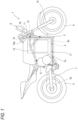
- FIG. 1 is a schematic view of a vehicle 1 according to an embodiment.
- the vehicle 1 is a straddle-type electric motorcycle.
- the vehicle 1 includes a vehicle body 2 and a battery pack 3.
- the battery pack 3 is attachable to and detachable from the vehicle body 2.
- the vehicle body 2 is supported by a front wheel 4, which is a driven wheel, and a rear wheel 5, which is a driving wheel.
- An electric motor 6 as a traveling drive source is supported by the vehicle body 2.
- the electric motor 6 generates a traveling driving force to be transmitted to the rear wheel 5 which is a driving wheel.
- the driving torque generated by the electric motor 6 is transmitted to the rear wheel 5 via a power transmission mechanism 7.
- the electric motor 6 is rotatable forward and backward.
- the electric motor 6 functions as the traveling drive source.
- a rotation speed sensor 22 (see FIG. 2 ) that detects a rotation speed of an output shaft of the electric motor 6 is disposed in the electric motor 6.
- the electric motor 6 also functions as a generator that generates electric power using power transmitted from the driving wheel during deceleration of the vehicle 1 or the like.
- the power transmission mechanism 7 includes a speed reducer 7a that decelerates rotation of the electric motor 6, and a mechanism 7b (for example, a chain transmission mechanism, a belt transmission mechanism, or the like) that transmits rotational power output from the speed reducer 7a to an axle of the rear wheel 5.
- the vehicle body 2 includes a vehicle body frame, and the vehicle body frame includes a head pipe 11 and a pair of left and right main frames 12 that extend rearward from the head pipe 11.
- the head pipe 11 rotatably supports a steering shaft 13.
- a front fork 14 extending substantially vertically is connected to the steering shaft 13, and the front wheel 4 is rotatably supported at a lower end portion of the front fork 14.
- a bar-type handlebar 15 extending in a left-right direction is connected to an upper end portion of the steering shaft 13.
- An accelerator operator 15a for adjusting a driving torque generated by the electric motor 6 is disposed on the handlebar 15.
- the accelerator operator 15a is an accelerator grip that is a right grip of the handlebar 15.
- an operation amount (hereinafter, referred to as an accelerator operation amount) is detected by an accelerator sensor 21 (see FIG. 2 ).
- the accelerator sensor 21 is realized by a position sensor that detects a rotation amount of the grip as an example.
- the accelerator sensor 21 may be realized by a magnetic field detection sensor using a Hall IC.
- An urging force is applied to the accelerator operator 15a so that the accelerator operator 15a returns to the reference position in a state in which an operation of a user who is a driver is not applied.
- the predetermined first moving direction is set to a direction opposite to a clockwise direction when viewed from a right side of the vehicle body. With respect to the reference position, output of the electric motor 6 increases as a movement amount in the first moving direction increases, in other words, as an acceleration operation amount increases.
- a meter device 8 is disposed on a front side of the handlebar 15.
- the meter device 8 displays a traveling speed, a motor rotation speed, a battery remaining amount, and the like.
- the meter device 8 is supported by the head pipe 11 via a bracket 16.
- the battery pack 3 is accommodated in a battery case 17.
- the battery case 17 is disposed between the pair of main frames 12 in the left-right direction, and is fixed to the pair of main frames 12.
- the battery pack 3 includes a chargeable and dischargeable battery 3a and a battery management unit.
- the battery 3a, the battery management unit, and the like of the battery pack 3 accommodated in the battery case 17 are electrically connected to an electronic device on the vehicle body 2 side.
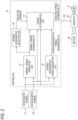
- FIG. 2 is a block diagram illustrating an electrical configuration of the vehicle 1 of FIG. 1 .
- a controller 31 and an inverter 32 are fixed to the vehicle body 2 of the vehicle 1.
- the controller 31 includes a processor, a memory, an I/O interface, and the like in terms of hardware.
- the memory includes, for example, a storage such as a hard disk or a flash memory, and a main memory that is a RAM.
- the storage stores a program for issuing a control command to the electric motor 6.
- the processor, the memory, and the like included in the controller 31 are an example of a processing circuitry.
- the controller 31 receives the accelerator operation amount detected by the accelerator sensor 21.
- the accelerator operation amount may also be referred to as an accelerator opening degree.
- the controller 31 receives the motor rotation speed detected by the rotation speed sensor 22.
- the controller 31 and the inverter 32 are communicably connected to a controller area network (CAN) 30.
- the battery 3a is connected to the electric motor 6 via the inverter 32.
- the controller 31 When the vehicle 1 travels, the controller 31 performs power running control or regeneration control based on the received accelerator operation amount and motor rotation speed.
- the electric motor 6 In the power running control, the electric motor 6 is required to generate a driving torque for causing the vehicle 1 to travel. More specifically, in the power running control, the controller 31 generates a control command for causing the electric motor 6 to generate the driving torque that is a torque in a predetermined positive direction, and outputs the control command to the inverter 32.
- the positive direction of the electric motor 6 is a rotation direction of the electric motor 6 that generates a driving torque for accelerating the vehicle 1 forward.
- the inverter 32 is controlled by the controller 31 to convert DC power discharged from the battery 3 a into AC power and supply the AC power to the electric motor 6.
- the controller 31 requests the electric motor 6 to generate a regenerative torque. More specifically, in the regeneration control, the controller 31 generates a regeneration control command and outputs the regeneration control command to the inverter 32. Upon receiving the regeneration control command, the inverter causes the electric motor 6 to generate the regenerative torque that is a torque in a negative direction opposite to the positive direction in order to brake the vehicle 1. The inverter 32 converts the AC power generated by the electric motor 6 as a generator into the DC power and supplies the DC power to the battery 3a to charge the battery 3a.
- the controller 31 includes a normal torque acquisition unit 41, a strong regenerative torque acquisition unit 42, a strong regenerative selection unit 43, and a torque determination unit 44 in terms of functions.
- the normal torque acquisition unit 41, the strong regenerative torque acquisition unit 42, the strong regenerative selection unit 43, and the torque determination unit 44 are realized by the processor performing arithmetic processing on the program read from the storage to the main memory.
- the normal torque acquisition unit 41, the strong regenerative torque acquisition unit 42, the strong regenerative selection unit 43, and the torque determination unit 44 perform traveling control of the vehicle 1 for switching between the power running control and the regeneration control.
- the normal torque acquisition unit 41 acquires the torque corresponding to the accelerator operation amount and the motor rotation speed using a normal torque map.
- the strong regenerative torque acquisition unit 42 acquires the torque corresponding to the accelerator operation amount and the motor rotation speed using a strong regenerative torque map.
- the torque acquired by the normal torque acquisition unit 41 using the normal torque map is referred to as a normal torque T1.
- the torque acquired by the strong regenerative torque acquisition unit 42 using the strong regenerative torque map is referred to as a strong regenerative torque T2.
- the memory of the controller 31 stores the normal torque map and the strong regenerative torque map. Both the normal torque map and the strong regenerative torque map illustrate a correspondence relationship between the accelerator operation amount and the motor rotation speed, and the torque.
- the normal torque map may be referred to as a first torque map.
- the strong regenerative torque map may be referred to as a second torque map.
- the strong regenerative torque map is set so that the regenerative torque becomes larger than the regenerative torque obtained by the normal torque map even under the same conditions of the motor rotation speed and the accelerator operation amount. Details of the map will be described later.
- the normal torque acquisition unit 41 and the strong regenerative torque acquisition unit 42 output torque information acquired from the respective maps to the torque determination unit 44.
- the normal torque acquisition unit 41 outputs the acquired torque information to the strong regenerative selection unit 43.
- the strong regenerative selection unit 43 outputs a selection command as to whether to select the strong regenerative torque based on the torque information provided from the normal torque acquisition unit 41.
- the strong regenerative selection unit 43 issues, to the torque determination unit 44, a selection command to select a required torque based on the regenerative torque information from the strong regenerative torque acquisition unit 43 for a predetermined period after the torque information given from the normal torque acquisition unit 41 is switched to the regenerative torque.
- the strong regenerative selection unit 43 outputs a selection command indicating whether to use the strong regenerative torque information output from the strong regenerative torque acquisition unit 43 based on a predetermined selection condition.
- the torque determination unit 44 determines a required torque Tr required for the electric motor 6.
- the required torque Tr is a positive value
- the required torque Tr is a negative value
- the required torque Tr during the power running control is also referred to as a required driving torque Tr
- the required torque Tr during the regeneration control is also referred to as a required regenerative torque Tr.
- the torque determination unit 44 outputs the required torque Tr to the inverter 30 based on the torque information supplied from the normal torque acquisition unit 41 and the strong regenerative torque acquisition unit 42 and the selection command supplied from the strong regenerative selection unit 43. More specifically, the torque determination unit 44 determines the regenerative torque to be different based on a temporal change (a degree of decrease to be described later) of the accelerator operation amount before start of regeneration.
- the torque determination unit 44 determines the required driving torque Tr using the normal torque T1 acquired by the normal torque acquisition unit 41.
- the torque determination unit 44 determines the required regenerative torque Tr using both the normal torque T1 acquired by the normal torque acquisition unit 41 and the strong regenerative torque T2 acquired by the strong regenerative torque acquisition unit 42. A method of determining the required torque Tr will be described in detail later.
- the torque determination unit 44 outputs a control command for causing the electric motor 6 to generate the determined required torque Tr to the inverter 32.
- FIG. 3 illustrates two normal torque maps M1a and M1b and one strong regenerative torque map M2.
- Each torque map illustrated in FIG. 3 is a graph illustrating the correspondence relationship between the motor rotation speed and the torque for each accelerator operation amount, and a horizontal axis indicates the motor rotation speed and a vertical axis indicates the torque.
- the normal torque map M1a indicated by a solid line in FIG. 3 illustrates a correspondence relationship between the motor rotation speed and the normal torque T1 when the accelerator operation amount is 50%.
- the normal torque map M1b indicated by a one-dot chain line in FIG. 3 illustrates a correspondence relationship between the motor rotation speed and the normal torque T1 when the accelerator operation amount is 0%.
- the strong regenerative torque map M2 indicated by a broken line in FIG. 3 illustrates a correspondence relationship between the motor rotation speed and the strong regenerative torque T2 when the accelerator operation amount is 0%.
- a positive torque indicates a driving torque for driving the driving wheel
- a negative torque indicates a regenerative torque for braking the driving wheel.
- the normal torque T1 having a negative value may also be referred to as a normal regenerative torque T1.
- the normal torque map is set such that the torque in the positive direction increases as the accelerator operation amount increases.
- FIG. 3 illustrates the normal torque map M1a in which the accelerator operation amount is 50%, but the normal torque map in which the accelerator operation amount is larger than 50% is positioned in a region above the graph M1a in FIG. 3 , and the normal torque map in which the accelerator operation amount is less than 50% is positioned in a region below the graph M1a in FIG. 3 .
- the positive torque (driving torque) is set to be smaller as the motor rotation speed increases even with the same accelerator operation amount (see the normal torque map M1a in FIG. 3 ).
- the normal torque map is set such that a regenerative torque is generated when the motor rotation speed is equal to or higher than a predetermined slow speed A in a case where the accelerator operation amount is zero.
- the regeneration amount is set to be different according to the motor rotation speed. For example, the motor rotation speed is set such that the regeneration amount becomes maximum at a predetermined regeneration amount maximum speed B, and the regeneration amount becomes smaller as the motor rotation speed deviates from the maximum speed B (see the normal torque map M1b in FIG. 3 ).
- the torque is interpolated based on data for each of adjacent torque rotation speeds.
- a plurality of normal torque maps respectively corresponding to values of a plurality of accelerator operation amounts are stored in advance in the memory.
- the accelerator operation amount is 2%
- the linear interpolation is performed on the torque obtained from the normal torque map in which the accelerator operation amount is 0% and the torque obtained from the normal torque map in which the accelerator operation amount is 10%, so that the torque in which the accelerator operation amount is 2% is obtained.
- the normal torque map even when the accelerator operation amount is a value exceeding zero, if the accelerator operation amount is a very small value such as 5% or less, for example, the torque corresponding to the motor rotation speed near the regeneration amount maximum speed is set to a negative value, that is, the regenerative torque. In this way, even in the normal torque map other than when the accelerator operation amount is 0%, the normal torque T1 can take a negative value in the entire region or a partial region of the motor rotation speed.
- the regenerative torque when the accelerator operation amount is zero, the regenerative torque is set to be larger than that in the normal torque map if the conditions of the motor rotation speed are the same.
- the normal torque map M1b when the normal regenerative torque T1 and the strong regenerative torque T2 corresponding to the same accelerator operation amount and the same motor rotation speed are compared, an absolute value of the strong regenerative torque T2 is less than an absolute value of the normal regenerative torque T1. That is, the strong regenerative torque map is a torque map for obtaining a regenerative braking force stronger than the normal torque map.
- the regenerative torque may be set to be generated when the motor rotation speed exceeds zero.
- the motor rotation speed is set such that the regeneration amount becomes maximum at a speed C that is higher than the regeneration amount maximum speed B set in the normal torque map, and the regeneration amount becomes smaller as the motor rotation speed deviates from the maximum speed C (see the strong regenerative torque map M2 in FIG. 3 ).
- the strong regenerative torque map is set to generate a regenerative torque larger than the regenerative torque of the normal torque map.
- FIG. 3 illustrates the strong regenerative torque map M2 illustrating the correspondence relationship between the motor rotation speed and the strong regenerative torque T2 when the accelerator operation amount is 0%, but a plurality of strong regenerative torque maps respectively corresponding to values of a plurality of accelerator operation amount may be stored in advance in the memory.
- the strong regenerative torque map is a map used when the regeneration control is performed, only a map corresponding to an accelerator operation amount at which the regeneration control can be performed is prepared. For example, when the normal torque map in which the accelerator operation amount is 5% or less includes a torque of a negative value, a plurality of strong regenerative torque maps in which the accelerator operation amount is 5% or less may be prepared.
- a torque map in which the torque is zero at any motor rotation speed may be prepared as a strong regenerative torque map in which the accelerator operation amount is a predetermined minute positive value.
- the torque corresponding to the accelerator operation amount between 0% and the minute value may be obtained by linear interpolation with respect to the torque obtained from the strong regenerative torque map in which the accelerator operation amount is 0% and the torque obtained from the normal torque map in which the accelerator operation amount is the minute value.
- the traveling control of the vehicle 1 by the controller 31 is performed by the controller 31 reading and executing a program stored in the memory of the controller 31.
- the controller 31 switches between the power running control and the regeneration control of the electric motor 6 according to the acquired accelerator operation amount and motor rotation speed.
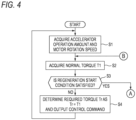
- the controller 31 receives the accelerator operation amount from the accelerator sensor 21 and receives the motor rotation speed from the rotation speed sensor 22 (step S1).
- the controller 31, more specifically, the strong regenerative selection unit 43 determines whether a predetermined regeneration start condition is satisfied (step S3).
- the regeneration start condition is set to a condition that the normal torque T1 acquired in step S2 has changed from a positive value to a negative value.
- steps S1, S2, and S4 are repeated, and the power running control for generating the traveling driving force by the electric motor 6 using the electric power from the battery 3a is performed.
- step S3 When it is determined that the regeneration start condition is satisfied (step S3: Yes), the controller 31 switches the traveling control from the power running control to the regeneration control illustrated in FIG. 5 .
- the user decelerates the straddle-type vehicle and steers the straddle-type vehicle before approaching the curve.
- a load applied to the front wheel is larger than that applied to the rear wheel. This can lead to an improvement in ease of steering of the straddle-type vehicle.
- an absolute value of the required regenerative torque Tr determined during the predetermined period from the start of the regeneration control is set to be larger than an absolute value of the required regenerative torque Tr determined after the predetermined period has elapsed.
- the controller 31 acquires the degree of decrease d in the accelerator operation amount with the lapse of time before the start of the regeneration control.
- the degree of decrease d is an index for determining the magnitude of change in the speed and the operation amount of the operation performed on the accelerator operator 15a by the user when decelerating the vehicle 1.
- the degree of decrease d indicates how the accelerator operation amount has decreased in a period until the start of the regeneration control.
- the degree of decrease d is an index for determining a degree of deceleration intended by the user.
- the degree of decrease d may be a temporal change per unit time of the accelerator operation for returning the accelerator operator 15a to the reference position, or a temporal change per unit time of the deceleration operation.
- the controller 31 determines the required regenerative torque Tr based on the degree of decrease d in the accelerator operation amount. Specifically, when the degree of decrease d is large, the required regenerative torque Tr is increased compared to when the degree of decrease d is small. In the present embodiment, the controller 31 increases the required regenerative torque Tr with the lapse of time in accordance with the degree of decrease d in the accelerator operation amount. As the degree of decrease d increases, the required regenerative torque Tr that increases per unit time is increased. When the required regenerative torque Tr reaches a predetermined upper limit value, the required regenerative torque Tr is maintained at the upper limit value.
- the predetermined upper limit value corresponds to the strong regenerative torque T2 obtained with reference to the strong regenerative torque map M2 as described later. That is, in the present embodiment, the upper limit value may change with a change in the accelerator operation amount and the rotation speed of the electric motor 6 (see also the graph of the broken line in FIG. 3 ).
- the controller 31 determines whether a predetermined regeneration reduction condition is satisfied while the required regenerative torque Tr is maintained at the upper limit value or while the required regenerative torque Tr is increased based on the degree of decrease d in the accelerator operation amount.
- the regeneration reduction condition corresponds to a condition that a regeneration time t to be described later reaches a set time ts.
- the controller 31 determines that the regeneration reduction condition is satisfied, the controller 31 decreases the required regenerative torque Tr with the lapse of time.
- the controller 31 maintains the required regenerative torque Tr at the lower limit value.
- the predetermined lower limit value corresponds to the normal regenerative torque T1 obtained with reference to the normal torque map M1b as described later. That is, in the present embodiment, the lower limit value may change with a change in the accelerator operation amount and the rotation speed of the electric motor 6 (see the graph of the one-dot chain line in FIG. 3 ).
- FIG. 5 is a flowchart illustrating a flow of the regeneration control.
- the controller 31 counts the elapsed time from a start time point of the regeneration control, that is, an elapsed time t from a time point when the regeneration start condition is satisfied (step S11).
- the elapsed time t from the time point when the regeneration start condition is satisfied is referred to as the regeneration time t.
- the controller 31, more specifically, the torque determination unit 44 calculates the degree of decrease d in the accelerator operation amount with the lapse of time before the start of the regeneration control, that is, before the time point when the regeneration start condition is satisfied (step S 12).
- the degree of decrease d in the accelerator operation amount is used to determine the required regenerative torque Tr during the predetermined period from the start of the regeneration control.
- the predetermined period is a period from the start of the regeneration control to a time when a coefficient k to be described later reaches 0.
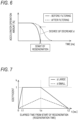
- FIG. 6 is a graph illustrating an example of a method of calculating the degree of decrease d.
- a graph indicated by a solid line in FIG. 6 is a graph illustrating time series data of the accelerator operation amount received from the accelerator sensor 21, and a horizontal axis indicates a time axis, and a vertical axis indicates the accelerator operation amount that is the accelerator operation amount.
- the broken line in FIG. 6 is obtained by performing low-pass filtering on the time series data of the accelerator operation amount received from the accelerator sensor 21.
- the time series data of the accelerator operation amount received from the accelerator sensor 21 is referred to as "unfiltered data”
- the data obtained by performing the low-pass filtering on the time series data of the accelerator operation amount received from the accelerator sensor 21 is referred to as "filtered data”.
- the controller 31 sets, as the degree of decrease d, a difference in the accelerator operation amount obtained by subtracting the value of the unfiltered data at the start of the regeneration control from the value of the filtered data at the start of the regeneration control.
- the degree of decrease d may not be the difference between the value of the filtered data and the value of the unfiltered data at the same time.
- the degree of decrease d may be a difference of the accelerator operation amount obtained by subtracting the value of the unfiltered data at the start of the regeneration control from the value of the filtered data before a predetermined time (for example, a control cycle of the controller 31) from the start of the regeneration control.
- the controller 31, more specifically, the torque determination unit 44 initializes a coefficient k to 0 (step S13).
- the coefficient k may take a value of 0 or more and 1 or less.
- the coefficient k varies from 0 to 1 with time, and the required regenerative torque Tr required for the electric motor 6 is calculated using the coefficient k.
- the controller 31, more specifically, the strong regenerative selection unit 43 determines whether the regeneration time t is less than the set time ts (step S16). When it is determined that the regeneration time t is less than the set time ts (step S 16: Yes), the controller 31 determines whether the coefficient k has reached 1 (step S17). When the coefficient k has not reached 1 (step S17: No), the controller 31 increases the coefficient k at a change rate corresponding to the degree of decrease d acquired in step S12 (step S18), and proceeds to step S21.
- correspondence relationship information indicating a correspondence relationship between the degree of decrease d and the change rate of the coefficient k is stored in advance.
- the change rate of the coefficient k is an increase amount of the coefficient k per unit time.
- the controller 31 acquires the change rate corresponding to the acquired degree of decrease d, and increases the coefficient k at the acquired change rate.
- the degree of decrease d and the change rate of the coefficient k have a relationship in which the change rate (time increase rate) of the coefficient k increases as the degree of decrease d increases.
- step S17 Yes
- the controller 31 maintains the coefficient k at 1 without changing the coefficient k, and proceeds to step S21.
- step S16 determines whether the coefficient k has reached 0 (step S19). When the coefficient k has not reached 0 (step S19: No), the controller 31 decreases the coefficient k (step S20) and proceeds to step S21.
- the coefficient k may be decreased with time based on the degree of decrease d.
- correspondence relationship information indicating a correspondence relationship between the degree of decrease d and the change rate of the coefficient k when the regeneration time t exceeds the set time ts may also be stored in advance in the memory of the controller 31.
- the change rate of the coefficient k may be information indicating a relationship obtained by multiplying the degree of decrease d by a predetermined negative value (- ⁇ 2). That is, the coefficient k may be decreased by a value of ⁇ 2 ⁇ d per unit time.
- the coefficient k may be calculated by multiplying a predetermined negative value (- ⁇ 2), the degree of decrease d, and the elapsed time (t - ts) from the set time ts, that is, may be calculated by the following calculation formula (2).
- k ⁇ ⁇ 2 ⁇ d ⁇ t ⁇ ts
- step S19 Yes
- the controller 31 maintains the coefficient k at 0 without changing the coefficient k, and proceeds to step S21.
- the controller 31, more specifically, the torque determination unit 44 calculates the required torque Tr by the following formula (3) using the coefficient k obtained through steps S16, S17, S18, S19, and S20, the normal torque T1 acquired in step S14, and the strong regenerative torque T2 acquired in step S15, and outputs the control command to the inverter 32 (step S21).
- Tr 1 ⁇ k ⁇ T1 + K ⁇ T2
- a value obtained by adding a value obtained by multiplying the normal regenerative torque T1 by a coefficient (1 - k) to a value obtained by multiplying the strong regenerative torque T2 by a coefficient k is set as the required regenerative torque Tr.
- the required torque Tr is calculated using the normal torque T1 and the strong regenerative torque T2.
- the above formula (3) indicates that a ratio of the strong regenerative torque T2 to the required torque Tr increases as the coefficient k increases.
- the above formula (3) indicates that the magnitude (that is, the absolute value) of the required regenerative torque Tr increases as the coefficient k increases.
- the controller 31, more specifically, the torque determination unit 44 receives the accelerator operation amount from the accelerator sensor 21 and receives the motor rotation speed from the rotation speed sensor 22 (step S22).
- the controller 31 determines whether a regeneration end condition is satisfied (step S23).
- the regeneration end condition may be set to a condition that the normal torque T1 becomes a positive value, or may be set to a condition that the accelerator operation amount exceeds a predetermined value (for example, the accelerator operation amount of 5%).
- the regeneration end condition may be other conditions.
- the regeneration end condition may be a user operation such as a brake operation or a clutch operation.
- step S23 When it is determined that the regeneration end condition is not satisfied (step S23: No), the process returns to step S14. Thus, when it is determined in step S23 that the regeneration end condition is not satisfied, the steps from step S14 to step S23 are repeated to cause the electric motor 6 to generate the regenerative torque corresponding to the required regenerative torque Tr.
- step S23: Yes the controller 31 switches the traveling control from the regeneration control to the power running control.
- FIG. 7 illustrates an example of a change in the coefficient k with the lapse of time.
- a horizontal axis indicates the regeneration time t which is the elapsed time from the time point when the regeneration start condition is satisfied
- a vertical axis indicates the coefficient k.
- an example of a change in the coefficient k when a relatively large degree of decrease d is acquired is indicated by a solid line
- an example of a change in the coefficient k when a relatively small degree of decrease d is acquired is indicated by a broken line.
- the change rate is obtained from the correspondence relationship information indicating the correspondence relationship between the degree of decrease d and the change rate of the coefficient k stored in the memory of the controller 31.
- the coefficient k decreases at a constant change rate as time elapses (see step S20 in FIG. 5 ).
- a strong regeneration end time t2 is set in advance.
- the strong regeneration end time t2 is a fixed value.
- the coefficient k decreases at a constant change rate with time so as to reach 0 at the strong regeneration end time t2. After the coefficient k reaches 0, the required torque Tr becomes the normal regenerative torque T1.
- the regeneration time t reaches the set time ts without the coefficient k reaching 1.
- the coefficient k decreases at a constant change rate with the lapse of time so as to reach 0 when the regeneration time t reaches the strong regeneration end time t2.
- the required torque Tr becomes the normal regenerative torque T1.
- the controller 31 acquires the degree of decrease d in the accelerator operation amount with the lapse of time before the start of the regeneration control, and determines the required regenerative torque Tr, which is the regenerative torque required for the electric motor 6, based on the degree of decrease d in the accelerator operation amount. Therefore, the regenerative torque is varied according to the accelerator operation by the user. Since the braking force corresponding to the user operation can be generated when the regeneration control is performed, the braking feeling felt by the user can be brought close to the feeling intended by the user.
- the strong regenerative torque map is used at least for the predetermined period from the start of the regeneration control.
- the required regenerative torque Tr is determined based on the degree of decrease d in the accelerator operation amount. Therefore, the braking feeling immediately after the start of the regeneration control can be brought close to the feeling intended by the user.
- the correspondence relationship information stored in the memory is set such that the time increase rate of the coefficient k increases as the degree of decrease d increases.
- the required regenerative torque Tr is determined using the formula (3) in which the absolute value of the required regenerative torque Tr increases as the coefficient k increases. That is, the required regenerative torque Tr is increased as the degree of decrease d in the accelerator operation amount is increased. Therefore, the braking feeling felt by the user when the regeneration control is performed can be brought close to the braking feeling when the engine brake in the engine vehicle is operated. Accordingly, it is easy to prevent the user who is familiar with the driving of the engine vehicle from feeling uncomfortable.
- the coefficient k is increased in step S 18 from the start of the regeneration control to a time point when the condition that the coefficient k reaches 1 is satisfied. Accordingly, since the required regenerative torque Tr is increased with the lapse of time from the start of the regeneration control to the time point when the predetermined condition is satisfied, it is possible to reduce the shock generated in a vehicle body as compared with a case where the regenerative torque is suddenly changed.
- the change rate in the coefficient k increases as the degree of decrease d in the accelerator operation amount increases. Accordingly, since the increase amount per unit time of the required regenerative torque Tr is increased as the degree of decrease d in the accelerator operation amount is increased, the braking feeling can be brought close to the braking feeling when the engine brake in the engine vehicle is operated, and it is easy to prevent the user who is familiar with the driving of the engine vehicle from feeling uncomfortable.
- the coefficient k when the coefficient k reaches 1, the coefficient k is maintained at 1. That is, the required regenerative torque Tr is maintained at the strong regenerative torque T2 as the upper limit value. Since the upper limit value of the regenerative torque is set in this way, it is possible to prevent the braking force due to the regenerative torque from becoming excessive. Since the upper limit value varies depending on the rotation speed of the electric motor 6, the regenerative torque of the electric motor 6 can be limited to a range suitable for the rotation speed.
- the regenerative torque decreases with the lapse of time, and therefore it is possible to reduce the shock generated in the vehicle body as compared with the case where the regenerative torque is suddenly decreased.
- the absolute value of the required regenerative torque Tr determined during the predetermined period from the start of the regeneration control is larger than the absolute value of the required regenerative torque Tr determined after the predetermined period has elapsed. Therefore, it is possible to apply a relatively large regenerative torque from the start of the regeneration control to the predetermined period, and to generate a braking feeling in accordance with a deceleration intention of the user.
- the coefficient k (where 0 ⁇ k ⁇ 1) is determined so as to increase with the lapse of time as the degree of decrease in the accelerator operation amount increases, and the regenerative torque is determined by adding a value obtained by multiplying the normal regenerative torque by a coefficient (1 - k) to a value obtained by multiplying the strong regenerative torque by the coefficient k. Therefore, with a simple control logic, the regenerative torque can be increased as the degree of decrease in the accelerator operation amount is increased.
- the vehicle described in the above embodiment is an electric vehicle including one traveling drive source, but the vehicle is not limited thereto.
- the vehicle may be a hybrid vehicle including two traveling drive sources of an electric motor and an internal combustion engine. That is, the regeneration control method according to the present disclosure is also applicable to the hybrid vehicle.
- the above regeneration control may be performed during traveling by motor driving.
- the straddle-type vehicle may not be a two-wheeled vehicle but may be a three-wheeled vehicle.
- the vehicle may not be a straddle-type vehicle, and may be, for example, a four-wheel vehicle.
- the vehicle may include a transmission that switches a transmission gear ratio.
- the regeneration control method according to the present disclosure is applicable to all vehicles. Further, the regeneration control method according to the present disclosure can be suitably applied to a straddle-type vehicle which has a relatively light weight compared to the four-wheel vehicle and has a large influence on a feeling by the regeneration control.
- the regeneration start condition is a condition determined using the accelerator operation amount, the motor rotation speed, and the normal torque map, but the regeneration start condition is not limited thereto.
- the regeneration start condition may be a condition that the accelerator operation amount is zero or is equal to or less than a predetermined value (for example, an accelerator operation amount of 5%).
- the start condition of the regeneration control is determined based on the accelerator operation amount, but the start condition of the regeneration control may be determined based on conditions other than the accelerator operation amount.
- the start condition of the regeneration control may include a condition that a brake operation is performed on a brake operator.
- the start condition of the regeneration control may include a condition that the shift operation of the user is a predetermined operation. In this way, the start of the regeneration control may be determined based on the operation of the user. Further, the start condition of the regeneration control may be determined based on a plurality of user operations such as an accelerator operation amount, a brake operation amount, and a shift operation amount. Further, the regeneration start condition may be corrected or changed based on a vehicle state such as a vehicle speed, the motor rotation speed, and the transmission gear ratio. For example, the regeneration start condition may be set such that the regeneration control is started earlier as the vehicle speed or the motor rotation speed is higher.
- the regeneration start condition may be set such that the start of the regeneration control is prevented when it is determined that the battery or the circuit is damaged, for example, when a state of charge (SOC) of the battery is large or when a temperature of an electric wire is excessive.
- SOC state of charge
- the regeneration reduction condition is a condition that the regeneration time t reaches the set time ts, but the regeneration reduction condition is not limited thereto.
- the regeneration reduction condition may be a condition that either a condition that the regeneration time t reaches the set time ts or a condition that the coefficient k reaches 1 is satisfied.
- the regeneration reduction condition may be set according to the vehicle speed or the motor rotation speed.
- the strong regenerative torque map is used during the strong regeneration end time t2 that is a predetermined period from the start of the regeneration control.
- the strong regeneration end time t2 is a preset fixed value, but the predetermined period is not limited thereto.
- the strong regeneration end time t2 may be a variation value.
- the strong regeneration end time t2 may be set to increase as the degree of decrease d increases.
- the strong regeneration end time t2 may be set to increase as the magnitude of the coefficient k at the time point when the regeneration time t reaches the set time ts increases.
- the change rate of the coefficient k with the lapse of time after the regeneration time t reaches the set time ts may be a fixed value, and accordingly the strong regeneration end time t2 may depend on the magnitude of the coefficient k at the time point when the regeneration time t reaches the set time ts.
- the two torque maps of the strong regenerative torque map and the normal torque map are used, and the coefficient k, which is the ratio of the strong regenerative torque T2 to the required torque Tr, is increased with the lapse of time as the degree of decrease d is increased, so that the required regenerative torque is increased as the degree of decrease d is increased.
- the method for determining the required regenerative torque that increases as the degree of decrease d increases is not limited thereto.
- both the strong regenerative torque map and the normal torque map are used for the predetermined period from the start of the regeneration control, but only the normal torque map may be used.
- the normal regenerative torque may be acquired from the normal torque map, and a value obtained by adding an additional torque corresponding to the magnitude of the degree of decrease d to the normal regenerative torque obtained from the normal torque map during the predetermined period from the start of the regeneration control may be set as the required regenerative torque.
- a value obtained by multiplying the normal regenerative torque obtained by the normal torque map by a value corresponding to the magnitude of the degree of decrease d (however, a value of 1 or more) may be set as the required regenerative torque.
- both the strong regenerative torque map and the normal torque map are used for the predetermined period from the start of the regeneration control, but only the strong regenerative torque map may be used, and in this case, the value obtained with reference to the strong regenerative torque map may be used as the required regenerative torque.
- two types of regenerative torque that is, the normal regenerative torque and the strong regenerative torque
- the normal regenerative torque and the strong regenerative torque may be acquired by a method other than the torque map.
- the normal regenerative torque and the strong regenerative torque may be calculated by the calculation formulas different from each other such as different coefficients.
- the normal torque map and the strong regenerative torque map illustrate the correspondence relationship between the accelerator operation amount and the motor rotation speed, and the torque, but the normal torque map and the strong regenerative torque map are not limited thereto.
- the normal torque map and the strong regenerative torque map only one or both of the normal torque map and the strong regenerative torque map may indicate a correspondence relationship between the torque and only one of the accelerator operation amount and the motor rotation speed.
- the required regenerative torque Tr is maintained so as not to exceed the predetermined upper limit value, and the upper limit value corresponds to the strong regenerative torque T2 obtained with reference to the strong regenerative torque map M2, but the upper limit value is not limited thereto.
- the upper limit value may not change according to the accelerator operation amount or the motor rotation speed.
- the upper limit value may be a fixed value set in advance.
- the acquisition of the degree of decrease in the accelerator operation amount with the lapse of time before the start of the regeneration control includes performing the low-pass filtering on the acquired accelerator operation amount, and calculating the degree of decrease in the accelerator operation amount by subtracting the acquired accelerator operation amount from the accelerator operation amount after low-pass filtering.
- a method of acquiring the degree of decrease is not limited thereto.
- the degree of decrease d is the difference of the accelerator operation amount obtained by subtracting the value of the unfiltered data at the start of the regeneration control from the value of the filtered data at the start of the regeneration control, but the degree of decrease may be a value correlated with the temporal change rate of the accelerator operation amount, and other indices indicating the degree of decrease in the accelerator operation amount may be used.
- the degree of decrease in the accelerator operation amount may be calculated from a difference between the accelerator operation amount at the start of the regeneration control and the accelerator operation amount acquired a predetermined time before the start of the regeneration control.
- the predetermined time is set to a relatively small value, only the operation of the user immediately before the regeneration control start time point is reflected in the degree of decrease in the accelerator operation amount. Therefore, for example, a difference in the calculated degree of decrease is less likely to occur between a case where an operation of suddenly closing the accelerator operation amount is performed from a state where the accelerator operation amount is fully opened (100%) and a case where an operation of suddenly closing the accelerator operation amount is performed from a state where the accelerator operation amount is 20%.
- the degree of decrease in the accelerator operation amount is preferably calculated by subtracting the acquired accelerator operation amount from the accelerator operation amount after the low-pass filtering, from the viewpoint that the operation of the user is easily reflected in the degree of decrease in the acquired accelerator operation amount.
- the coefficient k when the coefficient k is gradually changed, the coefficient k is linearly changed so as to increase by a certain amount per unit time as illustrated in FIG. 7 , but the coefficient k may be changed non-linearly or may be changed stepwise. In addition, the coefficient k may be instantaneously changed instead of being gradually changed.
- the required torque Tr is calculated by the formula (3), but the calculation formula of the required torque Tr is merely an example.
- the required torque Tr may be determined by another method.
- the increase amount of the regenerative torque (the temporal change rate of the regenerative torque) by which the regenerative torque increases with the lapse of time from the start of the regeneration is increased.
- the larger the degree of decrease in the accelerator operation amount is, the larger the maximum value of the regenerative torque is, and the temporal change rate of the regenerative torque may be the same regardless of the degree of decrease in the accelerator operation amount.
- the required regenerative torque may be determined to become the maximum regenerative torque at the start of regeneration, instead of gradually increasing at the start of regeneration. Also in this case, it is preferable that the maximum regenerative torque is determined to increase as the degree of decrease in the accelerator operation amount increases.
- the strong regenerative torque is set based on the motor rotation speed and the accelerator operation amount, but the strong regenerative torque is not limited thereto, and the strong regenerative torque may be a value that generates a large regeneration amount with respect to the regeneration amount of the normal torque map. Since the strong regenerative torque having a value different from that of the regenerative torque obtained by the normal torque map is set based on the motor rotation speed and the accelerator operation amount, it is possible to easily obtain the regenerative torque different depending on the situation and to easily approach the braking feeling preferred by the user.
- the battery is detachable in the above embodiment, the battery may not be detachable.
- the electric motor may not be disposed between the front and rear wheels.
- the electric motor may be an in-wheel motor.
- the electric motor may be disposed on a swing arm that pivotally supports the rear wheel.
- the electric motor is exemplified by an AC motor, but may be a DC motor.
- the vehicle may separately include a driving motor and a braking motor.
- the vehicle body frame supporting the electric motor and the battery can be appropriately changed.
- the meter device 8 may display information indicating a regeneration control state in which the regeneration control is performed. In this case, the controller 31 transmits a command for displaying the regeneration control state to the meter device 8. In addition, when displaying the regeneration control state, the meter device 8 may make a display mode different between a state in which the regenerative braking is strong and a state in which the regenerative braking is weak. In this case, the controller 31 transmits, to the meter device 8, information indicating whether the regenerative braking is strong or weak.
- the functions of the elements disclosed in the present specification can be executed by using a general-purpose processor, a dedicated processor, an integrated circuit, application specific integrated circuits (ASICs), a conventional circuit, a circuit or a processing circuitry including any combination thereof, which is configured or programmed to execute the disclosed functions.
- the processor includes a transistor and other circuits, the processor is regarded as a processing circuitry or a circuit.
- the circuit, the unit, and the means are hardware for executing the listed functions or hardware programmed to execute the listed functions.
- the hardware may be the hardware disclosed in this specification, or may be a program or other known hardware configured to execute the listed functions.
- the hardware is a processor considered as a kind of circuit
- the circuit, means, or unit is a combination of hardware and software, and the software is used for the hardware or the configuration of the processor.
- a program including instructions to execute the method disclosed herein may be stored in a non-transitory computer-readable storage medium.
- the non-transitory computer-readable storage medium includes, for example, a magnetic disk such as a hard disk drive, an optical disk such as a CD-ROM, a DVD disk, and a Blu-ray disk, a read-only memory (ROM), a random access memory (RAM), an EPROM, an EEPROM, a magnetic card, a flash memory, an optical card, and any type of medium suitable for storing an electronic command.
- a regeneration control method for a vehicle which is executed in a processing circuitry of the vehicle including an electric motor as a drive source, includes: determining whether a start condition of regeneration control for requesting the electric motor to generate a regenerative torque is satisfied; acquiring a degree of decrease in an accelerator operation amount with lapse of time before start of the regeneration control; and determining a required regenerative torque, which is the regenerative torque required for the electric motor, based on the degree of decrease in the accelerator operation amount.
- the regenerative torque is varied according to an accelerator operation by a user. Since the braking force corresponding to the user operation can be generated when the regeneration control is performed, the braking feeling felt by the user can be brought close to the feeling intended by the user.
- determining the required regenerative torque based on the degree of decrease in the accelerator operation amount is performed for a predetermined period from the start of the regeneration control.
- the braking feeling immediately after the start of the regeneration control can be brought close to the feeling intended by the user.
- determining the required regenerative torque based on the degree of decrease in the accelerator operation amount includes increasing the required regenerative torque as the degree of decrease in the accelerator operation amount increases.
- the braking feeling felt by the user when the regeneration control is executed can be brought close to the braking feeling when an engine brake in an engine vehicle is operated. Accordingly, it is easy to prevent the user who is familiar with the driving of the engine vehicle from feeling uncomfortable.
- determining the required regenerative torque based on the degree of decrease in the accelerator operation amount includes increasing the required regenerative torque with the lapse of time from the start of the regeneration control to a time point when a predetermined condition is satisfied.
- the method since the regenerative torque generated by the electric motor increases with the lapse of time, it is possible to reduce shock generated in a vehicle body as compared with a case where the regenerative torque is suddenly changed.
- increasing the required regenerative torque includes increasing an increase amount per unit time in the required regenerative torque as the degree of decrease in the accelerator operation amount increases.
- the braking feeling can be brought close to the braking feeling when the engine brake in the engine vehicle is operated, and it is easy to prevent the user who is familiar with the driving of the engine vehicle from feeling uncomfortable.
- determining the required regenerative torque based on the degree of decrease in the accelerator operation amount includes: increasing the required regenerative torque with the lapse of time based on the degree of decrease in the accelerator operation amount; maintaining the required regenerative torque at a predetermined upper limit value when the required regenerative torque reaches the upper limit value; determining whether a predetermined regeneration reduction condition is satisfied; and decreasing the required regenerative torque when being determined that the regeneration reduction condition is satisfied.
- the upper limit value of the regenerative torque is set, it is possible to prevent the braking force due to the regenerative torque from becoming excessive.
- the upper limit value changes in accordance with a rotation speed of the electric motor.
- the regenerative torque of the electric motor can be limited to a range suitable for the rotation speed.
- determining the required regenerative torque based on the degree of decrease in the accelerator operation amount includes: changing the required regenerative torque with the lapse of time based on the degree of decrease in the accelerator operation amount; determining whether a predetermined regeneration reduction condition is satisfied; and reducing the regenerative torque with the lapse of time when being determined that the regeneration reduction condition is satisfied, after or while changing the required regenerative torque based on the degree of decrease in the accelerator operation amount.
- the regenerative torque decreases with the lapse of time after it is determined that the regeneration reduction condition is satisfied, it is possible to reduce the shock generated in the vehicle body as compared with the case where the regenerative torque is suddenly decreased.
- a regeneration control method for a vehicle which is executed in a processing circuitry of a vehicle including an electric motor as a drive source, includes: determining whether a start condition of regeneration control for requesting the electric motor to generate a regenerative torque is satisfied; and determining a required regenerative torque, which is the regenerative torque required for the electric motor, after being determined that the start condition is satisfied.
- An absolute value of the required regenerative torque determined during a predetermined period from start of the regeneration control is larger than an absolute value of the required regenerative torque determined after the predetermined period has elapsed.
- the method it is possible to apply a relatively large regenerative torque from the start of the regeneration control to a predetermined period, and to generate a braking feeling in accordance with a deceleration intention of the user.
- a straddle-type vehicle includes: an accelerator operator operated by a user; a driving wheel; an electric motor serving as a drive source for driving the driving wheel; and a processing circuitry configured to control a regenerative torque of the electric motor for braking the driving wheel.
- the processing circuitry is configured to: determine whether a start condition of regeneration control for requesting the electric motor to generate the regenerative torque is satisfied; acquire a degree of decrease in an accelerator operation amount with lapse of time before start of the regeneration control; and determine a required regenerative torque, which is the regenerative torque required for the electric motor, based on the degree of decrease in the accelerator operation amount.
Landscapes
- Engineering & Computer Science (AREA)
- Mechanical Engineering (AREA)
- Transportation (AREA)
- Power Engineering (AREA)
- Chemical & Material Sciences (AREA)
- Combustion & Propulsion (AREA)
- Automation & Control Theory (AREA)
- Electric Propulsion And Braking For Vehicles (AREA)
Applications Claiming Priority (1)
| Application Number | Priority Date | Filing Date | Title |
|---|---|---|---|
| JP2023095057A JP2024176496A (ja) | 2023-06-08 | 2023-06-08 | 回生制御方法および鞍乗車両 |
Publications (1)
| Publication Number | Publication Date |
|---|---|
| EP4477451A1 true EP4477451A1 (de) | 2024-12-18 |
Family
ID=91465431
Family Applications (1)
| Application Number | Title | Priority Date | Filing Date |
|---|---|---|---|
| EP24180687.6A Pending EP4477451A1 (de) | 2023-06-08 | 2024-06-07 | Regenerationssteuerungsverfahren und grätschsitzfahrzeug |
Country Status (4)
| Country | Link |
|---|---|
| US (1) | US20240408969A1 (de) |
| EP (1) | EP4477451A1 (de) |
| JP (1) | JP2024176496A (de) |
| CN (1) | CN119099775A (de) |
Citations (3)
| Publication number | Priority date | Publication date | Assignee | Title |
|---|---|---|---|---|
| JP2012205476A (ja) * | 2011-03-28 | 2012-10-22 | Honda Motor Co Ltd | 車両の制御装置 |
| US20150019058A1 (en) * | 2013-07-12 | 2015-01-15 | Stephan P. Georgiev | Regenerative braking regulation in automotive vehicles |
| US20150258898A1 (en) * | 2012-10-22 | 2015-09-17 | Kawasaki Jukogyo Kabushiki Kaisha | Regenerative Brake Control System of Electric Vehicle |
-
2023
- 2023-06-08 JP JP2023095057A patent/JP2024176496A/ja active Pending
-
2024
- 2024-06-07 EP EP24180687.6A patent/EP4477451A1/de active Pending
- 2024-06-07 CN CN202410736096.1A patent/CN119099775A/zh active Pending
- 2024-06-07 US US18/736,828 patent/US20240408969A1/en active Pending
Patent Citations (3)
| Publication number | Priority date | Publication date | Assignee | Title |
|---|---|---|---|---|
| JP2012205476A (ja) * | 2011-03-28 | 2012-10-22 | Honda Motor Co Ltd | 車両の制御装置 |
| US20150258898A1 (en) * | 2012-10-22 | 2015-09-17 | Kawasaki Jukogyo Kabushiki Kaisha | Regenerative Brake Control System of Electric Vehicle |
| US20150019058A1 (en) * | 2013-07-12 | 2015-01-15 | Stephan P. Georgiev | Regenerative braking regulation in automotive vehicles |
Also Published As
| Publication number | Publication date |
|---|---|
| CN119099775A (zh) | 2024-12-10 |
| US20240408969A1 (en) | 2024-12-12 |
| JP2024176496A (ja) | 2024-12-19 |
Similar Documents
| Publication | Publication Date | Title |
|---|---|---|
| JP6381573B2 (ja) | 電動機の回生制御装置、電動機の回生駆動装置、及び電動補助車両 | |
| JP5278617B1 (ja) | ハイブリッド車における車両状態表示装置 | |
| JP5865509B2 (ja) | 電動式乗物の回生ブレーキ制御システム | |
| CN109305044A (zh) | 一种车辆的电制动扭矩分配方法及装置 | |
| US11745595B2 (en) | Electric vehicle and method of controlling the same according to a plurality of control maps defining a driving force | |
| US10137787B2 (en) | Regenerative controller for electric motor, regenerative driver for electric motor, and power-assisted vehicle | |
| CN104627024B (zh) | 提高纯电动车驾驶性的控制方法 | |
| EP3929023B1 (de) | Traktionssteuerungssystem für ein elektrisches motorrad | |
| JP2012113613A (ja) | 運転操作評価装置 | |
| CN104527456A (zh) | 动平衡车及其限速控制方法和系统 | |
| EP4477451A1 (de) | Regenerationssteuerungsverfahren und grätschsitzfahrzeug | |
| EP4474204A1 (de) | Grätschsitzfahrzeug und fahrzeugsteuerungsverfahren | |
| CN112319478B (zh) | 车辆驱动模式切换方法、装置及存储介质、电动商用车 | |
| TW201221411A (en) | Two-wheeled electric vehicle | |
| WO2023188743A1 (ja) | 電動二輪車の制御方法 | |
| JP4780114B2 (ja) | 運転支援装置 | |
| JP5585416B2 (ja) | 運転支援装置 | |
| EP4474198A1 (de) | Grätschsitzfahrzeug und fahrzeugsteuerungsverfahren | |
| CN114074560A (zh) | 电动机车牵引力控制系统的控制方法 | |
| CN121608726B (zh) | 车辆扭矩控制方法及车辆 | |
| CN118934961B (zh) | 混合动力变速箱离合器压力补偿的控制方法及装置 | |
| JP2024158688A (ja) | 車両の制御装置及び電動アシスト車、並びに情報処理装置 | |
| CN117984980A (zh) | 混动车辆的电机扭矩控制方法 |
Legal Events
| Date | Code | Title | Description |
|---|---|---|---|
| PUAI | Public reference made under article 153(3) epc to a published international application that has entered the european phase |
Free format text: ORIGINAL CODE: 0009012 |
|
| STAA | Information on the status of an ep patent application or granted ep patent |
Free format text: STATUS: REQUEST FOR EXAMINATION WAS MADE |
|
| 17P | Request for examination filed |
Effective date: 20240607 |
|
| AK | Designated contracting states |
Kind code of ref document: A1 Designated state(s): AL AT BE BG CH CY CZ DE DK EE ES FI FR GB GR HR HU IE IS IT LI LT LU LV MC ME MK MT NL NO PL PT RO RS SE SI SK SM TR |