EP4474445A1 - Sulfonierte lignine zur kesselsteinhemmung - Google Patents
Sulfonierte lignine zur kesselsteinhemmung Download PDFInfo
- Publication number
- EP4474445A1 EP4474445A1 EP23178014.9A EP23178014A EP4474445A1 EP 4474445 A1 EP4474445 A1 EP 4474445A1 EP 23178014 A EP23178014 A EP 23178014A EP 4474445 A1 EP4474445 A1 EP 4474445A1
- Authority
- EP
- European Patent Office
- Prior art keywords
- sulfonated lignin
- oxidized
- scale inhibitor
- scale
- amount
- Prior art date
- Legal status (The legal status is an assumption and is not a legal conclusion. Google has not performed a legal analysis and makes no representation as to the accuracy of the status listed.)
- Pending
Links
Images
Classifications
-
- C—CHEMISTRY; METALLURGY
- C09—DYES; PAINTS; POLISHES; NATURAL RESINS; ADHESIVES; COMPOSITIONS NOT OTHERWISE PROVIDED FOR; APPLICATIONS OF MATERIALS NOT OTHERWISE PROVIDED FOR
- C09K—MATERIALS FOR MISCELLANEOUS APPLICATIONS, NOT PROVIDED FOR ELSEWHERE
- C09K8/00—Compositions for drilling of boreholes or wells; Compositions for treating boreholes or wells, e.g. for completion or for remedial operations
- C09K8/02—Well-drilling compositions
- C09K8/03—Specific additives for general use in well-drilling compositions
- C09K8/035—Organic additives
-
- C—CHEMISTRY; METALLURGY
- C07—ORGANIC CHEMISTRY
- C07G—COMPOUNDS OF UNKNOWN CONSTITUTION
- C07G1/00—Low-molecular-weight derivatives of lignin
-
- C—CHEMISTRY; METALLURGY
- C09—DYES; PAINTS; POLISHES; NATURAL RESINS; ADHESIVES; COMPOSITIONS NOT OTHERWISE PROVIDED FOR; APPLICATIONS OF MATERIALS NOT OTHERWISE PROVIDED FOR
- C09K—MATERIALS FOR MISCELLANEOUS APPLICATIONS, NOT PROVIDED FOR ELSEWHERE
- C09K8/00—Compositions for drilling of boreholes or wells; Compositions for treating boreholes or wells, e.g. for completion or for remedial operations
- C09K8/52—Compositions for preventing, limiting or eliminating depositions, e.g. for cleaning
- C09K8/528—Compositions for preventing, limiting or eliminating depositions, e.g. for cleaning inorganic depositions, e.g. sulfates or carbonates
Definitions
- the present invention relates to an oxidized sulfonated lignin scale inhibitor, the use thereof for inhibiting the formation of scale in oilfield applications, a method for inhibiting scale in oilfield applications, and a method for preparing the inventive oxidized sulfonated lignin scale inhibitor.
- Scale formation is a significant challenge faced by the oil and gas industry. When certain minerals, such as calcium carbonate, calcium sulfate, or barium sulfate, exceed their solubility limits, they can precipitate and form scale deposits. These scales can accumulate on the surfaces of production equipment, wellbores, and reservoir formations, leading to reduced production rates, decreased efficiency, and equipment damage.
- minerals such as calcium carbonate, calcium sulfate, or barium sulfate
- scale inhibitors can be added into the production fluids or the drilling muds, resulting in enhanced production rates, extended equipment lifespan, and improved operational efficiency.
- scale inhibitors are, for example, anionic polymers (e.g. polyacrylate, polyvinyl sulfonate) or organophosphonate molecules (e.g. 1-hydroxy ethylidene-1 ,1-diphosphonic acid).
- anionic polymers e.g. polyacrylate, polyvinyl sulfonate
- organophosphonate molecules e.g. 1-hydroxy ethylidene-1 ,1-diphosphonic acid.
- Such compounds are fossil-based, environmentally unfriendly, and not considered PLONOR acceptable.
- the scale inhibitors commonly used in oil- and gasfields are more and more undesirable.
- lignin-based materials Another class of compounds that has been envisaged as a scale inhibitor in the past are lignin-based materials.
- US 2,297,670 describes the use of lignin materials for protecting boilers against embrittlement and, as a side-aspect, for preventing the adherence of boiler scales.
- US 3,849,328 mentions the use of sulfonated alkali lignins for inhibiting the build-up of mineral scale deposits from scale prone waters. US 3,849,328 , however, teaches that sulfite lignins do not impart unusual scale-inhibiting properties and, thus, teaches against using this class of compounds.
- US 2,505,457 discloses the use of lignin derivatives prepared by heating sodium lignosulfonate in the presence of caustic soda for inhibiting scale in evaporators, feed water heaters, economizers, boilers, and other steam generating systems.
- the lignin derivative of US 2,505,457 has a very low performance and does not perform well enough for commercial use.
- lignosulfonate has been mixed or grafted with synthetic moieties known to inhibit scale, for example acrylic acid and polyacrylate (see US 2013/0137799 and Ind. Eng. Chem. Res. 2006, 45, 16, 5716-5721 ).
- the performance/efficiency of scale inhibitors is typically expressed as the fail inhibitor concentration (FIC). This is the concentration of inhibitor at which the onset of scale is detected (FIC). A lower FIC value indicates a better performing scale inhibitor.
- Commonly used scale inhibitors typically have a FIC value of about 10 ppm or less, depending on how aggressive the scaling conditions are, and it is desirable that the novel scale inhibitors have about the same efficiency.
- novel scale inhibitors of the present invention which are based on the biomolecule lignin, in particular on sulfonated lignin.
- Sulfonated lignins in particular lignosulfonates
- Lignosulfonates are PLONOR-registered, biobased, and available in large volumes in concentrated liquid form.
- currently available lignin materials in particular common sulfonated lignins such as lignosulfonate obtained from sulfite pulping, are not suitable as scale inhibitors.
- sulfonated lignins can be converted into highly efficient scale inhibitors by providing for a certain amount of -COOH groups and methoxy groups. Specifically, it has been found that the amount of -COOH groups should be above 4 wt.% and, at the same time, the amount of methoxy groups should be below 6 wt.%, both based on the total weight of the lignin material.
- the required amounts of -COOH and methoxy groups can be provided for by oxidizing a sulfonated lignin.
- sulfonated lignins have not been known before the present invention was made, let alone their high efficiency for inhibiting scale under extreme conditions.
- the sulfonated lignin derivative disclosed in WO 2021/165298 has an amount of only 3 wt.% of -COOH groups and, thus, shows insufficient scale inhibiting properties (FIC of about 50 ppm; see Table 6).
- the present invention relates to an oxidized sulfonated lignin scale inhibitor, characterized by a -COOH group content of more than 4.0 wt.%, based on the total weight of the oxidized sulfonated lignin, and a methoxy group content of less than 6.0 wt.%, based on the total weight of the oxidized sulfonated lignin.
- the present invention relates to the use of the oxidized sulfonated lignin scale inhibitor of the present invention for inhibiting the formation of scale in oilfield applications.
- the present invention relates to a method for inhibiting the formation of scale in oilfield applications.
- the present invention relates to a method for preparing the oxidized sulfonated lignin scale inhibitor of the present invention.
- the present invention is based on the surprising finding that sulfonated lignins, in particular lignosulfonates, can be used as efficient scale inhibitors if certain amounts of -COOH groups and methoxy groups, in combination, are provided for. Specifically, it has been found that the amount of -COOH groups should be above 4 wt.% and, at the same time, the amount of methoxy groups should be below 6 wt.%, both based on the total weight of the modified lignin.
- the amount of -COOH groups is more than 4.0 wt.% and the amount of methoxy groups is equal to or less than 4.0 wt.%.
- the amount of -COOH groups is equal to or more than 5.0 wt.% and the amount of methoxy groups is equal to or less than 4.0 wt.%.
- the amount of -COOH groups is more than 5.0 wt.% and the amount of methoxy groups is less than 6.0 wt.%.
- the amount of -COOH groups is more than 5.0 wt.% and the amount of methoxy groups is equal to or less than 5.0 wt.%.
- the amount of -COOH groups is more than 5.0 wt.% and the amount of methoxy groups is equal to or less than 4.0 wt.%.
- the amount of -COOH groups is more than 5.0 wt.% and the amount of methoxy groups is less than 4.0 wt.%.
- the amount of -COOH groups is equal to or more than 6.0 wt.% and the amount of methoxy groups is less than 6.0 wt.%.
- the amount of -COOH groups is equal to or more than 6.0 wt.% and the amount of methoxy groups is equal to or less than 5.0 wt.%.
- the amount of -COOH groups is equal to or more than 6.0 wt.% and the amount of methoxy groups is less than 5.0 wt.%.
- the amount of -COOH groups is equal to or more than 6.0 wt.% and the amount of methoxy groups is equal to or less than 4.0 wt.%.
- the amount of -COOH groups is equal to or more than 6.0 wt.% and the amount of methoxy groups is less than 4.0 wt.%.
- the amount of -COOH groups is more than 6.0 wt.% and the amount of methoxy groups is less than 6.0 wt.%.
- the amount of -COOH groups is more than 6.0 wt.% and the amount of methoxy groups is equal to or less than 5.0 wt.%.
- the amount of -COOH groups is more than 6.0 wt.% and the amount of methoxy groups is less than 5.0 wt.%.
- the amount of -COOH groups is more than 6.0 wt.% and the amount of methoxy groups is equal to or less than 4.0 wt.%.
- the amount of -COOH groups is more than 6.0 wt.% and the amount of methoxy groups is less than 4.0 wt.%.
- the organic sulfur content i.e. the amount of sulfur which is associated with the sulfonate groups attached to the lignin, i.e. the degree of sulfonation
- the organic sulfur content also plays a role, in particular with respect to the calcium compatibility of the oxidized sulfonated lignin scale inhibitor.
- an amount of organic sulfur of greater than 0.5 wt.% is advantageous.
- the amount of organic sulfur is greater than 1 wt.%, more preferably greater than 3 wt.%.
- the wt.% are based on the total weight of the oxidized sulfonated lignin scale inhibitor.
- an amount of organic sulfur of greater than 3 wt.%, in combination with the required amounts of -COOH and methoxy groups leads to a particularly good calcium compatibility.
- the oxidized sulfonated lignin scale inhibitor of the present invention has an efficiency in the same range as commonly used scale inhibitors, while having a number of further advantages, in particular PLONOR-conformability and high temperature and calcium tolerance while being biobased. This is summarized in Table 1 below: Table 1: The sulfonated lignins of the invention compared to some common scale inhibitors.
- the oxidized sulfonated lignin scale inhibitor of the present invention has a fail inhibitor concentration (FIC) of less than 50 ppm, preferably less than 40 ppm, more preferably less than 30 ppm, more preferably less than 20 ppm, more preferably less than 10 ppm, more preferably equal or less than 5 ppm, more preferably less than 5 ppm.
- FIC can be determined according to the scale rig test as described further down below.
- the oxidized sulfonated lignin scale inhibitor does not comprise acrylic acid moieties grafted thereto or polyacrylate moieties grafted thereto.
- the oxidized sulfonated lignin scale inhibitor of the present invention preferably has a number average molecular weight of 1000-100000 g/mol, preferably 5000-60000 g/mol, more preferably 15000-40000 g/mol.
- the number average molecular weight can be determined by using gel permeation chromatography, as known to the skilled person.
- the oxidized sulfonated lignin scale inhibitor of the present invention has a very good thermal stability.
- the oxidized sulfonated lignin scale inhibitor of the present invention has been found to be stable under prolonged high temperature conditions.
- the oxidized sulfonated lignin scale inhibitor of the present invention has a fail inhibitor concentration (FIC) of less than 50 ppm, preferably less than 40 ppm, more preferably less than 30 ppm, more preferably less than 20 ppm, more preferably less than 10 ppm, more preferably less than 5 ppm, after storage for 14 days at 130 °C.
- FIC fail inhibitor concentration
- the advantageous properties of the oxidized sulfonated lignin scale inhibitor render the same particularly suitable for oilfield applications, in particular for inhibiting the formation of calcite and barite scale.
- the oxidized sulfonated lignin scale inhibitor is for inhibiting the formation of calcite and barite scale in oilfield applications.
- the present invention further relates to the use of the oxidized sulfonated lignin scale inhibitor of the present invention for inhibiting the formation of scale in oilfield applications.
- the oxidized sulfonated lignin scale inhibitor is used in oilfield applications for inhibiting the formation of calcite and barite scale.
- the present invention relates to a method for inhibiting the formation of scale in oilfield applications.
- the method comprises the use of the oxidized sulfonated lignin scale inhibitor of the present invention.
- the sulfonated lignin starting material is lignosulfonate, preferably lignosulfonate as obtained from sulfite pulping.
- the multi-step oxidation method is characterized in that it is a two-step oxidation method and comprises the sequential application of two oxidants.
- one of the two oxidants is sodium hydroxide and the other one of the two oxidants is ozone.
- sodium hydroxide is applied first.
- Lignin F A sodium lignosulfonate produced from commercial spent sulfite liquor was dissolved in water at 30% solid content and reacted with 20% sodium hydroxide in a par reactor at 160°C for 3 hours. The mixture was subsequently oxidized with ozone gas (15% ozone on lignin solids) at 50°C using a laboratory ozone generator and reactor. Finally, the product was treated with 30% aqueous hydrogen peroxide solution (30% peroxide on lignin solids) in a round-bottom flask heated at 66°C.
- peracetic acid composition hydrogen peroxide dose 40% w/w wrt. dry lignin mass + glacial acetic acid 1 ⁇ 4 volume of the total peroxide used + catalytic amount of 50% H 2 SO 4 solution
- the inhibition performance was tested using a high-pressure dynamic scale rig.
- the scale rig is located at University of Stavanger, Norway and manufactured by PMAC Group, Aberdeen, UK. This is an efficient laboratory method to determine the inhibition efficiency of scale inhibitors against oilfield calcite and barite scales.
- the equipment has a main control unit consisting of two pumps that flow aqueous solution at a desired flow rate through a stainless-steel coil (1m long and 1mm of internal diameter).
- the coil is placed inside an oven which is connected to the main control unit via steel tubing.
- the main control unit also contains a pH probe and a conductometer to measure pH and conductivity of the mixed aqueous solutions passing through the coil.
- the test is done at 100°C with a line pressure of about 1200 psi, but the rig is designed to tolerate even higher variations of temperature and pressure.
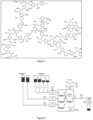
- FIG. 2 represents a schematic diagram of the control unit that explains a typical scenario during one tube-blocking test run.
- Pump 1 injects cation brine aqueous solutions
- pump 2 is responsible to pump four different solutions controlled by valves A, B, C and D.
- Valve A is responsible for pumping the anion brine aqueous solutions
- valve B injects inhibitors solution (dissolved in anion brine) at a certain flow rate which is then mixed and pumped into the scale coil.
- Valve A and B have to open and close simultaneously to maintain the flow rate inside the coil.
- One full run consists of two successive tests, controlled by the automated scale rig: The first is 'Chemical' where cation and anion brines are mixed with inhibitor solution and being pumped into the scaling coil at a flow rate of 10 mL/min.
- the test consists of several automated periods, each with a duration of 1 hr. In each test the inhibitor concentration is getting decreased gradually until the rapid tube blocking occurs at a certain inhibitor concentration.
- the second one is 'Repeat Chemical' which starts from a stage with inhibitor concentration same as the one that led to rapid scale formation.
- the initial concentration of the stock inhibitor solution (SLS dissolved in anion brine) is about 200 ppm with a pH of 7.
- the brines and the inhibitor solution are mixed at a certain ratio to obtain a desired inhibitor concentration inside the test coil.
- FIC Fail Inhibitor Concentration
- the synthetic brine used in this study is modelled according to the water produced in Heidrun oilfield, Norway. Formation water was used only for the calcite scale test.
- the salt compositions for the brines are given in Table 3 below. Before each experiment, the brines, scale inhibitor solutions and the cleaning liquids are freshly prepared and degassed thoroughly to avoid complications during the automated run. Table 3. Salt composition for brines 1 and 2 for calcite scaling. Ion Conc.
- Brine 1 (g/ 3L) Brine 2 (g/ 3L) Na + 39020 NaCl 148.77 148.77 Ca 2+ 2040 CaCl 2 , 2H 2 O 22.45 Mg 2+ 530 MgCl 2 , 6H 2 O 13.30 K + 1090 KCI 6.23 Ba 2+ 570 BaCl 2 , 2H 2 O 3.04 Sr 2+ 290 SrCl 2 . 6H 2 O 2.65 HCO 3 - 1000 NaHCOs 8.26
- Formation water can have high levels of Ca 2+ ion which can cause serious problem if the injected scale inhibitor is not compatible with brines. If incompatible, the scale inhibitor itself can precipitate via formation of insoluble Ca 2+ -scale inhibitor complex during the squeeze treatment. It can block the pores of the formation rocks and cause severe formation damage. Therefore, all the scale inhibitors were screened to determine their Ca-tolerance limit.
- a simple test method was used to check the initial compatibility of the scale inhibitors with cation brine, especially with Ca ion. Roughly 1 mL of a 1 wt% solution of scale inhibitors in distilled water was mixed with equal volume of cation brine and the resulting solution was heated to 90°C. The solution was later checked for any occurring precipitate or turbidity.
- Temperature stability tests are performed to test whether the scale inhibitors can retain their inhibition performance under reservoir conditions, including squeeze treatments.
- a 5 wt% solution of scale inhibitor in distilled water equipped with a magnetic stir-bar were placed inside a hard-glass tube fitted with a Teflon stopcock. The solution was then subjected to three repetitive cycles of vacuum-refill (with nitrogen) before finally sealing off under a nitrogen atmosphere.
- the tube was then placed at an oil bath preheated at 130 °C or 160 °C and maintained at that temperature for 14 or 10 days. Afterwards, the water was evaporated off, and the solid sample was tested in the scale rig.
- the inhibition performance of the thermally aged inhibitor is compared to the non-aged ones to determine whether they are stable when exposed to high-temperature conditions.
- 1 H- 13 C HSQC spectra were optimized for the methoxy groups (1JC,H coupling constant of 145 Hz ) and recorded in the phase-sensitive mode using echo-antiecho with the standard Bruker pulse sequence. 200 t1 experiments of 1k real data points (24 scans and 16 dummy scans) were recorded with a relaxation delay of 3 s, spectral width 9 ppm for proton and 130 ppm for carbon. Total experiment time 4.5 hours. A squared sine window function was employed in both directions after zerofilling to a matrix of 1k*1k data points.
- the spectra were phase-corrected in the F2-direction, baseline-corrected in both F1 and F2 direction using the automatic 5th degree polynominal function, and the sum projection calculated for the F1-direction.
- the amount of methoxy groups was determined from the signal intensity in the 53-58 ppm region.
- Inorganic sulfur is determined by measuring sulfate in oxidized samples using ion chromatography with conductivity detection (Dionex instrument using an IonPac AS11 - HC column with 13 mM OH- eluent). 30 mg samples are weighed into 50-ml volumetric flasks. 10 ml of 0.5 % NaOH and 5 ml of 3 % H 2 O 2 are added to oxidize sulfurous inorganic anions into sulfate. Samples are then left 12-16 h to give time to react. Milli-Q water is added and pH neutralized by adding 2 ml of 5 % CH 3 COOH and diluted to the mark with Milli-Q water. Sulfate standards are prepared between 5 mg/L and 80 mg/L. The sulfate content in the oxidized samples is then determined using ion chromatography according to the instrument manual.
- the 31 P NMR experiment is run with the BBO probe at 300 K.
- the NMR experiment settings are the following for a 500 MHz Avance III Bruker instrument: Table 4 Parameters Value P-31 frequency 202.4867 Hz Pulseprogram zgig Relaxation delay 15 sec Number of scans 128 Number of dummy scans 4 Sweepwidth 70 ppm Offset 150 ppm Acquisition time 1.15 sec FID resolution 0.43 Hz Temperature 300 K
- phase of the frequency domain spectrum is corrected manually (.ph) followed by apodization-fourier transformation-automatic phase correction (efp) and finally base correction (abs).
- Calibration of the spectrum is done by using the sharp peak of the reaction's by-product between the phosphorylation reagent and water at 132.20 ppm.
- the cholesterol's peak at 144.8 ppm is integrated first between 145.0-144.4 ppm and calibrated at 1.
- the mass of -COOH groups on the lignin polymer can then be calculated using the molecular weight of a -COOH functional group (45.0174 g/mol), and the wt.% based on the total weight of the oxidized sulfonated lignin can be calculated.
- the inventors of the present invention have studied the scale inhibiting performance and calcium compatibility of a range of sulfonated lignins with varying character.
- Sulfonated lignins A and B are lignosulfonates produced from spent sulfite liquor raw material without further modification.
- Sulfonated lignins C and D are alkali lignosulfonates produced in accordance with the hydrothermal caustic treatment described in the prior art mentioned above (see US 3,849,328 and US 2,505,457 , respectively)
- Sulfonated lignin E was an oxidized lignosulfonate as described in WO 2021/165298 .
- Sulfonated lignins F and G are according to the present invention and have been prepared as set out above.
- sulfonated lignin scale inhibitors should have a FIC value comparable to or better than commercial synthetic scale inhibitors (see Table 2 above) and have good compatibility with the calcium salt brine.
- Table 6 shows that only sulfonated lignins with a combination of both high -COOH content and low methoxy group content performed well enough to be considered commercially relevant (lignosulfonates F and G).
- Unmodified lignosulfonates (A and B) and the hydrothermal alkali treated lignosulfonates of the prior art (C and D) did not have this combination of attributes and did not perform well enough to be considered relevant for oilfield scale inhibition application.
- Oxidized lignosulfonate E had not been oxidized severely enough and did not have the advantageous combination of attributes and did not perform well enough to be considered relevant for oilfield scale inhibition application.
- Lignosulfonate F was further tested for thermal stability (Table 7) and found to be stable under prolonged high temperature conditions: Table 7: Performance of lignosulfonate F after thermal treatment Sulfonated lignin FIC before thermal treatment* FIC after 14 days at 130 °C* FIC after 10 days at 160 °C* F 5 ppm 5 ppm 10 ppm * Determined according to the scale rig test described below.
Landscapes
- Chemical & Material Sciences (AREA)
- Organic Chemistry (AREA)
- Life Sciences & Earth Sciences (AREA)
- General Life Sciences & Earth Sciences (AREA)
- Engineering & Computer Science (AREA)
- Materials Engineering (AREA)
- Inorganic Chemistry (AREA)
- Compounds Of Unknown Constitution (AREA)
Priority Applications (3)
| Application Number | Priority Date | Filing Date | Title |
|---|---|---|---|
| EP23178014.9A EP4474445A1 (de) | 2023-06-07 | 2023-06-07 | Sulfonierte lignine zur kesselsteinhemmung |
| CN202480037340.3A CN121487984A (zh) | 2023-06-07 | 2024-06-07 | 用于阻垢的磺化木质素 |
| PCT/EP2024/065740 WO2024251950A1 (en) | 2023-06-07 | 2024-06-07 | Sulfonated lignins for scale inhibition |
Applications Claiming Priority (1)
| Application Number | Priority Date | Filing Date | Title |
|---|---|---|---|
| EP23178014.9A EP4474445A1 (de) | 2023-06-07 | 2023-06-07 | Sulfonierte lignine zur kesselsteinhemmung |
Publications (1)
| Publication Number | Publication Date |
|---|---|
| EP4474445A1 true EP4474445A1 (de) | 2024-12-11 |
Family
ID=86732788
Family Applications (1)
| Application Number | Title | Priority Date | Filing Date |
|---|---|---|---|
| EP23178014.9A Pending EP4474445A1 (de) | 2023-06-07 | 2023-06-07 | Sulfonierte lignine zur kesselsteinhemmung |
Country Status (3)
| Country | Link |
|---|---|
| EP (1) | EP4474445A1 (de) |
| CN (1) | CN121487984A (de) |
| WO (1) | WO2024251950A1 (de) |
Citations (9)
| Publication number | Priority date | Publication date | Assignee | Title |
|---|---|---|---|---|
| US2297670A (en) | 1938-10-31 | 1942-09-29 | Wilburn C Schroeder | Method of protecting boilers and the like against embrittlement |
| US2505457A (en) | 1947-06-19 | 1950-04-25 | Nat Aluminate Corp | Method of inhibiting scale |
| US3726850A (en) * | 1971-07-29 | 1973-04-10 | American Can Co | Lignin dispersing agent |
| US3849328A (en) | 1972-05-04 | 1974-11-19 | Texaco Inc | Process and composition for inhibiting scale deposition |
| US20130137799A1 (en) | 2009-07-31 | 2013-05-30 | Akzo Nobel N.V. | Graft copolymers |
| CN102604120B (zh) * | 2012-02-29 | 2013-11-20 | 福州大学 | 采用两步氧化法制备木质素磺酸盐分散剂的方法 |
| WO2021165298A1 (en) | 2020-02-17 | 2021-08-26 | Borregaard As | Lignin derivative for reducing dishwasher film |
| WO2021197624A1 (en) * | 2020-04-03 | 2021-10-07 | Rockwool International A/S | Solid state binder |
| WO2022194774A1 (en) * | 2021-03-16 | 2022-09-22 | Borregaard As | Biobased dispersants for laundry cleaning applications |
-
2023
- 2023-06-07 EP EP23178014.9A patent/EP4474445A1/de active Pending
-
2024
- 2024-06-07 CN CN202480037340.3A patent/CN121487984A/zh active Pending
- 2024-06-07 WO PCT/EP2024/065740 patent/WO2024251950A1/en not_active Ceased
Patent Citations (9)
| Publication number | Priority date | Publication date | Assignee | Title |
|---|---|---|---|---|
| US2297670A (en) | 1938-10-31 | 1942-09-29 | Wilburn C Schroeder | Method of protecting boilers and the like against embrittlement |
| US2505457A (en) | 1947-06-19 | 1950-04-25 | Nat Aluminate Corp | Method of inhibiting scale |
| US3726850A (en) * | 1971-07-29 | 1973-04-10 | American Can Co | Lignin dispersing agent |
| US3849328A (en) | 1972-05-04 | 1974-11-19 | Texaco Inc | Process and composition for inhibiting scale deposition |
| US20130137799A1 (en) | 2009-07-31 | 2013-05-30 | Akzo Nobel N.V. | Graft copolymers |
| CN102604120B (zh) * | 2012-02-29 | 2013-11-20 | 福州大学 | 采用两步氧化法制备木质素磺酸盐分散剂的方法 |
| WO2021165298A1 (en) | 2020-02-17 | 2021-08-26 | Borregaard As | Lignin derivative for reducing dishwasher film |
| WO2021197624A1 (en) * | 2020-04-03 | 2021-10-07 | Rockwool International A/S | Solid state binder |
| WO2022194774A1 (en) * | 2021-03-16 | 2022-09-22 | Borregaard As | Biobased dispersants for laundry cleaning applications |
Non-Patent Citations (3)
| Title |
|---|
| "KIRK-OTHMER ENCYCLOPEDIA OF CHEMICAL TECHNOLOGY (4th edition)", 15 December 2015, WILEY-INTERSCIENCE, Hoboken, NJ, USA, ISBN: 978-0-471-48494-3, article GARGULAK JERRY D. ET AL: "Lignin", pages: 1 - 26, XP055969095, DOI: 10.1002/0471238961.12090714120914.a01.pub3 * |
| ARGYROPOULOS, D.S.ABACHERLI, A.RINCΔN, A.G.ARX, U.V.: "Analytical Methods for Lignin Characterisation", 2009, INTERNATIONAL LIGNIN INSTITUTE, article "Quantitative 31 P nuclear magnetic resonance (NMR) spectra of lignin" |
| IND. ENG. CHEM. RES., vol. 45, no. 16, 2006, pages 5716 - 5721 |
Also Published As
| Publication number | Publication date |
|---|---|
| WO2024251950A1 (en) | 2024-12-12 |
| CN121487984A (zh) | 2026-02-06 |
Similar Documents
| Publication | Publication Date | Title |
|---|---|---|
| EP2872453B1 (de) | Markierte kesselsteinhemmende polymerzusammensetzungen und verfahren zur verhinderung der bildung von kesselstein | |
| AU2016200974B2 (en) | Thermally stable scale inhibitor compositions | |
| Ganguly et al. | Sustainable calcite scale inhibitors via oxidation of lignosulfonates | |
| US20110046025A1 (en) | Low Molecular Weight Graft Copolymers | |
| Jarrahian et al. | Experimental Investigation of the interaction between a phosphate ester scale inhibitor and carbonate rocks for application in squeeze treatments | |
| EP2751216B1 (de) | Alternative ligandformulierungen für zelluloseprodukte | |
| NZ510148A (en) | Process for the inhibition of scale in kraft process and polymeric antiscalants for same | |
| FI111732B (fi) | Ligandimodifioitu selluloosatuote | |
| EP0157465A1 (de) | In Wasser nachweisbare Polymermischungen | |
| EP4474445A1 (de) | Sulfonierte lignine zur kesselsteinhemmung | |
| Ismail et al. | Synthesis and evaluation of a novel polyacrylamide functionalized nano-silica as a calcium carbonate inhibitor in upstream applications | |
| FI63432B (fi) | Preparat bestaoende av lignosulfonater | |
| JPH07173226A (ja) | ビニルスルホン酸ポリマー | |
| US20220275126A1 (en) | Processs to obtain random terpolymers derived from itaconic acid, aconitic acid and/or its isomers, and alkenyl sulfonates and use of the product thereof | |
| WO2014055343A1 (en) | Traceable polymeric sulfonate scale inhibitors and methods of using | |
| Wang et al. | Structural evolution and reaction kinetics of lignin-carbohydrate complex oxidized by chlorine dioxide | |
| Baig et al. | Phosphonated inulin as an eco-friendly thermally stable scale inhibitor for the oil and gas industry: Synthesis, characterization, efficacy, and molecular insights | |
| SA118400046B1 (ar) | بوليمر مشترك عشوائي، وطريقة تحضيره واستخدامه، ومائع حفر | |
| US3849328A (en) | Process and composition for inhibiting scale deposition | |
| CN117247163A (zh) | 一种油田污水处理防垢剂及其制备方法 | |
| CN104591412A (zh) | 一种防垢剂及其制备方法 | |
| CN111094507A (zh) | 水溶性芘三磺酸聚合物及其制备方法 | |
| Moulay et al. | Low molecular weight poly (acrylic acid) as a salt scaling inhibitor in oilfield operations | |
| CN104293324B (zh) | 一种超高温钻井液降滤失剂及其制备方法 | |
| WO2025015393A1 (pt) | Compostos inibidores de incrustações inorgânicas e método de preparo dos mesmos |
Legal Events
| Date | Code | Title | Description |
|---|---|---|---|
| PUAI | Public reference made under article 153(3) epc to a published international application that has entered the european phase |
Free format text: ORIGINAL CODE: 0009012 |
|
| STAA | Information on the status of an ep patent application or granted ep patent |
Free format text: STATUS: THE APPLICATION HAS BEEN PUBLISHED |
|
| AK | Designated contracting states |
Kind code of ref document: A1 Designated state(s): AL AT BE BG CH CY CZ DE DK EE ES FI FR GB GR HR HU IE IS IT LI LT LU LV MC ME MK MT NL NO PL PT RO RS SE SI SK SM TR |