EP4474003A1 - Vorrichtung zur behandlung durch phototherapie - Google Patents
Vorrichtung zur behandlung durch phototherapie Download PDFInfo
- Publication number
- EP4474003A1 EP4474003A1 EP24180040.8A EP24180040A EP4474003A1 EP 4474003 A1 EP4474003 A1 EP 4474003A1 EP 24180040 A EP24180040 A EP 24180040A EP 4474003 A1 EP4474003 A1 EP 4474003A1
- Authority
- EP
- European Patent Office
- Prior art keywords
- helmet
- support
- base
- seat
- light source
- Prior art date
- Legal status (The legal status is an assumption and is not a legal conclusion. Google has not performed a legal analysis and makes no representation as to the accuracy of the status listed.)
- Pending
Links
Images


Classifications
-
- A—HUMAN NECESSITIES
- A61—MEDICAL OR VETERINARY SCIENCE; HYGIENE
- A61N—ELECTROTHERAPY; MAGNETOTHERAPY; RADIATION THERAPY; ULTRASOUND THERAPY
- A61N5/00—Radiation therapy
- A61N5/06—Radiation therapy using light
- A61N5/0613—Apparatus adapted for a specific treatment
- A61N5/0616—Skin treatment other than tanning
- A61N5/0617—Hair treatment
-
- A—HUMAN NECESSITIES
- A61—MEDICAL OR VETERINARY SCIENCE; HYGIENE
- A61N—ELECTROTHERAPY; MAGNETOTHERAPY; RADIATION THERAPY; ULTRASOUND THERAPY
- A61N5/00—Radiation therapy
- A61N5/06—Radiation therapy using light
- A61N2005/0635—Radiation therapy using light characterised by the body area to be irradiated
- A61N2005/0643—Applicators, probes irradiating specific body areas in close proximity
- A61N2005/0645—Applicators worn by the patient
- A61N2005/0647—Applicators worn by the patient the applicator adapted to be worn on the head
Definitions
- the present invention relates to a phototherapy treatment device for an external region of the body of a living being. More particularly but not exclusively, it applies to phototherapy treatment of the head surface of a user, for example to treatment of the scalp as a treatment for baldness.
- the treatment consists of applying light radiation with a predefined emission spectrum directly to the scalp.
- This phototherapy treatment can also be applied in combination with a photosensitizing product applied to the area to be treated a few hours before exposure to the light radiation to increase the effectiveness of the treatment.
- dynamic phototherapy also known by the English acronym PDT "Photo Dynamic Therapy”
- the radiation is preferably substantially monochromatic or has an emission spectrum within a relatively narrow band of wavelengths.
- the emission spectrum includes a peak wavelength in visible red light or visible blue light, these wavelengths having demonstrated particular efficacy for the treatment of certain skin conditions and scalp treatment.
- phototherapy treatment in a predefined wavelength range can have a beneficial effect on many skin problems, such as scars, stretch marks, acne, wrinkles and fine lines and many hair problems including alopecia.
- the cells in the irradiated region will react according to a principle similar to that of plant photosynthesis.
- the light will stimulate the cells, and more specifically certain cellular structures of the cell, such as the mitochondria.
- ATP acronym for Adenosine Tri Phosphate
- EP2477697 a phototherapy treatment device for the scalp of a user, comprising a helmet defining an open end through which, in the use position, the user's head is at least partially engaged.
- the helmet described in this document has certain significant drawbacks, particularly in terms of practicality and ergonomics.
- phototherapy objects are now considered as well-being products and must integrate as well as possible into the daily life and the environment of users. These objects must therefore be both ergonomic and aesthetic by offering an overall visual aspect of premium quality. Different characteristics make it possible to provide a perception of quality such as the choice of materials, weight and ergonomics.
- the invention proposes to provide a solution to improve the daily use of these objects while providing a perception of quality, ergonomics and increased technicality.
- the invention relates to a support for a phototherapy treatment helmet incorporating a light source emitting inside the helmet to treat the scalp of a user's head, characterized in that it comprises a base for powering the helmet during treatment, the base comprising a user interface configured to control the light source of the helmet, and comprises an arm extending in a substantially vertical direction mounted at a first end on the base and extended at a second end by a helmet support seat extending in a substantially horizontal direction.
- the seat having a generally oblong shape defining crossed longitudinal and transverse directions
- the helmet is configured to be carried by the support such that in the support configuration, the longitudinal direction of the support extends along an axis extending transversely between two lateral auricular zones of the helmet.
- the seat has a generally curved shape with edges falling in the longitudinal direction and is configured to support the helmet in a top portion.
- the seat is in the form of a curved ovoid plate rounded on the peripheral edges.
- the contact surface with the helmet of the support seat to form an adhesion surface of the helmet on the support.
- the seat comprises a silicone layer overmolded on a surface for adhesion to the helmet.
- the surface of the seat in contact with the helmet comprises a plurality of anti-slip pins on the upper surface of the support.
- the base is a weighted base, for example by a piece of platinum housed inside a housing.
- the base encloses an electronic card for controlling the light source of the helmet according to a predefined protocol.
- the invention also relates to a device for phototherapy treatment of a surface of a user's scalp, comprising a helmet and a helmet support, characterized in that the support is according to the invention.
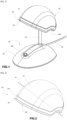
- the device 10 comprises a phototherapy helmet 20 and a support 40 of the helmet 20 bearing the reference 14.
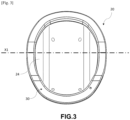
- the helmet 20 is illustrated in detail in [ Fig.2 ] and in [ Fig.3 ].
- the helmet 20 comprises a body 22 of generally hemispherical shape delimiting an opening for the passage of the head of a user.
- the body 22 also delimits an interior cavity which makes it possible to cover a surface of the scalp of the user.
- the body 22 of the helmet 20 conventionally incorporates a light source (not visible in the figures) which emits towards the surface to be treated towards the inside of the helmet 20.
- the light source comprises in this example a plurality of light-emitting diodes preferably emitting red light with a wavelength around 630 nanometers, for example in a range of 620 to 640 nanometers. Alternatively, other wavelengths of light may be used depending on the nature of the desired phototherapy treatment.
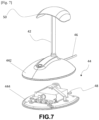
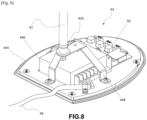
- the support 40 comprises a base 44 for electrically powering the light source of the helmet 20 during treatment.
- the base 44 encloses for example an electronic control card 448 of the light source of the helmet 20 according to a predefined protocol.
- the support 40 also comprises a power cable 46 from the electronic card 448 of the base 44 to an external power source, for example the general power supply of a domestic electrical network.
- an external power source for example the general power supply of a domestic electrical network.
- connection means 48 comprise, for example, an electrical connection socket, such as a USB socket, a jack socket, etc., to which a power cable (not visible in the figures) of the headset 20 is connected.
- the base 44 further comprises a user interface 440.
- the user interface 440 is supported hardware directly on the base 44 of the device 10, for example by a touch-sensitive or non-touch button or alternatively, for example by sliders and adjustment wheels of the buttons implemented hardware on the base 44.
- This user interface 440 makes it possible to control the switching on and off of the light source of the headset 10.
- the base of the support comprises a display window forming the user interface.
- the user interface is supported in software on a tablet (not illustrated).
- the tablet communicates for example with the device 10 by a wired or wireless connection (for example by Bluetooth ® or by WiFi), via a control module housed in the base.
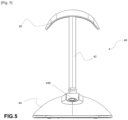
- the support 40 comprises an arm 42, such as a self-supporting rod 42, mounted at a first end 422 on the base 44 and extended at a second end 424 by a seat 50 for supporting the helmet 20 in a balanced position.
- This arm 42 extends substantially vertically in a configuration of use of the support.
- the seat 50 extends in a substantially horizontal direction.
- Base 44 includes a base housing, as illustrated in [ Fig.3 ] on which the rod 42 is fixed by its end 420.
- the base 44 comprises a bracket 448 for fixing the rod 42.
- the housing comprises a cover 442 mounted on a base 444.
- the base 44 is preferably weighted for example by a piece of platinum 446 housed inside the housing forming the base of the support 40.
- the base 44 has both a counterweight function to form a stable support for the helmet 20 and a basic function of controlling the light source.
- the seat 50 has a generally oblong shape and defines a longitudinal direction 52 and a transverse direction 54 crossed.
- the headset 20 is configured to be carried by the support 50 such that in the support configuration, the longitudinal direction of the support 50 extends along a transverse axis X1 extending between the two lateral auricular zones 210 of the headset 20.
- each lateral auricular zone 210 delimits a lateral excursion in the shape of a lobe for bypassing the ear.
- the seat 50 is provided with a complementary shape conformation when the helmet 20 is associated with the support 40.
- the seat 50 is configured to be positioned opposite the top position of the helmet 20.
- this conformation makes it possible to naturally and intuitively suggest the positioning of the helmet 20 on the support 40.
- the seat 50 has a generally curved shape, for example in the form of a convex cap configured to support the helmet 20 in its top part.
- the cap is in the form of a curved ovoid plate rounded on the peripheral edges, and in particular on its two transverse end edges. This rounded tongue shape on its two transverse lateral edges makes it possible to match the internal curvature of the helmet 20.
- the contact surface with the helmet 20 of the seat 50 supporting the helmet 20 has adhesion properties of the helmet 20 on the support 40.
- the seat 50 comprises an overmolded silicone layer to form an adhesion surface with the helmet 20.
- the surface of the seat 50 comprises a plurality of anti-slip pins on the upper surface of the support 40.
- the helmet 10 is balanced on the support 40, in this case on the seat 50 provided for this purpose.
- This seat 50 has crossed directions which are such that the helmet is perfectly supported along the axis X1 and that the helmet 10 pivots slightly towards its final position by tilting under the effect of gravity around this X1 axis in order to naturally come into a stable equilibrium position.
Landscapes
- Health & Medical Sciences (AREA)
- Biomedical Technology (AREA)
- Life Sciences & Earth Sciences (AREA)
- Engineering & Computer Science (AREA)
- Nuclear Medicine, Radiotherapy & Molecular Imaging (AREA)
- Pathology (AREA)
- Biophysics (AREA)
- Radiology & Medical Imaging (AREA)
- Animal Behavior & Ethology (AREA)
- General Health & Medical Sciences (AREA)
- Public Health (AREA)
- Veterinary Medicine (AREA)
- Radiation-Therapy Devices (AREA)
Applications Claiming Priority (1)
| Application Number | Priority Date | Filing Date | Title |
|---|---|---|---|
| FR2305755A FR3149511B1 (fr) | 2023-06-07 | 2023-06-07 | Dispositif de traitement par photothérapie. |
Publications (1)
| Publication Number | Publication Date |
|---|---|
| EP4474003A1 true EP4474003A1 (de) | 2024-12-11 |
Family
ID=87974527
Family Applications (1)
| Application Number | Title | Priority Date | Filing Date |
|---|---|---|---|
| EP24180040.8A Pending EP4474003A1 (de) | 2023-06-07 | 2024-06-04 | Vorrichtung zur behandlung durch phototherapie |
Country Status (2)
| Country | Link |
|---|---|
| EP (1) | EP4474003A1 (de) |
| FR (1) | FR3149511B1 (de) |
Citations (4)
| Publication number | Priority date | Publication date | Assignee | Title |
|---|---|---|---|---|
| US20040153131A1 (en) * | 2003-02-04 | 2004-08-05 | Yorke John A. | Apparatus and method for hair retention and regeneration |
| EP2477697A2 (de) | 2009-09-18 | 2012-07-25 | Apira Science, Inc. | Lichttherapievorrichtung für behandlungen der haare und der kopfhaut |
| US20190060662A1 (en) * | 2017-08-28 | 2019-02-28 | Capillus, Llc | Laser therapy apparatus with silicone liner |
| KR20200081882A (ko) * | 2018-12-28 | 2020-07-08 | (주)셀리턴 | 헤어 관리 장치 세트 |
-
2023
- 2023-06-07 FR FR2305755A patent/FR3149511B1/fr active Active
-
2024
- 2024-06-04 EP EP24180040.8A patent/EP4474003A1/de active Pending
Patent Citations (4)
| Publication number | Priority date | Publication date | Assignee | Title |
|---|---|---|---|---|
| US20040153131A1 (en) * | 2003-02-04 | 2004-08-05 | Yorke John A. | Apparatus and method for hair retention and regeneration |
| EP2477697A2 (de) | 2009-09-18 | 2012-07-25 | Apira Science, Inc. | Lichttherapievorrichtung für behandlungen der haare und der kopfhaut |
| US20190060662A1 (en) * | 2017-08-28 | 2019-02-28 | Capillus, Llc | Laser therapy apparatus with silicone liner |
| KR20200081882A (ko) * | 2018-12-28 | 2020-07-08 | (주)셀리턴 | 헤어 관리 장치 세트 |
Also Published As
| Publication number | Publication date |
|---|---|
| FR3149511A1 (fr) | 2024-12-13 |
| FR3149511B1 (fr) | 2025-05-23 |
Similar Documents
| Publication | Publication Date | Title |
|---|---|---|
| US8252033B2 (en) | Phototherapy apparatus for skin treatment | |
| EP2416846B1 (de) | Verfahren und gerät zur kosmetischen hautpflege | |
| US20100076529A1 (en) | Phototherapy apparatus for hair, scalp and skin treatment | |
| US20130041432A1 (en) | Device for promoting growth of eyebrow hair | |
| US11123572B2 (en) | Eyewear phototherapy device for eye cosmetology | |
| CN205072328U (zh) | 化妆镜 | |
| US10610448B2 (en) | Spa apparatus | |
| EP4474003A1 (de) | Vorrichtung zur behandlung durch phototherapie | |
| CN106334268A (zh) | 一种基于互联网云端大数据的智能面部美容仪 | |
| FR2892940A1 (fr) | Dispositif biomedical de traitement par immersion virtuelle | |
| EP4182016A1 (de) | Freihändige lichttherapievorrichtung | |
| US20140252924A1 (en) | Beauty Center | |
| EP3174598B1 (de) | Vorrichtung zum anbringen von aktiven elementen am schädel eines patienten | |
| JP2018102546A (ja) | 光覚醒用照明体を備えた化粧鏡 | |
| FR3071743B1 (fr) | Dispositif cosmetique de soin de la peau du visage sous forme de masque | |
| KR102577222B1 (ko) | 물품 전시장치 | |
| FR3143373A1 (fr) | Dispositif de traitement par photothérapie | |
| EP4585259A2 (de) | Vorrichtung zur behandlung durch phototherapie | |
| TWD113103S1 (zh) | 眼鏡之模組 | |
| FR3042420A1 (fr) | Dispositif de traitement par phototherapie | |
| KR102279869B1 (ko) | 휴대의 편의성을 강화한 폴더형 피부 개선용 광 조사기 | |
| EP4474005A1 (de) | Vorrichtung zur behandlung durch phototherapie | |
| FR3110085A1 (fr) | Dispositif de traitement par photothérapie. | |
| CN219595653U (zh) | 一种光照美容及化妆装置 | |
| EP4474004A1 (de) | Vorrichtung zur behandlung durch phototherapie |
Legal Events
| Date | Code | Title | Description |
|---|---|---|---|
| PUAI | Public reference made under article 153(3) epc to a published international application that has entered the european phase |
Free format text: ORIGINAL CODE: 0009012 |
|
| STAA | Information on the status of an ep patent application or granted ep patent |
Free format text: STATUS: THE APPLICATION HAS BEEN PUBLISHED |
|
| AK | Designated contracting states |
Kind code of ref document: A1 Designated state(s): AL AT BE BG CH CY CZ DE DK EE ES FI FR GB GR HR HU IE IS IT LI LT LU LV MC ME MK MT NL NO PL PT RO RS SE SI SK SM TR |
|
| STAA | Information on the status of an ep patent application or granted ep patent |
Free format text: STATUS: REQUEST FOR EXAMINATION WAS MADE |
|
| 17P | Request for examination filed |
Effective date: 20250511 |
|
| GRAP | Despatch of communication of intention to grant a patent |
Free format text: ORIGINAL CODE: EPIDOSNIGR1 |
|
| STAA | Information on the status of an ep patent application or granted ep patent |
Free format text: STATUS: GRANT OF PATENT IS INTENDED |
|
| INTG | Intention to grant announced |
Effective date: 20251009 |
|
| RAP3 | Party data changed (applicant data changed or rights of an application transferred) |
Owner name: LUCIBEL SA |
|
| RAP3 | Party data changed (applicant data changed or rights of an application transferred) |
Owner name: LUCIBEL SA |