EP4472103A2 - Koordinierte gemeinsame frequenznutzung zwischen satelliten- und terrestrischen funkzugangsnetzwerken - Google Patents
Koordinierte gemeinsame frequenznutzung zwischen satelliten- und terrestrischen funkzugangsnetzwerken Download PDFInfo
- Publication number
- EP4472103A2 EP4472103A2 EP24174994.4A EP24174994A EP4472103A2 EP 4472103 A2 EP4472103 A2 EP 4472103A2 EP 24174994 A EP24174994 A EP 24174994A EP 4472103 A2 EP4472103 A2 EP 4472103A2
- Authority
- EP
- European Patent Office
- Prior art keywords
- satellite
- base station
- signals
- coverage area
- terrestrial
- Prior art date
- Legal status (The legal status is an assumption and is not a legal conclusion. Google has not performed a legal analysis and makes no representation as to the accuracy of the status listed.)
- Pending
Links
- 238000000034 method Methods 0.000 claims abstract description 46
- 230000000116 mitigating effect Effects 0.000 claims abstract description 37
- 238000001228 spectrum Methods 0.000 claims description 18
- 230000015556 catabolic process Effects 0.000 claims description 13
- 238000006731 degradation reaction Methods 0.000 claims description 13
- 230000005540 biological transmission Effects 0.000 claims description 6
- 208000018910 keratinopathic ichthyosis Diseases 0.000 claims 7
- 238000004891 communication Methods 0.000 abstract description 22
- 238000003860 storage Methods 0.000 description 15
- 238000005516 engineering process Methods 0.000 description 13
- 230000001413 cellular effect Effects 0.000 description 10
- 230000008054 signal transmission Effects 0.000 description 6
- 238000004590 computer program Methods 0.000 description 2
- 238000010586 diagram Methods 0.000 description 2
- 230000006870 function Effects 0.000 description 2
- 230000003287 optical effect Effects 0.000 description 2
- 230000000644 propagated effect Effects 0.000 description 2
- 229940121710 HMGCoA reductase inhibitor Drugs 0.000 description 1
- 230000009471 action Effects 0.000 description 1
- 230000002776 aggregation Effects 0.000 description 1
- 238000004220 aggregation Methods 0.000 description 1
- 230000003466 anti-cipated effect Effects 0.000 description 1
- 230000010267 cellular communication Effects 0.000 description 1
- 230000008859 change Effects 0.000 description 1
- 230000007423 decrease Effects 0.000 description 1
- 230000000694 effects Effects 0.000 description 1
- 230000010354 integration Effects 0.000 description 1
- 238000002955 isolation Methods 0.000 description 1
- 238000004519 manufacturing process Methods 0.000 description 1
- 238000007639 printing Methods 0.000 description 1
- 230000011664 signaling Effects 0.000 description 1
- 230000007723 transport mechanism Effects 0.000 description 1
Images


Classifications
-
- H—ELECTRICITY
- H04—ELECTRIC COMMUNICATION TECHNIQUE
- H04B—TRANSMISSION
- H04B7/00—Radio transmission systems, i.e. using radiation field
- H04B7/14—Relay systems
- H04B7/15—Active relay systems
- H04B7/185—Space-based or airborne stations; Stations for satellite systems
- H04B7/1851—Systems using a satellite or space-based relay
- H04B7/18513—Transmission in a satellite or space-based system
-
- H—ELECTRICITY
- H04—ELECTRIC COMMUNICATION TECHNIQUE
- H04B—TRANSMISSION
- H04B7/00—Radio transmission systems, i.e. using radiation field
- H04B7/14—Relay systems
- H04B7/15—Active relay systems
- H04B7/185—Space-based or airborne stations; Stations for satellite systems
- H04B7/1853—Satellite systems for providing telephony service to a mobile station, i.e. mobile satellite service
- H04B7/18563—Arrangements for interconnecting multiple systems
-
- H—ELECTRICITY
- H04—ELECTRIC COMMUNICATION TECHNIQUE
- H04W—WIRELESS COMMUNICATION NETWORKS
- H04W16/00—Network planning, e.g. coverage or traffic planning tools; Network deployment, e.g. resource partitioning or cells structures
- H04W16/14—Spectrum sharing arrangements between different networks
-
- H—ELECTRICITY
- H04—ELECTRIC COMMUNICATION TECHNIQUE
- H04W—WIRELESS COMMUNICATION NETWORKS
- H04W52/00—Power management, e.g. Transmission Power Control [TPC] or power classes
- H04W52/04—Transmission power control [TPC]
- H04W52/18—TPC being performed according to specific parameters
- H04W52/24—TPC being performed according to specific parameters using SIR [Signal to Interference Ratio] or other wireless path parameters
- H04W52/241—TPC being performed according to specific parameters using SIR [Signal to Interference Ratio] or other wireless path parameters taking into account channel quality metrics, e.g. SIR, SNR, CIR or Eb/lo
-
- H—ELECTRICITY
- H04—ELECTRIC COMMUNICATION TECHNIQUE
- H04W—WIRELESS COMMUNICATION NETWORKS
- H04W52/00—Power management, e.g. Transmission Power Control [TPC] or power classes
- H04W52/04—Transmission power control [TPC]
- H04W52/18—TPC being performed according to specific parameters
- H04W52/24—TPC being performed according to specific parameters using SIR [Signal to Interference Ratio] or other wireless path parameters
- H04W52/243—TPC being performed according to specific parameters using SIR [Signal to Interference Ratio] or other wireless path parameters taking into account interferences
-
- H—ELECTRICITY
- H04—ELECTRIC COMMUNICATION TECHNIQUE
- H04W—WIRELESS COMMUNICATION NETWORKS
- H04W72/00—Local resource management
- H04W72/04—Wireless resource allocation
- H04W72/044—Wireless resource allocation based on the type of the allocated resource
- H04W72/0453—Resources in frequency domain, e.g. a carrier in FDMA
-
- H—ELECTRICITY
- H04—ELECTRIC COMMUNICATION TECHNIQUE
- H04W—WIRELESS COMMUNICATION NETWORKS
- H04W72/00—Local resource management
- H04W72/50—Allocation or scheduling criteria for wireless resources
- H04W72/54—Allocation or scheduling criteria for wireless resources based on quality criteria
- H04W72/541—Allocation or scheduling criteria for wireless resources based on quality criteria using the level of interference
Definitions
- the present disclosure is directed to sharing radio frequency spectrum assets between satellite and terrestrial radio access networks, substantially as shown and/or described in connection with at least one of the Figures, and as set forth more completely in the claims.
- one or more mitigating procedures are implemented by a base station of a terrestrial radio access network (RAN) based on a determination that the base station is causing co-channel interference with a satellite.
- Satellites will be increasingly integrated with conventional cellular telecommunication networks. In order to communicate with a wide range of UEs, it is most likely that satellites will be deployed with hardware and software configurations that utilize existing cellular telecommunication frequency bands to communicate with UEs at or near the ground. Particularly when satellites are statically configured to use a single frequency band, co-channel interference can be created by terrestrial base stations using the same band.
- a multi-domain telecommunication system comprising terrestrial and satellite RAN components can provide better overall service for UEs.
- NAT network access technology
- Embodiments of the technology described herein may be embodied as, among other things, a method, system, or computer-program product. Accordingly, the embodiments may take the form of a hardware embodiment, or an embodiment combining software and hardware. An embodiment takes the form of a computer-program product that includes computer-useable instructions embodied on one or more computer-readable media that may cause one or more computer processing components to perform particular operations or functions.
- Computer-readable media include both volatile and nonvolatile media, removable and nonremovable media, and contemplate media readable by a database, a switch, and various other network devices.
- Network switches, routers, and related components are conventional in nature, as are means of communicating with the same.
- computer-readable media comprise computer-storage media and communications media.
- Computer-storage media include media implemented in any method or technology for storing information. Examples of stored information include computer-useable instructions, data structures, program modules, and other data representations.
- Computer-storage media include, but are not limited to RAM, ROM, EEPROM, flash memory or other memory technology, CD-ROM, digital versatile discs (DVD), holographic media or other optical disc storage, magnetic cassettes, magnetic tape, magnetic disk storage, and other magnetic storage devices. These memory components can store data momentarily, temporarily, or permanently.
- Communications media typically store computer-useable instructions - including data structures and program modules - in a modulated data signal.
- modulated data signal refers to a propagated signal that has one or more of its characteristics set or changed to encode information in the signal.
- Communications media include any information-delivery media.
- communications media include wired media, such as a wired network or direct-wired connection, and wireless media such as acoustic, infrared, radio, microwave, spread-spectrum, and other wireless media technologies. Combinations of the above are included within the scope of computer-readable media.
- satellites for integration into a cellular telecommunication network will feature hardware and software configurations with fewer potential configurations than a terrestrial base station.
- satellites for use with cellular networks are anticipated to utilize existing cellular radio frequency spectrum resources.
- the terrestrial base station can cause co-channel interference for UEs attempting to communicate with the satellite, even beyond the usable range (i.e., cell edge) of the terrestrial base station.
- the present disclosure is directed to systems and methods for determining when co-channel interference is likely to be occurring between a terrestrial base station and a satellite. Based on a determination that co-channel interference is occurring, one or more co-channel mitigation procedures may be implemented. In aspects where configuration changes to satellites may be difficult or impossible, the one or more mitigation procedures can be implemented at the terrestrial base station. In other aspects, the one or more mitigation procedures could be implemented at the satellite or both the satellite and the terrestrial base station.
- a first aspect of the present disclosure is directed to a system for mitigating co-channel interference of a satellite link.
- the system comprises a base station of a terrestrial radio access network (RAN) configured to wirelessly communicate a first set of signals to a first coverage area using a first frequency band.
- the system further comprises one or more computer processing components configured to determine that the base station is causing co-channel interference with a satellite, wherein the satellite is configured to wirelessly communicate a second set of signals to a second coverage area using the first frequency band.
- the one or more computer processing components are further configured to implement, based on said determination, one or more co-channel interference mitigation procedures at the terrestrial base station.
- a second aspect of the present disclosure is directed to a method for mitigating co-channel interference between multi-domain components of one or more radio access networks.
- the method comprises determining, based on reporting from a UE, that the UE is wirelessly connected to a satellite, wherein the satellite is configured to wirelessly communicate a first set of signals with the UE using a first frequency band.
- the method further comprises determining, based on a threshold high signal degradation of the first set of signals, that a terrestrial base station is causing co-channel interference by communicating a second set of signals using the first frequency band.
- the method further comprises implementing one or more co-channel mitigation procedures at the terrestrial base station.
- Another aspect of the technology described herein is directed to one or more non-transitory computer readable media that, when executed by one or more computer processing components, cause the one or more computer processing components to perform a method for mitigating co-channel interference between a terrestrial base station and a satellite.
- the one or more computer processing components are caused to identify an overlapping coverage area of a satellite coverage area and a terrestrial base station coverage area, wherein the satellite communicates a first set of signals to the satellite coverage area and the terrestrial base station communicates a second set of signals to the terrestrial coverage area.
- the one or more computer processing components are further caused to determine that the satellite RAN is communicating the first set of signals on a first frequency band to the overlapping coverage area and the terrestrial RAN is communicating the second set of signals on the first frequency band to the overlapping coverage area.
- the one or more computer processing components are further caused to communicate, based on a determination that zero UEs are wirelessly connected to the satellite within a predetermined range of the terrestrial base station, a third set of signals to the terrestrial coverage area using the first frequency from the terrestrial base station
- computing device 100 an exemplary computer environment is shown and designated generally as computing device 100 that is suitable for use in implementations of the present disclosure.
- Computing device 100 is but one example of a suitable computing environment and is not intended to suggest any limitation as to the scope of use or functionality of the invention. Neither should computing device 100 be interpreted as having any dependency or requirement relating to any one or combination of components illustrated.
- the computing device 100 is generally defined by its capability to transmit one or more signals to an access point and receive one or more signals from the access point (or some other access point); the computing device 100 may be referred to herein as a user equipment, wireless communication device, or user device,
- the computing device 100 may take many forms; non-limiting examples of the computing device 100 include a fixed wireless access device, cell phone, tablet, internet of things (IoT) device, smart appliance, automotive or aircraft component, pager, personal electronic device, wearable electronic device, activity tracker, desktop computer, laptop, PC, and the like.
- IoT internet of things
- implementations of the present disclosure may be described in the general context of computer code or machine-useable instructions, including computer-executable instructions such as program components, being executed by a computer or other machine, such as a personal data assistant or other handheld device.
- program components including routines, programs, objects, components, data structures, and the like, refer to code that performs particular tasks or implements particular abstract data types.
- Implementations of the present disclosure may be practiced in a variety of system configurations, including handheld devices, consumer electronics, general-purpose computers, specialty computing devices, etc. Implementations of the present disclosure may also be practiced in distributed computing environments where tasks are performed by remote-processing devices that are linked through a communications network.
- computing device 100 includes bus 102 that directly or indirectly couples the following devices: memory 104, one or more processors 106, one or more presentation components 108, input/output (I/O) ports 110, I/O components 112, and power supply 114.
- Bus 102 represents what may be one or more busses (such as an address bus, data bus, or combination thereof).
- I/O input/output
- FIG. 1 the devices of FIG. 1 are shown with lines for the sake of clarity, in reality, delineating various components is not so clear, and metaphorically, the lines would more accurately be grey and fuzzy. For example, one may consider a presentation component such as a display device to be one of I/O components 112.
- processors such as one or more processors 106, have memory.
- FIG. 1 is merely illustrative of an exemplary computing environment that can be used in connection with one or more implementations of the present disclosure. Distinction is not made between such categories as “workstation,” “server,” “laptop,” “handheld device,” etc., as all are contemplated within the scope of FIG. 1 and refer to "computer” or "computing device.”
- Computer-readable media can be any available media that can be accessed by computing device 100 and includes both volatile and nonvolatile media, removable and non-removable media.
- Computer-readable media may comprise computer storage media and communication media.
- Computer storage media includes both volatile and nonvolatile, removable and non-removable media implemented in any method or technology for storage of information such as computer-readable instructions, data structures, program modules or other data.
- Computer storage media includes RAM, ROM, EEPROM, flash memory or other memory technology, CD-ROM, digital versatile disks (DVD) or other optical disk storage, magnetic cassettes, magnetic tape, magnetic disk storage or other magnetic storage devices.
- Computer storage media does not comprise a propagated data signal.
- Communication media typically embodies computer-readable instructions, data structures, program modules or other data in a modulated data signal such as a carrier wave or other transport mechanism and includes any information delivery media.
- modulated data signal means a signal that has one or more of its characteristics set or changed in such a manner as to encode information in the signal.
- communication media includes wired media such as a wired network or direct-wired connection, and wireless media such as acoustic, RF, infrared and other wireless media. Combinations of any of the above should also be included within the scope of computer-readable media.
- Memory 104 includes computer-storage media in the form of volatile and/or nonvolatile memory. Memory 104 may be removable, nonremovable, or a combination thereof. Exemplary memory includes solid-state memory, hard drives, optical-disc drives, etc.
- Computing device 100 includes one or more processors 106 that read data from various entities such as bus 102, memory 104 or I/O components 112.
- One or more presentation components 108 presents data indications to a person or other device.
- Exemplary one or more presentation components 108 include a display device, speaker, printing component, vibrating component, etc.
- I/O ports 110 allow computing device 100 to be logically coupled to other devices including I/O components 112, some of which may be built in computing device 100.
- Illustrative I/O components 112 include a microphone, joystick, game pad, satellite dish, scanner, printer, wireless device, etc.
- a first radio 120 and second radio 130 represent radios that facilitate communication with one or more wireless networks using one or more wireless links.
- the first radio 120 utilizes a first transmitter 122 to communicate with a wireless network on a first wireless link and the second radio 130 utilizes the second transmitter 132 to communicate on a second wireless link.
- two radios are shown, it is expressly conceived that a computing device with a single radio (i.e., the first radio 120 or the second radio 130) could facilitate communication over one or more wireless links with one or more wireless networks via both the first transmitter 122 and the second transmitter 132.
- Illustrative wireless telecommunications technologies include CDMA, GPRS, TDMA, GSM, and the like.
- first radio 120 and the second radio 130 may carry wireless communication functions or operations using any number of desirable wireless communication protocols, including 802.11 (Wi-Fi), WiMAX, LTE, 3G, 4G, LTE, 5G, NR, VoLTE, or other VoIP communications.
- the first radio 120 and the second radio 130 may be configured to communicate using the same protocol but in other aspects they may be configured to communicate using different protocols.
- the first radio 120 and the second radio 130 may be configured to communicate on distinct frequencies or frequency bands (e.g., as part of a carrier aggregation scheme).
- each of the first radio 120 and the second radio 130 can be configured to support multiple technologies and/or multiple frequencies; for example, the first radio 120 may be configured to communicate with a base station according to a cellular communication protocol (e.g., 4G, 5G, 6G, or the like), and the second radio 130 may configured to communicate with one or more other computing devices according to a local area communication protocol (e.g., IEEE 802.11 series, Bluetooth, NFC, z-wave, or the like).
- a cellular communication protocol e.g., 4G, 5G, 6G, or the like
- a local area communication protocol e.g., IEEE 802.11 series, Bluetooth, NFC, z-wave, or the like.
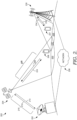
- FIG. 2 an exemplary network environment is illustrated in which implementations of the present disclosure may be employed.
- a network environment is illustrated and designated generally as network environment 200.
- the network environment 200 comprises a gateway 202, a satellite 204 of a satellite radio access network (RAN), at least one UE, a terrestrial base station 230 of a terrestrial RAN, and a network 208.
- RAN satellite radio access network
- the composition of network environment 200 illustrates objects in the singular, it should be understood that more than one of each component is expressly conceived as being within the bounds of the present disclosure; for example, the network environment 200 may comprise multiple gateways, multiple distinct networks, multiple UEs, multiple satellites that communicate with a single gateway, multiple terrestrial base stations, and the like.
- UEs such as a first UE206 and a second UE 207 are illustrated as cellular phones, a UE suitable for implementations with the present disclosure may be any computing device having any one or more aspects described with respect to Fig. 1 .
- the network environment 200 includes a gateway 202 communicatively connected to the network 208 and the satellite 204.
- the gateway 202 may be connected to the network 208 via one or more wireless or wired connections and is connected to the satellite 204 via a feeder link 210.
- the gateway 202 may take the form of a device or a system of components configured to communicate with the UE 206 via the satellite 204 and to provide an interface between the network 208 and the satellite 204.
- the gateway 202 utilizes one or more antennas to transmit signals to the satellite 204 via a forward uplink 212 and to receive signals from the satellite 204 via a return downlink 214.
- the gateway 202 may communicate with a plurality of satellites, including the satellite 204.
- the network 208 comprises any one or more public or private networks, any one or more of which may be configured as a satellite network, a publicly switched telephony network (PSTN), or a cellular telecommunications network.
- the network 208 may comprise a satellite network connecting a plurality of gateways (including the gateway 202) to other networks, a cellular core network (e.g., a 4G, 5G, of 6G core network, an IMS network, and the like), and a data network.
- each of the satellite network and the cellular core network may be associated with a network identifier such as a public land mobile network (PLMN), a mobile country code, a mobile network code, or the like, wherein the network identifier associated with the satellite network is the same or different than the network identifier associated with the cellular network.
- PLMN public land mobile network
- MLMN public land mobile network
- mobile country code a mobile country code
- mobile network code or the like
- the network environment 200 includes one or more satellites, represented by satellite 204.
- the satellite 204 is generally configured to relay communications between the gateway 202 and the UE 206.
- the satellite 204 communicates with the gateway using the feeder link 210 and communicates with the UE 206 using a user link 220.
- the user link 220 comprises a forward downlink 224 used to communicate signals from the satellite 204 to the UE 206 and a return uplink 226 used to communicate signals from the UE 206 to the satellite 204.
- the satellite 204 may communicate with the UE 206 using any wireless telecommunication protocol desired by a network operator, including but not limited to 3G, 4G, 5G, 6G, 802.11x and the like.
- the satellite 204 may be configured to utilize a plurality of individual beams to communicate with multiple different areas at or near the same time.
- the UE 206 may utilize multiple downlinks and/or multiple uplinks to communicate with the satellite 204, using any one or more frequencies as desired by a satellite or network operator.
- the satellite 204 is characterized by its orbit around the earth.
- the orbit of any particular satellite will vary by operator desire and/or intended use; for example, a satellite suitable for use with the present disclosure may be characterized by its maximum orbital altitude and/or orbital period as Low Earth Orbit (LEO), Medium Earth Orbit (MEO), and High Earth Orbit (HEO).
- LEO Low Earth Orbit
- MEO Medium Earth Orbit
- HEO High Earth Orbit
- an LEO satellite may orbit with a maximum orbital altitude of less than approximately 1,250 miles
- an MEO satellite may orbit with a maximum orbital altitude generally between 1,250 and 22,000 miles
- an HEO satellite may orbit with a maximum orbital altitude of greater than approximately 22,000 miles.
- a satellite in HEO may be considered geosynchronous on the basis that its orbital period is approximately equal to the length of a sidereal or solar day (approximately 24 hours); generally, a satellite in geosynchronous orbit will appear to be in the same position relative to a fixed point on the surface of the earth 208 at the same time each day.
- a geostationary orbit is a special type of geosynchronous orbit with the Earth's equator with each of an eccentricity and inclination equal to zero.
- Some satellites in HEO and all that are in LEO or MEO have an orbital period that is different than the length of a sidereal/solar day and are considered to be non-geosynchronous and do not remain stationary relative to a fixed position on the surface of the Earth.
- the network environment 200 includes one or more terrestrial base stations, represented by terrestrial base station 230.
- the terrestrial base station 230 is generally configured to relay communications between the network 208 and one or more UEs, such as the second UE 207.
- the terrestrial base station 230 communicates signals to the UE 206 using a terrestrial downlink 234 and receives signals from the second UE 207 using a terrestrial uplink 236.
- the terrestrial base station 230 may communicate with the second UE 207 using any wireless telecommunication protocol desired by a network operator, including but not limited to 3G, 4G, 5G, 6G, 802.11x and the like.
- the terrestrial base station 230 may be configured to utilize a plurality of individual beams to communicate with multiple different areas at or near the same time.
- the second UE 207 may utilize multiple downlinks and/or multiple uplinks to communicate with the terrestrial base station 230, using any one or more frequencies as desired by a mobile network operator.
- co-channel interference may exist in and/or around the overlapping coverage area 242.
- co-channel interference is a type of interference that occurs in telecommunications when two or more transmitters, such as the satellite 204 and the terrestrial base station 230, broadcast on the same frequency channel. The interference can lead to reduced signal quality and even cause a loss of communications for UEs in or near the overlapping coverage area 242. Though illustrated in FIG.
- the overlapping coverage area 242 of the present disclosure is not limited to where intended coverage areas (i.e., cells) overlap, but rather where a threshold high level of co-channel interference occurs.
- Determining that a threshold high level of co-channel interference is occurring may be the result of identifying overlapping coverage areas.
- One or more computer processing components, whether of the network 208, the satellite 204, and/or the terrestrial base statin 230, may determine the approximate coverage areas associated with each radio access network. Such a determination may be based on ideal or planned coverage areas, or modeled based on real world conditions including factors like observed interference, signal transmission power, traffic, and the like. Accordingly, the satellite coverage area 222 and the terrestrial coverage area 232, may be determined to at least partially overlap or that an edge of the satellite coverage area 222 is within a predetermined threshold distance of an edge of the terrestrial coverage area 232.
- Determining that a threshold high level of co-channel interference is occurring may be the result of a UE reporting signal degradation and attributing the degradation to co-channel interference.
- a UE such as the first UE 206, may report to the network 208 one or more key performance indicators (KPIs) that can be used to identify a threshold high signal degradation.
- KPIs key performance indicators
- a mobile network operator may use any one or more KPIs alone or in combination.
- a sufficiently triggering signal degradation may be the result of the first UE 206 reporting a signal to interference noise ratio (SINR) less than a predetermined threshold (e.g., 0, 1, 3, or 5 dB) or a reference signal receive quality (RSRQ) lower than a predetermined threshold (e.g., -15, -18, or - 20 dB).
- a sufficiently triggering signal degradation may be the result of the first UE 206 reporting a threshold high change to a KPI, such as if the RSRQ or SINR decreases by a threshold amount (e.g., 3 dB).
- one or more networked computer processing components of the terrestrial base station 230 and/or the network 208 may receive an indication from the first UE 206 that the first UE 206 is wirelessly connected to the satellite 204 and that the terrestrial base station 230 is observed to be a neighboring base station.
- the signals from the terrestrial base station 230 may be of insufficient strength to cause a handoff from the satellite 204
- the signal degradation reported from the first UE 206 may be attributed to co-channel interference if said one or more networked computer processing components determine (or the first UE 206 reports) that a frequency used by the satellite 204 to communicate with the first UE 206 is the same as (or within a predetermined range of) a frequency that is actively being used by the terrestrial base station 230.
- the first UE 206 may be wirelessly connected to the satellite 204 and report to the satellite 204 an RSRQ of -20 dB (wherein an operator-set triggering threshold is -17 dB) and an observation of the terrestrial base station 230 is a neighboring base station; based on said reports, one or more networked computer processing components of the network 208 may then determine that the satellite 204 is using the 1900 MHz frequency band to communicate with the first UE 206 and that the terrestrial base station 230 is also actively using the 1900 MHz frequency band to communicates with UEs with the terrestrial coverage areas 232.
- a determination of co-channel interference between the satellite 204 and the terrestrial base station 230 may be made without observing degradation of a radio link.
- a determination of co-channel interference may be based on a report from the second UE 207 that it is connected to the terrestrial base station 230 and that the satellite 204 is observed as a neighboring base station.
- one or more networked computer processing components of the terrestrial base station 230 and/or the network 208 may determine that the satellite 204 and the terrestrial base station 230 are using the same (or within a predetermined range) frequency to communicate in the downlink.
- one or more mitigating procedures may be implemented.
- the one or more mitigating procedures described herein may be implemented at the terrestrial base station 230, particularly when a configuration of the satellite 204 is difficult (or impossible) to modify.
- the one or more mitigation procedures may ceasing or reducing the power of signal transmissions, modifying the offending frequency at the terrestrial base station 230 that has been determined to cause co-channel interference, implementing timing offsets at the terrestrial base station 230, and implementation of spread spectrum coding at the terrestrial base station 230 and/or satellite 204.
- the one or more mitigating procedures may comprise shutting down, deactivating, or otherwise suspending the transmission/use of the satellite 204 or the terrestrial base station 230. Such an action may be done based on a determination that either the satellite 204 or the terrestrial base station has a threshold low utilization. For example, it may be determined that the terrestrial base station 230 has below a threshold utilization rate or below a threshold number of connected users; based on said determination, the terrestrial base station 230 may be instructed to not transmit any signals for a predetermined period of time. Such a mitigating action may be particularly helpful where the both the satellite 204 and terrestrial base station 230 utilize a common frequency and neither has the ability to implement other mitigating procedures.
- the satellite 204 or the terrestrial base station 230 may be instructed to reduce their signal transmission power, causing their associate coverage area to be reduced and reducing or eliminating the overlapping coverage area 242.
- the terrestrial base station 230 may be permitted to continue transmitting/receiving signals on the frequency band subject to co-channel interference with the satellite 204 based on a determination that a threshold low number, or zero, UEs are wirelessly attached to the satellite 204 within a predetermined distance of the terrestrial base station 230.
- the terrestrial base station 230 may be instructed to implement one or more mitigation procedures discussed herein based at least in part on a determination that a greater than predetermined threshold number of UEs are wirelessly connected to the satellite within the predetermined range of the terrestrial base station.
- the one or more mitigating procedures may comprise modifying the offending frequency, at either the satellite 204 or the terrestrial base station, which has been determined to cause co-channel interference. If, for example, the satellite 204 is configured to communicate only on a first frequency band (e.g., 1900 MHz band) and the terrestrial base station 230 is configured to communicate at a set of frequencies comprising the first frequency band and a second frequency band (e.g., 2500 MHz band), then the terrestrial base station 230 may be instructed to modify its channel usage from the first frequency band to the second frequency band.
- a first frequency band e.g., 1900 MHz band
- a second frequency band e.g., 2500 MHz band
- the switch from the offloading of traffic previously served on the first frequency band to the second frequency band may be implemented by way of applying orthogonal spread spectrum coding to the second frequency band (increasing the use of the second frequency band without increasing interference on the second frequency band).
- the one or more mitigating procedures may comprise timing offsets.
- one or more of the satellite 204 and the terrestrial base station 230 may have the timing of signaling offset in order that signals are not communicated by both the satellite 204 and the terrestrial base station 230 to the overlapping coverage area 242 at the same time and on the same frequency.
- one or more networked computer processing components of the network 208 or the terrestrial base station 230 may determine that the satellite 204 is configured to transmit signals to the second UE 206 during a first time period, receive signals from the first UE during a second time period, and that the satellite 204 is not transmitting/receiving signals during a third time period.
- the terrestrial base station may be permitted to continue communicating using a shared radio frequency resource, without other mitigating procedures, as a result of being instructed to only transmit (and instructing connected UEs to transmit) on the conflicting frequency only during the third time period.
- the one or more mitigating procedures may comprise implementing a spread spectrum code to signals transmitted/received by one or more of the satellite 204 and the terrestrial base station 230.
- co-channel interference may be mitigated by implementing a spread spectrum code paradigm at either the satellite 204 or the terrestrial base station 230.
- co-channel interference may be mitigated by implementing a first spread spectrum code at the satellite 204 and a second spread spectrum code at the terrestrial base station 230, wherein the first spread spectrum code is different than the second spread spectrum code.
- a flow chart representing a method 300 is provided.
- a UE such as the first UE 206 of Fig. 2
- a satellite such as the satellite 204 of Fig. 2
- the satellite is configured to wirelessly communicate a first set of signals with the UE using a first frequency band.
- a terrestrial base station is causing co-channel interference by communicating a second set of signals using the first frequency band, based at least in part on a threshold high signal degradation of the first set of signals, according to any one or more aspects described with respect to Fig. 2 .
- one or more co-channel mitigation procedures are implemented, according to any one or more aspects described with respect to Fig. 2 .
Landscapes
- Engineering & Computer Science (AREA)
- Computer Networks & Wireless Communication (AREA)
- Signal Processing (AREA)
- Quality & Reliability (AREA)
- Physics & Mathematics (AREA)
- Astronomy & Astrophysics (AREA)
- Aviation & Aerospace Engineering (AREA)
- General Physics & Mathematics (AREA)
- Mobile Radio Communication Systems (AREA)
- Radio Relay Systems (AREA)
Applications Claiming Priority (1)
| Application Number | Priority Date | Filing Date | Title |
|---|---|---|---|
| US18/195,268 US20240381107A1 (en) | 2023-05-09 | 2023-05-09 | Coordinated frequency sharing between satellite and terrestrial radio access networks |
Publications (2)
| Publication Number | Publication Date |
|---|---|
| EP4472103A2 true EP4472103A2 (de) | 2024-12-04 |
| EP4472103A3 EP4472103A3 (de) | 2025-02-05 |
Family
ID=91070150
Family Applications (1)
| Application Number | Title | Priority Date | Filing Date |
|---|---|---|---|
| EP24174994.4A Pending EP4472103A3 (de) | 2023-05-09 | 2024-05-08 | Koordinierte gemeinsame frequenznutzung zwischen satelliten- und terrestrischen funkzugangsnetzwerken |
Country Status (2)
| Country | Link |
|---|---|
| US (1) | US20240381107A1 (de) |
| EP (1) | EP4472103A3 (de) |
Families Citing this family (1)
| Publication number | Priority date | Publication date | Assignee | Title |
|---|---|---|---|---|
| US20240121743A1 (en) * | 2022-10-10 | 2024-04-11 | T-Mobile Innovations Llc | Enhanced multi-satellite downlink connectivity |
Family Cites Families (5)
| Publication number | Priority date | Publication date | Assignee | Title |
|---|---|---|---|---|
| US7792487B2 (en) * | 2006-01-04 | 2010-09-07 | Globalstar, Inc. | Satellite communication system for communicating packet data messages |
| US9780888B2 (en) * | 2015-05-12 | 2017-10-03 | Qualcomm Incorporated | Techniques for mitigating cross device co-existence interference |
| WO2019152231A1 (en) * | 2018-02-05 | 2019-08-08 | Telcom Ventures, Llc | Interference mitigation technique for a mss system from an inverted terrestrial frequency bwa reuse |
| US11968151B2 (en) * | 2021-03-02 | 2024-04-23 | Qualcomm Incorporated | Spatial inter-cell interference aware downlink coordination |
| US20240204863A1 (en) * | 2022-12-19 | 2024-06-20 | Dish Wireless L.L.C. | Managing interference for coexistence of terrestrial and non-terrestrial wireless networks |
-
2023
- 2023-05-09 US US18/195,268 patent/US20240381107A1/en active Pending
-
2024
- 2024-05-08 EP EP24174994.4A patent/EP4472103A3/de active Pending
Non-Patent Citations (1)
| Title |
|---|
| "Newton's Telecom Dictionary", 2022 |
Also Published As
| Publication number | Publication date |
|---|---|
| EP4472103A3 (de) | 2025-02-05 |
| US20240381107A1 (en) | 2024-11-14 |
Similar Documents
| Publication | Publication Date | Title |
|---|---|---|
| US12143956B2 (en) | Communication method and apparatus | |
| CN116918307B (zh) | 用于无线通信的方法及装置 | |
| Shahid et al. | Emerging advancements in 6G NTN radio access technologies: An overview | |
| KR20230058489A (ko) | Pucch 송신의 신뢰성을 증가시키기 위한 pucch 반복 | |
| US12015473B2 (en) | Method and apparatus for sequence determination in wireless transmission | |
| EP4472103A2 (de) | Koordinierte gemeinsame frequenznutzung zwischen satelliten- und terrestrischen funkzugangsnetzwerken | |
| EP4192178A1 (de) | Verfahren zur auswahl eines anfänglichen bandbreitenteils (bwp), endgerät und netzwerkvorrichtung | |
| US20220095245A1 (en) | Resource sharing method and apparatus, terminal, and network device | |
| US11368958B2 (en) | Method and apparatus for determining frequency resource, and user equipment | |
| KR20210148251A (ko) | 신호 전송 방법 및 장치, 네트워크 기기 | |
| EP3840248B1 (de) | Informationsübertragungsverfahren, netzwerkvorrichtung und endgerätevorrichtung | |
| EP4482052A2 (de) | Signalsturmvermeidung zwischen satelliten und benutzergerät | |
| US20250309978A1 (en) | Dynamic power configuration of low earth orbit satellites | |
| US20250385728A1 (en) | Non-terrestrial network utilization during terrestrial network congestion | |
| KR102456845B1 (ko) | 이중 빔 포밍에 기반한 간섭 완화 장치 및 방법 | |
| US20250365030A1 (en) | Coordinated frequency sharing between satellite and terrestrial radio access networks | |
| CA3066672C (en) | Method for wireless communication, terminal device, network device, and network node | |
| EP4472284A2 (de) | Zellenauswahl und übergabepriorisierung in einer mehrdomänen-netzwerkumgebung | |
| US20240121743A1 (en) | Enhanced multi-satellite downlink connectivity | |
| US20260046629A1 (en) | Management of power-restricted radio resource configurations | |
| US20250386392A1 (en) | Non-terrestrial network utilization during time of flight interference | |
| US20240405858A1 (en) | Mitigating interference between satellite and terrestrial cellular networks | |
| US12431968B2 (en) | Diversity gain for space mobile systems | |
| US20250386290A1 (en) | Non-terrestrial network utilization during low activity at terrestrial base stations | |
| US20250310039A1 (en) | Multiple satellite and terrestrial base station coordination functionality |
Legal Events
| Date | Code | Title | Description |
|---|---|---|---|
| PUAI | Public reference made under article 153(3) epc to a published international application that has entered the european phase |
Free format text: ORIGINAL CODE: 0009012 |
|
| STAA | Information on the status of an ep patent application or granted ep patent |
Free format text: STATUS: REQUEST FOR EXAMINATION WAS MADE |
|
| 17P | Request for examination filed |
Effective date: 20240508 |
|
| AK | Designated contracting states |
Kind code of ref document: A2 Designated state(s): AL AT BE BG CH CY CZ DE DK EE ES FI FR GB GR HR HU IE IS IT LI LT LU LV MC ME MK MT NL NO PL PT RO RS SE SI SK SM TR |
|
| RAP3 | Party data changed (applicant data changed or rights of an application transferred) |
Owner name: T-MOBILE INNOVATIONS LLC |
|
| PUAL | Search report despatched |
Free format text: ORIGINAL CODE: 0009013 |
|
| AK | Designated contracting states |
Kind code of ref document: A3 Designated state(s): AL AT BE BG CH CY CZ DE DK EE ES FI FR GB GR HR HU IE IS IT LI LT LU LV MC ME MK MT NL NO PL PT RO RS SE SI SK SM TR |
|
| RIC1 | Information provided on ipc code assigned before grant |
Ipc: H04B 7/185 20060101AFI20250102BHEP |