EP4482052A2 - Signalsturmvermeidung zwischen satelliten und benutzergerät - Google Patents
Signalsturmvermeidung zwischen satelliten und benutzergerät Download PDFInfo
- Publication number
- EP4482052A2 EP4482052A2 EP24168680.7A EP24168680A EP4482052A2 EP 4482052 A2 EP4482052 A2 EP 4482052A2 EP 24168680 A EP24168680 A EP 24168680A EP 4482052 A2 EP4482052 A2 EP 4482052A2
- Authority
- EP
- European Patent Office
- Prior art keywords
- satellite
- determining
- uplink
- signals
- ran
- Prior art date
- Legal status (The legal status is an assumption and is not a legal conclusion. Google has not performed a legal analysis and makes no representation as to the accuracy of the status listed.)
- Pending
Links
- 238000000034 method Methods 0.000 claims abstract description 43
- 230000000116 mitigating effect Effects 0.000 claims abstract description 16
- 238000004891 communication Methods 0.000 claims description 31
- 230000005540 biological transmission Effects 0.000 claims description 18
- 230000000903 blocking effect Effects 0.000 claims description 15
- 230000004044 response Effects 0.000 claims description 12
- 230000008054 signal transmission Effects 0.000 claims description 6
- 230000011664 signaling Effects 0.000 abstract description 35
- 238000005516 engineering process Methods 0.000 description 13
- 230000004048 modification Effects 0.000 description 9
- 238000012986 modification Methods 0.000 description 9
- 230000001413 cellular effect Effects 0.000 description 5
- 230000000694 effects Effects 0.000 description 4
- 230000006870 function Effects 0.000 description 3
- 238000004590 computer program Methods 0.000 description 2
- 238000010586 diagram Methods 0.000 description 2
- 230000003287 optical effect Effects 0.000 description 2
- 230000000644 propagated effect Effects 0.000 description 2
- 230000009471 action Effects 0.000 description 1
- 230000002776 aggregation Effects 0.000 description 1
- 238000004220 aggregation Methods 0.000 description 1
- 230000006399 behavior Effects 0.000 description 1
- 230000010267 cellular communication Effects 0.000 description 1
- 238000002955 isolation Methods 0.000 description 1
- 230000002265 prevention Effects 0.000 description 1
- 238000007639 printing Methods 0.000 description 1
- 230000009467 reduction Effects 0.000 description 1
- 238000001228 spectrum Methods 0.000 description 1
- 238000010025 steaming Methods 0.000 description 1
- 230000007723 transport mechanism Effects 0.000 description 1
Images

Classifications
-
- H—ELECTRICITY
- H04—ELECTRIC COMMUNICATION TECHNIQUE
- H04B—TRANSMISSION
- H04B7/00—Radio transmission systems, i.e. using radiation field
- H04B7/14—Relay systems
- H04B7/15—Active relay systems
- H04B7/185—Space-based or airborne stations; Stations for satellite systems
- H04B7/1851—Systems using a satellite or space-based relay
- H04B7/18513—Transmission in a satellite or space-based system
-
- H—ELECTRICITY
- H04—ELECTRIC COMMUNICATION TECHNIQUE
- H04W—WIRELESS COMMUNICATION NETWORKS
- H04W28/00—Network traffic management; Network resource management
- H04W28/02—Traffic management, e.g. flow control or congestion control
- H04W28/0284—Traffic management, e.g. flow control or congestion control detecting congestion or overload during communication
-
- H—ELECTRICITY
- H04—ELECTRIC COMMUNICATION TECHNIQUE
- H04W—WIRELESS COMMUNICATION NETWORKS
- H04W28/00—Network traffic management; Network resource management
- H04W28/02—Traffic management, e.g. flow control or congestion control
- H04W28/0289—Congestion control
-
- H—ELECTRICITY
- H04—ELECTRIC COMMUNICATION TECHNIQUE
- H04W—WIRELESS COMMUNICATION NETWORKS
- H04W28/00—Network traffic management; Network resource management
- H04W28/02—Traffic management, e.g. flow control or congestion control
- H04W28/08—Load balancing or load distribution
- H04W28/09—Management thereof
- H04W28/0958—Management thereof based on metrics or performance parameters
-
- H—ELECTRICITY
- H04—ELECTRIC COMMUNICATION TECHNIQUE
- H04W—WIRELESS COMMUNICATION NETWORKS
- H04W84/00—Network topologies
- H04W84/02—Hierarchically pre-organised networks, e.g. paging networks, cellular networks, WLAN [Wireless Local Area Network] or WLL [Wireless Local Loop]
- H04W84/04—Large scale networks; Deep hierarchical networks
- H04W84/06—Airborne or Satellite Networks
Definitions
- the present disclosure is directed to avoiding signaling storms between satellites and user equipment, substantially as shown and/or described in connection with at least one of the Figures, and as set forth more completely in the claims.
- a user equipment modifies signaling behavior based on a determination that the UE is utilizing a satellite to communicate with a network.
- Modern UEs communicate all manner of signals in the uplink to a base station or relay to which they are attached. Whether querying mail servers for new emails, checking for updates on social media feeds, fetching packets for streaming video, or any number of other activities, UEs bombard their access points.
- excessive signaling is mitigated by the size of geographic service areas and a high capacity of radio resources.
- a single satellite access point can provide for coverage for thousands of square miles and has a finite amount of power for handling radio resources.
- Excessive signaling from UEs communicating with a satellite can cause congestion and a denial of service for other devices.
- signaling storms can be avoided and overall system performance can be improved.
- NAT network access technology
- Embodiments of the technology described herein may be embodied as, among other things, a method, system, or computer-program product. Accordingly, the embodiments may take the form of a hardware embodiment, or an embodiment combining software and hardware. An embodiment takes the form of a computer-program product that includes computer-useable instructions embodied on one or more computer-readable media that may cause one or more computer processing components to perform particular operations or functions.
- Computer-readable media include both volatile and nonvolatile media, removable and nonremovable media, and contemplate media readable by a database, a switch, and various other network devices.
- Network switches, routers, and related components are conventional in nature, as are means of communicating with the same.
- computer-readable media comprise computer-storage media and communications media.
- Computer-storage media include media implemented in any method or technology for storing information. Examples of stored information include computer-useable instructions, data structures, program modules, and other data representations.
- Computer-storage media include, but are not limited to RAM, ROM, EEPROM, flash memory or other memory technology, CD-ROM, digital versatile discs (DVD), holographic media or other optical disc storage, magnetic cassettes, magnetic tape, magnetic disk storage, and other magnetic storage devices. These memory components can store data momentarily, temporarily, or permanently.
- Communications media typically store computer-useable instructions - including data structures and program modules - in a modulated data signal.
- modulated data signal refers to a propagated signal that has one or more of its characteristics set or changed to encode information in the signal.
- Communications media include any information-delivery media.
- communications media include wired media, such as a wired network or direct-wired connection, and wireless media such as acoustic, infrared, radio, microwave, spread-spectrum, and other wireless media technologies. Combinations of the above are included within the scope of computer-readable media.
- the present disclosure is directed to systems and methods for radio resource conservation on return uplinks between a UE and a satellite. Based on a determination that the UE is wirelessly connected to a satellite, a UE will be permitted to communicate certain types of uplink signaling to the satellite and not to send other types of uplink signaling. In some aspects, the UE may implement the radio resource conservation in the uplink by blocking applications on the UE from causing the transmission of impermissible types of signaling. By limiting the types of uplink signaling, a signal storm at the satellite is less likely to occur, or, is more likely to abate quickly if it has already begun.
- a first aspect of the present disclosure is directed to a system for mitigating a signal storm on a satellite uplink.
- the system comprises one or more antennas configured to receive downlink signals from a satellite radio access network (RAN).
- the system further comprises one or more computer processing components configured to determine, based on one or more signals received from the satellite RAN by the one or more antennas, that the system is connected to a satellite.
- the one or more computer processing components are further configured to determine that a user link of the satellite is experiencing a congestion condition.
- the one or more computer processing components are further configured to implement one or more uplink mitigation procedures.
- a second aspect of the present disclosure is directed to a method for communicating with a satellite radio access network (RAN).
- the method comprises determining, based on one or more signals received from a RAN, that a user equipment (UE) is connected to a satellite.
- the method further comprises determining that a set of uplink signals having a characteristic are unauthorized for transmission to the satellite in response to determining that the UE is connected to the satellite.
- the method further comprises blocking a transmission of uplink signals having the characteristic.
- the method comprises determining that the UE is connected to a satellite.
- the method further comprises, communicating an instruction to the UE to block transmission of uplink signals having a characteristic in response to determining that the UE is connected to the satellite.
- computing device 100 an exemplary computer environment is shown and designated generally as computing device 100 that is suitable for use in implementations of the present disclosure.
- Computing device 100 is but one example of a suitable computing environment and is not intended to suggest any limitation as to the scope of use or functionality of the invention. Neither should computing device 100 be interpreted as having any dependency or requirement relating to any one or combination of components illustrated.
- the computing device 100 is generally defined by its capability to transmit one or more signals to an access point and receive one or more signals from the access point (or some other access point); the computing device 100 may be referred to herein as a user equipment, wireless communication device, or user device,
- the computing device 100 may take many forms; non-limiting examples of the computing device 100 include a fixed wireless access device, cell phone, tablet, internet of things (IoT) device, smart appliance, automotive or aircraft component, pager, personal electronic device, wearable electronic device, activity tracker, desktop computer, laptop, PC, and the like.
- IoT internet of things
- implementations of the present disclosure may be described in the general context of computer code or machine-useable instructions, including computer-executable instructions such as program components, being executed by a computer or other machine, such as a personal data assistant or other handheld device.
- program components including routines, programs, objects, components, data structures, and the like, refer to code that performs particular tasks or implements particular abstract data types.
- Implementations of the present disclosure may be practiced in a variety of system configurations, including handheld devices, consumer electronics, general-purpose computers, specialty computing devices, etc. Implementations of the present disclosure may also be practiced in distributed computing environments where tasks are performed by remote-processing devices that are linked through a communications network.
- computing device 100 includes bus 102 that directly or indirectly couples the following devices: memory 104, one or more processors 106, one or more presentation components 108, input/output (I/O) ports 110, I/O components 112, and power supply 114.
- Bus 102 represents what may be one or more busses (such as an address bus, data bus, or combination thereof).
- I/O input/output
- FIG. 1 the devices of FIG. 1 are shown with lines for the sake of clarity, in reality, delineating various components is not so clear, and metaphorically, the lines would more accurately be grey and fuzzy. For example, one may consider a presentation component such as a display device to be one of I/O components 112.
- processors such as one or more processors 106, have memory.
- FIG. 1 is merely illustrative of an exemplary computing environment that can be used in connection with one or more implementations of the present disclosure. Distinction is not made between such categories as “workstation,” “server,” “laptop,” “handheld device,” etc., as all are contemplated within the scope of FIG. 1 and refer to "computer” or "computing device.”
- Computer-readable media can be any available media that can be accessed by computing device 100 and includes both volatile and nonvolatile media, removable and non-removable media.
- Computer-readable media may comprise computer storage media and communication media.
- Computer storage media includes both volatile and nonvolatile, removable and non-removable media implemented in any method or technology for storage of information such as computer-readable instructions, data structures, program modules or other data.
- Computer storage media includes RAM, ROM, EEPROM, flash memory or other memory technology, CD-ROM, digital versatile disks (DVD) or other optical disk storage, magnetic cassettes, magnetic tape, magnetic disk storage or other magnetic storage devices.
- Computer storage media does not comprise a propagated data signal.
- Communication media typically embodies computer-readable instructions, data structures, program modules or other data in a modulated data signal such as a carrier wave or other transport mechanism and includes any information delivery media.
- modulated data signal means a signal that has one or more of its characteristics set or changed in such a manner as to encode information in the signal.
- communication media includes wired media such as a wired network or direct-wired connection, and wireless media such as acoustic, RF, infrared and other wireless media. Combinations of any of the above should also be included within the scope of computer-readable media.
- Memory 104 includes computer-storage media in the form of volatile and/or nonvolatile memory. Memory 104 may be removable, nonremovable, or a combination thereof. Exemplary memory includes solid-state memory, hard drives, optical-disc drives, etc.
- Computing device 100 includes one or more processors 106 that read data from various entities such as bus 102, memory 104 or I/O components 112.
- One or more presentation components 108 presents data indications to a person or other device.
- Exemplary one or more presentation components 108 include a display device, speaker, printing component, vibrating component, etc.
- I/O ports 110 allow computing device 100 to be logically coupled to other devices including I/O components 112, some of which may be built in computing device 100.
- Illustrative I/O components 112 include a microphone, joystick, game pad, satellite dish, scanner, printer, wireless device, etc.
- a first radio 120 and second radio 130 represent radios that facilitate communication with one or more wireless networks using one or more wireless links.
- the first radio 120 utilizes a first transmitter 122 to communicate with a wireless network on a first wireless link and the second radio 130 utilizes the second transmitter 132 to communicate on a second wireless link.
- two radios are shown, it is expressly conceived that a computing device with a single radio (i.e., the first radio 120 or the second radio 130) could facilitate communication over one or more wireless links with one or more wireless networks via both the first transmitter 122 and the second transmitter 132.
- Illustrative wireless telecommunications technologies include CDMA, GPRS, TDMA, GSM, and the like.
- first radio 120 and the second radio 130 may carry wireless communication functions or operations using any number of desirable wireless communication protocols, including 802.11 (Wi-Fi), WiMAX, LTE, 3G, 4G, LTE, 5G, NR, VoLTE, or other VoIP communications.
- the first radio 120 and the second radio 130 may be configured to communicate using the same protocol but in other aspects they may be configured to communicate using different protocols.
- the first radio 120 and the second radio 130 may be configured to communicate on distinct frequencies or frequency bands (e.g., as part of a carrier aggregation scheme).
- each of the first radio 120 and the second radio 130 can be configured to support multiple technologies and/or multiple frequencies; for example, the first radio 120 may be configured to communicate with a base station according to a cellular communication protocol (e.g., 4G, 5G, 6G, or the like), and the second radio 130 may configured to communicate with one or more other computing devices according to a local area communication protocol (e.g., IEEE 802.11 series, Bluetooth, NFC, z-wave, or the like).
- a cellular communication protocol e.g., 4G, 5G, 6G, or the like
- a local area communication protocol e.g., IEEE 802.11 series, Bluetooth, NFC, z-wave, or the like.
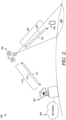
- FIG. 2 an exemplary network environment is illustrated in which implementations of the present disclosure may be employed.
- a network environment is illustrated and designated generally as network environment 200.
- the network environment 200 comprises a gateway 202, a satellite 204, a UE 206, and a network 208.
- the composition of network environment 200 illustrates objects in the singular, it should be understood that more than one of each component is expressly conceived as being within the bounds of the present disclosure; for example, the network environment 200 may comprise multiple gateways, multiple distinct networks, multiple UEs, multiple satellites that communicate with a single gateway, and the like.
- the UE 206 is illustrated as a cellular phone, a UE suitable for implementations with the present disclosure may be any computing device having any one or more aspects described with respect to Fig. 1 .
- the network environment 200 includes a gateway 202 communicatively connected to the network 208 and the satellite 204.
- the gateway 202 may be connected to the network 208 via one or more wireless or wired connections and is connected to the satellite 204 via a feeder link 210.
- the gateway 202 may take the form of a device or a system of components configured to communicate with the UE 206 via the satellite 204 and to provide an interface between the network 208 and the satellite 204.
- the gateway 202 utilizes one or more antennas to transmit signals to the satellite 204 via a forward uplink 212 and to receive signals from the satellite 204 via a return downlink 214.
- the gateway 202 may communicate with a plurality of satellites, including the satellite 204.
- the network 208 comprises any one or more public or private networks, any one or more of which may be configured as a satellite network, a publicly switched telephony network (PSTN), or a cellular telecommunications network.
- the network 208 may comprise a satellite network connecting a plurality of gateways (including the gateway 202) to other networks, a cellular core network (e.g., a 4G, 5G, of 6G core network, an IMS network, and the like), and a data network.
- each of the satellite network and the cellular core network may be associated with a network identifier such as a public land mobile network (PLMN), a mobile country code, a mobile network code, or the like, wherein the network identifier associated with the satellite network is the same or different than the network identifier associated with the cellular network.
- PLMN public land mobile network
- MLMN public land mobile network
- mobile country code a mobile country code
- mobile network code or the like
- the network environment 200 includes one or more satellites, represented by satellite 204.
- the satellite 204 is generally configured to relay communications between the gateway 202 and the UE 206.
- the satellite 204 communicates with the gateway using the feeder link 210 and communicates with the UE 206 using a user link 220.
- the user link 220 comprises a forward downlink 224 used to communicate signals from the satellite 204 to the UE 206 and a return uplink 226 used to communicate signals from the UE 206 to the satellite 204.
- the satellite 204 may communicate with the UE 206 using any wireless telecommunication protocol desired by a network operator, including but not limited to 3G, 4G, 5G, 6G, 802.11x and the like.
- the satellite 204 may be configured to utilize a plurality of individual beams to communicate with multiple different areas at or near the same time.
- the UE 206 may utilize multiple downlinks and/or multiple uplinks to communicate with the satellite 204, using any one or more frequencies as desired by a satellite or network operator.
- the satellite 204 is characterized by its orbit around the earth.
- the orbit of any particular satellite will vary by operator desire and/or intended use; for example, a satellite suitable for use with the present disclosure may be characterized by its maximum orbital altitude and/or orbital period as Low Earth Orbit (LEO), Medium Earth Orbit (MEO), and High Earth Orbit (HEO).
- LEO Low Earth Orbit
- MEO Medium Earth Orbit
- HEO High Earth Orbit
- an LEO satellite may orbit with a maximum orbital altitude of less than approximately 1,250 miles
- an MEO satellite may orbit with a maximum orbital altitude generally between 1,250 and 22,000 miles
- an HEO satellite may orbit with a maximum orbital altitude of greater than approximately 22,000 miles.
- a satellite in HEO may be considered geosynchronous on the basis that its orbital period is approximately equal to the length of a sidereal or solar day (approximately 24 hours); generally, a satellite in geosynchronous orbit will appear to be in the same position relative to a fixed point on the surface of the earth 208 at the same time each day.
- a geostationary orbit is a special type of geosynchronous orbit with the Earth's equator with each of an eccentricity and inclination equal to zero.
- Some satellites in HEO and all that are in LEO or MEO have an orbital period that is different than the length of a sidereal/solar day and are considered to be non-geosynchronous and do not remain stationary relative to a fixed position on the surface of the Earth.
- the UE 206 may perform or instructed to perform any one more procedures for avoiding or mitigating a signal storm at the satellite 204 - specifically on the return uplink 226.
- the one or more procedures include any one or more of determining that the UE 206 is communicatively coupled to the satellite 204, determining a type of uplink communication signaling that is permissible in view of the UE 206's connection to the satellite 204, and preventing, blocking, or modifying uplink transmissions that are not permissible.
- the prevention, blocking, or modification of uplink transmission may be based solely on a determination that the UE 206 is connected to the satellite 204; in other aspects, it may additionally be based on a determination that the satellite 204 is experiencing a threshold high level of congestion.
- the UE 206 may determine that it is connected to the satellite 204 based on the UE 206 observing that one or more key performance indicators (KPIs) of the forward downlink 224 are below a predetermined threshold, such as a threshold low reference signal received power (RSRP) of one or more reference signals (e.g., channel state information signals, synchronization signals, information block signals, and the like), a threshold low signal to interference noise ratio (SINR), and a threshold poor reference signal receive quality (RSRQ).
- KPIs key performance indicators
- RSRP threshold low reference signal received power
- SINR threshold low signal to interference noise ratio
- RSSQ threshold poor reference signal receive quality
- the UE 206 may determine that it is connected to the satellite 204 based on the UE 206 observing or obtaining a network identifier associated with the satellite 204; if the satellite 204 has a network identifier (e.g., a public land mobile network identifier (PLMN)) that is unique to a satellite-based radio access network (RAN), then the UE 206 can extract the network identifier from the system information broadcast or other control/reference signaling and identify the satellite 204 as a satellite-based RAN based on a local query of network identifiers.
- PLMN public land mobile network identifier
- the UE 206 may determine that it is connected to the satellite 204 based on an observation that signals in the forward downlink 224 have a threshold high Doppler effect.
- the UE 206 may determine a threshold high Doppler shift exists for signals on the forward downlink 224 based on an observation of threshold high frequency shift on said signals; in other aspects, the UE 206 may compare the observed frequency shift and account for the UE 206's own motion to determine that threshold high Doppler shift exists.
- the UE 206 may determine that the originator of the signal is also in motion, and thus that the originator of the downlink signal is a satellite such as the satellite 204.
- one or more components remote to the UE 206 may determine that the UE 206 is connected to a satellite RAN based on an indication that the UE 206 has performed cell selection/re-selection and connected to the satellite 204. Such a determination may be made, for example, during a registration procedure, in which the network 208 may determine that the UE is connected to a RAN having a network identifier associated with a satellite RAN.
- an indication may be communicated to the UE 206 that it is connected to a satellite RAN as a basis for performing one or modifications to its uplink signaling.
- the determination that the UE 206 may not be separately communicated to the UE 206; instead, the UE 206 may be instructed to modify its uplink signaling.
- the UE 206 may modify its uplink signaling.
- the modification of uplink signaling may additionally be based upon a determination that the satellite 204 has a threshold high level of congestion or utilization; in such aspects, congestion conditions may be reported to the UE 206 or deduced by the UE 206 (e.g., based on a threshold number of uplink transmissions not receiving acknowledgement messages from the satellite 204).
- modifications to uplink signaling between the UE 206 and the satellite 204 on the return uplink 226 function to reduce the load on the satellite 204 by reducing the amount of signaling on the return uplink 226.
- the UE 206 may, based on its own action or in response to an instruction from a remote component (e.g., a component on the network 208), determine a first type of uplink signaling that may be communicated to the satellite 204 on the return uplink 226 and block/modify all other types of uplink signaling; alternatively, an unauthorized type of uplink signaling may be determined and uplink signaling of the unauthorized type may be blocked/modified.
- uplink signaling may be carried out by any one or more of a reduction in background activities, service type restrictions, and packet length restrictions.
- Uplink signaling may be modified by restricting the UE 206 to signaling relating to an application or service that is being actively used by the UE 206 (i.e., not in the background). In order to cause such a modification, it may be determined by the UE 206 or communicated to the UE 206 that the only type of uplink messaging that may be communicated on the return uplink 226 is for active applications/services, which can then be used by the UE 206 to block any uplink communications from background applications or services (i.e., applications or services that are not displayed or otherwise determined to be actively in use the by UE 206). In the alternative, it may be determined that background application/service uplink communications are unauthorized, which can then be used by the UE 206 to block any uplink communications from background applications/services.
- Uplink signaling may be modified by restricting the UE 206 to signaling for certain types of service.
- service-based restrictions include affirmatively blocking certain services (e.g., data, voice), certain high bitrate protocols/codecs (e.g., Advanced Audio Coding (AAC), H.265, and the like), or certain features (e.g., all streaming audio, all steaming video, all extended reality (XR) applications, and the like); examples of service-based restrictions may alternatively come in the form of blocking all types of uplink data except for one or more authorized types (e.g., SMS, emergency voice call, standard voice call, or any other type as desired by a network operator).
- AAC Advanced Audio Coding
- H.265 High Bitrate protocols/codecs
- certain features e.g., all streaming audio, all steaming video, all extended reality (XR) applications, and the like
- examples of service-based restrictions may alternatively come in the form of blocking all types of uplink data except for one or more authorized types (e.g.,
- uplink signaling for one or more authorized service may be communicated to the satellite 204 on the return uplink 226 and all other types of uplink signaling should be blocked or modified; alternatively, it may be determined by the UE 206 or communicated to the UE 206 that uplink signaling for one or more services types, protocols/codecs, and/or features are unauthorized and that all such uplink signaling should be blocked from transmission or modified prior to transmission.
- Uplink signaling may be modified by implementing packet length restrictions. ). In order to cause such a modification, it may be determined by the UE 206 or communicated to the UE 206 that uplink messaging may only be communicated on the return uplink 226 if its packet length is less than a predetermined limit, which can then be used by the UE 206 to block any uplink communications with packet lengths that exceed the predetermined limit. In the alternative, it may be determined that payloads having a packet length greater than the predetermined limit are unauthorized, which can then be used by the UE 206 to block any uplink communications having a payload greater than the predetermined limit.
- uplink signaling may be modified by the UE 206 instead of being blocked altogether. For example, if the UE 206 determines a certain codec is unauthorized (or is instructed that the certain codec is unauthorized), then the UE 206 may convert an uplink message from the unauthorized codec to a second codec that is either affirmatively permitted or is not unauthorized. In another example, if a packet-length restriction is in place, the UE 206 may convert an uplink message from having a first packet length that exceeds a limit to a second packet length that is less than the limit.
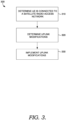
- a flow chart representing a method 300 is provided.
- a UE such as the UE 206 of Fig. 2
- a satellite such as the satellite 204 of Fig. 2
- one or more uplink modifications are determined in order to avoid or mitigate a signal storm on a satellite return uplink, according to any one or more aspects described with respect to Fig. 2 .
- the one or more uplink modifications of the second step 320 are carried out by way of blocking (or modifying) an uplink transmission by a UE, according to any one or more aspects described with respect to Fig. 2 .
Landscapes
- Engineering & Computer Science (AREA)
- Computer Networks & Wireless Communication (AREA)
- Signal Processing (AREA)
- Physics & Mathematics (AREA)
- Astronomy & Astrophysics (AREA)
- Aviation & Aerospace Engineering (AREA)
- General Physics & Mathematics (AREA)
- Radio Relay Systems (AREA)
Applications Claiming Priority (1)
| Application Number | Priority Date | Filing Date | Title |
|---|---|---|---|
| US18/131,445 US20240340692A1 (en) | 2023-04-06 | 2023-04-06 | Signal storm avoidance between satellites and user equipment |
Publications (2)
| Publication Number | Publication Date |
|---|---|
| EP4482052A2 true EP4482052A2 (de) | 2024-12-25 |
| EP4482052A3 EP4482052A3 (de) | 2025-02-26 |
Family
ID=90719084
Family Applications (1)
| Application Number | Title | Priority Date | Filing Date |
|---|---|---|---|
| EP24168680.7A Pending EP4482052A3 (de) | 2023-04-06 | 2024-04-05 | Signalsturmvermeidung zwischen satelliten und benutzergerät |
Country Status (2)
| Country | Link |
|---|---|
| US (1) | US20240340692A1 (de) |
| EP (1) | EP4482052A3 (de) |
Families Citing this family (1)
| Publication number | Priority date | Publication date | Assignee | Title |
|---|---|---|---|---|
| EP4447340A1 (de) * | 2023-04-14 | 2024-10-16 | Nokia Solutions and Networks Oy | Vorrichtung, verfahren und computerprogramm |
Family Cites Families (2)
| Publication number | Priority date | Publication date | Assignee | Title |
|---|---|---|---|---|
| US10523684B2 (en) * | 2017-10-02 | 2019-12-31 | Higher Ground Llc | Forward path congestion mitigation for satellite communications |
| US11974212B2 (en) * | 2021-03-23 | 2024-04-30 | Verizon Patent And Licensing Inc. | Method and system for cellular device-satellite communications |
-
2023
- 2023-04-06 US US18/131,445 patent/US20240340692A1/en active Pending
-
2024
- 2024-04-05 EP EP24168680.7A patent/EP4482052A3/de active Pending
Non-Patent Citations (1)
| Title |
|---|
| "Newton's Telecom Dictionary", 2022 |
Also Published As
| Publication number | Publication date |
|---|---|
| US20240340692A1 (en) | 2024-10-10 |
| EP4482052A3 (de) | 2025-02-26 |
Similar Documents
| Publication | Publication Date | Title |
|---|---|---|
| US12250577B2 (en) | Cell measurement method, terminal device, and network device | |
| KR102452092B1 (ko) | 세션 관리 방법, 단말 기기 및 네트워크 기기 | |
| EP4102890A1 (de) | Zellenübergabeverfahren, elektronische vorrichtung und speichermedium | |
| US11805563B2 (en) | Wireless communication method and base station | |
| US20190357105A1 (en) | Method and apparatus for reducing interruption delay, and user device | |
| US20250056619A1 (en) | Random access method, terminal, apparatus and storage medium | |
| JP2023505943A (ja) | Srsのパスロスrsの活性化又は更新方法及びデバイス | |
| WO2022067760A1 (zh) | 一种小区测量方法、电子设备及存储介质 | |
| US20220046632A1 (en) | Communication method in d2d system, terminal device, and network device | |
| US12015473B2 (en) | Method and apparatus for sequence determination in wireless transmission | |
| EP4482052A2 (de) | Signalsturmvermeidung zwischen satelliten und benutzergerät | |
| US11184895B2 (en) | Information transmission method, network device, and terminal device | |
| US11368958B2 (en) | Method and apparatus for determining frequency resource, and user equipment | |
| US20230403068A1 (en) | Method for time-domain parameter determination, terminal device, and network device | |
| EP4472103A2 (de) | Koordinierte gemeinsame frequenznutzung zwischen satelliten- und terrestrischen funkzugangsnetzwerken | |
| WO2021163913A9 (zh) | 一种数据传输方法、终端设备、网络设备 | |
| US11985540B2 (en) | Control-plane overload management | |
| US11974166B2 (en) | 5G new radio (NR) time division duplexing frame structure management for heavy uplink traffic site | |
| US20250385728A1 (en) | Non-terrestrial network utilization during terrestrial network congestion | |
| US20240121743A1 (en) | Enhanced multi-satellite downlink connectivity | |
| CA3066672C (en) | Method for wireless communication, terminal device, network device, and network node | |
| US20250024230A1 (en) | Rich communication services encrypted messaging fallback on non-terrestrial networks | |
| US11770185B2 (en) | Dynamic spectrum sharing dynamic mode switch in time division multiple access | |
| EP4472284A2 (de) | Zellenauswahl und übergabepriorisierung in einer mehrdomänen-netzwerkumgebung | |
| US20260005754A1 (en) | Diversity gain for space mobile systems |
Legal Events
| Date | Code | Title | Description |
|---|---|---|---|
| PUAI | Public reference made under article 153(3) epc to a published international application that has entered the european phase |
Free format text: ORIGINAL CODE: 0009012 |
|
| STAA | Information on the status of an ep patent application or granted ep patent |
Free format text: STATUS: REQUEST FOR EXAMINATION WAS MADE |
|
| 17P | Request for examination filed |
Effective date: 20240405 |
|
| AK | Designated contracting states |
Kind code of ref document: A2 Designated state(s): AL AT BE BG CH CY CZ DE DK EE ES FI FR GB GR HR HU IE IS IT LI LT LU LV MC ME MK MT NL NO PL PT RO RS SE SI SK SM TR |
|
| PUAL | Search report despatched |
Free format text: ORIGINAL CODE: 0009013 |
|
| AK | Designated contracting states |
Kind code of ref document: A3 Designated state(s): AL AT BE BG CH CY CZ DE DK EE ES FI FR GB GR HR HU IE IS IT LI LT LU LV MC ME MK MT NL NO PL PT RO RS SE SI SK SM TR |
|
| RIC1 | Information provided on ipc code assigned before grant |
Ipc: H04B 7/185 20060101AFI20250117BHEP |