EP4471973A1 - Zylindrische sekundärbatterie - Google Patents
Zylindrische sekundärbatterie Download PDFInfo
- Publication number
- EP4471973A1 EP4471973A1 EP23747317.8A EP23747317A EP4471973A1 EP 4471973 A1 EP4471973 A1 EP 4471973A1 EP 23747317 A EP23747317 A EP 23747317A EP 4471973 A1 EP4471973 A1 EP 4471973A1
- Authority
- EP
- European Patent Office
- Prior art keywords
- battery
- coupling part
- tab
- secondary battery
- cylindrical secondary
- Prior art date
- Legal status (The legal status is an assumption and is not a legal conclusion. Google has not performed a legal analysis and makes no representation as to the accuracy of the status listed.)
- Pending
Links
Images




Classifications
-
- H—ELECTRICITY
- H01—ELECTRIC ELEMENTS
- H01M—PROCESSES OR MEANS, e.g. BATTERIES, FOR THE DIRECT CONVERSION OF CHEMICAL ENERGY INTO ELECTRICAL ENERGY
- H01M50/00—Constructional details or processes of manufacture of the non-active parts of electrochemical cells other than fuel cells, e.g. hybrid cells
- H01M50/50—Current conducting connections for cells or batteries
- H01M50/531—Electrode connections inside a battery casing
- H01M50/533—Electrode connections inside a battery casing characterised by the shape of the leads or tabs
-
- H—ELECTRICITY
- H01—ELECTRIC ELEMENTS
- H01M—PROCESSES OR MEANS, e.g. BATTERIES, FOR THE DIRECT CONVERSION OF CHEMICAL ENERGY INTO ELECTRICAL ENERGY
- H01M50/00—Constructional details or processes of manufacture of the non-active parts of electrochemical cells other than fuel cells, e.g. hybrid cells
- H01M50/50—Current conducting connections for cells or batteries
- H01M50/572—Means for preventing undesired use or discharge
- H01M50/574—Devices or arrangements for the interruption of current
- H01M50/583—Devices or arrangements for the interruption of current in response to current, e.g. fuses
-
- H—ELECTRICITY
- H01—ELECTRIC ELEMENTS
- H01M—PROCESSES OR MEANS, e.g. BATTERIES, FOR THE DIRECT CONVERSION OF CHEMICAL ENERGY INTO ELECTRICAL ENERGY
- H01M50/00—Constructional details or processes of manufacture of the non-active parts of electrochemical cells other than fuel cells, e.g. hybrid cells
- H01M50/50—Current conducting connections for cells or batteries
- H01M50/528—Fixed electrical connections, i.e. not intended for disconnection
-
- H—ELECTRICITY
- H01—ELECTRIC ELEMENTS
- H01M—PROCESSES OR MEANS, e.g. BATTERIES, FOR THE DIRECT CONVERSION OF CHEMICAL ENERGY INTO ELECTRICAL ENERGY
- H01M10/00—Secondary cells; Manufacture thereof
- H01M10/04—Construction or manufacture in general
- H01M10/0422—Cells or battery with cylindrical casing
-
- H—ELECTRICITY
- H01—ELECTRIC ELEMENTS
- H01M—PROCESSES OR MEANS, e.g. BATTERIES, FOR THE DIRECT CONVERSION OF CHEMICAL ENERGY INTO ELECTRICAL ENERGY
- H01M10/00—Secondary cells; Manufacture thereof
- H01M10/04—Construction or manufacture in general
- H01M10/0431—Cells with wound or folded electrodes
-
- H—ELECTRICITY
- H01—ELECTRIC ELEMENTS
- H01M—PROCESSES OR MEANS, e.g. BATTERIES, FOR THE DIRECT CONVERSION OF CHEMICAL ENERGY INTO ELECTRICAL ENERGY
- H01M50/00—Constructional details or processes of manufacture of the non-active parts of electrochemical cells other than fuel cells, e.g. hybrid cells
- H01M50/10—Primary casings; Jackets or wrappings
- H01M50/102—Primary casings; Jackets or wrappings characterised by their shape or physical structure
- H01M50/107—Primary casings; Jackets or wrappings characterised by their shape or physical structure having curved cross-section, e.g. round or elliptic
-
- H—ELECTRICITY
- H01—ELECTRIC ELEMENTS
- H01M—PROCESSES OR MEANS, e.g. BATTERIES, FOR THE DIRECT CONVERSION OF CHEMICAL ENERGY INTO ELECTRICAL ENERGY
- H01M50/00—Constructional details or processes of manufacture of the non-active parts of electrochemical cells other than fuel cells, e.g. hybrid cells
- H01M50/10—Primary casings; Jackets or wrappings
- H01M50/147—Lids or covers
- H01M50/148—Lids or covers characterised by their shape
- H01M50/152—Lids or covers characterised by their shape for cells having curved cross-section, e.g. round or elliptic
-
- H—ELECTRICITY
- H01—ELECTRIC ELEMENTS
- H01M—PROCESSES OR MEANS, e.g. BATTERIES, FOR THE DIRECT CONVERSION OF CHEMICAL ENERGY INTO ELECTRICAL ENERGY
- H01M50/00—Constructional details or processes of manufacture of the non-active parts of electrochemical cells other than fuel cells, e.g. hybrid cells
- H01M50/10—Primary casings; Jackets or wrappings
- H01M50/147—Lids or covers
- H01M50/166—Lids or covers characterised by the methods of assembling casings with lids
- H01M50/169—Lids or covers characterised by the methods of assembling casings with lids by welding, brazing or soldering
-
- H—ELECTRICITY
- H01—ELECTRIC ELEMENTS
- H01M—PROCESSES OR MEANS, e.g. BATTERIES, FOR THE DIRECT CONVERSION OF CHEMICAL ENERGY INTO ELECTRICAL ENERGY
- H01M50/00—Constructional details or processes of manufacture of the non-active parts of electrochemical cells other than fuel cells, e.g. hybrid cells
- H01M50/10—Primary casings; Jackets or wrappings
- H01M50/183—Sealing members
- H01M50/184—Sealing members characterised by their shape or structure
-
- H—ELECTRICITY
- H01—ELECTRIC ELEMENTS
- H01M—PROCESSES OR MEANS, e.g. BATTERIES, FOR THE DIRECT CONVERSION OF CHEMICAL ENERGY INTO ELECTRICAL ENERGY
- H01M50/00—Constructional details or processes of manufacture of the non-active parts of electrochemical cells other than fuel cells, e.g. hybrid cells
- H01M50/10—Primary casings; Jackets or wrappings
- H01M50/183—Sealing members
- H01M50/186—Sealing members characterised by the disposition of the sealing members
-
- H—ELECTRICITY
- H01—ELECTRIC ELEMENTS
- H01M—PROCESSES OR MEANS, e.g. BATTERIES, FOR THE DIRECT CONVERSION OF CHEMICAL ENERGY INTO ELECTRICAL ENERGY
- H01M50/00—Constructional details or processes of manufacture of the non-active parts of electrochemical cells other than fuel cells, e.g. hybrid cells
- H01M50/30—Arrangements for facilitating escape of gases
- H01M50/342—Non-re-sealable arrangements
- H01M50/3425—Non-re-sealable arrangements in the form of rupturable membranes or weakened parts, e.g. pierced with the aid of a sharp member
-
- H—ELECTRICITY
- H01—ELECTRIC ELEMENTS
- H01M—PROCESSES OR MEANS, e.g. BATTERIES, FOR THE DIRECT CONVERSION OF CHEMICAL ENERGY INTO ELECTRICAL ENERGY
- H01M50/00—Constructional details or processes of manufacture of the non-active parts of electrochemical cells other than fuel cells, e.g. hybrid cells
- H01M50/50—Current conducting connections for cells or batteries
- H01M50/531—Electrode connections inside a battery casing
-
- H—ELECTRICITY
- H01—ELECTRIC ELEMENTS
- H01M—PROCESSES OR MEANS, e.g. BATTERIES, FOR THE DIRECT CONVERSION OF CHEMICAL ENERGY INTO ELECTRICAL ENERGY
- H01M50/00—Constructional details or processes of manufacture of the non-active parts of electrochemical cells other than fuel cells, e.g. hybrid cells
- H01M50/50—Current conducting connections for cells or batteries
- H01M50/531—Electrode connections inside a battery casing
- H01M50/538—Connection of several leads or tabs of wound or folded electrode stacks
-
- H—ELECTRICITY
- H01—ELECTRIC ELEMENTS
- H01M—PROCESSES OR MEANS, e.g. BATTERIES, FOR THE DIRECT CONVERSION OF CHEMICAL ENERGY INTO ELECTRICAL ENERGY
- H01M50/00—Constructional details or processes of manufacture of the non-active parts of electrochemical cells other than fuel cells, e.g. hybrid cells
- H01M50/50—Current conducting connections for cells or batteries
- H01M50/572—Means for preventing undesired use or discharge
- H01M50/584—Means for preventing undesired use or discharge for preventing incorrect connections inside or outside the batteries
- H01M50/586—Means for preventing undesired use or discharge for preventing incorrect connections inside or outside the batteries inside the batteries, e.g. incorrect connections of electrodes
-
- H—ELECTRICITY
- H01—ELECTRIC ELEMENTS
- H01M—PROCESSES OR MEANS, e.g. BATTERIES, FOR THE DIRECT CONVERSION OF CHEMICAL ENERGY INTO ELECTRICAL ENERGY
- H01M50/00—Constructional details or processes of manufacture of the non-active parts of electrochemical cells other than fuel cells, e.g. hybrid cells
- H01M50/50—Current conducting connections for cells or batteries
- H01M50/572—Means for preventing undesired use or discharge
- H01M50/584—Means for preventing undesired use or discharge for preventing incorrect connections inside or outside the batteries
- H01M50/59—Means for preventing undesired use or discharge for preventing incorrect connections inside or outside the batteries characterised by the protection means
- H01M50/593—Spacers; Insulating plates
-
- H—ELECTRICITY
- H01—ELECTRIC ELEMENTS
- H01M—PROCESSES OR MEANS, e.g. BATTERIES, FOR THE DIRECT CONVERSION OF CHEMICAL ENERGY INTO ELECTRICAL ENERGY
- H01M50/00—Constructional details or processes of manufacture of the non-active parts of electrochemical cells other than fuel cells, e.g. hybrid cells
- H01M50/60—Arrangements or processes for filling or topping-up with liquids; Arrangements or processes for draining liquids from casings
- H01M50/609—Arrangements or processes for filling with liquid, e.g. electrolytes
- H01M50/627—Filling ports
-
- Y—GENERAL TAGGING OF NEW TECHNOLOGICAL DEVELOPMENTS; GENERAL TAGGING OF CROSS-SECTIONAL TECHNOLOGIES SPANNING OVER SEVERAL SECTIONS OF THE IPC; TECHNICAL SUBJECTS COVERED BY FORMER USPC CROSS-REFERENCE ART COLLECTIONS [XRACs] AND DIGESTS
- Y02—TECHNOLOGIES OR APPLICATIONS FOR MITIGATION OR ADAPTATION AGAINST CLIMATE CHANGE
- Y02E—REDUCTION OF GREENHOUSE GAS [GHG] EMISSIONS, RELATED TO ENERGY GENERATION, TRANSMISSION OR DISTRIBUTION
- Y02E60/00—Enabling technologies; Technologies with a potential or indirect contribution to GHG emissions mitigation
- Y02E60/10—Energy storage using batteries
Definitions
- the present invention relates to a cylindrical secondary battery.
- a cylindrical secondary battery according to a related art generally has a structure in which a tab connecting a jelly-roll to an external terminal is welded to a foil of the jelly-roll.
- the cylindrical secondary battery having such a structure has a limited current path, and self-resistance of the jelly-roll is inevitably very high.
- the jelly-roll having the new structure and the application of the collector are more necessary for devices that require a battery pack having high output/high capacity such as, for example, an electric vehicle.
- One object to be implemented by the present invention is to provide a cylindrical secondary battery including a collector having a structure suitable for an electrode assembly having a low resistance structure.
- Another object to be implemented by the present invention is to provide a cylindrical secondary battery including a collector having a structure that is capable of reducing possibility of damage to a welded portion with an electrode assembly and/or a welded portion with a battery can even when vibration and an impact are applied.
- a cylindrical secondary battery may include: an electrode assembly provided with an electrode tab; a battery can configured to accommodate the electrode assembly through an opening defined at one side thereof; a cap plate configured to cover the opening; a collector disposed between the electrode assembly and the cap plate to electrically connect the electrode tab to the battery can; and a spacer comprising a body part disposed between the collector and the cap plate, a sealing part configured to seal a gap between the battery can and the cap plate, and a connection part configured to connect the body part to the sealing part.
- the collector may include: a center part; a tab coupling part expanded outward from the center part and coupled to the electrode tab; a can coupling part coupled to the battery can and having a height difference with respect to the tab coupling part; and a bridge connecting the center part to the can coupling part and extending so as to be inclined in a direction away from the electrode assembly as the bridge extends away from the center part.
- the bridge of the collector and the connection part of the spacer may be alternately so as not to overlap each other in a height direction of the battery can.
- the bridge and the tab coupling part may be alternately disposed with respect to a circumferential direction of the center part.
- the tab coupling part and the can coupling part may non-overlap each other in the height direction of the battery can.
- the bridge may be gently inclined as the bridge extends away from the center part.
- the can coupling part may extend along an inner circumference of the battery can.
- the tab coupling part may have a width increasing as the tab coupling part extends away from the center part.
- At least one injection hole may be defined in the tab coupling part.
- the injection hole may have a width increasing as the injection hole extend away from the center part.
- a distance from a central axis of the battery can to an outer edge of the can coupling part may be greater than a distance from the central axis of the battery can to an outer edge of the tab coupling part in a radius direction of the battery can.
- An outer edge of the tab coupling part may have an arc shape having a first curvature radius, and an outer edge of the can coupling part may have an arc shape having a second curvature radius greater than the first curvature radius.
- a beading part press-fitted between the cap plate and the electrode assembly may be disposed on a circumference of the battery can, and the can coupling part may be coupled to the beading part.
- the cylindrical secondary battery may further include a sealing part configured to surround a circumference of the cap plate.
- the can coupling part may be interposed between the sealing part and the beading part so as to be fixed.
- the can coupling part may include: an outer area overlapping the beading part in the height direction of the battery can; and an inner area disposed inside the outer area and connected to the bridge.
- the tab coupling part may non-overlap the beading part in the height direction of the can.
- a distance from a central axis of the battery can to an outer edge of the tab coupling part may be equal to or greater than 2/3 of a radius of the electrode assembly.
- the height difference between the tab coupling part and the can coupling part may correspond to a height of the beading part.
- Coupling strength between the battery can and the can coupling part may be greater than coupling strength between the electrode tab and the tab coupling part.
- a beading part press-fitted between the cap plate and the electrode assembly may be disposed on a circumference of the battery can, and the can coupling part may be welded on a flat area of the beading part.
- a welding bead disposed on the can coupling part may be disposed inward at an interval 0.1 mm or more with respect to a boundary of the flat area.
- a venting part having a thickness less than 1/10 of a thickness of the cap plate may be defined on the cap plate.
- a height of the body part may correspond to a distance between the collector and the cap plate.
- the body part may not press the collector.
- the sealing part may surround an edge portion of the cap plate to insulate the battery can from the cap plate.
- a distance between the connection part and the cap plate may gradually increase as the connection part extends from the body part.
- the resistance when the electrode assembly and the battery can are electrically connected to each other, the resistance may be significantly reduced.
- the possibility of damage to the welded portion between the collector and the electrode assembly and/or the welded portion between the collector and the battery can be significantly reduced.
- FIG. 1 is a perspective view of a cylindrical secondary battery according to an embodiment of the present invention
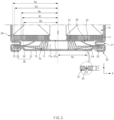
- FIG. 2 is a cutaway cross-sectional view of the cylindrical secondary battery according to an embodiment of the present invention.
- a cylindrical secondary battery 1 (hereinafter, referred to as 'secondary battery') according to an embodiment of the present invention may include an electrode assembly 10 and a battery can 20 accommodating the electrode assembly 10.
- the electrode assembly 10 may include a positive electrode, a negative electrode, and a separator interposed between the positive electrode and the negative electrode.
- the electrode assembly 10 may be provided with a first electrode tab 11 connected to one of the positive electrode and the negative electrode, and a second electrode tab 12 connected to the other of the positive electrode and the negative electrode.
- the electrode assembly 10 may be a jelly-roll type.
- the electrode assembly 10 may be manufactured by winding a stack in which the positive electrode, the separator, the negative electrode, and the separator are sequentially stacked.
- the electrode assembly 10 may preferably have a height-to-diameter ratio of 1 or more, but is not limited thereto.
- a hollow C defined to be elongated in a height direction may be defined in a center of the electrode assembly 10.
- the separator may be disposed at the outermost side of the electrode assembly 10.
- the first electrode tab 11 and the second electrode tab 12 may be provided on both ends of the electrode assembly 10 in the height direction, respectively.
- a non-coating portion of any one of the positive electrode and the negative electrode may be disposed on one end of the electrode assembly 10 to function as a first electrode tab 11.
- the non-coating portion of the other of the positive electrode and the negative electrode may be disposed on the other end of the electrode assembly 10 to function as a second electrode tab 12.
- Each of the electrode tabs 11 and 12 may extend along a winding direction of the electrode assembly 10.
- each of the electrode tabs 11 and 12 may include a plurality of foil-flags disposed along the winding direction of the electrode assembly 10.
- a first collector 50 to be described later may be coupled to the first electrode tab 11, and a second collector 60 to be described later may be coupled to the second electrode tab 12.
- the electrode assembly 10 may be accommodated in the battery can 20 in a state in which the collectors 50 and 60 are coupled to the electrode tabs 11 and 12, respectively.
- the first electrode tab 11 may be a non-coating portion of the negative electrode
- the second electrode tab 12 may be a non-coating portion of the positive electrode
- the first collector 50 may be referred to as a negative electrode collector
- the second collector 60 may be referred to as a positive electrode collector.
- the battery can 20 may have a substantially cylindrical shape.
- One surface 20a may be provided at one side of the battery can 20 in the height direction, and an opening may be defined at the other side.
- the electrode assembly 10 may be accommodated in the battery can 20 together with an electrolyte through the opening.
- the battery can 20 may have a conductive material such as a metal.
- the battery can 20 may be electrically connected to the first electrode tab 11 through the first collector 50 to be described later.
- the battery can 20 may have the same polarity as the first electrode tab 11.
- a beading part 21 and a crimping part 22 may be provided on the battery can 20.
- the beading part 21 and the crimping part 22 may be disposed adjacent to the opening of the battery can 20.
- the beading part 21 may be disposed by press-fitting a circumference of the battery can 20 to the inside of a radius thereof.
- An inner diameter of the beading part 21 may be less than an inner diameter of the battery can 20.
- the beading part 21 may be provided in a state in which the electrode assembly 10 is accommodated in the battery can 20.
- the electrode assembly 10 may be restricted between the one surface 20a of the battery can 20 and the beading part 21 in the height direction of the battery can 20.
- the beading part 21 may prevent the electrode assembly 10 from being separated from the opening of the battery can 20.
- the beading part 21 may be coupled to the first collector 50.
- the first collector 50 may be welded to the beading part 21.
- the first collector 50 may electrically connect the first electrode tab 11 to the battery can 20.
- the crimping part 22 may be disposed adjacent to the beading part 21.
- the crimping part 22 may be provided by bending an end of a circumferential surface of the battery can 20 toward the inside of a radius thereof.
- the crimping part 22 may be formed after the first collector 50 is coupled to the beading part 21.
- the crimping part 22 may restrict a cap plate 30 to be described later together with the beading part 21.
- the secondary battery 1 may include the cap plate 30 covering the opening of the battery can 20.
- the cap plate 30 may have a substantially circular plate shape.
- the cap plate 30 may define an outer appearance of the secondary battery 1 together with the battery can 20.
- An edge portion of the cap plate 30 may be restricted between the beading part 21 and the crimping part 22 of the battery can 20.
- the cap plate 30 may have a material having high rigidity such as a metal.
- the cap plate 30 may be insulated from the battery can 20 and may not have a polarity.
- a sealing part 72 of a spacer 70 to be described below may be interposed between the cap plate 30 and the battery can 20. This will be described in detail later.
- the secondary battery 1 may include a terminal 40 fixed by passing through the one surface 20a of the battery can 20.
- the terminal 40 may pass through the one surface 20a of the battery can 20, more specifically, a center of the one surface 20a. A portion of the terminal 40 may be exposed to the outside of the battery can 20, and the other portion of the terminal 40 may be disposed inside the battery can 20. For example, the terminal 40 may be fixed to the one surface 20a of the battery can 20 by riveting.
- the terminal 40 may have a conductive material such as a metal.
- the terminal 40 may be coupled to the second collector 60 to be described later.
- the second collector 60 may be welded to the terminal 40.
- the second collector 60 may electrically connect the second electrode tab 12 to the terminal 40.
- the terminal 40 may be insulated from the battery can 20.
- an insulating gasket G may be interposed between the terminal 40 and the battery can 20.
- an insulating coating layer may be disposed on a portion of the terminal 40, or a method for structurally fixing the terminal 40 may be applied while spacing the terminal 40 and the battery can 20 apart from each other.
- the insulating gasket G may be deformed during the riveting of the terminal 40 and then be bent toward an inner surface of the one surface 20a of the battery can 20.
- the insulating gasket G may seal a gap between the terminal 40 and the battery can 20.
- the battery can 20 and the terminal 40 may have polarities opposite to each other due to the insulating gasket G.
- the battery can 20 may have the same polarity as the first electrode tab 11, and the terminal 40 may have the same polarity as the second electrode tab 12.
- the one surface 2a of the battery can 20 may function as a first terminal having a first polarity
- the terminal 40 may function as a second terminal having a second polarity. Since the one surface 2a of the battery can 20 and the terminal 40 are disposed adjacent to each other, an inner space required for installing a bus bar in the battery module including the plurality of secondary batteries 1 may be reduced, and thus, energy density of the battery module may increase.
- the secondary battery 1 may include the first collector 50 electrically connecting the first electrode tab 11 to the battery can 20.
- the first electrode tab 11 may be connected to the negative electrode of the electrode assembly 10, and the first collector 50 may be referred to as a negative electrode collector.
- the secondary battery 1 may include the second collector 60 electrically connecting the second electrode tab 11 to the terminal 40.
- the second electrode tab 12 may be connected to the positive electrode of the electrode assembly 10, and the second collector 60 may be referred to as a positive collector.
- the first collector 50 and the second collector 60 may be disposed within the battery can 20.
- the first collector 50 may be disposed between the electrode assembly 10 and the cap plate 30 in the height direction of the battery can 20.
- the first collector 50 may be coupled to the first electrode tab 11.
- the first collector 50 may be welded to the first electrode tab 11.
- the first collector 50 may be welded to the battery can 20, more specifically, to the beading part 21.
- the second collector 60 may be disposed between the electrode assembly 10 and the one surface 20a of the battery can 20 in the height direction of the battery can 20.
- the second collector 60 may be coupled to the second electrode tab 12.
- the second collector 60 may be welded to the second electrode tab 12.
- the second collector 60 may be welded to the terminal 40.
- the secondary battery 1 may include a spacer 70 disposed between the cap plate 30 and the electrode assembly 10.
- the spacer 70 may be disposed between the cap plate 30 and the first collector 50.
- a height of the spacer 70 may correspond to a distance between the cap plate 30 and the electrode assembly 10.
- the spacer 70 may prevent the electrode assembly 10 from moving or shaking within the battery can 20.
- the secondary battery 1 may include an insulator 80 disposed between the electrode assembly 10 and the battery can 20.
- the insulator 80 may be disposed between the second collector 60 and the battery can 20.
- the insulator 80 may insulate the second collector 60 and the electrode assembly 10 from the battery can 20.
- the insulator 80 may have a resin material having insulating properties.
- a hole through which the terminal 40 passes may be defined in a center of the insulator 80.
- the terminal 40 may be coupled to the second collector 60 through the hole.
- the insulator 80 may have a substantially cap shape. In this case, a portion of the insulator 80 may be disposed between the one surface 20a of the battery can 20 and the second collector 60, and the other portion of the insulator 80 may be disposed between an outer circumference of the second collector 60 and an inner circumference of the battery can 20.
- the insulator 80 may have a plate shape disposed between the one surface 20a of the battery can 20 and the second collector 60.
- an insulating tape that is separated from the insulator 80 may be interposed between the outer circumference of the second collector 60 and the inner circumference of the battery can 20.
- a height of the insulator 80 may correspond to a vertical distance between the one surface 20a of the battery can 20 and the electrode assembly 10.
- the insulator 80 together with the spacer 70 may prevent the electrode assembly 10 from moving or shaking within the battery can 20.
- FIG. 3 is an enlarged cross-sectional view of the first collector and surroundings of the first collector, which are illustrated in FIG. 2
- FIG. 4 is a perspective view of the first collector according to an embodiment of the present invention
- FIG. 5 is a plan view of the first collector according to an embodiment of the present invention
- FIG. 6 is a cross-sectional view taken along line A-A' of FIG. 5 .
- the first collector 50 will be described with reference to FIGS. 3 to 6 .
- the first collector 50 may be coupled to the first electrode tab 11.
- at least a portion of the first electrode tab 11 may be bent toward a hollow C of the electrode assembly 10, and the first collector 50 may be coupled to the bent portion of the first electrode tab 11.
- a height of the first electrode tab 11 may be reduced, and energy density of the secondary battery 1 may be improved.
- a coupling area between the first electrode tab 11 and the first collector 50 increases, coupling force between the first electrode tab 11 and the first collector 50 may be improved to reduce resistance.
- the first collector 50 may include a center part 51, a tab coupling part 52 extending outward from the center part 51 and coupled to the first electrode tab 11, a can coupling part 53 coupled to the battery can 20 and spaced apart from the tab coupling part 52, and a bridge 54 connecting the can coupling part 53 to the center part 51.
- the center part 51 may be disposed at a center of one side (e.g., lower side) of the electrode assembly 10.
- a center hole 51a may be defined in the center part 51.
- the center hole 51a may face the hollow C of the electrode assembly 10.
- the center hole 51a together with the hollow C may function as a passage for insertion of a welding rod for the coupling between the terminal 40 and the second collector 60 or laser irradiation.
- the center hole 51a may function as a passage through which an electrolyte is smoothly impregnated into the electrode assembly 10 when the electrolyte is injected.
- the tab coupling part 52 may extend radially outward from the center part 51.
- the tab coupling part 52 may be coupled to the first electrode tab 11.
- the tab coupling part 52 may be provided in plurality, and the plurality of tab coupling parts 52 may radially extend from the center part 51.
- a width of the tab coupling part 52 may increase as a distance from the center part 51 increases.
- the tab coupling part 52 may widely cover the bent portion of the first electrode tab 11 and may prevent the bent portion of the first electrode tab 11 from being lifted.
- Central axes of each of the electrode assembly 10, the battery can 20, and the first collector 50 may substantially coincide with each other.
- a distance R1 from the central axis of the battery can 20 to an outer edge 52a of the tab coupling part 52 may be less than a radius Ra of the electrode assembly 10 and also be equal to or less than an inner radius Rb of the beading part 21 in the radial direction of the battery can 20.
- the outer edge 52a of the tab coupling part 52 may have an arc shape having a first curvature radius R1.
- a center of curvature of the outer edge 52a may coincide with the center of the first collector 50.
- the first curvature radius R1 may be less than the radius Ra of the electrode assembly 10. In addition, the first curvature radius R1 may be less than the inner radius Rb of the beading part 21 disposed on the battery can 20.
- the tab coupling part 52 may non-overlap the beading part 21 in the height direction of the battery can 20. That is, the tab coupling part 52 may not be disposed between the electrode assembly 10 and the beading part 21. Thus, it is possible to prevent the tab coupling part 52 from being damaged by being jammed between the electrode assembly 10 and the beading part 21 due to a sizing process.
- the sizing refers to a compression process of reducing a height of the beading part 21 to reduce a height of the secondary battery 1 after the beading part 21 and the crimping part 22 are formed on the battery can 20 in which the electrode assembly 10 is accommodated.
- the distance R1 from the central axis of the battery can 20 to the outer edge 52a of the tab coupling part 52 may be equal to or greater than 2/3 of the radius Ra of the electrode assembly 10.
- the first curvature radius R1 may be 2/3 or more of the radius Ra of the electrode assembly 10.
- Both edges 52b of the tab coupling part 52 may be disposed along the radial direction of the first collector 50.
- a virtual line extending along both the edges 52b may pass through the center of the first collector 50.
- An injection hole 52d may be defined in the tab coupling part 52. The impregnation of the electrolyte into the electrode assembly 10 may be improved by the injection hole 52d.
- the injection hole 52d may be disposed outside the coupling area 52c coupled to the first electrode tab 11 on the tab coupling part 52.
- a pair of injection holes 52d may be defined in the tab coupling part 52, and the pair of injection holes 52d may be disposed with a coupling area 52c interposed therebetween.
- a width W of the coupling area 52c may be provided to be constant.
- the pair of injection holes 52d may have symmetrical shapes with respect to the coupling area 52c.
- the width of the injection hole 52d may increase as a distance from the center part 51 increases.
- the electrolyte may be impregnated more uniformly with respect to the electrode assembly 10 in which a winding length per unit angle becomes longer toward the outside of the radius.
- the can coupling part 53 may be coupled to the battery can 20, more specifically to the beading part 21.
- the can coupling part 53 may be coupled to a surface disposed relatively far from the electrode assembly 10 on the beading part 21.
- the can coupling part 53 may have a predetermined height difference H with respect to the center part 51 and the tab coupling part 52.
- the height difference H may mean a distance between the tab coupling part 52 and the can coupling part 53 with respect to the height direction of the battery can 20.
- the height difference H may correspond to the height of the beading part 21. That is, the distance between the tab coupling part 52 and the can coupling part 53 in the height direction of the battery can 20 may be the same as or similar to the height of the beading part 21.
- the can coupling part 53 may be pressed by a sealing part 72 to be described later.
- the can coupling part 53 may be interposed and fixed between the sealing part 72 and the beading part 21.
- the can coupling part 53 may be spaced apart from the tab coupling part 52.
- each of the can coupling part 53 and the tab coupling part 52 may be only connected to the center part 51, and the can coupling part 53 and the tab coupling part 52 may not be directly connected to each other.
- the can coupling part 53 may be provided in plurality.
- the can coupling part 53 and the tab coupling part 52 may be alternately disposed in a circumferential direction of the first collector 50.
- the can coupling part 53 may extend along the inner circumference of the battery can 20. That is, the can coupling part 53 may extend in the circumferential direction of the beading part 21. Thus, since a contact area between the can coupling part 53 and the beading part 21 increases, the can coupling part 53 and the beading part 21 may be stably coupled to each other, and the resistance between the can coupling part 53 and the beading part 21 may decrease.
- the distance R2 from the central axis of the battery can 20 to the outer edge 53a of the can coupling part 53 may be greater than the distance R1 from the central axis of the battery can 20 to the outer edge 52a of the tab coupling part 52 in the radial direction of the battery can 20.
- the distance R3 from the central axis of the battery can 20 to the inner edge 53b of the can coupling part 53 may be less than the distance R2 from the central axis of the battery can 20 to the outer edge 53a of the can coupling part 53 in the radial direction of the battery can 20.
- the outer edge 53a of the can coupling part 53 may have an arc shape having a second curvature radius R2 greater than the first curvature radius R1 described above.
- the inner edge 53a of the can coupling part 53 may have an arc shape having a third curvature radius R2 less than the second curvature radius R2.
- the center of curvature of the outer edge 53a and the inner edge 53b of the can coupling part 53 may substantially coincide with the central axis of the battery can 20.
- the second curvature radius R2 may be greater than the inner radius Rb of the beading part 21 disposed on the battery can 20, and the third curvature radius R3 may be less than the inner radius Rb of the beading part 21. That is, the distance R2 from the central axis of the battery can 20 to the outer edge 53a of the can coupling part 53 may be greater than the inner radius Rb of the beading part 21, and the distance R3 from the central axis of the battery can 20 to the inner edge 53b of the can coupling part 53 may be less than the inner radius Rb of the beating part 21 in the radial direction of the battery can 20.
- the second curvature radius R2 is equal to or less than the inner radius Rb of the beading part 21, it may be difficult to couple the can coupling part 53 to the beading part 21. If the third curvature radius R3 is equal to or greater than the inner radius Rb of the beading part 21, interference may occur between the bridge 54 to be described later and the beading part 20.
- Both edges 53c of the can coupler 53 may be disposed along the radial direction of the first collector 50.
- a virtual line extending along both the edges 52c may pass through the center of the first collector 50.
- the can coupling part 53 and the tab coupling part 52 may non-overlap each other in the height direction of the battery can 20. Thus, when the plurality of first collectors 50 that is in a state before being coupled to the electrode assembly 10 are loaded, the can coupling parts 53 of one first collector 50 and the tab coupling part 52 of the other first collector 50 may be prevented from interfering with each other.
- Coupling strength between the can coupling part 53 and the battery can 20, more specifically, between the can coupling part 53 and the beading part 21, may be greater than that between the tab coupling part 52 and the first electrode tab 11.
- the can coupling part 53 may be stably coupled to the rigid battery can 20.
- the bridge 54 may connect the can coupling part 53 to the center part 51.
- the bridge 54 may extend radially outward from the center part 51 and may be spaced apart from the tab coupling part 52 in the circumferential direction of the first collector 50.
- the bridge 54 may be provided in plurality, like the can coupler 53, and the plurality of bridges 54 may extend radially from the center part 51.
- the bridges 54 and the tab coupling parts 52 may be alternately disposed in the circumferential direction of the first collector 50.
- the bridge 54 may be inclined.
- the bridge 54 may obliquely extend in a direction away from the electrode assembly 10 as the distance from the center part 51 increases.
- the bridge 54 may include a first inclined part 54a extending from the center part 51 and a second inclined part 54b extending from the first inclined part 54a and having a gentler inclination than the first inclined part 54a.
- the first inclined part 54a may form a first angle a1
- the second inclined part 54b may form a second angle a2 less than the second angle a2 on a horizontal plane that is orthogonal to the height direction of the battery can 20.
- the bridge 54 may be rounded in a direction that becomes gentler as the distance from the center part 51 increases.
- the bridge 54 it is possible to prevent the bridge 54 from being excessively deformed due to the sizing process and prevent the center part 51 and the first electrode tab 11 coupled to the center part 51 from being lifted.
- the tab coupling part 53 coupled to the beading part 21 may also move toward the electrode assembly 10.
- repulsive force in a direction away from the electrode assembly 10 may act on the center part 51 connected to the tab coupling part 53 and the bridge 54.
- the bridge 54 may minimize the lifting of the center part 51 and the first electrode tab 11, which is caused by the sizing process.
- a process of press-fitting the outer circumference of the battery can 20 to the inside of the radius to form the beading part 21 may be performed in a state in which the electrode assembly 10 to which the first collector 50 is coupled is accommodated in the battery can 20.
- the bridge 54 since the bridge 54 is gently inclined as the bridge extends away from the center part 51, the beading part 21 may be easily formed without interfering with the bridge 54.
- FIG. 7 is an enlarged cross-sectional view illustrating a state in which the first collector is coupled to the beading part according to an embodiment of the present invention
- FIG. 8 is a plan view illustrating a state in which the first collector is coupled to the beading part according to an embodiment of the present invention.
- the coupling between the can coupling part 53 of the first collector 50 and the beading part 20 may be performed before the crimping part 22 (see FIG. 3 ) is formed on the battery can 20.
- the can coupling part 53 may include an outer area 531 overlapping the beading part 21 in the height direction of the battery can 20 and an inner area 532 disposed inside the outer area 531. That is, a portion of the inside of the can coupling part 53 may non-overlap the beading part 21 in the height direction of the battery can 20. Since the inner area 532 is connected to the bridge 54 described above, it is possible to minimize a risk of the interference between the beading part 21 and the bridge 54.
- the can coupling part 53 may be welded to a flat area 21a on the beading part 21. That is, the welding bead 53d disposed on the can coupling part 53 may be disposed on the flat area 21a.
- the welding bead 53d may be disposed to be elongated in the circumferential direction of the beading part 21. At least one welding bead 53d may be disposed on each of the can coupling parts 53.
- a portion connecting the circumference of the battery can 20 to the beading part 21 may be rounded.
- the flat area 21a may be spaced apart from the inner circumference of the battery can 20 in a radially inward direction of the battery can 20.
- a welded position of the can coupling part 53 with respect to the flat area 21a may be spaced apart from a boundary of the flat area 21a. That is, the welding bead 53d disposed on the can coupling part 53 may be disposed at the inside at a predetermined interval with respect to the boundary of the flat area 21a. Preferably, the welding bead 53d may be disposed inward at an interval of 0.1 mm or more with respect to the boundary of the flat area 21a. For example, a distance d1 up to an outer boundary of the flat area 21a may be 1.95 mm, and a distance d2 up to an inner boundary of the flat area 21a may be 3.15 mm, based on the outer circumference of the battery can 20. In this case, a position of the welding bead 53d may be disposed on an area of 2.05 mm to 3.05 mm, based on the outer circumference of the battery can 20.
- FIG. 9 is a perspective view of a cap plate and a spacer according to another embodiment of the present invention.
- cap plate 30 and a spacer 70 will be described with reference to FIGS. 3 and 9 .
- the cap plate 30 may include a plate part 31, an inclined part 32 extended around the plate part 31 and inclined, and an edge part 33 extending from the inclined part 32.
- the plate part 31, the inclined part 32, and the edge part 33 may be integrated with each other.
- the plate part 31 may have a substantially flat disc shape.
- the inclined part 32 may be inclined in a direction closer to the electrode assembly 10 as the distance from the plate part 31 increases.
- the edge part 33 may be substantially parallel to the plate part 31 and may have a predetermined height difference with respect to the plate part 31.
- a distance from the electrode assembly 10 to the plate part 31 may be greater than that from the electrode assembly 10 to the edge part 31 in the height direction of the battery can 20.
- the edge part 33 may be disposed between a beading part 21 and a crimping part 22 of the battery can 20.
- the edge part 33 may be fixed by a sealing part 72 to be described later.
- rigidity of the cap plate 30 may increase compared to the case in which the entire cap plate 30 is flat.
- a venting part 34 may be provided in the cap plate 30.
- the venting part 31 may be disposed in the plate part 31 of the cap plate 30.
- the venting part 34 may have a thickness less than that of the plate part 31.
- the venting part 34 may be structurally weak compared to a surrounding area thereof, and if an internal pressure of the battery can 20 increases beyond a preset value, the venting part 34 may be preferentially ruptured.
- the venting part 34 may be disposed along a circumferential direction of the cap plate 30.
- the venting part 34 may have a closed loop shape such as a ring. Therefore, when the venting part 34 is ruptured, an area of the cap plate 30 disposed inside the venting part 34 may be easily separated to form an opening, and a gas in the battery can 20 may be quickly discharged.
- the venting part 34 may be disposed closer to the inclined part 32 than to a center of the plate part 31.
- the venting part 31 may be disposed adjacent to the inclined part 32.
- a thickness t2 of the venting part 34 may be less than 1/10 of a thickness t1 of the cap plate 30, more specifically, the plate part 31.
- the venting part 34 may not be easily ruptured.
- the venting part 34 may be formed by notching both surfaces of the cap plate 30 to a predetermined depth to partially reduce the thickness of the cap plate 30. When only one surface of the cap plate 30 is notched, a shape of the cap plate 30 may be deformed.
- the center of the cap plate 30 may coincide with a center axis of the battery can 20.
- a distance from the center of the cap plate 30 to the venting part 31 may be a curvature radius Rc of a closed curve formed by the venting part 31.
- a portion of the venting part 34 may overlap a tab coupling part 52 of a first collector 50 in a height direction of the battery can 20.
- a distance R1 from the central axis of the battery can 20 to an outer edge 52a of the tab coupling part 52 of the first collector 50 may be greater than a distance Rc to the venting part 34. That is, the first curvature radius R1 may be greater than the curvature radius Rc of the venting part 31. This may be a feature for the tab coupling part 52 to have a sufficiently wide contact area with the first electrode tab 11.
- the cap plate 30 may not protrude from the battery can 20.
- a bottom surface of the plate part 31 of the cap plate 30 may be disposed on the same surface as the bottom surface of the battery can 20 or be disposed higher than the bottom surface of the battery can 20.
- the cap plate 30 may not be pressed upward by the bottom surface supporting the battery can 20, and a phenomenon in which a pressure required for rupturing the venting part 34 due to a weight of the secondary battery 1 is different from a design value may be prevented from occurring.
- the spacer 70 may prevent shaking or movement of the electrode assembly 10 and enhance sealing force of the battery can 20.
- the spacer 70 may have an elastic material.
- the spacer 70 may include a body part 71 disposed between the first collector 50 and the cap plate 30, a sealing part 72 sealing a gap between the battery can 20 and the cap plate 30, and a connection part 73 connecting the body part 71 to the sealing part 72.
- the body part 71, the sealing part 72, and the connection portion 73 may be integrated with each other.
- the body part 71 may be disposed approximately at a center of the electrode assembly 10 with the first collector 50 therebetween.
- the body part 71 may face the first collector 50, more specifically, a center part 51.
- a spacer hole 71a facing a hollow C of the electrode assembly 10 may be defined in the body part 71 through a center hole 51a of the first collector 50.
- the spacer hole 71a together with the center hole 51a and the hollow C may function as a passage for inserting a welding rod or a passage for laser irradiation.
- the spacer hole 71a may function as a passage through which an electrolyte is smoothly impregnated into the electrode assembly 10.
- a height of the body part 71 may correspond to a distance between the first collector 50 and the cap plate 30.
- the body part 71 may effectively prevent the electrode assembly 10 from moving within the battery can 20 due to a gap defined between the first collector 50 and the cap plate 30. Therefore, the body part 71 may prevent a coupled portion between the electrode assembly 10 and the first collector 50 and/or a coupled portion between the first collector 50 and the battery can 20 from being damaged.
- the distance between the first collector 50 and the cap plate 30 may be greater than a height of the body part 71, and then, a height of the beading part 21 may be reduced by the sizing process so that the distance between the first collector 50 and the cap plate 30 is equal to or similar to the height of the body part 71. Therefore, the body part 71 may not be elastically deformed between the cap plate 30 and the first collector 50, and the body part 71 may not press the first collector 50. Thus, it is possible to prevent the first collector 50 from being damaged by the spacer 70.
- the sealing part 72 may have a circular ring shape extending along an inner circumference of the battery can 20.
- the sealing part 72 may be fixed between the beading part 21 and the crimping unit 22 of the battery can 20.
- a portion of the sealing part 72 may be bent together with a crimping part 22 to fix the cap plate 30, more specifically, an edge part 33.
- the sealing part 72 may firmly seal the gap between the cap plate 30 and the battery can 20.
- the sealing part 72 may function as a gasket for improving fixing force of the cap plate 30 and sealing force of the battery can 20.
- the sealing part 72 may press the can coupling part 53 of the first collector 50 toward the beading part 21 to further strengthen the coupling between the can coupling part 53 and the beading part 21.
- the sealing part 72 may insulate the can coupling part 53 from the cap plate 30.
- connection part 73 may connect the body part 71 to the sealing part 72.
- the connection part 73 may be provided in plurality, and the plurality of connection parts 73 may radially extend from the body part 71 to the sealing part 72. Electrolyte injection may be smoothly performed through a space between the plurality of connection parts 73.
- the venting part 34 is ruptured as an internal pressure of the battery can 20 increases, a gas inside the battery can 20 may be smoothly discharged through the space between the plurality of connecting parts 73.
- a distance between the connection part 73 and the cap plate 30 may increase as a distance from the body part 71 increases.
- a distance between the connection part 73 and the plate part 31 of the cap plate 30 may increase toward an outer radial direction of the battery can 20 in the height direction of the battery can 20.
- connection part 73 of the spacer 70 which is caused by compressive force applied to the battery can 20 in the height direction during the sizing process, may be minimized, and even if the deformation occurs, interference with the cap plate 30 may be minimized.
- connection part 73 may non-overlap a bridge 54 of the first collector 50 in the height direction of the battery can 20.
- the connection part 73 may overlap the tab coupling part 52 of the first collector 50 in the height direction of the battery can 20.
- the plurality of bridges 54 of the first collector 50 and the plurality of connection parts 73 of the spacer 70 may be arranged alternately so as not to overlap each other in the height direction of the battery can 20. That is, the plurality of bridges 54 and the plurality of connection parts 73 may be alternately disposed in a circumferential direction.
- connection part 73 of the spacer 70 and the bridge 54 of the first collector 50 due to the compressive force applied to the battery can 20 in the height direction during the sizing process, the interference between the connection part 73 and the bridge 54 may be prevented from occurring.
- Electrode assembly 11 First electrode tab 12: Second electrode tab 20: Battery can 21: Beading part 21a: Flat area 22: Crimping part 30: Cap plate 31: Plate part 32: Inclined part 33: Edge part 34: Venting part 40: Terminal 50: First collector 51: Center part 51a: Center hole 52: Tab coupling part 52a: Outer edge (of tab coupling part) 52b: Both edges (of tab coupling part) 52c: Coupling area 52d: Injection hole 53: Can coupling part 531: Outer area 532: Inner area 53a: Outer edge (of can coupling part) 53b: Inner edge (of can coupling part) 53c: Both edges (of can coupling part) 53d: Welding bead 54: Bridge 54a: First inclined part 54b: Second inclined part 60: Second collector 70: Spacer 71: Body part 72: Sealing part 73: Connection part 80: Insulator
Landscapes
- Chemical & Material Sciences (AREA)
- Chemical Kinetics & Catalysis (AREA)
- Electrochemistry (AREA)
- General Chemical & Material Sciences (AREA)
- Engineering & Computer Science (AREA)
- Manufacturing & Machinery (AREA)
- Connection Of Batteries Or Terminals (AREA)
- Sealing Battery Cases Or Jackets (AREA)
- Gas Exhaust Devices For Batteries (AREA)
Applications Claiming Priority (2)
| Application Number | Priority Date | Filing Date | Title |
|---|---|---|---|
| KR1020220010937A KR102797992B1 (ko) | 2022-01-25 | 2022-01-25 | 집전판 및 이를 포함하는 원통형 이차전지 |
| PCT/KR2023/001143 WO2023146276A1 (ko) | 2022-01-25 | 2023-01-25 | 원통형 이차전지 |
Publications (2)
| Publication Number | Publication Date |
|---|---|
| EP4471973A1 true EP4471973A1 (de) | 2024-12-04 |
| EP4471973A4 EP4471973A4 (de) | 2025-10-29 |
Family
ID=87329164
Family Applications (1)
| Application Number | Title | Priority Date | Filing Date |
|---|---|---|---|
| EP23747317.8A Pending EP4471973A4 (de) | 2022-01-25 | 2023-01-25 | Zylindrische sekundärbatterie |
Country Status (7)
| Country | Link |
|---|---|
| US (1) | US20250112338A1 (de) |
| EP (1) | EP4471973A4 (de) |
| JP (1) | JP7670430B2 (de) |
| KR (1) | KR102797992B1 (de) |
| CN (2) | CN116505206A (de) |
| CA (1) | CA3243218A1 (de) |
| WO (1) | WO2023146276A1 (de) |
Families Citing this family (6)
| Publication number | Priority date | Publication date | Assignee | Title |
|---|---|---|---|---|
| KR102797992B1 (ko) * | 2022-01-25 | 2025-04-22 | 주식회사 엘지에너지솔루션 | 집전판 및 이를 포함하는 원통형 이차전지 |
| KR20250028882A (ko) * | 2023-08-22 | 2025-03-04 | 주식회사 엘지에너지솔루션 | 배터리 및 이를 포함하는 배터리 팩, 그리고 배터리 팩을 포함하는 자동차 |
| KR102714686B1 (ko) | 2023-08-30 | 2024-10-11 | (주)오토노머스에이투지 | 특정 자율주행 차량의 측위를 수행하기 위한 방법 및 이를 이용한 컴퓨팅 장치 |
| WO2025135779A1 (ko) * | 2023-12-21 | 2025-06-26 | 에스케이온 주식회사 | 전극조립체 및 이를 포함하는 배터리셀 |
| WO2025249412A1 (ja) * | 2024-05-31 | 2025-12-04 | パナソニックIpマネジメント株式会社 | 蓄電装置 |
| KR20260010878A (ko) * | 2024-07-15 | 2026-01-22 | 주식회사 엘지에너지솔루션 | 원통형 전지용 집전판 |
Family Cites Families (18)
| Publication number | Priority date | Publication date | Assignee | Title |
|---|---|---|---|---|
| JP4567374B2 (ja) * | 2003-08-28 | 2010-10-20 | パナソニック株式会社 | 電池およびその製造方法 |
| KR100599792B1 (ko) * | 2004-05-19 | 2006-07-13 | 삼성에스디아이 주식회사 | 이차 전지와 이에 사용되는 전극 조립체 및 집전판 |
| KR100709870B1 (ko) * | 2005-04-27 | 2007-04-20 | 삼성에스디아이 주식회사 | 이차 전지 및 그 형성 방법 |
| JP5051410B2 (ja) * | 2005-05-30 | 2012-10-17 | 株式会社Gsユアサ | 密閉形電池用リード、そのリードを用いた密閉形電池及びその電池の製造方法 |
| JP4708202B2 (ja) * | 2006-02-03 | 2011-06-22 | 本田技研工業株式会社 | 電池及び電池の製造方法 |
| JP5055809B2 (ja) * | 2006-04-06 | 2012-10-24 | パナソニック株式会社 | 円筒型蓄電池 |
| KR102007702B1 (ko) * | 2013-01-03 | 2019-10-21 | 삼성에스디아이 주식회사 | 이차 전지 |
| KR102235281B1 (ko) * | 2014-09-12 | 2021-04-02 | 삼성에스디아이 주식회사 | 이차 전지 |
| KR20160043724A (ko) * | 2014-10-14 | 2016-04-22 | 주식회사 엘지화학 | 실링층을 포함하는 원통형 이차 전지 |
| KR20180018279A (ko) * | 2016-08-11 | 2018-02-21 | 신흥에스이씨주식회사 | 전기적 단락을 방지하는 캡조립체 및 그를 포함하는 이차전지 |
| KR102520538B1 (ko) * | 2017-12-05 | 2023-04-11 | 삼성에스디아이 주식회사 | 이차 전지 |
| KR102647962B1 (ko) * | 2018-07-13 | 2024-03-14 | 주식회사 엘지에너지솔루션 | 이차전지 및 이의 제조방법 |
| KR102863609B1 (ko) * | 2019-08-19 | 2025-09-22 | 삼성에스디아이 주식회사 | 이차전지 |
| KR20220003395A (ko) * | 2020-07-01 | 2022-01-10 | 삼성에스디아이 주식회사 | 이차 전지 |
| CN119812692A (zh) * | 2021-01-19 | 2025-04-11 | 株式会社Lg新能源 | 电极端子的铆接结构、包括其的圆柱形电池单元、电池组和车辆 |
| JP7721647B2 (ja) * | 2021-02-19 | 2025-08-12 | エルジー エナジー ソリューション リミテッド | バッテリー、それを含むバッテリーパック及び自動車 |
| CN113224472B (zh) * | 2021-05-14 | 2025-08-08 | 星链正储(玉溪)新能源科技有限公司 | 一种大容量电池的集流盘及其极柱连接结构 |
| KR102797992B1 (ko) * | 2022-01-25 | 2025-04-22 | 주식회사 엘지에너지솔루션 | 집전판 및 이를 포함하는 원통형 이차전지 |
-
2022
- 2022-01-25 KR KR1020220010937A patent/KR102797992B1/ko active Active
-
2023
- 2023-01-20 CN CN202310087546.4A patent/CN116505206A/zh active Pending
- 2023-01-20 CN CN202320182438.0U patent/CN219513296U/zh active Active
- 2023-01-25 EP EP23747317.8A patent/EP4471973A4/de active Pending
- 2023-01-25 JP JP2024542377A patent/JP7670430B2/ja active Active
- 2023-01-25 CA CA3243218A patent/CA3243218A1/en active Pending
- 2023-01-25 US US18/833,156 patent/US20250112338A1/en active Pending
- 2023-01-25 WO PCT/KR2023/001143 patent/WO2023146276A1/ko not_active Ceased
Also Published As
| Publication number | Publication date |
|---|---|
| JP2025503743A (ja) | 2025-02-04 |
| KR102797992B1 (ko) | 2025-04-22 |
| CN219513296U (zh) | 2023-08-11 |
| KR20230114582A (ko) | 2023-08-01 |
| CA3243218A1 (en) | 2025-01-20 |
| EP4471973A4 (de) | 2025-10-29 |
| CN116505206A (zh) | 2023-07-28 |
| JP7670430B2 (ja) | 2025-04-30 |
| US20250112338A1 (en) | 2025-04-03 |
| WO2023146276A1 (ko) | 2023-08-03 |
Similar Documents
| Publication | Publication Date | Title |
|---|---|---|
| EP4471973A1 (de) | Zylindrische sekundärbatterie | |
| EP4425690A1 (de) | Stromsammelplatte und zylindrische sekundärbatterie damit | |
| EP2045854B1 (de) | Wiederaufladbare Batterie | |
| EP2993715B1 (de) | Batterie mit einem deckel mit einer integrierten rille, welche an einen elektrodenleiter gekoppelt ist | |
| EP4350825B1 (de) | Wiederaufladbare batterie | |
| US20150287965A1 (en) | Rechargeable battery | |
| JP5203729B2 (ja) | 二次電池及び電池モジュール | |
| EP2650943A1 (de) | Wiederaufladbare Batterie | |
| EP3086382B1 (de) | Wiederaufladbare batterie | |
| KR20220118893A (ko) | 원통형 이차전지, 그리고 이를 포함하는 배터리 팩 및 자동차 | |
| EP4343907A1 (de) | Wiederaufladbare batterie | |
| US12341202B2 (en) | Pouch type secondary battery, battery pack, and method for manufacturing pouch type secondary battery | |
| US20240405393A1 (en) | Rechargeable battery | |
| EP4576351A1 (de) | Zylindrische batteriezelle und batteriepack und fahrzeug damit | |
| EP4521544A1 (de) | Batteriezelle, batteriemodul, batteriepack und fahrzeug damit | |
| KR20250098862A (ko) | 원통형 리튬 이차 전지 | |
| EP4629411A1 (de) | Crimpverfahren einer zylindrischen sekundärbatterie | |
| KR20250098924A (ko) | 원통형 리튬 이차 전지 |
Legal Events
| Date | Code | Title | Description |
|---|---|---|---|
| STAA | Information on the status of an ep patent application or granted ep patent |
Free format text: STATUS: THE INTERNATIONAL PUBLICATION HAS BEEN MADE |
|
| PUAI | Public reference made under article 153(3) epc to a published international application that has entered the european phase |
Free format text: ORIGINAL CODE: 0009012 |
|
| STAA | Information on the status of an ep patent application or granted ep patent |
Free format text: STATUS: REQUEST FOR EXAMINATION WAS MADE |
|
| 17P | Request for examination filed |
Effective date: 20240710 |
|
| AK | Designated contracting states |
Kind code of ref document: A1 Designated state(s): AL AT BE BG CH CY CZ DE DK EE ES FI FR GB GR HR HU IE IS IT LI LT LU LV MC ME MK MT NL NO PL PT RO RS SE SI SK SM TR |
|
| DAV | Request for validation of the european patent (deleted) | ||
| DAX | Request for extension of the european patent (deleted) | ||
| REG | Reference to a national code |
Ref country code: DE Ref legal event code: R079 Free format text: PREVIOUS MAIN CLASS: H01M0050583000 Ipc: H01M0050107000 |
|
| A4 | Supplementary search report drawn up and despatched |
Effective date: 20250929 |
|
| RIC1 | Information provided on ipc code assigned before grant |
Ipc: H01M 50/107 20210101AFI20250923BHEP Ipc: H01M 50/152 20210101ALI20250923BHEP Ipc: H01M 50/533 20210101ALI20250923BHEP Ipc: H01M 50/538 20210101ALI20250923BHEP Ipc: H01M 10/04 20060101ALI20250923BHEP |