EP4471319A2 - Multifunktionale koordinationsrahmenmaterialien - Google Patents
Multifunktionale koordinationsrahmenmaterialien Download PDFInfo
- Publication number
- EP4471319A2 EP4471319A2 EP24207795.6A EP24207795A EP4471319A2 EP 4471319 A2 EP4471319 A2 EP 4471319A2 EP 24207795 A EP24207795 A EP 24207795A EP 4471319 A2 EP4471319 A2 EP 4471319A2
- Authority
- EP
- European Patent Office
- Prior art keywords
- framework
- ordination
- formula
- complexes
- iii
- Prior art date
- Legal status (The legal status is an assumption and is not a legal conclusion. Google has not performed a legal analysis and makes no representation as to the accuracy of the status listed.)
- Pending
Links
Images






Classifications
-
- C—CHEMISTRY; METALLURGY
- C07—ORGANIC CHEMISTRY
- C07F—ACYCLIC, CARBOCYCLIC OR HETEROCYCLIC COMPOUNDS CONTAINING ELEMENTS OTHER THAN CARBON, HYDROGEN, HALOGEN, OXYGEN, NITROGEN, SULFUR, SELENIUM OR TELLURIUM
- C07F15/00—Compounds containing elements of Groups 8, 9, 10 or 18 of the Periodic Table
- C07F15/02—Iron compounds
-
- B—PERFORMING OPERATIONS; TRANSPORTING
- B01—PHYSICAL OR CHEMICAL PROCESSES OR APPARATUS IN GENERAL
- B01J—CHEMICAL OR PHYSICAL PROCESSES, e.g. CATALYSIS OR COLLOID CHEMISTRY; THEIR RELEVANT APPARATUS
- B01J20/00—Solid sorbent compositions or filter aid compositions; Sorbents for chromatography; Processes for preparing, regenerating or reactivating thereof
- B01J20/22—Solid sorbent compositions or filter aid compositions; Sorbents for chromatography; Processes for preparing, regenerating or reactivating thereof comprising organic material
- B01J20/223—Solid sorbent compositions or filter aid compositions; Sorbents for chromatography; Processes for preparing, regenerating or reactivating thereof comprising organic material containing metals, e.g. organo-metallic compounds, coordination complexes
- B01J20/226—Coordination polymers, e.g. metal-organic frameworks [MOF], zeolitic imidazolate frameworks [ZIF]
-
- C—CHEMISTRY; METALLURGY
- C01—INORGANIC CHEMISTRY
- C01C—AMMONIA; CYANOGEN; COMPOUNDS THEREOF
- C01C3/00—Cyanogen; Compounds thereof
- C01C3/08—Simple or complex cyanides of metals
- C01C3/12—Simple or complex iron cyanides
-
- C—CHEMISTRY; METALLURGY
- C07—ORGANIC CHEMISTRY
- C07F—ACYCLIC, CARBOCYCLIC OR HETEROCYCLIC COMPOUNDS CONTAINING ELEMENTS OTHER THAN CARBON, HYDROGEN, HALOGEN, OXYGEN, NITROGEN, SULFUR, SELENIUM OR TELLURIUM
- C07F15/00—Compounds containing elements of Groups 8, 9, 10 or 18 of the Periodic Table
- C07F15/0006—Compounds containing elements of Groups 8, 9, 10 or 18 of the Periodic Table compounds of the platinum group
- C07F15/0046—Ruthenium compounds
-
- C—CHEMISTRY; METALLURGY
- C07—ORGANIC CHEMISTRY
- C07F—ACYCLIC, CARBOCYCLIC OR HETEROCYCLIC COMPOUNDS CONTAINING ELEMENTS OTHER THAN CARBON, HYDROGEN, HALOGEN, OXYGEN, NITROGEN, SULFUR, SELENIUM OR TELLURIUM
- C07F15/00—Compounds containing elements of Groups 8, 9, 10 or 18 of the Periodic Table
- C07F15/0006—Compounds containing elements of Groups 8, 9, 10 or 18 of the Periodic Table compounds of the platinum group
- C07F15/0046—Ruthenium compounds
- C07F15/0053—Ruthenium compounds without a metal-carbon linkage
-
- C—CHEMISTRY; METALLURGY
- C07—ORGANIC CHEMISTRY
- C07F—ACYCLIC, CARBOCYCLIC OR HETEROCYCLIC COMPOUNDS CONTAINING ELEMENTS OTHER THAN CARBON, HYDROGEN, HALOGEN, OXYGEN, NITROGEN, SULFUR, SELENIUM OR TELLURIUM
- C07F15/00—Compounds containing elements of Groups 8, 9, 10 or 18 of the Periodic Table
- C07F15/02—Iron compounds
- C07F15/025—Iron compounds without a metal-carbon linkage
-
- C—CHEMISTRY; METALLURGY
- C07—ORGANIC CHEMISTRY
- C07F—ACYCLIC, CARBOCYCLIC OR HETEROCYCLIC COMPOUNDS CONTAINING ELEMENTS OTHER THAN CARBON, HYDROGEN, HALOGEN, OXYGEN, NITROGEN, SULFUR, SELENIUM OR TELLURIUM
- C07F15/00—Compounds containing elements of Groups 8, 9, 10 or 18 of the Periodic Table
- C07F15/04—Nickel compounds
- C07F15/045—Nickel compounds without a metal-carbon linkage
-
- C—CHEMISTRY; METALLURGY
- C07—ORGANIC CHEMISTRY
- C07F—ACYCLIC, CARBOCYCLIC OR HETEROCYCLIC COMPOUNDS CONTAINING ELEMENTS OTHER THAN CARBON, HYDROGEN, HALOGEN, OXYGEN, NITROGEN, SULFUR, SELENIUM OR TELLURIUM
- C07F15/00—Compounds containing elements of Groups 8, 9, 10 or 18 of the Periodic Table
- C07F15/06—Cobalt compounds
- C07F15/065—Cobalt compounds without a metal-carbon linkage
-
- F—MECHANICAL ENGINEERING; LIGHTING; HEATING; WEAPONS; BLASTING
- F17—STORING OR DISTRIBUTING GASES OR LIQUIDS
- F17C—VESSELS FOR CONTAINING OR STORING COMPRESSED, LIQUEFIED OR SOLIDIFIED GASES; FIXED-CAPACITY GAS-HOLDERS; FILLING VESSELS WITH, OR DISCHARGING FROM VESSELS, COMPRESSED, LIQUEFIED, OR SOLIDIFIED GASES
- F17C11/00—Use of gas-solvents or gas-sorbents in vessels
-
- C—CHEMISTRY; METALLURGY
- C01—INORGANIC CHEMISTRY
- C01B—NON-METALLIC ELEMENTS; COMPOUNDS THEREOF; METALLOIDS OR COMPOUNDS THEREOF NOT COVERED BY SUBCLASS C01C
- C01B3/00—Hydrogen; Gaseous mixtures containing hydrogen; Separation of hydrogen from mixtures containing it; Purification of hydrogen
- C01B3/0005—Reversible uptake of hydrogen by an appropriate medium, i.e. based on physical or chemical sorption phenomena or on reversible chemical reactions, e.g. for hydrogen storage purposes ; Reversible gettering of hydrogen; Reversible uptake of hydrogen by electrodes
- C01B3/001—Reversible uptake of hydrogen by an appropriate medium, i.e. based on physical or chemical sorption phenomena or on reversible chemical reactions, e.g. for hydrogen storage purposes ; Reversible gettering of hydrogen; Reversible uptake of hydrogen by electrodes characterised by the uptaking medium; Treatment thereof
-
- C—CHEMISTRY; METALLURGY
- C01—INORGANIC CHEMISTRY
- C01C—AMMONIA; CYANOGEN; COMPOUNDS THEREOF
- C01C3/00—Cyanogen; Compounds thereof
- C01C3/08—Simple or complex cyanides of metals
- C01C3/11—Complex cyanides
-
- Y—GENERAL TAGGING OF NEW TECHNOLOGICAL DEVELOPMENTS; GENERAL TAGGING OF CROSS-SECTIONAL TECHNOLOGIES SPANNING OVER SEVERAL SECTIONS OF THE IPC; TECHNICAL SUBJECTS COVERED BY FORMER USPC CROSS-REFERENCE ART COLLECTIONS [XRACs] AND DIGESTS
- Y02—TECHNOLOGIES OR APPLICATIONS FOR MITIGATION OR ADAPTATION AGAINST CLIMATE CHANGE
- Y02E—REDUCTION OF GREENHOUSE GAS [GHG] EMISSIONS, RELATED TO ENERGY GENERATION, TRANSMISSION OR DISTRIBUTION
- Y02E60/00—Enabling technologies; Technologies with a potential or indirect contribution to GHG emissions mitigation
- Y02E60/10—Energy storage using batteries
-
- Y—GENERAL TAGGING OF NEW TECHNOLOGICAL DEVELOPMENTS; GENERAL TAGGING OF CROSS-SECTIONAL TECHNOLOGIES SPANNING OVER SEVERAL SECTIONS OF THE IPC; TECHNICAL SUBJECTS COVERED BY FORMER USPC CROSS-REFERENCE ART COLLECTIONS [XRACs] AND DIGESTS
- Y02—TECHNOLOGIES OR APPLICATIONS FOR MITIGATION OR ADAPTATION AGAINST CLIMATE CHANGE
- Y02E—REDUCTION OF GREENHOUSE GAS [GHG] EMISSIONS, RELATED TO ENERGY GENERATION, TRANSMISSION OR DISTRIBUTION
- Y02E60/00—Enabling technologies; Technologies with a potential or indirect contribution to GHG emissions mitigation
- Y02E60/30—Hydrogen technology
- Y02E60/32—Hydrogen storage
Definitions
- the present invention relates to a class of multifunctional co-ordination framework materials, methods of making said materials and the use thereof.
- the present invention provides a co-ordination framework comprising complexes of Formula (I) M 2 [M' (CN) 6 ] Formula (I) wherein
- the co-ordination framework comprising complexes of Formula (I) is a co-ordination framework comprising complexes of Formula (II) A x (M 2 [M' (CN) 6 ]) Formula (II) wherein A is selected from Li + , Na + , K + , Be 2+ , Mg 2+ and Ca 2+ , especially Li + , Na + and K + , M and M' are as defined above in the first aspect, 0 ⁇ x ⁇ 8, and A is located in the pores of the framework.
- the present invention provides a highly crystalline co-ordination framework comprising complexes of Formula (III) M 2 [M' (CN) 6 ] Formula (III) wherein
- the co-ordination framework comprising complexes of Formula (III) is a co-ordination framework comprising complexes of Formula (IV) A x (M 2 [M' (CN) 6 ]) Formula (IV) wherein A is selected from Li + , Na + , K + , Be 2+ , Mg 2+ and Ca 2+ , especially Li + , Na + and K + , M and M' are as defined above in the second aspect, 0 ⁇ x ⁇ 8, and A is located in the pores of the framework.
- M is in the +2 oxidation state. In some embodiments, M is in the +3 oxidation state. In some embodiments, M' is in the +2 oxidation state. In some embodiments, M' is in the +3 oxidation state.
- M is Cu.
- one or more M or [M'(CN) 6 ] groups and/or M 2 [M'(CN) 6 ] complexes are absent from the framework.
- the co-ordination framework further comprises a pore surface modifying agent.
- the present invention provides a co-ordination framework obtained by a method comprising contacting a co-ordination framework of the first or second aspect, with a pore surface modifying agent.
- the pore surface modifying agent is selected from NH 3 , ethylene diamine (H 2 NCH 2 CH 2 NH 2 ), pyridine, mono, poly or perfluoroC 1-10 alkylamine (e.g. CF 3 (CF 2 ) 2 NH 2 ), tetrahydrofuran (THF) or thiophene.
- the present invention provides a method of preparing a co-ordination framework comprising complexes of Formula (IV) A x (M 2 [M' (CN) 6 ]) Formula (IV)
- the method further comprises isolating the precipitate or suspension of the co-ordination framework comprising complexes of Formula (IV) formed in the diffusion zone.
- the M 2+ ion is derived from a salt selected from M(CH 3 CH 2 COO) 2 , M(SO 4 ), a hydrate thereof and a mixture thereof.
- more than 95% of M is in the +2 oxidation state.
- more than 95% of M' is in the +2 oxidation state.
- the present invention provides a method of preparing a modified co-ordination framework, the method comprising contacting a co-ordination framework according to first or second aspect with a pore surface modifying agent.
- the present invention provides a co-ordination framework obtained by the method according to the fourth or fifth aspect.
- the present invention provides a co-ordination framework comprising complexes of Formula (I) M 2 [M'(CN) 6 ] Formula (I) wherein
- the co-ordination frameworks comprising complexes of Formula (I) are cyano-bridged frameworks comprising multiple complexes of Formula (I).
- M is other than Cu, Ag or Au (i.e. V, Cr, Mn, Fe, Co, Ni, Zn, Ru, Rh, Pd or Pt)
- the co-ordination framework may exhibit a cubic vacancy structure (as depicted in Figure 1 ).
- M is Cu, Ag or Au
- the framework may exhibit a Pillar Hoffman structure (as depicted in Figure 2 ).
- the framework may include vacancies and/or charged interstitial species to balance the charge in the framework.
- the framework may host, for example, Li + , Na + , or K + species in the pores of the framework.
- the charge may also be balanced by oxidising or reducing M and/or M' (e.g. M being M II or M III , and/or M' being M' II or M' III ); and/or by M, [M'(CN) 6 ] or M 2 [M'(CN) 6 ] being randomly absent.
- M or [M'(CN) 6 ] are absent, the empirical formula of the overall co-ordination framework may change.
- the empirical formula of the overall co-ordination framework with M or [M'(CN) 6 ] absent may vary, for example, from about M 10 [M'(CN) 6 ] to about M 0.1 [M'(CN) 6 ], for example, from about M 5 [M'(CN) 6 ] to about M 0.2 [M'(CN) 6 ], from about M 4 [M'(CN) 6 ] to about M 0.5 [M'(CN) 6 ], from about M 3 [M' (CN) 6 ] to about M 1 [M' (CN) 6 ] or about M 2 [M' (CN) 6 ].
- M is M II or M III , especially M II .
- M' is M' II or M' III , especially M' II .
- the co-ordination framework comprising complexes of Formula (I) is comprised of at least 90% complexes of Formula (I) (e.g. at least 95%, at least 97%, at least 98%, at least 99%, at least 99.5%, at least 99.8%, at least 99.9%, at least 99.95% or at least 99.99%).
- the co-ordination framework comprises complexes of Formula (II): A x (M 2 [M'(CN) 6 ]) Formula (II) wherein A is selected from Li + , Na + , K + , Be 2+ , Mg 2+ and Ca 2+ , especially Li + , Na + and K + , M and M' are as defined for Formula (I), 0 ⁇ x ⁇ 8, and A is located in the pores of the framework.
- A may be described as a "charge carrying ion” or “interstitial pore ion” and may be said to reside in the "pore space” within the co-ordination framework. Such charge carrying ions are not covalently bonded within the framework and may migrate through the co-ordination framework through pore spaces and channels created through long range ordering present in crystalline materials.
- x may be said to represent the relative amount of A in the co-ordination framework. “x” includes integer and non-integer values greater than 0 and less than or equal to 8.
- M is M II or M III , especially M II .
- M' is M' II or M' III , especially M' II .
- the co-ordination framework comprising complexes of Formula (II) is comprised of at least 90% complexes of Formula (II) (e.g. at least 95%, at least 97%, at least 98%, at least 99%, at least 99.5%, at least 99.8%, at least 99.9%, at least 99.95% or at least 99.99%).
- the present invention provides a highly crystalline co-ordination framework comprising complexes of Formula (III) M 2 [M'(CN) 6 ] Formula (III) wherein
- M is M II or M III , especially M II .
- M' is M' II or M' III , especially M' II .
- the co-ordination framework comprising complexes of Formula (III) is comprised of at least 90% complexes of Formula (III) (e.g. at least 95%, at least 97%, at least 98%, at least 99%, at least 99.5%, at least 99.8%, at least 99.9%, at least 99.95% or at least 99.99%).
- the highly crystalline co-ordination framework comprises complexes of Formula (IV): A x (M 2 [M'(CN) 6 ]) Formula (IV) wherein A is selected from Li + , Na + , K + , Be 2+ , Mg 2+ and Ca 2+ , especially Li + , Na + and K + , M and M' are as defined for formula (III), 0 ⁇ x ⁇ 8, and wherein A is located in the pores of the framework.
- M is M II or M III , especially M II .
- M' is M' II or M' III , especially M' II .
- the co-ordination framework comprising complexes of Formula (IV) is comprised of at least 90% complexes of Formula (IV) (e.g. at least 95%, at least 97%, at least 98%, at least 99%, at least 99.5%, at least 99.8%, at least 99.9%, at least 99.95% or at least 99.99%).
- crystallinity of co-ordination frameworks comprising complexes of Formula (I), (II), (III) or (IV) may be assessed by a number of techniques.
- “highly crystalline” (and variations thereof such as “high crystallinity"), in relation to Frameworks comprising complexes of Formula (I), (II), (III) or (IV) is used to describe materials that satisfy one or more or all of the following conditions:
- high crystalline in relation to frameworks comprising complexes of Formula (I), (II), (III) or (IV), may also be used to describe materials that satisfy one or more or all of the following conditions:
- a non-flat baseline in the X-ray diffractogram may be indicative of co-ordination frameworks containing some amorphous material.
- the "crystallinity" of a material may therefore lie on a continuum from poorly crystalline material (bordering amorphous material), through crystalline material to highly crystalline material.
- the crystalline or highly crystalline co-ordination frameworks comprising complexes Formula (I), (II), (III) or (IV) are solvated, wherein solvent molecules are present within the framework, optionally co-ordinated to one or more metal ions.
- the frameworks are desolvated or partially desolvated.
- the frameworks are desolvated or partially desolvated, at least some solvent molecules within the framework are removed from the framework.
- the crystalline or highly crystalline co-ordination frameworks comprising complexes of formula (I), (II), (III) or (IV) have vacancies within the crystalline structure.
- one or more M or [M'(CN) 6 ] groups and/or M 2 [M'(CN) 6 ] complexes may be absent from the co-ordination framework. The absence may be random (i.e randomly absent). The absence of a M or [M'(CN) 6 ] group or a M 2 [M'(CN) 6 ] complex provides a vacancy in the framework that may balance a charge or provide a larger pore.
- the absence or vacancy of the M or [M'(CN) 6 ] group or the M 2 [M'(CN) 6 ] complex does not typically reduce the crystallinity of the framework.
- the absence of one or more M or [M'(CN) 6 ] groups and/or M 2 [M'(CN) 6 ] complexes may contribute to forming a co-ordination framework that has an overall neutral charge.
- the absence of one or more M or [M'(CN) 6 ] groups and/or M 2 [M'(CN) 6 ] complexes in conjunction with one or more other charge carrying ions may contribute to forming a co-ordination framework that has an overall neutral charge.
- neutral co-ordination frameworks may be further subjected to conditions that perturb the charge from neutral (e.g. applied voltage / voltage induced (electric) redox reactions, chemical oxidation and/or reduction, and electric field induced (non-physical contact) redox reactions).
- the crystalline or highly crystalline co-ordination frameworks comprising complexes of formula (I), (II), (III) or (IV) may comprise up to 50 mol% vacancies. That is, the total amount of M, [M'(CN) 6 ] and M 2 [M'(CN) 6 ] groups/complexes that are absent from the co-ordination framework is less than 50 mol% (e.g. up to every second charge centre is missing).
- Formulas (Ia), (IIa), (IIIa) and (IVa) include the variables “y” and "z".
- the variables "y” and “z” may be integer or non-integer values.
- Formulas (II), (IIa), (IV) and (IVa) include “A x ", where "A” may be described as a "charge carrying ion” and "x" may be said to represent the relative amount of A in the co-ordination framework.
- the lower limit for x is greater than zero (e.g. 0 ⁇ x ⁇ 8, 0 ⁇ x ⁇ 7, 0 ⁇ x ⁇ 6, 0 ⁇ x ⁇ 5, 0 ⁇ x ⁇ 4, 0 ⁇ x ⁇ 3, 0 ⁇ x ⁇ 2, 0 ⁇ x ⁇ 1).
- the lower limit for x is 1 (e.g.
- the lower limit for x is 2 (e.g. 2 ⁇ x ⁇ 8, 2 ⁇ x ⁇ 7, 2 ⁇ x ⁇ 6, 2 ⁇ x ⁇ 5, 2 ⁇ x ⁇ 4, 2 ⁇ x ⁇ 3). In some embodiments, the lower limit for x is 3 (e.g. 3 ⁇ x ⁇ 8, 3 ⁇ x ⁇ 7, 3 ⁇ x ⁇ 6, 3 ⁇ x ⁇ 5, 3 ⁇ x ⁇ 4).
- the lower limit for x is 4 (e.g. 4 ⁇ x ⁇ 8, 4 ⁇ x ⁇ 7, 4 ⁇ x ⁇ 6, 4 ⁇ x ⁇ 5) . In some embodiments, the lower limit for x is 5 (e.g. 5 ⁇ x ⁇ 8, 5 ⁇ x ⁇ 7, 5 ⁇ x ⁇ 6). In some embodiments, the lower limit for x is 6 (e.g. 6 ⁇ x ⁇ 8, 6 ⁇ x ⁇ 7). In some embodiments, the lower limit for x is 7 (e.g. 7 ⁇ x ⁇ 8). In some particular embodiments, the upper limit for x is 4 (i.e. ⁇ 4). In some particular embodiments, x is approximately 2 (e.g. 1 ⁇ x ⁇ 3); such values have thus far proven operationally simpler to achieve electrochemically than other values.
- the co-ordination frameworks comprising complexes of Formula (I), (II), (III) or (IV) having higher crystallinity have increased porosity.
- the co-ordination frameworks comprising complexes of Formula (I), (II), (III) or (IV) having increased porosity have a number of bare/open metal sites which can capture various ions, solvents or gases.
- the frameworks may be desolvated, or at least partially desolvated.
- the ability to capture ions, solvents or gases give the frameworks a variety of commercial applications.
- the ability of the co-ordination frameworks comprising complexes of Formula (I), (II), (III) or (IV) to capture the various ions, solvents or gases generally tends to improve with increased crystallinity.
- the crystalline or highly crystalline co-ordination frameworks comprising complexes of Formula (I), (II), (III) or (IV) also have useful thermal properties.
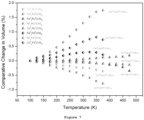
- the crystalline or highly crystalline co-ordination frameworks comprising complexes of Formula (I), (II), (III) or (IV), particularly those that have been partially or entirely desolvated exhibit zero or negative thermal expansion over a wide temperature range.
- the frameworks exhibiting zero or negative thermal expansion over a wide temperature range have M' as Ru. As crystallinity increases, the co-ordination frameworks tend to: (1) exhibit more linear thermal expansion behaviour; (2) exhibit the characteristic thermal expansion property (positive, zero or negative) over a larger temperature range (e.g.
- co-ordination frameworks comprising complexes of Formula (I), (II), (III) or (IV) can be oxidised or reduced such that they exhibit two or more (i.e. multiple) stabilised electrochemical/redox states.
- the co-ordination frameworks comprising complexes of Formula (I), (II), (III) or (IV) can therefore be redox active.
- the frameworks may be oxidised or reduced to provide M II /M' II , M II /M' III , M III /M' II or M III /M' III complexes within the framework.
- crystalline or highly crystalline co-ordination frameworks comprising complexes of Formula (I), (II), (III) or (IV) can be prepared that:
- co-ordination frameworks with more than two stabilised electrochemical/redox states are rare in the published literature. Materials that exhibit zero or negative thermal expansion are extremely rare in the published literature. Co-ordination frameworks which exhibit multiple redox states and negative/zero thermal expansion properties are extremely rare in the published literature.
- the co-ordination frameworks comprising complexes of Formula (I), (II), (III) or (IV) are in the form of microcrystallites.
- microcrystallites refers to a solid particle having one, two or three dimensions greater than 400 ⁇ and comprising more than 95 wt% crystalline material.
- microcrystallites is the plural of "microcrystallite”.
- the microcrystallites comprise more than 98 wt% crystalline material (e.g. more than 99 wt%, more than 99.5 wt% or more than 99.9 wt% crystalline material).
- the microcrystallites have one, two or three dimensions greater than about 500 ⁇ (e.g. greater than about 100 nm, greater than about 200 nm, greater than about 500 nm, greater than about 1 ⁇ m, greater than about 2 ⁇ m, greater than about 5 ⁇ m, greater than about 10 ⁇ m, greater than about 20 ⁇ m, greater than about 50 ⁇ m, greater than about 100 ⁇ m, greater than about 200 ⁇ m, greater than about 500 ⁇ m, greater than about 1 mm, greater than about 2 mm). In some embodiments, the microcrystallites have one, two or three dimensions of up to about 5 mm (e.g.
- the microcrystallites have one, two or three dimensions, especially two, more especially three, in the range of from about 500 ⁇ to about 5 mm, such as from about 50 ⁇ m to about 2 mm, from about 500 ⁇ m to about 2 mm or from about 1 mm to about 2 mm.
- the microcrystallites are composed of single crystals of the co-ordination frameworks comprising complexes of Formula (I), (II), (III) or (IV).
- the co-ordination frameworks comprising complexes of Formula (I), (II), (III) or (IV) can also be further modified by incorporating a ligand or guest (such as a pore surface modifying agent, discussed below) into the framework to change the ion or gas selectivity or thermal expansion properties of the co-ordination framework.
- a ligand or guest such as a pore surface modifying agent, discussed below
- the modification of a co-ordination framework comprising complexes of Formula (I), (II), (III) or (IV) by incorporating a pore surface modifying agents into the framework is referred to herein as "post-synthetic modification".
- the co-ordination frameworks comprising complexes of Formula (I), (II), (III) or (IV), where M is selected from V, Cr, Mn, Fe, Co, Ni, Zn, Ru, Rh, Pd and Pt, have a face-centred cubic topology Fm3m.
- M is selected from V, Cr, Mn, Fe, Co, Ni, Zn, Ru, Rh, Pd and Pt
- Figures 4 and 5 Examples of non-vacancy and vacancy face-centred cubic Fm 3 m unit cells of Ni II 2 [Fe II (CN) 6 ] are depicted in Figures 4 and 5 , respectively.
- the structures depicted in Figures 4 and 5 were refined from Rietveld analysis of data collected from the Australian Synchrotron in 2015.
- the co-ordination frameworks comprising complexes of Formula (I), (II), (III) or (IV), where M is selected from Cu, have an elongated tetragonal topology P4/mmm.
- the structure depicted in Figure 6 is the tetragonal P 4/ mmm structure of Cu II 2 [Fe II (CN) 6 ].
- the co-ordination frameworks comprising complexes of Formula (I), (II), (III) or (IV) may prepared by contacting a first aqueous solution comprising a V 2+ , Cr 2+ , Mn 2+ , Fe 2+ , Co 2+ , Ni 2+ , Cu 2+ , Zn 2+ , Ru 2+ , Rh 2+ , Pd 2+ or Pt 2+ salt (i.e M II, M being in the +2 oxidation state) with a second aqueous solution comprising a lithium, sodium, potassium, beryllium, magnesium or calcium salt, especially a lithium, sodium or potassium salt, of [Fe II (CN) 6 ] 4- or [Ru II (CN) 6 ] 4- under conditions which maintain a diffusion zone between the first aqueous solution and the second aqueous solution for a time of in excess of 1 day.
- a first aqueous solution comprising a V 2+ , Cr 2+ , Mn 2+ , Fe 2+
- diffusion zone refers to a zone where the first aqueous solution contacts and mixes with the second aqueous solution, wherein the first and second aqueous solutions outside the diffusion zone have not yet mixed.
- the co-ordination framework comprising complexes of Formula (I), (II), (III) or (IV) is formed in the diffusion zone.
- co-ordination frameworks comprising complexes of Formula (I), (II), (III) or (IV) having high crystallinity may be prepared.
- the diffusion zone is maintained for a period of at least 2 weeks, e.g. at least 3 weeks, at least 4 weeks or at least 6 weeks.
- the diffusion zone is at a temperature of from about 10 °C to about 50 °C, e.g. from about 10 °C to about 40 °C, from about 15 °C to about 40 °C, from about 15 °C to about 30 °C, from about 20 °C to about 30 °C or from about 20 °C to about 25 °C.
- the invention provides a method of preparing a co-ordination framework comprising complexes of Formula (IV) A x (M 2 [M' (CN) 6 ]) Formula (IV) wherein
- Such a method typically forms a co-ordination framework comprising complexes of Formula (IV), wherein M and M' are in the +2 oxidation state (i.e. A x (M 2 II [M'(CN) 6 ]).
- the co-ordination framework comprising complexes of Formula (IV) prepared by the method is crystalline. In some embodiments, the co-ordination framework comprising complexes of Formula (IV) prepared by the method is highly crystalline.
- the reaction may be carried out in an H-cell.
- An H-cell is a reaction vessel comprising two reservoirs with a fluid connection between the reservoirs.
- the fluid connection is generally a horizontal connection between the reservoirs.
- the H-cell is typically in a similar form to the capital letter H with the reservoirs in vertical chambers on either side of the cell, and a generally horizontal section connecting the two reservoirs.
- Such a system may allow for the maintenance of a diffusion zone (between the first aqueous solution and the second aqueous solution) for in excess of 1 day, for example, in excess of 2 days, 3 days, 4 days, 5 days, 6 days, 1 week, 2 weeks, 3 weeks, 1 month, 2 months or 6 months.
- maintaining a low concentration of M II and/or [M'(CN) 6 ] 4- in the diffusion zone allows co-ordination frameworks to be produced that have improved/increased crystallinity compared to co-ordination frameworks produced by prior art methods.
- a “slow diffusion” method may be employed.
- an M 2+ salt in the solid state is added to one reservoir of an H-cell, and a salt of [M'(CN) 6 ] 4- , also in the solid state, is added to the other reservoir of the H-cell.
- Solvent is then added to each of the reservoirs so as to minimise disturbance of the solids. Disturbance of the solid may be minimised by, for example, slow addition of the solvent with minimal mixing/turbulence (e.g.
- the first solution frontier (comprising the M 2+ ) and the second solution frontier (comprising the [M'(CN) 6 ] 4- ) slowly diffuse and eventually make contact in the diffusion zone, whereupon the M 2+ and [M'(CN) 6 ] 4- (each in a very low concentration) then react over time to form co-ordination frameworks comprising complexes of Formula (I), (II), (III) or (IV) having high crystallinity (e.g. in the form of a powder with a high proportion of microcrystalites).
- the molar ratio of the starting materials M 2+ : [M'(CN) 6 ] 4- may be varied.
- the molar ratio of M 2+ : [M'(CN) 6 ] 4- varies from about 3:1 to about 1:3 (e.g. about 3:1 to about 1:1, about 2:1 to about 1:1, about 2:1 to about 1:2, about 2:1 or about 1:1).
- the resultant co-ordination framework may be collected from the diffusion zone by, for example, filtration or collection of the precipitate (e.g. microcrystalites).
- the co-ordination framework may then be washed, e.g. by deionised water washes and separation of supernatant, e.g. by centrifuge (which may be used to separate the microcrystallites from amorphous material). The washing procedure may be repeated multiple times.
- Additional lithium, sodium, potassium, beryllium, magnesium or calcium especially lithium, sodium or potassium, in the form of lithium, sodium, potassium, beryllium, magnesium or calcium salts may be included in the first aqueous solution, the second aqueous solution or both aqueous solutions in order to vary the content of these ions in the resultant co-ordination framework.
- suitable lithium, sodium or potassium salts include lithium, sodium or potassium halides (e.g. Cl, Br or I, such as LiCl, LiBr, NaCl, NaBr, KCl and KBr).
- suitable lithium, sodium, potassium, beryllium, magnesium or calcium salts include nitrates (e.g.
- suitable lithium, sodium, potassium, beryllium, magnesium or calcium salts, especially lithium, sodium or potassium salts include the counterions sulphate (SO 4 2- ), carbonate (CO 3 2- ), acetate (CH 3 COO - ), trifluoromethanesulfonate (triflate) (CF 3 SO 3 - ), nitrate (NO 3 ), hexafluorophosphate (PF 6 - ), hexafluoroarsenate (AsF 6 - ), hydroxide (OH - ), metaborate (BO 2 - ), tetraborate (B 4 O 7 2- ), tetrachloroaluminate (AlCl 4 - ), tetrachloroaurate (AuCl 4 - ), tetrachloro
- the molar ratio of A : [M'(CN) 6 ] 4- may be varied. Typically, the molar ratio of A : [M'(CN) 6 ] 4- varies from about 4:1 to about 1:4 (e.g. about 4:1 to about 1:1, about 1:1 to about 1:4, about 3:1 to about 1:3, about 3:1 to about 1:1, about 1:1 to about 1:3, about 2:1 to about 1:2, about 2:1 to about 1:1, about 1:1 to about 1:2, about 2:1 or about 1:1).
- 4:1 to about 1:4 e.g. about 4:1 to about 1:1, about 1:1 to about 1:4, about 3:1 to about 1:3, about 3:1 to about 1:1, about 1:1 to about 1:3, about 2:1 to about 1:2, about 2:1 to about 1:1, about 1:1 to about 1:2, about 2:1 or about 1:1.
- Co-ordination frameworks comprising complexes of Formula (I), (II), (III) or (IV) are typically prepared in the M II /M' II oxidation state (i.e. M is in the +2 oxidation state and M' is in the +2 oxidation state).
- Co-ordination frameworks comprising complexes of Formula (I), (II), (III) or (IV) in the M II /M' II oxidation state are redox active and may be converted to other oxidation state combinations (e.g. M II /M' III , M III /M' II or M III /M' III ) using electrochemical methods (e.g. by contacting the material and an electrode and applying a voltage/charge to the material via the electrode).
- co-ordination frameworks comprising complexes of Formula (I), (II), (III) or (IV) may be used to alter the redox state of the co-ordination frameworks comprising complexes of Formula (I), (II), (III) or (IV) whilst maintaining the structural integrity of the framework.
- the co-ordination frameworks comprising complexes of Formula (I), (II), (III) or (IV) are initially prepared in the M II /M' II oxidation state, as doing so can provide advantageous properties.
- co-ordination frameworks comprising complexes of Formula (I), (II), (III) or (IV) in the M II /M' II oxidation state can have increased porosity, increased charge capacity (as measured by the amount of guest ions packed into the pores) and/or increased thermal stability, relative to other co-ordination frameworks.
- Such co-ordination frameworks comprising complexes of Formula (I), (II), (III) or (IV) in the M II /M' II oxidation state can subsequently be subjected to further manipulations (e.g. redox reactions) in order to construct co-ordination frameworks comprising complexes of Formula (I), (II), (III) or (IV) in other oxidation state combinations (e.g. M II /M' III , M III /M' II or M III /M' III ) that maintain at least some of the porosity, charge capacity and/or thermal stability properties of the initial M II /M' II framework.
- the co-ordination frameworks comprising complexes of Formula (I), (II), (III) or (IV) may be subjected to further synthetic manipulations.
- the co-ordination frameworks comprising complexes of Formula (I), (II), (III) or (IV) can be modified through a process referred to herein as "post-synthetic modification”. This process, and the products of this process (sometimes referred to herein as “post-synthetically modified frameworks" or “post-synthetically modified derivatives”), are discussed later under the heading "Post-synthetic modification".
- the co-ordination frameworks comprising complexes of Formula (I), (II), (III) or (IV), and post-synthetically modified derivatives thereof, are typically prepared in the form of powders.
- powders may be transformed into other forms by processes known in the art.
- a solid material may be obtained from a powder by packing the powder into a press or a mold.
- co-ordination frameworks comprising complexes of Formula (I), (II), (III) or (IV), as well as post-synthetically modified frameworks, are redox active and porous and have a number of internal sites which can capture various guests, for example gases, solvents (including volatile solvents) and/or ions (e.g. metal ions).
- Co-ordination frameworks which have high crystallinity tend to have a higher porosity and significantly larger capacity to capture guests. High crystallinity of the framework is an important feature driving porosity, and therefore the capacity to sorb guests.
- Co-ordination frameworks having high crystallinity have both long and short range ordering of atoms, which is thought to be advantageous for the efficient flow of guests into and out of the pores/channels of the co-ordination framework.
- the rationale for this is that if the framework is not crystalline, or only exhibits some short range ordering (as evidenced by one or more of: (i) broadening of peaks in X-ray diffraction spectra; (ii) low intensity peaks in X-ray diffraction pattern; or (iii) only peaks at low Q/low angle (i.e.
- the co-ordination framework may need to be desolvated or dehydrated to adsorb guests into the pores (dehydration being to remove residual water from the framework remaining from the synthesis of the framework).
- dehydration being to remove residual water from the framework remaining from the synthesis of the framework.
- ion sorption and desorption can typically occur without desorption of the residual water or other solvent from the framework
- gas sorption including, but not limited to, H 2 , CO 2 , O 2 , NO 2 , CH 4 , N 2 , ethane, ethene, ethyne, propane, butane, and CO
- gas sorption typically requires desorption of the residual water or other solvent from the framework prior to sorption of the gas.
- the co-ordination frameworks comprising complexes of Formula (I), (II), (III) or (IV) typically have a high affinity for one or more of CH 4 , CO 2 , O 2 and H 2 , especially CO 2 and H 2 , and can be used to capture these gases.
- the gases are captured by exposing the co-ordination framework to an atmosphere comprising the gas.
- Some of the co-ordination frameworks comprising complexes of Formula (I), (II), (III) or (IV) also have affinity for small chain hydrocarbons, such as methane, ethane, ethylene or acetylene, and can be used to capture these gases.
- the present invention provides a method of capturing or adsorbing a gas (e.g. H 2 , CO 2 , O 2 , CO, NO 2 , NO, N 2 O 4 , CH 4 , N 2 , ethane, ethene, ethyne, propane or butane, especially H 2 , CO 2 , O 2 , CO, NO 2 , CH 4 , N 2 , ethane, ethene, ethyne, propane or butane), the method comprising contacting a co-ordination framework comprising complexes of Formula (I), (II), (III) or (IV) and the gas to be captured or adsorbed.
- a gas e.g. H 2 , CO 2 , O 2 , CO, NO 2 , NO, N 2 O 4 , CH 4 , N 2 , ethane, ethene, ethyne, propane or butane
- the present invention provides the use of a co-ordination framework comprising complexes of Formula (I), (II), (III) or (IV) in the capture or absorption of a gas (e.g. H 2 , CO 2 , O 2 , CO, NO 2 , NO, N 2 O 4 , CH 4 , N 2 , ethane, ethene, ethyne, propane or butane, especially H 2 , CO 2 , O 2 , CO, NO 2 , CH 4 , N 2 , ethane, ethene, ethyne, propane or butane).
- a gas e.g. H 2 , CO 2 , O 2 , CO, NO 2 , NO 2 O 4 , CH 4 , N 2 , ethane, ethene, ethyne, propane or butane.
- the present invention provides the use of a co-ordination framework of Formula (I), (II), (III) or (IV) in the storage of a gas (e.g. H 2 , CO 2 , O 2 , CO, NO 2 , NO, N 2 O 4 , CH 4 , N 2 , ethane, ethene, ethyne, propane or butane, especially H 2 , CO 2 , O 2 , CO, NO 2 , CH 4 , N 2 , ethane, ethene, ethyne, propane or butane).
- a gas e.g. H 2 , CO 2 , O 2 , CO, NO 2 , NO 2 , CH 4 , N 2 , ethane, ethene, ethyne, propane or butane.
- the post-synthetically modified co-ordination frameworks i.e. a co-ordination framework comprising complexes of Formula (I), (II), (III) or (IV) that has been subjected to post-synthetic modification
- the post-synthetic modification may also be used to change the gas selectivity of the co-ordination framework.
- the selectivity towards a particular gas is typically dependent on the ligand used for PSM (i.e. the "pore surface modifying agent" as described below under the heading "Post-synthetic modification").
- the ligand i.e. "pore surface modifying agent"
- the ligand changes the gas selectivity of the framework.
- ligands i.e. "pore surface modifying agents”
- a post-synthetically modified framework may, for example, be used to store CO 2 , N 2 , H 2 , O 2 , CH 4 , C 2 H 2 , C 2 H 6 , C 2 H 4 , C 3 H 8 , C 4 H 10 , and other gases including high volatility organic solvents.
- gases may include, for example, NO and N 2 O 4 .
- the present invention provides a method of capturing or adsorbing a gas (e.g. H 2 , CO 2 , O 2 , CO, NO 2 , NO, N 2 O 4 , CH 4 , N 2 , ethane, ethene, ethyne, propane or butane, especially H 2 , CO 2 , O 2 , CO, NO 2 , CH 4 , N 2 , ethane, ethene, ethyne, propane or butane), the method comprising contacting a post-synthetically modified framework and the gas to be captured or adsorbed.
- a gas e.g. H 2 , CO 2 , O 2 , CO, NO 2 , NO, N 2 O 4 , CH 4 , N 2 , ethane, ethene, ethyne, propane or butane
- the present invention provides the use of a post-synthetically modified framework in the capture or absorption of a gas (e.g. H 2 , CO 2 , O 2 , CO, NO 2 , NO, N 2 O 4 , CH 4 , N 2 , ethane, ethene, ethyne, propane or butane, especially H 2 , CO 2 , O 2 , CO, NO 2 , CH 4 , N 2 , ethane, ethene, ethyne, propane or butane).
- a gas e.g. H 2 , CO 2 , O 2 , CO, NO 2 , CH 4 , N 2 , ethane, ethene, ethyne, propane or butane.
- a gas e.g. H 2 , CO 2 , O 2 , CO, NO 2 , NO, CH 4 , N 2 , ethane, ethene, eth
- the co-ordination frameworks of the present invention can be tuned to change their porosity and affinity for guests.
- the frameworks tend to vary with different ion incorporation and it is believed that as the quantity and/or size of ions increases, the pore volume decreases.
- the ions can have an effect on the affinity for certain guests (e.g. gases and ions).
- Electric fields can, in some embodiments, be used to change the gas sorption properties and release the gas when it is needed. Gases may, in various embodiments, also be released through changes in temperature, changes in pressure, changes in magnetic fields, changes in electric fields or through guest substitution (i.e. the introduction of other gases or solvents into the pore space).
- co-ordination frameworks comprising complexes of Formula (I), (II), (III) or (IV), and post-synthetically modified frameworks, may be used in one or more of:
- Porosity is also dependent on the coordinating metals in the framework (i.e. M and M'), as these have an effect on the bond length, and therefore the dimensions of the pores/channels. Larger pores/channels yields greater porosity, and thus, the ability to add more, or larger, cations (or other guests) to generate more vacancies without sacrificing all the available pore space.
- Some materials show a strong affinity for H 2 , while others show a strong affinity for H 2 , CO 2 , O 2 , NO 2 , CH 4 , N 2 , ethane, ethene, ethyne, propane, butane, CO.
- Affinity may, for example, be determined using a calculation of isosteric heat of adsorption for each gas in each framework with BET isotherm experiments undertaken at 3 different temperatures. Some materials show a strong affinity for H 2 (e.g. Ni[Ru(CN) 6 ] and Ni[Fe(CN) 6 ), while others show a strong affinity for H 2 and/or CO 2 (e.g. Cu[Ru(CN) 6 ] and Cu[Fe(CN) 6 ]).
- the co-ordination frameworks comprising complexes of Formula (I), (II), (III) or (IV), and post-synthetically modified frameworks, typically have an affinity for various ions and may be used to capture and release these ions.
- the capture of the ions is performed by contacting the co-ordination framework with a solution comprising the ion.
- the present invention provides a method of capturing and/or releasing an ion (e.g.
- the present invention provides the use of a co-ordination framework comprising complexes of Formula (I), (II), (III) or (IV), or a post-synthetically modified framework, in the capture and/or release of an ion (e.g. one or more ions selected from ions of Li, Na, K, Be, Mg, Al, Ca, V, Cr, Mn, Fe, Co, Ni, Cu, Zn, Ga, Ge, Zr, Ru, Rh, Pd, Au, Ag, Pt, Cd, In, Sn, Sb, Bi, Pb, Hg and Ir, especially one or more ions selected from ions of Li, Na, K, Al, Be, Mg and Ca).
- an ion e.g. one or more ions selected from ions of Li, Na, K, Be, Mg, Al, Ca, V, Cr, Mn, Fe, Co, Ni, Cu, Zn, Ga, Ge, Zr, Ru, Rh, Pd, Au, Ag, Pt, Cd,
- the present invention provides the use of a co-ordination framework comprising complexes of Formula (I), (II), (III) or (IV), or a post-synthetically modified framework, in the storage of an ion (e.g. one or more ions selected from ions of Li, Na, K, Be, Mg, Al, Ca, V, Cr, Mn, Fe, Co, Ni, Cu, Zn, Ga, Ge, Zr, Ru, Rh, Pd, Au, Ag, Pt, Cd, In, Sn, Sb, Bi, Pb, Hg, Ir, especially one or more ions selected from ions of Li, Na, K, Al, Be, Mg and Ca).
- an ion e.g. one or more ions selected from ions of Li, Na, K, Be, Mg, Al, Ca, V, Cr, Mn, Fe, Co, Ni, Cu, Zn, Ga, Ge, Zr, Ru, Rh, Pd, Au, Ag, Pt, Cd, In, Sn
- the present invention provides a co-ordination framework comprising complexes of Formula (I), (II), (III) or (IV), or a post-synthetically modified derivative thereof, wherein the framework comprises an ion in a pore of the framework, wherein the ion is selected from ions of Li, Na, K, Be, Mg, Al, Ca, V, Cr, Mn, Fe, Co, Ni, Cu, Zn, Ga, Ge, Zr, Ru, Rh, Pd, Au, Ag, Pt, Cd, In, Sn, Sb, Bi, Pb, Hg, Ir, especially one or more ions selected from ions of Li, Na, K, Al, Be, Mg and Ca, more especially one or more ions selected from ions of Li, Na and K.
- the ion is in the +1, +2, +3, +4 or +5 state, especially the +1, +2 or +3 state, more especially the +1 or +2 state.
- Zero Thermal Expansion (ZTE) and Negative Thermal Expansion (NTE) are physicochemical properties whereby materials either do not undergo dimensional change or contract upon heating, rather than expanding as most materials do.
- ZTE and NTE materials have received increasing interest over the past three decades for a variety of uses domestically (e.g. in thermally resistant kitchenware) and industrially (e.g. in electronic devices, heat engine components, heat resistant auto-parts and a wide variety of aerospace technologies).
- Commercial ZTE and NTE technologies have largely been ceramic based with LAS systems (Li 2 O-Al 2 O 3 -SiO 2 ) dominating both the kitchenware and aerospace engineering industry.
- the co-ordination frameworks of the present invention comprise a 3-D cyanido-bridged co-ordination framework which is believed to have increased vibrational flexibility of the diatomic -CN- linker compared with other bridging systems, such as seen in metal oxides.
- the cyanido-bridge is a unique ligand. It is the strongest in crystal field strength of known monodentate ligands, enabling fast, low energy input synthesis.
- the cyanido-bridge displays versatile electronic properties via its simultaneous o-donor/n-acceptor (i.e. ⁇ -backbonding) system, which enables metal-to-metal communication, such as long range ordering of spin states, or intervalence charge transfer (IVCT) in mixed valent compounds. It is also a relatively small ligand, which limits the structural possibilities when bringing multiple secondary building units (SBUs) together during one-step co-ordination framework synthesis, thereby creating predictable morphologies.
- the cyanido ligand is also flexible, making it ideal to simultaneously facilitate electronic activity, magnetic cooperativity and anomalous thermal expansion properties.
- the co-ordination frameworks comprising complexes of Formula (I), (II), (III) or (IV), or post-synthetically modified frameworks, that have useful thermal properties are desolvated.
- partially or entirely desolvated crystalline co-ordination frameworks comprising complexes of Formula (I), (II), (III) or (IV), where M' is Ru exhibit zero or negative thermal expansion over a wide temperature range.
- the partially or entirely desolvated crystalline co-ordination frameworks comprising complexes of Formula (I), (II), (III) or (IV) exhibit zero or negative thermal expansion over a temperature range of 0 - 700k.
- the co-ordination frameworks comprising complexes of Formula (I), (II), (III) or (IV) generally need to be more than about 90% desolvated in order to exhibit such thermal expansion properties.
- desolvating crystalline frameworks comprising complexes of Formula (I), (II), (III) or (IV), where M is Cu, provides materials having positive or negative thermal expansion.
- the materials that exhibit ZTE between 100 - 600 K may have application in lattices on which to deposit thin film solar voltaic (to protect the film from microcracking as a result of exposure to extreme heat/cold), to replace batteries which are used under extreme heat conditions (such as in phones) and to provide ZTE properties to high precision devices including scientifically calibrated instruments, high precision medical devices, lasers (which generate large amounts of heat), induction electric engines, stoves/benchtops.
- the coordination frameworks of the present invention have an array of properties that make them useful for various functions or applications. They may thus be referred to as multifunctional materials.
- the coordination framework of the present invention possesses one or more properties that make it useful for one or more particular functions or applications.
- the material may display properties such as ZTE, NTE, PTE, semi-conductive properties, conductive properties, capacitive properties, charge storage/release, gas storage/release, guest storage/release, separations, filtrations or redox activity.
- the material possesses one of these properties as a defining characteristic.
- the material possesses two or more (e.g. three, four, five or six) of these properties as defining characteristics.
- the coordination frameworks of the present invention may be used as single function or multifunctional components that involve the movement of ions (e.g. electrons), such as electronic devices (e.g. in computers or computational devices).
- ions e.g. electrons
- electronic devices e.g. in computers or computational devices.
- the naturally high capacitance of the materials, combined with their semi or full conductivity and ability to adsorb and release ions, makes them useful as storage devices (e.g. batteries) and as constituents in a range of computing components.
- co-ordination frameworks comprising complexes of Formula (I), (II), (III) or (IV) can be modified through a process referred to herein as "post-synthetic modification” which affords materials referred to herein as “post-synthetically modified frameworks".
- a "pore surface modifying agent” (sometimes referred to herein as PSMA or "pore surface modifier”) is introduced into the pores of a co-ordination framework comprising complexes of Formula (I), (II), (III) or (IV), where it binds to one or more metal centres of the coordination framework and has the effect of modifying the surface properties of a pore.
- the pore surface modifying agent modifies the surface properties of the pore.
- properties may include the chemical properties as well as physical properties.
- the PSMA may increase or decrease the hydrophobicity of the pore surface, increase or decrease the hydrophilicity of the pore surface, increase or decrease the ionicity of the pore surface, add functional groups (e.g. reactive functional groups) to the pore surface.
- a pore surface modifying agent may be selected to increase affinity towards: (1) specific elements, (2) molecules based on their electronegativity, (3) molecules based on polarity, (4) organic molecules containing ⁇ -bonds, (5) organic molecules containing conjugated ⁇ -systems, and/or (6) organic molecules having specific functional groups (e.g. containing heteroatoms such as S, N, O and F) through dipole-dipole or hydrogen bonding interactions unique to those functional groups.
- the pore surface modifying agent may also increase or (more typically) decrease the pore size, impede the movement of guests through the pores/channels (e.g. by steric effects, covalent or non-covalent bonding), or facilitate the movement of guests through the pores/channels.
- a bulky (i.e. sterically demanding) pore surface modifying agent may be used to reduce negative thermal expansion behaviour towards zero thermal expansion behaviour. It is believed that this change in behaviour is due, at least in part, to sterically hindering phonon vibrational modes.
- Post-synthetic modification can change the properties of the co-ordination framework, for example, increasing or decreasing the affinity for certain guests, increasing or (more typically) decreasing the porosity of the co-ordination framework.
- Post-synthetic modification may also be used to (1) increase the thermal stability of the overall framework, (2) increase the chemical resistivity of the overall framework (e.g. resistance to extremely acidic or basic environments), and/or (3) change the electronic and/or magnetic properties of the overall material.
- the "pore surface modifying agent” is typically introduced into the pores of a co-ordination framework comprising complexes of Formula (I), (II), (III) or (IV) by contacting the "pore surface modifying agent” and the co-ordination framework comprising complexes of Formula (I), (II), (III) or (IV). These may be contacted by any means, for example, adding the "pore surface modifying agent” to a vessel containing the co-ordination framework comprising complexes of Formula (I), (II), (III) or (IV), or adding the co-ordination framework comprising complexes of Formula (I), (II), (III) or (IV) to a vessel containing the "pore surface modifying agent".
- the "pore surface modifying agent” may be in solid form or in solution.
- the "pore surface modifying agent" is in a fluid form, for example, a liquid, gas or dissolved in a solvent (i.e. solution).
- a solvent i.e. solution.
- the co-ordination framework comprising complexes of Formula (I), (II), (III) or (IV) may be in solid form or in solution. Solutions may be aqueous solutions or solutions in organic solvents (e.g. THF, ethanol (EtOH), methanol (MeOH), isopropanol, acetonitrile, toluene, phenol, benzonitrile).
- the solvent is preferably selected so as to minimise competition with the PSMA.
- the pore surface modifying agent comprises a metal binding group covalently bound to a pore modifying group, optionally via a linker.
- the linker is covalently bound to the metal binding group and covalently bound to the pore modifying group.
- the pore surface modifying agent may comprise 1, 2, 3 or 4 metal binding groups, which are each independently optionally covalently bound to a linker.
- the pore surface modifying agent may comprise 1, 2, 3 or 4 pore modifying groups, which are each independently optionally covalently bound to a linker.
- the linker when present, may be covalently bound to 1, 2, 3 or 4 metal binding groups and/or 1, 2, 3 or 4 pore modifying groups.
- the metal binding group also functions as a pore surface modifying group. That is, in some embodiments the metal binding group is a pore surface modifying group (e.g. ammonia or pyridine).
- a pore surface modifying group e.g. ammonia or pyridine
- the metal binding group is covalently bound directly to the pore modifying group (i.e. there is no linker).
- a “metal binding group” is a functional group that binds to a metal.
- Useful examples include functional groups containing nitrogen, oxygen and/or sulphur, such as -NH-, -NH 2 , -NHC 1-3 -alkyl, -N (C 1-3 -alkyl) (C 1-3 -alkyl), -OH, -OC 1-3 -alkyl, -COOH, -COOC 1-3 -alkyl, -SH, -SC 1-3 -alkyl, -(CO)NH 2 , -(CO)NHC 1-3 -alkyl, - (CO)N (C 1-3 -alkyl)(C 1-3 -alkyl), and heterocycles such as imidazole, morpholine, pyrimidine, pyridine, piperidine, pyrrole, pyrolidine, thiazole, thiophene, furan and tetrahydrofuran.
- Especially useful metal binding groups include diamine-based ligands, such as H 2 N(CH 2 ) 2 NH 2 , H 2 N(CH 2 ) 3 NH 2 , H 2 N(CH 2 ) 4 NH 2 , H 2 N(CH 2 ) 5 NH 2 , H 2 N(CH 2 ) 6 NH 2 , H 2 N(CH 2 ) 7 NH 2 or H 2 N(CH 2 ) 8 NH 2 .
- ethylenediamine (en) has displayed efficient CO 2 capture in some examples.
- the metal binding group is covalently bound to a linker (when present) or the pore modifying group (unless the metal binding group is also the pore modifying group).
- a "pore modifying group” is a functional group that is capable of interacting with a guest by chemical and/or steric interactions.
- chemical interactions include hydrophobic interactions, hydrophilic interactions, fluorophilic interactions, fluorophobic interactions, ionic interactions, covalent bonding interactions, van der Waals interactions, London dispersion forces, hydrogen bonding and ⁇ - ⁇ interactions (e.g. ⁇ - ⁇ stacking).
- pore modifying groups include -H, -NH 2 , -NHC 1-3 -alkyl, -N(C 1-3 -alkyl)(C 1-3 -alkyl), - OH, -OC 1-3 -alkyl, -CHO, -COOH, -COOC 1-3 -alkyl, -C(O)C 1-3 -alkyl, -SH, - SC 1-3 -alkyl, mono- or polyfluorinated C 1-10 -alkyl groups, phenyl, phenyl substituted with 1, 2, 3, 4 or 5 groups each independently selected from -OH, -NH 2 and -F.
- the pore modifying group is covalently bound to a linker (when present) or the metal binding group (unless the metal binding group is also the pore modifying group).
- the linker is optional.
- the linker when present, covalently links a metal binding group and a pore modifying group.
- the linker is typically between 1 and 6 atoms in length (e.g. C 1-6 -alkyl).
- the linker covalently bonds 1, 2, 3 or 4 metal binding groups and/or 1, 2, 3 or 4 pore modifying groups.
- the pore surface modifying agent is of the form: MBG-L-PMG wherein
- the linker is a divalent linear C 1-6 -alkyl (e.g. C 1 -alkyl, C 2 -alkyl, C 3 -alkyl, C 4 -alkyl, C 5 -alkyl or C 6 -alkyl) bound at one end to the MBG and the other end to the PMG.
- C 1-6 -alkyl e.g. C 1 -alkyl, C 2 -alkyl, C 3 -alkyl, C 4 -alkyl, C 5 -alkyl or C 6 -alkyl
- the MBG comprises an amine, such as -NH 2 .
- the PMG comprises a conjugated ⁇ -system, for example a conjugated alkene or alkyne system or an aromatic system, such as phenyl, substituted phenyl, pyridine, 1-naphthylamine, bipyridines including 2,2'-bipyridine, 2,3'-bipyridine, 2,4'-bipyridine, 3,3'-bipyridine, 3,4'-bipyridine and 4,4'-bipyridine.
- the PMG comprises an amine, such as -NH 2 .
- the pore surface modifying agent comprises an amine and an aromatic group, such as phenyl.
- the pore surface modifying agent is or comprises a diamine (e.g. ethylene diamine (H 2 NCH 2 CH 2 NH 2 )), which may be useful for applications involving CO 2 sorption.
- the pore surface modifying agent comprises 2, 3, 4, 5, 6, 7 or 8 conjugated ⁇ -bonds, or an aromatic system (such as phenyl, substituted phenyl, pyridine, 1-naphthylamine, bipyridines including 2,2'-bipyridine, 2,3'-bipyridine, 2,4'-bipyridine, 3,3'-bipyridine, 3,4'-bipyridine or 4,4'-bipyridine), which may be useful for applications involving H 2 sorption.
- an aromatic system such as phenyl, substituted phenyl, pyridine, 1-naphthylamine, bipyridines including 2,2'-bipyridine, 2,3'-bipyridine, 2,4'-bipyridine, 3,3'-bipyridine, 3,4'-bipyridine or 4,4'-bipyridine
- the pore surface modifying agent is selected from ethylene diamine (H 2 NCH 2 CH 2 NH 2 ), mono, poly or perfluoroC 1-10 alkylamine (e.g. CF 3 (CF 2 ) 2 NH 2 , tetrahydrofuran, thiophene, ammonia and pyridine).
- ethylene diamine H 2 NCH 2 CH 2 NH 2
- mono, poly or perfluoroC 1-10 alkylamine e.g. CF 3 (CF 2 ) 2 NH 2 , tetrahydrofuran, thiophene, ammonia and pyridine.
- the metal binding group binds to a metal of the co-ordination framework comprising complexes of Formula (I), (II), (III) or (IV), holding the pore modifying group in the pore/channel of the framework (e.g. on the surface of the pore or protruding into the pore/channel).
- the present invention provides a co-ordination framework comprising complexes of Formula (I), (II), (III) or (IV), incorporating pore surface modifying agent co-ordinated within the framework.
- the metal binding group binds (e.g. ligates) to bare metal sites in the cubic vacancy materials, or to both/either bare metal sites and pillaring Cu sites in the Hoffman type materials.
- the present invention provides a method of modifying a co-ordination framework comprising complexes of Formula (I), (II), (III) or (IV), comprising contacting a co-ordination framework comprising complexes of Formula (I), (II), (III) or (IV) with a pore surface modifying agent such that the pore surface modifying agent becomes co-ordinated within the framework.
- the pore surface modifying agent is competitive and will bind with metal sites without desolvation (e.g. desorption of water). Such embodiments will typically depend on the ligand field strength of the relevant pore surface modifying agent.
- the co-ordination framework comprising complexes of Formula (I), (II), (III) or (IV) is at least partially desolvated before contacting the co-ordination framework comprising complexes of Formula (I), (II), (III) or (IV) with the pore surface modifying agent to facilitate the co-ordination of the pore surface modifying agent within the framework.
- the co-ordination framework may be desolvated or partially desolvated by any means that removes at least some solvate from the framework to provide a framework having at least some bare metal sites.
- the co-ordination framework is desolvated by heating the framework.
- the co-ordination framework is desolvated by subjecting the framework to reduced pressure (e.g. a vacuum or at least less than atmospheric pressure).
- the co-ordination framework is desolvated by heating the framework under reduced pressure.
- the at least partially desolvated co-ordination framework may be contacted with the pore surface modifying agent by any means which allows the pore surface modifying agent to enter the framework and co-ordinate with a metal in the framework.
- the pore surface modifying agent is a volatile compound
- the at least partially desolvated co-ordination framework may be contacted with the pore surface modifying agent in gaseous form by exposing the framework to an atmosphere of the pore surface modifying agent.
- the pore surface modifying agent is a liquid
- the at least partially desolvated co-ordination framework may be contacted with the pore surface modifying agent in liquid form.
- the post-synthetic modification allows for several new tunable properties including:
- co-ordination frameworks comprising complexes of Formulas (I), (II), (III) or (IV) described above act as platforms for a whole series of properties, e.g. different chemical reactions or processes that would not otherwise be possible in the same efficiency (i.e. the efficiency can be improved by PSM).
- the ligand ethylenediamine (en) may be added to frameworks using the above described methods whereby a non-desorbed framework sample is exposed to ethylenediamine at a temperature that increases the volatility of ethylenediamine but below a temperature that decays the framework.
- the reaction can be monitored using solid state Ultra-Violet-visible-Near-Infrared (UV-vis-NIR) spectrometry to monitor completion of a colour change associated with ethylenediamine binding to metal sites.
- UV-vis-NIR Ultra-Violet-visible-Near-Infrared
- the unbound end of the en molecule has an amine group (-NH 2 ).
- This group has a strong affinity for the gases CO 2 and CO.
- the PSM-framework is typically bestowed increased CO 2 affinity as determined by isosteric heat of adsorption. This PSM method may increase the gas sorption functionality of the material.
- a pore surface modifying agent may be selected or designed to achieve certain binding properties using known structure-binding relationships. By incorporating such pore surface modifying agents within an ordered framework structure, it is possible to enhance the binding properties of the relevant framework. Without wishing to be bound by theory, it is believed that one advantage of incorporating ligands into a framework comprising complexes of Formula (I), (II), (III) or (IV) versus simply using the pore surface modifying agents by themselves is the multiple order of magnitude increase in density achieved as the framework, through its high crystalline nature, orders atoms at long range providing highly ordered channels. Such long range highly ordered channels can facilitate reactions occurring at much faster rates, and ions and gases can be stored with greater affinity.
- Energy storage e.g. Battery
- semiconductor applications e.g.
- the co-ordination frameworks comprising complexes of Formula (I), (II), (III) or (IV), and post-synthetically modified frameworks, are typically redox active and porous.
- the frameworks are semi-conducting.
- the redox active frameworks can act as energy storage devices (e.g. batteries) with high cycles (e.g. upwards of 2000 charges and theoretically upwards of 50000 charges) without appreciable loss of crystallinity or performance (e.g. greater than 90% retention of capacity).
- these frameworks can act as devices to hold and transfer ions (e.g. electrons) and energy carrying gases (e.g. H 2 , O 2 and CH 4 ), on demand, without appreciable loss of crystallinity or performance.
- the invention provides an energy storage device (e.g. a battery or storage for an energy carrying gas) comprising a co-ordination framework of the present invention, or a post-synthetically modified co-ordination framework of the present invention.
- an energy storage device e.g. a battery or storage for an energy carrying gas
- the invention provides the use of a co-ordination framework of the present invention, or a post-synthetically modified co-ordination framework of the present invention, in an energy storage device (e.g. a battery or storage for an energy carrying gas).
- the co-ordination frameworks of the present invention may be used in tunable lightweight, high cyclability batteries or energy storage devices for the transport industry including electric/hybrid: cars, drones, passenger and cargo jets, motorcycles, trucks, trains, unmanned vehicles, autonomous vehicles (both land, water and flying), robots, spaceships.
- the batteries or energy storage devices may also be utilised as a domestic or industrial power storage unit - providing the grid or houses with peak load capacity, or capacity during brown or blackouts.
- the batteries could be used to facilitate power efficiency measure in large industrial buildings/skyscrapers, and to regulate and increase the evenness of electricity distribution in smart cities, through the enablement of smart grids.
- the batteries or energy storage devices may also be utilised in electronic devices (phones, tablets, laptops other portable devices with screens and/or communication capabilities) as well as satellites and space craft.
- batteries or energy storage devices may be utilised for any device which requires a power source (e.g. stored or on demand power).
- the co-ordination frameworks of the present invention are comprised of at least 90% complexes of Formula (I), Formula (II), Formula (III) and/or Formula (IV) (e.g. at least 95%, at least 97%, at least 98%, at least 99%, at least 99.5%, at least 99.8%, at least 99.9%, at least 99.95% or at least 99.99%).
- the co-ordination frameworks of the present invention are comprised of at least 90% complexes of Formula (I) (e.g. at least 95%, at least 97%, at least 98%, at least 99%, at least 99.5%, at least 99.8%, at least 99.9%, at least 99.95% or at least 99.99%).
- the co-ordination frameworks of the present invention are comprised of at least 90% complexes of Formula (II) (e.g. at least 95%, at least 97%, at least 98%, at least 99%, at least 99.5%, at least 99.8%, at least 99.9%, at least 99.95% or at least 99.99%). In some embodiments, the co-ordination frameworks of the present invention are comprised of at least 90% complexes of Formula (III) (e.g. at least 95%, at least 97%, at least 98%, at least 99%, at least 99.5%, at least 99.8%, at least 99.9%, at least 99.95% or at least 99.99%).
- the co-ordination frameworks of the present invention are comprised of at least 90% complexes of Formula (IV) (e.g. at least 95%, at least 97%, at least 98%, at least 99%, at least 99.5%, at least 99.8%, at least 99.9%, at least 99.95% or at least 99.99%).
- the co-ordination frameworks of the present invention are post-synthetically modified to controllably vary the thermal expansion, redox/electronic, porosity, surface chemistry, gas sorption, ion sorption and/or solvent separation properties.
- the present invention provides: an energy storage device (including Group I, II and III ion storage devices), an H 2 gas storage device, an organic hydrocarbon (e.g. CH 4 , C 2 H 2 , C 2 H 4 , C 2 H 6 ) gas storage device, or a low molecular weight gas (e.g. O 2 and CO 2 ) gas capture device; the device comprising a co-ordination framework of the present invention (including post-synthetically modified derivatives thereof).
- an energy storage device including Group I, II and III ion storage devices
- an H 2 gas storage device e.g. CH 4 , C 2 H 2 , C 2 H 4 , C 2 H 6
- a low molecular weight gas e.g. O 2 and CO 2
- the present invention provides: a Zero Thermal Expansion material, a Negative Thermal Expansion material or a low Positive Thermal Expansion material, the material comprising a co-ordination framework of the present invention (including post-synthetically modified derivatives thereof).
- the expansion behaviour of the material is tuned by type and quantity of ions in the pores.
- the present invention provides a microporous material that can be used for gas and solvent sorption and separation, the material comprising a co-ordination framework of the present invention (including post-synthetically modified derivatives thereof).
- High crystallinity powders of M II 2 [Fe II (CN) 6 ] and M II 2 [Ru II (CN) 6 ] (wherein M Fe, Co, Ni and Cu) were grown in H-cells using a two component stoichiometric slow diffusion method. 50 and 100 mL H-cells used in the syntheses were custom made by joining two test tubes using a cylindrical tube of similar diameter as the horizontal join. A schematic representation of the H-cell is shown in Figure 3 .
- K 4 [Fe II (CN) 6 ] or K 4 [Ru II (CN) 6 ] were dissolved in water in the other side of the H-cell.
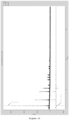
- Powder X-ray diffraction (PXRD) patterns were collected on a PANalytical X'Pert PRO MPD diffractometer with Cu-K ⁇ 1 (1.5406 ⁇ ) radiation and equipped with an Oxford Cryostream 700.
- the application software was X'Pert Data Collector v2.2f [X'Pert Data Collector Version 2.2F; PANAlytical B.V.: Almelo, The Netherlands, 2010], and the instrument control software was XPERT-PRO v1.9E [XPERT-PRO Version 1.9E; PANAlytical B.V.: Almelo, The Netherlands, 2008].
- Samples were packed in glass capillaries that were mounted and aligned on a goniometer, which was set to spin within the incident X-ray beam.
- VT variable temperature
- PXRD patterns were obtained at 50 K intervals over the range 100-500 K using the Oxford Cryostream 700 attachment.
- data were collected with a 20 range of 7.5 - 55° and a step size of 0.013°.
- High temperature VT studies to determine thermal stability and decomposition temperatures were undertaken in the range 300-673 K, using the PANalytical X'Pert PRO MPD furnace attachment.
- VT PXRD patterns were also obtained using the powder function of a Cu lab source Rigaku-Agilent SuperNova single crystal diffractometer using a large Atlas area detector. VT data was collected using an Oxford Cryostream 700 Plus attachment. High resolution synchrotron VT PXRD patterns were obtained at 20 K intervals over the range 100 - 500 K at the Australian Synchrotron (0.7524 ⁇ ) and at the Advanced Photon Source (0.7291 ⁇ ) using an Oxford Crysostream.
- UV/Vis/NIR spectra were recorded using a CARY 5E UV/Vis/NIR spectrophotometer with an Omni Diff Probe attachment interfaced to Varian WinUV software. Solid state samples were mounted onto high density filter paper onto which the Omni Diff Probe was placed. Two measurements were recorded per sample and averaged to reduce noise.
- FTIR spectra were recorded using a Bruker IFS 66v FTIR with a Single Bounce Diamond/KRS-5 Attenuated Total Reflection (ATR) Accessory. A minimum amount of crystalline powder was placed in close contact with the crystal interface and scanned from 360-4500 cm -1 . All measurements were undertaken in a dry dinitrogen atmosphere. Two spectra were recorded per sample and averaged to reduce noise due to background interference.
- Electrochemical measurements were performed under argon using a Bioanalytical Systems BAS 100A Electrochemical Analyser. Cyclic and square wave voltammograms were recorded under argon in 0.1 M [( n -C 4 H 9 ) 4 N]PF 6 dissolved in anhydrous CH 3 CN at 25 °C using a glassy carbon working electrode, a platinum wire auxiliary electrode and an Ag/Ag + wire quasi reference electrode. Solid state samples were mounted on the glassy carbon working electrode by dipping the electrode in the powder sample dispersed in a minimum of acetone and securing it with Nafion. A scan of the carbon working electrode with Nafion was obtained to provide a background reference.
- Nafion exhibits a peak at -0.5 mV versus the ferrocene/ferrocenium couple (Fc + /Fc 0 ). Ferrocene was added as an internal standard on completion of each experiment. The ferrocene/ferrocenium couple (Fc + /Fc 0 ) occurred at +250 mV vs Ag/Ag + and potentials are quoted in mV versus Fc + /Fc 0 [ Connelly, N. G.; Geiger, W. E. Chemical Reviews 1996, 96, 877 ].
- the adsorption isotherm measurement was performed using an Accelerated Surface Area & Porosimetry System (ASAP) 2020 supplied by Micromeritics Instruments Inc.
- ASAP Accelerated Surface Area & Porosimetry System
- the sample was placed in a preweighed sample tube with a Transeal cap to prevent intrusion of atmospheric gas during transfer and weighing.
- the sample was desolvated at 170 °C under high vacuum for 12 hr.
- the mass of the degassed sample was measured and the evacuated sample tube was transferred to the analysis port of the instrument.
- the warm and cold free space corrections were obtained using high purity helium gas.
- the hydrogen and nitrogen adsorption and desorption isotherms were subsequently measured at 77 K.
- the data were analysed using BET [ Brunauer, S.; Emmett, P. H.; Teller, E. Journal of the American Chemical Society 1938, 60, 309 ] models to determine the surface area.
- Electrochemically, Na + and K + show higher cyclability of electrochemical reactions. That is, frameworks loaded with Na + and K + and can typically sustain at least 2,000 charge-discharge cycles (and theoretically at least 50,000 charge-discharge cycles), typically with at least 90% capacity retention. Some frameworks loaded with Li + samples can also sustain at least 2,000 charge-discharge cycles (and theoretically at least 50,000 charge-discharge cycles), however, some Li + loaded samples were observed to degrade after 1,000 to 5,000 cycles.
- Li + , Na + and K + loaded samples also vary in thermal expansion properties, with their coefficients of thermal expansion positively correlated with the ionic radii of ion within each family of frameworks. That is, larger ions lead to increase in coefficients of thermal expansion from negative to zero, or zero to low positive.
- the porosity and affinity for guests for each framework also varies greatly with different ion incorporation. As the number of ions increases, the pore volume decreases.
- the ions can have an affinity for certain gases (H 2 , O 2 , gases of low molecular weight organic molecules).
- PSM Post-Synthetic-Modification
- Scheme 1 and 2 refer to vacancy Prussian blues (PBs), which are all the materials described with the exception of Cu II 2 [Fe II (CN) 6 ] and Cu II 2 [Ru II (CN) 6 ].
- Scheme 3 describes PSM of these copper-based analogues.
- Scheme 4 is relevant to all materials.
- Pore surface modifying agents e.g. NH 3 , ethylene diamine, pyridine, THF and thiophene
- Pore surface modifying agents e.g. NH 3 , ethylene diamine, pyridine, THF and thiophene
- Dry evacuated desolvated high crystallinity powders of the co-ordination frameworks of Formula (I) (with the exception of [Cu 2 Fe(CN) 6 ] and [Cu 2 Ru(CN) 6 ]) were placed in a smaller open vial inside the larger vial.
- the large vial was sealed.
- the sealed glass vial-in-a-vial setup was placed on a custom built solid-state UV-vis-NIR reflectance spectrometer to monitor the absorbance spectral shift.
- New low energy bands appear when the N-donor volatile ligands bind to bare metal sites within the pore space of the co-ordination frameworks of Formula (I). Spectroscopic measurements continue every 15 minutes. When this new low energy band appears to be approaching a maximum the power is removed from the setup, evacuated at 1bar for 1 hour and placed under a stream argon overnight.
- Ammonia added to Ni 2 Fe(CN) 6 gives the framework (Ni 2 Fe(CN) 6 ).2NH 3 .
- the ammonia displaces water or adds to bare metal sites on the Ni.
- the UV-vis-NIR reveals a low energy band in the 9000 cm -1 region. This is believed to indicate the PSM with ammonia has increased the electronic delocalisation of d-orbital electrons across the cyanide bridges, leading to through-framework semi-conductivity.
- the material was observed to have up to 10% higher CO 2 uptake compared to its non-PSM equivalent.
- Cu, Ag and Au based analogues do not form vacancy type-2,2-PB morphologies. Rather, they distort along the Jahn Teller axis of half of the Cu, Ag or Au in the framework forming a structure similar to a pillared-Hofmann-type MOF (metal organic framework).
- the pillared Cu, Ag or Au has four water around it. These waters can be displaced using N- and O- donor ligands during the volatile method described in Scheme 1.
Landscapes
- Chemical & Material Sciences (AREA)
- Organic Chemistry (AREA)
- Inorganic Chemistry (AREA)
- Health & Medical Sciences (AREA)
- General Health & Medical Sciences (AREA)
- Toxicology (AREA)
- Chemical Kinetics & Catalysis (AREA)
- Analytical Chemistry (AREA)
- Engineering & Computer Science (AREA)
- Combustion & Propulsion (AREA)
- Mechanical Engineering (AREA)
- General Engineering & Computer Science (AREA)
- Catalysts (AREA)
- Hydrogen, Water And Hydrids (AREA)
- Exhaust Gas Treatment By Means Of Catalyst (AREA)
- Treating Waste Gases (AREA)
Applications Claiming Priority (3)
| Application Number | Priority Date | Filing Date | Title |
|---|---|---|---|
| AU2018901246A AU2018901246A0 (en) | 2018-04-13 | Multifunctional Co-ordination Framework Materials | |
| EP19785988.7A EP3774826B1 (de) | 2018-04-13 | 2019-04-12 | Multifunktionale koordinationsrahmenmaterialien |
| PCT/AU2019/050330 WO2019195894A1 (en) | 2018-04-13 | 2019-04-12 | Multifunctional co-ordination framework materials |
Related Parent Applications (1)
| Application Number | Title | Priority Date | Filing Date |
|---|---|---|---|
| EP19785988.7A Division EP3774826B1 (de) | 2018-04-13 | 2019-04-12 | Multifunktionale koordinationsrahmenmaterialien |
Publications (2)
| Publication Number | Publication Date |
|---|---|
| EP4471319A2 true EP4471319A2 (de) | 2024-12-04 |
| EP4471319A3 EP4471319A3 (de) | 2025-02-19 |
Family
ID=68163000
Family Applications (2)
| Application Number | Title | Priority Date | Filing Date |
|---|---|---|---|
| EP19785988.7A Active EP3774826B1 (de) | 2018-04-13 | 2019-04-12 | Multifunktionale koordinationsrahmenmaterialien |
| EP24207795.6A Pending EP4471319A3 (de) | 2018-04-13 | 2019-04-12 | Multifunktionale koordinationsrahmenmaterialien |
Family Applications Before (1)
| Application Number | Title | Priority Date | Filing Date |
|---|---|---|---|
| EP19785988.7A Active EP3774826B1 (de) | 2018-04-13 | 2019-04-12 | Multifunktionale koordinationsrahmenmaterialien |
Country Status (5)
| Country | Link |
|---|---|
| US (2) | US12071354B2 (de) |
| EP (2) | EP3774826B1 (de) |
| JP (1) | JP7138377B2 (de) |
| AU (1) | AU2019251515B2 (de) |
| WO (1) | WO2019195894A1 (de) |
Families Citing this family (4)
| Publication number | Priority date | Publication date | Assignee | Title |
|---|---|---|---|---|
| CN113327774B (zh) * | 2021-05-31 | 2022-11-11 | 青岛科技大学 | 一种碳基金属硒化物复合材料的制备方法 |
| US11912581B1 (en) * | 2023-03-13 | 2024-02-27 | Natron Energy, Inc. | Low vacancy Fe-substituted Mn-based Prussian blue analogue |
| WO2024192157A2 (en) | 2023-03-13 | 2024-09-19 | Natron Energy, Inc. | Low vacancy fe-substituted mn-based prussian blue analogue |
| CN117174884A (zh) * | 2023-11-02 | 2023-12-05 | 宁德时代新能源科技股份有限公司 | 复合补锂材料及其制备方法、正极极片、电池、用电装置 |
Citations (1)
| Publication number | Priority date | Publication date | Assignee | Title |
|---|---|---|---|---|
| US20170096348A1 (en) * | 2014-06-06 | 2017-04-06 | National Institute Of Advanced Industrial Science And Technology | Ammonia adsorbent |
Family Cites Families (2)
| Publication number | Priority date | Publication date | Assignee | Title |
|---|---|---|---|---|
| EP1873117B1 (de) | 2005-02-17 | 2018-05-30 | National Institute of Advanced Industrial Science and Technology | Verfahren zur herstellung von ultrafeinen teilchen eines metallkomplexes vom berliner-blau-typ und einer dispersionsflüssigkeit davon |
| US9198988B2 (en) * | 2011-02-08 | 2015-12-01 | Kent State University | Nanoparticulate manganese MRI contrast agents |
-
2019
- 2019-04-12 AU AU2019251515A patent/AU2019251515B2/en active Active
- 2019-04-12 EP EP19785988.7A patent/EP3774826B1/de active Active
- 2019-04-12 JP JP2021504550A patent/JP7138377B2/ja active Active
- 2019-04-12 EP EP24207795.6A patent/EP4471319A3/de active Pending
- 2019-04-12 WO PCT/AU2019/050330 patent/WO2019195894A1/en not_active Ceased
- 2019-04-12 US US17/046,947 patent/US12071354B2/en active Active
-
2024
- 2024-07-24 US US18/782,366 patent/US20240375970A1/en active Pending
Patent Citations (1)
| Publication number | Priority date | Publication date | Assignee | Title |
|---|---|---|---|---|
| US20170096348A1 (en) * | 2014-06-06 | 2017-04-06 | National Institute Of Advanced Industrial Science And Technology | Ammonia adsorbent |
Non-Patent Citations (4)
| Title |
|---|
| BRUNAUER, SEMMETT, P. HTELLER, E, JOURNAL OF THE AMERICAN CHEMICAL SOCIETY, vol. 60, 1938, pages 309 |
| CONNELLY, N. G.GEIGER, W. E., CHEMICAL REVIEWS, vol. 96, 1996, pages 877 |
| DEMESSENCE, A.;D'ALESSANDRO, D. M.;FOO, M. LLONG, J. R., JOURNAL OF THE AMERICAN CHEMICAL SOCIETY, vol. 131, 2009, pages 8784 |
| GSAS, J. APPL. CRYST., vol. 34, 2001, pages 210 - 213 |
Also Published As
| Publication number | Publication date |
|---|---|
| US12071354B2 (en) | 2024-08-27 |
| EP3774826C0 (de) | 2024-11-06 |
| US20240375970A1 (en) | 2024-11-14 |
| EP3774826A4 (de) | 2022-04-13 |
| JP2021521096A (ja) | 2021-08-26 |
| EP3774826A1 (de) | 2021-02-17 |
| EP4471319A3 (de) | 2025-02-19 |
| AU2019251515B2 (en) | 2021-08-05 |
| JP7138377B2 (ja) | 2022-09-16 |
| AU2019251515A1 (en) | 2020-10-15 |
| US20210046448A1 (en) | 2021-02-18 |
| WO2019195894A1 (en) | 2019-10-17 |
| EP3774826B1 (de) | 2024-11-06 |
Similar Documents
| Publication | Publication Date | Title |
|---|---|---|
| US20240375970A1 (en) | Multifunctional co-ordination framework materials | |
| US10035127B2 (en) | Metal-organic frameworks with a high density of highly charged exposed metal cation sites | |
| US20220176343A1 (en) | Mixed-metal, mixed-organic framework systems for selective co2 capture | |
| US9593132B2 (en) | Metal-organic frameworks (MOF) for gas capture | |
| CN103459404B (zh) | 金属儿茶酚化物骨架的制备 | |
| Xu et al. | A cationic microporous metal–organic framework for highly selective separation of small hydrocarbons at room temperature | |
| US6372932B1 (en) | Porous solid products of 1,3,5-benzenetricarboxylate and metal ions | |
| EP3411140B1 (de) | Verfahren zur abtrennung von acetylen aus einer gasmischung | |
| KR100907907B1 (ko) | 다공성 금속-유기 골격 구조를 갖는 배위중합체 화합물 및 이의 용매 함유물 | |
| WO2009011545A2 (en) | Compound or solvate thereof with mesoporous metal-organic framework | |
| Qian et al. | Crystal structure, morphology and sorption behaviour of porous indium-tetracarboxylate framework materials | |
| US10702850B2 (en) | Adsorbents with stepped isotherms for gas storage applications | |
| US11311856B2 (en) | Vanadium metal-organic framework for selective adsorption | |
| CN106188107A (zh) | 多功能锌基有机无机杂化材料、其制备方法与应用 | |
| CN115028854A (zh) | 一种半导体金属-有机晶体纳米管阵列及其制备方法和应用 | |
| Li et al. | Mild synthesis of mercapto zeolitic imidazolate frameworks for selective removal of mercury ion from aqueous solution | |
| KR20220045468A (ko) | 납 카이랄 화합물 및 이를 포함하는 유기 염료 흡착제 | |
| Nguyen et al. | Bi-metalic ZIFs (Zn-M)(M: Co, Ni) for photocatalytic removal of organic pollutants in aqueous solutions | |
| CN121181007A (zh) | 具有开放结构的非常规相六方普鲁士蓝类似物 | |
| Pan | Developing efficient adsorbents for dynamic iodine capture from nuclear off-gas | |
| Hashimoto et al. | High CO2/CH4 Separation Performance Exhibited at Room Temperature by a Nonporous Ionic Crystal with 3-Methylpyridinium Cation | |
| Burazer | Mechanochemical synthesis and structural characterization of bimetallic and hybrid tetrahydridoborates | |
| Atzori | Novel Ce3+ and Ce4+ Metal-Organic Frameworks: a multi-technique characterization | |
| Jayasinghe | Exploring the unique water properties of metal-organic nanotubes | |
| Norton | Hybrid Materials Based on a Terpyridine Carboxylate Ligand: A Method for Introducing Light Harvesting and Auxiliary Metal Centers into Metal-Organic Frameworks |
Legal Events
| Date | Code | Title | Description |
|---|---|---|---|
| PUAI | Public reference made under article 153(3) epc to a published international application that has entered the european phase |
Free format text: ORIGINAL CODE: 0009012 |
|
| STAA | Information on the status of an ep patent application or granted ep patent |
Free format text: STATUS: THE APPLICATION HAS BEEN PUBLISHED |
|
| REG | Reference to a national code |
Ref country code: DE Ref legal event code: R079 Free format text: PREVIOUS MAIN CLASS: F17C0011000000 Ipc: C07F0015020000 |
|
| AC | Divisional application: reference to earlier application |
Ref document number: 3774826 Country of ref document: EP Kind code of ref document: P |
|
| AK | Designated contracting states |
Kind code of ref document: A2 Designated state(s): AL AT BE BG CH CY CZ DE DK EE ES FI FR GB GR HR HU IE IS IT LI LT LU LV MC MK MT NL NO PL PT RO RS SE SI SK SM TR |
|
| RIC1 | Information provided on ipc code assigned before grant |
Ipc: F17C 11/00 20060101ALI20241107BHEP Ipc: C07F 15/06 20060101ALI20241107BHEP Ipc: C07F 15/04 20060101ALI20241107BHEP Ipc: C01B 3/00 20060101ALI20241107BHEP Ipc: B01J 20/02 20060101ALI20241107BHEP Ipc: C01C 3/12 20060101ALI20241107BHEP Ipc: C01C 3/11 20060101ALI20241107BHEP Ipc: B01J 20/22 20060101ALI20241107BHEP Ipc: C07F 15/00 20060101ALI20241107BHEP Ipc: C07F 15/02 20060101AFI20241107BHEP |
|
| PUAL | Search report despatched |
Free format text: ORIGINAL CODE: 0009013 |
|
| AK | Designated contracting states |
Kind code of ref document: A3 Designated state(s): AL AT BE BG CH CY CZ DE DK EE ES FI FR GB GR HR HU IE IS IT LI LT LU LV MC MK MT NL NO PL PT RO RS SE SI SK SM TR |
|
| RIC1 | Information provided on ipc code assigned before grant |
Ipc: F17C 11/00 20060101ALI20250115BHEP Ipc: C07F 15/06 20060101ALI20250115BHEP Ipc: C07F 15/04 20060101ALI20250115BHEP Ipc: C01B 3/00 20060101ALI20250115BHEP Ipc: B01J 20/02 20060101ALI20250115BHEP Ipc: C01C 3/12 20060101ALI20250115BHEP Ipc: C01C 3/11 20060101ALI20250115BHEP Ipc: B01J 20/22 20060101ALI20250115BHEP Ipc: C07F 15/00 20060101ALI20250115BHEP Ipc: C07F 15/02 20060101AFI20250115BHEP |
|
| STAA | Information on the status of an ep patent application or granted ep patent |
Free format text: STATUS: REQUEST FOR EXAMINATION WAS MADE |
|
| 17P | Request for examination filed |
Effective date: 20250813 |
|
| STAA | Information on the status of an ep patent application or granted ep patent |
Free format text: STATUS: EXAMINATION IS IN PROGRESS |
|
| 17Q | First examination report despatched |
Effective date: 20251029 |