EP4470710A1 - Procédé d'usinage de pièce et machine d'usinage - Google Patents
Procédé d'usinage de pièce et machine d'usinage Download PDFInfo
- Publication number
- EP4470710A1 EP4470710A1 EP23760172.9A EP23760172A EP4470710A1 EP 4470710 A1 EP4470710 A1 EP 4470710A1 EP 23760172 A EP23760172 A EP 23760172A EP 4470710 A1 EP4470710 A1 EP 4470710A1
- Authority
- EP
- European Patent Office
- Prior art keywords
- workpiece
- spindle
- holding portion
- additive manufacturing
- processing
- Prior art date
- Legal status (The legal status is an assumption and is not a legal conclusion. Google has not performed a legal analysis and makes no representation as to the accuracy of the status listed.)
- Pending
Links
Images




Classifications
-
- B—PERFORMING OPERATIONS; TRANSPORTING
- B22—CASTING; POWDER METALLURGY
- B22F—WORKING METALLIC POWDER; MANUFACTURE OF ARTICLES FROM METALLIC POWDER; MAKING METALLIC POWDER; APPARATUS OR DEVICES SPECIALLY ADAPTED FOR METALLIC POWDER
- B22F10/00—Additive manufacturing of workpieces or articles from metallic powder
- B22F10/40—Structures for supporting workpieces or articles during manufacture and removed afterwards
- B22F10/47—Structures for supporting workpieces or articles during manufacture and removed afterwards characterised by structural features
-
- B—PERFORMING OPERATIONS; TRANSPORTING
- B23—MACHINE TOOLS; METAL-WORKING NOT OTHERWISE PROVIDED FOR
- B23K—SOLDERING OR UNSOLDERING; WELDING; CLADDING OR PLATING BY SOLDERING OR WELDING; CUTTING BY APPLYING HEAT LOCALLY, e.g. FLAME CUTTING; WORKING BY LASER BEAM
- B23K26/00—Working by laser beam, e.g. welding, cutting or boring
- B23K26/34—Laser welding for purposes other than joining
- B23K26/342—Build-up welding
-
- B—PERFORMING OPERATIONS; TRANSPORTING
- B22—CASTING; POWDER METALLURGY
- B22F—WORKING METALLIC POWDER; MANUFACTURE OF ARTICLES FROM METALLIC POWDER; MAKING METALLIC POWDER; APPARATUS OR DEVICES SPECIALLY ADAPTED FOR METALLIC POWDER
- B22F10/00—Additive manufacturing of workpieces or articles from metallic powder
- B22F10/20—Direct sintering or melting
- B22F10/25—Direct deposition of metal particles, e.g. direct metal deposition [DMD] or laser engineered net shaping [LENS]
-
- B—PERFORMING OPERATIONS; TRANSPORTING
- B22—CASTING; POWDER METALLURGY
- B22F—WORKING METALLIC POWDER; MANUFACTURE OF ARTICLES FROM METALLIC POWDER; MAKING METALLIC POWDER; APPARATUS OR DEVICES SPECIALLY ADAPTED FOR METALLIC POWDER
- B22F10/00—Additive manufacturing of workpieces or articles from metallic powder
- B22F10/30—Process control
- B22F10/38—Process control to achieve specific product aspects, e.g. surface smoothness, density, porosity or hollow structures
-
- B—PERFORMING OPERATIONS; TRANSPORTING
- B22—CASTING; POWDER METALLURGY
- B22F—WORKING METALLIC POWDER; MANUFACTURE OF ARTICLES FROM METALLIC POWDER; MAKING METALLIC POWDER; APPARATUS OR DEVICES SPECIALLY ADAPTED FOR METALLIC POWDER
- B22F10/00—Additive manufacturing of workpieces or articles from metallic powder
- B22F10/80—Data acquisition or data processing
- B22F10/85—Data acquisition or data processing for controlling or regulating additive manufacturing processes
-
- B—PERFORMING OPERATIONS; TRANSPORTING
- B22—CASTING; POWDER METALLURGY
- B22F—WORKING METALLIC POWDER; MANUFACTURE OF ARTICLES FROM METALLIC POWDER; MAKING METALLIC POWDER; APPARATUS OR DEVICES SPECIALLY ADAPTED FOR METALLIC POWDER
- B22F12/00—Apparatus or devices specially adapted for additive manufacturing; Auxiliary means for additive manufacturing; Combinations of additive manufacturing apparatus or devices with other processing apparatus or devices
- B22F12/90—Means for process control, e.g. cameras or sensors
-
- B—PERFORMING OPERATIONS; TRANSPORTING
- B23—MACHINE TOOLS; METAL-WORKING NOT OTHERWISE PROVIDED FOR
- B23K—SOLDERING OR UNSOLDERING; WELDING; CLADDING OR PLATING BY SOLDERING OR WELDING; CUTTING BY APPLYING HEAT LOCALLY, e.g. FLAME CUTTING; WORKING BY LASER BEAM
- B23K26/00—Working by laser beam, e.g. welding, cutting or boring
- B23K26/02—Positioning or observing the workpiece, e.g. with respect to the point of impact; Aligning, aiming or focusing the laser beam
- B23K26/03—Observing, e.g. monitoring, the workpiece
- B23K26/034—Observing the temperature of the workpiece
-
- B—PERFORMING OPERATIONS; TRANSPORTING
- B23—MACHINE TOOLS; METAL-WORKING NOT OTHERWISE PROVIDED FOR
- B23K—SOLDERING OR UNSOLDERING; WELDING; CLADDING OR PLATING BY SOLDERING OR WELDING; CUTTING BY APPLYING HEAT LOCALLY, e.g. FLAME CUTTING; WORKING BY LASER BEAM
- B23K26/00—Working by laser beam, e.g. welding, cutting or boring
- B23K26/14—Working by laser beam, e.g. welding, cutting or boring using a fluid stream, e.g. a jet of gas, in conjunction with the laser beam; Nozzles therefor
- B23K26/144—Working by laser beam, e.g. welding, cutting or boring using a fluid stream, e.g. a jet of gas, in conjunction with the laser beam; Nozzles therefor the fluid stream containing particles, e.g. powder
-
- B—PERFORMING OPERATIONS; TRANSPORTING
- B23—MACHINE TOOLS; METAL-WORKING NOT OTHERWISE PROVIDED FOR
- B23K—SOLDERING OR UNSOLDERING; WELDING; CLADDING OR PLATING BY SOLDERING OR WELDING; CUTTING BY APPLYING HEAT LOCALLY, e.g. FLAME CUTTING; WORKING BY LASER BEAM
- B23K26/00—Working by laser beam, e.g. welding, cutting or boring
- B23K26/70—Auxiliary operations or equipment
- B23K26/702—Auxiliary equipment
-
- B—PERFORMING OPERATIONS; TRANSPORTING
- B23—MACHINE TOOLS; METAL-WORKING NOT OTHERWISE PROVIDED FOR
- B23K—SOLDERING OR UNSOLDERING; WELDING; CLADDING OR PLATING BY SOLDERING OR WELDING; CUTTING BY APPLYING HEAT LOCALLY, e.g. FLAME CUTTING; WORKING BY LASER BEAM
- B23K31/00—Processes relevant to this subclass, specially adapted for particular articles or purposes, but not covered by only one of the preceding main groups
- B23K31/003—Processes relevant to this subclass, specially adapted for particular articles or purposes, but not covered by only one of the preceding main groups relating to controlling of welding distortion
-
- B—PERFORMING OPERATIONS; TRANSPORTING
- B33—ADDITIVE MANUFACTURING TECHNOLOGY
- B33Y—ADDITIVE MANUFACTURING, i.e. MANUFACTURING OF THREE-DIMENSIONAL [3-D] OBJECTS BY ADDITIVE DEPOSITION, ADDITIVE AGGLOMERATION OR ADDITIVE LAYERING, e.g. BY 3-D PRINTING, STEREOLITHOGRAPHY OR SELECTIVE LASER SINTERING
- B33Y10/00—Processes of additive manufacturing
-
- B—PERFORMING OPERATIONS; TRANSPORTING
- B33—ADDITIVE MANUFACTURING TECHNOLOGY
- B33Y—ADDITIVE MANUFACTURING, i.e. MANUFACTURING OF THREE-DIMENSIONAL [3-D] OBJECTS BY ADDITIVE DEPOSITION, ADDITIVE AGGLOMERATION OR ADDITIVE LAYERING, e.g. BY 3-D PRINTING, STEREOLITHOGRAPHY OR SELECTIVE LASER SINTERING
- B33Y30/00—Apparatus for additive manufacturing; Details thereof or accessories therefor
-
- B—PERFORMING OPERATIONS; TRANSPORTING
- B33—ADDITIVE MANUFACTURING TECHNOLOGY
- B33Y—ADDITIVE MANUFACTURING, i.e. MANUFACTURING OF THREE-DIMENSIONAL [3-D] OBJECTS BY ADDITIVE DEPOSITION, ADDITIVE AGGLOMERATION OR ADDITIVE LAYERING, e.g. BY 3-D PRINTING, STEREOLITHOGRAPHY OR SELECTIVE LASER SINTERING
- B33Y50/00—Data acquisition or data processing for additive manufacturing
- B33Y50/02—Data acquisition or data processing for additive manufacturing for controlling or regulating additive manufacturing processes
-
- B—PERFORMING OPERATIONS; TRANSPORTING
- B22—CASTING; POWDER METALLURGY
- B22F—WORKING METALLIC POWDER; MANUFACTURE OF ARTICLES FROM METALLIC POWDER; MAKING METALLIC POWDER; APPARATUS OR DEVICES SPECIALLY ADAPTED FOR METALLIC POWDER
- B22F12/00—Apparatus or devices specially adapted for additive manufacturing; Auxiliary means for additive manufacturing; Combinations of additive manufacturing apparatus or devices with other processing apparatus or devices
- B22F12/20—Cooling means
-
- Y—GENERAL TAGGING OF NEW TECHNOLOGICAL DEVELOPMENTS; GENERAL TAGGING OF CROSS-SECTIONAL TECHNOLOGIES SPANNING OVER SEVERAL SECTIONS OF THE IPC; TECHNICAL SUBJECTS COVERED BY FORMER USPC CROSS-REFERENCE ART COLLECTIONS [XRACs] AND DIGESTS
- Y02—TECHNOLOGIES OR APPLICATIONS FOR MITIGATION OR ADAPTATION AGAINST CLIMATE CHANGE
- Y02P—CLIMATE CHANGE MITIGATION TECHNOLOGIES IN THE PRODUCTION OR PROCESSING OF GOODS
- Y02P10/00—Technologies related to metal processing
- Y02P10/25—Process efficiency
Definitions
- the present invention relates to a method for processing a workpiece, and a processing machine.
- Japanese Patent No. 6810823 discloses an additive manufacturing method for a workpiece, the additive manufacturing method including: applying a stress to the workpiece having a first linear expansion coefficient; supplying material powder having a second linear expansion coefficient different from the first linear expansion coefficient, and emitting a laser beam, to the workpiece, while applying the stress to the workpiece; and cooling the workpiece while relieving the stress on the workpiece, after supplying the material powder and emitting the laser beam.
- the workpiece in order to support the workpiece to be processed, the workpiece is held by a first holding portion and a second holding portion that are disposed to be separated from each other.
- the workpiece thermally expands, and thereby the surface of the workpiece is distorted between the first holding portion and the second holding portion. This may cause a problem that the material powder cannot be supplied onto the surface of the workpiece as intended, and the accuracy of processing the workpiece decreases.
- an object of the present invention is to solve the aforementioned problem, and to provide a method for processing a workpiece and a processing machine that can maintain the accuracy of processing the workpiece to be high in additive manufacturing for the workpiece using the directed energy deposition method.
- a method for processing a workpiece includes holding the workpiece by a first holding portion and a second holding portion that are disposed to be separated from each other, performing additive manufacturing on the workpiece by supplying material powder and emitting a laser beam to the workpiece held by the first holding portion and the second holding portion, and relatively moving the first holding portion and the second holding portion in a direction away from each other during at least a portion of performing the additive manufacturing on the workpiece.
- the workpiece when the laser beam is emitted to the workpiece during the additive manufacturing, the workpiece thermally expands between the first holding portion and the second holding portion.
- distortion of the surface of the workpiece between the first holding portion and the second holding portion can be suppressed by relatively moving the first holding portion and the second holding portion in the direction away from each other during the at least a portion of performing the additive manufacturing on the workpiece.
- the material powder can be supplied onto the surface of the workpiece as intended, and thus the accuracy of processing the workpiece can be maintained to be high.
- the first holding portion is a first workpiece spindle for rotating the workpiece about a predetermined axis.
- the second holding portion is a second workpiece spindle for rotating the workpiece about the predetermined axis, the second workpiece spindle being disposed to face the first workpiece spindle in an axial direction of the predetermined axis, and being slidable in the axial direction of the predetermined axis.
- Relatively moving the first holding portion and the second holding portion includes sliding the second workpiece spindle in the axial direction of the predetermined axis.
- the method for processing the workpiece further includes cooling the workpiece while relatively moving the first holding portion and the second holding portion in a direction closer to each other, after performing the additive manufacturing on the workpiece.
- a processing machine is a processing machine that performs additive manufacturing for a workpiece.
- the processing machine includes: an additive manufacturing head that supplies material powder and emits a laser beam to the workpiece; a first workpiece spindle for rotating the workpiece about a predetermined axis; a second workpiece spindle for rotating the workpiece about the predetermined axis, the second workpiece spindle being disposed to face the first workpiece spindle in an axial direction of the predetermined axis, and being slidable in the axial direction of the predetermined axis; and a control device that controls the processing machine.
- the control device controls operation of the additive manufacturing head to perform the additive manufacturing on the workpiece by supplying the material powder and emitting the laser beam to the workpiece held by the first workpiece spindle and the second workpiece spindle, and controls sliding operation of the second workpiece spindle such that the second workpiece spindle moves in a direction away from the first workpiece spindle during at least a portion during the additive manufacturing for the workpiece.
- the material powder can be supplied onto the surface of the workpiece as intended, and thus the accuracy of processing the workpiece can be maintained to be high.
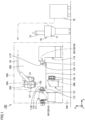
- Fig. 1 is a front view showing a processing machine.
- Fig. 1 shows an inside of the processing machine when seen through a cover body serving as an exterior of the processing machine.
- Fig. 2 is a perspective view showing a state within a processing area during additive manufacturing, in the processing machine in Fig. 1 .
- a processing machine 100 is an AM/SM hybrid processing machine capable of performing additive manufacturing (AM) processing for a workpiece and subtractive manufacturing (SM) processing for a workpiece.
- Processing machine 100 has a turning function using a fixed tool and a milling function using a rotary tool, as functions of the SM processing.
- Processing machine 100 is a numerically controlled (NC) processing machine in which various operations for workpiece processing are automated by numerical control using a computer.
- NC numerically controlled
- an axis parallel to a left-right direction (width direction) of processing machine 100 and extending in a horizontal direction is referred to as a "Z axis”
- an axis parallel to a front-rear direction (depth direction) of processing machine 100 and extending in the horizontal direction is referred to as a "Y axis”
- an axis extending in a vertical direction is referred to as an "X axis”.
- a rightward direction is referred to as a "+Z-axis direction”
- a leftward direction is referred to as a "-Z-axis direction”.
- a frontward direction with respect to the sheet plane is referred to as a "+Y-axis direction", and a rearward direction is referred to as a "-Y-axis direction”.
- a rearward direction is referred to as a "-Y-axis direction”.
- an upward direction is referred to as a "+X-axis direction”
- a downward direction is referred to as a "-X-axis direction”.
- Processing machine 100 has a bed 136, a first headstock 111, a second headstock 116, a tool spindle 121, and a lower tool rest 131.
- Bed 136 is a base member for supporting first headstock 111, second headstock 116, tool spindle 121, lower tool rest 131, and the like, and is installed on a floor surface of a factory or the like.
- First headstock 111 (a first workpiece spindle 112 described later), second headstock 116, tool spindle 121, and lower tool rest 131 are provided within a processing area 200 defined by a splash guard 205.
- Processing area 200 is a space in which subtractive manufacturing and additive manufacturing for a workpiece are performed, and is enclosed to prevent foreign matters such as chips, cutting oil, fumes, and the like generated by such workpiece processing from escaping to the outside of processing area 200.
- First headstock 111 and second headstock 116 are provided to face each other in a Z-axis direction.
- First headstock 111 and second headstock 116 respectively have first workpiece spindle 112 and a second workpiece spindle 117 for rotating a workpiece during turning processing using a fixed tool, or holding a workpiece during milling processing or subtractive manufacturing using a rotary tool.
- First workpiece spindle 112 is provided to be rotatable about a central axis 201A parallel to the Z axis
- second workpiece spindle 117 is provided to be rotatable about a central axis 201B parallel to the Z axis.
- Central axis 201A and central axis 201B extend on the same straight line, and constitute a central axis 201.
- First workpiece spindle 112 and second workpiece spindle 117 respectively have a chuck 113 and a chuck 118 that removably grip the workpiece.
- an end surface of a block that supports a claw for gripping the workpiece in chuck 113 is referred to as a spindle end surface 112f of first workpiece spindle 112
- an end surface of a block that supports a claw for gripping the workpiece in chuck 118 is referred to as a spindle end surface 117f of second workpiece spindle 117.
- a distance in the Z-axis direction between spindle end surface 112f of first workpiece spindle 112 and spindle end surface 117f of second workpiece spindle 117 corresponds to a spindle-to-spindle distance H between first workpiece spindle 112 and second workpiece spindle 117.
- a workpiece W to be processed is held by first workpiece spindle 112 and second workpiece spindle 117.
- Workpiece W is made of a metal material such as stainless steel, for example.
- Workpiece W extends on an axis of central axis 201.
- One end of workpiece W in an axial direction of central axis 201 is gripped by chuck 113, and the other end of workpiece W in the axial direction of central axis 201 is gripped by chuck 118.
- Workpiece W is rotatable about central axis 201 by rotatably driving first workpiece spindle 112 and second workpiece spindle 117 in synchronization with each other.
- Second headstock 116 (second workpiece spindle 117) is slidable in the Z-axis direction, by a variety of a feed mechanism, a guide mechanism, a servo motor, and the like.
- Second workpiece spindle 117 moves in a direction away from first workpiece spindle 112 (the +Z-axis direction)
- spindle-to-spindle distance H between first workpiece spindle 112 and second workpiece spindle 117 increases
- second workpiece spindle 117 moves in a direction closer to first workpiece spindle 112 (the -Z-axis direction)
- spindle-to-spindle distance H between first workpiece spindle 112 and second workpiece spindle 117 decreases.
- Tool spindle (an upper tool rest) 121 rotates the rotary tool during the milling processing using the rotary tool.
- Tool spindle 121 is provided to be rotatable about a central axis 203 parallel to an X axis-Z axis plane.
- Tool spindle 121 is provided with a clamp mechanism for detachably holding the rotary tool.
- Tool spindle 121 is supported above bed 136 by a column (not shown) or the like.
- Tool spindle 121 is slidable in an X-axis direction, a Y-axis direction, and the Z-axis direction, by a variety of a feed mechanism, a guide mechanism, a servo motor, and the like provided to the column or the like. With such a configuration, a processing position by the rotary tool attached to tool spindle 121 moves three-dimensionally.
- tool spindle 121 is provided to be swivelable about a swiveling central axis 204 parallel to the Y axis (B-axis swiveling).
- a swiveling range of tool spindle 121 is a range of ⁇ 120° relative to a posture in which a spindle end surface 123 of tool spindle 121 faces downward (posture shown in Figs. 1 and 2 ).
- the swiveling range of tool spindle 121 is preferably a range of more than or equal to ⁇ 90° relative to the posture shown in Figs. 1 and 2 .
- an automatic tool changer for automatically changing a tool attached to tool spindle 121, and a tool magazine for accommodating replacement tools attachable to tool spindle 121 are provided near first headstock 111.
- Lower tool rest 131 is of a so-called turret type, to which the plurality of fixed tools are radially attached and perform swivel indexing.
- lower tool rest 131 has a swiveling portion 132.
- Swiveling portion 132 is provided to be swivelable about a central axis 206 parallel to the Z axis.
- a plurality of tool holders for holding the fixed tools are attached at positions spaced apart from each other in a circumferential direction around central axis 206.
- Lower tool rest 131 is supported on bed 136 by a saddle (not shown) or the like.
- Lower tool rest 131 is slidable in the X-axis direction and the Z-axis direction, by a variety of a feed mechanism, a guide mechanism, a servo motor, and the like provided to the saddle or the like.
- Processing machine 100 further has an additive manufacturing head 21.
- Additive manufacturing head 21 performs additive manufacturing by supplying material powder P and emitting a laser beam L to workpiece W (directed energy deposition).
- material powder P for example, powder of a metal such as a cobalt-based alloy or an SKD material can be used.
- Material powder P may be the same material as that for workpiece W, or may be a material different from that for workpiece W.
- additive manufacturing head 21 has a nozzle 26.
- Nozzle 26 is made of a tube member through which material powder P can pass. Nozzle 26 discharges material powder P toward workpiece W.
- Additive manufacturing head 21 is configured to be detachably attached to tool spindle 121. During the additive manufacturing, additive manufacturing head 21 is attached to tool spindle 121. As tool spindle 121 slides in the X-axis direction, the Y-axis direction, and the Z-axis direction, a processing position of the additive manufacturing by additive manufacturing head 21 moves three-dimensionally. Further, as tool spindle 121 swivels about swiveling central axis 204, additive manufacturing head 21 also swivels about swiveling central axis 204 together with tool spindle 121. Thereby, a direction of the additive manufacturing by additive manufacturing head 21 (a direction in which laser beam L is emitted to workpiece W) can be freely changed.
- additive manufacturing head 21 is separated from tool spindle 121 and is stored in a head stocker (not shown).
- Tool spindle 121 is provided with the clamp mechanism, and when additive manufacturing head 21 is attached to tool spindle 121, the clamp mechanism operates to couple additive manufacturing head 21 to tool spindle 121.
- the clamp mechanism include a mechanism that obtains a clamped state using a spring force and obtains an unclamped state using a hydraulic pressure.
- processing machine 100 further has a powder feeder 70, a laser oscillation device 76, and a cable 24.
- Powder feeder 70 feeds the material powder to be used for the additive manufacturing toward additive manufacturing head 21 within processing area 200.
- Powder feeder 70 has a powder hopper 72 and a mixer 71.
- Powder hopper 72 forms an enclosed space for accommodating the material powder to be used for the additive manufacturing.
- Mixer 71 mixes the material powder accommodated in powder hopper 72 with a carrier gas for the material powder.
- Laser oscillation device 76 oscillates the laser beam to be used for the additive manufacturing.
- Cable 24 includes an optical fiber for guiding the laser beam from laser oscillation device 76 toward additive manufacturing head 21, a pipe for guiding the material powder from powder feeder 70 toward additive manufacturing head 21, an air pipe serving as an air flow path, a gas pipe serving as an inert gas flow path, a cooling pipe serving as a refrigerant flow path, electric wiring, and a tube member accommodating these.
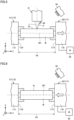
- FIGs. 3 to 6 are front views showing steps of performing the method for processing the workpiece in the present embodiment.
- the method for processing the workpiece in the present embodiment has the step of holding workpiece W by a first holding portion 51 (first workpiece spindle 112) and a second holding portion 52 (second workpiece spindle 117) as shown in Fig. 3 , the step of performing additive manufacturing on workpiece W by supplying material powder P and emitting laser beam L to workpiece W held by first holding portion 51 and second holding portion 52 as shown in Fig. 4 , and the step of relatively moving first holding portion 51 and second holding portion 52 in a direction away from each other during at least a portion of the step of performing the additive manufacturing on workpiece W as shown in Fig. 5 .
- distortion of surface fa of workpiece W due to thermal expansion of workpiece W can be suppressed by relatively moving first holding portion 51 and second holding portion 52 in the direction away from each other during the at least a portion of the step of performing the additive manufacturing on workpiece W.
- material powder P can be stacked at an intended position on surface fa of workpiece W, and thus highly accurate additive manufacturing can be performed on workpiece W.
- the method for processing the workpiece in the present embodiment further has the step of detecting a temperature of workpiece W during at least a portion of the step of performing the additive manufacturing on workpiece W, and the step of calculating a thermal expansion amount of workpiece W based on the detected temperature of workpiece W.
- first holding portion 51 and second holding portion 52 are relatively moved in the direction away from each other, by a distance corresponding to the calculated thermal expansion amount of workpiece W.
- the thermal expansion amount of workpiece W during the additive manufacturing can be understood accurately based on the temperature of workpiece W.
- distortion of surface fa of workpiece W due to thermal expansion of workpiece W can be suppressed more reliably.
- first holding portion 51 and second holding portion 52 are relatively moved in the direction closer to each other, according to thermal contraction of workpiece W during cooling. Thereby, occurrence of residual stress in workpiece W can be suppressed.
- Control device 81 controls processing machine 100.
- Control device 81 is a control panel provided to processing machine 100 for controlling various operations in processing machine 100.
- Control device 81 has a program storage unit 82, a program execution unit 83, a tool spindle control unit 84, an additive manufacturing control unit 85, a first workpiece spindle control unit 86, and a second workpiece spindle control unit 87.
- Program storage unit 82 stores an execution program (numerical control program) for workpiece processing created by an operator of processing machine 100.
- program storage unit 82 is a flash memory.
- Tool spindle control unit 84 controls a tool spindle feed motor 89 for sliding tool spindle 121 in the X-axis direction, the Y-axis direction, and the Z-axis direction, and a tool spindle swivel motor 90 for causing tool spindle 121 to perform B-axis swiveling, according to the control signal from program execution unit 83.
- Additive manufacturing control unit 85 controls laser oscillation device 76 for supplying the laser beam to additive manufacturing head 21, and powder feeder 70 for supplying the material powder to additive manufacturing head 21, according to the control signal from program execution unit 83.
- First workpiece spindle control unit 86 controls a first workpiece spindle rotary motor 91 for rotating first workpiece spindle 112, according to the control signal from program execution unit 83.
- Second workpiece spindle control unit 87 controls a second workpiece spindle rotary motor 92 for rotating second workpiece spindle 117, and a second workpiece spindle feed motor 93 for sliding second workpiece spindle 117 in the Z-axis direction, according to the control signal from program execution unit 83.
- Processing machine 100 further has an operating unit 95 and a temperature detection unit 94.
- Operating unit 95 is provided outside processing area 200.
- Operating unit 95 includes various buttons and switches used when the operator operates processing machine 100, a display unit showing, for example, a processing state of the workpiece in processing machine 100, and the like.
- Operating unit 95 is configured such that the type of metal used for the workpiece and the total length of the workpiece in the Z-axis direction can be inputted thereto.
- Temperature detection unit 94 is provided within processing area 200. Temperature detection unit 94 is configured to detect the temperature of the workpiece during the additive manufacturing. Temperature detection unit 94 detects the temperature of the workpiece by a non-contact method. Temperature detection unit 94 is, for example, an infrared temperature sensor that senses infrared radiation energy released from the surface of the workpiece, and converts the energy into a temperature and outputs the temperature. Temperature detection unit 94 outputs the detected temperature of the workpiece to second workpiece spindle control unit 87.
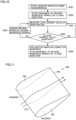
- first, workpiece W is held by first workpiece spindle 112 and second workpiece spindle 117 (S101).
- workpiece W is disposed between first workpiece spindle 112 and second workpiece spindle 117.
- One end and the other end of workpiece W in the Z-axis direction are gripped by chuck 113 and chuck 118, respectively.
- the type of metal used for workpiece W and a total length S of workpiece W in the Z-axis direction are inputted to operating unit 95 (S102).
- Operating unit 95 outputs the inputted type of metal and total length S to second workpiece spindle control unit 87.
- second workpiece spindle control unit 87 specifies a linear expansion coefficient ⁇ of workpiece W (S103).
- second workpiece spindle control unit 87 checks the type of metal used for workpiece W obtained in the step of S102, against the data stored in storage unit 96, to specify linear expansion coefficient ⁇ of workpiece W.
- tool spindle control unit 84, additive manufacturing control unit 85, and the like start the additive manufacturing for workpiece W (S105).
- the additive manufacturing for workpiece W is performed according to the execution program stored in program storage unit 82.
- tool spindle control unit 84 controls tool spindle feed motor 89 and tool spindle swivel motor 90 such that additive manufacturing head 21 attached to tool spindle 121 is disposed directly above workpiece W, and spindle end surface 123 of tool spindle 121 is oriented in the -X-axis direction.
- First workpiece spindle control unit 86 and second workpiece spindle control unit 87 control first workpiece spindle rotary motor 91 and second workpiece spindle rotary motor 92, respectively, such that surface fa of workpiece W is oriented in the +X-axis direction.
- Additive manufacturing control unit 85 controls laser oscillation device 76 and powder feeder 70 such that laser beam L and material powder P are supplied from additive manufacturing head 21 toward surface fa of workpiece W.
- Tool spindle control unit 84 controls tool spindle feed motor 89 such that additive manufacturing head 21 moves according to the execution program stored in program storage unit 82.
- ⁇ U n ⁇ *S* T n ⁇ T n ⁇ 1
- Temperature detection unit 94 and second workpiece spindle control unit 87 repeat the steps of S106, S107, and S108 while the additive manufacturing for workpiece W started in the step of S105 is performed. Each time the steps of S106, S107, and S108 are repeated, the value of n in the equation described above takes an integer value that sequentially increases from 1. As second workpiece spindle 117 moves in the +Z-axis direction, spindle-to-spindle distance H between first workpiece spindle 112 and second workpiece spindle 117 increases (H2>H1).
- the temperature distribution of workpiece W in the Z-axis direction actually has a gradient in which a region to which laser beam L is emitted has the highest temperature and the temperature decreases with increase in distance from the region to which laser beam L is emitted.
- thermal expansion amount ⁇ U(n) of workpiece W can be determined for example by dividing workpiece W into a plurality of regions arranged in the Z-axis direction, detecting a representative temperature of workpiece W in each region, calculating a thermal expansion amount of workpiece W in each region based on the detected representative temperature, and finally, adding all the thermal expansion amounts of the workpiece in the plurality of regions.
- ⁇ V m ⁇ *S* T m ⁇ 1 ⁇ T m
- an axis-to-axis distance between first holding portion 51 and second holding portion 52 that hold workpiece W can be adjusted freely, using first workpiece spindle 112 and second workpiece spindle 117 disposed to face each other in processing machine 100. Accordingly, the method for processing the workpiece in the present embodiment can be implemented with a simple configuration.
Landscapes
- Engineering & Computer Science (AREA)
- Chemical & Material Sciences (AREA)
- Materials Engineering (AREA)
- Manufacturing & Machinery (AREA)
- Physics & Mathematics (AREA)
- Optics & Photonics (AREA)
- Mechanical Engineering (AREA)
- Automation & Control Theory (AREA)
- Plasma & Fusion (AREA)
- Analytical Chemistry (AREA)
- Laser Beam Processing (AREA)
Applications Claiming Priority (2)
| Application Number | Priority Date | Filing Date | Title |
|---|---|---|---|
| JP2022029669A JP7101321B1 (ja) | 2022-02-28 | 2022-02-28 | ワークの加工方法および加工機械 |
| PCT/JP2023/007068 WO2023163174A1 (fr) | 2022-02-28 | 2023-02-27 | Procédé d'usinage de pièce et machine d'usinage |
Publications (2)
| Publication Number | Publication Date |
|---|---|
| EP4470710A1 true EP4470710A1 (fr) | 2024-12-04 |
| EP4470710A4 EP4470710A4 (fr) | 2026-01-07 |
Family
ID=82402552
Family Applications (1)
| Application Number | Title | Priority Date | Filing Date |
|---|---|---|---|
| EP23760172.9A Pending EP4470710A4 (fr) | 2022-02-28 | 2023-02-27 | Procédé d'usinage de pièce et machine d'usinage |
Country Status (5)
| Country | Link |
|---|---|
| US (1) | US20250162035A1 (fr) |
| EP (1) | EP4470710A4 (fr) |
| JP (1) | JP7101321B1 (fr) |
| CN (1) | CN120018929A (fr) |
| WO (1) | WO2023163174A1 (fr) |
Families Citing this family (1)
| Publication number | Priority date | Publication date | Assignee | Title |
|---|---|---|---|---|
| JP7681785B1 (ja) * | 2024-10-09 | 2025-05-23 | Dmg森精機株式会社 | 付加加工装置、付加加工方法、および付加加工プログラム |
Family Cites Families (7)
| Publication number | Priority date | Publication date | Assignee | Title |
|---|---|---|---|---|
| JP5061062B2 (ja) * | 2008-08-08 | 2012-10-31 | パナソニック株式会社 | 三次元形状造形物の製造方法 |
| EP3034207A1 (fr) * | 2014-12-15 | 2016-06-22 | AirbusGroup Limited | Procédé d'assurance qualité d'un processus de conception de fabrication additive |
| KR101671420B1 (ko) * | 2016-04-07 | 2016-11-01 | 오정식 | 용접 모재의 열팽창을 완충할 수 있는 육성 용접 장치 |
| US10471695B2 (en) * | 2016-10-26 | 2019-11-12 | General Electric Company | Methods and thermal structures for additive manufacturing |
| JP2019119162A (ja) | 2018-01-09 | 2019-07-22 | 株式会社リコー | 立体造形装置 |
| US20210197281A1 (en) | 2018-11-29 | 2021-07-01 | Hitachi Metals, Ltd. | Manufacturing method for additively manufactured body and manufacturing device for additively manufactured body |
| JP6810823B1 (ja) | 2020-09-01 | 2021-01-06 | Dmg森精機株式会社 | ワークの付加加工方法および加工機械 |
-
2022
- 2022-02-28 JP JP2022029669A patent/JP7101321B1/ja active Active
-
2023
- 2023-02-27 WO PCT/JP2023/007068 patent/WO2023163174A1/fr not_active Ceased
- 2023-02-27 EP EP23760172.9A patent/EP4470710A4/fr active Pending
- 2023-02-27 CN CN202380023596.4A patent/CN120018929A/zh active Pending
- 2023-02-27 US US18/841,274 patent/US20250162035A1/en active Pending
Also Published As
| Publication number | Publication date |
|---|---|
| WO2023163174A1 (fr) | 2023-08-31 |
| US20250162035A1 (en) | 2025-05-22 |
| CN120018929A (zh) | 2025-05-16 |
| JP7101321B1 (ja) | 2022-07-14 |
| JP2023125537A (ja) | 2023-09-07 |
| EP4470710A4 (fr) | 2026-01-07 |
Similar Documents
| Publication | Publication Date | Title |
|---|---|---|
| KR101009708B1 (ko) | 선반, 선반 제어용 컴퓨터 프로그램 및 선반을 이용한 가공방법 | |
| US6640676B2 (en) | Tool presetter and tool offset amount calculation method | |
| US20170008127A1 (en) | Machine Tool System and Method for Additive Manufacturing | |
| JP6810823B1 (ja) | ワークの付加加工方法および加工機械 | |
| US20210146613A1 (en) | Systems and Methods for Solidification Rate Control During Additive Manufacturing | |
| CN105904268B (zh) | 机床 | |
| JPWO2012114533A1 (ja) | マシニングセンタ | |
| US20100278606A1 (en) | System and method of synchronized machining | |
| EP4470710A1 (fr) | Procédé d'usinage de pièce et machine d'usinage | |
| US20150266109A1 (en) | Machining jig for rotatably supporting workpiece with respect to tool of machine tool and machining system | |
| JP6850934B1 (ja) | 加工機械 | |
| US20190202017A1 (en) | Selecting device, selecting method, and program | |
| US20190201980A1 (en) | Systems And Methods For Additive Manufacturing Using Highly Reactive Materials | |
| JP2020059073A (ja) | 工作機械及び加工方法 | |
| EP4163048B1 (fr) | Procédé de traitement de pièce et machine de traitement | |
| JP6721805B1 (ja) | 工作機械 | |
| JPH08197311A (ja) | 多軸自動旋盤のクーラント供給装置 | |
| US20240261830A1 (en) | Processing Machine | |
| EP4173751A1 (fr) | Magasin et machine-outil | |
| US20230088641A1 (en) | Method of reprocessing metal product | |
| JPH08243870A (ja) | 工作機械の工具交換装置 | |
| JP2021091040A (ja) | 工作機械 | |
| JP2017164856A (ja) | 加工装置および加工方法 | |
| JPH11226847A (ja) | 刃具自動交換手段を備えた金属加工装置の稼動方法 |
Legal Events
| Date | Code | Title | Description |
|---|---|---|---|
| STAA | Information on the status of an ep patent application or granted ep patent |
Free format text: STATUS: THE INTERNATIONAL PUBLICATION HAS BEEN MADE |
|
| PUAI | Public reference made under article 153(3) epc to a published international application that has entered the european phase |
Free format text: ORIGINAL CODE: 0009012 |
|
| STAA | Information on the status of an ep patent application or granted ep patent |
Free format text: STATUS: REQUEST FOR EXAMINATION WAS MADE |
|
| 17P | Request for examination filed |
Effective date: 20240828 |
|
| AK | Designated contracting states |
Kind code of ref document: A1 Designated state(s): AL AT BE BG CH CY CZ DE DK EE ES FI FR GB GR HR HU IE IS IT LI LT LU LV MC ME MK MT NL NO PL PT RO RS SE SI SK SM TR |
|
| DAV | Request for validation of the european patent (deleted) | ||
| DAX | Request for extension of the european patent (deleted) | ||
| A4 | Supplementary search report drawn up and despatched |
Effective date: 20251208 |
|
| RIC1 | Information provided on ipc code assigned before grant |
Ipc: B23K 26/08 20140101AFI20251202BHEP Ipc: B23K 26/03 20060101ALI20251202BHEP Ipc: B23K 26/10 20060101ALI20251202BHEP Ipc: B23K 26/342 20140101ALI20251202BHEP Ipc: B22F 10/25 20210101ALI20251202BHEP Ipc: B22F 10/38 20210101ALI20251202BHEP Ipc: B22F 12/90 20210101ALI20251202BHEP Ipc: B23K 26/144 20140101ALI20251202BHEP Ipc: B23K 26/70 20140101ALI20251202BHEP Ipc: B23K 31/00 20060101ALI20251202BHEP Ipc: B33Y 10/00 20150101ALI20251202BHEP Ipc: B33Y 30/00 20150101ALI20251202BHEP Ipc: B33Y 50/02 20150101ALI20251202BHEP |