EP4468630A1 - System und verfahren zur erkennung und meldung von funkkommunikationsanomalien - Google Patents
System und verfahren zur erkennung und meldung von funkkommunikationsanomalien Download PDFInfo
- Publication number
- EP4468630A1 EP4468630A1 EP24172568.8A EP24172568A EP4468630A1 EP 4468630 A1 EP4468630 A1 EP 4468630A1 EP 24172568 A EP24172568 A EP 24172568A EP 4468630 A1 EP4468630 A1 EP 4468630A1
- Authority
- EP
- European Patent Office
- Prior art keywords
- audio
- communication
- audio communication
- anomaly
- radio communication
- Prior art date
- Legal status (The legal status is an assumption and is not a legal conclusion. Google has not performed a legal analysis and makes no representation as to the accuracy of the status listed.)
- Pending
Links
Images


Classifications
-
- H—ELECTRICITY
- H04—ELECTRIC COMMUNICATION TECHNIQUE
- H04K—SECRET COMMUNICATION; JAMMING OF COMMUNICATION
- H04K3/00—Jamming of communication; Counter-measures
- H04K3/20—Countermeasures against jamming
- H04K3/22—Countermeasures against jamming including jamming detection and monitoring
-
- H—ELECTRICITY
- H04—ELECTRIC COMMUNICATION TECHNIQUE
- H04K—SECRET COMMUNICATION; JAMMING OF COMMUNICATION
- H04K2203/00—Jamming of communication; Countermeasures
- H04K2203/10—Jamming or countermeasure used for a particular application
- H04K2203/22—Jamming or countermeasure used for a particular application for communication related to vehicles
-
- H—ELECTRICITY
- H04—ELECTRIC COMMUNICATION TECHNIQUE
- H04K—SECRET COMMUNICATION; JAMMING OF COMMUNICATION
- H04K3/00—Jamming of communication; Counter-measures
- H04K3/20—Countermeasures against jamming
- H04K3/22—Countermeasures against jamming including jamming detection and monitoring
- H04K3/222—Countermeasures against jamming including jamming detection and monitoring wherein jamming detection includes detecting the absence or impossibility of intelligible communication on at least one channel
Definitions
- the present disclosure generally relates to radio communications and, more particularly, to systems and methods for detecting and alerting about radio communication anomalies.
- a method to detect and alert about radio communication anomalies includes receiving, in a processing system, a first audio communication that is audio from a demodulated radio communication, and receiving, in the processing system, a second audio communication that is audio from a vehicle operator.
- the first audio communication is processed, in the processing system, to determine, from at least one audio characteristic, when the first audio communication is characteristic of a first radio communication anomaly.
- the first audio communication and the second audio communication are processed, in the processing system, to determine when the first audio communication and the second audio communication are causing a second radio communication anomaly.
- the vehicle operator is alerted, via an alert generator, when it is determined that either the first radio communication anomaly or the second radio communication anomaly occur.
- system for detecting and alerting about radio communication anomalies includes an alert generator and a processing system.
- the alert generator is coupled to receive an alert signal and is configured, upon receipt of the alert signal, to generate an alert.
- the processing system is in operable communication with the alert generator.
- the processing system is configured, by programming instructions, to: receive a first audio communication that is audio from a demodulated radio communication; receive a second audio communication that is audio from a vehicle operator; process the first audio communication to determine, from at least one audio characteristic, when the first audio communication is characteristic of a first radio communication anomaly; process the first audio communication and the second audio communication to determine when the first audio communication and the second audio communication are causing a second radio communication anomaly; and generate and supply the alert signal to the alert generator when it is determined that either the first radio communication anomaly or the second radio communication anomaly occur.
- a system for detecting and alerting about radio communication anomalies includes an alert generator, a radio receiver, a microphone, and a processing system.
- the alert generator is coupled to receive an alert signal and is configured, upon receipt of the alert signal, to generate an alert.
- the radio receiver is configured to receive and demodulate a transmitted radio communication to thereby supply a first audio communication.
- the microphone is configured to receive audio from a vehicle operator and supply a second audio communication.
- the processing system is in operable communication with the alert generator, the radio receive, and the microphone.
- the processing system is configured, by programming instructions, to: receive the first audio communication; receive the second audio communication; process the first audio communication to determine, from at least one audio characteristic, when the first audio communication is characteristic of a first radio communication anomaly; process the first audio communication and the second audio communication to determine when the first audio communication and the second audio communication are causing a second radio communication anomaly; and generate and supply the alert signal to the alert generator when it is determined that either the first radio communication anomaly or the second radio communication anomaly occur.
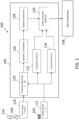
- the depicted system 100 includes a radio receiver 102, a microphone 104, a processing system 106, and an alert generator 108.
- the radio receiver 102 is configured, using known technology, to receive and demodulate a transmitted radio communication to thereby supply a first audio communication 112.
- the radio receiver 102 may be implemented using any one of numerous known receivers that are configured to receive and demodulate radio communications transmitted from a remote location, such as another vehicle (e.g., another aircraft) and/or a control station (e.g., air traffic control). Regardless of how it is specifically implemented, the first audio communication 112 may be supplied to a non-illustrated speaker to thereby generate an audible communication. In the depicted embodiment, the first audio communication 112 is also supplied to the processing system 106.
- the microphone 104 is configured, using known technology, to receive audio supplied from a vehicle operator 114 (e.g., a pilot) and to supply a second audio communication 116.
- the microphone 104 may be implemented using any one of numerous known devices that are configured to receive an audible communication from a human and, in response, generate the second audio communication 116.
- the second audio communication 116 may be supplied to a non-illustrated radio transmitter, which modulates and transmits the second audio communication 116 to another vehicle (e.g., another aircraft) and/or a control station (e.g., air traffic control).
- the second audio communication 116 is also supplied to the processing system 106.
- the processing system 106 is in operable communication with the radio receiver 102, the microphone 104, and the alert generator 108.
- the processing system 106 may include one or more processors and computer-readable storage devices or media encoded with programming instructions for configuring the processing system 106.
- the one or more processors may be any custom-made or commercially available processor, a central processing unit (CPU), a graphics processing unit (GPU), an application specific integrated circuit (ASIC), a field programmable gate array (FPGA), an auxiliary processor among several processors associated with the controller, a semiconductor-based microprocessor (in the form of a microchip or chip set), any combination thereof, or generally any device for executing instructions.
- the computer readable storage devices or media may include volatile and nonvolatile storage in read-only memory (ROM), random-access memory (RAM), and keep-alive memory (KAM), for example.
- KAM is a persistent or non-volatile memory that may be used to store various operating variables while the processor is powered down.
- the computer-readable storage device or media may be implemented using any of a number of known memory devices such as PROMs (programmable read-only memory), EPROMs (electrically PROM), EEPROMs (electrically erasable PROM), flash memory, or any other electric, magnetic, optical, or combination memory devices capable of storing data, some of which represent executable programming instructions, used by the one or more processors.
- the processing system 106 is configured, by the programming instructions, to receive the first audio communication 112 from the radio receiver 102, and to receive the second audio communication 116 from the microphone 104.
- the processing system 106 is further configured to process the first audio communication 112 to determine, from at least one audio characteristic, when the first audio communication 112 is characteristic of a first radio communication anomaly.
- the processing system 106 is additionally configured to process both the first audio communication 112 and the second audio communication 116 to determine when the first audio communication 112 and the second audio communication 116 are causing a second radio communication anomaly.
- the first and second radio communication anomalies may vary.
- the first radio communication anomaly is when the first audio communication 112 and second audio communication 116 overlap in a manner that completely blocks further processing, by the radio receiver 102, of the first audio communication 112, and thus no communication is audible to the vehicle operator 114.
- the second radio communication anomaly is when the first audio communication 112 and the second audio communication 116 overlap in a manner that partially blocks further processing, by the radio receiver 102, of the first audio communication 112.
- the processing system 106 determines when the first audio communication 112 is characteristic of the first radio communication anomaly from at least one audio characteristic of the first radio communication 112.
- the at least one audio characteristic includes a power spectral density of the first audio communication 112, and the processing system 106, via the programming instructions, implements what is referred to herein as a squeal detector module 118.
- the squeal detector module 118 implements a process to determine when the first radio communication anomaly has occurred and, when it has occurred, sends a signal to, what is referred to herein as, an audio anomaly detector module 120.
- the audio anomaly detector module 120 which is implemented via the programming instructions, processes this signal to generate and supply an appropriate alert signal to the alert generator 108. The process that the squeal detector module 118 implements is described in more detail further below.
- the processing system 106 processes both the first audio communication 112 and the second audio communication 116 to determine when the first audio communication 112 and the second audio communication 116 are causing the second radio communication anomaly. To do so, the processing system 106, via the programming instructions, implements what are referred to herein as a clipping detector module 122, a channel separator module 124, a speaker diarisation module 126, and a speaker attributes module 128.
- the clipping detector module 122 analyzes the first audio communication 112 to determine when the first audio communication 112 is clipped. To do so, the clipping detector module 122 implements any one of numerous known clipping detection techniques. As FIG. 1 further depicts, when the clipping detector module 122 determines that the first audio communication 112 is clipped, it sends an appropriate signal to the audio anomaly detector module 120.
- the channel separator module 124 receives the first and second audio communications 112, 116, separates the audio communications 112, 116 into separate channels, and supplies each to the speaker diarisation module 126.
- the speaker diarisation module 126 using any one of numerous known techniques, partitions the first and second audio communications 112, 116 into homogeneous segments to identify, using the speaker attributes module 128, the speaker attributes contained within the first and second audio communications 112, 116.
- the speaker attributes module 128 also implements its functionality using any one of numerous known techniques.
- the speaker attributes module 128 supplies the identified speaker attributes to the audio anomaly detector module 120.
- the audio anomaly detector module 120 determines receives and processes the signals supplied from the clipping detector module 122 and the speaker attributes from the speaker attributes module 128 and determines that the second radio communication anomaly has occurred when (i) the first audio communication is clipped and (ii) the speaker attributes are identified. If the second radio communication anomaly has occurred, the audio anomaly detector module 120 generates and supplies an appropriate alert signal to the alert generator 108.
- the alert generator 108 is coupled to receive the alert signal supplied from the audio anomaly detector module 120 and is configured, upon receipt of the alert signal, to generate an alert.
- the alert signal supplied by the audio anomaly detector module 120 will depend upon which radio communication anomaly - the first radio communication anomaly or the second radio communication anomaly - is occurring. It will be appreciated that the alert generator 108 may be variously implemented and may be configured to generate various types of alerts, including an audible alert, a visual alert, a haptic alert, or any combination thereof.
- the process 200 begins by receiving the first audio communication 112 (202) and the second audio communication 116 (204).
- the first audio communication 112 is audio from a demodulated radio communication
- the second audio communication 116 is audio from a vehicle operator.
- the first audio communication 112 is processed (205), in the processing system 106, to determine when the first audio communication 112 is characteristic of the first radio communication anomaly (206).
- the first and second audio communications 112, 116 are processed (207), in the processing system, to determine when first audio communication 112 and the second audio communication 116 are causing the second radio communication anomaly (208). If either the first radio communication anomaly or the second radio communication anomaly is occurring, the vehicle operator, via the alert generator 108, is alerted (212).
- FIGS. 3 and 4 For completeness, the processes implemented in the processing system 106 for determining when the first or second radio communication anomaly are occurring are depicted in flowchart form in FIGS. 3 and 4 , respectively, and will now be described beginning with FIG. 3 .
- the process 300 for determining when the first radio communication anomaly is occurring begins by segmenting the first audio communication 112 into a plurality of audio segments (302).
- the squeal detector module 118 then applies a Fast Fourier Transform (FFT) to each audio segment (304) and determines, from the FFT applied to each audio segment, the complex modulus of each audio segment (306).
- the squeal detector module 118 then calculates, using the complex modulus, the power spectral density of each audio segment (308).
- the power spectral density of each audio segment is then compared to a reference threshold (312). If the power spectral density of each audio segment exceeds the reference threshold, it is determined that the first radio communication anomaly has occurred (314).
- the process 400 for determining when second radio communication anomaly is occurring begins by analyzing, in the processing system, the first audio communication 112 to determine that the first audio communication is clipped (402).
- the above-described speaker diarization process is then implemented on the first and second audio communication 112, 116 to identify speaker attributes therein (404).
- the first audio communication 112 is clipped and the speaker attributes are identified, it is determined that the second radio communication anomaly has occurred (406).
- the system and methods described herein will detect overlapping radio transmissions and alert vehicle operators that such transmissions have occurred.
- Skilled artisans may implement the described functionality in varying ways for each particular application, but such implementation decisions should not be interpreted as causing a departure from the scope of the present invention.
- an embodiment of a system or a component may employ various integrated circuit components, e.g., memory elements, digital signal processing elements, logic elements, look-up tables, or the like, which may carry out a variety of functions under the control of one or more microprocessors or other control devices.
- integrated circuit components e.g., memory elements, digital signal processing elements, logic elements, look-up tables, or the like, which may carry out a variety of functions under the control of one or more microprocessors or other control devices.
- DSP digital signal processor
- ASIC application specific integrated circuit
- FPGA field programmable gate array
- a general-purpose processor may be a microprocessor, but in the alternative, the processor may be any conventional processor, controller, microcontroller, or state machine.
- a processor may also be implemented as a combination of computing devices, e.g., a combination of a DSP and a microprocessor, a plurality of microprocessors, one or more microprocessors in conjunction with a DSP core, or any other such configuration.
- a software module may reside in RAM memory, flash memory, ROM memory, EPROM memory, EEPROM memory, registers, hard disk, a removable disk, a CD-ROM, or any other form of storage medium known in the art.
- An exemplary storage medium is coupled to the processor such that the processor can read information from, and write information to, the storage medium.
- the storage medium may be integral to the processor.
- the processor and the storage medium may reside in an ASIC.
- an embodiment of a system or a component may employ various integrated circuit components, e.g., memory elements, digital signal processing elements, logic elements, look-up tables, or the like, which may carry out a variety of functions under the control of one or more microprocessors or other control devices.
- integrated circuit components e.g., memory elements, digital signal processing elements, logic elements, look-up tables, or the like, which may carry out a variety of functions under the control of one or more microprocessors or other control devices.
- various elements of the systems described herein are essentially the code segments or instructions that perform the various tasks.
- the program or code segments can be stored in a processor-readable medium or transmitted by a computer data signal embodied in a carrier wave over a transmission medium or communication path.
- the "computer-readable medium”, “processor-readable medium”, or “machine-readable medium” may include any medium that can store or transfer information. Examples of the processor-readable medium include an electronic circuit, a semiconductor memory device, a ROM, a flash memory, an erasable ROM (EROM), a floppy diskette, a CD-ROM, an optical disk, a hard disk, a fiber optic medium, a radio frequency (RF) link, or the like.
- RF radio frequency
- the computer data signal may include any signal that can propagate over a transmission medium such as electronic network channels, optical fibers, air, electromagnetic paths, or RF links.
- the code segments may be downloaded via computer networks such as the Internet, an intranet, a LAN, or the like.
- modules Some of the functional units described in this specification have been referred to as "modules" in order to more particularly emphasize their implementation independence.
- functionality referred to herein as a module may be implemented wholly, or partially, as a hardware circuit comprising custom VLSI circuits or gate arrays, off-the-shelf semiconductors such as logic chips, transistors, or other discrete components.
- a module may also be implemented in programmable hardware devices such as field programmable gate arrays, programmable array logic, programmable logic devices, or the like. Modules may also be implemented in software for execution by various types of processors.
- An identified module of executable code may, for instance, comprise one or more physical or logical modules of computer instructions that may, for instance, be organized as an object, procedure, or function.
- the executables of an identified module need not be physically located together, but may comprise disparate instructions stored in different locations that, when joined logically together, comprise the module and achieve the stated purpose for the module.
- a module of executable code may be a single instruction, or many instructions, and may even be distributed over several different code segments, among different programs, and across several memory devices.
- operational data may be embodied in any suitable form and organized within any suitable type of data structure. The operational data may be collected as a single data set, or may be distributed over different locations including over different storage devices, and may exist, at least partially, merely as electronic signals on a system or network.
Landscapes
- Engineering & Computer Science (AREA)
- Radar, Positioning & Navigation (AREA)
- Remote Sensing (AREA)
- Computer Networks & Wireless Communication (AREA)
- Signal Processing (AREA)
- Traffic Control Systems (AREA)
Applications Claiming Priority (2)
| Application Number | Priority Date | Filing Date | Title |
|---|---|---|---|
| IN202311035175 | 2023-05-19 | ||
| US18/346,397 US20240388371A1 (en) | 2023-05-19 | 2023-07-03 | System and method for detecting and alerting about radio communication anomalies |
Publications (1)
| Publication Number | Publication Date |
|---|---|
| EP4468630A1 true EP4468630A1 (de) | 2024-11-27 |
Family
ID=90904680
Family Applications (1)
| Application Number | Title | Priority Date | Filing Date |
|---|---|---|---|
| EP24172568.8A Pending EP4468630A1 (de) | 2023-05-19 | 2024-04-25 | System und verfahren zur erkennung und meldung von funkkommunikationsanomalien |
Country Status (1)
| Country | Link |
|---|---|
| EP (1) | EP4468630A1 (de) |
Citations (4)
| Publication number | Priority date | Publication date | Assignee | Title |
|---|---|---|---|---|
| US4335468A (en) * | 1978-07-28 | 1982-06-15 | Foster George B | Simultaneous transmission signal detection system |
| US6308052B1 (en) * | 1999-01-15 | 2001-10-23 | Imran A. Jamali | Half-duplex radios for indicating signal transmissions |
| EP2556593B1 (de) * | 2010-04-09 | 2014-05-21 | Harris Corporation | Simulierter snr-verlust bei decodiertem digitalem audio im zusammenhang mit der bitfehlerrate einer drahtlosverbindung |
| US20200403715A1 (en) * | 2018-03-19 | 2020-12-24 | Hitachi Kokusai Electric Inc. | Control station device and alarm issue method for control station device |
-
2024
- 2024-04-25 EP EP24172568.8A patent/EP4468630A1/de active Pending
Patent Citations (4)
| Publication number | Priority date | Publication date | Assignee | Title |
|---|---|---|---|---|
| US4335468A (en) * | 1978-07-28 | 1982-06-15 | Foster George B | Simultaneous transmission signal detection system |
| US6308052B1 (en) * | 1999-01-15 | 2001-10-23 | Imran A. Jamali | Half-duplex radios for indicating signal transmissions |
| EP2556593B1 (de) * | 2010-04-09 | 2014-05-21 | Harris Corporation | Simulierter snr-verlust bei decodiertem digitalem audio im zusammenhang mit der bitfehlerrate einer drahtlosverbindung |
| US20200403715A1 (en) * | 2018-03-19 | 2020-12-24 | Hitachi Kokusai Electric Inc. | Control station device and alarm issue method for control station device |
Similar Documents
| Publication | Publication Date | Title |
|---|---|---|
| US10491405B2 (en) | Cryptographic security verification of incoming messages | |
| US11348474B2 (en) | Automation architecture for compliance with air traffic clearances | |
| US9326087B2 (en) | Sound augmentation system performance health monitoring | |
| US20150200957A1 (en) | Detection of false vehicle-to-vehicle emergency brake light messages | |
| US11070939B2 (en) | System and method for managing emergency vehicle alert geofence | |
| US20100063687A1 (en) | Gps device and safe driving method using the same | |
| US9602937B2 (en) | Method and apparatus to provide surroundings awareness using sound recognition | |
| CN113534197B (zh) | 卫星定位信号的干扰检测方法及装置 | |
| US20230300169A1 (en) | Autonomous vehicle dos resistant communication system using acoustic communications | |
| US20180273034A1 (en) | Advanced driver assistance system | |
| US20240388371A1 (en) | System and method for detecting and alerting about radio communication anomalies | |
| CN105355197A (zh) | 用于语音识别系统的增益处理方法及装置 | |
| EP3627859B1 (de) | System und verfahren zum erfassen und anzeigen, dass ein audiosystem nicht wirksam abgestimmt ist | |
| WO2023219641A3 (en) | Systems and methods for detecting microwave pulses | |
| CN101887247A (zh) | 过程多回路波动源定位识别方法 | |
| CN119846642A (zh) | 一种车载超声波雷达探测方法、装置及车辆 | |
| US10278034B1 (en) | Audio processing system and method using push to talk (PTT) audio attributes | |
| CN109936822B (zh) | 广播消息发送方法、装置、存储介质、设备及广播系统 | |
| CN114222315B (zh) | 一种射频设备的巡检的方法及存储介质 | |
| EP3290942B1 (de) | Verfahren und vorrichtung zur detektion eines signals | |
| CN113486100B (zh) | 服务治理方法、装置、服务器及计算机存储介质 | |
| KR102281810B1 (ko) | 레이더 디텍터 및 이를 이용한 신호 패턴 검출 방법 | |
| US12477373B2 (en) | Management device, management method, and recording medium | |
| RU2736007C1 (ru) | Способ оценки качества приёма и акустического воспроизведения радиосистем транспортных средств | |
| US20240428447A1 (en) | System and method for detecting the positioning of a person relative to a seat |
Legal Events
| Date | Code | Title | Description |
|---|---|---|---|
| PUAI | Public reference made under article 153(3) epc to a published international application that has entered the european phase |
Free format text: ORIGINAL CODE: 0009012 |
|
| STAA | Information on the status of an ep patent application or granted ep patent |
Free format text: STATUS: THE APPLICATION HAS BEEN PUBLISHED |
|
| AK | Designated contracting states |
Kind code of ref document: A1 Designated state(s): AL AT BE BG CH CY CZ DE DK EE ES FI FR GB GR HR HU IE IS IT LI LT LU LV MC ME MK MT NL NO PL PT RO RS SE SI SK SM TR |
|
| P01 | Opt-out of the competence of the unified patent court (upc) registered |
Free format text: CASE NUMBER: APP_8678/2025 Effective date: 20250220 |
|
| STAA | Information on the status of an ep patent application or granted ep patent |
Free format text: STATUS: REQUEST FOR EXAMINATION WAS MADE |
|
| 17P | Request for examination filed |
Effective date: 20250522 |