EP4468340A1 - Halbleiteranordnung - Google Patents
Halbleiteranordnung Download PDFInfo
- Publication number
- EP4468340A1 EP4468340A1 EP24152145.9A EP24152145A EP4468340A1 EP 4468340 A1 EP4468340 A1 EP 4468340A1 EP 24152145 A EP24152145 A EP 24152145A EP 4468340 A1 EP4468340 A1 EP 4468340A1
- Authority
- EP
- European Patent Office
- Prior art keywords
- gate
- film
- pattern
- active
- source
- Prior art date
- Legal status (The legal status is an assumption and is not a legal conclusion. Google has not performed a legal analysis and makes no representation as to the accuracy of the status listed.)
- Pending
Links
Images



















Classifications
-
- H10W70/611—
-
- H—ELECTRICITY
- H10—SEMICONDUCTOR DEVICES; ELECTRIC SOLID-STATE DEVICES NOT OTHERWISE PROVIDED FOR
- H10D—INORGANIC ELECTRIC SEMICONDUCTOR DEVICES
- H10D84/00—Integrated devices formed in or on semiconductor substrates that comprise only semiconducting layers, e.g. on Si wafers or on GaAs-on-Si wafers
- H10D84/80—Integrated devices formed in or on semiconductor substrates that comprise only semiconducting layers, e.g. on Si wafers or on GaAs-on-Si wafers characterised by the integration of at least one component covered by groups H10D12/00 or H10D30/00, e.g. integration of IGFETs
- H10D84/82—Integrated devices formed in or on semiconductor substrates that comprise only semiconducting layers, e.g. on Si wafers or on GaAs-on-Si wafers characterised by the integration of at least one component covered by groups H10D12/00 or H10D30/00, e.g. integration of IGFETs of only field-effect components
- H10D84/83—Integrated devices formed in or on semiconductor substrates that comprise only semiconducting layers, e.g. on Si wafers or on GaAs-on-Si wafers characterised by the integration of at least one component covered by groups H10D12/00 or H10D30/00, e.g. integration of IGFETs of only field-effect components of only insulated-gate FETs [IGFET]
- H10D84/834—Integrated devices formed in or on semiconductor substrates that comprise only semiconducting layers, e.g. on Si wafers or on GaAs-on-Si wafers characterised by the integration of at least one component covered by groups H10D12/00 or H10D30/00, e.g. integration of IGFETs of only field-effect components of only insulated-gate FETs [IGFET] comprising FinFETs
-
- H—ELECTRICITY
- H10—SEMICONDUCTOR DEVICES; ELECTRIC SOLID-STATE DEVICES NOT OTHERWISE PROVIDED FOR
- H10D—INORGANIC ELECTRIC SEMICONDUCTOR DEVICES
- H10D84/00—Integrated devices formed in or on semiconductor substrates that comprise only semiconducting layers, e.g. on Si wafers or on GaAs-on-Si wafers
- H10D84/80—Integrated devices formed in or on semiconductor substrates that comprise only semiconducting layers, e.g. on Si wafers or on GaAs-on-Si wafers characterised by the integration of at least one component covered by groups H10D12/00 or H10D30/00, e.g. integration of IGFETs
- H10D84/82—Integrated devices formed in or on semiconductor substrates that comprise only semiconducting layers, e.g. on Si wafers or on GaAs-on-Si wafers characterised by the integration of at least one component covered by groups H10D12/00 or H10D30/00, e.g. integration of IGFETs of only field-effect components
- H10D84/83—Integrated devices formed in or on semiconductor substrates that comprise only semiconducting layers, e.g. on Si wafers or on GaAs-on-Si wafers characterised by the integration of at least one component covered by groups H10D12/00 or H10D30/00, e.g. integration of IGFETs of only field-effect components of only insulated-gate FETs [IGFET]
-
- H—ELECTRICITY
- H10—SEMICONDUCTOR DEVICES; ELECTRIC SOLID-STATE DEVICES NOT OTHERWISE PROVIDED FOR
- H10D—INORGANIC ELECTRIC SEMICONDUCTOR DEVICES
- H10D30/00—Field-effect transistors [FET]
- H10D30/40—FETs having zero-dimensional [0D], one-dimensional [1D] or two-dimensional [2D] charge carrier gas channels
- H10D30/43—FETs having zero-dimensional [0D], one-dimensional [1D] or two-dimensional [2D] charge carrier gas channels having 1D charge carrier gas channels, e.g. quantum wire FETs or transistors having 1D quantum-confined channels
-
- H—ELECTRICITY
- H10—SEMICONDUCTOR DEVICES; ELECTRIC SOLID-STATE DEVICES NOT OTHERWISE PROVIDED FOR
- H10D—INORGANIC ELECTRIC SEMICONDUCTOR DEVICES
- H10D30/00—Field-effect transistors [FET]
- H10D30/60—Insulated-gate field-effect transistors [IGFET]
- H10D30/67—Thin-film transistors [TFT]
- H10D30/6729—Thin-film transistors [TFT] characterised by the electrodes
- H10D30/673—Thin-film transistors [TFT] characterised by the electrodes characterised by the shapes, relative sizes or dispositions of the gate electrodes
- H10D30/6735—Thin-film transistors [TFT] characterised by the electrodes characterised by the shapes, relative sizes or dispositions of the gate electrodes having gates fully surrounding the channels, e.g. gate-all-around
-
- H—ELECTRICITY
- H10—SEMICONDUCTOR DEVICES; ELECTRIC SOLID-STATE DEVICES NOT OTHERWISE PROVIDED FOR
- H10D—INORGANIC ELECTRIC SEMICONDUCTOR DEVICES
- H10D30/00—Field-effect transistors [FET]
- H10D30/60—Insulated-gate field-effect transistors [IGFET]
- H10D30/67—Thin-film transistors [TFT]
- H10D30/6757—Thin-film transistors [TFT] characterised by the structure of the channel, e.g. transverse or longitudinal shape or doping profile
-
- H—ELECTRICITY
- H10—SEMICONDUCTOR DEVICES; ELECTRIC SOLID-STATE DEVICES NOT OTHERWISE PROVIDED FOR
- H10D—INORGANIC ELECTRIC SEMICONDUCTOR DEVICES
- H10D62/00—Semiconductor bodies, or regions thereof, of devices having potential barriers
- H10D62/10—Shapes, relative sizes or dispositions of the regions of the semiconductor bodies; Shapes of the semiconductor bodies
- H10D62/113—Isolations within a component, i.e. internal isolations
- H10D62/115—Dielectric isolations, e.g. air gaps
-
- H—ELECTRICITY
- H10—SEMICONDUCTOR DEVICES; ELECTRIC SOLID-STATE DEVICES NOT OTHERWISE PROVIDED FOR
- H10D—INORGANIC ELECTRIC SEMICONDUCTOR DEVICES
- H10D64/00—Electrodes of devices having potential barriers
- H10D64/20—Electrodes characterised by their shapes, relative sizes or dispositions
- H10D64/23—Electrodes carrying the current to be rectified, amplified, oscillated or switched, e.g. sources, drains, anodes or cathodes
- H10D64/251—Source or drain electrodes for field-effect devices
- H10D64/254—Source or drain electrodes for field-effect devices for lateral devices wherein the source or drain electrodes extend entirely through the semiconductor bodies, e.g. via-holes for back side contacts
-
- H10W10/014—
-
- H10W10/17—
-
- H10W20/20—
-
- H10W20/42—
-
- H10W20/427—
-
- H10W20/43—
-
- H10W70/65—
Definitions
- the present disclosure relates to a semiconductor device.
- One of scaling methods for increasing an integration density of a semiconductor device includes a multi-gate transistor, in which a multi-channel active pattern (or a silicon body) in a shape of a fin or a nanowire is formed on a substrate, and a gate is formed on a surface of the multi-channel active pattern. Because such a multi-gate transistor uses a three-dimensional channel, it is easy to scale the same. Further, current control capability of the multi-gate transistor may be improved without increasing a gate length of the multi-gate transistor. In addition, the multi-gate transistor may effectively suppress SCE (short channel effect) in which potential of a channel area is affected by drain voltage.
- SCE short channel effect
- a semiconductor device including a substrate including a first surface and a second surface opposite to each other in a first direction, an active pattern on the first surface of the substrate and extending in a second direction intersecting the first direction, a gate electrode on the first surface of the substrate and covering the active pattern, wherein the gate electrode extends in a third direction intersecting the first and second directions, a source/drain pattern on at least one side of the gate electrode and connected to the active pattern, a gate cutting structure on one side of the active pattern and cutting the gate electrode, a power rail on the second surface of the substrate and extending in the second direction, and a via contact extending through the substrate, wherein one end of the via contact contacts the power rail while the other end thereof is connected to the source/drain pattern, wherein the gate cutting structure includes a third surface and a fourth surface opposite to each other in the first direction, wherein the fourth surface of the gate cutting structure is coplanar with the second surface of the substrate.
- a semiconductor device including a substrate including a first surface and a second surface opposite to each other in a first direction, an active pattern on the first surface of the substrate and extending in the second direction intersecting the first direction, a gate electrode on the first surface of the substrate, wherein the gate electrode covers the active pattern and extends in a third direction intersecting the first and second directions, an active cutting structure spaced apart from the gate electrode in the second direction and extending in the third direction, wherein the active cutting structure cuts the active pattern, a source/drain pattern on at least one side of the gate electrode and connected to the active pattern, a power rail on the second surface of the substrate and extending in the second direction, and a via contact extending through the substrate, wherein one end of the via contact contacts the power rail while the other end thereof is connected to the source/drain pattern, wherein the active cutting structure includes a fifth surface and a sixth surface opposite to each other in the first direction, wherein the sixth face of the active cutting structure is coplanar with
- a semiconductor device including a substrate including a first surface and a second surface opposite to each other in a first direction, a lower pattern on the first surface of the substrate and extending in a second direction intersecting the first direction, a plurality of sheet patterns on the lower pattern and spaced apart from the lower pattern in the first direction, a gate electrode on the first surface of the substrate and extending in a third direction intersecting the first and second directions, wherein the gate electrode surrounds the plurality of sheet patterns, an active cutting structure spaced apart from the gate electrodes in the second direction, and extending in the third direction, wherein the active cutting structure cuts the lower pattern and the plurality of sheet patterns, and extends through the substrate, a source/drain pattern on an upper surface of the lower pattern and on at least one side of the gate electrode, wherein the source/drain pattern is connected to the plurality of sheet patterns, a gate cutting structure on one side of each of the plurality of sheet patterns, wherein the gate cutting structure cuts the gate electrode and extend
- a fin-type transistor including a fin-type pattern-shaped channel area, a transistor including nanowires or nanosheets, MBCFET TM (Multi-Bridge Channel Field Effect Transistor) or a vertical transistor (Vertical FET) is shown illustratively.
- a tunneling transistor tunneling FET
- a three-dimensional (3D) transistor a planar transistor
- 2D (two-dimensional) material transistor (2D material based FETs) and a heterostructure thereof e.g., a bipolar junction transistor, a lateral double diffusion transistor (LDMOS), etc.
- LDMOS lateral double diffusion transistor
- FIG. 1 is an illustrative layout diagram for illustrating a semiconductor device according to some embodiments.
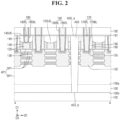
- FIG. 2 is an illustrative cross-section cut along a line A-A in FIG. 1 .
- FIG. 3 is an illustrative cross-section cut along a line B-B in FIG. 1 .
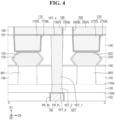
- FIG. 4 is an illustrative cross-section cut along a line C-C in FIG. 1 .
- FIG. 5 is an illustrative cross-sectional view as cut along a line D-D in FIG. 1 .
- a semiconductor device may include a first active pattern AP1, a second active pattern AP2, a plurality of gate electrodes 120, a first source/drain contact 170, a second source/drain contact 270, a gate contact 180, a power rail PR, a via contact VCT, a gate cutting structure GSS, and an active cutting structure ASS.
- a substrate 100 may be provided.
- the substrate 100 may include a first surface 100a and a second surface 100b opposite to each other in a first direction D 1.
- the first surface 100a of the substrate 100 may be referred to as an upper surface of the substrate 100 or a front side of the substrate 100.
- the second surface 100b of the substrate 100 may be referred to as a lower surface of the substrate 100 or a back side of the substrate 100.
- the substrate 100 be a bulk silicon substrate or a silicon-on-insulator (SOI) substrate.
- the substrate 100 may be a silicon substrate, or may be made of a material other than silicon, e.g., silicon germanium, SGOI (silicon germanium on insulator), indium antimonide, lead telluride compound, indium arsenide, indium phosphide, gallium arsenide or gallium antimonide.
- Each of the first active pattern AP1 and the second active pattern AP2 may be disposed on the first surface 100a of the substrate 100.
- Each of the first active pattern AP1 and the second active pattern AP2 may extend along a second direction D2 while being disposed on the substrate 100.
- the first active pattern AP1 and the second active pattern AP2 may be spaced apart from each other in a third direction D3.
- each of the first active pattern AP 1 and the second active pattern AP2 may include a long side extending in the second direction D2 and a short side extending in the third direction D3.
- the second direction D2 may intersect with the third direction D3 and the first direction D1.
- the third direction D3 may intersect the first direction D1.
- the first direction D1 may be a thickness direction of the substrate 100.
- Each of the first active pattern AP1 and the second active pattern AP2 may be a multi-channel active pattern.
- the first active pattern AP1 may include a first lower pattern BP1 and a plurality of first sheet patterns SP1.
- the second active pattern AP2 may include a second lower pattern BP2 and a plurality of second sheet patterns SP2.
- the first lower pattern BP1 may protrude from the substrate 100 in the first direction D1.
- the first lower pattern BP1 may extend (e.g., lengthwise) in the second direction D2.
- the first lower pattern BP1 may be a fin-shaped pattern.
- the plurality of first sheet patterns SP1 may be disposed on the first lower pattern BP1.
- the plurality of first sheet patterns SP1 may be spaced apart from the first lower pattern BP1 in the first direction D 1.
- the plurality of first sheet patterns SP1 may be spaced apart from each other in the first direction D1. Although it is illustrated that three first sheet patterns SP1 are arranged in the first direction D1, this is only for convenience of illustration and any suitable number of first sheet patterns SP1 may be used.
- the second lower pattern BP2 may protrude from substrate 100 in the first direction D1.
- the second lower pattern BP2 may extend (e.g., lengthwise) in the second direction D2.
- the second lower pattern BP2 may be a fin-shaped pattern.
- the plurality of second sheet pattern SP2 may be disposed on the second lower pattern BP2.
- the plurality of second sheet patterns SP2 may be spaced apart from the second lower pattern BP2 in the first direction D1.
- the plurality of second sheet patterns SP2 may be spaced apart from each other in the first direction D1.
- Each of the first lower pattern BP1 and the second lower pattern BP2 may be formed by etching a portion of the substrate 100, or may include an epitaxial layer grown from the substrate 100.
- each of the first lower pattern BP1 and the second lower pattern BP2 may include an elemental semiconductor material, e.g., silicon or germanium.
- each of the first lower pattern BP1 and the second lower pattern BP2 may include a compound semiconductor, e.g., each of the first lower pattern BP1 and the second lower pattern BP2 may include a group IV-IV compound semiconductor or a group III-V compound semiconductor.
- the group IV-IV compound semiconductor may include a binary compound including two of carbon (C), silicon (Si), germanium (Ge), and tin (Sn), a ternary compound including three thereof, or a compound obtained by doping a group IV element thereto.
- the group III-V compound semiconductor may include a binary compound obtained by combining one of aluminum (Al), gallium (Ga), and indium (In) as a group III element and one of phosphorus (P), arsenic (As), and antimony (Sb) as a group V element with each other, a ternary compound obtained by combining two of aluminum (Al), gallium (Ga), and indium (In) as a group III element and one of phosphorus (P), arsenic (As), and antimony (Sb) as a group V with each other, or a quaternary compound obtained by combining three of aluminum (Al), gallium (Ga), and indium (In) as a group III element and one of phosphorus (P), arsenic (As), and antimony (Sb) as a group V with each other.
- Each of the first sheet patterns SP1 and the second sheet patterns SP2 may include one of silicon or germanium as the elemental semiconductor material, the group IV-IV compound semiconductor, or the group III-V compound semiconductor.
- Each of the first sheet patterns SP1 may include the same material as that of the first lower pattern BP1, or may include a different material from that of the first lower pattern BP1.
- Each of the second sheet patterns SP2 may include the same material as that of the second lower pattern BP2, or may include a different material from that of the second lower pattern BP2.
- each of the first lower pattern BP1 and the second lower pattern BP2 may be a silicon lower pattern including silicon, while each of the first sheet patterns SP1 and the second sheet patterns SP2 may be a silicon sheet patterns including silicon.
- a field insulating film 105 may be formed on the substrate 100.
- the field insulating film 105 may be formed on the first surface 100a of the substrate 100.
- the field insulating film 105 may cover a sidewall of the first lower pattern BP1 and a sidewall of the second lower pattern BP2.
- Each of the first sheet patterns SP1 and each of the second sheet patterns SP2 may be positioned at a higher vertical level than that of an upper surface of the field insulating film 105, e.g., relative to the second surface 100b of the substrate 100.
- the field insulating film 105 may include, e.g., an oxide film, a nitride film, an oxynitride film, or a combination thereof.
- the field insulating film 105 is illustrated as a single film but may include a plurality of films, e.g., the field insulating film 105 may include a field liner extending along a sidewall and a bottom surface of a fin trench defining the first and second lower patterns BP1 and BP2, and a field filling film disposed on the field liner.
- the plurality of gate electrodes 120 may be disposed on the substrate 100.
- the plurality of gate electrodes 120 may be disposed on the field insulating film 105.
- Each of the plurality of gate electrodes 120 may extend (e.g., lengthwise) in the third direction D3.
- the plurality of gate electrodes 120 may be spaced apart from each other in the second direction D2.
- the plurality of gate electrodes 120 may be disposed on the first active pattern AP1 and the second active pattern AP2.
- the plurality of gate electrodes 120 may intersect the first active pattern AP1 and the second active pattern AP2.
- the plurality of gate electrodes 120 may surround the first sheet patterns SP1 and the second sheet patterns SP2.
- Each of the plurality of gate electrodes 120 may include a long side extending in the third direction D3 and a short side extending in the second direction D2.
- an upper surface 120US of each of the plurality of gate electrodes 120 may be a concavely curved surface recessed toward an upper surface of the first active pattern AP1.
- the upper surface 120US of each of the plurality of gate electrodes 120 may be a flat surface.
- Each of the plurality of gate electrodes 120 may include at least one of, e.g., titanium nitride (TiN), tantalum carbide (TaC), tantalum nitride (TaN), titanium silicon nitride (TiSiN), tantalum silicon nitride (TaSiN), tantalum titanium nitride (TaTiN), titanium aluminum nitride (TiAlN), tantalum aluminum nitride (TaAlN), tungsten nitride (WN), ruthenium (Ru), titanium aluminum (TiAl), titanium aluminum carbonitride (TiAlC-N), titanium aluminum carbide (TiAlC), titanium carbide (TiC), tantalum carbonitride (TaCN), tungsten (W), aluminum (Al), copper (Cu), cobalt (Co), titanium (Ti), tantalum (Ta), nickel (Ni), platinum (Pt), nickel platinum (Ni-
- Each of the plurality of gate electrodes 120 may include a conductive metal oxide, a conductive metal oxynitride, and the like.
- the conductive metal oxide and the conductive metal oxynitride may include oxidized products of the above-mentioned materials.
- Each of the plurality of gate electrodes 120 may be disposed on each of both opposing sides of a first source/drain pattern 150 to be described later. Although not shown, each of the plurality of gate electrodes 120 may be disposed on each of both opposing sides of a second source/drain pattern 250.
- each of the gate electrodes 120 respectively disposed on both opposing sides of the first source/drain pattern 150 or on both opposing sides of the second source/drain pattern 250 may be a normal gate electrode used as a gate of a transistor.
- the gate electrode 120 disposed on one side of the first source/drain pattern 150 or on one side of the second source/drain pattern 250 may be used as a gate of the transistor, while the gate electrode 120 disposed on the other side of the first source/drain pattern 150 or on the other side of the second source/drain pattern 250 may be a dummy gate electrode.
- a plurality of gate spacers 140 may be disposed on a sidewall of each of the plurality of gate electrodes 120. The plurality of gate spacers 140 may not contact the plurality of gate electrodes 120.
- a gate insulating film 130 may be disposed between the gate spacer 140 and the sidewall of the gate electrode 120. Each of the plurality of gate spacers 140 may extend (e.g., lengthwise) in the third direction D3.
- Each of the plurality of gate spacers 140 may include, e.g., at least one of silicon nitride (SiN), silicon oxynitride (SiON), silicon oxide (SiO 2 ), silicon oxycarbonitride (SiOCN), silicon boron nitride (SiBN), silicon oxyboronitride (SiOBN), silicon oxycarbide (SiOC), or combinations thereof.
- silicon nitride SiN
- silicon oxynitride SiON
- silicon oxide SiO 2
- silicon oxycarbonitride SiOCN
- SiBN silicon boron nitride
- SiOBN silicon oxyboronitride
- SiOC silicon oxycarbide
- the gate insulating film 130 may be disposed between the gate electrodes 120 and the upper surface of the field insulating film 105, between the gate electrodes 120 and the upper surface of the first lower pattern BP1, between the gate electrodes 120 and the upper surface of the second lower pattern BP2, between the gate electrodes 120 and the first sheet patterns SP 1, and between the gate electrodes 120 and the second sheet patterns SP2.
- the gate insulating film 130 may be formed between the gate electrodes 120 and the gate spacers 140. Furthermore, the gate insulating film 130 may be formed between the first source/drain pattern 150 and the gate electrodes 120.
- the gate insulating film 130 may include silicon oxide, silicon oxynitride, silicon nitride, or a high dielectric constant (high-k) material having a higher dielectric constant than that of silicon oxide.
- the high dielectric constant (high-k) material may include at least one of, e.g., boron nitride, hafnium oxide, hafnium silicon oxide, hafnium aluminum oxide, lanthanum oxide, lanthanum aluminum oxide, zirconium oxide, zirconium silicon oxide, tantalum oxide, titanium oxide, barium strontium titanium oxide, barium titanium oxide, strontium titanium oxide, yttrium oxide, aluminum oxide, lead scandium tantalum oxide, or lead zinc niobate.
- the present disclosure is not limited thereto.
- the gate insulating film 130 is illustrated as being embodied as a single film. However, this is only for convenience of illustration, e.g., the gate insulating film 130 may be embodied as a stack of a plurality of films.
- the semiconductor device may include an NC (negative capacitance) FET using a negative capacitor.
- the gate insulating film 130 may include a ferroelectric material film having ferroelectric properties and a paraelectric material film having paraelectric properties.
- the ferroelectric material film may have negative capacitance, and the paraelectric material film may have positive capacitance.
- the paraelectric material film may have positive capacitance.
- a total capacitance is smaller than capacitance of each individual capacitor.
- at least one of capacitances of two or more capacitors connected in series to each other has a negative value
- a total capacitance may have a positive value and be greater than an absolute value of each individual capacitance.
- a total capacitance value of the ferroelectric material film and the paraelectric material film connected in series to each other may be increased.
- a transistor including the ferroelectric material film may have a subthreshold swing (SS) lower than about 60 mV/decade at room temperature.
- the ferroelectric material film may have ferroelectric properties.
- the ferroelectric material film may include, e.g., at least one of hafnium oxide, hafnium zirconium oxide, barium strontium titanium oxide, barium titanium oxide, and lead zirconium titanium oxide.
- hafnium zirconium oxide may refer to a material obtain by doping hafnium oxide with zirconium (Zr).
- hafnium zirconium oxide may refer to a compound of hafnium (Hf), zirconium (Zr), and oxygen (O).
- the ferroelectric material film may further contain dopants.
- the dopants may include at least one of aluminum (Al), titanium (Ti), niobium (Nb), lanthanum (La), yttrium (Y), magnesium (Mg), silicon (Si), calcium (Ca), cerium (Ce), dysprosium (Dy), erbium (Er), gadolinium (Gd), germanium (Ge), scandium (Sc), strontium (Sr) and tin (Sn).
- a type of the dopant contained in the ferroelectric material film may vary depending on a type of the ferroelectric material included in the ferroelectric material film.
- the dopant contained in the ferroelectric material film may include, e.g., at least one of gadolinium (Gd), silicon (Si), zirconium (Zr), aluminum (Al), and yttrium (Y).
- Gd gadolinium
- Si silicon
- Zr zirconium
- Al aluminum
- Y yttrium
- the ferroelectric material film may contain about 3 at% to about 8 at% (atomic %) of aluminum.
- a content of the dopant may be a content of aluminum based on a sum of hafnium and aluminum.
- the ferroelectric material film may contain about 2 at% to about 10 at% of silicon.
- the ferroelectric material film may contain about 2 at% to about 10 at% yttrium.
- the ferroelectric material film may contain about 1 at% to about 7 at% gadolinium.
- the dopant is zirconium (Zr)
- the ferroelectric material film may contain about 50 at% to about 80 at% zirconium.
- the paraelectric material film may have paraelectric properties.
- the paraelectric material film may include, e.g., at least one of silicon oxide and metal oxide having a high dielectric constant.
- the metal oxide contained in the paraelectric material film may include at least one of hafnium oxide, zirconium oxide and aluminum oxide.
- the ferroelectric material film and the paraelectric material film may include the same material.
- the ferroelectric material film may have ferroelectric properties, but the paraelectric material film may not have the ferroelectric properties.
- a crystal structure of hafnium oxide contained in the ferroelectric material film is different from a crystal structure of hafnium oxide contained in the paraelectric material film.
- the ferroelectric material film may have a thickness sized to exhibit ferroelectric properties.
- the thickness of the ferroelectric material film may be, e.g., in a range of about 0.5 nm to about 10 nm. Because a critical thickness exhibiting the ferroelectric properties may be vary based on a type of the ferroelectric material, the thickness of the ferroelectric material film may vary depending on the type of the ferroelectric material.
- the gate insulating film 130 may include one ferroelectric material film. In another example, the gate insulating film 130 may include a plurality of ferroelectric material films spaced apart from each other. The gate insulating film 130 may have a multilayer structure in which a plurality of ferroelectric material films and a plurality of paraelectric material films are alternately stacked on top of each other.
- Each of a plurality of gate capping films 145 may be disposed on an upper surface 120US of each of the plurality of gate electrodes 120 and an upper surface of each of the plurality of gate spacers 140.
- Each of the plurality of the first gate capping films 145 may include, e.g., at least one of silicon nitride (SiN), silicon oxynitride (SiON), silicon oxide (SiO 2 ), silicon carbonitride (SiCN), silicon oxycarbonitride (SiOCN), or combinations thereof.
- an upper surface 145US of each of the plurality of gate capping films 145 may be coplanar with a fifth surface ASS_a of the active cutting structure ASS ( FIG. 2 ) to be described later. Furthermore, the upper surface 145US of each of the plurality of gate capping films 145 may be coplanar with a third surface GSS_a of the gate cutting structure GSS ( FIG. 5 ) to be described later. The upper surface 145US of each of the plurality of gate capping films 145 may be coplanar with an upper surface of the gate contact 180 ( FIG. 2 ) to be described later, an upper surface of the first source/drain contact 170 to be described later, an upper surface of the second source/drain contact 270 to be described later, and an upper surface of a first interlayer insulating film 190.
- the first source/drain pattern 150 may be disposed on the substrate 100.
- the first source/drain pattern 150 may be formed on the first lower pattern BP1.
- the first source/drain pattern 150 is connected to the first lower pattern BP1.
- a bottom surface of the first source/drain pattern 150 is in contact (e.g., direct contact) with the first lower pattern BP1.
- the first source/drain pattern 150 may be connected to the plurality of first sheet patterns SP1.
- a sidewall of the first source/drain pattern 150 contacts (e.g., directly contacts) the plurality of first sheet patterns SP1.
- the first source/drain pattern 150 may be disposed on a side surface of each of the plurality of gate electrodes 120.
- the first source/drain pattern 150 may be disposed between adjacent ones of the plurality of gate electrodes 120.
- the first source/drain pattern 150 may be disposed on each of both opposing sides of each of the plurality of gate electrodes 120.
- the first source/drain pattern 150 may be disposed on only one side of each of the plurality of gate electrodes 120 and may not be disposed on the other side of each of the plurality of gate electrodes 120.
- the first source/drain pattern 150 may include an epitaxial pattern.
- the first source/drain pattern 150 may include a semiconductor material.
- the first source/drain pattern 150 may be included in a source/drain of a transistor using the first sheet pattern SP1 as a channel area.
- the first source/drain pattern 150 may be connected to a portion of the first active pattern AP1 used as a channel area.
- the first source/drain pattern 150 may be connected to the first sheet pattern SP1.
- a sidewall of the first source/drain pattern 150 may have a wavy shape.
- a portion of the sidewall of the first source/drain pattern 150 facing the first sheet pattern SP1 may be concave, and a portion of the sidewall of the first source/drain pattern 150 facing the gate electrode 120 may be convex.
- the portion of the sidewall of the first source/drain pattern 150 facing the first sheet pattern SP1 may be convex, and the portion of the sidewall of the first source/drain pattern 150 facing the gate electrode 120 may be concave.
- the second source/drain pattern 250 may be disposed on the substrate 100.
- the second source/drain pattern 250 may be formed on the second lower pattern BP2.
- the second source/drain pattern 250 is connected to the second lower pattern BP2.
- a bottom surface of the second source/drain pattern 250 contacts (e.g., directly contacts) the second lower pattern BP2.
- the second source/drain pattern 250 may be connected to the plurality of second sheet patterns SP2.
- a sidewall of the second source/drain pattern 250 contacts (e.g., directly contacts) the plurality of second sheet patterns SP2.
- the second source/drain pattern 250 may be disposed on a side surface of each of the plurality of gate electrodes 120.
- the second source/drain pattern 250 may be disposed between adjacent ones of the plurality of gate electrodes 120.
- the second source/drain pattern 250 may be disposed on each of both opposing sides of the plurality of gate electrodes 120. In another example, the second source/drain pattern 250 may be disposed on only one side of each of the plurality of gate electrodes 120 and may not be disposed on the other side of each of the plurality of gate electrodes 120.
- the second source/drain pattern 250 may include an epitaxial pattern.
- the second source/drain pattern 250 may include a semiconductor material.
- the second source/drain pattern 250 may be included in a source/drain of a transistor using the second active pattern AP2 as a channel area.
- the second source/drain pattern 250 may be connected to a portion of the second active pattern AP2a used as a channel area.
- the second source/drain pattern 250 may be connected to the second sheet pattern SP2.
- An etch stop film 160 may extend along the upper surface of the field insulating film 105, the sidewalls of the plurality of gate spacers 140, and a profile of the first source/drain pattern 150, and a profile of the second source/drain pattern 250.
- the etch stop film 160 may be disposed on the upper surface of the first source/drain pattern 150, the sidewall of the first source/drain pattern 150, the upper surface of the second source/drain pattern 250, and the sidewall of the second source/drain pattern 250, and the sidewalls of the plurality of gate spacers 140. In some embodiments, the etch stop film 160 is not disposed on the sidewall of the gate capping film 145.
- the gate capping film 145 may be disposed on an upper surface of the etch stop film 160. Furthermore, a side wall of the etch stop film 160 may be connected to an outer sidewall of the gate capping film 145. Unlike what is illustrated, the etch stop film 160 may be disposed on the sidewall of the gate capping film 145.
- the etch stop film 160 may include a material having an etch selectivity with respect to a material of the first interlayer insulating film 190 to be described later.
- the etch stop film 160 may include a nitride-based insulating material.
- the etch stop film 160 may include at least one of silicon nitride (SiN), silicon oxynitride (SiON), silicon oxycarbonitride (SiOCN), silicon boron nitride (SiBN), silicon oxyboronitride (SiOBN), or combinations thereof.
- the first interlayer insulating film 190 is disposed on the etch stop film 160.
- the first interlayer insulating film 190 may be formed on the field insulating film 105.
- the first interlayer insulating film 190 may be disposed on the first source/drain pattern 150 and the second source/drain pattern 250.
- the first interlayer insulating film 190 may not cover the upper surface 145US of the gate capping film 145.
- the upper surface of the first interlayer insulating film 190 may be coplanar with the upper surface 145US of the gate capping film 145.
- the first interlayer insulating film 190 may include, e.g., at least one of silicon oxide, silicon nitride, silicon oxynitride, or a low dielectric constant (low-k) material.
- the low dielectric constant (low-k) material may include, e.g., fluorinated tetraethylorthosilicate (FTEOS), hydrogen silsesquioxane (HSQ), bis-benzocyclobutene (BCB), tetramethylorthosilicate (TMOS), octamethyleyclotetrasiloxane (OMCTS), hexamethyldisiloxane (HMDS), trimethylsilyl borate (TMSB), diacetoxyditertiarybutosiloxane (DADBS), trimethylsilil phosphate (TMSP), polytetrafluoroethylene (PTFE), TOSZ (Tonen SilaZen), FSG (fluoride silicate glass), polyimi
- the first source/drain contact 170 may be disposed on the first source/drain pattern 150 disposed on the first lower pattern BP1 of the first active pattern AP1.
- the second source/drain contact 270 may be disposed on the second source/drain pattern 250 disposed on the second lower pattern BP2 of the second active pattern AP2.
- the first source/drain contact 170 may be connected to the first source/drain pattern 150.
- the second source/drain contact 270 may be connected to the second source/drain pattern 250.
- the gate contact 180 may contact some of the plurality of gate electrodes 120.
- the gate contact 180 may overlap each of some of the plurality of gate electrodes 120.
- the first source/drain contact 170 may extend through the etch stop film 160 so as to be connected to the first source/drain pattern 150.
- the first source/drain contact 170 may be disposed on the first source/drain pattern 150.
- the first source/drain contact 170 may be disposed in the first interlayer insulating film 190.
- the first source/drain contact 170 may be surrounded with the first interlayer insulating film 190.
- a first contact silicide layer 155 may be disposed between the first source/drain contact 170 and the first source/drain pattern 150.
- the first contact silicide layer 155 may be formed along a profile of an interface between the first source/drain pattern 150 and the first source/drain contact 170.
- the first contact silicide layer 155 may include, e.g., a metal silicide material.
- the first interlayer insulating film 190 may not cover an upper surface of the first source/drain contact 170.
- the upper surface of the first source/drain contact 170 may not protrude upwardly beyond the upper surface 145US of the gate capping film 145.
- the upper surface of the first source/drain contact 170 may be coplanar with the upper surface 145US of the gate capping film 145. Unlike what is illustrated, in another example, the upper surface of the first source/drain contact 170 may protrude upwardly beyond the upper surface 145US of the gate capping film 145.
- the upper surface of the first source/drain contact 170 may be coplanar with an upper surface of the gate contact 180.
- the upper surface of the first source/drain contact 170 may be coplanar with an upper surface VCT_a of the via contact VCT.
- the first source/drain contact 170 may include a first source/drain barrier film 170BL and a first source/drain filling film 170FL disposed on the first source/drain barrier film 170BL.
- a bottom surface of the first source/drain contact 170 is illustrated as having a flat shape. However, the present disclosure is not limited thereto, e.g., the bottom surface of the first source/drain contact 170 may have a wavy shape.
- the first source/drain barrier film 170BL may include, e.g., at least one of tantalum (Ta), tantalum nitride (TaN), titanium (Ti), titanium nitride (TiN), titanium silicon nitride (TiSiN), ruthenium (Ru), cobalt (Co), nickel (Ni), nickel boron (NiB), tungsten (W), tungsten nitride (WN), tungsten carbonitride (WCN), zirconium (Zr), zirconium nitride (ZrN), vanadium (V), vanadium nitride (VN), niobium (Nb), niobium nitride (NbN), platinum (Pt), iridium (Ir), rhodium (Rh), or a two-dimensional (2D) material.
- Ta tantalum
- TaN tantalum nitride
- Ti titanium
- TiN titanium
- the 2D material may be a metallic material and/or a semiconductor material.
- the two-dimensional material (2D material) may include a two-dimensional allotrope or a two-dimensional compound.
- the two-dimensional material (2D material) may include at least one of graphene, molybdenum disulfide (MoS 2 ), molybdenum diselenide (MoSe 2 ), tungsten diselenide (WSe 2 ), or tungsten disulfide (WS 2 ).
- the first source/drain filling film 170FL may include, e.g., at least one of aluminum (Al), tungsten (W), cobalt (Co), ruthenium (Ru), silver (Ag), gold (Au), manganese (Mn) or molybdenum (Mo).
- the first source/drain contact 170 is illustrated as including a plurality of conductive films. However, the present disclosure is not limited thereto, e.g., the first source/drain contact 170 may be embodied as a single film.
- the second source/drain contact 270 may extend through the etch stop film 160 so as to be connected to the second source/drain pattern 250.
- the second source/drain contact 270 may be disposed on the second source/drain pattern 250.
- the second source/drain contact 270 may be disposed in the first interlayer insulating film 190.
- the second source/drain contact 270 may be surrounded with the first interlayer insulating film 190.
- the second contact silicide layer 255 may be disposed between the second source/drain contact 270 and the second source/drain pattern 250.
- the second contact silicide layer 255 may be formed along a profile of an interface between the second source/drain pattern 250 and the second source/drain contact 270.
- the second contact silicide layer 255 may include, e.g., a metal silicide material.
- the first interlayer insulating film 190 may not cover an upper surface of the second source/drain contact 270.
- the upper surface of the second source/drain contact 270 may not protrude upwardly beyond the upper surface 145US of the gate capping film 145.
- the upper surface of the second source/drain contact 270 may be coplanar with the upper surface 145US of the gate capping film 145.
- the upper surface of the second source/drain contact 270 may protrude upwardly beyond the upper surface 145US of the gate capping film 145.
- an upper surface of the second source/drain contact 270 may be coplanar with the upper surface of the gate contact 180.
- the upper surface of the second source/drain contact 270 may be coplanar with the upper surface VCT_a of the via contact VCT.
- the second source/drain contact 270 may include a second source/drain barrier film 270BL and a second source/drain filling film 270FL disposed on the second source/drain barrier film 270BL.
- a bottom surface of the second source/drain contact 270 is illustrated as having a flat shape. However, the present disclosure is not limited thereto, e.g., the bottom surface of the second source/drain contact 270 may have a wavy shape.
- a material included in the second source/drain barrier film 270BL may be the same as the material included in the first source/drain barrier film 170BL.
- the material included in the second source/drain filling film 270FL may be the same as the material included in the first source/drain filling film 170FL.
- the second source/drain contact 270 is illustrated as including a plurality of conductive films. However, the present disclosure is not limited thereto, e.g., the second source/drain contact 270 may be embodied as a single film.
- the gate contact 180 may be disposed on the gate electrode 120.
- the gate contact 180 may extend through the gate capping film 145 so as to be connected to the gate electrode 120.
- the upper surface of the gate contact 180 may be coplanar with the upper surface 145US of the gate capping film 145. In another example, the upper surface of the gate contact 180 may protrude upwardly beyond the upper surface 145US of the gate capping film 145.
- the gate contact 180 may include a gate barrier film 180BL and a gate filling film 180FL disposed on the gate barrier film 180BL.
- a material included in the gate barrier film 180BL and a material included in the gate filling film 180FL may be respectively the same as the material included in the first source/drain barrier film 170BL, and the material included in the first source/drain filling film 170FL.
- the gate contact 180 is illustrated as including a plurality of conductive films. However, the present disclosure is not limited thereto, e.g., the gate contact 180 may be embodied as a single film.
- the gate cutting structure GSS may be interposed between the first active pattern AP1 and the second active pattern AP2.
- the gate cutting structure GSS may cut, e.g., extend through an entire thickness of, at least some of the gate electrodes 120.
- the gate cutting structure GSS may have an island shape (e.g., to cut a single gate electrode 120) or a line shape (e.g., to cut at least two or more gate electrodes 120).
- the gate cutting structure GSS may extend through the gate capping film 145, the gate electrode 120, the field insulating film 105, and the substrate 100 in the first direction D1.
- the gate cutting structure GSS may include the third surface GSS_a and a fourth surface GSS_b opposite to each other in the first direction D1.
- the third surface GSS_a of the gate cutting structure GSS may be coplanar with the upper surface 145US of the gate capping film 145. Based on the first surface 100a of the substrate 100, the third surface GSS_a of the gate cutting structure GSS may be positioned at a vertical level higher than a vertical level of the upper surface 120US of the gate electrode 120. The third surface GSS_a of the gate cutting structure GSS may be coplanar with the upper surface of the gate contact 180, the upper surface of the first source/drain contact 170, the upper surface of the second source/drain contact 270, and the upper surface of the first interlayer insulating film 190.
- the third surface GSS_a of the gate cutting structure GSS may be coplanar with the fifth surface ASS_a of the active cutting structure ASS to be described later.
- the third surface GSS_a of the gate cutting structure GSS may be coplanar with the upper surface VCT_a of the via contact VCT as described later.
- the fourth surface GSS_b of the gate cutting structure GSS may be coplanar with the second surface 100b of the substrate 100. Furthermore, the fourth surface GSS_b of the gate cutting structure GSS may be coplanar with a sixth surface ASS_b of the active cutting structure ASS to be described later. The fourth surface GSS_b of the gate cutting structure GSS may be coplanar with the lower surface VCT_b of the via contact VCT.
- the gate cutting structure GSS may include a material having an etch selectivity with respect to the material of the substrate 100.
- the gate cutting structure GSS may be used as an etch stop film in a formation process of the substrate 100.
- the gate cutting structure GSS may include an insulating material.
- the gate cutting structure GSS may include silicon nitride (SiN), silicon oxide (SiO 2 ), silicon oxynitride (SiON), silicon oxycarbonitride (SiOCN), or combinations thereof.
- the gate cutting structure GSS may be embodied as a single film.
- the active cutting structure ASS may extend in parallel with the gate electrodes 120.
- the active cutting structure ASS may entirely overlap each of some of the gate electrodes 120, and may cut each of some of the gate electrodes 120.
- the active cutting structure ASS may cut, e.g., extend through an entire thickness of, the first active pattern AP1 and the second active pattern AP2.
- the active cutting structure ASS may extend in an elongated manner (e.g., lengthwise) in the third direction D3.
- the active cutting structure ASS may be spaced apart from the gate electrodes 120 in the second direction D2.
- the active cutting structure ASS may extend through the first lower pattern BP1 and the plurality of first sheet patterns SP1 in the first direction D1. Although not shown, the active cutting structure ASS may extend, e.g., continuously, through the second lower pattern BP2 and the plurality of second sheet patterns SP2 in the first direction D1. Furthermore, the active cutting structure ASS may extend, e.g., continuously, through the field insulating film 105 and the substrate 100. The active cutting structure ASS may be interposed between adjacent first source/drain patterns 150. Although not shown, the active cutting structure ASS may be interposed between adjacent second source/drain patterns 250.
- the active cutting structure ASS may include the fifth surface ASS_a and the sixth surface ASS_b opposite to each other in the first direction D1.
- the fifth surface ASS_a of the active cutting structure ASS may be coplanar with the upper surface 145US of the gate capping film 145.
- the fifth surface ASS_a of the active cutting structure ASS may be positioned at a vertical level higher than a vertical level of the upper surface 120US of the gate electrode 120.
- the fifth surface ASS_a of the active cutting structure ASS may be coplanar with the upper surface of the gate contact 180, the upper surface of the first source/drain contact 170, the upper surface of the second source/drain contact 270, and the upper surface of the first interlayer insulating film 190.
- the fifth surface ASS_a of the active cutting structure ASS may be coplanar with the upper surface VCT_a of the via contact VCT described later, and may be coplanar with the third surface GSS_a of the gate cutting structure GSS.
- the sixth surface ASS_b of the active cutting structure ASS may be coplanar with the second surface 100b of the substrate 100. Furthermore, the sixth surface ASS_b of the active cutting structure ASS may be coplanar with the fourth surface GSS_b of the gate cutting structure GSS. The sixth surface ASS_b of the active cutting structure ASS may be coplanar with the lower surface VCT_b of the via contact VCT.
- the active cutting structure ASS may include a material having an etch selectivity with respect to a material of the substrate 100.
- the active cutting structure ASS may be used as an etch stop film during the formation of the substrate 100.
- the active cutting structure ASS may include an insulating material.
- the active cutting structure ASS may include silicon nitride (SiN), silicon oxide (SiO2), silicon oxynitride (SiON), silicon oxycarbonitride (SiOCN), or combinations thereof.
- the active cutting structure ASS may be embodied as a single film.
- the gate cutting structure GSS and the active cutting structure ASS may be formed in the same process. Therefore, a stack structure of the gate cutting structure GSS and a stack structure of the active cutting structure ASS may be the same as each other.
- the active cutting structure ASS may be embodied as a single film.
- the active cutting structure ASS may be composed of multiple films.
- the semiconductor device may further include a lower insulating film 102.
- the lower insulating film 102 may be disposed on the second surface 100b of the substrate 100.
- the lower insulating film 102 may contact the second surface 100b of the substrate 100.
- the lower insulating film 102 may include, e.g., at least one of silicon oxide, silicon nitride, silicon oxynitride, or a low dielectric constant (low-k) material.
- the low dielectric constant (low-k) material may include, e.g., fluorinated tetraethylorthosilicate (FTEOS), hydrogen silsesquioxane (HSQ), bis-benzocyclobutene (BCB), tetramethylorthosilicate (TMOS), octamethyleyclotetrasiloxane (OMCTS), hexamethyldisiloxane (HMDS), trimethylsilyl borate (TMSB), diacetoxyditertiarybutosiloxane (DADBS), trimethylsilil phosphate (TMSP), polytetrafluoroethylene (PTFE), TOSZ (Tonen SilaZen), FSG (fluoride silicate glass), polyimide nano
- the power rail PR may be disposed between the first active pattern AP1 and the second active pattern AP2.
- the power rail PR may be disposed in the lower insulating film 102.
- the lower insulating film 102 may surround the power rail PR.
- the power rail PR may extend in an elongate manner (e.g., lengthwise) in the second direction D2.
- the power rail PR is disposed on the second surface 100b of the substrate 100.
- the power rail PR is disposed in the lower insulating film 102.
- the power rail PR may contact (e.g., directly contact) the lower surface VCT_b of the via contact VCT.
- the power rail PR may contact (e.g., directly contact) the lower surface VCT_b of the second portion VCT_2 of the via contact VCT.
- the power rail PR may be electrically connected to the via contact VCT.
- the power rail PR may be connected to the first source/drain pattern 150.
- the power rail PR may be connected to the first source/drain pattern 150 via the via contact VCT, a first via plug 195, and the first source/drain contact 170.
- a voltage may be applied to the first source/drain pattern 150 via the power rail PR.
- the power rail PR may include a power rail barrier film PR_BL and a power rail filling film PR_FL disposed on the power rail barrier film PR_BL.
- a material included in the power rail barrier film PR_BL and a material included in the power rail filling film PR_FL may be respectively the same as the material included in the first source/drain barrier film 170BL and the material included in the first source/drain filling film 170FL.
- the power rail PR is illustrated as including a plurality of conductive films. However, the present disclosure is not limited thereto, e.g., the power rail PR may be embodied as a single film.
- the via contact VCT may be disposed on the power rail PR.
- the via contact VCT may extend, e.g., continuously, through the first interlayer insulating film 190, the etch stop film 160, the field insulating film 105, and the substrate 100 so as to contact the power rail PR.
- the lower surface VCT_b of the via contact VCT may contact an upper surface of the power rail PR.
- the first interlayer insulating film 190 may not cover the upper surface VCT_a of the via contact VCT.
- the upper surface VCT_a of the via contact VCT may be coplanar with the upper surface of the first interlayer insulating film 190.
- the upper surface VCT_a of the via contact VCT may be coplanar with the upper surface of the first source/drain contact 170 and the upper surface of the second source/drain contact 270.
- the upper surface VCT_a of the via contact VCT may be coplanar with the upper surface of the gate contact 180 and the upper surface 145US of the gate capping film 145.
- the upper surface VCT_a of the via contact VCT may be coplanar with the third surface GSS_a of the gate cutting structure GSS and the fifth surface ASS_a of the active cutting structure ASS.
- the lower surface VCT_b of the via contact VCT may be opposite to the upper surface VCT_a of the via contact VCT in the first direction D 1.
- the lower surface VCT_b of the via contact VCT may be coplanar with the fourth surface GSS_b of the gate cutting structure GSS, the sixth surface ASS_b of the active cutting structure ASS, and the second surface 100b of the substrate 100.
- the via contact VCT may include a first portion VCT_1 and a second portion VCT_2.
- the first portion VCT_1 of the via contact VCT may be disposed on the first surface 100a of the substrate 100.
- the second portion VCT_2 of the via contact VCT may be disposed in (e.g., inside or within) the substrate 100.
- the first portion VCT_1 of the via contact VCT may be disposed on top of (e.g., directly on) the second portion VCT_2 of the via contact VCT.
- the first portion VCT_1 of the via contact VCT may extend through the first interlayer insulating film 190, the etch stop film 160, and the field insulating film 105.
- An upper surface of the first portion VCT_1 of the via contact VCT may be the upper surface VCT_a of the via contact VCT.
- the second portion VCT_2 of the via contact VCT may extend through the substrate 100.
- An upper surface of the second portion VCT_2 of the via contact VCT may be coplanar with the first surface 100a of the substrate 100.
- a lower surface of the second portion VCT_2 of the via contact VCT may be the lower surface VCT_b of the via contact VCT.
- a lower end of the via contact VCT may be connected to the power rail PR, and an upper end thereof may be connected to the first source/drain pattern 150.
- the lower end of the via contact VCT may directly contact the power rail PR.
- the upper end of the via contact VCT may not directly contact the first source/drain pattern 150.
- the upper end of the via contact VCT may be connected to the first source/drain pattern 150 via the first source/drain contact 170 and the first via plug 195.
- a width of the first portion VCT_1 of the via contact VCT may gradually increase as the first portion VCT_1 extends away from the first surface 100a of the substrate 100. That is, the first portion VCT_1 of the via contact VCT has a maximum width at the upper surface VCT_a of the via contact VCT.
- a width of the second portion VCT_2 of the via contact VCT may gradually increase as the second portion VCT_2 of the via contact VCT extends away from the first surface 100a of the substrate 100. That is, the second portion VCT_2 of the via contact VCT has a maximum width at the lower surface VCT_b of the via contact VCT.
- the via contact VCT has a minimum width at a boundary point (i.e., interface) between the first portion VCT_1 and the second portion VCT_2 of the via contact VCT. Furthermore, the width of the via contact VCT may gradually decrease and then increase as the via contact VCT extends away from the second surface 100b of the substrate 100.
- the via contact VCT may include a conductive material.
- the via contact VCT may include at least one of aluminum (Al), tungsten (W), cobalt (Co), ruthenium (Ru), silver (Ag), gold (Au), manganese (Mn), copper (Cu), or molybdenum (Mo).
- An upper stop film 191 may be disposed on the first interlayer insulating film 190, the gate capping film 145, the first source/drain contact 170, the second source/drain contact 270, the via contact VCT, and the gate contact 180.
- a second interlayer insulating film 192 may be disposed on the upper stop film 191.
- the upper stop film 191 may include a material having an etch selectivity with respect to a material of the second interlayer insulating film 192.
- the upper stop film 191 may include, e.g., at least one of silicon nitride (SiN), silicon oxynitride (SiON), silicon oxycarbonitride (SiOCN), silicon boron nitride (SiBN), silicon oxyboronitride (SiOBN), silicon oxycarbide (SiOC), aluminum oxide (AlO), aluminum nitride (AIN), aluminum oxycarbide (AlOC), or combinations thereof.
- the upper stop film 191 is illustrated as a single film, but may be omitted.
- the second interlayer insulating film 192 may include, e.g., at least one of silicon oxide, silicon nitride, silicon carbonitride, silicon oxynitride, or a low dielectric constant material.
- the first via plug 195 may be disposed in the second interlayer insulating film 192.
- the first via plug 195 may extend through the upper stop film 191 so as to contact the first source/drain contact 170 and the via contact VCT.
- a portion of the first via plug 195 may cover an entirety of each of the upper surface of the first source/drain contact 170 and the upper surface VCT_a of the via contact VCT. That is, the first source/drain contact 170 and the via contact VCT may be connected to one (e.g., a single and same) first via plug 195.
- the first via plug 195 may include a first via barrier film 195BL and a first via filling film 195FL.
- the first via barrier film 195BL may extend along a sidewall and a bottom surface of the first via filling film 195FL.
- the first via barrier film 195BL may include, e.g., at least one of tantalum (Ta), tantalum nitride (TaN), titanium (Ti), titanium nitride (TiN), titanium silicon nitride (TiSiN), nickel (Ni), nickel boron (NiB), tungsten nitride (WN), tungsten carbonitride (WCN), zirconium (Zr), zirconium nitride (ZrN), vanadium (V), vanadium nitride (VN), niobium (Nb), niobium nitride (NbN), platinum (Pt), iridium (Ir), rhodium (
- the first via filling film 195FL may include, e.g., at least one of aluminum (Al), tungsten (W), cobalt (Co), ruthenium (Ru), copper (Cu), silver (Ag), gold (Au), manganese (Mn) or molybdenum (Mo).
- a second via plug 295 may be disposed in the second interlayer insulating film 192.
- the second via plug 295 may extend through the upper stop film 191 so as to be connected to the second source/drain contact 270.
- a portion of the second via plug 295 may cover an entirety of an upper surface of the second source/drain contact 270.
- the second via plug 295 may include a second via barrier film 295BL and a second via filling film 295FL.
- the second via barrier film 295BL may extend along a sidewall and a bottom surface of the second via filling film 295FL.
- a material included in the second via barrier film 295BL may be the same as the material included in the first via barrier film 195BL.
- a material included in the second via filling film 295FL may be the same as the material included in the first via filling film 195FL.
- FIG. 6A to FIG. 18 a semiconductor device according to some further embodiments will be described with reference to FIG. 6A to FIG. 18 .
- FIG. 6A to FIG. 18 For the convenience of description, differences thereof from the descriptions set forth above with reference to FIG. 1 to FIG. 5 will be set forth below.
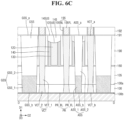
- FIG. 6A to FIG. 6C are diagrams for illustrating a semiconductor device according to some further embodiments.
- FIG. 6A corresponds to a cross-sectional view along line A-A in FIG. 1 .
- FIG. 6B corresponds to a cross-sectional view along line B-B in FIG. 1 .
- FIG. 6C corresponds to a cross-sectional view along line D-D of FIG. 1 .
- each of the gate cutting structure GSS and the active cutting structure ASS may be composed of multiple films.
- the gate cutting structure GSS may include a first gate sub-film GSS_1 and a second gate sub-film GSS_2.
- the second gate sub-film GSS_2 may be disposed on the first gate sub-film GSS_1.
- the first gate sub-film GSS_1 may have a solid columnar shape.
- an interface between the first gate sub-film GSS_1 and the second gate sub-film GSS_2 may be flat.
- an interface between the first gate sub-film GSS_1 and the second gate sub-film GSS_2 may be positioned at a vertical level lower than a vertical level of an upper surface of the first lower pattern BP1.
- the interface between the first gate sub-film GSS_1 and the second gate sub-film GSS_2 may be positioned at a vertical level higher than a vertical level of the first surface 100a of the substrate 100.
- the technical idea of the present disclosure is not limited thereto.
- the interface between the first gate sub-film GSS_1 and the second gate sub-film GSS_2 may be disposed at a higher level than that of each of the upper surface of the field insulating film 105 and the upper surface of the first lower pattern BP1 or may be positioned at a vertical level lower than a vertical level of the first surface 100a of the substrate 100.
- the active cutting structure ASS may include a first active sub-film ASS_1 and a second active sub-film ASS_2.
- the second active sub-film ASS_2 may be disposed on the first active sub-film ASS_1.
- the first active sub-film ASS_1 may have a solid column shape.
- an interface between the first active sub-film ASS_1 and the second active sub-film ASS_2 may be flat. Based on the second surface 100b of the substrate 100, the interface between the first active sub-film ASS_1 and the second active sub-film ASS_2 may be positioned at a lower level than that of the upper surface of the first lower pattern BP1. Based on the second surface 100b of the substrate 100, the interface between the first active sub-film ASS_1 and the second active sub-film ASS_2 may be positioned at a vertical level higher than a vertical level of the first surface 100a of the substrate 100.
- the technical idea of the present disclosure is not limited thereto.
- the interface between the first active sub-film ASS_1 and the second active sub-film ASS_2 may be positioned at a higher level than that of each of the upper surface of field insulating film 105 and the upper surface of the first lower pattern BP1 or may be positioned at a vertical level lower than a vertical level of the first surface 100a of the substrate 100.
- the first gate sub-film GSS_1 and the first active sub-film ASS_1 may be formed in the same process. Accordingly, the interface between the first gate sub-film GSS_1 and the second gate sub-film GSS_2 may be positioned at the same vertical level as that of the interface between the first active sub-film ASS_1 and the second active sub-film ASS_2. Furthermore, a height of the first gate sub-film GSS_1 in the first direction D1 may be the same as a height of the first active sub-film ASS_1 in the first direction D1.
- each of the first gate sub-film GSS_1 and the first active sub-film ASS_1 may be used as an etch stop film.
- Each of the first gate sub-film GSS_1 and the first active sub-film ASS_1 may be made of a material having an etching selectivity with respect to the material of the substrate 100.
- the substrate 100 and the first gate sub-film GSS_1 may be removed via a chemical mechanical polishing (CMP) process.
- CMP chemical mechanical polishing
- the CMP process may be stopped.
- the substrate 100 and the first active sub-film ASS_1 may be removed via the CMP process.
- the CMP process may be stopped.
- the first gate sub-film GSS_1 and the second gate sub-film GSS_2 may be made of different materials.
- the first active sub-film ASS_1 and the second active sub-film ASS_2 may made of different materials.
- the first gate sub-film GSS_1 and the first active sub-film ASS_1 may include the same material as each other.
- the second gate sub-film GSS_2 and the second active sub-film ASS_2 may include the same material as each other.
- each of the first gate sub-film GSS_1 and the first active sub-film ASS_1 may include a nitride-based insulating material.
- Each of the second gate sub-film GSS_2 and the second active sub-film ASS_2 may include an oxide-based insulating material.
- each of the first gate sub-film GSS_1 and the first active sub-film ASS_1 may include an oxide-based insulating material, while each of the second gate sub-film GSS_2 and the second active sub-film ASS_2 may include a nitride-based insulating material.
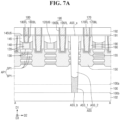
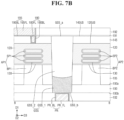
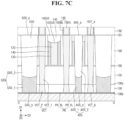
- FIG. 7A to FIG. 7C are diagrams for illustrating a semiconductor device according to some still further embodiments.
- FIG. 7A corresponds to a cross-sectional view along line A-A in FIG. 1 .
- FIG. 7B corresponds to a cross-sectional view along line B-B in FIG. 1 .
- FIG. 7C corresponds to a cross-sectional view along line D-D of FIG. 1 .
- descriptions duplicate with those as set forth above with reference to FIG. 6A to FIG. 6C are omitted.
- each of the gate cutting structure GSS and the active cutting structure ASS may be composed of multiple films.
- the gate cutting structure GSS may include the first gate sub-film GSS_1 and the second gate sub-film GSS_2.
- the active cutting structure ASS may include the first active sub-film ASS_1 and the second active sub-film ASS_2.
- An interface between the first gate sub-film GSS_1 and the second gate sub-film GSS_2 may be a curved surface.
- the interface between the first gate sub-film GSS_1 and the second gate sub-film GSS_2 may be convex toward the first surface 100a of the substrate 100.
- An interface between the first active sub-film ASS_1 and the second active sub-film ASS_2 may be a curved surface.
- the interface between the first active sub-film ASS_1 and the second active sub-film ASS_2 may be convex toward the first surface 100a.
- an angle defined between the sidewall of the gate cutting structure GSS and the interface between the first gate sub-film GSS_1 and the second gate sub-film GSS_2 at a point where the sidewall of the gate cutting structure GSS and the interface between the first gate sub-film GSS_1 and the second gate sub-film GSS_2 meet each other may be smaller than an angle defined between the sidewall of the active cutting structure ASS and the interface between the first active sub-film ASS_1 and the second active sub-film the interface of ASS_2 at a point where the sidewall of the active cutting structure ASS and the interface between the first active sub-film ASS_1 and the second active sub-film ASS_2 meet each other. This may be because a width of the gate cutting structure GSS is smaller than a width of the active cutting structure ASS.
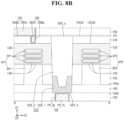
- FIG. 8A to FIG. 8C are diagrams for illustrating a semiconductor device according to some still yet further embodiments.
- FIG. 8A corresponds to a cross-sectional view along line A-A of FIG. 1 .
- FIG. 8B corresponds to a cross-sectional view along line B-B of FIG. 1 .
- FIG. 8C corresponds to a cross-sectional view along line D-D of FIG. 1 .
- descriptions duplicate with those as set forth above with reference to FIG. 6A to FIG. 6C are omitted.
- each of the gate cutting structure GSS and the active cutting structure ASS may be composed of multiple films.
- the gate cutting structure GSS may include the first gate sub-film GSS_1 and the second gate sub-film GSS_2.
- the active cutting structure ASS may include the first active sub-film ASS_1 and the second active sub-film ASS_2.
- Each of the first gate sub-film GSS_1 and the first active sub-film ASS_1 may have a cup shape.
- each of the first gate sub-film GSS_1 and the first active sub-film ASS_1 may have a 'U' shape.
- Each of the first gate sub-film GSS_1 and the first active sub-film ASS_1 may include a horizontal portion extending in the second direction D2 and the third direction D3 and a vertical portion extending in the first direction D1, e.g., the vertical portion may extend from an edge of the horizontal portion to define an empty space over a center of the horizonal portion.
- the horizontal portion may constitute a bottom portion of the cup shape.
- the vertical portion may include left and right vertical portions spaced apart from each other in the second direction D2 and/or the third direction D3.
- each of inner sidewalls of the left and right vertical portions facing each other may have an inclination with respect to the first surface 100a of the substrate 100.
- each of the second gate sub-film GSS_2 and the second active sub-film ASS_2 may have a 'T' shape.
- the second gate sub-film GSS_2 may fill an inner space defined by the cup shape of the first gate sub-film GSS_1 and extend on and above the cup shape of the first gate sub-film GSS_1.
- the second active sub-film ASS_2 may fill an inner space defined by the cup shape of the first active sub-film ASS_1 and extend on and above the cup shape of the active sub-film ASS_1.
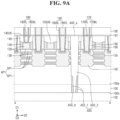
- FIG. 9A to FIG. 9C are diagrams for illustrating a semiconductor device according to some still yet further embodiments.
- FIG. 9A corresponds to a cross-sectional view along line A-A in FIG. 1 .
- FIG. 9B corresponds to a cross-sectional view along line B-B of FIG. 1 .
- FIG. 9C corresponds to a cross-sectional view along line D-D of FIG. 1 .
- descriptions duplicate with those as set forth above with reference to FIG. 6A to FIG. 6C are omitted.
- each of the gate cutting structure GSS and the active cutting structure ASS may be composed of multiple films.
- the gate cutting structure GSS may include the first gate sub-film GSS_1 and the second gate sub-film GSS_2.
- the active cutting structure ASS may include the first active sub-film ASS_1 and the second active sub-film ASS_2.
- Each of the first gate sub-film GSS_1 and the first active sub-film ASS_1 may have a hollow column shape, e.g., a structure including only the vertical portion of FIGS. 8A-8C without the horizontal portion.
- Each of the second gate sub-film GSS_2 and the second active sub-film ASS_2 may fill an inner space defined in each hollow columnar shape.
- the second gate sub-film GSS_2 may contact the power rail PR and/or the lower insulating film 102.
- At least a portion of the second active sub-film ASS_2 may contact the power rail PR and/or the lower insulating film 102.
- the substrate 100 and the first gate sub-film GSS_1 may be removed via the CMP process.
- the second gate sub-film GSS_2 may be exposed.
- the substrate 100 and the first active sub-film ASS_1 may be removed via the CMP process.
- the first active sub-film ASS_1 is excessively etched during the CMP process, the second active sub-film ASS_2 may be exposed.
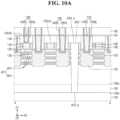
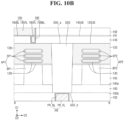
- FIG. 10A to FIG. 10C are diagrams for illustrating a semiconductor device according to some still yet further embodiments.
- FIG. 10A corresponds to a cross-sectional view along line A-A in FIG. 1 .
- FIG. 10B corresponds to a cross-sectional view along line B-B in FIG. 1 .
- FIG. 10C corresponds to a cross-sectional view along line D-D in FIG. 1 .
- the upper surface 120US of each of the gate electrodes 120 may be flat.
- the third surface GSS_a of the gate cutting structure GSS may be coplanar with the upper surface 120US of each of the gate electrodes 120.
- the fifth surface ASS_a of the active cutting structure ASS may be coplanar with the upper surface 120US of each of the gate electrodes 120.
- the gate cutting structure GSS and the active cutting structure ASS may be formed.
- the third surface GSS_a of the gate cutting structure GSS may be coplanar with the upper surface 120US of each of the gate electrodes 120
- the fifth surface ASS_a of the active cutting structure ASS may be coplanar with the upper surface 120US of each of the gate electrodes 120.
- the gate capping film 145 may be formed.
- the gate capping film 145 may be made of the same material as that of the first interlayer insulating film 190.
- the first interlayer insulating film 190 may entirely cover the gate cutting structure GSS.
- the gate capping film 145 may cover the third surface GSS_a of the gate cutting structure GSS.
- the first interlayer insulating film 190 may entirely cover the active cutting structure ASS.
- the gate capping film 145 may cover the fifth surface ASS_a of the active cutting structure ASS.
- each of the third surface GSS_a of the gate cutting structure GSS and the fifth surface ASS_a of the active cutting structure ASS may be positioned at a vertical level lower than a vertical level of the upper surface 145US of the gate capping film 145.
- each of the third surface GSS_a of the gate cutting structure GSS and the fifth surface ASS_a of the active cutting structure ASS may be positioned at a vertical level lower than a vertical level of each of the upper surface of the first interlayer insulating film 190, the upper surface of the first source/drain contact 170, the upper surface of the second source/drain contact 270, the upper surface of the gate contact 180, and the upper surface VCT_a of the via contact VCT.
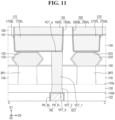
- FIG. 11 and FIG. 12 are diagrams for illustrating semiconductor devices according to some still yet further embodiments, respectively.
- FIGS. 11 and 12 correspond to cross-sectional views along line C-C of FIG. 1 , respectively.
- the upper surface VCT_a of the via contact VCT may not be coplanar with the upper surface of the first source/drain contact 170.
- the upper surface VCT_a of the via contact VCT may contact the bottom surface of the first source/drain contact 170.
- the via contact VCT may not extend to the upper surface of the first interlayer insulating film 190.
- the upper surface VCT_a of the via contact VCT is positioned at a lower level than that of the upper surface of the first interlayer insulating film 190, e.g., the upper surface VCT_a of the via contact VCT may be coplanar with the upper surfaces of the contact silicide layers 155 and 175.
- the via contact VCT does not overlap with the first source/drain contact 170 and the second source/drain contact 270 in the third direction D3.
- the first portion VCT_1 of the via contact VCT does not overlap with the first source/drain contact 170 and the second source/drain contact 270 in the third direction D3.
- the via contact VCT may contact the first source/drain pattern 150.
- the via contact VCT may extend through the substrate 100 and the first lower pattern BP1 in the first direction D1.
- the upper surface VCT_a of the via contact VCT may be the upper surface of the second portion VCT_2 of the via contact.
- the upper surface VCT_a of the via contact VCT may directly contact the bottom surface of the first source/drain pattern 150.
- the via contact VCT may include only the second portion VCT_2. That is, the via contact VCT may extend from the second surface 100b of the substrate 100 and may not extend from the upper surface of the first interlayer insulating film 190.
- a width of the via contact VCT may gradually decrease as the via contact extends away from the second surface 100b of the substrate 100. That is, the width of the via contact VCT may have a minimum value at the upper surface VCT_a of the via contact VCT and a maximum value at the lower surface VCT_b of the via contact VCT.
- the lower surface VCT_b of the via contact VCT may be coplanar with the second surface 100b of the substrate 100, while the upper surface VCT_a of via contact VCT may be coplanar with the upper surface of the first lower pattern BP1.
- FIG. 13 and FIG. 14 are diagrams for illustrating semiconductor devices according to some still yet further embodiments, respectively.
- FIG. 13 and FIG. 14 correspond to cross-sectional views along line A-A of FIG. 1 , respectively.
- the sidewall of the first source/drain pattern 150 may not have a wavy shape.
- the sidewall figure of the second source/drain pattern 250 may not have a wavy shape.
- the gate spacer 140 may include an outer spacer 141 and an inner spacer 142.
- the inner spacer 142 may be disposed between the first lower pattern BP1 and the bottommost first sheet pattern SP1 and between adjacent first sheet patterns SP1.
- the inner spacer 142 may be disposed between the second lower pattern BP2 and the bottommost second sheet pattern, and between adjacent second sheet patterns.
- FIG. 15 to FIG. 18 are diagrams for illustrating a semiconductor device according to some still yet further embodiments.
- FIG. 15 is an illustrative layout diagram of a semiconductor device according to some embodiments.
- FIG. 16 is an illustrative cross-section along line E-E in FIG. 15 .
- FIG. 17 is an illustrative cross-section along line F-F in FIG. 15 .
- FIG. 18 is an illustrative cross-section along line G-G in FIG. 15 .
- a semiconductor device may be a fin-type transistor (FinFET).
- the semiconductor device may not include sheet patterns.
- each of the first active pattern AP1 and the second active pattern AP2 may be a fin-shaped pattern. Each of the first active pattern AP1 and the second active pattern AP2 may protrude from the substrate 100 in the first direction D1. Each of the first active pattern AP1 and the second active pattern AP2 may extend in the second direction D2.
- the first active pattern AP1 may include at least one first active pattern.
- the first active patterns AP1 may be spaced apart from each other in the third direction D3. Although it is illustrated that the number of the first active patterns AP1 is three, any suitable number of first active patterns may be implemented.
- the second active pattern AP2 may include at least one second active pattern. The second active patterns AP2 may be spaced apart from each other in the third direction D3. Although it is illustrated that the number of the second active patterns AP2 is three, any suitable number of second active patterns may be implemented.
- a portion of the first active pattern AP1 interposed between the first source/drain patterns 150 may function as a channel of the fin-type transistor.
- a portion of the second active pattern AP2 interposed between the second source/drain patterns 250 may function as a channel of the fin-type transistor.
- the portion of the first active pattern AP1 interposed between the first source/drain patterns 150 and the portion of the second active pattern AP2 interposed between the second source/drain patterns 250 may be covered with the gate electrode 120.
- FIG. 19A to FIG. 26B are diagrams of stages in a method for manufacturing a semiconductor device according to some embodiments.
- FIGS. 19A , 20A , 21A , 22A , 23A , 24A , 25A , 26A , and 27A correspond to cross-sectional views along line A-A of FIG. 1 , respectively.
- FIGS. 19B , 20B , 21B , 22B , 23B , 24B , 25B , 26B , and 27B correspond to cross-sectional views along line B-B of FIG. 1 , respectively.
- a pre-substrate 100p may be provided.
- the pre-substrate 100p may be made of bulk silicon or may be embodied as a SOI (silicon-on-insulator) substrate.
- the pre-substrate 100p may be a silicon substrate, or be made of a material other than silicon, e.g., silicon germanium, SGOI (silicon germanium on insulator), indium antimonide, lead telluride compound, indium arsenide, indium phosphide, gallium arsenide or gallium antimonide.
- silicon germanium silicon germanium
- SGOI silicon germanium on insulator
- indium antimonide lead telluride compound
- indium arsenide indium phosphide
- gallium arsenide or gallium antimonide gallium antimonide.
- the present disclosure is not limited thereto.
- the first lower pattern BP1, the second lower pattern BP2, and the field insulating film 105 are formed on the pre-substrate 100p.
- the plurality of first sheet patterns SP1 are formed on the first lower pattern BP1, the plurality of first sheet patterns SP1 are formed.
- the plurality of second sheet patterns SP2 are formed on the second lower pattern BP2, the plurality of second sheet patterns SP2 are formed.
- the first source/drain pattern 150 is formed between adjacent ones of the plurality of first sheet patterns SP1.
- the second source/drain pattern 250 is formed between adjacent ones of the plurality of second sheet patterns SP2.
- the sidewall of the first source/drain pattern 150 may have a wavy shape.
- the gate electrode 120, the gate insulating film 130, the gate spacer 140, and the gate capping film 145 may be formed.
- the gate electrode 120 may be formed on the first lower pattern BP1 and the second lower pattern BP2.
- the gate electrode 120 may cover the first sheet patterns SP1 and the second sheet patterns SP2.
- the gate insulating film 130 may be formed along the upper surface of the first lower pattern BP1, the upper surface of the second lower pattern BP2, and the upper surface of the field insulating film 105.
- the gate insulating film 130 may be formed between the gate electrode 120 and the first sheet patterns SP1.
- the gate insulating film 130 may be formed between the gate electrode 120 and the second sheet patterns SP2.
- the gate insulating film 130 may be formed along the sidewall and the bottom surface of the gate electrode 120 while being disposed on the first sheet pattern SP1 and the second sheet pattern SP2.
- the gate spacer 140 may be formed on the sidewall of the gate electrode 120.
- the gate capping film 145 may be formed on the upper surface of the gate electrode 120. Subsequently, the etch stop film 160, the first interlayer insulating film 190, the first source/drain contact 170, the second source/drain contact 270, and the gate contact 180 may be formed.
- a mask layer MASK may be formed on the upper surface of the gate capping film 145 and the upper surface of the first interlayer insulating film 190.
- the mask layer MASK may have each opening defined therein that roughly defines a position of each of the gate cutting structure GSS and the active cutting structure ASS.
- the mask film MASK may be embodied as at least one of a photoresist film, an ACL (amorphous carbon layer), an SOH (spin on hardmask), an SOC (spin on carbon), or a silicon nitride film.
- an active cutting trench ASS_t and a gate cutting trench GSS_t may be formed using the mask film MASK as an etch mask.
- the active cutting trench ASS_t may be formed between the first source/drain patterns 150. Although not shown, the active cutting trench ASS_t may be formed between the second source/drain patterns 250. The active cutting trench ASS_t may extend in an elongate manner in the third direction D3. The active cutting trench ASS_t may cut the first active pattern AP1 and the second active pattern AP2. For example, the active cutting trench ASS_t may cut the first lower pattern BP1, the first sheet patterns SP1, the second lower pattern BP2, and the second sheet patterns SP2. The active cutting trench ASS_t may extend through the gate capping film 145, the gate electrode 120, and the gate insulating film 130. The active cutting trench ASS_t may not extend through an entirety of the pre-substrate 100p.
- the gate cutting trench GSS_t may be formed between the first active pattern AP1 and the second active pattern AP2.
- the gate cutting trench GSS_t may extend through the gate capping film 145, the gate electrode 120, the gate insulating film 130, and the field insulating film 105.
- the gate cutting trench GSS_t may cut the gate electrode 120.
- the gate cutting trench GSS_t may not extend through an entirety of the pre-substrate 100p.
- the active cutting trench ASS_t and the gate cutting trench GSS_t may be formed in the same process. Accordingly, a depth of the active cutting trench ASS_t and a depth of the gate cutting trench GSS_t may be equal to each other.
- a pre-active cutting structure ASS_p and a pre-gate cutting structure GSS_p may be formed.
- the pre-active cutting structure ASS_p may fill the active cutting trench ASS_t.
- the pre-gate cutting structure GSS_p may fill the gate cutting trench GSS_t. Subsequently, the mask film MASK may be removed.
- Each of the pre-active cutting structure ASS_p and the pre-gate cutting structure GSS_p may be formed as a single film.
- each of the pre-active cutting structure ASS_p and the pre-gate cutting structure GSS_p may include at least one of silicon nitride (SiN), silicon oxide (SiO 2 ), silicon oxynitride (SiON), or silicon oxycarbonitride (SiOCN).
- each of the pre-active cutting structure ASS_p and the pre-gate cutting structure GSS_p may be formed as a stack of multiple films.
- a lower portion of each of the active cutting trench ASS_t and the gate cutting trench GSS_t may include a material with an etch rate higher than that of the material of the pre-substrate 100p, while an upper portion of each of the active cutting trench ASS_t and the gate cutting trench GSS_t may include a material which can easily fill a gap.
- the gate cutting structure GSS and the active cutting structure ASS may be formed, and then, the upper stop film 191 and the second interlayer insulating film 192 may be formed. Subsequently, the first via plug 195 may be formed in the second interlayer insulating film 192. Although not shown, the second via plug 295 may be formed in the second interlayer insulating film 192. The first via plug 195 may contact the gate contact 180 or the first source/drain contact 170.
- a glass substrate 500 may be formed on the second interlayer insulating film 192. After the glass substrate 500 has been formed, a resulting structure may be turned upside down.
- the pre-substrate 100p, the pre-active cutting structure ASS_p, and the pre-gate cutting structure GSS_p may be etched.
- the pre-substrate 100p, the pre-active cutting structure ASS_p, and the pre-gate cutting structure GSS_p may be etched using the CMP process.
- a material of each of the pre-gate cutting structure GSS_p and the pre-active cutting structure ASS_p may have an etch selectivity with respect to the material of the pre-substrate 100p. That is, each of the pre-gate cutting structure GSS_p and the pre-active cutting structure ASS_p may be used as an etch stop film.
- the CMP process may be stopped.
- the substrate 100 may be formed by etching the pre-substrate 100p.
- the substrate 100 may include the first surface 100a and the second surface 100b opposite to each other in the first direction D1.
- the gate cutting structure GSS may be formed by etching the pre-gate cutting structure GSS_p.
- the gate cutting structure GSS may include the third surface GSS_a and the fourth surface GSS_b opposite to each other in the first direction D1.
- the active cutting structure ASS may be formed by etching the pre-active cutting structure ASS_p.
- the active cutting structure ASS may include the fifth surface ASS_a and the sixth surface ASS_b opposite to each other in the first direction D1.
- the second surface 100b of the substrate 100, the fourth surface GSS_b of the gate cutting structure GSS, and the sixth surface ASS_b of the active cutting structure ASS may be coplanar with each other.
- the lower insulating film 102 and the power rail PR may be formed.
- the lower insulating film 102 may be formed on the second surface 100b of the substrate 100.
- the power rail PR may be formed in the lower insulating film 102.
- Example embodiments provide a semiconductor device with improved reliability. That is, example embodiments provide a gate cutting structure and an active cutting structure that penetrate through an entire thickness of the substrate, e.g., trenches of the gate cutting structure and the active cutting structure are formed in a deep manner, so each of the gate cutting structure and the active cutting structure may be used as a stop layer, e.g., during the CMP process of the substrate 100.
Landscapes
- Insulated Gate Type Field-Effect Transistor (AREA)
- Physics & Mathematics (AREA)
- Engineering & Computer Science (AREA)
- Condensed Matter Physics & Semiconductors (AREA)
- General Physics & Mathematics (AREA)
- Computer Hardware Design (AREA)
- Microelectronics & Electronic Packaging (AREA)
- Power Engineering (AREA)
- Electrodes Of Semiconductors (AREA)
- Geometry (AREA)
- Internal Circuitry In Semiconductor Integrated Circuit Devices (AREA)
- Manufacturing & Machinery (AREA)
Applications Claiming Priority (1)
| Application Number | Priority Date | Filing Date | Title |
|---|---|---|---|
| KR1020230065977A KR20240168529A (ko) | 2023-05-23 | 2023-05-23 | 반도체 장치 |
Publications (1)
| Publication Number | Publication Date |
|---|---|
| EP4468340A1 true EP4468340A1 (de) | 2024-11-27 |
Family
ID=89619358
Family Applications (1)
| Application Number | Title | Priority Date | Filing Date |
|---|---|---|---|
| EP24152145.9A Pending EP4468340A1 (de) | 2023-05-23 | 2024-01-16 | Halbleiteranordnung |
Country Status (6)
| Country | Link |
|---|---|
| US (1) | US20240395807A1 (de) |
| EP (1) | EP4468340A1 (de) |
| JP (1) | JP2024169335A (de) |
| KR (1) | KR20240168529A (de) |
| CN (1) | CN119028974A (de) |
| TW (1) | TW202447933A (de) |
Citations (3)
| Publication number | Priority date | Publication date | Assignee | Title |
|---|---|---|---|---|
| US20180069000A1 (en) * | 2016-09-07 | 2018-03-08 | International Business Machines Corporation | Gate cut with integrated etch stop layer |
| US20220344263A1 (en) * | 2021-04-27 | 2022-10-27 | Taiwan Semiconductor Manufacturing Company, Ltd. | Integrated circuit with backside interconnections and method of making same |
| EP4369388A1 (de) * | 2022-11-10 | 2024-05-15 | Samsung Electronics Co., Ltd. | Halbleiteranordnung |
-
2023
- 2023-05-23 KR KR1020230065977A patent/KR20240168529A/ko active Pending
-
2024
- 2024-01-11 US US18/409,884 patent/US20240395807A1/en active Pending
- 2024-01-16 EP EP24152145.9A patent/EP4468340A1/de active Pending
- 2024-03-11 TW TW113108872A patent/TW202447933A/zh unknown
- 2024-05-09 JP JP2024076733A patent/JP2024169335A/ja active Pending
- 2024-05-09 CN CN202410567366.0A patent/CN119028974A/zh active Pending
Patent Citations (3)
| Publication number | Priority date | Publication date | Assignee | Title |
|---|---|---|---|---|
| US20180069000A1 (en) * | 2016-09-07 | 2018-03-08 | International Business Machines Corporation | Gate cut with integrated etch stop layer |
| US20220344263A1 (en) * | 2021-04-27 | 2022-10-27 | Taiwan Semiconductor Manufacturing Company, Ltd. | Integrated circuit with backside interconnections and method of making same |
| EP4369388A1 (de) * | 2022-11-10 | 2024-05-15 | Samsung Electronics Co., Ltd. | Halbleiteranordnung |
Also Published As
| Publication number | Publication date |
|---|---|
| TW202447933A (zh) | 2024-12-01 |
| KR20240168529A (ko) | 2024-12-02 |
| US20240395807A1 (en) | 2024-11-28 |
| JP2024169335A (ja) | 2024-12-05 |
| CN119028974A (zh) | 2024-11-26 |
Similar Documents
| Publication | Publication Date | Title |
|---|---|---|
| KR102821759B1 (ko) | 반도체 장치 | |
| US12040275B2 (en) | Semiconductor device including via plug connected to source/drain pattern | |
| US11804528B2 (en) | Semiconductor device | |
| KR102791057B1 (ko) | 반도체 장치 | |
| US12094976B2 (en) | Semiconductor device | |
| US20250133787A1 (en) | Semiconductor device | |
| US12376327B2 (en) | Field-effect transistors including a lower insulating layer | |
| KR20220134891A (ko) | 반도체 장치 | |
| US12148749B2 (en) | Semiconductor device and method for fabricating the same | |
| KR20240043950A (ko) | 반도체 장치 | |
| KR20220045314A (ko) | 반도체 장치 및 이의 제조 방법 | |
| US12490481B2 (en) | Semiconductor devices and methods for fabricating the same | |
| EP4468340A1 (de) | Halbleiteranordnung | |
| EP4459671B1 (de) | Halbleiteranordnung | |
| US12532732B2 (en) | Semiconductor device | |
| US20250063763A1 (en) | Semiconductor device | |
| US20230122379A1 (en) | Semiconductor device and method for manufacturing the same | |
| US20240405113A1 (en) | Semiconductor device | |
| EP4525030A1 (de) | Halbleiteranordnungen | |
| KR20240050238A (ko) | 반도체 장치 | |
| KR20230141013A (ko) | 반도체 장치 제조 방법 | |
| KR20240048317A (ko) | 반도체 장치 |
Legal Events
| Date | Code | Title | Description |
|---|---|---|---|
| PUAI | Public reference made under article 153(3) epc to a published international application that has entered the european phase |
Free format text: ORIGINAL CODE: 0009012 |
|
| STAA | Information on the status of an ep patent application or granted ep patent |
Free format text: STATUS: EXAMINATION IS IN PROGRESS |
|
| 17P | Request for examination filed |
Effective date: 20240116 |
|
| AK | Designated contracting states |
Kind code of ref document: A1 Designated state(s): AL AT BE BG CH CY CZ DE DK EE ES FI FR GB GR HR HU IE IS IT LI LT LU LV MC ME MK MT NL NO PL PT RO RS SE SI SK SM TR |
|
| P01 | Opt-out of the competence of the unified patent court (upc) registered |
Free format text: CASE NUMBER: APP_66294/2024 Effective date: 20241213 |