EP4465408A1 - Zellbildungsvorrichtung, zellbildungsverfahren und zelle - Google Patents
Zellbildungsvorrichtung, zellbildungsverfahren und zelle Download PDFInfo
- Publication number
- EP4465408A1 EP4465408A1 EP23762679.1A EP23762679A EP4465408A1 EP 4465408 A1 EP4465408 A1 EP 4465408A1 EP 23762679 A EP23762679 A EP 23762679A EP 4465408 A1 EP4465408 A1 EP 4465408A1
- Authority
- EP
- European Patent Office
- Prior art keywords
- pole piece
- diaphragm
- cell
- cathode pole
- cathode
- Prior art date
- Legal status (The legal status is an assumption and is not a legal conclusion. Google has not performed a legal analysis and makes no representation as to the accuracy of the status listed.)
- Pending
Links
Images



Classifications
-
- H—ELECTRICITY
- H01—ELECTRIC ELEMENTS
- H01M—PROCESSES OR MEANS, e.g. BATTERIES, FOR THE DIRECT CONVERSION OF CHEMICAL ENERGY INTO ELECTRICAL ENERGY
- H01M10/00—Secondary cells; Manufacture thereof
- H01M10/05—Accumulators with non-aqueous electrolyte
- H01M10/058—Construction or manufacture
- H01M10/0587—Construction or manufacture of accumulators having only wound construction elements, i.e. wound positive electrodes, wound negative electrodes and wound separators
-
- H—ELECTRICITY
- H01—ELECTRIC ELEMENTS
- H01M—PROCESSES OR MEANS, e.g. BATTERIES, FOR THE DIRECT CONVERSION OF CHEMICAL ENERGY INTO ELECTRICAL ENERGY
- H01M10/00—Secondary cells; Manufacture thereof
- H01M10/04—Construction or manufacture in general
- H01M10/0404—Machines for assembling batteries
-
- H—ELECTRICITY
- H01—ELECTRIC ELEMENTS
- H01M—PROCESSES OR MEANS, e.g. BATTERIES, FOR THE DIRECT CONVERSION OF CHEMICAL ENERGY INTO ELECTRICAL ENERGY
- H01M10/00—Secondary cells; Manufacture thereof
- H01M10/04—Construction or manufacture in general
-
- H—ELECTRICITY
- H01—ELECTRIC ELEMENTS
- H01M—PROCESSES OR MEANS, e.g. BATTERIES, FOR THE DIRECT CONVERSION OF CHEMICAL ENERGY INTO ELECTRICAL ENERGY
- H01M10/00—Secondary cells; Manufacture thereof
- H01M10/04—Construction or manufacture in general
- H01M10/0404—Machines for assembling batteries
- H01M10/0409—Machines for assembling batteries for cells with wound electrodes
-
- H—ELECTRICITY
- H01—ELECTRIC ELEMENTS
- H01M—PROCESSES OR MEANS, e.g. BATTERIES, FOR THE DIRECT CONVERSION OF CHEMICAL ENERGY INTO ELECTRICAL ENERGY
- H01M10/00—Secondary cells; Manufacture thereof
- H01M10/04—Construction or manufacture in general
- H01M10/0431—Cells with wound or folded electrodes
-
- H—ELECTRICITY
- H01—ELECTRIC ELEMENTS
- H01M—PROCESSES OR MEANS, e.g. BATTERIES, FOR THE DIRECT CONVERSION OF CHEMICAL ENERGY INTO ELECTRICAL ENERGY
- H01M10/00—Secondary cells; Manufacture thereof
- H01M10/05—Accumulators with non-aqueous electrolyte
- H01M10/052—Li-accumulators
- H01M10/0525—Rocking-chair batteries, i.e. batteries with lithium insertion or intercalation in both electrodes; Lithium-ion batteries
-
- H—ELECTRICITY
- H01—ELECTRIC ELEMENTS
- H01M—PROCESSES OR MEANS, e.g. BATTERIES, FOR THE DIRECT CONVERSION OF CHEMICAL ENERGY INTO ELECTRICAL ENERGY
- H01M4/00—Electrodes
- H01M4/02—Electrodes composed of, or comprising, active material
- H01M4/04—Processes of manufacture in general
- H01M4/043—Processes of manufacture in general involving compressing or compaction
- H01M4/0435—Rolling or calendering
-
- H—ELECTRICITY
- H01—ELECTRIC ELEMENTS
- H01M—PROCESSES OR MEANS, e.g. BATTERIES, FOR THE DIRECT CONVERSION OF CHEMICAL ENERGY INTO ELECTRICAL ENERGY
- H01M4/00—Electrodes
- H01M4/02—Electrodes composed of, or comprising, active material
- H01M4/13—Electrodes for accumulators with non-aqueous electrolyte, e.g. for lithium-accumulators; Processes of manufacture thereof
- H01M4/139—Processes of manufacture
-
- H—ELECTRICITY
- H01—ELECTRIC ELEMENTS
- H01M—PROCESSES OR MEANS, e.g. BATTERIES, FOR THE DIRECT CONVERSION OF CHEMICAL ENERGY INTO ELECTRICAL ENERGY
- H01M50/00—Constructional details or processes of manufacture of the non-active parts of electrochemical cells other than fuel cells, e.g. hybrid cells
- H01M50/40—Separators; Membranes; Diaphragms; Spacing elements inside cells
- H01M50/403—Manufacturing processes of separators, membranes or diaphragms
-
- Y—GENERAL TAGGING OF NEW TECHNOLOGICAL DEVELOPMENTS; GENERAL TAGGING OF CROSS-SECTIONAL TECHNOLOGIES SPANNING OVER SEVERAL SECTIONS OF THE IPC; TECHNICAL SUBJECTS COVERED BY FORMER USPC CROSS-REFERENCE ART COLLECTIONS [XRACs] AND DIGESTS
- Y02—TECHNOLOGIES OR APPLICATIONS FOR MITIGATION OR ADAPTATION AGAINST CLIMATE CHANGE
- Y02E—REDUCTION OF GREENHOUSE GAS [GHG] EMISSIONS, RELATED TO ENERGY GENERATION, TRANSMISSION OR DISTRIBUTION
- Y02E60/00—Enabling technologies; Technologies with a potential or indirect contribution to GHG emissions mitigation
- Y02E60/10—Energy storage using batteries
-
- Y—GENERAL TAGGING OF NEW TECHNOLOGICAL DEVELOPMENTS; GENERAL TAGGING OF CROSS-SECTIONAL TECHNOLOGIES SPANNING OVER SEVERAL SECTIONS OF THE IPC; TECHNICAL SUBJECTS COVERED BY FORMER USPC CROSS-REFERENCE ART COLLECTIONS [XRACs] AND DIGESTS
- Y02—TECHNOLOGIES OR APPLICATIONS FOR MITIGATION OR ADAPTATION AGAINST CLIMATE CHANGE
- Y02P—CLIMATE CHANGE MITIGATION TECHNOLOGIES IN THE PRODUCTION OR PROCESSING OF GOODS
- Y02P70/00—Climate change mitigation technologies in the production process for final industrial or consumer products
- Y02P70/50—Manufacturing or production processes characterised by the final manufactured product
Definitions
- the present disclosure relates to the technical field of lithium batteries, and in particular to a cell forming apparatus, a cell forming process and a cell.
- the lithium battery As a rechargeable secondary battery, the lithium battery has advantages such as small size, high energy density, high number of reusability cycles and high stability, and has been widely used in automotive power batteries.
- a cell of the lithium battery comprises a cathode pole piece, an anode pole piece, and a diaphragm separating the cathode pole piece from the anode pole piece.
- a cathode pole piece and an anode pole piece are compounded with two diaphragm material strips respectively to obtain two compound material strips, and then the two compound material strips are fed into the winding device to form the cell.
- a cell forming apparatus comprises a first diaphragm-unwinding device, a cathode-unwinding device, an anode-unwinding device, a compounding device, a second diaphragm-unwinding device and a winding device;
- the first diaphragm-unwinding device is configured for unwinding a first diaphragm
- the cathode-unwinding device and the anode-unwinding device are capable of unwinding a cathode pole piece and an anode pole piece respectively on two sides of the first diaphragm
- the compounding device is capable of receiving the first diaphragm, the cathode pole piece and the anode pole piece and compounding them to obtain a first compound material strip
- the second diaphragm-unwinding device is configured for unwinding a second diaphragm
- the winding device comprises a winding needle structure capable of winding the first compound material strip and the second diaphragm into
- the compounding device comprises an upper pressure roller and a lower pressure roller, and wherein the cathode pole piece, the anode pole piece, and the first diaphragm are capable of passing between the upper pressure roller and the lower pressure roller.
- both the upper pressure roller and the lower pressure roller are heat pressure rollers.
- the cell is capable of being pressed into a flat structure with a straight area and a bent area
- the cell forming apparatus further comprises a pole piece processing apparatus, which is capable of processing the cathode pole piece to form a broken portion on the cathode pole piece of the first compound material strip, and the broken portion is located in the bent area of the manufactured cell.
- the pole piece processing apparatus comprises a holding-transporting mechanism and a cutting mechanism, which are both provided between the cathode-unwinding device and the compounding device, the holding-transporting mechanism is capable of clamping and transporting the cathode pole piece, the cutting mechanism is capable of cutting off the cathode pole piece between the holding-transporting mechanism and the compounding device, and the holding-transporting mechanism is capable of pulling apart at a cut-off position to form the broken portion.
- the pole piece processing apparatus further comprises a tape-bonding mechanism, which is capable of bonding a first tape on a side of the cathode pole piece so as to bond, to the first diaphragm, the cathode pole piece at a side of the broken portion proximate to the holding-transporting mechanism.
- the tape-bonding mechanism is further capable of bonding a second tape on a side of the cathode pole piece so as to bond, to the first diaphragm, the cathode pole piece at a side of the broken portion distal to the holding-transporting mechanism.
- the tape-bonding mechanism is provided between the cutting mechanism and the compounding device.
- the pole piece processing apparatus comprises:
- the winding device further comprises a turret where a plurality of winding needle structures are provided, and the turret rotates to drive the plurality of winding needle structures to sequentially transfer to a position capable of obtaining the first compound material strip and the second diaphragm.
- a cell forming process comprises steps of:
- the compounding device before the anode pole piece and cathode pole piece enter the winding device, firstly the compounding device compounds the anode pole piece and the cathode pole piece with the first diaphragm in a three-in-one compound to obtain the first compound material strip. Since the anode pole piece and the cathode pole piece are respectively located on two sides of the first diaphragm, the first diaphragm will be enveloped between the anode pole piece and the cathode pole piece. During the compounding process, the surfaces on both sides of the first diaphragm will not come into direct contact with the compounding device.
- the present disclosure further provides a cell, which is manufactured by the cell forming apparatus according to any one of the above preferred embodiments; or, the cell is manufactured by the cell forming process according to any one of the above preferred embodiments, the cell comprises a cathode pole piece, an anode pole piece, and a diaphragm located between a cathode pole piece and an anode pole piece adjacent thereto, wherein the cathode pole piece, the anode pole piece and the diaphragm are wound and pressed to form a flat structure, and the cell has a straight area and bent areas located at both ends of the straight area.
- the cathode pole piece at least partially located in the bent area, forms a broken portion extending in a width direction.
- the broken portion divides the cathode pole piece where the broken portion is located into at least two pole piece subsections, and the at least two pole piece subsections are integrally connected through a connector.
- first and second are only used for descriptive purposes and should not be understood as indicating or implying relative importance or implying a number of indicated technical features. Therefore, a feature delimited with “first”, “second” may expressly or implicitly comprise at least one of those features.
- a plurality means at least two, such as two, three, etc., unless expressly and specifically defined otherwise.
- a first feature "on” or “under” a second feature may be that the first feature is in direct contact with the second feature, or the first feature and the second feature are indirectly contacted through an intermediary.
- the first feature being “above”, “over” and “on” the second feature may mean that the first feature is directly above or obliquely above the second feature, or simply means that the first feature is higher than the second feature in a horizontal direction.
- the first feature being “below”, “under” and “below” the second feature may mean that the first feature is directly below or obliquely below the second feature, or simply means that the first feature is smaller than the second feature in a horizontal direction.
- the present disclosure provides a cell 100 and a cell forming apparatus 200, wherein the cell 100 may be manufactured by the cell forming apparatus 200.
- the cell 100 comprises a cathode pole piece 110, an anode pole piece 120, and a diaphragm 130, and the diaphragm 130 is located between the adjacent cathode pole piece 110 and anode pole piece 120 and is used for separating them to prevent short-circuiting.
- the cathode pole piece 110, the anode pole piece 120, and the diaphragm 130 are stacked and then wound and pressed to form a flat structure.
- the cell 100 has a straight area 101 and bent areas 102 at both ends of the straight area 101.
- the straight area 101 refers to an area with a parallel structure in the cell 100 with the flat structure, that is, the cathode pole piece 110, the anode pole piece 120, and the diaphragm 130 in the straight area 101 are essentially parallel to each other, and the surfaces of each layer of the cathode pole piece 110, anode pole piece 120, and diaphragm 130 in the straight area 101 are substantially flat surfaces.
- the bent area 102 refers to an area with a bent structure in the cell 100 with the flat structure, that is, the cathode pole piece 110, the anode pole piece 120, and the diaphragm 130 in the bent area 102 are all bent, and the surfaces of each layer of the cathode pole piece 110, the anode pole piece 120, and the diaphragm 130 are curved surfaces.
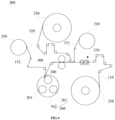
- the cell forming apparatus 200 comprises a first diaphragm-unwinding device 210, a cathode-unwinding device 220, an anode-unwinding device 230, a compounding device 240, a second diaphragm-unwinding device 250, and a winding device 260.
- the first diaphragm-unwinding device 210 is used for unwinding the first diaphragm 131.
- the surface of the first diaphragm 131 is pre-coated with glue or other adhesives.
- the second diaphragm-unwinding device 250 is used for unwinding the second diaphragm 132.
- the first diaphragm 131 and the second diaphragm 132 both refer to the diaphragm 130 in the cell 100.
- the diaphragms unwound by the first diaphragm-unwinding device 210 and those unwound by the second diaphragm-unwinding device 250 are respectively referred to as the first diaphragm 131 and the second diaphragm 132, respectively.
- Both the first diaphragm 131 and the second diaphragm 132 are insulating films that serve to prevent short-circuiting.
- the first diaphragm-unwinding device 210 and the second diaphragm-unwinding device 250 are generally identical in construction and may take the form of an unwinding shaft.
- the cathode-unwinding device 220 and the anode-unwinding device 230 are capable of unwinding the cathode pole piece 110 and the anode pole piece 120 respectively on two sides of the first diaphragm 131. Both the cathode-unwinding device 220 and the anode-unwinding device 230 may take the form of an unwinding shaft, and the cathode pole piece 110 and the anode pole piece 120 may be wound on the cathode-unwinding device 220 and the anode-unwinding device 230 in the form of material strips for continuous unwinding.
- the first diaphragm 131 is sandwiched between the cathode pole piece 110 and the anode pole piece 120. Specifically, the cathode pole piece 110 is located beneath the first diaphragm 131, while the anode pole piece 120 is located above the first diaphragm 131. Obviously, the positions of the cathode pole piece 110 and the anode pole piece 120 may be interchanged.
- the compounding device 240 may receive the first diaphragm 131, the cathode pole piece 110 and the anode pole piece 120, and compound them to obtain the first compound material strip 300.
- the first compound material strip 300 comprises the first diaphragm 131 as well as the cathode pole piece 110 and the anode pole piece 120 attached on a respective one of two sides of the first diaphragm 131 respectively.
- the compounding device 240 comprises an upper pressure roller (not labeled in the figure) and a lower pressure roller (not labeled in the figure), between which the cathode pole piece 110, anode pole piece 120, and the first diaphragm 131 may pass.
- the upper pressure roller and the lower pressure roller are both rotatable on their respective own axes, and one of them is connected to a driving assembly for active rotation.
- the upper pressure roller and the lower pressure roller cooperate to clamp the first diaphragm 131, the cathode pole piece 110, and the anode pole piece 120.
- the first diaphragm 131, the cathode pole piece 110, and the anode pole piece 120 are compounded to obtain the first compound material strip 300, and the obtained first compound material strip 300 may be transported downstream under driving of the compounding device 240.
- the upper pressure roller and the lower pressure roller may both be heating pressure rollers to form the first compound material strip 300 by hot pressing.
- the first compound material strip 300 may also be formed by cold pressing.
- the anode pole piece 120 and the cathode pole piece 110 are respectively located on two sides of the first diaphragm 131 respectively, the surfaces on both sides of the first diaphragm 131 will not come into direct contact with the compounding device 240. This avoids the adhesive on the surface of the first diaphragm 131 from adhering to the compounding device 240, thereby improving the compounding effect of the first diaphragm 131 with the anode pole piece 120 and the cathode pole piece 110.
- the winding device 260 comprises a winding needle structure 261.
- the winding needle structure 261 may wind the first compound material strip 300 and the second diaphragm 132 into the cell 100.
- the wound cell 100 is roughly cylindrical or oval in shape and may be pressed into the flat structure, which flat structure comprises the straight area 101 and the bent area 102.
- the winding device 260 further comprises a turret 262 where a plurality of winding needle structures 261 are provided, and the turret 262 rotates to drive the plurality of winding needle structures 261 to sequentially transfer to a position capable of obtaining the first compound material strip 300 and the second diaphragm 132.
- the turret 262 may be connected to a driving mechanism such as a motor and may rotate by a certain angle under the drive of the driving mechanism. After the previous cell 100 is wound, the turret 262 rotates and brings the next winding needle structure 261 to the winding station (i.e., a position where the first compound material strip 300 and the second diaphragm 132 may be obtained). Then, the next winding needle structure 261 extends out and obtains the first compound material strip 300 and the second diaphragm 132. Once the previous cell 100 is cut off at the end of the material strip, the next winding needle structure 261 may start winding for the manufacturing of the next cell 100. In this way, the plurality of winding needle structures 261 may alternately enter the winding station and wind the cell, thereby accelerating the production pace to reduce waiting time, and thus improving production efficiency.
- a driving mechanism such as a motor and may rotate by a certain angle under the drive of the driving mechanism.
- the cathode pole piece 110 is coated with a positive electrode active substance layer formed from lithium manganate, lithium cobaltate, lithium iron phosphate, etc., while the anode pole piece 120 is coated with a negative electrode active substance layer formed from graphite, silicon, etc.
- the applicant has found that the cathode pole piece 110 and the anode pole piece 120 located in the bent area 102 are prone to dislodge their respective active substances during bending, referred to as "powdering off'.
- the dislodgment of the negative electrode active substance on the anode pole piece 120 may cause that the lithium intercalation sites of the negative electrode active substance layer of the anode pole piece 120 are less than the number of lithium ions that can be provided by the positive electrode active substance layer of the cathode pole piece 110 adjacent thereto, and thus that the lithium ions de-intercalated from the positive electrode active substance layer will not be able to be intercalated in equal amounts in the negative electrode active substance layer. As a result, lithium precipitation tends to occur in the bent area 102 of the cell 100 during charging of the battery.
- the cathode pole piece 110 and the anode pole piece 120 in the straight area 101 do not need to be bent in the forming process of the cell 100 and hardly experience "powdering off', the lithium intercalation sites in the negative electrode active substance layer of the anode pole piece 120 in the straight area 101 may be well-matched with the number of lithium ions that can be provided by the positive electrode active substance layer of the cathode pole piece 110 adjacent thereto. Therefore, the straight area 101 of the cell 100 is generally free from the lithium precipitation phenomenon.
- the cell forming apparatus 200 further comprises a pole piece processing apparatus 270, which is capable of processing the cathode pole piece 110 to form a broken portion 103 on the cathode pole piece 110 of the first compound material strip 300.
- the broken portion 103 extends in a width direction of the cathode pole piece 110 and may cut off the cathode pole piece 110. It can be seen that there is no positive electrode active substance in the area where the broken portion 103 is located.
- the broken portion 103 of the cathode pole piece 110 is located in the bent area 102 of the manufactured cell 100. Since there is no positive electrode active substance in the area where the broken portion 103 is located, the number of lithium ions that may be de-intercalated from the cathode pole piece 110 located in the bent area 102 will be significantly reduced.
- the pole piece processing apparatus 270 comprises a holding-transporting mechanism 271 and a cutting mechanism 272, which are both provided between the cathode-unwinding device 220 and the compounding device 240.
- the holding-transporting mechanism 271 is capable of clamping and transporting the cathode pole piece 110
- the cutting mechanism 272 is capable of cutting off the cathode pole piece 110 between the holding-transporting mechanism 271 and the compounding device 240
- the holding-transporting mechanism 271 is capable of pulling apart at a cut-off position to form the broken portion 103.
- the holding-transporting mechanism 271 may pull apart at the cut-off position by regulating the transporting speed.
- the continuous cathode pole piece material strip first passes through the holding-transporting mechanism 271 and the cutting mechanism 272 before entering the compounding device 240.
- the cathode pole piece 110 located downstream of the cut-off portion is compounded with the first diaphragm 131 in the compounding device 240, and the obtained first compound material strip 300 may be driven by the compounding device 240 to maintain a uniform transporting speed; at this time, the holding-transporting mechanism 271 decelerates or stops the transporting, so that the cut-off portion of the cathode pole piece 110 is pulled apart until the broken portion 103 is formed.
- the holding-transporting mechanism 271 is regulated in speed to be synchronized with the compounding device 240, and assists the compounding device 240 in driving the first compound material strip 300 to be further transported downstream while feeding the cathode pole piece 110 located upstream of the cut-off portion into the compounding device 240.
- the holding-transporting mechanism 271 comprises clamping plates, which are capable of reciprocating movement along the transporting direction of the cathode pole piece 110. After the cathode pole piece 110 is cut off, the clamping plates may clamp the cathode pole piece 110 located upstream of the cut-off portion and move along with the cathode pole piece 110. In this way, it is possible to prevent the cut-off cathode pole piece 110 from sagging due to an excessively long overhang at the end, thereby ensuring that the cathode pole piece 110 may smoothly enter the compounding device 240.
- the cutting mechanism 272 may further punch the cathode pole piece 110 by the cooperation between a male die and a female die, and may remove a certain width of waste material from the cathode pole piece 110, thereby naturally forming the broken portion 103 while cutting the cathode pole piece 110 off.
- the holding-transporting mechanism 271 may maintain synchronous transporting with the compounding device 240, without the need to change the speed of the holding-transporting mechanism 271 to pull the cut-off portion of the cathode pole piece 110 apart to form the broken portion 103.
- One or more broken portions 103 may be formed on the cathode pole piece 110.
- the holding-transporting mechanism 271 and the cutting mechanism 272 may simply repeat the above operations.
- the pole piece processing apparatus 270 further comprises a tape-bonding mechanism 273, which is capable of bonding a first tape 140 on a side of the cathode pole piece 110 so as to bond, to the first diaphragm 131, the cathode pole piece 110 at a side of the broken portion 103 proximate to the holding-transporting mechanism 271.
- the broken portion 103 may divide the cathode pole piece 110 into two pole piece subsections, and the cathode pole piece 110 located at a side of the broken portion 103 proximate to the holding-transporting mechanism 271 refers to the upstream end of one of the pole piece subsections.
- the upstream end refers to the front end in the transporting direction of the first compound material strip 300, for example, if the first compound material strip 300 is transported from left to right, then the right end is the upstream end.
- the first compound material strip 300 Before the first compound material strip 300 enters the winding device 260, the first compound material strip 300 generally needs to wind around a guide roller to change direction.
- the upstream end of the pole piece subsection When winding around the guide roller, the upstream end of the pole piece subsection is prone to upwarping and detaching from the first diaphragm 131. Since the first tape 140 may bond the upstream end of the pole piece subsection to the first diaphragm 131, the cathode pole piece 110 will not detach from the first diaphragm 131 when the first compound material strip 300 winds around the guide roller.
- a portion of the first adhesive tape 140 passes through the broken portion 103 to be bonded to the first diaphragm 131, and another portion of the first adhesive tape 140 is bonded to the cathode pole piece 110.
- the first adhesive tape 140 may be bonded before or after the cathode pole piece 110 being compounded with the first diaphragm 131.
- the tape-bonding mechanism 273 is provided between the cutting mechanism 272 and the compounding device 240. That is, the tape-bonding mechanism 273 completes the tape-bonding before the cathode pole piece 110 being compounded with the first diaphragm 131. Therefore, during the three-in-one compound of the cathode pole piece 110, the anode pole piece 120, and the first diaphragm 131 by the compounding device 240, the first adhesive tape 140 may also prevent the cathode pole piece 110 and the first diaphragm 131 from being misaligned.
- the tape-bonding mechanism 273 is further capable of bonding a second tape (not shown in the figure) on a side of the cathode pole piece 110 so as to bond, to the first diaphragm 131, the cathode pole piece 110 at a side of the broken portion 103 distal to the holding-transporting mechanism 271.
- the broken portion 103 may divide the cathode pole piece 110 into the two pole piece subsections, and the cathode pole piece 110 at a side of the broken portion 103 distal to the holding-transporting mechanism 221 refers to the downstream end of one of the pole piece subsections.
- the downstream end refers to the rear end in the transporting direction of the first compound material strip 300, for example, if the first compound material strip 300 is transported from left to right, then the left end is the downstream end.
- the pole piece processing apparatus 270 may also take other forms.
- the pole piece processing apparatus 270 comprises a holding-transporting mechanism 274, a cutting mechanism 275 and a tape-bonding mechanism 276.
- each holding-transporting mechanism 274 is capable of holding and transporting the cathode pole piece 110.
- the cutting mechanism 275 is provided between two adjacent holding-transporting mechanisms 274, and each cutting mechanism 275 may cut off the cathode pole piece 110, so as to obtain at least two pole piece subsections.
- At least two pole piece subsections may be held by different holding-transporting mechanisms 274 and transported in the transporting direction.
- the at least two holding-transporting mechanisms 274 are capable of driving the pole piece subsection being held to be transported different distances in the transporting direction, such that the broken portion 103 is formed between the adjacent two pole piece subsections.
- the different holding-transporting mechanisms 274 may form a speed difference therebetween, so that the pole piece subsections held by the different holding-transporting mechanisms 274 are pulled apart to form the broken portions 103.
- the cutting mechanism 275 may also punch the cathode pole piece 110 by the cooperation between a male die and a female die, and may cut off a certain width of waste material from the cathode pole piece 110, thereby naturally forming the broken portion 103 while cutting the cathode pole piece 110 off. In this way, each holding-transporting mechanism 274 may maintain a uniform velocity without the need to pull the pole piece subsections apart by the holding-transporting mechanism 274.
- each holding-transporting mechanism 274 comprises a clamping roller, and the rotational speed of the clamping roller of each holding-transporting mechanism 274 may be adjusted individually.
- the rotational speed of the clamping roller it is possible to adjust the transporting speed of each holding-transporting mechanism 274. In this way, it is possible to create a velocity difference between the different holding-transporting mechanisms 274, so as to pull apart the respective pole piece subsections they are clamping to form the broken portion 103.
- the clamping roller may be adjusted more easily, takes up less space, and contributes to the compactness of the holding-transporting mechanism 274.
- each of the pole piece subsections is held by the holding-transporting mechanism 274.
- the tape-bonding mechanism 276 may bond the connector 150 to at least one side of the cathode pole piece 110 to cover the broken portion 103, so as to integrally connect at least two pole piece subsections.
- the tape-bonding mechanism 276 is also provided between two adjacent holding-transporting mechanisms 274.
- the tape-bonding mechanism 276 is provided in pairs with the cutting mechanism 275. More specifically, the tape-bonding mechanism 276 is located downstream of the cutting mechanism 275 with which it is paired.
- the connector 150 may be a tape, and the tape-bonding mechanism 276 bonds tapes on both sides of the cathode pole piece 110 to enhance reliability.
- the three holding-transporting mechanisms 274 from the upstream end to downstream end (from right to left in Figure 5 ) of the transporting direction of the cathode pole piece 110, are respectively referred to as the first, second, and third holding-transporting mechanisms 274;
- the two cutting mechanisms 275 are respectively referred to as the first cutting mechanism 275 and the second cutting mechanism 275;
- the two tape-bonding mechanisms 276 are respectively referred to as the first tape-bonding mechanisms 276 and the second tape-bonding mechanism 276;
- the obtained three pole piece subsections are respectively referred to as the first pole piece subsection, the second pole piece subsection, and the third pole piece subsection.
- the first cutting mechanism 275 in the pole piece transporting direction cuts off the cathode pole piece 110 between the first and second holding-transporting mechanisms 274, and the second cutting mechanism 275 cuts off the cathode pole piece 110 between the second and third holding-transporting mechanisms 274, resulting in three pole piece subsections; the first, second, and third holding-transporting mechanisms 274 hold the pole piece subsections and transport them downstream respectively.
- the transporting speed of the first holding-transporting mechanism 274 is less than that of the second holding-transporting mechanism 274, and the transporting speed of the second holding-transporting mechanism 274 is less than that of the third holding-transporting mechanism 274.
- the first pole piece subsection moves a shorter distance downstream than the second pole piece subsection, and the second holding-transporting mechanism moves a shorter distance than the third holding-transporting mechanism. In this way, the three pole piece subsections are pulled apart so as to form two broken portions 103.
- the two tape-bonding mechanisms 276 are provided with connectors 150 on both sides of the two broken portions 103 respectively, such as by applying adhesive tapes. Specifically, the first tape-bonding mechanism 276 applies a tape to bond the first pole piece subsection to the second pole piece subsection, and the second tape-bonding mechanism 276 applies a tape to bond the second pole piece subsection to the third pole piece subsection, thus integrally connecting the three pole piece subsections.
- connecting the both sides of the broken portion 103 by means of the connector 150 ensures the continuity of the cathode pole piece 110, allowing the cathode pole piece 110 to smoothly enter the compounding device 240 and be compounded with the first diaphragm 131 and anode pole piece 120.
- the compounding device 240 compounds the anode pole piece 120 and the cathode pole piece 110 with the first diaphragm 131 in a three-in-one compound to obtain the first compound material strip 300. Since the anode pole piece 120 and the cathode pole piece 110 are respectively located on two sides of the first diaphragm 131, the first diaphragm 131 will be enveloped between the anode pole piece 120 and the cathode pole piece 110. During the compounding process, the surfaces on both sides of the first diaphragm 131 will not come into direct contact with the compounding device 240.
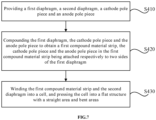
- the present disclosure further provides a cell forming process, which may be performed by the cell forming apparatus 200.
- the cell forming process comprises steps S410 to S430:
- the cathode pole piece 110 and the anode pole piece 120 are respectively located on two sides of the first diaphragm 131 respectively, and are capable of enveloping the first diaphragm 131.
- the surfaces on both sides of the first diaphragm 131 will not come into direct contact with the compounding device, thereby preventing the adhesive on the surfaces of the first diaphragm 131 from adhering to the compounding device, and thus improving the compounding effect between the first diaphragm 131, the anode pole piece 120, and the cathode pole piece 110.
- Step S430 winding the first compound material strip 300 and the second diaphragm 132 into a cell, and pressing the cell into a flat structure with a straight area and a bent area.
- the quality of the manufactured cell 100 may also be improved. It should be noted that since the manufacturing process of the cell 100 is continuous, the steps S410 to S430 may be performed simultaneously.
- the cell forming process further comprises a step of: processing the cathode pole piece 110 to form a broken portion 103 on the cathode pole piece 110 of the first compound material strip 300, the broken portion 103 being located in the bent area.
- the number of lithium ions that may be de-intercalated from the cathode pole piece 110 located in the bent area 102 will be significantly reduced, thereby reducing or avoiding the occurrence of lithium precipitation phenomenon.
Landscapes
- Engineering & Computer Science (AREA)
- Chemical & Material Sciences (AREA)
- Manufacturing & Machinery (AREA)
- Chemical Kinetics & Catalysis (AREA)
- Electrochemistry (AREA)
- General Chemical & Material Sciences (AREA)
- Materials Engineering (AREA)
- Secondary Cells (AREA)
- Battery Electrode And Active Subsutance (AREA)
Applications Claiming Priority (2)
| Application Number | Priority Date | Filing Date | Title |
|---|---|---|---|
| CN202210195515.6A CN114759270A (zh) | 2022-03-01 | 2022-03-01 | 电芯成型设备、电芯成型工艺及电芯 |
| PCT/CN2023/072042 WO2023165278A1 (zh) | 2022-03-01 | 2023-01-13 | 电芯成型设备、电芯成型工艺及电芯 |
Publications (2)
| Publication Number | Publication Date |
|---|---|
| EP4465408A1 true EP4465408A1 (de) | 2024-11-20 |
| EP4465408A4 EP4465408A4 (de) | 2026-04-22 |
Family
ID=82324775
Family Applications (1)
| Application Number | Title | Priority Date | Filing Date |
|---|---|---|---|
| EP23762679.1A Pending EP4465408A4 (de) | 2022-03-01 | 2023-01-13 | Zellbildungsvorrichtung, zellbildungsverfahren und zelle |
Country Status (4)
| Country | Link |
|---|---|
| US (1) | US20240413376A1 (de) |
| EP (1) | EP4465408A4 (de) |
| CN (1) | CN114759270A (de) |
| WO (1) | WO2023165278A1 (de) |
Families Citing this family (9)
| Publication number | Priority date | Publication date | Assignee | Title |
|---|---|---|---|---|
| CN114759270A (zh) * | 2022-03-01 | 2022-07-15 | 无锡先导智能装备股份有限公司 | 电芯成型设备、电芯成型工艺及电芯 |
| CN115159213B (zh) * | 2022-08-23 | 2022-12-06 | 江苏时代新能源科技有限公司 | 电极组件的制造装置 |
| CN116632317B (zh) * | 2023-07-21 | 2024-01-26 | 深圳海辰储能控制技术有限公司 | 电芯卷绕设备及电芯卷绕方法 |
| CN116613369B (zh) * | 2023-07-21 | 2024-03-01 | 深圳海辰储能控制技术有限公司 | 电极组件和电芯头部卷绕方法 |
| WO2025148306A1 (zh) * | 2024-01-11 | 2025-07-17 | 宁德时代新能源科技股份有限公司 | 卷绕设备及电池制造设备 |
| WO2025232028A1 (zh) * | 2024-05-07 | 2025-11-13 | 宁德时代新能源科技股份有限公司 | 卷绕设备和电池单体的生产方法 |
| CN118472419B (zh) * | 2024-07-12 | 2024-09-13 | 安仁亿等新能源研究院有限公司 | 一种电池卷绕装置及电池卷绕生产检测方法 |
| CN118763294B (zh) * | 2024-09-06 | 2025-01-10 | 宁德时代新能源科技股份有限公司 | 电芯成型方法和电池制造方法 |
| CN119447710B (zh) * | 2025-01-09 | 2025-08-26 | 宁德时代新能源科技股份有限公司 | 电池单体、复合极片制备装置及方法、电池装置及储能装置 |
Family Cites Families (15)
| Publication number | Priority date | Publication date | Assignee | Title |
|---|---|---|---|---|
| US6461759B1 (en) * | 2000-06-09 | 2002-10-08 | Wilson Greatbatch, Ltd. | Cathode assembly with bare current collector regions to facilitate winding |
| JP2004288837A (ja) * | 2003-03-20 | 2004-10-14 | Jelmax Co Ltd | 電解コンデンサ及びこれを用いた燃料電池駆動車 |
| CN101901934B (zh) * | 2010-07-22 | 2012-07-04 | 黄祥盛 | 一种卷绕式叠片方形锂离子电芯及其制备方法 |
| KR101579575B1 (ko) * | 2013-06-18 | 2015-12-22 | 주식회사 엘지화학 | 수명 및 안전성이 향상된 전기화학소자 |
| CN106099163B (zh) * | 2016-08-12 | 2019-07-12 | 无锡先导智能装备股份有限公司 | 保护胶带切断和转移机构 |
| CN207834493U (zh) * | 2017-11-03 | 2018-09-07 | 深圳市诚捷智能装备股份有限公司 | 全自动锂电池电芯卷绕机 |
| CN207800790U (zh) * | 2017-12-21 | 2018-08-31 | 佛山市金银河智能装备股份有限公司 | 一种卷绕机用的极片切断贴胶装置 |
| CN109830738B (zh) * | 2019-03-29 | 2024-07-02 | 无锡先导智能装备股份有限公司 | 电芯卷绕装置 |
| CN209947961U (zh) * | 2019-06-12 | 2020-01-14 | 新余赣锋电子有限公司 | 一种可防止极片断裂的电芯 |
| KR102848290B1 (ko) * | 2019-07-16 | 2025-08-20 | 삼성전자주식회사 | 배터리 및 그를 포함하는 전자 장치 |
| CN213692108U (zh) * | 2020-10-27 | 2021-07-13 | 宁德时代新能源科技股份有限公司 | 电极组件、电池单体、电池以及用电装置 |
| CN214254489U (zh) * | 2020-12-18 | 2021-09-21 | 宁德时代新能源科技股份有限公司 | 电极组件、电池单体、电池及用电装置 |
| CN214588948U (zh) * | 2021-04-21 | 2021-11-02 | 东莞市雅康精密机械有限公司 | 阴阳极片同时夹持追送入片复合成型装置 |
| CN114759270A (zh) * | 2022-03-01 | 2022-07-15 | 无锡先导智能装备股份有限公司 | 电芯成型设备、电芯成型工艺及电芯 |
| CN217740729U (zh) * | 2022-03-01 | 2022-11-04 | 无锡先导智能装备股份有限公司 | 电芯成型设备及电芯 |
-
2022
- 2022-03-01 CN CN202210195515.6A patent/CN114759270A/zh active Pending
-
2023
- 2023-01-13 EP EP23762679.1A patent/EP4465408A4/de active Pending
- 2023-01-13 WO PCT/CN2023/072042 patent/WO2023165278A1/zh not_active Ceased
-
2024
- 2024-08-23 US US18/813,634 patent/US20240413376A1/en active Pending
Also Published As
| Publication number | Publication date |
|---|---|
| WO2023165278A1 (zh) | 2023-09-07 |
| US20240413376A1 (en) | 2024-12-12 |
| EP4465408A4 (de) | 2026-04-22 |
| CN114759270A (zh) | 2022-07-15 |
Similar Documents
| Publication | Publication Date | Title |
|---|---|---|
| EP4465408A1 (de) | Zellbildungsvorrichtung, zellbildungsverfahren und zelle | |
| CN113302777B (zh) | 电极组件及其成型方法和生产系统、二次电池、电池模块以及装置 | |
| CN110459796B (zh) | 一种叠片电芯的制备方法、叠片电芯、叠片装置及系统 | |
| CN102971888B (zh) | 连续式方形电池叠片系统和方法 | |
| CN216750029U (zh) | 一种卷绕设备 | |
| CN218039357U (zh) | 电芯制造设备 | |
| CN108352492B (zh) | 二次电池电芯 | |
| CN216750028U (zh) | 一种卷绕设备 | |
| CN110247124A (zh) | 一种锂离子电池高速叠片方法、叠片装置及锂离子电池 | |
| JP2012513076A (ja) | 二次電池の製造方法及び二次電池 | |
| CN204946995U (zh) | 二次电池电芯及其卷绕成型系统 | |
| US20160013468A1 (en) | Method of manufacturing electrode assembly | |
| CN218333856U (zh) | 电芯、电池及电芯制造设备 | |
| CN109361011B (zh) | 一种卷绕式锂离子电芯及其制备方法 | |
| CN103490089A (zh) | 电极组件、其制造方法和锂二次电池 | |
| US20240421360A1 (en) | Cell, battery and cell manufacturing apparatus | |
| CN117790876B (zh) | 电芯卷绕设备及方法 | |
| CN217740615U (zh) | 电芯成型设备及电芯 | |
| CN219800980U (zh) | 电极组件、电池单体、电池、用电装置及卷绕装置 | |
| WO2025185065A1 (zh) | 贴胶装置、贴胶方法及电池生产线 | |
| CN218849573U (zh) | 电芯堆叠设备 | |
| CN111313104A (zh) | 一种锂离子电池 | |
| CN217426786U (zh) | 一种电池 | |
| CN116864825A (zh) | 阴极连续固态电池的制作方法、系统和固态电池 | |
| CN117374407A (zh) | 一种电芯连续卷绕系统和方法 |
Legal Events
| Date | Code | Title | Description |
|---|---|---|---|
| STAA | Information on the status of an ep patent application or granted ep patent |
Free format text: STATUS: THE INTERNATIONAL PUBLICATION HAS BEEN MADE |
|
| PUAI | Public reference made under article 153(3) epc to a published international application that has entered the european phase |
Free format text: ORIGINAL CODE: 0009012 |
|
| STAA | Information on the status of an ep patent application or granted ep patent |
Free format text: STATUS: REQUEST FOR EXAMINATION WAS MADE |
|
| 17P | Request for examination filed |
Effective date: 20240812 |
|
| AK | Designated contracting states |
Kind code of ref document: A1 Designated state(s): AL AT BE BG CH CY CZ DE DK EE ES FI FR GB GR HR HU IE IS IT LI LT LU LV MC ME MK MT NL NO PL PT RO RS SE SI SK SM TR |
|
| DAV | Request for validation of the european patent (deleted) | ||
| DAX | Request for extension of the european patent (deleted) | ||
| A4 | Supplementary search report drawn up and despatched |
Effective date: 20260320 |
|
| RIC1 | Information provided on ipc code assigned before grant |
Ipc: H01M 10/0587 20100101AFI20260316BHEP Ipc: H01M 10/0525 20100101ALI20260316BHEP Ipc: H01M 4/04 20060101ALI20260316BHEP Ipc: H01M 4/139 20100101ALI20260316BHEP Ipc: H01M 10/04 20060101ALI20260316BHEP Ipc: H01M 50/403 20210101ALI20260316BHEP |