EP4464801A1 - Stahlblech, element, verfahren zur herstellung davon, verfahren zur herstellung eines warmgewalzten stahlblechs für kaltgewalztes stahlblech und verfahren zur herstellung eines kaltgewalzten stahlblechs - Google Patents
Stahlblech, element, verfahren zur herstellung davon, verfahren zur herstellung eines warmgewalzten stahlblechs für kaltgewalztes stahlblech und verfahren zur herstellung eines kaltgewalzten stahlblechs Download PDFInfo
- Publication number
- EP4464801A1 EP4464801A1 EP22928716.4A EP22928716A EP4464801A1 EP 4464801 A1 EP4464801 A1 EP 4464801A1 EP 22928716 A EP22928716 A EP 22928716A EP 4464801 A1 EP4464801 A1 EP 4464801A1
- Authority
- EP
- European Patent Office
- Prior art keywords
- steel sheet
- less
- hot
- rolling
- ferrite
- Prior art date
- Legal status (The legal status is an assumption and is not a legal conclusion. Google has not performed a legal analysis and makes no representation as to the accuracy of the status listed.)
- Pending
Links
Images
Classifications
-
- C—CHEMISTRY; METALLURGY
- C21—METALLURGY OF IRON
- C21D—MODIFYING THE PHYSICAL STRUCTURE OF FERROUS METALS; GENERAL DEVICES FOR HEAT TREATMENT OF FERROUS OR NON-FERROUS METALS OR ALLOYS; MAKING METAL MALLEABLE, e.g. BY DECARBURISATION OR TEMPERING
- C21D9/00—Heat treatment, e.g. annealing, hardening, quenching or tempering, adapted for particular articles; Furnaces therefor
- C21D9/46—Heat treatment, e.g. annealing, hardening, quenching or tempering, adapted for particular articles; Furnaces therefor for sheet metals
-
- B—PERFORMING OPERATIONS; TRANSPORTING
- B32—LAYERED PRODUCTS
- B32B—LAYERED PRODUCTS, i.e. PRODUCTS BUILT-UP OF STRATA OF FLAT OR NON-FLAT, e.g. CELLULAR OR HONEYCOMB, FORM
- B32B15/00—Layered products comprising a layer of metal
- B32B15/01—Layered products comprising a layer of metal all layers being exclusively metallic
- B32B15/013—Layered products comprising a layer of metal all layers being exclusively metallic one layer being formed of an iron alloy or steel, another layer being formed of a metal other than iron or aluminium
-
- C—CHEMISTRY; METALLURGY
- C21—METALLURGY OF IRON
- C21D—MODIFYING THE PHYSICAL STRUCTURE OF FERROUS METALS; GENERAL DEVICES FOR HEAT TREATMENT OF FERROUS OR NON-FERROUS METALS OR ALLOYS; MAKING METAL MALLEABLE, e.g. BY DECARBURISATION OR TEMPERING
- C21D1/00—General methods or devices for heat treatment, e.g. annealing, hardening, quenching or tempering
- C21D1/18—Hardening; Quenching with or without subsequent tempering
-
- C—CHEMISTRY; METALLURGY
- C21—METALLURGY OF IRON
- C21D—MODIFYING THE PHYSICAL STRUCTURE OF FERROUS METALS; GENERAL DEVICES FOR HEAT TREATMENT OF FERROUS OR NON-FERROUS METALS OR ALLOYS; MAKING METAL MALLEABLE, e.g. BY DECARBURISATION OR TEMPERING
- C21D1/00—General methods or devices for heat treatment, e.g. annealing, hardening, quenching or tempering
- C21D1/18—Hardening; Quenching with or without subsequent tempering
- C21D1/25—Hardening, combined with annealing between 300 degrees Celsius and 600 degrees Celsius, i.e. heat refining ("Vergüten")
-
- C—CHEMISTRY; METALLURGY
- C21—METALLURGY OF IRON
- C21D—MODIFYING THE PHYSICAL STRUCTURE OF FERROUS METALS; GENERAL DEVICES FOR HEAT TREATMENT OF FERROUS OR NON-FERROUS METALS OR ALLOYS; MAKING METAL MALLEABLE, e.g. BY DECARBURISATION OR TEMPERING
- C21D6/00—Heat treatment of ferrous alloys
- C21D6/001—Heat treatment of ferrous alloys containing Ni
-
- C—CHEMISTRY; METALLURGY
- C21—METALLURGY OF IRON
- C21D—MODIFYING THE PHYSICAL STRUCTURE OF FERROUS METALS; GENERAL DEVICES FOR HEAT TREATMENT OF FERROUS OR NON-FERROUS METALS OR ALLOYS; MAKING METAL MALLEABLE, e.g. BY DECARBURISATION OR TEMPERING
- C21D6/00—Heat treatment of ferrous alloys
- C21D6/002—Heat treatment of ferrous alloys containing Cr
-
- C—CHEMISTRY; METALLURGY
- C21—METALLURGY OF IRON
- C21D—MODIFYING THE PHYSICAL STRUCTURE OF FERROUS METALS; GENERAL DEVICES FOR HEAT TREATMENT OF FERROUS OR NON-FERROUS METALS OR ALLOYS; MAKING METAL MALLEABLE, e.g. BY DECARBURISATION OR TEMPERING
- C21D6/00—Heat treatment of ferrous alloys
- C21D6/005—Heat treatment of ferrous alloys containing Mn
-
- C—CHEMISTRY; METALLURGY
- C21—METALLURGY OF IRON
- C21D—MODIFYING THE PHYSICAL STRUCTURE OF FERROUS METALS; GENERAL DEVICES FOR HEAT TREATMENT OF FERROUS OR NON-FERROUS METALS OR ALLOYS; MAKING METAL MALLEABLE, e.g. BY DECARBURISATION OR TEMPERING
- C21D6/00—Heat treatment of ferrous alloys
- C21D6/008—Heat treatment of ferrous alloys containing Si
-
- C—CHEMISTRY; METALLURGY
- C21—METALLURGY OF IRON
- C21D—MODIFYING THE PHYSICAL STRUCTURE OF FERROUS METALS; GENERAL DEVICES FOR HEAT TREATMENT OF FERROUS OR NON-FERROUS METALS OR ALLOYS; MAKING METAL MALLEABLE, e.g. BY DECARBURISATION OR TEMPERING
- C21D8/00—Modifying the physical properties of ferrous metals or ferrous alloys by deformation combined with, or followed by, heat treatment
- C21D8/02—Modifying the physical properties of ferrous metals or ferrous alloys by deformation combined with, or followed by, heat treatment during manufacturing of plates or strips
-
- C—CHEMISTRY; METALLURGY
- C21—METALLURGY OF IRON
- C21D—MODIFYING THE PHYSICAL STRUCTURE OF FERROUS METALS; GENERAL DEVICES FOR HEAT TREATMENT OF FERROUS OR NON-FERROUS METALS OR ALLOYS; MAKING METAL MALLEABLE, e.g. BY DECARBURISATION OR TEMPERING
- C21D8/00—Modifying the physical properties of ferrous metals or ferrous alloys by deformation combined with, or followed by, heat treatment
- C21D8/02—Modifying the physical properties of ferrous metals or ferrous alloys by deformation combined with, or followed by, heat treatment during manufacturing of plates or strips
- C21D8/0221—Modifying the physical properties of ferrous metals or ferrous alloys by deformation combined with, or followed by, heat treatment during manufacturing of plates or strips characterised by the working steps
- C21D8/0226—Hot rolling
-
- C—CHEMISTRY; METALLURGY
- C21—METALLURGY OF IRON
- C21D—MODIFYING THE PHYSICAL STRUCTURE OF FERROUS METALS; GENERAL DEVICES FOR HEAT TREATMENT OF FERROUS OR NON-FERROUS METALS OR ALLOYS; MAKING METAL MALLEABLE, e.g. BY DECARBURISATION OR TEMPERING
- C21D8/00—Modifying the physical properties of ferrous metals or ferrous alloys by deformation combined with, or followed by, heat treatment
- C21D8/02—Modifying the physical properties of ferrous metals or ferrous alloys by deformation combined with, or followed by, heat treatment during manufacturing of plates or strips
- C21D8/0221—Modifying the physical properties of ferrous metals or ferrous alloys by deformation combined with, or followed by, heat treatment during manufacturing of plates or strips characterised by the working steps
- C21D8/0236—Cold rolling
-
- C—CHEMISTRY; METALLURGY
- C21—METALLURGY OF IRON
- C21D—MODIFYING THE PHYSICAL STRUCTURE OF FERROUS METALS; GENERAL DEVICES FOR HEAT TREATMENT OF FERROUS OR NON-FERROUS METALS OR ALLOYS; MAKING METAL MALLEABLE, e.g. BY DECARBURISATION OR TEMPERING
- C21D8/00—Modifying the physical properties of ferrous metals or ferrous alloys by deformation combined with, or followed by, heat treatment
- C21D8/02—Modifying the physical properties of ferrous metals or ferrous alloys by deformation combined with, or followed by, heat treatment during manufacturing of plates or strips
- C21D8/0247—Modifying the physical properties of ferrous metals or ferrous alloys by deformation combined with, or followed by, heat treatment during manufacturing of plates or strips characterised by the heat treatment
- C21D8/0263—Modifying the physical properties of ferrous metals or ferrous alloys by deformation combined with, or followed by, heat treatment during manufacturing of plates or strips characterised by the heat treatment following hot rolling
-
- C—CHEMISTRY; METALLURGY
- C21—METALLURGY OF IRON
- C21D—MODIFYING THE PHYSICAL STRUCTURE OF FERROUS METALS; GENERAL DEVICES FOR HEAT TREATMENT OF FERROUS OR NON-FERROUS METALS OR ALLOYS; MAKING METAL MALLEABLE, e.g. BY DECARBURISATION OR TEMPERING
- C21D8/00—Modifying the physical properties of ferrous metals or ferrous alloys by deformation combined with, or followed by, heat treatment
- C21D8/02—Modifying the physical properties of ferrous metals or ferrous alloys by deformation combined with, or followed by, heat treatment during manufacturing of plates or strips
- C21D8/0247—Modifying the physical properties of ferrous metals or ferrous alloys by deformation combined with, or followed by, heat treatment during manufacturing of plates or strips characterised by the heat treatment
- C21D8/0273—Final recrystallisation annealing
-
- C—CHEMISTRY; METALLURGY
- C21—METALLURGY OF IRON
- C21D—MODIFYING THE PHYSICAL STRUCTURE OF FERROUS METALS; GENERAL DEVICES FOR HEAT TREATMENT OF FERROUS OR NON-FERROUS METALS OR ALLOYS; MAKING METAL MALLEABLE, e.g. BY DECARBURISATION OR TEMPERING
- C21D8/00—Modifying the physical properties of ferrous metals or ferrous alloys by deformation combined with, or followed by, heat treatment
- C21D8/02—Modifying the physical properties of ferrous metals or ferrous alloys by deformation combined with, or followed by, heat treatment during manufacturing of plates or strips
- C21D8/0278—Modifying the physical properties of ferrous metals or ferrous alloys by deformation combined with, or followed by, heat treatment during manufacturing of plates or strips involving a particular surface treatment
-
- C—CHEMISTRY; METALLURGY
- C22—METALLURGY; FERROUS OR NON-FERROUS ALLOYS; TREATMENT OF ALLOYS OR NON-FERROUS METALS
- C22C—ALLOYS
- C22C38/00—Ferrous alloys, e.g. steel alloys
- C22C38/001—Ferrous alloys, e.g. steel alloys containing N
-
- C—CHEMISTRY; METALLURGY
- C22—METALLURGY; FERROUS OR NON-FERROUS ALLOYS; TREATMENT OF ALLOYS OR NON-FERROUS METALS
- C22C—ALLOYS
- C22C38/00—Ferrous alloys, e.g. steel alloys
- C22C38/002—Ferrous alloys, e.g. steel alloys containing In, Mg, or other elements not provided for in one single group C22C38/001 - C22C38/60
-
- C—CHEMISTRY; METALLURGY
- C22—METALLURGY; FERROUS OR NON-FERROUS ALLOYS; TREATMENT OF ALLOYS OR NON-FERROUS METALS
- C22C—ALLOYS
- C22C38/00—Ferrous alloys, e.g. steel alloys
- C22C38/005—Ferrous alloys, e.g. steel alloys containing rare earths, i.e. Sc, Y, Lanthanides
-
- C—CHEMISTRY; METALLURGY
- C22—METALLURGY; FERROUS OR NON-FERROUS ALLOYS; TREATMENT OF ALLOYS OR NON-FERROUS METALS
- C22C—ALLOYS
- C22C38/00—Ferrous alloys, e.g. steel alloys
- C22C38/008—Ferrous alloys, e.g. steel alloys containing tin
-
- C—CHEMISTRY; METALLURGY
- C22—METALLURGY; FERROUS OR NON-FERROUS ALLOYS; TREATMENT OF ALLOYS OR NON-FERROUS METALS
- C22C—ALLOYS
- C22C38/00—Ferrous alloys, e.g. steel alloys
- C22C38/02—Ferrous alloys, e.g. steel alloys containing silicon
-
- C—CHEMISTRY; METALLURGY
- C22—METALLURGY; FERROUS OR NON-FERROUS ALLOYS; TREATMENT OF ALLOYS OR NON-FERROUS METALS
- C22C—ALLOYS
- C22C38/00—Ferrous alloys, e.g. steel alloys
- C22C38/04—Ferrous alloys, e.g. steel alloys containing manganese
-
- C—CHEMISTRY; METALLURGY
- C22—METALLURGY; FERROUS OR NON-FERROUS ALLOYS; TREATMENT OF ALLOYS OR NON-FERROUS METALS
- C22C—ALLOYS
- C22C38/00—Ferrous alloys, e.g. steel alloys
- C22C38/06—Ferrous alloys, e.g. steel alloys containing aluminium
-
- C—CHEMISTRY; METALLURGY
- C22—METALLURGY; FERROUS OR NON-FERROUS ALLOYS; TREATMENT OF ALLOYS OR NON-FERROUS METALS
- C22C—ALLOYS
- C22C38/00—Ferrous alloys, e.g. steel alloys
- C22C38/08—Ferrous alloys, e.g. steel alloys containing nickel
-
- C—CHEMISTRY; METALLURGY
- C22—METALLURGY; FERROUS OR NON-FERROUS ALLOYS; TREATMENT OF ALLOYS OR NON-FERROUS METALS
- C22C—ALLOYS
- C22C38/00—Ferrous alloys, e.g. steel alloys
- C22C38/12—Ferrous alloys, e.g. steel alloys containing tungsten, tantalum, molybdenum, vanadium, or niobium
-
- C—CHEMISTRY; METALLURGY
- C22—METALLURGY; FERROUS OR NON-FERROUS ALLOYS; TREATMENT OF ALLOYS OR NON-FERROUS METALS
- C22C—ALLOYS
- C22C38/00—Ferrous alloys, e.g. steel alloys
- C22C38/14—Ferrous alloys, e.g. steel alloys containing titanium or zirconium
-
- C—CHEMISTRY; METALLURGY
- C22—METALLURGY; FERROUS OR NON-FERROUS ALLOYS; TREATMENT OF ALLOYS OR NON-FERROUS METALS
- C22C—ALLOYS
- C22C38/00—Ferrous alloys, e.g. steel alloys
- C22C38/16—Ferrous alloys, e.g. steel alloys containing copper
-
- C—CHEMISTRY; METALLURGY
- C22—METALLURGY; FERROUS OR NON-FERROUS ALLOYS; TREATMENT OF ALLOYS OR NON-FERROUS METALS
- C22C—ALLOYS
- C22C38/00—Ferrous alloys, e.g. steel alloys
- C22C38/18—Ferrous alloys, e.g. steel alloys containing chromium
- C22C38/28—Ferrous alloys, e.g. steel alloys containing chromium with titanium or zirconium
-
- C—CHEMISTRY; METALLURGY
- C22—METALLURGY; FERROUS OR NON-FERROUS ALLOYS; TREATMENT OF ALLOYS OR NON-FERROUS METALS
- C22C—ALLOYS
- C22C38/00—Ferrous alloys, e.g. steel alloys
- C22C38/18—Ferrous alloys, e.g. steel alloys containing chromium
- C22C38/32—Ferrous alloys, e.g. steel alloys containing chromium with boron
-
- C—CHEMISTRY; METALLURGY
- C22—METALLURGY; FERROUS OR NON-FERROUS ALLOYS; TREATMENT OF ALLOYS OR NON-FERROUS METALS
- C22C—ALLOYS
- C22C38/00—Ferrous alloys, e.g. steel alloys
- C22C38/18—Ferrous alloys, e.g. steel alloys containing chromium
- C22C38/34—Ferrous alloys, e.g. steel alloys containing chromium with more than 1.5% by weight of silicon
-
- C—CHEMISTRY; METALLURGY
- C22—METALLURGY; FERROUS OR NON-FERROUS ALLOYS; TREATMENT OF ALLOYS OR NON-FERROUS METALS
- C22C—ALLOYS
- C22C38/00—Ferrous alloys, e.g. steel alloys
- C22C38/18—Ferrous alloys, e.g. steel alloys containing chromium
- C22C38/38—Ferrous alloys, e.g. steel alloys containing chromium with more than 1.5% by weight of manganese
-
- C—CHEMISTRY; METALLURGY
- C22—METALLURGY; FERROUS OR NON-FERROUS ALLOYS; TREATMENT OF ALLOYS OR NON-FERROUS METALS
- C22C—ALLOYS
- C22C38/00—Ferrous alloys, e.g. steel alloys
- C22C38/60—Ferrous alloys, e.g. steel alloys containing lead, selenium, tellurium, or antimony, or more than 0.04% by weight of sulfur
-
- C—CHEMISTRY; METALLURGY
- C23—COATING METALLIC MATERIAL; COATING MATERIAL WITH METALLIC MATERIAL; CHEMICAL SURFACE TREATMENT; DIFFUSION TREATMENT OF METALLIC MATERIAL; COATING BY VACUUM EVAPORATION, BY SPUTTERING, BY ION IMPLANTATION OR BY CHEMICAL VAPOUR DEPOSITION, IN GENERAL; INHIBITING CORROSION OF METALLIC MATERIAL OR INCRUSTATION IN GENERAL
- C23C—COATING METALLIC MATERIAL; COATING MATERIAL WITH METALLIC MATERIAL; SURFACE TREATMENT OF METALLIC MATERIAL BY DIFFUSION INTO THE SURFACE, BY CHEMICAL CONVERSION OR SUBSTITUTION; COATING BY VACUUM EVAPORATION, BY SPUTTERING, BY ION IMPLANTATION OR BY CHEMICAL VAPOUR DEPOSITION, IN GENERAL
- C23C2/00—Hot-dipping or immersion processes for applying the coating material in the molten state without affecting the shape; Apparatus therefor
- C23C2/02—Pretreatment of the material to be coated, e.g. for coating on selected surface areas
-
- C—CHEMISTRY; METALLURGY
- C23—COATING METALLIC MATERIAL; COATING MATERIAL WITH METALLIC MATERIAL; CHEMICAL SURFACE TREATMENT; DIFFUSION TREATMENT OF METALLIC MATERIAL; COATING BY VACUUM EVAPORATION, BY SPUTTERING, BY ION IMPLANTATION OR BY CHEMICAL VAPOUR DEPOSITION, IN GENERAL; INHIBITING CORROSION OF METALLIC MATERIAL OR INCRUSTATION IN GENERAL
- C23C—COATING METALLIC MATERIAL; COATING MATERIAL WITH METALLIC MATERIAL; SURFACE TREATMENT OF METALLIC MATERIAL BY DIFFUSION INTO THE SURFACE, BY CHEMICAL CONVERSION OR SUBSTITUTION; COATING BY VACUUM EVAPORATION, BY SPUTTERING, BY ION IMPLANTATION OR BY CHEMICAL VAPOUR DEPOSITION, IN GENERAL
- C23C2/00—Hot-dipping or immersion processes for applying the coating material in the molten state without affecting the shape; Apparatus therefor
- C23C2/02—Pretreatment of the material to be coated, e.g. for coating on selected surface areas
- C23C2/022—Pretreatment of the material to be coated, e.g. for coating on selected surface areas by heating
- C23C2/0224—Two or more thermal pretreatments
-
- C—CHEMISTRY; METALLURGY
- C23—COATING METALLIC MATERIAL; COATING MATERIAL WITH METALLIC MATERIAL; CHEMICAL SURFACE TREATMENT; DIFFUSION TREATMENT OF METALLIC MATERIAL; COATING BY VACUUM EVAPORATION, BY SPUTTERING, BY ION IMPLANTATION OR BY CHEMICAL VAPOUR DEPOSITION, IN GENERAL; INHIBITING CORROSION OF METALLIC MATERIAL OR INCRUSTATION IN GENERAL
- C23C—COATING METALLIC MATERIAL; COATING MATERIAL WITH METALLIC MATERIAL; SURFACE TREATMENT OF METALLIC MATERIAL BY DIFFUSION INTO THE SURFACE, BY CHEMICAL CONVERSION OR SUBSTITUTION; COATING BY VACUUM EVAPORATION, BY SPUTTERING, BY ION IMPLANTATION OR BY CHEMICAL VAPOUR DEPOSITION, IN GENERAL
- C23C2/00—Hot-dipping or immersion processes for applying the coating material in the molten state without affecting the shape; Apparatus therefor
- C23C2/02—Pretreatment of the material to be coated, e.g. for coating on selected surface areas
- C23C2/024—Pretreatment of the material to be coated, e.g. for coating on selected surface areas by cleaning or etching
-
- C—CHEMISTRY; METALLURGY
- C23—COATING METALLIC MATERIAL; COATING MATERIAL WITH METALLIC MATERIAL; CHEMICAL SURFACE TREATMENT; DIFFUSION TREATMENT OF METALLIC MATERIAL; COATING BY VACUUM EVAPORATION, BY SPUTTERING, BY ION IMPLANTATION OR BY CHEMICAL VAPOUR DEPOSITION, IN GENERAL; INHIBITING CORROSION OF METALLIC MATERIAL OR INCRUSTATION IN GENERAL
- C23C—COATING METALLIC MATERIAL; COATING MATERIAL WITH METALLIC MATERIAL; SURFACE TREATMENT OF METALLIC MATERIAL BY DIFFUSION INTO THE SURFACE, BY CHEMICAL CONVERSION OR SUBSTITUTION; COATING BY VACUUM EVAPORATION, BY SPUTTERING, BY ION IMPLANTATION OR BY CHEMICAL VAPOUR DEPOSITION, IN GENERAL
- C23C2/00—Hot-dipping or immersion processes for applying the coating material in the molten state without affecting the shape; Apparatus therefor
- C23C2/04—Hot-dipping or immersion processes for applying the coating material in the molten state without affecting the shape; Apparatus therefor characterised by the coating material
- C23C2/06—Zinc or cadmium or alloys based thereon
-
- C—CHEMISTRY; METALLURGY
- C23—COATING METALLIC MATERIAL; COATING MATERIAL WITH METALLIC MATERIAL; CHEMICAL SURFACE TREATMENT; DIFFUSION TREATMENT OF METALLIC MATERIAL; COATING BY VACUUM EVAPORATION, BY SPUTTERING, BY ION IMPLANTATION OR BY CHEMICAL VAPOUR DEPOSITION, IN GENERAL; INHIBITING CORROSION OF METALLIC MATERIAL OR INCRUSTATION IN GENERAL
- C23C—COATING METALLIC MATERIAL; COATING MATERIAL WITH METALLIC MATERIAL; SURFACE TREATMENT OF METALLIC MATERIAL BY DIFFUSION INTO THE SURFACE, BY CHEMICAL CONVERSION OR SUBSTITUTION; COATING BY VACUUM EVAPORATION, BY SPUTTERING, BY ION IMPLANTATION OR BY CHEMICAL VAPOUR DEPOSITION, IN GENERAL
- C23C2/00—Hot-dipping or immersion processes for applying the coating material in the molten state without affecting the shape; Apparatus therefor
- C23C2/26—After-treatment
- C23C2/28—Thermal after-treatment, e.g. treatment in oil bath
-
- C—CHEMISTRY; METALLURGY
- C23—COATING METALLIC MATERIAL; COATING MATERIAL WITH METALLIC MATERIAL; CHEMICAL SURFACE TREATMENT; DIFFUSION TREATMENT OF METALLIC MATERIAL; COATING BY VACUUM EVAPORATION, BY SPUTTERING, BY ION IMPLANTATION OR BY CHEMICAL VAPOUR DEPOSITION, IN GENERAL; INHIBITING CORROSION OF METALLIC MATERIAL OR INCRUSTATION IN GENERAL
- C23C—COATING METALLIC MATERIAL; COATING MATERIAL WITH METALLIC MATERIAL; SURFACE TREATMENT OF METALLIC MATERIAL BY DIFFUSION INTO THE SURFACE, BY CHEMICAL CONVERSION OR SUBSTITUTION; COATING BY VACUUM EVAPORATION, BY SPUTTERING, BY ION IMPLANTATION OR BY CHEMICAL VAPOUR DEPOSITION, IN GENERAL
- C23C2/00—Hot-dipping or immersion processes for applying the coating material in the molten state without affecting the shape; Apparatus therefor
- C23C2/26—After-treatment
- C23C2/28—Thermal after-treatment, e.g. treatment in oil bath
- C23C2/285—Thermal after-treatment, e.g. treatment in oil bath for remelting the coating
-
- C—CHEMISTRY; METALLURGY
- C23—COATING METALLIC MATERIAL; COATING MATERIAL WITH METALLIC MATERIAL; CHEMICAL SURFACE TREATMENT; DIFFUSION TREATMENT OF METALLIC MATERIAL; COATING BY VACUUM EVAPORATION, BY SPUTTERING, BY ION IMPLANTATION OR BY CHEMICAL VAPOUR DEPOSITION, IN GENERAL; INHIBITING CORROSION OF METALLIC MATERIAL OR INCRUSTATION IN GENERAL
- C23C—COATING METALLIC MATERIAL; COATING MATERIAL WITH METALLIC MATERIAL; SURFACE TREATMENT OF METALLIC MATERIAL BY DIFFUSION INTO THE SURFACE, BY CHEMICAL CONVERSION OR SUBSTITUTION; COATING BY VACUUM EVAPORATION, BY SPUTTERING, BY ION IMPLANTATION OR BY CHEMICAL VAPOUR DEPOSITION, IN GENERAL
- C23C2/00—Hot-dipping or immersion processes for applying the coating material in the molten state without affecting the shape; Apparatus therefor
- C23C2/26—After-treatment
- C23C2/28—Thermal after-treatment, e.g. treatment in oil bath
- C23C2/29—Cooling or quenching
-
- C—CHEMISTRY; METALLURGY
- C23—COATING METALLIC MATERIAL; COATING MATERIAL WITH METALLIC MATERIAL; CHEMICAL SURFACE TREATMENT; DIFFUSION TREATMENT OF METALLIC MATERIAL; COATING BY VACUUM EVAPORATION, BY SPUTTERING, BY ION IMPLANTATION OR BY CHEMICAL VAPOUR DEPOSITION, IN GENERAL; INHIBITING CORROSION OF METALLIC MATERIAL OR INCRUSTATION IN GENERAL
- C23C—COATING METALLIC MATERIAL; COATING MATERIAL WITH METALLIC MATERIAL; SURFACE TREATMENT OF METALLIC MATERIAL BY DIFFUSION INTO THE SURFACE, BY CHEMICAL CONVERSION OR SUBSTITUTION; COATING BY VACUUM EVAPORATION, BY SPUTTERING, BY ION IMPLANTATION OR BY CHEMICAL VAPOUR DEPOSITION, IN GENERAL
- C23C2/00—Hot-dipping or immersion processes for applying the coating material in the molten state without affecting the shape; Apparatus therefor
- C23C2/34—Hot-dipping or immersion processes for applying the coating material in the molten state without affecting the shape; Apparatus therefor characterised by the shape of the material to be treated
- C23C2/36—Elongated material
- C23C2/40—Plates; Strips
-
- C—CHEMISTRY; METALLURGY
- C25—ELECTROLYTIC OR ELECTROPHORETIC PROCESSES; APPARATUS THEREFOR
- C25D—PROCESSES FOR THE ELECTROLYTIC OR ELECTROPHORETIC PRODUCTION OF COATINGS; ELECTROFORMING; APPARATUS THEREFOR
- C25D3/00—Electroplating: Baths therefor
- C25D3/02—Electroplating: Baths therefor from solutions
- C25D3/22—Electroplating: Baths therefor from solutions of zinc
-
- C—CHEMISTRY; METALLURGY
- C21—METALLURGY OF IRON
- C21D—MODIFYING THE PHYSICAL STRUCTURE OF FERROUS METALS; GENERAL DEVICES FOR HEAT TREATMENT OF FERROUS OR NON-FERROUS METALS OR ALLOYS; MAKING METAL MALLEABLE, e.g. BY DECARBURISATION OR TEMPERING
- C21D2211/00—Microstructure comprising significant phases
- C21D2211/001—Austenite
-
- C—CHEMISTRY; METALLURGY
- C21—METALLURGY OF IRON
- C21D—MODIFYING THE PHYSICAL STRUCTURE OF FERROUS METALS; GENERAL DEVICES FOR HEAT TREATMENT OF FERROUS OR NON-FERROUS METALS OR ALLOYS; MAKING METAL MALLEABLE, e.g. BY DECARBURISATION OR TEMPERING
- C21D2211/00—Microstructure comprising significant phases
- C21D2211/002—Bainite
-
- C—CHEMISTRY; METALLURGY
- C21—METALLURGY OF IRON
- C21D—MODIFYING THE PHYSICAL STRUCTURE OF FERROUS METALS; GENERAL DEVICES FOR HEAT TREATMENT OF FERROUS OR NON-FERROUS METALS OR ALLOYS; MAKING METAL MALLEABLE, e.g. BY DECARBURISATION OR TEMPERING
- C21D2211/00—Microstructure comprising significant phases
- C21D2211/005—Ferrite
-
- C—CHEMISTRY; METALLURGY
- C21—METALLURGY OF IRON
- C21D—MODIFYING THE PHYSICAL STRUCTURE OF FERROUS METALS; GENERAL DEVICES FOR HEAT TREATMENT OF FERROUS OR NON-FERROUS METALS OR ALLOYS; MAKING METAL MALLEABLE, e.g. BY DECARBURISATION OR TEMPERING
- C21D2211/00—Microstructure comprising significant phases
- C21D2211/008—Martensite
Definitions
- the present invention relates to a steel sheet having high strength and excellent in crashworthiness, a member, methods for manufacturing the steel sheet and the member, a method for manufacturing a hot-rolled steel sheet for a cold-rolled steel sheet, and a method for manufacturing a cold-rolled steel sheet.
- a steel sheet according to the present invention is suitable for use mainly in automotive steel sheet applications.
- high-strength steel sheets having a tensile strength TS of 780 MPa or more have been increasingly used for automobile bodies.
- automotive parts are broadly classified into non-deformable members, such as pillars and bumpers, and energy-absorbing members, such as side members, and each member is required to have crashworthiness necessary to ensure the safety of occupants in the case of a crash of a moving automobile.
- the strength of non-deformable members has been increased, and high-strength steel sheets having a tensile strength (hereinafter also referred to simply as TS) of 780 MPa or more have already been put to practical use.
- TS tensile strength
- high-strength steel sheets of 780 MPa or more when crashed, tend to undergo a member fracture starting from a portion subjected to primary processing in forming and unfortunately cannot stably exhibit crash energy absorption performance, and materials of 590 MPa or less are mainly used.
- materials of 590 MPa or less are mainly used.
- suppression of member fracture at the time of a crash and stable exhibition of high absorbed energy ensure crash safety, while weight saving contributes to environmental conservation. Accordingly, it is necessary to use a high-strength steel sheet excellent in crashworthiness and having a TS of 780 MPa or more in an energy-absorbing member.
- Patent Literature 1 discloses a technique related to an ultra-high-strength steel sheet excellent in formability and impact resistance and having a TS of 1200 MPa or more.
- Patent Literature 2 discloses a technique related to a high-strength steel sheet having a maximum tensile strength of 780 MPa or more and applicable to a member for absorbing impact of a crash.
- Patent Literature 1 while discussing crashworthiness, discusses impact resistance on the assumption that member fracture does not occur at the time of a crash, and does not discuss crashworthiness from the viewpoint of member fracture resistance.
- the present invention has been made in view of these circumstances, and an object thereof is to provide a steel sheet suitable for an energy-absorbing member of an automobile, the steel sheet having a tensile strength (TS) of 780 MPa or more and being excellent in crashworthiness, a member, and methods for manufacturing the steel sheet and the member.
- TS tensile strength
- a steel sheet has a chemical composition satisfying a carbon equivalent (CE) of 0.46% or more and a steel microstructure including, in terms of area fraction, ferrite: 10% to 50%, tempered martensite and bainite in total: 30% or more, retained austenite: 3% to 20%, fresh martensite: 15% or less, and ferrite, tempered martensite, bainite, retained austenite, and fresh martensite in total: 85% or more, wherein an average crystal grain size of ferrite is 25 um or less, coefficient of variation (CV) of ferrite grain size ⁇ carbon equivalent (CE) is 0.28 or less, when the steel sheet is bent by 90° in a rolling (L) direction with a width (C) direction as an axis at radius of curvature/sheet thickness: 4.2 and then unbent to be flattened again, a ratio (NF void /NF) of ferrite grains having a void at an interface to all ferrite grains is 15% or less in an L section in a region extending by
- the present invention is based on these findings, and the gist thereof is as follows.
- a steel sheet having a tensile strength (TS) of 780 MPa or more and excellent in crashworthiness can be provided.
- a member obtained by subjecting the steel sheet according to the present invention to forming, welding, or the like is suitable for use as an energy-absorbing member used in the automobile field.
- a steel sheet according to the present invention has a chemical composition satisfying a carbon equivalent (CE) of 0.46% or more and a steel microstructure including, in terms of area fraction, ferrite: 10% to 50%, tempered martensite and bainite in total: 30% or more, retained austenite: 3% to 20%, fresh martensite: 15% or less, and ferrite, tempered martensite, bainite, retained austenite, and fresh martensite in total: 90% or more, wherein an average crystal grain size of ferrite is 25 um or less, coefficient of variation (CV) of ferrite grain size ⁇ carbon equivalent (CE) is 0.28 or less, when the steel sheet is bent by 90° in a rolling (L) direction with a width (C) direction as an axis at radius of curvature/sheet thickness: 4.2 and then unbent to be flattened again, a number ratio (NF void /NF) of ferrite grains having a void at an interface to all ferrite grains is 15% or less in an L section in a
- the carbon equivalent CE which is a measure of the strength of steel, means the effect of elements other than C expressed in terms of the C content.
- the carbon equivalent CE is preferably 0.48% or more.
- the upper limit is not particularly specified, but in view of the balance with weldability and formability, the carbon equivalent CE is preferably 0.85% or less, more preferably 0.82% or less.
- An area fraction of ferrite of more than 50% makes it difficult to achieve both the tensile strength (TS) of 780 MPa or more and crashworthiness.
- An area fraction of ferrite of less than 10% causes stress concentration in ferrite during deformation, which may promote void formation at the interface.
- the area fraction of ferrite is 10% to 50%.
- the area fraction of ferrite is preferably 15% or more.
- the area fraction of ferrite is preferably 45% or less.
- Total area fraction of tempered martensite and bainite 30% or more
- Tempered martensite is effective in improving absorbed energy and strength at a crash while improving crashworthiness by suppressing member fracture at the time of crash deformation. If the total area fraction of tempered martensite and bainite is less than 30%, these effects cannot be sufficiently produced. Thus, the total area fraction is 30% or more, preferably 40% or more. The upper limit of the total area fraction is not limited, but in view of the balance with other microstructures, the total area fraction is preferably 80% or less.
- Retained austenite is effective in improving crashworthiness by retarding the occurrence of cracking at the time of a crash.
- the mechanism is not clear but is probably as follows.
- Retained austenite is work-hardened at the time of crash deformation, which increases the radius of curvature in bending deformation to disperse the strain at a bent portion. The dispersion of the strain reduces stress concentration at a portion where a void is formed as a result of primary processing, resulting in improved crashworthiness. If the area fraction of retained austenite is less than 3%, this effect is not produced. Thus, the area fraction of retained austenite is 3% or more, preferably 5% or more.
- the area fraction of retained austenite is 20% or less, preferably 15% or less.
- Fresh martensite is effective in increasing strength. However, voids are likely to occur at grain boundaries between fresh martensite and soft phases, and an area fraction of fresh martensite of more than 15% may promote void formation at the interface between fresh martensite and ferrite to reduce crashworthiness. Thus, the area fraction of fresh martensite is 15% or less, preferably 10% or less, more preferably 5% or less. The lower limit of the area fraction of fresh martensite may be 0%.
- a total area fraction of ferrite, tempered martensite, bainite, retained austenite, and fresh martensite of less than 90% leads to an increased area fraction of phases other than the above, making it difficult to achieve both strength and crashworthiness.
- phases other than the above include pearlite and cementite, and these phases, if increased, may be origins of void formation at the time of crash deformation to reduce crashworthiness. An increase in pearlite or cementite may decrease strength.
- the total area fraction is preferably 95% or more.
- the total area fraction may be 100%.
- the total area fraction of pearlite and cementite constituting remaining microstructures other than the above is 10% or less.
- the total area fraction of these remaining microstructures is 7% or less, more preferably 5% or less, still more preferably 3% or less.
- the area fraction of each microstructure is the percentage of an area of each phase in an observed area.
- the area fraction of each microstructure is measured as described below.
- a thickness cross-section of a steel sheet cut at a right angle to the rolling direction is polished and then etched with 3 vol% nital.
- three view areas are micrographed with a scanning electron microscope (SEM) at a magnification of 1500X, and from image data obtained, the area fraction of each microstructure is determined using Image-Pro manufactured by Media Cybernetics.
- the average of area fractions in the three view areas is the area fraction of each microstructure in the present invention.
- ferrite in the image data, can be distinguished as black, bainite as black including island-shaped retained austenite or gray including regularly oriented carbides, tempered martensite as light gray including fine irregularly oriented carbides, and retained austenite as white.
- Fresh martensite also exhibits a white color, and fresh martensite and retained austenite are difficult to distinguish from each other in the SEM images.
- the area fraction of fresh martensite is determined by subtracting the area fraction of retained austenite determined by a method described later from the total area fraction of fresh martensite and retained austenite.
- an X-ray diffraction intensity was measured to determine the volume fraction of retained austenite, and the volume fraction was regarded as the area fraction of retained austenite.
- the volume fraction of retained austenite is determined as the ratio of an integrated X-ray diffraction intensity of (200), (220), and (311) planes of fcc iron to an integrated X-ray diffraction intensity of (200), (211), and (220) planes of bcc iron at the 1/4 thickness plane.
- Average crystal grain size of ferrite 25 um or less
- an average crystal grain size of ferrite of 25 um or less provides high crashworthiness. This mechanism is not clear but is probably as follows. A fracture at the time of a crash, which leads to lower crashworthiness, originates from the occurrence and growth of a crack. It is considered that the occurrence of a crack is facilitated by a decrease in work hardenability and the formation and joining of voids in a large hardness difference region. In a crash of an actual member, the member deforms such that a portion subjected to primary processing during forming is bent back in a direction perpendicular to the primary processing.
- the average crystal grain size of ferrite is 25 um or less, preferably 20 um or less.
- the lower limit of the average crystal grain size of ferrite is not particularly specified, but is preferably 3 um or more.
- the average crystal grain size of ferrite is measured as follows: at the 1/4 thickness position, at least 10 view areas of 40 um ⁇ 50 um are micrographed with a scanning electron microscope (SEM) at a magnification of 2000X, and from image data obtained, equivalent circular diameters are calculated from area ratios of ferrite grains using Image-Pro mentioned above and averaged.
- SEM scanning electron microscope
- the standard deviation of ferrite grain size given later can be calculated from ferrite grain sizes measured using Image-Pro mentioned above.
- CV ⁇ CE satisfying 0.28 or less provides high crashworthiness. This mechanism is not clear but is probably as follows. The formation and growth of voids in the primary-processed portion, which is the origin of a fracture at the time of a crash, are promoted by local stress concentration. To suppress this, the reducing of variation in ferrite grain size in the steel microstructure and the softening of hard phases are considered to be effective. Thus, CV ⁇ CE satisfying 0.28 or less, where CV is a measure of the former (the reducing of variation in ferrite grain size in the steel microstructure) and CE is a measure of the latter (the softening of hard phases), provides high fracture resistance. CV ⁇ CE is preferably 0.25 or less.
- the carbon equivalent CE can be determined by the following formula (1).
- CE [C%] + ([Si%]/24) + ([Mn%]/6) + ([Ni%]/40) + ([Cr%]/5) + ([Mo%]/4) + ([V%]/14)...(1)
- the desired ferrite average crystal grain size and CV ⁇ CE can be achieved by controlling the rolling reduction in finish rolling during hot rolling described later, the cooling process from finish rolling delivery to coiling, and the coiling temperature so as to form a hot-rolled microstructure as a microstructure composed mainly of fresh martensite and bainite.
- Forming the hot-rolled microstructure as a microstructure composed mainly of fine fresh martensite and bainite increases nucleation sites in the formation of ferrite in an annealing step and a cooling step subsequent to the annealing, thus providing a microstructure in which uniform and fine ferrite grains are dispersed.
- NF void /NF The number ratio (NF void /NF) of ferrite grains having a void at an interface to all ferrite grains in an L section in a region extending by 0 to 50 um from a steel sheet surface on a compressive-tensile deformation side, as determined when the steel sheet is bent by 90° in a rolling (L) direction with a width (C) direction as an axis at radius of curvature/sheet thickness: 4.2 and then unbent to be flattened again: 15% or less
- NF void /NF satisfying 15% or less provides high crashworthiness
- NF is the number of all ferrite grains in an L section in a region extending by 0 to 50 um from a steel sheet surface on a compressive-tensile deformation side, as counted when the steel sheet is bent by 90° in a rolling (L) direction with a width (C) direction as an axis at radius of curvature/sheet thickness: 4.2 and then unbent to be flattened again.
- NF void is the number of ferrite grains having a void at an interface in the L section in the region extending by 0 to 50 um from the steel sheet surface on the compressive-tensile deformation side, as counted when the steel sheet is bent by 90° in the rolling (L) direction with the width (C) direction as an axis at radius of curvature/sheet thickness: 4.2 and then unbent to be flattened again).
- a fracture at the time of a crash which leads to lower crashworthiness, originates from the occurrence and growth of a crack. It is considered that the occurrence of a crack is facilitated by a decrease in work hardenability and the formation and joining of voids in a large hardness difference region.
- a portion that has undergone deformation during forming (primary processing) undergoes secondary deformation at the time of the crash, and at this time, the deformation history of a fracture origin is considered to be a portion that has undergone tensile deformation after undergoing compressive deformation due to the primary processing and the secondary deformation.
- NF void /NF is 15% or less, preferably 10% or less.
- the industrially obtainable lower limit of NF void /NF is 1 or more.
- any processing method may be used.
- methods of primary bending include bending by a V-block method and bending by draw forming.
- methods of unbending include pressing using a flat jig.
- NF void /NF is measured in the following manner. After the steel sheet is bent by 90° in a rolling (L) direction with a width (C) direction as an axis at radius of curvature/sheet thickness: 4.2 and unbent to be flattened again, a thickness cross-section is polished, and an L section in a region extending by 0 to 50 um from a steel sheet surface on a compressive-tensile side is observed.
- NF void /NF is defined as the average of the three view areas. Voids are darker black than ferrite and clearly distinguishable from microstructures.
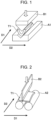
- bending by 90° in a rolling (L) direction with a width (C) direction as an axis refers to the following procedure: a steel sheet is bent by pressing on a steel sheet surface on one side in a direction perpendicular to the width direction and the rolling direction (see the reference signs D1 and D2 in Fig. 1 ) such that the distance between both end portions becomes shorter when the steel sheet is viewed in the width (C) direction (see the reference sign D1 in Fig. 1 ) (in a widthwise steel sheet view (widthwise vertical sectional view)), and the pressing is carried out until the angle between flat portions of the both end portions not subjected to bending becomes 90°.
- the steel sheet surface on a compressive-tensile deformation side refers to the pressed steel sheet surface on one side described above (a steel sheet surface that comes into contact with a pressing unit of a punch or the like that applies pressing).
- the L section after unbending refers to a section that is formed by cutting the steel sheet parallel to the direction of deformation caused by bending and perpendicularly to the steel sheet surface and that is perpendicular to the width direction.
- the position of measurement of ferrite grains after unbending is a region formed as a result of bending and including a corner portion extending in the width (C) direction (see the reference sign D1 in Fig. 1 ). More specifically, in an area that is lowest in a direction perpendicular to the width direction and the rolling direction (a pressing direction of a pressing unit of a punch or the like) after bending, the number of ferrite grains is measured in a region extending by 0 to 50 um in the thickness direction.
- the steel sheet according to the present invention may have, on a surface of the steel sheet, an electrogalvanized layer, a hot-dip galvanized layer, or a hot-dip galvannealed layer.
- the tensile strength (TS) of the steel sheet according to the present invention is 780 MPa or more.
- high strength refers to a tensile strength (TS) of 780 MPa or more.
- the upper limit of the tensile strength (TS) is not particularly specified, but preferably 1470 MPa or less from the viewpoint of the balance with other properties.
- the method of measuring the tensile strength (TS) is as follows: a JIS No.
- JIS Z 2201 tensile test piece 5 tensile test piece (JIS Z 2201) is sampled from a steel sheet in a direction perpendicular to the rolling direction, and a tensile test is performed at a strain rate of 10 -3 /s in accordance with provisions of JIS Z 2241 (2011) to determine the tensile strength (TS).
- the thickness of the steel sheet according to the present invention is preferably 0.2 mm or more from the viewpoint of effectively producing the advantageous effects of the present invention.
- the thickness of the steel sheet according to the present invention is preferably 3.2 mm or less from the viewpoint of effectively producing the advantageous effects of the present invention.
- the steel sheet according to the present invention is excellent in crashworthiness.
- excellent in crashworthiness refers to having good fracture resistance and having a good absorbed energy.
- having good fracture resistance means that when a bending-orthogonal bending test described below is performed, ⁇ S 50 , which is an average of strokes at points where the load has decreased from a maximum load by 50%, is 29 mm or more.
- having good crashworthiness means that when an axial crushing test described in EXAMPLES is performed, an average F ave of areas of stroke ranges of 0 to 100 mm in stroke-load graphs at crushing is 38000 N or more.
- a steel sheet is bent by 90° in a rolling (L) direction with a width (C) direction as an axis at radius of curvature/sheet thickness: 4.2 and then subjected to unbending (primary bending) to be flattened again, thereby preparing a test piece.
- a punch B1 is pressed against the steel sheet placed on a die A1 having a V-groove to obtain a test piece T1.
- a punch B2 is pressed against the test piece T1 placed on support rolls A2 such that the bending direction is a direction perpendicular to the rolling direction to perform orthogonal bending (secondary bending).
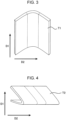
- D1 denotes the width (C) direction
- D2 denotes the rolling (L) direction.
- test piece T1 as a result of subjecting the steel sheet to 90° bending (primary bending) is illustrated in Fig. 3 .
- the positions indicated by the broken lines on the test piece T2 in Fig. 4 correspond to the positions indicated by the broken lines on the test piece T1 in Fig. 3 before being subjected to the orthogonal bending.
- a stroke at a point where the load has decreased from a maximum load by 50% is determined.
- the bending-orthogonal bending test is performed three times, and the strokes at points where the load has decreased from a maximum load by 50% are averaged to determine ⁇ S 50 .
- every axial crushing test is performed using a steel sheet having a thickness of 1.2 mm.
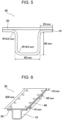
- a steel sheet is cut out and formed (bent) so as to have a depth of 40 mm using a die with a punch corner radius of 5.0 mm and a die corner radius of 5.0 mm, thereby fabricating a hat-shaped member 10 illustrated in Figs. 5 and 6 .
- the steel sheet used as a material of the hat-shaped member is cut out to a size of 200 mm ⁇ 80 mm.
- a steel sheet 20 thus cut out and the hat-shaped member 10 are spot welded to fabricate a test member 30 as illustrated in Figs. 5 and 6.
- FIG. 5 is a front view of the test member 30 fabricated by spot welding the hat-shaped member 10 and the steel sheet 20.
- Fig. 6 is a perspective view of the test member 30.
- spot welds 40 are positioned such that the distance between a steel sheet end and a weld is 10 mm and the distance between the welds is 45 mm.
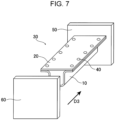
- the test member 30 is joined to a base plate 50 by TIG welding to prepare an axial crushing test sample.
- an impactor 60 is crashed against the prepared axial crushing test sample at a constant crash speed of 10 m/s to crush the axial crushing test sample by 100 mm.
- Si is a ferrite-forming element and is also a solid solution-strengthening element.
- Si contributes to improving the balance between strength and ductility.
- the Si content is preferably 0.10% or more, more preferably 0.20% or more.
- a Si content of more than 2.00% may cause a decrease in deposition and adhesion of zinc coating and deterioration of surface quality.
- the Si content is preferably 2.00% or less, more preferably 1.50% or less.
- Mn is a martensite-forming element and is also a solid solution-strengthening element. Mn also contributes to stabilizing retained austenite. To produce these effects, the Mn content is preferably 1.5% or more. The Mn content is more preferably 2.0% or more. On the other hand, a Mn content of more than 4.0% may lead to an increased retained austenite fraction, resulting in low crashworthiness. Thus, the Mn content is preferably 4.0% or less, more preferably 3.5% or less.
- P is an element effective in strengthening steel.
- a P content of more than 0.100% may significantly slow down the alloying rate.
- An excessively high P content of more than 0.100% may cause embrittlement due to grain boundary segregation, thus lowering the fracture resistance at the time of a crash even if the steel microstructure of the present invention is satisfied.
- the P content is 0.100% or less, preferably 0.050% or less.
- the lower limit of the P content is not specified, the lower limit that is industrially feasible at present is about 0.002%, preferably 0.002% or more.
- the S content is preferably as low as possible, but in terms of the manufacturing cost, the S content is preferably 0.050% or less.
- the S content is more preferably 0.010% or less.
- the lower limit of the S content is not specified, the lower limit that is industrially feasible at present is about 0.0002%, preferably 0.0002% or more.
- Al acts as a deoxidizing agent and is also a solid solution-strengthening element.
- a Sol. Al content of less than 0.005% may fail to produce these effects, resulting in low strength even if the steel microstructure of the present invention is satisfied.
- the Sol. Al content is preferably 0.005% or more.
- a Sol. Al content of more than 0.100% degrades the slab quality in steelmaking.
- the Sol. Al content is preferably 0.100% or less, more preferably 0.04% or less.
- N forms into coarse nitride and carbonitride inclusions such as TiN, (Nb, Ti)(C, N), and AlN in steel to reduce crashworthiness, and thus the content of N needs to be low. Since the crashworthiness tends to be low when the N content is more than 0.0100%, the N content is preferably 0.0100% or less. The N content is more preferably 0.007% or less, still more preferably 0.005% or less. Although the lower limit of the N content is not particularly specified, the lower limit that is industrially feasible at present is about 0.0003%, preferably 0.0003% or more.
- the steel sheet according to the present invention has a chemical composition containing the components described above and Fe (iron) and incidental impurities constituting the balance.
- a steel sheet according to an embodiment of the present invention preferably has a chemical composition containing the components described above with the balance being Fe and incidental impurities.
- the steel sheet according to the present invention may appropriately contain components (optional elements) described below according to the desired characteristics.
- Cr, Mo, and V are elements effective in enhancing hardenability and strengthening steel. However, when they are excessively added in amounts more than Cr: 1.000%, Mo: 0.500%, and V: 0.500%, the above effect is saturated, and furthermore the cost of raw materials increases. In addition, the second phase fraction may be excessively large to lower the fracture resistance at the time of a crash.
- the Cr content is preferably 1.000% or less, the Mo content is preferably 0.500% or less, and the V content is preferably 0.500% or less. More preferably, the Cr content is 0.800% or less, the Mo content is 0.400% or less, and the V content is 0.400% or less.
- the lower limit of each content is not particularly specified.
- the contents of Cr, Mo, and V are each preferably 0.005% or more.
- Ti and Nb are elements effective for precipitation strengthening of steel.
- a Ti content or Nb content of more than 0.500% may lower the fracture resistance at the time of a crash.
- the Ti content and the Nb content are each preferably 0.500% or less. More preferably, the Ti content and the Nb content are each 0.400% or less. Since the advantageous effects of the present invention are produced even when the contents of Ti and Nb are low, the lower limit of each content is not particularly specified.
- the Ti content and the Nb content are each preferably 0.005% or more.
- B can be added as required because B inhibits the formation and growth of ferrite from austenite grain boundaries to thereby contribute to improving hardenability.
- a B content of more than 0.0050% may lower the fracture resistance at the time of a crash.
- the B content is preferably 0.0050% or less. More preferably, the B content is 0.0040% or less. Since the advantageous effects of the present invention are produced even when the B content is low, the lower limit of the B content is not particularly specified. To more effectively produce the effect of hardenability improvement, the B content is preferably 0.0003% or more.
- Ni and Cu are elements effective in strengthening steel.
- a Ni or Cu content of more than 1.000% may lower the fracture resistance at the time of a crash.
- the contents of Ni and Cu are each preferably 1.000% or less. More preferably, the Ni content and the Cu content are each 0.800% or less. Since the advantageous effects of the present invention are produced even when the contents of Ni and Cu are low, the lower limit of each content is not particularly specified.
- the Ni content and the Cu content are each preferably 0.005% or more.
- Sb and Sn can be added as required from the viewpoint of suppressing nitriding and oxidation of steel sheet surfaces and decarburization of regions near the steel sheet surfaces. By suppressing such nitriding and oxidation, the amount of martensite formed in the steel sheet surfaces can be prevented from decreasing, thus improving crashworthiness.
- an Sb or Sn content of more than 1.000% may result in low crashworthiness due to grain boundary embrittlement.
- the Sb content and the Sn content are each preferably 1.000% or less. More preferably, the Sb content and the Sn content are each 0.800% or less.
- the lower limit of each content is not particularly specified.
- the Sb content and the Sn content are each preferably 0.005% or more.
- As (arsenic) is an element that segregates at grain boundaries and that is contained as impurities in raw material scraps. From the viewpoint of suppression of grain boundary embrittlement, the As content is preferably 1.000% or less. More preferably, the As content is 0.800% or less. The content of As is preferably as low as possible, and although the lower limit of the content is not particularly specified, it is preferably 0.005% or more from the viewpoint of refining cost.
- Ca is an element effective in improving workability through shape control of sulfides.
- a content of Ca of more than 0.0050% may adversely affect the cleanliness of steel, resulting in low characteristics.
- the content of Ca is preferably 0.0050% or less. More preferably, the Ca content is 0.0040% or less. Since the advantageous effects of the present invention are produced even when the content of Ca is low, the lower limit of the content is not particularly specified. To more effectively produce the effect of improving workability, the content of Ca is preferably 0.0010% or more.
- W forms into a fine carbide, a nitride, or a carbonitride during hot rolling or annealing and is useful for precipitation strengthening of steel.
- a W content of more than 0.500% reduces workability.
- the W content is 0.500% or less.
- the W content is preferably 0.005% or more, more preferably 0.050% or more.
- the W content is preferably 0.400% or less, more preferably 0.300% or less.
- Ta forms into a fine carbide, a nitride, or a carbonitride during hot rolling or annealing and is useful for precipitation strengthening of steel.
- a Ta content of more than 0.100% reduces workability.
- the Ta content is 0.100% or less.
- the Ta content is preferably 0.001% or more, more preferably 0.010% or more.
- the Ta content is preferably 0.08% or less, more preferably 0.060% or less.
- Mg is an element effective in improving workability through shape control of inclusions.
- a content of Mg of more than 0.050% may adversely affect the cleanliness of steel.
- the content of Mg is 0.050% or less.
- the content of Mg preferably 0.0005% or more, more preferably 0.001% or more.
- the content of Mg is preferably 0.040% or less, more preferably 0.030% or less.
- Zr is an element effective in improving workability through shape control of inclusions.
- a content of Zr of more than 0.050% may adversely affect the cleanliness of steel.
- the content of Zr is 0.050% or less.
- the content of Zr is preferably 0.0005% or more, more preferably 0.001% or more.
- the content of Zr is preferably 0.040% or less, more preferably 0.030% or less.
- REMs are elements effective in improving workability through shape control of sulfides.
- an REM content of more than 0.005% may adversely affect the cleanliness of steel, resulting in low characteristics.
- the content of each REM is preferably 0.005% or less. More preferably, the REM content is 0.004% or less. Since the advantageous effects of the present invention are produced even when the contents of REMs are low, the lower limit of each content is not particularly specified. To more effectively produce the effect of improving workability, the content of each REM is preferably 0.001% or more.
- temperatures in heating or cooling of a steel slab (steel material), a steel sheet, or the like given below are surface temperatures of the steel slab (steel material), the steel sheet, or the like, unless otherwise stated.
- a method for manufacturing a steel sheet according to the present invention includes, for example, a hot rolling step of heating a steel slab having the above-described chemical composition to a temperature range of 1100°C to 1300°C, and performing coiling with a finish rolling temperature (finish rolling delivery temperature) set to 800°C to 950°C, a rolling reduction in finish rolling set to 60% or more, a holding time in a temperature range of 750°C to 600°C in a cooling process from finish rolling delivery to coiling set to 10 s or less, and a coiling temperature set to 600°C or lower.
- finish rolling temperature finish rolling delivery temperature
- a holding time in a temperature range of 750°C to 600°C in a cooling process from finish rolling delivery to coiling set to 10 s or less and a coiling temperature set to 600°C or lower.
- a hot-rolled steel sheet may have a microstructure including, in terms of area fraction, ferrite: 20% or less, and fresh martensite and bainite in total: 80% or more.
- the method also includes a cold rolling step of pickling the hot-rolled steel sheet obtained in the hot rolling step and performing cold rolling at a cumulative rolling reduction of 20% or more.
- the method also includes an annealing step of heating a cold-rolled steel sheet obtained in the cold rolling step to an annealing temperature of 750°C to 880°C and performing holding for 30 seconds or more, a quenching step of, after the annealing step, performing cooling to a cooling stop temperature: (Ms - 250°C) to (Ms - 50°C), and a tempering step of, after the quenching step, performing heating to a reheating temperature: 300°C to 500°C and holding for 20 seconds or more.
- the method for manufacturing a steel sheet according to the present invention may also include, before the quenching step or after the tempering step, a coating step of performing hot-dip galvanizing or hot-dip galvannealing on a surface of the steel sheet.
- Finish rolling temperature 800°C to 950°C
- the finish rolling temperature (finish rolling delivery temperature) is lower than 800°C, ferrite transformation may occur during rolling, resulting in failure to provide a hot-rolled microstructure of the present invention.
- the finish rolling temperature is 800°C or higher, preferably 850°C or higher, more preferably 880°C or higher.
- the finish rolling temperature is higher than 950°C, crystal grains may coarsen, forming ununiform ferrite grains after annealing.
- the finish rolling temperature is 950°C or lower, preferably 930°C or lower.
- a cumulative rolling reduction in finish rolling of 60% or more increases the recrystallization rate during hot rolling, leading to a fine hot-rolled microstructure. Furthermore, by controlling the cooling process from finish rolling delivery to coiling and the coiling temperature, the formation of ferrite is suppressed to provide a fine hot-rolled microstructure composed mainly of fresh martensite and bainite, thus probably increasing ferrite nucleation sites in the annealing step to provide uniform and fine ferrite grains.
- a cumulative rolling reduction in finish rolling of less than 60% cannot produce these effects.
- the cumulative rolling reduction in finish rolling is 60% or more, preferably 70% or more.
- the upper limit is not particularly specified, but in view of the balance with the rolling reduction in cold rolling, the cumulative rolling reduction in finish rolling is preferably 99% or less, more preferably 96% or less.
- the holding time in the temperature range of 750°C to 600°C is more than 10 s, ferrite transformation may proceed, resulting in failure to provide the hot-rolled microstructure of the present invention.
- the holding time in the temperature range of 750°C to 600°C is 10 s or less, preferably 8 s or less.
- the lower limit is not particularly specified, but in view of the manufacturing cost, the holding time is preferably 1 s or more, more preferably 3 s or more.
- Coiling temperature 600°C or lower
- the coiling temperature is 600°C or lower, preferably 580°C or lower.
- the lower limit of the coiling temperature is not particularly specified, but from the viewpoint of reducing the likelihood of the occurrence of a shape defect of steel sheet and preventing an excessively hardened steel sheet, the coiling temperature is preferably 400°C or higher.
- controlling the microstructure of the hot-rolled steel sheet is important for achieving, in a final microstructure, ferrite with an average crystal grain size of 25 um or less and CV ⁇ CE satisfying 0.28 or less.
- the hot rolling step by controlling the rolling reduction in finish rolling, the cooling process from finish rolling delivery to coiling, and the coiling temperature, the formation of ferrite is suppressed to provide a hot-rolled steel sheet microstructure in which the area fraction of ferrite is 20% or less, whereby a fine hot-rolled microstructure described below including fresh martensite and bainite with an area fraction of 80% or more is obtained, thus probably increasing ferrite nucleation sites in the annealing step to provide uniform and fine ferrite grains.
- the area fraction of ferrite in the hot-rolled steel sheet is 20% or less, preferably 15% or less.
- the area fraction of ferrite in the hot-rolled steel sheet may be 0%.
- Total area fraction of fresh martensite and bainite in hot-rolled steel sheet 80% or more
- controlling the microstructure of the hot-rolled steel sheet to be a microstructure composed mainly of fresh martensite and bainite is important for achieving, in a final microstructure, ferrite with an average crystal grain size of 25 um or less and CV ⁇ CE satisfying 0.28 or less for the same reason as above.
- the total area fraction of fresh martensite and bainite in the hot-rolled steel sheet is 80% or more, preferably 85% or more.
- the total area fraction of fresh martensite and bainite in the hot-rolled steel sheet may be 100%.
- the microstructure, strength, and crashworthiness of the present invention are provided regardless of the types and area fractions of phases other than the above.
- phases other than the above include pearlite and cementite. If these phases are excessively increased and the total area fraction of fresh martensite and bainite in the hot-rolled steel sheet falls below 80%, ununiform ferrite grains are formed during annealing, and such grains may be origins of void formation at the time of crash deformation to reduce crashworthiness.
- the area fraction of these phases is preferably 15% or less.
- the hot-rolled steel sheet obtained in the hot rolling step is subjected to a pretreatment such as pickling or degreasing using a generally known method, and then subjected to cold rolling as needed.
- a pretreatment such as pickling or degreasing using a generally known method
- cold rolling as needed.
- a condition in the cold rolling step of performing cold rolling will be described.
- the cumulative rolling reduction in cold rolling is less than 20%, recrystallization of ferrite may be not promoted to leave unrecrystallized ferrite, resulting in failure to provide the steel microstructure of the present invention.
- the cumulative rolling reduction in cold rolling is 20% or more, preferably 30% or more.
- Annealing temperature 750°C to 880°C, holding time: 30 seconds or more
- An annealing temperature of lower than 750°C results in insufficient austenite formation and excessive ferrite formation, resulting in failure to provide the steel microstructure of the present invention.
- the annealing temperature is 750°C or higher.
- An annealing temperature of higher than 880°C may result with excessive austenite and insufficient ferrite.
- the annealing temperature is 880°C or lower.
- a holding time of less than 30 seconds results in insufficient austenite formation and excessive ferrite formation, resulting in failure to provide the steel microstructure of the present invention.
- the holding time is 30 seconds or more, preferably 60 seconds or more.
- the upper limit of the holding time is not particularly specified, but the holding time is preferably 600 seconds or less in order not to impair productivity.
- quenching is performed. A condition in the quenching step will be described.
- Cooling stop temperature (Ms - 250°C) to (Ms - 50°C)
- a cooling stop temperature of higher than (Ms - 50°C) results in insufficient tempered martensite formation, resulting in failure to provide the steel microstructure of the present invention.
- the cooling stop temperature is (Ms - 50°C) or lower, preferably (Ms - 100°C) or lower.
- a cooling stop temperature of lower than (Ms - 250°C) may result in excessive tempered martensite and insufficient retained austenite formation.
- the cooling stop temperature is (Ms - 250°C) or higher, preferably (Ms - 200°C) or higher.
- Ms can be determined by the following formula (3).
- Ms (°C) 539 - 423 ⁇ ⁇ [C%] ⁇ 100/(100 - [ ⁇ area%]) ⁇ - 30 ⁇ [Mn%] - 12 ⁇ [Cr%] - 18 ⁇ [Ni%] - 8 ⁇ [Mo%]...(3)
- each element symbol represents the content (mass%) of each element, and an element not contained is expressed as 0.
- [ ⁇ area%] means a ferrite area fraction after annealing.
- the ferrite area fraction after annealing is preliminarily determined by simulating the heating rate, the annealing temperature, and the holding time in the annealing using a thermodilatometer.
- [ ⁇ area%] is regarded as the same as the area fraction of ferrite contained in a final steel sheet that has been through the quenching step and the tempering step of the present invention after annealing.
- tempering is performed. Conditions in the tempering step will be described.
- Tempering temperature 300°C to 500°C, holding time: 20 seconds or more
- the tempering temperature is 300°C or higher, preferably 350°C or higher.
- reheating temperature is 500°C or lower, preferably 450°C or lower.
- the holding time is 20 seconds or more, preferably 30 seconds or more.
- the upper limit of the holding time is not particularly specified, but from the viewpoint of productivity and suppression of excessive bainite transformation, the holding time is preferably 500 seconds or less.
- electrogalvanizing, hot-dip galvanizing, or hot-dip galvannealing may be performed on a surface of the steel sheet after the annealing step and before the quenching step, or after the tempering step.
- the coating step after the annealing step and before the quenching step preferably includes performing holding in a temperature range of 300°C to 500°C for 0 to 300 s before coating.
- this temperature range is lower than 300°C, martensitic transformation may occur, and C may be excessively concentrated in non-transformed austenite to cause decomposition during coating or alloying by coating, reducing retained austenite.
- the temperature range is higher than 500°C, ferrite may be formed, resulting in failure to provide the steel microstructure of the present invention.
- bainite transformation may proceed excessively, resulting in failure to provide the steel microstructure and fracture resistance of the present invention.
- the coating step after the annealing step and before the quenching step preferably includes performing holding in a temperature range of 300°C to 500°C for 0 to 300 s before coating.
- the electrogalvanizing treatment is preferably performed by applying a current to the steel sheet immersed in a zinc solution at 50°C to 60°C.
- the hot-dip galvanizing treatment is preferably performed in such a manner that the steel sheet obtained as described above is immersed in a galvanizing bath at 440°C or higher and 500°C or lower, and then the coating weight is adjusted by, for example, gas wiping.
- the hot-dip galvanizing treatment step may be followed by an alloying step of performing an alloying treatment.
- the alloying treatment is performed on a zinc coating, the zinc coating is preferably alloyed while being held in a temperature range of 450°C or higher and 580°C or lower for 1 second or more 180 seconds or less.
- the steel sheet subjected to the hot-dip galvanizing treatment or the hot-dip galvannealing treatment may be subjected to temper rolling for shape correction, surface roughness adjustment, and other purposes.
- temper rolling a temper rolling reduction of more than 0.5% may result in lower bendability due to surface hardening, and thus the temper rolling rate is preferably 0.5% or less, more preferably 0.3% or less.
- coating treatments such as resin coating and oil coating may also be performed.
- a slab is preferably produced by continuous casting in order to prevent macrosegregation and can also be produced by ingot casting or thin slab casting.
- the hot rolling may be performed in such a manner that the slab is cooled to room temperature once and then reheated.
- the hot rolling may be performed in such a manner that the slab is charged into a heating furnace without being cooled to room temperature.
- An energy-saving process in which short-period heat retention is performed and the hot rolling is then immediately performed is also applicable.
- the slab is heated, it is preferably heated to 1100°C or higher in order to prevent an increase in rolling force and dissolve carbides.
- the slab heating temperature is preferably 1300°C or lower.
- a rough bar obtained by rough rolling may be heated so that troubles during rolling are prevented when the slab heating temperature is lowered.
- a so-called continuous rolling process in which rough bars are joined together and finish rolling is continuously performed is also applicable.
- scales may be removed by, for example, pickling. After the pickling, cold rolling, annealing, and galvanizing are performed under the above-described conditions.
- the member according to the present invention is obtained by subjecting the steel sheet according to the present invention to at least one of forming and welding.
- the method for manufacturing the member according to the present invention includes a step of subjecting a steel sheet manufactured by the method for manufacturing a steel sheet according to the present invention to at least one of forming and welding.
- the steel sheet according to the present invention has high strength and is excellent in crashworthiness.
- the member obtained using the steel sheet according to the present invention also has high strength, is excellent in crashworthiness, and is resistant to member fracture at the time of crash deformation.
- the member according to the present invention is suitable for use as an energy-absorbing member of an automotive part.
- any common forming method such as press forming can be used without limitation.
- any common welding such as spot welding or arc welding can be used without limitation.
- Steels having chemical compositions shown in Table 1 were obtained by steelmaking in a vacuum melting furnace and bloomed into steel slabs. These steel slabs were heated to 1100°C to 1300°C and subjected to hot rolling, cold rolling, annealing, quenching, tempering, and heat treatment under the conditions shown in Table 2 to manufacture steel sheets. When the steel sheets were manufactured under the conditions shown in Table 2, some of the steel sheets were subjected to a coating treatment before the quenching step or after the tempering step. In a hot-dip galvanizing treatment, each steel sheet was immersed in a plating bath to form a hot-dip galvanized layer (GI) with a coating weight of 10 to 100 g/m 2 .
- GI hot-dip galvanized layer
- hot-dip galvannealing After a hot-dip galvanized layer was formed on each steel sheet, an alloying treatment was performed to form a hot-dip galvannealed layer (GA).
- the final steel sheets each had a thickness of 1.2 mm.
- the steel sheets obtained were subjected to skin pass rolling at a rolling reduction of 0.2%, and then the area fractions of ferrite (F), bainite (B), fresh martensite (FM), tempered martensite (TM), and retained austenite (RA) were determined according to the following method.
- NF void /NF was measured in the following manner. After the steel sheet was bent by 90° in a rolling (L) direction with a width (C) direction as an axis at radius of curvature/sheet thickness: 4.2 and unbent to be flattened again, a thickness cross-section was polished, and an L section in a region extending by 0 to 50 um from a steel sheet surface on a compressive-tensile side was observed.
- NF void /NF was defined as the average of the three view areas. Voids were darker black than ferrite and clearly distinguishable from microstructures.
- the position of measurement of ferrite grains after unbending was a region formed as a result of bending and including a corner portion extending in the width (C) direction (see the reference sign D1 in Fig. 1 ). More specifically, in an area that was lowest in a direction perpendicular to the width direction and the rolling direction (a pressing direction of a pressing unit of a punch or the like) after bending, the number of ferrite grains was measured in a region extending by 0 to 50 um in the thickness direction.
- the area fraction of each microstructure was measured as described below. A thickness cross-section of a steel sheet cut at a right angle to the rolling direction was polished and then etched with 3 vol% nital. At its 1/4 thickness position, three view areas were micrographed with a scanning electron microscope (SEM) at a magnification of 1500X, and from image data obtained, the area fraction of each microstructure was determined using Image-Pro manufactured by Media Cybernetics. The average of area fractions in the three view areas was the area fraction of each microstructure in the present invention. In the image data, ferrite was distinguished as black, bainite as black including island-shaped retained austenite or gray including regularly oriented carbides, tempered martensite as light gray including fine irregularly oriented carbides, and retained austenite as white.
- Fresh martensite also exhibited a white color, and fresh martensite and retained austenite were difficult to distinguish from each other in the SEM images.
- the area fraction of fresh martensite was determined by subtracting the area fraction of retained austenite determined by a method described later from the total area fraction of fresh martensite and retained austenite.
- the area fraction of remaining microstructures can be determined by subtracting the total area fraction of ferrite (F), tempered martensite (TM), bainite (B), retained austenite (RA), and fresh martensite (FM) from 100%, and these remaining microstructures were estimated to consist of pearlite and/or cementite.
- volume fraction of retained austenite was determined as the ratio of an integrated X-ray diffraction intensity of (200), (220), and (311) planes of fcc iron to an integrated X-ray diffraction intensity of (200), (211), and (220) planes of bcc iron at the 1/4 thickness plane.
- JIS Z 2201 JIS No. 5 tensile test piece
- TS tensile strength
- Each of the steel sheets obtained was bent by 90° in a rolling (L) direction with a width (C) direction as an axis at radius of curvature/sheet thickness: 4.2 and then subjected to unbending (primary bending) to be flattened again, thereby preparing a test piece.
- a punch B1 was pressed against the steel sheet placed on a die A1 having a V-groove to obtain a test piece T1.
- a punch B2 was pressed against the test piece T1 placed on support rolls A2 such that the bending direction was a direction perpendicular to the rolling direction to perform orthogonal bending (secondary bending).
- D1 denotes the width (C) direction
- D2 denotes the rolling (L) direction.
- test piece T1 as a result of subjecting the steel sheet to 90° bending (primary bending) is illustrated in Fig. 3 .
- the positions indicated by the broken lines on the test piece T2 in Fig. 4 correspond to the positions indicated by the broken lines on the test piece T1 in Fig. 3 before being subjected to the orthogonal bending.
- a stroke at a point where the load decreased from a maximum load by 50% was determined.
- the bending-orthogonal bending test was performed three times, and the strokes at points where the load decreased from a maximum load by 50% were averaged to determine ⁇ S 50 .
- a steel sheet having ⁇ S 50 of 29 mm or more was evaluated as having good fracture resistance.
- the load, which determines the stroke length is important in the evaluation of fracture resistance. Fracture at the time of axial crushing deformation occurs in a manner that a crack that has occurred at a primary-processed portion of a member grows to extend across the sheet thickness, thus leading to fracture.
- a crack occurs in a test piece at or near a maximum load, and as the crack grows, the sectional area of a bent portion diminishes, and the load decreases. That is, the percentage of decrease in load from a maximum load indicates how much a crack has grown with deformation.
- ⁇ S 50 a stroke at a point where the load has decreased from a maximum load by 50%, is 29 mm or more, fracture can be suppressed even taking into account variations in actual crushing deformation.
- a steel sheet having ⁇ S 50 of 29 mm or more was evaluated as having good fracture resistance.
- every axial crushing test was performed using a steel sheet having a thickness of 1.2 mm.
- Each of the steel sheets obtained through the above manufacturing process was cut out and formed (bent) so as to have a depth of 40 mm using a die with a punch corner radius of 5.0 mm and a die corner radius of 5.0 mm, thereby fabricating a hat-shaped member 10 illustrated in Figs. 5 and 6 .
- the steel sheet used as a material of the hat-shaped member was cut out to a size of 200 mm ⁇ 80 mm.
- a steel sheet 20 thus cut out and the hat-shaped member 10 were spot welded to fabricate a test member 30 as illustrated in Figs. 5 and 6.
- FIG. 5 is a front view of the test member 30 fabricated by spot welding the hat-shaped member 10 and the steel sheet 20.
- Fig. 6 is a perspective view of the test member 30.
- spot welds 40 were positioned such that the distance between a steel sheet end and a weld was 10 mm and the distance between the welds was 45 mm.
- the test member 30 was joined to a base plate 50 by TIG welding to prepare an axial crushing test sample.
- an impactor 60 was crashed against the prepared axial crushing test sample at a constant crash speed of 10 m/s to crush the axial crushing test sample by 100 mm.
- a crushing direction D3 was parallel to the longitudinal direction of the test member 30.
- a stroke-load graph at the crushing the area of a stroke range of 0 to 100 mm was determined. The test was performed three times, and the areas were averaged to determine an absorbed energy (F ave ). When F ave was 38000 N or more, the steel sheet was evaluated as having a good absorbed energy. When both the fracture resistance and the absorbed energy were good, the steel sheet was evaluated as having good crashworthiness. [Table 3] Steel sheet No.
- the steel sheets of Inventive Examples had a TS of 780 MPa or more, and were excellent in crashworthiness.
- the steel sheets of Comparative Examples had a TS of less than 780 MPa or were poor in crashworthiness.
- the steel sheet No. 1 (Inventive Example) in Table 3 of Example 1 was formed by pressing to manufacture a member of Inventive Example. Furthermore, the steel sheet No. 1 in Table 3 of Example 1 and the steel sheet No. 30 (Inventive Example) in Table 3 of Example 1 were joined together by spot welding to manufacture a member of Inventive Example. It was confirmed that the members of Inventive Example manufactured using the steel sheets according to the present invention were excellent in crashworthiness and had high strength and that both the member manufactured by forming the steel sheet No. 1 (Inventive Example) in Table 3 of Example 1 and the member manufactured by spot welding the steel sheet No. 1 in Table 3 of Example 1 and the steel sheet No. 30 (Inventive Example) in Table 3 of Example 1 were suitable for use for automotive frame parts and the like.
- the galvanized steel sheet No. 1 (Inventive Example) in Table 3 of Example 1 was formed by pressing to manufacture a member of Inventive Example. Furthermore, the galvanized steel sheet No. 1 in Table 3 of Example 1 and the galvanized steel sheet No. 30 (Inventive Example) in Table 3 of Example 1 were joined together by spot welding to manufacture a member of Inventive Example. It was confirmed that the members of Inventive Example manufactured using the steel sheets according to the present invention were excellent in crashworthiness and had high strength and that both the member manufactured by forming the steel sheet No. 1 (Inventive Example) in Table 3 of Example 1 and the member manufactured by spot welding the steel sheet No. 1 in Table 3 of Example 1 and the steel sheet No. 30 (Inventive Example) in Table 3 of Example 1 were suitable for use for automotive frame parts and the like.
- a steel sheet having a TS of 780 MPa or more and excellent in crashworthiness can be obtained.
- Using a member obtained using the steel sheet according to the present invention as an automotive part can contribute to reducing the weight of an automobile and greatly contribute to improving the performance of an automobile body.
Landscapes
- Chemical & Material Sciences (AREA)
- Engineering & Computer Science (AREA)
- Materials Engineering (AREA)
- Metallurgy (AREA)
- Organic Chemistry (AREA)
- Mechanical Engineering (AREA)
- Thermal Sciences (AREA)
- Physics & Mathematics (AREA)
- Crystallography & Structural Chemistry (AREA)
- Chemical Kinetics & Catalysis (AREA)
- Oil, Petroleum & Natural Gas (AREA)
- Electrochemistry (AREA)
- Heat Treatment Of Sheet Steel (AREA)
- Heat Treatment Of Steel (AREA)
Applications Claiming Priority (1)
| Application Number | Priority Date | Filing Date | Title |
|---|---|---|---|
| PCT/JP2022/008145 WO2023162190A1 (ja) | 2022-02-28 | 2022-02-28 | 鋼板、部材、それらの製造方法、冷延鋼板用熱延鋼板の製造方法及び冷延鋼板の製造方法 |
Publications (2)
| Publication Number | Publication Date |
|---|---|
| EP4464801A1 true EP4464801A1 (de) | 2024-11-20 |
| EP4464801A4 EP4464801A4 (de) | 2025-04-02 |
Family
ID=87765193
Family Applications (1)
| Application Number | Title | Priority Date | Filing Date |
|---|---|---|---|
| EP22928716.4A Pending EP4464801A4 (de) | 2022-02-28 | 2022-02-28 | Stahlblech, element, verfahren zur herstellung davon, verfahren zur herstellung eines warmgewalzten stahlblechs für kaltgewalztes stahlblech und verfahren zur herstellung eines kaltgewalzten stahlblechs |
Country Status (7)
| Country | Link |
|---|---|
| US (1) | US20250171869A1 (de) |
| EP (1) | EP4464801A4 (de) |
| JP (1) | JP7726367B2 (de) |
| KR (1) | KR20240139067A (de) |
| CN (1) | CN118660983A (de) |
| MX (1) | MX2024010359A (de) |
| WO (1) | WO2023162190A1 (de) |
Families Citing this family (2)
| Publication number | Priority date | Publication date | Assignee | Title |
|---|---|---|---|---|
| EP4596947A1 (de) * | 2024-02-01 | 2025-08-06 | Deutsche Edelstahlwerke Specialty Steel GmbH & Co. KG | Verfahren zur herstellung eines druckbehälters für wasserstoff, durch das verfahren hergestellter druckbehälter und dessen verwendung |
| CN120945294B (zh) * | 2025-10-17 | 2026-01-09 | 鞍钢股份有限公司 | 一种1000MPa超高扩孔性能冷轧连退CH钢及其制备方法 |
Family Cites Families (22)
| Publication number | Priority date | Publication date | Assignee | Title |
|---|---|---|---|---|
| CN102242308B (zh) * | 2005-08-03 | 2013-03-27 | 住友金属工业株式会社 | 热轧钢板及冷轧钢板及它们的制造方法 |
| JP5305709B2 (ja) * | 2008-03-28 | 2013-10-02 | 株式会社神戸製鋼所 | 耐応力除去焼鈍特性と低温継手靭性に優れた高強度鋼板 |
| JP5206244B2 (ja) | 2008-09-02 | 2013-06-12 | 新日鐵住金株式会社 | 冷延鋼板 |
| JP5483562B2 (ja) * | 2010-02-26 | 2014-05-07 | 株式会社神戸製鋼所 | 伸びと伸びフランジ性のバランスに優れた高強度冷延鋼板 |
| JP5136609B2 (ja) | 2010-07-29 | 2013-02-06 | Jfeスチール株式会社 | 成形性および耐衝撃性に優れた高強度溶融亜鉛めっき鋼板およびその製造方法 |
| JP5821912B2 (ja) * | 2013-08-09 | 2015-11-24 | Jfeスチール株式会社 | 高強度冷延鋼板およびその製造方法 |
| JP6402460B2 (ja) | 2014-03-18 | 2018-10-10 | 新日鐵住金株式会社 | 引張最大強度780MPa以上を有する衝突特性に優れた高強度鋼板、高強度溶融亜鉛めっき鋼板、及び高強度合金化溶融亜鉛めっき鋼板 |
| US10253389B2 (en) * | 2014-03-31 | 2019-04-09 | Jfe Steel Corporation | High-yield-ratio, high-strength cold-rolled steel sheet and production method therefor |
| JP5888471B1 (ja) | 2014-03-31 | 2016-03-22 | Jfeスチール株式会社 | 高降伏比高強度冷延鋼板及びその製造方法 |
| JP6515281B2 (ja) * | 2014-07-11 | 2019-05-22 | 日本製鉄株式会社 | 冷延鋼板およびその製造方法 |
| JP6554396B2 (ja) * | 2015-03-31 | 2019-07-31 | 株式会社神戸製鋼所 | 加工性および衝突特性に優れた引張強度が980MPa以上の高強度冷延鋼板、およびその製造方法 |
| KR102004077B1 (ko) | 2015-05-29 | 2019-07-25 | 제이에프이 스틸 가부시키가이샤 | 고강도 냉연 강판, 고강도 도금 강판 및 이것들의 제조 방법 |
| US10941476B2 (en) * | 2016-01-22 | 2021-03-09 | Jfe Steel Corporation | High strength steel sheet and method for producing the same |
| WO2017179372A1 (ja) * | 2016-04-14 | 2017-10-19 | Jfeスチール株式会社 | 高強度鋼板およびその製造方法 |
| JP6323627B1 (ja) | 2016-08-31 | 2018-05-16 | Jfeスチール株式会社 | 高強度冷延薄鋼板及びその製造方法 |
| JP7218533B2 (ja) | 2018-10-09 | 2023-02-07 | 日本製鉄株式会社 | 鋼材およびその製造方法 |
| JP2020059880A (ja) * | 2018-10-09 | 2020-04-16 | 日本製鉄株式会社 | 鋼材およびその製造方法 |
| KR102164112B1 (ko) * | 2018-11-29 | 2020-10-12 | 주식회사 포스코 | 연성 및 저온 인성이 우수한 고강도 강재 및 이의 제조방법 |
| US12529131B2 (en) * | 2020-01-10 | 2026-01-20 | Jfe Steel Corporation | High-strength galvanized steel sheet and method for manufacturing the same |
| WO2021161679A1 (ja) * | 2020-02-13 | 2021-08-19 | Jfeスチール株式会社 | 高強度鋼板およびその製造方法 |
| EP4137602A4 (de) * | 2020-06-30 | 2023-03-29 | JFE Steel Corporation | Galvanisiertes stahlblech, element und verfahren zur herstellung davon |
| WO2022018502A1 (en) * | 2020-07-24 | 2022-01-27 | Arcelormittal | Cold rolled and annealed steel sheet |
-
2022
- 2022-02-28 CN CN202280092146.6A patent/CN118660983A/zh active Pending
- 2022-02-28 KR KR1020247027808A patent/KR20240139067A/ko active Pending
- 2022-02-28 US US18/839,790 patent/US20250171869A1/en active Pending
- 2022-02-28 JP JP2024502417A patent/JP7726367B2/ja active Active
- 2022-02-28 EP EP22928716.4A patent/EP4464801A4/de active Pending
- 2022-02-28 MX MX2024010359A patent/MX2024010359A/es unknown
- 2022-02-28 WO PCT/JP2022/008145 patent/WO2023162190A1/ja not_active Ceased
Also Published As
| Publication number | Publication date |
|---|---|
| EP4464801A4 (de) | 2025-04-02 |
| WO2023162190A1 (ja) | 2023-08-31 |
| JP7726367B2 (ja) | 2025-08-20 |
| KR20240139067A (ko) | 2024-09-20 |
| MX2024010359A (es) | 2024-09-02 |
| US20250171869A1 (en) | 2025-05-29 |
| CN118660983A (zh) | 2024-09-17 |
| JPWO2023162190A1 (de) | 2023-08-31 |
Similar Documents
| Publication | Publication Date | Title |
|---|---|---|
| CN115715332B (zh) | 镀锌钢板、构件和它们的制造方法 | |
| EP3901293B1 (de) | Hochfestes feuerverzinktes stahlblech und herstellungsverfahren dafür | |
| JP7028379B1 (ja) | 鋼板、部材及びそれらの製造方法 | |
| EP3875616A1 (de) | Stahlblech, element und herstellungsverfahren dafür | |
| CN115768915B (zh) | 镀锌钢板、构件和它们的制造方法 | |
| CN115698362B (zh) | 钢板、构件及它们的制造方法 | |
| US20250171869A1 (en) | Steel sheet, member, methods for manufacturing the same, method for manufacturing hot-rolled steel sheet for cold-rolled steel sheet, and method for manufacturing cold-rolled steel sheet | |
| EP4464809A1 (de) | Stahlblech, element, verfahren zu seiner herstellung, verfahren zur herstellung eines warmgewalzten stahlblechs für kaltgewalztes stahlblech und verfahren zur herstellung eines kaltgewalzten stahlblechs | |
| CN116897217B (zh) | 钢板、构件和它们的制造方法 |
Legal Events
| Date | Code | Title | Description |
|---|---|---|---|
| STAA | Information on the status of an ep patent application or granted ep patent |
Free format text: STATUS: THE INTERNATIONAL PUBLICATION HAS BEEN MADE |
|
| PUAI | Public reference made under article 153(3) epc to a published international application that has entered the european phase |
Free format text: ORIGINAL CODE: 0009012 |
|
| STAA | Information on the status of an ep patent application or granted ep patent |
Free format text: STATUS: REQUEST FOR EXAMINATION WAS MADE |
|
| 17P | Request for examination filed |
Effective date: 20240813 |
|
| AK | Designated contracting states |
Kind code of ref document: A1 Designated state(s): AL AT BE BG CH CY CZ DE DK EE ES FI FR GB GR HR HU IE IS IT LI LT LU LV MC MK MT NL NO PL PT RO RS SE SI SK SM TR |
|
| REG | Reference to a national code |
Ref country code: DE Ref legal event code: R079 Free format text: PREVIOUS MAIN CLASS: C21D0008020000 Ipc: C21D0001020000 |
|
| A4 | Supplementary search report drawn up and despatched |
Effective date: 20250228 |
|
| RIC1 | Information provided on ipc code assigned before grant |
Ipc: C21D 1/25 20060101ALI20250224BHEP Ipc: C22C 38/60 20060101ALI20250224BHEP Ipc: C22C 38/00 20060101ALI20250224BHEP Ipc: C21D 9/46 20060101ALI20250224BHEP Ipc: C22C 38/02 20060101ALI20250224BHEP Ipc: C22C 38/08 20060101ALI20250224BHEP Ipc: C22C 38/14 20060101ALI20250224BHEP Ipc: C22C 38/12 20060101ALI20250224BHEP Ipc: C22C 38/04 20060101ALI20250224BHEP Ipc: C22C 38/32 20060101ALI20250224BHEP Ipc: C22C 38/16 20060101ALI20250224BHEP Ipc: C22C 38/34 20060101ALI20250224BHEP Ipc: C23C 2/28 20060101ALI20250224BHEP Ipc: B32B 15/01 20060101ALI20250224BHEP Ipc: C23C 2/02 20060101ALI20250224BHEP Ipc: C25D 3/22 20060101ALI20250224BHEP Ipc: C22C 38/38 20060101ALI20250224BHEP Ipc: C21D 8/02 20060101ALI20250224BHEP Ipc: C23C 2/06 20060101ALI20250224BHEP Ipc: C22C 38/28 20060101ALI20250224BHEP Ipc: C21D 1/02 20060101AFI20250224BHEP |
|
| DAV | Request for validation of the european patent (deleted) | ||
| DAX | Request for extension of the european patent (deleted) |