EP4459769A1 - Batteriepack und fahrzeug damit - Google Patents
Batteriepack und fahrzeug damit Download PDFInfo
- Publication number
- EP4459769A1 EP4459769A1 EP23863320.0A EP23863320A EP4459769A1 EP 4459769 A1 EP4459769 A1 EP 4459769A1 EP 23863320 A EP23863320 A EP 23863320A EP 4459769 A1 EP4459769 A1 EP 4459769A1
- Authority
- EP
- European Patent Office
- Prior art keywords
- path
- battery
- flame
- battery pack
- cell
- Prior art date
- Legal status (The legal status is an assumption and is not a legal conclusion. Google has not performed a legal analysis and makes no representation as to the accuracy of the status listed.)
- Pending
Links
Images






Classifications
-
- H—ELECTRICITY
- H01—ELECTRIC ELEMENTS
- H01M—PROCESSES OR MEANS, e.g. BATTERIES, FOR THE DIRECT CONVERSION OF CHEMICAL ENERGY INTO ELECTRICAL ENERGY
- H01M50/00—Constructional details or processes of manufacture of the non-active parts of electrochemical cells other than fuel cells, e.g. hybrid cells
- H01M50/30—Arrangements for facilitating escape of gases
- H01M50/35—Gas exhaust passages comprising elongated, tortuous or labyrinth-shaped exhaust passages
- H01M50/367—Internal gas exhaust passages forming part of the battery cover or case; Double cover vent systems
-
- H—ELECTRICITY
- H01—ELECTRIC ELEMENTS
- H01M—PROCESSES OR MEANS, e.g. BATTERIES, FOR THE DIRECT CONVERSION OF CHEMICAL ENERGY INTO ELECTRICAL ENERGY
- H01M10/00—Secondary cells; Manufacture thereof
- H01M10/60—Heating or cooling; Temperature control
- H01M10/61—Types of temperature control
- H01M10/613—Cooling or keeping cold
-
- H—ELECTRICITY
- H01—ELECTRIC ELEMENTS
- H01M—PROCESSES OR MEANS, e.g. BATTERIES, FOR THE DIRECT CONVERSION OF CHEMICAL ENERGY INTO ELECTRICAL ENERGY
- H01M10/00—Secondary cells; Manufacture thereof
- H01M10/60—Heating or cooling; Temperature control
- H01M10/62—Heating or cooling; Temperature control specially adapted for specific applications
- H01M10/625—Vehicles
-
- H—ELECTRICITY
- H01—ELECTRIC ELEMENTS
- H01M—PROCESSES OR MEANS, e.g. BATTERIES, FOR THE DIRECT CONVERSION OF CHEMICAL ENERGY INTO ELECTRICAL ENERGY
- H01M10/00—Secondary cells; Manufacture thereof
- H01M10/60—Heating or cooling; Temperature control
- H01M10/64—Heating or cooling; Temperature control characterised by the shape of the cells
- H01M10/647—Prismatic or flat cells, e.g. pouch cells
-
- H—ELECTRICITY
- H01—ELECTRIC ELEMENTS
- H01M—PROCESSES OR MEANS, e.g. BATTERIES, FOR THE DIRECT CONVERSION OF CHEMICAL ENERGY INTO ELECTRICAL ENERGY
- H01M10/00—Secondary cells; Manufacture thereof
- H01M10/60—Heating or cooling; Temperature control
- H01M10/65—Means for temperature control structurally associated with the cells
- H01M10/655—Solid structures for heat exchange or heat conduction
- H01M10/6551—Surfaces specially adapted for heat dissipation or radiation, e.g. fins or coatings
-
- H—ELECTRICITY
- H01—ELECTRIC ELEMENTS
- H01M—PROCESSES OR MEANS, e.g. BATTERIES, FOR THE DIRECT CONVERSION OF CHEMICAL ENERGY INTO ELECTRICAL ENERGY
- H01M50/00—Constructional details or processes of manufacture of the non-active parts of electrochemical cells other than fuel cells, e.g. hybrid cells
- H01M50/20—Mountings; Secondary casings or frames; Racks, modules or packs; Suspension devices; Shock absorbers; Transport or carrying devices; Holders
- H01M50/204—Racks, modules or packs for multiple batteries or multiple cells
- H01M50/207—Racks, modules or packs for multiple batteries or multiple cells characterised by their shape
- H01M50/211—Racks, modules or packs for multiple batteries or multiple cells characterised by their shape adapted for pouch cells
-
- H—ELECTRICITY
- H01—ELECTRIC ELEMENTS
- H01M—PROCESSES OR MEANS, e.g. BATTERIES, FOR THE DIRECT CONVERSION OF CHEMICAL ENERGY INTO ELECTRICAL ENERGY
- H01M50/00—Constructional details or processes of manufacture of the non-active parts of electrochemical cells other than fuel cells, e.g. hybrid cells
- H01M50/20—Mountings; Secondary casings or frames; Racks, modules or packs; Suspension devices; Shock absorbers; Transport or carrying devices; Holders
- H01M50/249—Mountings; Secondary casings or frames; Racks, modules or packs; Suspension devices; Shock absorbers; Transport or carrying devices; Holders specially adapted for aircraft or vehicles, e.g. cars or trains
-
- H—ELECTRICITY
- H01—ELECTRIC ELEMENTS
- H01M—PROCESSES OR MEANS, e.g. BATTERIES, FOR THE DIRECT CONVERSION OF CHEMICAL ENERGY INTO ELECTRICAL ENERGY
- H01M50/00—Constructional details or processes of manufacture of the non-active parts of electrochemical cells other than fuel cells, e.g. hybrid cells
- H01M50/30—Arrangements for facilitating escape of gases
-
- H—ELECTRICITY
- H01—ELECTRIC ELEMENTS
- H01M—PROCESSES OR MEANS, e.g. BATTERIES, FOR THE DIRECT CONVERSION OF CHEMICAL ENERGY INTO ELECTRICAL ENERGY
- H01M50/00—Constructional details or processes of manufacture of the non-active parts of electrochemical cells other than fuel cells, e.g. hybrid cells
- H01M50/30—Arrangements for facilitating escape of gases
- H01M50/35—Gas exhaust passages comprising elongated, tortuous or labyrinth-shaped exhaust passages
-
- H—ELECTRICITY
- H01—ELECTRIC ELEMENTS
- H01M—PROCESSES OR MEANS, e.g. BATTERIES, FOR THE DIRECT CONVERSION OF CHEMICAL ENERGY INTO ELECTRICAL ENERGY
- H01M50/00—Constructional details or processes of manufacture of the non-active parts of electrochemical cells other than fuel cells, e.g. hybrid cells
- H01M50/30—Arrangements for facilitating escape of gases
- H01M50/383—Flame arresting or ignition-preventing means
-
- H—ELECTRICITY
- H01—ELECTRIC ELEMENTS
- H01M—PROCESSES OR MEANS, e.g. BATTERIES, FOR THE DIRECT CONVERSION OF CHEMICAL ENERGY INTO ELECTRICAL ENERGY
- H01M50/00—Constructional details or processes of manufacture of the non-active parts of electrochemical cells other than fuel cells, e.g. hybrid cells
- H01M50/30—Arrangements for facilitating escape of gases
- H01M50/394—Gas-pervious parts or elements
-
- H—ELECTRICITY
- H01—ELECTRIC ELEMENTS
- H01M—PROCESSES OR MEANS, e.g. BATTERIES, FOR THE DIRECT CONVERSION OF CHEMICAL ENERGY INTO ELECTRICAL ENERGY
- H01M2220/00—Batteries for particular applications
- H01M2220/20—Batteries in motive systems, e.g. vehicle, ship, plane
-
- Y—GENERAL TAGGING OF NEW TECHNOLOGICAL DEVELOPMENTS; GENERAL TAGGING OF CROSS-SECTIONAL TECHNOLOGIES SPANNING OVER SEVERAL SECTIONS OF THE IPC; TECHNICAL SUBJECTS COVERED BY FORMER USPC CROSS-REFERENCE ART COLLECTIONS [XRACs] AND DIGESTS
- Y02—TECHNOLOGIES OR APPLICATIONS FOR MITIGATION OR ADAPTATION AGAINST CLIMATE CHANGE
- Y02E—REDUCTION OF GREENHOUSE GAS [GHG] EMISSIONS, RELATED TO ENERGY GENERATION, TRANSMISSION OR DISTRIBUTION
- Y02E60/00—Enabling technologies; Technologies with a potential or indirect contribution to GHG emissions mitigation
- Y02E60/10—Energy storage using batteries
Definitions
- the present disclosure relates to a battery pack and a vehicle including the same, and more particularly, to a battery pack configured to ensure structural stability even when a thermal event occurs, and a vehicle including the same.
- lithium secondary batteries are in the spotlight because they have almost no memory effect compared to nickel-based secondary batteries, and thus have advantages of free charge/discharge, very low self-discharge rate, and high energy density.
- a lithium secondary battery mainly uses a lithium-based oxide and a carbon material as a positive electrode active material and a negative electrode active material, respectively.
- the lithium secondary battery includes an electrode assembly in which a positive electrode plate and a negative electrode plate coated with the positive electrode active material and the negative electrode active material, respectively are disposed with a separator interposed therebetween, and a casing for sealing and accommodating the electrode assembly along with an electrolyte.
- lithium secondary batteries may be classified into a can-type secondary battery in which an electrode assembly is embedded in a metal can, and a pouch-type secondary battery in which an electrode assembly is embedded in a pouch of an aluminum laminate sheet.
- the can-type secondary battery can be further classified into a cylindrical battery and a prismatic battery according to the shape of the metal can.
- the pouch of the pouch-type secondary battery can be largely classified into a lower sheet and an upper sheet covering it.
- an electrode assembly formed by stacking and winding a positive electrode, a negative electrode, and a separator is stored in the pouch.
- the edges of the upper sheet and the lower sheet are sealed by thermal fusion or the like.
- an electrode tab drawn out from each electrode may be coupled to an electrode lead, and an insulating film may be added to a portion of the electrode lead in contact with the sealing portion.
- the pouch-type secondary battery can have the flexibility to be configured in various forms.
- the pouch-type secondary battery has the advantage of being able to implement a secondary battery of the same capacity with a smaller volume and mass.
- the lithium secondary batteries are used to construct a battery module or a battery pack by stacking a plurality of battery cells themselves or in a cartridge to form a densely packed structure and electrically connecting them to provide high voltage and high current.
- the thermal event may spread to the other battery cell included in the battery pack, causing a greater problem such as a fire or explosion in the battery pack.
- the fire or explosion in the battery pack may cause human and economic loss and damage. Accordingly, the battery pack needs a configuration for properly controlling the thermal event.
- the present disclosure is designed to solve the problems of the related art, and therefore the present disclosure is directed to providing a battery pack configured to ensure structural stability even when a thermal event occurs, and a vehicle including the same.
- a battery pack comprises a battery cell; a pack housing configured to accommodate the battery cell within a cell accommodation portion and have a venting path including a first path and a second path composed of two layers in communication with the cell accommodation portion at a side and a lower part, respectively; and a cooling module provided to the lower part of the pack housing and configured to cool a venting gas or flame discharged from the battery cell and introduced into the second path.
- the pack housing may include a side frame configured to constitutes the side of the pack housing and have the first path that communicates with the cell accommodation portion through a distribution hole; and a floor frame connected to the side frame and configured to constitute the lower part of the pack housing and have the second path that communicates with the cell accommodation portion through a venting hole.
- the second path may include an upper path configured to communicate with the cell accommodation portion through the venting hole; and a lower path disposed below the upper path and configured to communicate with the upper path.
- the cooling module may include a first cooling unit; and a second cooling unit disposed on the opposite side of the first cooling unit within the floor frame with the upper path interposed therebetween.
- the lower path may be located below the cooling module.
- the battery cell may have an electrode lead provided on at least one side to face the venting path, and the venting hole may be formed in an area on the floor frame corresponding to the electrode lead.
- the length of the venting hole in the front and rear directions of the pack housing may be shorter than the length of the upper path in the front and rear directions of the pack housing.
- the pack housing may further include a first guide portion formed by bending from a part of the venting hole toward the inside of the upper path; and a second guide portion formed by bending from another part of the venting hole toward the inside of the lower path.
- the pack housing may further include a flow limiting portion provided on at least one of one side and the other side of the lower path and configured to collide with particles contained in the flame.
- the pack housing may further include a filtering portion provided within the second path and configured to filter particles contained in the flame, and the filtering portion may be configured to surround the cooling module within the upper path and the lower path.
- the battery cell may be provided in plurality
- the cell accommodation portion may be provided in plurality
- the plurality of battery cells may be accommodated within the plurality of cell accommodation portions, respectively
- the pack housing may further include a plurality of barriers having both sides connected to the side frame and configured to be in close contact with the front or rear of any one of the plurality of battery cells to seal the plurality of cell accommodation portions from each other.
- a vehicle according to another aspect of the present disclosure comprises at least one battery pack according to an aspect of the present disclosure.
- the flow of venting gas and/or flame can be guided in a certain direction. Accordingly, it is possible to minimize or prevent simultaneous ignition of a plurality of battery cells by preventing thermal runaway or flame propagation between battery cells.
- the venting path is configured on the side and lower part of the pack housing, respectively, so that the flow of venting gas and/or flame, which has strong straightness, is primarily directed to the side of the pack housing, and the flow of the remaining venting gas and/or flame can be guided to the lower part of the pack housing and cooled. Accordingly, it is possible to minimize or prevent high temperature venting gas and/or flame from being rapidly discharged outside the pack housing.
- the second path of the venting path is composed of two layers, the effect of cooling the venting gas and/or flame can be maximized while further weakening the flow of the venting gas and/or flame.
- venting gas and/or flame can be cooled in the lower part of the pack housing, it is possible to minimize or prevent the venting gas and/or flame from being directed toward the driver's side located above the battery pack.
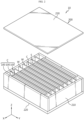
- FIG. 1 is a diagram showing a battery pack 10 according to an embodiment of the present disclosure
- FIG. 2 is a drawing to explain the detailed structure of the battery pack 10 of FIG. 1
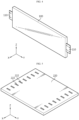
- FIG. 3 is an exploded perspective view showing the battery pack 10 of FIG. 1
- FIG. 4 is a diagram showing a battery cell 100 provided in the battery pack 10 of FIG. 1 .
- the X-axis direction shown in the drawings may mean front and rear directions of the battery pack 10, which will be described later
- the Y-axis direction may mean left and right directions of the battery pack 10 perpendicular to the X-axis direction on the horizontal plane (XY plane)
- the Z-axis direction may mean upper and lower directions perpendicular to both the X-axis direction and the Y-axis direction.
- the battery pack 10 may include a battery cell 100 and a pack housing 200.
- the battery cell 100 may refer to a secondary battery.
- This battery cell 100 may be prepared as a pouch-type battery cell, a cylindrical battery cell, or a prismatic battery cell.
- the battery cell 100 may be a pouch-type battery cell.
- an electrode lead 110 may be provided on at least one side (Y-axis direction) of the battery cell 100.
- two or more battery cells 100 may be provided to form a cell assembly C.
- the battery cells 100 may be stacked in one direction (e.g., X-axis direction) to form the cell assembly C.
- the pack housing 200 may be configured to accommodate the battery cell 100 therein.
- a cell accommodation portion S may be formed in the pack housing 200.
- the cell accommodation portion S is an empty space and may be provided in a shape that can accommodate at least one battery cell 100 therein.
- the cell accommodation portion S may be provided in a shape that can accommodate the battery cell 100 therein through a barrier W, which will be described later.
- the pack housing 200 may include a material with strong heat resistance and rigidity.
- the pack housing 200 may include a side frame 210, a floor frame 220, and an upper cover 230.
- the side frame 210 may configure the side of the pack housing 200.
- the side frame 210 may configure the side of the pack housing 200 in the front and rear directions (X-axis direction) and the side of the pack housing 200 in the left and right directions (Y-axis direction).
- the floor frame 220 constitutes the lower part of the pack housing 200 and may be connected to the lower part of the side frame 210.
- the upper cover 230 is coupled to the upper part of the side frame 210 and may cover the upper side of the battery cell 100 accommodated inside the pack housing 200. At this time, a heat transfer material (not shown) may be provided on the lower part of the upper cover 230.
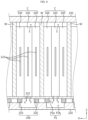
- FIG. 5 is a diagram showing a part of the pack housing 200 provided in the battery pack 10 of FIG. 1
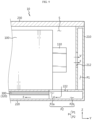
- FIG. 6 is a cross-sectional view showing the battery pack 10 in the direction A-A' of FIG. 1 (in detail, FIG. 6 is a cross-sectional view of the battery pack 10 of FIG. 1 with respect to the XZ plane based on A-A' line)
- FIG. 7 is a cross-sectional view showing the battery pack 10 in the direction B-B' of FIG. 1 (in detail, FIG. 7 is a cross-sectional view of the battery pack 10 of FIG. 1 with respect to the YZ plane based on B-B' line).
- the pack housing 200 may have a venting path P.
- the venting path P may include a first path P1 and a second path P2 in communication with the cell accommodation portion S at the side and the lower part of the pack housing 200, respectively. That is, the first path P1 may be configured in the side frame 210 and communicate with the cell accommodation portion S.
- the second path P2 may be configured in the floor frame 220 and communicate with the cell accommodation portion S. At this time, the second path P2 may be composed of two layers in the upper and lower directions within the floor frame 220.
- the battery pack 10 may further include a cooling module 300.
- the cooling module 300 may be installed at the lower part (floor frame 220) of the pack housing 200.
- the cooling module 300 may be a heat sink.
- venting gas may be generated from a specific battery cell, and when this venting gas meets oxygen, a flame may be generated inside or outside the battery pack.
- the battery pack 10 of the present disclosure can solve the above-mentioned problems by being equipped with the venting path P of the pack housing 200 and the cooling module 300 as described above.
- the venting path P may be configured to guide the discharge of venting gas and/or flame to the outside of the pack housing 200.
- the venting path P may provide a flow space so that the venting gas and/or flame discharged from the battery cell 100 can be discharged to the outside of the pack housing 200.
- the first path P1 may be provided on the side frame 210 and configured to face the electrode lead 110 of the battery cell 100 in the left and right directions (Y-axis direction) of the pack housing 200. Since the first path P1 may be configured to face the electrode lead 110 in this way, venting gas and/or flame with strong straightness may primarily flow into the first path P1 when the battery cell 100 thermally runs away. The venting gas and/or flame flowing into the side frame 210 through first path P1 in this way may collide with the inner surface of the side frame 210 and weaken its flow. As an example, a flame may contain particles. The particles are high-temperature active material particles or sparks discharged from the battery cell 100, and may be an ignition source.
- the cooling module 300 may be configured to cool the venting gas and/or flame discharged from the battery cell 100 and introduced into the second path P2.
- the venting gas and/or flame discharged from the battery cell 100 may be introduced into the second path P2 provided in the floor frame 220.
- the venting gas and/or flame introduced into the second path P2 in this way is cooled by the cooling module 300, and its flow may be weakened as the venting gas and/or flame flows within the second path P2.
- the second path P2 may be composed of two layers in the upper and lower directions within the floor frame 220, as described above. Therefore, as the venting gas and/or flame introduced into the second path P2 flows from the first layer of the second path P2 to the second layer or from the second layer of the second path P2 to the first layer, the flow may become weaker. Additionally, as the venting gas and/or flame flows in two layers, the contact time with the cooling module 300 can be increased.
- the side frame 210 may include a discharge hole. This discharge hole may be configured to communicate with the first path P1 to discharge venting gas and/or flame to the outside of the pack housing 200. Additionally, the floor frame 220 may include a discharge hole. This discharge hole may be configured to communicate with the second path P2 to discharge venting gas and/or flame to the outside of the pack housing 200.
- the flow of venting gas and/or flame can be guided in a certain direction. Accordingly, it is possible to minimize or prevent simultaneous ignition of a plurality of battery cells 100 by preventing thermal runaway or flame propagation between the battery cells 100.
- the venting path P is provided at the side and the lower part of the pack housing 200, so that the flow of venting gas and/or flame, which has strong straightness, is primarily directed to the side of the pack housing 200, and the flow of the remaining venting gas and/or flame is guided to the lower part of the pack housing 200 to be cooled. Accordingly, it is possible to minimize or prevent high temperature venting gas and/or flame from being rapidly discharged to the outside of the pack housing 200.
- the second path P2 of the venting path P is composed of two layers, it is possible to maximize the effect of cooling the venting gas and/or flame while weakening the flow of venting gas and/or flame.
- venting gas and/or flame can be cooled at the lower part of the pack housing 200, it is possible to minimize or prevent the venting gas and/or flame from being directed toward the driver's side located above the battery pack 10.
- the above-described side frame 210 may include a distribution hole 212.
- the first path P1 may communicate with the cell accommodation portion S through the distribution hole 212. That is, the venting gas and/or flame may quickly flow into the first path P1 through the distribution hole 212 corresponding to both sides of the cell accommodation portion S where the battery cell 100 is accommodated.
- the floor frame 220 described above may include a venting hole 222.
- the second path P2 may communicate with the cell accommodation portion S through the venting hole 222. That is, the venting gas and/or flame may quickly flow into the second path P2 through the venting hole 222 corresponding to the lower part of the cell accommodation portion S where the battery cell 100 is accommodated. At this time, the venting gas and/or flame may flow into the second path P2, which is composed of two layers, through the venting hole 222.
- simultaneous ignition of the plurality of battery cells 100 can be minimized or prevented by more stably guiding the flow of venting gas and/or flame to the venting path P.
- the second path P2 may include an upper path P2a and a lower path P2b.
- the upper path P2a may communicate with the cell accommodation portion S through the venting hole 222.
- the lower path P2b is disposed below the upper path P2a and may be in communication with the upper path P2a.
- the upper path P2a may be configured to extend along the left and right directions (Y-axis direction) of the pack housing 200.
- the lower path P2b may be configured to extend along the left and right directions of the pack housing 200. That is, the upper path P2a and the lower path P2b may form the upper and lower parts of the second path P2 in a vertically communicated form within the floor frame 220.
- venting gas and/or flame introduced into the second path P2 through the venting hole 222 may flow within the upper path P2a, and may also flow into the lower path P2b communicated with the upper path P2a and flow within the lower path P2b. Additionally, the venting gas and/or flame flowing within the lower path P2b may flow again to the upper path P2a and flow within the upper path P2a. Also, the flow direction of venting gas and/or flame within the upper path P2a may be in the same direction or in opposite directions to the flow direction of venting gas and/or flame within the lower path P2b, when viewed in the left and right directions (Y-axis direction) of the pack housing 200.
- the flow of venting gas and/or flame may be weakened, while increasing the contact time between the cooling module 300 and the venting gas and/or flame, thereby maximize the effect of cooling the venting gas and/or flame.
- the second path P2 is composed of two paths, the reverse inflow of venting gas and/or flame into the cell accommodation portion S through the venting hole 222 may be limited.
- the cooling module 300 may include a first cooling unit 310 and a second cooling unit 320.
- the first cooling unit 310 may be a heat sink.
- the second cooling unit 320 may be disposed on the opposite side of the first cooling unit 310 within the floor frame 220 with the upper path P2a interposed therebetween. That is, the first cooling unit 310 and the second cooling unit 320 may be arranged within the floor frame 220 with the upper path P2a interposed therebetween, when viewed in the front and rear directions (X-axis direction) of the pack housing 200.
- some of the high temperature venting gas and/or flame introduced into the second path P2 may be cooled between the first cooling unit 310 and the second cooling unit 320.
- the efficiency of cooling high temperature venting gas and/or flame by the cooling module 300 can be improved.
- the lower path P2b of the second path P2 may be disposed below the cooling module 300.
- the venting gas and/or flame cooled in the upper path P2a between the first cooling unit 310 and the second cooling unit 320 can be additionally cooled in the lower path P2b communicated with the upper path P2a.
- the lower path P2b may be located below the first cooling unit 310 and the second cooling unit 320.
- the venting gas and/or flame can be cooled even in the lower part of the cooling module 300, the effect of cooling the venting gas and/or flame can be maximized further by increasing the contact time between the cooling module 300 and the venting gas and/or flame.
- the electrode lead 110 of the battery cell 100 may be configured to face the venting path P. Specifically, the electrode lead 110 may be configured to face the first path P1 in the left and right directions (Y-axis direction) of the pack housing 200. Additionally, the electrode lead 110 may be configured to face the second path P2 in the upper and lower directions (Z-axis direction).
- the venting hole 222 may be formed in an area on the floor frame 220 corresponding to the electrode lead 110.
- the venting hole 222 is not formed in an area on the floor frame 220 corresponding to the entire lower part of the battery cell 100, but formed only in a narrow area of the floor frame 220, especially at both sides in the left and right directions (Y-axis direction) (see FIG. 3 ).
- venting gas and/or flame which has strong straightness, may be introduced through the first path P1.
- the venting gas and/or flame that does not flow into the first path P1 is introduced into the second path P2 through the venting hole 222, which has a relatively narrow area compared to the cell accommodation portion S, so that its flow may be weakened.
- the venting gas and/or flame introduced into the second path P2 through the venting hole 222 which has a relatively narrow area compared to the cell accommodation portion S, may be restricted from flowing back into the cell accommodation portion S.
- the venting gas and/or flame flows into the second path P2 through both left and right sides of the floor frame 220, the time during which high temperature venting gas and/or flame can be cooled by the cooling module 300 within the second path P2 may be increased.
- the flow of venting gas and/or flame can be clearly weakened, and also the time of cooling the high temperature venting gas and/or flame can be increased. Accordingly, the rapid discharge of high temperature venting gas and/or flame to the outside of the pack housing 200 can be more clearly minimized or prevented.
- the length of the venting hole 222 in the front and rear directions (X-axis direction) of the pack housing 200 can be configured to be shorter than the length of the upper path P2a in the front and rear directions of the pack housing 200.
- the area of the venting hole 222 may be smaller than the area of the corresponding upper path P2a on the horizontal plane (XY plane). Accordingly, when the venting gas and/or flame passes through the venting hole 222, the flow speed of venting gas and/or flame within the upper path P2a may be slower than the flow speed of venting gas and/or flame within the cell accommodation portion S.
- the flow of venting gas and/or flame introduced into the upper path P2a can be more securely weakened, so the time of cooling the high temperature venting gas and/or flame by the cooling module 300 can be further increased.
- the flow of venting gas and/or flame introduced into the upper path P2a is weakened, the flow of venting gas and/or flame within the lower path P2b communicated with the upper path P2a may also be weakened.
- FIGS. 8 and 9 are diagrams illustrating a state in which venting gas or flame is emitted during thermal runaway of a battery cell 100 in the battery pack 10 according to an embodiment of the present disclosure.
- venting gas and flame which will be described later in FIGS. 8 and 9 , will be denoted by reference symbols 'V' and 'F', respectively.
- the battery cell 100 may be provided in plurality. Additionally, the cell accommodation portion S may be provided in plurality. At this time, the plurality of cell accommodation portions S may be configured independently.
- the battery cell 100 may be accommodated in the cell accommodation portion S, respectively.
- the cell accommodation portion S may accommodate the cell assembly C having two or more battery cells 100.
- the pack housing 200 may include plurality of barriers W. Both sides of the barrier W may be connected to the side frame 210. At this time, both ends in the left and right directions (Y-axis direction) of the barrier W may be coupled to the side frame 210 disposed along the front and rear directions (X-axis direction) of the pack housing 200 among the side frames 210. Additionally, the barrier W may be formed to extend in the upper and lower directions to correspond to the height of the side frame 210. Additionally, the floor frame 220 may be coupled to the lower side of the barrier W, and the upper cover 230 may be coupled to the upper side of the barrier W.
- the barrier W may be in close contact with the front and rear surfaces of the battery cell 100 to seal the plurality of cell accommodation portions S from each other, when viewed in the front and rear directions (X-axis direction) of the pack housing 200. Meanwhile, when the cell assembly C is accommodated within each cell accommodation portion S, the barrier W may be in close contact with the front and rear surfaces of the cell assembly C.
- the distribution hole 212 of the side frame 210 and the venting hole 222 of the floor frame 220 may be configured to correspond to each cell accommodation portion S.
- the venting gas and/or flame can be guided to be introduced into the venting path P through the distribution hole 212 and the venting hole 222 more stably.
- FIGS. 10 and 11 are diagrams showing a battery pack 12 according to the second embodiment of the present disclosure. At this time, venting gas and flame, which will be described later in FIGS. 10 and 11 , will be denoted by reference symbols 'V' and 'F', respectively.
- the battery pack 12 according to this embodiment is similar to the battery pack 10 of the previous embodiment, redundant descriptions of components substantially the same as or similar to those of the previous embodiment will be omitted, and differences from the previous embodiment will be described below.
- the pack housing 200 may further include a first guide portion G1 and a second guide portion G2.
- the first guide portion G1 may be formed by bending from a portion of the venting hole 222 toward the inside of the upper path P2a. Specifically, one end of the first guide portion G1 may be coupled to a portion of the venting hole 222 close to the side frame 210. Additionally, the first guide portion G1 may be formed by bending from one end connected to the venting hole 222 toward the inside of the upper path P2a.
- the second guide portion G2 may be formed by bending from another part of the venting hole 222 toward the inside of the lower path P2b. Specifically, one end of the second guide portion G2 may be coupled to a portion of the venting hole 222 close to the side frame 210. Additionally, the second guide portion G2 may be bent from one end connected to the venting hole 222 toward the inside of the lower path P2b so that the other end may be coupled to the lower surface of the lower path P2b.
- the first guide portion G1 and the second guide portion G2 can provide more direction to the flow of venting gas and/or flame introduced into the second path P2 through the venting hole 222.
- the venting gas and/or flame introduced through the venting hole 222 can be guided through the first guide portion G1 and the second guide portion G2 and flow into the second path P2 more reliably.
- venting gas and/or flame introduced through the venting hole 222 may be induced to flow directly to the upper path P2a through the first guide portion G1, and the remaining venting gas and/or flame may be induced to flow directly to the lower path P2b through the second guide portion G2.
- the venting gas and/or flame that is primarily induced to flow to the upper path P2a through the first guide portion G1 may flow secondarily to the lower path P2b.
- the venting gas and/or flame that is primarily induced to flow to the lower path P2b through the second guide portion G2 may flow secondarily to the upper path P2a.
- the flow of the flame within the second path P2 can be further weakened, and also the contact time of the venting gas and/or flame and the cooling module 300 can be further increased.
- the flow of venting gas and/or flame can be weakened while being guided more stably, and also the high temperature venting gas and/or flame can be cooled more reliably by the cooling module 300.
- FIG. 12 is a diagram showing a battery pack 14 according to the third embodiment of the present disclosure. At this time, flame, which will be described later in FIG. 12 , will be denoted by reference symbol 'F'.
- the battery pack 14 according to this embodiment is similar to the battery pack 10 of the previous embodiment, redundant descriptions of components substantially the same as or similar to those of the previous embodiment will be omitted, and differences from the previous embodiment will be described below.
- the pack housing 200 may further include a flow limiting portion T.
- the flow limiting portion T may be provided on at least one of one side (X-axis direction one side) and the other side (X-axis direction the other side) of the lower path P2b. Specifically, the flow limiting portion T may be provided on at least one of the inner surfaces of the lower path P2b in the X-axis direction, and at least one flow limiting portion T may be provided in the form of protrusion.
- This flow limiting portion T may be configured to collide with particles contained in the flame emitted from the battery cell 100.
- the flame introduced into the upper path P2a through venting hole 222 can be initially weakened while flowing within the upper path P2a. Additionally, the flame introduced into the upper path P2a can be primarily cooled by the cooling module 300. In this way, the flame whose flow is primarily weakened within the upper path P2a can be further weakened secondarily through the flow limiting portion T within the lower path P2b.
- the flow of the flame within the second path P2 may be further weakened. Accordingly, the time of cooling the flame by the cooling module 300 can be increased by increasing the residual time of the flame within the second path P2.
- the discharge of ignition sources to the outside of the pack housing 200 can be further minimized.
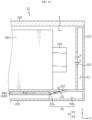
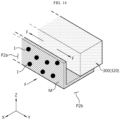
- FIGS. 13 and 14 are diagrams showing a battery pack 16 according to the fourth embodiment of the present disclosure.
- flame which will be described later in FIGS. 13 and 14
- particles which will be described later in FIG. 14
- reference symbol 'I' particles
- the battery pack 16 according to this embodiment is similar to the battery pack 10 of the previous embodiment, redundant descriptions of components substantially the same as or similar to those of the previous embodiment will be omitted, and differences from the previous embodiment will be described below.
- the pack housing 200 may further include a filtering portion M.
- FIG. 14 schematically shows a state in which the flame is cooled by the cooling module 300 after particles contained in the flame are filtered in the filtering portion M of FIG. 13 .
- the filtering portion M is provided in the second path P2 and may be configured to filter particles contained in the flame. Additionally, the filtering portion M may be configured to face the cooling module 300. As an example, the filtering portion M may be configured in the form of a mesh in which a plurality of fine holes are formed.
- the filtering portion M may be configured as a pair to face the first cooling unit 310 and the second cooling unit 320 in the front and rear directions (X-axis direction) of the pack housing 200, respectively.
- the filtering portion M may be configured to surround the cooling module 300 within the upper path P2a and the lower path P2b. That is, the filtering portion M may be configured to face the first cooling unit 310 or the second cooling unit 320 within the upper path P2a and the lower path P2b and to surround the first cooling unit 310 or the second cooling unit 320.
- this filtering portion M can primarily filter particles contained in the flame. Also, the flame from which large particles are filtered by the filtering portion M can be secondarily cooled through the cooling module 300.
- the process of filtering particles of the flame by the filtering portion M and the process of cooling the flame by the cooling module 300 can be performed sequentially, so the effect of cooling the flame by the cooling module 300 can be further improved.
- the battery pack 10, 12, 14, 16 according to the present disclosure can be applied to vehicles such as electric vehicles.
- the vehicle according to the present disclosure may include at least one battery pack 10, 12, 14, 16 according to the present disclosure.
Landscapes
- Chemical & Material Sciences (AREA)
- Chemical Kinetics & Catalysis (AREA)
- Electrochemistry (AREA)
- General Chemical & Material Sciences (AREA)
- Engineering & Computer Science (AREA)
- Manufacturing & Machinery (AREA)
- Aviation & Aerospace Engineering (AREA)
- Battery Mounting, Suspending (AREA)
- Secondary Cells (AREA)
- Gas Exhaust Devices For Batteries (AREA)
Applications Claiming Priority (2)
| Application Number | Priority Date | Filing Date | Title |
|---|---|---|---|
| KR1020220112577A KR20240033834A (ko) | 2022-09-06 | 2022-09-06 | 배터리 팩 및 이를 포함하는 자동차 |
| PCT/KR2023/009792 WO2024053839A1 (ko) | 2022-09-06 | 2023-07-10 | 배터리 팩 및 이를 포함하는 자동차 |
Publications (2)
| Publication Number | Publication Date |
|---|---|
| EP4459769A1 true EP4459769A1 (de) | 2024-11-06 |
| EP4459769A4 EP4459769A4 (de) | 2025-06-25 |
Family
ID=90191551
Family Applications (1)
| Application Number | Title | Priority Date | Filing Date |
|---|---|---|---|
| EP23863320.0A Pending EP4459769A4 (de) | 2022-09-06 | 2023-07-10 | Batteriepack und fahrzeug damit |
Country Status (5)
| Country | Link |
|---|---|
| EP (1) | EP4459769A4 (de) |
| JP (1) | JP7767596B2 (de) |
| KR (1) | KR20240033834A (de) |
| CN (1) | CN118266124A (de) |
| WO (1) | WO2024053839A1 (de) |
Families Citing this family (1)
| Publication number | Priority date | Publication date | Assignee | Title |
|---|---|---|---|---|
| CN116349063A (zh) * | 2020-11-13 | 2023-06-27 | 江苏时代新能源科技有限公司 | 箱体、电池、用电设备及电池的制造方法 |
Family Cites Families (13)
| Publication number | Priority date | Publication date | Assignee | Title |
|---|---|---|---|---|
| KR100684768B1 (ko) * | 2005-07-29 | 2007-02-20 | 삼성에스디아이 주식회사 | 이차 전지 모듈 |
| CN110190211B (zh) * | 2018-12-29 | 2020-03-31 | 比亚迪股份有限公司 | 电池托盘、动力电池包及车辆 |
| CN111384328A (zh) * | 2018-12-29 | 2020-07-07 | 比亚迪股份有限公司 | 电池托盘、动力电池包及车辆 |
| CN110190216B (zh) * | 2019-03-08 | 2020-06-19 | 比亚迪股份有限公司 | 动力电池包、储能装置以及电动车 |
| JP7259673B2 (ja) * | 2019-09-20 | 2023-04-18 | トヨタ自動車株式会社 | 電池パック |
| KR20210114752A (ko) * | 2020-03-11 | 2021-09-24 | 에스케이이노베이션 주식회사 | 에너지 저장 시스템 |
| CN114175363B (zh) * | 2020-07-10 | 2024-02-20 | 宁德时代新能源科技股份有限公司 | 电池及其相关装置、制备方法和制备设备 |
| CN114175377B (zh) * | 2020-07-10 | 2024-05-10 | 宁德时代新能源科技股份有限公司 | 电池及其相关装置、制备方法和制备设备 |
| CN221126070U (zh) * | 2020-11-13 | 2024-06-11 | 江苏时代新能源科技有限公司 | 箱体、电池、用电设备 |
| CN116349063A (zh) * | 2020-11-13 | 2023-06-27 | 江苏时代新能源科技有限公司 | 箱体、电池、用电设备及电池的制造方法 |
| KR102499372B1 (ko) | 2021-02-04 | 2023-02-10 | 강원대학교산학협력단 | 악성코드 학습 데이터 증강 장치, 방법 및 프로그램 |
| CN115668613B (zh) * | 2021-03-31 | 2024-01-19 | 宁德时代新能源科技股份有限公司 | 电池的箱体、电池、用电设备、制备箱体的方法和装置 |
| CN215644866U (zh) * | 2021-07-30 | 2022-01-25 | 蜂巢能源科技有限公司 | 电池组件 |
-
2022
- 2022-09-06 KR KR1020220112577A patent/KR20240033834A/ko active Pending
-
2023
- 2023-07-10 JP JP2024521863A patent/JP7767596B2/ja active Active
- 2023-07-10 EP EP23863320.0A patent/EP4459769A4/de active Pending
- 2023-07-10 WO PCT/KR2023/009792 patent/WO2024053839A1/ko not_active Ceased
- 2023-07-10 CN CN202380014578.XA patent/CN118266124A/zh active Pending
Also Published As
| Publication number | Publication date |
|---|---|
| JP2024539616A (ja) | 2024-10-29 |
| EP4459769A4 (de) | 2025-06-25 |
| WO2024053839A1 (ko) | 2024-03-14 |
| CN118266124A (zh) | 2024-06-28 |
| KR20240033834A (ko) | 2024-03-13 |
| JP7767596B2 (ja) | 2025-11-11 |
Similar Documents
| Publication | Publication Date | Title |
|---|---|---|
| EP4187700B1 (de) | Batteriemodul und batteriepack mit diesem | |
| EP4333183A1 (de) | Batteriemodul mit verbesserter entlüftungsleistung | |
| EP4358265B1 (de) | Batteriemodul, batteriepack und fahrzeug damit | |
| KR20240012284A (ko) | 배터리 팩 및 이를 포함하는 자동차 | |
| EP4184690B1 (de) | Batteriemodul und batteriepack mit diesem | |
| US20230378597A1 (en) | Battery module and battery pack including the same | |
| CA3213555A1 (en) | Battery module with improved safety | |
| JP7714681B2 (ja) | バッテリーモジュール、バッテリーパック、及びこれらを含む自動車 | |
| EP4459769A1 (de) | Batteriepack und fahrzeug damit | |
| EP4307453A1 (de) | Batteriepack mit verbesserter sicherheit | |
| CA3213473A1 (en) | Battery module and battery pack with reinforced safety | |
| KR101561121B1 (ko) | 효율적인 냉각 구조의 중대형 전지팩 | |
| EP4386960A1 (de) | Batteriepack und fahrzeug damit | |
| KR20240051647A (ko) | 배터리 팩 및 이를 포함하는 자동차 | |
| EP4539233A1 (de) | Batteriepack und fahrzeug damit | |
| EP4333185A1 (de) | Batteriemodul mit verstärkter sicherheit | |
| EP4546527A1 (de) | Batteriepack und fahrzeug damit | |
| EP4576381A1 (de) | Batteriepack und fahrzeug damit | |
| US20240186641A1 (en) | Battery module with reinforced safety | |
| US20250055122A1 (en) | Battery pack | |
| US20240413478A1 (en) | Battery Pack and Vehicle Including the Same | |
| KR20240074454A (ko) | 안전성이 강화된 배터리 모듈 | |
| CN121079822A (zh) | 电池组 |
Legal Events
| Date | Code | Title | Description |
|---|---|---|---|
| STAA | Information on the status of an ep patent application or granted ep patent |
Free format text: STATUS: THE INTERNATIONAL PUBLICATION HAS BEEN MADE |
|
| PUAI | Public reference made under article 153(3) epc to a published international application that has entered the european phase |
Free format text: ORIGINAL CODE: 0009012 |
|
| STAA | Information on the status of an ep patent application or granted ep patent |
Free format text: STATUS: REQUEST FOR EXAMINATION WAS MADE |
|
| 17P | Request for examination filed |
Effective date: 20240802 |
|
| AK | Designated contracting states |
Kind code of ref document: A1 Designated state(s): AL AT BE BG CH CY CZ DE DK EE ES FI FR GB GR HR HU IE IS IT LI LT LU LV MC ME MK MT NL NO PL PT RO RS SE SI SK SM TR |
|
| A4 | Supplementary search report drawn up and despatched |
Effective date: 20250526 |
|
| RIC1 | Information provided on ipc code assigned before grant |
Ipc: H01M 10/6551 20140101ALI20250520BHEP Ipc: H01M 10/625 20140101ALI20250520BHEP Ipc: H01M 10/613 20140101ALI20250520BHEP Ipc: H01M 50/249 20210101ALI20250520BHEP Ipc: H01M 50/30 20210101ALI20250520BHEP Ipc: H01M 50/383 20210101ALI20250520BHEP Ipc: H01M 50/367 20210101AFI20250520BHEP |
|
| DAV | Request for validation of the european patent (deleted) | ||
| DAX | Request for extension of the european patent (deleted) |