EP4459657A2 - Elektrische schaltvorrichtung und fremdkörpersperre dafür - Google Patents
Elektrische schaltvorrichtung und fremdkörpersperre dafür Download PDFInfo
- Publication number
- EP4459657A2 EP4459657A2 EP24195820.6A EP24195820A EP4459657A2 EP 4459657 A2 EP4459657 A2 EP 4459657A2 EP 24195820 A EP24195820 A EP 24195820A EP 4459657 A2 EP4459657 A2 EP 4459657A2
- Authority
- EP
- European Patent Office
- Prior art keywords
- leg
- barrier
- distal
- debris
- disposed
- Prior art date
- Legal status (The legal status is an assumption and is not a legal conclusion. Google has not performed a legal analysis and makes no representation as to the accuracy of the status listed.)
- Pending
Links
Images




Classifications
-
- H—ELECTRICITY
- H01—ELECTRIC ELEMENTS
- H01H—ELECTRIC SWITCHES; RELAYS; SELECTORS; EMERGENCY PROTECTIVE DEVICES
- H01H33/00—High-tension or heavy-current switches with arc-extinguishing or arc-preventing means
- H01H33/02—Details
- H01H33/04—Means for extinguishing or preventing arc between current-carrying parts
- H01H33/08—Stationary parts for restricting or subdividing the arc, e.g. barrier plate
-
- H—ELECTRICITY
- H01—ELECTRIC ELEMENTS
- H01H—ELECTRIC SWITCHES; RELAYS; SELECTORS; EMERGENCY PROTECTIVE DEVICES
- H01H9/00—Details of switching devices, not covered by groups H01H1/00 - H01H7/00
- H01H9/30—Means for extinguishing or preventing arc between current-carrying parts
- H01H9/34—Stationary parts for restricting or subdividing the arc, e.g. barrier plate
- H01H9/346—Details concerning the arc formation chamber
-
- H—ELECTRICITY
- H01—ELECTRIC ELEMENTS
- H01H—ELECTRIC SWITCHES; RELAYS; SELECTORS; EMERGENCY PROTECTIVE DEVICES
- H01H9/00—Details of switching devices, not covered by groups H01H1/00 - H01H7/00
- H01H9/30—Means for extinguishing or preventing arc between current-carrying parts
- H01H9/34—Stationary parts for restricting or subdividing the arc, e.g. barrier plate
- H01H9/36—Metal parts
-
- H—ELECTRICITY
- H01—ELECTRIC ELEMENTS
- H01H—ELECTRIC SWITCHES; RELAYS; SELECTORS; EMERGENCY PROTECTIVE DEVICES
- H01H9/00—Details of switching devices, not covered by groups H01H1/00 - H01H7/00
- H01H9/30—Means for extinguishing or preventing arc between current-carrying parts
- H01H9/34—Stationary parts for restricting or subdividing the arc, e.g. barrier plate
- H01H9/36—Metal parts
- H01H9/362—Mounting of plates in arc chamber
-
- H—ELECTRICITY
- H01—ELECTRIC ELEMENTS
- H01H—ELECTRIC SWITCHES; RELAYS; SELECTORS; EMERGENCY PROTECTIVE DEVICES
- H01H9/00—Details of switching devices, not covered by groups H01H1/00 - H01H7/00
- H01H9/30—Means for extinguishing or preventing arc between current-carrying parts
- H01H9/34—Stationary parts for restricting or subdividing the arc, e.g. barrier plate
- H01H2009/348—Provisions for recirculation of arcing gasses to improve the arc extinguishing, e.g. move the arc quicker into the arcing chamber
-
- H—ELECTRICITY
- H01—ELECTRIC ELEMENTS
- H01H—ELECTRIC SWITCHES; RELAYS; SELECTORS; EMERGENCY PROTECTIVE DEVICES
- H01H9/00—Details of switching devices, not covered by groups H01H1/00 - H01H7/00
- H01H9/30—Means for extinguishing or preventing arc between current-carrying parts
- H01H9/34—Stationary parts for restricting or subdividing the arc, e.g. barrier plate
- H01H9/36—Metal parts
- H01H2009/365—Metal parts using U-shaped plates
-
- H—ELECTRICITY
- H01—ELECTRIC ELEMENTS
- H01H—ELECTRIC SWITCHES; RELAYS; SELECTORS; EMERGENCY PROTECTIVE DEVICES
- H01H71/00—Details of the protective switches or relays covered by groups H01H73/00 - H01H83/00
- H01H71/02—Housings; Casings; Bases; Mountings
- H01H71/0207—Mounting or assembling the different parts of the circuit breaker
-
- H—ELECTRICITY
- H01—ELECTRIC ELEMENTS
- H01H—ELECTRIC SWITCHES; RELAYS; SELECTORS; EMERGENCY PROTECTIVE DEVICES
- H01H77/00—Protective overload circuit-breaking switches operated by excess current and requiring separate action for resetting
- H01H77/02—Protective overload circuit-breaking switches operated by excess current and requiring separate action for resetting in which the excess current itself provides the energy for opening the contacts, and having a separate reset mechanism
- H01H77/10—Protective overload circuit-breaking switches operated by excess current and requiring separate action for resetting in which the excess current itself provides the energy for opening the contacts, and having a separate reset mechanism with electrodynamic opening
- H01H77/107—Protective overload circuit-breaking switches operated by excess current and requiring separate action for resetting in which the excess current itself provides the energy for opening the contacts, and having a separate reset mechanism with electrodynamic opening characterised by the blow-off force generating means, e.g. current loops
- H01H77/108—Protective overload circuit-breaking switches operated by excess current and requiring separate action for resetting in which the excess current itself provides the energy for opening the contacts, and having a separate reset mechanism with electrodynamic opening characterised by the blow-off force generating means, e.g. current loops comprising magnetisable elements, e.g. flux concentrator, linear slot motor
Definitions
- the disclosed concept relates generally to electrical switching apparatus and, more particularly, to electrical switching apparatus, such as circuit breakers.
- the disclosed concept also relates to debris barriers for electrical switching apparatus.
- a circuit breaker may include, for example, a line conductor, a load conductor, a fixed contact and a movable contact, with the movable contact being movable into and out of electrically conductive engagement with the fixed contact. This switches the circuit breaker between an ON or closed position and an OFF or open position, or between the ON or closed position and a tripped or tripped OFF position.
- the fixed contact is electrically conductively engaged with one of the line and load conductors
- the movable contact is electrically conductively engaged with the other of the line and load conductors.
- the circuit breaker may also include an operating mechanism having a movable contact arm upon which the movable contact is disposed.
- circuit breakers typically include arc chutes which are structured to break-up the arcs.
- Each arc chute includes a plurality of spaced apart arc plates. As the movable contact is moved away from the stationary contact, the movable contact moves past the ends of the arc plates, with the arc being drawn toward and between the arc plates.
- the arc plates are electrically insulated from one another such that the arc is either split into multiple short arcs or squeezed into and extinguished by the arc plates.
- Arcs which extend between the electrical contacts, often result in metal material (e.g., without limitation, metal material of the electrical contacts or the movable arm) melting and being vaporized. This metal material creates debris, which can undesirably accumulate in critical functional areas of the circuit breaker and cause the circuit breaker to malfunction.
- metal material e.g., without limitation, metal material of the electrical contacts or the movable arm
- a debris barrier for an electrical switching apparatus.
- the electrical switching apparatus includes a pair of separable contacts and an arc interruption system having an arc chute located at or about the pair of separable contacts in order to not only extinguish the arc, but also attract and dissipate debris generated by the arc erosion while the pair of separable contacts trip open in response to an electrical fault.
- the arc chute includes a plurality of splitter plates each having an edge portion and at least one distal portion located opposite and distal the edge portion.
- the debris barrier includes a first leg, a second leg, and a middle portion connecting the first leg and the second leg. The middle portion is structured to be coupled to one of the pair of separable contacts.
- At least one of the first leg and the second leg has a first barrier portion and a second barrier portion extending from the first barrier portion.
- the first barrier portion is structured to be located at or about the distal portion.
- the second barrier portion is structured to extend from the first barrier portion toward the edge portion in order to redirect the debris toward the edge portion.
- an electrical switching apparatus including a pair of separable contacts, an arc interruption system, and the aforementioned debris barrier is provided.
- number shall mean one or an integer greater than one ( i.e., a plurality).
- the terms "generally U-shaped” or “generally U-shape” or “general U-shape” shall mean that the shape of a corresponding structure has the general shape of the letter “U” in which the bottom of such letter or structure is rounded, generally round, square, generally square, or partially round and partially square, or has the general shape of a base member with two leg (or arm) members extending normal or generally normal from the ends of the base member.
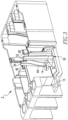
- FIGS. 1-3 depict different views of an electrical switching apparatus (e.g., without limitation, multi-pole circuit breaker 2), in accordance with one non-limiting embodiment of the disclosed concept.
- the example circuit breaker 2 has a plurality of poles 4,6,8, as shown in FIG. 2 .
- poles 6,8 are configured substantially the same as pole 4.
- Pole 4 has an arc interruption system 10, a movable contact (see, for example, movable contact 12, shown in FIGS. 2 and 5 ), and a line conductor 13 ( FIGS. 3-5 ) having a stationary contact 14 ( FIGS. 3-5 ).
- the movable contact 12 is structured to move into and out of engagement with the stationary contact 14 in a generally well known manner in order to close and open an electrical circuit, respectively. Furthermore, the separable contacts 12,14 are structured to generate debris when tripping open in response to an electrical fault.
- the arc interruption system 10 includes an arc chute 16 and a slot motor (e.g., a number of generally U-shaped ferromagnetic laminations 19).
- the arc chute 16 is located at or about the separable contacts 12,14 and functions to cool and split an arc that is generated by the separable contacts 12,14 tripping open in response to an electrical fault.
- the laminations 19 advantageously assist with accelerating the movable contact 12 during opening, thereby improving the interruption performance by reducing arcing energies.
- the arc chute 16 has a plurality of splitter plates 18 each having an edge portion 20 and at least one distal portion 22,24 ( FIG. 2 ) located opposite and distal the edge portion 20.
- the edge portion 20 is located at a rear portion of the arc chute 16, for example, opposite and distal the separable contacts 12,14 such that the movable contact 12 moves in a plane perpendicular to the edge portion 20.
- a suitable alternative arc chute (not shown) to employ splitter plates having only one distal portion opposite an edge portion.
- the circuit breaker 2 includes a novel debris barrier 50 that redirects debris generated from tripping open of the separable contacts 12,14. This protects critical functional areas of the circuit breaker 2, thereby minimizing the likelihood that the circuit breaker 2 will malfunction from debris accumulation.
- FIGS. 6-8 show different views of the debris barrier 50.
- the debris barrier 50 is a unitary component made from a single piece of thermoset material.
- the debris barrier 50 can better withstand arcing (e.g., is less likely to melt under tough arcing loads), as compared to a similarly structured thermoplastic debris barrier.
- certain regulations e.g., without limitation, regulations in the nuclear industry
- manufacture of the debris barrier 50 is advantageously relatively simple in that no separate assembly steps are required.
- the debris barrier 50 is generally U-shaped and includes a first leg 52, a second leg 54, and a middle portion 56 connecting the first leg 52 to the second leg 54.
- the middle portion 56 is preferably coupled to and reliably maintained on the stationary contact 14.
- the movable contact 12 is structured to move in a plane located between the first and second legs 52,54 (see, for example, FIG. 2 , wherein the movable contact 12 is located between the legs 52,54).
- the legs 52,54 include respective first barrier portions 58,60, respective second barrier portions 62,64 extending from the respective first barrier portions 58,60, and respective pocket portions 70,72 extending from the respective first barrier portions 58,60 away from the respective second barrier portions 62,64.
- the pocket portions 70,72 are a number of walls that are cooperatively structured to receive the laminations 19 ( FIGS. 1 , 2 , 4, and 5 ).
- the debris barrier 50 advantageously functions to redirect debris, as will be discussed below, and further to house and maintain the laminations 19.
- the first barrier portions 58,60 include respective barrier surfaces 59,61 that face away from the respective pocket portions 70,72.
- the second barrier portions 62,64 have respective barrier surfaces 63,65 that each extend at obtuse angles from one of the barrier surfaces 59,61 away from the respective pocket portions 70,72. Furthermore, the second barrier portions 62,64 have extension portions 66,68 extending from the respective barrier surfaces 63,65 and being located generally perpendicular to the respective first barrier portions 58,60.
- the first barrier portions 58,60 are located at or about the distal portions 22,24 of the splitter plates 18.
- the distal portions 22,24 engage the first barrier portions 58,60.
- the second barrier portions 62,64 extend from the first barrier portions 58,60 toward the edge portion 20. Accordingly, the second barrier portions 62,64 are located between the first distal portion 22 and the second distal portion 24.
- the second barrier portions 62,64 which are the portions of the debris barrier 50 extending away from the laminations 19, overlap a portion of the splitter plates 18 and/or extend into an interior of the arc chute 16.
- the second barrier portions 62,64 protrude outwardly from the first barrier portions 58,60 away from the laminations 19 and past the distal portions 22,24.
- the second barrier portions 62,64 are located substantially closer to the edge portion 20 than the distal portions 22,24.
- FIGS. 9 and 10 show simplified plan views of a conventional arc chute 116, and the arc chute 16 of the disclosed concept which is employed with the debris barrier 50, respectively.
- debris which is represented by dashed lines/arrows, is free to move from a source (e.g., an arcing region proximate a pair of separable contacts 112,114) away from an edge portion 120 of a splitter plate 118. It will be appreciated that movement of debris along the paths shown by the dashed lines/arrows in FIG.
- the debris barrier 50 results in a redirection of debris away from the critical functional areas and back toward the edge portion 20. More specifically, after the debris is generated by the arc erosion of surrounding materials while the separable contacts 12,14 trip open, the debris is moved toward the edge portion 20 and then away from the edge portion 20 by walls of the arc chute 16. However, rather than continuing to travel away from the edge portion 20, the first barrier portions 58,60 and the second barrier portions 62,64 cooperatively function to redirect the debris back toward the edge portion 20. Furthermore, the obtuse angles with which the barrier surfaces 63,65 extend from the first barrier portions 58,60 further aide with redirecting debris. Accordingly, the likelihood that debris will accumulate on critical functional areas of the circuit breaker 2 is significantly minimized, advantageously prolonging the life of the circuit breaker 2 and minimizing the possibility of a resulting malfunction.
- FIG. 11 shows another example electrical switching apparatus (e.g., without limitation, multi-pole circuit breaker 202), in accordance with another non-limiting embodiment of the disclosed concept.
- the example circuit breaker 202 includes a novel debris barrier 250, which is also shown in FIG. 12 .
- the second barrier portions 262,264 of the legs 252,254 of the debris barrier 250 each include a corresponding plurality of grooved regions 263,265. It will be appreciated that the grooved regions 263,265 are structured to receive the distal portions 222,224 of the splitter plates 218 (see, for example, FIG. 11 ).
- the debris barrier 250 in addition to redirecting debris, further functions to maintain the splitter plates 218 thereon and also prevents the arc from staying there and causing erosion of the arc plate legs. Additionally, as shown in FIG. 11 , the debris barrier 250 is also structured to receive the U-shaped ferromagnetic laminations 219.
- FIG. 13 shows another example electrical switching apparatus (e.g., without limitation, multi-pole circuit breaker 302), in accordance with another non-limiting embodiment of the disclosed concept.
- the example circuit breaker 302 includes a novel debris barrier 350, which is also shown in FIGS. 14 and 15 .
- the legs 352,354 of the debris barrier 350 each have a first end 361,365 and a second end 363,367 located opposite and distal the corresponding first end 361,365.
- the second ends 363,367 are located at the middle portion 356. Furthermore, as shown most clearly in FIG.
- the first barrier portions 358,360 of the legs 352,354 each have a corresponding plurality of grooved regions 369,371 located at a peripheral portion of the legs 352,354. More specifically, the grooved regions 369,371 extend longitudinally from the corresponding first ends 361,365 to the corresponding second ends 363,367. It will be appreciated that the grooved regions 369,371 advantageously function to provide a reservoir for debris (i.e., debris generated by separable contacts tripping open) to collect. That is, rather than being entirely redirected toward the second barrier portions 362,364, a significant portion of the debris is structured to be caught in the grooved regions 369,371, thereby further protecting critical functional areas of the circuit breaker 302.
- debris i.e., debris generated by separable contacts tripping open
- the distal portions of the splitter plates are spaced from the first barrier portions 358,360.
- debris has a pathway through which to pass, thus minimizing the likelihood that it will get stuck in this region and short out the splitter plates (e.g., an electrical connection of the splitter plates), a situation which would reduce the interruption performance and performance in dielectric testing.
- the debris barrier 350 is slightly V-shaped. That is, the legs 352,354 are spaced a greater distance from each other proximate a top of the debris barrier 350 than at an opposing bottom of the debris barrier 350. As a result, when the debris barrier 350 is inserted into the circuit breaker 302, the debris barrier 350 will be relatively tightly maintained therein. Additionally, it will be appreciated that the circuit breaker 302 of the disclosed concept is devoid of U-shaped ferromagnetic laminations. That is, the debris barrier 350 in the example of FIGS. 13-15 is not structured to house and maintain U-shaped ferromagnetic laminations.
- FIGS. 1-8 and 10-15 have been described in association with the debris barriers 50,250,350 having the first barrier portions 58,60,358,360 and the second barrier portions 62,64,262,264,362,364, it will be appreciated that other suitable alternative debris barriers may have barrier portions having different geometries, without departing from the scope of the disclosed concept.
- the disclosed concept provides for an improved (e.g., without limitation, better protected against malfunction) electrical switching apparatus 2,202,302 and debris barrier 50,250,350 therefor, in which a number of barrier portions 58,60,62,64,262,264,358,360,362,364 cooperatively function to redirect debris generated by a pair of separable contacts 12,14 tripping open away from critical functional areas of the electrical switching apparatus 2,202,302.
Landscapes
- Arc-Extinguishing Devices That Are Switches (AREA)
Applications Claiming Priority (3)
| Application Number | Priority Date | Filing Date | Title |
|---|---|---|---|
| US15/652,619 US10128069B1 (en) | 2017-07-18 | 2017-07-18 | Electrical switching apparatus and debris barrier therefor |
| PCT/IB2018/054666 WO2019016630A1 (en) | 2017-07-18 | 2018-06-25 | ELECTRICAL SWITCHING APPARATUS AND DEBRIS BARRIER THEREOF |
| EP18749119.6A EP3655979B1 (de) | 2017-07-18 | 2018-06-25 | Elektrische schaltvorrichtung und ablagerungsbarriere dafür |
Related Parent Applications (2)
| Application Number | Title | Priority Date | Filing Date |
|---|---|---|---|
| EP18749119.6A Division-Into EP3655979B1 (de) | 2017-07-18 | 2018-06-25 | Elektrische schaltvorrichtung und ablagerungsbarriere dafür |
| EP18749119.6A Division EP3655979B1 (de) | 2017-07-18 | 2018-06-25 | Elektrische schaltvorrichtung und ablagerungsbarriere dafür |
Publications (2)
| Publication Number | Publication Date |
|---|---|
| EP4459657A2 true EP4459657A2 (de) | 2024-11-06 |
| EP4459657A3 EP4459657A3 (de) | 2024-12-11 |
Family
ID=63077918
Family Applications (2)
| Application Number | Title | Priority Date | Filing Date |
|---|---|---|---|
| EP24195820.6A Pending EP4459657A3 (de) | 2017-07-18 | 2018-06-25 | Elektrische schaltvorrichtung und fremdkörpersperre dafür |
| EP18749119.6A Active EP3655979B1 (de) | 2017-07-18 | 2018-06-25 | Elektrische schaltvorrichtung und ablagerungsbarriere dafür |
Family Applications After (1)
| Application Number | Title | Priority Date | Filing Date |
|---|---|---|---|
| EP18749119.6A Active EP3655979B1 (de) | 2017-07-18 | 2018-06-25 | Elektrische schaltvorrichtung und ablagerungsbarriere dafür |
Country Status (4)
| Country | Link |
|---|---|
| US (1) | US10128069B1 (de) |
| EP (2) | EP4459657A3 (de) |
| CN (1) | CN110998771B (de) |
| WO (1) | WO2019016630A1 (de) |
Families Citing this family (6)
| Publication number | Priority date | Publication date | Assignee | Title |
|---|---|---|---|---|
| CN111755299B (zh) * | 2019-03-29 | 2022-07-05 | Ls产电株式会社 | 配线用断路器的灭弧装置 |
| KR102349754B1 (ko) * | 2019-12-06 | 2022-01-11 | 엘에스일렉트릭(주) | 아크 박스 및 이를 포함하는 전자 접촉기 |
| KR102542379B1 (ko) * | 2020-03-03 | 2023-06-12 | 엘에스일렉트릭(주) | 아크 소호 조립체 |
| CN213781970U (zh) * | 2020-11-12 | 2021-07-23 | 伊顿电气有限公司 | 断路器 |
| US11749475B2 (en) * | 2021-11-12 | 2023-09-05 | Eaton Intelligent Power Limited | Arc chute debris blocker |
| EP4632779A1 (de) * | 2024-04-08 | 2025-10-15 | Wöhner Besitz GmbH | Elektrischer schalter |
Family Cites Families (28)
| Publication number | Priority date | Publication date | Assignee | Title |
|---|---|---|---|---|
| US2244061A (en) * | 1940-07-31 | 1941-06-03 | Ite Circuit Breaker Ltd | Arc quencher |
| US5589672A (en) * | 1994-06-14 | 1996-12-31 | Fuji Electric Co., Ltd. | Circuit breaker with arc quenching device and vent |
| JP3216776B2 (ja) * | 1994-06-14 | 2001-10-09 | 富士電機株式会社 | 回路遮断器 |
| US6248970B1 (en) * | 1999-11-05 | 2001-06-19 | Siemens Energy & Automation, Inc. | ARC chute for a molded case circuit breaker |
| DE19956656A1 (de) * | 1999-11-25 | 2001-05-31 | Moeller Gmbh | Strombegrenzende Kontaktanordnung |
| IT1314358B1 (it) * | 1999-12-31 | 2002-12-09 | Abb Ricerca Spa | Camera d'arco per interruttori di bassa tensione |
| US6281459B1 (en) | 2000-04-21 | 2001-08-28 | Eaton Corporation | Circuit interrupter having an improved slot motor assembly |
| US6831536B1 (en) | 2003-08-29 | 2004-12-14 | Eaton Corporation | Circuit breaker slot motor having a stepped out portion |
| US6970059B2 (en) | 2003-12-11 | 2005-11-29 | Eaton Corporation | Slot motor including legs engaging openings of circuit breaker housing and electrical switching apparatus employing the same |
| KR20060035194A (ko) * | 2004-10-21 | 2006-04-26 | 엘에스산전 주식회사 | 배선용 차단기의 소호장치 |
| CN2743961Y (zh) * | 2004-11-11 | 2005-11-30 | 常熟开关制造有限公司(原常熟开关厂) | 断路器的灭弧装置 |
| US7348514B2 (en) | 2006-04-12 | 2008-03-25 | Eaton Corporation | Slot motor and circuit breaker including the same |
| US7358840B1 (en) | 2006-09-28 | 2008-04-15 | Eaton Corporation | Electrical switching apparatus including a split core slot motor and method of installing a slot motor assembly in a circuit interrupter |
| US7532097B2 (en) | 2007-02-12 | 2009-05-12 | Eaton Corporation | Slot motor housing and circuit interrupter including the same |
| JP4655094B2 (ja) * | 2008-02-08 | 2011-03-23 | 富士電機機器制御株式会社 | 消弧用樹脂加工品、及びそれを用いた回路遮断器 |
| AT509277A1 (de) * | 2008-03-05 | 2011-07-15 | Moeller Gebaeudeautomation Gmbh | Schaltgerät |
| CN101546681B (zh) * | 2009-04-27 | 2010-12-29 | 常熟开关制造有限公司(原常熟开关厂) | 低压断路器 |
| CN101789322B (zh) * | 2010-01-27 | 2011-09-28 | 江苏辉能电气有限公司 | 一种带放射状灭弧栅片的组合式灭弧室 |
| US8222983B2 (en) | 2010-12-08 | 2012-07-17 | Eaton Corporation | Single direct current arc chamber, and bi-directional direct current electrical switching apparatus employing the same |
| JP5682450B2 (ja) * | 2011-05-23 | 2015-03-11 | 富士電機機器制御株式会社 | 回路遮断器 |
| CN103383901B (zh) * | 2012-05-04 | 2015-08-12 | 伊顿电气有限公司 | 一种一体式隔弧装置 |
| US8368492B1 (en) | 2012-08-24 | 2013-02-05 | Eaton Corporation | Bidirectional direct current electrical switching apparatus |
| US8847096B2 (en) * | 2012-09-05 | 2014-09-30 | Eaton Corporation | Single direct current arc chute, and bi-directional direct current electrical switching apparatus employing the same |
| US9006601B2 (en) | 2013-03-13 | 2015-04-14 | Eaton Corporation | Arc chamber for bi-directional DC |
| US9396890B2 (en) * | 2014-05-28 | 2016-07-19 | Eaton Corporation | Electrical switching apparatus, and arc chute assembly and barrier member therefor |
| JP6237481B2 (ja) * | 2014-06-10 | 2017-11-29 | 三菱電機株式会社 | 回路遮断器 |
| US9653237B1 (en) | 2015-12-03 | 2017-05-16 | Eaton Corporation | Electrical switching apparatus and slot motor therefor |
| CN106449327A (zh) * | 2016-09-23 | 2017-02-22 | 德力西电气有限公司 | 一种用于灭弧室的灭弧罩 |
-
2017
- 2017-07-18 US US15/652,619 patent/US10128069B1/en active Active
-
2018
- 2018-06-25 CN CN201880054350.2A patent/CN110998771B/zh active Active
- 2018-06-25 WO PCT/IB2018/054666 patent/WO2019016630A1/en not_active Ceased
- 2018-06-25 EP EP24195820.6A patent/EP4459657A3/de active Pending
- 2018-06-25 EP EP18749119.6A patent/EP3655979B1/de active Active
Also Published As
| Publication number | Publication date |
|---|---|
| EP3655979A1 (de) | 2020-05-27 |
| US10128069B1 (en) | 2018-11-13 |
| WO2019016630A1 (en) | 2019-01-24 |
| EP3655979B1 (de) | 2024-10-16 |
| CN110998771A (zh) | 2020-04-10 |
| CN110998771B (zh) | 2023-09-12 |
| EP4459657A3 (de) | 2024-12-11 |
Similar Documents
| Publication | Publication Date | Title |
|---|---|---|
| US10128069B1 (en) | Electrical switching apparatus and debris barrier therefor | |
| EP3223293B1 (de) | Elektrische schaltvorrichtung und lichtbogenkammeranordnung sowie zugehöriges schaltungsschutzverfahren | |
| US6417474B1 (en) | Electrical switching apparatus having an arc runner with an elongated raised ridge | |
| US7716816B2 (en) | Method of manufacturing a switch assembly | |
| US9396890B2 (en) | Electrical switching apparatus, and arc chute assembly and barrier member therefor | |
| CA2271247C (en) | Electrical switching apparatus having arc runner integral with stationary arcing contact | |
| US8866034B2 (en) | Arc runner with integrated current path that develops a magnetic field to boost arc movement towards splitter plates | |
| US7812276B2 (en) | Electrical switching apparatus, and arc chute and arc member therefor | |
| US6518530B2 (en) | Current-limiting contact arrangement | |
| KR20140012034A (ko) | 회로 차단기 | |
| EP2064719B1 (de) | Lichtbogenleitblech und lichtbogenkammeranordnung sowie elektrische schaltung damit | |
| US7830232B2 (en) | Arc runner assembly and electrical switching apparatus and method incorporating same | |
| EP2048678B1 (de) | Gas abgebende Isolatoranordnung, Leiteranordnung und elektrische Schaltvorrichtung die dasselbe einsetzt | |
| EP1414057B1 (de) | Luftunterbrecherschalter | |
| US10068735B2 (en) | Electrical switching apparatus, and operating mechanism and lever assembly therefor | |
| KR200496737Y1 (ko) | 배선용 차단기의 트립 장치 | |
| JPH09171757A (ja) | 回路遮断器 | |
| JPH09171758A (ja) | 回路遮断器 |
Legal Events
| Date | Code | Title | Description |
|---|---|---|---|
| PUAI | Public reference made under article 153(3) epc to a published international application that has entered the european phase |
Free format text: ORIGINAL CODE: 0009012 |
|
| STAA | Information on the status of an ep patent application or granted ep patent |
Free format text: STATUS: REQUEST FOR EXAMINATION WAS MADE |
|
| REG | Reference to a national code |
Ref country code: DE Ref legal event code: R079 Free format text: PREVIOUS MAIN CLASS: H01H0071020000 Ipc: H01H0009340000 |
|
| 17P | Request for examination filed |
Effective date: 20240822 |
|
| AC | Divisional application: reference to earlier application |
Ref document number: 3655979 Country of ref document: EP Kind code of ref document: P |
|
| AK | Designated contracting states |
Kind code of ref document: A2 Designated state(s): AL AT BE BG CH CY CZ DE DK EE ES FI FR GB GR HR HU IE IS IT LI LT LU LV MC MK MT NL NO PL PT RO RS SE SI SK SM TR |
|
| PUAL | Search report despatched |
Free format text: ORIGINAL CODE: 0009013 |
|
| AK | Designated contracting states |
Kind code of ref document: A3 Designated state(s): AL AT BE BG CH CY CZ DE DK EE ES FI FR GB GR HR HU IE IS IT LI LT LU LV MC MK MT NL NO PL PT RO RS SE SI SK SM TR |
|
| RIC1 | Information provided on ipc code assigned before grant |
Ipc: H01H 71/02 20060101ALN20241104BHEP Ipc: H01H 77/10 20060101ALN20241104BHEP Ipc: H01H 9/36 20060101ALI20241104BHEP Ipc: H01H 9/34 20060101AFI20241104BHEP |
|
| STAA | Information on the status of an ep patent application or granted ep patent |
Free format text: STATUS: EXAMINATION IS IN PROGRESS |
|
| 17Q | First examination report despatched |
Effective date: 20260226 |