EP4459007A1 - Organische beschichtung und verfahren zur herstellung davon - Google Patents
Organische beschichtung und verfahren zur herstellung davon Download PDFInfo
- Publication number
- EP4459007A1 EP4459007A1 EP22915904.1A EP22915904A EP4459007A1 EP 4459007 A1 EP4459007 A1 EP 4459007A1 EP 22915904 A EP22915904 A EP 22915904A EP 4459007 A1 EP4459007 A1 EP 4459007A1
- Authority
- EP
- European Patent Office
- Prior art keywords
- organic film
- metal
- less
- acid
- protrusion
- Prior art date
- Legal status (The legal status is an assumption and is not a legal conclusion. Google has not performed a legal analysis and makes no representation as to the accuracy of the status listed.)
- Pending
Links
Images




Classifications
-
- B—PERFORMING OPERATIONS; TRANSPORTING
- B32—LAYERED PRODUCTS
- B32B—LAYERED PRODUCTS, i.e. PRODUCTS BUILT-UP OF STRATA OF FLAT OR NON-FLAT, e.g. CELLULAR OR HONEYCOMB, FORM
- B32B15/00—Layered products comprising a layer of metal
- B32B15/04—Layered products comprising a layer of metal comprising metal as the main or only constituent of a layer, which is next to another layer of the same or of a different material
-
- H—ELECTRICITY
- H05—ELECTRIC TECHNIQUES NOT OTHERWISE PROVIDED FOR
- H05K—PRINTED CIRCUITS; CASINGS OR CONSTRUCTIONAL DETAILS OF ELECTRIC APPARATUS; MANUFACTURE OF ASSEMBLAGES OF ELECTRICAL COMPONENTS
- H05K3/00—Apparatus or processes for manufacturing printed circuits
- H05K3/38—Improvement of the adhesion between the insulating substrate and the metal
- H05K3/389—Improvement of the adhesion between the insulating substrate and the metal by the use of a coupling agent, e.g. silane
-
- B—PERFORMING OPERATIONS; TRANSPORTING
- B32—LAYERED PRODUCTS
- B32B—LAYERED PRODUCTS, i.e. PRODUCTS BUILT-UP OF STRATA OF FLAT OR NON-FLAT, e.g. CELLULAR OR HONEYCOMB, FORM
- B32B15/00—Layered products comprising a layer of metal
- B32B15/04—Layered products comprising a layer of metal comprising metal as the main or only constituent of a layer, which is next to another layer of the same or of a different material
- B32B15/08—Layered products comprising a layer of metal comprising metal as the main or only constituent of a layer, which is next to another layer of the same or of a different material of synthetic resin
-
- C—CHEMISTRY; METALLURGY
- C09—DYES; PAINTS; POLISHES; NATURAL RESINS; ADHESIVES; COMPOSITIONS NOT OTHERWISE PROVIDED FOR; APPLICATIONS OF MATERIALS NOT OTHERWISE PROVIDED FOR
- C09D—COATING COMPOSITIONS, e.g. PAINTS, VARNISHES OR LACQUERS; FILLING PASTES; CHEMICAL PAINT OR INK REMOVERS; INKS; CORRECTING FLUIDS; WOODSTAINS; PASTES OR SOLIDS FOR COLOURING OR PRINTING; USE OF MATERIALS THEREFOR
- C09D5/00—Coating compositions, e.g. paints, varnishes or lacquers, characterised by their physical nature or the effects produced; Filling pastes
- C09D5/002—Priming paints
-
- C—CHEMISTRY; METALLURGY
- C09—DYES; PAINTS; POLISHES; NATURAL RESINS; ADHESIVES; COMPOSITIONS NOT OTHERWISE PROVIDED FOR; APPLICATIONS OF MATERIALS NOT OTHERWISE PROVIDED FOR
- C09D—COATING COMPOSITIONS, e.g. PAINTS, VARNISHES OR LACQUERS; FILLING PASTES; CHEMICAL PAINT OR INK REMOVERS; INKS; CORRECTING FLUIDS; WOODSTAINS; PASTES OR SOLIDS FOR COLOURING OR PRINTING; USE OF MATERIALS THEREFOR
- C09D7/00—Features of coating compositions, not provided for in group C09D5/00; Processes for incorporating ingredients in coating compositions
- C09D7/40—Additives
- C09D7/60—Additives non-macromolecular
- C09D7/61—Additives non-macromolecular inorganic
-
- C—CHEMISTRY; METALLURGY
- C09—DYES; PAINTS; POLISHES; NATURAL RESINS; ADHESIVES; COMPOSITIONS NOT OTHERWISE PROVIDED FOR; APPLICATIONS OF MATERIALS NOT OTHERWISE PROVIDED FOR
- C09D—COATING COMPOSITIONS, e.g. PAINTS, VARNISHES OR LACQUERS; FILLING PASTES; CHEMICAL PAINT OR INK REMOVERS; INKS; CORRECTING FLUIDS; WOODSTAINS; PASTES OR SOLIDS FOR COLOURING OR PRINTING; USE OF MATERIALS THEREFOR
- C09D7/00—Features of coating compositions, not provided for in group C09D5/00; Processes for incorporating ingredients in coating compositions
- C09D7/40—Additives
- C09D7/60—Additives non-macromolecular
- C09D7/63—Additives non-macromolecular organic
-
- C—CHEMISTRY; METALLURGY
- C23—COATING METALLIC MATERIAL; COATING MATERIAL WITH METALLIC MATERIAL; CHEMICAL SURFACE TREATMENT; DIFFUSION TREATMENT OF METALLIC MATERIAL; COATING BY VACUUM EVAPORATION, BY SPUTTERING, BY ION IMPLANTATION OR BY CHEMICAL VAPOUR DEPOSITION, IN GENERAL; INHIBITING CORROSION OF METALLIC MATERIAL OR INCRUSTATION IN GENERAL
- C23C—COATING METALLIC MATERIAL; COATING MATERIAL WITH METALLIC MATERIAL; SURFACE TREATMENT OF METALLIC MATERIAL BY DIFFUSION INTO THE SURFACE, BY CHEMICAL CONVERSION OR SUBSTITUTION; COATING BY VACUUM EVAPORATION, BY SPUTTERING, BY ION IMPLANTATION OR BY CHEMICAL VAPOUR DEPOSITION, IN GENERAL
- C23C22/00—Chemical surface treatment of metallic material by reaction of the surface with a reactive liquid, leaving reaction products of surface material in the coating, e.g. conversion coatings, passivation of metals
- C23C22/05—Chemical surface treatment of metallic material by reaction of the surface with a reactive liquid, leaving reaction products of surface material in the coating, e.g. conversion coatings, passivation of metals using aqueous solutions
- C23C22/06—Chemical surface treatment of metallic material by reaction of the surface with a reactive liquid, leaving reaction products of surface material in the coating, e.g. conversion coatings, passivation of metals using aqueous solutions using aqueous acidic solutions with pH less than 6
- C23C22/48—Chemical surface treatment of metallic material by reaction of the surface with a reactive liquid, leaving reaction products of surface material in the coating, e.g. conversion coatings, passivation of metals using aqueous solutions using aqueous acidic solutions with pH less than 6 not containing phosphates, hexavalent chromium compounds, fluorides or complex fluorides, molybdates, tungstates, vanadates or oxalates
- C23C22/52—Treatment of copper or alloys based thereon
-
- H—ELECTRICITY
- H05—ELECTRIC TECHNIQUES NOT OTHERWISE PROVIDED FOR
- H05K—PRINTED CIRCUITS; CASINGS OR CONSTRUCTIONAL DETAILS OF ELECTRIC APPARATUS; MANUFACTURE OF ASSEMBLAGES OF ELECTRICAL COMPONENTS
- H05K1/00—Printed circuits
- H05K1/02—Details
- H05K1/03—Use of materials for the substrate
- H05K1/0313—Organic insulating material
- H05K1/032—Organic insulating material consisting of one material
-
- H—ELECTRICITY
- H05—ELECTRIC TECHNIQUES NOT OTHERWISE PROVIDED FOR
- H05K—PRINTED CIRCUITS; CASINGS OR CONSTRUCTIONAL DETAILS OF ELECTRIC APPARATUS; MANUFACTURE OF ASSEMBLAGES OF ELECTRICAL COMPONENTS
- H05K2203/00—Indexing scheme relating to apparatus or processes for manufacturing printed circuits covered by H05K3/00
- H05K2203/07—Treatments involving liquids, e.g. plating, rinsing
- H05K2203/0779—Treatments involving liquids, e.g. plating, rinsing characterised by the specific liquids involved
- H05K2203/0786—Using an aqueous solution, e.g. for cleaning or during drilling of holes
- H05K2203/0789—Aqueous acid solution, e.g. for cleaning or etching
Definitions
- the present invention relates to an organic film and a method for producing the same.
- the present invention particularly relates to an organic film disposed on a metal surface for improving adhesive properties between a metal and a resin, and a method for producing the same.
- Patent Document 1 describes a film-forming composition for forming a film for improving adhesive properties with a resin on a surface of copper or a copper alloy in a printed wiring board. Specifically, attempts have been made to improve the adhesive properties between copper and a resin by adjusting the type of the silane coupling agent contained in the film-forming composition, the copper ion concentration, the Cu/Si molar ratio, and the pH.
- Patent Document 2 describes a copper surface treatment agent containing a tin compound, a complexing agent, and a silane coupling agent. Specifically, attempts have been made to improve the adhesive properties between a metal and a resin with the surface treatment agent by adding a tin compound or a complexing agent or adjusting the pH of the solution.
- Patent Document 3 describes a surface treatment liquid containing a specific silane coupling agent, a specific organic acid ion, an inorganic acid ion, an alkali metal ion and/or an ammonium ion, and a copper ion. Specifically, attempts have been made to improve the adhesive properties between a metal and a resin by including the above-described components in combination in the surface treatment liquid.
- the inventors of the present invention have found that adhesive properties between a metal and a resin cannot be sufficiently obtained yet by the conventional technique as described above. For example, when a resin layer was formed on the surface of an organic film and the resin was thermally cured, or when a HAST treatment (high temperature and high humidity treatment) was further performed after thermal curing, the adhesive properties between the metal and the resin was not sufficient.
- the inventors of the present invention have also found that the chemical resistance properties of an organic film when a resin layer formed on a metal with an organic film interposed therebetween is immersed in a chemical (for example, a basic solution, an acidic solution, or an organic solvent) are not sufficient. Specifically, when the organic film is dissolved in a chemical, a space may be observed between the metal and the resin, and/or peeling may be observed at an adhesion portion between the metal and the resin.
- a chemical for example, a basic solution, an acidic solution, or an organic solvent
- adheresive properties refers to properties that a metal and a resin (layer) adhere to each other with sufficiently high strength even when the resin (layer) is subjected to a thermal curing treatment or a HAST treatment after a thermal curing treatment on a surface of an organic film formed on a metal surface.
- the "chemical resistance properties” refer to properties that an organic film is hardly dissolved even when it comes into contact with a basic solution (in particular, a strongly basic solution such as a desmear solution), an acidic solution, or an organic solvent.
- An object of the present invention is to provide an organic film that is sufficiently excellent in adhesive properties between a metal and a resin and is also excellent in chemical resistance properties, and a method for producing the organic film.
- an object of the present invention is to provide an organic film that can sufficiently obtain adhesive properties between a metal and a resin even after full curing of a resin or even after HAST (high temperature and high humidity treatment) of an adhesion structure of a metal and a resin, and that is excellent in chemical resistance properties to a basic solution (in particular, a strongly basic solution such as a desmear solution), an acidic solution, or an organic solvent, and a method for producing the organic film.
- a basic solution in particular, a strongly basic solution such as a desmear solution
- an acidic solution such as a desmear solution
- organic solvent organic solvent
- the present invention relates to an organic film disposed on a metal surface, in which the organic film contains a silane coupling agent, and the organic film has a protrusion protruding to a side opposite to the metal.
- the present invention also relates to a method for producing an organic film, in which the method includs bringing a surface treatment liquid containing a silane coupling agent and an acid and having a pH of -1.0 or more and 1.9 or less into contact with a surface of a metal.
- the organic film according to the present invention is sufficiently excellent in adhesive properties between a metal and a resin.
- plan view refers to a state in which an object (for example, a metal having an organic film) is allowed to stand on a horizontal plane with its main surface (for example, a surface having a maximum area and on which an organic film is disposed) as an upper surface (top surface), and the object is viewed from the upper side or the lower side (in particular, the upper side) along a direction perpendicular to the horizontal plane.
- object for example, a metal having an organic film
- main surface for example, a surface having a maximum area and on which an organic film is disposed
- cross-sectional view refers to a state when viewed from a direction parallel to the horizontal plane.
- up-down directions and “left-right directions” used directly or indirectly in the present specification respectively correspond to the up-down directions and the left-right directions in the drawings.
- the same reference numerals or symbols indicate the same members/portions or the same semantic contents.
- the downward direction in a vertical direction that is, the direction in which gravity acts
- the opposite direction corresponds to the "upward direction”.
- the organic film of the present invention is an organic film disposed on a metal surface, and is a surface-treated film formed by surface treatment of a metal.
- an organic film 2 of the present invention has an uneven shape on the side opposite to a metal 1, specifically, includes a protrusion 20 protruding to the side opposite to the metal 1.
- the organic film 2 of the present invention includes the protrusion 20 protruding to the side opposite to the metal 1 and a recess 25 disposed between the protrusions 20.
- the recess 25 is a portion where no protrusion is formed in the organic film, and it may be a so-called flat portion.
- the organic film 2 contains a silane coupling agent and has an uneven shape (in particular, the protrusion 20).
- both the recess (that is, the flat portion) and the protrusion constituting the organic film 2 contain a silane coupling agent, and the protrusion is formed of an aggregate containing the silane coupling agent.
- an anchor effect based on the uneven shape (in particular, the protrusion 20) of the organic film 2 and an adhesion effect based on the silane coupling agent work, and the adhesive properties between the metal and the resin becomes stronger.
- the organic film containing the silane coupling agent causes the adhesion effect of the organic film itself to work, and the adhesive properties between the metal and the resin can be enhanced.
- the protrusion is formed of the aggregate containing the silane coupling agent, the contact area between the silane coupling agent and the resin increases, and the adhesive properties between the metal and the resin can be more sufficiently improved.
- the metal surface in particular, the metal circuit surface
- the adhesive properties between the metal circuit and the insulating resin layer can be more sufficiently improved by the anchor effect of the uneven shape (in particular, the protrusion) of the organic film and the adhesion effect of the silane coupling agent (in particular, the effect of increasing the contact area between the silane coupling agent and the resin).
- the protrusion 20 includes protrusions 20A, 20B, and 20C.
- Fig. 1 is a schematic cross-sectional view of an example of an organic film of the present invention.
- the protrusion 20 may have any shape as long as it protrudes to the side opposite to the metal 1.
- the protrusion 20 may have, for example, a polygonal shape such as a triangular shape, a quadrangular shape and a trapezoidal shape; a circular shape; an elliptical shape; a mountain-like shape; and an irregular shape, or the like in a cross-sectional view, may have a tuft shape in which a plurality of particles are connected as indicated by reference numeral "20A" in Fig. 1 , may have an umbrella open shape (for example, a mushroom shape) in which an umbrella is opened as indicated by reference numerals "20B" and "20C", or may have a composite shape thereof.
- the protrusion 20 may have a porous shape including pores.
- the protrusion 20 may be formed of an aggregate containing a silane coupling agent, and in this case, the aggregate may be an aggregate (secondary particle) of particles (primary particles) containing a silane coupling agent.
- the shape of the particles (primary particles) containing the silane coupling agent may have a spherical shape, a polyhedral shape, an irregular shape, or the like.
- the particles (primary particles) containing a silane coupling agent may be brought into contact with each other or necked (bonded) to form an aggregate (secondary particle), and the aggregate (secondary particle) may have a porous shape including pores.
- the aggregate as the protrusion has a porous shape including pores, not only the contact area between the organic film and the resin is more sufficiently increased, but also the anchor effect due to the entry of the resin into the pores functions more sufficiently. As a result, the adhesive properties between the metal circuit and the resin layer can further sufficiently improve.
- the size of the particles (primary particles) containing a silane coupling agent is usually 1 to 1000 nm, and is preferably 5 to 500 nm, more preferably 10 to 250 nm, and still more preferably 20 to 200 nm from the viewpoint of further improving the adhesive properties between the metal and the resin.
- the size of the particle (primary particle) containing a silane coupling agent is the average value of the maximum lengths of any 100 primary particles in plan view.
- the protrusion 20 may have a width-direction cut shape having a cut 200 in a width direction w in a cross-sectional view.
- the width-direction cut shape is a shape having a cut 200 cut in a direction in which the width is narrowed in the width direction w as shown in Figs. 1 and 2 in a cross-sectional view.
- the cut 200 is usually formed in a base portion of the protrusion 20.
- the base portion of the protrusion 20 is a root portion of the protrusion 20, and may be a portion (or a boundary portion) in the vicinity of the recess (flat portion) 25 in the protrusion 20.
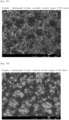
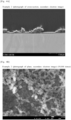
- a plurality of protrusions 20 are independently formed on the surface of the organic film 2, but they may be connected to each other at upper portions of the protrusions 20 to partially or entirely have a mesh shape or a porous shape in plan view, for example, as shown in Figs. 3B , 3C , 3D , 4B , 4C, 4D , and 4E .
- Fig. 2 is a schematic cross-sectional view of an example of the organic film of the present invention, which is a partially enlarged view showing the vicinity of a protrusion in an enlarged manner.
- 3B , 3C, and 3D are micrographs (SEM photographs) (secondary electron image at 30,000 times, secondary electron image at 5,000 times, and reflected electron image at 5,000 times, respectively) based on a plan view of a test piece having the organic film of the present invention, and are examples of SEM photographs showing protrusions of the organic film on a surface opposite to the metal (Example 1).
- SEM photographs secondary electron image at 30,000 times, secondary electron image at 5,000 times, and reflected electron image at 5,000 times, respectively
- 4B , 4C , 4D , and 4E are micrographs (SEM photographs) (secondary electron image at 50,000 times, secondary electron image at 30,000 times, secondary electron image at 5,000 times, and reflected electron image at 5,000 times, respectively) based on a plan view of a test piece having the organic film of the present invention, and are examples of SEM photographs showing protrusions of the organic film on a surface opposite to the metal (Example 2).
- each protrusion 20 includes the cut 200 at the base portion, the anchor effect functions more effectively, and the adhesion between the metal and the resin further sufficiently improves.
- each protrusion 20 includes the cut 200 on both sides in the width direction w in Figs. 1 and 2 , but it may have the cut only on one side.
- the protrusion 20 has a tuft shape in which a plurality of particles are connected, the anchor effect functions more effectively, and the adhesion between the metal and the resin further sufficiently improves.
- the protrusion 20 has a porous shape including pores, the anchor effect functions more effectively, and the adhesion between the metal and the resin further sufficiently improves.
- the protrusion length of the protrusion 20 is usually 20 to 5000 nm, and is preferably 50 to 800 nm, more preferably 70 to 600 nm, still more preferably 100 to 500 nm, particularly preferably 310 to 460 nm, and sufficiently preferably 350 to 450 nm from the viewpoint of further improving adhesive properties between the metal and the resin and chemical resistance properties.
- the protrusion length of the protrusion 20 is a difference between the average height of the protrusion 20 and the average height of the recess 25.
- the average height of the protrusion 20 is an average value of a length (distance) h1 from a metal-side surface 21 of the organic film 2 to an organic film surface 22 at the highest portion of the protrusion 20 in a cross-sectional view.
- a value obtained by the following method is used as the average height of the protrusion 20.
- the average height of the recess 25 corresponds to the thickness of the flat portion of the organic film 2, and is an average value of a length (distance) h2 from the metal-side surface 21 of the organic film 2 to an any point on the organic film surface 22 of the recess 25 in a cross-sectional view as shown in Fig. 2 .
- a value obtained by the following method is used as the average height of the recess 25.
- the height h2 of the recess at any one point in each region is measured, and the average of 12 points in total is obtained.
- the average height of the recesses 25 (the thickness of the flat portion of the organic film 2) is not particularly limited, and is usually 10 to 300 nm, and is preferably 10 to 100 nm, more preferably 15 to 80 nm, still more preferably 15 to 60 nm, particularly preferably 15 to 50 nm, sufficiently preferably 15 to 40 nm, and more sufficiently preferably 25 to 40 nm from the viewpoint of further improving the adhesive properties between the metal and the resin and the chemical resistance properties.
- the protrusion ratio of the protrusion 20 is usually 10 to 5000%, and is preferably 100 to 3000%, more preferably 200 to 2000%, still more preferably 500 to 1500%, particularly preferably 800 to 1500%, sufficiently preferably 1000 to 1500%, and more sufficiently preferably 1200 to 1500% from the viewpoint of further improving the adhesive properties between the metal and the resin and the chemical resistance properties.
- the protrusion ratio of the protrusion 20 is a ratio of the protrusion length of the protrusion 20 to the average height of the recess 25.
- the protrusion 20 occupies a certain range in a plan view of the organic film 2.
- the protrusions 20 are preferably connected to each other at a portion higher than the base portion in plan view in order to have a mesh shape or a porous shape at least in part (that is, partially or entirely), for example, as shown in Figs. 3B , 3C , 3D , 4B , 4C, 4D , and 4E .
- the occupation ratio of the protrusion 20 is not particularly limited as long as the effect of improving the adhesive properties between the metal and the resin is obtained, and may be, for example, 10 to 95%, and is preferably 20 to 90%, more preferably 40 to 85%, still more preferably 45 to 80%, and particularly preferably 50 to 80% from the viewpoint of further improving the adhesive properties between the metal and the resin and the chemical resistance properties.
- a region not occupied by the protrusion 20 is usually constituted by the recess (that is, the flat portion) 25.
- the occupancy ratio of the protrusion 20 is a ratio of the protrusion 20 to the entire organic film 2 in plan view.
- a value obtained by the following method is used as the occupancy ratio of the protrusion 20.
- binarization is performed with reference to a threshold determined by a method of Yen, a percentage of the number of pixels of the protrusion 20 to the number of pixels of the entire image is calculated, and an occupancy ratio of the protrusion is obtained. An average value of the occupancy ratios of the protrusion in the visual fields is used as the occupancy ratio of the protrusion.
- the lower limit value of the surface roughness (line roughness) represented by a roughness parameter based on JIS B0633:2001 of the organic film 2 of the present invention is not particularly limited, and is preferably as follows from the viewpoint of further improving the adhesive properties between the metal and the resin:
- the upper limit value of the surface roughness is not particularly limited, and is preferably as follows from the viewpoint of further improving the adhesive properties between the metal and the resin and the chemical resistance properties:
- the range of the surface roughness (plane roughness) represented by the parameter of the surface property based on ISO 25178 of the organic film 2 of the present invention is not particularly limited, but from the viewpoint of further improving the adhesive properties between the metal and the resin, the following parameters related to the surface roughness of the organic film 2 are each preferably the following ranges:
- the parameter of the surface roughness (plane roughness) of the organic film that is, the parameter related to the surface roughness
- an average value measured at any five points by the following method is used.
- both the protrusion 20 and the recess (that is, the flat portion) 25 have the same composition in that they contain a silane coupling agent (in particular, the protrusion 20 is formed of an aggregate containing a silane coupling agent).
- the organic film 2 may be disposed in direct or indirect contact with the surface of the metal 1. Specifically, as shown in Figs. 1 and 2 , the organic film 2 may be disposed in direct contact with the surface of the metal 1, or may be disposed in indirect contact with the surface of the metal 1 by interposing another film therebetween.
- the metal 1 on which the organic film 2 of the present invention is disposed is not particularly limited, and examples thereof include copper, aluminum, titanium, nickel, tin, iron, silver, gold, and alloys thereof.
- the alloy are not particularly limited as long as it is an alloy containing copper in the case of a copper alloy, and examples thereof include alloys of Cu-Ag type, Cu-Te type, Cu-Mg type, Cu-Sn type, Cu-Si type, Cu-Mn type, Cu-Be-Co type, Cu-Ti type, Cu-Ni-Si type, Cu-Zn-Ni type, Cu-Cr type, Cu-Zr type, Cu-Fe type, Cu-Al type, Cu-Zn type, Cu-Co type, and Cu-Fe-P type (KFC material).
- the metal 1 may in particular be a metal circuit (in particular, a copper circuit) of a printed wiring board.
- the metal 1 on which the organic film 2 of the present invention is disposed is usually also referred to as a "metal substrate", and it may have any shape.
- the surface roughness of the surface of the metal 1 on which the organic film 2 of the present invention is disposed is not particularly limited.
- Ra (arithmetic average roughness) may be 0.20 ⁇ m or less, and is preferably 0.10 ⁇ m or less, and more preferably 0.05 ⁇ m or less from the viewpoint of preventing deterioration (transmission loss) of electrical characteristics due to the skin effect of metal.
- Rz maximum height roughness
- the range of the surface roughness represented by the parameter of the surface property based on ISO 25178 of the metal 1 on which the organic film 2 of the present invention is disposed is not particularly limited.
- the following parameters related to the surface roughness of the metal 1 are each usually within the following ranges.
- the parameter of the surface roughness (plane roughness) of the metal 1 that is, the parameter related to the surface roughness
- an average value measured at any five points by the following method is used.
- a resin is usually disposed on the side of the organic film 2 opposite to the metal 1. As a result, the organic film 2 is usually present between the metal 1 and the resin.
- the resin may have any shape, for example, a layer shape.
- Such a resin material examples include nylon, an acrylate resin, an epoxy resin, a polybenzoxazole resin, a silicone resin, a polyimide resin, a bismaleimide resin, a maleimide resin, a cyanate resin, a polyphenylene ether resin, a polyphenylene oxide resin, a polybutadiene resin, an olefin resin, a fluorine-containing resin, a polyetherimide resin, a polyetheretherketone resin, and a liquid crystal resin.
- the resin material may be a combination of these resin materials mixed or modified with each other.
- a polyphenylene ether resin a polyphenylene oxide resin, a liquid crystal resin, an acrylate resin, an epoxy resin, an olefin resin, a polybenzoxazole resin, a silicone resin, and a polyimide resin are preferable, and an epoxy resin is particularly preferable.
- a resin material may contain a filler such as silica or alumina for the purpose of, for example, improving heat resistance or reducing the coefficient of thermal expansion (CTE).
- the organic film of the present invention can be produced by bringing a specific surface treatment liquid into contact with a metal surface.
- the surface treatment liquid is an aqueous solution containing a silane coupling agent and an acid and having a pH of 1.9 or less. Bringing such a surface treatment liquid into contact with the surface of the metal causes the silane coupling agent to be precipitated and aggregated on the surface of the metal, and as a result, an organic film having protrusions is formed.
- the organic film of the present invention is formed of a precipitate or aggregate containing the silane coupling agent, and contributes to improvement of adhesive properties between the metal and the resin.
- the pH of the surface treatment liquid is more than 1.9, an organic film having protrusions cannot be obtained.
- the components contained in the surface treatment liquid are as described later.
- the pH of the surface treatment liquid is 1.9 or less (in particular, -1.0 or more and 1.9 or less), and is, for example, a range obtained by combining a range of - 1.0 or more and less than 1.0 (hereinafter, may be referred to as a "range A") and a range of 1.0 or more and 1.9 or less (hereinafter, may be referred to as a "range B").
- range A a range obtained by combining a range of - 1.0 or more and less than 1.0
- range B range of 1.0 or more and 1.9 or less
- the pH of the surface treatment liquid is preferably -1.0 or more and 1.5 or less, more preferably in the range A, still more preferably -0.7 or more and less than 1.0, particularly preferably -0.7 or more and 0.55 or less, sufficiently preferably -0.5 or more and 0.5 or less, more sufficiently preferably -0.4 or more and 0.5 or less, and most preferably -0.35 or more and -0.05 or less from the viewpoint of further improving the adhesive properties between the metal and the resin and the chemical resistance properties, and the forming property of the protrusion.
- the pH range "-1.0 or more and 1.5 or less” is a range obtained by combining a range of -1.0 or more and less than 1.0 (that is, the "range A”) and a range of 1.0 or more and 1.5 or less (hereinafter, may be referred to as a "range B'").
- the pH of the surface treatment liquid is preferably -1.0 or more, more preferably -0.5 or more, still more preferably -0.4 or more, particularly preferably -0.2 or more, sufficiently preferably -0.1 or more, and most preferably 0.1 or more from the viewpoint of further improving the adhesive properties between the metal and the resin and the chemical resistance properties.
- the upper limit of the pH in this case is usually 1.9, and the pH is preferably 1.5 or less, more preferably less than 1.0, still more preferably 0.6 or less, particularly preferably 0.55 or less, sufficiently preferably 0.48 or less, and more sufficiently preferably 0.42 or less from the viewpoint of further improving the adhesive properties between the metal and the resin and the chemical resistance properties.
- the pH of the surface treatment liquid is preferably -1.0 or more, more preferably -0.8 or more, and still more preferably -0.4 or more from the viewpoint of further improving the adhesive properties between the metal and the resin and the chemical resistance properties.
- the upper limit of the pH in this case is usually 1.9, and the pH is preferably 1.5 or less, more preferably less than 1.0, still more preferably 0.9 or less, particularly preferably 0.6 or less, sufficiently preferably 0.2 or less, and more sufficiently preferably -0.15 or less from the viewpoint of further improving the adhesive properties between the metal and the resin and the chemical resistance properties.
- the pH of the surface treatment liquid can be controlled by adjusting the type and content of the acid and the base.
- the pH a value measured by a pH meter (HM-30R manufactured by DKK-TOA CORPORATION) is used.
- a pH meter was calibrated at 20°C ⁇ 0.2°C using three types of pH standard solutions (pH 1.68 standard solution, pH 4.01 standard solution, pH 6.86 standard solution) in advance.
- the pH of the surface treatment liquid was measured at 20°C ⁇ 0.2°C.
- the method for bringing the surface treatment liquid into contact with the surface of the metal is not particularly limited as long as direct contact between the surface treatment liquid and the metal surface is achieved, and for example, a method such as a spraying method, an immersion method, or a coating method can be adopted.
- the time (treatment time) for bringing the surface treatment liquid into contact with the metal surface may be appropriately determined according to the desired thickness of the flat portion of the organic film, the desired protrusion length of the protrusion 20, and the composition of the surface treatment liquid. Since the surface treatment liquid has a sufficiently high film-forming speed, a protrusion having a desired protrusion length can be formed within a predetermined time.
- the time for bringing the surface treatment liquid into contact with the surface of the metal is not particularly limited, and is preferably 1 second to 10 minutes, more preferably 5 seconds to 3 minutes, and still more preferably 20 seconds to 50 seconds, from the viewpoint of further improving the adhesive properties between the metal and the resin and the chemical resistance properties.
- the treatment time is 1 second or more, the organic film having the protrusion 20 on the metal surface can be sufficiently formed.
- a resin layer for example, an insulating resin layer
- a sufficiently high adhesive force between the metal and the resin layer can be obtained.
- the temperature of the surface treatment liquid at the time of causing the surface treatment liquid to adhere to the surface of the metal is not particularly limited, and is preferably 5 to 50°C. However, the temperature may be appropriately set in relation to the treatment time, the desired film thickness of the flat portion of the organic film, and the protrusion length of the protrusion 20.
- the surface treatment liquid After the surface treatment liquid is brought into contact with the surface of the metal, it is preferable to perform water washing as necessary, and then dry the surface of the metal. Drying is preferably performed at a temperature of room temperature (for example, 20°C) to 150°C, preferably at a temperature of 60 to 120°C, for a time of about 1 second to 10 minutes, preferably 10 seconds to 3 minutes. Pure water such as ion-exchanged water, distilled water, and purified water is preferable as water used for water washing.
- the method and time of water washing are not particularly limited, and may be an appropriate time in a method such as a spraying method or an immersion method.
- the dried organic film may be subjected to a treatment such as plasma, laser, ion beam, ozone, heating, or humidification to modify the surface of the organic film.
- a treatment such as plasma, laser, ion beam, ozone, heating, or humidification to modify the surface of the organic film.
- cleaning for the purpose of removing resin and ion residues on the metal surface may be performed using mechanical polishing such as plasma, laser, ion beam, or pumice brush, or a processing method such as drilling.
- an aqueous solution containing copper ions may be brought into contact with the surface of the metal.
- the aqueous solution containing copper ions has a function of enhancing the film formability of the organic film formed on the surface of copper and a function of enhancing the adhesive properties between the metal and the resin.
- the valency of the copper ion is not particularly limited, and is a monovalent or divalent copper ion.
- the copper ion source of the aqueous solution containing copper ions is not particularly limited as long as it is a copper salt dissolved in a solvent used for the surface treatment liquid, and examples thereof include copper salts such as copper sulfate, copper nitrate, cuprous chloride, cupric chloride, copper formate, copper acetate, cuprous bromide, cupric bromide, and copper phosphate. Ammonia and/or hydrochloric acid or the like may be added to solubilize the copper salt in water.
- An acidic or basic aqueous solution may be brought into contact with the surface of the metal before and/or after bringing the surface treatment liquid into contact with the surface of the metal.
- this acidic aqueous solution or basic aqueous solution also has a function of enhancing the film-forming property of the organic film formed on the surface of copper.
- the acidic aqueous solution and the basic aqueous solution are not particularly limited. Examples of the acidic aqueous solution include an aqueous solution containing an inorganic acid such as sulfuric acid, nitric acid, or hydrochloric acid, and an aqueous solution containing an organic acid such as formic acid, acetic acid, lactic acid, glycolic acid, or amino acid.
- Examples of the basic aqueous solution include aqueous solutions containing a hydroxide of an alkali metal such as sodium hydroxide or potassium hydroxide, and an amine such as ammonia, ethanolamine, monopropanolamine, or tetramethylammonium hydroxide.
- a hydroxide of an alkali metal such as sodium hydroxide or potassium hydroxide
- an amine such as ammonia, ethanolamine, monopropanolamine, or tetramethylammonium hydroxide.
- Performing the treatment as described above makes it possible to form an organic film having a protrusion on the surface of the metal, and it is possible to sufficiently enhance the adhesive properties between the resin layer formed on the organic film and the metal.
- the metal oxidation can be suppressed because of the protection by the organic film.
- adhesive properties between the metal wiring layer (metal circuit) and the insulating resin layer (resin material) can be enhanced and formation of metal oxide can be reduced without particularly performing roughening treatment on the metal wiring layer.
- the silane coupling agent is an organic silane compound having a silyl group containing at least one hydroxyl group or alkoxy group.
- a silane coupling agent is preferably a silane coupling agent containing a nitrogen atom in the molecule from the viewpoint of further improving the adhesive properties between the metal and the resin (in particular, the adhesive properties between the metal and the organic film).
- the nitrogen atom is contained in at least one of a substituent and a heterocyclic skeleton.
- the nitrogen atom may be contained only in the substituent (for example, an amino group), may be contained only in the heterocyclic skeleton, or may be contained in both the substituent (for example, an amino group) and the heterocyclic skeleton.
- the nitrogen atom is preferably contained in at least the heterocyclic skeleton, and more preferably contained in both the substituent (for example, an amino group) and the heterocyclic skeleton.
- Examples of the substituent containing a nitrogen atom include an amino group, an amide group, a cyano group, a nitro group, an azo group, a diazo group, a carbamide group, a ureido group, an azido group, and a guanidino group.
- Examples of the amino group include an unsubstituted amino group, a monosubstituted amino group, and a disubstituted amino group. Examples of the unsubstituted amino group include - NH 2 .
- Examples of the mono-substituted amino group include a methylamino group, an ethylamino group, an n-propylamino group, an n-aminohexylamino group, a 2-aminoethylamino group, and a phenylamino group.
- Examples of the disubstituted amino group include a dimethylamino group, a diethylamino group, an ethylmethylamino group, and a diphenylamino group.
- the substituent containing a nitrogen atom is preferably an amino group, more preferably an unsubstituted amino group or a monosubstituted amino group, and still more preferably an unsubstituted amino group, from the viewpoint of further improving the adhesive properties between the metal and the resin (in particular, adhesive properties between the metal and the organic film).
- heterocyclic skeleton containing a nitrogen atom examples include monocyclic rings such as pyrrole, pyrazole, diazole (imidazole), triazole, tetrazole, oxazole, oxadiazole, isoxazole, thiazole, isothiazole, furazan, pyridine, pyridazine, pyrimidine, pyrazine, triazine, tetrazine, pentazine, azepine, diazepine, and triazepine; fused bicyclic rings such as indole, isoindole, thienoindole, indazole, purine, quinoline, isoquinoline, benzodiazole, and benzotriazole; fused tricyclic rings such as carbazole, acridine, ⁇ -carboline, acridone, perimidine, phenazine, phenanthridine,
- the heterocyclic skeleton containing a nitrogen atom is preferably an aromatic ring, more preferably diazole, triazole, tetrazole, benzotriazole, or triazine, still more preferably triazole, benzotriazole, or tetrazole, particularly preferably benzotriazole or tetrazole, and sufficiently preferably tetrazole.
- Examples of the silane coupling agent in which a nitrogen atom is contained only in a substituent include 3-aminopropyldimethylmethoxysilane, 3-aminopropyldimethoxymethylsilane, 3-aminopropylmethyldiethoxysilane, 3-aminopropyltrimethoxysilane, 3-aminopropyltriethoxysilane, 3-(2-aminoethylamino)propylmethyldimethoxysilane, 3-(2-aminoethylamino)propylmethyldiethoxysilane, 3-(2-aminoethylamino)propyltrimethoxysilane, 3-(2-aminoethylamino)propyltriethoxysilane, 3-[2-(2-aminoethylamino)ethylamino]propyltrimethoxysilane, [3-(6-aminohexylamino
- the silane coupling agent containing a nitrogen atom in at least a heterocyclic skeleton examples include an azole silane coupling agent and a triazine silane coupling agent.
- the silane coupling agent preferably contains an azole silane coupling agent, more preferably one or more azolesilane compounds selected from the group consisting of a triazolesilane compound and a tetrazolesilane compound, and still more preferably a tetrazolesilane compound, from the viewpoint of further improving the adhesive properties between the metal and the resin, the chemical resistance properties, and improving the storage stability of the surface treatment liquid.
- the "storage stability” refers to a property that it is difficult to generate a precipitate due to the silane coupling agent in the surface treatment liquid even when the surface treatment liquid is stored after being prepared.
- “storage stability” refers to storage stability of the surface treatment liquid, but in the present invention, the storage stability is not necessarily a property that the surface treatment liquid must have, and is a property that the surface treatment liquid preferably has.
- Examples of the silane coupling agent in which a nitrogen atom is contained in both a substituent (for example, an amino group) and a heterocyclic skeleton include an amino group-containing azole silane coupling agent and an amino group-containing triazine silane coupling agent.
- the azole silane coupling agent is one or more azole silane compounds selected from the group consisting of a monoazole silane compound, a diazole silane compound, a triazole silane compound, and a tetrazole silane compound.
- the azole silane coupling agent preferably contains one or more azole silane compounds selected from the group consisting of a triazole silane compound and a tetrazole silane compound, and more preferably contains a tetrazole silane compound.
- the triazolesilane compound is a compound having one silyl group-containing alkyl group (for example, a -(CH 2 ) m -Si(OR) 3-n (OH) n group in General Formula (Ia) described later) in one molecule as a substituent in a heterocyclic 5-membered ring compound containing three nitrogen atoms (that is, a triazole compound).
- the atom to which the silyl group-containing alkyl group is bonded is an atom constituting a triazole ring, and may be, for example, a nitrogen atom or a carbon atom.
- the atom to which the silyl group-containing alkyl group is bonded is preferably a nitrogen atom from the viewpoint of further improving the adhesive properties between the metal and the resin and the chemical resistance properties.
- the triazole ring constituting the triazolesilane compound may be a 1,2,4-triazole ring or a 1,2,3-triazole ring.
- the triazole ring is preferably a 1,2,4-triazole ring from the viewpoint of further improving the adhesive properties between the metal and the resin and the chemical resistance properties.
- triazolesilane compound examples include triazolesilane compounds represented by General Formulas (Ia) and (Ib).
- the compounds represented by General Formulas (Ia) and (Ib) may be referred to as a triazolesilane compound (Ia) and a triazolesilane compound (Ib), respectively.
- X 1 and X 2 each independently represent a hydrogen atom, a linear or branched alkyl group having 1 to 12 carbon atoms, a phenyl group, a benzyl group, an amino group, or an alkylthio group having 1 to 6 carbon atoms.
- alkyl group examples include a methyl group, an ethyl group, a n-propyl group, an isopropyl group, a n-butyl group, an isobutyl group, a sec-butyl group, a tert-butyl group, an n-pentyl group, an n-hexyl group, an n-heptyl group, an n-octyl group, an n-nonyl group, an n-decyl group, an n-undecyl group, and an n-dodecyl group.
- alkylthio group examples include a methylthio group, an ethylthio group, an n-propylthio group, an isopropylthio group, an n-butylthio group, an isobutylthio group, a sec-butylthio group, a tert-butylthio group, an n-pentylthio group, and an n-hexylthio group.
- X 1 and X 2 may be the same or different and are preferably the same.
- X 1 and X 2 each independently preferably represent a hydrogen atom, a linear or branched alkyl group having 1 to 12 carbon atoms (in particular, a linear or branched alkyl group having 1 to 8 carbon atoms), a phenyl group, or an amino group, more preferably represent a hydrogen atom, a linear or branched alkyl group having 1 to 5 carbon atoms, or an amino group, and still more preferably represent an amino group, from the viewpoint of further improving the adhesive properties between the metal and the resin and the chemical resistance properties.
- m represents an integer of 1 to 12. From the viewpoint of improving the solubility of the azolesilane compound and further improving the adhesive properties between the metal and the resin and the chemical resistance properties, m represents an integer of preferably 1 to 10, more preferably 1 to 5, and still more preferably 2 to 5.
- n represents an integer of 0 to 3.
- R represents a methyl group or an ethyl group.
- R preferably represents an ethyl group from the viewpoint of improving the working environment.
- the triazolesilane compound (Ia) in which at least one of X 1 and X 2 is an amino group in Formula (Ia) is included in the amino group-containing azole silane coupling agent.
- m, n, and R are the same as m, n, and R in Formula (Ia), respectively.
- the other group may be selected from groups within similar ranges as X 1 and X 2 in Formula (Ia).
- X 1 , X 2 , m, n, and R are the same as X 1 , X 2 , m, n, and R in Formula (Ia), respectively.
- X 1 and X 2 each independently preferably represent a hydrogen atom, a linear or branched alkyl group having 1 to 12 carbon atoms (in particular, a linear or branched alkyl group having 1 to 8 carbon atoms), a phenyl group, or an amino group, more preferably represent a hydrogen atom, a linear or branched alkyl group having 1 to 5 carbon atoms, or an amino group, and still more preferably represent an amino group, from the viewpoint of further improving the adhesive properties between the metal and the resin and the chemical resistance properties.
- X 1 and X 2 may be bonded to each other to form a carbocyclic ring having 6 to 10 carbon atoms (in particular, a benzene ring or a naphthalene ring (preferably a benzene ring)) that is condensed with the triazole ring in Formula (Ib).
- the number of carbon atoms of the carbocyclic ring also includes the number of carbon atoms shared with the triazole ring condensed with the carbocyclic ring.
- m represents an integer of preferably 1 to 10, more preferably 1 to 5, and still more preferably 2 to 5.
- n represents an integer of 0 to 3.
- R represents a methyl group or an ethyl group.
- R preferably represents an ethyl group from the viewpoint of improving the working environment.
- the silyl group-containing alkyl group (that is, -(CH 2 ) m -Si(OR) 3-n (OH) n ) is bonded to the nitrogen atom at the 1-position, but may be bonded to the nitrogen atom at the 2-position.
- the triazolesilane compound (Ib) represented by General Formula (Ib) includes a triazolesilane compound in which a silyl group-containing alkyl group is bonded to a nitrogen atom at the 2-position instead of the nitrogen atom at the 1-position in General Formula (Ib).
- triazolesilane compounds in which the silyl group-containing alkyl group is bonded to the nitrogen atom at the 1-position or the 2-position are referred to as “triazolesilane compound (Ib) 1-position conjugate” or “triazolesilane compound (Ib) 2-position conjugate”, respectively.
- the triazolesilane compound (Ib) in which at least one of X 1 and X 2 is an amino group in Formula (Ib) is included in the amino group-containing azole silane coupling agent.
- m, n, and R are the same as m, n, and R in Formula (Ib), respectively.
- the other group may be selected from groups within similar ranges as X 1 and X 2 in Formula (Ib).
- the triazolesilane compound (Ia) includes triazolesilane compounds represented by General Formulas (Ia-1) to (Ia-4).
- the compounds represented by General Formulas (Ia-1) to (Ia-4) may be referred to as a triazolesilane compound (Ia-1), a triazolesilane compound (Ia-2), a triazolesilane compound (Ia-3), and a triazolesilane compound (Ia-4), respectively.
- X 1 , X 2 , m, and R are the same as X 1 , X 2 , m, and R in Formula (Ia), respectively.
- Preferred X 1 , X 2 , m, and R in Formulas (Ia-1) to (Ia-4) are also the same as preferred X 1 , X 2 , m, and R in Formula (Ia), respectively.
- the triazolesilane compounds (Ia-1) to (la-4) in which at least one of X 1 and X 2 is an amino group in Formulas (Ia-1) to (la-4) are included in the amino group-containing azole silane coupling agent.
- m and R are the same as m and R in Formulas (Ia-1) to (la-4), respectively.
- the other group may be selected from groups within similar ranges as X 1 and X 2 in Formulas (Ia-1) to (la-4).
- the triazolesilane compound (Ia-1) is a triazolesilane compound (trialkoxy form) when n is 0 in General Formula (Ia).
- the triazole silane compound (Ia-2) is a triazole silane compound when n is 1
- the triazole silane compound (Ia-3) is a triazole silane compound when n is 2
- the triazole silane compound (Ia-4) is a triazole silane compound when n is 3.
- triazolesilane compound (Ia) examples include triazolesilane compounds (Ia-1) exemplified below, and triazolesilane compounds (Ia-2) to (Ia-4) obtained by hydrolyzing (or converting) one to three alkoxy groups (for example, a methoxy group and/or an ethoxy group) to a hydroxyl group in the triazolesilane compound (Ia-1):
- the triazolesilane compound (Ia-1) can be synthesized in accordance with WO 2018/186476 , US 2012/0021232 , and WO 2019/058773 .
- a triazole compound in the present specification, it may be referred to as a triazole compound (Ia-x)) represented by General Formula (Ia-x)
- a halogenated alkylsilane compound in the present specification, it may be referred to as a halogenated alkylsilane compound (Ia-y)) represented by General Formula (Ia-y)
- a reaction solvent in the presence of a dehydrohalogenating agent at an appropriate reaction temperature and reaction time, whereby synthesis can be performed in a generally high yield.
- X 1 , X 2 , m, and R are the same as X 1 , X 2 , m, and R in Formula (Ia), respectively.
- the triazolesilane compounds (Ia) to (Ia-4) can be synthesized by bringing a trialkoxy triazolesilane compound (Ia-1) into contact with an appropriate amount of water and hydrolyzing the compound.
- the triazolesilane compound (Ia) may be a mixture of triazolesilane compounds (Ia-1) to (Ia-4).
- the triazolesilane compound (Ib) includes triazolesilane compounds represented by General Formulas (Ib-1) to (Ib 4).
- the compounds represented by General Formulas (Ib-1) to (Ib-4) may be referred to as a triazolesilane compound (Ib-1), a triazolesilane compound (Ib-2), a triazolesilane compound (Ib-3), and a triazolesilane compound (Ib-4), respectively.
- X 1 , X 2 , m, and R are the same as X 1 , X 2 , m, and R in Formula (Ib), respectively.
- preferred X 1 , X 2 , m, and R are the same as preferred X 1 , X 2 , m, and R in Formula (Ib), respectively.
- the silyl group-containing alkyl group (that is, - (CH2) m -Si(OR) 3-n (OH) n ) is bonded to the nitrogen atom at the 1-position, but may be bonded to the nitrogen atom at the 2-position.
- the triazolesilane compounds (Ib-1) to (Ib-4) represented by General Formulas (Ib-1) to (Ib-4) include triazolesilane compounds in which a silyl group-containing alkyl group is bonded to a nitrogen atom at the 2-position instead of the nitrogen atom at the 1-position in General Formulas (Ib-1) to (Ib-4), respectively.
- the triazolesilane compounds (Ib-1) to (Ib-4) in which at least one of X 1 and X 2 is an amino group in Formulas (Ib-1) to (Ib-4) are included in the amino group-containing azole silane coupling agent.
- m and R are the same as m and R in Formulas (Ib-1) to (Ib-4), respectively.
- the other group may be selected from groups within similar ranges as X 1 and X 2 in Formulas (Ib-1) to (Ib-4).
- the triazolesilane compound (Ib-1) is a triazolesilane compound (trialkoxy form) when n is 0 in General Formula (Ib).
- the triazole silane compound (Ib-2) is a triazole silane compound when n is 1
- the triazole silane compound (Ib-3) is a triazole silane compound when n is 2
- the triazole silane compound (Ib-4) is a triazole silane compound when n is 3.
- triazolesilane compound (Ib) examples include triazolesilane compounds (Ib-1) exemplified below, and triazolesilane compounds (Ib-2) to (Ib-4) obtained by hydrolyzing (or converting) one to three alkoxy groups (for example, a methoxy group and/or an ethoxy group) to a hydroxyl group in the triazolesilane compound (Ib-1):
- the triazolesilane compound (Ib-1) among the triazolesilane compounds (Ib) can be synthesized in a substantially high yield by the same method as the reaction scheme (E) except that the triazole compound (in the present specification, it may be referred to as a triazole compound (Ib-x)) represented by General Formula (Ib-x) is used instead of the triazole compound (Ia-x).
- X 1 and X 2 are the same as X 1 and X 2 in Formula (Ib), respectively.
- the triazolesilane compounds (Ib) to (Ib-4) can be synthesized by bringing a trialkoxy triazolesilane compound (Ib-1) into contact with an appropriate amount of water and hydrolyzing the compound.
- the triazolesilane compound (Ib) may be a mixture of triazolesilane compounds (Ib-1) to (Ib-4).
- the triazolesilane compound (Ib) may be particularly a mixture of the "triazolesilane compound (Ib) 1-position conjugate” and the "triazolesilane compound (Ib) 2-position conjugate".
- the ratio of the mixture is not particularly limited, and may be, for example, 10 : 90 to 90 : 10, preferably 20 : 80 to 80 : 20, and more preferably 30 : 70 to 70 : 30 in terms of a molar ratio of "triazolesilane compound (Ib) 1-position conjugate” : "triazolesilane compound (Ib) 2-position conjugate".
- the monoazolesilane compound is a compound having one silyl group-containing alkyl group (for example, the same group as -(CH 2 ) m -Si(OR) 3-n (OH) n group in General Formula (Ia)) in one molecule as a substituent in a heterocyclic 5-membered ring compound containing one nitrogen atom (that is, a monoazolesilane compound).
- the atom to which the silyl group-containing alkyl group is bonded is an atom constituting a monoazole ring, and may be, for example, a nitrogen atom or a carbon atom.
- the monoazolesilane compound may further have a substituent (for example, groups similar to X 1 and X 2 in General Formula (Ia)).
- the atom to which the substituent is bonded is an atom constituting a monoazole ring, and may be, for example, a nitrogen atom or a carbon atom.
- the monoazolesilane compound has an amino group as a substituent
- the monoazolesilane compound is included in the amino group-containing azole silane coupling agent.
- the diazolesilane compound is a compound having one silyl group-containing alkyl group (for example, the same group as -(CH 2 ) m -Si(OR) 3-n (OH) n group in General Formula (Ia)) in one molecule as a substituent in a heterocyclic 5-membered ring compound containing two nitrogen atoms (that is, a diazolesilane compound).
- the atom to which the silyl group-containing alkyl group is bonded is an atom constituting a diazole ring, and may be, for example, a nitrogen atom or a carbon atom.
- the atom to which the silyl group-containing alkyl group is bonded is preferably a nitrogen atom from the viewpoint of further improving the adhesive properties between the metal and the resin and the chemical resistance properties.
- the diazolesilane compound may further have a substituent (for example, groups similar to X 1 and X 2 in General Formula (Ia)).
- the atom to which the substituent is bonded is an atom constituting a diazole ring, and may be, for example, a nitrogen atom or a carbon atom.
- the diazolesilane compound has an amino group as a substituent
- the diazolesilane compound is included in the amino group-containing azole silane coupling agent.
- the tetrazolesilane compound is a compound having one silyl group-containing alkyl group (for example, the same group as -(CH 2 ) m -Si(OR) 3-n (OH) n group in General Formula (Ic) described later) in one molecule as a substituent in a heterocyclic 5-membered ring compound containing four nitrogen atoms (that is, a tetrazolesilane compound).
- the atom to which the silyl group-containing alkyl group is bonded is an atom constituting a tetrazole ring, and may be, for example, a nitrogen atom or a carbon atom.
- the atom to which the silyl group-containing alkyl group is bonded is preferably a nitrogen atom from the viewpoint of further improving the adhesive properties between the metal and the resin and the chemical resistance properties.
- the tetrazolesilane compound may further have a substituent (for example, a group similar to X 1 in General Formula (Ia)).
- the atom to which the substituent (for example, the same group as X 1 in General Formula (Ia)) is bonded is an atom constituting a tetrazole ring, and may be, for example, a nitrogen atom or a carbon atom.
- the atom to which the substituent (for example, the same group as X 1 in General Formula (Ia)) is bonded is preferably a carbon atom from the viewpoint of further improving adhesive properties between metal and resin and chemical resistance properties.
- Examples of the tetrazolesilane compound include a tetrazolesilane compound represented by General Formula (Ic).
- the compound represented by General Formula (Ic) may be referred to as a tetrazolesilane compound (Ic).
- X 1 , m, n, and R are the same as X 1 , m, n, and R in Formula (Ia), respectively.
- X 1 preferably represents a hydrogen atom, a linear or branched alkyl group having 1 to 12 carbon atoms (in particular, a linear or branched alkyl group having 1 to 8 carbon atoms), a phenyl group or an amino group, more preferably a phenyl group or an amino group, and still more preferably an amino group, from the viewpoint of further improving the adhesive properties between the metal and the resin and the chemical resistance properties.
- m represents an integer of preferably 1 to 10, more preferably 1 to 5, and still more preferably 2 to 5, from the viewpoint of improving the solubility of the azolesilane compound.
- n represents an integer of 0 to 3.
- R represents a methyl group or an ethyl group.
- R preferably represents an ethyl group from the viewpoint of improving the working environment.
- the silyl group-containing alkyl group (that is, -(CH 2 ) m -Si(OR) 3-n (OH) n ) is bonded to the nitrogen atom at the 2-position, but may be bonded to the nitrogen atom at the 1-position.
- the tetrazolesilane compound (Ic) represented by General Formula (Ic) includes a tetrazolesilane compound in which a silyl group-containing alkyl group is bonded to a nitrogen atom at the 1-position instead of the nitrogen atom at the 2-position in General Formula (Ic).
- tetrazolesilane compounds in which the silyl group-containing alkyl group is bonded to the nitrogen atom at the 1-position or the 2-position are referred to as "tetrazolesilane compound (Ic) 1-position conjugate” or “tetrazolesilane compound (Ic) 2-position conjugate", respectively.
- the tetrazolesilane compound (Ic) in which X 1 is an amino group in Formula (Ic) is included in the amino group-containing azole silane coupling agent.
- m, n, and R are the same as m, n, and R in Formula (Ic), respectively.
- the tetrazolesilane compound (Ic) includes tetrazolesilane compounds represented by General Formulas (Ic-1) to (Ic-4).
- the compounds represented by General Formulas (Ic-1) to (Ic-4) may be referred to as a tetrazolesilane compound (Ic-1), a tetrazolesilane compound (Ic-2), a tetrazolesilane compound (Ic-3), and a tetrazolesilane compound (Ic-4), respectively.
- the silyl group-containing alkyl group is bonded to the nitrogen atom at the 2-position, but may be bonded to the nitrogen atom at the 1-position as in Formula (Ic).
- X 1 , m, and R are the same as X 1 , m, and R in Formula (Ia), respectively.
- preferred X 1 , m, and R are the same as preferred X 1 , m, and R in Formula (Ic), respectively.
- the silyl group-containing alkyl group that is, - (CH 2 ) m -Si(OR) 3-n (OH) n
- the tetrazolesilane compounds (Ic-1) to (Ic-4) represented by General Formulas (Ic-1) to (Ic-4) includes a tetrazolesilane compound in which a silyl group-containing alkyl group is bonded to a nitrogen atom at the 1-position instead of a nitrogen atom at the 2-position in General Formulas (Ic-1) to (Ic-4), respectively.
- tetrazolesilane compounds (Ic-1) to (Ic-4) in which X 1 is an amino group in Formulas (Ic-1) to (Ic-4) are included in the amino group-containing azole silane coupling agent.
- m and R are the same as m and R in Formulas (Ic-1) to (Ic-4), respectively.
- the tetrazolesilane compound (Ic-1) is a tetrazolesilane compound (trialkoxy form) when n is 0 in General Formula (Ic).
- the tetrazolesilane compound (Ic-2) is a tetrazolesilane compound when n is 1
- the tetrazolesilane compound (Ic-3) is a tetrazolesilane compound when n is 2
- the tetrazolesilane compound (Ic-4) is a tetrazolesilane compound when n is 3.
- tetrazolesilane compound (Ic) examples include tetrazolesilane compounds (Ic-1) exemplified below, and tetrazolesilane compounds (Ic-2) to (Ic-4) obtained by hydrolyzing (or converting) one to three alkoxy groups (for example, a methoxy group and/or an ethoxy group) to a hydroxyl group in the tetrazolesilane compound (Ic-1):
- the tetrazolesilane compound (Ic-1) among the tetrazolesilane compounds (Ic) can be synthesized in a substantially high yield by the same method as the above-described reaction scheme (E) except that the tetrazole compound (in the present specification, it may be referred to as a tetrazole compound (Ic-x)) represented by General Formula (Ic-x) is used instead of the triazole compound (Ia-x).
- X 1 is the same as X 1 in Formula (Ia).
- Tetrazolesilane compounds (Ic-2) to (Ic-4) among tetrazolesilane compounds (Ic) can be synthesized by bringing the trialkoxy tetrazolesilane compound (Ic-1) into contact with an appropriate amount of water and hydrolyzing the compound.
- the tetrazolesilane compound (Ic) may be a mixture of tetrazolesilane compounds (Ic-1) to (Ic-4).
- the tetrazolesilane compound (Ic) may be particularly a mixture of a "tetrazolesilane compound (Ic) 1-position conjugate” and a "tetrazolesilane compound (Ic) 2-position conjugate".
- the ratio of the mixture is not particularly limited, and may be, for example, 10 : 90 to 90 : 10 in terms of a molar ratio of "tetrazolesilane compound (Ic) 1-position conjugate” : “tetrazolesilane compound (Ic) 2-position conjugate", and is preferably 20 : 80 to 80 : 20, more preferably 30 : 70 to 70 : 30, and still more preferably 35 : 65 to 45 : 55 from the viewpoint of further improving the adhesive properties between the metal and the resin and the chemical resistance properties.
- the azole silane coupling agent is hydrolyzed when brought into contact with water.
- An aspect of this hydrolysis is shown in Scheme (F).
- the silyl group of the azole silane coupling agent is hydrolyzed, that is, the trialkoxysilyl group (a) gradually changes to a dialkoxyhydroxysilyl group (b), a dihydroxyalkoxysilyl group (c), and a trihydroxysilyl group (d).
- X of the group represented by Chemical Formula (e) is an integer representing the number of repeating units.
- a part of the azole silane compound (for example, the above-described triazolesilane compounds (Ia-2) to (Ia-4), triazolesilane compounds (Ib-2) to (Ib-4), and tetrazolesilane compounds (Ic-2) to (Ic-4)) having a hydroxysilyl group generated in the surface treatment liquid gradually reacts with each other in the surface treatment liquid to undergo dehydration condensation, and the hydroxysilyl group may form a siloxane bond (Si-O-Si) (see Chemical Formula (e) in Scheme (F)) to be converted into a silane oligomer hardly soluble in water.
- a siloxane bond Si-O-Si
- the amount of the silane oligomer generated in the surface treatment liquid increases, an insoluble matter is precipitated, the surface treatment liquid becomes cloudy, and the treated product may be contaminated.
- the amount of silane oligomer generated in the surface treatment liquid is suppressed and the surface treatment liquid has transparency.
- the triazinesilane coupling agent is a compound having a triazine ring, and has one silyl group-containing alkylamino group (for example, a -NH-(CH 2 ) m -Si(OR) 3-n (OH) n group in one molecule as a substituent, and m and n are the same as m and n in Formula (Ia)).
- the atom to which the silyl group-containing alkylamino group is bonded is a carbon atom constituting a triazine ring.
- the triazinesilane coupling agent may further have a substituent (for example, groups similar to X 1 and X 2 in General Formula (Ia)).
- the atom to which the substituent is bonded is a carbon atom constituting a triazine ring.
- the triazinesilane coupling agent has an amino group as a substituent
- the triazinesilane coupling agent is included in the amino group-containing triazinesilane coupling agent described above.
- triazinesilane coupling agent examples include the following triazinesilane coupling agents:
- a substance having an alkoxysilyl group in a molecule is known to act as a silane coupling agent.
- the silane coupling agent containing a nitrogen atom in the molecule exerts the following action in producing the organic film:
- the silane coupling agent has a nitrogen atom and an alkoxysilyl group (-Si-OR) in the molecule, and the nitrogen atom interacts with a resin and a metal (in particular, copper) to form a chemical bond.
- the alkoxysilyl group undergoes hydrolysis and is converted into a hydroxysilyl group (-Si-OH), which chemically bonds with metal oxides (in particular, a copper oxide) interspersed on the surface of the resin and metal (in particular, copper).
- metal oxides in particular, a copper oxide
- an organic film derived from the silane coupling agent is formed on the surface of the metal (in particular, copper) by bonding with a nitrogen atom or a hydroxysilyl group.
- an insulating resin layer made of a resin material is formed on the surface of the organic film, the adhesive properties between the metal (in particular, copper) and the resin material can be enhanced as compared with the case where the insulating resin layer is directly formed on the surface of the metal (in particular, copper).
- an azole silane coupling agent or the triazine silane coupling agent exhibits the following action in the production of the organic film:
- an azole silane coupling agent or a triazine silane coupling agent has an azole ring or a triazine ring and an alkoxysilyl group (-Si-OR) in a molecule, and the azole ring or the triazine ring interacts with a resin and a metal (in particular, copper) to form a chemical bond.
- the alkoxysilyl group undergoes hydrolysis and is converted into a hydroxysilyl group (-Si-OH), which chemically bonds with metal oxides (in particular, a copper oxide) interspersed on the surface of the resin and metal (in particular, copper).
- metal oxides in particular, a copper oxide
- a metal in particular, copper
- a surface treatment liquid containing an azole silane coupling agent or a triazine silane coupling agent containing an azole silane coupling agent or a triazine silane coupling agent
- an organic film derived from the azole silane coupling agent or the triazine silane coupling agent is formed on the surface of the metal (in particular, copper) by bonding with an azole ring, a triazine ring, or a hydroxysilyl group.
- an insulating resin layer made of a resin material is formed on the surface of the organic film, the adhesive properties between the metal (in particular, copper) and the resin material can be enhanced as compared with the case where the insulating resin layer is directly formed on the surface of the metal (in particular, copper).
- the content of the silane coupling agent in the surface treatment liquid is not particularly limited as long as the organic film is formed, and may be, for example, 0.001 to 1.000 mol/L, and is preferably 0.005 to 0.500 mol/L, more preferably 0.005 to 0.100 mol/L, still more preferably 0.005 to 0.030 mol/L, and particularly preferably 0.020 to 0.030 mol/L from the viewpoint of further improving the adhesive properties between metal and resin and the chemical resistance properties.
- Two or more silane coupling agents may be contained in combination, and in such a case, the total content thereof may be within the above range.
- the acid contained in the surface treatment liquid is a compound that exhibits acidity when dissolved in water.
- an acid to form a surface treatment liquid having a strongly acidic composition in which the pH is within the above range, the elution amount of metal ions (in particular, copper ions) from the metal (in particular, copper) surface can be dramatically increased.
- the formation of a complex of the silane coupling agent and a metal ion is promoted, and the strength of the organic film can be increased or the formation rate of the organic film can be dramatically increased.
- the formation rate of the organic film is dramatically increased, and thus a protrusion can be formed as an aggregate containing a silane coupling agent on the organic film.
- the addition of an acid promotes the dissolution of the silane coupling agent in the surface treatment liquid.
- the acid contained in the surface treatment liquid is not particularly limited as long as the above-described organic film is formed, and from the viewpoint that the surface treatment liquid has the above-described pH, one acid may be used alone, or two or more acids may be used in combination.
- the acid may be, for example, an acid having an acid dissociation constant (pKa) of 4.8 or less (in particular, -9 to 4.8), and from the viewpoint of further improving adhesive properties between the metal and the resin and the chemical resistance properties, examples of the acid include an acid having an acid dissociation constant (pKa) of preferably 3.0 or less (in particular, -5 to 3.0), more preferably 1.5 or less (in particular, -5 to 1.5), still more preferably 0.0 or less (in particular, -5 to 0.0), particularly preferably -1.5 or less (in particular, -5 to -1.5), and sufficiently preferably -2.5 or less (in particular, -5 to -2.5).
- two or more acids selected from the acids when one acid is used alone may be used as the acid, or one or more acids having an acid dissociation constant of more than 4.8 may be used together with one or more acids selected from the acids when one acid is used alone.
- an acid having an excessively large acid dissociation constant for example, only an acid having a pKa of 4.9 or more
- such an acid may be an organic acid or an inorganic acid.
- one or more acids selected from acids having an acid dissociation constant (pKa) of more sufficiently preferably -5 to 0.0, particularly sufficiently preferably -5 to -1.5, and most preferably -5 to -2.5 are used from the viewpoint of further improving the adhesive properties between the metal and the resin and the chemical resistance properties and improving the storage stability of the surface treatment liquid.
- pKa acid dissociation constant
- organic acid examples include monocarboxylic acids such as formic acid (pKa: 3.8), acetic acid (pKa: 4.7), propionic acid, butyric acid (pKa: 4.8), valeric acid (pKa: 4.8), 2-ethylbutyric acid (pKa: 4.8), caproic acid, heptanoic acid, caprylic acid, pelargonic acid, capric acid, lauric acid, mystiphosphoric acid, palmitic acid, margaric acid, oleic acid, stearic acid, levulinic acid (pKa: 4.7), glycolic acid (pKa: 3.8), lactic acid (pKa: 3.8), gluconic acid (pKa: 3.9), glyceric acid (pKa: 3.6), glycine (pKa: 2.4 (COOH)), benzoic acid (pKa: 4.2), isobutyric acid (pKa: 4.8), 2-ethylbuty
- the organic acid ion contained in the organic acid has an action of promoting dissolution of the silane coupling agent in the surface treatment liquid, for example, an action of promoting hydrolysis of the silane coupling agent.
- inorganic acid examples include sulfuric acid (pKa 1: -3.0), nitric acid (pKa: -1.8), phosphoric acid (pKa 1: 2.1), and hydrochloric acid (pKa: -3.7).
- the inorganic acid ion contained in the inorganic acid has an effect of improving the film formation rate of the organic film by the salting-out effect.
- the acid is preferably selected from the group consisting of the organic acid such as the monocarboxylic acids and the sulfonic acids; and the inorganic acid such as sulfuric acid and nitric acid, more preferably selected from the group consisting of sulfonic acids and sulfuric acid, even more preferably selected from the group consisting of tosylic acid and sulfuric acid, and sufficiently preferably sulfuric acid is used.
- the organic acid such as the monocarboxylic acids and the sulfonic acids
- the inorganic acid such as sulfuric acid and nitric acid, more preferably selected from the group consisting of sulfonic acids and sulfuric acid, even more preferably selected from the group consisting of tosylic acid and sulfuric acid, and sufficiently preferably sulfuric acid is used.
- the content of the acid in the surface treatment liquid is not particularly limited as long as the surface treatment liquid has the pH described above, and may be, for example, 0.010 to 10.0 mol/L, and is preferably 0.10 to 8.0 mol/L, more preferably 0.10 to 5.0 mol/L, still more preferably 0.20 to 3.5 mol/L, and particularly preferably 0.50 to 2.5 mol/L from the viewpoint of further improving the adhesive properties between the metal and the resin and the chemical resistance properties.
- Two or more acids may be contained in combination, and in such a case, the total content thereof may be within the above range.
- the total content of the organic acid ion and the inorganic acid ion contained in the surface treatment liquid is not particularly limited as long as the surface treatment liquid has the pH described above, and may be, for example, 0.010 to 10.0 mol/L, and is preferably 0.10 to 8.0 mol/L, more preferably 0.10 to 5.0 mol/L, still more preferably 0.20 to 3.5 mol/L, and particularly preferably 0.50 to 2.5 mol/L from the viewpoint of further improving the adhesive properties between the metal and the resin and the chemical resistance properties.
- the ratio of the concentration of the acid to the concentration of the silane coupling agent in particular, the ratio of the concentration of sulfonic acids or sulfuric acid to the concentration of the silane coupling agent) in addition to the fact that the concentrations of the silane coupling agent and the acid in the surface treatment liquid are within the above ranges.
- the ratio (acid concentration/Si) of the total molar concentration of the organic acid ion and the inorganic acid ion to the molar concentration of Si derived from the silane coupling agent in the surface treatment liquid may be, for example, 1 to 1000, and is preferably 5 to 500, more preferably 10 to 250, and still more preferably 20 to 150 from the viewpoint of further improving the formation rate of the organic film.
- the ratio (S/Si) of the total molar concentration of S derived from the sulfonic acids and the sulfuric acid to the molar concentration of Si derived from the silane coupling agent in the surface treatment liquid may be, for example, 1 to 1000, and is preferably 5 to 500, more preferably 10 to 250, and still more preferably 20 to 150 from the viewpoint of further improving the formation rate of the organic film.
- the surface treatment liquid may contain other components such as a base, a copper-based compound, a halogen compound, a salt, an organic solvent, and filler particles in addition to the silane coupling agent and the acid described above.
- the surface treatment liquid may contain a base.
- a base is a compound that exhibits basicity when dissolved in water.
- the base is useful for adjusting the pH of the surface treatment liquid to the above-described range, and the addition of the base increases the amount of ions in the surface treatment liquid, and thus the base has an effect of improving the film formation rate of the organic film by the salting-out effect and an effect of improving the storage stability of the surface treatment liquid.
- Examples of the base include one or more compounds selected from the group consisting of hydrides, hydroxides, and alkoxides of alkali metals or alkaline earth metals, and ammonia or amine compounds (primary, secondary, tertiary or quaternary ammonium salts).
- the base is preferably an alkali metal hydroxide or ammonia, and more preferably sodium hydroxide or ammonia, from the viewpoint of further improving adhesive properties between the metal and the resin and chemical resistance properties.
- Examples of the "hydrides, hydroxides and alkoxides of alkali metals or alkaline earth metals” include alkali metal hydrides such as lithium hydride, sodium hydride, and potassium hydride; alkali metal hydroxides such as lithium hydroxide, sodium hydroxide, and potassium hydroxide; alkaline earth metal hydroxides such as magnesium hydroxide and calcium hydroxide; and alkoxides such as sodium alkoxide and potassium alkoxide.
- ammonia or amine compound examples include ammonia, methylamine, dimethylamine, trimethylamine, ethylamine, diethylamine, triethylamine, propylamine, isopropylamine, butylamine, pentylamine, hexylamine, heptylamine, octylamine, nonylamine, allylamine, ethylenediamine, diethylenetriamine, triethylenetetramine, monoethanolamine, diethanolamine, triethanolamine, monopropanolamine, dipropanolamine, tripropanolamine, monoisopropanolamine, diisopropanolamine, triisopropanolamine, 3-amino-1-propanol, 2-amino-1-propanol, N,N-dimethylethanolamine, cyclohexylamine, aniline, pyrrolidine, piper
- an alkali metal ion, an alkaline earth metal ion, an ammonium ion, a primary ammonium ion, a secondary ammonium ion, and a tertiary ammonium ion have an effect of improving the film formation rate of the organic film by the salting-out effect.
- quaternary ammonium cations have an effect of improving the storage stability of the surface treatment liquid.
- the content of the base in the surface treatment liquid is not particularly limited as long as the surface treatment liquid has the pH described above, and may be, for example, 5.0 mol/L or less (in particular, 0 to 5.0 mol/L). From the viewpoint of further improving adhesive properties between the metal and the resin and the chemical resistance properties, the content is preferably 3.0 mol/L or less (in particular, 0 to 3.0 mol/L), more preferably 1.0 mol/L or less (in particular, 0 to 1.0 mol/L), and still more preferably 0.50 mol/L or less (in particular, 0 to 0.50 mol/L). Two or more bases may be contained in combination, and in such a case, the total content thereof may be within the above range.
- the total content of alkali metal ions, alkaline earth metal ions, ammonium ions, primary ammonium ions, secondary ammonium ions, tertiary ammonium ions, and quaternary ammonium cations contained in the surface treatment liquid is not particularly limited as long as the surface treatment liquid has the pH described above, and may be, for example, 5.0 mol/L or less (in particular, 0 to 5.0 mol/L), and is preferably 3.0 mol/L or less (in particular, 0 to 3.0 mol/L), more preferably 1.0 mol/L or less (in particular, 0 to 1.0 mol/L), still more preferably 0.50 mol/L or less (in particular, 0 to 0.50 mol/L) from the viewpoint of further improving adhesive properties between the metal and the resin and the chemical resistance properties.
- a copper ion generated by dissolving the copper-based compound in the surface treatment liquid forms a complex with the silane coupling agent, and the strength of the organic film can be increased or the adhesion strength between the metal and the resin can be increased.
- the valency of the copper ion generated from the copper-based compound may be monovalent or divalent.
- Examples of the copper-based compound include metal copper, copper sulfate (and hydrates thereof (in particular, pentahydrate)), copper formate (and hydrates thereof (in particular, tetrahydrate)), copper nitrate, cuprous chloride, cupric chloride, copper acetate (and hydrates thereof (in particular, monohydrate)), copper hydroxide, copper oxide, copper sulfide, copper carbonate, cuprous bromide, cupric bromide, copper phosphate, and copper benzoate.
- the copper-based compound is preferably copper sulfate (and hydrates thereof (in particular, pentahydrate)), copper formate (and hydrates thereof (in particular, tetrahydrate)), copper acetate (and hydrates thereof (in particular, monohydrate)), cuprous chloride, or cupric chloride, and more preferably selected from the group consisting of copper sulfate (and hydrates thereof (in particular, pentahydrate)), copper formate (and hydrates thereof (in particular, tetrahydrate)), and copper acetate (and hydrates thereof (in particular, monohydrate)).
- the copper-based compound may also include compounds that act as acids or bases in water.
- the cuprous chloride, the cupric chloride, the cuprous bromide, and the cupric bromide are also useful as halogen compounds described later.
- the copper ions in the surface treatment liquid may contain copper ions eluted from metal copper or copper oxide contained in the copper circuit at the time of treatment of the copper circuit with the surface treatment liquid.
- the content of the copper-based compound in the surface treatment liquid is not particularly limited, and may be, for example, 1.00 mol/L or less (in particular, 0 mol/L or more and 1.00 mol/L or less), and is preferably 0.50 mol/L or less (in particular, 0 mol/L or more and 0.50 mol/L or less), more preferably 0.10 mol/L or less (in particular, 0 mol/L or more and 0.10 mol/L or less), still more preferably 0.010 mol/L or less (in particular, 0 mol/L or more and 0.010 mol/L or less) from the viewpoint of further improving the adhesive properties between the metal and the resin, the chemical resistance properties, and the storage stability of the surface treatment liquid.
- the surface treatment liquid preferably contains a copper-based compound.
- the content of the copper-based compound may be more than 0 mol/L and 1.00 mol/L or less, and from the viewpoint of further improving the adhesive properties between the metal and the resin, the chemical resistance properties, and the storage stability of the surface treatment liquid, the content is preferably more than 0 mol/L and 0.50 mol/L or less, more preferably more than 0 mol/L and 0.10 mol/L or less, and still more preferably more than 0 mol/L and 0.010 mol/L or less.
- the content of copper ions produced by dissolving the copper-based compound in the surface treatment liquid is not particularly limited, and may be, for example, 1.00 mol/L or less (in particular, 0 to 1.00 mol/L). From the viewpoint of further improving the adhesive properties between the metal and the resin and the chemical resistance properties, the content is preferably 0.50 mol/L or less (in particular, 0 to 0.50 mol/L), more preferably 0.10 mol/L or less (in particular, 0 to 0.10 mol/L), and still more preferably 0.010 mol/L or less (in particular, 0 to 0.010 mol/L).
- the surface treatment liquid preferably contains copper ions.
- the content of copper ions in such a case may be more than 0 mol/L and 1.00 mol/L or less, and is preferably more than 0 mol/L and 0.50 mol/L or less, more preferably more than 0 mol/L and 0.10 mol/L or less, still more preferably more than 0 mol/L and 0.010 mol/L or less from the viewpoint of further improving the adhesive properties between the metal and the resin, the chemical resistance properties, and the storage stability of the surface treatment liquid.
- the ratio of the concentration of the copper ion to the concentration of the silane coupling agent may be adjusted.
- the ratio of the molar concentration of Cu ions to the molar concentration of Si derived from the silane coupling agent in the surface treatment liquid (Cu/Si) may be, for example, 0 to 10, and is preferably 0 to 5.0, more preferably 0 to 1.0, and still more preferably 0 to 0.50 from the viewpoint of further improving the adhesive properties between the metal and the resin and the chemical resistance properties.
- the halogen compound is a salt containing a halide ion, and the halide ion contained in the halogen compound exhibits an effect of uniformly forming the flat portion of the organic film.
- the halide ion include a fluoride ion, a chloride ion, a bromide ion, and an iodide ion.
- halogen compound examples include lithium fluoride, sodium fluoride, potassium fluoride, magnesium fluoride, calcium fluoride, lithium chloride, sodium chloride, potassium chloride, magnesium chloride, calcium chloride, lithium bromide, sodium bromide, potassium bromide, magnesium bromide, calcium bromide, lithium iodide, sodium iodide, potassium iodide, magnesium iodide, calcium iodide, ammonium fluoride, ammonium chloride, ammonium bromide, ammonium iodide, cuprous chloride, cupric chloride, cuprous bromide, and cupric bromide.
- the halogen compound may be contained as impurities of other components.
- the halogen compound may also include compounds that act as acids or bases in water. As described above, cuprous chloride, cupric chloride, cuprous bromide, and cupric bromide are also useful as copper-based compounds.
- the content of the halogen compound in the surface treatment liquid is not particularly limited, and may be, for example, 0.10 mol/L or less (in particular, 0 to 0.10 mol/L), and is preferably 0.050 mol/L or less (in particular, 0 to 0.050 mol/L), more preferably 0.020 mol/L or less (in particular, 0 to 0.020 mol/L), still more preferably 0.010 mol/L or less (in particular, 0 to 0.010 mol/L) from the viewpoint of further improving the adhesive properties between the metal and the resin, the chemical resistance properties, and the storage stability of the surface treatment liquid.
- Two or more halogen compounds may be contained in combination, and in such a case, the total content thereof may be within the above range.
- the content of the halide ion derived from the halogen compound in the surface treatment liquid is not particularly limited, and may be, for example, 0.10 mol/L or less (in particular, 0 to 0.10 mol/L), and is preferably 0.050 mol/L or less (in particular, 0 to 0.050 mol/L), more preferably 0.020 mol/L or less (in particular, 0 to 0.020 mol/L), still more preferably 0.010 mol/L or less (in particular, 0 to 0.010 mol/L) from the viewpoint of further improving the adhesive properties between the metal and the resin and the chemical resistance properties.
- the ratio of the concentration of the halide ion to the concentration of the silane coupling agent may be adjusted.
- the ratio (Hal/Si) of the molar concentration of halide ions to the molar concentration of Si derived from the silane coupling agent in the surface treatment liquid may be, for example, 0 to 20, and is preferably 0 to 10, more preferably 0 to 5.0, and still more preferably 0 to 1.0 from the viewpoint of further improving the adhesive properties between the metal and the resin and the chemical resistance properties.
- the salt is a salt other than the copper-based compound and the halogen compound, and cations and/or anions contained in the salt are dissolved in the surface treatment liquid to increase the amount of ions in the surface treatment liquid, and thus there is an effect of improving the film formation rate of the organic film by the salting-out effect.
- the cation contained in the salt include alkali metal ions such as lithium ion, sodium ion, and potassium ion; alkaline earth metal ions such as magnesium ions and calcium ions; transition metal ions such as zinc ion, manganese ion, cobalt ion, nickel ion, and iron ion; and ammonium ions.
- anion contained in the salt examples include a sulfate ion, a sulfite ion, a nitrate ion, a phosphate ion, a monohydrogen phosphate ion, a dihydrogen phosphate ion, a carbonate ion, a bicarbonate ion, a formate ion, and an acetate ion.
- the salt examples include watersoluble salts such as sodium sulfate, sodium nitrate, potassium sulfate, sodium carbonate, sodium hydrogen carbonate, potassium carbonate, potassium hydrogen carbonate, sodium formate, potassium formate, sodium acetate, potassium acetate, sodium phosphate, disodium monohydrogen phosphate, sodium dihydrogen phosphate, ammonium sulfate, ammonium formate, ammonium acetate, ammonium carbonate, and ammonium nitrate.
- watersoluble salts such as sodium sulfate, sodium nitrate, potassium sulfate, sodium carbonate, sodium hydrogen carbonate, potassium carbonate, potassium hydrogen carbonate, sodium formate, potassium formate, sodium acetate, potassium acetate, sodium phosphate, disodium monohydrogen phosphate, sodium dihydrogen phosphate, ammonium sulfate, ammonium formate, ammonium acetate, ammonium carbonate, and ammonium nitrate.
- the content of the salt in the surface treatment liquid is not particularly limited, and may be, for example, 1.0 mol/L or less (in particular, 0 to 1.0 mol/L). From the viewpoint of further improving the storage stability of the surface treatment liquid, the content is preferably 0.80 mol/L or less (in particular, 0 to 0.80 mol/L), more preferably 0.50 mol/L or less (in particular, 0 to 0.50 mol/L), and still more preferably 0.30 mol/L or less (in particular, 0 to 0.30 mol/L). Two or more salts may be contained in combination, and in such a case, the total content thereof may be within the above range.
- organic solvent examples include methanol, ethanol, 1-propanol, 2-propanol, butanol, tert-butyl alcohol, 1-methoxy -2 propanol, 1-ethoxy -2 propanol, 1-butoxy -2 propanol, ethylene glycol, propylene glycol, glycerin, diethylene glycol, triethylene glycol, ethylene glycol monomethyl ether, ethylene glycol dimethyl ether, ethylene glycol monoethyl ether, ethylene glycol diethyl ether, ethylene glycol monobutyl ether, propylene glycol monomethyl ether, propylene glycol monoethyl ether, propylene glycol monobutyl ether, diethylene glycol monomethyl ether, diethylene glycol dimethyl ether, diethylene glycol monoethyl ether, diethylene glycol diethyl ether, diethylene glycol monobutyl ether, triethylene glycol dimethyl ether, triethylene glycol diethyl dieth
- the content of the organic solvent in the surface treatment liquid is not particularly limited, and may be, for example, 5.0 mol/L or less (in particular, 0 to 5.0 mol/L), and is preferably 3.0 mol/L or less (in particular, 0 to 3.0 mol/L), more preferably 2.0 mol/L or less (in particular, 0 to 2.0 mol/L), still more preferably 1.0 mol/L or less (in particular, 0 to 1.0 mol/L) from the viewpoint of further improving the adhesive properties between the metal and the resin and the chemical resistance properties.
- Two or more organic solvents may be contained in combination, and in such a case, the total content thereof may be within the above range.
- the surface treatment liquid may further contain filler particles.
- the organic film of the present invention also contains filler particles.
- a silane coupling agent is present on the surface of the filler particles, and it is more preferable that the surface of the filler particles is covered with the silane coupling agent.
- the filler particles may be one or more particles selected from the group consisting of inorganic particles made of an inorganic substance and organic particles made of an organic substance.
- the filler particles form an organic film (in particular, a precipitate or an aggregate) on the surface of the metal together with the silane coupling agent, and can increase the adhesion strength between the metal (in particular, copper) and the resin.
- the filler particles include inorganic particles such as silica, alumina, magnesia, titania, and zirconia; and melamine-based and acryl-based organic particles.
- the filler particles preferably include inorganic particles.
- the average particle size of the filler particles is, for example, 1 nm to 20 ⁇ m, preferably 5 nm to 15 ⁇ m, and more preferably 10 nm to 15 ⁇ m.
- the silane coupling agent is present on the surface of the filler particles, and it is more preferable that the surface of the filler particles is covered with the silane coupling agent.
- the silane coupling agent on the filler particle surface is not particularly limited, and may be a silane coupling agent included in the silane coupling agent constituting the organic film and the surface treatment liquid in the present invention, may be a silane coupling agent other than the silane coupling agent, or may be a mixture thereof.
- the content of the filler particles in the surface treatment liquid is not particularly limited, and may be, for example, 10.0 wt% or less (in particular, 0 to 10.0 wt% or less), preferably 5.0 wt% or less (in particular, 0 to 5.0 wt% or less), more preferably 3.0 wt% or less (in particular, 0 to 3.0 wt%), still more preferably 2.0 wt% or less (in particular, 0 to 2.0 wt%), and particularly preferably 1.0 wt% or less (in particular, 0 to 1.0 wt%).
- Two or more filler particles may be contained in combination, and in such a case, the total content thereof may be within the above range.
- the present invention also provides a method for producing the above-described surface treatment liquid.
- the method for producing a surface treatment liquid of the present invention is characterized by combining a silane coupling agent, an acid, and optionally other components, and water.
- “Combining” means that all the components may be mixed in any combination as long as the obtained surface treatment liquid finally contains all the components at a predetermined concentration. For example, all the components may be mixed at once (batch mixing method), or some of all the components may be mixed in advance, and then the remaining components may be further mixed (split mixing method). In the split mixing method, for example, the silane coupling agent may be dissolved in an organic solvent in advance and then mixed with the remaining components.
- the surface treatment liquid can be easily produced in a relatively short stirring time even at room temperature of 10 to 30°C.
- the stirring time is usually 10 minutes to 30 minutes.
- Examples of the water used for producing the surface treatment liquid include pure water such as ion-exchanged water, distilled water, and purified water.
- the concentrated liquid of the surface treatment liquid is a liquid (for example, an aqueous solution) (that is, a liquid before dilution) to be diluted with water (for example, only water) and used, and specifically, is a liquid (that is, a liquid before dilution) from which the surface treatment liquid is obtained by dilution with water (for example, only water).
- a concentrated liquid of the surface treatment liquid is also referred to as a "surface treatment stock solution”.
- the concentrated liquid of the metal surface treatment liquid is a concentrated liquid for producing the metal surface treatment liquid by being diluted with water (for example, only water).
- the concentration of each of the above-described components in the concentrated liquid of the metal surface treatment liquid of the present invention is not particularly limited as long as the surface treatment liquid obtained by dilution finally contains all the above-described components, but it is preferable that the concentration is such that the surface treatment liquid can finally contain all the above-described components at a predetermined concentration.
- the concentration of each component in the concentrated liquid of the surface treatment liquid of the present invention is set to a relatively high concentration according to the assumed dilution rate.
- the dilution ratio is, for example, 1.1 to 10 times, preferably 1.1 to 8 times, and more preferably 1.1 to 5 times.
- the dilution ratio is represented by a value obtained by dividing the volume of the surface treatment liquid obtained after dilution by the volume of the concentrated liquid before dilution.
- the pH is not particularly limited, but it is preferable that the pH is such that the surface treatment liquid obtained by dilution with water (for example, only water) finally has the above-described pH.
- the water used for dilution is preferably pure water such as ion-exchanged water, distilled water, and purified water.
- the water used for dilution may be water only.
- the present invention also provides a metal surface treatment liquid set.
- the metal surface treatment liquid set of the present invention includes a first liquid and a second liquid.
- the first liquid and the second liquid are combined and distributed on the market, for example, while being stored in separate containers.
- the first liquid and the second liquid being combined and distributed on the market includes not only a case where the first liquid and the second liquid are integrally handled in the market, such as a case where the first liquid and the second liquid are sold as a set, but also a case where the first liquid and the second liquid are distributed separately but it is suggested that the first liquid and the second liquid are used in combination with each other with an instruction manual or the like.
- the first liquid and the second liquid are mixed with each other to produce the metal surface treatment liquid.
- the metal surface treatment liquid is a metal surface treatment liquid containing a silane coupling agent, an acid, and other components contained as desired.
- the silane coupling agent is contained in the first liquid, and the acid and the other component are each independently contained in the first liquid and/or the second liquid.
- the acid and the other component may be each independently included in one of the first liquid or the second liquid, or may be included in both of them.
- the first liquid and the second liquid are usually aqueous solutions.
- the concentration of each of the above-described components in the first liquid and the second liquid is not particularly limited as long as the surface treatment liquid obtained by mutual mixing finally contains all the above-described components, but it is preferable that the concentration is such that the surface treatment liquid can finally contain all the above-described components at a predetermined concentration.
- the present invention also provides a method for bonding a metal and a resin material.
- the method for bonding a metal and a resin material is not particularly limited as long as the surface treatment liquid of the present invention is used, and can be performed, for example, by the following method.
- the surface treatment liquid of the present invention is brought into contact with the surface of the metal to form an organic film on the surface of the metal, and then a resin layer (for example, a base material) made of a resin material is formed on the surface of the metal via the organic film. After the organic film formed on the metal surface is dried, a resin layer may be formed on the surface of the organic film.
- the method for forming the resin layer is not particularly limited as long as the resin layer including the resin material is formed on a part or the whole of the organic film, and examples thereof include a method of applying or pressure-bonding the resin material, a method of bonding the resin material with an adhesive or an adhesive sheet (film), and a method of combining these means. It is preferable that the organic film is disposed in direct contact with the surface of the metal, and the resin layer is disposed in direct contact with the surface of the organic film.
- the present invention also provides a printed wiring board and a method for producing the printed wiring board.
- the printed wiring board of the present invention includes the organic film of the present invention described above.
- the bonding method is used. That is, the method for producing a printed wiring board of the present invention includes a step of bringing the surface treatment liquid of the present invention into contact with the surface of the metal circuit of the printed wiring board to form an organic film.
- the metal circuit of the printed wiring board is a metal (that is, wiring) constituting a circuit in the printed wiring board.
- the organic film By forming an organic film on the surface of a metal using the surface treatment liquid of the present invention, adhesive properties to a resin material can be enhanced, and thus, the organic film can be suitably used for various electric and electronic components in which a metal and a resin material are composited, and electronic devices including printed wiring boards and the like.
- the organic film In the printed wiring board, the organic film is disposed between a metal (in particular, a metal circuit) and a resin (insulating resin layer).
- the surface treatment liquid of the present invention can be suitably used particularly for a base material formed of copper or a copper alloy.
- the surface treatment liquid of the present invention is suitable, for example, for surface treatment of copper or a copper alloy for the purpose of improving adhesive properties (close contact propeties) between a copper circuit (copper wiring layer) and a prepreg or solder resist (insulating resin layer), and can improve adhesive properties between the copper wiring layer and the insulating resin layer in a printed wiring board having the insulating resin layer in contact with the copper wiring layer.
- the printed wiring board can be produced by bringing the surface treatment liquid of the present invention into contact with the surface of the copper wiring layer, then washing with water as necessary, subsequently drying, and then forming an insulating resin layer on the surface of the copper wiring layer.
- the contact method is as described above, and immersion of the copper wiring layer in a surface treatment liquid, spraying of the treatment liquid onto the copper wiring layer, or the like is simple, reliable, and preferable.
- the method of water washing is not particularly limited either, but immersion of the copper wiring layer in cleaning water or spraying of cleaning water onto the surface of the copper wiring layer is simple, reliable, and preferable.
- a known method for example, a method of sticking a semi-cured resin material, a method of applying a liquid resin material containing a solvent, or the like can be adopted.
- the copper wiring layer may be produced by a method such as an electroless plating method, an electrolytic plating method, a vapor deposition method, a sputtering method, or a damascene method, or may include an inner via hole, a through hole, a connection terminal, or the like.
- the “copper” according to the present invention is used in applications and forms of thin films and grains, needles, fibers, wires, rods, tubes, plates, and the like formed by a foil (electrolytic copper foil, rolled copper foil, resin-attached copper foil, ultra-thin electrolytic copper foil, electroless copper foil, sputtered copper foil, thin copper foil), a plating film (electroless copper plating film, electrolytic copper plating film), a vapor deposition method, a sputtering method, a damascene method, and the like used for electronic devices such as printed wiring boards and lead frames, decorative articles, building materials, and the like.
- a foil electrolytic copper foil, rolled copper foil, resin-attached copper foil, ultra-thin electrolytic copper foil, electroless copper foil, sputtered copper foil, thin copper foil
- a plating film electroless copper plating film, electrolytic copper plating film
- a vapor deposition method a sputtering method, a dam
- the surface of copper is preferably a smooth surface having an arithmetic average roughness (Ra) of 0.1 ⁇ m or less.
- the surface of copper may be plated with nickel, zinc, chromium, tin, or the like as a pretreatment.
- the ultra-thin electrolytic copper foil to be treated with the surface treatment solution of the present invention is an ultra-thin electrolytic copper foil to be used in a printed wiring board obtained by a method including a step of forming a circuit by any of a semi-additive method, a subtractive method, a part-additive method, a modified semi-additive method, an advanced modified semi-additive method, and a primer semi-additive method.
- the ultra-thin electrolytic copper foil may include a copper foil carrier, a release layer stacked on the copper foil carrier, and an ultra-thin copper layer stacked on the release layer.
- the surface of the copper foil may be subjected to at least one pretreatment selected from the group consisting of pickling treatment, roughening treatment, heat resistance treatment, rust prevention treatment, and chemical conversion treatment.
- the roughened layer formed by subjecting the surface of the copper foil to a roughening treatment includes fine granular copper particles precipitated on the surface of the copper foil of the copper-clad laminate. Since fine granular copper particles are deposited on the surface of the copper foil, an interval between unevenness formed on the surface of the copper foil (a distance between a top portion and a valley portion of the unevenness) can be increased. Then, the mechanical bonding force between the copper foil layer and the insulating resin layer of the copper-clad laminate can be improved.
- the method for stacking the roughened layer is not particularly limited as long as the above effect is exhibited, and a known method can be adopted.
- fine granular copper particles can be deposited on the surface of the copper foil by appropriately adjusting the voltage applied using an electrolytic copper foil production apparatus, the concentration of the electrolytic solution including the sulfuric acid acidic copper sulfate solution, and the like.
- the heat resistant treatment layer can exhibit the above-described function by being formed of at least one selected from a compound containing nitrogen, nickel, zinc, chromium zinc, a nickel alloy, a zinc alloy, and a chromium alloy.
- the method for stacking the heat resistant treatment layer is not particularly limited as long as the above-described effect is exhibited, and a known method can be adopted.
- a method can be adopted in which a treatment liquid is prepared by dissolving the compound in water or an organic solvent, and the treatment liquid is brought into contact with the surface of the copper foil by means such as spraying or immersion.
- electroplating, vapor deposition, or other methods can be adopted.
- the rust prevention treatment layer can exhibit the above-described function by being formed of a compound containing nitrogen or by being formed by zinc-chromate or chromate treatment.
- the method for stacking the rustproofing treatment layer is not particularly limited as long as the above-described effect is exhibited, and a known method can be adopted.
- the case of a compound containing nitrogen is as described above.
- a chromate film of chromium oxide or the like can be formed.
- the metal surface treatment liquid is suitable for surface treatment of a semiconductor circuit for the purpose of improving adhesive properties (close contact propeties) between the semiconductor circuit formed on the semiconductor wafer and a protective film (for example, an insulating protective film such as a photosensitive positive type, a photosensitive negative type, or a non-photosensitive buffer coat or a bump protective film.).
- a protective film for example, an insulating protective film such as a photosensitive positive type, a photosensitive negative type, or a non-photosensitive buffer coat or a bump protective film.
- the metal surface treatment liquid is suitable for surface treatment of a copper circuit rewiring layer for the purpose of improving adhesive properties (close contact propeties) between the copper circuit rewiring layer and an insulating material in a package substrate (WL-CSP, FO-WLP, PLP) or a 2.5 dimensional (2.5D) or three-dimensional (3D) interposer substrate for forming a rewiring layer on a semiconductor wafer.
- a package substrate WL-CSP, FO-WLP, PLP
- 2.5D 2.5 dimensional
- 3D three-dimensional
- the metal surface treatment liquid is suitable for surface treatment of a lead frame for the purpose of improving adhesive properties (close contact propeties) with a sealing resin or an adhesive at the time of mounting a semiconductor chip on a metal surface in a lead frame forming step, a frame metal surface after mounting a semiconductor chip (before and after a die bonding and pre-baking step), a frame metal surface after wire bonding mounting, or a frame metal surface in a step before resin sealing (resin molding, before and after baking step).
- the metal surface treatment liquid is suitable for surface treatment of a lead frame for the purpose of improving adhesive properties (close contact propeties) with a sealing resin or an adhesive at the time of mounting a semiconductor chip on a metal surface in a lead frame forming step, a lead frame metal surface after a bonding material (solder, Au plating, Sn plating, and the like) is temporarily placed, a frame metal surface after a semiconductor chip is mounted (before and after alignment and chip mount baking step), a lead frame metal surface after main curing (before and after steps such as reflow heating, thermocompression bonding, ultrasonic wave, and plasma), and a lead frame metal surface in a step until resin sealing.
- a bonding material solder, Au plating, Sn plating, and the like
- the metal surface treatment liquid is also suitable for surface treatment of a copper circuit wiring layer for the purpose of improving adhesive properties (close contact propeties) between the copper circuit wiring layer and an insulating material in a 2.1 dimensional (2.1 D) organic substrate or glass substrate, a component built-in substrate (EPS substrate) in which a semiconductor is built in a substrate, and a coreless substrate.
- a 2.1 dimensional (2.1 D) organic substrate or glass substrate a component built-in substrate (EPS substrate) in which a semiconductor is built in a substrate
- EPS substrate component built-in substrate
- the metal surface treatment liquid is suitable for surface treatment of a copper circuit wiring layer for the purpose of improving adhesive properties (close contact propeties) between a copper circuit wiring layer and an insulating material in a case where pattern wiring is built in, upper and lower layers are subjected to laser via processing, and via fill plating is performed, or a copper pillar formed by plating is used for conduction between the upper and lower layers, and a circuit embedded substrate (ETS substrate) using MIS using a mold resin is used for the insulating layer.
- ETS substrate circuit embedded substrate
- MIS substrate circuit embedded substrate
- An azole silane coupling agent AS-1 was synthesized by the following synthesis method.
- the synthesis method was in accordance with WO 2019/058773.
- This concentrate was washed with 220 mL of hexane, and the volatiles (solvent and the like) were distilled off under reduced pressure to obtain a light brown liquid in an amount of 65.8 g (0.227 mol, yield 82.7%).
- the obtained light brown liquid was recognized to be a mixture containing 5-amino-1-[3-(triethoxysilyl)propyl]-1H-tetrazole and 5-amino-2-[3-(triethoxysilyl)propyl]-2H-tetrazole represented by the following structural formula in a ratio (mol%) of 40 : 60.
- An azole silane coupling agent AS-2 was synthesized by the following synthesis method.
- the suspended reaction liquid was concentrated to 90 g under reduced pressure, and the concentrate was diluted (dispersed and dissolved) with 100 mL of ethyl acetate, washed three times with 80 mL of saturated saline, and the organic layer was dried over magnesium sulfate, and then the volatiles (solvent and the like) were distilled off under reduced pressure to obtain a colorless liquid in an amount of 39.3 g (0.14 mol, yield 93.1%).
- Copper sulfate was used as a copper-based compound. At the time of preparation of the surface treatment liquid, copper sulfate pentahydrate was used as copper sulfate.
- Silica (SiO 2 ) particles (model number MFII,-P(S), average particle size 12 ⁇ m) manufactured by MADHU SILICA were used as filler particles.
- a beaker containing ion-exchanged water was charged with a silane coupling agent, an acid, and the other components in predetermined amounts so that the concentration of each component in the surface treatment liquid was the concentration shown in Table 1A or 1B, and the mixture was stirred until it became uniform.
- the base was then added and stirred until it became uniform to adjust the pH to a predetermined pH, whereby a surface treatment liquid was obtained.
- the pH of the surface treatment liquid was as described in Table 1A or Table 1B.
- an electrolytic copper foil (copper thickness: 35 ⁇ m) was used for measurement of peel strength, and a copper-clad laminate (copper thickness: 35 ⁇ m) subjected to electrolytic copper plating was used for SEM observation.
- the surface of each copper sample was cleaned using a potassium persulfate-based soft etchant (GB-200: manufactured by Shikoku Chemicals Corporation) as a pretreatment liquid.
- each copper sample was washed with water, and the pretreatment liquid was sufficiently washed away.
- a copper-clad laminate (copper thickness: 35 ⁇ m) subjected to electrolytic copper plating was used, and the surface roughness (surface roughness) of the copper surface was measured using a laser microscope VK-X3000 (manufactured by KEYENCE CORPORATION).
- Each copper sample was immersed in a surface treatment liquid (30°C) in a constant temperature state (surface treatment).
- the treatment time (that is, immersion time) was as described in Table 1A or Table 1B.
- each copper sample was washed with water, the surface treatment liquid attached to the surface of each copper sample was washed away, and then dried at 100°C for 1 minute.
- Each copper sample obtained was subjected to evaluation.
- the surface roughness (Ra and Rz) of the organic film of the copper sample (copper-clad laminate) after the surface treatment was measured using a laser microscope VK-8710 (manufactured by KEYENCE CORPORATION).
- the surface roughness (plane roughness) of the organic film of the copper sample (copper-clad laminate) after the surface treatment in Example 11 was measured using a laser microscope VK-X3000 (manufactured by Keyence Corporation).
- a resin for a build-up wiring board manufactured by Ajinomoto Fine-Techno Co., Inc, product name "GX-T31", epoxy-based resin, sheet shape
- an FR-4 substrate thickness: 1 mm
- the resin was semi-cured by performing the following pre-curing treatment to bond the copper foil, the resin, and the substrate together, whereby a test substrate was prepared.
- test substrate after the pre-cure treatment was subjected to the following treatment (full cure treatment or HAST treatment) in accordance with "JIS C6481 (1996)", and then cut into a width of 10 mm to prepare a test piece for measuring the peel strength, and the peel strength (peel strength) (kN/m) of the copper foil was measured.
- the adhesive properties were evaluated based on the average value of the measured values of the three test pieces according to the following criteria.
- test substrate after the pre-cure treatment was subjected to the following heat treatment (H3).
- the test substrate after the full cure treatment was subjected to a HAST treatment (high temperature and high humidity treatment).
- the HAST treatment is an accelerated test in a high temperature and high humidity environment, and was performed by holding the test substrate after the full cure treatment at a humidity of 85% and a temperature of 130°C for 50 hours.
- a build-up resin (manufactured by Ajinomoto Fine-Techno Co., Inc., product name "GX-T31", epoxy-based resin, sheet shape) was stacked on the surface-treated surface of the treated copper sample (copper-clad laminate), and the resin was semi-cured by performing a pre-cure treatment to prepare a test piece for a chemical resistance properties test.
- a via having a diameter of 50 ⁇ m was formed using CO 2 laser, and then the test piece was subjected to a degreasing treatment, a desmear treatment, a neutralization treatment, and a drying treatment under the following conditions.
- the test piece after via formation was immersed in a degreasing liquid (manufactured by Okuno Chemical Industries Co., Ltd.) at 60°C for 5 minutes, and then subjected to a water washing treatment.
- a degreasing liquid manufactured by Okuno Chemical Industries Co., Ltd.
- the degreased test piece was immersed in a desmear solution (strong basic solution manufactured by Okuno Pharmaceutical Co., Ltd.) at 80°C for 20 minutes, and then subjected to a water washing treatment.
- a desmear solution strong basic solution manufactured by Okuno Pharmaceutical Co., Ltd.
- the test piece after the desmear treatment was immersed in a neutralizing solution (manufactured by Okuno Chemical Industry Co., Ltd.) at 40°C for 5 minutes, and then subjected to a water washing treatment.
- a neutralizing solution manufactured by Okuno Chemical Industry Co., Ltd.
- a haloing width was measured at an observation magnification of 400 times using a laser microscope VK-8710 (manufactured by KEYENCE CORPORATION).
- VK-8710 manufactured by KEYENCE CORPORATION
- the distance from the via end portion to the portion where the desmear liquid permeated was measured as the haloing width.
- the liquid state was visually checked after being left at room temperature (20 to 30°C) for 6 hours, 1 day, and 1 week.
- the storage stability of the surface treatment liquid is low, a precipitate due to the silane coupling agent is generated in the surface treatment liquid, and an organic film having a sufficient film thickness cannot be obtained.
- Adhesive properties and chemical resistance properties were comprehensively evaluated. Specifically, the lowest evaluation result among the evaluation results of the adhesive properties and the evaluation results of the chemical resistance properties after the full cure treatment and the HAST treatment was used as the comprehensive evaluation result.
- the order of the evaluation results decreases in the following order: ⁇ , ⁇ , ⁇ , ⁇ , ⁇ , ⁇ ⁇ .
- Figs. 3A and 4A show examples of secondary electron images (30,000 times) in SEM observation based on a cross-sectional view of the test piece (copper-clad laminate) in Examples 1 and 2, respectively.
- the secondary electron images based on these cross-sectional views are secondary electron images based on a cross-sectional view of a test piece in which a platinum vapor deposition film and a carbon deposition film are further formed for the purpose of suppressing damage to the organic film at the time of cross-sectional processing with respect to the organic film 2.
- the platinum vapor deposition film was a platinum vapor deposition film, and was formed using an auto fine coater JEC-3000 FC (manufactured by JEOL Ltd.).
- the carbon deposition film was a carbon film, and was formed with a focused ion beam machining observation apparatus JIB-4000 (manufactured by JEOL Ltd.).
- Figs. 3B , 4B , and 4C show examples of secondary electron images (30,000 times or 50,000 times) in SEM observation based on a plan view of the test pieces in Examples 1 and 2.
- Figs. 3C and 4D show examples of secondary electron images (5,000 times) in SEM observation based on a plan view of test pieces in Examples 1 and 2, respectively.
- Figs. 3D and 4E show examples of reflected electron images (5,000 times) in SEM observation based on a plan view of the test pieces in Examples 1 and 2, respectively.
- the plurality of protrusions 20 in the organic film 2 had a width-direction cut shape (base portion) and an umbrella open shape (upper portion) in a cross-sectional view.
- the plurality of protrusions 20 in the organic film 2 were formed by necking (bonding) amorphous particles (primary particles) of about 100 nm in plan view to form aggregates (secondary particles), and the aggregates (secondary particles) were connected to each other at upper portions, and had a network shape or a porous shape including pores as a whole.
- the plurality of protrusions 20 in the organic film 2 had a widthwise cut shape (base portion) and a tuft shape (upper portion) in a cross-sectional view.
- the plurality of protrusions 20 in the organic film 2 were formed by necking (bonding) amorphous particles (primary particles) of about 100 nm in plan view to form aggregates (secondary particles), and the aggregates (secondary particles) were connected to each other at upper portions, and had a network shape or a porous shape including pores as a whole.
- an SEM image based on a cross-sectional view was obtained, and then various dimensions were measured from the obtained image.
- the surface-treated test piece was sequentially subjected to the following treatments S 1 to S5, and then various dimensions were measured:
- the cross-sectional view image photographed at a magnification of 100,000 was divided into four regions uniform in the width direction, and the height (length (distance) h2 from the copper-foil-side surface 21 of the organic film 2 to any one point on the organic film surface 22 of the recess 25 (see Fig. 2 )) of the recess at any one point in each region was measured.
- Such measurement was performed on images of three fields of view, and the average height of the protrusion (flat portion) was obtained by obtaining the average of 12 points in total.
- the cross-sectional view image photographed at a magnification of 30,000 was divided into four regions uniform in the width direction, and the maximum height (length (distance) h1 from the copper-foil-side surface 21 of the organic film 2 to the organic film surface 22 at highest part of the protrusion 20 (see Fig. 2 )) of the protrusion in each region was measured.
- Such measurement was performed for each of the images of three fields of view, and the average height of the protrusion was obtained by obtaining the average of h1 in the measurement region where the protrusion 20 was confirmed among the total of 12 measurement regions.
- the protrusion having a protrusion length (h1 - average height of recesses) of 20 nm or more was counted as the protrusion 20, and h1 was measured. Specifically, a protrusion having a protrusion length (h1 - average height of recesses) of less than 20 nm was not counted as the protrusion 20.
- protrusion was present When one or more protrusions having a protrusion length (h1 - average height of recesses) of 20 nm or more were confirmed in each of two or more measurement regions among 12 measurement regions in the "method for measuring average height of protrusions (aggregates)" described above, it was evaluated as “protrusion was present”. On the other hand, when there was only one or less measurement regions in which one or more protrusions having a protrusion length (h1 - average height of recesses) of 20 nm or more were confirmed, it was evaluated as "protrusion was absent".
- protrusions having a protrusion length (h1 - average height of recesses) of 20 nm or more were confirmed in each of the 12 measurement regions.
- all the protrusions had a porous shape including pores while having a tuft shape in which a plurality of particles were connected.
- Example 32 it is considered that protrusions were formed from the aggregate containing the silane coupling agent (AS-1) and the silica particles during formation of the organic film.
- Protrusion Length of Protrusion (nm) Average Height of Protrusion - Average Height of Recess
- Protrusion Ratio of Protrusion (%) ⁇ (Average Height of Protrusion - Average Height of Recess)/Average Height of Recess ⁇ ⁇ 100
- an SEM image based on a plan view was obtained, and then the obtained image was binarized.
- the surface-treated test piece was sequentially subjected to the following treatments T1 to T3, and then various dimensions were measured:
- Elemental analysis was performed by energy dispersive X-ray spectroscopy (SEM-EDX) using a part of each of the protrusion and the recess in the cross-section of the test piece in Example 1 as a measurement region.
- the analysis conditions are as follows.
- simple quantitative analysis using C, N, O, Si, and Cu as target elements was performed by the ZAF method.
- Elemental analysis was performed by energy dispersive X-ray spectroscopy (SEM-EDX) using a surface (that is, the surface of the organic film including the protrusion and the recess) of the test piece in Examples 1 to 11 in plan view as a measurement region.
- the analysis conditions are as follows.
- simple quantitative analysis using C, N, O, Si, and Cu as target elements was performed by the ZAF method.
- Example 1 Example 2
- Example 3 Example 4
- Example 5 Example 6
- Example 7 Example 8
- Example 10 Example 11 Atom% Atom% Atom% Atom% Atom% Atom% Atom% Atom% C 27.6 25.9 27.1 28.4 23.8 24.2 25.4 24.7 26.8 23.2 22.2 N 21.1 21.5 21.7 19.0 17.7 16.2 18.3 15.4 24.6 20.2 18.5 O 7.0 5.7 6.8 6.0 5.5 4.8 5.9 4.8 7.4 5.9 5.3 Si 2.1 1.7 1.7 1.5 1.6 1.3 1.5 1.3 2.1 1.8 1.5 Cu 42.2 45.2 42.7 45.1 51.4 53.6 49.0 53.9 39.1 49.1 52.3
- the components (C, N, Si, O) of the silane coupling agent (AS-1) were confirmed in the organic film of Examples 1 to 11. From this result, it is apparent that the organic film of Examples 1 to 11 is substantially formed of the silane coupling agent as a main component. Cu is detected at a relatively high concentration because metal copper of the copper-clad laminate on which the organic film is formed is detected.
- Tables 5A and 5B show measurement results of parameters of surface roughness (plane roughness) of the copper surface of the copper-clad laminate.
- Table 6A and Table 6B are the measurement results of the parameter of the surface roughness (plane roughness) of the organic film of Example 11.
- the organic film of the present invention is useful as an organic film for improving adhesive properties between a metal such as a metal circuit of a printed wiring board and a metal core material of an electric wire or a tire and a resin layer (for example, an insulating resin layer) formed on a surface of the metal.
Landscapes
- Chemical & Material Sciences (AREA)
- Engineering & Computer Science (AREA)
- Materials Engineering (AREA)
- Organic Chemistry (AREA)
- Life Sciences & Earth Sciences (AREA)
- Wood Science & Technology (AREA)
- Microelectronics & Electronic Packaging (AREA)
- Manufacturing & Machinery (AREA)
- Chemical Kinetics & Catalysis (AREA)
- Mechanical Engineering (AREA)
- Metallurgy (AREA)
- General Chemical & Material Sciences (AREA)
- Inorganic Chemistry (AREA)
- Laminated Bodies (AREA)
- Paints Or Removers (AREA)
- Application Of Or Painting With Fluid Materials (AREA)
Applications Claiming Priority (3)
| Application Number | Priority Date | Filing Date | Title |
|---|---|---|---|
| JP2021214973 | 2021-12-28 | ||
| JP2022118876 | 2022-07-26 | ||
| PCT/JP2022/047321 WO2023127681A1 (ja) | 2021-12-28 | 2022-12-22 | 有機被膜およびその製造方法 |
Publications (2)
| Publication Number | Publication Date |
|---|---|
| EP4459007A1 true EP4459007A1 (de) | 2024-11-06 |
| EP4459007A4 EP4459007A4 (de) | 2025-12-24 |
Family
ID=86999091
Family Applications (1)
| Application Number | Title | Priority Date | Filing Date |
|---|---|---|---|
| EP22915904.1A Pending EP4459007A4 (de) | 2021-12-28 | 2022-12-22 | Organische beschichtung und verfahren zur herstellung davon |
Country Status (6)
| Country | Link |
|---|---|
| US (1) | US20250331107A1 (de) |
| EP (1) | EP4459007A4 (de) |
| JP (1) | JPWO2023127681A1 (de) |
| KR (1) | KR20240131342A (de) |
| TW (1) | TW202336276A (de) |
| WO (1) | WO2023127681A1 (de) |
Families Citing this family (1)
| Publication number | Priority date | Publication date | Assignee | Title |
|---|---|---|---|---|
| JP2025079796A (ja) * | 2023-11-10 | 2025-05-22 | 住友化学株式会社 | 積層体 |
Family Cites Families (13)
| Publication number | Priority date | Publication date | Assignee | Title |
|---|---|---|---|---|
| WO2009110364A1 (ja) | 2008-03-04 | 2009-09-11 | 日本ペイント株式会社 | 銅の表面処理剤および表面処理方法 |
| WO2010010716A1 (ja) * | 2008-07-25 | 2010-01-28 | 日本ペイント株式会社 | 銅の表面処理剤および表面処理方法 |
| DE102009005105B4 (de) | 2009-01-19 | 2015-12-31 | Airbus Defence and Space GmbH | Korrosionshemmende Zusammensetzung für Aluminium- und Magnesiumlegierungen und ihre Verwendung, Verfahren zum Korrosionsschutz sowie korrosionsbeständiges Substrat |
| JP5946827B2 (ja) * | 2010-07-06 | 2016-07-06 | イーサイオニック コーポレーション | プリント配線板を製造する方法 |
| KR20140034698A (ko) * | 2012-09-12 | 2014-03-20 | 주식회사 두산 | 동박의 표면처리 방법 및 그 방법으로 표면처리된 동박 |
| TWI524991B (zh) * | 2013-02-04 | 2016-03-11 | 東洋紡股份有限公司 | A laminated body, a method for producing a laminated body, and a method for manufacturing the flexible electronic device |
| JP6294862B2 (ja) * | 2015-12-09 | 2018-03-14 | 古河電気工業株式会社 | プリント配線板用表面処理銅箔、プリント配線板用銅張積層板及びプリント配線板 |
| KR102230999B1 (ko) * | 2016-02-10 | 2021-03-22 | 후루카와 덴키 고교 가부시키가이샤 | 표면 처리 동박 및 이것을 이용하여 제조되는 동 클래드 적층판 |
| EP3608327B1 (de) | 2017-04-07 | 2022-05-04 | Shikoku Chemicals Corporation | Triazol-silan-verbindung, verfahren zur synthese der besagten verbindung und verwendung davon |
| KR102575352B1 (ko) | 2017-09-22 | 2023-09-06 | 시코쿠가세이고교가부시키가이샤 | 테트라졸실란 화합물, 당해 화합물의 합성 방법 및 그의 이용 |
| EP4026931A4 (de) * | 2019-09-06 | 2023-10-04 | Shikoku Chemicals Corporation | Metalloberflächenbehandlungslösung und flüssiges konzentrat davon, metalloberflächenbehandlungslösungssatz, metalloberflächenbehandlungsverfahren und verfahren zur herstellung einer leiterplatte |
| KR102890338B1 (ko) * | 2019-12-26 | 2025-11-25 | 나믹스 가부시끼가이샤 | 실란 커플링제로 처리된 복합 구리 부재 |
| JP6779557B1 (ja) | 2020-07-20 | 2020-11-04 | メック株式会社 | 被膜形成用組成物、表面処理金属部材の製造方法、および金属‐樹脂複合体の製造方法 |
-
2022
- 2022-12-22 US US18/724,363 patent/US20250331107A1/en active Pending
- 2022-12-22 WO PCT/JP2022/047321 patent/WO2023127681A1/ja not_active Ceased
- 2022-12-22 EP EP22915904.1A patent/EP4459007A4/de active Pending
- 2022-12-22 JP JP2023570929A patent/JPWO2023127681A1/ja active Pending
- 2022-12-22 KR KR1020247021386A patent/KR20240131342A/ko active Pending
- 2022-12-22 TW TW111149351A patent/TW202336276A/zh unknown
Also Published As
| Publication number | Publication date |
|---|---|
| EP4459007A4 (de) | 2025-12-24 |
| US20250331107A1 (en) | 2025-10-23 |
| JPWO2023127681A1 (de) | 2023-07-06 |
| TW202336276A (zh) | 2023-09-16 |
| KR20240131342A (ko) | 2024-08-30 |
| WO2023127681A1 (ja) | 2023-07-06 |
Similar Documents
| Publication | Publication Date | Title |
|---|---|---|
| EP3686207B1 (de) | Tetrazol-silan-verbindung, verfahren zur synthese der besagten verbindung und verwendung davon | |
| CN110475782B (zh) | 三唑硅烷化合物、该化合物的合成方法及其利用 | |
| JP7421559B2 (ja) | 金属の表面処理液およびその濃縮液、金属の表面処理液セットおよび表面処理方法ならびにプリント配線板の製造方法 | |
| EP4459006A1 (de) | Oberflächenbehandlungsflüssigkeit für metall | |
| EP4459007A1 (de) | Organische beschichtung und verfahren zur herstellung davon | |
| JP6846952B2 (ja) | 防錆処理液及びその利用 | |
| CN121752575A (zh) | 四唑化合物、该四唑化合物的合成方法及其应用 | |
| JP7760779B1 (ja) | 表面処理液ならびにこれを用いた表面処理方法および接着方法 | |
| CN118414453A (zh) | 有机被膜及其制造方法 | |
| JP7734622B2 (ja) | 金属表面のはんだ広がり防止被膜、その形成のための表面処理液およびはんだ広がり防止被膜の利用 | |
| KR20240167827A (ko) | 트리아졸 화합물, 당해 트리아졸 화합물의 합성 방법, 커플링제 및 그들의 이용 | |
| JP7804690B2 (ja) | トリアジンシラン化合物、及び接着促進剤としてのその使用 | |
| US20240179851A1 (en) | Modified copper surface, heteroaromatic silane compounds and their usage for increasing adhesion strength between copper and an organic material and reducing halo and wedge void formation | |
| TWI913437B (zh) | 三𠯤矽烷化合物及其作為黏合促進劑之運用 | |
| HK40063836A (en) | Metal surface treatment solution and liquid concentrate thereof, metal surface treatment solution set, metal surface treatment method, and method for manufacturing printed wiring board | |
| HK40114045A (zh) | 三唑化合物、该三唑化合物的合成方法、偶联剂和它们的用途 | |
| HK40019732A (en) | Tetrazole silane compound, method for synthesizing said compound and use thereof |
Legal Events
| Date | Code | Title | Description |
|---|---|---|---|
| STAA | Information on the status of an ep patent application or granted ep patent |
Free format text: STATUS: THE INTERNATIONAL PUBLICATION HAS BEEN MADE |
|
| PUAI | Public reference made under article 153(3) epc to a published international application that has entered the european phase |
Free format text: ORIGINAL CODE: 0009012 |
|
| STAA | Information on the status of an ep patent application or granted ep patent |
Free format text: STATUS: REQUEST FOR EXAMINATION WAS MADE |
|
| 17P | Request for examination filed |
Effective date: 20240528 |
|
| AK | Designated contracting states |
Kind code of ref document: A1 Designated state(s): AL AT BE BG CH CY CZ DE DK EE ES FI FR GB GR HR HU IE IS IT LI LT LU LV MC ME MK MT NL NO PL PT RO RS SE SI SK SM TR |
|
| DAV | Request for validation of the european patent (deleted) | ||
| DAX | Request for extension of the european patent (deleted) | ||
| REG | Reference to a national code |
Ref country code: DE Ref legal event code: R079 Free format text: PREVIOUS MAIN CLASS: C23C0026000000 Ipc: H05K0003380000 |
|
| A4 | Supplementary search report drawn up and despatched |
Effective date: 20251120 |
|
| RIC1 | Information provided on ipc code assigned before grant |
Ipc: H05K 3/38 20060101AFI20251114BHEP Ipc: B32B 15/04 20060101ALI20251114BHEP Ipc: B32B 15/08 20060101ALI20251114BHEP Ipc: C09D 5/00 20060101ALI20251114BHEP Ipc: C09D 7/61 20180101ALI20251114BHEP Ipc: C09D 7/63 20180101ALI20251114BHEP Ipc: C23C 22/52 20060101ALI20251114BHEP |