EP4458968A1 - Zirkuläre nukleinsäuren und deren verwendungen zur formung des zellulären proteoms - Google Patents
Zirkuläre nukleinsäuren und deren verwendungen zur formung des zellulären proteoms Download PDFInfo
- Publication number
- EP4458968A1 EP4458968A1 EP23171754.7A EP23171754A EP4458968A1 EP 4458968 A1 EP4458968 A1 EP 4458968A1 EP 23171754 A EP23171754 A EP 23171754A EP 4458968 A1 EP4458968 A1 EP 4458968A1
- Authority
- EP
- European Patent Office
- Prior art keywords
- nucleotides
- nucleotide
- sequence
- seq
- nucleotide sequence
- Prior art date
- Legal status (The legal status is an assumption and is not a legal conclusion. Google has not performed a legal analysis and makes no representation as to the accuracy of the status listed.)
- Withdrawn
Links
Images







Classifications
-
- C—CHEMISTRY; METALLURGY
- C12—BIOCHEMISTRY; BEER; SPIRITS; WINE; VINEGAR; MICROBIOLOGY; ENZYMOLOGY; MUTATION OR GENETIC ENGINEERING
- C12N—MICROORGANISMS OR ENZYMES; COMPOSITIONS THEREOF; PROPAGATING, PRESERVING, OR MAINTAINING MICROORGANISMS; MUTATION OR GENETIC ENGINEERING; CULTURE MEDIA
- C12N15/00—Mutation or genetic engineering; DNA or RNA concerning genetic engineering, vectors, e.g. plasmids, or their isolation, preparation or purification; Use of hosts therefor
- C12N15/09—Recombinant DNA-technology
- C12N15/11—DNA or RNA fragments; Modified forms thereof; Non-coding nucleic acids having a biological activity
- C12N15/113—Non-coding nucleic acids modulating the expression of genes, e.g. antisense oligonucleotides; Antisense DNA or RNA; Triplex- forming oligonucleotides; Catalytic nucleic acids, e.g. ribozymes; Nucleic acids used in co-suppression or gene silencing
-
- C—CHEMISTRY; METALLURGY
- C12—BIOCHEMISTRY; BEER; SPIRITS; WINE; VINEGAR; MICROBIOLOGY; ENZYMOLOGY; MUTATION OR GENETIC ENGINEERING
- C12N—MICROORGANISMS OR ENZYMES; COMPOSITIONS THEREOF; PROPAGATING, PRESERVING, OR MAINTAINING MICROORGANISMS; MUTATION OR GENETIC ENGINEERING; CULTURE MEDIA
- C12N15/00—Mutation or genetic engineering; DNA or RNA concerning genetic engineering, vectors, e.g. plasmids, or their isolation, preparation or purification; Use of hosts therefor
- C12N15/09—Recombinant DNA-technology
- C12N15/11—DNA or RNA fragments; Modified forms thereof; Non-coding nucleic acids having a biological activity
- C12N15/111—General methods applicable to biologically active non-coding nucleic acids
-
- C—CHEMISTRY; METALLURGY
- C12—BIOCHEMISTRY; BEER; SPIRITS; WINE; VINEGAR; MICROBIOLOGY; ENZYMOLOGY; MUTATION OR GENETIC ENGINEERING
- C12N—MICROORGANISMS OR ENZYMES; COMPOSITIONS THEREOF; PROPAGATING, PRESERVING, OR MAINTAINING MICROORGANISMS; MUTATION OR GENETIC ENGINEERING; CULTURE MEDIA
- C12N15/00—Mutation or genetic engineering; DNA or RNA concerning genetic engineering, vectors, e.g. plasmids, or their isolation, preparation or purification; Use of hosts therefor
- C12N15/09—Recombinant DNA-technology
- C12N15/11—DNA or RNA fragments; Modified forms thereof; Non-coding nucleic acids having a biological activity
- C12N15/113—Non-coding nucleic acids modulating the expression of genes, e.g. antisense oligonucleotides; Antisense DNA or RNA; Triplex- forming oligonucleotides; Catalytic nucleic acids, e.g. ribozymes; Nucleic acids used in co-suppression or gene silencing
- C12N15/1137—Non-coding nucleic acids modulating the expression of genes, e.g. antisense oligonucleotides; Antisense DNA or RNA; Triplex- forming oligonucleotides; Catalytic nucleic acids, e.g. ribozymes; Nucleic acids used in co-suppression or gene silencing against enzymes
-
- C—CHEMISTRY; METALLURGY
- C12—BIOCHEMISTRY; BEER; SPIRITS; WINE; VINEGAR; MICROBIOLOGY; ENZYMOLOGY; MUTATION OR GENETIC ENGINEERING
- C12N—MICROORGANISMS OR ENZYMES; COMPOSITIONS THEREOF; PROPAGATING, PRESERVING, OR MAINTAINING MICROORGANISMS; MUTATION OR GENETIC ENGINEERING; CULTURE MEDIA
- C12N2310/00—Structure or type of the nucleic acid
- C12N2310/10—Type of nucleic acid
- C12N2310/11—Antisense
-
- C—CHEMISTRY; METALLURGY
- C12—BIOCHEMISTRY; BEER; SPIRITS; WINE; VINEGAR; MICROBIOLOGY; ENZYMOLOGY; MUTATION OR GENETIC ENGINEERING
- C12N—MICROORGANISMS OR ENZYMES; COMPOSITIONS THEREOF; PROPAGATING, PRESERVING, OR MAINTAINING MICROORGANISMS; MUTATION OR GENETIC ENGINEERING; CULTURE MEDIA
- C12N2310/00—Structure or type of the nucleic acid
- C12N2310/50—Physical structure
- C12N2310/53—Physical structure partially self-complementary or closed
- C12N2310/532—Closed or circular
-
- C—CHEMISTRY; METALLURGY
- C12—BIOCHEMISTRY; BEER; SPIRITS; WINE; VINEGAR; MICROBIOLOGY; ENZYMOLOGY; MUTATION OR GENETIC ENGINEERING
- C12N—MICROORGANISMS OR ENZYMES; COMPOSITIONS THEREOF; PROPAGATING, PRESERVING, OR MAINTAINING MICROORGANISMS; MUTATION OR GENETIC ENGINEERING; CULTURE MEDIA
- C12N2320/00—Applications; Uses
- C12N2320/30—Special therapeutic applications
- C12N2320/33—Alteration of splicing
Definitions
- the present invention relates to polynucleotides, e.g. , circular polynucleotides, compositions and the use thereof in methods for shaping the cellular proteome.
- the polynucleotides comprise a nucleotide sequence, which sequence comprises a targeting region having a nucleotide sequence complementary to a U1 snRNA or a 5' untranslated region (5'-UTR).
- the polynucleotides are involved in pre-mRNA splicing or in mRNA translation.
- Antisense approaches have been investigated for the last 30 years (for reviews, see Bennett, C.F. and Swayze, E.E., Annu. Rev. Pharmacol. Toxicol. 50 (2010): 259-293 ; Crooke, S.T., et al., Cell Metab. 27 (2016): 714-739 ; Bennett, C.F., et al., Annu. Rev. Neurosci, 42 (2019): 385-406 ).
- antisense approaches aim to modulate RNA structure and activity, mRNA splicing, translation, or stability.
- ASO antisense oligonucleotides
- LNA locked nucleic acids
- gapmers morpholino or other modifications that are introduced to increase RNA base-pairing and/or metabolic stability.
- Circular RNAs are a novel class of RNAs, which are generated from pre-mRNAs by circular splicing (also termed "back splicing") of one or several adjacent exons ( Wilusz, J.E., et al., Wiley Interdiscip Rev RNA 9(2018): e1478 ). Circular RNAs are expressed in a cell-type specific manner, are much more stable than the corresponding linear mRNA, evolutionarily conserved, and are mostly cytoplasmic. Although present in all eukaryotes investigated so far, circular RNAs are still largely undefined in functional terms, except for development of artificial miRNA sponges ( Jost, I., et al., RNA Biol.
- polynucleotides targeting a U1 snRNA, or a 5'-untranslated region (also referred to as 5'-UTR herein) of an mRNA in particular polynucleotides targeting a 5'-UTR of a human ⁇ -globin (HBB) mRNA or a 5'-UTR of the mouse double minute 2 homolog (MDM2) mRNA, are particularly suitable for improved antisense approaches.
- HBB human ⁇ -globin
- MDM2 mouse double minute 2 homolog
- the targeting region comprising or consisting of a nucleotide sequence complementary to the U1 snRNA or to a portion thereof, or complementary to the 5'-UTR or to a portion thereof is presented by a circular RNA (also referred to as circRNA herein), thereby exploiting the unusual metabolic stability of circular RNAs.
- a circular RNA also referred to as circRNA herein
- the invention therefore relates to a polynucleotide comprising a nucleotide sequence, which sequence comprises a targeting region comprising or consisting of a nucleotide sequence complementary to a target structure which is involved in shaping the cellular proteome, wherein the target structure is involved in pre-mRNA splicing and the polynucleotide is capable of at least one of:
- the polynucleotide is a circular polynucleotide.
- the nucleotide sequence comprises a targeting region comprising or consisting of a nucleotide sequence complementary to a single-stranded region in the secondary structure, e . g ., in a loop sequence, of a U1 snRNA or to a continuous or discontinuous portion of said U1 snRNA.
- the nucleotide sequence of the targeting region is complementary to at least nucleotides 1 to 20, starting from the 5' end of the U1 snRNA nucleotide sequence.
- the targeting region of the polynucleotide may be flanked at the 5' end, relative to the 5' terminal nucleotide, of the nucleotide sequence of the targeting region.
- the flanking region may comprise one or more additional nucleotides, wherein each additional nucleotide may be complementary or non-complementary to the corresponding nucleotide of the nucleotides flanking the portion of the U1 snRNA to which the nucleotide sequence of the targeting region is complementary.
- the nucleotide sequence of the targeting region complementary to at least the nucleotides 1 to 20 is flanked 5' by one or more additional nucleotides for targeting the nucleotide at position 21 up to at most to the nucleotide at position 70 of the U1 snRNA nucleotide sequence.
- the nucleotide sequence of the targeting region complementary to at least the nucleotides 1 to 20 is flanked 5' by one or more additional nucleotides for targeting the nucleotide at position 21 up to at most to the nucleotide at position 50 of the U1 snRNA nucleotide sequence.
- the nucleotide sequence of the targeting region complementary to at least the nucleotides 1 to 20 is flanked 5' by one or more additional nucleotides for targeting the nucleotide at position 21 up to at most to the nucleotide at position 42 of the U1 snRNA nucleotide sequence.
- the nucleotide sequence of the targeting region complementary to at least the nucleotides 1 to 20 is flanked 5' by one or more additional nucleotides for targeting the nucleotide at position 21 up to at most to the nucleotide at position 30 of the U1 snRNA nucleotide sequence.
- Each nucleotide added 5' may be complementary or non-complementary to the corresponding nucleotide of the nucleotides flanking the portion of the U1 snRNA to which the nucleotide sequence of the targeting region is complementary.
- the nucleotide sequence complementary to a U1 snRNA or to a continuous or discontinuous portion of said U1 snRNA is complementary to at least one continuous portion of the U1 snRNA, the continuous portion being selected from the group consisting of:
- the nucleotide sequence of the targeting region is depicted in any one of SEQ ID NO: 3 to SEQ ID: 6. In one embodiment, the nucleotide sequence of the targeting region of the polynucleotide is a variant of any of the sequences depicted in any one of SEQ ID NO: 3 to SEQ ID: 6.
- the targeting region of the polynucleotide comprises two or more copies of a nucleotide sequence complementary to a U1 snRNA or to a continuous or discontinuous portion of said U1 snRNA.
- the targeting region of the polynucleotide comprises two or three copies of the nucleotide sequence complementary to a U1 snRNA or to a continuous or discontinuous portion of said U1 snRNA.
- the nucleotide sequence to be copied comprises a targeting region comprising or consisting of a nucleotide sequence complementary to a single-stranded region in the secondary structure, e . g ., in a loop sequence, of a U1 snRNA or to a continuous or discontinuous portion of said U1 snRNA.
- the nucleotide sequence to be copied comprises a nucleotide sequence which is complementary to at least nucleotides 1 to 20 of the U1 snRNA nucleotide sequence, starting from the 5' end of the U1 snRNA nucleotide sequence.
- the nucleotide sequence complementary to at least the nucleotides 1 to 20 is flanked 5' by one or more additional nucleotides for targeting the nucleotide at position 21 up to at most to the nucleotide at position 50 of the U1 snRNA nucleotide sequence.
- Each nucleotide added 5' may be complementary or non-complementary to the corresponding nucleotide of the nucleotides flanking the portion of the U1 snRNA to which the nucleotide sequence of the targeting region is complementary.
- the nucleotide sequence to be copied comprises a nucleotide sequence which is complementary to at least nucleotides 1 to 25 of the U1 snRNA nucleotide sequence.
- the nucleotide sequence complementary to at least the nucleotides 1 to 25 is flanked 5' by one or more additional nucleotides for targeting the nucleotide at position 26 up to at most to the nucleotide at position 50 of the U1 snRNA nucleotide sequence.
- Each nucleotide added 5' may be complementary or non-complementary to the corresponding nucleotide of the nucleotides flanking the portion of the U1 snRNA to which the nucleotide sequence of the targeting region is complementary.
- the nucleotide sequence to be copied is complementary to at least one continuous portion of the U1 snRNA, the continuous portion being selected from the group consisting of:
- the nucleotide sequence of the continuous portion to be copied is depicted in any one of SEQ ID NO: 3 to SEQ ID: 6. In one embodiment, the nucleotide sequence of the continuous portion to be copied of the polynucleotide is a variant of any of the sequences depicted in any one of SEQ ID NO: 3 to SEQ ID: 6.
- the targeting region comprises two or three copies of a continuous portion selected from the group consisting of:
- a non-complementary sequence of two or more nucleotides is inserted between the nucleotides of the copied continuous portions.
- the noncomplementary sequence may be independently at least 1, at least 2 or at least 3 nucleotides in length, and/or may be independently at most 20, at most 15, at most 12, at most 10 or at most 8 nucleotides in length.
- each inserted nucleotide sequence may be 1 to 10 or 2 to 8 nucleotides in length.
- the inserted nucleotide sequence may be composed of adenine nucleotides or modified adenine nucleotides and thymine/uracil nucleotides or modified thymine/uracil nucleotides.
- the nucleotide sequence of the targeting region is depicted in any one of SEQ ID NO: 7 to SEQ ID: 9. In one embodiment, the nucleotide sequence of the targeting region is a variant of any of the sequences depicted in any one of SEQ ID NO: 7 to SEQ ID: 9.
- the nucleotide sequence of the U1snRNA is depicted in SEQ ID NO: 1, which sequence shows a human U1snRNA.
- the U1snRNA is a variant of the sequence depicted in SEQ ID NO: 1.
- the invention relates to a polynucleotide comprising a nucleotide sequence, which sequence comprises a targeting region comprising or consisting of a nucleotide sequence complementary to a target structure which is involved in shaping the cellular proteome, wherein the target structure is involved in mRNA translation and the polynucleotide is capable of inhibiting mRNA translation, and the nucleotide sequence comprises a targeting region comprising or consisting of a nucleotide sequence complementary to a 5' untranslated region (5'-UTR) or to a continuous or discontinuous portion of said 5'-UTR.
- a nucleotide sequence which sequence comprises a targeting region comprising or consisting of a nucleotide sequence complementary to a target structure which is involved in shaping the cellular proteome, wherein the target structure is involved in mRNA translation and the polynucleotide is capable of inhibiting mRNA translation
- the nucleotide sequence comprises a targeting region comprising or consisting of a
- the polynucleotide is a linear, preferably circular polynucleotide.
- the nucleotide sequence of the targeting region is complementary to a 5'-UTR or to a continuous or discontinuous portion of said 5'-UTR of the mouse double minute 2 homolog (MDM2) mRNA.
- MDM2 mouse double minute 2 homolog
- nucleotide sequence of the 5'-untranslated region is depicted in SEQ ID NO: 10, which sequence shows the 5'-UTR of isoforms 1 and 2 of MDM2. In one embodiment, the 5'-UTR as a variant of the sequence depicted in SEQ ID NO: 10.
- the nucleotide sequence of the targeting region is complementary to nucleotides 22 to 40 of the sequence depicted in SEQ ID NO: 10 or to a continuous or discontinuous portion of said sequence.
- the targeting region of the polynucleotide may be flanked on one or both ends by a flanking region.
- Each flanking region may comprise one or more additional nucleotides, wherein each additional nucleotide may be complementary or non-complementary to the corresponding nucleotide of the nucleotides flanking the portion of the 5'-UTR to which the nucleotide sequence of the targeting region is complementary. Flanking on both ends means 3' and 5', relative to the 3' terminal nucleotide or the 5' terminal nucleotide, respectively, of the nucleotide sequence of the targeting region.
- the nucleotide sequence of the targeting region complementary to at least nucleotides 22 to 40 of the sequence depicted in SEQ ID NO: 10 is flanked on one or both ends by a flanking region, wherein each flanking region comprises one or more additional nucleotides, and each additional nucleotide is complementary or non-complementary to the corresponding nucleotide of the nucleotides flanking the portion of the 5'-UTR to which the nucleotide sequence of the targeting region is complementary.
- the nucleotide sequence of the targeting region complementary to at least nucleotides 22 to 40 of the sequence depicted in SEQ ID NO: 10 is flanked 3' by one or more additional nucleotides for targeting the nucleotide at position 21 up to at most to the nucleotide at position 1 of the sequence depicted in SEQ ID NO: 10.
- Each nucleotide added 3' may be complementary or non-complementary to the corresponding nucleotide of the nucleotides flanking the portion of the 5'-UTR to which the nucleotide sequence of the targeting region is complementary.
- nucleotide sequence of the targeting region complementary to at least nucleotides 22 to 40 of the sequence depicted in SEQ ID NO: 10 is flanked 5' by one or more additional nucleotides for targeting the nucleotide at position 41 up to at most to the nucleotide at position 50 of the sequence depicted in SEQ ID NO: 10.
- Each nucleotide added 5' may be complementary or non-complementary to the corresponding nucleotide of the nucleotides flanking the portion of the 5'-UTR to which the nucleotide sequence of the targeting region is complementary.
- the nucleotide sequence of the targeting region is complementary to nucleotides 67 to 86 of the sequence depicted in SEQ ID NO: 10 or to a continuous or discontinuous portion of said sequence.
- the nucleotide sequence of the targeting region complementary to at least nucleotides 67 to 86 of the sequence depicted in SEQ ID NO: 10 is flanked on one or both ends by a flanking region, wherein each flanking region comprises one or more additional nucleotides, and each additional nucleotide is complementary or non-complementary to the corresponding nucleotide of the nucleotides flanking the portion of the 5'-UTR to which the nucleotide sequence of the targeting region is complementary.
- the nucleotide sequence of the targeting region complementary to at least nucleotides 67 to 86 of the sequence depicted in SEQ ID NO: 10 is flanked 3' by one or more additional nucleotides for targeting the nucleotide at position 66 up to at most to the nucleotide at position 47 of the sequence depicted in SEQ ID NO: 10.
- the nucleotide sequence of the targeting region complementary to at least nucleotides 67 to 86 of the sequence depicted in SEQ ID NO: 10 is flanked 3' by one or more additional nucleotides for targeting the nucleotide at position 66 up to at most to the nucleotide at position 57 of the sequence depicted in SEQ ID NO: 10.
- Each nucleotide added 3' may be complementary or non-complementary to the corresponding nucleotide of the nucleotides flanking the portion of the 5'-UTR to which the nucleotide sequence of the targeting region is complementary.
- nucleotide sequence of the targeting region complementary to at least nucleotides 67 to 86 of the sequence depicted in SEQ ID NO: 10 is flanked 5' by one or more additional nucleotides for targeting the nucleotide at position 87 up to at most to the nucleotide at position 106 of the sequence depicted in SEQ ID NO: 10.
- the nucleotide sequence of the targeting region complementary to at least nucleotides 67 to 86 of the sequence depicted in SEQ ID NO: 10 is flanked 5' by one or more additional nucleotides for targeting the nucleotide at position 87 up to at most to the nucleotide at position 96 of the sequence depicted in SEQ ID NO: 10.
- Each nucleotide added 5' may be complementary or non-complementary to the corresponding nucleotide of the nucleotides flanking the portion of the 5'-UTR to which the nucleotide sequence of the targeting region is complementary.
- the nucleotide sequence of the targeting region is complementary to nucleotides 138 to 157 of the sequence depicted in SEQ ID NO: 10 or to a continuous or discontinuous portion of said sequence.
- the nucleotide sequence of the targeting region complementary to at least nucleotides 138 to 157 of the sequence depicted in SEQ ID NO: 10 is flanked on one or both ends by a flanking region, wherein each flanking region comprises one or more additional nucleotides, and each additional nucleotide is complementary or non-complementary to the corresponding nucleotide of the nucleotides flanking the portion of the 5'-UTR to which the nucleotide sequence of the targeting region is complementary.
- the nucleotide sequence of the targeting region complementary to at least nucleotides 138 to 157 of the sequence depicted in SEQ ID NO: 10 is flanked 3' by one or more additional nucleotides for targeting the nucleotide at position 137 up to at most to the nucleotide at position 118 of the sequence depicted in SEQ ID NO: 10.
- the nucleotide sequence of the targeting region complementary to at least nucleotides 138 to 157 of the sequence depicted in SEQ ID NO: 10 is flanked 3' by one or more additional nucleotides for targeting the nucleotide at position 137 up to at most to the nucleotide at position 128 of the sequence depicted in SEQ ID NO: 10.
- Each nucleotide added 3' may be complementary or non-complementary to the corresponding nucleotide of the nucleotides flanking the portion of the 5'-UTR to which the nucleotide sequence of the targeting region is complementary.
- nucleotide sequence of the targeting region complementary to at least nucleotides 138 to 157 of the sequence depicted in SEQ ID NO: 10 is flanked 5' by one or more additional nucleotides for targeting the nucleotide at position 158 up to at most to the nucleotide at position 177 of the sequence depicted in SEQ ID NO: 10.
- the nucleotide sequence of the targeting region complementary to at least nucleotides 138 to 157 of the sequence depicted in SEQ ID NO: 10 is flanked 5' by one or more additional nucleotides for targeting the nucleotide at position 158 up to at most to the nucleotide at position 167 of the sequence depicted in SEQ ID NO: 10.
- Each nucleotide added 5' may be complementary or non-complementary to the corresponding nucleotide of the nucleotides flanking the portion of the 5'-UTR to which the nucleotide sequence of the targeting region is complementary.
- the nucleotide sequence of the targeting region is complementary to nucleotides 301 to 318 of the sequence depicted in SEQ ID NO: 10 or to a continuous or discontinuous portion of said sequence.
- the nucleotide sequence of the targeting region complementary to at least nucleotides 301 to 318 of the sequence depicted in SEQ ID NO: 10 is flanked on one or both ends by a flanking region, wherein each flanking region comprises one or more additional nucleotides, and each additional nucleotide is complementary or non-complementary to the corresponding nucleotide of the nucleotides flanking the portion of the 5'-UTR to which the nucleotide sequence of the targeting region is complementary.
- the nucleotide sequence of the targeting region complementary to at least nucleotides 301 to 318 of the sequence depicted in SEQ ID NO: 10 is flanked 3' by one or more additional nucleotides for targeting the nucleotide at position 300 up to at most to the nucleotide at position 269 of the sequence depicted in SEQ ID NO: 10.
- the nucleotide sequence of the targeting region complementary to at least nucleotides 301 to 318 of the sequence depicted in SEQ ID NO: 10 is flanked 3' by one or more additional nucleotides for targeting the nucleotide at position 300 up to at most to the nucleotide at position 279 of the sequence depicted in SEQ ID NO: 10.
- Each nucleotide added 3' may be complementary or non-complementary to the corresponding nucleotide of the nucleotides flanking the portion of the 5'-UTR to which the nucleotide sequence of the targeting region is complementary.
- the nucleotide sequence of the targeting region complementary to at least nucleotides 301 to 318 of the sequence depicted in SEQ ID NO: 10 is flanked 5' by one or more additional nucleotides for targeting the nucleotide at position 319 up to at most to the nucleotide at position 324 of the sequence depicted in SEQ ID NO: 10.
- Each nucleotide added 5' may be complementary or non-complementary to the corresponding nucleotide of the nucleotides flanking the portion of the 5'-UTR to which the nucleotide sequence of the targeting region is complementary.
- the nucleotide sequence of the targeting region is complementary to at least one continuous portion of the 5'-UTR, the continuous portion being selected from the group consisting of:
- the continuous portion of the 5'-UTR is variant of any one of these portions under (i) to (v).
- the nucleotide sequence of the targeting region is depicted in any one of SEQ ID NO: 11 to SEQ ID NO: 31. In one embodiment, the nucleotide sequence of the targeting region of the polynucleotide is a variant of any of the sequences depicted in any one of SEQ ID NO: 11 to SEQ ID NO: 31.
- the nucleotide sequence of the targeting region comprises the sequences as depicted in SEQ ID NO: 31, wherein the sequence is additionally flanked 5' in a contiguous manner by one or more nucleotides for targeting nucleotide +1 up to at most nucleotide +26, preferably up to at most nucleotide +16 of the main ORF.
- nucleotide sequence of the 5'-untranslated region is depicted in SEQ ID NO: 32, which sequence shows 5'-UTR of isoforms 3 to 6 of MDM2 (mouse double minute 2 homolog) mRNA.
- the 5'-UTR as a variant of the sequence depicted in SEQ ID NO: 32.
- the nucleotide sequence of the targeting region is complementary to nucleotides 22 to 40 of the sequence depicted in SEQ ID NO: 32 or to a continuous or discontinuous portion of said sequence.
- the nucleotide sequence of the targeting region complementary to at least nucleotides 22 to 40 of the sequence depicted in SEQ ID NO: 32 is flanked on one or both ends by a flanking region, wherein each flanking region comprises one or more additional nucleotides, and each additional nucleotide is complementary or non-complementary to the corresponding nucleotide of the nucleotides flanking the portion of the 5'-UTR to which the nucleotide sequence of the targeting region is complementary.
- the nucleotide sequence of the targeting region complementary to at least nucleotides 22 to 40 of the sequence depicted in SEQ ID NO: 32 is flanked 3' by one or more additional nucleotides for targeting the nucleotide at position 21 up to at most to the nucleotide at position 1 of the sequence depicted in SEQ ID NO: 32.
- the nucleotide sequence of the targeting region complementary to at least nucleotides 22 to 40 of the sequence depicted in SEQ ID NO: 32 is flanked 3' by one or more additional nucleotides for targeting the nucleotide at position 21 up to at most to the nucleotide at position 10 of the sequence depicted in SEQ ID NO: 32.
- Each nucleotide added 3' may be complementary or non-complementary to the corresponding nucleotide of the nucleotides flanking the portion of the 5'-UTR to which the nucleotide sequence of the targeting region is complementary.
- nucleotide sequence of the targeting region complementary to at least nucleotides 22 to 40 of the sequence depicted in SEQ ID NO: 32 is flanked 5' by one or more additional nucleotides for targeting the nucleotide at position 41 up to at most to the nucleotide at position 61 of the sequence depicted in SEQ ID NO: 32.
- nucleotide sequence of the targeting region complementary to at least nucleotides 22 to 40 of the sequence depicted in SEQ ID NO: 32 is flanked 5' by one or more additional nucleotides for targeting the nucleotide at position 41 up to at most to the nucleotide at position 50 of the sequence depicted in SEQ ID NO: 32.
- Each nucleotide added 5' may be complementary or non-complementary to the corresponding nucleotide of the nucleotides flanking the portion of the 5'-UTR to which the nucleotide sequence of the targeting region is complementary.
- the nucleotide sequence of the targeting region is complementary to nucleotides 44 to 67 of the sequence depicted in SEQ ID NO: 32 or to a continuous or discontinuous portion of said sequence.
- the nucleotide sequence of the targeting region complementary to at least nucleotides 44 to 67 of the sequence depicted in SEQ ID NO: 32 is flanked on one or both ends by a flanking region, wherein each flanking region comprises one or more additional nucleotides, and each additional nucleotide is complementary or non-complementary to the corresponding nucleotide of the nucleotides flanking the portion of the 5'-UTR to which the nucleotide sequence of the targeting region is complementary.
- the nucleotide sequence of the targeting region complementary to at least nucleotides 44 to 67 of the sequence depicted in SEQ ID NO: 32 is flanked 3' by one or more additional nucleotides for targeting the nucleotide at position 43 up to at most to the nucleotide at position 32 of the sequence depicted in SEQ ID NO: 32.
- Each nucleotide added 3' may be complementary or non-complementary to the corresponding nucleotide of the nucleotides flanking the portion of the 5'-UTR to which the nucleotide sequence of the targeting region is complementary.
- the nucleotide sequence of the targeting region is complementary to at least one continuous portion of the 5'-UTR, the continuous portion being selected from the group consisting of:
- the continuous portion of the 5'-UTR is variant of any one of these portions under (i) to (iii).
- the nucleotide sequence of the targeting region is depicted in any one of SEQ ID NO: 33 to 39. In one embodiment, the nucleotide sequence of the targeting region of the polynucleotide is a variant of any of the sequences depicted in any one of SEQ ID NO: 33 to 39.
- the nucleotide sequence of the targeting region comprises the sequences as depicted in SEQ ID NO: 38, wherein the sequence is additionally flanked 5' in a contiguous manner by one or more nucleotides for targeting nucleotide +1 up to at most nucleotide +26, preferably up to at most nucleotide +16 of the ORF.
- the nucleotide sequence of the targeting region is at least 70%, at least 75%, at least 80%, at least 81%, at least 82%, at least 83%, at least 84%, at least 85%, at least 86%, at least 87%, at least 88%, at least 89%, at least 90%, at least 91%, at least 92%, at least 93%, at least 94%, at least 95%, at least 96%, at least 97%, at least 98%, or at least 99% complementary to the U1 snRNA or to a continuous or discontinuous portion thereof.
- the nucleotide sequence of the targeting region is fully complementary, i.e., 100% complementary, to the U1 snRNA or to a continuous or discontinuous portion thereof.
- the nucleotide sequence of the targeting region is at least 70%, at least 75%, at least 80%, at least 81%, at least 82%, at least 83%, at least 84%, at least 85%, at least 86%, at least 87%, at least 88%, at least 89%, at least 90%, at least 91%, at least 92%, at least 93%, at least 94%, at least 95%, at least 96%, at least 97%, at least 98%, or at least 99% complementary to the 5'-UTR or to a continuous or discontinuous portion thereof.
- the nucleotide sequence of the targeting region is fully complementary, i.e., 100% complementary, to the 5'-UTR or to a continuous or discontinuous portion thereof.
- the nucleotide sequence of the targeting region is at least 15 nucleotides, at least 20 nucleotides, at least 25 nucleotides, at least 30 nucleotides, at least 35 nucleotides, or at least 40 nucleotides in length.
- the nucleotide sequence of the targeting region is at most 300 nucleotides, at most 265 nucleotides, at most 250 nucleotides, at most 200 nucleotides, at most 150 nucleotides, at most 125 nucleotides, at most 100 nucleotides, at most 90 nucleotides, at most 80 nucleotides, at most 70 nucleotides, at most 60 nucleotides, or at most 50 nucleotides in length.
- the nucleotide sequence of the targeting region may be 15 to 300 or may be 20 to 250 or may be 15 to 100 nucleotides in length.
- any of the lower limits disclosed can be combined with any of the upper limits mentioned.
- the polynucleotide comprises at least one ribonucleotide. In one embodiment of all aspects, the polynucleotide consists of ribonucleotides. In one embodiment of all aspects, the polynucleotide comprises at least one deoxyribonucleotide. In one embodiment of all aspects, the polynucleotide comprises a mixture of ribonucleotides and deoxyribonucleotides.
- the polynucleotide of the present invention may be a DNA polynucleotide, a cDNA polynucleotide, an RNA polynucleotide or a DNA/RNA hydrid polynucleotide.
- a DNA/RNA hydrid polynucleotide comprises at least one deoxyribonucleotide and at least one ribonucleotide, e.g. , such a hybrid may comprise one or more portions being DNA and one or more portions being RNA.
- the polynucleotide of the invention may be a circular DNA polynucleotide, a circular cDNA polynucleotide, a circular RNA polynucleotide or a circular DNA/RNA hydrid polynucleotide.
- the polynucleotide comprises at least one modified nucleotide.
- a nucleotide may be modified with regard to the nucleobase and/or the sugar compound. Within the present invention such modifications may further comprise or be backbone modifications.
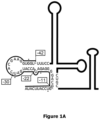
- the polynucleotide comprises in addition to (i) the targeting region, preferably a targeting region as specified above or below, (ii) a region comprising or consisting of a nucleotide sequence capable of forming a stem-loop, which region is linked to the targeting region of (i), and (iii) two linker nucleotide sequences flanking the nucleotide sequence of the targeting region at both sides, i.e., 5' and 3'. That is, when the polynucleotide is in a circularized form, the targeting region is on both sides separated from region capable of forming a stem-loop of (ii) by the one linker sequence.
- the linkers allow a more flexible presentation of the targeting region.
- the nucleotide sequence capable of forming a stem-loop comprises at least 2, at least 3, at least 4, at least 5 or at least 6, and/or at most 15, at most 14, at most 13, at most 12, at most 11, at most 10, at most 9 or at most 8 perfect base-pairs with two overhanging ends.
- the nucleotide sequence capable of forming a stem-loop may comprise 4 to 10 or 5 to 8 perfect base-pairs.
- any of the lower limits disclosed can be combined with any of the upper limits mentioned.
- the overhanging ends may be each at least 2, at least 3, at least 4, at least 5, at least 6, at least 7, at least 8, at least 9 or at least 10 nucleotides in length, and/or the overhanging ends may be each at most 40, at most 35, at most 30, at most 20 or at most 15 nucleotides in length.
- the overhanging ends may be each 2 to 30 or 3 to 20 nucleotides in length.
- each linker nucleotide sequence may be independently at least 1, at least 2 or at least 3 nucleotides in length, and/or may be independently at most 20, at most 15, at most 12, at most 10 or at most 8 nucleotides in length.
- each linker may be 1 to 20 or 2 to 10 nucleotides in length.
- the nucleotide sequence of the polynucleotide is depicted in SEQ ID NO: 48 to 53, 55 to 58, or 61 to 70, respectively.
- the nucleotide sequence of the polynucleotide is a variant of any of the sequences depicted in SEQ ID NO: 48 to 53, 55 to 58 or 61 to 70, respectively.
- the entire length of the polynucleotide is at least 30 nucleotides, at least 35 nucleotides, at least 40 nucleotides, at least 45 nucleotides, at least 50 nucleotides, at least 55 nucleotides, or at least 60 nucleotides in length.
- the nucleotide sequence of the targeting region is at most 500 nucleotides, at most 400 nucleotides, at most 300 nucleotides, at most 200 nucleotides, at most 150 nucleotides, at most 125 nucleotides, at most 100 nucleotides, at most 90 nucleotides, or at most 80 nucleotides in length.
- the nucleotide sequence of the targeting region may be 30 to 500 or may be 35 to 300 in length.
- the invention relates to a pharmaceutical composition
- a pharmaceutical composition comprising one or more of the polynucleotides of the invention, and at least one pharmaceutically acceptable carrier.
- the pharmaceutical composition may also comprise one or more excipients and/or one or more diluents.
- the composition is an aqueous composition.
- the aqueous composition may optionally comprise solutes, e . g ., salts.
- the composition is in the form of a freeze-dried composition.
- a freeze-dried composition is obtainable by freeze-drying a respective aqueous composition.
- the composition is an injectable composition, optionally comprising sodium, potassium and calcium salts, such as Ringer's solution or Ringer's Lactate.
- the polynucleotide, e . g ., the circular RNA molecule, to be administered is naked, i.e., not complexed with any kind of delivery material or proteins.
- the polynucleotide, e . g ., the RNA molecule, to be administered is formulated in a delivery vehicle.
- the delivery vehicle comprises particles.
- the delivery vehicle comprises a lipid.
- the lipid comprises a cationic lipid.
- the lipid forms a complex with and/or encapsulates the polynucleotide, e . g ., the RNA molecule.
- the polynucleotide, e . g ., the RNA molecule is formulated in liposomes.
- composition according to the present invention is generally to be applied in a “pharmaceutically effective amount” and in "a pharmaceutically acceptable preparation”.
- the one or more polynucleotides of the present invention is/are comprised in the pharmaceutical composition in an amount of at least 20 ng, of at least 50 ng, of at least 100 ng, of at least 200 ng, of at least 500 ng, of at least 1,000 ng or of at least 2,000 ng, and/or at most 20 mg, at most 15 mg, at most 10 mg, at most 9 mg, at most 8 mg, at most 7 mg, or at most 6 mg.
- the one or more polynucleotides may be comprised in an amount of 20 ng to 20 mg or in an amount of 50 ng to 15 mg.
- any of the lower limits disclosed can be combined with any of the upper limits mentioned.
- the one or more polynucleotides of the present invention is/are comprised in the pharmaceutical composition in a concentration of at least 1 nM, of at least 2 nM, of at least 3 nM, of at least 4 nM, of at least 5 nM, of at least 10 nM, of at least 15 nM, or of at least 20 nM, and/or at most 100 nM, at most 90 nM, at most 80 nM, at most 70 nM, at most 60 nM, at most 50 nM, at most 45 nM, or at most 40 nM.
- the one or more polynucleotides may be comprised in a concentration of 1 nM to 100 nM or in a concentration of 5 nM to 50 nM.
- concentration of 1 nM to 100 nM or in a concentration of 5 nM to 50 nM.
- the pharmaceutical composition is formulated to be suitable for local or systemic administration.
- the pharmaceutical composition can be formulated to be suitable for a parenteral administration.
- the pharmaceutical composition of the invention can be used in the field of medicine.
- the invention relates to a pharmaceutical composition of the invention for use as a medicament.
- the polynucleotides or the pharmaceutical composition of the invention may be used in a method of treating or preventing a proliferative disorder.
- the proliferative disorder may be cancer.
- the invention relates to a polynucleotide of the invention or a pharmaceutical composition of the invention for use in a method of treating or preventing a proliferative disorder, said method comprising a step of administering to a patient in need thereof one or more of the polynucleotides of the invention or the pharmaceutical composition of the invention.
- the proliferative disorder is cancer.
- the invention in another aspect, relates to a method of treating or preventing a proliferative disease comprising administering to a patient in need thereof one or more of the polynucleotides of the invention or the pharmaceutical composition of the invention.
- the proliferative disorder is cancer.
- the one or more polynucleotides or the pharmaceutical composition is administered locally or systemically. In one embodiment, the one or more polynucleotides or the pharmaceutical composition is/are administered parenterally.
- the patient to be treated may be a human.
- the polynucleotide(s) of the invention or the pharmaceutical composition of the invention is/are applied in a pharmaceutically effective amount and/or in a pharmaceutically acceptable preparation.
- the one or more polynucleotides of the present invention are administered per treatment in an amount of at least 20 ng, of at least 50 ng, of at least 100 ng, of at least 200 ng, of at least 500 ng, of at least 1,000 ng or of at least 2,000 ng, and/or at most 20 mg, at most 15 mg, at most 10 mg, at most 9 mg, at most 8 mg, at most 7 mg, or at most 6 mg.
- the one or more polynucleotides may be administered in an amount of 20 ng to 20 mg per treatment or in an amount of 50 ng to 15 mg per treatment.
- any of the lower limits disclosed can be combined with any of the upper limits mentioned.
- the one or more polynucleotides of the present invention are administered per treatment with a concentration of at least 1 nM, of at least 2 nM, of at least 3 nM, of at least 4 nM, of at least 5 nM, of at least 10 nM, of at least 15 nM, or of at least 20 nM, and/or at most 100 nM, at most 90 nM, at most 80 nM, at most 70 nM, at most 60 nM, at most 50 nM, at most 45 nM, or at most 40 nM.
- the one or more polynucleotides may be administered in a concentration of 1 nM to 100 nM or in a concentration of 5 nM to 50 nM.
- concentration of 1 nM to 100 nM or in a concentration of 5 nM to 50 nM.
- the invention relates to a method for targeting a nucleic acid comprising contacting the nucleic acid to be targeted with a polynucleotide of the invention.
- the nucleic acid to be targeted is RNA.
- the RNA to be targeted may be a portion of a mRNA, e . g ., a 5'-UTR or a portion of the 5'-UTR, or may be a U1 snRNA, e . g ., a human U1 snRNA, or a portion of said U1 snRNA.
- the nucleic acid to be targeted is at least partially complementary to the nucleotide sequence of the targeting region of the polynucleotide.
- the nucleic acid to be targeted comprises at least 70%, at least 75%, at least 80%, at least 81%, at least 82%, at least 83%, at least 84%, at least 85%, at least 86%, at least 87%, at least 88%, at least 89%, at least 90%, at least 91%, at least 92%, at least 93%, at least 94%, at least 95%, at least 96%, at least 97%, at least 98%, at least 99%, or 100% sequence complementarity to the nucleotide sequence of the targeting region of the polynucleotide.
- the invention relates to a method for forming a complex comprising a polynucleotide of the invention, and a single-stranded nucleic acid.
- the method comprises a step of contacting the polynucleotide with the single-stranded nucleic acid.
- the single-stranded nucleic acid is a nucleic acid comprising or consisting of deoxyribonucleotides.
- the nucleic acid may be a portion of a mRNA, e . g ., a 5'-UTR or a portion of the 5'-UTR, or may be a U1 snRNA, e .
- the single-stranded nucleic acid is at least partially complementary to the nucleotide sequence of the targeting region of the polynucleotide.
- the single-stranded nucleic acid comprises at least 70%, at least 75%, at least 80%, at least 81%, at least 82%, at least 83%, at least 84%, at least 85%, at least 86%, at least 87%, at least 88%, at least 89%, at least 90%, at least 91%, at least 92%, at least 93%, at least 94%, at least 95%, at least 96%, at least 97%, at least 98%, at least 99%, or 100% sequence complementarity to the nucleotide sequence of the targeting region of the polynucleotide.
- the invention relates to a method for interfering with genome expression or for shaping the cellular proteome.
- the method comprises a step of contacting a polynucleotide of the invention with the nucleic acid of the cell or a patient.
- the patient may be a patient having a proliferative disease or being at the risk of developing a proliferative disease.
- the patient may be a cancer patient.
- the respective method is an in vitro or an in vivo method.
- reducing or “inhibiting” relate to the ability to cause an overall decrease, preferably of 5% or greater, 10% or greater, 20% or greater, more preferably of 50% or greater, and most preferably of 75% or greater, in the level.
- inhibitor or similar phrases can include a complete or essentially complete inhibition, i.e., a reduction to zero or essentially to zero.
- Terms such as “increasing”, “enhancing”, “promoting” or “prolonging” preferably relate to an increase, enhancement, promotion or prolongation by about at least 10%, preferably at least 20%, preferably at least 30%, preferably at least 40%, preferably at least 50%, preferably at least 80%, preferably at least 100%, preferably at least 200% and in particular at least 300%. These terms may also relate to an increase, enhancement, promotion or prolongation from zero or a non-measurable or non-detectable level to a level of more than zero or a level which is measurable or detectable.
- polynucleotide and “nucleic acid”, used interchangeably herein, refer to a polymeric form of nucleotides of any length, either ribonucleotides or/and deoxyribonucleotides.
- this term includes, but is not limited to, single-, or double-stranded DNA or RNA, genomic DNA, cDNA, DNA-RNA hybrids, or a polymer comprising purine and pyrimidine bases or other natural, chemically or biochemically modified, non-natural, or derivatized nucleotides.
- a polynucleotide preferably the 5' end of one nucleotide and the 3' end of another nucleotide being linked to another.
- a polynucleotide typically varies in length and the term as used herein is, unless specified otherwise, not intended to be limited to a certain length. Polynucleotides can typically vary in length from 15 to several hundred nucleotides, more typically about 20-300 nucleotides in length or shorter, even more typically about 30-200 nucleotides in length.
- nucleotide sequence and “nucleic acid sequence”, used interchangeably herein, refer to the sequence of nucleotides in a polynucleotide, e . g ., a ribonucleic acid (RNA) or a deoxyribonucleic acid (DNA).
- RNA ribonucleic acid
- DNA deoxyribonucleic acid
- the term may refer to an entire nucleic acid molecule (such as to the single strand of an entire nucleic acid molecule) or to a portion ( e.g ., a fragment) thereof.
- sequences disclosed herein are set forth in the direction 5' to 3' unless other specified.
- a strand containing the sequence of a SEQ ID NO has that sequence from 5' to 3' unless otherwise specified.
- 3' when used directionally, generally refers to a region or position in a polynucleotide or oligonucleotide 3' (toward the 3' end of the nucleotide) from another region or position in the same polynucleotide or oligonucleotide.
- 3' end generally refers to the 3' terminal nucleotide of the component oligonucleotides.
- 5' when used directionally, generally refers to a region or position in a polynucleotide or oligonucleotide 5' (toward the 5' end of the nucleotide) from another region or position in the same polynucleotide or oligonucleotide.
- the term “5' end” generally refers to the 5' terminal nucleotide of the component polynucleotide.
- a polynucleotide of the invention comprises a nucleotide sequence, which sequence comprises a targeting region comprising or consisting of a nucleotide sequence complementary to (i) a U1 snRNA or to a continuous or discontinuous portion of said U1 snRNA or (ii) a 5' untranslated region (5'-UTR) of a mRNA or to a continuous or discontinuous portion of said 5' untranslated region.
- the targeting region has a nucleotide sequence that is capable of hybridizing or hybridizes to a corresponding portion of a target nucleic acid, e . g ., the U1 snRNA or the 5'-UTR.
- the targeting region is preferably a single-stranded nucleic acid.
- a nucleic acid is “capable of hybridizing” or “hybridizes” to another nucleic acid if the two sequences are complementary with one another.
- a nucleic acid is “complementary” to another nucleic acid if the two sequences are capable of forming a stable duplex with one another under the appropriate in vitro and/or in vivo conditions of temperature and solution ionic strength.
- standard Watson-Crick base-pairing includes: adenine (A) pairing with thymine (T), adenine (A) pairing with uracil (U), and guanine (G) pairing with cytosine (C).
- Hybridization and washing conditions are also well known.
- the conditions of temperature and ionic strength determine the "stringency" of the hybridization.
- Hybridization requires that the two nucleic acids contain complementary sequences, although mismatches between bases are possible.
- hybridization is preferably carried out under conditions which allow specific hybridization between polynucleotides (stringent conditions). Stringent conditions are described, for example, in Molecular Cloning: A Laboratory Manual, J. Sambrook et al., Editors, 2nd Edition, Cold Spring Harbor Laboratory press, Cold Spring Harbor, New York, 1989 or Current Protocols in Molecular Biology, F.M. Ausubel et al., Editors, John Wiley & Sons, Inc., New York .
- nucleotide sequences need not be 100% complementary to that of its target nucleic acid to be specifically hybridizable or hybridizable.
- a polynucleotide may hybridize over one or more segments such that intervening or adjacent segments are not involved in the hybridization event (e.g ., a loop structure or hairpin structure).
- a nucleotide sequence of a targeting region can comprise at least 70%, at least 75%, at least 80%, at least 81%, at least 82%, at least 83%, at least 84%, at least 85%, at least 86%, at least 87%, at least 88%, at least 89%, at least 90%, at least 91%, at least 92%, at least 93%, at least 94%, at least 95%, at least 96%, at least 97%, at least 98%, at least 99%, or 100% sequence complementarity to the nucleotide sequence of a target region, e . g ., the U1 snRNA or the 5'-UTR or a respective portion thereof.
- nucleotides out of 10 nucleotides being 50%, 60%, 70%, 80%, 90%, and 100% complementary. If the complementary is not 100%, the remaining non-complementary nucleotides may be clustered or interspersed with complementary nucleotides and need not be contiguous to each other or to complementary nucleotides. "Fully complementary” or "100% complementary” means that all the contiguous residues of a nucleotide sequence will hydrogen bond with the same number of contiguous residues in a second nucleotide acid sequence.
- the degree of complementarity according to the invention is at least 70%, at least 75%, at least 80%, at least 81%, at least 82%, at least 83%, at least 84%, at least 85%, at least 86%, at least 87%, at least 88%, at least 89%, at least 90%, at least 91%, at least 92%, at least 93%, at least 94%, at least 95%, at least 96%, at least 97%, at least 98%, or at least 99%.
- the degree of complementarity according to the invention is 100%.
- sequence comparisons between two nucleotide sequences are conventionally carried out by comparing these sequences after having aligned them optimally, said comparison being carried out by segment or by "window of comparison” in order to identify and compare local regions of sequence similarity.
- the optimal alignment of the sequences for comparison may be produced, besides manually, by means of the local homology algorithm of Smith and Waterman, 1981, Ads App. Math. 2, 482 , by means of the local homology algorithm of Needleman and Wunsch, 1970, J. Mol. Biol. 48, 443 , by means of the similarity search method of Pearson and Lipman, 1988, Proc.
- Targeting means the process of design and selection of a nucleotide sequence that will hybridize, preferably specifically hybridize, to a target sequence, for example a target RNA, such as a U1 snRNA portion or a 5'-UTR portion.
- a target sequence for example a target RNA, such as a U1 snRNA portion or a 5'-UTR portion.
- a "target sequence”, “target nucleic acid” or “target RNA” or “target DNA” all refer to a nucleotide sequence to which a targeting region is targeted.
- the polynucleotides of the invention are for targeting either (i) a U1 snRNA or a continuous or discontinuous portion of said U1 snRNA or (ii) a 5'-UTR or a continuous or discontinuous portion of said 5'-UTR.
- the U1 snRNA or the 5'-UTR is, e . g ., a target sequence.
- portion refers to a continuous or discontinuous fraction of a structure. With respect to a particular structure such as an amino acid sequence or protein or a nucleotide sequence the terms “part”, “fragment” and “portion” thereof may designate a continuous or a discontinuous fraction of said structure.
- a "part", “fragment” and “portion” of a structure such as an amino acid sequence or a nucleotide sequence preferably comprises, preferably consists of at least 2%, at least 4%, at least 10%, at least 20%, at least 30%, at least 40%, at least 50%, at least 60%, at least 70%, at least 80%, at least 85%, at least 90%, at least 92%, at least 94%, at least 96%, at least 98%, at least 99% of the entire structure or amino acid sequence or nucleotide sequence.
- a portion, a part or a fragment of a structure preferably comprises one or more functional or structural properties of said structure.
- a portion, a part or a fragment may be capable of forming a stem-loop in secondary structure.
- the portion, part or fragment is a discontinuous fraction said discontinuous fraction is preferably composed of 2, 3, 4, 5, 6, 7, 8, or more parts or segments of a structure, each of these parts or segments being a continuous element of the structure.
- a discontinuous fraction of a nucleotide sequence may be composed of 2, 3, 4, 5, 6, 7, 8, or more, preferably not more than 4 parts of said nucleotide sequence, wherein each part or segment preferably comprises at least 5 continuous nucleotides, preferably at least 10 continuous nucleotides, more preferably at least 12 continuous nucleotides, more preferably at least 15 continuous nucleotides of the nucleotide sequence.
- continuous and “contiguous” may be used interchangeably herein and refer preferably to an uninterrupted extension on the nucleotide sequence, e . g ., of the U1 snRNA or the 5'-UTR.
- Two segments are interrupted, if one or more nucleotides are inserted between two segments, e . g ., a first segment and a second segment, thereby connecting these segments, which inserted nucleotides may be any nucleotides and are preferably nucleotides different in number and/or in chemical structure from the respective nucleotides present in the uninterrupted starting sequence.
- first, second, third and the like in the description and in the claims are used for distinguishing between similar elements and not necessarily for describing a sequential or chronological order, unless the context indicates otherwise.
- a portion of a U1 snRNA or a 5'-UTR target sequence may, for example, be a nucleotide sequence of a stem-loop or a subregion of such a stem-loop.
- a portion of a target sequence may also be sequence which is located 5' or 3' to such a stem-loop or a subregion of such a stem-loop.
- stem-loop structure does not require exact base-pairing.
- the stem may include one or more base mismatches.
- the base- pairing may be exact, i.e., not include any mismatches.
- any reference to a particular nucleotide position in a target sequence should not be construed to that extent that in a corresponding target sequence of another species or variant the corresponding nucleotide must be present at the same nucleotide position, as insertions or deletions of nucleotides may occur. That is, the corresponding nucleotide positions may vary and can, for example, be determined after performing a sequence alignment of the sequences in questions. Thus, when reference is made herein to a "nucleotide position", e . g ., "a nucleotide position of the sequence depicted in SEQ ID NO: X", or to "a portion comprising nucleotides x to y", e .
- a portion comprises nucleotides x to y of the sequence depicted in SEQ ID NO: X
- these phrases are intended to comprise also the corresponding nucleotide position or the corresponding portion in another sequence, e . g ., in another target sequence.
- the target sequence is a U1 snRNA or a continuous or discontinuous portion of said U1 snRNA.
- the U1 snRNA can be a human U1 snRNA.
- the U1 snRNA is a general component of the spliceosome that governs 5' splice site recognition and selection. Therefore, by targeting the U1 snRNA with antisense RNA molecules pre-mRNA splicing can be inhibited and/or alternative splicing patterns can be modulated.
- the target sequence can be the complete U1 snRNA, for example a U1 snRNA having or comprising a sequence depicted in SEQ ID NO: 1 or can be a variant of this depicted nucleotide sequence.
- the U1 snRNA can be divided into portions and the target sequence comprises one or more of these portions or one or more segments of these portions.
- the U1 snRNA target sequence can be selected from the following portions:
- Preferred targeting regions comprise or consist of a nucleotide sequence complementary to at least one continuous portion selected form the group consisting of nucleotides 1 to 42, nucleotides 1 to 30, nucleotides 1 to 26, nucleotides 1 to 25, nucleotides 1 to 22, nucleotides 12 to 27, nucleotides 28 to 37, each of the sequence depicted in SEQ ID NO: 1, and any variants of these portions.
- the nucleotide sequence of the targeting region may comprise at least two segments, each segment complementary to a nucleotide sequence of the U1 snRNA, wherein the complementary nucleotide sequences of the U1 snRNA are not continuous. Preferred combinations of such segments are disclosed in the summary of the invention and the attached claims. Within the nucleotide sequence of these targeting regions complementary to a discontinuous portion of the U1 snRNA one or more nucleotides, between two consecutive segments can be comprised.
- a polynucleotide of the invention can comprise a targeting region comprising or consisting of a nucleotide sequence depicted in SEQ ID NO: 3, which sequence is complementary to nucleotides 1 to 20 of the U1 snRNA sequence as depicted in SEQ ID NO: 1.
- a polynucleotide of the invention can comprise a targeting region comprising or consisting of a nucleotide sequence having at least 70%, at least 75%, at least 80%, at least 85%, at least 90%, at least 95%, at least 97%, at least 99%, or 100% identity to the nucleotide sequence depicted in SEQ ID NO: 3.
- Table 1 Nucleotide sequence for targeting nucleotides 1 to 20 of a human U1 snRNA: SEQ ID NO: 5'elongation AS-U1-20 (SEQ ID NO: 3) 3'elongation 3 CTCCCCTGCCAGGTAAGTAT
- nucleotide sequence of the targeting region of said polynucleotide can be further elongated by one or more additional nucleotides.
- the nucleotide sequence depicted in SEQ ID NO: 3 can be elongated in 5' direction, i.e., 5' relative to the said sequence.
- nucleotide sequence as set forth in SEQ ID NO: 3 can be additionally flanked 5' in a contiguous manner by one or more nucleotides for targeting nucleotide 21 up to at most nucleotide 100, preferably up to at most nucleotide 50, 42 or 30 of the sequence depicted in SEQ ID NO: 1, respectively, or the respective nucleotides in variant sequences.
- the first nucleotide added 5' to the sequence depicted in SEQ ID NO: 3 is for targeting the nucleotide at position 21 of the sequence depicted in SEQ ID NO: 1.
- the second nucleotide added to the elongated sequence is for targeting the nucleotide at position 22 of the sequence depicted in SEQ ID NO: 1
- the third nucleotide added to the elongated sequence i.e., SEQ ID NO: 3 plus 2 nucleotides
- the forth nucleotide added to the elongated sequence i.e., SEQ ID NO: 3 plus 3 nucleotide
- nucleotide sequence as set forth in SEQ ID NO: 3 can be 5' elongated in a contiguous manner by 1, 2, 3, 4, 5, 6, 7, 8, 9, 10, 11, 12, 13, 14, 15, 16, 17, 18, 19, 20, 21, 22, 23, 24, 25, 26, 27, 28, 29, 30, 31, 32, 33, 34, 35, 36, 37, 38, 39, 40, 41, 42, 43, 44, 45, 46, 47, 48, 49, 50, 51, 52, 53, 54, 55, 56, 57, 58, 59, 60, 61, 62, 63, 64, 65, 66, 67, 68, 69, 70, 71, 72, 73, 74, 75, 76, 77, 78, 79, or 80 nucleotides.
- each nucleotide added 5' can be complementary or not to its respective nucleotide in the sequence depicted in SEQ ID NO: 1.
- the first nucleotide added at the 5' end of the sequence (5'-CTCCCCTGCCAGGTAAGTAT-3') depicted in SEQ ID NO: 3 is a nucleotide having the nucleobase thymine/uracil for targeting the nucleotide having the nucleobase adenine at position 21 of the target strand (shown from 5' to 3' in the sequence below)
- the second nucleotide added at the 5' end of the elongated sequence is a nucleotide having the nucleobase adenine for targeting the nucleotide having the nucleobase thymine/uracil at position 22 of the target strand
- the third nucleotide added at the 5' end of the elongated sequence is a nucleotide having the nucleobase thymine/urac
- Preferred nucleotide sequences of targeting regions which are elongated in 5' direction comprise any of the sequences as shown in Table 2, or any variants thereof: Table 2: SEQ ID NO: 5'elongation AS-U1-20 (SEQ ID NO: 3) 3'elongation 4 AT CTCCCCTGCCAGGTAAGTAT 5 ATCATGGTAT CTCCCCTGCCAGGTAAGTAT 6 ACCACCTTCGTGATCATGGTAT CTCCCCTGCCAGGTAAGTAT
- nucleotides 1 to 22 SEQ ID NO: 4 or nucleotides 1 to 30 (SEQ ID NO: 5) or nucleotides 1 to 42 (SEQ ID NO: 6) of the human U1 snRNA.
- the polynucleotides of the present invention can also comprise a targeting region comprising or consisting of a nucleotide sequence which is the result of a 5' elongation of the sequence depicted in SEQ ID NO: 3 for targeting a portion selected from the group consisting of nucleotides 1 to 25, nucleotides 1 to 26, nucleotides 1 to 27, nucleotides 1 to 28, nucleotides 1 to 29, nucleotides 1 to 31, nucleotides 1 to 32, nucleotides 1 to 33, nucleotides 1 to 34, nucleotides 1 to 35, nucleotides 1 to 36, nucleotides 1 to 37, nucleotides 1 to 38, nucleotides 1 to 39, nucleotides 1 to 40, nucleotides 1 to 41, nucleotides 1 to 43, nucleotides 1 to 44, nucleotides 1 to 45, nucleotides 1 to 46, nucleotides 1 to 47,
- the polynucleotides of the present invention can also comprise a targeting region comprising or consisting of a nucleotide sequence for targeting a portion selected from the group consisting of nucleotides 2 to 20, nucleotides 2 to 21, nucleotides 2 to 22, nucleotides 2 to 23, nucleotides 2 to 24, nucleotides 2 to 25, nucleotides 2 to 26, nucleotides 2 to 27, nucleotides 2 to 28, nucleotides 2 to 29, nucleotides 2 to 30, nucleotides 2 to 31, nucleotides 2 to 32, nucleotides 2 to 33, nucleotides 2 to 34, nucleotides 2 to 35, nucleotides 2 to 36, nucleotides 2 to 37, nucleotides 2 to 38, nucleotides 2 to 39, nucleotides 2 to 40, nucleotides 2 to 41, nucleotides 2 to 42, nucleotides 2 to 43, nucleotides
- the polynucleotides of the present invention can also comprise a targeting region comprising or consisting of a nucleotide sequence for targeting a portion selected from the group consisting of nucleotides 3 to 20, nucleotides 3 to 21, nucleotides 3 to 22, nucleotides 3 to 23, nucleotides 3 to 24, nucleotides 3 to 25, nucleotides 3 to 26, nucleotides 3 to 27, nucleotides 3 to 28, nucleotides 3 to 29, nucleotides 3 to 30, nucleotides 3 to 31, nucleotides 3 to 32, nucleotides 3 to 33, nucleotides 3 to 34, nucleotides 3 to 35, nucleotides 3 to 36, nucleotides 3 to 37, nucleotides 3 to 38, nucleotides 3 to 39, nucleotides 3 to 40, nucleotides 3 to 41, nucleotides 3 to 42, nucleotides 3 to 43, nucleotides
- the polynucleotides of the present invention can also comprise a targeting region comprising or consisting of a nucleotide sequence for targeting a portion selected from the group consisting of nucleotides 4 to 20, nucleotides 4 to 21, nucleotides 4 to 22, nucleotides 4 to 23, nucleotides 4 to 24, nucleotides 4 to 25, nucleotides 4 to 26, nucleotides 4 to 27, nucleotides 4 to 28, nucleotides 4 to 29, nucleotides 4 to 30, nucleotides 4 to 31, nucleotides 4 to 32, nucleotides 4 to 33, nucleotides 4 to 34, nucleotides 4 to 35, nucleotides 4 to 36, nucleotides 4 to 37, nucleotides 4 to 38, nucleotides 4 to 39, nucleotides 4 to 40, nucleotides 4 to 41, nucleotides 4 to 42, nucleotides 4 to 43, nucleotides
- the polynucleotides of the present invention can also comprise a targeting region comprising or consisting of a nucleotide sequence for targeting a portion selected from the group consisting of nucleotides 5 to 20, nucleotides 5 to 21, nucleotides 5 to 22, nucleotides 5 to 23, nucleotides 5 to 24, nucleotides 5 to 25, nucleotides 5 to 26, nucleotides 5 to 27, nucleotides 5 to 28, nucleotides 5 to 29, nucleotides 5 to 30, nucleotides 5 to 31, nucleotides 5 to 32, nucleotides 5 to 33, nucleotides 5 to 34, nucleotides 5 to 35, nucleotides 5 to 36, nucleotides 5 to 37, nucleotides 5 to 38, nucleotides 5 to 39, nucleotides 5 to 40, nucleotides 5 to 41, nucleotides 5 to 42, nucleotides 5 to 43, nucleotides
- the polynucleotides of the present invention can also comprise a targeting region comprising or consisting of a nucleotide sequence for targeting a portion selected from the group consisting of nucleotides 10 to 20, nucleotides 10 to 21, nucleotides 10 to 22, nucleotides 10 to 23, nucleotides 10 to 24, nucleotides 10 to 25, nucleotides 10 to 26, nucleotides 10 to 27, nucleotides 10 to 28, nucleotides 10 to 29, nucleotides 10 to 30, nucleotides 10 to 31, nucleotides 10 to 32, nucleotides 10 to 33, nucleotides 10 to 34, nucleotides 10 to 35, nucleotides 10 to 36, nucleotides 10 to 37, nucleotides 10 to 38, nucleotides 10 to 39, nucleotides 10 to 40, nucleotides 10 to 41, nucleotides 10 to 42, nucleotides 10 to 43, nucleotides
- the polynucleotides of the present invention can also comprise a targeting region comprising or consisting of a nucleotide sequence for targeting a contiguous portion of a U1 snRNA, wherein the targeting nucleotide sequence is 20 to 50 nucleotides in length and is complementary to a contiguous portion of the U1 snRNA.
- the U1 snRNA comprises a nucleotide sequence as depicted in SEQ ID NO: 1 or is a variant thereof.
- the target region is located within nucleotides 1 to 100, 1 to 90, 1 to 80, 1 to 70, 1 to 60, 1 to 50, each of the sequence depicted in SEQ ID NO: 1, and any variants of these portions.
- the targeting region of the polynucleotide comprises two or more copies of the nucleotide sequence complementary to a U1 snRNA or to a continuous or discontinuous portion of said U1 snRNA, e . g ., the aforementioned portions of the U1 snRNA or the aforementioned embodiments of the U1 snRNA targeting sequences.
- the targeting region of the polynucleotide comprises two or three copies of the nucleotide sequence complementary to a U1 snRNA or to a continuous or discontinuous portion of said U1 snRNA.
- each spacer sequence may comprise 1 to 10, preferably 2 to 8, 2 to 6, or 2 to 4 nucleotides.
- the spacer sequence is not complementary to the U1 snRNA sequence.
- the nucleotides of the spacer sequence are nucleotides having the nucleobase adenine and/or the nucleobase thymine/uracil.
- a polynucleotide of the invention may comprise or consist of a nucleotide sequence depicted in any of SEQ ID NO: 7 to 9, as shown in Table 3, or any variants thereof.
- Table 3 SEQ ID NO: Name Sequence 7 AS-U1-3x25 8 AS-U1-2x30 9 AS-U1-3x30
- sequence depicted in SEQ ID NO: 7 is for targeting nucleotide positions 1 to 25 of the sequence depicted in SEQ ID NO: 1, wherein the sequence depicted in SEQ ID NO: 7 comprises three copies of the nucleotide sequence complementary to nucleotides 1 to 25 of the U1 snRNA.
- sequence depicted in SEQ ID NO: 8 is for targeting nucleotide positions 1 to 30 of the sequence depicted in SEQ ID NO: 1, wherein the sequence depicted in SEQ ID NO: 8 comprises two copies of the nucleotide sequence complementary to nucleotides 1 to 30 of the U1 snRNA.
- sequence depicted in SEQ ID NO: 9 is for targeting nucleotide positions 1 to 30 of the sequence depicted in SEQ ID NO: 1, wherein the sequence depicted in SEQ ID NO: 9 comprises three copies of the nucleotide sequence complementary to nucleotides 1 to 30 of the U1 snRNA.
- the spacer sequences are shown in bold and underlined in Table 3. Also encompassed by the present invention are variants of the sequences depicted in SEQ ID NO: 7 to SEQ ID NO: 9.
- the entire length of the nucleotide sequence of the targeting region is preferably at least 50, at least 55, or at least 60 nucleotides in length.
- the nucleotide sequence of the entire targeting region is at most 120 nucleotides, at most 110 nucleotides, or at most 100 nucleotides in length.
- the nucleotide sequence of the entire targeting region may be 50 to 120 or may be 55 to 100 nucleotides in length.
- the target structure is involved in mRNA translation and the polynucleotide is capable of inhibiting mRNA translation.
- the target region can be a 5' untranslated region (5'-UTR) of a mRNA or a continuous or discontinuous portion of said 5' untranslated region.
- the targeting sequence can be directed against a 5'-UTR of a human ⁇ -globin (HBB) mRNA or a 5'-UTR of a MDM2 (mouse double minute 2 homolog) gene, e . g ., of a human MDM2 gene.
- mRNA generally contains a 5' untranslated region (5'-UTR), a peptide coding region and a 3' untranslated region (3'-UTR).
- the term "untranslated region” or “UTR” relates to a region in a DNA molecule which is transcribed but is not translated into an amino acid sequence, or to the corresponding region in an RNA molecule, such as an mRNA molecule.
- An untranslated region (UTR) can be present 5' (upstream) of an open reading frame (5'-UTR) and/or 3' (downstream) of an open reading frame (3'-UTR).
- a 5'-UTR if present, is located at the 5' end, upstream of the start codon of a protein-encoding region.
- a 5'-UTR is downstream of the 5'-cap (if present), e . g ., directly adjacent to the 5'-cap.
- ORF open reading frame
- the target sequence can be the complete 5' untranslated region (5'-UTR).
- the 5'-UTR can be divided into portions and the target sequence comprises one or more of these portions or one or more segments of these portions.
- the 5'-UTR is a eukaryotic 5'-UTR, for example a 5'-UTR having or comprising a sequence depicted in SEQ ID NO: 10, SEQ ID NO: 32 or SEQ ID NO: 40, or can be a variant of these depicted nucleotide sequences.
- the targeting region is complementary to at least one region of the 5' UTR which located in the 5' terminal of the 5'-UTR.
- a region of the 5' terminal of the 5'-UTR can comprise or consist of a nucleotide sequence comprised in the first 60% of the complete 5'-UTR nucleotide sequence, relative to the 5' end of the 5'-UTR sequence.
- the 5' terminal of the 5'-UTR can comprise or consist of a nucleotide sequence comprised in the first 55%, 50%, 45% of 40% of the complete 5'-UTR nucleotide sequence.
- the targeting region is complementary to at least one region of the 5' UTR which is located in the AUG-proximal region of the 5'-UTR.
- the AUG-proximal region of the 5'-UTR does not comprise the start codon AUG of the ORF or the main ORF.
- the AUG-proximal region of the 5'-UTR comprises the start codon AUG of the ORF or the main ORF, wherein the A nucleotide of the AUG start codon is referred to as the nucleotide at position +1 herein.
- the AUG-proximal region of the 5'-UTR comprises the start codon AUG comprises at least nucleotides -3 to -1 of the 5'-UTR nucleotide sequence, and at least nucleotides +4 to +9 of the ORF or the main ORF nucleotide sequence.
- the AUG-proximal region of the 5'-UTR complementary to at least the nucleotides -3 to +9 is flanked on one or both ends by a flanking region, wherein each flanking region comprises one or more additional nucleotides, and each additional nucleotide is complementary or non-complementary to the corresponding nucleotide of the nucleotides flanking the portion of the AUG-proximal region of the 5'-UTR to which the nucleotide sequence of the targeting region is complementary.
- nucleotide sequence of the targeting region complementary to at least the nucleotides -3 to +9 is flanked 5' by one or more additional nucleotides for targeting the nucleotide at position -4 up to at most to the nucleotide at position -40 of the 5'-UTR sequence. In one embodiment, the nucleotide sequence of the targeting region complementary to at least the nucleotides -3 to +9 is flanked 5' by one or more additional nucleotides for targeting the nucleotide at position -4 up to at most to the nucleotide at position -30 of the 5'-UTR sequence.
- nucleotide sequence of the targeting region complementary to at least the nucleotides -3 to +9 is flanked 5' by one or more additional nucleotides for targeting the nucleotide at position -4 up to at most to the nucleotide at position -20 of the 5'-UTR sequence. In one embodiment, the nucleotide sequence of the targeting region complementary to at least the nucleotides -3 to +9 is flanked 5' by one or more additional nucleotides for targeting the nucleotide at position -4 up to at most to the nucleotide at position -10 of the 5'-UTR sequence.
- nucleotide sequence of the targeting region complementary to at least the nucleotides -3 to +9 is flanked 3' by one or more additional nucleotides for targeting the nucleotide at position +10 up to at most to the nucleotide at position +50 of the ORF or the main ORF nucleotide sequence.
- nucleotide sequence of the targeting region complementary to at least the nucleotides -3 to +9 is flanked 3' by one or more additional nucleotides for targeting the nucleotide at position +10 up to at most to the nucleotide at position +50 of the ORF or the main ORF nucleotide sequence.
- nucleotide sequence of the targeting region complementary to at least the nucleotides -3 to +9 is flanked 3' by one or more additional nucleotides for targeting the nucleotide at position +10 up to at most to the nucleotide at position +40 of the ORF or the main ORF nucleotide sequence.
- nucleotide sequence of the targeting region complementary to at least the nucleotides -3 to +9 is flanked 3' by one or more additional nucleotides for targeting the nucleotide at position +10 up to at most to the nucleotide at position +30 or +20 of the ORF or the main ORF nucleotide sequence.
- the 5'-UTR can comprise at least one upstream open reading frame (uORF).
- the nucleotide sequence of the targeting region does not comprise a nucleotide sequence complementary to nucleotide sequence comprising an AUG start codon of the at least one uORF.
- the 5'-UTR target sequence can be selected from the following portions:
- the targeting region is complementary to at least the nucleotides 22 to 40 of the 5'-UTR nucleotide sequence.
- the nucleotide sequence of the targeting region can be further elongated by one or more additional nucleotides in one or both directions, i.e., 3' and/or 5' relative to the said sequence.
- the 5' terminal targeting region complementary to at least the nucleotides 22 to 40 of the 5'-UTR is flanked on one or both ends by a flanking region, wherein each flanking region comprises one or more additional nucleotides, and each additional nucleotide is complementary or non-complementary to the corresponding nucleotide of the nucleotides flanking the portion of the 5'-UTR to which the nucleotide sequence of the targeting region is complementary.
- nucleotide sequence of the targeting region complementary to at least nucleotides 22 to 40 of the 5'-UTR is flanked 3' by one or more additional nucleotides for targeting the nucleotide at position 21 up to at most to the nucleotide at position 1 of the 5'-UTR sequence.
- nucleotide sequence of the targeting region complementary to at least nucleotides 22 to 40 of the 5'-UTR is flanked 3' by one or more additional nucleotides for targeting the nucleotide at position 21 up to at least to the nucleotide at position 10 of the 5'-UTR sequence.
- nucleotide sequence of the targeting region complementary to at least nucleotides 22 to 40 of the 5'-UTR is flanked 5' by one or more additional nucleotides for targeting the nucleotide at position 41 up to at most to the nucleotide at position 60 of the 5'-UTR sequence.
- nucleotide sequence of the targeting region complementary to at least nucleotides 22 to 40 of the 5'-UTR is flanked 5' by one or more additional nucleotides for targeting the nucleotide at position 41 up to at least to the nucleotide at position 50 of the 5'-UTR sequence.
- the polynucleotides of the present invention can also comprise a targeting region comprising or consisting of a nucleotide sequence which is the result of any combination between above mentioned 5' elongations and 3' elongations, including variants of these combined nucleotide sequences.
- the 5'-UTR is from a MDM2 (mouse double minute 2 homolog) gene, e . g ., from a human MDM2 proto-oncogene.
- MDM2 mouse double minute 2 homolog
- the MDM2 gene shows a complex expression and processing pattern, with a relatively long, complex 5'-UTR that is processed in several variants and contains two upstream open reading frames (uORFs).
- MDM2 encodes a cellular phosphoprotein that plays a key role in the regulation of the tumor suppressor protein p53, negatively modulating its activity and stability through ubiquitylation and proteasome-dependent degradation. Functionally, MDM2 and p53 act in a self-regulatory feedback loop.
- MDM2 can bind p53 with high affinity, inducing its nuclear export and inhibiting its ability to act as a transcription factor.
- the MDM2-p53 feedback loop is deregulated, which makes it an attractive target for therapy, in particular for the therapy of proliferative diseases, such as the treatment of cancer.
- overexpression of MDM2 can promote the formation, progression, and drug resistance of malignant tumors.
- MDM2 comprises six main isoforms.
- Isoform 1 comprises the sequence set forth in NCBI Reference Sequence: NM_002392
- isoform 2 comprises the sequence set forth in NCBI Reference Sequence: NM_001145339
- isoform 3 comprises the sequence set forth in NCBI Reference Sequence: NM_001145337
- isoform 4 comprises the sequence set forth in NCBI Reference Sequence: NM_001145340
- isoform 5 comprises the sequence set forth in NCBI Reference Sequence: NM_001278462
- isoform 6 comprises the sequence set forth in NCBI Reference Sequence: NM_001367990.
- Isoforms 1 and 2 contain a long 5'-UTR sequence (nucleotides 1 to 324 as depicted in SEQ ID NO: 10) with two additional uORFs.
- Isoforms 3 to 6 have a short 5'-UTR sequence (nucleotides 1 to 67 without uORFs as depicted in SEQ ID NO: 32).
- the target sequence can be the complete 5'-UTR having or comprising a sequence depicted in SEQ ID NO: 10 or can be a variant of this depicted nucleotide sequence.
- the 5'-UTR having or comprising a sequence depicted in SEQ ID NO: 10 can be divided into portions and the target sequence comprises one or more of these portions or one or more segments of these portions.
- the 5'-UTR target sequence can be selected from the following portions:
- the targeting region of the polynucleotide may comprise or consist of a nucleotide sequence complementary to at least one of these portions or to at least one segment within these portions.
- Preferred targeting regions comprise or consist of a nucleotide sequence complementary to at least one continuous portion selected form the group consisting of nucleotides 1 to 40, nucleotides 22 to 40, nucleotides 57 to 96, nucleotides 67 to 86, nucleotides 128 to 167, nucleotides 138 to 157, nucleotides 279 to 318, nucleotides 279 to 324, nucleotides 301 to 318, nucleotides 301 to 324, each of the sequence depicted in SEQ ID NO: 10, and any variants of these portions.
- the nucleotide sequence of the targeting region may comprise at least two segments, each segment complementary to a nucleotide sequence of the 5'-UTR, wherein the complementary nucleotide sequences of the 5'-UTR are not continuous.
- the nucleotide sequence of these targeting regions complementary to a discontinuous portion of the 5'-UTR one or more nucleotides, between two consecutive segments can be comprised.
- a polynucleotide of the invention can comprise a targeting region comprising or consisting of a nucleotide sequence depicted in SEQ ID NO: 11, which sequence is complementary to nucleotides 22 to 40 of the 5'-UTR sequence as depicted in SEQ ID NO: 10.
- a polynucleotide of the invention can comprise a targeting region comprising or consisting of a nucleotide sequence having at least 70%, at least 75%, at least 80%, at least 85%, at least 90%, at least 95%, at least 97%, at least 99%, or 100% identity to the nucleotide sequence depicted in SEQ ID NO: 11.
- nucleotide sequence of the targeting region of said polynucleotide can be further elongated by one or more additional nucleotides.
- the nucleotide sequence depicted in SEQ ID NO: 11 can be elongated in one or both directions, i.e., 3' and/or 5' relative to the said sequence.
- nucleotide sequence as set forth in SEQ ID NO: 11 can be additionally flanked 3' in a contiguous manner by one or more nucleotides for targeting nucleotide 21 up to at most nucleotide 1 or up to at most nucleotide 10 of the sequence depicted in SEQ ID NO: 10, respectively, or the respective nucleotides in variant sequences.
- the first nucleotide added 3' to the sequence depicted in SEQ ID NO: 11 is for targeting the nucleotide at position 21 of the sequence depicted in SEQ ID NO: 10.
- the second nucleotide added to the elongated sequence is for targeting the nucleotide at position 20 of the sequence depicted in SEQ ID NO: 10
- the third nucleotide added to the elongated sequence i.e., SEQ ID NO: 11 plus 2 nucleotides
- the forth nucleotide added to the elongated sequence i.e., SEQ ID NO: 11 plus 3 nucleotide
- nucleotide sequence as set forth in SEQ ID NO: 11 can be 3' elongated in a contiguous manner by 1, 2, 3, 4, 5, 6, 7, 8, 9, 10, 11, 12, 13, 14, 15, 16, 17, 18, 19, 20 or 21 nucleotides.
- Each nucleotide added 3' can be complementary or not to its respective nucleotide in the sequence depicted in SEQ ID NO: 10.
- the first nucleotide added at the 3' end of the sequence (5'-CAGCCAAGCTCGCCGCGGT-3') depicted in SEQ ID NO: 11 is a nucleotide having the nucleobase guanin for targeting the nucleotide having the nucleobase cytosine at position 21 of the target strand (shown from 5' to 3' in the sequence below)
- the second nucleotide added at the 3' end of the elongated sequence is a nucleotide having the nucleobase cytosine for targeting the nucleotide having the nucleobase guanin at position 20 of the target strand
- the third nucleotide added at the 3' end of the elongated sequence is a nucleotide having the nucleobase cytosine for targeting the nucleotide having the nucleobase guanin at position 19 of the target strand
- the fourth nucleotide added at the 3' end of the elongated sequence
- Preferred nucleotide sequences of targeting regions which are elongated in 3' direction comprise any of the sequences as shown in Table 5, or any variants thereof: Table 5: SEQ ID NO: 5'elongation AS-MDM2 22-40 (iso1-2) (SEQ ID NO: 11) 3'elongation 12 CAGCCAAGCTCGCCGCGGT GCCTCGGTGCGC 13 CAGCCAAGCTCGCCGCGGT GCCTCGGTGCGCGCCCCCTAC
- These preferred 3' elongations are for targeting the portion comprising nucleotides 10 to 40 (SEQ ID NO: 12) or nucleotides 1 to 40 (SEQ ID NO: 13) of the 5'-UTR of isoforms 1 and 2 of MDM2. Also encompassed by the present invention are variants of the sequences depicted in SEQ ID NO: 12 or 13.
- nucleotide sequences of the targeting region which are elongated in 3' direction comprise the sequences for targeting nucleotides 2 to 40, nucleotides 3 to 40, nucleotides 4 to 40, nucleotides 5 to 40, nucleotides 6 to 40, nucleotides 7 to 40, nucleotides 8 to 40, nucleotides 9 to 40, nucleotides 11 to 40, nucleotides 12 to 40, nucleotides 13 to 40, nucleotides 14 to 40, nucleotides 15 to 40, nucleotides 16 to 40, nucleotides 17 to 40, nucleotides 18 to 40, nucleotides 19 to 40, each of the sequence depicted in SEQ ID NO: 10, and any variants of these portions.
- the nucleotide sequence depicted in SEQ ID NO: 11 can be flanked 5' in a contiguous manner by one or more nucleotides for targeting nucleotide 41 up to at most nucleotide 60, preferably up to at most nucleotide 50 of the sequence depicted in SEQ ID NO: 10, respectively.
- the first nucleotide added 5' to the sequence as set forth in SEQ ID NO: 11 is for targeting the nucleotide at position 41 of the sequence depicted in SEQ ID NO: 10.
- the second nucleotide added to the elongated sequence is for targeting the nucleotide at position 42 of the sequence depicted in SEQ ID NO: 10
- the third nucleotide added to the elongated sequence i.e., SEQ ID NO: 11 plus 2 nucleotides
- the forth nucleotide added to the elongated sequence i.e., SEQ ID NO: 11 plus 3 nucleotide
- nucleotide sequence as set forth in SEQ ID NO: 11 can be 5' elongated in a contiguous manner by 1, 2, 3, 4, 5, 6, 7, 8, 9, 10, 11, 12, 13, 14, 15, 16, 17, 18, 19, or 20 nucleotides.
- Each nucleotide added 5' can be complementary or not to its respective nucleotide in the sequence depicted in SEQ ID NO: 10.
- the first nucleotide added at the 5' end of the sequence (5'-CAGCCAAGCTCGCCGCGGT-3') depicted in SEQ ID NO: 11 is a nucleotide having the nucleobase guanin for targeting the nucleotide having the nucleobase cytosine at position 41 of the target strand (shown from 5' to 3' in the sequence below)
- the second nucleotide added at the 5' end of the elongated sequence is a nucleotide having the nucleobase adenine for targeting the nucleotide having the nucleobase thymine/uracil at position 42 of the target strand
- the third nucleotide added at the 5' end of the elongated sequence is a nucleotide having the nucleobase adenine for targeting the nucleotide having the nucleobase thymine/uracil at position 43 of the target strand
- Preferred nucleotide sequences of targeting regions which are elongated in 5' direction comprise any of the sequences as shown in Table 6, or any variants thereof: Table 6: SEQ ID NO: 5'elongation AS-MDM2 22-40 (iso1-2) (SEQ ID NO: 11) 3'elongation 14 GCCCCAGAAG CAGCCAAGCTCGCCGCGGT 15 GGCCACACAGGCCCCAGAAG CAGCCAAGCTCGCCGCGGT
- 3' elongations are for targeting the portion comprising nucleotides 22 to 50 (SEQ ID NO: 14) or nucleotides 22 to 60 (SEQ ID NO: 15) of the 5'-UTR of isoforms 1 and 2 of MDM2. Also encompassed by the present invention are variants of the sequences depicted in SEQ ID NO: 14 or 15.
- nucleotide sequences of the targeting region which are elongated in 5' direction comprise the sequences for targeting nucleotides 22 to 59, nucleotides 22 to 58, nucleotides 22 to 57, nucleotides 22 to 56, nucleotides 22 to 55, nucleotides 22 to 54, nucleotides 22 to 53, nucleotides 22 to 52, nucleotides 22 to 51, nucleotides 22 to 49, nucleotides 22 to 48, nucleotides 22 to 47, nucleotides 22 to 46, nucleotides 22 to 45, nucleotides 22 to 44, nucleotides 22 to 43, nucleotides 22 to 42, nucleotides 22 to 41, each of the sequence depicted in SEQ ID NO: 10, and any variants of these portions.
- the polynucleotides of the present invention can also comprise a targeting region comprising or consisting of a nucleotide sequence which is the result of any combination between above mentioned 5' elongations and 3' elongations, including variants of these combined nucleotide sequences.
- a preferred targeting region comprises or consists of a nucleotide sequence depicted in SEQ ID NO: 13.
- a polynucleotide of the invention can comprise a targeting region comprising or consisting of a nucleotide sequence depicted in SEQ ID NO: 16, which sequence is complementary to nucleotides 67 to 86 of the 5'-UTR sequence as depicted in SEQ ID NO. 10.
- a polynucleotide of the invention can comprise a targeting region comprising or consisting of a nucleotide sequence having at least 70%, at least 75%, at least 80%, at least 85%, at least 90%, at least 95%, at least 97%, at least 99%, or 100% identity to the nucleotide sequence depicted in SEQ ID NO: 16.
- nucleotide "X” has the meaning C, G, A or T. In one embodiment the nucleotide "X" is A or T.
- nucleotide sequence of the targeting region of said polynucleotide can be further elongated by one or more additional nucleotides.
- the nucleotide sequence depicted in SEQ ID NO: 16 can be elongated in one or both directions, i.e., 3' and/or 5' relative to the said sequence.
- nucleotide sequence as set forth in SEQ ID NO: 16 can be additionally flanked 3' in a contiguous manner by one or more nucleotides for targeting nucleotide 66 up to at most nucleotide 47, preferably up to at most nucleotide 57 of the sequence depicted in SEQ ID NO: 10, respectively, or the respective nucleotides in variant sequences.
- the first nucleotide added 3' to the sequence depicted in SEQ ID NO: 16 is for targeting the nucleotide at position 66 of the sequence depicted in SEQ ID NO: 10.
- the second nucleotide added to the elongated sequence is for targeting the nucleotide at position 65 of the sequence depicted in SEQ ID NO: 10
- the third nucleotide added to the elongated sequence i.e., SEQ ID NO: 16 plus 2 nucleotides
- the forth nucleotide added to the elongated sequence i.e., SEQ ID NO: 16 plus 3 nucleotide
- nucleotide sequence as set forth in SEQ ID NO: 16 can be 3' elongated in a contiguous manner by 1, 2, 3, 4, 5, 6, 7, 8, 9, 10, 11, 12, 13, 14, 15, 16, 17, 18, 19, or 20 nucleotides.
- Each nucleotide added 3' can be complementary or not to its respective nucleotide in the sequence depicted in SEQ ID NO: 10.
- Preferred nucleotide sequences of targeting regions which are elongated in 3' direction comprise any of the sequences as shown in Table 8, or any variants thereof: Table 8: SEQ ID NO: 5'elongation AS-MDM2 67-86 (iso1-2) (SEQ ID NO: 16) 3'elongation 17 TCNTGCTCCATCTTTCCGAC ACACAGGGCC 18 TCNTGCTCCATCTTTCCGAC ACACAGGGCCACACAGGCCC
- nucleotide “N” has the meaning A or C or G or T/U. In one embodiment the nucleotide “N” is A or T/U. In one embodiment the nucleotide “N” is A.
- These preferred 3' elongations are for targeting the portion comprising nucleotides 57 to 86 (SEQ ID NO: 17) or nucleotides 47 to 86 (SEQ ID NO: 18) of the 5'-UTR of isoforms 1 and 2 of MDM2. Also encompassed by the present invention are variants of the sequences depicted in SEQ ID NO: 17 or 18.
- nucleotide sequences of the targeting region which are elongated in 3' direction comprise the sequences for targeting nucleotides 48 to 86, nucleotides 49 to 86, nucleotides 50 to 86, nucleotides 51 to 86, nucleotides 52 to 86, nucleotides 53 to 86, nucleotides 54 to 86, nucleotides 55 to 86, nucleotides 56 to 86, nucleotides 58 to 86, nucleotides 59 to 86, nucleotides 60 to 86, nucleotides 61 to 86, nucleotides 62 to 86, nucleotides 63 to 86, nucleotides 64 to 86, nucleotides 65 to 86, nucleotides 66 to 86 each of the sequence depicted in SEQ ID NO: 10, and any variants of these portions.
- the nucleotide sequence depicted in SEQ ID NO: 16 can be flanked 5' in a contiguous manner by one or more nucleotides for targeting nucleotide 87 up to at most nucleotide 106, preferably up to at most nucleotide 96 of the sequence depicted in SEQ ID NO: 10, respectively.
- the first nucleotide added 5' to the sequence as set forth in SEQ ID NO: 16 is for targeting the nucleotide at position 87 of the sequence depicted in SEQ ID NO: 10.
- the second nucleotide added to the elongated sequence is for targeting the nucleotide at position 88 of the sequence depicted in SEQ ID NO: 10
- the third nucleotide added to the elongated sequence i.e., SEQ ID NO: 16 plus 2 nucleotides
- the forth nucleotide added to the elongated sequence i.e., SEQ ID NO: 16 plus 3 nucleotide
- nucleotide sequence as set forth in SEQ ID NO: 16 can be 5' elongated in a contiguous manner by 1, 2, 3, 4, 5, 6, 7, 8, 9, 10, 11, 12, 13, 14, 15, 16, 17, 18, 19, or 20 nucleotides.
- Each nucleotide added 5' can be complementary or not to its respective nucleotide in the sequence depicted in SEQ ID NO: 10.
- Preferred nucleotide sequences of the targeting region which are elongated in 5' direction comprise any of the sequences as shown in Table 9, or any variants thereof: Table 9: SEQ ID NO: 5'elongation AS-MDM2 67-86 (iso1-2) (SEQ ID NO: 16) 3'elongation 19 GGGCTCGGCT TCNTGCTCCATCTTTCCGAC 20 GCCGCCCCTCGGGCTCGGCT TCNTGCTCCATCTTTCCGAC
- nucleotide “N” has the meaning A or C or G or T/U. In one embodiment the nucleotide “N” is A or T/U. In one embodiment the nucleotide “N” is A.
- These preferred 5' elongations are for targeting the portion comprising nucleotides 67 to 96 (SEQ ID NO: 19) or nucleotides 67 to 106 (SEQ ID NO: 20) the 5'-UTR of isoforms 1 and 2 of MDM2. Also encompassed by the present invention are variants of the sequences depicted in SEQ ID NO: 19 or 20.
- nucleotide sequences of the targeting region which are elongated in 5' direction comprise the sequences for targeting nucleotides 67 to 105, nucleotides 67 to 104, nucleotides 67 to 103, nucleotides 67 to 102, nucleotides 67 to 101, nucleotides 67 to 100, nucleotides 67 to 99, nucleotides 67 to 98, nucleotides 67 to 97, nucleotides 67 to 95, nucleotides 67 to 94, nucleotides 67 to 93, nucleotides 67 to 92, nucleotides 67 to 91, nucleotides 67 to 90, nucleotides 67 to 89, nucleotides 67 to 88, nucleotides 67 to 87, each of the sequence depicted in SEQ ID NO: 10, and any variants of these portions.
- the polynucleotides of the present invention can also comprise a targeting region comprising or consisting of a nucleotide sequence which is the result of any combination between above mentioned 5' elongations and 3' elongations, including variants of these combined nucleotide sequences.
- a preferred (combined) targeting region comprises or consists of a nucleotide sequence depicted in SEQ ID NO: 21 and/or Table 10, or any variants thereof.
- the nucleotide sequence is for targeting the portion comprising nucleotides 57 to 96 the 5'-UTR of isoforms 1 and 2 of MDM2.
- Table 10 SEQ ID NO: 5'elongation AS-MDM2 67-86 (iso1-2) (SEQ ID NO: 16) 3'elongation 21 GGGCTCGGCT TCNTGCTCCATCTTTCCGAC ACACAGGGCC
- nucleotide “N” has the meaning A or C or G or T/U. In one embodiment the nucleotide “N” is A or T/U. In one embodiment the nucleotide “N” is A.
- a polynucleotide of the invention can comprise a targeting region comprising or consisting of a nucleotide sequence depicted in SEQ ID NO: 22, which sequence is complementary to nucleotides 138 to 157 of the 5'-UTR sequence as depicted in SEQ ID NO: 10.
- a polynucleotide of the invention can comprise a targeting region comprising or consisting of a nucleotide sequence having at least 70%, at least 75%, at least 80%, at least 85%, at least 90%, at least 95%, at least 97%, at least 99%, or 100% identity to the nucleotide sequence depicted in SEQ ID NO: 22.
- Table 11 Nucleotide sequence for targeting nucleotides 138 to 157 of the 5'-UTR: SEQ ID NO: 5'elongation AS-MDM2 138-157 (iso1-2) (SEQ ID NO: 22) 3'elongation 22 GACGGTGCTCCTGGCTGCGA
- nucleotide sequence of the targeting region of said polynucleotide can be further elongated by one or more additional nucleotides.
- the nucleotide sequence depicted in SEQ ID NO: 22 can be elongated in one or both directions, i.e., 3' and/or 5' relative to the said sequence.
- nucleotide sequence as set forth in SEQ ID NO: 22 can be additionally flanked 3' in a contiguous manner by one or more nucleotides for targeting nucleotide 137 up to at most nucleotide 118, preferably up to at most nucleotide 128 of the sequence depicted in SEQ ID NO: 10, respectively, or the respective nucleotides in variant sequences.
- the first nucleotide added 3' to the sequence depicted in SEQ ID NO: 22 is for targeting the nucleotide at position 137 of the sequence depicted in SEQ ID NO: 10.
- the second nucleotide added to the elongated sequence is for targeting the nucleotide at position 136 of the sequence depicted in SEQ ID NO: 10
- the third nucleotide added to the elongated sequence i.e., SEQ ID NO: 22 plus 2 nucleotides
- the forth nucleotide added to the elongated sequence i.e., SEQ ID NO: 22 plus 3 nucleotide
- nucleotide sequence as set forth in SEQ ID NO: 22 can be 3' elongated in a contiguous manner by 1, 2, 3, 4, 5, 6, 7, 8, 9, 10, 11, 12, 13, 14, 15, 16, 17, 18, 19, or 20 nucleotides.
- Each nucleotide added 3' can be complementary or not to its respective nucleotide in the sequence depicted in SEQ ID NO: 10.
- Preferred nucleotide sequences of targeting regions which are elongated in 3' direction comprise any of the sequences as shown in Table 12, or any variants thereof: Table 12: SEQ ID NO: 5'elongation AS-MDM2 138-157 (iso1-2) (SEQ ID NO: 22) 3'elongation 23 GACGGTGCTCCTGGCTGCGA AAGCAGCAGG 24 GACGGTGCTCCTGGCTGCGA AAGCAGCAGGATCTCGGTCA
- These preferred 3' elongations are for targeting the portion comprising nucleotides 128 to 157 (SEQ ID NO: 23) or nucleotides 118 to 157 (SEQ ID NO: 24) of the 5'-UTR of isoforms 1 and 2 of MDM2. Also encompassed by the present invention are variants of the sequences depicted in SEQ ID NO: 23 or 24.
- nucleotide sequences of the targeting region which are elongated in 3' direction comprise the sequences for targeting nucleotides 119 to 157, nucleotides 120 to 157, nucleotides 121 to 157, nucleotides 122 to 157, nucleotides 123 to 157, nucleotides 124 to 157, nucleotides 125 to 157, nucleotides 126 to 157, nucleotides 127 to 157, nucleotides 129 to 157, nucleotides 130 to 157, nucleotides 131 to 157, nucleotides 132 to 157, nucleotides 133 to 157, nucleotides 134 to 157, nucleotides 135 to 157, nucleotides 136 to 157, nucleotides 137 to 157, each of the sequence depicted in SEQ ID NO: 10, and any variants of these portions.
- the nucleotide sequence depicted in SEQ ID NO: 22 can be flanked 5' in a contiguous manner by one or more nucleotides for targeting nucleotide 158 up to at most nucleotide 177, preferably up to at most nucleotide 176 of the sequence depicted in SEQ ID NO: 10, respectively.
- the first nucleotide added 5' to the sequence as set forth in SEQ ID NO: 22 is for targeting the nucleotide at position 158 of the sequence depicted in SEQ ID NO: 10.
- the second nucleotide added to the elongated sequence is for targeting the nucleotide at position 159 of the sequence depicted in SEQ ID NO: 10
- the third nucleotide added to the elongated sequence i.e., SEQ ID NO: 22 plus 2 nucleotides
- the forth nucleotide added to the elongated sequence i.e., SEQ ID NO: 22 plus 3 nucleotide
- nucleotide sequence as set forth in SEQ ID NO: 22 can be 5' elongated in a contiguous manner by 1, 2, 3, 4, 5, 6, 7, 8, 9, 10, 11, 12, 13, 14, 15, 16, 17, 18, 19, or 20 nucleotides.
- Each nucleotide added 5' can be complementary or not to its respective nucleotide in the sequence depicted in SEQ ID NO: 10.
- Preferred nucleotide sequences of targeting regions which are elongated in 5' direction comprise any of the sequences as shown in Table 13, or any variants thereof: Table 13: SEQ ID NO: 5'elongation AS-MDM2 138-157 (iso1-2) (SEQ ID NO: 22) 3'elongation 25 TCCGGGGAGG GACGGTGCTCCTGGCTGCGA 26 TACGCACTAATCCGGGGAGG GACGGTGCTCCTGGCTGCGA
- These preferred 5' elongations are for targeting the portion comprising nucleotides 138 to 167 (SEQ ID NO: 25) or nucleotides 138 to 177 (SEQ ID NO: 26) of the 5'-UTR of isoforms 1 and 2 of MDM2. Also encompassed by the present invention are variants of the sequences depicted in SEQ ID NO: 25 or 26.
- nucleotide sequences of the targeting region which are elongated in 5' direction comprise the sequences for targeting nucleotides 138 to 176, nucleotides 138 to 175, nucleotides 138 to 174, nucleotides 138 to 173, nucleotides 138 to 172, nucleotides 138 to 171, nucleotides 138 to 170, nucleotides 138 to 169, nucleotides 138 to 168, nucleotides 138 to 166, nucleotides 138 to 165, nucleotides 138 to 164, nucleotides 138 to 163, nucleotides 138 to 162, nucleotides 138 to 161, nucleotides 138 to 160, nucleotides 138 to 159, nucleotides 138 to 158, each of the sequence depicted in SEQ ID NO: 10, and any variants of these portions.
- the polynucleotides of the present invention can also comprise a targeting region comprising or consisting of a nucleotide sequence which is the result of any combination between above mentioned 5' elongations and 3' elongations, including variants of these combined nucleotide sequences.
- a preferred (combined) targeting regions comprises or consists of a nucleotide sequence depicted in any of SEQ ID NO: 27 and/or Table 14, or any variants thereof.
- the nucleotide sequence is for targeting the portion comprising nucleotides 128 to 167 the 5'-UTR of isoforms 1 and 2 of MDM2.
- Table 14 SEQ ID NO: 5'elongation AS-MDM2 138-157 (iso1-2) (SEQ ID NO: 22) 3'elongation 27 TCCGGGGAGG GACGGTGCTCCTGGCTGCGA AAGCAGCAGG
- a polynucleotide of the invention can comprise a targeting region comprising or consisting of a nucleotide sequence depicted in SEQ ID NO: 28, which sequence is complementary to nucleotides 301 to 318 of the 5'-UTR sequence as depicted in SEQ ID NO: 10.
- a polynucleotide of the invention can comprise a targeting region comprising or consisting of a nucleotide sequence having at least 70%, at least 75%, at least 80%, at least 85%, at least 90%, at least 95%, at least 97%, at least 99%, or 100% identity to the nucleotide sequence depicted in SEQ ID NO: 28.
- nucleotide sequence of the targeting region of said polynucleotide can be further elongated by one or more additional nucleotides.
- the nucleotide sequence depicted in SEQ ID NO: 28 can be elongated in one or both directions, i.e., 3' and/or 5' relative to the said sequence.
- nucleotide sequence as set forth in SEQ ID NO: 28 can be additionally flanked 3' in a contiguous manner by one or more nucleotides for targeting nucleotide 301 up to at most nucleotide 269, preferably up to at most nucleotide 279 of the sequence depicted in SEQ ID NO: 10, respectively, or the respective nucleotides in variant sequences.
- the first nucleotide added 3' to the sequence depicted in SEQ ID NO: 28 is for targeting the nucleotide at position 300 of the sequence depicted in SEQ ID NO: 10.
- the second nucleotide added to the elongated sequence is for targeting the nucleotide at position 299 of the sequence depicted in SEQ ID NO: 10
- the third nucleotide added to the elongated sequence i.e., SEQ ID NO: 28 plus 2 nucleotides
- the forth nucleotide added to the elongated sequence i.e., SEQ ID NO: 28 plus 3 nucleotide
- nucleotide sequence as set forth in SEQ ID NO: 28 can be 3' elongated in a contiguous manner by 1, 2, 3, 4, 5, 6, 7, 8, 9, 10, 11, 12, 13, 14, 15, 16, 17, 18, 19, 20, 21, 22, 23, 24, 25, 26, 27, 28, 29, 30, 31, or 32 nucleotides.
- Each nucleotide added 3' can be complementary or not to its respective nucleotide in the sequence depicted in SEQ ID NO: 10.
- Preferred nucleotide sequences of targeting regions which are elongated in 3' direction comprise any of the sequences as shown in Table 16, or any variants thereof: Table 16: SEQ ID NO: 5'elongation AS-MDM2 301-318 (iso1-2) (SEQ ID NO: 28) 3'elongation 29 GCTCCTCACCATCCGGGG TTNTCGCGCTTGGAGTCGGGGG 30 GCTCCTCACCATCCGGGG
- nucleotide “N” has the meaning A or C or G or T/U. In one embodiment the nucleotide “N” is A or T/U. In one embodiment the nucleotide “N” is A.
- These preferred 3' elongations are for targeting the portion comprising nucleotides 279 to 318 (SEQ ID NO: 29), or nucleotides 269 to 318 (SEQ ID NO: 30) of the 5'-UTR of isoforms 1 and 2 of MDM2 5'-UTR. Also encompassed by the present invention are variants of the sequences depicted in SEQ ID NO: 29 or 30.
- nucleotide sequences of the targeting region which are elongated in 3' direction comprise the sequences for targeting nucleotides 270 to 318, nucleotides 271 to 318, nucleotides 272 to 318, nucleotides 273 to 318, nucleotides 274 to 318, nucleotides 275 to 318, nucleotides 276 to 318, nucleotides 277 to 318, nucleotides 278 to 318, nucleotides 280 to 318, nucleotides 281 to 318, nucleotides 282 to 318, nucleotides 283 to 318, nucleotides 284 to 318, nucleotides 285 to 318, nucleotides 286 to 318, nucleotides 287 to 318, nucleotides 288 to 318, nucleotides 289 to 318, nucleotides 290 to 318, nucleotides 2
- the nucleotide sequence depicted in SEQ ID NO: 28 can be flanked 5' in a contiguous manner by one or more nucleotides for targeting nucleotide 301 up to at most nucleotide 324 of the sequence depicted in SEQ ID NO: 10, respectively.
- the first nucleotide added 5' to the sequence as set forth in SEQ ID NO: 28 is for targeting the nucleotide at position 319 of the sequence depicted in SEQ ID NO: 10.
- the second nucleotide added to the elongated sequence is for targeting the nucleotide at position 320 of the sequence depicted in SEQ ID NO: 10
- the third nucleotide added to the elongated sequence i.e ., SEQ ID NO: 28 plus 2 nucleotides
- the forth nucleotide added to the elongated sequence i.e ., SEQ ID NO: 28 plus 3 nucleotide
- nucleotide sequence as set forth in SEQ ID NO: 28 can be 5' elongated in a contiguous manner by 1, 2, 3, 4, 5, or 6 nucleotides. Each nucleotide added 5' can be complementary or not to its respective nucleotide in the sequence depicted in SEQ ID NO: 10.
- a preferred nucleotide sequence of the targeting region which is elongated in 5' direction comprise the sequence as shown in Table 17, or any variants thereof: Table 17: SEQ ID NO: 5'elongation AS-MDM2 301-318 (iso1-2) (SEQ ID NO: 28) 3'elongation 31 TTGCCT GCTCCTCACCATCCGGGG
- This preferred 5' elongation is for targeting the portion comprising nucleotides 301 to 324 (SEQ ID NO: 31) of the 5'-UTR of isoforms 1 and 2 of MDM2. Also encompassed by the present invention are variants of the sequences depicted in SEQ ID NO: 31.
- nucleotide sequences of the targeting region which are elongated in 5' direction comprise the sequences for targeting nucleotides 301 to 319, nucleotides 301 to 320, nucleotides 301 to 321, nucleotides 301 to 322, nucleotides 301 to 323, each of the sequence depicted in SEQ ID NO: 10, and any variants of these portions.
- the polynucleotides of the present invention can also comprise a targeting region comprising or consisting of a nucleotide sequence which is the result of any combination between above mentioned 5' elongations and 3' elongations, including variants of these combined nucleotide sequences.
- a preferred targeting region comprises or consists of a nucleotide sequence depicted in SEQ ID NO: 29 or any variants thereof.
- the AUG-proximal region of the 5'-UTR is complementary to at least the nucleotides covering the start codon AUG of the main ORF, wherein the A nucleotide of the AUG start codon is referred to as the nucleotide at position +1, at least nucleotides -3 to -1 of the 5'-UTR nucleotide sequence as depicted in SEQ ID NO: 10, and at least nucleotides +4 to +9 of the main ORF nucleotide sequence.
- the nucleotides -3 to -1 of the 5'-UTR nucleotide sequence are nucleotides 322 to 324 of the 5'-UTR nucleotide sequence as depicted in SEQ ID NO: 10.
- the AUG-proximal region of the 5'-UTR complementary to at least the nucleotides - 3 to +9 is flanked on one or both ends by a flanking region, wherein each flanking region comprises one or more additional nucleotides, and each additional nucleotide is complementary or non-complementary to the corresponding nucleotide of the nucleotides flanking the portion of the AUG-proximal region of the 5'-UTR to which the nucleotide sequence of the targeting region is complementary.
- the AUG-proximal region of the 5'-UTR complementary to at least the nucleotides -3 to +9 can be additionally flanked 3' in a contiguous manner by one or more nucleotides for targeting nucleotide 321 up to at most nucleotide 291, preferably up to at most nucleotide 301 of the sequence depicted in SEQ ID NO: 10, respectively, or the respective nucleotides in variant sequences.
- the AUG-proximal region of the 5'-UTR complementary to at least the nucleotides -3 to +9 can be additionally flanked 5' in a contiguous manner by one or more nucleotides for targeting nucleotide +10 up to at most nucleotide +30, preferably up to at most nucleotide +20 of the main ORF, or the respective nucleotides in variant sequences.
- the polynucleotides of the present invention can also comprise a targeting region comprising or consisting of a nucleotide sequence which is the result of any combination between above mentioned 5' elongations and 3' elongations, including variants of these combined nucleotide sequences.
- the targeting region comprises the sequence as depicted in SEQ ID NO: 31, wherein the sequence is additionally flanked 5' in a contiguous manner by one or more nucleotides for targeting nucleotide +1 up to at most nucleotide +26, preferably up to at most nucleotide +16 of the main ORF.
- the target region is a 5'-UTR of the mRNAs encoding isoforms 3 to 6 of MDM2, or is a continuous or discontinuous portion of said 5'-UTR.
- the target sequence can be the complete 5'-UTR having or comprising a sequence depicted in SEQ ID NO: 32 or can be a variant of this depicted nucleotide sequence.
- the 5'-UTR having or comprising a sequence depicted in SEQ ID NO: 32 can be divided into portions and the target sequence comprises one or more of these portions or one or more segments of these portions.
- the 5'-UTR target sequence can be selected from the following portions:
- the targeting region of the polynucleotide may comprise or consist of a nucleotide sequence complementary to at least one of these portions or to at least one segment within these portions.
- Preferred targeting region comprise or consist of a nucleotide sequence complementary to at least one continuous portion selected form the group consisting of nucleotides 1 to 40, nucleotides 22 to 40, nucleotides 22 to 61, nucleotides 32 to 67, nucleotides 44 to 67, each of the sequence depicted in SEQ ID NO: 32, and any variants of these portions.
- the nucleotide sequence of the targeting region may comprise at least two segments, each segment complementary to a nucleotide sequence of the 5'-UTR, wherein the complementary nucleotide sequences of the 5'-UTR are not continuous.
- the nucleotide sequence of these targeting regions complementary to a discontinuous portion of the 5'-UTR one or more nucleotides, between two consecutive segments can be comprised.
- a polynucleotide of the invention can comprise a targeting region comprising or consisting of a nucleotide sequence depicted in SEQ ID NO: 33, which sequence is complementary to nucleotides 22 to 40 of the 5'-UTR sequence as depicted in SEQ ID NO: 32.
- a polynucleotide of the invention can comprise a targeting region comprising or consisting of a nucleotide sequence having at least 70%, at least 75%, at least 80%, at least 85%, at least 90%, at least 95%, at least 97%, at least 99%, or 100% identity to the nucleotide sequence depicted in SEQ ID NO: 33.
- Table 18 Nucleotide sequence for targeting nucleotides 22 to 40 of the 5'-UTR: SEQ ID NO: 5'elongation AS-MDM2 22-40 (iso3-6) (SEQ ID NO: 33) 3'elongation 33 CGTGCGTCCGTGCCCACAG
- nucleotide sequence of the targeting region of said polynucleotide can be further elongated by one or more additional nucleotides.
- the nucleotide sequence depicted in SEQ ID NO: 33 can be elongated in one or both directions, i.e., 3' and/or 5' relative to the said sequence.
- nucleotide sequence as set forth in SEQ ID NO: 33 can be additionally flanked 3' in a contiguous manner by one or more nucleotides for targeting nucleotide 21 up to at most nucleotide 1 or nucleotide 10 of the sequence depicted in SEQ ID NO: 32, respectively, or the respective nucleotides in variant sequences.
- the first nucleotide added 3' to the sequence depicted in SEQ ID NO: 33 is for targeting the nucleotide at position 21 of the sequence depicted in SEQ ID NO: 32.
- the second nucleotide added to the elongated sequence is for targeting the nucleotide at position 20 of the sequence depicted in SEQ ID NO: 32
- the third nucleotide added to the elongated sequence i.e., SEQ ID NO: 33 plus 2 nucleotides
- the forth nucleotide added to the elongated sequence i.e., SEQ ID NO: 33 plus 3 nucleotide
- nucleotide sequence as set forth in SEQ ID NO: 33 can be 3' elongated in a contiguous manner by 1, 2, 3, 4, 5, 6, 7, 8, 9, 10, 11, 12, 13, 14, 15, 16, 17, 18, 19, 20 or 21 nucleotides.
- Each nucleotide added 3' can be complementary or not to its respective nucleotide in the sequence depicted in SEQ ID NO: 32.
- Preferred nucleotide sequences of targeting regions which are elongated in 3' direction comprise any of the sequences as shown in Table 19, or any variants thereof: Table 19: SEQ ID NO: 5'elongation AS-MDM2 22-40 (iso3-6) (SEQ ID NO: 33) 3'elongation 34 CGTGCGTCCGTGCCCACAG GTCTACCCTCCA 35 CGTGCGTCCGTGCCCACAG GTCTACCCTCCAATCGCCACT
- These preferred 3' elongations are for targeting the portion comprising nucleotides 10 to 40 (SEQ ID NO: 34) or nucleotides 1 to 40 (SEQ ID NO: 35) of the 5'-UTR of isoforms 3 to 6 of MDM2. Also encompassed by the present invention are variants of the sequences depicted in SEQ ID NO: 34 or 35.
- nucleotide sequences of the targeting region which are elongated in 3' direction comprise the sequences for targeting nucleotides 2 to 40, nucleotides 3 to 40, nucleotides 4 to 40, nucleotides 5 to 40, nucleotides 6 to 40, nucleotides 7 to 40, nucleotides 8 to 40, nucleotides 9 to 40, nucleotides 11 to 40, nucleotides 12 to 40, nucleotides 13 to 40, nucleotides 14 to 40, nucleotides 15 to 40, nucleotides 16 to 40, nucleotides 17 to 40, nucleotides 18 to 40, nucleotides 19 to 40, each of the sequence depicted in SEQ ID NO: 32, and any variants of these portions.
- the nucleotide sequence depicted in SEQ ID NO: 33 can be flanked 5' in a contiguous manner by one or more nucleotides for targeting nucleotide 41 up to at most nucleotide 61, preferably up to at most nucleotide 51 of the sequence depicted in SEQ ID NO: 32, respectively.
- the first nucleotide added 5' to the sequence as set forth in SEQ ID NO: 33 is for targeting the nucleotide at position 41 of the sequence depicted in SEQ ID NO: 32.
- the second nucleotide added to the elongated sequence is for targeting the nucleotide at position 42 of the sequence depicted in SEQ ID NO: 32
- the third nucleotide added to the elongated sequence i.e., SEQ ID NO: 33 plus 2 nucleotides
- the forth nucleotide added to the elongated sequence is for targeting the nucleotide at position 44 of the sequence depicted in SEQ ID NO: 32, and so forth.
- nucleotide sequence as set forth in SEQ ID NO: 33 can be 5' elongated in a contiguous manner by 1, 2, 3, 4, 5, 6, 7, 8, 9, 10, 11, 12, 13, 14, 15, 16, 17, 18, 19, 20, or 21 nucleotides.
- Each nucleotide added 5' can be complementary or not to its respective nucleotide in the sequence depicted in SEQ ID NO: 32.
- Preferred nucleotide sequences of targeting regions which are elongated in 5' direction comprise any of the sequences as shown in Table 20, or any variants thereof: Table 20: SEQ ID NO: 5'elongation AS-MDM2 22-40 (iso3-6) (SEQ ID NO: 33) 3'elongation 36 GAAAAAGTGG CGTGCGTCCGTGCCCACAG 37 GGATCAGCAGAGAAAAAGTGG CGTGCGTCCGTGCCCACAG
- These preferred 5' elongations are for targeting the portion comprising nucleotides 22 to 50 (SEQ ID NO: 36) or nucleotides 22 to 61 (SEQ ID NO: 37) of the 5'-UTR of isoforms 3 to 6 of MDM2. Also encompassed by the present invention are variants of the sequences depicted in SEQ ID NO: 36 or 37.
- nucleotide sequences of the targeting region which are elongated in 5' direction comprise the sequences for targeting nucleotides 22 to 60, nucleotides 22 to 59, nucleotides 22 to 58, nucleotides 22 to 57, nucleotides 22 to 56, nucleotides 22 to 55, nucleotides 22 to 54, nucleotides 22 to 53, nucleotides 22 to 52, nucleotides 22 to 51, nucleotides 22 to 49, nucleotides 22 to 48, nucleotides 22 to 47, nucleotides 22 to 46, nucleotides 22 to 45, nucleotides 22 to 44, nucleotides 22 to 43, nucleotides 22 to 42, nucleotides 22 to 41, each of the sequence depicted in SEQ ID NO: 32, and any variants of these portions.
- the polynucleotides of the present invention can also comprise a targeting region comprising or consisting of a nucleotide sequence which is the result of any combination between above mentioned 5' elongations and 3' elongations, including variants of these combined nucleotide sequences.
- Preferred targeting regions comprise or consist of a nucleotide sequence depicted in SEQ ID NO: 35 or SEQ ID NO: 37, or any variants thereof.
- a polynucleotide of the invention can comprise a targeting region comprising or consisting of a nucleotide sequence depicted in SEQ ID NO: 38, which sequence is complementary to nucleotides 44 to 67 of the 5'-UTR sequence as depicted in SEQ ID NO: 32.
- a polynucleotide of the invention can comprise a targeting region comprising or consisting of a nucleotide sequence having at least 70%, at least 75%, at least 80%, at least 85%, at least 90%, at least 95%, at least 97%, at least 99%, or 100% identity to the nucleotide sequence depicted in SEQ ID NO: 38.
- Table 21 Nucleotide sequence for targeting nucleotides 44 to 67 of the 5'-UTR: SEQ ID NO: 5'elongation AS-MDM2 44-67 (iso3-6) (SEQ ID NO: 38) 3'elongation 38 TTGCCTGGATCAGCAGAGAAAAAG
- nucleotide sequence of the targeting region of said polynucleotide can be further elongated by one or more additional nucleotides.
- the nucleotide sequence depicted in SEQ ID NO: 38 can be elongated in one or both directions, i.e., 3' and/or 5' relative to the said sequence.
- nucleotide sequence as set forth in SEQ ID NO: 38 can be additionally flanked 3' in a contiguous manner by one or more nucleotides for targeting nucleotide 43 up to at most nucleotide 32 of the sequence depicted in SEQ ID NO: 32, or the respective nucleotides in variant sequences.
- the first nucleotide added 3' to the sequence depicted in SEQ ID NO: 38 is for targeting the nucleotide at position 43 of the sequence depicted in SEQ ID NO: 32.
- the second nucleotide added to the elongated sequence is for targeting the nucleotide at position 42 of the sequence depicted in SEQ ID NO: 32
- the third nucleotide added to the elongated sequence i.e., SEQ ID NO: 38 plus 2 nucleotides
- the forth nucleotide added to the elongated sequence i.e., SEQ ID NO: 38 plus 3 nucleotide
- nucleotide sequence as set forth in SEQ ID NO: 38 can be 3' elongated in a contiguous manner by 1, 2, 3, 4, 5, 6, 7, 8, 9, 10, 11, 12, 13, 14, 15, 16, 17, 18, 19, 20, 21 or 22 nucleotides.
- Each nucleotide added 3' can be complementary or not to its respective nucleotide in the sequence depicted in SEQ ID NO: 32.
- a preferred nucleotide sequence of the targeting region which is elongated in 3' direction comprise the sequence as shown in Table 22, or any variants thereof: Table 22: SEQ ID NO: 5'elongation AS-MDM2 44-67 (iso3-6) (SEQ ID NO: 38) 3'elongation 39 TTGCCTGGATCAGCAGAGAAAAAG ACCGCACGCA
- This preferred 3' elongation is for targeting the portion comprising nucleotides 32 to 67 (SEQ ID NO: 39) of the 5'-UTR of isoforms 3 to 6 of MDM2. Also encompassed by the present invention are variants of the sequences depicted in SEQ ID NO: 39.
- nucleotide sequences of the targeting region which are elongated in 3' direction comprise the sequences for targeting nucleotides 33 to 67, nucleotides 34 to 67, nucleotides 35 to 67, nucleotides 36 to 67, nucleotides 37 to 67, nucleotides 38 to 67, nucleotides 39 to 67, nucleotides 40 to 67, nucleotides 41 to 67, nucleotides 42 to 67, nucleotides 43 to 67, each of the sequence depicted in SEQ ID NO: 32, and any variants of these portions.
- the nucleotide sequence depicted in SEQ ID NO: 38 can be flanked 5' in a contiguous manner by one or more nucleotides.
- the 5' flanking region is complementary to at least the nucleotides covering the start codon AUG of the main ORF, wherein the A nucleotide of the AUG start codon is referred to as the nucleotide at position +1.
- the 5' flanking region is complementary to nucleotide +1 up to at most nucleotide +26, preferably up to at most nucleotide +16 of the ORF.
- the polynucleotides of the present invention can also comprise a targeting region comprising or consisting of a nucleotide sequence which is the result of any combination between above mentioned 5' elongations and 3' elongations, including variants of these combined nucleotide sequences.
- an AUG-proximal region of the 5'-UTR is complementary to at least the nucleotides covering the start codon AUG of the main ORF, wherein the A nucleotide of the AUG start codon is referred to as the nucleotide at position +1, at least nucleotides -3 to -1 of the 5'-UTR nucleotide sequence as depicted in SEQ ID NO: 32, and at least nucleotides +4 to +9 of the ORF nucleotide sequence.
- the nucleotides -3 to -1 of the 5'-UTR nucleotide sequence are nucleotides 65 to 67 of the 5'-UTR nucleotide sequence as depicted in SEQ ID NO: 32.
- the AUG-proximal region of the 5'-UTR complementary to at least the nucleotides - 3 to +9 is flanked on one or both ends by a flanking region, wherein each flanking region comprises one or more additional nucleotides, and each additional nucleotide is complementary or non-complementary to the corresponding nucleotide of the nucleotides flanking the portion of the AUG-proximal region of the 5'-UTR to which the nucleotide sequence of the targeting region is complementary.
- the AUG-proximal region of the 5'-UTR complementary to at least the nucleotides -3 to +9 can be additionally flanked 3' in a contiguous manner by one or more nucleotides for targeting nucleotide 64 up to at most nucleotide 32, preferably up to at most nucleotide 44 of the sequence depicted in SEQ ID NO: 32, respectively, or the respective nucleotides in variant sequences.
- the AUG-proximal region of the 5'-UTR complementary to at least the nucleotides -3 to +9 can be additionally flanked 5' in a contiguous manner by one or more nucleotides for targeting nucleotide +10 up to at most nucleotide +30, preferably up to at most nucleotide +20 of the ORF, or the respective nucleotides in variant sequences.
- the polynucleotides of the present invention can also comprise a targeting region comprising or consisting of a nucleotide sequence which is the result of any combination between above mentioned 5' elongations and 3' elongations, including variants of these combined nucleotide sequences.
- the targeting region comprises the sequences as depicted in SEQ ID NO: 38, wherein the sequence is additionally flanked 5' in a contiguous manner by one or more nucleotides for targeting nucleotide +1 up to at most nucleotide +26, preferably up to at most nucleotide +16 of the ORF.
- the target region is a 5'-UTR of the mRNAs encoding human ⁇ -globin (HBB), or is a continuous or discontinuous portion of said 5'-UTR.
- HBB gene has a short 5'-UTR of only 50 nucleotides and encodes the ⁇ -globin subunit of the ⁇ 2 ⁇ 2 heterotetrameric hemoglobin.
- the target sequence can be the complete 5'-UTR having or comprising a sequence depicted in SEQ ID NO: 40 or can be a variant of this depicted nucleotide sequence.
- the 5'-UTR having or comprising a sequence depicted in SEQ ID NO: 40 can be divided into portions and the target sequence comprises one or more of these portions or one or more segments of these portions.
- the 5'-UTR target sequence can be selected from the following portions:
- the targeting region of the polynucleotide may comprise or consist of a nucleotide sequence complementary to at least one of these portions or to at least one segment within these portions.
- Preferred targeting region comprise or consist of a nucleotide sequence complementary to at least one continuous portion selected form the group consisting of nucleotides 1 to 44, nucleotides 10 to 44, nucleotides 17 to 44, nucleotides 17 to 50, nucleotides 45 to 85, each of the sequence depicted in SEQ ID NO: 40, and any variants of these portions.
- the nucleotide sequence of the targeting region may comprise at least two segments, each segment complementary to a nucleotide sequence of the 5'-UTR, wherein the complementary nucleotide sequences of the 5'-UTR are not continuous.
- the nucleotide sequence of these targeting regions complementary to a discontinuous portion of the 5'-UTR one or more nucleotides, between two consecutive segments can be comprised.
- a polynucleotide of the invention can comprise a targeting region comprising or consisting of a nucleotide sequence depicted in SEQ ID NO: 41, which sequence is complementary to nucleotides 17 to 44 of the 5'-UTR sequence as depicted in SEQ ID NO. 40.
- a polynucleotide of the invention can comprise a targeting region comprising or consisting of a nucleotide sequence having at least 70%, at least 75%, at least 80%, at least 85%, at least 90%, at least 95%, at least 97%, at least 99%, or 100% identity to the nucleotide sequence depicted in SEQ ID NO: 41.
- nucleotide sequence of the targeting region of said polynucleotide can be further elongated by one or more additional nucleotides.
- the nucleotide sequence depicted in SEQ ID NO: 41 can be elongated in one or both directions, i.e., 3' and/or 5' relative to the said sequence.
- nucleotide sequence as set forth in SEQ ID NO: 41 can be additionally flanked 3' in a contiguous manner by one or more nucleotides for targeting nucleotide 16 up to at most nucleotide 1, preferably up to at most nucleotide 10 of the sequence depicted in SEQ ID NO: 40, respectively, or the respective nucleotides in variant sequences.
- the first nucleotide added 3' to the sequence depicted in SEQ ID NO: 41 is for targeting the nucleotide at position 16 of the sequence depicted in SEQ ID NO: 40.
- the second nucleotide added to the elongated sequence is for targeting the nucleotide at position 15 of the sequence depicted in SEQ ID NO: 40
- the third nucleotide added to the elongated sequence i.e., SEQ ID NO: 41 plus 2 nucleotides
- the forth nucleotide added to the elongated sequence i.e., SEQ ID NO: 41 plus 3 nucleotide
- nucleotide sequence as set forth in SEQ ID NO: 41 can be 3' elongated in a contiguous manner by 1, 2, 3, 4, 5, 6, 7, 8, 9, 10, 11, 12, 13, 14, 15, or 16 nucleotides.
- Each nucleotide added 3' can be complementary or not to its respective nucleotide in the sequence depicted in SEQ ID NO: 40.
- Preferred nucleotide sequences of targeting regions which are elongated in 3' direction comprise any of the sequences as shown in Table 24, or any variants thereof: Table 24: SEQ ID NO: 5'elongation AS-HBB 17-44 (SEQ ID NO: 41) 3'elongation 42 TGTTTGAGGTTGCTAGTGAACACAGTTG TGTCAGA 43 TGTTTGAGGTTGCTAGTGAACACAGTTG TGTCAGAAGCAAATGT
- These preferred 3' elongations are for targeting the portion comprising nucleotides 10 to 44 (SEQ ID NO: 42) or nucleotides 1 to 44 (SEQ ID NO: 43) of the 5'-UTR of HBB. Also encompassed by the present invention are variants of the sequences depicted in SEQ ID NO: 42 or 43.
- nucleotide sequences of the targeting region which are elongated in 3' direction comprise the sequences for targeting nucleotides 2 to 44, nucleotides 3 to 44, nucleotides 4 to 44, nucleotides 5 to 44, nucleotides 6 to 44, nucleotides 7 to 44, nucleotides 8 to 44, nucleotides 9 to 44, nucleotides 11 to 44, nucleotides 12 to 44, nucleotides 13 to 44, nucleotides 14 to 44, nucleotides 15 to 44, nucleotides 16 to 44, nucleotides 17 to 44, nucleotides 18 to 44, nucleotides 19 to 44, each of the sequence depicted in SEQ ID NO: 40, and any variants of these portions.
- nucleotide sequence depicted in SEQ ID NO: 41 can be flanked 5' in a contiguous manner by one or more nucleotides for targeting nucleotide 45 up to at most nucleotide 50, or the respective nucleotides in variant sequences.
- the first nucleotide added 5' to the sequence as set forth in SEQ ID NO: 41 is for targeting the nucleotide at position 45 of the sequence depicted in SEQ ID NO: 40.
- the second nucleotide added to the elongated sequence is for targeting the nucleotide at position 46 of the sequence depicted in SEQ ID NO: 40
- the third nucleotide added to the elongated sequence i.e., SEQ ID NO: 41 plus 2 nucleotides
- the forth nucleotide added to the elongated sequence i.e., SEQ ID NO: 41 plus 3 nucleotide
- nucleotide sequence as set forth in SEQ ID NO: 41 can be 5' elongated in a contiguous manner by 1, 2, 3, 4, 5, or 6 nucleotides.
- Each nucleotide added 5' can be complementary or not to its respective nucleotide in the sequence depicted in SEQ ID NO: 40.
- a preferred nucleotide sequence of the targeting region which is elongated in 5' direction comprise the sequence as shown in Table 25, or any variants thereof: Table 25: SEQ ID NO: 5'elongation AS-HBB 17-44 (SEQ ID NO: 41) 3'elongation 44 GGTGTC TGTTTGAGGTTGCTAGTGAACACAGTTG
- the preferred 5' elongation is for targeting the portion comprising nucleotides 17 to 50 (SEQ ID NO: 44) of the 5' UTR of HBB. Also encompassed by the present invention are variants of the sequences depicted in SEQ ID NO: 44.
- nucleotide sequences of the targeting region which are elongated in 5' direction comprise the sequences for targeting nucleotides 17 to 45, nucleotides 17 to 46, nucleotides 17 to 47, nucleotides 17 to 48, nucleotides 17 to 49, each of the sequence depicted in SEQ ID NO: 40, and any variants of these portions.
- the polynucleotides of the present invention can also comprise a targeting region comprising or consisting of a nucleotide sequence which is the result of any combination between above mentioned 5' elongations and 3' elongations, including variants of these combined nucleotide sequences.
- Preferred targeting regions comprise or consist of a nucleotide sequence depicted in any of SEQ ID NOs: 45 to 47 and/or Table 26, or any variants thereof.
- Table 26 SEQ ID NO: 5'elongation AS-HBB 17-44 (SEQ ID NO: 41) 3'elongation 45 TGTTTGAGGTTGCTAGTGAACACAGTTG TGTCAGAAGCAAAT 46 TGTTTGAGGTTGCTAGTGAACACAGTTG TGT 47 GTC TGTTTGAGGTTGCTAGTGAACACAGTTG
- the targeting region is complementary to an AUG-proximal region of the 5'-UTR of HBB, e.g., a 5'-UTR having a sequence as depicted in SEQ ID NO: 40 of the sequence listing.
- the AUG-proximal region of the 5'-UTR can be complementary to at least the nucleotides covering the start codon AUG of the main ORF, wherein the A nucleotide of the AUG start codon is referred to as the nucleotide at position +1, at least nucleotides -3 to -1 of the 5'-UTR nucleotide sequence as depicted in SEQ ID NO: 40, and at least nucleotides +4 to +9 of the main ORF nucleotide sequence.
- the nucleotides -3 to -1 of the 5'-UTR nucleotide sequence are nucleotides 48 to 50 of the 5'-UTR nucleotide sequence as depicted in SEQ ID NO: 40.
- the AUG-proximal region of the 5'-UTR complementary to at least the nucleotides -3 to +9 is flanked on one or both ends by a flanking region, wherein each flanking region comprises one or more additional nucleotides, and each additional nucleotide is complementary or non-complementary to the corresponding nucleotide of the nucleotides flanking the portion of the AUG-proximal region of the 5'-UTR to which the nucleotide sequence of the targeting region is complementary.
- the AUG-proximal region of the 5'-UTR complementary to at least the nucleotides -3 to +9 can be additionally flanked 3' in a contiguous manner by one or more nucleotides for targeting nucleotide 47 up to at most nucleotide 35, preferably up to at most nucleotide 45 of the sequence depicted in SEQ ID NO: 40, respectively, or the respective nucleotides in variant sequences.
- the AUG-proximal region of the 5'-UTR complementary to at least the nucleotides -3 to +9 can be additionally flanked 5' in a contiguous manner by one or more nucleotides for targeting nucleotide +10 up to at most nucleotide +50, preferably up to at most nucleotide +40 of the ORF, or the respective nucleotides in variant sequences.
- the polynucleotides of the present invention can also comprise a targeting region comprising or consisting of a nucleotide sequence which is the result of any combination between above mentioned 5' elongations and 3' elongations, including variants of these combined nucleotide sequences.
- the nucleotide sequence of the targeting region is preferably at least 20, at least 25, or at least 30 nucleotides in length.
- the nucleotide sequence of the targeting region, preferably the targeting region as specified above is at most 60 nucleotides, at most 55 nucleotides, or at most 50 nucleotides in length.
- the nucleotide sequence of the targeting region may be 20 to 60 or may be 25 to 50 nucleotides in length.
- the polynucleotide can in addition to (i) the targeting region, comprise (ii) a region comprising or consisting of a nucleotide sequence capable of forming a stem-loop, which region is linked to the targeting region of (i), and (iii) two linker nucleotide sequences flanking the nucleotide sequence of the targeting region at both sides, i.e., 5' and 3'. That is, when the polynucleotide is in a circularized form, the targeting region is on both sides separated from region capable of forming a stem-loop of (ii) by the one linker sequence.
- the linkers allow a more flexible presentation of the antisense sequence.
- the nucleotide sequence of the targeting region may be at least 15 nucleotides, at least 20 nucleotides, or at least 25 nucleotides in length, and/or the nucleotide sequence of the targeting region may be at most 300 nucleotides, at most 265 nucleotides, at most 250 nucleotides, or at most 150 nucleotides in length.
- the nucleotide sequence of the targeting region may be 15 to 300 nucleotides or 20 to 250 nucleotides or 15 to 265 nucleotides in length.
- the region capable of forming a stem-loop may comprise at least 2, 3, 4, 5 or 6, and/or at most 15, 14, 13, 12, 11, 10, 9 or 8 perfect base-pairs with two overhanging ends.
- the region capable of forming a stem-loop may comprise 4 to 10 or 5 to 8 perfect base-pairs.
- any of the lower limits disclosed can be combined with any of the upper limits mentioned.
- the overhanging ends may be each at least 2, 3, 4, 5, 6, 7, 8, 9 or 10 nucleotides in length, and/or the overhanging ends may be each at most 40, 35, 30, 20 or 15 nucleotides in length.
- the overhanging ends may be each 2 to 30 or 3 to 20 nucleotides in length.
- any of the lower limits disclosed can be combined with any of the upper limits mentioned.
- Each linker is preferably at least 1, 2 or 3 nucleotides in length, and/or is preferably at most 20, 15, 12, 10 or 8 nucleotides in length.
- each linker may be 1 to 20 or 2 to 10 nucleotides in length.
- polynucleotides comprising (i) a targeting region, (ii) a backbone region or a region comprising or consisting of a nucleotide sequence capable of forming a stem-loop, and (iii) two linker nucleotide sequences are represented by the sequences depicted in SEQ ID NO: 48 to 53, 55 to 58, 61 to 70, or any variants thereof.
- These polynucleotides, e.g., RNAs are circularizable.
- the polynucleotides e.g., RNAs
- a polynucleotide of the invention can in one embodiment comprise at least one ribonucleotide and/or at least one deoxyribonucleotide.
- a polynucleotide of the invention consists of ribonucleotides, deoxyribonucleotides or a combination thereof, with the 5' end of one nucleotide and the 3' end of another nucleotide being linked to one another by a phosphodiester bond.
- These polynucleotides may be synthesized in the conventional manner or produced recombinantly.
- the polynucleotide may be or preferably is circular, which means that the polynucleotide, e.g., the RNA has been circularized.
- RNA relates to a molecule which comprises ribonucleotide residues and preferably being entirely or substantially composed of ribonucleotide residues.
- “Ribonucleotide” relates to a nucleotide with a hydroxyl group at the 2'-position of a ⁇ -D-ribofuranosyl group.
- the term includes double stranded RNA, single stranded RNA, isolated RNA such as partially or completely purified RNA, essentially pure RNA, synthetic RNA, recombinantly produced RNA, as well as modified RNA that differs from naturally occurring RNA by the addition, deletion, substitution and/or alteration of one or more nucleotides.
- Such alterations can include addition of non-nucleotide material, such as internally, for example, at one or more nucleotides of the RNA.
- Nucleotides in RNA molecules can also comprise non-standard nucleotides, such as non-naturally occurring nucleotides or chemically synthesized nucleotides or deoxynucleotides. These altered RNAs can be referred to as analogs or analogs of naturallyoccurring RNA.
- naturally occurring refers to the fact that an object can be found in nature.
- a peptide or nucleic acid that is present in an organism (including viruses) and can be isolated from a source in nature and which has not been intentionally modified by man in the laboratory is naturally occurring.
- found in nature means "present in nature” and includes known objects as well as objects that have not yet been discovered and/or isolated from nature, but that may be discovered and/or isolated in the future from a natural source.
- recombinant in the context of the present invention means "made through genetic engineering”.
- a “recombinant object” in the context of the present invention is not occurring naturally.
- RNA includes and preferably relates to "circular RNA” or "circRNA” which means a RNA molecule that has been circularized, for example such that it does not have a 5' and 3' end, e.g., one that results from the ligation of the 5' end to the 3' end or one that results from the action of one or more ribozymes.
- the RNA is produced by in vitro transcription using a DNA template and then the ends are ligated together.
- the RNA is obtained by in vitro transcription or chemical synthesis.
- the in vitro transcription and ligation methodologies are known to the skilled person. For example, there is a variety of commercially available in vitro transcription kits as well as ligation kits.
- RNA according to the invention may be unmodified and/or comprise naturally occurring nucleobases only, i.e., the naturally occurring heterocyclic nucleobases of RNA or DNA: the purine bases adenine (A) and guanine (G), and the pyrimidine bases thymine (T), cytosine (C) (including 5-methyl C), and uracil (U).
- the RNA according to the invention may contain a modification.
- modification means a chemical difference in a compound when compared to a naturally occurring counterpart.
- chemical modification does not include differences only in nucleobase sequence, i.e., a base modification, but for example, also comprise a backbone modification or a sugar modification. That is, the polynucleotide may be modified in very different ways, without impairing its ability to bind its target, in order to increase, for example, its stability or therapeutic efficacy.
- the RNA has modified ribonucleotides, which can increase its stability and/or decrease cytotoxicity or immunogenicity.
- 5-methylcytidine is substituted partially or completely, preferably completely, for cytidine.
- pseudouridine is substituted partially or completely, preferably completely, for uridine.
- modified ribonucleotides include 1-methyl-adenine, 2-methyladenine, 2-methylthio-N6-isopentenyladenine, N6-methyladenine, N6-isopentenyladenine, 2-thio-cytosine, 3-methylcytosine, 4-acetylcytosine, 5-methylcytosine, 2,6-diaminopurine, 1-methylguanine, 2-methylguanine, 2,2-dimethylguanine, 7-methylguanine, 7-deaza-guanosine, inosine, 1-methylinosine, pseudouracil (5-uracil), dihydrouracil, 2-thiouracil, 4-thiouracil, 5-carboxymethylaminomethyl-2-thiouracil, 5-(carboxyhydroxymethyl)-uracil, 5-fluorouracil, 5-bromouracil, 5-carboxymethylaminomethyluracil, 5- methyl-2-thiouracil, 5-methyluracil, N-uracil-5-oxyace
- Backbone modifications typically include, without being limited thereto, modifications from the group consisting of methylphosphonates, methylphosphoramidates, phosphoramidates, phosphorothioates, and boranophosphates.
- a sugar modification in connection with the circular RNA described herein is a chemical modification of the sugar of the nucleotides it contains and typically includes, without being limited thereto, sugar modifications chosen from the group consisting of 2'-deoxy-2'-fluorooligoribonucleotide (2'-fluoro-2'-deoxycytidine 5'-triphosphate, 2'-fluoro-2'-deoxyuridine 5'-triphosphate), 2'-deoxy-2'-deamine-oligoribonucleotide (2'-amino-2'-deoxycytidine 5'-triphosphate, 2'-amino-2'-deoxyuridine 5'-triphosphate), 2'-O-alkyl-oligoribonucleotide, 2'-deoxy-2'-C-alkyloligoribonucleotide (2'-O-methylcytidine 5'-triphosphate, 2'-methyluridine 5'-triphosphate), 2'-C-alkyloligoribonucleo
- "Half-life” relates to the period of time which is needed to eliminate half of the maximum (pharmacologic) activity, amount, or number of molecules of an agent, e.g., from the body or blood of a patient to which the agent was administered or as measured in an in vitro assay.
- the maximum pharmacologic activity is defined by the steady state value, where intake equals elimination. Since the kinetics of certain agents, such as pharmaceutical drugs, can be complex, the "half-life" of an agent does not necessarily follow or is limited to first order kinetics.
- the nucleic acid, e.g., the RNA, to be administered according to the invention is preferably non-immunogenic.
- non-immunogenic nucleic acid or “non-immunogenic RNA” as used herein refers to a nucleic acid or RNA, respectively, that does not induce a response by the immune system upon administration, e.g., to a mammal, or induces a weaker response than would have been induced by the same nucleic acid, e.g., the same RNA, that differs only in that it has not been subjected to the modifications and treatments that render the immunogenic nucleic acid, e.g., the RNA, non-immunogenic.
- a non-immunogenic nucleic acid or a non-immunogenic RNA is rendered non-immunogenic by incorporating modified nucleotides suppressing nucleic acid or RNA-mediated activation of innate immune receptors into the nucleic acid or the RNA or by having a sequence that does not form double-stranded structures or by removing any double-stranded nucleic acids or double-stranded RNA (dsRNA) present with the circular RNA.
- dsRNA double-stranded RNA
- any modified nucleotide may be used as long as it lowers or suppresses immunogenicity of the nucleic acid, e.g., the RNA.
- Particularly preferred are modified nucleotides that suppress a nucleic acid-mediated activation of innate immune receptors.
- the modified nucleotides comprise a replacement of one or more uridines with a nucleoside comprising a modified nucleobase.
- the modified nucleobase is a modified uracil.
- the nucleoside comprising a modified nucleobase is selected from the group consisting of 3-methyl-uridine (m3U), 5-methoxy-uridine (mo5U), 5-aza-uridine, 6-aza-uridine, 2-thio-5-aza-uridine, 2-thio-uridine (s2U), 4-thio-uridine (s4U), 4-thio-pseudouridine, 2-thio-pseudouridine, 5-hydroxy-uridine (ho5U), 5-aminoallyluridine, 5-halo-uridine (e.g.
- 5-iodo-uridineor 5-bromo-uridine uridine 5-oxyacetic acid (cmo5U), uridine 5-oxyacetic acid methyl ester (mcmo5U), 5-carboxymethyl-uridine (cm5U), 1-carboxymethyl-pseudouridine, 5-carboxyhydroxymethyl-uridine (chm5U), 5-carboxyhydroxy-methyluridine methyl ester (mchm5U), 5-methoxycarbonylmethyl-uridine (mcm5U), 5-methoxycarbonylmethyl-2-thio-uridine (mcm5s2U), 5-aminomethyl-2-thio-uridine (nm5s2U), 5-methylaminomethyl-uridine (mnm5U), 1-ethyl-pseudouridine, 5-methyl-aminomethyl-2-thio-uridine (mnm5s2U), 5-methylaminomethyl-2-seleno-uridine (mnm5se2
- the nucleoside comprising a modified nucleobase is pseudouridine ( ⁇ ), N1-methyl-pseudouridine (m1 ⁇ ), 5-methyl-uridine (m5U), or 1-methyl-pseudouridine.
- nucleoside comprising a modified nucleobase
- structure of an exemplary nucleoside comprising a modified nucleobase is 1-methylpseudouridine m1 ⁇ :
- the replacement of one or more uridines with a nucleoside comprising a modified nucleobase comprises a replacement of at least 1%, at least 2%, at least 3%, at least 4%, at least 5%, at least 10%, at least 25%, at least 50%, at least 75%, at least 90%, at least 95%, at least 96%, at least 97%, at least 98%, at least 99% or 100% of the uridines.
- dsRNA double-stranded RNA
- IVT in vitro transcription
- dsRNA double-stranded RNA
- dsRNA induces inflammatory cytokines and activates effector enzymes leading to protein synthesis inhibition.
- dsRNA can be removed from RNA such as IVT RNA, by methods known to the skilled person, for example, by ion-pair reversed phase HPLC using a non-porous or porous C-18 polystyrene-divinylbenzene (PS-DVB) matrix.
- PS-DVB polystyrene-divinylbenzene
- double-stranded RNA or “dsRNA” means RNA with two partially or completely complementary strands.
- dsRNA double-stranded RNA
- the circRNA described herein preferably is a circularized "single-stranded" RNA molecule, it may nonetheless contain self-complementary sequences that allow parts of the RNA to fold back and to form secondary structure motifs including without limitation base pairs, stems, stem loops and bulges.
- remove or “removal” refers to the characteristic of a population of first substances, such as non-immunogenic RNA, being separated from the proximity of a population of second substances, such as dsRNA, wherein the population of first substances is not necessarily devoid of the second substance, and the population of second substances is not necessarily devoid of the first substance.
- a population of first substances characterized by the removal of a population of second substances has a measurably lower content of second substances as compared to the non-separated mixture of first and second substances.
- the polynucleotides of the invention e.g., the circular RNAs, and compositions described herein are useful in methods of treating or preventing a disease, for example for treating or preventing proliferative disease, such as cancer.
- the polynucleotides and compositions described herein are also useful in methods for shaping the cellular proteome.
- the polynucleotides and compositions described herein can be involved in pre-mRNA splicing and the polynucleotides or compositions can be capable of at least one of inhibiting pre-mRNA splicing, resulting in intron retention, resulting in alternative 5' splice site use, and/or resulting in single-exon skipping.
- the polynucleotides and compositions described herein can be capable of inhibiting mRNA translation.
- circular DNA or circular RNA more preferably non-immunogenic circular DNA or circular RNA, is administered to the patient/subject.
- disease refers to an abnormal condition that affects the body of an individual.
- a disease is often construed as a medical condition associated with specific symptoms and signs.
- a disease may be caused by factors originally from an external source, such as infectious disease, or it may be caused by internal dysfunctions, such as cancer.
- disease is often used more broadly to refer to any condition that causes pain, dysfunction, distress, social problems, or death to the individual afflicted, or similar problems for those in contact with the individual. In this broader sense, it sometimes includes injuries, disabilities, disorders, syndromes, infections, isolated symptoms, deviant behaviors, and atypical variations of structure and function, while in other contexts and for other purposes these may be considered distinguishable categories.
- the term "disease” preferably includes a proliferative disease, such as cancer.
- a proliferative disease includes a disease characterized by aberrantly regulated cellular growth, proliferation, differentiation, adhesion, and/or migration.
- proliferative diseases are cancer and psoriasis.
- treatment relates to any treatment which improves the health status and/or prolongs (increases) the lifespan of an individual.
- Said treatment may eliminate the disease in an individual, arrest or slow the development of a disease in an individual, inhibit or slow the development of a disease in an individual, decrease the frequency or severity of symptoms in an individual, and/or decrease the recurrence in an individual who currently has or who previously has had a disease.
- prophylactic treatment or “preventive treatment” relate to any treatment that is intended to prevent a disease from occurring in an individual, in particular an individual being at risk for the disease.
- proventive treatment are used herein interchangeably.
- a prophylactic administration of a circular RNA e.g., by administering a composition of the present invention, can protect the receiving individual from the development of serve symptoms.
- a composition of the present invention by administering a composition of the present invention, the development of a disease can be stopped, e.g., leading to inhibition of the progress of the disease. This comprises the deceleration of the progress of the disease, in particular a disruption of the progression of the disease.
- being at risk is meant a subject, i.e., a patient, that is identified as having a higher than normal chance of developing a disease compared to the general population.
- in vivo relates to the situation in a subject.
- mammals in the context of the present invention are humans, non-human primates, domesticated mammals such as dogs, cats, sheep, cattle, goats, pigs, horses etc., laboratory animals such as mice, rats, rabbits, guinea pigs, etc. as well as animals in captivity such as animals of zoos.
- subject also relates to non-mammalian vertebrates such as birds (particularly domesticated birds such as chicken, ducks, geese, turkeys) and to fish (particularly farmed fish, e.g., salmon or catfish).
- animal as used herein also includes humans.
- the agents may be administered in the form of any suitable pharmaceutical composition.
- pharmaceutical composition relates to a formulation comprising a therapeutically effective agent or a salt thereof, preferably together with pharmaceutical excipients such as buffers, preservatives and tonicity modifiers. Said pharmaceutical composition is useful for treating or preventing a disease or disorder by administration of said pharmaceutical composition to an individual.
- a pharmaceutical composition is also known in the art as a pharmaceutical formulation.
- the pharmaceutical composition can be administered locally or systemically, alone or in combination with any other agent.
- systemic administration refers to the administration of a therapeutically effective agent such that the agent becomes widely distributed in the body of an individual in significant amounts and develops a biological effect. According to the present invention, it is preferred that administration is by parenteral administration, wherein the polynucleotide or the pharmaceutical composition of the invention can be administered alone or in combination with any other agent.
- the subject being administered the polynucleotide of the invention or the pharmaceutical composition of the invention is additionally treated with at least one of a chemotherapeutic agent, an immunotherapeutic agent, a cytokine, a hormone, radiation or surgery.
- a chemotherapeutic agent can be selected from anthracyclines, taxanes, nucleotide analogs, platinum-based agents, and combinations thereof.
- the immunotherapeutic agent can be an antibody or an antigen-binding fragment thereof targeting a checkpoint inhibitor.
- the cytokine can be selected from interferon, interleukin, growth factors, and combinations thereof.
- parenteral administration refers to administration of a therapeutically effective agent such that the agent does not pass the intestine.
- parenteral administration includes intravenous administration, subcutaneous administration, intradermal administration, inhalation or intraarterial administration, but is not limited thereto.
- composition according to the present invention is generally applied in a “pharmaceutically effective amount” and in “a pharmaceutically acceptable preparation”.
- the term "pharmaceutically effective amount” refers to the amount which achieves a desired reaction or a desired effect alone or together with further doses.
- the desired reaction preferably relates to inhibition of the course of the disease. This comprises slowing down the progress of the disease and, in particular, interrupting or reversing the progress of the disease.
- the desired reaction in a treatment of a disease may also be delay of the onset or a prevention of the onset of said disease or said condition.
- An effective amount of the compositions described herein will depend on the condition to be treated, the severity of the disease, the individual parameters of the patient, including age, physiological condition, size and weight, the duration of treatment, the type of an accompanying therapy (if present), the specific route of administration and similar factors.
- the doses administered of the compositions described herein may depend on several of such parameters.
- higher doses or effectively higher doses achieved by a different, more localized route of administration may be used.
- pharmaceutically acceptable refers to the non-toxicity of a material which does not interact with the action of the active component of the pharmaceutical composition.
- compositions of the present invention may contain salts, buffers, preserving agents, carriers and optionally other therapeutic agents.
- the pharmaceutical compositions of the present invention comprise one or more pharmaceutically acceptable carriers, diluents and/or excipients.
- carrier refers to an organic or inorganic component, of a natural or synthetic nature, in which the active component is combined in order to facilitate, enhance or enable application.
- carrier also includes one or more compatible solid or liquid fillers, diluents or encapsulating substances, which are suitable for administration to a patient.
- Possible carrier substances include, e.g., sterile water, Ringer, Ringer lactate, sterile sodium chloride solution, polyalkylene glycols, hydrogenated naphthalenes and, in particular, biocompatible lactide polymers, lactide/glycolide copolymers or polyoxyethylene/polyoxypropylene copolymers, oils, including those which are derived from mineral oil, animals, or plants, such as peanut oil, soy bean oil, sesame oil, sunflower oil, etc. Salt solutions and aqueous dextrose and glycerin solutions may also be used as aqueous carrier compounds.
- excipient when used herein is intended to indicate all substances which may be present in a pharmaceutical composition and which are not active ingredients such as, e.g., carriers, binders, lubricants, thickeners, surface active agents, preservatives, emulsifiers, buffers, flavoring agents, or colorants.
- diluting and/or thinning agent relates a diluting and/or thinning agent.
- diluting and/or thinning agent includes any one or more of fluid, liquid or solid suspension and/or mixing media.
- Pharmaceutically acceptable carriers or diluents for therapeutic use are well known in the pharmaceutical art, and are described, for example, in Remington's Pharmaceutical Sciences, Mack Publishing Co. (A. R Gennaro edit. 1985 ).
- suitable carriers include, for example, magnesium carbonate, magnesium stearate, talc, sugar, lactose, pectin, dextrin, starch, gelatin, tragacanth, methylcellulose, sodium carboxymethyl-cellulose, a low melting wax, cocoa butter, and the like.
- suitable diluents include ethanol, glycerol and water.
- compositions of the present invention may comprise as, or in addition to, the carrier(s), excipient(s) or diluent(s) any suitable binder(s), lubricant(s), suspending agent(s), coating agent(s), and/or solubilising agent(s).
- suitable binders include starch, gelatin, natural sugars such as glucose, anhydrous lactose, free-flow lactose, beta-lactose, corn sweeteners, natural and synthetic gums, such as acacia, tragacanth or sodium alginate, carboxymethyl cellulose and polyethylene glycol.
- Suitable lubricants include sodium oleate, sodium stearate, magnesium stearate, sodium benzoate, sodium acetate, sodium chloride and the like.
- Preservatives, stabilizers, dyes and even flavoring agents may be provided in the pharmaceutical composition.
- preservatives include sodium benzoate, benzalkonium chloride, chlorobutanol, paraben, thimersol, sorbic acid and esters of p-hydroxybenzoic acid.
- Antioxidants and suspending agents may be also used.
- the composition is an aqueous composition.
- the aqueous composition may optionally comprise solutes, e.g., salts.
- the composition is in the form of a freeze-dried composition.
- a freeze-dried composition is obtainable by freeze-drying a respective aqueous composition.
- the composition is an injectable composition, optionally comprising sodium, potassium and calcium salts, such as Ringer's solution or Ringer's Lactate.
- transfection can be transient or stable. For some applications of transfection, it is sufficient if the transfected genetic material is only transiently present. Since the nucleic acid introduced in the transfection process is usually not integrated into the nuclear genome, the foreign nucleic acid will be diluted through mitosis or degraded.
- the polynucleotide, e.g ., the circular RNA molecule, to be administered is naked, i.e., not complexed with any kind of delivery material or proteins.
- the polynucleotide, e.g ., the RNA molecule, to be administered is formulated in a delivery vehicle.
- the delivery vehicle may be used to transport the polynucleotide, e.g ., the RNA molecule, into the target organ or tissue by preventing its degradation.
- the delivery vehicle comprises particles.
- the delivery vehicle comprises a lipid.
- the lipid comprises a cationic lipid.
- the lipid forms a complex with and/or encapsulates the polynucleotide molecule.
- the polynucleotide molecule is formulated in liposomes, preferably liposomes comprising a cationic lipid and optionally another lipid.
- Liposomes may be formed using standard methods known to the skilled person. Respective methods include the reverse evaporation method, the ethanol injection method, the dehydration-rehydration method, sonication or other suitable methods. Following liposome formation, the liposomes can be sized to obtain a population of liposomes having a substantially homogeneous size range.
- compositions of the invention are preferably sterile and contain an effective amount of the agents described herein and optionally of further agents as discussed herein to generate the desired reaction or the desired effect.
- compositions are usually provided in a uniform dosage form and may be prepared in a manner known per se.
- a pharmaceutical composition may, e.g., be in the form of a solution or suspension.
- the pharmaceutical composition according to the invention can be buffered, e.g., with an acetate buffer, a citrate buffer, a succinate buffer, a Tris buffer, or a phosphate buffer.
- the polynucleotides, e.g., the circular RNA molecules, of the present invention are provided in complexed or encapsulated form.
- Respective pharmaceutical compositions are provided in the present invention.
- the pharmaceutical composition of the present invention comprises nucleic acid-containing particles, preferably RNA-containing particles.
- Respective pharmaceutical compositions are referred to as particulate formulations.
- a particle comprises a polynucleotide according to the invention and a pharmaceutically acceptable carrier or a pharmaceutically acceptable vehicle that is suitable for delivery of the nucleic acid.
- the nucleic acid-containing particles may be, for example, in the form of proteinaceous particles or in the form of lipid-containing particles.
- Suitable proteins or lipids are referred to as particle forming agents. Proteinaceous particles and lipid-containing particles have been described previously to be suitable for delivery of RNA in particulate form ( e.g ., Strauss & Strauss, 1994, Microbiol. Rev. 58:491-562 ).
- the particulate formulation of the present invention is a nanoparticulate formulation.
- the composition according to the present invention comprises a polynucleotide according to the invention in the form of nanoparticles.
- Nanoparticulate formulations can be obtained by various protocols and with various complexing compounds. Lipids, polymers, oligomers, or amphiphiles are typical constituents of nanoparticulate formulations.
- nanoparticle refers to any particle having a diameter making the particle suitable for systemic, in particular parenteral, administration, of, in particular, nucleic acids, typically a diameter of 1000 nanometers (nm) or less.
- the nanoparticles have an average diameter in the range of from about 50 nm to about 1000 nm, preferably from about 50 nm to about 400 nm, preferably about 100 nm to about 300 nm such as about 150 nm to about 200 nm.
- the nanoparticles have a diameter in the range of about 200 to about 700 nm, about 200 to about 600 nm, preferably about 250 to about 550 nm, in particular about 300 to about 500 nm or about 200 to about 400 nm.
- the polynucleotide, e.g., the circular RNA, according to the present invention is present in the form of an emulsion.
- Emulsions have been previously described to be used for delivery of nucleic acid molecules, such as RNA molecules, to cells.
- Preferred herein are oil-in-water emulsions.
- the respective emulsion particles comprise an oil core and a cationic lipid. More preferred are cationic oil-in-water emulsions in which the polynucleotide, e.g., the circular RNA, according to the present invention is complexed to the emulsion particles.
- the emulsion particles comprise an oil core and a cationic lipid.
- the cationic lipid can interact with the negatively charged RNA, thereby anchoring the circular RNA to the emulsion particles.
- emulsion particles are dispersed in an aqueous continuous phase.
- the average diameter of the emulsion particles may typically be from about 80 nm to 180 nm.
- the pharmaceutical composition of the present invention is a cationic oil-in-water emulsion, wherein the emulsion particles comprise an oil core and a cationic lipid, as described in WO 2012/006380 A2 .
- the polynucleotide, e.g., the RNA, according to the present invention may be present in the form of an emulsion comprising a cationic lipid wherein the N:P ratio of the emulsion is at least 4:1, as described in WO 2013/006834 A1 .
- the polynucleotide, e.g., the RNA according to the present invention may be present in the form of a cationic lipid emulsion, as described in WO 2013/006837 A1 .
- the composition may comprise RNA complexed with a particle of a cationic oil-in-water emulsion, wherein the ratio of oil/lipid is at least about 8:1 (mole:mole).
- variants includes degenerate nucleotide sequences, wherein a degenerate nucleotide sequence according to the invention is a nucleotide sequence that differs from a reference nucleotide sequence in codon sequence due to the degeneracy of the genetic code.
- a "variant" of a given nucleotide sequence according to the invention includes nucleotide sequences comprising single or multiple such as at least 2, at least 4, or at least 6 and preferably up to 3, up to 4, up to 5, up to 6, up to 10, up to 15, or up to 20 nucleotide substitutions, deletions and/or additions.
- the degree of identity between a given nucleotide sequence and a nucleotide sequence which is a variant of said given nucleotide sequence will be at least 70%, preferably at least 75%, preferably at least 80%, more preferably at least 85%, even more preferably at least 90% or most preferably at least 95%, 96%, 97%, 98% or 99%.
- the degree of identity is preferably given for a region of at least about 30, at least about 50, at least about 70, at least about 90, at least about 100, at least about 150, at least about 200, at least about 250, at least about 300, or at least about 400 nucleotides. In preferred embodiments, the degree of identity is given for the entire length of the reference nucleotide sequence.
- Sequence identity between two nucleotide sequences indicates the percentage of nucleotides that are identical between the sequences.
- percentage identity is intended to denote a percentage of nucleotides which are identical between the two sequences to be compared, obtained after the best alignment, this percentage being purely statistical and the differences between the two sequences being distributed randomly and over their entire length.
- Sequence comparisons between two nucleotide sequences are conventionally carried out by comparing these sequences after having aligned them optimally, said comparison being carried out by segment or by "window of comparison” in order to identify and compare local regions of sequence similarity.
- the optimal alignment of the sequences for comparison may be produced, besides manually, by means of the local homology algorithm of Smith and Waterman, 1981, Ads App. Math. 2, 482 , by means of the local homology algorithm of Needleman and Wunsch, 1970, J. Mol.
- the percentage identity is calculated by determining the number of identical positions between the two sequences being compared, dividing this number by the number of positions compared and multiplying the result obtained by 100 so as to obtain the percentage identity between these two sequences.
- the disclosure in particular relates to the following items:
- the Tornado-based antisense-U1 and -MDM2 circRNA expression constructs as shown in Table 27 were prepared using standard PCR and cloning methods known to the skilled person: Table 27: antisense-U1 circRNAs antisense-MDM2 circRNAs Tornado U1 AS 30nt 1-40 (iso1-2) Tornado U1 AS 42nt 57-96 (iso1-2) Tornado U1 AS 60nt 128-167 (iso1-2) Tornado U1 AS 90nt 190-229 (iso1-2) Tornado Control 250-289 (iso1-2) Minx 279-318 (iso1-2) 301-340 (iso1-2) 1-40 (iso3-6) 22-61 (iso3-6) 44-83 (iso3-6) CTR1 CTR2
- AS-U1-30, -42, -60, and -90 constructs carry an antisense region against the human U1 snRNA.
- AS-U1-30 is designed to specifically target the region starting at the very 5'-terminus of U1 snRNA and extending to nucleotide 30 of the sequence as shown in SEQ ID NO: 1.
- AS-U1-42 is designed to specifically target the region starting at the very 5'-terminus of U1 snRNA and extending to nucleotide 42 of the sequence as shown in SEQ ID NO: 1.
- AS-U1-60 also referred to as AS-US-2x30 herein, is designed to specifically target the region starting at the very 5'-terminus of U1 snRNA and extending to nucleotide 30 of the sequence as shown in SEQ ID NO: 1, but comprises two copies of the 1-30 antisense-U1 region.
- AS-U1-90 also referred to as AS-US-3x30 herein, is designed to specifically target the region starting at the very 5'-terminus of U1 snRNA and extending to nucleotide 30 of the sequence as shown in SEQ ID NO: 1, but comprises three copies of the 1-30 antisense-U1 region.
- Antisense sequences of 40 nucleotides target the 5'-UTR of MDM2, including the two uORFs in the long 5'-UTR of MDM2_iso 1-2; as shown in Figure 5A (MDM2_iso1-2) and Figure 5B (MDM2_iso3-6).
- the nucleotides of the respective 5'-UTR sequence to be targeted are indicated by the numbers.
- “1-40 (iso1-2)” is designed to specifically target the region from nucleotide 1 to nucleotide 40 of the 5' UTR iso1-2 sequence of the MDM2 as shown in SEQ ID NO: 10.
- 57-96 (iso1-2) is designed to specifically target the region from nucleotide 57 to nucleotide 96 of the 5' UTR iso1-2 sequence of the MDM2 as shown in SEQ ID NO: 10, and so forth.
- Double-stranded DNA oligonucleotides with NotI and SacII overhangs were inserted into NotI-/SacII-digested pAV-U6+27-Tornado-Broccoli vector (obtained from Addgene; Litke, J.L., and Jaffrey, S.R., Nat. Biotechnol. 37 (2019): 667-675 ).
- short spacers were inserted when multiple copies of antisense sequence were used. Randomized sequences of similar length were used as controls.
- the MINX minigene for transfection was cloned between the KpnI/BamHI sites of pcDNA3, using a PCR product from the original SP6 MINX construct ( Zillmann, M., et al., Mol. Cell. Biol. 8(1988): 814-821 ).
- the PLCD3 minigene was cloned by PCR in pcDNA3 and contains exon 14 (102 nucleotides), exon 15 (150 nucleotides), and exon 16 (80 nucleotides), with shortened introns (intron 14 to 109 nucleotides, intron 15 to 158 nucleotides; Refseq NM_133373).
- the 5'-UTR (nucleotides 1-50, as shown in SED ID NO: 40) sequence of human hemoglobin subunit beta ( ⁇ -globin; HBB) was cloned into pcDNA5-CMV-FF ( Medenbach, J., et al., Cell 145 (2011): 902-913 ) containing the Firefly reporter ORF, using the HindIII and BamHI restriction sites.
- MDM2 comprises six main isoforms (isoform 1: NM_002392, isoform 2: NM_001145339, isoform 3: NM_001145337, isoform 4: NM_001145340, isoform 5: NM_001278462, isoform 6: NM_001367990).
- Isoforms 1 and 2 contain a long 5'-UTR sequence (nucleotides 1-324, as shown in SEQ ID NO: 10) with two additional uORFs.
- Isoforms 3-6 have a short 5'-UTR sequence (nucleotides 1-67; without uORFs, as shown in SEQ ID NO: 32).
- Example 1 In vitro transcription and circularization of short designer circRNAs
- RNAs were transcribed from annealed DNA-oligonucleotide templates, using the HighScribe TM T7 high-yield RNA synthesis kit (NEB) in the presence of ATP, CTP, UTP, and GTP (each at 7.5 mM), GMP (30 mM GMP; Merck), and RNaseOut (Thermo Fisher Scientific) for 2 h at 37°C.
- the DNA template was digested by the addition of RQ1 DNase (2 U per 20 ⁇ l-reaction, Promega), and incubation for 30 min at 37°C. Transcripts were purified using the Monarch RNA purification kit (NEB).
- RNA transcripts were internally labeled by incorporation of 2.5 mM (33% of total UTP) azide-modified UTP analog (Jena Bioscience), and - after circularization- biotinylated with copper-free Click chemistry (DABCO-containing biotin; Jena Bioscience).
- Example 2 Antisense-circRNAs (AS-circRNAs) directed against the human U1 snRNA
- AS-U1 circular RNAs were designed to specifically target regions, starting at the very 5'-terminus of U1 snRNA and extending to various lengths, ranging from 11 to 42 perfect base pairs (AS-U1-11, -22, -30, and 42; as shown in Figure 1A ).
- AS-U1 circRNAs with further extended base-pairing potential were tested.
- the 1-25 antisense-U1 region is designed to specifically target the region, starting at the very 5'-terminus of U1 snRNA up to nucleotide 25 of the U1 snRNA.
- Each circular RNA was designed such that the targeting sequence (shown in bold letters in the sequences shown in this example) was linked to a common short stem-loop comprising 6 perfect base-pairs (underlined letters in the above sequences) with two overhanging ends that were joined by ligation.
- the circular RNAs were generated by in vitro T7-transcription and ligation, followed by gel purification. The circular configuration of the purified circRNAs was confirmed by their resistance to the exonuclease RNase R, as well by their unusual mobility in denaturing PAGE (as shown in Figure 1B ).
- Biotin-labeled circular or linear RNAs were incubated with HeLa nuclear extract, followed by affinity selection.
- 1 ⁇ g of biotinylated linear or circular RNA was incubated with 20 ⁇ l nuclear extract (CILBiotech, Belgium) and 180 ⁇ l WB100 buffer (100 mM KCI, 10 mM MgCl 2 , 0.01% NP-40, 20 mM Hepes pH 7.5, 1 mM DTT) for one hour (at room temperature, rotating), followed by binding to 20 ⁇ l blocked Neutravidin agarose resin (Thermo Scientific, rotating for two hours at 4°C).
- RNA samples were washed five times with WB150 buffer (150 mM KCI, 10 mM MgCl 2 , 0.01% NP-40, 20 mM Hepes pH 7.5, 1 mM DTT). Selected RNAs were eluted by incubating with 200 ⁇ l proteinase K buffer (150 mM NaCl, 12.5 mM EDTA, 1% SDS, 100 mM Tris pH 8.0) for 10 min at 80°C, followed by phenol extraction and ethanol precipitation.
- WB150 buffer 150 mM KCI, 10 mM MgCl 2 , 0.01% NP-40, 20 mM Hepes pH 7.5, 1 mM DTT.
- Selected RNAs were eluted by incubating with 200 ⁇ l proteinase K buffer (150 mM NaCl, 12.5 mM EDTA, 1% SDS, 100 mM Tris pH 8.0) for 10 min at 80°C, followed by
- Isolated RNA was analyzed by 10% denaturing PAGE and silver staining (Bio-Rad), whereby all the spliceosomal snRNAs, 7SL RNA, and tRNA can be detected by silver staining (as shown in Figure 1D ).
- AS-U1-circRNA As a first functional assessment, the effect of AS-U1-circRNA on in vitro splicing of a model twoexon pre-mRNA, MINX, in HeLa nuclear extract, was assayed focussing on the AS-U1-30 circRNA (as shown in Figure 1E ).
- AS-U1 circRNA or a control circRNA of similar length, as shown in SEQ ID NO: 54, were added to nuclear extract, for comparison also in linear configuration, and titrating amounts between 100 and 1000 ng per 25- ⁇ l splicing reaction.
- BamHI-digested MINX plasmid DNA was transcribed in the presence of m 7 GpppG cap analog (NEB).
- NEB GpppG cap analog
- In vitro splicing assays were performed in HeLa nuclear extract (CILBiotech, Belgium), preincubating 5 ng of MINX pre-mRNA for 15 min in a 25- ⁇ l reaction, followed by the addition of 100, 200, 500, or 1000 ng (as shown in Figure 1E ), or one or four ⁇ g (as shown in Figure 1F ) of circular or linear AS-U1 RNA, and incubation for 60 min.
- Splicing activity was detected by RT-PCR analysis with gene-specific primers, detecting unspliced pre-mRNA and spliced mRNA.
- control RNA SEQ ID NO: 54
- AS-U1-30 circRNA showed the strongest splicing-inhibitory effects, in a dose-dependent manner [splicing efficiencies at the highest concentration reduced from 78% (control) to 47% (anti-U1-30)].
- the linear counterpart was less effective at all concentrations, with efficiencies reduced to levels between 69 and 55%).
- AS-U1 circRNAs with further extended base-pairing potential were also tested in these in vitro splicing inhibition assays (as shown in Figure 1C ): AS-U1-42, AS-U1-2x30, and AS-U1-3x25, all in comparison to the AS-U1-30 and the negative control circRNA.
- AS-U1-42, AS-U1-2x30, and AS-U1-3x25 all in comparison to the AS-U1-30 and the negative control circRNA.
- AS-circRNAs Extending the antisense-U1 region further strongly increases splicing inhibition by AS-circRNAs, at the highest concentration from 75% (control) to 36% (AS-U1-30), 27% (AS-U1-42), 29% (AS-U1-2x30), and 8% (AS-U1-3x25), respectively.
- AS-U1 circRNAs efficiently target U1 snRNAs in extracts, can be applied for highly specific affinity selection or functional depletion of U1 snRNA, resulting in splicing inhibition.
- Each of these Tornado constructs was transfected in HeLa cells, in combination with splice reporter minigene constructs.
- HeLa cells were plated on 6-well plates (4 ⁇ 10 5 cells per well) and cultured in Dulbecco's modified Eagle's medium (DMEM, Invitrogen).
- DMEM Dulbecco's modified Eagle's medium
- AS-U1-Tornado constructs AS-U1-30, AS-U1-42, AS-U1-60 (2x30), or AS-U1-90 (3x30)
- minigene constructs MINX, PLCD3, or CD45
- AS-U1-Tornado constructs AS-U1-30, AS-U1-42, AS-U1-60 (2x30), or AS-U1-90 (3x30)
- minigene constructs MINX, PLCD3, or CD45
- MINX pre-mRNA splicing efficiency was reduced from the control level of 77% to levels between 53 and 57% for each of the AS-U1 circRNAs.
- Splicing of the three-exon PLCD3 minigene was analyzed for both efficiency (of exon 15-16 splicing) as well as for inclusion of exon 15.
- the splicing efficiency was reduced by AS-U1 circRNAs -42, -60 (2x30), and -90 (3x30) from 81% (control) to levels between 56 and 65%.
- PLCD3 exon 15 inclusion was reduced by all four AS-U1 circRNAs from 42% (control) to between 18 and 36%.
- the splicing efficiency and the complex alternative splicing pattern of CD45 was assayed, using a five-exon minigene derivative with the three variable exons 4, 5, and 6.
- the splicing efficiency of exons 5 and 6 (75% for the control) was reduced to 57% by AS-U1-30 circRNA, and to levels between 12 and 22% by the AS-U1 circRNAs with longer complementarity (-42, -60 (2x30), and -90 (3x30).
- Example 6 Transfected antisense-U1 circRNAs modulate alternative splicing of cellular genes.
- AS-U1 circRNAs were generated and compared: AS-U1-30 and AS-U1-42, each with a single copy of sequence perfectly complementary to nucleotides 1-30 and 1-42 of U1 snRNA, respectively; AS-U1-2x30 and AS-U1-3x25, with two or three copies of antisense sequence to the first 30 or 25 nucleotides, respectively, of U1 snRNA (for details see SEQ ID NOs: 50 to 53).
- a circRNA was used with a random-generated 20-nucleotide sequence (SEQ ID NO: 54) inserted instead of the antisense sequence.
- the four different, gel-purified AS-U1 circRNAs were transfected in HeLa cells, and 24 h later, alternative splicing (intron retention, alternative 5'ss use, and exon skipping; see Figure 3A ) was analyzed by RT-PCR and gene-specific primers. For Northern blot analysis of circRNA expression, see Figure 7 ).
- RNA-seq analysis was applied with total RNA from HeLa cells transfected with the AS-U1-42 circRNA (or control) to analyze alternative splicing patterns. Since U1 snRNAs is essential for 5' splice site definition, three modes of alternative splicing were analyzed: intron retention, alternative 5' splice site use, and single-exon skipping. Five alternative splicing targets with most significant effects were selected from each of the three alternative-splicing modes for RT-PCR validation, using all four AS-U1 circRNA samples ( Figure 3B and Figure 3C ), allowing direct comparison of the activities of the different AS-U1 circRNAs.
- Alternative 5' splice site targets gene_id chromosome (strand) RefSeq target exon position (exon #) WDR26 chr1 (-) NM_001115113 224619227..224619283 (e3) 224619179..224619283 HNRNPC chr14 (-) NM_004500 21699156..21699231 (e4) 21699117..21699231 SRSF5 chr14 (+) NM_001320214 70233804..70233972 (e1) 70233804..70234097 RPS15A chr16 (-) NM_001030009 18801632..18801656 (e1) 18801566..18801656 UQCR10 chr22 (+) NM_013387 30163358..30163537 (e1) 30163358..30163596 C.
- Exon skipping targets gene_id chromosome (strand) RefSeq target exon position (exon #) RPL5 chr1 (+) NM_000969 93298946..93299015 (e2) EIF4G2 chr11 (-) NM_001418 10823208..10823321 (e14) EIF4G2 chr11 (-) NM_001418 10828367..10828432 (e3) UBE2L3 chr22 (+) NM_003347 21947150..21947245 (e2) CHRAC1 chr8 (+) NM_017444 141524468..141524594 (e2)
- Example 7 Antisense-circRNAs targeting the 5'-UTR of human ⁇ -globin mRNA: design, synthesis, transfection, and translation-inhibitory activities.
- AS-circRNAs For testing the applicability of designer AS-circRNAs for modulating gene expression, mRNA translation inhibitory effects by small circRNAs were analysed.
- HBB human ⁇ -globin
- a luciferase reporter system was used (as shown in Figure 4A ).
- the complete 5'-UTR sequence of 50 nucleotides (SEQ ID NO: 40) including the translation start codon was fused in-frame with the luciferase ORF.
- AS-HBB circRNAs 50 to 62 nucleotides in length
- the antisense sequences of these circRNAs were between 30 and 42 nucleotides in length.
- AS-HBB 3-44 is designed to specifically target the region starting from nucleotide 3 to nucleotide 44 of the 5' UTR HBB sequence as shown in SEQ ID NO: 40.
- AS-HBB 3-44, AS-HBB 14-44, and AS-HBB 17-47 cover almost the complete ⁇ -globin 5'-UTR, and the AS-HBB/Luc 45-85 is directed against the AUG-proximal region with flanking luciferase-ORF sequences.
- a non-specific circRNA with a randomized sequence of 25 nucleotides was used instead of the specific antisense sequences.
- the antisense sequence shown in bold letters
- the AS-circRNAs were produced by in vitro T7 transcription and circularization by T4 RNA ligase. Circularization was controlled by RNase R treatment (as shown in Figure 4B ).
- Example 8 Design, overexpresssion, and translation-inhibitory activities of antisense-circRNAs targeting the 5'-UTR of human MDM2 mRNA isoforms.
- MDM2 Another human gene, which is complex due to at least six different protein isoforms and a long 5'-UTR with two uORFs. Therefore, two luciferase reporter constructs were designed for the respective isoforms, which differ in their 5'-UTR (MDM2_iso1-2, with the two uORFs in a 324 nucleotide 5'-UTR (SEQ ID NO: 10), and MDM2_iso3-6, with a short, 67 nucleotide 5'-UTR (SEQ ID NO: 32) without the uORFs; as shown in Figure 5A (MDM2_iso1-2) and Figure 5B (MDM2_iso3-6), respectively).
- a mutant reporter of MDM2_iso1-2 was included, with mutations in the respective start codons (AUG to AAG) of the first and second uORF.
- the start codon of the first uORF is located at positions 76 to 78 of the sequence as depicted in SEQ ID NO: 10
- the start codon of the second uORF is located at positions 210 to 212 of the sequence as depicted in SEQ ID NO: 10.
- the 5'-UTR sequence of the mutant reporter of MDM2_isol-2 is as depicted in SEQ ID NO: 73. All three constructs contain the ORF translation start codon and the first 30 nucleotides of the MDM2 open reading frame (ORF), fused in-frame with the luciferase ORF.
- Each circular RNA was designed such that the targeting sequence (shown in bold letters in the sequences shown in this example) was linked to a common Tornado stem loop.
- the targeting region and the Tornado stem loop are connected by two flexible linkers (shown in cursive letters in the sequences of this example).
- RNA AS-MDM2 57-96 the nucleotide at position 36 of the nucleotide sequence as depicted in SEQ ID NO: 62 is A
- circular RNA AS-MDM2 279-318 the nucleotide at position 44 of the nucleotide sequence as depicted in SEQ ID NO: 66 is A for avoiding longer stretches of T nucleotides in order to increase transcription efficiency of polymerase III.
- Each of CTR1 and CTR2 contains a central 40-nucleotide randomized sequence.
- AS-MDM2 1-40 (iso1-2) is designed to specifically target the region starting from nucleotide 1 to nucleotide 40 of the 5' UTR sequence of MDM2 isoforms 1 and 2, as shown in SEQ ID NO: 10. Accordingly, both AS-MDM2 1-40 (iso1-2 as well as iso3-6) target the 5'-terminal 40 nucleotides of the respective 5'-UTR. Furthermore, AS-MDM2 57-96 and AS-MDM2 190-229 cover the start codons of the first and second uORF (iso1-2), respectively.
- AS-MDM2 301-340 for MDM2_iso1-2
- AS-MDM2 44-83 for MDM2_iso3-6
- AS-MDM2 128-167 targets an internal region of MDM2_iso1-2
- AS-MDM2 250-289 iso1-2
- AS-MDM2 279-318 iso1-2
- AS-MDM2 22-61 iso3-6
- each of these AS-circRNAs was transiently overexpressed in HeLa cells by the Tornado system. After one day, the respective MDM2/luciferase reporter construct was transfected, followed -after one more day- by Northern blotting (to validate circRNA overexpression) and luciferase assays (to assess translation inhibition activities; for experimental workflow, as shown in Figure 5C ).
- AS-MDM2 1-40 and AS-MDM2 301-340 did not further increase the translation-inhibitory effect above their separate effects.
- a U1 probe (against nucleotides 1-30) was used ( Figure 7 ), for expressed antisense-MDM2 circRNAs, a circular-junction-specific probe ( Figure 5C ). Further steps were performed following the standard procedure for Northern Blot ( Schneider, T., et al., Methods Mol Biol. 1724 (2016): 119-133 ), using alkaline phosphatase-conjugated anti-DIG Fab fragments, and CDP-Star chemiluminescence (Roche). As a loading control, endogenous U1 snRNA was detected by an antisense-riboprobe.
- Example 10 Transfection of in vitro -transcribed RNAs and Tornado-based circRNA expression constructs; luciferase reporter assays
- RNA transfections were done using Lipofectamine 2000, Tornado-plasmid transfections with Turbofect reagent, both in a total volume of 1 ml medium per well (Thermo Fisher Scientific). For titration experiments, different amounts (100, 250, 500, 750, or 1000 ng per assay) of circular or corresponding linear RNAs were used.
- telomeres were transfected with 1 ⁇ g of plasmid DNA. After one day, cells were co-transfected with 50 ng of 5'-UTR luciferase reporter plasmids, together with 5 ng of pRL-SCV40 Renilla-reporter (Promega). At 24 h post-transfection, cells were washed three times with PBS (Gibco), and lysed in 250 ⁇ l Lysis-Juice (PJK). Luminescence was measured for Firefly and Renilla luciferase (Beetle- and Renilla-Juice kits, respectively; PJK).
Landscapes
- Life Sciences & Earth Sciences (AREA)
- Health & Medical Sciences (AREA)
- Engineering & Computer Science (AREA)
- Genetics & Genomics (AREA)
- Biomedical Technology (AREA)
- General Engineering & Computer Science (AREA)
- Wood Science & Technology (AREA)
- Organic Chemistry (AREA)
- Molecular Biology (AREA)
- Biotechnology (AREA)
- Chemical & Material Sciences (AREA)
- Zoology (AREA)
- Bioinformatics & Cheminformatics (AREA)
- General Health & Medical Sciences (AREA)
- Microbiology (AREA)
- Plant Pathology (AREA)
- Biochemistry (AREA)
- Biophysics (AREA)
- Physics & Mathematics (AREA)
- Virology (AREA)
- Medicines That Contain Protein Lipid Enzymes And Other Medicines (AREA)
- Pharmaceuticals Containing Other Organic And Inorganic Compounds (AREA)
Priority Applications (2)
| Application Number | Priority Date | Filing Date | Title |
|---|---|---|---|
| EP23171754.7A EP4458968A1 (de) | 2023-05-05 | 2023-05-05 | Zirkuläre nukleinsäuren und deren verwendungen zur formung des zellulären proteoms |
| PCT/EP2024/062139 WO2024231230A2 (en) | 2023-05-05 | 2024-05-02 | Circular nucleic acids and uses thereof for shaping the cellular proteome |
Applications Claiming Priority (1)
| Application Number | Priority Date | Filing Date | Title |
|---|---|---|---|
| EP23171754.7A EP4458968A1 (de) | 2023-05-05 | 2023-05-05 | Zirkuläre nukleinsäuren und deren verwendungen zur formung des zellulären proteoms |
Publications (1)
| Publication Number | Publication Date |
|---|---|
| EP4458968A1 true EP4458968A1 (de) | 2024-11-06 |
Family
ID=86330262
Family Applications (1)
| Application Number | Title | Priority Date | Filing Date |
|---|---|---|---|
| EP23171754.7A Withdrawn EP4458968A1 (de) | 2023-05-05 | 2023-05-05 | Zirkuläre nukleinsäuren und deren verwendungen zur formung des zellulären proteoms |
Country Status (2)
| Country | Link |
|---|---|
| EP (1) | EP4458968A1 (de) |
| WO (1) | WO2024231230A2 (de) |
Citations (8)
| Publication number | Priority date | Publication date | Assignee | Title |
|---|---|---|---|---|
| WO1999049065A1 (en) * | 1998-03-26 | 1999-09-30 | Isis Pharmaceuticals, Inc. | Antisense modulation of human mdm2 expression |
| WO2003048315A2 (en) * | 2001-12-04 | 2003-06-12 | Isis Pharmaceuticals, Inc. | Antisense modulation of mdm2 expression |
| WO2007150071A1 (en) * | 2006-06-23 | 2007-12-27 | Myriad Genetics, Inc. | Gene amplifications and deletions |
| WO2012006380A2 (en) | 2010-07-06 | 2012-01-12 | Novartis Ag | Cationic oil-in-water emulsions |
| WO2013006834A1 (en) | 2011-07-06 | 2013-01-10 | Novartis Ag | Oil-in-water emulsions that contain nucleic acids |
| WO2013006837A1 (en) | 2011-07-06 | 2013-01-10 | Novartis Ag | Cationic oil-in-water emulsions |
| WO2014008474A1 (en) * | 2012-07-05 | 2014-01-09 | The Trustees Of The University Of Pennsylvania | U1 snrnp regulates gene expression and modulates oncogenicity |
| EP3819377A1 (de) * | 2019-11-08 | 2021-05-12 | Justus-Liebig-Universität Gießen | Zirkuläre rna und ihre verwendung zur hemmung von rna-bindungsproteinen |
Family Cites Families (1)
| Publication number | Priority date | Publication date | Assignee | Title |
|---|---|---|---|---|
| US7374927B2 (en) * | 2004-05-03 | 2008-05-20 | Affymetrix, Inc. | Methods of analysis of degraded nucleic acid samples |
-
2023
- 2023-05-05 EP EP23171754.7A patent/EP4458968A1/de not_active Withdrawn
-
2024
- 2024-05-02 WO PCT/EP2024/062139 patent/WO2024231230A2/en not_active Ceased
Patent Citations (8)
| Publication number | Priority date | Publication date | Assignee | Title |
|---|---|---|---|---|
| WO1999049065A1 (en) * | 1998-03-26 | 1999-09-30 | Isis Pharmaceuticals, Inc. | Antisense modulation of human mdm2 expression |
| WO2003048315A2 (en) * | 2001-12-04 | 2003-06-12 | Isis Pharmaceuticals, Inc. | Antisense modulation of mdm2 expression |
| WO2007150071A1 (en) * | 2006-06-23 | 2007-12-27 | Myriad Genetics, Inc. | Gene amplifications and deletions |
| WO2012006380A2 (en) | 2010-07-06 | 2012-01-12 | Novartis Ag | Cationic oil-in-water emulsions |
| WO2013006834A1 (en) | 2011-07-06 | 2013-01-10 | Novartis Ag | Oil-in-water emulsions that contain nucleic acids |
| WO2013006837A1 (en) | 2011-07-06 | 2013-01-10 | Novartis Ag | Cationic oil-in-water emulsions |
| WO2014008474A1 (en) * | 2012-07-05 | 2014-01-09 | The Trustees Of The University Of Pennsylvania | U1 snrnp regulates gene expression and modulates oncogenicity |
| EP3819377A1 (de) * | 2019-11-08 | 2021-05-12 | Justus-Liebig-Universität Gießen | Zirkuläre rna und ihre verwendung zur hemmung von rna-bindungsproteinen |
Non-Patent Citations (36)
| Title |
|---|
| "A multilingual glossary of biotechnological terms: (IUPAC Recommendations", 1995, HELVETICA CHIMICA ACTA |
| "Molecular Cloning: A Laboratory Manual", 1989, COLD SPRING HARBOR LABORATORY PRESS |
| BENNETT, C.F. ET AL., ANNU. REV. NEUROSCI, vol. 42, 2019, pages 385 - 406 |
| BENNETT, C.F.SWAYZE, E.E., ANNU. REV. PHARMACOL. TOXICOL., vol. 50, 2010, pages 259 - 293 |
| BREUER, J.ROSSBACH, 0., METHODS PROTOC, vol. 3, 2020, pages 42 |
| CROOKE, S.T. ET AL., CELL METAB, vol. 27, 2018, pages 714 - 739 |
| FENG QIUMIN ET AL: "U1 AMO (antisense morpholino oligo) disrupts U1 snRNP structure to promote intronic premature cleavage and polyadenylation (PCPA)", BIORXIV, 25 February 2023 (2023-02-25), XP093085317, Retrieved from the Internet <URL:https://www.biorxiv.org/content/10.1101/2023.02.24.529985v1.full.pdf> [retrieved on 20230925], DOI: 10.1101/2023.02.24.529985 * |
| GORACZNIAK R ET AL: "Gene silencing by synthetic U1 Adaptors", NATURE BIOTECHNOLOGY, NATURE PUBLISHING GROUP US, NEW YORK, vol. 27, no. 3, 15 February 2009 (2009-02-15), pages 257 - 263, XP002614063, ISSN: 1087-0156, [retrieved on 20090215], DOI: 10.1038/NBT.1525 * |
| JAHNS HARTMUT ET AL: "Small circular interfering RNAs (sciRNAs) as a potent therapeutic platform for gene-silencing", NUCLEIC ACIDS RESEARCH, vol. 49, no. 18, 11 September 2021 (2021-09-11), GB, pages 10250 - 10264, XP055858149, ISSN: 0305-1048, Retrieved from the Internet <URL:https://academic.oup.com/nar/article-pdf/49/18/10250/40538220/gkab724.pdf> DOI: 10.1093/nar/gkab724 * |
| JOST, I. ET AL., RNA BIOL, vol. 15, 2018, pages 1032 - 1039 |
| KLEIN ALYSSA M. ET AL: "The roles and regulation of MDM2 and MDMX: it is not just about p53", GENES & DEVELOPMENT, vol. 35, no. 9-10, 22 April 2021 (2021-04-22), US, pages 575 - 601, XP093118246, ISSN: 0890-9369, Retrieved from the Internet <URL:https://genesdev.cshlp.org/content/35/9-10/575.full.pdf> DOI: 10.1101/gad.347872.120 * |
| LITKE JACOB L ET AL: "Highly efficient expression of circular RNA aptamers in cells using autocatalytic transcripts", NATURE BIOTECHNOLOGY, NATURE PUBLISHING GROUP US, NEW YORK, vol. 37, no. 6, 8 April 2019 (2019-04-08), pages 667 - 675, XP036900696, ISSN: 1087-0156, [retrieved on 20190408], DOI: 10.1038/S41587-019-0090-6 * |
| LITKE, J.L.JAFFREY, S.R., NAT. BIOTECHNOL., vol. 37, 2019, pages 667 - 675 |
| LIU CHU-XIAO ET AL: "Circular RNAs: Characterization, cellular roles, and applications", CELL, ELSEVIER, AMSTERDAM NL, vol. 185, no. 12, 17 May 2022 (2022-05-17), pages 2016 - 2034, XP087092802, ISSN: 0092-8674, [retrieved on 20220517], DOI: 10.1016/J.CELL.2022.04.021 * |
| MEDENBACH, J. ET AL., CELL, vol. 145, 2011, pages 902 - 913 |
| NEEDLEMANWUNSCH, J. MOL. BIOL., vol. 48, 1970, pages 443 |
| PEARSONLIPMAN, PROC. NATL ACAD. SCI. USA, vol. 85, 1988, pages 2444 |
| PFAFENROT CHRISTINA ET AL: "Inhibition of SARS-CoV-2 coronavirus proliferation by designer antisense-circRNAs", NUCLEIC ACIDS RESEARCH, vol. 49, no. 21, 24 November 2021 (2021-11-24), GB, pages 12502 - 12516, XP093045711, ISSN: 0305-1048, Retrieved from the Internet <URL:https://watermark.silverchair.com/gkab1096.pdf?token=AQECAHi208BE49Ooan9kkhW_Ercy7Dm3ZL_9Cf3qfKAc485ysgAAAtgwggLUBgkqhkiG9w0BBwagggLFMIICwQIBADCCAroGCSqGSIb3DQEHATAeBglghkgBZQMEAS4wEQQMfXEvnfUh_P4ppYpBAgEQgIICi1MbJiX54GGL3VQQTQjNoWQsHMs0pUNvvYYFY8YCV9K-h3hyWJMdomYlpOaaYN_kQaXr8Pd6tC-IcKfvRZwitAdrNRV> DOI: 10.1093/nar/gkab1096 * |
| PFAFENROT CHRISTINA: "Design and application of small circular RNAs with antisense function", PH. D. THESIS, 31 May 2023 (2023-05-31), XP093118250, Retrieved from the Internet <URL:https://jlupub.ub.uni-giessen.de/bitstream/handle/jlupub/16320/PfafenrotChristina-2022-07-04.pdf?sequence=3&isAllowed=y> [retrieved on 20240111] * |
| PFAFENROT, C. ET AL., NUCLEIC ACIDS RES., vol. 49, 2021, pages 12502 - 12516 |
| PFAFFL, M.W., NUCLEIC ACIDS RES, vol. 29, 2001, pages e45 |
| PREUSSNER, M. ET AL., NUCLEIC ACIDS RES., vol. 40, 2012, pages 5666 - 5678 |
| QIN MEILIN ET AL: "Circ-UBR5: An exonic circular RNA and novel small nuclear RNA involved in RNA splicing", BIOCHEMICAL AND BIOPHYSICAL RESEARCH COMMUNICATIONS, vol. 503, no. 2, 24 June 2018 (2018-06-24), Amsterdam NL, pages 1027 - 1034, XP093085041, ISSN: 0006-291X, Retrieved from the Internet <URL:https://www.sciencedirect.com/science/article/pii/S0006291X18314244/pdfft?md5=8dcec74b5c55443db6fbabf86544746d&pid=1-s2.0-S0006291X18314244-main.pdf> DOI: 10.1016/j.bbrc.2018.06.112 * |
| REN SHUAIWEI ET AL: "Efficient Modulation of Exon Skipping via Antisense Circular RNAs", RESEARCH, vol. 6, 19 January 2023 (2023-01-19), XP093085037, ISSN: 2096-5168, DOI: 10.34133/research.0045 * |
| ROSEL-HILLGARTNER, T.D. ET AL., PLOS GENET, vol. 9, 2013, pages e1003856 |
| SCHNEIDER, T. ET AL., METHODS MOL BIOL, vol. 1724, 2018, pages 119 - 133 |
| SCHREINER SILKE ET AL: "Design and application of circular RNAs with protein-sponge function", NUCLEIC ACIDS RESEARCH, vol. 48, no. 21, 24 November 2020 (2020-11-24), GB, pages 12326 - 12335, XP055826564, ISSN: 0305-1048, Retrieved from the Internet <URL:https://watermark.silverchair.com/gkaa1085.pdf?token=AQECAHi208BE49Ooan9kkhW_Ercy7Dm3ZL_9Cf3qfKAc485ysgAAAtgwggLUBgkqhkiG9w0BBwagggLFMIICwQIBADCCAroGCSqGSIb3DQEHATAeBglghkgBZQMEAS4wEQQMy1ILPJ5r5O9xct6MAgEQgIICizclvRVVxAh3i_6dk9WmPuZT8fAmFW4BnzT_g8nMthcJ3aWFZE6BsViMQ5loHniT2GAXNfQAPisu4T3QeSB4gztN8xT> DOI: 10.1093/nar/gkaa1085 * |
| SCHREINER, S. ET AL., NUCLEIC ACIDS RES., vol. 48, 2020, pages 12326 - 12335 |
| SMITHWATERMAN, ADS APP. MATH., vol. 2, 1981, pages 482 |
| STRAUSSSTRAUSS, MICROBIOL. REV., vol. 58, 1994, pages 491 - 562 |
| TROTTA ROSSANA ET AL: "BCR/ABL activates mdm2 mRNA translation via the La antigen", CANCER CELL, CELL PRESS, US, vol. 3, no. 2, February 2003 (2003-02-01), pages 145 - 160, XP002397382, ISSN: 1535-6108, DOI: 10.1016/S1535-6108(03)00020-5 * |
| VENTERS CHRISTOPHER C. ET AL: "U1 snRNP Telescripting: Suppression of Premature Transcription Termination in Introns as a New Layer of Gene Regulation", COLD SPRING HARBOR PERSPECTIVES IN BIOLOGY, vol. 11, no. 2, 1 February 2019 (2019-02-01), pages a032235, XP093086276, Retrieved from the Internet <URL:https://www.ncbi.nlm.nih.gov/pmc/articles/PMC6360859/pdf/cshperspect-RNA-a032235.pdf> DOI: 10.1101/cshperspect.a032235 * |
| WILUSZ, J.E. ET AL., WILEY INTERDISCIP REV RNA, vol. 9, 2018, pages e1478 |
| ZHAOYONG LI ET AL: "Exon-intron circular RNAs regulate transcription in the nucleus - Suppl. Information", NATURE STRUCTURAL & MOLECULAR BIOLOGY, vol. 22, no. 3, 9 February 2015 (2015-02-09), New York, pages 256 - 264, XP055397014, ISSN: 1545-9993, DOI: 10.1038/nsmb.2959 * |
| ZHAOYONG LI ET AL: "Exon-intron circular RNAs regulate transcription in the nucleus", NATURE STRUCTURAL & MOLECULAR BIOLOGY, vol. 22, no. 3, 9 February 2015 (2015-02-09), New York, pages 256 - 264, XP055396885, ISSN: 1545-9993, DOI: 10.1038/nsmb.2959 * |
| ZILLMANN, M. ET AL., MOL. CELL. BIOL., vol. 8, 1988, pages 814 - 821 |
Also Published As
| Publication number | Publication date |
|---|---|
| WO2024231230A3 (en) | 2025-03-13 |
| WO2024231230A2 (en) | 2024-11-14 |
Similar Documents
| Publication | Publication Date | Title |
|---|---|---|
| EP3571300A1 (de) | Oligonukleotidkomplexe zur verwendung bei der rna-editierung | |
| EP3430143B1 (de) | Inhibitoren von srsf1 zur behandlung neurodegenerativer erkrankungen | |
| WO2016054615A2 (en) | Targeted augmentation of nuclear gene output | |
| JPWO2012043633A1 (ja) | 優性変異遺伝子発現抑制剤 | |
| US20200063130A1 (en) | Chimeric rna oligonucleotides and uses thereof | |
| EP3819377A1 (de) | Zirkuläre rna und ihre verwendung zur hemmung von rna-bindungsproteinen | |
| JP2025062608A (ja) | 肝細胞核因子4-アルファ(HNF4α)遺伝子発現をモジュレートするための組成物および方法 | |
| TW201209163A (en) | Treatment of BCL2 binding component 3 (BBC3) related diseases by inhibition of natural antisense transcript to BBC3 | |
| US20180208914A1 (en) | Lentivirus and non-integrating lentivirus as viral vector to deliver crispr therapeutic | |
| US20240254462A1 (en) | Compositions and methods for modulating secreted frizzled receptor protein 1 (sfrp1) gene expression | |
| KR102238594B1 (ko) | Heres 발현 억제제를 포함하는 편평상피세포암 예방 또는 치료용 약학적 조성물 | |
| EP4458968A1 (de) | Zirkuläre nukleinsäuren und deren verwendungen zur formung des zellulären proteoms | |
| WO2025045136A1 (zh) | 靶向rna的组合物及其用途 | |
| JP2022548320A (ja) | アポリポタンパク質b(apob)遺伝子発現をモジュレートするための組成物および方法 | |
| EP4008785A1 (de) | Zirkuläre nukleinsäuren und verwendungen davon zur beeinflussung der genomexpression und zur proliferation von coronaviren | |
| US20220251566A1 (en) | Cells engineered for oligonucleotide delivery, and methods for making and using thereof | |
| CA2966624A1 (en) | Malat-1, a non-coding rna, is a target for the regulation of learning and memory | |
| CA2949345A1 (en) | Small interfering rna (sirna) for the therapy of type 2 (ado2) autosomal dominant osteopetrosis caused by clcn7 (ado2 clcn7-dependent) gene mutation | |
| US12365900B2 (en) | miRNA switches for RNA-triggered control of RNA interference | |
| JP5781732B2 (ja) | がん抑制miRNA | |
| WO2024036343A2 (en) | Synergistic nucleic acid based therapeutics and methods of use for treating genetic disorders | |
| EP1574574A1 (de) | Exon 1-beta des gens für pdgf-rezeptor-alpha und verwendung davon | |
| WO2024254243A2 (en) | Rnai targeting ppp2r5d missense mutations for treatment of jordan's syndrome | |
| WO2025253282A1 (en) | Small interfering nucletides (sioligo) for the treatment of cole-carpenter syndrome (ccs) | |
| JPWO2018003988A1 (ja) | 脳腫瘍を含む腫瘍の治療用核酸および組成物 |
Legal Events
| Date | Code | Title | Description |
|---|---|---|---|
| PUAI | Public reference made under article 153(3) epc to a published international application that has entered the european phase |
Free format text: ORIGINAL CODE: 0009012 |
|
| STAA | Information on the status of an ep patent application or granted ep patent |
Free format text: STATUS: THE APPLICATION HAS BEEN PUBLISHED |
|
| AK | Designated contracting states |
Kind code of ref document: A1 Designated state(s): AL AT BE BG CH CY CZ DE DK EE ES FI FR GB GR HR HU IE IS IT LI LT LU LV MC ME MK MT NL NO PL PT RO RS SE SI SK SM TR |
|
| STAA | Information on the status of an ep patent application or granted ep patent |
Free format text: STATUS: THE APPLICATION IS DEEMED TO BE WITHDRAWN |
|
| 18D | Application deemed to be withdrawn |
Effective date: 20250507 |