EP4458788A1 - Sinterkörper, verfahren zur herstellung eines sinterkörpers, ausgangsmaterialpulver für sinterkörper und kalzinierter körper - Google Patents
Sinterkörper, verfahren zur herstellung eines sinterkörpers, ausgangsmaterialpulver für sinterkörper und kalzinierter körper Download PDFInfo
- Publication number
- EP4458788A1 EP4458788A1 EP22916122.9A EP22916122A EP4458788A1 EP 4458788 A1 EP4458788 A1 EP 4458788A1 EP 22916122 A EP22916122 A EP 22916122A EP 4458788 A1 EP4458788 A1 EP 4458788A1
- Authority
- EP
- European Patent Office
- Prior art keywords
- sintered body
- zirconia
- mol
- powder
- mass
- Prior art date
- Legal status (The legal status is an assumption and is not a legal conclusion. Google has not performed a legal analysis and makes no representation as to the accuracy of the status listed.)
- Pending
Links
Images
Classifications
-
- C—CHEMISTRY; METALLURGY
- C01—INORGANIC CHEMISTRY
- C01G—COMPOUNDS CONTAINING METALS NOT COVERED BY SUBCLASSES C01D OR C01F
- C01G25/00—Compounds of zirconium
-
- C—CHEMISTRY; METALLURGY
- C04—CEMENTS; CONCRETE; ARTIFICIAL STONE; CERAMICS; REFRACTORIES
- C04B—LIME, MAGNESIA; SLAG; CEMENTS; COMPOSITIONS THEREOF, e.g. MORTARS, CONCRETE OR LIKE BUILDING MATERIALS; ARTIFICIAL STONE; CERAMICS; REFRACTORIES; TREATMENT OF NATURAL STONE
- C04B35/00—Shaped ceramic products characterised by their composition; Ceramics compositions; Processing powders of inorganic compounds preparatory to the manufacturing of ceramic products
- C04B35/01—Shaped ceramic products characterised by their composition; Ceramics compositions; Processing powders of inorganic compounds preparatory to the manufacturing of ceramic products based on oxide ceramics
- C04B35/48—Shaped ceramic products characterised by their composition; Ceramics compositions; Processing powders of inorganic compounds preparatory to the manufacturing of ceramic products based on oxide ceramics based on zirconium or hafnium oxides, zirconates, zircon or hafnates
- C04B35/486—Fine ceramics
- C04B35/488—Composites
- C04B35/4885—Composites with aluminium oxide
-
- C—CHEMISTRY; METALLURGY
- C01—INORGANIC CHEMISTRY
- C01G—COMPOUNDS CONTAINING METALS NOT COVERED BY SUBCLASSES C01D OR C01F
- C01G25/00—Compounds of zirconium
- C01G25/006—Compounds containing zirconium, with or without oxygen or hydrogen, and containing two or more other elements
-
- C—CHEMISTRY; METALLURGY
- C01—INORGANIC CHEMISTRY
- C01G—COMPOUNDS CONTAINING METALS NOT COVERED BY SUBCLASSES C01D OR C01F
- C01G25/00—Compounds of zirconium
- C01G25/02—Oxides
-
- C—CHEMISTRY; METALLURGY
- C04—CEMENTS; CONCRETE; ARTIFICIAL STONE; CERAMICS; REFRACTORIES
- C04B—LIME, MAGNESIA; SLAG; CEMENTS; COMPOSITIONS THEREOF, e.g. MORTARS, CONCRETE OR LIKE BUILDING MATERIALS; ARTIFICIAL STONE; CERAMICS; REFRACTORIES; TREATMENT OF NATURAL STONE
- C04B35/00—Shaped ceramic products characterised by their composition; Ceramics compositions; Processing powders of inorganic compounds preparatory to the manufacturing of ceramic products
- C04B35/01—Shaped ceramic products characterised by their composition; Ceramics compositions; Processing powders of inorganic compounds preparatory to the manufacturing of ceramic products based on oxide ceramics
- C04B35/48—Shaped ceramic products characterised by their composition; Ceramics compositions; Processing powders of inorganic compounds preparatory to the manufacturing of ceramic products based on oxide ceramics based on zirconium or hafnium oxides, zirconates, zircon or hafnates
- C04B35/486—Fine ceramics
- C04B35/488—Composites
-
- C—CHEMISTRY; METALLURGY
- C04—CEMENTS; CONCRETE; ARTIFICIAL STONE; CERAMICS; REFRACTORIES
- C04B—LIME, MAGNESIA; SLAG; CEMENTS; COMPOSITIONS THEREOF, e.g. MORTARS, CONCRETE OR LIKE BUILDING MATERIALS; ARTIFICIAL STONE; CERAMICS; REFRACTORIES; TREATMENT OF NATURAL STONE
- C04B35/00—Shaped ceramic products characterised by their composition; Ceramics compositions; Processing powders of inorganic compounds preparatory to the manufacturing of ceramic products
- C04B35/622—Forming processes; Processing powders of inorganic compounds preparatory to the manufacturing of ceramic products
- C04B35/64—Burning or sintering processes
-
- C—CHEMISTRY; METALLURGY
- C04—CEMENTS; CONCRETE; ARTIFICIAL STONE; CERAMICS; REFRACTORIES
- C04B—LIME, MAGNESIA; SLAG; CEMENTS; COMPOSITIONS THEREOF, e.g. MORTARS, CONCRETE OR LIKE BUILDING MATERIALS; ARTIFICIAL STONE; CERAMICS; REFRACTORIES; TREATMENT OF NATURAL STONE
- C04B2235/00—Aspects relating to ceramic starting mixtures or sintered ceramic products
- C04B2235/02—Composition of constituents of the starting material or of secondary phases of the final product
- C04B2235/30—Constituents and secondary phases not being of a fibrous nature
- C04B2235/32—Metal oxides, mixed metal oxides, or oxide-forming salts thereof, e.g. carbonates, nitrates, (oxy)hydroxides, chlorides
- C04B2235/3205—Alkaline earth oxides or oxide forming salts thereof, e.g. beryllium oxide
- C04B2235/3206—Magnesium oxides or oxide-forming salts thereof
-
- C—CHEMISTRY; METALLURGY
- C04—CEMENTS; CONCRETE; ARTIFICIAL STONE; CERAMICS; REFRACTORIES
- C04B—LIME, MAGNESIA; SLAG; CEMENTS; COMPOSITIONS THEREOF, e.g. MORTARS, CONCRETE OR LIKE BUILDING MATERIALS; ARTIFICIAL STONE; CERAMICS; REFRACTORIES; TREATMENT OF NATURAL STONE
- C04B2235/00—Aspects relating to ceramic starting mixtures or sintered ceramic products
- C04B2235/02—Composition of constituents of the starting material or of secondary phases of the final product
- C04B2235/30—Constituents and secondary phases not being of a fibrous nature
- C04B2235/32—Metal oxides, mixed metal oxides, or oxide-forming salts thereof, e.g. carbonates, nitrates, (oxy)hydroxides, chlorides
- C04B2235/3205—Alkaline earth oxides or oxide forming salts thereof, e.g. beryllium oxide
- C04B2235/3208—Calcium oxide or oxide-forming salts thereof, e.g. lime
-
- C—CHEMISTRY; METALLURGY
- C04—CEMENTS; CONCRETE; ARTIFICIAL STONE; CERAMICS; REFRACTORIES
- C04B—LIME, MAGNESIA; SLAG; CEMENTS; COMPOSITIONS THEREOF, e.g. MORTARS, CONCRETE OR LIKE BUILDING MATERIALS; ARTIFICIAL STONE; CERAMICS; REFRACTORIES; TREATMENT OF NATURAL STONE
- C04B2235/00—Aspects relating to ceramic starting mixtures or sintered ceramic products
- C04B2235/02—Composition of constituents of the starting material or of secondary phases of the final product
- C04B2235/30—Constituents and secondary phases not being of a fibrous nature
- C04B2235/32—Metal oxides, mixed metal oxides, or oxide-forming salts thereof, e.g. carbonates, nitrates, (oxy)hydroxides, chlorides
- C04B2235/3217—Aluminum oxide or oxide forming salts thereof, e.g. bauxite, alpha-alumina
-
- C—CHEMISTRY; METALLURGY
- C04—CEMENTS; CONCRETE; ARTIFICIAL STONE; CERAMICS; REFRACTORIES
- C04B—LIME, MAGNESIA; SLAG; CEMENTS; COMPOSITIONS THEREOF, e.g. MORTARS, CONCRETE OR LIKE BUILDING MATERIALS; ARTIFICIAL STONE; CERAMICS; REFRACTORIES; TREATMENT OF NATURAL STONE
- C04B2235/00—Aspects relating to ceramic starting mixtures or sintered ceramic products
- C04B2235/02—Composition of constituents of the starting material or of secondary phases of the final product
- C04B2235/30—Constituents and secondary phases not being of a fibrous nature
- C04B2235/32—Metal oxides, mixed metal oxides, or oxide-forming salts thereof, e.g. carbonates, nitrates, (oxy)hydroxides, chlorides
- C04B2235/3224—Rare earth oxide or oxide forming salts thereof, e.g. scandium oxide
-
- C—CHEMISTRY; METALLURGY
- C04—CEMENTS; CONCRETE; ARTIFICIAL STONE; CERAMICS; REFRACTORIES
- C04B—LIME, MAGNESIA; SLAG; CEMENTS; COMPOSITIONS THEREOF, e.g. MORTARS, CONCRETE OR LIKE BUILDING MATERIALS; ARTIFICIAL STONE; CERAMICS; REFRACTORIES; TREATMENT OF NATURAL STONE
- C04B2235/00—Aspects relating to ceramic starting mixtures or sintered ceramic products
- C04B2235/02—Composition of constituents of the starting material or of secondary phases of the final product
- C04B2235/30—Constituents and secondary phases not being of a fibrous nature
- C04B2235/32—Metal oxides, mixed metal oxides, or oxide-forming salts thereof, e.g. carbonates, nitrates, (oxy)hydroxides, chlorides
- C04B2235/3224—Rare earth oxide or oxide forming salts thereof, e.g. scandium oxide
- C04B2235/3225—Yttrium oxide or oxide-forming salts thereof
-
- C—CHEMISTRY; METALLURGY
- C04—CEMENTS; CONCRETE; ARTIFICIAL STONE; CERAMICS; REFRACTORIES
- C04B—LIME, MAGNESIA; SLAG; CEMENTS; COMPOSITIONS THEREOF, e.g. MORTARS, CONCRETE OR LIKE BUILDING MATERIALS; ARTIFICIAL STONE; CERAMICS; REFRACTORIES; TREATMENT OF NATURAL STONE
- C04B2235/00—Aspects relating to ceramic starting mixtures or sintered ceramic products
- C04B2235/02—Composition of constituents of the starting material or of secondary phases of the final product
- C04B2235/30—Constituents and secondary phases not being of a fibrous nature
- C04B2235/32—Metal oxides, mixed metal oxides, or oxide-forming salts thereof, e.g. carbonates, nitrates, (oxy)hydroxides, chlorides
- C04B2235/3231—Refractory metal oxides, their mixed metal oxides, or oxide-forming salts thereof
- C04B2235/3244—Zirconium oxides, zirconates, hafnium oxides, hafnates, or oxide-forming salts thereof
- C04B2235/3246—Stabilised zirconias, e.g. YSZ or cerium stabilised zirconia
-
- C—CHEMISTRY; METALLURGY
- C04—CEMENTS; CONCRETE; ARTIFICIAL STONE; CERAMICS; REFRACTORIES
- C04B—LIME, MAGNESIA; SLAG; CEMENTS; COMPOSITIONS THEREOF, e.g. MORTARS, CONCRETE OR LIKE BUILDING MATERIALS; ARTIFICIAL STONE; CERAMICS; REFRACTORIES; TREATMENT OF NATURAL STONE
- C04B2235/00—Aspects relating to ceramic starting mixtures or sintered ceramic products
- C04B2235/02—Composition of constituents of the starting material or of secondary phases of the final product
- C04B2235/30—Constituents and secondary phases not being of a fibrous nature
- C04B2235/32—Metal oxides, mixed metal oxides, or oxide-forming salts thereof, e.g. carbonates, nitrates, (oxy)hydroxides, chlorides
- C04B2235/3287—Germanium oxides, germanates or oxide forming salts thereof, e.g. copper germanate
-
- C—CHEMISTRY; METALLURGY
- C04—CEMENTS; CONCRETE; ARTIFICIAL STONE; CERAMICS; REFRACTORIES
- C04B—LIME, MAGNESIA; SLAG; CEMENTS; COMPOSITIONS THEREOF, e.g. MORTARS, CONCRETE OR LIKE BUILDING MATERIALS; ARTIFICIAL STONE; CERAMICS; REFRACTORIES; TREATMENT OF NATURAL STONE
- C04B2235/00—Aspects relating to ceramic starting mixtures or sintered ceramic products
- C04B2235/02—Composition of constituents of the starting material or of secondary phases of the final product
- C04B2235/30—Constituents and secondary phases not being of a fibrous nature
- C04B2235/40—Metallic constituents or additives not added as binding phase
- C04B2235/401—Alkaline earth metals
-
- C—CHEMISTRY; METALLURGY
- C04—CEMENTS; CONCRETE; ARTIFICIAL STONE; CERAMICS; REFRACTORIES
- C04B—LIME, MAGNESIA; SLAG; CEMENTS; COMPOSITIONS THEREOF, e.g. MORTARS, CONCRETE OR LIKE BUILDING MATERIALS; ARTIFICIAL STONE; CERAMICS; REFRACTORIES; TREATMENT OF NATURAL STONE
- C04B2235/00—Aspects relating to ceramic starting mixtures or sintered ceramic products
- C04B2235/65—Aspects relating to heat treatments of ceramic bodies such as green ceramics or pre-sintered ceramics, e.g. burning, sintering or melting processes
- C04B2235/656—Aspects relating to heat treatments of ceramic bodies such as green ceramics or pre-sintered ceramics, e.g. burning, sintering or melting processes characterised by specific heating conditions during heat treatment
- C04B2235/6567—Treatment time
-
- C—CHEMISTRY; METALLURGY
- C04—CEMENTS; CONCRETE; ARTIFICIAL STONE; CERAMICS; REFRACTORIES
- C04B—LIME, MAGNESIA; SLAG; CEMENTS; COMPOSITIONS THEREOF, e.g. MORTARS, CONCRETE OR LIKE BUILDING MATERIALS; ARTIFICIAL STONE; CERAMICS; REFRACTORIES; TREATMENT OF NATURAL STONE
- C04B2235/00—Aspects relating to ceramic starting mixtures or sintered ceramic products
- C04B2235/70—Aspects relating to sintered or melt-casted ceramic products
- C04B2235/96—Properties of ceramic products, e.g. mechanical properties such as strength, toughness, wear resistance
Definitions
- the present disclosure relates to a sintered body having high impact resistance and including a major phase of zirconia, to a method for producing the sintered body, to a raw material powder for the sintered body and to a calcined body.
- Sintered bodies including a matrix of zirconia are conventionally used as grinding media, structural materials and the like.
- decorative applications are now being considered, which include applications in decorative components for timepieces, mobile electronic devices, automobiles, home appliances and the like.
- Sintered bodies that are used in decorative applications are required to have high strength and high toughness so as to be prevented from being fractured by an external impact.
- various sintered bodies having high strength and high toughness have been reported as highly reliable materials.
- Sintered bodies such as those of zirconia ceramics tend to experience a brittle fracture when a dynamic load that exceeds the fracture resistance of the material is applied.
- the plastic deformation absorbs the impact before a brittle fracture occurs, which can inhibit the formation and propagation of cracks, and, therefore, the sintered bodies exhibit high impact resistance.
- Patent Document 1 reports on a zirconia-alumina composite sintered body obtained by sintering a powder containing a zirconia powder mixed with an alumina powder, the zirconia powder containing 3.4 to 5.0 mol% ceria and 0.7 to 1.2 mol% yttria. Patent Document 1 states that the sintered body exhibits excellent impact resistance as evidenced by the formation of an impact mark and exhibition of a ball drop strength of 1.2 J or greater in a ball drop test (weight: 300 g, height: 350 mm, sample shape: a plate shape of 40 mm in length, 30 mm in width and 2 mm in thickness).
- Patent Document 1 JP-A-2021-91601
- the sintered body of Patent Document 1 includes ceria. Since ceria exhibits a characteristic color, in instances where the element is used, the resulting sintered bodies have a yellowish color. Accordingly, it is difficult to produce sintered bodies that exhibit an inherent color of zirconia without exhibiting a color derived from ceria.
- An object of the present disclosure is to provide at least one of a zirconia sintered body; a method for producing the sintered body; a raw material powder for the sintered body; and a calcined body.
- the zirconia sintered body does not exhibit a color derived from ceria and, in response to a dynamic impact, exhibits high impact resistance by absorbing the impact by undergoing plastic deformation.
- An object of the present disclosure is to provide at least one of a zirconia sintered body, a raw material powder for the zirconia sintered body, a calcined body thereof and a method for producing the sintered body.
- the zirconia sintered body does not exhibit a color derived from ceria and, in response to an impact greater than the fracture resistance of the sintered body, exhibits high impact resistance by causing the absorption of the impact to occur before a brittle fracture occurs.
- a sintered body of the present disclosure will be described below with reference to an exemplary embodiment.
- a sintered body that can be obtained from a powder of the present embodiment (hereinafter also referred to as a "sintered body of the present embodiment") has a region that undergoes plastic deformation.
- the region that undergoes plastic deformation may be, for example, a region in which an impact mark is formed in instances in which an impact force is applied.
- the "plastic deformation” is a deformation of the sintered body that results from the application of an external force and which remains in the sintered body after removal of the external force.
- the plastic deformation differs from deformations that do not remain after the external force is removed (so-called elastic deformations) and from a fracture caused, while the sintered body remains undeformed, by the occurrence and propagation of a defect such as a crack (a so-called brittle fracture). Furthermore, in the present embodiment, the plastic deformation also differs from deformations due to a so-called superplastic phenomenon, which is a phenomenon in which stretching occurs due to sequential occurrences of grain boundary sliding in an instance in which the deformation is caused at a constant strain rate in a high-temperature range (e.g., in a temperature range of 800°C and greater).
- a so-called superplastic phenomenon which is a phenomenon in which stretching occurs due to sequential occurrences of grain boundary sliding in an instance in which the deformation is caused at a constant strain rate in a high-temperature range (e.g., in a temperature range of 800°C and greater).
- the sintered body of the present embodiment has ameliorated impact resistance, that is, the sintered body has improved impact resistance
- the region that undergoes plastic deformation (hereinafter also referred to as a "plastic deformation region"), such as a region in which an impact mark is formed, functions to absorb energy that is transmitted by an applied impact force and disperse the energy.
- plastic deformation region such as a region in which an impact mark is formed
- the sintered body of the present embodiment include a plastic deformation region in at least a portion of the sintered body (that is, it is sufficient that the sintered body include a plastic deformation region).
- the sintered body may be formed primarily of a plastic deformation region or may be formed of a plastic deformation region.
- the "impact force” is a force that transmits energy to the sintered body and, in particular, refers to a dynamic external force.
- the impact force is preferably an external force that is greater than the fracture resistance of the sintered body, more preferably a dynamic external force that is greater than the fracture resistance of the sintered body and even more preferably a dynamic external force that imparts elastic energy to the sintered body.
- an impact force is applied refers to the application of energy to at least a portion of the sintered body.
- the application of energy may be dynamic application of energy to the sintered body caused by contact of the sintered body with a contact object, such as contact of the sintered body with the ground or the like due to falling of the sintered body or contact of a falling object with the sintered body.
- the "impact mark” is a mark resulting from the application of an impact force to the sintered body and is preferably a mark formed in the sintered body by the application of an impact force.
- the impact mark is a mark resulting from the occurrence of plastic deformation in the sintered body and a mark of plastic deformation that occurred before the occurrence of a fracture.
- the impact mark may be formed in the impacted portion (described later), and the form of the impact mark may be a depressed portion or a depressed and projected portion, may be a depressed portion or may be a depressed portion formed in the direction in which an impact force was applied.
- whether the sintered body includes a plastic deformation region can be confirmed by applying an impact force (e.g., a dynamic external force that causes the progression of a fracture in the sintered body) to the sintered body with any method.
- an impact force e.g., a dynamic external force that causes the progression of a fracture in the sintered body
- a confirmation that the sintered body includes a plastic deformation region can be made when it can be confirmed that, after application of an impact force to the sintered body, the sintered body has an impact mark formed therein and that the impact mark is a mark, such as a depressed portion or a depressed and projected portion, that results from the occurrence of plastic deformation (in particular, a mark resulting from deformation that occurs before the occurrence of a fracture).
- the impact mark which is formed as a result of plastic deformation, may contain a defect attributable to a brittle fracture, such as a crack, that occurs subsequently (after the formation of the impact mark).
- a determination that the sintered body includes no plastic deformation region can be made in the following instances: an instance in which only a defect attributable to a brittle fracture, such as a crack, is present after the application of an impact force (i.e., an instance in which only a defect that does not involve the formation of an impact mark due to plastic deformation is observed); and an instance in which only a deformation due to a fracture such as a Hertzian fracture is present after the application of an impact force (i.e., an instance in which only a deformation formed by the propagation of a fracture such as a crack that initially occurred is observed).
- a preferred method for confirming the presence of the plastic deformation region may be, for example, a ball drop test performed by dropping a drop weight from a specified height at room temperature by using a Dupont impact tester that is in accordance with JIS K 5600 5-3 (hereinafter also referred to simply as a "ball drop test").
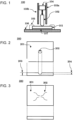
- Fig. 1 is a schematic diagram illustrating a ball drop test performed with a Dupont impact tester.
- a measurement sample (101) is disposed on a sample stage (106) of the cylindrical impact tester, with protective tape (107) attached to a back surface of the measurement sample; the measurement sample is secured on the sample stage by securing tape (105) attached to side surfaces of the measurement sample.
- the drop weight is made up of a weight (104) and a punch (102).
- the punch (102) is disposed on a front surface of the measurement sample (101).
- the ball drop test can be performed by dropping the weight (104) from a height that is equal to a drop height from the punch (in Fig.
- the punch (102) has a cylindrical shape with a spherical (hemispherical) tip.
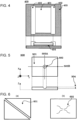
- Fig. 2 is a schematic diagram illustrating an appearance of the sintered body of the present embodiment, which is an appearance after the ball drop test.
- the sintered body of the present embodiment has an impact mark formed in the region to which the impact force produced by the drop weight (punch) in the ball drop test was applied (hereinafter, the region is also referred to as an "impacted portion").
- the impact mark is illustrated as a depressed portion formed in or near the impacted portion, and thus, the presence of a plastic deformation region can be visually confirmed.
- a defect attributable to a brittle fracture such as a crack, may be present in or near the depressed portion.
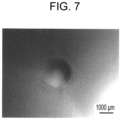
- FIG. 3 is a schematic diagram illustrating an appearance of a sintered body of the related art, which is an appearance after a ball drop test. As illustrated in Fig.3 , the sintered body of the related art cannot be confirmed to have an impact mark formed in an impacted portion, but a defect attributable to a brittle fracture, such as a crack, is observed therein.
- the presence or absence of the plastic deformation region can be verified by at least one of visual observation and observation with an optical microscope or by visual observation.
- the magnification for the observation may be, for example, 1 to 100 times or preferably 10 to 50 times.
- the post-ball-drop-test appearance is not changed from the pre-ball-drop-test appearance, and, therefore, no impact mark can be observed.
- the ball drop test may be repeatedly performed by increasing the drop height until an impact mark can be observed, so that the formation of an impact mark, such as the formation of a depressed portion, can be confirmed. Such a process may be used to investigate the presence or absence of the plastic deformation region.
- a ball drop test involving dropping a 300-g drop weight from a drop height of 200 mm to investigate the presence or absence of a plastic deformation region.
- the ball drop test may be performed at room temperature (20 to 30°C) with a Dupont impact tester that is in accordance with JIS K 5600 5-3.
- the conditions for the ball drop test include the following conditions.
- the measurement sample is to be placed such that one of the surfaces of the measurement sample (a major surface that is a surface of 40 mm in length and 30 mm in width) is secured to the sample stage of the impact tester with double-sided tape so that the scattering of pieces of the sample can be prevented.
- Securing tape protection tape
- the ball drop test can be performed on the secured measurement sample.
- a depth [mm] (204 in Fig. 2 ) of the impact mark at the deepest point, relative to a thickness [mm] (203 in Fig. 2 ) of the sintered body may be, for example, greater than 0% and 3.5% or less, 0.05% or greater and 3% or less or 0.1% or greater and 3% or less. Note that in Fig. 2 , the depth (204) of the impact mark (depressed portion) is illustrated with the depth being exaggerated.
- the depth of the impact mark can be measured with a common laser microscope (e.g., VK-9500/VK-9510, manufactured by Keyence Corporation) or a contact surface profilometer (e.g., Dektak XTL, manufactured by Bruker).
- a laser microscope e.g., VK-9500/VK-9510, manufactured by Keyence Corporation
- a contact surface profilometer e.g., Dektak XTL, manufactured by Bruker.
- the magnification for the observation may be 10 to 50 times or 20 times, and the laser wavelength may be 408 nm, for example.
- Fig. 5 is a schematic diagram illustrating an exemplary method for measuring the depth of the impact mark.
- the method for measuring the depth of the impact mark is not limited to the method described below.
- the measurement of the depth of the impact mark can be carried out as follows: an X-axis direction (503A) is defined as a direction of a maximum diameter of the impact mark that is formed and has a generally circular shape as viewed from above a plane on which the weight dropped; a Y-axis direction (503B) is defined as a direction orthogonal to the X-axis direction and extending in the plane on which the weight dropped; a line profile is obtained individually for the X-axis direction and the Y-axis direction; and a depth (504) of the impact mark is measured, the depth being a difference between the height of the plane on which weight dropped and the height of the surface of the impact mark, as defined with respect to a Z-axis direction, which is orthogonal to the X-axis and the Y-axis.
- a maximum depth measured in the X-axis direction is designated as L1
- a maximum depth measured in the Y-axis direction is designated as L2
- the obtained length is designated as the depth of the impact mark of the sample.
- a measurement condition may be, for example, 0.5 ⁇ m/step. Before the measurement, analysis precision can be adjusted by measuring a standard sample (e.g., a patterned Si substrate) that is provided along with the instrument and has a known pattern length.
- the sintered body of the present embodiment comprises zirconia and germanium oxide, and the zirconia contains a stabilizing element.
- Y/X is 0.35 or greater, and X+Y is 4.0 or less, where X is an amount of the stabilizing element in the zirconia expressed in mol%, and Y is an amount of the germanium oxide in the zirconia expressed in mol%.
- the sintered body of the present embodiment is a sintered body comprising zirconia that contains a stabilizing element and is a so-called zirconia sintered body in which zirconia that contains a stabilizing element is present as a major phase.
- the stabilizing element has a function of stabilizing zirconia and may be at least one selected from the group of calcium (Ca), magnesium (Mg), scandium (Sc), yttrium (Y), gadolinium (Gd), ytterbium (Yb) and dysprosium (Dy).
- the stabilizing element is preferably at least one selected from the group of calcium (Ca), magnesium (Mg), yttrium (Y), gadolinium (Gd) and ytterbium (Yb) and more preferably at least one selected from the group of yttrium (Y) and gadolinium (Gd).
- a content of the stabilizing element may be any amount sufficient to partially stabilize the zirconia.
- the amount of the stabilizing element is 0.1 mol% or greater, 0.2 mol% or greater, 0.25 mol% or greater or 0.5 mol% or greater and is 4.0 mol% or less, 3.5 mol% or less, 3.0 mol% or less or less than 3.0 mol%, on an oxide basis.
- the amount of the stabilizing element is a ratio (mol%) of a total amount of one or more stabilizing elements on an oxide basis to the sum of the amount of the zirconia, the amount of the one or more stabilizing elements on an oxide basis and the amount of the germanium oxide.
- the sintered body of the present embodiment contains germanium oxide.
- the germanium oxide (GeO 2 ) need not be dissolved in the zirconia, or at least a portion of the germanium oxide may be dissolved in the zirconia.
- the amount of the germanium oxide may be 0.1 mol%, 0.3 mol% or greater or 0.5 mol% or greater and may be 4.0 mol% or less, 3.5 mol% or less, 3.0 mol% or less or less than 3.0 mol%, on an oxide (GeO 2 ) basis.
- the amount of the germanium oxide is a ratio (mol%) of a total amount of the germanium oxide to the sum of the amount of the zirconia, the amount of the one or more stabilizing elements on an oxide basis and the amount of the germanium oxide.
- the Y/X of the sintered body of the present embodiment is 0.35 or greater or is preferably 0.45 or greater or 0.5 or greater.
- the Y/X may be 4.0 or less or 3.0 or less. Any combination of these upper and lower limits is possible.
- the X+Y of the sintered body of the present embodiment is 4.0 or less or is preferably 3.5 or less or 3.0 or less.
- the X+Y may be 0.5 or greater or 1.0 or greater. Any combination of these upper and lower limits is possible.
- the sintered body of the present embodiment may comprise alumina (Al 2 O 3 ). Since the sintered body of the present embodiment need not comprise alumina, the alumina content is 0 mass% or greater. In instances where alumina is included, the alumina content may be greater than 0 mass% and less than 30 mass%. The alumina content is preferably greater than 0 mass% and 25 mass% or less and more preferably 0.005 mass% or greater and 20 mass% or less. The alumina content may be 0 mass% or greater, greater than 0 mass%, 0.005 mass% or greater, 0.05 mass% or greater or 0.25 mass% or greater and may be 30 mass% or less, 25 mass% or less or 20 mass% or less. Any combination of these upper and lower limits is possible.
- the sintered body of the present embodiment it is preferable that the sintered body not contain alumina.
- the alumina content be 0.05 mass% or greater, and in terms of a tendency for the sintered body of the present embodiment to have enhanced mechanical properties, with the mechanical properties including a static strength, it is preferable that the alumina content be 30 mass% or less.
- the alumina content is a mass ratio of the amount of aluminum on an Al 2 O 3 basis to the sum of the amount of the zirconia, the amount of the one or more stabilizing elements on an oxide basis, the amount of the germanium oxide and the amount of aluminum on an Al 2 O 3 basis.
- the sintered body of the present embodiment may include a pigment component.
- the pigment component that may be included in the sintered body is a component that has a function of coloring the sintered body.
- the sintered body can exhibit a desired color different from an inherent color of zirconia.
- the pigment component that may be included in the sintered body of the present embodiment is at least one of an element and a compound thereof that have a function of coloring zirconia.
- the pigment component may be, for example, a compound containing a rare earth metal or containing a metal element.
- the pigment component is a transition metal element or a compound containing a transition metal element.
- the pigment component is an element or a compound, where the element is at least one selected from the group of vanadium (V) chromium (Cr), manganese (Mn), iron (Fe), cobalt (Co), nickel (Ni), copper (Cu) and zinc (Zn), and the compound contains at least one of the elements; even more preferably, the pigment component is an oxide containing at least one element selected from the group of manganese, iron, cobalt, nickel and zinc.
- the inclusion of the pigment component can be achieved, for example, by mixing a powder of a pigment with a zirconia powder and sintering the mixture; in this manner, a coloring element or a compound containing the coloring element, which is derived from the pigment powder, can be included as the pigment component into the zirconia sintered body.
- the pigment component may be present in any form.
- the pigment component may be present as particles (second phase particles) or may be dissolved in the zirconia.
- the sintered body of the present embodiment is more likely to exhibit plastic deformation with smaller contents of the pigment component.
- the content of the pigment component may be greater than 0 mass% and preferably 0.001 mass% or greater.
- the content of the pigment component is not limited as long as the sintered body includes the plastic deformation region.
- the content of the pigment component may be, for example, 10 mass% or less, less than 7.5 mass%, 5.0 mass% or less, 3.5 mass% or less or 3.0 mass% or less. Any combination of these upper and lower limits is possible.
- the content of the pigment component can be determined as a ratio of the total mass of one or more pigment components on an oxide basis to the mass of the sintered body of the present embodiment.
- the oxides may be Co 3 O 4 for cobalt, Fe 2 O 3 for iron, Mn 3 O 4 for manganese and NiO for nickel, for example.
- the content of the pigment components can be determined as the ratio of the total mass of the pigment components on the composite-oxide-basis to the mass of the sintered body of the present embodiment.
- the sintered body of the present embodiment is a zirconia sintered body containing, as pigment components, a composite oxide represented by ABO 3 and AB 2 O 4 , containing germanium oxide and alumina and containing, as stabilizing elements, yttrium and gadolinium, the content of each of the components can be determined as follows.
- Amount [mass%] of pigment components ⁇ (ABO 3 + AB 2 O 4 )/(Y 2 O 3 + Gd 2 O 3 + ZrO 2 + Al 2 O 3 + GeO 2 + ABO 3 + AB 2 O 4 ) ⁇ ⁇ 100
- Amount [mass%] of alumina ⁇ Al 2 O 3 /(Y 2 O 3 + Gd 2 O 3 + ZrO 2 + Al 2 O 3 + GeO 2 + ABO 3 + AB 2 O 4 ) ⁇ ⁇ 100
- Germanium oxide mol % GeO 2 / GeO 2 + Y 2 O 3 + Gd 2 O 3 + ZrO 2 ⁇ 100
- Amount [mol%] of stabilizing element ⁇ (Y 2 O 3 + Gd 2 O 3 )/Y 2 O 3 + Gd 2 O 3 + ZrO 2 ) ⁇ ⁇ 100
- Amount mol % of yttrium Y 2 O 3 / Y 2 O 3 + Gd 2 O 3 + ZrO 2 )
- the sintered body of the present embodiment does not contain any other components except for incidental impurities.
- the incidental impurities include hafnia (HfO 2 ).
- hafnia when values related to a composition, such as a density, are to be calculated, hafnia can be regarded as zirconia (ZrO 2 ).
- the sintered body of the present embodiment may have any color, and preferably, the color has an L* value of 0 or greater and 95 or less, an a* value of -15 or greater and 15 or less and a b* value of -30 or greater and 40 or less, according to the CIE1976 (L*, a*, b*) color space.
- the lightness value L* and the chrominance values a* and b* can be measured by a method that is in accordance with JIS Z 8722, using a common spectral colorimeter (e.g., CM-700d, manufactured by Konica Minolta Japan, Inc.).
- Measurement conditions for the lightness value L* and the chrominance values a* and b* include the following conditions.
- the measurement is a measurement that uses a black plate as the background (a so-called black background measurement).
- the measurement sample to be used may be a sintered body having a disc shape with a diameter of 20 mm and a thickness of 1.8 mm.
- the surface to be evaluated may be mirror-polished (Ra ⁇ 0.02 ⁇ m) for the evaluation of the color.
- An effective area for evaluating the color may be an area with a diameter of 10 mm.
- the sintered body of the present embodiment has a high density. More preferably, the density is a density equivalent to a relative density of 98% or greater, preferably 99% or greater, and 100% or less.
- a measured density can be determined by an Archimedes method and is a value determined as a mass, which is determined by a mass measurement, to a volume determined by the Archimedes method.
- the relative density can be determined from a ratio of the measured density to a theoretical density.
- the zirconia included in the sintered body of the present embodiment is formed primarily of a tetragonal phase.
- zirconia is formed primarily of a tetragonal phase means that a tetragonal phase is present in an amount of 50 vol.% or greater based on a total volume of the crystalline phases of the zirconia.
- a tetragonal phase is present in an amount of 50 vol.% or greater, preferably 60 vol.% or greater, based on the total volume of the crystalline phases of the zirconia.
- the zirconia included in the sintered body of the present embodiment may include at least one of a cubic phase and a monoclinic phase.
- a tetragonal phase fraction is a proportion of tetragonal zirconia in the crystalline phases of the zirconia.
- f t is the tetragonal phase fraction (%)
- I m (111) and I m (11-1) are integrated intensities of XRD peaks corresponding respectively to a (111) plane and a (11-1) plane of monoclinic zirconia
- I t (111) is an integrated intensity of an XRD peak corresponding to a (111) plane of tetragonal zirconia
- I c (111) is an integrated intensity of an XRD peak corresponding to a (111) plane of cubic zirconia.
- the powder X-ray diffraction pattern of the sintered body can be measured with a common crystallinity analysis X-ray diffractometer (e.g., X'pert PRO MPD (instrument name), manufactured by Spectris Co., Ltd.).
- a common crystallinity analysis X-ray diffractometer e.g., X'pert PRO MPD (instrument name), manufactured by Spectris Co., Ltd.
- the measurement conditions include the following conditions.
- the sintered body of the present embodiment may have at least one shape selected from the group of, for example, spherical shapes, generally spherical shapes, elliptical shapes, disc shapes, cylindrical shapes, cubic shapes, rectangular parallelepiped shapes, polyhedral shapes and generally polyhedral shapes.
- the shape may be any shape for achieving intended purposes, including various applications.
- the sintered body of the present embodiment has a ball drop strength of 0.5 J or greater or 0.6 J or greater.
- the ball drop strength is one of the indices that indicate impact resistance, and the higher the value, the higher the impact resistance.
- the ball drop strength of the sintered body may be, for example, 10 J or less, 7 J or less or 5 J or less. Any combination of these upper and lower limits is possible.
- Ball drop strength (J) mass (g) of drop weight ⁇ drop height (mm) ⁇ acceleration of gravity (m/s 2 )
- An acceleration of gravity of 9.8 m/s 2 can be used.
- the ball drop strength can be measured in a manner similar to that of the ball drop test described above, except that the ball drop height may be a height selected within the range described below.
- Ball drop height 50 to 500 mm
- a fracture when the measurement sample has broken into two or more pieces, it can be assumed that a fracture has occurred ( Fig. 6(a) ).
- a crack not extending from one end to another end has formed ( Fig. 6(b) ).
- no fracture when a crack not extending from one end to another end has formed ( Fig. 6(b) ), it can be assumed that no fracture has occurred.
- the ball drop test may be repeatedly performed until a fracture occurs, by increasing the drop height with constant increments (e.g., increments of 50 mm) until the drop height becomes 500 mm, and then visual observation may be similarly performed.
- the ball drop test may be repeatedly performed by changing the weight of the drop weight rather than changing the ball drop height.
- the mass of the drop weight may be changed from 300 g to 500 g, and then the ball drop test may be performed again at the drop height of 500 mm. In this case, higher ball drop strengths can be measured.
- An exemplary index for indicating the fracture resistance of the sintered body of the present embodiment is a fracture toughness value.
- the fracture toughness value (MPa ⁇ m 0.5 ) of the sintered body of the present embodiment may be 5.0 MPa ⁇ m 0.5 or greater or 6.0 MPa ⁇ m 0.5 or greater and may be 20.0 MPa ⁇ m 0.5 or less or 18.0 MPa ⁇ m 0.5 or less, as measured by an SEPB method specified in JIS R 1607.
- a flexural strength may be measured in a 3-point bending test that is in accordance with JIS R 1601.
- the flexural strength of the sintered body of the present embodiment is preferably 100 MPa or greater and more preferably 300 MPa or greater.
- the flexural strength of the sintered body of the present embodiment may be, for example, 1800 MPa or less or 1600 MPa or less.
- the sintered body of the present embodiment can be used in conventional applications of sintered bodies, particularly, applications of zirconia sintered bodies, such as those for structural materials, optical materials and dental materials. Further, the sintered body can be used as a component that is required to have a relatively high impact resistance, and examples of the component include decorative items, covers for an accessory, such as a timepiece or a casing, and exterior members of a mobile electronic device, such as a mobile phone.
- An exemplary method for producing the sintered body of the present embodiment is a production method including a step of sintering a powder that contains a stabilizing element source, zirconia and a germanium source (hereinafter, the powder is also referred to as a "raw material composition").
- the powder may be in any form when it is subjected to the mentioned step (hereinafter also referred to as a "sintering step").
- the powder may be formed into a green body (green compact) before being subjected to sintering.
- the stabilizing element source is at least one of an oxide of the stabilizing element and a stabilizing-element-containing compound that serves as a precursor of an oxide of the stabilizing element.
- the stabilizing element source may be, for example, at least one selected from the group of oxides, hydroxides, oxychlorides, chlorides, acetic acid salts, nitric acid salts and sulfuric acid salts that serve as precursors of an oxide of the stabilizing element.
- the stabilizing element source is at least one of a chloride and a nitric acid salt.
- the stabilizing element source may be individually referred to as an yttrium source or a gatolinium source.
- the content of the stabilizing element source in the raw material composition may be an amount equivalent to the amount of the stabilizing element of the target sintered body.
- the yttrium source is at least one of yttria (yttrium oxide, Y 2 O 3 ) and an yttrium compound that serves as a precursor of yttria.
- the yttrium source may be at least one selected from the group of yttrium chloride, yttria and yttrium carbonate and may preferably be yttrium chloride.
- the gadolinium source is at least one of gadolinia (gadolinium oxide) and a gadolinium compound that serves as a precursor of gadolinia.
- the gadolinium source may be at least one selected from the group of gadolinium chloride, gadolinia and gadolinium carbonate and may preferably be gadolinium chloride.
- the germanium source is at least one of germanium oxide and a compound that serves as a precursor of germanium oxide.
- the germanium source may be, for example, at least one selected from the group of hydroxides, chlorides, alkoxides, nitric acid salts and sulfuric acid salts of germanium that serve as precursors of germanium oxide and may preferably be at least one selected from the group of germanium oxide, and chlorides and alkoxides of germanium that serve as precursors of germanium oxide.
- the content of the germanium source in the raw material composition may be an amount equivalent to the amount of the stabilizing element of the target sintered body.
- the raw material composition may include an alumina source.
- the alumina source is at least one of alumina (Al 2 O 3 ) and an aluminum (Al)-containing compound that serves as a precursor of alumina.
- the alumina source may be at least one selected from the group of aluminum chloride, aluminum sulfate, aluminum nitrate, aluminum hydroxide, alumina sols and alumina and may preferably be alumina.
- the content of the alumina source in the raw material composition may be an amount equivalent to the alumina content of the target sintered body.
- the zirconia may be zirconium oxide (ZrO 2 ) or a stabilizing-element-containing zirconia, which contains a stabilizing element.
- the stabilizing-element-containing zirconia include yttrium-stabilized zirconias.
- any method may be used to include the stabilizing element into the zirconia.
- a hydrated zirconia sol may be mixed with a stabilizing element source in an amount equivalent to the target content of the stabilizing element, and the mixture may be dried, calcined and washed.
- the zirconia may be a germanium oxide-containing stabilized zirconia that contains germanium oxide and a stabilizing element.
- Examples of the germanium oxide-containing stabilized zirconia include germanium oxide-containing yttrium-stabilized zirconias. In the instance where a germanium oxide-containing stabilized zirconia is to be used, any method may be used to include the germanium oxide into the zirconia.
- a hydrated zirconia sol may be mixed with a stabilizing element source and a germanium source, and the mixture may be dried, calcined and washed; and in another method, a hydrated zirconia sol may be mixed with a stabilizing element source, the mixture may be dried and calcined, and subsequently, a germanium source may be mixed with the mixture, which may then be calcined.
- the mixing may be carried out by any method.
- the method is preferably at least one of dry mixing and wet mixing, more preferably wet mixing and even more preferably wet mixing that uses a ball mill.
- the method for producing the sintered body of the present embodiment may include a step of compacting the raw material composition to give a green body (green compact) (hereinafter, the step is also referred to as a "molding step").
- any method may be used to produce the green body.
- zirconia, a stabilizing element source, a germanium source and, if necessary, one or more additives, such as an alumina source are mixed together and compacted in any manner.
- the green body may include a binding agent so as to have improved shape stability.
- the binding agent may be any organic binder for use in the compaction of a ceramic and may be, for example, at least one selected from the group of acrylic resins, polyolefin resins, waxes and plasticizing agents.
- a ratio of the binding agent in a volume of the green body may be, for example, 25 vol.% or greater and 65 vol.% or less at room temperature.
- the binding agent may be present in an amount of, for example, greater than 0 mass% and 10 mass% or less based on a total mass of the green body.
- the green body may have any shape that suits a purpose and which is selected with shrinkage due to sintering taken into account.
- the shape may be, for example, at least one selected from the group of spherical shapes, generally spherical shapes, elliptical shapes, disc shapes, cylindrical shapes, cubic shapes, rectangular parallelepiped shapes, polyhedral shapes and generally polyhedral shapes.
- the compaction may be carried out by a compaction method known in the art that can form a green compact from a mixed powder.
- the compaction method is at least one selected from the group of uniaxial pressing, isostatic pressing, injection molding, extrusion, tumbling granulation, slip casting and casing.
- the compaction method is preferably at least one of uniaxial pressing and isostatic pressing, more preferably at least one of cold isostatic pressing and uniaxial pressing (powder pressing) and even more preferably uniaxial pressing followed by cold isostatic pressing.
- An additional step of calcinating a green body before sintering, to give a calcined body, may be provided (hereinafter, the step is also referred to as a "calcination step"). Calcinating the green body can remove a binder from the green body.
- the calcination step may be performed under any conditions as long as the sintered body of the present embodiment can be obtained.
- the sintering may be carried out by performing a heat treatment in air at a temperature of 400°C or greater and less than 1100°C.
- the sintering step is a step of sintering the green body to give a sintered body.
- Any sintering method may be used as long as the method enables sintering to proceed. Examples of the method include sintering methods known in the art, such as pressureless sintering, pressure sintering and vacuum sintering.
- the sintering method is pressureless sintering. Since pressureless sintering is easy, the sintering method may preferably use only pressureless sintering. In this case, the resulting sintered body of the present embodiment can be a so-called pressureless sintered body.
- Pressureless sintering is a method of sintering that is carried out simply by heating the green body (or calcined body) for sintering, without applying an external force. Note that during the process of sintering, the composition of the germanium oxide-containing stabilized zirconia does not change. That is, it can be assumed that the powder of the germanium oxide-containing stabilized zirconia, the calcined body of the germanium oxide-containing stabilized zirconia and the sintered body of the germanium oxide-containing stabilized zirconia have the same composition.
- examples of a sintering temperature include 1050°C or greater and 1600°C or less.
- the sintering temperature may be, for example, 1100°C or greater and 1550°C or less, 1100°C or greater and 1500°C or less or 1150°C or greater and 1500°C or less.
- a sintering atmosphere may be at least one of an air atmosphere and an oxygen atmosphere and may preferably be an air atmosphere.
- a heating rate may be, for example, 20°C/hour or greater and 5000°C/hour or less.
- a sintering time may be appropriately set in accordance with the amount and size of the material that is to be sintered and the features of the sintering furnace.
- the material may be held at any of the above-mentioned sintering temperatures for a time of 0.3 hours or more and 20 hours or less, a time of 0.5 hours or more and 20 hours or less or a time of 0.5 hours or more and 15 hours or less.
- the zirconia that is used in the method for producing the sintered body of the present embodiment may be produced by any method.
- An exemplary method for producing the zirconia is a production method including a step of preparing a calcined powder and a step of grinding the calcined powder.
- the calcined powder is prepared by heat-treating a composition containing a zirconia sol and a stabilizing element source at a temperature of 600°C or greater and 1250°C or less.
- the zirconia sol contains crystalline zirconia that includes a major phase of monoclinic zirconia.
- the production method will be described in detail below. It is to be noted that the method for producing the zirconia of the present embodiment is not limited to the production method that is described below.
- the zirconia sol containing crystalline zirconia that includes a major phase of monoclinic zirconia may be produced by any method.
- the method may be, for example, at least one of a hydrothermal synthesis method and a hydrolysis method.
- the zirconia sol can be prepared by heat-treating, at a temperature of 100 to 200°C, a coprecipitate obtained by mixing a zirconium salt with an alkali or the like in the presence of a solvent.
- the zirconia sol can be prepared by heating a zirconium salt in the presence of a solvent, thereby hydrolyzing the zirconium salt.
- the zirconia sol may be, for example, a zirconia sol prepared by a hydrothermal synthesis method or a hydrolysis method, and preferably, the zirconia sol is a zirconia sol prepared by a hydrolysis method.
- a precursor that is used in the method for producing the zirconia sol may be a zirconium salt.
- the zirconium salt may be, for example, at least one selected from the group of zirconium oxychloride, zirconium nitrate, zirconium chloride and zirconium sulfate.
- the zirconium salt is preferably at least one of zirconium nitrate and zirconium oxychloride and more preferably zirconium oxychloride.
- a composition (a zirconia raw material composition) containing a zirconia sol that contains zirconia that includes a major phase of monoclinic zirconia and containing a stabilizing element source is heat-treated at a temperature of 600°C or greater and 1250°C or less, it is possible to prepare the calcined powder, which is a precursor of the powder of the zirconia.
- the heat treatment is performed at a temperature of 500°C or greater and 1250°C or less or at a temperature of 600°C or greater and 1250°C or less.
- the temperature for the heat treatment is 600°C or greater, a powder that can be easily densified by pressureless sintering can be obtained.
- the temperature for the heat treatment is 1250°C or less, a powder that can be easily dispersed by grinding can be readily obtained.
- the time of the heat treatment may be appropriately varied in accordance with the heat treatment temperature, the amount of the zirconia raw material composition that is to be treated and the characteristics of the heat treatment furnace. An example of the time is 30 minutes or more and 6 hours or less.
- the heating rate for achieving the heat treatment temperature has little influence on the resulting calcined powder.
- the heating rate may be 50°C/hour or greater and 1000°C/hour or less.
- the atmosphere for the heat treatment may be any atmosphere and, for example, may be one selected from the group of oxidizing atmospheres, reducing atmospheres, inert atmospheres and vacuum atmospheres.
- the atmosphere is preferably an oxidizing atmosphere and more preferably an air atmosphere.
- the zirconia raw material composition that is subjected to the powder calcination step may be any composition that contains a zirconia sol and a stabilizing element source, as described above. All or a portion of the stabilizing element source may be dissolved in the zirconia sol. The dissolution of at least a portion of the stabilizing element source can be facilitated, for example, by a method involving mixing a zirconium salt with the stabilizing element source to cause hydrolysis or a method involving mixing a zirconium salt, a stabilizing element source, an alkaline and the like together to yield a coprecipitate.
- the calcined powder is subjected to a grinding process.
- Zirconia in which the content of the stabilizing element is low tends to exhibit cracking, chipping and/or the like during sintering.
- the grinding process of the calcined powder can be performed to address this and tends to increase a sintering yield.
- the grinding may be carried out by any method, and the method may be at least one of wet grinding and dry grinding.
- the method is preferably wet grinding, preferably wet grinding that uses an aqueous dispersion medium having a pH of ⁇ 7.0 (i.e., being acidic) and more preferably wet grinding that uses an aqueous dispersion medium having a pH of ⁇ 5.0.
- the wet grinding may be, for example, at least one selected from the group of wet grinding in a ball mill and wet grinding in a continuous medium stirring mill. Wet grinding in a ball mill is preferable.
- the powder that is subjected to the grinding step may be the calcined powder or a mixed powder containing the calcined powder, a germanium source and an alumina source.
- the germanium source include the germanium sources previously mentioned
- examples of the alumina source include the alumina sources previously mentioned.
- the conditions for the grinding in a ball mill are, for example, as follows.
- the calcined powder is mixed with a solvent (e.g., at least one of water and an alcohol, or water) to form a slurry in which a mass ratio of the calcined powder is 30 mass% or greater and 60 mass% or less based on the mass of the slurry, and the slurry is ground with zirconia balls having a diameter of 0.5 mm or greater and 15 mm or less being used as grinding media.
- the time of the grinding may be appropriately adjusted in accordance with the amount of the calcined powder that is processed. The time is, for example, 8 hours or more and 100 hours or less.
- drying is performed by any method to give a zirconia powder.
- the conditions for the drying may include, for example, an air atmosphere and a temperature of 110°C to 130°C.
- the method for producing the powder may include a step of granulating the powder (hereinafter also referred to as a "granulation step") in order to improve the handling of the powder.
- the granulation may be carried out by any method. Examples of the method include spray-granulating a slurry obtained by mixing the powder with a solvent.
- the solvent is at least one of water and an alcohol and is preferably water.
- the granulated powder (hereinafter also referred to as "powder granules”) may have an average granule size of 30 ⁇ m or greater and 80 ⁇ m or less or 50 ⁇ m or greater and 60 ⁇ m or less and a bulk density of 1.00 g/cm 3 or greater and 1.50 g/cm 3 or less or 1.10 g/cm 3 or greater and 1.45 g/cm 3 or less.
- the measurement sample was placed such that one of the surfaces of the measurement sample (a surface of 40 mm in length and 30 mm in width) was secured to the sample stage of the impact tester with double-sided tape so that the scattering of pieces of the sample could be prevented. Tape was attached along the length of the surface opposite to the surface onto which the placed measurement sample was secured. The punch was positioned such that the drop weight could drop onto a center or a region near the center of the secured measurement sample, and then, a ball drop test was performed.
- Ball drop strength (J) mass (g) of drop weight ⁇ drop height (mm) ⁇ acceleration of gravity (9.8 m/s 2 )
- the measured density of the sintered body sample was determined as the ratio (g/cm 3 ) of the volume measured by an Archimedes method to the mass measured by a mass measurement. Before the measurement, the mass of the dried sintered body was measured, and subsequently, a pretreatment was performed in which the sintered body was placed in water and boiled for 1 hour.
- the theoretical density (g/cm 3 ) was determined by determining the unit cell mass (g) of the zirconia per unit cell volume (cm 3 ) thereof, assuming that all the crystalline phases of the zirconia in the sintered body were tetragonal.
- the fracture toughness value of the sintered body sample was measured with a method that is in accordance with the SEPB method specified in JIS R 1607.
- the flexural strength of the sintered body sample was measured in a 3-point bending test that is in accordance with JIS R 1601.
- the color of the sintered body sample was measured with a method that is in accordance with JIS Z 8722.
- the measurement was carried out with a common spectral colorimeter (CM-700d (instrument name), manufactured by Konica Minolta Japan, Inc.).
- CM-700d instrument name
- the measurement was a black background measurement that used a black plate as the background.
- the measurement conditions were as follows.
- the sintered body sample used had a disc shape with a diameter of 20 mm and a thickness of 1.8 mm.
- One surface of the sintered body sample was mirror-polished (Ra ⁇ 0.02 ⁇ m), and the color was evaluated using the surface as the evaluation surface.
- the effective area for evaluating the color was an area with a diameter of 10 mm.
- a hydrated zirconia sol was prepared by hydrolyzing an aqueous zirconium oxychloride solution. Yttrium chloride hexahydrate was added to and mixed with the hydrated zirconia sol such that an yttrium concentration of 1.0 mol% could be achieved. After the mixing, the mixture was dried in an air atmosphere and then calcined in an air atmosphere at 1000°C for 2 hours to give a calcined powder of an yttrium-stabilized zirconia. The resulting calcined powder was washed with purified water, and subsequently, a germanium oxide powder was added to and wet-mixed with the calcined powder such that a germanium oxide concentration of 2.4 mol% could be achieved.
- a mixed powder was prepared.
- the mixed powder was dried in an air atmosphere and then calcined in an air atmosphere at 800°C for 2 hours to give a zirconia powder made of a germanium oxide-containing yttrium-stabilized zirconia.
- the powder of the present Example was subjected to uniaxial pressing at a pressure of 50 MPa and a cold isostatic pressing (CIP) process at a pressure of 196 MPa to give a green body.
- CIP cold isostatic pressing
- the resulting green body was calcined under the following conditions.
- the sintered body was made of a germanium oxide-containing yttrium-stabilized zirconia and had a germanium oxide content of 2.4 mol% and an yttrium oxide content of 1.0 mol%.
- the sintering conditions are shown below.
- a powder containing a germanium oxide-containing yttrium-stabilized zirconia was prepared in a manner similar to that of Example 1, except that the amount of the germanium oxide added was 2.0 mol%, and 10 mass% of an alumina powder was mixed with the slurry for the grinding and mixing.
- alumina was present in an amount of 10 mass% based on the mass of the zirconia, which had a germanium oxide content of 2.0 mol% and an yttrium oxide content of 1.0 mol%.
- a sintered body of the present Example was prepared in a manner similar to that of Example 1, except that the powder just described was used, and the sintering temperature was 1350°C.
- a powder containing a germanium oxide-containing yttrium-stabilized zirconia was prepared in a manner similar to that of Example 1, except that the amount of the germanium oxide added was 2.0 mol%, and 20 mass% of an alumina powder was mixed with the slurry for the grinding and mixing.
- alumina was present in an amount of 20 mass% based on the mass of the zirconia, which had a germanium oxide content of 2.0 mol% and an yttrium oxide content of 1.0 mol%.
- a sintered body of the present Example was prepared in a manner similar to that of Example 1, except that the powder just described was used, and the sintering temperature was 1400°C.
- a hydrated zirconia sol was prepared by hydrolyzing an aqueous zirconium oxychloride solution. Yttrium chloride hexahydrate was added to and mixed with the hydrated zirconia sol such that an yttrium concentration of 1.2 mol% could be achieved. After the mixing, the mixture was dried in an air atmosphere and then calcined in an air atmosphere at 1000°C for 2 hours to give a calcined powder of an yttrium-stabilized zirconia.
- alumina was present in an amount of 10 mass% based on the mass of the zirconia, which had a germanium oxide content of 1.1 mol% and an yttrium oxide content of 1.2 mol%.
- a sintered body of the present Example was prepared in a manner similar to that of Example 1, except that the powder just described was used.
- a powder containing a germanium oxide-containing gadolinium-stabilized zirconia was prepared in a manner similar to that of Example 1, except that 1.2 mol% gadolinium chloride was added instead of yttrium chloride, the amount of the germanium oxide added was 1.8 mol% and 10 mass% of an alumina powder was mixed with the slurry for the grinding and mixing.
- alumina was present in an amount of 10 mass% based on the mass of the zirconia, which had a germanium oxide content of 1.8 mol% and a gadolinium oxide content of 1.2 mol%.
- a sintered body of the present Example was prepared in a manner similar to that of Example 1, except that the powder just described was used, and the sintering temperature was 1350°C.
- a powder containing a germanium oxide-containing gadolinium-stabilized zirconia was prepared in a manner similar to that of Example 3, except that 1.2 mol% gadolinium chloride was added instead of yttrium chloride, and the amount of the germanium oxide added was 1.2 mol%.
- alumina was present in an amount of 10 mass% based on the mass of the zirconia, which had a germanium oxide content of 1.2 mol% and a gadolinium oxide content of 1.2 mol%.
- a sintered body of the present Example was prepared in a manner similar to that of Example 1, except that the powder just described was used.
- a powder containing a germanium oxide-containing gadolinium-stabilized zirconia was prepared in a manner similar to that of Example 4, except that yttrium chloride hexahydrate was added such that an yttrium concentration of 1.5 mol% could be achieved, the amount of the germanium oxide added was 0.7 mol% and the amount of the alumina added was 0.25 mass%.
- alumina was present in an amount of 0.25 w mass% based on the mass of the zirconia, which had a germanium oxide content of 0.7 mol% and an yttrium content of 1.5 mol%.
- a sintered body 1 of the present Example was prepared in a manner similar to that of Example 1, except that the powder just described was used, and the sintering temperature was 1250°C.
- a sintered body 2 of the present Example was prepared in a manner similar to that just described, except that the sintering temperature was 1450°C.
- the two types of sintered bodies 1 and 2, which were prepared from the powder of the present Example, are indicated as Example 7-1 and Example 7-2, respectively, in Table 2, shown below.
- a zirconia powder made of an yttrium-stabilized zirconia having an yttrium oxide content of 2.0 mol% was prepared in a manner similar to that of Example 1, except that yttrium chloride hexahydrate was added such that an yttrium concentration of 2.0 mol% could be achieved, and no germanium oxide was added.
- a sintered body of the present Comparative Example was prepared in a manner similar to that of Example 1, except that the powder just described was used, and the sintering temperature was 1450°C.
- a zirconia powder made of a cerium-and-yttrium-stabilized zirconia having an yttrium oxide content of 1.0 mol% and a cerium oxide content of 4.0 mol% was prepared in a manner similar to that of Example 1, except that cerium chloride heptahydrate was added such that a ceria concentration of 4.0 mol% could be achieved, and no germanium oxide was added.
- a sintered body of the present Comparative Example was prepared in a manner similar to that of Example 1, except that the powder just described was used, and the sintering temperature was 1450°C.
- a powder containing a germanium oxide-containing yttrium-stabilized zirconia was prepared in a manner similar to that of Example 4, except that yttrium chloride hexahydrate was added such that an yttrium concentration of 3.0 mol% could be achieved, the amount of the germanium oxide added was 0.3 mol% and the amount of the alumina added was 0.25 mass%.
- alumina was present in an amount of 0.25 mass% based on the mass of the zirconia, which had a germanium oxide content of 0.3 mol% and an yttrium oxide content of 3.0 mol%.
- a sintered body of the present Example was prepared in a manner similar to that of Example 1, except that the powder just described was used, and the sintering temperature was 1200°C.
- Example 1 Stabilizing Element [mol%] GeO2(Y) [mol%] Y/X X+Y [mol%] Al2O3 [wt%] Y2O3 Gd2O3 CeO2 Total (X)
- Example 1 1.0 - - 1.0 2.4 2.4 3.4 0
- Example 2 1.0 - - 1.0 2.0 2.0 3.0
- Example 3 1.0 - - 1.0 2.0 2.0 3.0
- Example 4 1.2 - - 1.2 1.1 0.9 2.3 10
- Example 1 1300 88.04 -0.37 0.88 1.0 white ⁇ 96.6 1.18 8.4
- Example 2 1350 97.00 -0.40 1.81 1.9 white ⁇ 86.5 3.92 13.1
- Example 3 1400 98.08 -0.10 1.71 1.7 white ⁇ 66.0 1.47 11.5
- Example 4 1300 98.66 -0.08 0.01 0.1 white ⁇ 90.4 2.20 12.8
- Example 5 1350 97.99 -0.36 1.06 1.1 white ⁇ 96.8 1.03 9.7
- Example 6 1 1300 88.04 -0.37 0.88 1.0 white ⁇ 96.6 1.18 8.4
- Example 2 1350 97.00 -0.40 1.81 1.9 white ⁇ 86.5 3.92 13.1
- Example 3 1400 98.08 -0.10 1.71 1.7 white ⁇ 66.0 1.47 11.5
- Example 4 1300 98.66 -0.08 0.01 0.1 white ⁇ 90.4 2.20 12.8
- Example 5 1350 97.99 -0.36
- Fig. 7 shows an appearance of the sintered body of Example 2, which is an appearance after the ball drop test.
- Fig. 7 it can be visually observed that the region with which the drop weight came into contact in the ball drop test had an impact mark (depressed portion) formed therein without fractures such as a crack being involved, that is, an impact mark (depressed portion) that was a mark of plastic deformation was present.
- the sintered bodies of Examples 1 to 6 all had a tetragonal phase fraction of greater than 60% and, therefore, can be confirmed to have been made primarily of a tetragonal phase. Furthermore, an impact mark that was a mark of plastic deformation was visually observed, and a ball drop fracture energy was greater than or equal to 1.0 J. In these sintered bodies, an impact mark that was a mark of plastic deformation, as in Fig. 7 , was visually observed.
- Comparative Example 1 which contained only yttrium as a stabilizing element, had a fracture toughness value and a ball drop fracture energy that were both lower than those of Examples 1 to 6.
- the L* value was greater than or equal to 80, the absolute values of the a* value and the b* value were less than or equal to 5, and thus, a white color was exhibited.
- the sintered body of Comparative Example 2 which contained CeO 2 as a stabilizing element, an impact mark that was a mark of plastic deformation was visually observed, and the ball drop fracture energy was high.
- the L* value was less than 80, the absolute values of the a* value and the b* value were greater than 5.0, and a yellow color derived from ceria was exhibited.
- the sintered bodies of the Examples all had high impact resistance and high fracture toughness and did not exhibit a color derived from ceria.
- a hydrated zirconia sol was prepared by hydrolyzing an aqueous zirconium oxychloride solution. Yttrium chloride hexahydrate was added to and mixed with the hydrated zirconia sol such that an yttrium concentration of 1.6 mol% could be achieved. After the mixing, the mixture was dried in an air atmosphere and then calcined in an air atmosphere at 1000°C for 2 hours to give a calcined powder of an yttrium-stabilized zirconia.
- the resulting calcined powder was washed with purified water, and subsequently, germanium oxide, alumina and cobalt oxide were added to the calcined powder such that a germanium oxide concentration of 1.0 mol%, an alumina content of 0.25 mass% and a cobalt oxide content of 1.0 mass% could be achieved.
- Purified water was then added to form a slurry, which was subsequently subjected to grinding and mixing in a ball mill that used zirconia balls as grinding media. After the grinding and mixing, the slurry was dried in an air atmosphere at 110°C and then sieved to remove coarse particles having an agglomerate size of greater than 180 ⁇ m.
- a powder of the present Example which contained a germanium oxide-containing yttrium-stabilized zirconia, was prepared.
- alumina was present in an amount of 0.25 mass%, and cobalt oxide in an amount of 1.0 mass%, based on the mass of the zirconia powder, which had a germanium oxide content of 1.0 mol% and an yttrium oxide content of 1.6 mol%.
- the powder of the present Example was subjected to uniaxial pressing at a pressure of 50 MPa and a cold isostatic pressing (CIP) process at a pressure of 196 MPa to give a green body.
- CIP cold isostatic pressing
- the resulting green body was calcined under the following conditions to give a calcined body of the present Example.
- a sintered body of the present Example was prepared.
- alumina was present in an amount of 0.25 mass%, and cobalt oxide in an amount of 1.0 mass%, based on the mass of the zirconia, which had a germanium oxide content of 1.0 mol% and an yttrium oxide content of 1.6 mol%.
- the sintering conditions are shown below.
- a powder and a calcined body of the present Example were prepared in a manner similar to that of Example 8, except that the amount of the germanium oxide added was 0.6 mol%, and iron oxide (Fe 2 O 3 ) was used as a pigment component instead of cobalt oxide (Co 3 O 4 ).
- alumina was present in an amount of 0.25 mass%, and iron oxide in an amount of 1.0 mass%, based on the mass of the zirconia, which had a germanium oxide content of 0.6 mol% and an yttrium oxide content of 1.6 mol%.
- a sintered body of the present Example was prepared in a manner similar to that of Example 8, except that the powder just described was used, and the sintering temperature was 1350°C.
- a powder and a calcined body of the present Example were prepared in a manner similar to that of Example 7, except that yttrium chloride hexahydrate was added such that an yttrium concentration of 1.2 mol% could be achieved, the amount of the germanium oxide added was 1.2 mol%, no alumina was added and 0.5 mass% CoAl 2 O 4 was used as a pigment component instead of cobalt oxide (Co 3 O 4 ).
- CoAl 2 O 4 was present in an amount of 0.5 mass%, based on the mass of the zirconia, which had a germanium oxide content of 1.2 mol% and an yttrium oxide content of 1.2 mol%.
- a sintered body of the present Example was prepared in a manner similar to that of Example 8, except that the powder just described was used, and the sintering temperature was 1250°C.
- a powder, a calcined body and a sintered body of the present Example were prepared in a manner similar to that of Example 10, except that 0.03 mass% iron oxide (Fe 2 O 3 ), in addition to CoAl 2 O 4 , was added as a pigment component, 10 mass% alumina was added and the amount of the CoAl 2 O 4 added was 0.01 mass%.
- alumina was present in an amount of 10 mass%, iron oxide in an amount of 0.03 mass% and CoAl 2 O 4 in an amount of 0.01 mass%, based on the mass of the zirconia powder, which had a germanium oxide content of 1.2 mol% and an yttrium oxide content of 1.2 mol%.
- a sintered body of the present Example was prepared in a manner similar to that of Example 8, except that the powder just described was used, and the sintering temperature was 1250°C.
- a powder and a calcined body of the present Example were prepared in a manner similar to that of Example 10, except that yttrium chloride was added such that an yttrium concentration of 1.0 mol% could be achieved, and the amount of the germanium oxide added was 2.0 mol%.
- alumina was present in an amount of 10 mass%, iron oxide in an amount of 0.03 mass% and CoAl 2 O 4 in an amount of 0.01 mass%, based on the mass of the zirconia, which had a germanium oxide content of 2.0 mol% and an yttrium oxide content of 1.0 mol%.
- a sintered body of the present Example was prepared in a manner similar to that of Example 8, except that the powder just described was used, and the sintering temperature was 1250°C.
- a powder and a calcined body of the present Example were prepared in a manner similar to that of Example 9, except that gadolinium chloride was added instead of yttrium chloride such that a gadolinium concentration of 1.4 mol% could be achieved, and 1 mass% nickel oxide (NiO) was added instead of CoAl 2 O 4 .
- NiO was present in an amount of 1.0 mass% based on the mass of the zirconia, which had a germanium oxide content of 1.2 mol% and a gadolinium oxide content of 1.4 mol%.
- a sintered body of the present Example was prepared in a manner similar to that of Example 8, except that the powder just described was used, and the sintering temperature was 1200°C.
- a powder and a calcined body of the present Example were prepared in a manner similar to that of Example 12, except that yttrium chloride was added in addition to gadolinium chloride such that an yttrium concentration of 0.4 mol% could be achieved, the amount of the germanium oxide added was 0.7 mol% and 1 mass% manganese oxide (Mn 3 O 4 ) was added instead of nickel oxide.
- manganese oxide was present in an amount of 1.0 mass% based on the mass of the zirconia, which had a germanium oxide content of 0.7 mol%, an yttrium oxide content of 0.4 mol% and a gadolinium oxide content of 1.4 mol%.
- a sintered body of the present Example was prepared in a manner similar to that of Example 8, except that the powder just described was used, and the sintering temperature was 1200°C.
- a powder and a calcined body of the present Example were prepared in a manner similar to that of Example 14, except that the amount of the germanium oxide added was 1.2 mol%, and 10 mass% alumina, 0.3 mass% iron oxide and 0.3 mass% cobalt oxide were added in addition to 1 mass% manganese oxide.
- alumina was present in an amount of 10 mass%, iron oxide in an amount of 0.3 mass%, manganese oxide in an amount of 1.0 mass% and cobalt oxide in an amount of 0.3 mass%, based on the mass of the zirconia, which had a germanium oxide content of 1.2 mol%, an yttrium oxide content of 0.4 mol% and a gadolinium oxide content of 1.4 mol%.
- a sintered body of the present Example was prepared in a manner similar to that of Example 8, except that the powder just described was used, and the sintering temperature was 1350°C.
- a powder and a calcined body of the present Example were prepared in a manner similar to that of Example 15, except that yttrium chloride was added such that an yttrium concentration of 1.6 mol% could be achieved, no gadolinium chloride was added and the amount of the germanium oxide added was 0.6 mol%.
- alumina was present in an amount of 10 mass%, iron oxide in an amount of 0.3 mass%, manganese oxide in an amount of 1.0 mass% and cobalt oxide in an amount of 0.3 mass%, based on the mass of the zirconia, which had a germanium oxide content of 0.6 mol% and an yttrium oxide content of 1.6 mol%.
- a sintered body of the present Example was prepared in a manner similar to that of Example 8, except that the powder just described was used.
- a powder and a calcined body of the present Example were prepared in a manner similar to that of Example 8, except that yttrium chloride was added such that an yttrium concentration of 2.0 mol% could be achieved, the amount of the germanium oxide added was 0.8 mol% and 0.01 mass% iron oxide, 0.5 mass% manganese oxide and 0.6 mass% CoAl 2 O 4 were added instead of 1 mass% cobalt oxide.
- alumina was present in an amount of 0.25 mass%, iron oxide in an amount of 0.01 mass%, manganese oxide in an amount of 0.5 mass% and CoAl 2 O 4 in an amount of 0.6 mass%, based on the mass of the zirconia, which had a germanium oxide content of 0.8 mol% and an yttrium oxide content of 2.0 mol%.
- a sintered body of the present Example was prepared in a manner similar to that of Example 8, except that the powder just described was used, and the sintering temperature was 1450°C.
- the powders contained germanium oxide and that the ratio (Y/X) of the germanium oxide content to the stabilizing element content in the zirconia powders was greater than or equal to 0.35, as with the powders listed in Table 1.
- Example 8 1400 45.46 -0.98 -0.94 navy blue ⁇ 88.7 2.45 10.8
- Example 9 1350 49.01 5.2 4.48 brown ⁇ 98.4 1.03 6.4
- Example 10 1250 52.61 -3.36 -18.36 blue ⁇ 95.5 2.45 11.0
- Example 11 1250 95.62 0.09 2.01 light gray ⁇ 96.0 1.47 9.6
- Example 12 1350 95.17 0.32 2.05 light gray ⁇ 93.9 2.94 10.2
- Example 13 1200 75.79 -7.61 9.57 green ⁇ 84.6 1.32 10.4
- Example 14 1200 45.25 0.17 -0.78 black ⁇ 78.0 1.03 6.5
- Example 15 1350 51.18 -0.74 1.01 dark gray ⁇ 69.0 1.32 9.0
- Example 16 1400 49.67 -0.19
- the sintered bodies had a color different from white as a result of the addition of one or more pigment components, and that a desired color was exhibited without an influence of a color derived from ceria. Furthermore, in the sintered bodies of Examples 8 to 17, an impact mark that was a mark of plastic deformation was visually observed, and a ball drop fracture energy was greater than or equal to 1.0 J.
Landscapes
- Chemical & Material Sciences (AREA)
- Engineering & Computer Science (AREA)
- Organic Chemistry (AREA)
- Ceramic Engineering (AREA)
- Manufacturing & Machinery (AREA)
- Composite Materials (AREA)
- Materials Engineering (AREA)
- Structural Engineering (AREA)
- Inorganic Chemistry (AREA)
- Compositions Of Oxide Ceramics (AREA)
- Inorganic Compounds Of Heavy Metals (AREA)
Applications Claiming Priority (2)
| Application Number | Priority Date | Filing Date | Title |
|---|---|---|---|
| JP2021212807 | 2021-12-27 | ||
| PCT/JP2022/048288 WO2023127900A1 (ja) | 2021-12-27 | 2022-12-27 | 焼結体、焼結体の製造方法、焼結体の原料粉末、及び、仮焼体 |
Publications (2)
| Publication Number | Publication Date |
|---|---|
| EP4458788A1 true EP4458788A1 (de) | 2024-11-06 |
| EP4458788A4 EP4458788A4 (de) | 2025-11-19 |
Family
ID=86999186
Family Applications (1)
| Application Number | Title | Priority Date | Filing Date |
|---|---|---|---|
| EP22916122.9A Pending EP4458788A4 (de) | 2021-12-27 | 2022-12-27 | Sinterkörper, verfahren zur herstellung eines sinterkörpers, ausgangsmaterialpulver für sinterkörper und kalzinierter körper |
Country Status (6)
| Country | Link |
|---|---|
| US (1) | US20250059097A1 (de) |
| EP (1) | EP4458788A4 (de) |
| JP (3) | JP7380822B2 (de) |
| KR (1) | KR20240127330A (de) |
| CN (1) | CN117940393A (de) |
| WO (1) | WO2023127900A1 (de) |
Cited By (1)
| Publication number | Priority date | Publication date | Assignee | Title |
|---|---|---|---|---|
| EP4074673A1 (de) * | 2021-04-12 | 2022-10-19 | Tosoh Corporation | Sinterkörper |
Families Citing this family (2)
| Publication number | Priority date | Publication date | Assignee | Title |
|---|---|---|---|---|
| CN121889357A (zh) * | 2023-09-22 | 2026-04-17 | 可乐丽则武齿科株式会社 | 氧化锆预烧体 |
| CN120736894B (zh) * | 2025-06-12 | 2026-03-17 | 广东盈浩工艺制品有限公司 | 一种耐冲击复合陶瓷材料及其制备方法和应用 |
Family Cites Families (12)
| Publication number | Priority date | Publication date | Assignee | Title |
|---|---|---|---|---|
| JPH04349172A (ja) * | 1990-07-17 | 1992-12-03 | Nissan Chem Ind Ltd | ジルコニアセラミックス |
| JP2703207B2 (ja) * | 1995-01-30 | 1998-01-26 | 松下電工株式会社 | ジルコニア系複合セラミック焼結体及びその製法 |
| JP4479142B2 (ja) | 2002-04-11 | 2010-06-09 | 住友電気工業株式会社 | ジルコニア質焼結体及びその製造方法 |
| JP5481316B2 (ja) * | 2010-08-20 | 2014-04-23 | 株式会社ノリタケカンパニーリミテド | ジルコニア焼結体、並びにその焼結用組成物及び仮焼体 |
| JP6405699B2 (ja) * | 2014-05-22 | 2018-10-17 | 東ソー株式会社 | ジルコニア焼結体及びその製造方法 |
| JP6615262B2 (ja) | 2018-05-24 | 2019-12-04 | クラレノリタケデンタル株式会社 | ジルコニア仮焼体及びジルコニア焼結体 |
| EP3960721A4 (de) * | 2019-04-25 | 2023-01-25 | Tosoh Corporation | Sinterkörper, pulver und verfahren zur herstellung davon |
| JP7838224B2 (ja) | 2019-12-10 | 2026-04-01 | 東ソー株式会社 | 耐衝撃性に優れる焼結体 |
| JP7767715B2 (ja) | 2019-12-10 | 2025-11-12 | 東ソー株式会社 | 耐衝撃性に優れる焼結体 |
| CN115427373B (zh) | 2020-04-22 | 2025-02-25 | 东曹株式会社 | 烧结体及其制造方法 |
| CN113387698A (zh) * | 2021-06-29 | 2021-09-14 | 乌鲁木齐市口腔医院 | 氧化锗掺杂氧化锆陶瓷材料及其制备方法 |
| CN113429202A (zh) * | 2021-06-29 | 2021-09-24 | 乌鲁木齐市口腔医院 | 氧化铝氧化锗共掺杂氧化锆复合材料及其制备方法 |
-
2022
- 2022-12-27 WO PCT/JP2022/048288 patent/WO2023127900A1/ja not_active Ceased
- 2022-12-27 EP EP22916122.9A patent/EP4458788A4/de active Pending
- 2022-12-27 CN CN202280062253.4A patent/CN117940393A/zh active Pending
- 2022-12-27 JP JP2022209941A patent/JP7380822B2/ja active Active
- 2022-12-27 KR KR1020247012689A patent/KR20240127330A/ko active Pending
- 2022-12-27 US US18/723,691 patent/US20250059097A1/en active Pending
-
2023
- 2023-10-25 JP JP2023183126A patent/JP7662009B2/ja active Active
- 2023-10-25 JP JP2023183128A patent/JP7609237B2/ja active Active
Cited By (1)
| Publication number | Priority date | Publication date | Assignee | Title |
|---|---|---|---|---|
| EP4074673A1 (de) * | 2021-04-12 | 2022-10-19 | Tosoh Corporation | Sinterkörper |
Also Published As
| Publication number | Publication date |
|---|---|
| JP2023178432A (ja) | 2023-12-14 |
| JP7609237B2 (ja) | 2025-01-07 |
| JP7662009B2 (ja) | 2025-04-15 |
| JP2023097434A (ja) | 2023-07-07 |
| CN117940393A (zh) | 2024-04-26 |
| EP4458788A4 (de) | 2025-11-19 |
| US20250059097A1 (en) | 2025-02-20 |
| KR20240127330A (ko) | 2024-08-22 |
| WO2023127900A1 (ja) | 2023-07-06 |
| JP2023176044A (ja) | 2023-12-12 |
| JP7380822B2 (ja) | 2023-11-15 |
Similar Documents
| Publication | Publication Date | Title |
|---|---|---|
| EP4458788A1 (de) | Sinterkörper, verfahren zur herstellung eines sinterkörpers, ausgangsmaterialpulver für sinterkörper und kalzinierter körper | |
| EP4074673A1 (de) | Sinterkörper | |
| JP7838224B2 (ja) | 耐衝撃性に優れる焼結体 | |
| EP4488232A1 (de) | Sinterkörper, verfahren zur herstellung eines sinterkörpers, pulver und vorgesinterter körper | |
| KR102933554B1 (ko) | 내충격성이 우수한 소결체 | |
| EP4538234A1 (de) | Sinterkörper | |
| JP7662099B2 (ja) | 赤色焼結体及びその製造方法 | |
| JP7670225B2 (ja) | チタン及びイットリウム固溶ジルコニア焼結体 | |
| JP2025059040A (ja) | 焼結体、粉末、成形体、及び、仮焼体 | |
| EP4596520A1 (de) | Gesinterter gegenstand | |
| KR20260056271A (ko) | 적색 소결체 및 그의 제조 방법 |
Legal Events
| Date | Code | Title | Description |
|---|---|---|---|
| STAA | Information on the status of an ep patent application or granted ep patent |
Free format text: STATUS: THE INTERNATIONAL PUBLICATION HAS BEEN MADE |
|
| PUAI | Public reference made under article 153(3) epc to a published international application that has entered the european phase |
Free format text: ORIGINAL CODE: 0009012 |
|
| STAA | Information on the status of an ep patent application or granted ep patent |
Free format text: STATUS: REQUEST FOR EXAMINATION WAS MADE |
|
| 17P | Request for examination filed |
Effective date: 20240620 |
|
| AK | Designated contracting states |
Kind code of ref document: A1 Designated state(s): AL AT BE BG CH CY CZ DE DK EE ES FI FR GB GR HR HU IE IS IT LI LT LU LV MC ME MK MT NL NO PL PT RO RS SE SI SK SM TR |
|
| DAV | Request for validation of the european patent (deleted) | ||
| DAX | Request for extension of the european patent (deleted) | ||
| A4 | Supplementary search report drawn up and despatched |
Effective date: 20251022 |
|
| RIC1 | Information provided on ipc code assigned before grant |
Ipc: C04B 35/488 20060101AFI20251016BHEP Ipc: C01G 25/00 20060101ALI20251016BHEP Ipc: C01G 25/02 20060101ALI20251016BHEP Ipc: C04B 35/48 20060101ALI20251016BHEP |