EP4456549A1 - Verarbeitungsvorrichtung, sensorvorrichtung, steuerungssystem und verarbeitungsverfahren - Google Patents
Verarbeitungsvorrichtung, sensorvorrichtung, steuerungssystem und verarbeitungsverfahren Download PDFInfo
- Publication number
- EP4456549A1 EP4456549A1 EP22830944.9A EP22830944A EP4456549A1 EP 4456549 A1 EP4456549 A1 EP 4456549A1 EP 22830944 A EP22830944 A EP 22830944A EP 4456549 A1 EP4456549 A1 EP 4456549A1
- Authority
- EP
- European Patent Office
- Prior art keywords
- signal
- output
- sensor
- section
- frequency band
- Prior art date
- Legal status (The legal status is an assumption and is not a legal conclusion. Google has not performed a legal analysis and makes no representation as to the accuracy of the status listed.)
- Granted
Links
Images

Classifications
-
- B—PERFORMING OPERATIONS; TRANSPORTING
- B60—VEHICLES IN GENERAL
- B60W—CONJOINT CONTROL OF VEHICLE SUB-UNITS OF DIFFERENT TYPE OR DIFFERENT FUNCTION; CONTROL SYSTEMS SPECIALLY ADAPTED FOR HYBRID VEHICLES; ROAD VEHICLE DRIVE CONTROL SYSTEMS FOR PURPOSES NOT RELATED TO THE CONTROL OF A PARTICULAR SUB-UNIT
- B60W10/00—Conjoint control of vehicle sub-units of different type or different function
- B60W10/18—Conjoint control of vehicle sub-units of different type or different function including control of braking systems
- B60W10/184—Conjoint control of vehicle sub-units of different type or different function including control of braking systems with wheel brakes
- B60W10/188—Conjoint control of vehicle sub-units of different type or different function including control of braking systems with wheel brakes hydraulic brakes
-
- B—PERFORMING OPERATIONS; TRANSPORTING
- B60—VEHICLES IN GENERAL
- B60W—CONJOINT CONTROL OF VEHICLE SUB-UNITS OF DIFFERENT TYPE OR DIFFERENT FUNCTION; CONTROL SYSTEMS SPECIALLY ADAPTED FOR HYBRID VEHICLES; ROAD VEHICLE DRIVE CONTROL SYSTEMS FOR PURPOSES NOT RELATED TO THE CONTROL OF A PARTICULAR SUB-UNIT
- B60W50/00—Details of control systems for road vehicle drive control not related to the control of a particular sub-unit, e.g. process diagnostic or vehicle driver interfaces
- B60W50/0098—Details of control systems ensuring comfort, safety or stability not otherwise provided for
-
- H—ELECTRICITY
- H04—ELECTRIC COMMUNICATION TECHNIQUE
- H04Q—SELECTING
- H04Q9/00—Arrangements in telecontrol or telemetry systems for selectively calling a substation from a main station, in which substation desired apparatus is selected for applying a control signal thereto or for obtaining measured values therefrom
-
- B—PERFORMING OPERATIONS; TRANSPORTING
- B60—VEHICLES IN GENERAL
- B60W—CONJOINT CONTROL OF VEHICLE SUB-UNITS OF DIFFERENT TYPE OR DIFFERENT FUNCTION; CONTROL SYSTEMS SPECIALLY ADAPTED FOR HYBRID VEHICLES; ROAD VEHICLE DRIVE CONTROL SYSTEMS FOR PURPOSES NOT RELATED TO THE CONTROL OF A PARTICULAR SUB-UNIT
- B60W50/00—Details of control systems for road vehicle drive control not related to the control of a particular sub-unit, e.g. process diagnostic or vehicle driver interfaces
- B60W2050/0001—Details of the control system
- B60W2050/0043—Signal treatments, identification of variables or parameters, parameter estimation or state estimation
- B60W2050/0052—Filtering, filters
- B60W2050/0054—Cut-off filters, retarders, delaying means, dead zones, threshold values or cut-off frequency
- B60W2050/0056—Low-pass filters
-
- B—PERFORMING OPERATIONS; TRANSPORTING
- B60—VEHICLES IN GENERAL
- B60W—CONJOINT CONTROL OF VEHICLE SUB-UNITS OF DIFFERENT TYPE OR DIFFERENT FUNCTION; CONTROL SYSTEMS SPECIALLY ADAPTED FOR HYBRID VEHICLES; ROAD VEHICLE DRIVE CONTROL SYSTEMS FOR PURPOSES NOT RELATED TO THE CONTROL OF A PARTICULAR SUB-UNIT
- B60W50/00—Details of control systems for road vehicle drive control not related to the control of a particular sub-unit, e.g. process diagnostic or vehicle driver interfaces
- B60W2050/0001—Details of the control system
- B60W2050/0043—Signal treatments, identification of variables or parameters, parameter estimation or state estimation
- B60W2050/0057—Frequency analysis, spectral techniques or transforms
-
- B—PERFORMING OPERATIONS; TRANSPORTING
- B60—VEHICLES IN GENERAL
- B60W—CONJOINT CONTROL OF VEHICLE SUB-UNITS OF DIFFERENT TYPE OR DIFFERENT FUNCTION; CONTROL SYSTEMS SPECIALLY ADAPTED FOR HYBRID VEHICLES; ROAD VEHICLE DRIVE CONTROL SYSTEMS FOR PURPOSES NOT RELATED TO THE CONTROL OF A PARTICULAR SUB-UNIT
- B60W2300/00—Indexing codes relating to the type of vehicle
- B60W2300/36—Cycles; Motorcycles; Scooters
-
- B—PERFORMING OPERATIONS; TRANSPORTING
- B60—VEHICLES IN GENERAL
- B60W—CONJOINT CONTROL OF VEHICLE SUB-UNITS OF DIFFERENT TYPE OR DIFFERENT FUNCTION; CONTROL SYSTEMS SPECIALLY ADAPTED FOR HYBRID VEHICLES; ROAD VEHICLE DRIVE CONTROL SYSTEMS FOR PURPOSES NOT RELATED TO THE CONTROL OF A PARTICULAR SUB-UNIT
- B60W2520/00—Input parameters relating to overall vehicle dynamics
- B60W2520/10—Longitudinal speed
- B60W2520/105—Longitudinal acceleration
Definitions
- the present invention relates to a processor, a sensor device, a control system, and a processing method.
- Various sensors are mounted to a vehicle, and various types of control are executed by using a sensor signal that is output from each of the sensors.
- a motorcycle to which an inertial measurement unit is mounted as the sensor is disclosed in PTL 1.
- a signal that is output from the inertial measurement unit is used by plural controllers such as a controller for controlling an engine and a controller for controlling a hydraulic pressure control unit.
- the sensor signal that is output from the sensor is used by the plural controllers.
- an available frequency band differs by the controllers.
- the sensor has to be provided for each of the controllers, which possibly increases the number of the mounted sensors.
- the present invention has been made in view of such a problem and therefore has a purpose of providing a processor, a sensor device, a control system, and a processing method capable of suppressing an increase in the number of mounted sensors.
- a processor that processes a sensor signal output from a sensor mounted to a vehicle, and includes: an acquisition section that acquires the sensor signal output from the sensor; a first processing section that generates a first output signal through a first filter for extracting a first frequency band from the sensor signal acquired by the acquisition section; a second processing section that generates a second output signal through a second filter for extracting a second frequency band, which differs from the first frequency band, from the sensor signal acquired by the acquisition section; and an output section that outputs the first output signal and the second output signal at once.
- a sensor device is a sensor device that includes: a sensor that is mounted to a vehicle; and a processor that processes a sensor signal output from the sensor.
- the processor includes: an acquisition section that acquires the sensor signal output from the sensor; a first processing section that generates a first output signal through a first filter for extracting a first frequency band from the sensor signal acquired by the acquisition section; a second processing section that generates a second output signal through a second filter for extracting a second frequency band, which differs from the first frequency band, from the sensor signal acquired by the acquisition section; and an output section that outputs the first output signal and the second output signal at once.
- a control system is a control system that includes: a sensor device including a sensor that is mounted to a vehicle and a processor that processes a sensor signal output from the sensor; and plural controllers.
- the processor includes: an acquisition section that acquires the sensor signal output from the sensor; a first processing section that generates a first output signal through a first filter for extracting a first frequency band from the sensor signal acquired by the acquisition section; a second processing section that generates a second output signal through a second filter for extracting a second frequency band, which differs from the first frequency band, from the sensor signal acquired by the acquisition section; and an output section that outputs the first output signal and the second output signal at once.
- the plural controllers include: a first controller that uses a signal limited to the first frequency band; and a second controller that uses a signal limited to the second frequency band.
- the output section sends the first output signal to the first controller, and sends the second output signal to the second controller.
- a processing method is a processing method for a sensor signal that is output from a sensor mounted to a vehicle, and includes: a first step of acquiring the sensor signal that is output from the sensor; a second step of generating a first output signal through a first filter for extracting a first frequency band from the sensor signal acquired in the first step; a third step of generating a second output signal through a second filter for extracting a second frequency band, which differs from the first frequency band, from the sensor signal acquired in the first step; and a fourth step of outputting the first output signal and the second output signal at once.
- control system that is mounted to a two-wheeled motorcycle.
- the control system according to the present invention may be used for a vehicle other than the two-wheeled motorcycle (for example, a four-wheeled automobile or the like).
- a description will hereinafter be made on a control system for controlling an engine and a hydraulic pressure control unit.
- devices as control targets by the control system according to the present invention are not limited to the following examples.
- the devices as the control targets by the control system according to the present invention may not include at least one of the engine and the hydraulic pressure control unit, and may include a device (for example, a suspension or the like) other than the engine and the hydraulic pressure control unit.
- the sensor in the control system may be a sensor other than the inertial measurement unit (for example, a surrounding environment sensor such as a radar).
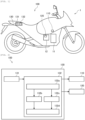
- Fig. 1 is a schematic view illustrating an outline configuration of a vehicle 1 to which the control system 100 is mounted.
- the vehicle 1 is a two-wheeled motorcycle that corresponds to an example of the vehicle according to the present invention.
- the vehicle 1 includes an engine 11 and a hydraulic pressure control unit 12.
- the engine 11 corresponds to an example of a drive source of the vehicle 1 and can output power for driving a wheel.
- the engine 11 is provided with: one or plural cylinders, each of which is formed with a combustion chamber therein; a fuel injector that injects fuel into the respective combustion chamber; and an ignition plug.
- the fuel is injected from the fuel injector, air-fuel mixture containing air and the fuel is produced in the combustion chamber, and the air-fuel mixture is then ignited by the ignition plug and burned. Consequently, a piston provided in the cylinder reciprocates to cause a crankshaft to rotate.
- a throttle valve is provided to an intake pipe of the engine 11, and an intake air amount to the combustion chamber varies according to a throttle opening amount as an opening amount of the throttle valve.
- the drive source of the vehicle 1 may be an electric motor, for example.
- the hydraulic pressure control unit 12 is a unit that has a function of controlling a braking force that is generated on the wheel.
- the hydraulic pressure control unit 12 is provided on an oil passage that connects a master cylinder and a wheel cylinder, and includes components (for example, a control valve and a pump) for controlling a brake hydraulic pressure in the wheel cylinder.
- the hydraulic pressure control unit 12 may control the braking force that is generated on each of a front wheel and a rear wheel, or may only control the braking force that is generated on one of the front wheel and the rear wheel.
- the control system 100 is mounted to the vehicle 1.
- the control system 100 is a system for controlling the engine 11 and the hydraulic pressure control unit 12. As illustrated in Fig. 1 , the control system 100 includes a first controller 110, a second controller 120, and a sensor device 130.
- the first controller 110 controls operation of the engine 11. By controlling output of the engine 11, the first controller 110 can control drive power that is generated to the vehicle 1.
- the second controller 120 controls operation of the hydraulic pressure control unit 12. By controlling the braking force that is generated on the wheel by the hydraulic pressure control unit 12, the second controller 120 can control the braking force that is generated to the vehicle 1.
- the control system 100 includes the plural controllers.
- the plural controllers in the control system 100 include the first controller 110 and the second controller 120.
- the plural controllers in the control system 100 also differ from those in the example illustrated in Fig. 1 .
- the sensor device 130 includes an inertial measurement unit (IMU) 131 and a processor 132.
- the inertial measurement unit 131 corresponds to an example of the sensor according to the present invention.
- the inertial measurement unit 131 includes a three-axis acceleration sensor and a three-axis gyroscope sensor, and detects acceleration in three axial directions and angular velocities around three axes.
- the inertial measurement unit 131 is provided to a trunk of the vehicle 1, for example.
- the processor 132 processes a sensor signal that is output from the inertial measurement unit 131. Then, the processor 132 sends a signal, which is acquired by processing the sensor signal, to the first controller 110 and the second controller 120.
- the first controller 110 and the second controller 120 use the signal that is received from the processor 132 for control of the engine 11 and control of the hydraulic pressure control unit 12, respectively.
- the processor 132 includes: a central processing unit (CPU) as an arithmetic processing unit; read only memory (ROM) as a storage element for storing a program, an arithmetic parameter, and the like that are used by the CPU; random access memory (RAM) as a storage element for temporarily storing a parameter and the like that are appropriately changed by running of the CPU; and the like.
- CPU central processing unit
- ROM read only memory
- RAM random access memory
- Fig. 2 is a block diagram illustrating an exemplary functional configuration of the processor 132.
- the processor 132 includes an acquisition section 132a, a first processing section 132b, a second processing section 132c, and an output section 132d.
- the processor 132 communicates with each of the devices in the vehicle 1.
- the acquisition section 132a acquires the sensor signal that is output from the inertial measurement unit 131.
- the sensor signal that is acquired by the acquisition section 132a is processed by each of the first processing section 132b and the second processing section 132c. In this way, a first output signal is generated by the first processing section 132b, and a second output signal is generated by the second processing section 132c.
- the generated output signals are output by the output section 132d. More specifically, the output section 132d sends the first output signal (a digital signal) to the first controller 110 and sends the second output signal (a digital signal) to the second controller 120.
- an increase in the number of the mounted sensors can be suppressed by devising the processing that is executed by the processor 132. A detailed description on the processing that is executed by the processor 132 will be made below.
- Fig. 3 is a flowchart illustrating an example of a processing procedure that is executed by the processor 132. Step S101 in Fig. 3 corresponds to initiation of the control flow illustrated in Fig. 3 .
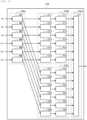
- Fig. 4 is a block diagram illustrating a flow of the signal in the processor 132 and a detailed configuration of the processor 132. A description will hereinafter be made on the flowchart illustrated in Fig. 3 with appropriate reference to Fig. 4 .
- step S102 the acquisition section 132a acquires the sensor signal that is output from the inertial measurement unit 131.
- the acquisition section 132a of the processor 132 includes storage sections M1, M2, M3, M4, M5, M6.
- each of the storage sections M1, M2, M3, M4, M5, M6 is realized by a storage area of the RAM in the processor 132.
- the sensor signals that are output from the inertial measurement unit 131 include signals Ax, Ay, Az indicating the acceleration in the three axial directions of the vehicle 1 and signals ⁇ x, ⁇ y, Qz indicating the angular velocities around the three axes of the vehicle 1.
- a three-axis coordinate system is set.
- the three-axis coordinate system has an x-axis, a y-axis, and a z-axis that are orthogonal to each other, and is fixed to a vehicle body of the vehicle 1.
- the three-axis coordinate system that is set in the inertial measurement unit 131 may be an appropriate coordinate system that differs from the coordinate system fixed to the vehicle body.
- the sensor signal is converted into the coordinate system that is fixed to the vehicle body.
- the signals Ax, Ay, Az indicate acceleration in an x-axis direction, a y-axis direction, and a z-axis direction, respectively.
- the signals ⁇ x, ⁇ y, ⁇ z indicate angular velocities around the x-axis, the y-axis, and the z-axis, respectively.
- the signals Ax, Ay, Az, ⁇ x, ⁇ y, Qz that are output from the inertial measurement unit 131 are stored as digital values in the storage sections M1, M2, M3, M4, M5, M6, respectively.
- step S103 the first processing section 132b generates the first output signal from the sensor signal that is acquired by the acquisition section 132a.
- step S104 the second processing section 132c generates the second output signal from the sensor signal that is acquired by the acquisition section 132a.
- step S104 may be executed prior to step S103 or may be executed in parallel with step S103.
- an available frequency band differs among the plural controllers in the control system 100. More specifically, the available frequency band differs between the first controller 110 and the second controller 120.
- the first controller 110 uses the signal that is limited to a first frequency band.
- the second controller 120 uses the signal that is limited to a second frequency band, which differs from the first frequency band.
- each of the first frequency band and the second frequency band is a frequency band having a width from 0 Hz to an upper limit frequency
- the upper limit frequency differs between the first frequency band and the second frequency band.
- the upper limit frequency differs according to a type of the controller, and can be any of various values from 10 Hz to 70 Hz, for example.
- a lower limit frequency of each of the first frequency band and the second frequency band may not be 0 Hz.
- the first processing section 132b generates the first output signal through a first filter as a digital filter for extracting the first frequency band from the sensor signal that is acquired by the acquisition section 132a.
- the first output signal that is limited to the first frequency band is sent to the first controller 110 as described above.
- the first controller 110 can appropriately use the signal received from the processor 132 for the control of the engine 11.
- the second processing section 132c generates the second output signal through a second filter as a digital filter for extracting the second frequency band from the sensor signal that is acquired by the acquisition section 132a.
- the second output signal that is limited to the second frequency band is sent to the second controller 120 as described above.
- the second controller 120 can appropriately use the signal received from the processor 132 for the control of the hydraulic pressure control unit 12.
- the first processing section 132b of the processor 132 has relay sections C11, C12, C13, C14, C15, C16 and first filters F11, F12, F13, F14, F15, F16.
- the relay sections C11, C12, C13, C14, C15, C16 and the first filters F11, F12, F13, F14, F15, F16 are operated when the program that is stored in the ROM of the processor 132 is executed.
- the relay sections C11, C12, C13, C14, C15, C16 read information that is stored in the storage sections M1, M2, M3, M4, M5, M6, and transmit the information to the first filters F11, F12, F13, F14, F15, F16, respectively.
- Each of the first filters F11, F12, F13, F14, F15, F16 is a filter that extracts the first frequency band.
- Each of the first filters F11, F12, F13, F14, F15, F16 is a low-pass filter, for example. However, in the case where the lower limit frequency of the first frequency band is not 0 Hz, each of the first filters F11, F12, F13, F14, F15, F16 is a bandpass filter.
- the signal Ax that is stored as the digital value in the storage section M1 is read by the relay section C11, and the first output signal that corresponds to the signal Ax is generated by the first filter F11.
- the signal Ay that is stored as the digital value in the storage section M2 is read by the relay section C12, and the first output signal that corresponds to the signal Ay is generated by the first filter F12.
- the signal Az that is stored as the digital value in the storage section M3 is read by the relay section C13, and the first output signal that corresponds to the signal Az is generated by the first filter F13.
- the signal Qx that is stored as the digital value in the storage section M4 is read by the relay section C14, and the first output signal that corresponds to the signal ⁇ x is generated by the first filter F14.
- the signal ⁇ y that is stored as the digital value in the storage section M5 is read by the relay section C15, and the first output signal that corresponds to the signal ⁇ y is generated by the first filter F15.
- the signal ⁇ z that is stored as the digital value in the storage section M6 is read by the relay section C16, and the first output signal that corresponds to the signal Qz is generated by the first filter F16.
- the second processing section 132c of the processor 132 has relay sections C21, C22, C23, C24, C25, C26 and second filters F21, F22, F23, F24, F25, F26.
- the relay sections C21, C22, C23, C24, C25, C26 and the second filters F21, F22, F23, F24, F25, F26 are operated when the program that is stored in the ROM of the processor 132 is executed.
- the relay sections C21, C22, C23, C24, C25, C26 reads the information that is stored in the storage sections M1, M2, M3, M4, M5, M6, and transmits the information to the second filters F21, F22, F23, F24, F25, F26, respectively.
- Each of the second filters F21, F22, F23, F24, F25, F26 is a filter that extracts the second frequency band.
- Each of the second filters F21, F22, F23, F24, F25, F26 is the low-pass filter, for example. However, in the case where the lower limit frequency of the second frequency band is not 0 Hz, each of the second filters F21, F22, F23, F24, F25, F26 is the bandpass filter.
- the signal Ax that is stored as the digital value in the storage section M1 is read by the relay section C21, and the second output signal that corresponds to the signal Ax is generated by the second filter F21.
- the signal Ay that is stored as the digital value in the storage section M2 is read by the relay section C22, and the second output signal that corresponds to the signal Ay is generated by the second filter F22.
- the signal Az that is stored as the digital value in the storage section M3 is read by the relay section C23, and the second output signal that corresponds to the signal Az is generated by the second filter F23.
- the signal ⁇ x that is stored as the digital value in the storage section M4 is read by the relay section C24, and the second output signal that corresponds to the signal ⁇ x is generated by the second filter F24.
- the signal ⁇ y that is stored as the digital value in the storage section M5 is read by the relay section C25, and the second output signal that corresponds to the signal ⁇ y is generated by the second filter F25.
- the signal ⁇ z that is stored as the digital value in the storage section M6 is read by the relay section C26, and the second output signal that corresponds to the signal ⁇ z is generated by the second filter F26.
- processing that uses the different filters is independently executed for the sensor signal (for example, the signal Ax) that is output from the inertial measurement unit 131 and stored in the common storage section (for example, the storage section M1).
- the sensor signal for example, the signal Ax
- the common storage section for example, the storage section M1
- each of these relay sections may read the information that is stored in the corresponding storage section, and may duplicate and store the information in the storage area of the RAM.
- the first output signal and the second output signal can be generated by executing processing that uses the respective filters on the information duplicated by the respective relay sections and stored.
- the processing that uses the different filters is independently executed for the sensor signal (for example, the signal Ax) that is output from the inertial measurement unit 131. In this way, the first output signal and the second output signal as the different output signals are generated at the same timing.
- step S105 the output section 132d outputs the first output signal and the second output signal as the digital signals at a time interval requested from the controller side (that is, outputs the first output signal and the second output signal at once), and the processing returns to step S102. More specifically, the output section 132d sends the first output signal to the first controller 110 and sends the second output signal to the second controller 120.
- outputting of the first output signal and the second output signal at once only needs to be outputting of the first output signal and outputting of the second output signal in a specified period such that the processing in the first controller 110 and the processing in the second controller 120 can be executed in parallel.
- outputting of the first output signal and the second output signal at once may be outputting of the first output signal and the second output signal at the same time from different output ports or may be that outputting of the first output signal and outputting of the second output signal from the same output port are alternated in a time-division manner.
- the output section 132d of the processor 132 includes a selection section E1.
- the selection section E1 is operated when the program that is stored in the ROM of the processor 132 is executed.
- the sensor signals that are output from the inertial measurement unit 131 include plural types of the signals.
- the first processing section 132b and the second processing section 132c generate plural types of the first output signals and plural types of the second output signals, respectively.
- the selection section E1 selects the type of the signal that is requested by the first controller 110 from the plural types of the first output signals that are generated by the first processing section 132b, and sends such a signal to the first controller 110.
- the selection section E1 selects the type of the signal that is requested by the first controller 110 from the first output signals that correspond to the signals Ax, Ay, Az, ⁇ x, ⁇ y, ⁇ z generated by the first filters F11, F12, F13, F14, F15, F16, respectively.
- the selection section E1 selects the first output signals that correspond to the signals Ax, Ay, Az generated by the first filters F11, F12, F13, respectively, and sends such first output signals to the first controller 110.
- the selection section E1 selects the first output signals that correspond to the signals ⁇ x, ⁇ y, ⁇ z generated by the first filters F14, F15, F16, respectively, and sends such first output signals to the first controller 110.
- the selection section E1 selects all of the first output signals that correspond to the signals Ax, Ay, Az, ⁇ x, ⁇ y, ⁇ z generated by the first filters F11, F12, F13, F14, F15, F16, respectively, and outputs all of the first output signals to the first controller 110.
- the selection section E1 selects the type of the signal that is requested by the second controller 120 from the plural types of the second output signals that are generated by the second processing section 132c, and sends such a signal to the second controller 120.
- the selection section E1 selects the type of the signal that is requested by the second controller 120 from the second output signals that correspond to the signals Ax, Ay, Az, ⁇ x, ⁇ y, ⁇ z generated by the second filters F21, F22, F23, F24, F25, F26, respectively.
- the selection section E1 selects the second output signals that correspond to the signals Ax, Ay, Az generated by the second filters F21, F22, F23, respectively, and sends such second output signals to the second controller 120.
- the selection section E1 selects the second output signals that correspond to the signals ⁇ x, ⁇ y, ⁇ z generated by the second filters F24, F25, F26, respectively, and sends such second output signals to the second controller 120.
- the selection section E1 selects all of the second output signals that correspond to the signals Ax, Ay, Az, ⁇ x, ⁇ y, ⁇ z generated by the second filters F21, F22, F23, F24, F25, F26, respectively, and outputs all of the second output signals to the second controller 120.
- the first processing section 132b generates the first output signal through the first filter extracting the first frequency band from the sensor signal that is acquired by the acquisition section 132a.
- the second processing section 132c generates the second output signal through the second filter for extracting the second frequency band from the sensor signal that is acquired by the acquisition section 132a.
- the processing that uses the different filters is independently executed for the common sensor signal that is output from the inertial measurement unit 131. In this way, the first output signal and the second output signal as the different output signals are generated at the same timing.
- the output section 132d can output the first output signal and the second output signal at the time interval requested from the controller side (that is, output the first output signal and the second output signal at once) .
- a state where the first output signal can be sent to the first controller 110 and a state where the second output signal can be sent to the second controller 120 are switched by rewriting each of the filters to change the extracted frequency band.
- a time difference is generated between sending of the first output signal to the first controller 110 and sending of the second output signal to the second controller 120.
- the output section 132d can output the first output signal and the second output signal at once.
- the single sensor device 130 can send the available output signal to each of the plural controllers. Therefore, since there is no need to provide the sensor (the inertial measurement unit 131 in the above example) for each of the controllers, the increase in the number of the mounted sensors can be suppressed.
- the processor 132 further includes one or plural processing sections, each of which generates the output signal through the filter for extracting a different frequency band from both of the first frequency band and the second frequency band from the sensor signal that is acquired by the acquisition section 132a. That is, the processor 132 only needs to include the plural processing sections, each of which generates the output signal by using the filter for extracting the different frequency band from each other from the common sensor signal.
- the acquisition section 132a acquires the sensor signal that is output from the sensor (the inertial measurement unit 131 in the above example).
- the first processing section 132b generates the first output signal through the first filter (each of F11, F12, F13, F14, F15, F16 in the above example) for extracting the first frequency band from the sensor signal that is acquired by the acquisition section 132a.
- the second processing section 132c generates the second output signal through the second filter (each of F21, F22, F23, F24, F25, F26 in the above example) for extracting the second frequency band differing from the first frequency band from the sensor signal that is acquired by the acquisition section 132a.
- the output section 132d outputs the first output signal and the second output signal at once. In this way, the single sensor device 130 can send the available output signals to the plural controllers. Therefore, since there is no need to provide the sensor for each of the controllers, the increase in the number of the mounted sensors can be suppressed.
- the output section 132d sends the first output signal to the first controller 110 that uses the signal limited to the first frequency band, and sends the second output signal to the second controller 120 that uses the signal limited to the second frequency band.
- the available output signal can be sent to each of the first controller 110 and the second controller 120. Therefore, the first controller 110 and the second controller 120 can each appropriately use the signal received from the processor 132.
- the sensor signals include the plural types of the signals
- the first processing section 132b generates the plural types of the first output signals
- the second processing section 132c generates the plural types of the second output signals
- the output section 132d selects the type of the signal requested by the first controller 110 from the plural types of the first output signals generated by the first processing section 132b, sends such a signal to the first controller 110, selects the type of the signal requested by the second controller 120 from the plural types of the second output signals generated by the second processing section 132c, and sends such a signal to the second controller 120.
- the types of the output signals requested by the first controller 110 and the second controller 120 can be sent to the respective controllers. Therefore, sending of an unnecessary signal can be suppressed, and thus a processing burden can be reduced.
- the senor is the inertial measurement unit 131 that detects the acceleration in the three axial directions and the angular velocities around the three axes, and the sensor signals include the signal indicating the acceleration in the three axial directions and the signal indicating the angular velocities around the three axes. Therefore, since there is no need to provide the inertial measurement unit 131 for each of the controllers, the increase in the number of the mounted inertial measurement units 131 can be suppressed.
- the processing that has been described in the present specification by using the flowchart may not necessarily be executed in the order illustrated in the flowchart. Some of the processing steps may be executed in parallel. In addition, an additional processing step may be adopted, and some of the processing steps may not be provided.
- a series of the control processing by the processor 132 described above may be realized by using any of software, hardware, and a combination of the software and the hardware.
- the program constituting the software is stored in advance in a storage medium that is provided inside or outside an information processor, for example.
Landscapes
- Engineering & Computer Science (AREA)
- Automation & Control Theory (AREA)
- Transportation (AREA)
- Mechanical Engineering (AREA)
- Computer Networks & Wireless Communication (AREA)
- Human Computer Interaction (AREA)
- Chemical & Material Sciences (AREA)
- Combustion & Propulsion (AREA)
- Arrangements For Transmission Of Measured Signals (AREA)
- Combined Controls Of Internal Combustion Engines (AREA)
Applications Claiming Priority (2)
| Application Number | Priority Date | Filing Date | Title |
|---|---|---|---|
| JP2021208883 | 2021-12-23 | ||
| PCT/IB2022/061590 WO2023119026A1 (ja) | 2021-12-23 | 2022-11-30 | 処理装置、センサ装置、制御システムおよび処理方法 |
Publications (2)
| Publication Number | Publication Date |
|---|---|
| EP4456549A1 true EP4456549A1 (de) | 2024-10-30 |
| EP4456549B1 EP4456549B1 (de) | 2026-02-25 |
Family
ID=84688261
Family Applications (1)
| Application Number | Title | Priority Date | Filing Date |
|---|---|---|---|
| EP22830944.9A Active EP4456549B1 (de) | 2021-12-23 | 2022-11-30 | Verarbeitungsvorrichtung, sensorvorrichtung, steuerungssystem und verarbeitungsverfahren |
Country Status (5)
| Country | Link |
|---|---|
| US (1) | US20250033626A1 (de) |
| EP (1) | EP4456549B1 (de) |
| JP (1) | JP7791906B2 (de) |
| CN (1) | CN118435621A (de) |
| WO (1) | WO2023119026A1 (de) |
Family Cites Families (18)
| Publication number | Priority date | Publication date | Assignee | Title |
|---|---|---|---|---|
| JPS61185652A (ja) * | 1985-02-12 | 1986-08-19 | Mazda Motor Corp | エンジンの制御装置 |
| JPH07232527A (ja) * | 1994-02-23 | 1995-09-05 | Unisia Jecs Corp | 車両懸架装置 |
| EP0907526A4 (de) * | 1996-06-24 | 2001-01-03 | Breed Automotive Tech | Steuergerät für eine fahrzeug-sicherheitsvorrichtung |
| DE69714440T2 (de) * | 1996-06-24 | 2003-04-03 | Breed Automotive Technology, Inc. | Steuergerät für ein fahrzeug-sicherheitssystem |
| EP2031517A1 (de) * | 2007-08-28 | 2009-03-04 | Toyota Motor Europe NV | Verfahren und Systeme zur Datenverarbeitung und ihre Anwendungen |
| US9346441B2 (en) * | 2010-09-24 | 2016-05-24 | Infineon Technologies Ag | Sensor self-diagnostics using multiple signal paths |
| JP5512507B2 (ja) * | 2010-12-27 | 2014-06-04 | 日立オートモティブシステムズ株式会社 | センサモジュール、およびセンサシステム |
| US9292409B2 (en) * | 2013-06-03 | 2016-03-22 | Infineon Technologies Ag | Sensor interfaces |
| US9863786B2 (en) * | 2013-07-17 | 2018-01-09 | Infineon Technologies Ag | Sensor with interface for functional safety |
| KR102524291B1 (ko) * | 2017-01-25 | 2023-04-24 | 현대자동차주식회사 | 자동차의 에어백 점화 제어 시스템 및 이를 이용한 에어백 점화 제어 방법 |
| WO2018155541A1 (ja) * | 2017-02-24 | 2018-08-30 | 日立オートモティブシステムズ株式会社 | 車両挙動制御装置 |
| US10782366B2 (en) * | 2017-10-11 | 2020-09-22 | Allegro Microsystems, Llc | Multi-channel sensor output signal protocols |
| JP7077694B2 (ja) * | 2018-03-19 | 2022-05-31 | セイコーエプソン株式会社 | センサーモジュール、計測システム、電子機器、及び移動体 |
| JP7119455B2 (ja) * | 2018-03-19 | 2022-08-17 | セイコーエプソン株式会社 | センサーモジュール、計測システム、電子機器、及び移動体 |
| JP7218512B2 (ja) * | 2018-07-30 | 2023-02-07 | セイコーエプソン株式会社 | センサーモジュール、電子機器及び移動体 |
| JP7438754B2 (ja) * | 2019-12-27 | 2024-02-27 | ニデック株式会社 | 制御装置 |
| JP7290679B2 (ja) * | 2021-02-10 | 2023-06-13 | 本田技研工業株式会社 | ヨーレート推定装置 |
| US12499518B2 (en) * | 2023-03-16 | 2025-12-16 | Hrl Laboratories, Llc | Using blind source separation to reduce noise in a sensor signal |
-
2022
- 2022-11-30 EP EP22830944.9A patent/EP4456549B1/de active Active
- 2022-11-30 US US18/716,749 patent/US20250033626A1/en active Pending
- 2022-11-30 JP JP2023568753A patent/JP7791906B2/ja active Active
- 2022-11-30 CN CN202280085209.5A patent/CN118435621A/zh active Pending
- 2022-11-30 WO PCT/IB2022/061590 patent/WO2023119026A1/ja not_active Ceased
Also Published As
| Publication number | Publication date |
|---|---|
| WO2023119026A1 (ja) | 2023-06-29 |
| US20250033626A1 (en) | 2025-01-30 |
| EP4456549B1 (de) | 2026-02-25 |
| JPWO2023119026A1 (de) | 2023-06-29 |
| CN118435621A (zh) | 2024-08-02 |
| JP7791906B2 (ja) | 2025-12-24 |
Similar Documents
| Publication | Publication Date | Title |
|---|---|---|
| US4817418A (en) | Failure diagnosis system for vehicle | |
| US9719439B2 (en) | System and method for controlling spark timing when cylinders of an engine are deactivated to reduce noise and vibration | |
| EP4063216A1 (de) | Steuerungssystem, steuergerät und steuerungsverfahren | |
| EP2644464B1 (de) | Bewegungsstabilisator für ein kombiniertes Fahrzeug | |
| JP2018178736A (ja) | 車両の振動抑制装置 | |
| US10006379B2 (en) | Variable displacement engine control | |
| EP4456549A1 (de) | Verarbeitungsvorrichtung, sensorvorrichtung, steuerungssystem und verarbeitungsverfahren | |
| EP4292897A1 (de) | Steuergerät und steuerungsverfahren | |
| US9964064B1 (en) | Method of improving active fuel management reactivation torque responsiveness | |
| CN108626001B (zh) | 车辆的控制装置 | |
| US10077726B2 (en) | System and method to activate and deactivate engine cylinders | |
| JP6521495B1 (ja) | 車両の挙動制御装置 | |
| EP4647311A1 (de) | Steuerungsvorrichtung und steuerungsverfahren | |
| US7333885B2 (en) | Engine control unit | |
| EP4647283A1 (de) | Steuerungsvorrichtung und steuerungsverfahren | |
| JPS611543A (ja) | 車両の加速スリツプ防止方法 | |
| JP5989514B2 (ja) | 車両制御装置、車両制御方法および車両制御プログラムならびに車両 | |
| US10989583B2 (en) | Method and system for determining a level of a fluid | |
| EP4597471A1 (de) | Steuerungsvorrichtung und steuerungsverfahren | |
| JP6898356B2 (ja) | 可変圧縮比を有するレシプロ機関を診断および/あるいは制御するための方法およびシステム | |
| US20050029862A1 (en) | Vehicle motion control apparatus | |
| KR102133487B1 (ko) | 비정상 연소 중에 내연 기관을 제어하기 위한 방법 | |
| EP4556334A1 (de) | Steuerungsvorrichtung und steuerungsverfahren | |
| US20250382027A1 (en) | Control apparatus and control method | |
| EP4549988A1 (de) | Informationsverarbeitungsvorrichtung, informationsverarbeitungssystem und informationsverarbeitungsverfahren |
Legal Events
| Date | Code | Title | Description |
|---|---|---|---|
| STAA | Information on the status of an ep patent application or granted ep patent |
Free format text: STATUS: UNKNOWN |
|
| STAA | Information on the status of an ep patent application or granted ep patent |
Free format text: STATUS: THE INTERNATIONAL PUBLICATION HAS BEEN MADE |
|
| PUAI | Public reference made under article 153(3) epc to a published international application that has entered the european phase |
Free format text: ORIGINAL CODE: 0009012 |
|
| STAA | Information on the status of an ep patent application or granted ep patent |
Free format text: STATUS: REQUEST FOR EXAMINATION WAS MADE |
|
| 17P | Request for examination filed |
Effective date: 20240723 |
|
| AK | Designated contracting states |
Kind code of ref document: A1 Designated state(s): AL AT BE BG CH CY CZ DE DK EE ES FI FR GB GR HR HU IE IS IT LI LT LU LV MC ME MK MT NL NO PL PT RO RS SE SI SK SM TR |
|
| DAV | Request for validation of the european patent (deleted) | ||
| DAX | Request for extension of the european patent (deleted) | ||
| GRAP | Despatch of communication of intention to grant a patent |
Free format text: ORIGINAL CODE: EPIDOSNIGR1 |
|
| STAA | Information on the status of an ep patent application or granted ep patent |
Free format text: STATUS: GRANT OF PATENT IS INTENDED |
|
| INTG | Intention to grant announced |
Effective date: 20251111 |
|
| GRAS | Grant fee paid |
Free format text: ORIGINAL CODE: EPIDOSNIGR3 |
|
| GRAA | (expected) grant |
Free format text: ORIGINAL CODE: 0009210 |
|
| STAA | Information on the status of an ep patent application or granted ep patent |
Free format text: STATUS: THE PATENT HAS BEEN GRANTED |
|
| AK | Designated contracting states |
Kind code of ref document: B1 Designated state(s): AL AT BE BG CH CY CZ DE DK EE ES FI FR GB GR HR HU IE IS IT LI LT LU LV MC ME MK MT NL NO PL PT RO RS SE SI SK SM TR |
|
| REG | Reference to a national code |
Ref country code: CH Ref legal event code: F10 Free format text: ST27 STATUS EVENT CODE: U-0-0-F10-F00 (AS PROVIDED BY THE NATIONAL OFFICE) Effective date: 20260225 Ref country code: GB Ref legal event code: FG4D |
|
| REG | Reference to a national code |
Ref country code: DE Ref legal event code: R096 Ref document number: 602022031275 Country of ref document: DE |
|
| REG | Reference to a national code |
Ref country code: IE Ref legal event code: FG4D |