EP4456087A1 - Isolierende harzzusammensetzung für stromkabel, stromkabel und stromkabelverbindungsteil - Google Patents
Isolierende harzzusammensetzung für stromkabel, stromkabel und stromkabelverbindungsteil Download PDFInfo
- Publication number
- EP4456087A1 EP4456087A1 EP22911082.0A EP22911082A EP4456087A1 EP 4456087 A1 EP4456087 A1 EP 4456087A1 EP 22911082 A EP22911082 A EP 22911082A EP 4456087 A1 EP4456087 A1 EP 4456087A1
- Authority
- EP
- European Patent Office
- Prior art keywords
- electric power
- power cable
- resin composition
- insulating resin
- temperature
- Prior art date
- Legal status (The legal status is an assumption and is not a legal conclusion. Google has not performed a legal analysis and makes no representation as to the accuracy of the status listed.)
- Pending
Links
Images

Classifications
-
- H—ELECTRICITY
- H01—ELECTRIC ELEMENTS
- H01B—CABLES; CONDUCTORS; INSULATORS; SELECTION OF MATERIALS FOR THEIR CONDUCTIVE, INSULATING OR DIELECTRIC PROPERTIES
- H01B3/00—Insulators or insulating bodies characterised by the insulating materials; Selection of materials for their insulating or dielectric properties
- H01B3/18—Insulators or insulating bodies characterised by the insulating materials; Selection of materials for their insulating or dielectric properties mainly consisting of organic substances
- H01B3/30—Insulators or insulating bodies characterised by the insulating materials; Selection of materials for their insulating or dielectric properties mainly consisting of organic substances plastics; resins; waxes
- H01B3/44—Insulators or insulating bodies characterised by the insulating materials; Selection of materials for their insulating or dielectric properties mainly consisting of organic substances plastics; resins; waxes vinyl resins; acrylic resins
-
- C—CHEMISTRY; METALLURGY
- C08—ORGANIC MACROMOLECULAR COMPOUNDS; THEIR PREPARATION OR CHEMICAL WORKING-UP; COMPOSITIONS BASED THEREON
- C08L—COMPOSITIONS OF MACROMOLECULAR COMPOUNDS
- C08L23/00—Compositions of homopolymers or copolymers of unsaturated aliphatic hydrocarbons having only one carbon-to-carbon double bond; Compositions of derivatives of such polymers
- C08L23/02—Compositions of homopolymers or copolymers of unsaturated aliphatic hydrocarbons having only one carbon-to-carbon double bond; Compositions of derivatives of such polymers not modified by chemical after-treatment
- C08L23/10—Homopolymers or copolymers of propene
- C08L23/12—Polypropene
-
- C—CHEMISTRY; METALLURGY
- C08—ORGANIC MACROMOLECULAR COMPOUNDS; THEIR PREPARATION OR CHEMICAL WORKING-UP; COMPOSITIONS BASED THEREON
- C08L—COMPOSITIONS OF MACROMOLECULAR COMPOUNDS
- C08L23/00—Compositions of homopolymers or copolymers of unsaturated aliphatic hydrocarbons having only one carbon-to-carbon double bond; Compositions of derivatives of such polymers
- C08L23/02—Compositions of homopolymers or copolymers of unsaturated aliphatic hydrocarbons having only one carbon-to-carbon double bond; Compositions of derivatives of such polymers not modified by chemical after-treatment
- C08L23/10—Homopolymers or copolymers of propene
- C08L23/14—Copolymers of propene
-
- C—CHEMISTRY; METALLURGY
- C08—ORGANIC MACROMOLECULAR COMPOUNDS; THEIR PREPARATION OR CHEMICAL WORKING-UP; COMPOSITIONS BASED THEREON
- C08L—COMPOSITIONS OF MACROMOLECULAR COMPOUNDS
- C08L25/00—Compositions of, homopolymers or copolymers of compounds having one or more unsaturated aliphatic radicals, each having only one carbon-to-carbon double bond, and at least one being terminated by an aromatic carbocyclic ring; Compositions of derivatives of such polymers
- C08L25/02—Homopolymers or copolymers of hydrocarbons
- C08L25/04—Homopolymers or copolymers of styrene
- C08L25/08—Copolymers of styrene
-
- C—CHEMISTRY; METALLURGY
- C08—ORGANIC MACROMOLECULAR COMPOUNDS; THEIR PREPARATION OR CHEMICAL WORKING-UP; COMPOSITIONS BASED THEREON
- C08L—COMPOSITIONS OF MACROMOLECULAR COMPOUNDS
- C08L53/00—Compositions of block copolymers containing at least one sequence of a polymer obtained by reactions only involving carbon-to-carbon unsaturated bonds; Compositions of derivatives of such polymers
- C08L53/02—Compositions of block copolymers containing at least one sequence of a polymer obtained by reactions only involving carbon-to-carbon unsaturated bonds; Compositions of derivatives of such polymers of vinyl-aromatic monomers and conjugated dienes
- C08L53/025—Compositions of block copolymers containing at least one sequence of a polymer obtained by reactions only involving carbon-to-carbon unsaturated bonds; Compositions of derivatives of such polymers of vinyl-aromatic monomers and conjugated dienes modified
-
- H—ELECTRICITY
- H01—ELECTRIC ELEMENTS
- H01B—CABLES; CONDUCTORS; INSULATORS; SELECTION OF MATERIALS FOR THEIR CONDUCTIVE, INSULATING OR DIELECTRIC PROPERTIES
- H01B1/00—Conductors or conductive bodies characterised by the conductive materials; Selection of materials as conductors
- H01B1/20—Conductive material dispersed in non-conductive organic material
- H01B1/24—Conductive material dispersed in non-conductive organic material the conductive material comprising carbon-silicon compounds, carbon or silicon
-
- H—ELECTRICITY
- H01—ELECTRIC ELEMENTS
- H01B—CABLES; CONDUCTORS; INSULATORS; SELECTION OF MATERIALS FOR THEIR CONDUCTIVE, INSULATING OR DIELECTRIC PROPERTIES
- H01B3/00—Insulators or insulating bodies characterised by the insulating materials; Selection of materials for their insulating or dielectric properties
- H01B3/18—Insulators or insulating bodies characterised by the insulating materials; Selection of materials for their insulating or dielectric properties mainly consisting of organic substances
- H01B3/28—Insulators or insulating bodies characterised by the insulating materials; Selection of materials for their insulating or dielectric properties mainly consisting of organic substances natural or synthetic rubbers
-
- H—ELECTRICITY
- H01—ELECTRIC ELEMENTS
- H01B—CABLES; CONDUCTORS; INSULATORS; SELECTION OF MATERIALS FOR THEIR CONDUCTIVE, INSULATING OR DIELECTRIC PROPERTIES
- H01B3/00—Insulators or insulating bodies characterised by the insulating materials; Selection of materials for their insulating or dielectric properties
- H01B3/18—Insulators or insulating bodies characterised by the insulating materials; Selection of materials for their insulating or dielectric properties mainly consisting of organic substances
- H01B3/30—Insulators or insulating bodies characterised by the insulating materials; Selection of materials for their insulating or dielectric properties mainly consisting of organic substances plastics; resins; waxes
- H01B3/44—Insulators or insulating bodies characterised by the insulating materials; Selection of materials for their insulating or dielectric properties mainly consisting of organic substances plastics; resins; waxes vinyl resins; acrylic resins
- H01B3/441—Insulators or insulating bodies characterised by the insulating materials; Selection of materials for their insulating or dielectric properties mainly consisting of organic substances plastics; resins; waxes vinyl resins; acrylic resins from alkenes
-
- H—ELECTRICITY
- H01—ELECTRIC ELEMENTS
- H01B—CABLES; CONDUCTORS; INSULATORS; SELECTION OF MATERIALS FOR THEIR CONDUCTIVE, INSULATING OR DIELECTRIC PROPERTIES
- H01B3/00—Insulators or insulating bodies characterised by the insulating materials; Selection of materials for their insulating or dielectric properties
- H01B3/18—Insulators or insulating bodies characterised by the insulating materials; Selection of materials for their insulating or dielectric properties mainly consisting of organic substances
- H01B3/30—Insulators or insulating bodies characterised by the insulating materials; Selection of materials for their insulating or dielectric properties mainly consisting of organic substances plastics; resins; waxes
- H01B3/44—Insulators or insulating bodies characterised by the insulating materials; Selection of materials for their insulating or dielectric properties mainly consisting of organic substances plastics; resins; waxes vinyl resins; acrylic resins
- H01B3/442—Insulators or insulating bodies characterised by the insulating materials; Selection of materials for their insulating or dielectric properties mainly consisting of organic substances plastics; resins; waxes vinyl resins; acrylic resins from aromatic vinyl compounds
-
- H—ELECTRICITY
- H01—ELECTRIC ELEMENTS
- H01B—CABLES; CONDUCTORS; INSULATORS; SELECTION OF MATERIALS FOR THEIR CONDUCTIVE, INSULATING OR DIELECTRIC PROPERTIES
- H01B7/00—Insulated conductors or cables characterised by their form
- H01B7/02—Disposition of insulation
- H01B7/0291—Disposition of insulation comprising two or more layers of insulation having different electrical properties
-
- H—ELECTRICITY
- H01—ELECTRIC ELEMENTS
- H01B—CABLES; CONDUCTORS; INSULATORS; SELECTION OF MATERIALS FOR THEIR CONDUCTIVE, INSULATING OR DIELECTRIC PROPERTIES
- H01B7/00—Insulated conductors or cables characterised by their form
- H01B7/17—Protection against damage caused by external factors, e.g. sheaths or armouring
- H01B7/29—Protection against damage caused by extremes of temperature or by flame
- H01B7/292—Protection against damage caused by extremes of temperature or by flame using material resistant to heat
-
- H—ELECTRICITY
- H01—ELECTRIC ELEMENTS
- H01B—CABLES; CONDUCTORS; INSULATORS; SELECTION OF MATERIALS FOR THEIR CONDUCTIVE, INSULATING OR DIELECTRIC PROPERTIES
- H01B9/00—Power cables
- H01B9/02—Power cables with screens or conductive layers, e.g. for avoiding large potential gradients
-
- C—CHEMISTRY; METALLURGY
- C08—ORGANIC MACROMOLECULAR COMPOUNDS; THEIR PREPARATION OR CHEMICAL WORKING-UP; COMPOSITIONS BASED THEREON
- C08L—COMPOSITIONS OF MACROMOLECULAR COMPOUNDS
- C08L2203/00—Applications
- C08L2203/20—Applications use in electrical or conductive gadgets
- C08L2203/202—Applications use in electrical or conductive gadgets use in electrical wires or wirecoating
-
- C—CHEMISTRY; METALLURGY
- C08—ORGANIC MACROMOLECULAR COMPOUNDS; THEIR PREPARATION OR CHEMICAL WORKING-UP; COMPOSITIONS BASED THEREON
- C08L—COMPOSITIONS OF MACROMOLECULAR COMPOUNDS
- C08L25/00—Compositions of, homopolymers or copolymers of compounds having one or more unsaturated aliphatic radicals, each having only one carbon-to-carbon double bond, and at least one being terminated by an aromatic carbocyclic ring; Compositions of derivatives of such polymers
- C08L25/02—Homopolymers or copolymers of hydrocarbons
- C08L25/04—Homopolymers or copolymers of styrene
- C08L25/06—Polystyrene
Definitions
- the present disclosure relates to an insulating resin composition for electric power cable, an electric power cable and an electric power cable connecting part.
- the insulating layer may be broken by the heat generated from the conductor of the electric power cable.
- crosslinking the polyethylene has been carried out.
- problems may occur such as a decline in recyclability of the insulating layer, a drastic increase in processing time due to adding the crosslinking process, a decline in electrical insulation property of the insulating layer due to crosslinking residue, etc.
- composition development using polypropylene instead of crosslinked polyethylene has been considered.
- polypropylene since the melting point of polypropylene is high, the breakdown of the insulating layer due to heat generated from the conductor of the electric power cable is suppressed, even without crosslinking polypropylene.
- polypropylene is relatively soft among resins, polypropylene is harder than polyethylene.
- the electric power cable made using polypropylene as the insulating layer is difficult to bend easily; therefore, compared to crosslinked polyethylene, the characteristics of the electric power cable such as workability and transportability may be poor.
- the electrical insulation property at high temperature of polypropylene is low.
- composition improvement such as adding additives or modifying the polypropylene has been considered. Based on such a situation, composition development is being actively carried out for improving the flexibility and the electrical insulation property in the polypropylene.
- EPR ethylene propylene rubber
- TPO olefinic elastomer
- EPR and TPO soften above 90°C. Due to polypropylene melting at 135 to 175°C, so-called sag in which the resin sags under its own weight occurs after extrusion molding of the electric power cable, and further, the possibility of falling off is high.
- the polypropylene composition made by kneading EPR and TPO tends to undergo thermal deformation due to the molecular fluctuation such as when heat is applied. For this reason, due to the usage environmental temperature of the electric power cable, the electric power cable deforms after the elapse of a long period, and there is a high possibility of causing a sudden decline in electrical insulation property.
- Patent Document 1 describes a resin composition for wire and cable containing a resin composition having a copolymer including styrene blocks containing constituent units derived from styrene, and ethylene blocks containing constituent units derived from ethylene, in which the content proportion of the constituent units derived from styrene relative to total constituent units constituting the resin component is 1.1 mol% or more to 40 mol% or less.
- the copolymer styrene/ethylene - propylene/styrene block copolymers, or styrene/ethylene - ethylene - propylene - styrene block copolymers, etc. can be exemplified.
- the copolymer may have an olefin of propylene or the like other than the styrene blocks and ethylene blocks.
- Patent Document 1 Japanese Unexamined Patent Application, Publication No. 2018-035237
- An object of the present disclosure is to provide an insulating resin composition for electric power cable, an electric power cable and an electric power cable connecting part which are superior in flexibility and electrical insulation property, and can suppress thermal deformation and sag, even without conducting a crosslinking process.
- an insulating resin composition for electric power cable, an electric power cable and an electric power cable connecting part which are superior in flexibility and electrical insulation property, and can suppress thermal deformation and sag, even without conducting a crosslinking process.
- thermoplastic elastomer superior in compatibility with polypropylene resin, without conducting crosslinking or oil extension, and focusing on the temperature characteristic curve of the loss tangent tan ⁇ obtained by dynamic viscoelasticity measurement of the insulating resin composition for electric power cable, it is possible to produce without carrying out a crosslinking process, and be superior in flexibility and electrical insulation property, and suppress thermal deformation and sag due to molecular fluctuation such as when heat is applied, thereby arriving a completion of the present disclosure based on this knowledge.
- the insulating resin composition for electric power cable (hereinafter also referred to simply as insulating resin composition) according to the embodiment includes: a polypropylene resin (A) which is a propylene-based polymer; and a styrene-based thermoplastic elastomer (B), in which a temperature characteristic curve of loss tangent tan ⁇ obtained by dynamic viscoelasticity measurement at a frequency of 100 rad/s has a high-temperature-side temperature region in which the loss tangent tan ⁇ is 0.1 or more and 0.4 or less, and a low-temperature-side temperature region in which the loss tangent tan ⁇ is less than 0.1; and a highest temperature of the high-temperature-side temperature region is 240°C or more.
- A polypropylene resin
- B styrene-based thermoplastic elastomer
- FIG. 1 is an example of a temperature characteristic curve of the loss tangent tan ⁇ obtained by dynamic viscoelasticity measurement at a frequency of 100 rad/s relative to the insulating resin composition for electric power cable according to an embodiment. It should be noted that FIG. 1 and FIG. 2 described later show the temperature characteristic curve of the loss tangent tan ⁇ having a loss tangent tan ⁇ up to 0.4 for convenience.
- the temperature characteristic curve of the loss tangent tan ⁇ obtained by dynamic viscoelasticity measurement at a frequency of 100 rad/s has a high-temperature-side temperature region in which the loss tangent tan ⁇ is 0.1 or more and 0.4 or less, and a low-temperature side temperature region in which the loss tangent tan ⁇ is less than 0.1.
- the temperature when the loss tangent tan ⁇ is 0.1 is defined as a reference temperature, more than the reference temperature is defined as the high-temperature-side temperature region, and less than the reference temperature is defined as the low-temperature-side temperature region.
- the temperature characteristic curve of the loss tangent tan ⁇ has the reference temperature, the high-temperature-side temperature region and the low-temperature-side temperature region.
- the temperature characteristic curve of the loss tangent tan ⁇ is continuous between the high-temperature-side temperature region and the low-temperature-side temperature region.
- FIG. 2 is another example of a temperature characteristic curve of the loss tangent tan ⁇ obtained by dynamic viscoelasticity measurement at a frequency of 100 rad/s relative to the insulating resin composition for electric power cable according to an embodiment.
- the highest temperature among the plurality of temperatures at which the loss tangent tan ⁇ is 0.1 is defined as the reference temperature.
- the low-temperature-side temperature region which is a temperature region in which the loss tangent tan ⁇ is less than 0.1, in the temperature characteristic curve of the loss tangent tan ⁇ shown in FIG. 1 , is a temperature region lower than the reference temperature, and in the temperature characteristic curve of the loss tangent tan ⁇ shown in FIG. 2 , is a temperature region higher than the temperature on the low-temperature side at which the loss tangent tan ⁇ is 0.1, and lower than the reference temperature.
- the temperature on the low-temperature side at which the loss tangent tan ⁇ is 0.1 is lower than the reference temperature.
- the loss tangent tan ⁇ in the high-temperature-side temperature region which is the higher temperature side from the low-temperature-side temperature region is 0.1 or more and 0.4 or less.
- the loss tangent tan ⁇ in the high-temperature-side temperature region is 0.1 or more, since the torque during extrusion molding of the insulating resin composition declines, the extrusion molding of the insulating resin composition is easy.
- the loss tangent tan ⁇ in the high-temperature-side temperature region is 0.4 or less, since it is possible to suppress sag of the insulating resin composition obtained by extrusion molding, the shape of the insulating resin composition can be stably maintained over a long period.
- the highest temperature is 240°C or more.
- the highest temperature of the high-temperature-side temperature region is about 270°C.
- the highest temperature of the high-temperature-side temperature region is 240°C or more, for example, since sag will no longer occur with the weight of the resin itself due to melting during molding, it is effective to keep the roundness of the cable.
- the highest temperature of the high-temperature-side temperature region is 240°C or more, and is preferably 300°C or less. If it becomes a composition having a highest temperature of the high-temperature-side temperature region higher than 300°C, since the insulating resin composition is considered to have a low loss tangent tan ⁇ even when heating close to 300°C, the insulating resin composition is considered to be a very hard material.
- the lowest temperature of the high-temperature-side temperature region is preferably 90°C or more and 175°C or less, and more preferably 90°C or more and 150°C or less.
- the lowest temperature of the high-temperature-side temperature region is the reference temperature.
- the lowest temperature of the high-temperature-side temperature region is 90°C or more, there will be no molecular structure change such as melting due to the heat generating in the cable during energization, and when the lowest temperature of the high-temperature-side temperature region is 175°C or less, since there is no need to raise the extrusion molding temperature too high, it is effective in a sag problem, the thermal degradation problem, etc. during extrusion molding.
- the lowest temperature of the high-temperature-side temperature region can vary according to the composition of the polypropylene resin (A).
- the polypropylene resin (A) is a homo polypropylene or block polypropylene, since the melting point of the polypropylene resin (A) becomes high on the order of 155°C or more to 175°C or less, it is possible to control the lowest temperature of the high-temperature-side temperature region to be higher, for example, possible to control to 175°C or less.
- the polypropylene resin (A) is a random polypropylene
- the melting point of the polypropylene resin (A) is on the order of 135°C or more to 155°C or less
- the styrene-based thermoplastic elastomer (B) there is a tendency for lowering the lowest temperature of the high-temperature-side temperature region. For this reason, by adjusting the composition of the polypropylene resin (A) and the content of the styrene-based thermoplastic elastomer (B), it is possible to control to the desired lowest temperature of the high-temperature-side temperature region.
- the highest temperature in the range of loss tangent tan ⁇ of 0.1 or more to 0.3 or less is preferably 160°C or more, more preferably 170°C or more, and even more preferably 180°C or more. This highest temperature is lower than the highest temperature of the high-temperature-side temperature region.
- the highest temperature in the range of loss tangent tan ⁇ of 0.1 or more to 0.3 or less is 160°C or more, molding is possible without generating sag during extrusion molding.
- the loss tangent tan ⁇ at 90°C is preferably less than 0.1.
- 90°C is preferably within the low-temperature-side temperature region.
- the loss tangent tan ⁇ at 90°C is less than 0.1, it is effective since there is no molecular structure change due to the heat generated in the cable during energization.
- the loss tangent tan ⁇ may temporarily rise by scissioning reaction of pseudo-crosslinking of the styrene-based elastomer near 100°C.
- the loss tangent tan ⁇ at 100°C is preferably less than 0.1 in the temperature characteristic curve of the loss tangent tan ⁇ .
- the loss tangent tan ⁇ at 80°C is preferably less than 0.1.
- the temperature characteristic curve of the loss tangent tan ⁇ can be obtained by dynamic viscoelasticity measurement at a frequency of 100 rad/s relative to the insulating resin composition.
- the dynamic viscoelasticity measurement is carried out using a viscoelasticity measuring instrument (Physica MCR 301 manufactured by Anton Paar GmbH), at a frequency of 100 rad/s, at a measurement temperature of 25°C or more and 250°C or less with a temperature rising rate of 5°C/min, on the sheet-like insulating resin composition with thickness of 2 mm.
- the insulating resin composition can have sufficient flexibility and electrical insulation property, even without containing oily liquids such as mineral oils and phenyl-derived oils, for example, naphthalene oil, aromatic oil, paraffin oil and polyaromatic oil either independently or by combining two or more types; however, in order to further improve the flexibility and the electrical insulation property, it may contain the above-mentioned oily liquid to an extent not decreasing the sag resistance property.
- the content proportion of an oily liquid contained in the insulating resin composition is preferably 0% by mass or more and 25% by mass or less, more preferably 0% by mass or more and 15% by mass or less, and even more preferably 0% by mass or more and 5% by mass or less.
- the insulating resin composition can have sufficient flexibility and electrical insulation property even without containing a filler component such as zinc oxide, magnesium oxide, silica, carbon, fullerene either independently or by combining two or more types; however, in order to further improve the flexibility or electrical insulation property, the above-mentioned filler component may be contained in an extent not decreasing the sag resistance.
- the content proportion of the filler component contained in the insulating resin composition is preferably 0% by mass or more and 20% by mass or less, more preferably 0% by mass or more and 10% by mass or less, and even more preferably 0% by mass or more and 5% by mass or less.
- the insulating resin composition can have sufficient flexibility and electrical insulation property even without containing at least one of a thermoplastic resin having a melting point of 50 to 200°C such as polyethylene, polyvinyl acetate or polystyrene, and a modified resin of this thermoplastic resin either independently or by combining two or more types; however, in order to further improve the flexibility or electrical insulation property, the insulating resin composition may contain at least one of the above-mentioned thermoplastic resin and the modified resin of the above-mentioned thermoplastic resin in an extent not decreasing the sag resistance.
- a thermoplastic resin having a melting point of 50 to 200°C such as polyethylene, polyvinyl acetate or polystyrene
- the insulating resin composition may contain at least one of the above-mentioned thermoplastic resin and the modified resin of the above-mentioned thermoplastic resin in an extent not decreasing the sag resistance.
- the total content proportion of the thermoplastic resin and the modified resin contained in the insulating resin composition is preferably 0.1% by mass or more and 25.0% by mass or less, more preferably 1% by mass or more and 20% by mass or less, and even more preferably 5% by mass or more and 10% by mass or less.
- the insulating resin composition can have sufficient heat resistance and electrical insulation property, even without containing and crosslinking a crosslinking agent such as di-t-hexyl peroxide (Perhexyl D, manufactured by NOF Corporation), dicumyl peroxide (Percumyl D, manufactured by NOF Corporation), 2,5-dimethyl-2,5-di(t-butylperoxy)hexane (Perhexa 25B, manufactured by NOF Corporation), ⁇ , ⁇ '-di(t-butylperoxy)diisopropylbenzene (Perbutyl P, manufactured by NOF Corporation), t-butyl cumyl peroxide (Perbutyl C, manufactured by NOF Corporation), and di-t-butyl peroxide (Perbutyl D, manufactured by NOF Corporation) either independently or by combining two or more types; however, in order to further improve the heat resistance or electrical insulation property, the above-mentioned crosslinking agent may be contained and crosslinked in an extent not
- the content proportion of the crosslinking agent contained in the insulating resin composition is preferably 0.1% by mass or more and 5.0% by mass or less, and more preferably 0.5% by mass or more and 3.0% by mass or less.
- the insulating resin composition crosslinked by the crosslinking agent is a cross-linked insulating resin composition
- the insulating resin composition not crosslinked by a crosslinking agent is a non-crosslinked insulating resin composition.
- the insulating resin composition may contain, as a stabilizing agent, a hindered phenolic antioxidant, thioether antioxidant, or a mixture selecting at least two types of these antioxidants in an extent not decreasing the heat resistance, the electrical insulation property and the sag resistance.
- the hindered phenolic antioxidant is preferably tetrakis[methylene-3-(3',5'-di-t-butyl-4'-hydroxyphenyl)propionate]methane (Irganox 1010 manufactured by BASF), 1,6-hexanediol-bis[3-(3,5-di-t-butyl-4-hydroxyphenyl)propionate] (Irganox 259 manufactured by BASF), octadecyl-3-(3,5-di-t-butyl-4-hydroxyphenyl)propionate (Irganox 1076 manufactured by BASF), or isooctyl-3-(3,5-di-t-butyl-4-hydroxyphenyl)propionate (Irganox 1135 manufactured by BASF), and is more preferably tetrakis[methylene-3-(3',5'-dit-butyl-4'-hydroxyphenyl)propionate]methane.
- the thioether antioxidant is preferably 4,4'-thiobis-(3-methyl-6-t-butylphenol) (Seenox BCS manufactured by Cipro Kasei), or 2,2'-thiobis-(4-methyl-6-t-butylphenol) (Irganox 1081 manufactured by BASF), and is more preferably 4,4'-thiobis-(3-methyl-6-t-butylphenol). These can be used independently or by combining two or more types.
- the content proportion of the stabilizing agent contained in the insulating resin composition is preferably 0.01% by mass or more and 10.00% by mass or less, and is more preferably 0.20% by mass or more and 1.0% by mass or less.
- the content proportion of the stabilizing agent is 0.01% by mass or more, it is possible to improve the heat resistance of the insulating resin composition.
- the content proportion of the stabilizing agent is 10.00% by mass or less, it is possible to improve the electrical insulation property of the insulating resin composition.
- the polypropylene resin (A) is preferably a homo polypropylene; a random polypropylene containing a constituent unit derived from ethylene and a constituent unit derived from a C3 to C30 ⁇ -olefin; or a block polypropylene containing a homo polypropylene, a constituent unit derived from ethylene, and a constituent unit derived from a C3 to C30 ⁇ -olefin, is more preferably a random polypropylene containing a constituent unit derived from ethylene and a constituent unit derived from a C3 to C30 ⁇ -olefin; or a block polypropylene containing a homo polypropylene, a constituent unit derived from ethylene, and a constituent unit derived from a C3 to C30 ⁇ -olefin,
- the constituent unit that is derived from ethylene and constitutes the random polypropylene is preferably ethylene.
- the constituent unit that is derived from a C3 to C30 ⁇ -olefin and constitutes the random polypropylene is preferably propylene or butene.
- the ratio (E/O) of the constituent unit (E) derived from ethylene relative to the constituent unit (O) derived from a C3 to C30 ⁇ -olefin is preferably 0 or more, more preferably 0.001 or more, and even more preferably 0.010 or more. If the ratio (E/O) of the random polypropylene is within the above-mentioned range, it is possible to improve the compatibility with the styrene-based thermoplastic elastomer (B).
- the constituent unit that is derived from ethylene and constitutes the block polypropylene is preferably ethylene.
- the constituent unit that is derived from a C3 to C30 ⁇ -olefin and constitutes the block polypropylene is preferably propylene or butene.
- the ratio (E/O) of the constituent unit (E) derived from ethylene relative to the constituent unit (O) derived from a C3 to C30 ⁇ -olefin is preferably 0 or more, more preferably 0.001 or more, and even more preferably 0.010 or more. If the ratio (E/O) of the block polypropylene is within the above-mentioned range, it is possible to improve the compatibility with the styrene-based thermoplastic elastomer (B).
- the ratio (E/O) of the block polypropylene is preferably 0.250 or less, more preferably 0.120 or less, and even more preferably 0.055 or less. If the ratio (E/O) of the block polypropylene is within the above-mentioned range, it is possible to suppress the thermal deformation due to molecular fluctuation when heat is applied.
- the content ratio of the polypropylene resin (A) and the styrene-based thermoplastic elastomer (B) contained in the insulating resin composition is preferably 20.0 to 55.0 : 45.0 to 80.0 by % by mass of the polypropylene resin (A) : the styrene-based thermoplastic elastomer (B).
- the polypropylene resin (A) is more preferably 30.0% by mass or more, and even more preferably 35.0% by mass or more.
- the polypropylene resin (A) is within the above-mentioned range, although it depends on the shape of the polypropylene resin (A), overtorque during extrusion and bridging under the hopper, cracking of the molded product and whitening are less likely to occur.
- the polypropylene resin (A) is more preferably 45.0% by mass or less.
- the polypropylene resin (A) is within the above-mentioned range, it is possible to improve the flexibility and the electrical insulation property of the insulating resin composition and to suppress the sag during molding of the insulating resin composition, without conducting crosslinking treatment.
- the styrene-based thermoplastic elastomer (B) is more preferably 40.0% by mass or more, even more preferably 42.5% by mass or more, and particularly preferably 45.0% by mass or more.
- the styrene-based thermoplastic elastomer (B) is within the above-mentioned range, it is possible to improve the flexibility and the electrical insulation property of the insulating resin composition and to suppress the sag of the insulating resin composition, without carrying out crosslinking treatment.
- the styrene-based thermoplastic elastomer (B) is more preferably 70.0% by mass or less, and even more preferably 65.0% by mass or less.
- the styrene-based thermoplastic elastomer (B) is within the above-mentioned range, although it depends on the shape of the styrene-based thermoplastic elastomer (B), overtorque during extrusion and bridging under the hopper, and cracking of the molded product are less likely to occur. In addition to that, it is possible to improve the flexibility and the electrical insulation property of the insulating resin composition and to suppress the sag of the insulating resin composition, without carrying out crosslinking treatment.
- the content proportion of styrene contained in the insulating resin composition is preferably 10% by mass or more and 30% by mass or less, more preferably 12.5% by mass or more and 25% by mass or less, and even more preferably 15% by mass or more and 20% by mass or less.
- the content proportion of styrene is within the above-mentioned range, the compatibility with the polypropylene increases, and it is possible to improve the flexibility and the electrical insulation property of the insulating resin composition and to suppress the sag of the insulating resin composition, without carrying out crosslinking treatment.
- the styrene-based thermoplastic elastomer (B) preferably contains a constituent unit derived from styrene, and contains at least one of a constituent unit derived from ethylene and a constituent unit derived from a C3 to C30 ⁇ -olefin.
- the constituent unit that is derived from styrene and constitutes the styrene-based thermoplastic elastomer (B) is preferably styrene.
- the constituent unit that is derived from ethylene and constitutes the styrene-based thermoplastic elastomer (B) is preferably ethylene.
- the constituent unit that is derived from a C3 to C30 ⁇ -olefin and constitutes the styrene-based thermoplastic elastomer (B) is preferably propylene or butene.
- the constituent unit derived from styrene is preferably 10% by mass or more, more preferably 15.0% by mass or more, and even more preferably 20.0% by mass or more.
- the above-mentioned constituent unit derived from styrene is 10% by mass or more, it is possible to improve the flexibility and the electrical insulation property of the insulating resin composition without carrying out crosslinking treatment.
- the constituent unit derived from styrene is preferably 60.0% by mass or less, more preferably 50.0% by mass or less, and even more preferably 40.0% by mass or less.
- the compatibility with the polypropylene resin (A) improves, and it is possible to improve the flexibility and the electrical insulation property of the insulating resin composition and to suppress the sag of the insulating resin composition, without carrying out crosslinking treatment.
- the constituent unit derived from ethylene is preferably 20.0% by mass or more, more preferably 30.0% by mass or more, and even more preferably 40.0% by mass or more.
- the constituent unit derived from ethylene is preferably 70.0% by mass or less, more preferably 67.5% by mass or less, and even more preferably 60.0% by mass or less.
- the constituent unit derived from a C3 to C30 ⁇ -olefin is preferably 10.0% by mass or more, more preferably 12.5% by mass or more, and even more preferably 15.0% by mass or more.
- the constituent unit derived from a C3 to C30 ⁇ -olefin is preferably 45.0% by mass or less, more preferably 42.5% by mass or less, and even more preferably 40.0% by mass or less.
- the above-mentioned constituent unit derived from a C3 to C30 ⁇ -olefin is 40.0% by mass or less, since the thermal deformation due to molecular fluctuation such as when heat is applied is less likely to occur while maintaining the heat resistance and maintaining the compatibility with the polypropylene resin (A), it is possible to further improve the flexibility and the electrical insulation property of the insulating resin composition and to further suppress the sag of the insulating resin composition, without carrying out crosslinking treatment.
- the insulating resin composition may contain various additives, in addition to the polypropylene resin (A) and the styrene-based thermoplastic elastomer (B), so long as a decline in flexibility, the electrical insulation property, the thermal deformation and the sag resistance does not occur, without carrying out crosslinking treatment.
- the dielectric loss tangent when applying an AC electric field of 30 kV/m at 90°C is preferably 0.15% or less, more preferably 0.10% or less, and even more preferably 0.05% or less.
- the dielectric loss tangent is the electrical energy loss inside the insulator, and is an index evaluating the insulation performance with AC electric power.
- a phenomenon called dielectric loss occurs in that a part of the electrical energy changes to thermal energy inside the insulator, and the insulator heats up.
- the dielectric loss tangent ratio of current charged to current lost
- the above-mentioned dielectric loss tangent of the insulating resin composition is 0.15% or less, it is possible to improve the flexibility and the electrical insulation property of the insulating resin composition and to suppress the sag of the insulating resin composition, without carrying out crosslinking treatment. Furthermore, the insulating resin composition can be better used in an electric power cable for high-voltage use, as the above-mentioned dielectric loss tangent becomes lower.
- the ratio (Q300/Q0) of electric charge amount (Q300) after 5 minutes when applying a DC electric field of 30 kV/mm at 90°C relative to the initial electric charge amount (Q0) is preferably 2.00 or less, more preferably 1.75 or less, even more preferably 1.50 or less, and most preferably 1.00.
- the ratio (Q300/Q0), i.e. electrical charge storage rate, is an index evaluating the insulation performance with DC electric power, and is measured by the Q(t) method (current integration method).
- the production method of the above-mentioned insulating resin composition includes a step of kneading the polypropylene resin (A) and the styrene-based thermoplastic elastomer (B). By kneading the polypropylene resin (A) and the styrene-based thermoplastic elastomer (B), it is possible to produce the insulating resin composition. With the production method of the insulating resin composition, oil extension and crosslinking do not carried out.
- the insulating resin composition obtained by such a production method can be favorably used in an electric power cable and an electric power cable connecting part for which high flexibility and electrical insulation property as well as suppression of thermal deformation and sag are sought without carrying a crosslinking treatment.
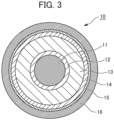
- FIG. 3 is a lateral cross-sectional view showing an example of an electric power cable including the insulating resin composition according to the embodiment.
- the electric power cable 10 includes at least a conductor 11, an internal semiconducting layer 12, an insulating layer 13 consisting of the above-mentioned insulating resin composition, and an external semiconducting layer 14.
- the internal semiconducting layer 12 covers the outer circumference of the conductor 11.
- the insulating layer 13 covers the outer circumference of the internal semiconducting layer 12.
- the external semiconducting layer 14 covers the outer circumference of the insulating layer 13.
- the electric power cable 10 may further include a metal shielding layer 15 which covers the outer circumference of the external semiconducting layer 14.
- the electric power cable 10 may further include a sheath 16 covering the outer circumference of the metal shielding layer 15.
- the insulating layer 13 covering the outer circumference of the internal semiconducting layer 12 is formed.
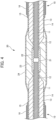
- FIG. 4 is a longitudinal cross-sectional view showing an example of the electric power cable connecting part including the insulating resin composition according to the embodiment.
- the electric power cable connecting part 20 includes: a connecting part internal semiconducting layer 22 that covers a connecting part 21 connecting the conductor 11 of one electric power cable 10 with the conductor 11 of another electric power cable 10, an exposed portion of the conductor 11 of the one electric power cable 10, and an exposed portion of the conductor 11 of the other electric power cable 10; a connecting part insulating layer 23 consisting of the above-mentioned insulating resin composition which covers the outer circumference of the connecting part internal semiconducting layer 22; and a connecting part external semiconducting layer 24 which covers the outer circumference of the connecting part insulating layer 23.
- the connecting part insulating layer 23 is formed by covering, with the above-mentioned insulating resin composition, the outer circumference of the connecting part internal semiconducting layer 22 that covers the connecting part 21 connecting the conductor 11 at the end of one electric power cable 10 exposed by the stripping process with the conductor 11 at the end of another electric power cable 10 exposed by the stripping process; an exposed portion of the conductor 11 of the one electric power cable 10 exposed by the stripping process; and an exposed portion of the conductor 11 of the other electric power cable 10 exposed by the stripping process.
- the connecting part external semiconducting layer 24 by a known method, it is possible to produce the electric power cable connecting part 20.
- the insulating resin compositions of the compositions shown in Tables 1 to 3 were produced by kneading the raw materials including the polypropylene resin (A) and the styrene-based thermoplastic elastomer (B). More specifically, kneading was performed by a single axis extruder at an extruding temperature of 200°C or more and 220°C or less. After kneading, this was made into pellet form, and a sheet-like insulating resin composition having the desired thickness was prepared by conducting press molding on this at the temperature conditions of 200°C or more and 220°C or less.
- the dynamic viscoelasticity measurement of the sheet-like insulating resin composition with a thickness of 2 mm was performed at a frequency of 100 rad/s, at a measurement temperature of 25°C or more and 250°C or less at a temperature rising rate of 5°C/min., whereby the temperature characteristic curve of the loss tangent tan ⁇ was obtained.
- a guard electrode and a measurement electrode were provided on the same surface of the sheet-like insulating resin composition with a thickness of 0.1 mm to 3.0 mm immersed in silicone oil within a constant temperature bath of 90°C, and the dielectric loss tangent of the insulating resin composition was measured when applying an AC electric field of 30 kV/mm.
- the electrical charge storage rate of the sheet-like insulating resin composition with a thickness of 0.1 mm to 3.0 mm was measured by the Q(t) method at 90°C with a DC electric field of 30 kV/mm to obtain the electric charge amount (Q300) after 5 min. Then, the ratio (Q300/Q0) of the electric charge amount (Q300) relative to the initial electric charge amount (Q0) was calculated.
- the sag resistance was determined as none. In the case of performing this test three times, and stretch not being observed in the insulating resin composition, the sag resistance was determined as present.
- the assumed temperature during extrusion molding is 200°C.
- the insulating resin composition After placing the insulating resin composition of 15 mm length, 30 mm width and 2 mm thickness on a rod of semicircular shape with 5 mm radius and approximately 35 mm length, the insulating resin composition was heated for 30 minutes at 140°C, then the insulating resin composition was further heated for 30 minutes at 140°C while a load of 1 kg being applied, and the thickness of the insulating resin composition was measured to calculate the rate of decrease. If the rate of decrease was less than 10%, it was said to have passed.
- the tensile modulus was measured based on the tensile test of JIS K6921-2:2010. Materials with large tensile modulus have low strain due to stress, and are expressed as "hard”, and materials with low tensile modulus are expressed as "soft”, and herein, the tensile modulus of 500 MPa or less was defined as a soft material, and approved as an insulating material for electric power cable.
- the space charge of the sheet-like insulating resin composition of 50 mm length, 50 mm width and 0.3 mm thickness was measured by the pulse electrostatic stress method (PEA method) at 90°C, with applied voltage of 9 kV and measurement time of 24 h, and the presence/absence of electric field distortion was checked.
- PEA method pulse electrostatic stress method
- the insulating resin composition is favorable as a DC insulating material.
- Comparative Examples 1 to 20 since the temperature characteristic curve of the loss tangent tan ⁇ did not have a low-temperature-side temperature region, or the highest temperature of the high-temperature-side temperature region was over 240°C, the decline in flexibility or electrical insulation property, and the occurrence of thermal deformation or sag was confirmed.
- the content proportion of polypropylene resin was not 20% by mass or more and 55% by mass or less, or the ethylene component ratio derived from the styrene-based thermoplastic elastomer in the insulating resin composition was low; therefore, the loss tangent obtained by the dynamic viscoelastic measurement under temperature condition of the melting temperature or more was 0.3 or more.
- Comparative Examples 10 to 17 were polypropylene compositions free of styrene-based elastomer, due to lacking compatibility, the sag occurs.
- Comparative Examples 18 to 20 changed the base material to a material having more ethylene component than a propylene resin such as polyethylene. As a result thereof, it was found that the heating deformability was poor due to the ethylene component being excessive. This suggests that it will deform when made into a cable either by the electric heating of current flowing and external load.
Landscapes
- Chemical & Material Sciences (AREA)
- Health & Medical Sciences (AREA)
- Chemical Kinetics & Catalysis (AREA)
- Medicinal Chemistry (AREA)
- Polymers & Plastics (AREA)
- Organic Chemistry (AREA)
- Physics & Mathematics (AREA)
- Spectroscopy & Molecular Physics (AREA)
- Dispersion Chemistry (AREA)
- Organic Insulating Materials (AREA)
- Compositions Of Macromolecular Compounds (AREA)
- Insulated Conductors (AREA)
Applications Claiming Priority (2)
| Application Number | Priority Date | Filing Date | Title |
|---|---|---|---|
| JP2021209527A JP7197671B1 (ja) | 2021-12-23 | 2021-12-23 | 電力ケーブル用絶縁性樹脂組成物、電力ケーブルおよび電力ケーブル接続部 |
| PCT/JP2022/046229 WO2023120374A1 (ja) | 2021-12-23 | 2022-12-15 | 電力ケーブル用絶縁性樹脂組成物、電力ケーブルおよび電力ケーブル接続部 |
Publications (2)
| Publication Number | Publication Date |
|---|---|
| EP4456087A1 true EP4456087A1 (de) | 2024-10-30 |
| EP4456087A4 EP4456087A4 (de) | 2025-12-17 |
Family
ID=84687836
Family Applications (1)
| Application Number | Title | Priority Date | Filing Date |
|---|---|---|---|
| EP22911082.0A Pending EP4456087A4 (de) | 2021-12-23 | 2022-12-15 | Isolierende harzzusammensetzung für stromkabel, stromkabel und stromkabelverbindungsteil |
Country Status (6)
| Country | Link |
|---|---|
| US (1) | US20250034381A1 (de) |
| EP (1) | EP4456087A4 (de) |
| JP (1) | JP7197671B1 (de) |
| KR (1) | KR20240128811A (de) |
| CN (1) | CN118020115A (de) |
| WO (1) | WO2023120374A1 (de) |
Families Citing this family (5)
| Publication number | Priority date | Publication date | Assignee | Title |
|---|---|---|---|---|
| JP7658521B1 (ja) * | 2024-04-26 | 2025-04-08 | 住友電気工業株式会社 | 樹脂組成物および電力ケーブル |
| JPWO2025225020A1 (de) * | 2024-04-26 | 2025-10-30 | ||
| WO2026048918A1 (ja) * | 2024-08-30 | 2026-03-05 | 古河電気工業株式会社 | 電力ケーブル絶縁用樹脂組成物および電力ケーブル |
| WO2026133515A1 (ja) * | 2024-12-19 | 2026-06-25 | 住友電気工業株式会社 | ケーブル接続構造、連結電力ケーブル、およびケーブル接続構造の製造方法 |
| JP7848947B1 (ja) * | 2024-12-19 | 2026-04-21 | 住友電気工業株式会社 | 樹脂組成物、電力ケーブル、および電力ケーブルの製造方法 |
Family Cites Families (9)
| Publication number | Priority date | Publication date | Assignee | Title |
|---|---|---|---|---|
| JP5355851B2 (ja) * | 2006-09-07 | 2013-11-27 | 古河電気工業株式会社 | 難燃性樹脂組成物、それを用いた成形物品、成形部品およびケーブル |
| JP5863781B2 (ja) * | 2011-05-02 | 2016-02-17 | 古河電気工業株式会社 | 難燃性樹脂組成物及び成形物品 |
| JP5937634B2 (ja) | 2014-03-26 | 2016-06-22 | 株式会社フジクラ | 難燃性樹脂組成物、及び、これを用いたケーブル |
| JP2018035237A (ja) | 2016-08-30 | 2018-03-08 | 住友電気工業株式会社 | 電線・ケーブル用樹脂組成物及び電線・ケーブル |
| KR102741892B1 (ko) * | 2019-03-29 | 2024-12-11 | 후루카와 덴키 고교 가부시키가이샤 | 전력 케이블의 접속부 피복용 절연 테이프, 전력 케이블의 접속부 외면에의 절연 피복 형성 방법 및 전력 케이블 |
| KR102284030B1 (ko) * | 2019-10-02 | 2021-07-29 | 일진전기 주식회사 | 절연유를 포함하는 절연재 조성물 및 이를 이용하여 제조된 절연재 |
| WO2021090579A1 (ja) * | 2019-11-08 | 2021-05-14 | 住友電気工業株式会社 | 樹脂組成物、樹脂組成物成形体および電力ケーブル |
| JP6800362B1 (ja) * | 2020-03-30 | 2020-12-16 | 古河電気工業株式会社 | 電力ケーブル及び電力ケーブルの製造方法 |
| KR20230065683A (ko) * | 2021-11-05 | 2023-05-12 | 에이치디씨현대이피 주식회사 | 향상된 투명성 및 가공성을 갖는 전력 케이블용 수지 조성물 및 이를 절연층에 포함하는 전력 케이블 |
-
2021
- 2021-12-23 JP JP2021209527A patent/JP7197671B1/ja active Active
-
2022
- 2022-12-15 WO PCT/JP2022/046229 patent/WO2023120374A1/ja not_active Ceased
- 2022-12-15 US US18/713,706 patent/US20250034381A1/en active Pending
- 2022-12-15 EP EP22911082.0A patent/EP4456087A4/de active Pending
- 2022-12-15 CN CN202280064321.0A patent/CN118020115A/zh active Pending
- 2022-12-15 KR KR1020247003186A patent/KR20240128811A/ko active Pending
Also Published As
| Publication number | Publication date |
|---|---|
| US20250034381A1 (en) | 2025-01-30 |
| JP7197671B1 (ja) | 2022-12-27 |
| CN118020115A (zh) | 2024-05-10 |
| WO2023120374A1 (ja) | 2023-06-29 |
| KR20240128811A (ko) | 2024-08-27 |
| JP2023094199A (ja) | 2023-07-05 |
| EP4456087A4 (de) | 2025-12-17 |
Similar Documents
| Publication | Publication Date | Title |
|---|---|---|
| US20250034381A1 (en) | Insulating resin composition for electric power cable, electric power cable, and electric power cable connecting part | |
| EP2160739B1 (de) | Energiekabel | |
| JP6467415B2 (ja) | 可撓性電力ケーブル絶縁体 | |
| JP6152922B2 (ja) | 感圧センサ | |
| CN104797649A (zh) | 改性的基于乙烯的聚合物组合物及其制备方法 | |
| KR101576907B1 (ko) | 유연성과 가교 특성이 뛰어난 전선용 절연 재료 및 이를 갖춘 전선 | |
| CN107112089A (zh) | 直流电缆、组合物以及直流电缆的制造方法 | |
| CN103797059A (zh) | 具有热塑性电绝缘层的能量电缆 | |
| CN114599724A (zh) | 树脂组合物、树脂组合物成型体以及电力电缆 | |
| KR20180007762A (ko) | 케이블 절연층용 이상 폴리머 조성물 및 이를 포함하는 절연층, 전력케이블 | |
| CN111354507A (zh) | 耐水树电缆 | |
| KR20180097507A (ko) | 반도전성 차폐 조성물 | |
| KR102727961B1 (ko) | 유리한 전기적 특성을 갖는 와이어 및 케이블 용도를 위한 중합체 블렌드 조성물 | |
| KR20180096171A (ko) | 고전압 케이블용 절연 조성물 및 이로부터 형성된 절연층을 포함하는 케이블 | |
| KR101880534B1 (ko) | 전력케이블용 반도전성 수지 조성물 및 이의 제조 방법 | |
| KR100727207B1 (ko) | 스웨트-아웃 억제 및 전기 절연특성이 우수한 가교 폴리에틸렌 조성물 | |
| JP2015017161A (ja) | エラストマー組成物、並びにこれを用いた絶縁電線及び絶縁ケーブル | |
| WO2014000820A1 (en) | Insulating composition for electrical power applications | |
| CN109071720B (zh) | 用于电缆附件的交联聚合物组合物 | |
| JP2015193690A (ja) | 難燃性組成物およびこれを用いた絶縁電線 | |
| JP2015193689A (ja) | 難燃性組成物およびこれを用いた絶縁電線 | |
| KR100949633B1 (ko) | 박리성 수가교 반도전 수지 조성물 및 이를 이용하여제조된 절연전선 | |
| JP2023005377A (ja) | 架橋性樹脂組成物および電線・ケーブル | |
| JP2009245927A (ja) | 高耐熱性絶縁材製造用組成物及びこれを用いて製造された高耐熱絶縁電線 | |
| JP6358514B2 (ja) | 感圧センサ |
Legal Events
| Date | Code | Title | Description |
|---|---|---|---|
| STAA | Information on the status of an ep patent application or granted ep patent |
Free format text: STATUS: THE INTERNATIONAL PUBLICATION HAS BEEN MADE |
|
| PUAI | Public reference made under article 153(3) epc to a published international application that has entered the european phase |
Free format text: ORIGINAL CODE: 0009012 |
|
| STAA | Information on the status of an ep patent application or granted ep patent |
Free format text: STATUS: REQUEST FOR EXAMINATION WAS MADE |
|
| 17P | Request for examination filed |
Effective date: 20240607 |
|
| AK | Designated contracting states |
Kind code of ref document: A1 Designated state(s): AL AT BE BG CH CY CZ DE DK EE ES FI FR GB GR HR HU IE IS IT LI LT LU LV MC ME MK MT NL NO PL PT RO RS SE SI SK SM TR |
|
| DAV | Request for validation of the european patent (deleted) | ||
| DAX | Request for extension of the european patent (deleted) | ||
| A4 | Supplementary search report drawn up and despatched |
Effective date: 20251113 |
|
| RIC1 | Information provided on ipc code assigned before grant |
Ipc: H01B 7/02 20060101AFI20251107BHEP Ipc: C08L 23/10 20060101ALI20251107BHEP Ipc: C08L 25/04 20060101ALI20251107BHEP Ipc: H01B 1/24 20060101ALI20251107BHEP Ipc: H01B 3/44 20060101ALI20251107BHEP Ipc: H01B 9/02 20060101ALI20251107BHEP |