EP4454822A1 - Aufnahmebehälter für werkstückpartikel, handwerkzeugmaschinenanordnung, partikelsammelanordnung, handwerkzeugmaschinensystem und verwendung einer führungsschiene - Google Patents
Aufnahmebehälter für werkstückpartikel, handwerkzeugmaschinenanordnung, partikelsammelanordnung, handwerkzeugmaschinensystem und verwendung einer führungsschiene Download PDFInfo
- Publication number
- EP4454822A1 EP4454822A1 EP23170200.2A EP23170200A EP4454822A1 EP 4454822 A1 EP4454822 A1 EP 4454822A1 EP 23170200 A EP23170200 A EP 23170200A EP 4454822 A1 EP4454822 A1 EP 4454822A1
- Authority
- EP
- European Patent Office
- Prior art keywords
- receptacle
- collection
- power tool
- handheld power
- collection receptacle
- Prior art date
- Legal status (The legal status is an assumption and is not a legal conclusion. Google has not performed a legal analysis and makes no representation as to the accuracy of the status listed.)
- Pending
Links
- 239000002245 particle Substances 0.000 title claims abstract description 81
- 239000000203 mixture Substances 0.000 claims description 12
- 238000005096 rolling process Methods 0.000 claims description 3
- 230000007246 mechanism Effects 0.000 description 33
- 230000005284 excitation Effects 0.000 description 23
- 238000000034 method Methods 0.000 description 14
- 230000008878 coupling Effects 0.000 description 11
- 238000010168 coupling process Methods 0.000 description 11
- 238000005859 coupling reaction Methods 0.000 description 11
- 230000000694 effects Effects 0.000 description 10
- 238000007789 sealing Methods 0.000 description 8
- 238000001914 filtration Methods 0.000 description 5
- 230000000903 blocking effect Effects 0.000 description 2
- 239000000463 material Substances 0.000 description 2
- 238000001514 detection method Methods 0.000 description 1
- 238000003754 machining Methods 0.000 description 1
- 238000012423 maintenance Methods 0.000 description 1
- 230000000737 periodic effect Effects 0.000 description 1
- 239000011148 porous material Substances 0.000 description 1
- 230000001960 triggered effect Effects 0.000 description 1
Images




Classifications
-
- B—PERFORMING OPERATIONS; TRANSPORTING
- B25—HAND TOOLS; PORTABLE POWER-DRIVEN TOOLS; MANIPULATORS
- B25F—COMBINATION OR MULTI-PURPOSE TOOLS NOT OTHERWISE PROVIDED FOR; DETAILS OR COMPONENTS OF PORTABLE POWER-DRIVEN TOOLS NOT PARTICULARLY RELATED TO THE OPERATIONS PERFORMED AND NOT OTHERWISE PROVIDED FOR
- B25F5/00—Details or components of portable power-driven tools not particularly related to the operations performed and not otherwise provided for
- B25F5/02—Construction of casings, bodies or handles
-
- B—PERFORMING OPERATIONS; TRANSPORTING
- B23—MACHINE TOOLS; METAL-WORKING NOT OTHERWISE PROVIDED FOR
- B23D—PLANING; SLOTTING; SHEARING; BROACHING; SAWING; FILING; SCRAPING; LIKE OPERATIONS FOR WORKING METAL BY REMOVING MATERIAL, NOT OTHERWISE PROVIDED FOR
- B23D59/00—Accessories specially designed for sawing machines or sawing devices
- B23D59/006—Accessories specially designed for sawing machines or sawing devices for removing or collecting chips
-
- B—PERFORMING OPERATIONS; TRANSPORTING
- B23—MACHINE TOOLS; METAL-WORKING NOT OTHERWISE PROVIDED FOR
- B23Q—DETAILS, COMPONENTS, OR ACCESSORIES FOR MACHINE TOOLS, e.g. ARRANGEMENTS FOR COPYING OR CONTROLLING; MACHINE TOOLS IN GENERAL CHARACTERISED BY THE CONSTRUCTION OF PARTICULAR DETAILS OR COMPONENTS; COMBINATIONS OR ASSOCIATIONS OF METAL-WORKING MACHINES, NOT DIRECTED TO A PARTICULAR RESULT
- B23Q11/00—Accessories fitted to machine tools for keeping tools or parts of the machine in good working condition or for cooling work; Safety devices specially combined with or arranged in, or specially adapted for use in connection with, machine tools
- B23Q11/0042—Devices for removing chips
-
- B—PERFORMING OPERATIONS; TRANSPORTING
- B23—MACHINE TOOLS; METAL-WORKING NOT OTHERWISE PROVIDED FOR
- B23Q—DETAILS, COMPONENTS, OR ACCESSORIES FOR MACHINE TOOLS, e.g. ARRANGEMENTS FOR COPYING OR CONTROLLING; MACHINE TOOLS IN GENERAL CHARACTERISED BY THE CONSTRUCTION OF PARTICULAR DETAILS OR COMPONENTS; COMBINATIONS OR ASSOCIATIONS OF METAL-WORKING MACHINES, NOT DIRECTED TO A PARTICULAR RESULT
- B23Q11/00—Accessories fitted to machine tools for keeping tools or parts of the machine in good working condition or for cooling work; Safety devices specially combined with or arranged in, or specially adapted for use in connection with, machine tools
- B23Q11/0042—Devices for removing chips
- B23Q11/0046—Devices for removing chips by sucking
-
- B—PERFORMING OPERATIONS; TRANSPORTING
- B23—MACHINE TOOLS; METAL-WORKING NOT OTHERWISE PROVIDED FOR
- B23Q—DETAILS, COMPONENTS, OR ACCESSORIES FOR MACHINE TOOLS, e.g. ARRANGEMENTS FOR COPYING OR CONTROLLING; MACHINE TOOLS IN GENERAL CHARACTERISED BY THE CONSTRUCTION OF PARTICULAR DETAILS OR COMPONENTS; COMBINATIONS OR ASSOCIATIONS OF METAL-WORKING MACHINES, NOT DIRECTED TO A PARTICULAR RESULT
- B23Q11/00—Accessories fitted to machine tools for keeping tools or parts of the machine in good working condition or for cooling work; Safety devices specially combined with or arranged in, or specially adapted for use in connection with, machine tools
- B23Q11/0042—Devices for removing chips
- B23Q11/0071—Devices for removing chips dust collectors for hand tools
-
- B—PERFORMING OPERATIONS; TRANSPORTING
- B24—GRINDING; POLISHING
- B24B—MACHINES, DEVICES, OR PROCESSES FOR GRINDING OR POLISHING; DRESSING OR CONDITIONING OF ABRADING SURFACES; FEEDING OF GRINDING, POLISHING, OR LAPPING AGENTS
- B24B55/00—Safety devices for grinding or polishing machines; Accessories fitted to grinding or polishing machines for keeping tools or parts of the machine in good working condition
- B24B55/06—Dust extraction equipment on grinding or polishing machines
-
- B—PERFORMING OPERATIONS; TRANSPORTING
- B27—WORKING OR PRESERVING WOOD OR SIMILAR MATERIAL; NAILING OR STAPLING MACHINES IN GENERAL
- B27B—SAWS FOR WOOD OR SIMILAR MATERIAL; COMPONENTS OR ACCESSORIES THEREFOR
- B27B9/00—Portable power-driven circular saws for manual operation
- B27B9/04—Guiding equipment, e.g. for cutting panels
-
- B—PERFORMING OPERATIONS; TRANSPORTING
- B23—MACHINE TOOLS; METAL-WORKING NOT OTHERWISE PROVIDED FOR
- B23D—PLANING; SLOTTING; SHEARING; BROACHING; SAWING; FILING; SCRAPING; LIKE OPERATIONS FOR WORKING METAL BY REMOVING MATERIAL, NOT OTHERWISE PROVIDED FOR
- B23D59/00—Accessories specially designed for sawing machines or sawing devices
- B23D59/006—Accessories specially designed for sawing machines or sawing devices for removing or collecting chips
- B23D59/0064—Accessories specially designed for sawing machines or sawing devices for removing or collecting chips by suction
Definitions
- the present invention relates to a collection receptacle for collecting workpiece particles.
- the collection receptacle is configured to be coupled to a handheld power tool.
- the collection receptacle comprises a receptacle shell having an inlet port provided on a first side of the receptacle shell and an outlet provided on a second side of the receptacle shell.
- the receptacle shell delimits a collection volume of the collection receptacle.
- the inlet port is configured for receiving a mixture of air and workpiece particles.
- the outlet is configured for allowing air to leave the collection volume delimited by the receptacle shell.
- the present invention is further directed to a handheld power tool assembly comprising a handheld power tool having a base plate for positioning the handheld power tool on a workpiece and a collection receptacle as mentioned above.
- the present invention relates to a particle collection assembly comprising a guide rail and a collection receptacle as mentioned above.
- the present invention is directed to a handheld power tool system comprising such a particle collection assembly and a handheld power tool.
- the present invention also is directed to a use of a guide rail.
- Collection receptacles and handheld power tools are known. Workpiece particles may be produced during the machining of a workpiece by the handheld power tool. The workpiece particles may be collected in the collection receptacle. When connected to each other, the
- collection receptacle represents a volume and a weight being added to the handheld power tool.
- a user not only needs to manipulate the handheld power tool but also the collection receptacle.
- an influence of the collection receptacle on the operation of the handheld power tool shall be as small as possible.
- the collection receptacle may also affect the quality of a workpiece being treated by the handheld power tool.
- a collection receptacle for collecting workpiece particles.
- the collection receptacle is configured to be coupled to a handheld power tool.
- the collection receptacle comprises a receptacle shell having an inlet port provided on a first side of the receptacle shell and an outlet provided on a second side of the receptacle shell.
- the receptacle shell delimits a collection volume of the collection receptacle.
- the inlet port is configured for receiving a mixture of air and workpiece particles.
- the outlet is configured for allowing air to leave the collection volume delimited by the receptacle shell.
- the collection receptacle further comprises a support means arranged on the receptacle shell.
- the support means is configured for supporting the receptacle shell on a guide rail, a workpiece and/or on a base plate of the handheld power tool. Consequently, at least a portion of the weight of the collection receptacle may be supported on the guide rail, the workpiece and/or on the base plate of the handheld power tool. This has the effect that an influence of the collection receptacle on the operation of the handheld power tool is reduced.
- the present invention is particularly useful, if the collection receptacle has a particularly large volume or a particularly high weight.
- the receptacle shell of the collection receptacle according to the present invention may be at least partially rigid.
- the receptacle shell is mechanically rigid adj acent to the support means.
- the remaining portions of the receptacle shell may be flexible.
- the receptacle shell is mechanically rigid.
- the collection volume of the collection receptacle may for example have a volume of 3 liters or more.
- the support means is separate from the inlet port of the collection receptacle.
- the connection receptacle may be supported on the handheld power tool via the inlet port and the base plate.
- the collection receptacle may be supported by the guide rail and the inlet port.
- the support means is configured for supporting the receptacle shell on the workpiece
- the collection receptacle may be supported by the workpiece and the inlet port.
- the inlet port of the collection receptacle may be provided at an end of a flexible tube segment of the collection receptacle.
- a flexible tube segment may also be called a hose segment.
- the collection receptacle is configured for receiving a mixture of air and workpiece particles via the flexible tube segment or the hose segment.
- the support means comprises a support bracket configured to be supported and/or connected to the base plate of the handheld power tool.
- the support bracket extends from the receptacle shell.
- the collection receptacle and the base plate are connected in a mechanically stable manner. Consequently, the receptacle shell may be reliably supported on and/or connected to the base plate.
- such a support bracket is structurally simple.
- the support bracket is formed by a bar-shaped connection element.
- the support bracket is arranged on the first side of the receptacle shell.
- the support bracket may be connected to the first side or may be connected to a side adjacent to the first side of the receptacle shell. In both alternatives, the support bracket is arranged in a compact manner.
- the support bracket may be integrally formed with at least a portion of the receptacle shell. This is structurally very simple and compact. Moreover, this configuration allows the support bracket to be arranged in accordance with a distribution of forces within the collection receptacle.
- the support bracket may be pivotably supported on the receptacle shell. Consequently, the support bracket is adjustable. This has the effect that the collection receptacle can be adapted to different types of handheld power tools to which it may be coupled.
- the support bracket is made from a bent wire.
- the wire may be U-shaped, wherein a basis of the U-shape is configured to be connected to the base plate of the handheld power tool. In this configuration, the free ends of the U-shape may be pivotably connected to the receptacle shell.
- the support means comprises at least one wheel rotatably supported on the receptacle shell and configured for rolling on the guide rail and/or on the workpiece. Consequently, the collection receptacle may be moved along the guide rail and/or the workpiece with particular ease.
- the guide rail may have a surface which may be specifically dedicated to the wheel of the collection receptacle.
- the at least one wheel may be arranged at an end of the receptacle shell arranged opposite the first side.
- the at least one wheel may be arranged at the rear end of the receptacle shell when considering a working direction of the collection receptacle and a handheld power tool to which the collection receptacle may be connected. Since the rear end of the collection receptacle is subject to particularly high forces and torques, placing the at least one wheel at this end is particularly helpful in order to facilitate the manipulation of the collection receptacle and the handheld power tool to which the collection receptacle may be connected.
- the support means comprises a sliding surface arranged on the receptacle shell and configured for sliding on a counter-surface of the guide rail and/or on the workpiece.
- the collection receptacle may be moved along the guide rail and/or the workpiece with particular ease.
- the guide rail may have a surface which may be specifically dedicated to interact with the sliding surface of the collection receptacle.
- the sliding surface may be arranged on a lower side of the receptacle shell if the receptacle shell is in an operational position.
- the sliding surface may cover at least a fifth of the lower side, the fifth being the most remote fifth of the lower side with respect to the first side.
- the sliding surface is comparatively large. Consequently, comparatively large forces may be supported.
- the collection receptacle is subject to particularly large forces and torques at its rear end. Thus, placing the sliding surface at this end is particularly helpful in order to facilitate the manipulation of the collection receptacle and the handheld power tool to which it may be coupled.
- the sliding surface covers at least half of the lower side. In another example, the sliding surface substantially covers the entire lower side.
- the sliding surface is formed by a soft and/or cushioned material. This avoids undesired damage on the guide rail and/or the workpiece being contacted by the sliding surface.
- the support means comprises a guiding means for laterally guiding the receptacle shell on the guide rail and/or on the workpiece.
- laterally is to be understood with respect to a workflow direction of the collection receptacle and the handheld power tool to which it is connected.
- the guide rail may have a specific surface being configured to interact with the guiding means of the receptacle shell.
- the receptacle shell may comprise a lid part for selectively accessing the collection volume.
- At least one component of the support means may be arranged on the lid part.
- the components of the support means e.g. the at least one wheel, the sliding surface and/or the guiding means, are easily accessible for maintenance and repair.
- arranging these components on the lid part i.e. designing the collection receptacle in a highly integral manner, renders the collection receptacle compact.
- a collection receptacle for collecting workpiece particles.
- the collection receptacle is configured to be coupled to a handheld power tool.
- the collection receptacle comprises a receptacle shell having an inlet port provided on a first side of the receptacle shell and an outlet provided on a second side of the receptacle shell.
- the receptacle shell delimits a collection volume of three liters or more.
- the inlet port is configured for receiving a mixture of air and workpiece particles, and the outlet is configured for allowing air to leave the collection volume delimited by the receptacle shell.
- the collection volume is comparatively large.
- the handheld power tool is a saw and the comparatively large job comprises generating a comparatively long cut.
- the receptacle shell is rigid and comprises a filter means
- the comparatively large collection volume of three liters or more offers a comparatively large surface of the collection receptacle which can be used for the filter means.
- a comparatively large filter area or filter surface can be provided. This enhances the collection efficiency, i.e. the ratio of workpiece particles that are collected in the collection volume is increased.
- the collection receptacle has a length of 275 mm or less, a width of 200 mm or less and a height of 180 mm or less.
- the collection receptacle can be arranged in a cuboid space having a length of 275 mm, a width of 200 mm and a height of 180 mm. It has been found that a collection receptacle having such dimensions and, at the same time, a collection volume of three liters or more, can be easily handled by a user.
- a ratio of the length of the collection receptacle and the width of the collection receptacle is inferior to 1.6. Preferably, the ratio is inferior to 1.5.
- Such a collection receptacle may be easily handled. This is the case when handling the collection receptacle alone and also when handling the collection receptacle in combination with a handheld power tool.
- a ratio of a length of the collection receptacle and the width of the collection receptacle is inferior to 1.6.
- Such a collection receptacle may be easily handled. This is the case when handling the collection receptacle alone and also when handling the collection receptacle in combination with a handheld power tool.
- a ratio of the width of the collection receptacle and the height of the collection receptacle is 0.8 to 1.2.
- the height and the width are similar in size.
- the collection receptacle has a substantially rectangular cross-section in a plane defined by a width and a height of the collection receptacle. Such a collection receptacle may be easily handled. This is the case when handling the collection receptacle alone and also when handling the collection receptacle in combination with a handheld power tool.
- the collection receptacle according to the second aspect may be configured according to any one of the remaining aspects or examples.
- a handheld power tool assembly comprises a handheld power tool having a base plate for positioning the handheld power tool on a workpiece or a guide rail.
- the handheld power tool assembly further comprises a collection receptacle according to the invention.
- the inlet port of the collection receptacle is connected to a corresponding outlet port of the handheld power tool.
- the support means of the collection receptacle is supported on the base plate. Consequently, at least a portion of the weight of the collection receptacle may be supported on the base plate of the handheld power tool.
- the handheld power tool and the collection receptacle are connected in a mechanically stable manner. This has the effect that an influence of the collection receptacle on the operation of the handheld power tool may be reduced.
- the present invention is particularly useful, if the collection receptacle has a particularly large volume or a particularly high weight.
- the support means of the collection receptacle may be secured on the base plate.
- the support means may be clamped on the base plate. Consequently, forces and torques resulting from the collection receptacle may be particularly well directed into the baseplate.
- a particle collection assembly comprising a guide rail and a collection receptacle according to the present invention.
- the support means of the collection receptacle is supported on the guide rail. Consequently, at least a portion of the weight of the collection receptacle may be supported on the guide rail. This has the effect that an influence of the collection receptacle on the operation of the handheld power tool to which the collection receptacle may be connected may be reduced.
- the present invention is particularly useful, if the collection receptacle has a particularly large volume or a particularly high weight.
- a handheld power tool system comprising a particle collection assembly according to the present invention and a handheld power tool.
- the inlet port of the collection receptacle is connected to a corresponding outlet port of the handheld power tool. Consequently, at least a portion of the weight of the collection receptacle may be supported on the guide rail rather than being solely supported on the handheld power tool. This has the effect that an influence of the collection receptacle on the operation of the handheld power tool may be reduced.
- the collection receptacle may be additionally supported on and/or connected to the base plate of the handheld power tool.
- the handheld power tool may be a Plunge Cut Track Saw or a jig saw. Such handheld power tools are frequently used in combination with the guide rail.
- the handheld power tool is a handheld grinder.
- a guide rail for supporting a collection receptacle for workpiece particles.
- Using the guide rail has the effect that at least a portion of the weight of the collection receptacle may be supported on the guide rail. This has the effect that an influence of the collection receptacle on the operation of the handheld power tool may be reduced.
- the collection receptacle may be a collection receptacle according to the present invention.
- the guide rail may form part of a particle collection assembly according to the present invention or a handheld power tool system according to the present invention.
- a collection receptacle for collecting workpiece particles.
- the collection receptacle is configured for coupling to a handheld power tool.
- the collection receptacle comprises a receptacle shell having an inlet port on a first side of the receptacle shell and an outlet on a second side of the receptacle shell.
- the receptacle shell delimits a collection volume of the collection receptacle.
- the receptacle shell is configured to be rigidly or pivotably coupled to the handheld power tool.
- the inlet port is configured to receive a mixture of air and workpiece particles.
- the outlet is configured to allow air to leave the collection volume delimited by the receptacle shell.
- the collection receptacle comprises an energy source module with an electric battery.
- the energy source module is configured to provide electric energy to one or more components of the collection receptacle.
- Figure 1 shows a handheld power tool system 10.
- the handheld power tool system 10 comprises a handheld power tool 12, a collection receptacle 14 for collecting workpiece particles, and a guide rail 16.
- the collection receptacle 14 is coupled to the handheld power tool 12 such that workpiece particles resulting from an operation of the handheld power tool 12 can be collected by the collection receptacle 14.
- the collection receptacle 14 and the handheld power tool 12 may be rotated relative to one another around an axis of rotation coinciding with a middle axis of an inlet port 26 of the collection receptacle 14. Otherwise, the collection receptacle 14 and the handheld power tool 12 are rigidly connected. This means that the mentioned rotation is the only degree of freedom that can be used for a relative movement between the collection receptacle and the handheld power tool 12.
- a distance between a collection volume in the interior of the collection receptacle 14 and the handheld power tool 12 is inferior to 10 centimeters.
- the collection receptacle 12 is provided in close proximity to the handheld power tool 12.
- the guide rail 16 is used for supporting the collection receptacle 14.
- the handheld power tool 12 and the collection receptacle 14 together form a handheld power tool assembly 18.
- the collection receptacle 14 and the guide rail 16 may be referred to as a particle collection assembly 20.
- the handheld power tool 12 is a circular hand saw. It is understood that this is just an example of a handheld power tool 12 and the handheld power tool 12 may be any other type of a handheld power tool, such as a handheld sander or a handheld router.
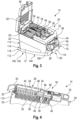
- the collection receptacle 14 is shown in more detail in Figure 2 .
- the collection receptacle 14 is generally prism-shaped and comprises a mechanically rigid receptacle shell 22.
- the receptacle shell 22 encloses a collection volume of the collection receptacle 14. In other words, workpiece particles may be collected in the interior of the receptacle shell 22.
- the collection volume has a capacity of three liters or more.
- an inlet port 26 On a first side 24 of the receptacle shell 22, there is provided an inlet port 26.
- the inlet port 26 is configured to be coupled to the handheld power tool 12 as shown in Figure 1 .
- the inlet port 26 is configured to receive a mixture of air and workpiece particles resulting from an operation performed by the handheld power tool.
- the inlet port 26 is formed as a short feed pipe.
- the first side 24 of the receptacle shell 22 is the side of the receptacle shell 22 being oriented towards the handheld power tool 12.
- An outlet 28 is provided on a second side 30 of the receptacle shell 22.
- the second side 30 is facing upwards in an operational position of the collection receptacle 14.
- the first side 24 and the second side 30 share a common edge.
- An operational position of the collection receptacle 14 is a position in which the collection receptacle 14 is coupled or couplable to the handheld power tool 12, wherein the power tool is oriented such that is can perform its task. If the receptacle 14 is coupled to the handheld power tool 12, the receptacle 14 may be moved together with the handheld power tool 12.
- the outlet 28 is configured to allow air to leave the receptacle shell 22.
- the outlet 28 has the form of a grid.
- the outlet 28, thus, comprises a plurality of openings which are distributed over a portion of the second side 30.
- the receptacle shell 22 comprises a transparent section 31. A user of the collection receptacle 14 can see through this transparent section 31 allowing a user to estimate an amount of workpiece particles that has been accumulated in the collection volume.
- the transparent section 31 may also be called a window.
- a handle 33 is pivotably supported on the receptacle shell 22.
- the pivotable handle 33 can be selectively positioned such that it is flush with an outer contour of the receptacle shell 22. This means that the handle 33 does not protrude beyond the outer contour of the receptacle shell 22. In order to manipulate the collection receptacle 12, the handle 33 can be pivoted upwards such that it can be easily grasped by a human hand.
- the collection receptacle 14 comprises a filter means 32 (cf. Figures 3 and 4 ).
- the filter means 32 is disposed at the outlet 28. This means that the filter means 32 is arranged between the outlet 28 and the collection volume. In other words, the filter means 32 is located on an inner side of the outlet 28. The filter means 32 extends over the outlet 28.
- the filter means 32 is configured to separate workpiece particles from air. Thus, pores of the filter means 32 are sized such that air can pass, but workpiece particles are too big to pass.
- the filter means 32 comprises a sheet-like filter element which is pleated (see especially Figure 4 ).
- the filter element may be made from a paper material.
- the collection receptacle 14 additionally comprises a filter dedusting mechanism 34.
- the filter dedusting mechanism 34 is a manual filter dedusting mechanism 34.
- the filter dedusting mechanism 34 is configured to remove workpiece particles from the filter means 32.
- the filter dedusting mechanism 34 is coupled with the filter means 32 to this end.
- the filter dedusting mechanism 34 comprises a first excitation element 36 and a second excitation element 38.
- the first excitation element 36 comprises a first protrusion 40 and the second excitation element 38 comprises a second protrusion 42.
- Both the first protrusion 40 and the second protrusion 42 contact the filter means 32 or are configured to contact the filter means 32.
- both the first protrusion 40 and the second protrusion 42 extend into a region of the filter means 32 and, thus, are configured to contact the filter means 32 on a side opposing the collection volume.
- the first protrusion 40 and the second protrusion 42 are configured to contact the creases of the pleated filter element.
- first excitation element 36 and the second excitation element 38 are coupled to a linear guiding means.
- the linear guiding means comprises two linear guiding rods 44 which extend through corresponding openings 46, 48 in the first excitation element 36 and the second excitation element 38.
- the linear guiding rods 44 extend along a longitudinal direction of the collection receptacle 14. This means that the linear guiding rods 44 extend in a direction away from the first side 24 of the receptacle shell 22 and/or along the second side 30 of the receptacle shell 22.
- Both the first excitation element 36 and the second excitation element 38 are coupled to a common gripping means 50.
- the gripping means 50 comprises a gripping portion 52 which is configured for being gripped by a human hand and an actuation rod portion 54.
- the gripping portion 52 and the actuation rod portion 54 are fixedly connected to one another or formed integrally.
- the actuation rod portion 54 is fixedly connected to both the first excitation element 36 and the second excitation element 38.
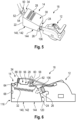
- the excitation elements 36, 38 may be manually moved along the linear guiding means, i.e. the linear guiding rods 44, by pushing and/or pulling the gripping portion 52 (see especially Figures 4 and 5 in combination).
- the filter means 32 While moving along the linear guiding means, the first excitation element 36 and the second excitation element 38 stroke or impact the filter means 32, in particular the creases of the pleated filter. Thereby the filter means 32 is subjected to mechanical excitation, i.e. the filter means 32 is subject to a movement. As a consequence of this mechanical excitation, workpiece particles sticking to the filter means 32 may be separated from the filter means 32.
- the linear guiding rods 44 i.e. the linear guiding means, the gripping means 50 and the excitation elements 36, 38 are supported on a lid 56 of the receptacle shell 22.
- the lid 56 may be pivoted between a closed position and an open position. In an open position of the lid 56, the filter means 32 is accessible, for example for exchanging the filter means 32. In other words, the filter means 32 may be selectively accessed via the lid 56.
- the lid 56 is shown in an open position, however in contrast to reality and for better visibility only, the linear guiding means, the gripping means 50 and the excitation elements 36, 38 are shown as if the lid 56 were in its closed position.
- the collection receptacle as shown in Figures 1 to 5 is completely passive. This means that the collection receptacle 14 requires an external mechanism, e.g. located in the handheld power tool 12, to produce a pressure difference that allows for a dust-laden air flow to be driven from the inlet port 26 through the filter means 32 to the outlet 28.
- the dedusting criterion may for example relate to an operation time of the collection receptacle 14 exceeding a predefined time threshold.
- the dedusting criterion may relate to a filtering performance of the filter means 32 dropping below a predefined filtering performance threshold. This may be visually indicated, and hence noticed by a user of the collection receptacle 14.
- the dedusting mechanism 34 is operated as has been explained above.
- Figure 6 shows a handheld power tool assembly 18 with a collection receptacle 14 according to another embodiment. In the following, only the differences with respect to the embodiments as mentioned before will be explained.
- the collection receptacle 14 of Figure 6 comprises a suction means 58 configured to suck air and/or workpiece particles from the inlet port 26 towards the outlet 28.
- the suction means 58 comprises a fan 60 being arranged on the second side 30 of the receptacle shell 22. This fan 60 is configured to suck air out of the collection volume.
- the fan is powered by an electric motor 62.
- suction means 58 i.e. the fan 60
- the suction means 58 is arranged on an external side of the filter means 32.
- the suction means 58 may pull air from the collection volume through the filter means 32.
- the collection receptacle 14 comprises a dedusting mechanism 34.
- the dedusting mechanism 34 of the embodiment of Figure 6 is automatic.
- the dedusting mechanism 34 comprises a reflow valve 64 and a corresponding electric valve actuator 66.
- the reflow valve 64 may be selectively transferred from a closed state into an open state. In its open state, the reflow valve 64 opens a bypass flow path which by-passes the filter means and fluidically connects an inlet of the suction means 58 to an environment of the collection receptacle 14.
- opening the reflow valve 64 leads to a sudden change of a pressure difference over the filter means 32. This has the effect that the filter means 32 is subject to a sudden movement which makes workpiece particles fall off the filter means 32.
- the reflow valve 64 may be opened in a periodic manner by the electric valve actuator 66.
- the filter means 32 may vibrate. This leads to a very thorough dedusting of the filter means 32.
- the collection receptacle comprises a lid 56.
- the lid 56 is configured for being pivoted between an open state and a closed state. By putting the lid 56 in the open state, the filter means 32 may be selectively accessed.
- the reflow valve 64, the valve actuator 66 and the suction means 58 are arranged on the lid 56.
- both the electric valve actuator 66 and the electric motor 62 are supplied with electric power from the handheld power tool 12.
- the electric power may be drawn from the battery of the electric power tool.
- collection receptacle 14 may be operated in accordance with the method for operating a collection receptacle 14.
- a second step the operation of the dedusting mechanism is triggered. This means that the electric valve actuator 66 is operated such that the reflow valve 64 is transferred into its open state.
- a first criterion relates to an operation time of the collection receptacle 14 exceeding a predefined time threshold.
- the reflow valve 64 is opened after the lapse of a certain time span in order to dedust the filter means 32.
- the collection receptacle 14 may comprise a pressure sensor 68 and the criterion relates to a pressure difference over the filter means 32 exceeding a predefined pressure threshold.
- the collection receptacle 14 may comprise a volumetric flow sensor and the criterion relates to a volumetric flow rate over the filter means 32 dropping below a predefined flow rate threshold.
- the collection receptacle 14 may comprise a sensor for measuring filtering performance.
- the criterion may relate to a filtering performance of the filter means 32 dropping below a predefined filtering performance threshold.
- the filter means 32 may be reliably dedusted. Consequently, a comparatively big portion of the workpiece particles may be collected in the collection volume of the collection receptacle 14.
- the filter element of the filter means 32 may be used for a comparatively long time and/or the collection container may reliably filter the mixture of air and workpiece particles resulting from an operation of the handheld power tool 12.
- Figures 7 and 8 show a portion of the collection receptacle 14 comprising the inlet port 26.
- the collection receptacle 14 comprises a closure mechanism 70.
- the closure mechanism 70 comprises a closure element 72 supported on the receptacle shell 22.
- the inlet port 26 may be selectively opened and closed.
- the closure element 72 is substantially plate-shaped. Thus, the closure element 72 extends in a plane being defined by its plate-shape.
- closure element 72 When moving the closure element 72 in order to selectively open and close the inlet port 26, the closure element 72 is moved within the plane being defined by its plate-shape.
- This plane may also be referred to as a sealing plane.
- closure element 72 is arranged in a closure element housing 74 which is arranged on an inner side of the receptacle shell 22. More precisely, the closure element housing 74 is arranged on an inner side of the receptacle shell 22 corresponding to the first side 24 of the receptacle shell 22. In simplified words, the closure element housing 74 is arranged at an inner side of the inlet port 26 (cf. Figures 9 and 10 ).
- the closure element housing 74 comprises a main wall 76 which is arranged in parallel to the first side 24 of the receptacle shell 22. However, the main wall 76 is arranged at a distance from the receptacle shell 22.
- the main wall 76 is substantially rectangular.
- the distance between the receptacle shell 22 and the main wall 76 substantially corresponds to a thickness of the closure element 72.
- the closure element 72 is arranged between the main wall 76 and the receptacle shell 22.
- the main wall 76 extends over the inlet port 26. However, there is provided an opening 78 in the main wall 76 being substantially congruent to the inlet port 26.
- the closure element housing 74 additionally comprises four lateral walls which all extend between the main wall 76 and the receptacle shell 22.
- a lower lateral wall 80 is arranged at the bottom of the closure element 72 if the collection receptacle 14 is in an operational position.
- the lower lateral wall 80 slidingly supports the closure element 72.
- the lower lateral wall 80 and the main wall 76 form a guiding means 81 for the closure element 72.
- an upper lateral wall 82 is provided.
- the upper lateral wall 82 and the lower lateral wall 80 define a space for the closure element 72 along a vertical direction.
- a left lateral wall 84 and a right lateral wall 86 are provided on the remaining sides of the main wall 76.
- the designations as left and right are defined with reference to a work flow direction of the collection receptacle 14 and the handheld power tool 12 to which the collection receptacle 14 is coupled.
- the workflow direction extends in parallel to a longitudinal direction of the collection receptacle 14.
- Both the left lateral wall 84 and the right lateral wall 86 form abutment means 88 for the closure element 72.
- both the left lateral wall 84 and the right lateral wall 86 are configured to limit a range of motion of the closure element 72 on the lower natural wall 80. This applies to a horizontal direction.
- the inlet port 26 is configured for receiving a mixture of air and workpiece particles. This means that both the closure element 72 and the closure element housing 74 may be in contact with workpiece particles.
- a particle removal opening 90 is provided on the closure element housing 74.
- the particle removal opening 90 is arranged in the lower lateral wall 80 at a position adjacent to the inlet port 26.
- a pocket 92 is provided on a radially opposite side of the inlet port 26 with respect to the particle removal opening 90. Consequently, the pocket 92 is also provided adjacent to the inlet port 26.
- This pocket 92 is formed on the upper lateral wall 82.
- the pocket 92 fulfills a similar function as the particle removal opening 90.
- closure element 72 In a case in which the closure element 72 is sliding from an open position towards a closed position while workpiece particles are located within the closure element housing 74, these workpiece particles may be obstructing the motion of the closure element 72. However, these workpiece particles may be pushed into the pocket 92 by the movement of the closure element 72. Consequently, despite the presence of workpiece particles, the closure element 72 may be moved into the closed position.
- the pocket 92 is configured to receive workpiece particles.
- the closure mechanism 70 may be operated manually.
- the closure mechanism 70 comprises a gripping means 94.
- the gripping means 94 is fixedly connected to the closure element 72 via a connection portion 96 thereof.
- the closure element 72 is arranged inside the receptacle shell 22.
- the gripping means 94 is arranged on an outside of the receptacle shell 22 such that it is accessible by a hand of a user of the collection receptacle 14.
- the receptacle shell 22 comprises an opening in the form of an oblong hole 98 in the region of the closure element 72.
- the connection portion 96 extends through this oblong hole 98.
- closure element 72 may be translated between its open position and its closed position by manually moving the gripping means 94 along the oblong hole 98. The same is true for a translation of the closure element 72 between its closed position and its open position.
- Figures 7 and 9 show a flow diverter 99 which is arranged adjacent to the inlet port 26.
- the flow diverter 99 is configured for guiding a flow of a mixture of air and workpiece particles towards a center portion of the collection volume.
- using the flow diverter has the effect that not all workpiece particles accumulate in a portion of the collection volume being directly adjacent to the inlet port 26.
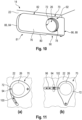
- FIG 11 shows two alternative closure mechanisms 70. In the following, only the difference with respect to the closure mechanism 70 as described above will be explained.
- closure element 72 is pivotably supported on an inside of the receptacle shell 22.
- the gripping means 94 is pin-shaped and extends through a curved oblong hole 100 in the receptacle shell 22.
- the pin-shaped gripping means 94 needs to be moved along the curved oblong hole 100 (cf. arrow in Figure 11 (a) ).
- a centerline of the curved oblong hole 100 corresponds to a portion of a circle around the pivoting point of the closure element 72.
- the gripping means 94 substantially corresponds to the gripping means 94 of the alternative of Figures 7 to 10 . As before, the gripping means 94 is slidable along the oblong hole 98.
- connection arm 102 is pivotably connected to both the closure element 72 and the gripping means 94.
- closure element 72 may be pivoted between its open position and its closed position by translatorily moving the gripping means 94 along the oblong hole 98.
- the closure mechanism 70 may be an automatic mechanism. This means that the closure element 72 may be automatically movable.
- the closure mechanism 70 comprises an actuator which is operationally coupled to the closure element 72 in order to move the closure element 72 from a closed position into an open position and vice versa.
- the closure mechanism 70 may additionally comprise a sensing means.
- the sensing means may be configured to detect a coupled state in which the collection receptacle 14 is coupled to a handheld power tool 12 and to detect an uncoupled state in which the collection receptacle 14 is separated from the handheld power tool 12. Consequently, based on a detection result of the sensing means, the closure element 72 may be automatically moved into its closed position if the collection receptacle 14 is uncoupled from the handheld power tool 12. In situations in which the collection receptacle 14 is coupled to the handheld power tool, the closure element may be automatically moved into its open position.
- the sensing means may be configured to detect an actuation of the connection mechanism, wherein the connection mechanism is configured to selectively couple the collection receptacle 14 to the handheld power tool 12. More precisely, using such a connection mechanism, the inlet port 26 of the collection receptacle 14 may be connected to the handheld power tool 12.
- connection mechanism 104 of the collection receptacle 14 is shown in the detailed view of Figure 12 .
- connection mechanism 104 comprises a connection ring 106.
- connection ring 106 is axially fixed on the inlet port 26, but rotatable with respect to the receptacle shell 22 and, thus, also the inlet port 26.
- connection ring 106 At its radially inner side, the connection ring 106 comprises an engagement feature 108.
- the engagement feature 108 comprises two engagement protrusions 109 protruding from the connection ring 106 in a radially inward direction.
- the engagement feature 108 is configured for engaging a connection feature of the handheld power tool 12. More precisely, the two engagement protrusions 109 are configured for engaging corresponding connection features of the handheld power tool 12. For example, the engagement protrusions 109 may be configured to engage corresponding connection recesses or to extend over corresponding connection protrusions of the handheld power tool 12.
- connection ring 106 is biased into a default rotational position by means of a biasing element.
- the default rotational position corresponds to an engaged position of the engagement feature 108.
- a method for coupling a collection receptacle 14 for workpiece particles to a handheld power tool 12 can be executed (cf. Figure 13, (c) to (a) ).
- this method may only be executed if the collection receptacle 14 and the handheld power tool 12 are provided in an uncoupled state (cf. Figure 13 (c) ). It is additionally assumed that in this state, the closure element 72 is in its closed position. This means that the inlet port 26 is closed such that workpiece particles which may be present in the collection volume are blocked from leaving the collection receptacle 14 via the inlet port 26.
- the inlet port 26 is connected to the handheld power tool 12 while the inlet port 26 is kept closed (cf. Figure 13 (b) ).
- the inlet port 26 is opened by transferring the closure mechanism 70, i.e. the closure element 72, from its closed state into its open state (cf. Figure 13 (a) ).
- the inlet port is ready for receiving a mixture of air and workpiece particles.
- a method for uncoupling a collection receptacle 14 for workpiece particles to a handheld power tool 12 can be executed (see also Figure 13, (a) to (c) ).
- the inlet port 26 is closed.
- the closure element 72 is transferred from its open position into its closed position. Consequently, it is impossible for workpiece particles to leave the collection volume of the collection receptacle 14 via the inlet port 26 (cf. Figure 13 (b) ).
- the inlet port 26 is disconnected from the handheld power tool 12, i.e. the collection receptacle 14 is uncoupled from the handheld power tool 12 (cf. Figure 13 (c) ).
- the method for coupling a collection receptacle 14 for workpiece particles to a handheld power tool 12 and the method for uncoupling a collection receptacle 14 for workpiece particle and the handheld power tool 12 may be facilitated if the connection ring 106 and the closure element 72 are movably coupled.
- Figure 14 (a) schematically shows an example of the collection receptacle 14, wherein the connection ring 106 and the closure element 72 are movably coupled by a flexible element 111a such as a wire or a cord.
- the closure element 72 is represented in its open condition.
- the connection ring 106 is represented in a condition in which it may be coupled to the handheld power tool 12.
- closure element 72 is spring-biased into its open position.
- connection ring 106 If the connection ring 106 is turned in order to uncouple the collection receptacle 14 and the handheld power tool 12, the flexible element 111a is wound around the circumference of the connection ring 106, thereby moving the closure element 72 into its closed position.
- connection ring 106 is indicated by an arrow.
- connection ring 106 and/or the closure element 72 need to be locked or blocked in the closed position in order to avoid undesired opening of the closure element 72 due to the spring-bias.
- a locking or blocking means may be provided to this end. The locking or blocking means may be configured to be released upon contact with an outlet port of the handheld power tool 12.
- connection ring 106 is turned to couple the collection receptacle 14 and the handheld power tool 12, the connection ring 106 is turned against the direction indicated by the arrow in Figure 14 (a) . This allows the closure element 72 to retract due to the spring-bias.
- Figure 14 (b) schematically shows another example of the collection receptacle 14, wherein the connection ring 106 and the closure element 72 are movably coupled by a rod 111b.
- connection ring 106 is represented in a condition in which it may be coupled to the handheld power tool 12.
- connection ring 106 If the connection ring 106 is turned in order to uncouple the collection receptacle 14 and the handheld power tool 12, the rod 111b pulls the closure element 72 into its closed position.
- connection ring 106 is indicated by an arrow.
- connection ring 106 is turned to couple the collection receptacle 14 and the handheld power tool 12, the connection ring 106 is turned against the direction indicated by the arrow in Figure 14 (a) . Consequently, the closure element 72 is pushed into its open position by the rod 111b.
- Figure 14 (c) schematically shows a further example of the collection receptacle 14, wherein the connection ring 106 and the closure element 72 are movably coupled by a protrusion 111c being provided on the connection ring 106 and a notch 111d being arranged on an arm 111e of the closure element 72.
- the protrusion 111c extends radially from the ring-shaped portion of the connection ring 106.
- the arm 111e extends from a lower side of the remaining portions of the closure element 72 towards the connection ring 106.
- the notch 111d is arranged on an upper side of the arm 111e such that a tip of the protrusion 111c can be arranged in the notch 111d.
- connection ring 106 is represented in a condition in which it may be coupled to the handheld power tool 12.
- connection ring 106 If the connection ring 106 is turned in order to uncouple the collection receptacle 14 and the handheld power tool 12, the protrusion 111c pulls the closure element 72 into its closed position by engaging the notch 11 1d.
- connection ring 106 is indicated by an arrow.
- connection ring 106 is turned to couple the collection receptacle 14 and the handheld power tool 12, the connection ring 106 is turned against the direction indicated by the arrow in Figure 14 (c) . Consequently, the closure element 72 is pushed into its open position by the protrusion 111c engaging the notch 11 1d.
- Figure 14 (d) schematically shows another example of the collection receptacle 14, wherein the connection ring 106 and the closure element 72 are movably coupled by a slot 111f being provided on a coupling tab 111g connected to the connection ring 106 and a pin 111h being arranged on the closure element 72.
- the coupling tab 111g extends radially from the ring-shaped portion of the connection ring 106.
- the slot 111f has a curved form. This means that the slot may be formed as a portion of a circle. However, other curved geometries may also be used to achieve a desired coupling characteristic between the closure element 72 and the connection ring 106 when the connection ring 106 is turned. In an example, the slot is formed as a portion of a spiral.
- the pin 111h is arranged on the closure element 72. Moreover, the pin 111h is located in the slot 111f.
- connection ring 106 is represented in a condition in which it may be coupled to the handheld power tool 12.
- connection ring 106 If the connection ring 106 is turned in order to uncouple the collection receptacle 14 and the handheld power tool 12, the closure element 72 is moved into its closed position by the pin 111h engaging the slot 111f. This is due to the fact that a radius of the slot 111f gets smaller along the direction of relative movement of the pin 11 1h.
- connection ring 106 is indicated by an arrow.
- connection ring 106 is turned to couple the collection receptacle 14 and the handheld power tool 12, the connection ring 106 is turned against the direction indicated by the arrow in Figure 14 (d) . Consequently, the closure element 72 is pushed into its open position by the pin 111h engaging the slot 111f.
- such a retardation element may be realized by a predefined amount of slack of the flexible element 111a.
- the retardation element may be realized by supporting the rod 11 1b in an oblong hole.
- the oblong hole may have corners and curves.
- the retardation element may be realized by making the notch 11 1d wider than necessary for the engagement of the protrusion 11 1c.
- the notch 111d may be arranged on the arm 111e such that the protrusion 111c immediately contacts a wall of the notch 111d if the connection ring 106 is turned in a first direction and such that the protrusion 111c contacts a wall of the notch 111d only after a predefined rotational travel if the connection ring 106 is turned in a second direction.
- the retardation element may be realized by providing retardation sections in the slot 111f.
- the retardation sections are shaped as a portion of a circle having the same center as the connection ring 106.
- closure element 72 is guided such that it can move in a translatory manner only. This is illustrated by two lines on the inner side of the receptacle shell 22.
- the receptacle shell 22 comprises a cup-shaped base part 110.
- the base part 110 is obstacle-free in an opening direction of the cup-shape.
- the opening direction of the cup-shaped base part 110 extents downwards in an operating position of the container shell 22. Consequently, the fact that the base part 110 is obstacle-free in this direction means that it does not comprise any geometric features which could block an object, e.g. workpiece particles, translating from the interior of the cup-shaped base part 110 towards an outside of the cup-shaped base part 110 along this direction.
- the base part 110 especially does not comprises steps, sloping surfaces or edges that could block workpiece particles from leaving the collection volume.
- the receptacle shell 22 comprises a lid part 112.
- the lid part 112 is shaped like a flat tray.
- the lid part 112 is a self-sustainingly rigid component which is movably connected to the base part 110 by means of a hinge 114.
- the lid part 112 forms a bottom side of the receptacle shell 22 if the collection receptacle 14 is in an operational position.
- the lid part 112 is arranged opposite the handle 33 which is arranged on the base part 110 and opposite the filter means 32 which is also arranged on the base part 110.
- the lid part 112 can selectively assume a closed position in which the collection volume is fully enclosed by the base part 110 and the lid part 112. This is shown in Figure 15 . Additionally, the lid part 112 can selectively assume an open position in which the collection volume is accessible. This is shown in Figure 16 .
- the lid part 112 may be transferred into its open position in order to empty the collection receptacle 14, i.e. in order to eliminate workpiece particles from the collection volume of the collection receptacle 14.
- the hinge 114 is arranged at a proximal end 120 of the lid part 112 with respect to the first side 24. This means that the hinge 114 is arranged at the end of the lid part 112 which is arranged adjacent to the first side. As has been mentioned before, the collection receptacle 14 may be grabbed by the handle 33 when emptying the collection volume.
- the collection receptacle 14 additionally comprises a securing means 118.
- the securing means 118 is configured for securing the lid part 112 on the base part 110 in the closed position of the lid part 112.
- the securing means 118 and the hinge 114 are arranged at opposite ends of the lid part 112.
- the securing means 118 is arranged at a distal end 116 of the lid part 112 with respect to the first side 24. This means that the securing means 118 is arranged at the end of the lid part 112 being arranged remote from the first side 24.
- the securing means 118 is arranged centrally.
- the width direction refers to an operational position of the collection receptacle 14 in which the width extends in a horizontal direction orthogonal to a work direction.
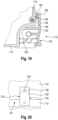
- the securing means 118 is shown in more detail in Figure 19 .
- the securing means 118 comprises a hook part 122 which is pivotably supported on the lid part 112.
- the pivot axis extends substantially parallel to the first side 24.
- an engagement feature 124 which comprises an engagement surface 126.
- the hook part 122 can assume a locked position, if the lid part 112 is in its closed position. In such a situation, the engagement feature 124, more precisely the engagement surface 126 is engaged by the hook part 122. Consequently, the lid part 112 is not able to pivot with respect to the base part 110.
- the hook part 122 can also assume and unlocked position, if the lid part is in its closed position. In such a situation, the engagement feature 124, more precisely the engagement surface 126, is not engaged by the hook part 122. Consequently, the lid part 112 is free to pivot with respect to the base part 110.
- the hook part 122 is resiliently biased towards the locked position by a spring 128. Consequently, in the absence of external forces, if the lid part 112 is in its closed position, the hook part 122 is in the locked position such that the lid part 112 is not able to pivot.
- the hook part 112 additionally comprises a mounting slope 130.
- the mounting slope 130 is oriented towards the base part 110 and is provided at the free end of the hook part 122. Thus, if the lid part 112 is in its open condition and the hook part 122 is in the locked position, the lid part 112 may be moved into its closed position and the hook part 122 is brought into engagement with the engagement feature 124 by sliding along the mounting slope 130.
- the hook part 122 may be manually actuated.
- the hook part 122 comprises an actuation surface 132.
- the actuation surface 132 is oriented towards an exterior of the receptacle shell 22 such that it is easily accessible by a human finger or hand.
- the actuation surface 132 and the engagement feature 124 are arranged on opposite sides of the pivot axis of the hook part 122. Consequently, the hook part 122 may be moved into the unlocked position by pushing on the actuation surface 132. It is understood that in this context, the hook part 122 needs to be pushed against the force of the spring 128.
- the collection receptacle 14 is equipped with a sealing means 134.
- the sealing means 134 is arranged on the base part 110, such that a counter-sealing feature 136 of the lid part 112 abuts against the sealing means 134 if the lid part 112 is in its closed position. In other words, in the closed position of the lid part, the sealing means 134 is interposed between the lid part 112 and the base part 110. Consequently, workpiece particles are reliably kept in the collection volume.
- Figures 17 and 18 show an alternative example of a collection receptacle 14, comprising the base part 110 and the lid part 112. In the following, only the differences with respect to the example of Figures 15 and 16 will be explained.
- the locations at which the hinge 114 and the securing means 118 are arranged are inverted. This means, that in the example of Figures 17 and 18 , the hinge 114 is arranged at the distal end 116 of the lid part 112 and the securing means 118 is arranged at the proximal end 120 of the lid part 112 with respect to the first side 24.
- the collection receptacle 14 of Figures 17 and 18 is similar to the collection receptacle 14 of Figures 15 and 16 .
- Figure 20 shows an alternative configuration of the securing means 118 and a corresponding engagement feature 124.
- the hook part 122 is pivotably connected to the lid part 112.
- the pivot axis extends substantially perpendicular to a side wall of the receptacle shell 22, in the present case the first side 24.
- the hook part 112 comprises a curved notch 138 which is oriented towards the first side 24 of the receptacle shell 22, i.e. the base part 110.
- the engagement feature 124 is provided which has the form of a protrusion which can be selectively received inside the notch 138.
- the hook part 122 comprises two actuation interfaces 132 such that the hook part 122 can be pivoted around the pivot axis such that it can be selectively brought into engagement with the engagement feature 124.
- the arrangement of the hook part 122 and the corresponding engagement feature 124 may be kinematically inverted.
- the hook part 122 may be arranged on the base part 110 and the engagement feature 124 may be provided on the lid part 112.
- the collection receptacle 14 may be supported on the guide rail 16.
- the collection receptacle 14 comprises a support means 140 being arranged on the receptacle shell 22.
- the support means 140 comprises a sliding surface 142.
- the sliding surface 142 is arranged on a lower side 144 of the receptacle shell 22, if the receptacle shell 22 is in an operational position.
- the sliding surface 142 is essentially formed by the entire lower side 144 of the receptacle shell 22. More precisely, as has been explained before, the sliding surface 142 is formed by the lower side 144 of the lid part 112.
- the sliding surface 142 is configured for supporting the receptacle shell 22 on the guide rail 16. More precisely, the sliding surface 142 may slide on a counter-surface of the guide rail 16.
- the collection receptacle 14 slides on the guide rail 16.
- the collection receptacle 14 does not hinder the handheld power tool 12 from being inclined, e.g. for making a bevel cut.
- the handheld power tool 12 i.e. the circular hand saw, is shown in a configuration in which it may generate a bevel cut.
- the rotational degree of freedom may be provided by allowing the inlet port 26 to rotate with respect to the receptacle shell 22.
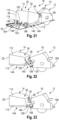
- Figure 21 shows a further example of a collection receptacle 14 being coupled to a handheld power tool 12.
- This example differs from the example of Figure 1 in that the support means 140 is designed in accordance with an alternative.
- the support means 140 is configured for supporting the receptacle shell 22 on a guide rail 16.
- the support means 140 comprises two wheels 146 which are arranged on a common axle 148.
- the wheels 146 are rotatably supported on the receptacle shell 22.
- the wheels 146 are configured for rolling on the guiderail 16.
- the two wheels 146 are arranged at an end of the receptacle shell 22 which is arranged opposite to the first side 24.
- the wheels 146 are arranged at a distal end 116 of the receptacle shell 22 with respect to the first side 24 or with respect to the handheld power tool 12.
- the axle 148 fulfills a double functionality. As has been mentioned before, the axle 148 rotatorily supports the wheels 146 on the receptacle shell 22. Additionally, the axle 148 forms part of the hinge 114 by which the base part 110 and the lid part 112 are pivotably connected.
- the support means 140 comprises a guiding means 150.
- the guiding means 150 is configured for laterally guiding the receptacle shell 22 on the guiderail 16. Again, the lateral direction is determined with respect to a work flow direction.
- the guiding means 150 comprises a notch 152 which extends over the entire lower side 144 of the receptacle shell 22. Consequently, the notch 152 extends along a longitudinal direction of the collection receptacle 14 which extends in parallel to the work flow direction.
- the notch 152 is configured to receive a rib 154 of the guiderail 16.
- the rib 154 and the notch 152 are sized such that the rib 154 may be received in the notch 152 with little play.
- the collection receptacle 14 may move along the rib 154. Movements in a transverse direction are prevented or at least reduced to a minimum.
- FIG. 22 A further example of the collection receptacle 14 is shown in Figure 22 . As before, this collection receptacle 14 differs from the other collection receptacles 14 by its support means 140.
- the support means 140 is configured for supporting the receptacle shell 22 on a base plate 156 of the handheld power tool 12.
- Such a base plate 156 is configured for positioning the handheld power tool 12 on a workpiece or on a guide rail 16.
- the support means 140 comprises a support bracket 158 which is pivotably supported on the receptacle shell 22. More precisely, the support bracket 158 is pivotably supported on the base part 110 of the receptacle shell 22.
- the support bracket 158 may be supported on the base plate 156.
- the support bracket 158 may be secured on the base plate 156.
- the support bracket 158 is pivotably supported on the receptacle shell 22, the support bracket 158 can be used in different angular positions if the collection receptacle 14 is used in combination with different handheld power tools 12.
- Figure 23 shows a further example of a collection receptacle 14 being coupled to a handheld power tool 12. As before, the collection receptacle 14 differs from the previous examples by the support means 140.
- the support means 140 comprises a support bracket 158.
- the support bracket 158 now is rigidly connected to the receptacle shell 22.
- the support bracket 158 may not be moved with respect to the receptacle shell 22.
- the support bracket 158 is integrally formed with the receptacle shell 22 in the example of Figure 23 . More precisely, the support bracket 158 is integrally formed with the base part 110.
- the support bracket 158 may be supported on the base plate 156 if the collection receptacle 14 is coupled to a handheld power tool 12, as shown in Figure 23 .
- the support bracket 158 may be secured on the base plate 156.
- the inlet port 26 may be pivotable around an axis extending transverse to a standard working direction.
- the inlet port 26 may be pivoted around a portion of the collection receptacle 14.
- a Standard working direction may be a direction perpendicular to the axis 148 of the wheel 146 and/or the guiding means 150, e.g. the notch 152, of the support means 140. Additionally or alternatively, the standard working direction is perpendicular to a portion of the support bracket 158 configured to be attached to handheld power tool 12.
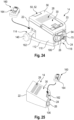
- Figure 24 shows a collection receptacle 14 according to another embodiment in a partially exploded representation.
- the collection receptacle 14 of Figure 24 comprises an energy source module 160 which comprises an energy source formed by an electric battery.
- the energy source module 160 is formed as a component separate from the receptacle shell 22, which is selectively couplable to the receptacle shell 22 and selectively decouplable from the receptacle shell 22.
- a receptacle shell connection interface 162 is arranged on a lateral side of the receptacle shell 22. The lateral side is defined with respect to a standard working direction.
- An energy source module connection interface 164 is provided on the energy source module 160.
- Both the receptacle shell connection interface 162 and the energy source module connection interface 164 are combined mechanical and electrical interfaces. Moreover, the receptacle shell connection interface 162 and the energy source module connection interface 164 are configured to be connected to one another. This applies in a mechanical sense and in an electrical sense. Thus, through the energy source module connection interface 164, the energy source module 160 may be mechanically connected to the receptacle shell connection interface 162 of the receptacle shell 22 and electrically connected to one or more electric consumers, e.g. the electric motor 62 and/or the electric valve actuator 66, arranged on the receptacle shell 22.
- electric consumers e.g. the electric motor 62 and/or the electric valve actuator 66
- the receptacle shell connection interface 162 and the energy source module connection interface 164 are configured to be slidingly connected and slidingly disconnected from one another.
- the energy source module connection interface 164 is slid with respect to the receptacle shell connection interface 162 along a first direction.
- the first direction is substantially parallel to the standard working direction.
- the energy source module connection interface 164 is slid with respect to the receptacle shell connection interface 162 along a second direction opposing the first direction.
- the energy source module 160 is accessible from a rear side of the collection receptacle 14 when the collection receptacle 14 is coupled to the handheld power tool 12.
- the electric battery of the energy source module 160 may be used to power the suction means 58 and/or the reflow valve 64.
- the energy source module 160 is separate from a battery unit of the handheld power tool 12.
- Figure 25 shows a collection receptacle 14 according to still another embodiment.
- the collection receptacle 14 of Figure 25 also comprises an energy source module 160 which comprises an energy source being formed by an electric battery.
- the energy source module 160 is formed as a component separate from the receptacle shell 22. Moreover, the energy source module 160 is selectively couplable to the receptacle shell 22 and selectively decouplable from the receptacle shell 22 using the receptacle shell connection interface 162 and the energy source module connection interface 164. Reference is made to the above explanations concerning the embodiment of Figure 24 .
- the receptacle shell connection interface 162 is arranged on or proximal the first side 24 of the receptacle shell 22. This means that the receptacle shell connection interface 162 and the inlet port 26 are arranged on the same side of the receptacle shell 22.
- the receptacle shell connection interface 162 is oriented such that the first direction along which the energy source module connection interface 164 is slid with respect to the receptacle shell connection interface 162 extends downwards, if the collection receptacle 14 is in an operational position. Consequently, the second direction extends upwards.
- the energy source module 160 is accessible from a top side of the collection receptacle 14, even if the collection receptacle 14 is coupled to the handheld power tool 12.
Landscapes
- Engineering & Computer Science (AREA)
- Mechanical Engineering (AREA)
- Life Sciences & Earth Sciences (AREA)
- Wood Science & Technology (AREA)
- Forests & Forestry (AREA)
- Finish Polishing, Edge Sharpening, And Grinding By Specific Grinding Devices (AREA)
- Auxiliary Devices For Machine Tools (AREA)
- Grinding-Machine Dressing And Accessory Apparatuses (AREA)
Priority Applications (3)
| Application Number | Priority Date | Filing Date | Title |
|---|---|---|---|
| EP23170200.2A EP4454822A1 (de) | 2023-04-26 | 2023-04-26 | Aufnahmebehälter für werkstückpartikel, handwerkzeugmaschinenanordnung, partikelsammelanordnung, handwerkzeugmaschinensystem und verwendung einer führungsschiene |
| PCT/EP2024/061294 WO2024223694A1 (en) | 2023-04-26 | 2024-04-24 | Collection receptacle for workpiece particles, handheld power tool assembly, particle collection assembly, handheld power tool system, and use of a guide rail |
| CN202480026082.9A CN120957838A (zh) | 2023-04-26 | 2024-04-24 | 工件颗粒的收集容器、手持式动力工具组件、颗粒收集组件、手持式动力工具系统及导轨的用途 |
Applications Claiming Priority (1)
| Application Number | Priority Date | Filing Date | Title |
|---|---|---|---|
| EP23170200.2A EP4454822A1 (de) | 2023-04-26 | 2023-04-26 | Aufnahmebehälter für werkstückpartikel, handwerkzeugmaschinenanordnung, partikelsammelanordnung, handwerkzeugmaschinensystem und verwendung einer führungsschiene |
Publications (1)
| Publication Number | Publication Date |
|---|---|
| EP4454822A1 true EP4454822A1 (de) | 2024-10-30 |
Family
ID=86226384
Family Applications (1)
| Application Number | Title | Priority Date | Filing Date |
|---|---|---|---|
| EP23170200.2A Pending EP4454822A1 (de) | 2023-04-26 | 2023-04-26 | Aufnahmebehälter für werkstückpartikel, handwerkzeugmaschinenanordnung, partikelsammelanordnung, handwerkzeugmaschinensystem und verwendung einer führungsschiene |
Country Status (3)
| Country | Link |
|---|---|
| EP (1) | EP4454822A1 (de) |
| CN (1) | CN120957838A (de) |
| WO (1) | WO2024223694A1 (de) |
Citations (3)
| Publication number | Priority date | Publication date | Assignee | Title |
|---|---|---|---|---|
| EP1171261B1 (de) * | 2000-02-10 | 2003-04-09 | Robert Bosch Gmbh | Handwerkzeugmaschine mit staubabsaugung |
| EP2902155B1 (de) * | 2014-02-01 | 2016-11-09 | Festool GmbH | Anschlussvorrichtung für eine Staubabfuhreinrichtung und eine Hand-Werkzeugmaschine |
| US20220314384A1 (en) * | 2021-04-01 | 2022-10-06 | Milwaukee Electric Tool Corporation | Integrated dust extractor and power tool |
-
2023
- 2023-04-26 EP EP23170200.2A patent/EP4454822A1/de active Pending
-
2024
- 2024-04-24 CN CN202480026082.9A patent/CN120957838A/zh active Pending
- 2024-04-24 WO PCT/EP2024/061294 patent/WO2024223694A1/en not_active Ceased
Patent Citations (3)
| Publication number | Priority date | Publication date | Assignee | Title |
|---|---|---|---|---|
| EP1171261B1 (de) * | 2000-02-10 | 2003-04-09 | Robert Bosch Gmbh | Handwerkzeugmaschine mit staubabsaugung |
| EP2902155B1 (de) * | 2014-02-01 | 2016-11-09 | Festool GmbH | Anschlussvorrichtung für eine Staubabfuhreinrichtung und eine Hand-Werkzeugmaschine |
| US20220314384A1 (en) * | 2021-04-01 | 2022-10-06 | Milwaukee Electric Tool Corporation | Integrated dust extractor and power tool |
Also Published As
| Publication number | Publication date |
|---|---|
| CN120957838A (zh) | 2025-11-14 |
| WO2024223694A1 (en) | 2024-10-31 |
Similar Documents
| Publication | Publication Date | Title |
|---|---|---|
| JP7472316B2 (ja) | クリーナーステーション | |
| CN101273859B (zh) | 电清扫机 | |
| US8069529B2 (en) | Handheld vacuum cleaner | |
| EP1795105B1 (de) | Staubsauger | |
| EP3641611B1 (de) | Oberflächenreinigungsvorrichtung | |
| EP1733669B1 (de) | Staubsammelgefäss und staubsauger mit einem solchen staubsammelgefäss | |
| CN102438495A (zh) | 电动吸尘器 | |
| EP4454821A1 (de) | Aufnahmebehälter für werkstückpartikel, handwerkzeugmaschinenanordnung und verfahren zum an- und abkoppeln eines aufnahmebehälters für werkstückpartikel | |
| EP4454808A1 (de) | Sammelbehälter für werkstückpartikel, verfahren zum betreiben eines sammelbehälters und handwerkzeugmaschinenanordnung | |
| EP4454822A1 (de) | Aufnahmebehälter für werkstückpartikel, handwerkzeugmaschinenanordnung, partikelsammelanordnung, handwerkzeugmaschinensystem und verwendung einer führungsschiene | |
| EP4454823A1 (de) | Sammelbehälter für werkstückpartikel und handwerkzeugmaschinenanordnung | |
| JP4945317B2 (ja) | 集塵袋ホルダ | |
| EP1491128B1 (de) | Befestigungsvorrichtung für Staubsaugerzubehörteile | |
| US8141200B2 (en) | Air inlet for a vacuum cleaner | |
| JP4896818B2 (ja) | 電気掃除機 | |
| JP4286879B2 (ja) | 電気掃除機 | |
| US20250339005A1 (en) | Cleaner station | |
| JP2010035623A (ja) | 電気掃除機 | |
| JP4982200B2 (ja) | 電気掃除機 | |
| JP2008200121A (ja) | 電気掃除機 | |
| KR20070010283A (ko) | 업라이트형 진공청소기 |
Legal Events
| Date | Code | Title | Description |
|---|---|---|---|
| PUAI | Public reference made under article 153(3) epc to a published international application that has entered the european phase |
Free format text: ORIGINAL CODE: 0009012 |
|
| STAA | Information on the status of an ep patent application or granted ep patent |
Free format text: STATUS: REQUEST FOR EXAMINATION WAS MADE |
|
| 17P | Request for examination filed |
Effective date: 20240806 |
|
| AK | Designated contracting states |
Kind code of ref document: A1 Designated state(s): AL AT BE BG CH CY CZ DE DK EE ES FI FR GB GR HR HU IE IS IT LI LT LU LV MC ME MK MT NL NO PL PT RO RS SE SI SK SM TR |