EP4454787A1 - Artikelherstellung mittels heissisostatisches pressens unter verwendung von einem oxid-getter medium - Google Patents
Artikelherstellung mittels heissisostatisches pressens unter verwendung von einem oxid-getter medium Download PDFInfo
- Publication number
- EP4454787A1 EP4454787A1 EP24168368.9A EP24168368A EP4454787A1 EP 4454787 A1 EP4454787 A1 EP 4454787A1 EP 24168368 A EP24168368 A EP 24168368A EP 4454787 A1 EP4454787 A1 EP 4454787A1
- Authority
- EP
- European Patent Office
- Prior art keywords
- hopper
- powder
- oxide
- article
- steel powder
- Prior art date
- Legal status (The legal status is an assumption and is not a legal conclusion. Google has not performed a legal analysis and makes no representation as to the accuracy of the status listed.)
- Pending
Links
Images


Classifications
-
- B—PERFORMING OPERATIONS; TRANSPORTING
- B22—CASTING; POWDER METALLURGY
- B22F—WORKING METALLIC POWDER; MANUFACTURE OF ARTICLES FROM METALLIC POWDER; MAKING METALLIC POWDER; APPARATUS OR DEVICES SPECIALLY ADAPTED FOR METALLIC POWDER
- B22F3/00—Manufacture of workpieces or articles from metallic powder characterised by the manner of compacting or sintering; Apparatus specially adapted therefor ; Presses and furnaces
- B22F3/12—Both compacting and sintering
- B22F3/14—Both compacting and sintering simultaneously
- B22F3/15—Hot isostatic pressing
-
- B—PERFORMING OPERATIONS; TRANSPORTING
- B22—CASTING; POWDER METALLURGY
- B22F—WORKING METALLIC POWDER; MANUFACTURE OF ARTICLES FROM METALLIC POWDER; MAKING METALLIC POWDER; APPARATUS OR DEVICES SPECIALLY ADAPTED FOR METALLIC POWDER
- B22F1/00—Metallic powder; Treatment of metallic powder, e.g. to facilitate working or to improve properties
- B22F1/14—Treatment of metallic powder
- B22F1/145—Chemical treatment, e.g. passivation or decarburisation
-
- B—PERFORMING OPERATIONS; TRANSPORTING
- B22—CASTING; POWDER METALLURGY
- B22F—WORKING METALLIC POWDER; MANUFACTURE OF ARTICLES FROM METALLIC POWDER; MAKING METALLIC POWDER; APPARATUS OR DEVICES SPECIALLY ADAPTED FOR METALLIC POWDER
- B22F3/00—Manufacture of workpieces or articles from metallic powder characterised by the manner of compacting or sintering; Apparatus specially adapted therefor ; Presses and furnaces
- B22F3/12—Both compacting and sintering
- B22F3/1208—Containers or coating used therefor
-
- B—PERFORMING OPERATIONS; TRANSPORTING
- B22—CASTING; POWDER METALLURGY
- B22F—WORKING METALLIC POWDER; MANUFACTURE OF ARTICLES FROM METALLIC POWDER; MAKING METALLIC POWDER; APPARATUS OR DEVICES SPECIALLY ADAPTED FOR METALLIC POWDER
- B22F5/00—Manufacture of workpieces or articles from metallic powder characterised by the special shape of the product
- B22F5/10—Manufacture of workpieces or articles from metallic powder characterised by the special shape of the product of articles with cavities or holes, not otherwise provided for in the preceding subgroups
-
- G—PHYSICS
- G21—NUCLEAR PHYSICS; NUCLEAR ENGINEERING
- G21C—NUCLEAR REACTORS
- G21C13/00—Pressure vessels; Containment vessels; Containment in general
- G21C13/08—Vessels characterised by the material; Selection of materials for pressure vessels
- G21C13/087—Metallic vessels
-
- G—PHYSICS
- G21—NUCLEAR PHYSICS; NUCLEAR ENGINEERING
- G21C—NUCLEAR REACTORS
- G21C21/00—Apparatus or processes specially adapted to the manufacture of reactors or parts thereof
-
- B—PERFORMING OPERATIONS; TRANSPORTING
- B22—CASTING; POWDER METALLURGY
- B22F—WORKING METALLIC POWDER; MANUFACTURE OF ARTICLES FROM METALLIC POWDER; MAKING METALLIC POWDER; APPARATUS OR DEVICES SPECIALLY ADAPTED FOR METALLIC POWDER
- B22F2201/00—Treatment under specific atmosphere
- B22F2201/01—Reducing atmosphere
- B22F2201/013—Hydrogen
-
- B—PERFORMING OPERATIONS; TRANSPORTING
- B22—CASTING; POWDER METALLURGY
- B22F—WORKING METALLIC POWDER; MANUFACTURE OF ARTICLES FROM METALLIC POWDER; MAKING METALLIC POWDER; APPARATUS OR DEVICES SPECIALLY ADAPTED FOR METALLIC POWDER
- B22F2301/00—Metallic composition of the powder or its coating
- B22F2301/35—Iron
-
- B—PERFORMING OPERATIONS; TRANSPORTING
- B22—CASTING; POWDER METALLURGY
- B22F—WORKING METALLIC POWDER; MANUFACTURE OF ARTICLES FROM METALLIC POWDER; MAKING METALLIC POWDER; APPARATUS OR DEVICES SPECIALLY ADAPTED FOR METALLIC POWDER
- B22F2302/00—Metal Compound, non-Metallic compound or non-metal composition of the powder or its coating
- B22F2302/25—Oxide
-
- B—PERFORMING OPERATIONS; TRANSPORTING
- B22—CASTING; POWDER METALLURGY
- B22F—WORKING METALLIC POWDER; MANUFACTURE OF ARTICLES FROM METALLIC POWDER; MAKING METALLIC POWDER; APPARATUS OR DEVICES SPECIALLY ADAPTED FOR METALLIC POWDER
- B22F2998/00—Supplementary information concerning processes or compositions relating to powder metallurgy
- B22F2998/10—Processes characterised by the sequence of their steps
Definitions
- the present invention relates to a method for manufacturing an article. More specifically a method for manufacturing an article such as a vessel, e.g. a nuclear reactor pressure vessel, from a powder, e.g. a steel powder.
- a vessel e.g. a nuclear reactor pressure vessel
- a powder e.g. a steel powder.
- Hot isostatic pressing is typically used to manufacture articles or to modify the physical properties of articles.
- Articles that manufactured using hot isostatic pressing process are typically formed from a metallic powder contained within a "can". High pressure and temperature is applied to the can in order to form the powder into a solid construct. The can is subsequently removed by machining or pickling to reveal the required shape of the article.
- Articles that are used in safety critical or mission critical applications invariably require their material properties to be of a very high quality in order to provide the necessary strength to withstand the loads applied to them in-service. Furthermore, the required strength of the material must readily and reliably repeatable when manufacturing a number of the same articles. The material quality and strength must be guaranteed every time that the article is manufactured.
- the article may be a nuclear reactor pressure vessel, which is typically used within a nuclear power plant to safely and effectively contain a nuclear coolant, a core shroud and a reactor core. It must be constructed to withstand the extreme conditions expected in operation. The required safety of operation is especially extreme given the very significant implications of any failure by the nuclear pressure vessel or the nuclear power plant generally.
- Articles such as nuclear pressure vessels are commonly extremely expensive to manufacture, they can be large and of a complex geometry, and can take a considerable time to produce. Thus, if the required material properties are not achieved, the article cannot be used and is then scrapped. The actual material properties that are achieved on each article can only be ascertained towards the end of the manufacturing sequence after the material has been formed following a significant number of value-adding activities. Thus, when scrapped, all the previous operations conducted to form the article are nugatory resulting in significant financial loss, waste, and production delays.
- the material properties of the article i.e. quality, are commonly ascertained by taking a sample of material from an accessible part of the formed article which can be easily removed, and testing this sample. It is imperative that the sample taken is representative of the rest of the material of the article.
- An article integrity issue leading potentially to a safety issue, can arise if, for example, the sample taken is tested and produces good property results, but there are other areas of the article that cannot be tested and have inferior material properties.
- the manufacturer of the article must be able to substantiate that the sample taken is representative of all areas of the article in order to provide a justification to enable the article to be used in service. If this cannot be provided, then the method of manufacture and article cannot be justified and used.
- a recognised problem in the hot isostatic pressing of articles is the degradation of metal powder brought about by the unwanted presence and uptake of oxygen and the resulting formation of oxides on the powder particles, which creates powder of poor quality, and hence poor material properties in the consolidated article.
- Proposed solutions include the stripping of oxides formed within the aforementioned can after it has been filled with the powder metal.
- Research teams have attempted such oxygen stripping using cans containing the powder that have simple geometries such as cylindrical billets with varying degrees of success, and generally with relatively small quantities of powder being treated.
- the effective stripping of oxygen from large and complex cans, particularly so where large quantities of powder need to be treated effectively remains a significant challenge, e.g. in terms of accessing all areas of the article, removing all oxides, and uniformly treating all portions of the article.
- the present invention provides a method for manufacturing an article that overcomes at least some of the aforementioned problems or at least provides a useful alternative to known methods for manufacturing HIPed articles.
- the present invention provides a method for manufacturing an article as set out in the appended claims.
- a method for manufacturing a vessel comprises the steps of:
- the method involves oxide stripping steel powder particles within the hopper rather than within the can. This is in contrast to known methods that involve oxide stripping powders when the powder has been discharged into a can and the oxide stripping medium, the stripped oxides and any by-products of the stripping process remain with the powder throughout the HIP consolidation process.
- the oxide stripping medium is hydrogen gas.
- the at least one hopper is a plurality of hoppers.
- the at least one hopper is frustoconical in shape.
- the at least one hopper includes a mixing apparatus.
- the at least one hopper is rotatable about an axis.
- the oxide stripping medium and oxide particles stripped from the steel powder are removed from the at least one hopper through an oxide stripping medium and oxide particles exit port formed in the at least one hopper.
- the oxide stripped steel powder is discharged through a powder exit port formed in the at least one hopper into the can.
- the oxide stripped steel powder is discharged from a plurality of hoppers into the can through a plurality of powder exit ports formed in the plurality of hoppers and a plurality of powder inlets formed in the can.
- the powder inlets are substantially equally spaced apart in order to evenly fill the can with the oxide stripped steel powder.
- the article is a vessel.
- the vessel is a nuclear reactor pressure vessel.
- article means a raw material shaped form that is subsequently processed, e.g. machined, to create a product that is used in an application, or a semifinished form that is subsequently processed, e.g. machined, to create a product that is used in an application, or the final finished form of a product that is used in an application.
- the article may be a vessel, e.g. a nuclear reactor pressure vessel.
- oxide stripping medium means a solid, a fluid, or a gas that can remove an oxide from a steel powder particle.
- steel as used herein means an alloy of iron and carbon that typically has greater strength and fracture resistance than iron alone.
- carbon steel as used herein means a steel that contains no elements other than iron and carbon, excepting negligible traces via slight impurities.
- alloy steel as used herein means a steel that contains one or more elements in addition to iron and carbon. Such additional elements typically include one or more of boron, chromium, cobalt, manganese, molybdenum, nickel, niobium, titanium, tungsten, and vanadium.
- low alloy steel as used herein means a steel that does not contain any significant number or quantity of additional elements that may otherwise be added to improve the mechanical properties of the steel.
- high alloy steel means a steel that contains additional elements that have been added to improve the mechanical properties of the steel.
- Such elements typically include one or more of boron, chromium, cobalt, manganese, molybdenum, nickel, niobium, titanium, tungsten, and vanadium.
- hot isostatic pressing is a manufacturing process that is used to form articles from metal or ceramic powder.
- the process typically involves subjecting a can filed with powder to both elevated temperature (e.g. 480 to 1230 °C) and isostatic gas pressure in a high-pressure consolidation vessel.
- the pressurising gas is typically an inert gas e.g. argon.
- can as used herein is a receptacle or vessel that is suitable for containing powder, e.g. metallic or ceramic powder, and that is placed in a HIP consolidation vessel and deformed by the application of high pressure and high temperature to form the powder together as part of the HIP process.
- the can is typically shaped to represent the final shape or near-nett shape of the geometry of a desired article.
- hopper is a receptacle/vessel that is suitable for containing a powder prior to powder being poured into a can. Unlike a can, a hopper is not placed in the HIP consolidation vessel and deformed as part of the HIP process.
- the present invention provides a method for manufacturing an article.
- the method comprises the steps of:
- the article may take various forms. It is typically composed of an alloy steel.
- FIG. 1 Such an article in the form of a vessel is schematically represented in FIG. 1 .
- the vessel is a nuclear pressure vessel.
- FIG. 1 shows a nuclear reactor pressure vessel 1 that has a top portion 3, a generally cylindrical and hollow body portion 6 and a base portion 9.
- the vessel has a plurality of inlet nozzles 12 through which in use a fluid, e.g. water, is supplied to the interior of the vessel and a plurality of outlet nozzles 15 through which in use the fluid is drained from the interior of the vessel.
- the vessel also has a plurality of lifting lugs 18 for lifting the vessel to a desired location and a plurality of support mounts 21 and support lugs 25 for mounting the vessel in its desired location.
- the nuclear reactor pressure vessel 1 of FIG. 1 can be manufactured by the method of the present invention using equipment shown schematically in FIG. 2 .
- the equipment comprises a can 27 which is supplied with metal powder from a plurality of hoppers 30, which are supported on a frame 33 above the can 27, via a plurality of delivery pipes 36 that feed into a plurality of powder inlets 37 formed in the can 27.
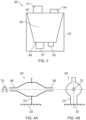
- a hopper 30 is schematically represented in FIG. 3 .
- a main hopper section 39 is housed within a hopper support frame 42.
- the hopper 30 has a hopper top 45 and a hopper base 48.
- a powder entry port 51 and an oxide stripping medium entry port 54 are provided in the hopper top 45 and a powder exit port 57 and an oxide stripping medium and oxide particles exit port 55 is provided on the hopper base 48.
- the positions of the entry and exit ports may be at different positions around the hopper, they do not necessarily have to be at the top and base positions as shown in FIG. 3 .
- entry ports 51, 54 and exit ports 55, 57 can be configured, or additional ports added, to provide for oxide stripped steel powder and/or the used oxide stripping medium and any compounds formed from any reaction between the oxide stripping medium and the steel powder to be removed from the hopper 30.
- FIGS. 4A and 4B show an alternative hopper 60 that can be used to enable the oxide stripping of powder particles, e.g. in the manufacture the nuclear reactor pressure vessel 1 of FIG. 1 using the method of the present invention.
- the hopper 60 has a hopper body 63 that has a first port 66 and a second port 69.
- the hopper body is supported on the frame 33 by a hopper support 72.
- the hopper 60 is configured so that the hopper body 63 can be rotated about an axis 75.
- the first port 66 and the second port 69 can be configured to provide for steel powder and/or an oxide stripping medium to be supplied to the hopper 60.
- first port 66 and the second port 69 can be configured, or additional ports added, to provide for oxide stripped steel powder and/or the used oxide stripping medium and any compounds formed from any reaction between the oxide stripping medium and the steel powder to be removed from the hopper 60.
- the hopper 60 is shown in FIGS. 4A and 4B to be rotatable in an axis that is substantially parallel to the frame 33 upon which the hopper 60 sits, the hopper 60 can be configured to be rotatable in an axis that is otherwise angled with respect to the frame 33, for example substantially vertically to the frame 33.
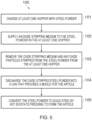
- the method of the present invention is summarised in the flow chart of FIG. 5 .
- the method 100 comprises steps (a)-(e) 101-105.
- Step (a) 101 of the method 100 of the present invention involves charging at least one hopper with steel powder.
- the steel powder may take various forms.
- the steel powder is a low alloy steel powder.
- the low alloy steel is typically a steel that complies with American Society of Mechanical Engineers Standard ASME SA508, which is a widely used steel grade for nuclear reactor pressure vessels.
- the average particle size of the steel powder can vary and will typically depend on the source of the powder and the desired specifications for the article concerned e.g. the nuclear reactor pressure vessel of FIG. 1 .
- the hopper may take various forms.
- a simple hopper shape can facilitate the oxide stripping process to come, which will be described below.
- the hopper has a frustoconical shape.
- the number of hoppers employed depends on the desired article to be manufactured, more particularly the size of the article.
- the drawings illustrate a nuclear reactor pressure vessel and equipment for the manufacture of same.
- the arrangement shown in FIG. 2 has four hoppers for the manufacture of a generally cylindrical nuclear reactor pressure vessel of FIG. 1 that is about 10 metres length, 3 metres wide and weighs about 50,000 kilograms.
- the steel powder is poured from a source of steel powder (not shown) into the main hopper section 39 of the hopper 30 via the powder entry port 51 that is formed in the hopper top 45 of the hopper 30.
- the powder hopper 39 has a simple, frustoconical shape.
- Step (b) 102 of the method 100 of the present invention involves supplying an oxide stripping medium to the steel powder in the at least one hopper.
- the oxide stripping medium can take various forms.
- the oxide stripping medium is a gas, for example hydrogen.
- the oxide stripping medium is a liquid or a solid. The key factor is that the oxide stripping medium reacts with the oxide on the steel powder to form a compound, for example water where hydrogen is used as the medium, which can be removed from the hopper leaving behind oxide free powder in the hopper.
- the hopper may take various forms however a simple hopper shape, e.g. a frustoconical shaped hopper (or powder hopper thereof), can facilitate the oxide stripping process. That is because it enables the oxide stripping medium to reach all powder areas easily and to more easily achieve optimal medium flow paths through the powder. It can also avoid or at least minimise any undesirable compounds, for example chemical by-products, of the oxide stripping process becoming trapped in the hopper.
- this simple hopper shape is a frustoconical shape.
- the manner in which the oxide stripping medium is supplied to the steel powder can vary as suitable.
- the hopper 30 is configured to supply the oxide stripping medium in the form of hydrogen gas to the steel powder.
- the oxide stripping medium is supplied into the powder hopper 39 of the hopper 30 via the oxide stripping medium entry port 54 that is formed in the hopper top 45 of the hopper 30.
- the supply of oxide stripping medium can be monitored and controlled by suitable means that are known in the art.
- the powder and oxide stripping medium can be provided via the same entry port(s).
- Step (c) 103 of the method 100 of the present invention involves removing the oxide stripping medium and any oxide particles stripped from the steel powder from the at least one hopper (30, 60).
- the oxide stripping medium and any oxide particles stripped from the steel powder can be removed using any suitable method, for example a gas flow, evaporation, or physical cleaning of the hopper(s).
- any compounds formed from any reaction between the oxide stripping medium and/or the steel powder and/or the oxides particles i.e. "by-product compounds" will typically also be removed from the hopper(s) with the oxide stripping medium and any oxide particles stripped from the steel powder.
- the hopper 30 includes mixing equipment (not shown) to ensure a thorough mixing of oxide stripping medium within steel powder thereby maximising the stripping of oxide particles stripped from the steel powder.
- the used oxide stripping medium and oxide particles (and any compounds formed from any reaction between the oxide stripping medium and/or the steel powder and/or the oxide particles) are removed from the hopper via the oxide stripping medium and oxide particles exit port 55.
- the steel powder, the oxide stripping medium, the oxide particles and any by-product compounds can be removed via the same entry port(s). In some embodiments the entry and exit ports may be the same.
- the movement of the oxide stripping medium through the steel powder and removal of the oxide stripping medium, oxide particles and compounds can be achieved by any suitable means, e.g. by gravity, or by creating a differential pressure across the hopper (e.g. by pumping the medium or by pulling a vacuum across the hopper).
- the used oxide stripping medium is recycled to be used again in the method of the present invention.
- Step (d) 104 of the method 100 of the present invention involves discharging the oxide stripped steel powder into a can that provides a mould for the article.
- the oxide stripped steel powder can be discharged (or otherwise transferred) from the at least one hopper into a can using any suitable method.
- the oxide stripped steel powder is discharged from a plurality of hoppers and into a plurality of powder inlets 37 formed in the can 27.
- these powder inlets 37 are substantially equally spaced apart, e.g. around the top of the can, in order to evenly fill the can with oxide stripped steel powder.
- the oxide stripped steel powder is removed from the hopper via the powder exit port 57 that is provided on the hopper base 48 of the hopper 30, i.e. opening the powder exit port 57 enables the oxide stripped steel powder to drain from the powder hopper due to gravity.
- the removal of oxide stripped steel powder can be monitored and controlled by suitable means that are known in the art.
- the can provides a mould for the article to be formed from the oxide stripped steel powder.
- the can is typically manufactured from sheet metal and shaped either for the desired shape of the article or shaped in a shape that approximates the desired shape with the expectation that the desired shape will be obtained once the oxide stripped steel powder has been hot isostatically pressed.
- Step (e) 105 of the method 100 of the present invention involves converting the steel powder to solid steel by hot isostatic pressing to form the article.
- the steel powder can be converted to solid steel by hot isostatic pressing using any suitable hot isostatic pressing method.
- the article formed by the method of the present invention can removed or separated from the can by any suitable method.
- the can may be removed by acid pickling or by machining.
- the method of present invention for manufacturing an article, e.g. a vessel, as described above offers various technical advantages. Whilst many of have been described above, in summary such advantages include: The steel powder has been stripped of oxides in a hopper before it is exposed to any downstream processing such as hot isostatically pressing.
- Treating powder in a hopper prior to it being discharged, e.g. poured, into the can of the article to be formed makes it easier to remove any oxide particles or chemical by-products of the oxide stripping process. If not removed such particles/compounds/chemical by-products can compromise the mechanical properties of the article that is manufactured by the method of the present invention. That is of particular concern for safety/mission critical applications such as a nuclear reactor pressure vessel when it must be guaranteed that the material properties of the article are at the required level.
- a simple hopper shape can be used so that the oxide stripping medium can reach all powder areas easily, and more easily achieve optimal medium flow paths rather than using a can that may be complex in design to achieve a near net shape geometry.
- the use of a simple hopper shape can avoid or at least minimise the risk of the oxide stripping medium, oxide particles, and compounds/chemical by-products of the oxide stripping process becoming trapped in complex geometries.
- FIG. 1 shows an article in the form of a nuclear pressure vessel that has many features such as inlet nozzles 12, outlet nozzles 15, support mounts 21 and lifting lugs 18.
- the can for such a geometry is therefore rather complex.
- the can was filled with powder and then the oxide stripping process applied, there is the risk that the powder in the complex features will not receive an adequate oxide stripping treatment and also that the oxide particles, the oxide stripping medium and/or compounds/chemical by-products will become trapped in such areas.
- the properties of the consolidated powder e.g. after a HIP process, could be inferior to other areas of the article that have been adequately treated and thus the manufactured article is unacceptable.
- the powder is treated in the hopper first, as per the method of the present invention, e.g. in a simpler shaped hopper, prior to being inserted into the can, the quality of the powder and hence resulting properties of the manufactured can be more easily guaranteed.
- the effectiveness in treating all of the powder can be increased by treating powder in a hopper rather than after it has been filled into a can.
- the hopper can be subjected to motion to move the powder particles around in the hopper, for example tumbling the powder particles. All of the powder is then more likely to be treated to the same level, whereas when powder has been filled into a can, larger-scale motions of the powder particles, for example tumbling is not possible. Samples can be taken after powder has been moved around in the hopper to provide greater confidence that all of_the powder has been treated similarly.
- the method of the present invention reduces the risk of can distortion or failure during hot isostatic pressing If the medium used to strip the oxide from the powder or the compounds/chemical by-products produced from the application of the oxide-stripping process expand significantly as a result of an increase in temperature, this can result in the volume of same increasing such that the can may distort or fail.
- the extremely high temperatures used in the HIP process for example greater than 1000°C, can result in large changes in volume and resulting pressure in the can.
- hydrogen gas when hydrogen gas is used, water is a by-product of the process, and any hydrogen gas and water that is not removed from the can will expand significantly when the temperature is increased in the HIP process.
- the at least one hopper as the chamber to which oxide stripping is conducted, not only removes the detriments of applying the process to complex near-nett shape cans, but also means the oxide stripping can be conducted up-stream of when the powder is required for can filling, thus allowing more flexible time management planning.
- a larger quantity of powder can be treated all at once in a large hopper, and then applied to one, or numerous cans.
- the can does not fail during the HIP process, else the powder will not consolidate fully, and the article will need to be scrapped.
- Near-nett shape cans are commonly achieved through complex, welded fabrications, and relative to hoppers, the can material is generally far thinner as it needs to be able to deform without failure to enable the powder inside it to consolidate.
- a can is therefore more susceptible to any weakening of the can material or the welds as a consequence of the oxide-stripping process being applied, for example weakening caused by the compounds/chemical by-products created in the oxide stripping process, or the temperature.
- Powder hoppers for storing/transporting powders are commonly designed to be robust containers to allow for powder to be shipped from powder manufacturer to HIP vendor, so this mitigates potential weaknesses in structural integrity from oxide stripping in cans.
Landscapes
- Engineering & Computer Science (AREA)
- Manufacturing & Machinery (AREA)
- Physics & Mathematics (AREA)
- Mechanical Engineering (AREA)
- Plasma & Fusion (AREA)
- General Engineering & Computer Science (AREA)
- High Energy & Nuclear Physics (AREA)
- Chemical & Material Sciences (AREA)
- Chemical Kinetics & Catalysis (AREA)
- General Chemical & Material Sciences (AREA)
- Inorganic Compounds Of Heavy Metals (AREA)
- Powder Metallurgy (AREA)
Applications Claiming Priority (1)
| Application Number | Priority Date | Filing Date | Title |
|---|---|---|---|
| GBGB2305716.9A GB202305716D0 (en) | 2023-04-19 | 2023-04-19 | Article manufacture |
Publications (1)
| Publication Number | Publication Date |
|---|---|
| EP4454787A1 true EP4454787A1 (de) | 2024-10-30 |
Family
ID=86497289
Family Applications (1)
| Application Number | Title | Priority Date | Filing Date |
|---|---|---|---|
| EP24168368.9A Pending EP4454787A1 (de) | 2023-04-19 | 2024-04-04 | Artikelherstellung mittels heissisostatisches pressens unter verwendung von einem oxid-getter medium |
Country Status (3)
| Country | Link |
|---|---|
| US (1) | US20240351101A1 (de) |
| EP (1) | EP4454787A1 (de) |
| GB (1) | GB202305716D0 (de) |
Citations (6)
| Publication number | Priority date | Publication date | Assignee | Title |
|---|---|---|---|---|
| US3689259A (en) * | 1969-06-02 | 1972-09-05 | Wheeling Pittsburgh Steel Corp | Method of consolidating metallic bodies |
| EP3269475A1 (de) * | 2016-07-12 | 2018-01-17 | MTU Aero Engines GmbH | Kapselfülleinrichtung zum befüllen von pulverkapseln für die pulvermetallurgie sowie verfahren zum befüllen von kapseln |
| RU2650375C1 (ru) * | 2017-03-31 | 2018-04-11 | Открытое акционерное общество "Композит" | Установка для получения герметичных капсул с металлическим порошком для горячего изостатического прессования (ГИП) изделий и способ получения герметичных капсул с металлическим порошком для ГИП изделий |
| US10094007B2 (en) * | 2013-10-24 | 2018-10-09 | Crs Holdings Inc. | Method of manufacturing a ferrous alloy article using powder metallurgy processing |
| EP3530383A1 (de) * | 2018-02-27 | 2019-08-28 | Rolls-Royce plc | Verfahren zur herstellung einer austenitischen eisenlegierung |
| US10632536B2 (en) * | 2013-02-20 | 2020-04-28 | Rolls-Royce Plc | Apparatus for manufacturing an article from powder material |
-
2023
- 2023-04-19 GB GBGB2305716.9A patent/GB202305716D0/en not_active Ceased
-
2024
- 2024-03-20 US US18/611,196 patent/US20240351101A1/en active Pending
- 2024-04-04 EP EP24168368.9A patent/EP4454787A1/de active Pending
Patent Citations (6)
| Publication number | Priority date | Publication date | Assignee | Title |
|---|---|---|---|---|
| US3689259A (en) * | 1969-06-02 | 1972-09-05 | Wheeling Pittsburgh Steel Corp | Method of consolidating metallic bodies |
| US10632536B2 (en) * | 2013-02-20 | 2020-04-28 | Rolls-Royce Plc | Apparatus for manufacturing an article from powder material |
| US10094007B2 (en) * | 2013-10-24 | 2018-10-09 | Crs Holdings Inc. | Method of manufacturing a ferrous alloy article using powder metallurgy processing |
| EP3269475A1 (de) * | 2016-07-12 | 2018-01-17 | MTU Aero Engines GmbH | Kapselfülleinrichtung zum befüllen von pulverkapseln für die pulvermetallurgie sowie verfahren zum befüllen von kapseln |
| RU2650375C1 (ru) * | 2017-03-31 | 2018-04-11 | Открытое акционерное общество "Композит" | Установка для получения герметичных капсул с металлическим порошком для горячего изостатического прессования (ГИП) изделий и способ получения герметичных капсул с металлическим порошком для ГИП изделий |
| EP3530383A1 (de) * | 2018-02-27 | 2019-08-28 | Rolls-Royce plc | Verfahren zur herstellung einer austenitischen eisenlegierung |
Also Published As
| Publication number | Publication date |
|---|---|
| US20240351101A1 (en) | 2024-10-24 |
| GB202305716D0 (en) | 2023-05-31 |
Similar Documents
| Publication | Publication Date | Title |
|---|---|---|
| US11434766B2 (en) | Process for producing a near net shape component with consolidation of a metallic powder | |
| Petrovic et al. | Powder recyclability in electron beam melting for aeronautical use | |
| EP3909752B1 (de) | Verfahren zur rückgewinnung und regeneration von metallpulver in ebm-anwendungen | |
| JP5025085B2 (ja) | 金属物品を融解せずに製造する方法 | |
| US9327349B2 (en) | Endplate for hot isostatic pressing canister, hot isostatic pressing canister, and hot isostatic pressing method | |
| USRE31355E (en) | Method for hot consolidating powder | |
| WO2020128500A1 (en) | Powder recovery system | |
| EP4454787A1 (de) | Artikelherstellung mittels heissisostatisches pressens unter verwendung von einem oxid-getter medium | |
| CN105492146A (zh) | 通过粉末冶金法制造钢零件的方法及所得的钢零件 | |
| Berez et al. | Fatigue of laser powder bed fusion processed 17-4 stainless steel using prior process exposed powder feedstock | |
| Melentiev et al. | 3D printing, debinding and sintering of stainless steel metamaterials via lithography metal manufacturing: processing, microstructure and properties relationships | |
| EP4499884A1 (de) | Hartmetallwerkstoff | |
| EP0162549A1 (de) | Verfahren zur Herstellung von Formkörpern aus Schnellarbeitsstahl, Werkzeugstahl und Matrizenstahl | |
| WO2025061961A1 (en) | Body | |
| US3472709A (en) | Method of producing refractory composites containing tantalum carbide,hafnium carbide,and hafnium boride | |
| CN116174721B (zh) | 一种提高WRe/TZM合金靶盘密度及密度均匀性的方法 | |
| JP7242344B2 (ja) | オーステナイト鉄合金を製造する方法 | |
| Coughlin et al. | Development and testing of 316L stainless steel metal additive manufacturing test articles for powder bed fusion and directed energy deposition processes | |
| Tornberg et al. | New optimised manufacturing route for PM tool steels and high speed steels | |
| KR101442075B1 (ko) | 이트륨산화물이 분산된 원자력용 분산강화합금의 제조방법 | |
| Soltani-Tehrani et al. | Effects of Powder Reuse and Spatial Location Dependency on the Powder Characteristics and Defect Structure of Additively Manufactured Ti-6Al-4V Parts | |
| EP4523816A1 (de) | Verfahren zum entbinden in der generativen fertigung mit bindemittelausstoss | |
| Cordes et al. | Titanium metal powder production by The plasma quench process | |
| JP2003193225A (ja) | スパッタリング用タングステンターゲットの製造方法 | |
| Wang et al. | Powder injection moulding |
Legal Events
| Date | Code | Title | Description |
|---|---|---|---|
| PUAI | Public reference made under article 153(3) epc to a published international application that has entered the european phase |
Free format text: ORIGINAL CODE: 0009012 |
|
| STAA | Information on the status of an ep patent application or granted ep patent |
Free format text: STATUS: THE APPLICATION HAS BEEN PUBLISHED |
|
| AK | Designated contracting states |
Kind code of ref document: A1 Designated state(s): AL AT BE BG CH CY CZ DE DK EE ES FI FR GB GR HR HU IE IS IT LI LT LU LV MC ME MK MT NL NO PL PT RO RS SE SI SK SM TR |
|
| STAA | Information on the status of an ep patent application or granted ep patent |
Free format text: STATUS: REQUEST FOR EXAMINATION WAS MADE |
|
| 17P | Request for examination filed |
Effective date: 20250414 |