EP4451731A1 - Erfassungsverfahren und -vorrichtung sowie kommunikationsvorrichtung - Google Patents
Erfassungsverfahren und -vorrichtung sowie kommunikationsvorrichtung Download PDFInfo
- Publication number
- EP4451731A1 EP4451731A1 EP22906500.8A EP22906500A EP4451731A1 EP 4451731 A1 EP4451731 A1 EP 4451731A1 EP 22906500 A EP22906500 A EP 22906500A EP 4451731 A1 EP4451731 A1 EP 4451731A1
- Authority
- EP
- European Patent Office
- Prior art keywords
- information
- sensing
- preprocessing
- measurement result
- sensing measurement
- Prior art date
- Legal status (The legal status is an assumption and is not a legal conclusion. Google has not performed a legal analysis and makes no representation as to the accuracy of the status listed.)
- Pending
Links
Images


Classifications
-
- H—ELECTRICITY
- H04—ELECTRIC COMMUNICATION TECHNIQUE
- H04W—WIRELESS COMMUNICATION NETWORKS
- H04W24/00—Supervisory, monitoring or testing arrangements
- H04W24/10—Scheduling measurement reports ; Arrangements for measurement reports
-
- H—ELECTRICITY
- H04—ELECTRIC COMMUNICATION TECHNIQUE
- H04W—WIRELESS COMMUNICATION NETWORKS
- H04W24/00—Supervisory, monitoring or testing arrangements
- H04W24/02—Arrangements for optimising operational condition
-
- H—ELECTRICITY
- H04—ELECTRIC COMMUNICATION TECHNIQUE
- H04L—TRANSMISSION OF DIGITAL INFORMATION, e.g. TELEGRAPHIC COMMUNICATION
- H04L43/00—Arrangements for monitoring or testing data switching networks
- H04L43/02—Capturing of monitoring data
- H04L43/022—Capturing of monitoring data by sampling
-
- H—ELECTRICITY
- H04—ELECTRIC COMMUNICATION TECHNIQUE
- H04W—WIRELESS COMMUNICATION NETWORKS
- H04W28/00—Network traffic management; Network resource management
- H04W28/02—Traffic management, e.g. flow control or congestion control
Definitions
- This application relates to the field of communication technologies, and specifically, to a sensing method and apparatus, and a communication device.
- a processing process of data received by a communication system is relatively fixed.
- a sensing function is introduced into the communication system or in an integrated sensing and communication scenario
- significant differences may exist in processing processes of data received by different sensing services, and different requirements are imposed for sensing measurement results.
- the sensing measurement results obtained by the sensing devices through sensing measurement may not meet the corresponding requirements.
- Embodiments of this application provide a sensing method and apparatus, and a communication device, to resolve a problem regarding how to obtain a sensing measurement result that meets requirements.
- a first aspect provides a sensing method, including: A first device preprocesses a first sensing measurement result to obtain a second sensing measurement result.
- the first sensing measurement result is a sensing measurement result corresponding to a sensing measurement quantity obtained by the first device based on a received first signal.
- the first device reports the second sensing measurement result to a second device.
- a third aspect provides a sensing method, including: A second device obtains a second sensing measurement result transmitted by a first device.
- the second sensing measurement result is a sensing measurement result obtained by preprocessing a first sensing measurement result.
- the first sensing measurement result is a sensing measurement result corresponding to a sensing measurement quantity obtained by the first device based on a received first signal.
- a third aspect provides a sensing apparatus, including:
- a fourth aspect provides a sensing apparatus, including: a first obtaining module, configured to obtain a second sensing measurement result transmitted by a first device, where the second sensing measurement result is a sensing measurement result obtained by preprocessing a first sensing measurement result, and the first sensing measurement result is a sensing measurement result corresponding to a sensing measurement quantity obtained by the first device based on a received first signal.
- a fifth aspect provides a communication device, including a processor and a memory.
- the memory stores a program or instructions executable by a processor.
- the program or the instruction when executed by the processor, implement the steps of the sensing method in the first aspect or the second aspect.
- a sixth aspect provides a first device, including a processor and a communication interface.
- the processor is configured to preprocess a first sensing measurement result to obtain a second sensing measurement result.
- the first sensing measurement result is a sensing measurement result corresponding to a sensing measurement quantity obtained by the first device based on a received first signal.
- the communication interface is configured to report the second sensing measurement result to a second device.
- a seventh aspect provides a second device, including a processor and a communication interface.
- the communication interface is configured to obtain a second sensing measurement result transmitted by a first device.
- the second sensing measurement result is a sensing measurement result obtained by preprocessing a first sensing measurement result.
- the first sensing measurement result is a sensing measurement result corresponding to a sensing measurement quantity obtained by the first device based on a received first signal.
- An eighth aspect provides a sensing system, including a first device and a second device.
- the first device may be configured to perform the steps of the sensing method in the first aspect.
- the second device may be configured to perform the steps of the sensing method in the second aspect.
- a ninth aspect provides a readable storage medium.
- the readable storage medium stores a program or instructions.
- the program or the instructions when executed by a processor, implement the steps of the method in the first aspect or the second aspect.
- a tenth aspect provides a chip.
- the chip includes a processor and a communication interface.
- the communication interface is coupled to the processor.
- the processor is configured to execute a program or instructions to implement the method in the first aspect or the second aspect.
- An eleventh aspect provides a computer program product.
- the computer program product is stored in a storage medium.
- the computer program product is executed by at least one processor to implement the steps of the sensing method in the first aspect or implement the steps of the sensing method in the second aspect.
- the first sensing measurement result corresponding to the sensing measurement quantity is determined based on the received first signal
- the first sensing measurement result is preprocessed, to obtain the second sensing measurement result that meets the corresponding requirement.
- interpolation or sample extraction is performed on first sensing measurement results of a plurality of resources, so that the processed second sensing measurement result is a result obtained by uniformly sampling the first sensing measurement results of the corresponding resources.
- the second sensing measurement result can meet a reporting requirement of uniform sampling.
- the first sensing measurement results are merged or compressed, so that the second sensing measurement result can meet a reporting requirement of reducing reporting overheads.
- first, second, and the like in the specification and the claims of this application are used for distinguishing between similar objects, rather than describing a specific sequence or order. It should be understood that the terms used in this case may be transposed where appropriate, so that embodiments of this application may be implemented in a sequence other than those illustrated or described herein.
- objects defined by “first” and “second” are generally of the same class and do not limit a quantity of objects. For example, one first object may be arranged, or a plurality of objects may be arranged.
- “and/or” used in the specification and the claims indicates at least one of connected objects. The character “/" generally indicates an "or" relationship between associated objects.
- technologies described in embodiments of this application may be applied to a long term evolution (Long Term Evolution, LTE)/LTE-advanced (LTE-Advanced, LTE-A) system, and may be further applied to another wireless communication system, such as a code division multiple access (Code Division Multiple Access, CDMA) system, a time division multiple access (Time Division Multiple Access, TDMA) system, a frequency division multiple access (Frequency Division Multiple Access, FDMA) system, an orthogonal frequency division multiple access (Orthogonal Frequency Division Multiple Access, OFDMA) system, a single-carrier frequency division multiple access (Single-carrier Frequency Division Multiple Access, SC-FDMA) system, and another system.
- CDMA code division multiple access
- Time Division Multiple Access Time Division Multiple Access
- FDMA frequency division multiple access
- OFDMA Orthogonal Frequency Division Multiple Access
- SC-FDMA single-carrier frequency division multiple access
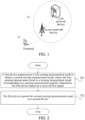
- FIG. 1 is a block diagram of a wireless communication system to which embodiments of this application may be applied.
- the wireless communication system includes a terminal 11 and a network side device 12.
- the terminal 11 may be a terminal side device such as a mobile phone, a tablet computer (Tablet Personal Computer), a laptop computer (Laptop Computer), which is also referred to as a notebook computer, a personal digital assistant (Personal Digital Assistant, PDA), a palm computer, a netbook, an ultra-mobile personal computer (Ultra-Mobile Personal Computer, UMPC), a mobile internet device (Mobile Internet Device, MID), an augmented reality (augmented reality, AR)/virtual reality (virtual reality, VR) device, a robot, a wearable device (Wearable Device), an on-board device (Vehicle User Equipment, VUE), a pedestrian user equipment (Pedestrian User Equipment, PUE), smart home (a home device with a wireless communication capability, such as a refrigerator, a television, a washing machine, or furniture),
- the wearable device includes a smart watch, a smart bracelet, a smart headset, smart glasses, smart jewelry (a smart bracelet, a smart chain bracelet, a smart ring, a smart necklace, a smart ankle, a smart ankle chain, and the like), a smart wristband, smart clothing, and the like.
- the network side device 12 may include an access network device or a core network device.
- the access network device may also be referred to as a wireless access network device, a radio access network (Radio Access Network, RAN), a wireless access network function, or a wireless access network unit.
- Radio Access Network Radio Access Network
- the access network device may include a base station, a wireless local area network (Wireless Local Area Network, WLAN) access point, a wireless fidelity (Wireless Fidelity, Wi-Fi) node, and the like
- the base station may be referred to as a NodeB, an evolved NodeB (eNB), an access point, a base transceiver station (Base Transceiver Station, BTS), a radio base station, a radio transceiver, a basic service sets (Basic Service Set, BSS), an extended service set (Extended Service Set, ESS), a household NodeB, a household evolved NodeB, a transmitting receiving point (Transmitting Receiving Point, TRP), or some other appropriate term in the field, as long as the same technical effect is achieved.
- the base station is not limited to a specific technical term. It should be noted that, in embodiments of this application, only a base station in the NR system is used as an example, but the specific type of the base station is not limited.
- the core network device may include but is not limited to at least one of a core network node, a core network function, a mobility management entity (Mobility Management Entity, MME), an access and mobility management function (Access and Mobility Management Function, AMF), a session management function (Session Management Function, SMF), a user plane function (User Plane Function, UPF), a policy control function (Policy Control Function, PCF), a policy and charging rules function (Policy and Charging Rules Function, PCRF), an edge application server discovery function (Edge Application Server Discovery Function, EASDF), a unified data management (Unified Data Management, UDM), a unified data warehouse (Unified Data Warehouse, UDR), a home subscription server (Home Subscription Server, HSS), a centralized network configuration (Centralized
- Integrated sensing and communication means realizing an integrated design of communication and sensing functions through spectrum sharing and hardware sharing in a same system.
- a system can sense information such as an orientation, a distance, and a speed, and detect, track, and recognize a target object or event.
- a communication system and a sensing system complement each other, to realize overall performance improvement and better service experience.
- Future mobile communication systems such as a beyond 5G (Beyond 5G, B5G) system or a 6G system, will have not only a communication capability but also a sensing capability.
- the sensing capability is a capability enabling one or more devices to sense information of a target object such as an orientation, a distance, and a speed or to detect, track, recognize, and image a target object, an event, an environment, or the like through wireless signal transmission and receiving.
- a target object such as an orientation, a distance, and a speed or to detect, track, recognize, and image a target object, an event, an environment, or the like
- sensing resolution is significantly improved compared with that of centimeter waves, so that the 6G network can provide more refined sensing services.
- Integrated radar and communication is a typical communication-sensing fused application.
- a radar system and a communication system were strictly distinguished from each other due to different research objects and focuses, which are researched separately in most scenarios.
- the radar system and the communication system are both typical information transmission, obtaining, processing, and exchange manners, and have many similarities in terms of working principle, system architecture, and frequency band.
- the integrated design of radar and communication has high feasibility, which is mainly reflected in the following aspects: First, the communication system and the sensing system are both based on the electromagnetic wave theory, which complete information obtaining and transmission through transmission and receiving of electromagnetic waves.
- the communication system and the sensing system both have structures such as an antenna, a transmitter end, a receiver end, and a signal processor, with significant overlapping in hardware resource.
- structures such as an antenna, a transmitter end, a receiver end, and a signal processor, with significant overlapping in hardware resource.
- increasing overlapping exist between the two in working frequency band.
- similarities in terms of key technology such as signal modulation, reception detection, and waveform design also exist.
- the fusion of the communication system and the radar system can bring many advantages, such as reduced costs, reduced sizes, reduced power consumption, improved spectrum efficiency, and reduced mutual interference, thereby improving overall performance of the system.
- Typical integration designs include: spectrum coexistence, which means that the two systems work independently but information exchange is allowed to reduce mutual interference; receiver end sharing, in which case the two systems transmit respective signal waveforms but the waveforms of the two systems need to be orthogonal to avoid impact on respective receiving and detection; transmitter end sharing, which means that a transmitter end transmits a joint waveform of the radar and the communication; and transceiver end sharing, which means that transceiver sides of the two systems share resources, which also requires use of a joint waveform or orthogonal waveforms.
- sensing may be performed in a single-station mode, that is, co-located sensing is performed.
- the transmitter end transmits a signal for sensing, and then receives an echo signal to perform analysis and extract sensing parameters.
- a base station serves as a transmitter end and a receiver end for the signal for sensing
- a terminal or another object serves as a to-be-sensed object.
- sensing may be performed in a dual-station/multi-station mode, that is, a transmitter end and a receiver end do not share a same address.
- the transmitter end transmits a signal for sensing, and another receiver end receives the signal to perform analysis and extract sensing parameters.
- a base station 1 serves as a transmitter end for the signal for sensing
- a terminal or a base station 2 serves as a receiver end for the signal for sensing
- the transmitter end for the sensing in the single-station mode or the multi-station mode may alternatively be a terminal.
- the communication system needs to jointly transmit a modulation symbol that carries information and a pilot symbol used for channel estimation, which focuses on decoding performance.
- a channel estimation algorithm thereof merely needs to estimate a composite channel with limited unknown parameters, which usually aims to improve a throughput and transmission reliability.
- Concerned performance indicators generally include spectrum efficiency, a channel capacity, a signal to noise ratio (Signal to Noise Ratio, SNR), a signal-to-noise and interference ratio (Signal-To-Noise And Interference Ratio, SINR), a bit error rate (Bit Error Rate, BER), a block error rate (Block Error Rate, BLER), a symbol error rate (Symbol Error Rate, SER), and the like.
- a performance metric may be a fuzzy function, a Cramér-Rao lower bound, a root mean square error, mutual information, a rate distortion function, a radar estimation rate, a Welch lower bound, and some indicators related to sensing scenarios and requirements.
- the communication system is used to realize a sensing function. For example, wireless sensing-related measurement is performed based on a Wi-Fi signal, an LTE signal, or an NR signal, and a sensing result is obtained. Since various types of sensing services exist, to ensure system performance after the fusion of the communication function and the sensing function, resource allocation and measurement reporting mechanisms for communication signals and sensing signals need to be comprehensively considered based on an actual service requirement.
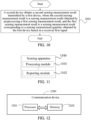
- Step 201 A first device preprocesses a first sensing measurement result to obtain a second sensing measurement result, where the first sensing measurement result is a sensing measurement result corresponding to a sensing measurement quantity obtained by the first device based on a received first signal.
- the above preprocessing includes at least one of
- the first signal includes a signal of at least one of the following signal types:
- the sensing signal in this embodiment of this application is a signal used for obtaining information of a target object such as an orientation, a distance, and a speed or used for detecting, tracking, recognizing, and imaging a target object, an event, an environment, or the like.
- the sensing signal includes at least one of: common radar signals such as a continuous wave (Continuous Wave, CW) signal, a frequency modulated continuous wave (FMCW) signal, a simple pulse signal, and a chirp (Chirp) pulse signal.
- common radar signals such as a continuous wave (Continuous Wave, CW) signal, a frequency modulated continuous wave (FMCW) signal, a simple pulse signal, and a chirp (Chirp) pulse signal.
- the above communication signal may be at least one of a communication reference signal and a data signal, and includes at least a demodulation reference signal (Demodulation Reference Signal, DMRS) for a physical downlink control channel (Physical downlink control channel, PDCCH)/paging PDCCH, a DMRS for a physical downlink shared channel (Physical downlink shared channel, PDSCH)/paging PDSCH, a DMRS for a physical uplink shared channel (Physical Uplink Shared Channel, PUSCH), a DMRS for a physical uplink control channel (Physical Uplink Control Channel, PUCCH), a DMRS for a physical broadcast channel (Physical Broadcast Channel, PBCH), a CSI reference signal (CSI Reference Signal, CSI-RS), a sounding reference signal (Sounding Reference Signal, SRS), a phase-tracking reference signal (Phase-tracking reference signal, PTRS), a positioning reference signal (Positioning Reference Signal, PRS), a tracking
- the above integrated sensing and communication signal is a signal that may be used for both communication and sensing.
- the sensing measurement quantity includes at least one of
- the original channel information includes at least one of:
- the signal strength information includes at least one of:
- the spectral information includes at least one of:
- the multi-path information includes at least one of:
- the information regarding differences between signals corresponding to different antennas includes at least one of
- the target parameter information determined based on the original channel information includes at least one of
- the angle information includes at least one of
- the angle information includes UE side angle information, base station side angle information, and reflection point angle information.
- Step 202 The first device reports the second sensing measurement result to a second device.
- the first sensing measurement result corresponding to the sensing measurement quantity is determined based on the received first signal
- the first sensing measurement result is preprocessed, to obtain the second sensing measurement result that meets the corresponding requirement.
- interpolation or sample extraction is performed on first sensing measurement results of a plurality of resources, so that the processed second sensing measurement result is a result obtained by uniformly sampling the first sensing measurement results of the corresponding resources.
- the second sensing measurement result can meet a reporting requirement of uniform sampling.
- the first sensing measurement results are merged or compressed, so that the second sensing measurement result can meet a reporting requirement of reducing reporting overheads.
- a first device preprocesses a first sensing measurement result includes:
- the first device obtains preprocessing information of the first sensing measurement result indicated by the second device.
- the first device preprocesses the first sensing measurement result based on the preprocessing information.
- That the first device obtains preprocessing information of the first sensing measurement result indicated by the second device includes:
- the first device obtains the preprocessing information based on target indication information transmitted by the second device.
- the target indication information includes at least one of preprocessing indication information and sensing indication information.
- the preprocessing indication information indicates the preprocessing information, and the sensing indication information is associated with the preprocessing information.
- the preprocessing information may be directly indicated by the preprocessing indication information, or indirectly indicated by the sensing indication information.
- the preprocessing information includes at least one of:
- the first parameter includes at least one of information regarding a proportion of effective sample points and a sensing performance indicator.
- the requirement information is that an effective sampling point proportion corresponding to the first sensing measurement result needs to be greater than a predetermined threshold or the sensing performance indicator corresponding to the first sensing measurement result needs to be greater than a predetermined threshold. If the effective sampling point proportion corresponding to the first sensing measurement result is less than the predetermined threshold, it is determined that the first sensing measurement result is invalid, or if the sensing performance indicator corresponding to the first sensing measurement result is less than the predetermined threshold, it is determined that the first sensing measurement result is invalid. In this case, the first device may not preprocess the first sensing measurement result.
- the requirement information is that an effective sampling point proportion corresponding to the second sensing measurement result needs to be greater than a predetermined threshold or a sensing performance indicator corresponding to the second sensing measurement result needs to be greater than a predetermined threshold. If it is determined that the effective sampling point proportion corresponding to the second sensing measurement result is less than the predetermined threshold or the sensing performance indicator corresponding to the second sensing measurement result is less than the predetermined threshold after the first sensing measurement result is preprocessed, the second sensing measurement result may not be reported.
- the preprocessing manner includes at least one of interpolation, sample extraction, clutter suppression, noise suppression, outlier removal, filtering, merging, and compression.
- the interpolation may be time-domain interpolation for obtaining a second sensing measurement result at a specific time point, or may be frequency-domain interpolation for obtaining a second sensing measurement result at a specific frequency, or may be space-domain interpolation for obtaining a second sensing measurement result at a specific antenna or space position.
- a first sensing measurement result may be selected for interpolation based on the sensing performance indicator corresponding to the first sensing measurement result.
- At least one first sensing measurement result with an optimal sensing performance indicator or with a sensing performance indicator exceeding a preset threshold is selected from first sensing measurement results corresponding to at least one resource location adjacent to a target resource location (in time domain, frequency domain, or space domain) for interpolation.
- the sample extraction may be time-domain sample extraction, frequency-domain sample extraction, or space-domain sample extraction.
- the clutter suppression means removing clutter components from the first sensing measurement result, which may be realized, for example, by removing a static clutter component from the sensing measurement result through direct current removal (time-domain mean subtraction).
- the noise suppression means suppressing noise in the second sensing measurement result, which may be realized by transform domain noise suppression (discrete Fourier transform (Discrete Fourier Transform, DFT) noise suppression), average noise suppression, minimum mean square error (Minimum Mean Square Error, MMSE) filtering noise suppression, discrete wavelet transform (Discrete Wavelet Transform, DWT) noise suppression, principal component analysis (Principal Component Analysis, PCA) noise suppression, or the like.
- transform domain noise suppression discrete Fourier transform (Discrete Fourier Transform, DFT) noise suppression
- average noise suppression minimum mean square error (Minimum Mean Square Error, MMSE) filtering noise suppression
- minimum mean square error Minimum Mean Square Error, MMSE
- filtering noise suppression discrete wavelet transform (Discrete Wavelet Transform, DWT) noise suppression
- principal component analysis Principal Component Analysis, PCA) noise suppression
- the outlier removal means removing outliers from the first sensing measurement result.
- the outliers may be discarded or replaced and the methods.
- the outlier removal may be realized by, for example, a median absolute deviation (Median Absolute Deviation, MAD) algorithm, a Hampel filtering method, a standard deviation method, a percentile method, or the like.
- MAD Median Absolute Deviation
- the filtering may be low pass filtering, high pass filtering, bandpass filtering, or bandstop filtering, or may be a specific filtering manner such as Savitzky-Golay filtering, Hampel filtering, alpha filtering, Kalman filtering, Butterworth filtering, Chebyshev filtering, Elliptic filtering, or Equiripple filtering.
- the merging may be summation, difference calculation, product calculation, quotient calculation, conjugate multiplication, correlation, convolution, and the like of at least two first sensing measurement results.
- the compression may be transformation domain compression. For example, time-domain data is transformed to Doppler-domain data and then sample points with amplitudes exceeding a threshold are retained, frequency-domain data is transformed to delay-domain data and then sample points with amplitudes exceeding a threshold are retained, or time-frequency-domain data is transformed to delay-Doppler-domain data and then sample points with amplitudes exceeding a threshold are retained.
- the compression may alternatively be other compression manners such as variable rate Huffman coding, A-law coding, or ⁇ -law coding.
- the preprocessing parameter information includes at least one of:
- the above preprocessing parameter information includes at least one of an interpolation manner; an interpolation density; an interpolation quantity; and time-domain resource information, frequency-domain resource information, or spatial resource information corresponding to the second sensing measurement result.
- the above preprocessing parameter information includes at least one of an extraction manner; an extraction density; an extraction quantity; and time-domain resource information, frequency-domain resource information, or spatial resource information corresponding to the second sensing measurement result.
- the above time-domain resource information may be a time point, a time window, a period, or a time-domain density corresponding to the second sensing measurement result.
- One or more time points may be set.
- the time-domain resource information may be represented in a form of an absolute time, for example, coordinated universal time (Coordinated Universal Time, UTC), a frame number, a half-frame number, a subframe number, or a time slot number, or may be represented in a form of a relative time.
- the above frequency-domain resource information may be a frequency, a frequency range, or a frequency density corresponding to the second sensing measurement result.
- a frequency resource may be represented by a true frequency value, a subcarrier (SubCarrier, SC), a resource element (Resource Element, RE), or a physical resource block (Physical Resource Block, PRB).
- the above spatial resource information may be a receiving antenna index, a transmitting antenna index, a transceiving antenna index, or spatial position coordinates corresponding to the second sensing measurement result.
- the above preprocessing parameter information includes at least one of the clutter suppression method and the window size for the direct current removal.
- the above preprocessing parameter information includes at least one of the noise suppression algorithm and the target SNR threshold.
- the above preprocessing parameter information includes at least one of the outlier removal method, the outlier processing manner (discarding or replacement) of outliers, and the window size for outlier removal.
- the above preprocessing parameter information includes at least one of the filtering manner, such as low pass filtering, high pass filtering, bandpass filtering, or bandstop filtering, a corresponding filtering parameter, and a specific filter to be adopted.
- the above preprocessing parameter information includes at least one of the merging manner, the quantity of and the requirement for the first sensing measurement results to be merged (for example, corresponding sensing performance indicators need to exceed a preset threshold), and the merging dimension (for example, the time domain or the frequency domain).
- the above preprocessing parameter information includes at least one of the compression manner, the compression ratio, and the data volume of the second sensing measurement result obtained after compression.
- the sensing indication information includes at least one of
- the sensing performance indicator includes at least one of: a sensing precision/sensing error, a sensing resolution, a sensing range, a sensing delay, a detection probability, a false alarm probability, a quantity of targets that can be simultaneously detected, an SNR, a RSRP, an RSSI, reference signal receiving quality (Reference Signal Receiving Quality, RSRQ), a signal-to-clutter ratio, a sidelobe feature of a signal (a main lobe to sidelobe ratio of the signal), a peak to average power ratio (Peak to Average Power Ratio, PAPR), a variance, a standard deviation, a mean absolute deviation, a peak amplitude of a signal for sensing, and a ratio of a target signal component for sensing to another signal component for sensing.
- a sensing precision/sensing error includes at least one of: a sensing precision/sensing error, a sensing resolution, a sensing range, a sensing delay, a detection probability,
- the target signal component is a signal component of the received signal for sensing greatly affected by a sensed target, which may be: an amplitude or an amplitude squared corresponding to a sample point in a frequency-domain channel response of the received signal with a largest amplitude, a sum of amplitudes and/or amplitudes squared corresponding to a plurality of sample points with the largest amplitude, an amplitude (or an amplitude squared) of a sample point corresponding to a specified SC or PRB, or a sum of amplitudes (or amplitudes squared) of sample points corresponding to a plurality of specified SCs or PRBs.
- the another signal component may be a sum of amplitudes or amplitudes squared corresponding to all sample points of the frequency-domain channel response of the received signal, an average of the amplitudes or the amplitudes squared corresponding to all of the sample points, a sum of amplitudes or amplitudes squared corresponding to all or some sample points other than one or more sample points with the largest amplitude/sample points corresponding to specified SCs or PRBs, or an average of the amplitudes or the amplitudes squared corresponding to all or some sample points other than the one or more sample points with the largest amplitude/the sample points corresponding to the specified SCs or PRBs.
- the target signal component is an amplitude or an amplitude squared corresponding to a sample point in an inverse Fourier transform (IFFT) result of the frequency-domain channel response of the received signal with a largest amplitude or a sum of amplitudes and/or amplitudes squared corresponding to a plurality of sample points with the largest amplitude.
- IFFT inverse Fourier transform
- the another signal component may be a sum of amplitudes or amplitudes squared corresponding to all sample points of the inverse Fourier transform (IFFT) result of the frequency-domain channel response of the received signal, an average of the amplitudes or the amplitudes squared corresponding to all of the sample points, a sum of amplitudes or amplitudes squared corresponding to all or some sample points other than one or more sample points with the largest amplitude, or an average of the amplitudes or the amplitudes squared corresponding to all or some sample points other than the one or more sample points with the largest amplitude.
- IFFT inverse Fourier transform
- the target signal component is an amplitude or an amplitude squared corresponding to a sample point in an FFT result of first time-domain data with a largest amplitude or a sum of amplitudes and/or amplitudes squared corresponding to a plurality of sample points with the largest amplitude.
- the first time-domain data is a frequency-domain channel response corresponding to a frequency resource (for example, an SC, an RE, or a PRB) of received signals at different sampling moments within a period of time, an amplitude, an amplitude squared, a phase, I channel data, or Q channel data of the frequency-domain channel response, or data composed of a result of a first operation on the I channel data and the Q channel data (which may be I*cos(theta)+Q*sin(theta), where theta is an angle value, I represents the I channel data, and Q represents the Q channel data).
- a frequency resource for example, an SC, an RE, or a PRB
- the another signal component may be a sum of amplitudes or amplitudes squared corresponding to all sample points of the FFT result of the first time-domain data, an average of the amplitudes or the amplitudes squared corresponding to all of the sample points, a sum of amplitudes or amplitudes squared corresponding to all or some sample points other than one or more sample points with the largest amplitude, or an average of the amplitudes or the amplitudes squared corresponding to all or some sample points other than the one or more sample points with the largest amplitude.
- the target signal component is a two-dimensional Fourier transform result of the channel response of the received signal, that is, an amplitude or an amplitude squared corresponding to a sample point in a delay-Doppler-domain result with a largest amplitude or a sum of amplitudes and/or amplitudes squared corresponding to a plurality of sample points with the largest amplitude.
- the another signal component may be a sum of amplitudes or amplitudes squared corresponding to all sample points of the frequency-domain channel response of the received signal, an average of the amplitudes or the amplitudes squared corresponding to all of the sample points, a sum of amplitudes or amplitudes squared corresponding to all or some sample points other than one or more sample points with the largest amplitude, or an average of the amplitudes or the amplitudes squared corresponding to all or some sample points other than the one or more sample points with the largest amplitude.
- the target signal component is an amplitude or an amplitude squared corresponding to a sample point in a calculated pseudospectrum (for example, a MUSIC spectrum) of the channel response of the received signal with a largest amplitude or a sum of amplitudes and/or amplitudes squared corresponding to a plurality of sample points with the largest amplitude.
- a calculated pseudospectrum for example, a MUSIC spectrum
- the another sensing signal component may be a sum of amplitudes or amplitudes squared corresponding to all sample points of the pseudospectrum, an average of the amplitudes or the amplitudes squared corresponding to all of the sample points, a sum of amplitudes or amplitudes squared corresponding to all or some sample points other than one or more sample points with the largest amplitude, or an average of the amplitudes or the amplitudes squared corresponding to all or some sample points other than the one or more sample points with the largest amplitude.
- the frequency-domain channel response of the received signal may be a frequency-domain channel response corresponding to a transmitting and receiving antenna combination (for example, a transmitting antenna 1 and a receiving antenna 1 or a transmitting antenna 1 and a receiving antenna 2 performs receiving), or may be a combination of frequency-domain channel responses corresponding to at least two transmitting and receiving antenna combinations, for example, a quotient or a conjugate product of the frequency-domain channel responses corresponding to the two transmitting and receiving antenna combinations.
- a transmitting and receiving antenna combination for example, a transmitting antenna 1 and a receiving antenna 1 or a transmitting antenna 1 and a receiving antenna 2 performs receiving
- a combination of frequency-domain channel responses corresponding to at least two transmitting and receiving antenna combinations for example, a quotient or a conjugate product of the frequency-domain channel responses corresponding to the two transmitting and receiving antenna combinations.
- the sensing requirement information includes at least one of
- the sensing measurement quantity in the above sensing indication information has been explained in the above description, which is not described in detail herein again.
- the sensing measurement quantity corresponds to the first sensing measurement result, and is used for instructing the second device to calculate the corresponding first sensing measurement result based on the received signal for sensing.
- the method further includes:
- the first device transmits feedback information of the preprocessing information to the second device.
- the feedback information includes first feedback information or second feedback information, the first feedback information is used for instructing the second device to re-indicate the preprocessing information, and the second feedback information is used for instructing the second device to reconfigure the first signal, and
- the preprocessing, by the first device, the first sensing measurement result based on the preprocessing information includes: preprocessing, by the first device, the first sensing measurement result based on the preprocessing information re-indicated by the second device through preprocessing indication information in a case that the feedback information includes the first feedback information; obtaining, by the first device, the first sensing measurement result based on the first signal reconfigured by the second device in a case that the feedback information includes the second feedback information; and preprocessing the first sensing measurement result based on the preprocessing information.
- the first device notifies the second device to replace the preprocessing information or change a configuration of the first signal through the above feedback information, to ensure that the second sensing measurement result can meet the corresponding requirement.
- the first device transmits feedback information of the preprocessing information to the second device includes: the first device transmits the feedback information to the second device in a case that a target condition is met.
- the target condition includes at least one of
- the first parameter includes at least one of information regarding a proportion of effective sample points and a sensing performance indicator.
- the method further includes:
- the first device transmits preprocessing capability information to the second device.
- the preprocessing capability information indicates a preprocessing capability supported by the first device, and the preprocessing capability information is used for determining the preprocessing information.
- the preprocessing capability information includes a preprocessing manner supported by the first device and/or preprocessing parameter information associated with the preprocessing manner.
- the preprocessing manner and the preprocessing parameter information have been described in detail above, and therefore are not described herein again.
- the first device transmits the supported preprocessing capability to the second device, so that the second device can configure preprocessing information for the first device based on the preprocessing capability.
- a transmitting and receiving manner of the signal for sensing during the sensing measurement includes the following manners.
- the first device may be a base station or a UE
- the second device may be a sensing network function device or a sensing network element of a core network, or may be a base station or a UE.
- Manner 1 A base station A transmits the signal for sensing, and a base station B receives the signal for sensing.
- the base station B serves as the first device, and the base station A serves as the second device.
- the base station A/B serves as the first device, and the core network serves as the second device.
- Manner 2 A base station transmits the signal for sensing, and a UE receives the signal for sensing.
- the base station serves as the second device, and the UE serves as the first device.
- the core network serves as the second device, and the base station/UE serves as the first device.
- Manner 3 A base station transmits and receives signals.
- the core network serves as the second device, and the base station serves as the first device.
- the base station serves as the second device, and the UE serves as the first device.
- the core network serves as the second device, and the UE serves as the first device.
- Manner 5 A UE transmits a signal, and a base station receives the signal.
- the core network serves as the second device, and the base station serves as the first device.
- Manner 6 A UE A transmits a signal, and a UE B receives the signal.
- the UE A serves as the second device, and the UE B serves as the first device.
- a base station to which the UE A/B is connected serves as the second device, and the UE A/B serves as the first device.
- the core network serves as the second device, and the UE A/B serves as the first device.
- the signal transmitting device may include a plurality of devices
- the signal receiving device may include a plurality of devices.
- the above base station may alternatively be a TRP, an AP, a relay, a reconfigurable intelligent surface (Reconfigurable Intelligent Surface, RIS), or the like.
- the following four scenarios may exist for sensing measurement:
- the base station transmits a signal
- the UE receives the signal and calculates a second sensing measurement result that needs to be reported to the base station or the core network.
- the UE transmits and receives signals, and calculates a second sensing measurement result that needs to be reported to the base station or the core network.
- the UE A transmits a signal, and the UE B receives the signal and calculates a second sensing measurement result that needs to be reported to the UE A, the base station, or the core network (the second sensing measurement result may be directly reported by the UE B to the base station, or may be first transmitted by the UE B to the UE A and then reported by the UE A to the base station).
- the UE A transmits a signal, and the UE B receives the signal and calculates a first sensing measurement result that needs to be reported to the UE A, and the UE A calculates a second sensing measurement result that needs to be reported to the base station or the core network based on the first sensing measurement result reported by the UE B.
- the base station reports a second sensing measurement result to the core network
- the following seven scenarios may exist for sensing measurement:
- the base station transmits a signal
- the UE receives the signal and calculates a first sensing measurement result that needs to be reported to the base station
- the base station calculates a second sensing measurement result that needs to be reported to the core network based on the first sensing measurement result reported by the UE.
- the UE transmits a signal, and the base station receives the signal and calculates a second sensing measurement result that needs to be reported to the core network.
- the base station transmits and receives signals, and calculates a second sensing measurement result that needs to be reported to the core network.
- the base station A transmits a signal
- the base station B receives the signal and calculates a second sensing measurement result that needs to be reported to the core network (the second sensing measurement result may be directly reported by the base station B to the core network, or may be first transmitted by the base station B to the base station A and then reported by the base station A to the core network).
- the base station A transmits a signal
- the base station B receives the signal and calculates a first sensing measurement result that needs to be reported to the base station A
- the base station A calculates a second sensing measurement result that needs to be reported to the base station or the core network based on the first sensing measurement result reported by the base station B.
- the UE transmits and receives signals, and calculates a first sensing measurement result that needs to be reported to the base station, and the base station calculates a second sensing measurement result that needs to be reported to the core network based on the first sensing measurement result reported by the UE.
- the UE A transmits a signal
- the UE B receives the signal and calculates a first sensing measurement result that needs to be reported to the base station (the first sensing measurement result may be directly reported by the UE B to the base station, or may be first transmitted by the UE B to the UE A and then reported by the UE A to the base station), and the base station calculates a second sensing measurement result that needs to be reported to the core network based on the first sensing measurement result reported by the UE.
- a method for the UE to report the second sensing measurement result to a network function device or a network element (for example, the sensing network function device or the sensing network element) of the core network may be as follows:
- the second sensing measurement result may be reported through radio resource control (Radio Resource Control RRC) signaling, a medium access control (Medium Access Control, MAC) layer control element (Control Element, CE), non access strategy (Non Access Strategy NAS) signaling (to an AMF), layer 1 signaling (uplink control information (Uplink Control Information, UCI)), or other newly defined sensing signaling, or may be reported through a user plane (for example, the core network is a protocol data unit (Protocol Data Unit, PDU) session (session), and a RAN side is a data radio bearer (Data Radio Bearer, DRB) or a sensing-specific user plane channel).
- Radio Resource Control RRC Radio Resource Control
- MAC Medium Access Control
- CE Control Element
- Non Access Strategy NAS Non Access Strategy
- UCI Up
- transmission may be specifically realized through an uplink control channel, a service channel, or a random access channel, such as a PUCCH or a PUSCH in a connected state, or by initiating small data transmission (Small Data Transmission, SDT) in an idle (idle)/inactive (inactive) state, or by reporting to the base station through MSG1, MSG3, or MSG A in a random access process or through a newly defined sensing-specific channel.
- SDT Small Data Transmission
- the base station transmits the second sensing measurement result to the AMF through an N2 interface, and the AMF forwards the second sensing measurement result to the network function device or the network element (for example, the sensing network function device/sensing network element) of the core network.
- the base station transmits the second sensing measurement result to a UPF through an N3 interface, and the UPF forwards the second sensing measurement result to the network function device or the network element (for example, the sensing network function device/sensing network element) of the core network.
- the base station transmits the second sensing measurement result to the network function device or the network element (for example, the sensing network function device/sensing network element) of the core network through a newly defined interface.
- a method for the UE to report the second sensing measurement result to the base station may be as follows:
- the second sensing measurement result may be reported through RRC signaling, a MAC CE, layer 1 signaling (UCI), other newly defined sensing signaling, or a sensing-specific data exchange channel.
- transmission may be specifically realized through an uplink control channel, a service channel, or a random access channel, such as a PUCCH or a PUSCH in a connected state, or by initiating SDT in an idle/active state, or by reporting to the base station through MSG1, MSG3, or MSG A in the random access process or through a newly defined sensing-specific channel.
- a random access channel such as a PUCCH or a PUSCH in a connected state
- a method for the UE B to report the second sensing measurement result to the UE A may be as follows:
- the second sensing measurement result may be reported through RRC signaling, a MAC CE, layer 1 signaling (sidelink control information (Sidelink Control Information, SCI)), other newly defined signaling bears, or a sensing-specific data exchange channel.
- SCI Segment Control Information
- transmission may be specifically realized through a sidelink control channel, a service channel, or a feedback channel, such as a physical sidelink control channel (Physical SideLink Control Channel, PSCCH), a physical sidelink shared channel (Physical SideLink Shared Channel, PSSCH), a physical sidelink feedback channel (Physical SideLink Feedback Channel, PSFCH), or a newly defined sensing-specific channel.
- a sidelink control channel Physical SideLink Control Channel, PSCCH
- a physical sidelink shared channel Physical SideLink Shared Channel, PSSCH
- Physical SideLink Feedback Channel Physical SideLink Feedback Channel
- PSFCH Physical SideLink Feedback Channel
- the base station transmits the second sensing measurement result to the AMF through an N2 interface, and the AMF forwards the second sensing measurement result to the network function or the network element (for example, the sensing network function device/sensing network element) of the core network.
- the base station transmits the second sensing measurement result to a UPF through an N3 interface, and the UPF forwards the second sensing measurement result to the network function device or the network element (for example, the sensing network function device/sensing network element) of the core network.
- the base station transmits the second sensing measurement result to the network function device or the network element (for example, the sensing network function device/sensing network element) of the core network through a newly defined interface.
- sensing service involved in embodiments of this application includes but is not limited to the following services:
- Object feature detection It derives information that can indicate an attribute or a state of a target object, which may be at least one of a position of the target object, a velocity of the target object, an acceleration of the target object, a material of the target object, a shape of the target object, a category of the target object, a radar cross section RCS (Radar Cross Section, RCS) of the target object, a polarization scattering characteristic, or the like.
- RCS Radar Cross Section
- Event detection It derives information related to a target event, that is, information that can be detected/sensed when the target event occurs.
- the event detection may be fall detection, intrusion detection, quantity counting, indoor positioning, gesture recognition, lip language recognition, gait recognition, facial expression recognition, respiratory monitoring, heart rate monitoring, sound source resolution, and the like.
- Environment detection It derives a humidity, a brightness, a temperature, an atmospheric pressure, air quality, a weather condition, terrain and topography, a distribution of buildings/vegetation, population statistics, a crowd density, a vehicle density, and the like.
- the signals for sensing may be of a same type or different types, for example, at one of a sensing signal, a communication signal, and an integrated sensing and communication signal.
- the communication signals may be a same reference signal or different reference signals or data symbols.
- the reference signal is at least one of signals in Table 1: Table 1 NR downlink reference signal NR uplink reference signal NR sidelink (Sidelink) reference signal PDSCH-DMRS PUSCH-DMRS PSSCH-DMRS PDCCH-DMRS PUCCH-DMRS PSCCH-DMRS PBCH-DMRS PTRS PSSCH-PTRS PT-RS SRS PSBCH-DMRS CSI-RS CSI-RS RIM-RS P-RS
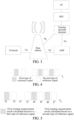
- Time-domain resources and frequency-domain resources of the signals for sensing may be non-uniformly distributed, and corresponding transmitting and receiving antennas may be uniformly or sparsely distributed. Taking the time domain as an example, formats of two different types of signals for sensing are shown in FIG. 4 .
- the base station transmits the above preprocessing indication information of the sensing measurement result to the UE, which is used for instructing the UE to determine whether interpolation preprocessing is required and an interpolation manner.
- the base station transmits the above sensing indication information to the UE, and the UE determines the preprocessing indication information based on the sensing indication information, that is, determines whether interpolation or extraction preprocessing is required and an interpolation or extraction manner.
- steps 1), 2), and 3) have no precedence relationship.
- LS least squares
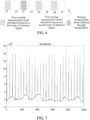
- the UE performs interpolation on the first sensing measurement results, as shown in FIG. 6 .
- interpolation needs to be performed on the first sensing measurement results at the moments t1 to t7 to obtain the sensing measurement result at the moment t*.
- the UE determines that the sensing measurement result at the moment t* needs to be obtained through interpolation based on the sensing indication information transmitted by the base station, to ensure uniformly sampling of the sensing measurement result in the time domain.
- the sensing measurement result at the moment t* is obtained through interpolation of the sensing measurement results at the moments t1 to t7.
- the sensing measurement results at the moments t1 to t7 are the first sensing measurement result, and the sensing measurement results at the moments t1 to t7 and the moment t* are the second sensing measurement result.
- the interpolation manner is selecting at least one sensing measurement result from the sensing measurement results corresponding to the moments t1 to t7, multiplying the at least one sensing measurement result by a specific weight coefficient, and adding up the at least one sensing measurement result as the sensing measurement result at the moment t*.
- a basis for selecting the sensing measurement result for interpolation may be a magnitude of a time interval to the moment t* and/or calculated sensing performance indicators corresponding to the sensing measurement results at the moments t1 to t7. For example, sensing measurement results X2 and X3 corresponding to adjacent moments t2 and time t3 are selected, and a sensing measurement result X* corresponding to the moment t * is obtained through linear interpolation.
- sensing measurement results X2 and X4 corresponding to the adjacent moments t2 and t4 with optimal sensing performance indicators (or with sensing performance indicators exceeding a preset threshold) (although a time interval between the moment t2 and the moment t* is smaller, its sensing performance indicator does not exceed the threshold or is lower than the sensing performance indicator corresponding to the calculated sensing measurement result at the moment t4) are selected, and the sensing measurement results X* corresponding to the moment t* is obtained through linear interpolation.
- the UE extracts the sensing measurement results after interpolation or before interpolation.
- the sensing measurement results at the moments t1, t*, t4, and t6 need to be extracted.
- the UE determines, based on the sensing indication information transmitted by the base station, a minimum time-domain sampling interval that needs to be met by the sensing measurement results required for calculating the final sensing result is t*-t1. In this case, only the sensing measurement results at the moments t1, t*, t4, and t6 (or the sensing measurement results at the moments t2, t3, t5, and t7) need to be reported.
- the UE reports the second sensing measurement result after interpolation and/or extraction to the base station.
- the signals for sensing may be of a same type or different types, for example, at one of a sensing signal, a communication signal, and an integrated sensing and communication signal.
- the communication signals may be a same reference signal or different reference signals or data symbols.
- the reference signal may be one of signals in Table 1.
- the base station transmits preprocessing indication information of the sensing measurement results to the UE, to instruct the UE to determine whether remove outliers and an outlier removal manner.
- the outlier removal manner includes algorithm selection and a window size for outlier removal, which is a quantity of samples used for an outlier removal-related calculation.
- the base station transmits sensing indication information to the UE, and the UE determines the preprocessing information of the first sensing measurement results based on the sensing indication information, that is, whether outlier removal is required and an outlier removal manner.
- steps 1), 2), and 3) have no precedence relationship.
- the outlier removal manner may include the following steps in case of a standard deviation method.
- An outlier removal window is selected, and an average x of data within the window is calculated.
- a standard deviation ⁇ of the data within the window is calculated.
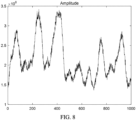
- the UE calculates the first sensing measurement results based on the received signals. Assuming that the window size for outlier removal is 1000 sample points, a time-domain amplitude distribution of the first sensing measurement results within the window is shown in FIG. 7 .
- the UE performs outlier removal on the first sensing measurement results within the outlier removal window (replaces outliers).
- a time-domain amplitude distribution of a second sensing measurement result is shown in FIG. 8 .
- the UE reports the second sensing measurement results to the base station.
- the main process is the same as the above preprocessing manner of interpolation or sample extraction.
- the UE is instructed to determine whether filtering is required and preprocessing parameter information associated with filtering.
- the UE determines whether filtering is required and a filtering manner based on the sensing indication information.
- the preprocessing parameter information associated with filtering may be:
- a specific filter may be defined, and a specific filter coefficient may be defined.
- a specific filter that is defined is a Savitzky-Golay filter, with a filter order of 41.
- the UE filters the first sensing measurement results based on an instruction to obtain the second sensing measurement result.
- the main process is the same as the above preprocessing manner of interpolation or sample extraction.
- the UE is instructed to determine whether noise suppression is required and preprocessing parameter information associated with noise suppression.
- the UE determines whether noise suppression is required and a noise suppression manner based on the sensing indication information.
- the preprocessing parameter information associated with noise suppression may be:
- the desired noise suppression result is the reported second sensing measurement result.
- original data may be decomposed into an approximate coefficient vector and a detail coefficient vector through L-step iterative decomposition by using DWT.
- the approximate coefficient vector represents a basic shape of an input signal with large-scale features
- the detail coefficient vector describes high-frequency noise with small-scale features and detail information.
- the desired noise suppression result (the second sensing measurement result) may be the approximate coefficient vector and/or the detail coefficient vector, or may be a result of a combination of the two based on a specific rule, for example, weighted summation.
- the main process is the same as the above preprocessing manner of interpolation or sample extraction.
- the UE is instructed to determine whether merging is required and preprocessing parameter information associated with merging.
- the UE determines whether merging is required and a merging manner based on the sensing indication information.
- the preprocessing parameter information associated with merging may be:
- the indicated merging method is direct summation in the frequency domain. If the first device calculates sensing measurement results corresponding to a plurality of frequency-domain positions, the first device adds up the sensing measurement results of the plurality of frequency-domain positions as the second sensing measurement result.
- the indicated merging method is antenna domain quotient calculation (dot division, that is, element-by-element division). If the first device calculates frequency-domain channel responses corresponding to an antenna combination 1 (a transmitting antenna 1 and a receiving antenna 1) and an antenna combination 2 (a transmitting antenna 1 and a receiving antenna 2), the first device uses a quotient of the frequency-domain channel responses corresponding to the two antenna combinations as the second sensing measurement result.
- the indicated merging manner is antenna-domain quotient calculation (merging 1) followed by frequency-domain weighted summation (merging 2).
- a weighting factor is a value related to a sensing performance indicator.
- an obtained first sensing measurement result corresponding to each subcarrier after the antenna-domain quotient calculation (merging 1) is at least one of an amplitude and/or a phase of a frequency-domain channel responder H-ratio, an I channel amplitude and/or a Q channel amplitude of the H-ratio, a projection operation result of I channel and Q channel signals of the H-ratio (the projection operation may be I*cos(theta)+Q*sin(theta), where theta represents an angle value, different thetas correspond to different projections, I represents I channel data, and Q represents Q channel data), and a time-domain autocorrelation result corresponding to the above results.
- the sensing performance indicator is defined as a breath to noise ratio (Breath to Noise Ratio, BNR), which is calculated as follows: A ratio of a target sensing signal component to another sensing signal component obtained after an FFT operation of the first sensing measurement result within a specific time window is the sensing performance indicator.
- the another sensing signal component may be a sum of amplitudes and/or amplitudes squared corresponding to all sample points in the FFT result, an average or an average squared of amplitudes corresponding to all sample points, a sum of amplitudes and/or amplitudes squared corresponding to all sample points in the FFT result other than a sample point corresponding to a target sensing component, or an average or an average squared of the amplitudes corresponding to all of the sample points in the FFT result other than the sample point corresponding to the target sensing component.
- first sensing measurement results are respectively a first sensing measurement result 1 and a first sensing measurement result 2
- corresponding sensing performance indicators are respectively BNR1 and BNR2.
- the first sensing measurement result 1*BNR1+the first sensing measurement result 2*BNR2 is used as the second sensing measurement result, or the first sensing measurement result 1*BNR1/(BNR1+BNR2)+the first sensing measurement result 2*BNR2/(BNR1+BNR2) is used as the second sensing measurement result.
- the first sensing measurement result corresponding to the sensing measurement quantity is determined based on the received first signal
- the first sensing measurement result is preprocessed, to obtain the second sensing measurement result that meets the corresponding requirement.
- interpolation or sample extraction is performed on first sensing measurement results of a plurality of resources, so that the processed second sensing measurement result is a result obtained by uniformly sampling the first sensing measurement results of the corresponding resources.
- the second sensing measurement result can meet a reporting requirement of uniform sampling.
- the first sensing measurement results are merged or compressed, so that the second sensing measurement result can meet a reporting requirement of reducing reporting overheads.
- an embodiment of this application provides a sensing method, including the following steps: Step 1001: A second device obtains a second sensing measurement result transmitted by a first device, where the second sensing measurement result is a sensing measurement result obtained by preprocessing a first sensing measurement result, and the first sensing measurement result is a sensing measurement result corresponding to a sensing measurement quantity obtained by the first device based on a received first signal.
- the second sensing measurement result obtained by the second device is a sensing measurement result obtained after preprocessing of the first sensing measurement result.
- interpolation or sample extraction is performed on first sensing measurement results of a plurality of resources, so that the processed second sensing measurement result is a result obtained by uniformly sampling the first sensing measurement results of the corresponding resources.
- the second sensing measurement result can meet a reporting requirement of uniform sampling.
- the first sensing measurement results are merged or compressed, so that the second sensing measurement result can meet a reporting requirement of reducing reporting overheads. In this way, the second sensing measurement result that meets the corresponding requirement can be obtained by preprocessing the first sensing measurement result.
- the method before the second device obtains the second sensing measurement result transmitted by the first device, the method further includes:
- the second device indicates preprocessing information of the first sensing measurement result.
- the second device indicates preprocessing information of the first sensing measurement result includes:
- the second device transmits at least one of preprocessing indication information and sensing indication information.
- the preprocessing indication information indicates the preprocessing information, and the sensing indication information is associated with the preprocessing information.
- the preprocessing information includes at least one of:
- the first parameter includes at least one of information regarding a proportion of effective sample points and a sensing performance indicator.
- the preprocessing manner includes at least one of:
- the sensing indication information includes at least one of
- the method in this embodiment of this application further includes: obtaining, by the second device, feedback information of the preprocessing information transmitted by the first device, where the feedback information includes first feedback information or second feedback information, the first feedback information is used for instructing the second device to re-indicate the preprocessing information, and the second feedback information is used for instructing the second device to reconfigure the first signal; and transmitting the reconfigured first signal or re-indicating the preprocessing information through preprocessing indication information based on the feedback information.
- the second device indicates preprocessing information of the first sensing measurement result includes: The second device obtains preprocessing capability information of the first device.
- the second device indicates the preprocessing information of the first sensing measurement result based on the preprocessing capability information.
- the sensing method for the second device side corresponds to the method for the first device side.
- a specific interaction process between the second device and the first device has been described in detail in the above embodiment of the method for the first device side, and therefore is not described herein again.
- An execution body of the sensing method provided in this embodiment of this application may be a sensing apparatus.
- that the sensing apparatus performs the sensing method is used as an example to describe the sensing apparatus provided in embodiments of this application.
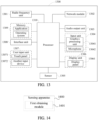
- an embodiment of this application provides a sensing apparatus 1100, including:
- the processing module includes:
- the first obtaining submodule is configured to obtain the preprocessing information based on target indication information transmitted by the second device.
- the target indication information includes at least one of preprocessing indication information and sensing indication information.
- the preprocessing indication information indicates the preprocessing information, and the sensing indication information is associated with the preprocessing information.
- the preprocessing information includes at least one of:
- the first parameter includes at least one of information regarding a proportion of effective sample points and a sensing performance indicator.
- the preprocessing manner includes at least one of interpolation, sample extraction, clutter suppression, noise suppression, outlier removal, filtering, merging, and compression.
- the preprocessing parameter information includes at least one of:
- the sensing indication information includes at least one of
- the sensing measurement quantity includes at least one of
- the apparatus in this embodiment of this application further includes: a feedback module, configured to: before the processing module preprocesses the first sensing measurement result based on the preprocessing information, transmit feedback information of the preprocessing information to the second device, where the feedback information includes first feedback information or second feedback information, the first feedback information is used for instructing the second device to re-indicate the preprocessing information, and the second feedback information is used for instructing the second device to reconfigure the first signal.
- a feedback module configured to: before the processing module preprocesses the first sensing measurement result based on the preprocessing information, transmit feedback information of the preprocessing information to the second device, where the feedback information includes first feedback information or second feedback information, the first feedback information is used for instructing the second device to re-indicate the preprocessing information, and the second feedback information is used for instructing the second device to reconfigure the first signal.
- the processing module is configured to: preprocess, by the first device, the first sensing measurement result based on the preprocessing information re-indicated by the second device through preprocessing indication information in a case that the feedback information includes the first feedback information; obtain, by the first device, the first sensing measurement result based on the first signal reconfigured by the second device in a case that the feedback information includes the second feedback information; and preprocess the first sensing measurement result based on the preprocessing information.
- the feedback module is configured to transmit the feedback information to the second device in a case that a target condition is met.
- the target condition includes at least one of
- the first parameter includes at least one of information regarding a proportion of effective sample points and a sensing performance indicator.
- the apparatus in this embodiment of this application further includes: a transmission module, configured to: before the first obtaining submodule obtains the preprocessing information of the first sensing measurement result indicated by the second device, transmit preprocessing capability information to the second device, where the preprocessing capability information indicates a preprocessing capability supported by the first device, and the preprocessing capability information is used for determining the preprocessing information.
- a transmission module configured to: before the first obtaining submodule obtains the preprocessing information of the first sensing measurement result indicated by the second device, transmit preprocessing capability information to the second device, where the preprocessing capability information indicates a preprocessing capability supported by the first device, and the preprocessing capability information is used for determining the preprocessing information.
- the first signal includes a signal of at least one of the following signal types:
- the first sensing measurement result corresponding to the sensing measurement quantity is determined based on the received first signal
- the first sensing measurement result is preprocessed, to obtain the second sensing measurement result that meets the corresponding requirement.
- interpolation or sample extraction is performed on first sensing measurement results of a plurality of resources, so that the processed second sensing measurement result is a result obtained by uniformly sampling the first sensing measurement results of the corresponding resources.
- the second sensing measurement result can meet a reporting requirement of uniform sampling.
- the first sensing measurement results are merged or compressed, so that the second sensing measurement result can meet a reporting requirement of reducing reporting overheads.
- the sensing apparatus in this embodiment of this application may be an electronic device, such as an electronic device with an operating system, or may be a component in the electronic device, such as an integrated circuit or a chip.
- the electronic device may be a terminal or a device other than the terminal.
- the terminal may include but is not limited to the types of the terminal 11 listed above, and the other devices may be servers, network attached storages (Network Attached Storage, NAS), or the like. This is not specifically limited in this embodiment of this application.
- the sensing apparatus provided in this embodiment of this application can implement all processes implemented in the method embodiments of FIG. 2 to FIG. 10 , and achieve the same technical effects. In order to avoid repetition, details are not described herein.
- an embodiment of this application further provides a communication device 1200, including a processor 1201 and a memory 1202.
- the memory 1202 stores a program or instructions executable by the processor 1201.
- the program or the instructions, when executed by the processor 1201 implement the steps of the method embodiment of the first device side, and can achieve the same technical effects.
- the program or the instructions, when executed by the processor 1201 implement the steps of the method embodiment of the second device side, and can achieve the same technical effects. To avoid repetition, details are not described herein.
- An embodiment of this application further provides a first device, including a processor and a communication interface.
- the processor is configured to preprocess a first sensing measurement result to obtain a second sensing measurement result.
- the first sensing measurement result is a sensing measurement result corresponding to a sensing measurement quantity obtained by the first device based on a received first signal.
- the communication interface is configured to report the second sensing measurement result to a second device.
- This embodiment corresponds to the above method embodiment of the first device side.
- the implementation processes and manners of the above method embodiment are applicable to this embodiment, and can achieve the same technical effects.
- FIG. 13 is a schematic diagram of a hardware structure of a first device (which is specifically a terminal) for implementing an embodiment of this application.
- the terminal 1300 includes but is not limited to at least some of components such as a radio frequency unit 1301, a network module 1302, an audio output unit 1303, an input unit 1304, a sensor 1305, a display unit 1306, a user input unit 1307, an interface unit 1308, a memory 1309, and a processor 1310.
- the terminal 1300 may further include a power supply (such as a battery) that supplies power to the components.
- the power supply may be logically connected to the processor 1310 through a power management system, thereby implementing functions such as management of charging, discharging, and power consumption through the power management system.
- the terminal structure shown in FIG. 13 constitutes no limitation on the terminal, and the terminal may include more or fewer components than those shown in the figure, or some merged components, or different component arrangements. Details are not described herein.
- the input unit 1304 may include a graphics processing unit (Graphics Processing Unit, GPU) 13041 and a microphone 13042.
- the graphics processing unit 13041 processes image data of a static picture or a video obtained by an image capture apparatus (for example, a camera) in a video capture mode or an image capture mode.
- the display unit 1306 may include a display panel 13061.
- the display panel 13061 may be configured in a form such as a liquid crystal display or an organic light-emitting diode.
- the user input unit 1307 includes at least one of a touch panel 13071 and another input device 13072.
- the touch panel 13071 is also referred to as a touch screen.
- the touch panel 13071 may include two parts: a touch detection apparatus and a touch controller.
- the another input device 13072 may include but is not limited to a physical keyboard, a function button (such as a volume control button or a power button), a trackball, a mouse, and a joystick. Details are not described herein.
- the radio frequency unit 1301 receives downlink data from a network side device, and then may transmit the data to the processor 1310 for processing. In addition, the radio frequency unit 1301 may send uplink data to the network side device.
- the radio frequency unit 1301 includes but is not limited to an antenna, an amplifier, a transceiver, a coupler, a low noise amplifier, and a duplexer.
- the memory 1309 may be configured to store software programs or instructions as well as various data.
- the memory 1309 may mainly include a first storage area for storing programs or instructions and a second storage area for storing data.
- the first storage area may store an operating system, an application or an instruction required for at least one function (such as a sound playback function or an image playback function), and the like.
- the memory 1309 may include a volatile memory or a non-volatile memory, or the memory 1309 may include both a volatile memory and a non-volatile memory.
- the non-volatile memory may be a read-only memory (Read-Only Memory, ROM), a programmable read-only memory (Programmable ROM, PROM), an erasable programmable read-only memory (Erasable PROM, EPROM), an electrically erasable programmable read-only memory (Electrically EPROM, EEPROM), or a flash memory.
- ROM Read-Only Memory
- PROM programmable read-only memory
- Erasable PROM Erasable PROM
- EPROM electrically erasable programmable read-only memory
- EEPROM electrically erasable programmable read-only memory
- the non-volatile memory may be a random access memory (Random Access Memory, RAM), a static random access memory (Static RAM, SRAM), a dynamic random access memory (Dynamic RAM, DRAM), a synchronous dynamic random access memory (Synchronous DRAM, RAM), a double data rate synchronous dynamic random access memory (Double Data Rate SDRAM, DDRSDRAM), an enhanced synchronous dynamic random access memory (Enhanced SDRAM, ESDRAM), a synchronous link dynamic random access memory (Synch link DRAM, SLDRAM), and a direct rambus random access memory (Direct Rambus RAM, DRRAM).
- RAM Random Access Memory
- SRAM static random access memory
- DRAM dynamic random access memory
- DRAM synchronous dynamic random access memory
- Enhanced SDRAM synchronous dynamic random access memory
- Synch link DRAM synchronous link dynamic random access memory
- SLDRAM direct rambus random access memory
- Direct Rambus RAM Direct Rambus RAM
- the processor 1310 may include one or more processing units.
- an application processor and a modem processor may be integrated into the processor 1310.
- the application processor mainly processes an operating system, a user interface, an application, and the like.
- the modem processor mainly processes wireless communication signals, for example, may be baseband processor. It may be understood that, the modem processor may alternatively not be integrated into the processor 1310.
- the processor 1310 is configured to preprocess a first sensing measurement result to obtain a second sensing measurement result, where the first sensing measurement result is a sensing measurement result corresponding to a sensing measurement quantity obtained by the first device based on a received first signal.
- the radio frequency unit 1301 is configured to report the second sensing measurement result to a second device.
- the first sensing measurement result corresponding to the sensing measurement quantity is determined based on the received first signal
- the first sensing measurement result is preprocessed, to obtain the second sensing measurement result that meets the corresponding requirement.
- interpolation or sample extraction is performed on first sensing measurement results of a plurality of resources, so that the processed second sensing measurement result is a result obtained by uniformly sampling the first sensing measurement results of the corresponding resources.
- the second sensing measurement result can meet a reporting requirement of uniform sampling.
- the first sensing measurement results are merged or compressed, so that the second sensing measurement result can meet a reporting requirement of reducing reporting overheads.
- the processor 1310 is configured to: obtain, by the first device, preprocessing information of the first sensing measurement result indicated by the second device; and preprocess the first sensing measurement result based on the preprocessing information.
- the processor 1310 is configured to: obtain, by the first device, the preprocessing information based on target indication information transmitted by the second device.
- the target indication information includes at least one of preprocessing indication information and sensing indication information.
- the preprocessing indication information indicates the preprocessing information, and the sensing indication information is associated with the preprocessing information.
- the preprocessing information includes at least one of:
- the first parameter includes at least one of information regarding a proportion of effective sample points and a sensing performance indicator.
- the preprocessing manner includes at least one of:
- the preprocessing parameter information includes at least one of:
- the sensing indication information includes at least one of
- the sensing measurement quantity includes at least one of
- the radio frequency unit 1301 is configured to transmit feedback information of the preprocessing information to the second device, where the feedback information includes first feedback information or second feedback information, the first feedback information is used for instructing the second device to re-indicate the preprocessing information, and the second feedback information is used for instructing the second device to reconfigure the first signal.
- the processor 1310 is configured to: preprocess the first sensing measurement result based on the preprocessing information re-indicated by the second device through preprocessing indication information in a case that the feedback information includes the first feedback information; obtain the first sensing measurement result based on the first signal reconfigured by the second device in a case that the feedback information includes the second feedback information; and preprocess the first sensing measurement result based on the preprocessing information.
- the radio frequency unit 1301 is configured to transmit, by the first device, the feedback information to the second device in a case that a target condition is met.
- the target condition includes at least one of
- the first parameter includes at least one of information regarding a proportion of effective sample points and a sensing performance indicator.
- the radio frequency unit 1301 is configured to transmit preprocessing capability information to the second device, where the preprocessing capability information indicates a preprocessing capability supported by the first device, and the preprocessing capability information is used for determining the preprocessing information.
- the first signal includes a signal of at least one of the following signal types:
- the first sensing measurement result corresponding to the sensing measurement quantity is determined based on the received first signal
- the first sensing measurement result is preprocessed, to obtain the second sensing measurement result that meets the corresponding requirement.
- interpolation or sample extraction is performed on first sensing measurement results of a plurality of resources, so that the processed second sensing measurement result is a result obtained by uniformly sampling the first sensing measurement results of the corresponding resources.
- the second sensing measurement result can meet a reporting requirement of uniform sampling.
- the first sensing measurement results are merged or compressed, so that the second sensing measurement result can meet a reporting requirement of reducing reporting overheads.
- an embodiment of this application further provides a sensing apparatus 1400, including: a first obtaining module 1401, configured to obtain a second sensing measurement result transmitted by a first device, where the second sensing measurement result is a sensing measurement result obtained by preprocessing a first sensing measurement result, and the first sensing measurement result is a sensing measurement result corresponding to a sensing measurement quantity obtained by the first device based on a received first signal.
- a first obtaining module 1401 configured to obtain a second sensing measurement result transmitted by a first device, where the second sensing measurement result is a sensing measurement result obtained by preprocessing a first sensing measurement result, and the first sensing measurement result is a sensing measurement result corresponding to a sensing measurement quantity obtained by the first device based on a received first signal.
- the indication module is configured to transmit at least one of preprocessing indication information and sensing indication information.
- the preprocessing indication information indicates the preprocessing information, and the sensing indication information is associated with the preprocessing information.
- the preprocessing information includes at least one of:
- the first parameter includes at least one of information regarding a proportion of effective sample points and a sensing performance indicator.
- the preprocessing manner includes at least one of:
- the sensing indication information includes at least one of
- the apparatus in this embodiment of this application further includes: a second obtaining module, configured to: obtain feedback information of the preprocessing information transmitted by the first device, where the feedback information includes first feedback information or second feedback information, the first feedback information is used for instructing the second device to re-indicate the preprocessing information, and the second feedback information is used for instructing the second device to reconfigure the first signal; and transmit the reconfigured first signal or re-indicate the preprocessing information through preprocessing indication information based on the feedback information.
- a second obtaining module configured to: obtain feedback information of the preprocessing information transmitted by the first device, where the feedback information includes first feedback information or second feedback information, the first feedback information is used for instructing the second device to re-indicate the preprocessing information, and the second feedback information is used for instructing the second device to reconfigure the first signal; and transmit the reconfigured first signal or re-indicate the preprocessing information through preprocessing indication information based on the feedback information.
- the indication module includes:
- the obtained second sensing measurement result is a sensing measurement result obtained after preprocessing of the first sensing measurement result. For example, interpolation or sample extraction is performed on first sensing measurement results of a plurality of resources, so that the processed second sensing measurement result is a result obtained by uniformly sampling the first sensing measurement results of the corresponding resources. In this way, the second sensing measurement result can meet a reporting requirement of uniform sampling.
- the first sensing measurement results are merged or compressed, so that the second sensing measurement result can meet a reporting requirement of reducing reporting overheads. In this way, the second sensing measurement result that meets the corresponding requirement can be obtained by preprocessing the first sensing measurement result.
- An embodiment of this application further provides a second device, including a processor and a communication interface.
- the communication interface is configured to obtain a second sensing measurement result transmitted by a first device.
- the second sensing measurement result is a sensing measurement result obtained by preprocessing a first sensing measurement result.
- the first sensing measurement result is a sensing measurement result corresponding to a sensing measurement quantity obtained by the first device based on a received first signal.
- the embodiment of the second device corresponds to the above method embodiment of the second device side. The implementation processes and manners of the above method embodiment are applicable to the embodiment of the second device, and can achieve the same technical effects.
- an embodiment of this application further provides a network side device (which may be specifically a first device or a second device).
- the network side device 1500 includes an antenna 151, a radio frequency apparatus 152, a baseband apparatus 153, a processor 154, and a memory 155.
- the antenna 151 is connected to the radio frequency apparatus 152.
- the radio frequency apparatus 152 receives information through the antenna 151 and transmits the received information to the baseband apparatus 153 for processing.
- the baseband apparatus 153 processes to-be-transmitted information and transmits the to-be-transmitted information to the radio frequency apparatus 152.
- the radio frequency apparatus 152 processes the received information and then transmits the information through the antenna 151.
- the baseband apparatus 153 may include, for example, at least one baseband board. A plurality of chips are arranged on the baseband board, as shown in FIG. 15 . One of the chips is, for example, a baseband processor, and is connected to the memory 155 through a bus interface to call a program in the memory 155 to perform the operations of the network device shown in the above method embodiment.
- the network side device 1500 in this embodiment of this application further includes instructions or a program stored in the memory 155 and executable by the processor 154.
- the processor 154 calls the instructions or the program in the memory 155 to perform the method performed by each module shown in FIG. 11 or FIG. 14 , and achieves the same technical effects. To avoid repetition, details are not described herein.
- the network side device 1600 in this embodiment of this application further includes instructions or a program stored in the memory 1603 and executable by the processor 1601.
- the processor 1601 calls the instructions or the program in the memory 1603 to perform the method performed by each module shown in FIG. 14 , and achieves the same technical effects. To avoid repetition, details are not described herein.
- An embodiment of this application further provides a readable storage medium.
- the readable storage medium stores a program or instructions.
- the program or instructions are executed by a processor, the processes of the embodiment of the foregoing sensing method are implemented, and the same technical effects can be achieved. To avoid repetition, details are not described herein.
- the processor is a processor in the terminal described in the above embodiments.
- the readable storage medium includes a computer-readable storage medium, such as a computer read-only memory ROM, a random access memory RAM, a magnetic disk, or an optical disk.
- An embodiment of this application further provides a chip.
- the chip includes a processor and a communication interface.
- the communication interface is coupled to the processor.
- the processor is configured to execute a program or instructions to implement the processes of the embodiment of the above sensing method, and can achieve the same technical effects. To avoid repetition, details are not described herein.
- the chip in this embodiment of this application may also be referred to as a system level chip, a system chip, a chip system, a system on chip, or the like.
- An embodiment of this application further provides a computer program product stored in a storage medium.
- the computer program product is executed by at least one processor to implement the steps of the embodiment of the above sensing method or information transmission method, and the same technical effects can be achieved. To avoid repetition, details are not described herein.
- An embodiment of this application further provides a sensing system, including a first device and a second device.
- the first device may be configured to perform the steps of the sensing method for the first device side.
- the second device may be configured to perform the steps of the sensing method for the second device side.
- a term “comprise”, “include”, or any other variant herein is intended to encompass non-exclusive inclusion, so that a process, a method, an article or an apparatus including a series of elements not only includes those elements, but also includes another element not listed explicitly or includes intrinsic elements for the process, the method, the article, or the apparatus. Without any further limitation, an element defined by the phrase "include one" does not exclude existence of other same elements in the process, the method, the article, or the apparatus that includes the elements.
- the scope of the method and the apparatus in the embodiments of this application is not limited to function execution in the order shown or discussed, and may further include function execution in a substantially simultaneous manner or in the opposite order based on the functions. For example, the described method may be performed in different order from the described order, and various steps may also be added, omitted, or combined.
- features described with reference to some examples may be combined in another example.
- the method in the above embodiments may be implemented by software using a necessary universal hardware platform, or may be implemented by hardware.
- software using a general hardware platform is an example implementation.
- the technical solution of this application in essence, or a part contributing to the related art may be embodied in a form of a computer software product.
- the software product is stored in a storage medium (such as a ROM/RAM, a disk, or a compact disc), including instructions for causing a terminal (such as a mobile phone, a computer, a server, or a network device) to perform the method in the embodiments of this application.
Landscapes
- Engineering & Computer Science (AREA)
- Computer Networks & Wireless Communication (AREA)
- Signal Processing (AREA)
- Mobile Radio Communication Systems (AREA)
Applications Claiming Priority (2)
| Application Number | Priority Date | Filing Date | Title |
|---|---|---|---|
| CN202111547553.5A CN116266928A (zh) | 2021-12-16 | 2021-12-16 | 感知方法、装置及通信设备 |
| PCT/CN2022/138389 WO2023109755A1 (zh) | 2021-12-16 | 2022-12-12 | 感知方法、装置及通信设备 |
Publications (2)
| Publication Number | Publication Date |
|---|---|
| EP4451731A1 true EP4451731A1 (de) | 2024-10-23 |
| EP4451731A4 EP4451731A4 (de) | 2025-03-19 |
Family
ID=86743432
Family Applications (1)
| Application Number | Title | Priority Date | Filing Date |
|---|---|---|---|
| EP22906500.8A Pending EP4451731A4 (de) | 2021-12-16 | 2022-12-12 | Erfassungsverfahren und -vorrichtung sowie kommunikationsvorrichtung |
Country Status (4)
| Country | Link |
|---|---|
| US (1) | US20240373254A1 (de) |
| EP (1) | EP4451731A4 (de) |
| CN (1) | CN116266928A (de) |
| WO (1) | WO2023109755A1 (de) |
Families Citing this family (9)
| Publication number | Priority date | Publication date | Assignee | Title |
|---|---|---|---|---|
| CN116743788A (zh) * | 2022-03-03 | 2023-09-12 | 腾讯科技(深圳)有限公司 | 感知数据获取方法、装置及感知数据上报方法、装置 |
| US12279190B1 (en) * | 2022-06-29 | 2025-04-15 | Amazon Technologies, Inc. | Respiration monitoring based on noisy channel state information (CSI) data |
| CN117692920A (zh) * | 2022-09-05 | 2024-03-12 | 维沃移动通信有限公司 | 信息处理方法、装置及通信设备 |
| CN116760521A (zh) * | 2023-07-26 | 2023-09-15 | 中国联合网络通信集团有限公司 | 感知方法、装置及存储介质 |
| CN121220083A (zh) * | 2023-08-03 | 2025-12-26 | Oppo广东移动通信有限公司 | 通信方法、装置、设备、存储介质、芯片、产品及程序 |
| CN120075755A (zh) * | 2023-11-30 | 2025-05-30 | 华为技术有限公司 | 通信方法、装置及计算机可读存储介质 |
| CN120224250A (zh) * | 2023-12-27 | 2025-06-27 | 维沃移动通信有限公司 | 信息传输方法、装置及通信设备 |
| CN120455926A (zh) * | 2024-02-06 | 2025-08-08 | 华为技术有限公司 | 通信方法、装置及系统 |
| WO2025213604A1 (en) * | 2024-04-08 | 2025-10-16 | Huawei Technologies Co., Ltd. | Methods and apparatuses for communication |
Family Cites Families (5)
| Publication number | Priority date | Publication date | Assignee | Title |
|---|---|---|---|---|
| CN1132465C (zh) * | 2000-08-29 | 2003-12-24 | 华为技术有限公司 | 全球移动通信系统中测量信息的处理方法 |
| US8463198B2 (en) * | 2009-07-15 | 2013-06-11 | Mediatek Inc. | Signal processing method and communication apparatus utilizing the same |
| CN101656981B (zh) * | 2009-09-18 | 2012-11-14 | 中兴通讯股份有限公司 | 小区测量调度的控制方法及移动终端 |
| SG11202002051PA (en) * | 2017-09-07 | 2020-04-29 | Guangdong Oppo Mobile Telecommunications Corp Ltd | Signal reporting method, terminal device, and network device |
| CN109085545B (zh) * | 2018-06-28 | 2023-03-21 | 西安电子科技大学 | 基于fista的压缩感知信号实时重构方法 |
-
2021
- 2021-12-16 CN CN202111547553.5A patent/CN116266928A/zh active Pending
-
2022
- 2022-12-12 EP EP22906500.8A patent/EP4451731A4/de active Pending
- 2022-12-12 WO PCT/CN2022/138389 patent/WO2023109755A1/zh not_active Ceased
-
2024
- 2024-06-12 US US18/741,287 patent/US20240373254A1/en active Pending
Also Published As
| Publication number | Publication date |
|---|---|
| EP4451731A4 (de) | 2025-03-19 |
| CN116266928A (zh) | 2023-06-20 |
| WO2023109755A1 (zh) | 2023-06-22 |
| US20240373254A1 (en) | 2024-11-07 |
Similar Documents
| Publication | Publication Date | Title |
|---|---|---|
| EP4451731A1 (de) | Erfassungsverfahren und -vorrichtung sowie kommunikationsvorrichtung | |
| US20240272269A1 (en) | Sensing signal detection method, sensing signal detection processing method, and related device | |
| US20240284229A1 (en) | Sensing signal processing method and apparatus and communication device | |
| US20240310473A1 (en) | Sensing signal transmission processing method and apparatus, and related device | |
| US20250016624A1 (en) | Sensing processing method and apparatus, communication device, and readable storage medium | |
| US20240411004A1 (en) | Sensing method and apparatus and communication device | |
| US20240340806A1 (en) | Transmit power determining method and apparatus, and device | |
| CN118075769A (zh) | 信息发送方法、信息接收方法、装置及相关设备 | |
| EP4455715A1 (de) | Parameterbestimmungsverfahren, vorrichtung und vorrichtung zur drahtlosen erfassung | |
| WO2023226826A1 (zh) | 感知方法、装置及通信设备 | |
| WO2023160546A1 (zh) | 感知方法、装置及通信设备 | |
| WO2024114460A1 (zh) | 测量方法、装置及设备 | |
| CN118041729A (zh) | 信息传输方法、装置及通信设备 | |
| WO2025124291A1 (zh) | 感知方式切换方法、装置及通信设备 | |
| WO2025124300A1 (zh) | 感知方式切换方法、装置及通信设备 | |
| WO2026026640A1 (zh) | 信息发送方法、信息接收方法、装置及设备 | |
| CN119561587A (zh) | 信道状态信息的确定方法、终端及网络侧设备 | |
| WO2024120359A1 (zh) | 信息处理、传输方法及通信设备 | |
| CN118102366A (zh) | 测量方法、装置及设备 | |
| WO2025185586A1 (zh) | 测量方法、测量配置方法、装置及设备 | |
| WO2025124302A1 (zh) | 测量结果处理方法、发送方法、装置及设备 | |
| WO2025124270A1 (zh) | 测量配置信息发送方法、接收方法、装置及设备 | |
| CN119789155A (zh) | 测量切换方法、装置及设备 | |
| WO2025130792A1 (zh) | 模型推理方法及装置 | |
| WO2025124241A1 (zh) | 感知处理方法、装置、终端及网络侧设备 |
Legal Events
| Date | Code | Title | Description |
|---|---|---|---|
| STAA | Information on the status of an ep patent application or granted ep patent |
Free format text: STATUS: THE INTERNATIONAL PUBLICATION HAS BEEN MADE |
|
| PUAI | Public reference made under article 153(3) epc to a published international application that has entered the european phase |
Free format text: ORIGINAL CODE: 0009012 |
|
| STAA | Information on the status of an ep patent application or granted ep patent |
Free format text: STATUS: REQUEST FOR EXAMINATION WAS MADE |
|
| 17P | Request for examination filed |
Effective date: 20240712 |
|
| AK | Designated contracting states |
Kind code of ref document: A1 Designated state(s): AL AT BE BG CH CY CZ DE DK EE ES FI FR GB GR HR HU IE IS IT LI LT LU LV MC ME MK MT NL NO PL PT RO RS SE SI SK SM TR |
|
| A4 | Supplementary search report drawn up and despatched |
Effective date: 20250214 |
|
| RIC1 | Information provided on ipc code assigned before grant |
Ipc: H04L 43/022 20220101ALI20250210BHEP Ipc: H04W 24/10 20090101AFI20250210BHEP |
|
| DAV | Request for validation of the european patent (deleted) | ||
| DAX | Request for extension of the european patent (deleted) |