EP4451071A1 - Verfahren und vorrichtung zur steuerung der konsistenzverfolgung für ein multiagentensystem, ausrüstung und medium - Google Patents
Verfahren und vorrichtung zur steuerung der konsistenzverfolgung für ein multiagentensystem, ausrüstung und medium Download PDFInfo
- Publication number
- EP4451071A1 EP4451071A1 EP23794225.5A EP23794225A EP4451071A1 EP 4451071 A1 EP4451071 A1 EP 4451071A1 EP 23794225 A EP23794225 A EP 23794225A EP 4451071 A1 EP4451071 A1 EP 4451071A1
- Authority
- EP
- European Patent Office
- Prior art keywords
- agent
- controller
- determining
- agent system
- consistency
- Prior art date
- Legal status (The legal status is an assumption and is not a legal conclusion. Google has not performed a legal analysis and makes no representation as to the accuracy of the status listed.)
- Pending
Links
Images


Classifications
-
- G—PHYSICS
- G05—CONTROLLING; REGULATING
- G05B—CONTROL OR REGULATING SYSTEMS IN GENERAL; FUNCTIONAL ELEMENTS OF SUCH SYSTEMS; MONITORING OR TESTING ARRANGEMENTS FOR SUCH SYSTEMS OR ELEMENTS
- G05B19/00—Program-control systems
- G05B19/02—Program-control systems electric
- G05B19/04—Program control other than numerical control, i.e. in sequence controllers or logic controllers
- G05B19/042—Program control other than numerical control, i.e. in sequence controllers or logic controllers using digital processors
- G05B19/0423—Input/output
-
- G—PHYSICS
- G05—CONTROLLING; REGULATING
- G05B—CONTROL OR REGULATING SYSTEMS IN GENERAL; FUNCTIONAL ELEMENTS OF SUCH SYSTEMS; MONITORING OR TESTING ARRANGEMENTS FOR SUCH SYSTEMS OR ELEMENTS
- G05B13/00—Adaptive control systems, i.e. systems automatically adjusting themselves to have a performance which is optimum according to some preassigned criterion
- G05B13/02—Adaptive control systems, i.e. systems automatically adjusting themselves to have a performance which is optimum according to some preassigned criterion electric
-
- G—PHYSICS
- G05—CONTROLLING; REGULATING
- G05B—CONTROL OR REGULATING SYSTEMS IN GENERAL; FUNCTIONAL ELEMENTS OF SUCH SYSTEMS; MONITORING OR TESTING ARRANGEMENTS FOR SUCH SYSTEMS OR ELEMENTS
- G05B2219/00—Program-control systems
- G05B2219/20—Pc systems
- G05B2219/25—Pc structure of the system
- G05B2219/25257—Microcontroller
-
- Y—GENERAL TAGGING OF NEW TECHNOLOGICAL DEVELOPMENTS; GENERAL TAGGING OF CROSS-SECTIONAL TECHNOLOGIES SPANNING OVER SEVERAL SECTIONS OF THE IPC; TECHNICAL SUBJECTS COVERED BY FORMER USPC CROSS-REFERENCE ART COLLECTIONS [XRACs] AND DIGESTS
- Y02—TECHNOLOGIES OR APPLICATIONS FOR MITIGATION OR ADAPTATION AGAINST CLIMATE CHANGE
- Y02P—CLIMATE CHANGE MITIGATION TECHNOLOGIES IN THE PRODUCTION OR PROCESSING OF GOODS
- Y02P90/00—Enabling technologies with a potential contribution to greenhouse gas [GHG] emissions mitigation
- Y02P90/02—Total factory control, e.g. smart factories, flexible manufacturing systems [FMS] or integrated manufacturing systems [IMS]
Definitions
- the invention relates to the technical field of mobile communication, in particular to a consistency tracking control method and device for a multi-agent system, equipment and a medium.
- a multi-agent system is a network system composed of a group of agents with certain perception, communication, computation, and execution capabilities, which are associated through communication and other means.
- Consistency control is a fundamental and important issue in the coordinated control of multi-agent systems. Consistency control refers to the situation where the states of agents in a multi-agent system reach the same value through negotiations with neighboring agents.
- Existing consistency control can be roughly divided into two categories: leaderless consistency control and leader-based consistency control, the latter of which is also known as consistency tracking control.
- the invention provides a consistency tracking control method and device for a multi-agent system, equipment and a medium, so as to realize consistency tracking of a high-order non-linear system under a directed communication topological graph.
- a consistency tracking control method for a multi-agent system comprising:
- a consistency tracking control apparatus for a multi-agent system comprising:
- an electronic device comprising:
- a computer-readable storage medium stores computer instructions for causing a processor to execute the consistency tracking control method for the multi-agent system according to any embodiment of the invention.
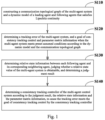
- constructing a communication topological graph of the multi-agent system and a dynamic model of a leading agent and following agents that satisfies Lipschitz continuity determining a tracking error of the multi-agent system, and a goal of consistency tracking control and parameter matrix information when the multi-agent system meets preset assumed conditions; determining relative state information between each following agent and its corresponding neighboring agent, and judging whether a relative state value of the multi-agent system is obtainable; and determining a consistency tracking controller of the multi-agent control system according to a judgment result, the relative state information and the parameter matrix information.
- Fig. 1 is a flowchart of a consistency tracking control method for a multi-agent system according to Embodiment 1 of the invention.
- This embodiment can be applied to consistency tracking control of a multi-agent system, and the method can be executed by a consistency tracking control device for a multi-agent system, which can be implemented in the form of hardware and/or software, and can be configured in an electronic device.
- the method comprises the following steps.
- the multi-agent system can be understood as a network system composed of a plurality of agents with certain perception, communication, computation, and execution capabilities, which are associated through communication and other means.
- the communication topological graph can be understood as a communication diagram between agents in the form of a directed graph.
- the leading agent can be understood as a target agent, such as an enemy attack drone.
- the following agent can be understood as a follower, such as our defense drone.
- the dynamic model can be understood as a way to characterize a multi-agent system using a dynamic model.
- a processor can construct the communication topological graph of the multi-agent system and the dynamic model of the leading agent and the following agents that satisfies Lipschitz continuity according to the state of each of agents in the multi-agent system.
- R n ⁇ n represents a set of all n ⁇ n real matrices.
- I n represents an n -dimensional unit matrix.
- 1 n represents an n -dimensional column vector with all elements being 1.
- a ⁇ B represents the Kronecker product of A and B.
- ⁇ x ⁇ and ⁇ x ⁇ ⁇ represent the 2 norm (i.e., Euclidean norm) and infinite norm of X respectively.
- sgn( x ) represents a sign function.
- diag x 1 , x 2 , ... , x n ⁇ R n ⁇ n represents a diagonal matrix composed of elements x 1 , x 2 ,..., x n .
- a T represents transposition of A
- rank( A ) represents the rank of A.
- a -1 represents the inverse of A.
- matrix inequality X > Y ( X ⁇ Y ) indicates that matrix X - Y is symmetric positive definite (positive semidefinite).
- Re( z ) represents the real part of Z.
- x i ⁇ R n the state of an agent
- y i ⁇ R m is the measurement output of the i -th agent.
- a , B and C are constant matrices with compatible dimensions
- f ( x i , t ) is a non-linear function.
- the non-linear function f ( x i , t ) meets the Lipschitz condition: ⁇ ⁇ x t ⁇ ⁇ y t ⁇ ⁇ ⁇ ⁇ x ⁇ y ⁇ , ⁇ x , y ⁇ R n
- ⁇ a Lipschitz constant.
- rank( B ) q
- rank( C ) m , m ⁇ q .
- Subscript 0 represents the leader, and subscript 1,2,..., N represents N followers.
- the communication topological graph of the multi-agent system is in the form of a directed graph.
- Each of agents is represented by a node in V.
- Each directed edge is represented by a directed pair ( v j , v i ) ⁇ ⁇ , and ( v j , v i ) ⁇ ⁇ represents that there is information exchange between agents, which means that information flows from agent i to agent j , that is, agent j can get the information of agent i . If ( v j , v i ) ⁇ ⁇ , agent i is the neighboring agent of agent j .
- the set ⁇ v j ⁇
- a ij defines the weight of edge ( v j , v i ) ⁇ ⁇ .
- a directed graph if there is a directed path from one node to every other node, then the directed graph is said to contain a directed spanning tree and the node is called a root node.
- the multi-agent system (1) comprises N followers and one leader.
- the tracking error can be understood as an error of state between the following agent and the leading agent.
- the assumed conditions can be understood as a prerequisite to achieve the goal of consistency tracking control.
- the goal of consistency tracking control can be understood as the criteria used to determine the consistency between the following agent and the leading agent in a multi-agent system.
- the parameter matrix information can be understood as a parameter matrix required for constructing a controller.
- the assumed conditions comprise: the communication topological graph at least comprises a directed spanning tree, control input of the leading agent is continuous and bounded, and a given matrix A and a given matrix B included in the dynamic model are stabilizable.
- the processor can determine the tracking error of each following agent in the multi-agent system according to the dynamic model and the communication topological graph, determine the tracking error of the multi-agent system according to the tracking error of each following agent, and determine the goal of consistency tracking control and the parameter matrix information of the multi-agent system when the multi-agent system meets the assumed conditions based on the tracking error of the multi-agent system, wherein the goal of consistency tracking control can be that the tracking error converges to zero asymptotically when the multi-agent system meets the assumed conditions.
- the neighboring agent can be understood as the agent that transmits information when the following agent directly receives information from an adjacent agent.
- the relative state information can be understood as the state of the following agent relative to the neighboring agent.
- the relative state value can be understood as the determined value of the relative state of the multi-agent system.
- the judgment result can be understood as a result used to characterize whether the multi-agent system can be obtained.
- the processor can determine the neighboring agents of each following agent according to the dynamic model and the communication topological graph, and can determine the relative state information between each following agent and its corresponding neighboring agents based on a set mathematical model.
- the state of the multi-agent system may be unmeasurable due to technical limitations, then the processor can judge whether the relative state value of multi-agent system can be obtained, thus identifying situations where the state of the multi-agent system is unmeasurable, and the processor can obtain a judgment result.
- the consistency tracking controller can be understood as a controller for keeping the state of the following agent consistent with that of the leading agent.
- the processor can determine a controller determination mode of an adopted consistency tracking controller according to the judgment result, and determine the consistency tracking controller of the multi-agent control system according to the controller determination mode combined with the relative state information and the parameter matrix information, to cause the tracking error meets the goal of consistency tracking control by the consistency tracking controller, even if the tracking error can converge to zero asymptotically.
- constructing a communication topological graph of the multi-agent system and a dynamic model of a leading agent and following agents that satisfies Lipschitz continuity determining a tracking error of the multi-agent system, and a goal of consistency tracking control and parameter matrix information when the multi-agent system meets preset assumed conditions; determining relative state information between each following agent and its corresponding neighboring agent, and judging whether a relative state value of the multi-agent system is obtainable; and determining a consistency tracking controller of the multi-agent control system according to a judgment result, the relative state information and the parameter matrix information.
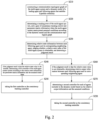
- Fig. 2 is a flowchart of a consistency tracking control method for a multi-agent system according to Embodiment 2 of the invention. This embodiment is a further refinement on the basis of the embodiment described above. As shown in Fig. 2 , the method comprises the following steps.
- step of constructing a communication topological graph of the multi-agent system may comprise the following steps.
- determining a node set, a directed edge set and a directed path between two nodes corresponding to the multi-agent system according to each agent in the multi-agent system and an information flow direction, determining a node set, a directed edge set and a directed path between two nodes corresponding to the multi-agent system.
- the information flow direction can be understood as the direction of information transmission.
- the node set can be understood as a node set formed by agents in the multi-agent system as nodes.
- the directed edge set can be understood as a set of directed edges with information flowing in a certain direction between two nodes.
- the directed path can be understood as a path between two nodes with information flowing in a certain direction.
- the processor can determine a node set, directed edge set and directed path between two nodes corresponding to the multi-agent system in the communication topological graph according to each of agents in the multi-agent system and the information flow direction therein.
- the directed edge set and the directed path determining the communication topological graph.
- the processor can determine the communication topological graph based on the node set, the directed edge set and the directed path, according to the rules of the communication topological graph.
- the first controller can be understood as a consistency tracking controller used when the relative state value is obtainable.
- the processor can determine the first controller of the multi-agent control system according to the relative state information, the parameter matrix information and the assumed conditions.
- c i ( t ) is time-varying coupling gain, c i (0) ⁇ 1.
- ⁇ i is a derivative function of c i ( t ) .
- ⁇ is a smooth non-decreasing function
- s is an argument
- ⁇ s 1 + s 3 2 , s ⁇ 0.
- x x 1 , x 2 , ... , x n T ⁇ R n
- sgn x ⁇ sgn x 1 , sgn x 2 , ... , sgn x n T is defined
- sgn(•) is a sign function
- K, P, ⁇ are parameter matrices
- K -B T P -1
- ⁇ P -1 BB T P -1
- the positive definite symmetric matrix P is the solution of the following linear matrix inequality (LMI): A 0 P + PA 0 T + 2 ⁇ P ⁇ 0 where the constant ⁇ > 0, meeting ⁇ ⁇ > max i Re ⁇ i A 0 ,
- the processor can take the first controller as the consistency tracking controller.
- the relative output information can be understood as relative output information that can be determined by a following agent and its neighboring agent, such as relative distance and the like.
- each of agents can only obtain the relative output information so the relative output information between each following agent and its corresponding neighboring agent can be determined.
- the second controller can be understood as a consistency tracking controller used when the relative state value is not obtainable.
- an unknown input observer can be constructed based on the relative output information, the relative state can be observed by the unknown input observer, a finite-time observer of the multi-agent system can be determined based on the unknown input observer, and the second controller can be determined based on the finite-time observer.
- the step of determining a second controller for each of agents in the dynamic model based on the relative output information and the assumed conditions may comprise the following steps.
- the unknown input observer can be understood as an observer that observes the relative state when the relative state information is unknown.
- the processor can construct an unknown input observer for the relative state information based on the relative output information.
- the step of constructing the unknown input observer for the relative state information based on the relative output information may comprise the following steps.
- the dynamic system can be understood as a dynamic system constructed when the relative state value is not obtainable, which is different from the dynamic model.
- the processor can determine the dynamic system when the relative state value is not obtainable based on the determined relative output information.
- the state space matrix can be understood as a matrix that transforms the dynamic system into a state space.
- the processor can perform non-singular transformation on the dynamic system to obtain the state space matrix of the transformed dynamical system in the state space representation.
- the processor can perform output transformation on the state space matrix to obtain the unknown output observer.
- ⁇ i t ⁇ R q is unknown input
- y ⁇ i ⁇ R m is the measurement output of multi-agent i
- A, B, C and D are constant matrices with compatible dimensions.
- the processor can determine the finite-time observer of the multi-agent system according to two unknown input observers.
- z i t z i 1 t z i 2 t
- z i t ⁇ ⁇ z i 1 t ⁇ ⁇ z i 2 t ⁇ ⁇
- ⁇ represents a time delay constant
- F , H , S , K represent parameter matrices.
- the set conditions can be understood as only the relative output information being obtainable.
- the processor can determine the second controller based on the finite-time observer.
- u i ⁇ c i ⁇ ⁇ ⁇ i T P ⁇ 1 ⁇ ⁇ i K ⁇ ⁇ i + ⁇ sgn K ⁇ ⁇ i
- ⁇ ⁇ 4 ⁇ ⁇ ⁇ ⁇ is a positive constant
- ⁇ the upper bound of the control input of the leader, which is given by Assumption 2.
- ⁇ s 1 + s 3 2
- s ⁇ 0 is a smooth non-decreasing function, and the parameter explanation in the above example is followed.
- the physical meaning of ⁇ is the time required for the observer state ⁇ i ( t ) ⁇ i ( t ) to converge to ⁇ i ( t ).
- the processor can take the second controller as the consistency tracking controller.
- Embodiment 2 if the relative state value is obtainable according to the judgment result, a fully-distributed first controller that does not rely on global information such as the Laplacian matrix of the communication topological graph is designed based on the relative state information between the following agent and its neighboring agents, a method for consistency tracking of multi-agent systems under directed graphs is provided.
- an unknown input observer is constructed based on the relative output information between the following agent and its neighboring agents, then, a finite-time unknown input observer is determined by on the unknown input observer, and a fully-distributed second controller does not depend on global information such as the Laplacian matrix of the communication graph is designed based on the finite-time observer, a method for consistency tracking of multi-agent systems under directed graphs is provided. Therefore, the method achieves consistency tracking of high-order non-linear systems under directed communication topological graphs and is more general in terms of applicable multi-agent systems and communication topological graphs. It can also achieve consistency tracking when the leader agent has non-zero bounded control input.
- Embodiment 2 on the basis of the above-mentioned embodiment, further optimization may be performed, comprising: proving the validity of the consistency tracking controller by using the Lyapunov function and Lasalle's theorem.
- a relative state dynamics model corresponding to the relative state information can be obtained according to the dynamics model and the relative state information, and then the Lyapunov function corresponding to the relative state dynamics model can be determined, and then, the derivative of the Lyapunov function along the relative state dynamics model is determined, the minimum value of the derivative is derived according to the set conditions that need to be met, and combined with the Lasalle's theorem, it can be determined that the relative state information asymptotically converges to zero, so as to prove the validity of the consistency tracking controller.
- Example 1 If the judgment result is that the relative state value is obtainable, the first controller can be verified by the following steps.
- Step 1 constructing a multi-agent system consisting of a leader and four followers according to the multi-agent system discussed.
- Fig. 3 is an exemplary communication topological graph provided by Embodiment 2 of the invention.
- the non-linear function f ( x i , t ) -4 x i 1 + 3sin( x i 2 ) - 4 x i 3 ,
- (A, B) is stabilizable.
- K 0 [10 24 26 9]
- the initial state of the agent is randomly selected in the interval [-1, 1].
- Example 2 If the judgment result is that the relative state value is not obtainable, following the dynamic model (26) and communication topological graph provided by the above example, the second controller can be verified by the following steps.
- Step 1 for the multi-agent system, the relative output information between a following agent and its neighboring agents is defined, and a finite-time distributed observer is designed based on the relative output information to observe the relative state of the multi-agent system.
- T I 4
- Q 1 0
- U 0 1 1 0
- L 1 5 5 6
- L 2 14 59
- F ⁇ 5 1 0 0 0 0 ⁇ 6 ⁇ 1 1 0 0 0 0 ⁇ 6 0 0 0 0 0 0 0 0 0 ⁇ 14 1 0 0 0 0 0 0 ⁇ 60 ⁇ 1 1 0 0 0 0 ⁇ 120 0 0
- H 5 0 5 0 6 1 14 0 59 0
- K ⁇ ⁇ 2.3129 1.1121 ⁇ 0.3565 3.3129 ⁇ 1.1121 0.3565 ⁇ 24.7762 11.9061 ⁇ 3.8150 24.7762 ⁇ 10.9061 3.8150 ⁇ 79.7253 38.2917 ⁇ 12.2632 79.7253 ⁇ 38.2917 13.2632
- the initial state of the agent and the initial state of the observer are randomly selected in the interval [-2, 2].
- Fig. 6 is a tracking error variation curve under a second controller according to Embodiment 2 of the invention.
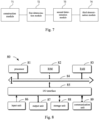
- Fig. 7 is a structural diagram of a consistency tracking control apparatus for a multi-agent system according to Embodiment 3 of the invention. As shown in Fig. 7 , the apparatus comprises a construction module 71, a first determination module 72, a second determination module 73 and a third determination module 74.
- the construction module 71 is configured to construct a communication topological graph of the multi-agent system and a dynamic model of a leading agent and following agents that satisfies Lipschitz continuity;
- the technical solution adopted in the embodiment of the invention comprises: constructing a communication topological graph of the multi-agent system and a dynamic model of a leading agent and following agents that satisfies Lipschitz continuity; determining a tracking error of the multi-agent system, and a goal of consistency tracking control and parameter matrix information when the multi-agent system meets preset assumed conditions; determining relative state information between each following agent and its corresponding neighboring agent, and judging whether a relative state value of the multi-agent system is obtainable; and determining a consistency tracking controller of the multi-agent control system according to a judgment result, the relative state information and the parameter matrix information.
- constructing a communication topological graph of the multi-agent system comprises:
- the third determination module 74 comprises:
- the fourth determination unit comprises:
- construction subunit is specifically configured to:
- the apparatus further comprises: a proof module configured to prove the validity of the consistency tracking controller by using the Lyapunov function and Lasalle's theorem.
- the consistency tracking control apparatus for the multi-agent system provided by the embodiment of the invention can execute the consistency tracking control method for the multi-agent system provided by any embodiment of the invention, and has functional modules for executing the method and corresponding beneficial effects.
- Fig. 8 is a structural diagram of an electronic device 80 for implementing the embodiments of the invention.
- the electronic device is intended to represent various forms of digital computers, such as laptop computers, desktop computers, workstations, personal digital assistants, servers, blade servers, mainframe computers, and other suitable computers.
- the electronic device can also represent various forms of mobile devices, such as personal digital processors, cellular phones, smart phones, wearable devices (such as helmets, glasses, watches, etc.) and other similar computing devices.
- the components shown herein, their connections and relationships, and their functions are only examples, and are not intended to limit the implementation of the invention described and/or claimed herein.
- the electronic device 80 comprises at least one processor 81, and a memory, such as a read-only memory (ROM) 82, a random access memory (RAM) 83 and the like, which communicatively coupled with the at least one processor 81, wherein the memory stores a computer program executable by the at least one processor, and the processor 81 can perform various appropriate actions and processes according to a computer program stored in the ROM 82 or a computer program loaded into the RAM 83 from a storage unit 18. In the RAM 83, various programs and data required for the operation of the electronic device 80 can also be stored.
- the processor 81, the ROM 82 and the RAM 83 are connected to each other through a bus 84.
- An input/output (I/O) interface 85 is also connected to the bus 84.
- I/O interface 85 Many components in the electronic device 80 are connected to the I/O interface 85, including: input units 86 such as keyboards and mouse, output units 87 such as various types of displays and speakers, storage units 88 such as magnetic disks and optical disks, and communication units 89 such as network cards, modems and wireless communication transceivers.
- the communication unit 89 allows the electronic device 80 to exchange information/data with other devices through computer networks such as the Internet and/or various telecommunication networks.
- the processor 81 may be various general-purpose and/or special-purpose processing components with processing and computing capabilities. Some examples of the processor 81 include, but are not limited to, a central processing unit (CPU), a graphics processing unit (GPU), various specialized artificial intelligence (AI) computing chips, various processors running machine learning model algorithms, a digital signal processor (DSP), and any suitable processor, controller, microcontroller, etc.
- the processor 81 executes various methods and processes described above, such as the consistency tracking control method for the multi-agent system.
- the consistency tracking control method for the multi-agent system can be implemented as a computer program tangibly embodied in a computer-readable storage medium, such as the storage unit 18.
- part or all of the computer program may be loaded and/or installed on the electronic device 80 via the ROM 82 and/or a communication unit 19.
- the processor 81 may be configured to execute the consistency tracking control method for the multi-agent system by any other suitable means (for example, by means of firmware).
- Various implementations of the systems and techniques described above herein may be implemented in digital electronic circuitry, integrated circuit systems, field programmable gate arrays (FPGA), application specific integrated circuits (ASIC), application specific standard products (ASSP), system-on-a-chip (SOC), complex programmable logic devices (CPLD), computer hardware, firmware, software, and/or combinations thereof.
- FPGA field programmable gate arrays
- ASIC application specific integrated circuits
- ASSP application specific standard products
- SOC system-on-a-chip
- CPLD complex programmable logic devices
- programmable processor may be a special-purpose or general-purpose programmable processor and can receive data and instructions from a storage system, at least one input device, and at least one output device, and transmit data and instructions to the storage system, the at least one input device, and the at least one output device.
- the computer program for implementing the method of the invention can be written in any combination of one or more programming languages. These computer programs may be provided to the processors of general-purpose computers, special-purpose computers or other programmable data processing devices, so that when executed by the processors, the computer programs cause the functions/operations specified in the flowcharts and/or block diagrams to be implemented.
- the computer programs can be completely executed on a machine, partially executed on a machine, partially executed on a machine as an independent software package, partially executed on a remote machine or completely executed on a remote machine or server.
- a computer-readable storage medium can be a tangible medium that can contain or store a computer program for use by or in connection with an instruction execution system, apparatus or device.
- Computer-readable storage media can include, but are not limited to, electronic, magnetic, optical, electromagnetic, infrared, or semiconductor systems, apparatuses or devices, or any suitable combination of the above.
- the computer-readable storage medium may be a machine-readable signal medium.
- machine-readable storage media will include electrical connection based on one or more wires, portable computer disk, hard disk, random access memory (RAM), read-only memory (ROM), erasable programmable read-only memory (EPROM or flash memory), optical fiber, compact disk read-only memory (CD-ROM), optical storage device, magnetic storage device, or any suitable combination of the above.
- RAM random access memory
- ROM read-only memory
- EPROM or flash memory erasable programmable read-only memory
- CD-ROM compact disk read-only memory
- magnetic storage device or any suitable combination of the above.
- the systems and techniques described herein can be implemented on the electronic device having a display device (for example, a cathode ray tube (CRT) or a liquid crystal display (LCD) monitor) for displaying information to the user; and a keyboard and a pointing device (for example, a mouse or a trackball) through which the user can provide input to the electronic device.
- a display device for example, a cathode ray tube (CRT) or a liquid crystal display (LCD) monitor
- a keyboard and a pointing device for example, a mouse or a trackball
- Other kinds of devices can also be used to provide interaction with the user.
- the feedback provided to the user can be any form of sensory feedback (for example, visual feedback, auditory feedback, or tactile feedback); and the input from the user can be received in any form, including acoustic input, voice input or tactile input.
- the systems and techniques described herein may be implemented in a computing system that comprises a back-end component (e.g., as a data server), or a computing system that comprises a first component (e.g., an application server), or a computing system that comprises a front-end component (e.g., a user computer with a graphical user interface or a web browser through which a user can interact with implementations of the systems and techniques described herein), or a computing system that comprises any combination of the back-end component, the first component and the front-end component.
- Components of the system can be interconnected through digital data communication in any form or medium (for example, communication network). Examples of communication networks include local area network (LAN), wide area network (WAN), blockchain network and Internet.
- the computing system may comprise a client and a server.
- the client and the server are generally away from each other and usually interact through a communication network.
- the relationship between the client and the server is generated by running computer programs on respective computers that have a client-server relationship with each other.
- the server can be a cloud server, also known as a cloud computing server or cloud host, which is a host product in the cloud computing service system that addresses the management difficulties and weak scalability of traditional physical hosts and VPS services.
Landscapes
- Engineering & Computer Science (AREA)
- Physics & Mathematics (AREA)
- Automation & Control Theory (AREA)
- General Physics & Mathematics (AREA)
- Computer Vision & Pattern Recognition (AREA)
- Medical Informatics (AREA)
- Software Systems (AREA)
- Evolutionary Computation (AREA)
- Health & Medical Sciences (AREA)
- Artificial Intelligence (AREA)
- Feedback Control In General (AREA)
- Management, Administration, Business Operations System, And Electronic Commerce (AREA)
- Multi Processors (AREA)
Applications Claiming Priority (2)
| Application Number | Priority Date | Filing Date | Title |
|---|---|---|---|
| CN202310206988.6A CN116047984B (zh) | 2023-03-07 | 2023-03-07 | 多智能体系统的一致性跟踪控制方法、装置、设备及介质 |
| PCT/CN2023/125193 WO2024183286A1 (zh) | 2023-03-07 | 2023-10-18 | 多智能体系统的一致性跟踪控制方法、装置、设备及介质 |
Publications (2)
| Publication Number | Publication Date |
|---|---|
| EP4451071A1 true EP4451071A1 (de) | 2024-10-23 |
| EP4451071A4 EP4451071A4 (de) | 2025-06-18 |
Family
ID=86123940
Family Applications (1)
| Application Number | Title | Priority Date | Filing Date |
|---|---|---|---|
| EP23794225.5A Pending EP4451071A4 (de) | 2023-03-07 | 2023-10-18 | Verfahren und vorrichtung zur steuerung der konsistenzverfolgung für ein multiagentensystem, ausrüstung und medium |
Country Status (3)
| Country | Link |
|---|---|
| EP (1) | EP4451071A4 (de) |
| CN (1) | CN116047984B (de) |
| WO (1) | WO2024183286A1 (de) |
Families Citing this family (46)
| Publication number | Priority date | Publication date | Assignee | Title |
|---|---|---|---|---|
| CN116047984B (zh) * | 2023-03-07 | 2023-06-06 | 北京全路通信信号研究设计院集团有限公司 | 多智能体系统的一致性跟踪控制方法、装置、设备及介质 |
| CN116679573B (zh) * | 2023-08-04 | 2023-10-20 | 北京全路通信信号研究设计院集团有限公司 | 一种一致性跟踪控制方法、装置、电子设备及存储介质 |
| CN117687345B (zh) * | 2024-02-01 | 2024-05-14 | 北京中关村实验室 | 多智能体系统的控制方法及相关产品 |
| CN117742141B (zh) * | 2024-02-19 | 2024-09-03 | 南开大学 | 一种基于控制屏障函数的分布式局部利普希茨算法 |
| CN119030883B (zh) * | 2024-08-05 | 2025-12-09 | 天津工业大学 | 一种拓扑设计方法及其在多智能体系统一致性中的应用 |
| CN118707859B (zh) * | 2024-08-30 | 2024-11-26 | 温州职业技术学院 | 一种基于有限时间的多智能体系统追踪控制方法 |
| CN119135740B (zh) * | 2024-09-14 | 2025-09-23 | 中国地质大学(武汉) | 具有丢包和参数不匹配的多智能体系统有限脉冲控制方法 |
| CN119036454B (zh) * | 2024-09-24 | 2025-09-16 | 北京航空航天大学 | 一种应用于多机械臂的固定时间轴间一致协同控制方法 |
| CN119440093B (zh) * | 2024-09-26 | 2025-10-17 | 安徽财经大学 | 一种混合攻击下的多智能体系统均方一致性控制方法 |
| CN119475424B (zh) * | 2024-11-01 | 2025-10-10 | 杭州电子科技大学 | 一种基于边缘扰动的二阶系统隐私保护平均一致性方法 |
| CN119440096A (zh) * | 2024-11-05 | 2025-02-14 | 河北科技大学 | 基于预设性能的未知非同向多智能体系统输出反馈一致性控制方法 |
| CN119440098B (zh) * | 2024-11-06 | 2025-09-05 | 北京航空航天大学 | 领导者系统矩阵未知的时变异构编队有限时间跟踪方法、系统、设备及介质 |
| CN119165775B (zh) * | 2024-11-11 | 2025-01-21 | 北京理工大学 | 基于双重观测器的不确定多智能体指定时间状态估计方法 |
| CN119597014B (zh) * | 2024-11-15 | 2026-03-03 | 南京邮电大学 | 一种受扰非线性多智能体系统固定时间时变编队控制方法 |
| CN119610089A (zh) * | 2024-11-26 | 2025-03-14 | 广东工业大学 | 一种基于邻居事件驱动的多轴机械臂模型一致性控制方法 |
| CN119689848B (zh) * | 2024-11-28 | 2025-12-09 | 广东工业大学 | 执行器故障下多自主体的固定时间滑模控制方法及系统 |
| CN119668103B (zh) * | 2024-12-04 | 2026-01-06 | 西南交通大学 | 一种基于分布式采样观测器的高速列车协同控制方法 |
| CN119668115B (zh) * | 2024-12-11 | 2025-10-17 | 哈尔滨理工大学 | 一种基于动态事件触发的二阶多智能体系统控制方法 |
| CN119717516B (zh) * | 2024-12-13 | 2025-10-03 | 河海大学 | 一种基于拓扑重构的多智能体系统协同容错跟踪控制方法及系统 |
| CN119937282A (zh) * | 2024-12-17 | 2025-05-06 | 东南大学南通海洋高等研究院 | 一种基于偏微分多智能体系统的多边一致性优化方法 |
| CN119337920B (zh) * | 2024-12-18 | 2025-06-27 | 华东交通大学 | 一种二阶离散多智能体矩阵尺度一致性控制方法 |
| CN119458367B (zh) * | 2024-12-19 | 2025-09-09 | 武汉工程大学 | 一种通信受限下基于事件触发的多机械臂一致性控制方法 |
| CN119356190B (zh) * | 2024-12-19 | 2025-04-25 | 华中科技大学 | 一种基于跨物种仿生的多智能体采样事件触发协同跟踪控制方法 |
| CN119458373B (zh) * | 2024-12-27 | 2026-02-06 | 河南科技大学 | 一种多柔性机械臂系统迭代学习容错一致性控制方法 |
| CN119758739B (zh) * | 2025-01-06 | 2025-10-03 | 中国科学院工程热物理研究所 | 一种航空动力矩阵一致跟踪控制系统及其方法 |
| CN119882439B (zh) * | 2025-01-10 | 2025-11-04 | 北京航空航天大学 | 一种多联盟博弈的智能体控制方法、装置、设备及介质 |
| CN119484160B (zh) * | 2025-01-13 | 2025-05-06 | 杭州师范大学 | 立即攻击检测的多智能体系统安全一致性控制方法及系统 |
| CN120065852B (zh) * | 2025-02-25 | 2026-04-21 | 重庆邮电大学 | 一种基于指定时间观测器的异质多智能体系统编队控制方法 |
| CN120103708B (zh) * | 2025-03-06 | 2025-12-02 | 浙江理工大学 | 一种多智能体事件触发固定时间一致性控制方法 |
| CN119828629B (zh) * | 2025-03-18 | 2025-06-27 | 华东交通大学 | 二阶非线性多智能体系统的固定时间包含控制方法及系统 |
| CN119828575B (zh) * | 2025-03-19 | 2025-05-30 | 华东交通大学 | 多智能体系统时间事件触发二分一致性的控制方法及系统 |
| CN120406146A (zh) * | 2025-04-27 | 2025-08-01 | 北京理工大学长三角研究院(嘉兴) | 基于神经网络的多智能体系统的自适应容错控制方法 |
| CN120065705B (zh) * | 2025-04-28 | 2025-07-08 | 青岛理工大学 | 一种异构集群无人系统的随机预定义时间跟踪控制方法 |
| CN120447449B (zh) * | 2025-05-08 | 2025-11-04 | 辽宁科技学院 | 一种基于图论的多智能体协同控制方法 |
| CN120143882A (zh) * | 2025-05-12 | 2025-06-13 | 北京理工大学 | 基于时变增益的无人机群指定时间分布式资源调度方法 |
| CN120215279A (zh) * | 2025-05-19 | 2025-06-27 | 天津工业大学 | 多智能体系统的自适应事件触发固定时间一致性控制方法 |
| CN120161729B (zh) * | 2025-05-19 | 2025-08-15 | 中国海洋大学 | 高阶全驱不确定多智能体系统的有限时间一致性控制方法 |
| CN120353143B (zh) * | 2025-06-24 | 2025-09-30 | 浪潮通用软件有限公司 | 基于完全分布式策略的多智能体协同输出调节方法及设备 |
| CN120722803A (zh) * | 2025-06-27 | 2025-09-30 | 武汉纺织大学 | 一种多智能体系统的动态事件触发一致性控制方法与系统 |
| CN120491498B (zh) * | 2025-07-16 | 2025-09-12 | 安徽大学 | 非线性多智能体系统采样一致性控制方法、系统及介质 |
| CN120652783B (zh) * | 2025-08-13 | 2025-10-17 | 南京信息工程大学 | 输入饱和特性的多智能体系统的全局一致性安全控制协议设计方法 |
| CN120825406B (zh) * | 2025-09-18 | 2026-02-17 | 浪潮通用软件有限公司 | 联合连通切换拓扑条件下多智能体输出调节方法及设备 |
| CN120972584A (zh) * | 2025-09-24 | 2025-11-18 | 重庆邮电大学 | 一种领导-跟随多智能体系统的有限时间一致性控制方法 |
| CN120891756B (zh) * | 2025-10-09 | 2025-12-16 | 浙江理工大学 | 多智能体动态事件触发预设时间二分跟踪控制方法及系统 |
| CN121000536B (zh) * | 2025-10-24 | 2026-03-03 | 深圳大学 | 基于量化事件触发的多智能体系统安全一致性控制方法及装置 |
| CN121115524B (zh) * | 2025-11-13 | 2026-02-03 | 山东大学 | 一种多水下机器人系统的弹性一致性控制方法及系统 |
Family Cites Families (13)
| Publication number | Priority date | Publication date | Assignee | Title |
|---|---|---|---|---|
| KR101935006B1 (ko) * | 2017-06-23 | 2019-01-03 | 중앙대학교 산학협력단 | 멀티 에이전트 시스템에 포함되는 추종 에이전트 및 이의 제어 방법 |
| US10983532B1 (en) * | 2017-08-03 | 2021-04-20 | University Of South Florida | Distributed control of heterogeneous multi-agent systems |
| US11129236B1 (en) * | 2018-10-02 | 2021-09-21 | University Of South Florida | Control of multiagent systems with local and global objectives |
| CN109407520B (zh) * | 2018-12-26 | 2021-04-06 | 南京航空航天大学 | 基于滑模控制的二阶多智能体系统的容错一致性控制算法 |
| CN110109351B (zh) * | 2019-04-08 | 2021-05-18 | 广东工业大学 | 一种基于指定性能的多智能体一致性控制方法 |
| CN112305918B (zh) * | 2020-11-11 | 2025-03-21 | 南京航空航天大学 | 超螺旋观测器下的多智能体系统滑模容错一致性控制算法 |
| CN112947407A (zh) * | 2021-01-14 | 2021-06-11 | 华南理工大学 | 一种多智能体有限时间的编队路径跟踪控制方法及系统 |
| CN112947581B (zh) * | 2021-03-25 | 2022-07-05 | 西北工业大学 | 基于多智能体强化学习的多无人机协同空战机动决策方法 |
| CN113589694B (zh) * | 2021-08-02 | 2023-08-18 | 厦门大学 | 异构多智能体系统的完全分布式抗饱和跟踪控制方法 |
| CN114326715B (zh) * | 2021-12-09 | 2023-10-03 | 东南大学 | 一种变维多智能体系统的编队控制方法与装置 |
| CN114861435B (zh) * | 2022-04-29 | 2024-06-11 | 南京航空航天大学 | 有限时间观测器下的多智能体系统一致性滑模控制算法 |
| CN115268275B (zh) * | 2022-08-24 | 2024-05-28 | 广东工业大学 | 基于状态观测器的多智能体系统一致性跟踪方法及系统 |
| CN116047984B (zh) * | 2023-03-07 | 2023-06-06 | 北京全路通信信号研究设计院集团有限公司 | 多智能体系统的一致性跟踪控制方法、装置、设备及介质 |
-
2023
- 2023-03-07 CN CN202310206988.6A patent/CN116047984B/zh active Active
- 2023-10-18 EP EP23794225.5A patent/EP4451071A4/de active Pending
- 2023-10-18 WO PCT/CN2023/125193 patent/WO2024183286A1/zh not_active Ceased
Also Published As
| Publication number | Publication date |
|---|---|
| CN116047984B (zh) | 2023-06-06 |
| EP4451071A4 (de) | 2025-06-18 |
| WO2024183286A1 (zh) | 2024-09-12 |
| CN116047984A (zh) | 2023-05-02 |
Similar Documents
| Publication | Publication Date | Title |
|---|---|---|
| EP4451071A1 (de) | Verfahren und vorrichtung zur steuerung der konsistenzverfolgung für ein multiagentensystem, ausrüstung und medium | |
| Wei et al. | Hesitant fuzzy linguistic arithmetic aggregation operators in multiple attribute decision making | |
| CN112507040A (zh) | 多元关系生成模型的训练方法、装置、电子设备及介质 | |
| CN113051239B (zh) | 数据共享方法、应用其的模型的使用方法及相关设备 | |
| CN113641829B (zh) | 图神经网络的训练与知识图谱的补全方法、装置 | |
| CN110363636A (zh) | 基于关系网络的欺诈风险识别方法及装置 | |
| JP2022173453A (ja) | ディープラーニングモデルのトレーニング方法、自然言語処理方法及び装置、電子機器、記憶媒体及びコンピュータプログラム | |
| CN113489011A (zh) | 电力系统暂态稳定评估方法、装置、电子设备和存储介质 | |
| JP2022013844A (ja) | 情報処理方法、情報処理装置及びプログラム | |
| CN116401372A (zh) | 知识图谱表示学习方法、装置、电子设备及可读存储介质 | |
| CN113360711A (zh) | 视频理解任务的模型训练和执行方法、装置、设备及介质 | |
| Abedinzadeh et al. | A multidimensional opinion evolution model with confirmation bias | |
| Wang et al. | Distributed computation of classic and exponential closeness on tree graphs | |
| CN114626523B (zh) | 训练深度学习模型的方法、装置、设备以及存储介质 | |
| WO2024051456A1 (zh) | 多方协同模型训练方法、装置、设备和介质 | |
| CN112749839A (zh) | 一种模型确定方法、装置、设备和存储介质 | |
| CN114491280B (zh) | 推荐及模型训练方法、装置、设备、介质及程序产品 | |
| Xiao-Chuang et al. | Delay-dependent and order-dependent asymptotic stability conditions for Riemann–Liouville fractional-order systems with time delays | |
| CN109902831A (zh) | 业务决策处理方法以及装置 | |
| CN113037489A (zh) | 数据处理方法、装置、设备和存储介质 | |
| CN120218182A (zh) | 模型蒸馏方法、答复信息生成方法及装置 | |
| Bao et al. | Quasi-synchronisation of conformable fractional-order complex dynamical networks with mixed delays | |
| CN114844889B (zh) | 视频处理模型的更新方法、装置、电子设备及存储介质 | |
| CN114416819B (zh) | 一种对公客户的挖掘方法及装置 | |
| CN117933390A (zh) | 模型混合精度确定方法、装置、设备及存储介质 |
Legal Events
| Date | Code | Title | Description |
|---|---|---|---|
| STAA | Information on the status of an ep patent application or granted ep patent |
Free format text: STATUS: UNKNOWN |
|
| STAA | Information on the status of an ep patent application or granted ep patent |
Free format text: STATUS: THE INTERNATIONAL PUBLICATION HAS BEEN MADE |
|
| PUAI | Public reference made under article 153(3) epc to a published international application that has entered the european phase |
Free format text: ORIGINAL CODE: 0009012 |
|
| STAA | Information on the status of an ep patent application or granted ep patent |
Free format text: STATUS: REQUEST FOR EXAMINATION WAS MADE |
|
| 17P | Request for examination filed |
Effective date: 20231102 |
|
| AK | Designated contracting states |
Kind code of ref document: A1 Designated state(s): AL AT BE BG CH CY CZ DE DK EE ES FI FR GB GR HR HU IE IS IT LI LT LU LV MC ME MK MT NL NO PL PT RO RS SE SI SK SM TR |
|
| REG | Reference to a national code |
Ref country code: DE Ref legal event code: R079 Free format text: PREVIOUS MAIN CLASS: G05B0019042000 Ipc: G05B0013020000 |
|
| A4 | Supplementary search report drawn up and despatched |
Effective date: 20250515 |
|
| RIC1 | Information provided on ipc code assigned before grant |
Ipc: G05B 19/042 20060101ALI20250512BHEP Ipc: G05B 13/02 20060101AFI20250512BHEP |