EP4450209A2 - Vorrichtung zur herstellung einer sekundärbatterie und verfahren zur herstellung einer sekundärbatterie damit - Google Patents
Vorrichtung zur herstellung einer sekundärbatterie und verfahren zur herstellung einer sekundärbatterie damit Download PDFInfo
- Publication number
- EP4450209A2 EP4450209A2 EP23835044.1A EP23835044A EP4450209A2 EP 4450209 A2 EP4450209 A2 EP 4450209A2 EP 23835044 A EP23835044 A EP 23835044A EP 4450209 A2 EP4450209 A2 EP 4450209A2
- Authority
- EP
- European Patent Office
- Prior art keywords
- welding
- module frame
- component
- assembly line
- inspection
- Prior art date
- Legal status (The legal status is an assumption and is not a legal conclusion. Google has not performed a legal analysis and makes no representation as to the accuracy of the status listed.)
- Pending
Links
Images


Classifications
-
- H—ELECTRICITY
- H01—ELECTRIC ELEMENTS
- H01M—PROCESSES OR MEANS, e.g. BATTERIES, FOR THE DIRECT CONVERSION OF CHEMICAL ENERGY INTO ELECTRICAL ENERGY
- H01M50/00—Constructional details or processes of manufacture of the non-active parts of electrochemical cells other than fuel cells, e.g. hybrid cells
- H01M50/20—Mountings; Secondary casings or frames; Racks, modules or packs; Suspension devices; Shock absorbers; Transport or carrying devices; Holders
- H01M50/244—Secondary casings; Racks; Suspension devices; Carrying devices; Holders characterised by their mounting method
-
- H—ELECTRICITY
- H01—ELECTRIC ELEMENTS
- H01M—PROCESSES OR MEANS, e.g. BATTERIES, FOR THE DIRECT CONVERSION OF CHEMICAL ENERGY INTO ELECTRICAL ENERGY
- H01M10/00—Secondary cells; Manufacture thereof
- H01M10/04—Construction or manufacture in general
- H01M10/0404—Machines for assembling batteries
- H01M10/0409—Machines for assembling batteries for cells with wound electrodes
-
- B—PERFORMING OPERATIONS; TRANSPORTING
- B23—MACHINE TOOLS; METAL-WORKING NOT OTHERWISE PROVIDED FOR
- B23K—SOLDERING OR UNSOLDERING; WELDING; CLADDING OR PLATING BY SOLDERING OR WELDING; CUTTING BY APPLYING HEAT LOCALLY, e.g. FLAME CUTTING; WORKING BY LASER BEAM
- B23K26/00—Working by laser beam, e.g. welding, cutting or boring
- B23K26/02—Positioning or observing the workpiece, e.g. with respect to the point of impact; Aligning, aiming or focusing the laser beam
- B23K26/03—Observing, e.g. monitoring, the workpiece
- B23K26/032—Observing, e.g. monitoring, the workpiece using optical means
-
- B—PERFORMING OPERATIONS; TRANSPORTING
- B23—MACHINE TOOLS; METAL-WORKING NOT OTHERWISE PROVIDED FOR
- B23K—SOLDERING OR UNSOLDERING; WELDING; CLADDING OR PLATING BY SOLDERING OR WELDING; CUTTING BY APPLYING HEAT LOCALLY, e.g. FLAME CUTTING; WORKING BY LASER BEAM
- B23K26/00—Working by laser beam, e.g. welding, cutting or boring
- B23K26/02—Positioning or observing the workpiece, e.g. with respect to the point of impact; Aligning, aiming or focusing the laser beam
- B23K26/04—Automatically aligning, aiming or focusing the laser beam, e.g. using the back-scattered light
- B23K26/044—Seam tracking
-
- B—PERFORMING OPERATIONS; TRANSPORTING
- B23—MACHINE TOOLS; METAL-WORKING NOT OTHERWISE PROVIDED FOR
- B23K—SOLDERING OR UNSOLDERING; WELDING; CLADDING OR PLATING BY SOLDERING OR WELDING; CUTTING BY APPLYING HEAT LOCALLY, e.g. FLAME CUTTING; WORKING BY LASER BEAM
- B23K26/00—Working by laser beam, e.g. welding, cutting or boring
- B23K26/08—Devices involving relative movement between laser beam and workpiece
- B23K26/082—Scanning systems, i.e. devices involving movement of the laser beam relative to the laser head
-
- B—PERFORMING OPERATIONS; TRANSPORTING
- B23—MACHINE TOOLS; METAL-WORKING NOT OTHERWISE PROVIDED FOR
- B23K—SOLDERING OR UNSOLDERING; WELDING; CLADDING OR PLATING BY SOLDERING OR WELDING; CUTTING BY APPLYING HEAT LOCALLY, e.g. FLAME CUTTING; WORKING BY LASER BEAM
- B23K26/00—Working by laser beam, e.g. welding, cutting or boring
- B23K26/08—Devices involving relative movement between laser beam and workpiece
- B23K26/082—Scanning systems, i.e. devices involving movement of the laser beam relative to the laser head
- B23K26/0821—Scanning systems, i.e. devices involving movement of the laser beam relative to the laser head using multifaceted mirrors, e.g. polygonal mirror
-
- B—PERFORMING OPERATIONS; TRANSPORTING
- B23—MACHINE TOOLS; METAL-WORKING NOT OTHERWISE PROVIDED FOR
- B23K—SOLDERING OR UNSOLDERING; WELDING; CLADDING OR PLATING BY SOLDERING OR WELDING; CUTTING BY APPLYING HEAT LOCALLY, e.g. FLAME CUTTING; WORKING BY LASER BEAM
- B23K26/00—Working by laser beam, e.g. welding, cutting or boring
- B23K26/20—Bonding
- B23K26/21—Bonding by welding
-
- H—ELECTRICITY
- H01—ELECTRIC ELEMENTS
- H01M—PROCESSES OR MEANS, e.g. BATTERIES, FOR THE DIRECT CONVERSION OF CHEMICAL ENERGY INTO ELECTRICAL ENERGY
- H01M50/00—Constructional details or processes of manufacture of the non-active parts of electrochemical cells other than fuel cells, e.g. hybrid cells
- H01M50/20—Mountings; Secondary casings or frames; Racks, modules or packs; Suspension devices; Shock absorbers; Transport or carrying devices; Holders
- H01M50/204—Racks, modules or packs for multiple batteries or multiple cells
-
- Y—GENERAL TAGGING OF NEW TECHNOLOGICAL DEVELOPMENTS; GENERAL TAGGING OF CROSS-SECTIONAL TECHNOLOGIES SPANNING OVER SEVERAL SECTIONS OF THE IPC; TECHNICAL SUBJECTS COVERED BY FORMER USPC CROSS-REFERENCE ART COLLECTIONS [XRACs] AND DIGESTS
- Y02—TECHNOLOGIES OR APPLICATIONS FOR MITIGATION OR ADAPTATION AGAINST CLIMATE CHANGE
- Y02E—REDUCTION OF GREENHOUSE GAS [GHG] EMISSIONS, RELATED TO ENERGY GENERATION, TRANSMISSION OR DISTRIBUTION
- Y02E60/00—Enabling technologies; Technologies with a potential or indirect contribution to GHG emissions mitigation
- Y02E60/10—Energy storage using batteries
-
- Y—GENERAL TAGGING OF NEW TECHNOLOGICAL DEVELOPMENTS; GENERAL TAGGING OF CROSS-SECTIONAL TECHNOLOGIES SPANNING OVER SEVERAL SECTIONS OF THE IPC; TECHNICAL SUBJECTS COVERED BY FORMER USPC CROSS-REFERENCE ART COLLECTIONS [XRACs] AND DIGESTS
- Y02—TECHNOLOGIES OR APPLICATIONS FOR MITIGATION OR ADAPTATION AGAINST CLIMATE CHANGE
- Y02P—CLIMATE CHANGE MITIGATION TECHNOLOGIES IN THE PRODUCTION OR PROCESSING OF GOODS
- Y02P70/00—Climate change mitigation technologies in the production process for final industrial or consumer products
- Y02P70/50—Manufacturing or production processes characterised by the final manufactured product
Definitions
- the present invention relates to an apparatus for manufacturing a secondary battery and a method of manufacturing the secondary battery using the apparatus.
- a secondary battery can be charged and discharged a plurality of times unlike a primary battery.
- Secondary batteries have been widely used as energy sources for various types of wireless devices such as handsets, laptop computers, and cordless vacuum cleaners. Recently, a main use of secondary batteries is moving from mobile devices to mobility, as manufacturing costs per unit capacity of secondary batteries drastically decrease due to improved energy density and economies of scale and a range of battery electric vehicles (BEVs) increases to the same level as fuel vehicles.
- BEVs battery electric vehicles
- a technical idea of the present invention is directed to providing an apparatus for manufacturing a secondary battery with improved productivity and a method of manufacturing a secondary battery using the same.
- inventions of the present invention provide an apparatus for manufacturing a secondary battery.
- the apparatus includes: a first beam source configured to generate a welding beam; a second beam source configured to generate an inspection beam; a scanner head configured to direct the welding beam and the inspection beam towards a module frame; a servo motor configured to move the scanner head; a detector configured to detect a reflected beam being a part of the inspection beam that is reflected from the module frame; a processor configured to collect assembly line data of the module frame based on an inspection signal generated by the detector; and a controller configured to control the servo motor based on the assembly line data of the module frame.
- the assembly line data may include coordinates of an assembly line of a first component and a second component of the module frame.
- the controller may be configured to control the servo motor to scan the assembly line of the first component and the second component by the welding beam.
- the controller may be configured to correct a welding line based on the assembly line data.
- the welding line may be part of the module frame to be scanned by the welding beam.
- the controller may be configured to generate a signal for controlling the servo motor and the scanner head to weld the module frame based on the assembly line data.
- the scanner head may include a dichroic mirror configured to transmit the welding beam and reflect the inspection beam.
- An optical axis of the welding beam transmitted through the dichroic mirror and an optical axis of the inspection beam reflected by the dichroic mirror may at least partially overlap each other.
- the scanner head may be configured to obliquely direct the inspection beam and the welding beam to the module frame.
- a method of manufacturing a secondary battery includes scanning a module frame by an inspection beam to collect assembly line data including coordinates of an assembly line of a first component and a second component of the module frame, and welding the first component and second component based on the assembly line data.
- the assembly line data may be collected based on a three-dimensional shape of the module frame.
- the assembly line of the first component and the second component of the module frame may be a center line on the gap between the first component and the second component.
- the welding of the first component and second component may include scanning the module frame by a welding beam based on the assembly line data.
- An optical axis of the welding beam and an optical axis of the inspection beam may partially overlap each other.
- the welding of the first component and second component may include collecting assembly line data indicating a position of the assembly line and transmitting the assembly line data to the controller.
- the controller may be configured to control a movement of a scanner head configured to be direct the inspection beam and the welding beam.
- the method may further include correcting coordinates of a welding line to generate a corrected welding line based on the assembly line data.
- the welding of the first component and second component may include scanning the module frame by the welding beam along the corrected welding line.
- assembly line data of components can be collected based on optical coherence tomography (OCT), and frames can be welded based on the assembly line data.
- OCT optical coherence tomography
- Three-dimensional shapes of components can be determined by OCT and thus there is no error due to surface roughness.
- OCT optical system can be coupled to a scanner head of a welding beam optical system, a travel time of the scanner head required to perform autofocusing and inspect an assembly line can be minimized, thereby improving the productivity of secondary batteries.
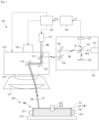
- FIG. 1 is a diagram illustrating a secondary battery manufacturing apparatus 100 according to embodiments.
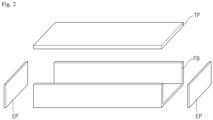
- FIG. 2 is an exploded perspective view of a module frame MF.
- the secondary battery manufacturing apparatus 100 may include a first beam source 110, a scanner head 120, an optical coherence tomography (OCT) optical system 130, a processor 140, a controller 150, and a servo motor 160.
- OCT optical coherence tomography
- the secondary battery manufacturing apparatus 100 may be configured to process a module frame MF of a battery module BM.
- the secondary battery manufacturing apparatus 100 may be configured to weld a frame body FB, an end plate EP, and a top plate TP of the module frame MF together.
- the secondary battery manufacturing apparatus 100 may be configured to perform laser welding.
- the first beam source 110 may be a light amplification by stimulated emission of radiation (laser) device.
- the first beam source 110 may be configured to generate a welding beam WB.
- the welding beam WB may be a laser beam.
- the welding beam WB may be a near-infrared ray.
- a wavelength of the welding beam WB may be in a range of about 750 nm to about 2500 nm.
- a wavelength of the welding beam WB may be about 1070 nm.
- the first beam source 110 may be a solid laser device such as a semiconductor laser device, an Nd:YAGlaser device, a titanium-saphire laser device, or an optical fiber laser device.
- the first beam source 110 may be a liquid laser such as a pigment laser device.
- the first beam source 110 may be a gas laser device such as a helium-neon laser, a carbon dioxide laser, or an excimer laser.
- the welding beam WB generated by the first beam source 110 may be coupled to the scanner head 120. According to embodiments, the welding beam WB may be transmitted to the scanner head 120 through one of a free space optical system, an optical integrated circuit, and a fiber optical system.
- the OCT optical system 130 may include a second beam source 131, a beam splitter 133, a reference mirror 135, a detector 137, a first scanning mirror 138, and a second scanning mirror 139.
- the OCT optical system 130 may be configured to capture a three-dimensional (3D) image of the module frame MF.
- the OCT optical system 130 may be based on a Michelson interferometer.
- An operation of the OCT optical system 130 may be based on a phase delay between a reference beam RFB and a reflected beam RFB.
- the reflected beam RB may be a part of an inspection beam IB reflected from a sample (i.e., the module frame MF).
- the phase delay represents the difference in time of flight between the reflected beam RB and the reference beam RFB, and the difference in flight time may include information about the 3D image of the module frame MF.
- a depth profile of a scanned portion of the module frame MF (i.e., a depth at coordinates on the module frame MF in an X-axis direction and a Y-axis direction) may be obtained and thus a 3D image of the module frame MF may be captured.
- the second beam source 131 may be a laser device.
- the second beam source 131 may be configured to generate an inspection beam IB.
- the inspection beam IB may be a laser beam.
- the inspection beam IB may be a near-infrared ray.
- a wavelength of the inspection beam IB may be in a range of about 750 nm to about 2500 nm.
- the wavelength of the inspection beam IB may be different from the wavelength of the welding beam WB.
- the wavelength of the inspection beam IB may be shorter than the wavelength of the welding beam WB.
- the wavelength of the inspection beam IB may be about 820 nm.
- the inspection beam IB may be collimated.
- the inspection beam IB may be parallel light. That is, the inspection beam IB may be non-converged light and non-emissive light.
- the second beam source 131 may include a collimating lens or a collimating lens may be interposed between the second beam source 131 and the beam splitter 133.
- the beam splitter 133 may be provided in an optical path of the inspection beam IB between the scanner head 120 and the second beam source 131.
- the inspection beam IB may be transmitted to the beam splitter 133.
- the beam splitter 133 may be configured to divide the inspection beam IB.
- the beam splitter 133 may be configured to transmit a part of the inspection beam IB and reflect a part of the inspection beam IB to generate the reference beam RFB.
- a reflectivity of the beam splitter 133 may be substantially the same as a transmittivity of the beam splitter 133 but embodiments are not limited thereto.
- the reflectivity of the beam splitter 133 may be higher than or lower than the transmittivity of the beam splitter 133.
- the reference beam RFB may be reflected by the reference mirror 135, transmitted through the beam splitter 133, and transmitted to the detector 137.
- the inspection beam IB transmitted through the beam splitter 133 may sequentially pass through the first and second scanning mirrors 138 and 139 and thereafter be coupled to the scanner head 120.
- the first scanning mirror 138 may be provided in an optical path of the inspection beam IB between the beam splitter 133 and the scanner head 120.
- the second scanning mirror 139 may be provided in an optical path of the inspection beam IB between the first scanning mirror 138 and the scanner head 120.
- Each of the first and second scanning mirrors 138 and 139 may be a galvo mirror.
- Each of the first and second scanning mirrors 138 and 139 may include a reflective surface and a servo motor configured to drive (e.g., rotatably drive) the reflective surface.
- the module frame MF may be scanned by the inspection beam IB by driving the first and second scanning mirrors 138 and 139.
- the scanner head 120 may include a dichroic mirror 121, a first scanning mirror 123, a second scanning mirror 124, and lenses 125 and 127.
- the scanner head 120 may be configured to direct the welding beam WB and the inspection beam IB to the module frame MF. Accordingly, the module frame MF may be inspected by the inspection beam IB and welded by the welding beam WB.
- the scanner head 120 may be configured to scan the module frame MF by the welding beam WB and the inspection beam IB.
- the inspection beam IB and the welding beam WB coupled to the scanner head 120 may be transmitted to the dichroic mirror 121.
- the dichroic mirror 121 may be provided in an optical path between the first beam source 110 and the module frame MF.
- the dichroic mirror 121 may be provided in an optical path between the second scanning mirror 139 and the module frame MF.
- An optical path of the inspection beam IB reflected by the dichroic mirror 121 may be similar to or be substantially the same as an optical path of the welding beam WB transmitted through the dichroic mirror 121.
- An optical axis of the inspection beam IB reflected by the dichroic mirror 121 and an optical axis of the welding beam WB transmitted through the dichroic mirror 121 may at least partially overlap each other. Accordingly, auto-focusing of the welding beam WB by the inspection beam IB may be achieved.
- the dichroic mirror 121 is a non-limiting example and may include a distributed Bragg reflector.
- the dichroic mirror 121 may have a high transmittivity with respect to the welding beam WB.
- the transmittivity of the dichroic mirror 121 with respect to a wavelength band of the welding beam WB may be 90% or more.
- the transmittivity of the dichroic mirror 121 with respect to the wavelength band of the welding beam WB may be 95% or more.
- the transmittivity of the dichroic mirror 121 with respect to the wavelength band of the welding beam WB may be 99% or more.
- the dichroic mirror 121 may have a high reflectivity with respect to the inspection beam IB.
- a reflectivity of the dichroic mirror 121 with respect to a wavelength band of the inspection beam IB may be 90% or more.
- the reflectivity of the dichroic mirror 121 with respect to the wavelength band of the inspection beam IB may be 95% or more.
- the reflectivity of the dichroic mirror 121 with respect to the wavelength band of the inspection beam IB may be 99% or more.
- the inspection beam IB reflected by the dichroic mirror 121 and the welding beam WB transmitted through the dichroic mirror 121 may sequentially pass through the first scanning mirror 123, the second scanning mirror 124, and the lenses 125 and 127 and thereafter be emitted to the module frame MF.
- the dichroic mirror 121 may be configured to reflect the welding beam WB and transmit the inspection beam IB.
- the dichroic mirror 121 may have a high reflectivity with respect to a wavelength band of the welding beam WB and a high transmittivity with respect to a wavelength band of the inspection beam IB.
- the first scanning mirror 123 may be provided in an optical path of the inspection beam IB and the welding beam WB between the dichroic mirror 121 and the module frame MF.
- the first scanning mirror 123 may be provided in an optical path of the inspection beam IB and the welding beam WB between the first scanning mirror 123 and the module frame MF.
- Each of the first and second scanning mirrors 123 and 124 may be a galvo mirror.
- Each of the first and second scanning mirrors 123 and 124 may include a reflective surface and a servo motor configured to drive (e.g., rotatably drive) the reflective surface.
- the module frame MF may be scanned by the inspection beam IB and the welding beam WB by driving the first and second scanning mirrors 123 and 124.
- the first and second scanning mirrors 123 and 124 may be configured to scan the module frame MF by the inspection beam IB in addition to the welding beam WB, and thus, the first and second scanning mirrors 138 and 139 may be omitted or replaced with non-galvo mirrors (i.e., non-driven fixed mirrors).
- Each of the lenses 125 and 127 may be a scanning lens.
- one of the lenses 125 and 127 may be an F-Theta scanning lens but embodiments are not limited thereto.
- One of the lenses 125 and 127 may be a flat-field scanning lens or a telecentric F-theta scanning lens.
- An F-theta lens is a standard lens for a galvo scanner-based laser tooling system.
- a diffraction limit, multi-elements and air-spaced lens design are optimized for flat fields and low F-theta distortion on an image plane.
- a displacement of an output beam of the F-theta lens is f* ⁇ .
- ⁇ is an incident angle of an input beam
- f is a focal length. Therefore, angular velocities of the input beam and the output beam may be directly proportional to each other, thus allowing an operation of the scanning mirror at a constant angular velocity and simplification of a control device.
- FIG. 1 illustrates both the inspection beam IB and the welding beam WB for convenience of illustration
- the inspection beam IB and the welding beam WB may be separately emitted to the module frame MF.
- the elements of the module frame MF may be welded together by the welding beam WB.
- the servo motor 160 and the fixing device 200 may be configured to adjust relative orientations and positions of the scanner head 120 and the module frame MF so that at least one of the inspection beam IB or the welding beam WB may be obliquely incident on the module frame MF. Due to the oblique incidence of the welding beam WB, spatter caused by the welding beam WB may be prevented or alleviated from being scattered into a battery cell. Accordingly, damage to the battery cell may be mitigated or prevented during the processing of the module frame MF.
- An area of the welding beam WB on the module frame MF may be different from an area of the inspection beam IB on the module frame MF.
- the area of the welding beam WB on the module frame MF may be larger than the area of the inspection beam IB on the module frame MF.
- the welding beam WB covers a large area of the module frame MF and thus the throughput of the secondary battery manufacturing apparatus 100 may increase.
- the inspection beam IB covers a narrow area of the module frame MF (i.e., a narrow field of view (FOV)), and thus a resolution of 3D modeling of the module frame MF using the OCT optical system 130 may be enhanced.
- FOV narrow field of view
- the battery module BM may include the module frame MF, a cell stack, and a bus bar assembly.
- the cell stack may include a plurality of battery cells and a plurality of separators.
- the plurality of battery cells may include a case, an electrode assembly, an electrolyte, and electrode leads.
- the case may be a pouch case, a cylindrical case, or a prismatic case.
- the electrode assembly may be a j elly-roll type electrode assembly or a stack type electrode assembly.
- the jelly roll type electrode assembly may include a structure in which a positive electrode, a negative electrode, and a separator interposed therebetween are wound together.
- the stack type electrode assembly may include a plurality of positive electrodes, a plurality of negative electrodes, and a plurality of separators interposed therebetween, which are stacked sequentially.
- the electrode leads may include positive electrode lead and a negative electrode lead.
- the positive electrode lead may be coupled to a positive electrode tab of the electrode assembly, and the negative electrode lead may be coupled to a negative electrode tab of the electrode assembly.
- the plurality of separators may horizontally support a plurality of battery cells to prevent swelling of the plurality of battery cells.
- the plurality of separators may be thermal barriers.
- the bus bar assembly may include a bus bar frame and bus bars.
- the bus bars may be an external connection terminal for outputting a voltage and a current of the cell stack, and be coupled to the positive electrode lead and the negative electrode lead of the cell stack.
- the bus bar frame may support the bus bars and the electrode leads of the cell stack.
- the bus bar assembly may further include an integrated circuit such as a cell management controller (CMC) mounted on the bus bar frame.
- CMC cell management controller
- the module frame MF may include a frame body FB, end plates EP, and a top plate TP.
- the elements (i.e., the cell stack and the bus bar assembly) of the battery module BM may be in the module frame MF.
- the module frame MF may cover the elements (i.e., the cell stack and the busbar assembly) of the battery module BM.
- the frame body FB may have a U shape.
- the frame body FB may include a bottom part and sidewalls coupled to the bottom part.
- the end plates EP and the top plate TP may have a roughly plate shape.
- the battery module BM may be loaded on a fixing device 200.
- the frame body FB, the end plates EP, and the top plate TP of the module frame MF may be maintained in an assembled state by the fixing device 200.
- the module frame MF may be inspected and welded by the secondary battery manufacturing apparatus 100 while the battery module BM is held by the fixing device 200.
- the fixing device 200 may include a stage 210 and a plurality of jigs 221, 222, 223, and 225.
- the battery module BM may be loaded on the stage 210.
- the frame body FB, the end plates EP, and the top plate TP of the battery module BM loaded on the stage 210 may be pressurized by the plurality of jigs 221, 222, 223, and 225.
- the jigs 221 and 222 may pressurize the end plates EP and the frame body FB.
- the jig 225 may pressurize the frame body FB and the top plate TP.
- the jigs 223 may pressurize both sidewalls of the frame body FB and the top plate TP.
- the reflected beam RB may sequentially pass through the lenses 125 and 127, the first and second scanning mirrors 123 and 124, the dichroic mirror 121, the first and second scanning mirrors 138 and 139, and the beam splitter 133 and thereafter reach the detector 137 .
- the detector 137 may be configured to generate an inspection signal IS, based on the reflected beam RB and the reference beam RFB.
- the detector 137 may include, for example, a charge-coupled device (CCD) camera, a complementary metal oxide semiconductor (CMOS) image sensor, or the like.
- CMOS complementary metal oxide semiconductor
- the detector 137 may be configured to transmit the inspection signal IS to the processor 140.
- the processor 140 may be configured to determine a 3D shape of the module frame MF, based on the inspection signal IS.
- the processor 140 may be configured to collect assembly line data ALD.
- the processor 140 may be configured to determine an assembly line of the frame body FB and the end plates EP, an assembly line of the frame body FB and the top plate TP, and an assembly line of the end plates EP and the top plate TP, based on the 3D shape of the module frame MF.
- the processor 140 may be configured to determine a gap between the frame body FB and the end plates EP, a gap between the frame body FB and the top plate TP, and a gap between the end plates EP and the top plate TP, based on the 3D shape of the module frame MF.
- the processor 140 may be configured to transmit the assembly line data ALD to the controller 150.
- the controller 150 may be configured to control overall operations of the first beam source 110, the scanner head 120, and the servo motor 160.
- the controller 150 may be configured to generate signals for controlling the oscillation of the first beam source 110, a chopping frequency of the welding beam WB, an intensity of the welding beam WB, the driving of the first and second scanning mirrors 123 and 124, and the driving of the servo motor 160.
- the controller 150 may be configured to generate a signal for controlling the servo motor 160 and the scanner head 120 to weld the module frame MF, based on the assembly line data ALD.
- the controller 150 may be configured to control the movement of the scanner head 120 by the servo motor 160 and the driving of the first and second scanning mirrors 123 and 124.
- the controller 150 may be a programmable logic controller (PLC).
- PLC programmable logic controller
- the PLC is a special type of microprocessor-based controller that stores instructions using a programmable memory and implements functions such as logic, sequencing, timing, counting and an arithmetic operation to control machines and processes. It is easy to operate and program the PLC.
- the controller 150 may include a power supply, a central process unit (CPU), an input interface, an output interface, a communication interface, and memory devices.
- CPU central process unit
- the processor 140 and the controller 150 may be implemented as hardware, firmware, software, or a combination thereof.
- the processor 140 and the controller 150 may be computing devices such as a workstation computer, a desktop computer, a laptop computer, and a tablet computer.
- the processor 140 and the controller 150 may be simple controllers, microprocessors, complex processors such as a CPU or a GPU, processors configured by software, dedicated hardware, or firmware.
- the processor 140 and the controller 150 may be implemented, for example, by a general-purpose computer or application-specific hardware such as a digital signal process (DSP), a field-programmable gate array (FPGA) or an application specific integrated circuit (ASIC).
- DSP digital signal process
- FPGA field-programmable gate array
- ASIC application specific integrated circuit
- operations of the processor 140 and the controller 150 may be implemented as instructions stored on machine-readable media that are readable and executable by one or more processors.
- the machine-readable media may include an arbitrary mechanism for storing and/or transmitting information in a form readable by a machine (e.g., a computing device).
- machine-readable media may include a read-only memory (ROM), a random access memory (RAM), magnetic disk storage media, optical storage media, flash memory devices, electrical, optical, acoustic, or other types of radio signals (e.g., carrier waves, infrared signals, digital signals, etc.), and other signals.
- Firmware, software, routines, and instructions may also be configured to perform the above-described operations of the processor 140 and the controller 150, or processes described below. However, the above description is provided only for convenience of description, and it should be understood that the above-described operations of the processor 140 and the controller 150 may be performed by a computing device, a processor, a controller, or other devices for executing firmware, software, routines, instructions, etc.
- the servo motor 160 may be configured to translate the scanner head 120.
- the servo motor 160 may be configured to move the scanner head 120 in a vertical direction (i.e., a working distance direction).
- the welding beam WB may be focused on the module frame MF due to the vertical movement of the scanner head 120.
- the servo motor 160 may be configured to move the scanner head 120 in a horizontal direction. Due to the horizontal movement of the scanner head 120, the assembly line of the module frame MF may be scanned by the welding beam WB and thus the frame body FB, the end plates EP, and the top plate TP of the module frame MF may be welded together.
- FIG. 3 is a flowchart of a method of manufacturing a secondary battery according to embodiments.
- FIG. 4 is a diagram for describing inspection of a module frame according to embodiments.
- a first component P1 may be one of the frame body FB, the top plate TP, and the end plates EP of the module frame MF
- a second component P2 may be another one of frame body FB, top plate TP, and end plates EP of the module frame MF.
- the module frame MF may be scanned by the inspection beam IB to collect the assembly line data ALD. More specifically, in order to collect the assembly line data ALD, an assembly line AL of the first component P1 and the second component P2, and parts of the first and second components P1 and P2 adjacent to the assembly line AL may be scanned by the inspection beam IB.
- a region on the module frame MF scanned by the inspection beam IB may include a zigzag line (e.g., a triangular waveform line).
- a sampling frequency of scanning by the inspection beam IB may be in a range of several tens of kHz to several hundreds of kHz.
- the assembly line AL may be a boundary line between the first and second components P1 and P2 of the module frame MF.
- the assembly line AL may be a profile of a contact surface between the first and second components P1 and P2 of the module frame MF.
- a Z-field measurement area (i.e., depth measurement limit) of the inspection beam IB may be in a range of several mm to several tens of mm.
- the Z-field measurement area (i.e., depth measurement limit) of the inspection beam IB may be in a range of about 3 mm to about 12 mm.
- a resolution of the inspection beam IB in the Z-axis direction may be in a range of about 1 ⁇ m to about 100 ⁇ m.
- a diameter of an XY field measurement area (i.e., a horizontal scanning range) of the inspection beam IB may be in a range of several mm to several tens of mm.
- a resolution of an XY plane of the inspection beam IB may be in a range of about 1 ⁇ m to about 100 ⁇ m.
- the XY plane may be a scanning plane of the inspection beam IB, and the Z axis may be substantially perpendicular to the XY plane.
- An inspection signal IS may be generated by scanning the module frame MF by the inspection beam IB.
- the processor 140 may be configured to determine a 3D shape of the module frame MF, based on the inspection signal IS.
- the processor 140 may be configured to collect the assembly line data ALD, based on the 3D shape of the module frame MF.
- the assembly line data ALD may include coordinates of the assembly line AL.
- the coordinates of the assembly line AL may be coordinates on a scanning plane of the module frame MF using the inspection beam IB, and the coordinates of the assembly line AL may include an X-direction coordinate and a Y-direction coordinate.
- the assembly line AL may be determined as a center line of the gap GP (e.g., a center line of the gap GP in a width direction).
- the processor 140 may be configured to determine the assembly line AL from the gap GP. Unlike that shown in FIG. 4 , the first and second components P1 and P2 may be ideally assembled together, and a width of the gap GP may be zero.
- the gap GP may be compared with a threshold.
- the module frame MF may be reassembled.
- P110 is returned to inspect the module frame MF to collect the assembly line data ALD.
- coordinates of a welding line WL may be corrected based on the assembly line data ALD.
- the welding line WL may be determined based on a standard model of the module frame MF of the battery module BM loaded in the fixing device 200.
- the welding line WL may be a part to be welded of the ideal module frame MF, without process errors.
- the welding line WL and the assembly line AL may be misaligned with to each other due to production and process errors of the module frame MF.
- the misalignment between the welding line WL and the assembly line AL may include inclination, separation, and the like.
- the controller 150 may be configured to correct the coordinates of the welding line WL to generate a corrected welding line, based on the assembly line data ALD.
- the correction of the welding line WL may include correcting the coordinates of the welding line WL, based on a starting point and an ending point of the assembly line AL.
- the module frame MF may be welded based on the corrected welding line.
- the welding of the module frame MF may include scanning the module frame MF by the welding beam WB along the corrected welding line. According to embodiments, by welding the module frame MF, based on the corrected welding line, a welding failure and weak welding of the module frame MF may be prevented, and the reliability of manufacturing a secondary battery may be improved.
- FIG. 6 is a flowchart of a method of manufacturing a secondary battery according to embodiments.
- P110 and P120 are substantially the same as those described above with reference to FIGS. 3 to 5 and thus a redundant description thereof is omitted here.
- the module frame MF may be welded based on the assembly line data ALD.
- a welding line WL is not corrected based on the assembly line data ALD, and the module frame MF may be directly scanned by the welding beam WB, based on the assembly line data LD.
- the controller 150 is configured to perform many operations in addition to the correction of the welding positions WP. Because the controller 150 generates a signal for performing welding directly using the assembly line data ALD, computing power of the controller 150 may be saved and thus the continuity and reliability of the process may be improved.
Landscapes
- Physics & Mathematics (AREA)
- Optics & Photonics (AREA)
- Engineering & Computer Science (AREA)
- Plasma & Fusion (AREA)
- Mechanical Engineering (AREA)
- Chemical & Material Sciences (AREA)
- Chemical Kinetics & Catalysis (AREA)
- Electrochemistry (AREA)
- General Chemical & Material Sciences (AREA)
- Manufacturing & Machinery (AREA)
- Sealing Battery Cases Or Jackets (AREA)
- Investigating Or Analysing Materials By Optical Means (AREA)
- Laser Beam Processing (AREA)
Applications Claiming Priority (3)
| Application Number | Priority Date | Filing Date | Title |
|---|---|---|---|
| KR20220084675 | 2022-07-08 | ||
| KR1020230083907A KR20240007602A (ko) | 2022-07-08 | 2023-06-29 | 이차 전지를 제조하는 장치 및 이를 이용한 이차 전지를제조하는 방법 |
| PCT/IB2023/058837 WO2024009286A2 (ko) | 2022-07-08 | 2023-09-07 | 이차 전지를 제조하는 장치 및 이를 이용한 이차 전지를 제조하는 방법 |
Publications (2)
| Publication Number | Publication Date |
|---|---|
| EP4450209A2 true EP4450209A2 (de) | 2024-10-23 |
| EP4450209A4 EP4450209A4 (de) | 2025-08-20 |
Family
ID=89454511
Family Applications (1)
| Application Number | Title | Priority Date | Filing Date |
|---|---|---|---|
| EP23835044.1A Pending EP4450209A4 (de) | 2022-07-08 | 2023-09-07 | Vorrichtung zur herstellung einer sekundärbatterie und verfahren zur herstellung einer sekundärbatterie damit |
Country Status (4)
| Country | Link |
|---|---|
| US (1) | US20250118789A1 (de) |
| EP (1) | EP4450209A4 (de) |
| JP (1) | JP2025503709A (de) |
| WO (1) | WO2024009286A2 (de) |
Family Cites Families (9)
| Publication number | Priority date | Publication date | Assignee | Title |
|---|---|---|---|---|
| JP4318415B2 (ja) * | 2001-09-19 | 2009-08-26 | 三洋電機株式会社 | レーザ溶接方法およびレーザ溶接装置 |
| WO2009078077A1 (ja) * | 2007-12-14 | 2009-06-25 | O.M.C Co., Ltd. | レーザ溶接方法及びレーザ溶接装置 |
| JP5316124B2 (ja) * | 2009-03-13 | 2013-10-16 | 日産自動車株式会社 | レーザー溶接装置 |
| DE102015015330B4 (de) * | 2015-11-25 | 2024-03-21 | Lessmüller Lasertechnik GmbH | Bearbeitungsvorrichtung und Verfahren zum Überwachen eines mit einer Bearbeitungsvorrichtung ausgeführten Bearbeitungsprozesses |
| DE102017126867A1 (de) * | 2017-11-15 | 2019-05-16 | Precitec Gmbh & Co. Kg | Laserbearbeitungssystem und Verfahren zur Laserbearbeitung |
| CN209936146U (zh) * | 2018-12-25 | 2020-01-14 | 南充德宇精密仪器制造有限公司 | 一种锂电池激光焊接机 |
| DE102020204622A1 (de) * | 2020-04-09 | 2021-10-14 | Trumpf Laser Gmbh | Verfahren und Bearbeitungsmaschine zur Werkstücklageerfassung mittels OCT |
| KR102543403B1 (ko) | 2020-12-14 | 2023-06-14 | (주)아이벡스메디칼시스템즈 | 고압산소챔버의 자동 압력 제어 방법 |
| KR20230083907A (ko) | 2021-12-03 | 2023-06-12 | 삼성전기주식회사 | 카메라 모듈 |
-
2023
- 2023-09-07 EP EP23835044.1A patent/EP4450209A4/de active Pending
- 2023-09-07 US US18/832,415 patent/US20250118789A1/en active Pending
- 2023-09-07 WO PCT/IB2023/058837 patent/WO2024009286A2/ko not_active Ceased
- 2023-09-07 JP JP2024542056A patent/JP2025503709A/ja active Pending
Also Published As
| Publication number | Publication date |
|---|---|
| JP2025503709A (ja) | 2025-02-04 |
| WO2024009286A3 (ko) | 2024-02-29 |
| EP4450209A4 (de) | 2025-08-20 |
| WO2024009286A2 (ko) | 2024-01-11 |
| US20250118789A1 (en) | 2025-04-10 |
Similar Documents
| Publication | Publication Date | Title |
|---|---|---|
| KR20240007602A (ko) | 이차 전지를 제조하는 장치 및 이를 이용한 이차 전지를제조하는 방법 | |
| CN111050979B (zh) | 用于使用激光束在弯曲的表面上分开带形的电极材料和分离器材料的方法 | |
| US8021913B2 (en) | Method and apparatus for forming the separating lines of a photovoltaic module with series-connected cells | |
| US20250033144A1 (en) | Welding device | |
| JP2015030011A (ja) | レーザ接合方法、密閉電池の製造方法、レーザ接合装置および密閉電池 | |
| EP4450209A2 (de) | Vorrichtung zur herstellung einer sekundärbatterie und verfahren zur herstellung einer sekundärbatterie damit | |
| US20250183345A1 (en) | Apparatus for manufacturing secondary battery, and method for manufacturing secondary battery using same | |
| JP2012125775A (ja) | レーザ溶接装置 | |
| CN213827594U (zh) | 一种激光光路检偏装置及自动校正装置 | |
| CN102721677A (zh) | 一种非共线光参量放大荧光光谱仪 | |
| CN120326161A (zh) | 一种转镜激光减薄设备 | |
| US20250214173A1 (en) | Etching Machine | |
| CN216390008U (zh) | 一种飞秒深紫外五倍频激光器 | |
| CN117990342A (zh) | 一种基于灰度质心法的同轴激光测量和补偿方法及装置 | |
| JP3190612B2 (ja) | レーザ溶接装置 | |
| KR20230137265A (ko) | 이차전지용 실링 갭 측정설비 및 측정방법 | |
| WO2025079946A1 (ko) | 이차 전지 제조 장치 및 이를 교정하는 방법 | |
| CN116711127A (zh) | 电池模块以及电池模块的制造方法 | |
| KR20220089357A (ko) | 이차전지 셀의 3차원 형상 측정장치 및 측정방법 | |
| CN119187976B (zh) | 超快激光并行加工系统 | |
| US20240097283A1 (en) | Systems and methods for manufacturing a battery module | |
| EP1681749A1 (de) | Laseroszillator | |
| EP4734266A1 (de) | Führungsvorrichtung für elektrodenlaschen | |
| WO2026080258A2 (en) | Systems and methods for monitoring on-the-fly (otf) welding using optical coherence tomography (oct) | |
| KR20260005558A (ko) | 이차 전지 제조 설비 및 이를 이용한 이차 전지를 제조하는 방법 |
Legal Events
| Date | Code | Title | Description |
|---|---|---|---|
| STAA | Information on the status of an ep patent application or granted ep patent |
Free format text: STATUS: THE INTERNATIONAL PUBLICATION HAS BEEN MADE |
|
| PUAI | Public reference made under article 153(3) epc to a published international application that has entered the european phase |
Free format text: ORIGINAL CODE: 0009012 |
|
| STAA | Information on the status of an ep patent application or granted ep patent |
Free format text: STATUS: REQUEST FOR EXAMINATION WAS MADE |
|
| 17P | Request for examination filed |
Effective date: 20240718 |
|
| AK | Designated contracting states |
Kind code of ref document: A2 Designated state(s): AL AT BE BG CH CY CZ DE DK EE ES FI FR GB GR HR HU IE IS IT LI LT LU LV MC ME MK MT NL NO PL PT RO RS SE SI SK SM TR |
|
| XX | Miscellaneous (additional remarks) |
Free format text: THE FILING DATE OF THE INTERNATIONAL APPLICATION IS WITHIN TWO MONTHS FROM THE DATE OF EXPIRATION OF THE PRIORITY PERIOD (R. 26BIS.3 PCT) |
|
| A4 | Supplementary search report drawn up and despatched |
Effective date: 20250717 |
|
| RIC1 | Information provided on ipc code assigned before grant |
Ipc: B23K 26/21 20140101AFI20250711BHEP Ipc: H01M 50/204 20210101ALI20250711BHEP Ipc: B23K 26/03 20060101ALI20250711BHEP Ipc: B23K 26/082 20140101ALI20250711BHEP Ipc: B23K 26/06 20140101ALI20250711BHEP Ipc: B23K 31/00 20060101ALI20250711BHEP Ipc: B23K 26/066 20140101ALI20250711BHEP Ipc: B23K 26/044 20140101ALI20250711BHEP Ipc: H01M 50/244 20210101ALI20250711BHEP |