EP4447149A1 - Magnetismus-ausrichtungsvorrichtung für negative elektroden und verfahren zur herstellung von negativen elektroden damit - Google Patents
Magnetismus-ausrichtungsvorrichtung für negative elektroden und verfahren zur herstellung von negativen elektroden damit Download PDFInfo
- Publication number
- EP4447149A1 EP4447149A1 EP23865834.8A EP23865834A EP4447149A1 EP 4447149 A1 EP4447149 A1 EP 4447149A1 EP 23865834 A EP23865834 A EP 23865834A EP 4447149 A1 EP4447149 A1 EP 4447149A1
- Authority
- EP
- European Patent Office
- Prior art keywords
- negative electrode
- electrode active
- carbon
- active material
- magnet part
- Prior art date
- Legal status (The legal status is an assumption and is not a legal conclusion. Google has not performed a legal analysis and makes no representation as to the accuracy of the status listed.)
- Pending
Links
Images
Classifications
-
- G—PHYSICS
- G01—MEASURING; TESTING
- G01B—MEASURING LENGTH, THICKNESS OR SIMILAR LINEAR DIMENSIONS; MEASURING ANGLES; MEASURING AREAS; MEASURING IRREGULARITIES OF SURFACES OR CONTOURS
- G01B21/00—Measuring arrangements or details thereof, where the measuring technique is not covered by the other groups of this subclass, unspecified or not relevant
- G01B21/02—Measuring arrangements or details thereof, where the measuring technique is not covered by the other groups of this subclass, unspecified or not relevant for measuring length, width, or thickness
- G01B21/08—Measuring arrangements or details thereof, where the measuring technique is not covered by the other groups of this subclass, unspecified or not relevant for measuring length, width, or thickness for measuring thickness
-
- H—ELECTRICITY
- H01—ELECTRIC ELEMENTS
- H01M—PROCESSES OR MEANS, e.g. BATTERIES, FOR THE DIRECT CONVERSION OF CHEMICAL ENERGY INTO ELECTRICAL ENERGY
- H01M4/00—Electrodes
- H01M4/02—Electrodes composed of, or comprising, active material
- H01M4/04—Processes of manufacture in general
- H01M4/0402—Methods of deposition of the material
- H01M4/0404—Methods of deposition of the material by coating on electrode collectors
-
- G—PHYSICS
- G01—MEASURING; TESTING
- G01B—MEASURING LENGTH, THICKNESS OR SIMILAR LINEAR DIMENSIONS; MEASURING ANGLES; MEASURING AREAS; MEASURING IRREGULARITIES OF SURFACES OR CONTOURS
- G01B11/00—Measuring arrangements characterised by the use of optical techniques
- G01B11/02—Measuring arrangements characterised by the use of optical techniques for measuring length, width or thickness
- G01B11/06—Measuring arrangements characterised by the use of optical techniques for measuring length, width or thickness for measuring thickness ; e.g. of sheet material
- G01B11/0616—Measuring arrangements characterised by the use of optical techniques for measuring length, width or thickness for measuring thickness ; e.g. of sheet material of coating
-
- G—PHYSICS
- G01—MEASURING; TESTING
- G01B—MEASURING LENGTH, THICKNESS OR SIMILAR LINEAR DIMENSIONS; MEASURING ANGLES; MEASURING AREAS; MEASURING IRREGULARITIES OF SURFACES OR CONTOURS
- G01B11/00—Measuring arrangements characterised by the use of optical techniques
- G01B11/02—Measuring arrangements characterised by the use of optical techniques for measuring length, width or thickness
- G01B11/06—Measuring arrangements characterised by the use of optical techniques for measuring length, width or thickness for measuring thickness ; e.g. of sheet material
- G01B11/0691—Measuring arrangements characterised by the use of optical techniques for measuring length, width or thickness for measuring thickness ; e.g. of sheet material of objects while moving
-
- H—ELECTRICITY
- H01—ELECTRIC ELEMENTS
- H01F—MAGNETS; INDUCTANCES; TRANSFORMERS; SELECTION OF MATERIALS FOR THEIR MAGNETIC PROPERTIES
- H01F7/00—Magnets
- H01F7/02—Permanent magnets [PM]
-
- H—ELECTRICITY
- H01—ELECTRIC ELEMENTS
- H01F—MAGNETS; INDUCTANCES; TRANSFORMERS; SELECTION OF MATERIALS FOR THEIR MAGNETIC PROPERTIES
- H01F7/00—Magnets
- H01F7/02—Permanent magnets [PM]
- H01F7/0231—Magnetic circuits with PM for power or force generation
- H01F7/0247—Orientating, locating, transporting arrangements
-
- H—ELECTRICITY
- H01—ELECTRIC ELEMENTS
- H01M—PROCESSES OR MEANS, e.g. BATTERIES, FOR THE DIRECT CONVERSION OF CHEMICAL ENERGY INTO ELECTRICAL ENERGY
- H01M10/00—Secondary cells; Manufacture thereof
- H01M10/04—Construction or manufacture in general
- H01M10/0404—Machines for assembling batteries
-
- H—ELECTRICITY
- H01—ELECTRIC ELEMENTS
- H01M—PROCESSES OR MEANS, e.g. BATTERIES, FOR THE DIRECT CONVERSION OF CHEMICAL ENERGY INTO ELECTRICAL ENERGY
- H01M4/00—Electrodes
- H01M4/02—Electrodes composed of, or comprising, active material
- H01M4/04—Processes of manufacture in general
-
- H—ELECTRICITY
- H01—ELECTRIC ELEMENTS
- H01M—PROCESSES OR MEANS, e.g. BATTERIES, FOR THE DIRECT CONVERSION OF CHEMICAL ENERGY INTO ELECTRICAL ENERGY
- H01M4/00—Electrodes
- H01M4/02—Electrodes composed of, or comprising, active material
- H01M4/04—Processes of manufacture in general
- H01M4/0402—Methods of deposition of the material
- H01M4/0409—Methods of deposition of the material by a doctor blade method, slip-casting or roller coating
-
- H—ELECTRICITY
- H01—ELECTRIC ELEMENTS
- H01M—PROCESSES OR MEANS, e.g. BATTERIES, FOR THE DIRECT CONVERSION OF CHEMICAL ENERGY INTO ELECTRICAL ENERGY
- H01M4/00—Electrodes
- H01M4/02—Electrodes composed of, or comprising, active material
- H01M4/13—Electrodes for accumulators with non-aqueous electrolyte, e.g. for lithium-accumulators; Processes of manufacture thereof
- H01M4/133—Electrodes based on carbonaceous material, e.g. graphite-intercalation compounds or CFx
-
- H—ELECTRICITY
- H01—ELECTRIC ELEMENTS
- H01M—PROCESSES OR MEANS, e.g. BATTERIES, FOR THE DIRECT CONVERSION OF CHEMICAL ENERGY INTO ELECTRICAL ENERGY
- H01M4/00—Electrodes
- H01M4/02—Electrodes composed of, or comprising, active material
- H01M4/13—Electrodes for accumulators with non-aqueous electrolyte, e.g. for lithium-accumulators; Processes of manufacture thereof
- H01M4/139—Processes of manufacture
- H01M4/1393—Processes of manufacture of electrodes based on carbonaceous material, e.g. graphite-intercalation compounds or CFx
-
- H—ELECTRICITY
- H01—ELECTRIC ELEMENTS
- H01M—PROCESSES OR MEANS, e.g. BATTERIES, FOR THE DIRECT CONVERSION OF CHEMICAL ENERGY INTO ELECTRICAL ENERGY
- H01M4/00—Electrodes
- H01M4/02—Electrodes composed of, or comprising, active material
- H01M4/36—Selection of substances as active materials, active masses, active liquids
- H01M4/58—Selection of substances as active materials, active masses, active liquids of inorganic compounds other than oxides or hydroxides, e.g. sulfides, selenides, tellurides, halogenides or LiCoFy; of polyanionic structures, e.g. phosphates, silicates or borates
- H01M4/583—Carbonaceous material, e.g. graphite-intercalation compounds or CFx
-
- H—ELECTRICITY
- H01—ELECTRIC ELEMENTS
- H01M—PROCESSES OR MEANS, e.g. BATTERIES, FOR THE DIRECT CONVERSION OF CHEMICAL ENERGY INTO ELECTRICAL ENERGY
- H01M4/00—Electrodes
- H01M4/02—Electrodes composed of, or comprising, active material
- H01M2004/021—Physical characteristics, e.g. porosity, surface area
-
- H—ELECTRICITY
- H01—ELECTRIC ELEMENTS
- H01M—PROCESSES OR MEANS, e.g. BATTERIES, FOR THE DIRECT CONVERSION OF CHEMICAL ENERGY INTO ELECTRICAL ENERGY
- H01M4/00—Electrodes
- H01M4/02—Electrodes composed of, or comprising, active material
- H01M2004/026—Electrodes composed of, or comprising, active material characterised by the polarity
- H01M2004/027—Negative electrodes
-
- Y—GENERAL TAGGING OF NEW TECHNOLOGICAL DEVELOPMENTS; GENERAL TAGGING OF CROSS-SECTIONAL TECHNOLOGIES SPANNING OVER SEVERAL SECTIONS OF THE IPC; TECHNICAL SUBJECTS COVERED BY FORMER USPC CROSS-REFERENCE ART COLLECTIONS [XRACs] AND DIGESTS
- Y02—TECHNOLOGIES OR APPLICATIONS FOR MITIGATION OR ADAPTATION AGAINST CLIMATE CHANGE
- Y02E—REDUCTION OF GREENHOUSE GAS [GHG] EMISSIONS, RELATED TO ENERGY GENERATION, TRANSMISSION OR DISTRIBUTION
- Y02E60/00—Enabling technologies; Technologies with a potential or indirect contribution to GHG emissions mitigation
- Y02E60/10—Energy storage using batteries
Definitions
- the present invention relates to a magnetic alignment device capable of uniformly aligning a negative electrode active layer in the manufacture of a negative electrode, and a method for manufacturing a negative electrode using the same.
- Such a secondary battery refers to a power generation element that can be charged and discharged by a laminated structure of a positive electrode, a separator, and a negative electrode.
- the positive electrode includes lithium metal oxide as the positive electrode active material and the negative electrode includes a carbon-based negative electrode active material such as graphite, so that lithium ions discharged from the positive electrode are absorbed into the carbon-based negative electrode active material of the negative electrode during charging, and lithium ions contained in the carbon-based negative electrode active material are absorbed into the lithium metal oxide of the positive electrode during discharging, and charging and discharging are repeated.
- the negative electrode active material used for the negative electrode is graphite material such as natural graphite, etc.
- This graphite has a layered structure and is formed by laminating a number of layers that are spread out in a planar shape with carbon atoms forming a network structure.
- lithium ions intercalate to the edges of these graphite layers (where the layers overlap) and diffuse between the layers.
- lithium ions can be deintercalated and released from the edge faces of the layers.
- graphite since graphite has a lower electrical resistance in the plane direction of the layer than in the laminated direction of the layer, a conductive path for diverted electrons is formed along thein plane direction of the layer.
- the graphite is oriented so that the (0,0,2) crystal face of the graphite is almost vertical to the negative electrode current collector in a magnetic field during the formation of the negative electrode and has a configuration that fixes it.
- the edge of the graphite layer faces the positive active layer, the insertion and removal of lithium ions can be carried out smoothly, and the conductive path of electrons can be shortened to improve the electronic conductivity of the negative electrode, thereby improving the charging performance of the battery.
- An object of the present invention is to provide an alignment device capable of uniformly aligning the crystal faces of a carbon-based negative electrode active material contained in a negative electrode active layer by adjusting the intensity of a magnetic field according to the thickness of a negative electrode slurry containing the carbon-based negative electrode active material, and a method for manufacturing a negative electrode using the same.
- the present invention provides, in one embodiment, a magnetic alignment device for a negative electrode in which a negative electrode slurry including a carbon-based negative electrode active material is applied to a negative electrode sheet applied on a negative electrode current collector to orient a carbon-based negative electrode active material by applying a magnetic force.
- the magnetic alignment device for negative electrode comprises:
- control part is equipped with a database in which the spacing reference values of the first magnet part and the second magnet part according to the thickness of the negative electrode slurry are stored, and the spacing reference values corresponding to the thickness of the negative electrode slurry measured by the thickness measuring part may be calculated to adjust the separation distance of the first magnet part and the second magnet part.
- the separation distance between the first magnet part and the second magnet part may be adjusted from 10 mm to 50 mm.
- first and second magnet parts may each include a single permanent magnet arranged in the width direction of the traveling negative electrode slurry; a support part to which the magnet is fixed; and distance adjustment means connected to the support part and inducing a lifting movement of the support part in a direction perpendicular to the traveling electrode sheet.
- first magnet part and the second magnet part may include magnets having opposite poles.
- the loading amount measuring part may include at least one of a confocal meter, a web gauge, and an IR thickness gauge.
- the magnetic alignment device may further include a drying part for drying the negative electrode slurry in which the carbon-based negative electrode active material is aligned by the first magnet part and the second magnet part.
- the present invention includes, a method of manufacturing negative electrode.
- the method of manufacturing negative electrode comprises,
- the negative electrode slurry may be applied in a thickness of 50 ⁇ m to 500 ⁇ m.
- the magnetic alignment device can measure the thickness of the negative electrode slurry applied on the negative electrode current collector in real time and can easily control the intensity of the magnetic field by adjusting the separation distance of the magnet part according to the measured negative electrode slurry thickness.
- the negative electrode active layer prepared accordingly has an advantage of uniformly high alignment of the crystal faces of the carbon-based negative electrode active material.
- a portion such as a layer, a film, an area, a plate, or the like when referred to as being “on” another portion, this includes not only the case in which the portion is “directly on” the another portion but also the case in which still another portion is interposed therebetween.
- a portion such as a layer, a film, an area, a plate, or the like when referred to as being “below” another portion, this includes not only the case in which the portion is “directly below” the another portion but also the case in which still another portion is interposed therebetween.
- to be disposed “on” in the specification of the present invention may include the case disposed at the lower portion as well as the upper portion.
- "comprising as a major component” may mean comprising 50 wt.% or more (or 50 vol.% or more), 60 wt.% or more (or 60 vol.% or more), 70 wt.% or more (or 70 vol.% or more), 80 wt.% or more (or 80 vol.% or more), 90 wt.% or more (or 90 vol.% or more), or 95 wt.% or more (or 95 vol.% or more) of the defined component relative to the total weight (or total volume).
- “comprising graphite as the primary component of the negative electrode active material” may mean comprising at least 50 wt.%, at least 60 wt.%, at least 70 wt.%, at least 80 wt.%, at least 90 wt.%, or at least 95 wt.% graphite based on the total weight of the negative electrode active material, and in some cases may mean that the entire negative electrode active material is composed of graphite and comprises 100% graphite.
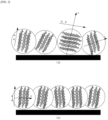
- carbon-based negative electrode active material is oriented or “carbon-based negative electrode active material is aligned” may mean that certain crystal faces (e.g., a-b axis crystal faces of graphite) representing the two-dimensional planar structure of the carbon-based negative electrode active material comprising the negative electrode active material particles are arranged to have a predetermined tilt relative to the surface of the negative electrode current collector, as shown in (b) of FIG. 2 . This may be different from the carbon-based negative electrode active material particles themselves being oriented in a predetermined direction only within the negative electrode active layer and not with respect to the negative electrode current collector, as shown in (a) of FIG. 2 .
- crystal faces e.g., a-b axis crystal faces of graphite
- highly oriented carbon-based negative electrode active material may mean that certain crystal faces (e.g., a-b axis crystal faces of graphite) representing the two-dimensional planar structure of the carbon-based negative electrode active material contained in the negative electrode active layer have a high frequency of having a predetermined tilt relative to the negative electrode current collector surface. It may also mean, in some cases, that the crystal faces of the carbon-based negative electrode active material contained in the negative electrode active layer are arranged at a high angle (e.g., a near-vertical angle, greater than 45°; specifically greater than 60°) relative to the negative electrode current collector surface.
- a high angle e.g., a near-vertical angle, greater than 45°; specifically greater than 60°
- high alignment of the carbon-based negative electrode active material means that the "alignment (O.I.)" referred to herein has a large value, which may mean that certain crystal faces (e.g., a-b axis crystal faces of graphite) representing the two-dimensional planar structure of the carbon-based negative electrode active material contained in the negative electrode active layer are arranged at a low angle (e.g., less than 45°) relative to the surface of the negative electrode current collector.
- certain crystal faces e.g., a-b axis crystal faces of graphite
- low alignment of the carbon-based negative electrode active material may mean that the "degree of alignment (O.I.)" has a small value, such that the crystal faces of the carbon-based negative electrode active material contained in the negative electrode active layer are arranged at a high angle (e.g., an angle close to vertical, greater than 45°; specifically greater than 60°) relative to the surface of the negative electrode current collector.
- a high angle e.g., an angle close to vertical, greater than 45°; specifically greater than 60°
- average particle diameter (D 50 ) means the particle diameter at which the sum value is 50% in the particle diameter distribution of the particles, which is also referred to as the median diameter.
- the present invention provides a magnetic alignment device for a negative electrode, in which a negative electrode slurry comprising a carbon-based negative electrode active material is aligned by applying a magnetic force to a negative electrode sheet applied to a negative electrode current collector, including:
- the magnetic alignment device of a negative electrode refers to a device applied in the manufacture of a negative electrode used in a secondary battery.
- the magnetic alignment device is capable of aligning the carbon-based negative electrode active material contained in the negative electrode slurry in a direction perpendicular to the negative electrode current collector by applying a magnetic field to a surface of the negative electrode current collector to which the negative electrode slurry containing the carbon-based negative electrode active material is applied, that is, to the surface of the negative electrode slurry.
- the magnetic alignment device can control the magnetic field of the traveling negative electrode, that is, the magnet part disposed on the upper and lower portions of the electrode sheet, by measuring the condition of the negative electrode slurry applied to the negative electrode current collector, specifically the thickness of the negative electrode slurry, in real time during the application of the magnetic field. Accordingly, the magnetic alignment device can realize uniform alignment of the carbon-based negative electrode active material contained in the negative electrode slurry, and the negative electrode thus prepared can exhibit the effect of increasing the mobility of the lithium ions and decreasing the resistance during charging and discharging of the battery, thereby improving the charging and discharging performance.
- the crystal faces of the carbon-based negative electrode active material are aligned.
- the carbon-based negative electrode active material is vertically aligned with the negative electrode current collector
- the planar direction of the graphite may have an average tilt of 60 to 120° with respect to the negative electrode current collector, preferably 70 to 110°; or 80 to 100°.
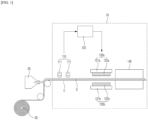
- the magnetic alignment device 10 comprises a first magnet part 120a and a second magnet part 120b arranged at the upper and lower portions, respectively, of the traveling electrode sheet, i.e., the negative electrode current collector C on which the negative electrode slurry S is applied, as shown in FIG. 1 ; a thickness measuring part 110 arranged upstream of the first magnet part 120a and/or the second magnet part 120b relative to the traveling direction of the electrode sheet and measuring the thickness of the negative electrode slurry (S) on the electrode sheet; and a control part 130 that adjusts the separation distance between the first magnet part 120a and the second magnet part 120b according to the thickness of the negative electrode slurry measured by the thickness measuring part.
- the thickness measuring part 110 is located upstream of the first magnet part 120a and/or the second magnet part 120b relative to the traveling direction of the electrode sheet, and serves to measure the thickness of the negative electrode slurry S before the magnetic field applied by the magnet part affects the negative electrode slurry.
- the thickness measuring part 110 may be any means/method conventionally used in the art for measuring the thickness of the negative electrode slurry S, without being particularly limited.
- the thickness measuring part 110 may comprise a non-contact measuring device that can prevent loss and/or change of state of the negative electrode slurry.
- the thickness measuring part 110 may comprise at least one of a confocal meter, a web gauge, and an IR thickness gauge.
- the thickness measuring part 110 may measure the thickness of the negative electrode slurry in real time by arranging two or more non-contact measuring devices in the width direction of the traveling negative electrode slurry S in order to measure the thickness of the negative electrode slurry S more precisely.
- the measured thickness values are sent to the control part, and the average value can be reflected as the thickness of the negative electrode slurry.
- it is advantageous in that the thickness of the negative electrode slurry applied may be measured more precisely using a die coater or the like.
- the thickness measuring part 110 may include two or more non-contact measuring devices along the traveling direction of the electrode sheet.
- the thickness measuring part 110 may comprise a first measuring instrument 111 and a second measuring instrument 112 arranged successively along the traveling direction of the electrode sheet. In this case, the error rate for the thickness of the negative electrode slurry, which is measured in real time, can be lowered.
- the control part 130 may play a role in controlling a separation distance between the first magnet part 120a and the second magnet part 120b.
- the magnetic alignment device 10 may receive the measured thickness of the negative electrode slurry S from the thickness measuring part 110, compare the measured negative electrode slurry thickness with the spacing reference value, recognize the spacing reference value corresponding to the measured negative electrode slurry thickness, and transmit the recognized spacing reference value to the first magnet part 120a and the second magnet part 120b respectively to adjust the separation distance of the first magnet part 120a and the second magnet part 120b.
- the spacing reference value is a value indicating the spacing, i.e., the separation distance, of the first magnet part 120a and the second magnet part 120b according to the thickness of the negative electrode slurry, and this value may be stored in a data base (not shown) provided in the control part 130.
- the spacing reference value may be a value stored in the database by obtaining data on the spacing distance between the first magnet part 120a and the second magnet part 120b according to the thickness of the negative electrode slurry S using a conventionally installed prior measurement device, and selectively selecting only the data in which the alignment of the carbon-based negative electrode active material contained in the negative electrode slurry is most effectively realized among the obtained data.
- the negative electrode slurry S may have a different content of carbon-based negative electrode active material, depending on the density (or concentration) of carbon-based negative electrode active material contained in the negative electrode slurry, even for the same thickness.
- the content of the carbon-based negative electrode active material affects the alignment of the crystal faces with respect to the negative electrode current collector C, so that the magnetic field strength can be adjusted according to the content during the alignment.
- the database may further include information on the separation distance of the first magnet part 120a and the second magnet part 120b according to the thickness of the negative electrode slurry S, as well as information on the density (or concentration) of the carbon-based negative electrode active material in the negative electrode slurry by the thickness of the negative electrode slurry S for correcting the thickness of the negative electrode slurry.
- the spacing reference value stored in the database may be a value reflecting the data on the density (or concentration) of the carbon-based negative electrode active material in the negative electrode slurry stored in the database, since the density (or concentration) of the carbon-based negative electrode active material may affect the magnetic field strength for compensation for the thickness of the negative electrode slurry S as mentioned above.
- the first magnet part 120a and the second magnet part 120b are arranged at the upper and lower portions of the traveling electrode sheet, respectively, to play a role in applying a magnetic field to the surface of the negative electrode slurry S.
- the first magnet part 120a and the second magnet part 120b may include magnets 122a and 122b, respectively, for applying a magnetic field to the surface of the negative electrode slurry S, and means 121a and 121b for adjusting a spacing, i.e., a separation distance, between them by performing a lifting movement on the upper and lower portions of the negative electrode slurry, respectively.
- the first magnet part 120a and the second magnet part 120b may each include single permanent magnets 122a and 122b arranged in the width direction of the traveling negative electrode slurry; a support part (not shown) on which the magnets are fixed; and distance adjustment means 121a and 121b connected to the support part, which induce a lifting movement of the support part (or a lifting movement of the single magnet) in a direction perpendicular to the traveling electrode sheet.
- the distance adjustment means 121a and 121b may receive a spacing reference value from the control part 130 and operate to adjust the separation distance of the first magnet part 120a and the second magnet part 120b in accordance with the received spacing reference value.
- the first magnet part 120a and the second magnet part 120b can facilitate controlling the intensity of the magnetic field applied to the negative electrode slurry S by adjusting their separation distance. That is, the first magnet part 120a and the second magnet part 120b can increase the intensity of the magnetic field applied to the negative electrode slurry S as the separation distance decreases, and decrease the intensity of the magnetic field applied to the negative electrode slurry S as the separation distance increases.
- first magnet part 120a and the second magnet part 120b may be positioned in the width direction of the negative electrode slurry S so as to face each other, and may be arranged to have opposite poles.
- the N pole of the first magnet 122a of the first magnet part 120a and the S pole of the second magnet part 120b may be facing each other, or the S pole of the first magnet 122a of the first magnet part 120a and the N pole of the second magnet 122b of the second magnet part 120b may be facing each other.
- the first magnet part 120a may be arranged at the upper portion of the traveling electrode sheet, but a Halbach arrangement may be applied to the first single permanent magnet 122a to apply a high magnetic field to the carbon-based negative electrode active material of the negative electrode slurry S.
- the Halbach arrangement is a permanent magnet arrangement that can provide a magnet with a high magnetic field strength by gradually changing the magnetization direction of the magnet.
- a magnet having a Halbach arrangement is applied as the magnet 122a of the first magnet part 120a, it is advantageous to be able to adjust the intensity of the magnetic field applied to the negative electrode slurry S without significantly changing the separation distance between the first magnet part 120a and the second magnet part 120b.
- the separation distance of the first magnet part 120a and the second magnet part 120b may be 10 mm to 50 mm, more specifically, 10 mm to 40 mm; 20 mm to 50 mm; or 15 mm to 45 mm, and the separation distance of the first magnet part 120a and the second magnet part 120b may be the same as the separation distance of the first single permanent magnet 122a and the second single permanent magnet 122b.
- the present invention can perform alignment of the carbon-based negative electrode active material contained in the negative electrode slurry S more efficiently.
- the magnetic alignment device 10 may further include a drying part 140 for drying the negative electrode slurry S in which the carbon-based negative electrode active material is aligned by the first magnet part 120a and the second magnet part 120b.
- the drying part 140 is formed by including a wall body (not shown) that blocks the periphery except for the take in and take out of the electrode sheet to which the slurry S is applied, and a dryer (not shown) for drying the electrode sheet on the wall of the side from which the electrode sheet to which the electrode slurry is applied is taken out.
- the wall is preferably made of an insulating material to prevent the transfer of internal energy to the outside, resulting in heat loss.
- the dryer may be configured to perform a two step drying process in order to maintain the alignment of the carbon-based negative electrode active material contained within the negative electrode active layer.
- the dryer may include a first dryer for drying the negative electrode slurry using light and a second dryer for drying the negative electrode slurry using heat, wherein the first dryer and the second dryer may operate continuously to dry the negative electrode slurry.
- the first dryer may be a device for drying the negative electrode slurry, and may irradiate the surface of the negative electrode slurry with light or wavelengths as described above.
- drying the negative electrode slurry may be accomplished by applying hot air at a high temperature.
- this requires a long drying time for the negative electrode slurry, which can disturb the alignment of the carbon-based negative electrode active materials in the negative electrode slurry.
- the temperature of the hot air is increased to solve this problem, the tendency of drying on the surface of the slurry increases, so that the binder is concentrated on the surface of the slurry by the volatilizing solvent, and migration occurs, which reduces the adhesion strength of the active material layer and the negative electrode current collector.
- the present invention can be configured to dry the electrode slurry by irradiating energy in the form of light or wavelengths using a first dryer to dry the negative electrode slurry while maintaining a high degree of alignment of the carbon-based negative electrode active material without these problems.
- a first dryer may include, for example, an ultraviolet dryer, a near-infrared dryer, a far-infrared dryer, or the like, and may include, in particular, a far-infrared dryer that emits energy with a wavelength of 1 ⁇ m or more, more specifically 5 ⁇ m or more, 10 ⁇ m or more, or 20 ⁇ m or more, to achieve a uniform drying rate of the electrode slurry.
- the far-infrared dryer has high energy efficiency due to its long light or wavelength. Furthermore, the far-infrared dryer has the advantage of being able to apply energy uniformly not only to the surface of the negative electrode slurry but also to its interior, thereby increasing the adhesion between the negative electrode slurry and the negative electrode current collector in a short time.
- the first dryer may emit energy at an output density of 50 kW/m 2 to 1,000 kW/m 2 , and more specifically, may emit energy at an output density of 50 kW/m 2 to 500 kW/m 2 ; of 50 kW/m 2 to 250 kW/m 2 ; or of 50 kW/m 2 to 200 kW/m 2 .
- the present invention can prevent an excessive power density from inducing uneven drying of the active material layer.
- the second dryer may apply heat to the negative electrode slurry that has been pre-dried by light or wavelength to ensure uniform complete drying.
- Such second dryers may include, without limitation, those conventionally applied in the art, but may include, in particular, hot air dryers, vacuum ovens, and the like, either singly or in combination.
- the magnetic alignment device having the above-described configuration, can reflect the state of the negative electrode slurry in real time to uniformly guide the alignment of the carbon-based negative electrode active material therein, so that the produced negative electrode can show the effect of increasing the mobility of lithium ions and decreasing the resistance during charging and discharging of the battery, thereby improving the charging and discharging performance.
- the present invention also provides, in one embodiment, a method of manufacturing negative electrode.
- the method of manufacturing negative electrode comprises,
- the method of manufacturing a negative electrode according to the present invention may include applying a negative electrode slurry comprising a carbon-based negative electrode active material on a negative electrode current collector, and applying a magnetic field to a surface of the applied negative electrode slurry using a magnetic alignment device of the present invention described above to align the carbon-based negative electrode active material in the negative electrode slurry perpendicular to the surface of the negative electrode current collector (or to the traveling direction of the electrode sheet). Furthermore, the above method may be followed by subsequent drying of the negative electrode slurry to form a negative electrode active layer in which the vertical alignment of the carbon-based negative electrode active material is maintained.
- the method of manufacturing the negative electrode may utilize the magnetic alignment device described above to reflect the state of the negative electrode slurry, specifically the thickness, in real time to uniformly guide the alignment of the carbon-based negative electrode active material therein, so that the manufactured negative electrode may exhibit the effect of increasing the mobility of lithium ions and decreasing the resistance during charging and discharging of the battery, thereby improving the charging and discharging performance.
- applying the negative electrode slurry to the negative electrode current collector and drying the negative electrode slurry may be performed in a manner conventionally applied in the art.
- applying the negative electrode slurry in applying the negative electrode slurry may be applied to have a certain range of thickness considering the alignment efficiency of the carbon-based negative electrode active material contained in the negative electrode slurry and the drying efficiency of the negative electrode slurry.
- the negative electrode slurry may be applied with a thickness of 50 ⁇ m to 500 ⁇ m, more specifically 50 ⁇ m to 400 ⁇ m; 50 ⁇ m to 300 ⁇ m; 80 ⁇ m to 250 ⁇ m; 100 ⁇ m to 200 ⁇ m; 100 ⁇ m to 180 ⁇ m; or 110 ⁇ m to 180 ⁇ m.
- the application condition of the magnetic field may be adjusted to increase the alignment efficiency of the carbon-based negative electrode active material.
- the degree of alignment of the carbon-based negative electrode active material may be controlled by a magnetic field strength, an application time, or the like.
- the magnetic field may be applied with a magnetic field strength of 0.5 to 2.0 T, and more specifically, the magnetic field may be applied with a magnetic field strength of 0.9 to 1.5 T; 1.0 to 1.4 T; or 1.0 to 1.2 T.
- the magnetic field may be applied for a time period of 0.1 to 20 seconds, more specifically, for a time period of 0.5 to 15 seconds; 0.5 to 12 seconds; 1 to 10 seconds; or 2 to 8 seconds.
- the present invention provides, in one embodiment, a negative electrode manufactured using a magnetic alignment device according to the present invention as described above.
- the negative electrode for a lithium secondary battery includes a negative electrode active layer comprising a carbon-based negative electrode active material on both sides of the negative electrode current collector.
- the negative electrode active layer is a layer that embodies the electrical activity of the negative electrode, and is prepared by applying an electrode slurry comprising a negative electrode active material that realizes an electrochemical redox reaction during charging and discharging of the battery to both sides of the negative electrode current collector, and then drying and rolling it.
- the negative electrode active layer includes a carbon-based negative electrode active material as the negative electrode active material to realize electrical activity through a reversible oxidation-reduction reaction during charging and discharging of the battery.
- the carbon-based negative electrode active material refers to a material having carbon atoms as a main component, and such a carbon-based negative electrode active material may include graphite.
- the graphite may comprise one or more of natural graphite, synthetic graphite, but preferably natural graphite, or a mixture of natural graphite and synthetic graphite.
- the carbon-based negative electrode active material may include natural or synthetic graphite alone, or in some cases, a mixture of natural and synthetic graphite. In this case, the mixture ratio of natural graphite to artificial graphite based on weight may be 5-40:60-95, or 10-30:70-90.
- the carbon-based negative electrode active material can solidify the adhesion of the negative electrode active layer to the negative electrode current collector and realize a high orientation of the carbon-based negative electrode active material to the surface of the negative electrode current collector.
- the carbon-based negative electrode active material is preferably a spherical graphite assembly formed by aggregation of a plurality of flake graphite.
- the flake graphite can be natural graphite, artificial graphite, mesophase calcined carbon (bulk mesophase) made from tar and pitch, graphitized cokes (raw coke, green coke, pitch coke, needle coke, petroleum coke, etc.), and the like, and in particular, it is preferred to be assembled using a plurality of highly crystalline natural graphite.
- one graphite assembly may be formed from 2 to 100 pieces of flake-shaped graphite, preferably 3 to 20 pieces.
- Such carbon-based negative electrode active material may have a spherical particle shape, wherein the sphericity of the graphite particles may be 0.75 or more, such as 0.75 to 1.0; 0.75 to 0.95; 0.8 to 0.95; or 0.90 to 0.99.
- sphericity may mean the ratio of the shortest diameter (short diameter) to the longest diameter (long diameter) of any diameter passing through the center of the particle, wherein a sphericity of 1 means that the shape of the particle is spherical.
- the sphericity may be measured by a particle shape analyzer.
- the present invention has the advantage that by realizing the shape of the carbon-based negative electrode active material close to a spherical shape, the electrical conductivity of the negative electrode active layer can be realized high, thereby improving the capacity of the battery, and the specific surface area of the negative electrode active material can be increased, thereby improving the adhesion between the negative electrode active layer and the current collector.
- the carbon-based negative electrode active material may exhibit an average particle diameter (D 50 ) of 0.5 ⁇ m to 10 ⁇ m, and more specifically, may exhibit an average particle diameter (D 50 ) of 2 ⁇ m to 7 ⁇ m; 0.5 ⁇ m to 5 ⁇ m; or 1 ⁇ m to 3 ⁇ m.
- the average particle size of spherical natural graphite can be advantageous to have a smaller particle size to maximize the degree of disorder in the swelling direction for each particle to prevent the particles from swelling due to the charging of lithium ions.
- the particle size of natural graphite is less than 0.5 ⁇ m, a large amount of binder is required due to the increase in the number of particles per unit volume, and the degree of sphericity and the yield of sphericity may be lowered.
- the maximum particle diameter exceeds 10 ⁇ m, the swelling becomes severe, and the binding capability between particles and the binding capability between particles and current collector decreases with repeated charging and discharging, which can significantly reduce the cycle characteristics.
- a negative electrode active layer comprising such a carbon-based negative electrode active material can have a controlled degree of alignment of the carbon-based negative electrode active material. By aligning the crystal face of the carbon-based negative electrode active material contained in the negative electrode active layer in a certain direction, the present invention can lower the electrode resistance, thereby further improving the charging performance of the negative electrode active layer.
- the degree of alignment (i.e., orientation) of the carbon-based negative electrode active material can be determined by analyzing the crystal faces of graphite.
- the crystal face orientation of the carbon-based negative electrode active material which will be an indicator of the extent to which the crystal structure of the spherical carbon-based negative electrode active material is arranged in a certain orientation, specifically perpendicular to the surface of the negative electrode current collector, when measured by X-ray diffraction, can be determined by crystal plane analysis of the carbon-based negative electrode active material, such as X-ray diffraction spectroscopy.
- the orientation index (O.I) of the carbon-based negative electrode active material represented by Equation 1 can be an indicator of the direction in which the crystal structure of the carbon-based negative electrode active material is aligned during X-ray diffraction measurements, specifically, the degree to which the a-b axis crystal planes representing the two-dimensional planar structure of the carbon-based negative electrode active material are aligned with respect to the negative electrode current collector surface.
- the negative electrode active layer comprises graphite as a carbon-based negative electrode active material
- graphene layers are placed on the a- and b-axis planes, and these graphene layers are stacked along the c-axis to form a hexagonal or rhombohedral crystal structure.
- X-ray diffraction was measured using a CuK ⁇ -ray as the target line, and to improve the peak intensity resolution, the target line was extracted with a monochromator device.
- the degree of alignment may mean that the angle or tilt of the graphite layer surface with respect to the negative electrode current collector surface is close to 90° when the value is close to 0, and the tilt with respect to the negative electrode current collector surface is close to 0° or 180° when the value is larger.
- the negative electrode active layer according to the present invention may have a lower degree of alignment (O.I) of graphite compared to the case where no magnetic field is applied, since the carbon-based negative electrode active material is vertically aligned with respect to the negative electrode current collector.
- the alignment of the carbon-based negative electrode active material in the negative electrode active layer may be from 0.1 to 5.0, and more specifically, from 0.1 to 4.5; 0.1 to 4.0; 0.1 to 3.5; 0.1 to 3.0; 0.1 to 2.5; 0.1 to 2.0; 0.1 to 1.0; 0.5 to 2.9; 1.0 to 4.5; 1.1 to 4.1; 1.5 to 4. 0; 1.1 to 3.5; 1.5 to 3.0; 0.9 to 2.9; 0.1 to 2.4; 0.1 to 2.1; 0.1 to 1.9; 2.0 to 5.0; 2.0 to 4.0; 2.1 to 3.9; 2.5 to 3. 9; 3.1 to 4.5; 0.1 to 0.6; 0.15 to 0.6; 0.15 to 0.5; 0.2 to 0.5; 0.2 to 0.4; 0.25 to 0.45; or 0.3 to 0.5.
- NXAFS near-field X-ray fluorescence spectrometer
- the near edge X-ray absorption spectrum also called the near edge X-ray absorption fine structure (NEXAFS) spectrum, is the absorption spectrum observed as the electrons in the occupied valence level (1s orbital) of the carbon atom (K-angle valence electrons) absorb the energy of the irradiated X-rays and are excited to various vacant levels.
- NXAFS near edge X-ray absorption fine structure
- the vacant levels at which the core electrons are excited include, in natural graphite, the ⁇ * level, which is attributed to the antibonding orbital of sp2 bond reflecting the crystallinity (basal or oriented, etc.), the ⁇ * level, which is attributed to the antibonding orbital of sp3 bond reflecting the disorder of the crystallinity (edges or undirected, etc.), or the vacant levels which is attributed to the anti-bonding orbitals such as C-H bonds or C-O bonds.
- a plane of the hexagonal network (AB plane in the following) is a basal plane, and a plane where the ends of the hexagonal network appear is the edge plane.
- near-field NEXAFS spectra can only reflect the surface structure of the measured graphite particles, in addition to reflecting the local structure in the vicinity of carbon atoms containing excited valence electrons. Therefore, by utilizing near-field NEXAFS spectra, the present invention can measure the crystal state (orientation) of graphite, a carbon-based negative electrode active material that forms spherical particles.
- the measurement of the near-field NEXAFS spectrum can be performed by an all-electron quantitative method in which the sample is irradiated with radiation light at a fixed incidence angle with respect to the sample, and the energy of the irradiated radiation light is injected from 280 eV to 320 eV, while measuring the sample current flowing in the sample to compensate for the photoelectrons emitted from the sample.
- the present invention can measure the degree of alignment (S 60/0 ) shown in Equation 2 to more quantitatively measure the degree of alignment of the carbon-based negative electrode active material contained in the negative electrode active layer.
- highly oriented graphite e.g., HOPG, single crystal graphite
- has highly aligned graphite crystals that form sp2 bonds near the surface so changing the angle of incidence of the radiation on the sample significantly changes the spectral shape.
- a low-orientation sidelobe e.g., a non-graphitic carbon vapor deposition film
- a low-orientation sidelobe has a low orientation of the carbon material forming the sp2 bonds near the surface, so the spectral shape changes little when the angle of incidence of the radiation to the sample is changed.
- the ratio (I B/A ) of any first absorption peak intensity (I A ) to any second absorption peak intensity (I B ) may vary with the incident angle, which may indicate that the carbon-based negative electrode active materials contained in the measured negative electrode active layer are regularly arranged (i.e., highly oriented).
- the ratio I does not change with the angle of incidence, it may mean that the carbon-based negative electrode active materials in the measured negative electrode active layer are irregularly arranged (i.e., low-oriented).
- NEXAFS near-field X-ray fluorescence spectroscopy
- S 60/0 may mean that the closer to 1, the lower the alignment of the graphite crystal, and the closer to 0, the higher the alignment of the graphite crystal.
- the negative electrode active layer according to the present invention may satisfy the value (S 60/0 ) according to Equation 2 as 1.0 or less, more specifically as 0.9 or less, 0.8 or less, 0.7 or less, 0.1 to 0.7; or 0.3 to 0.7.
- the negative electrode active layer may uniformly induce a vertical alignment of the carbon-based negative electrode active material with respect to the negative electrode current collector such that the alignment degree deviation of the plurality of carbon-based negative electrode active materials arbitrarily measured in a unit area is low.
- the negative electrode active layer according to the present invention may have a deviation of the degree of alignment of the carbon-based negative electrode active material represented by Equation 2 from the average value of less than 5% when measured by near-end X-ray fluorescence spectroscopy (NEXAFS) for any three points present in a unit area (10 cm ⁇ 10 cm) of the negative electrode active layer, and may be less than 4%, less than 3%, less than 2%, or less than 1%.
- NXAFS near-end X-ray fluorescence spectroscopy
- the negative electrode active layer according to the present invention may optionally further include, in addition to the negative electrode active material, a conductor, a binder, and other additives, etc. as needed.
- the conductor may include one or more types of carbon black, acetylene black, ketjen black, carbon nanotubes, carbon fibers, and the like, but is not limited thereto.
- the negative electrode active layer may contain carbon nanotubes or carbon fibers as a conductor alone or in combination.
- the content of the conductor may be from 0.1 to 10 parts by weight, more specifically from 0.1 to 8 parts by weight, from 0.1 to 5 parts by weight, from 0.1 to 3 parts by weight, or from 2 to 6 parts by weight, based on a total of 100 parts by weight of the negative electrode active layer.
- the present invention can prevent the resistance of the negative electrode from increasing due to a low content of the conductor, thereby reducing the charging capacity.
- the present invention can prevent the content of the negative electrode active material from decreasing due to an excessive amount of the conductor, resulting in a decrease in the charging capacity, or a decrease in the fast charging characteristics due to an increase in the loading amount of the negative electrode active layer.
- the binder can be appropriately applied as a component that assists in the bonding of the active material and the conductor and the bonding to the current collector to the extent that it does not degrade the electrical properties of the electrode, and may include one or more among vinylidene fluoride-hexafluoropropylene copolymer (PVDF-co-HFP), polyvinylidenefluoride (PVdF), and polyacrylonitrile, polymethylmethacrylate, polyvinyl alcohol, carboxymethyl cellulose (CMC), starch, hydroxypropyl cellulose, regenerated cellulose, polyvinylpyrrolidone, tetrafluoroethylene, polyethylene, polypropylene, polyacrylic acid, ethylene-propylene-diene monomer, sulfonated ethylene-propylene-diene monomer, styrene butadiene rubber, and fluorinated rubber.
- PVDF-co-HFP vinylidene fluoride-hexafluoropropy
- the content of the binder may be from 0.1 to 10 parts by weight, more particularly from 0.1 to 8 parts by weight, from 0.1 to 5 parts by weight, from 0.1 to 3 parts by weight, or from 2 to 6 parts by weight, based on a total of 100 parts by weight of the negative electrode active layer.
- the present invention can prevent the adhesive strength of the active layer from being reduced due to a low content of binder or the electrical properties of the electrode from being reduced due to an excess of binder.
- the negative electrode current collector is not particularly limited as long as it has a high conductivity without causing chemical changes in the battery, and for example, copper, stainless steel, nickel, titanium, calcined carbon, and the like can be used, and in the case of copper or stainless steel, a surface treatment with carbon, nickel, titanium, silver, and the like can also be used.
- the average thickness of the negative electrode current collector may be appropriately applied from 1 to 500 ⁇ m in consideration of the conductivity and total thickness of the negative electrode to be prepared.
- a negative electrode for a lithium secondary battery was manufactured using the magnetic alignment device of the present invention having a structure as shown in FIG. 1 , but the number of non-contact measuring devices introduced in the thickness measuring part was adjusted as shown in Table 1.
- natural graphite was first used to prepare the negative electrode active material, and 97 parts by weight of the negative electrode active material and 3 parts by weight of styrene butadiene rubber (SBR) were mixed with water to form a negative electrode slurry, and then the negative electrode slurry was cast on a copper sheet that was being transported in a roll-to-roll transfer (transfer speed: 3 m/min) using a die coater.
- SBR styrene butadiene rubber
- the negative electrode slurry was cast on the copper sheet for 20 seconds so that the average thickness of the applied negative electrode slurry was 100 ⁇ m, and the negative electrode slurry was cast on the copper sheet for 20 seconds so that the average thickness of the successively applied negative electrode slurry was 200 ⁇ m.
- the thickness measuring part included a confocal meter as a non-contact measuring instrument, and the number of confocal meters included was indicated in Table 1 below along the direction of travel of the copper sheet. Further, the thickness of the negative electrode slurry measured by the thickness measuring part was transmitted to the control part, and the control part recognized the measured negative electrode slurry thickness and the corresponding spacing reference value by comparing it with the spacing reference value stored in the database, and transmitted the recognized spacing reference value to the first magnet part and the second magnet part, respectively.
- the first magnet part and the second magnet part adjusted the distance adjustment means to adjust the separation distance of the first unit permanent magnet and the second unit permanent magnet fixed on the support part to the spacing reference value transmitted from the control part.
- the separation distance between the first unit permanent magnet and the second unit permanent magnet was adjusted from 20 to 40 mm according to the spacing reference value transmitted from the control part, and the intensity of the applied magnetic field was 1.0T.
- a negative electrode for a lithium secondary battery was prepared by drying the negative electrode slurry by moving a copper sheet with a magnetic field applied to the negative electrode slurry to the drying part.
- a negative electrode for a lithium secondary battery was prepared by performing the same method as in Example 1, except that a magnetic alignment device that does not include a thickness measurement part and a control part was used. In this case, the separation distance between the first unit permanent magnet of the first magnet part and the second unit permanent magnet of the second magnet part was adjusted to 30 mm.
- a first unit area (10 cm ⁇ 10 cm) existing within the casting area with an average thickness of the negative electrode slurry of 100 ⁇ m, and ii) a second unit area (10 cm ⁇ 10 cm) existing within the casting area with an average thickness of the negative electrode slurry of 100 ⁇ m were arbitrarily set.
- X-ray diffraction spectroscopy X-ray diffraction spectroscopy
- NXAFS near-end X-ray fluorescence spectroscopy
- NAFS near-end X-ray fluorescence spectroscopy
- XRD X-ray diffraction
- S 60 / 0 I 60 B / A I 0 B / A in Equation 2, S 60/0 represents a value of a ratio of a ratio of the peak intensity (I60 B/A ) at an incidence angle of 60° to a ratio of a peak intensity (I0 B/A ) at an incidence angle of 0° in the near-field X-ray fluorescence spectrometer (NEXAFS) measurement.
- NXAFS near-field X-ray fluorescence spectrometer
- the negative electrode prepared using the magnetic alignment device according to the present invention was found to have a high degree of alignment of the carbon-based negative electrode active material contained in the negative electrode active layer.
- the negative electrode active layer of the prepared negative electrode was found to have a low error rate of 3% or less of the degree of alignment of any three points and the average value thereof. This means that the magnetic alignment device according to the present invention aligns the carbon-based negative electrode active material uniformly on the negative electrode current collector with a high degree of alignment.
- the magnetic alignment device can align the carbon-based negative electrode active material uniformly on the negative electrode current collector with a high degree of alignment by measuring the thickness of the negative electrode slurry in real time and reflecting it in the spacing between the first and second magnet parts.
Landscapes
- Chemical & Material Sciences (AREA)
- Engineering & Computer Science (AREA)
- Chemical Kinetics & Catalysis (AREA)
- Electrochemistry (AREA)
- General Chemical & Material Sciences (AREA)
- Manufacturing & Machinery (AREA)
- Physics & Mathematics (AREA)
- Materials Engineering (AREA)
- General Physics & Mathematics (AREA)
- Electromagnetism (AREA)
- Power Engineering (AREA)
- Inorganic Chemistry (AREA)
- Battery Electrode And Active Subsutance (AREA)
- Application Of Or Painting With Fluid Materials (AREA)
- Coating Apparatus (AREA)
- Carbon And Carbon Compounds (AREA)
Applications Claiming Priority (2)
| Application Number | Priority Date | Filing Date | Title |
|---|---|---|---|
| KR1020220116200A KR20240037551A (ko) | 2022-09-15 | 2022-09-15 | 음극용 자성 정렬 장치 및 이를 이용한 음극의 제조방법 |
| PCT/KR2023/013692 WO2024058537A1 (ko) | 2022-09-15 | 2023-09-13 | 음극용 자성 정렬 장치 및 이를 이용한 음극의 제조방법 |
Publications (2)
| Publication Number | Publication Date |
|---|---|
| EP4447149A1 true EP4447149A1 (de) | 2024-10-16 |
| EP4447149A4 EP4447149A4 (de) | 2025-05-21 |
Family
ID=90275565
Family Applications (1)
| Application Number | Title | Priority Date | Filing Date |
|---|---|---|---|
| EP23865834.8A Pending EP4447149A4 (de) | 2022-09-15 | 2023-09-13 | Magnetismus-ausrichtungsvorrichtung für negative elektroden und verfahren zur herstellung von negativen elektroden damit |
Country Status (6)
| Country | Link |
|---|---|
| US (1) | US20250070109A1 (de) |
| EP (1) | EP4447149A4 (de) |
| JP (1) | JP7701127B2 (de) |
| KR (1) | KR20240037551A (de) |
| CN (1) | CN118511310A (de) |
| WO (1) | WO2024058537A1 (de) |
Families Citing this family (1)
| Publication number | Priority date | Publication date | Assignee | Title |
|---|---|---|---|---|
| CN222984795U (zh) * | 2024-07-22 | 2025-06-17 | 比亚迪股份有限公司 | 极片制备装置和极片 |
Family Cites Families (11)
| Publication number | Priority date | Publication date | Assignee | Title |
|---|---|---|---|---|
| JP3625137B2 (ja) * | 1998-08-05 | 2005-03-02 | 富士写真フイルム株式会社 | 磁気記録媒体の配向装置 |
| JP2004220926A (ja) | 2003-01-15 | 2004-08-05 | Matsushita Electric Ind Co Ltd | 非水電解質二次電池用負極 |
| US9673453B2 (en) * | 2010-12-06 | 2017-06-06 | Toyota Jidosha Kabushiki Kaisha | Method for manufacturing lithium ion secondary battery |
| US9166247B2 (en) * | 2011-02-18 | 2015-10-20 | Toyota Jidosha Kabushiki Kaisha | Lithium-ion secondary cell and method for manufacturing same |
| CN102306750B (zh) * | 2011-08-19 | 2015-11-25 | 东莞新能源科技有限公司 | 锂离子电池负极片的制备方法及涂膜干燥装置 |
| DE112011105960T5 (de) | 2011-12-14 | 2014-09-25 | Toyota Jidosha Kabushiki Kaisha | Nichtwässrige Elektrolytsekundärbatterie und Verfahren zum Herstellen einer negativen Elektrode für eine Sekundärbatterie |
| CH712877A2 (de) | 2016-09-06 | 2018-03-15 | Battrion Ag | Verfahren und Einrichtung zur kontinuierlichen Applizierung magnetischer Felder auf einen Gegenstand. |
| KR102484406B1 (ko) * | 2016-11-01 | 2023-01-02 | 삼성에스디아이 주식회사 | 리튬 이차 전지용 음극 및 이를 포함하는 리튬 이차 전지 |
| KR102417267B1 (ko) | 2016-11-02 | 2022-07-04 | 삼성에스디아이 주식회사 | 리튬 이차 전지 |
| KR20220116200A (ko) | 2019-12-13 | 2022-08-22 | 도요보 가부시키가이샤 | 2축 배향 폴리에스테르 필름 및 그 제조 방법 |
| KR102527051B1 (ko) | 2020-11-02 | 2023-05-02 | 에스케이온 주식회사 | 리튬 이차 전지용 음극, 그 제조방법 및 이를 포함하는 리튬 이차전지 |
-
2022
- 2022-09-15 KR KR1020220116200A patent/KR20240037551A/ko active Pending
-
2023
- 2023-09-13 EP EP23865834.8A patent/EP4447149A4/de active Pending
- 2023-09-13 JP JP2024540618A patent/JP7701127B2/ja active Active
- 2023-09-13 CN CN202380016412.1A patent/CN118511310A/zh active Pending
- 2023-09-13 WO PCT/KR2023/013692 patent/WO2024058537A1/ko not_active Ceased
- 2023-09-13 US US18/728,199 patent/US20250070109A1/en active Pending
Also Published As
| Publication number | Publication date |
|---|---|
| CN118511310A (zh) | 2024-08-16 |
| JP7701127B2 (ja) | 2025-07-01 |
| WO2024058537A1 (ko) | 2024-03-21 |
| JP2025502009A (ja) | 2025-01-24 |
| EP4447149A4 (de) | 2025-05-21 |
| US20250070109A1 (en) | 2025-02-27 |
| KR20240037551A (ko) | 2024-03-22 |
Similar Documents
| Publication | Publication Date | Title |
|---|---|---|
| EP4418353A1 (de) | Magnetismus-ausrichtungsvorrichtung für negative elektroden und verfahren zur herstellung einer negativen elektrode damit | |
| EP4421900A1 (de) | Negativelektrode für lithiumsekundärbatterie und magnetische ausrichtungsvorrichtung für negativelektrode dafür | |
| EP4421901A1 (de) | Magnetische ausrichtungsvorrichtung für anode und anodenherstellungsverfahren damit | |
| EP4447149A1 (de) | Magnetismus-ausrichtungsvorrichtung für negative elektroden und verfahren zur herstellung von negativen elektroden damit | |
| EP4443548A1 (de) | Magnetismus-ausrichtungsvorrichtung für negative elektroden und verfahren zur herstellung von negativen elektroden damit | |
| EP4447150A1 (de) | Magnetismus-ausrichtungsvorrichtung für negative elektroden und verfahren zur herstellung von negativen elektroden damit | |
| EP4447163A1 (de) | Negativelektrode für lithiumsekundärbatterie und lithiumsekundärbatterie damit | |
| EP4443539A1 (de) | Negativelektrode für lithiumsekundärbatterie und lithiumsekundärbatterie damit | |
| EP4447151A1 (de) | Magnetismus-ausrichtungsvorrichtung für negative elektroden und verfahren zur herstellung von negativen elektroden damit | |
| KR20240038296A (ko) | 음극용 자성 정렬 장치 및 이를 이용한 음극의 제조방법 | |
| EP4443564A1 (de) | Negativelektrode für lithiumsekundärbatterie und lithiumsekundärbatterie damit | |
| EP4478433A1 (de) | Negativelektrodenfolie, sekundärbatterie und elektrische vorrichtung | |
| EP4451410A1 (de) | Elektrodenanordnung vom wickeltyp und lithiumsekundärbatterie damit | |
| KR20240038566A (ko) | 리튬 이차전지용 음극 및 이를 포함하는 리튬 이차전지 |
Legal Events
| Date | Code | Title | Description |
|---|---|---|---|
| STAA | Information on the status of an ep patent application or granted ep patent |
Free format text: STATUS: THE INTERNATIONAL PUBLICATION HAS BEEN MADE |
|
| PUAI | Public reference made under article 153(3) epc to a published international application that has entered the european phase |
Free format text: ORIGINAL CODE: 0009012 |
|
| STAA | Information on the status of an ep patent application or granted ep patent |
Free format text: STATUS: REQUEST FOR EXAMINATION WAS MADE |
|
| 17P | Request for examination filed |
Effective date: 20240709 |
|
| AK | Designated contracting states |
Kind code of ref document: A1 Designated state(s): AL AT BE BG CH CY CZ DE DK EE ES FI FR GB GR HR HU IE IS IT LI LT LU LV MC ME MK MT NL NO PL PT RO RS SE SI SK SM TR |
|
| A4 | Supplementary search report drawn up and despatched |
Effective date: 20250422 |
|
| RIC1 | Information provided on ipc code assigned before grant |
Ipc: H01M 10/04 20060101ALI20250414BHEP Ipc: H01M 4/02 20060101ALI20250414BHEP Ipc: G01B 21/08 20060101ALI20250414BHEP Ipc: H01F 7/02 20060101ALI20250414BHEP Ipc: H01M 4/583 20100101ALI20250414BHEP Ipc: H01M 4/04 20060101ALI20250414BHEP Ipc: H01M 4/133 20100101ALI20250414BHEP Ipc: H01M 4/1393 20100101AFI20250414BHEP |
|
| STAA | Information on the status of an ep patent application or granted ep patent |
Free format text: STATUS: EXAMINATION IS IN PROGRESS |
|
| 17Q | First examination report despatched |
Effective date: 20250724 |
|
| DAV | Request for validation of the european patent (deleted) | ||
| DAX | Request for extension of the european patent (deleted) |