EP4442994A2 - Verfahren zum transport eines windenergieanlagenturms - Google Patents
Verfahren zum transport eines windenergieanlagenturms Download PDFInfo
- Publication number
- EP4442994A2 EP4442994A2 EP22900731.5A EP22900731A EP4442994A2 EP 4442994 A2 EP4442994 A2 EP 4442994A2 EP 22900731 A EP22900731 A EP 22900731A EP 4442994 A2 EP4442994 A2 EP 4442994A2
- Authority
- EP
- European Patent Office
- Prior art keywords
- tower
- towers
- segments
- segment
- manufacturing
- Prior art date
- Legal status (The legal status is an assumption and is not a legal conclusion. Google has not performed a legal analysis and makes no representation as to the accuracy of the status listed.)
- Pending
Links
Images
Classifications
-
- F—MECHANICAL ENGINEERING; LIGHTING; HEATING; WEAPONS; BLASTING
- F03—MACHINES OR ENGINES FOR LIQUIDS; WIND, SPRING, OR WEIGHT MOTORS; PRODUCING MECHANICAL POWER OR A REACTIVE PROPULSIVE THRUST, NOT OTHERWISE PROVIDED FOR
- F03D—WIND MOTORS
- F03D13/00—Assembly, mounting or commissioning of wind motors; Arrangements specially adapted for transporting wind motor components
- F03D13/40—Arrangements or methods specially adapted for transporting wind motor components
-
- F—MECHANICAL ENGINEERING; LIGHTING; HEATING; WEAPONS; BLASTING
- F03—MACHINES OR ENGINES FOR LIQUIDS; WIND, SPRING, OR WEIGHT MOTORS; PRODUCING MECHANICAL POWER OR A REACTIVE PROPULSIVE THRUST, NOT OTHERWISE PROVIDED FOR
- F03D—WIND MOTORS
- F03D13/00—Assembly, mounting or commissioning of wind motors; Arrangements specially adapted for transporting wind motor components
- F03D13/10—Assembly of wind motors; Arrangements for erecting wind motors
- F03D13/112—Assembly of wind motors; Arrangements for erecting wind motors of towers; of masts
-
- E—FIXED CONSTRUCTIONS
- E04—BUILDING
- E04H—BUILDINGS OR LIKE STRUCTURES FOR PARTICULAR PURPOSES; SWIMMING OR SPLASH BATHS OR POOLS; MASTS; FENCING; TENTS OR CANOPIES, IN GENERAL
- E04H12/00—Towers; Masts or poles; Chimney stacks; Water-towers; Methods of erecting such structures
- E04H12/02—Structures made of specified materials
- E04H12/12—Structures made of specified materials of concrete or other stone-like material, with or without internal or external reinforcements, e.g. with metal coverings, with permanent form elements
-
- E—FIXED CONSTRUCTIONS
- E04—BUILDING
- E04H—BUILDINGS OR LIKE STRUCTURES FOR PARTICULAR PURPOSES; SWIMMING OR SPLASH BATHS OR POOLS; MASTS; FENCING; TENTS OR CANOPIES, IN GENERAL
- E04H12/00—Towers; Masts or poles; Chimney stacks; Water-towers; Methods of erecting such structures
- E04H12/34—Arrangements for erecting or lowering towers, masts, poles, chimney stacks, or the like
- E04H12/342—Arrangements for stacking tower sections on top of each other
-
- F—MECHANICAL ENGINEERING; LIGHTING; HEATING; WEAPONS; BLASTING
- F03—MACHINES OR ENGINES FOR LIQUIDS; WIND, SPRING, OR WEIGHT MOTORS; PRODUCING MECHANICAL POWER OR A REACTIVE PROPULSIVE THRUST, NOT OTHERWISE PROVIDED FOR
- F03D—WIND MOTORS
- F03D13/00—Assembly, mounting or commissioning of wind motors; Arrangements specially adapted for transporting wind motor components
- F03D13/10—Assembly of wind motors; Arrangements for erecting wind motors
-
- F—MECHANICAL ENGINEERING; LIGHTING; HEATING; WEAPONS; BLASTING
- F03—MACHINES OR ENGINES FOR LIQUIDS; WIND, SPRING, OR WEIGHT MOTORS; PRODUCING MECHANICAL POWER OR A REACTIVE PROPULSIVE THRUST, NOT OTHERWISE PROVIDED FOR
- F03D—WIND MOTORS
- F03D13/00—Assembly, mounting or commissioning of wind motors; Arrangements specially adapted for transporting wind motor components
- F03D13/20—Arrangements for mounting or supporting wind motors; Masts or towers for wind motors
-
- F—MECHANICAL ENGINEERING; LIGHTING; HEATING; WEAPONS; BLASTING
- F03—MACHINES OR ENGINES FOR LIQUIDS; WIND, SPRING, OR WEIGHT MOTORS; PRODUCING MECHANICAL POWER OR A REACTIVE PROPULSIVE THRUST, NOT OTHERWISE PROVIDED FOR
- F03D—WIND MOTORS
- F03D13/00—Assembly, mounting or commissioning of wind motors; Arrangements specially adapted for transporting wind motor components
- F03D13/40—Arrangements or methods specially adapted for transporting wind motor components
- F03D13/402—Arrangements or methods specially adapted for transporting wind motor components for transporting or storing towers
-
- Y—GENERAL TAGGING OF NEW TECHNOLOGICAL DEVELOPMENTS; GENERAL TAGGING OF CROSS-SECTIONAL TECHNOLOGIES SPANNING OVER SEVERAL SECTIONS OF THE IPC; TECHNICAL SUBJECTS COVERED BY FORMER USPC CROSS-REFERENCE ART COLLECTIONS [XRACs] AND DIGESTS
- Y02—TECHNOLOGIES OR APPLICATIONS FOR MITIGATION OR ADAPTATION AGAINST CLIMATE CHANGE
- Y02E—REDUCTION OF GREENHOUSE GAS [GHG] EMISSIONS, RELATED TO ENERGY GENERATION, TRANSMISSION OR DISTRIBUTION
- Y02E10/00—Energy generation through renewable energy sources
- Y02E10/70—Wind energy
- Y02E10/72—Wind turbines with rotation axis in wind direction
-
- Y—GENERAL TAGGING OF NEW TECHNOLOGICAL DEVELOPMENTS; GENERAL TAGGING OF CROSS-SECTIONAL TECHNOLOGIES SPANNING OVER SEVERAL SECTIONS OF THE IPC; TECHNICAL SUBJECTS COVERED BY FORMER USPC CROSS-REFERENCE ART COLLECTIONS [XRACs] AND DIGESTS
- Y02—TECHNOLOGIES OR APPLICATIONS FOR MITIGATION OR ADAPTATION AGAINST CLIMATE CHANGE
- Y02P—CLIMATE CHANGE MITIGATION TECHNOLOGIES IN THE PRODUCTION OR PROCESSING OF GOODS
- Y02P70/00—Climate change mitigation technologies in the production process for final industrial or consumer products
- Y02P70/50—Manufacturing or production processes characterised by the final manufactured product
Definitions
- the present invention relates to a method for installing and assembling towers and, preferably, of wind turbine towers. More specifically, the invention relates to a method for manufacturing, transporting and assembling hollow towers, preferably formed by precast concrete segments, which is particularly suitable for simplifying the operations for installing tower unit assemblies, for example on a wind farm. The invention also relates to one or more concrete towers manufactured and assembled with the mentioned method.
- Concrete towers can essentially be divided into two main types:
- Reduced height rings or sections are annular segments whose height is lower than their diameter or width and which mainly take the form of a ring, as described in patent ES 2659523 T3 . Due to manufacturing and logistical constraints, they are less than 4.0 m in height and the rings at the lower portion of the tower are usually also divided into two C-shaped parts, because the diameter of the tower at the bottom (more than 6.0 m) means that a whole section cannot travel, due to its excessive width. In this way, a tower of, for example, 100 m may have about thirty rings, about half of which have been manufactured and transported in addition in two C-shaped portions and attached to one another to form a ring at the definitive assembly location. The smaller diameter rings in the upper portion can also each be manufactured and transported as a single part.
- High-height sections are segments whose height is significantly greater than their diameter or width, which are manufactured and transported horizontally. This is the most common case in steel towers, and may occur in some upper section of a concrete tower, although it is not the most common. They are characterised in that the tower segments are manufactured, transported and stored in a horizontal position, and during the assembly process, once at the definitive location, an assembly crane places them upright and then places them in their final position on the tower. These are sections that normally do not exceed 4.5 m in diameter, in order to be transported from the factory to the definitive location of the tower, complying with the typical transport clearances and the stability of the vehicles that transport them.
- Panels or voussoirs this type of segments is common in precast concrete towers.
- the elements making them up are elongated and can be flat or curved. They are elements that are manufactured, stored and transported horizontally.
- On arrival at the tower's definitive location they are placed upright and attached to one another to form a tower section by means of vertical joints between said parts. This operation is referred to as pre-assembly of sections.
- the section thus formed is then hoisted to its definitive position on the tower.
- An example of this type of tower is the one described in ES 2326010 B2 .
- the panels are placed upright and placed directly in their final position, without the aforementioned pre-assembly process, as described in ES 2704624 T3 .
- prefabricated towers are efficient manufacturing and high assembly speed, and the drawbacks are high transport costs and assembly costs.
- the weight and size of concrete towers makes it necessary to divide them into a considerable number of elements, which makes the manufacture, transport and assembly significantly more expensive.
- In-situ towers these are towers manufactured by climbing or sliding in the position of the wind turbine itself, such as the tower described in ES 2614861 T3 .
- Towers manufactured at their definitive location are towers whose elements are manufactured on an assembly platform close to the position of the tower, to then be placed with a crane in the position of the wind turbine, such as the tower described in patent EP 3212863 B1 .
- towers manufactured on site have the advantage that they are not manufactured at a height, but at ground level, so that several tower sections can be manufactured simultaneously, but they have the drawback that they require a final assembly phase of the tower.
- they require taking manufacturing tools to the location of each tower on the farm, which is not efficient in terms of time and causes the loss of the efficiency advantages of a more industrial manufacturing process.
- the tower variants manufactured on site save the entire transport and part or all of the assembly of the segments of the towers.
- their structure is simpler, because the towers usually comprise fewer segments to be attached to one another.
- their manufacture is slower and more complex, including the dismantling, removal and installation of complex tooling in each unit, as well as generally requiring manufacturing work at a height and a higher cost of concrete to be transported to the definitive location of each tower.
- an object of the present invention is to provide a method for manufacturing and assembling concrete towers based on a plurality of pre-assembled segments of a tower (preferably as a succession of segments, or analogous modules), which is more efficient than the alternatives in the prior art.
- the invention is applicable to concrete towers with a frustoconical section, commonly used to withstand the high moments at the base of the tower.
- the object can also be applied to other types of section configurations, such as cylindrical, polygonal, etc.
- the present invention can also be used, without limitation, in any other type of tower based on precast concrete elements, or portions thereof.
- the present invention proposes a novel method for manufacturing and assembling concrete towers, which is essentially based on optimising operations for pre-assembly, transport and assembly of the segments making up the tower, and that improves the times and reduces the total number of operations compared to known solutions.
- a first object of the present invention relates to a method for manufacturing and assembling a plurality of towers on a wind farm, wherein each of said towers comprises a plurality of precast concrete segments superimposed in height, forming a shaft of a tower, and wherein each tower occupies, after its assembly, a definitive location on the wind farm.
- the method preferably comprises performing the following steps, in any order:
- the method further comprises performing the following steps:
- the step e) includes a step of stockpiling in a region comprised between the manufacturing point and the definitive location of the tower, wherein the segment is stored in said stockpiling area in a substantially vertical position until it is taken to the definitive location.
- the method object of the present invention coincides in the simplicity of design that is achieved by reducing the number of segments forming the tower (as these have heights greater than 6.0 m).
- said reduction is not achieved based on manufacturing in said definitive location to eliminate restrictions on transport and to be able to make taller and wider tower sections, but by maintaining the manufacture of sections in a factory, with the advantages characteristic of a centralised manufacture: work in a controlled environment and at a low height, direct supply of concrete from an adjacent concrete plant and more robust and industrialised means, given that they do not have to be dismantled and taken to a new location with the construction of each tower.
- the method of the invention has the great advantage of significantly reducing the number of segments to be manufactured, transported and assembled to form the tower, while also maintaining the ease of manufacture typical of towers that are manufactured vertically, due to the absence of vertical joints.
- there are towers (almost all steel towers, with some concrete tower sections) having segments with heights in excess of 6.0 m (steel tower sections typically range from 8.0 m to 25.0 m).
- these towers are characterised by always comprising methods for manufacturing, storing and transporting the segments horizontally, with steps that are very different from those of the present method.
- the land transport system comprises a modular trailer type vehicle, a self-propelled modular transporter (SPMT) and/or a self-propelled transporter (SPT). Therefore, the method for manufacturing and assembling object of the invention is able to synergistically combine two main characteristics: the manufacturing in the vicinity of the wind farm or on said farm, in a factory supplying elements for all the towers on said wind farm, together with the use, for the transport and handling of the segments, of a transport system of the modular trailer/SPT/SPMT type, in a novel manner with respect to the uses conventionally performed in the sector of concrete towers.
- SPMT self-propelled modular transporter
- SPT self-propelled transporter
- the raised support mentioned in the above embodiment comprises height-adjustable surfaces, adapted such that they allow performing step d) also without needing cranes or other loading and unloading methods, by adjusting said surfaces until positioning the prefabricated segment on said land transport system.
- Said regulation can be carried out, in different embodiments, by hydraulic, pneumatic or mechanical means, without limitation.
- the weight and height of the segments of the tower are defined such that all the segments can be hoisted to their definitive position by one and the same crane, without requiring changes in the configuration thereof.
- step f) further comprises making horizontal joints in one or more segments assembled in the shaft of the tower. Said joints allow providing the shaft of the tower with structural resistance and integrity in a simple and scalable manner.
- step c) comprises using modular manufacturing formworks or moulds for prefabricating the segments, such that one and the same formwork or mould allows manufacturing at least two different segments by adding or removing or modifying some portions of said formwork or mould.
- all the segments of one and the same tower are prefabricated during step c) with a height greater than 6.0 m. This achieves constructing very tall towers with a much lower number of segments and in a time-efficient manner with respect to the known alternatives in the prior art.
- the segments with a larger diameter are manufactured in two C-shaped halves and joined together to form the segment of a tower on site.
- the term "definitive location” will be understood to mean the place where each tower is erected in its working or operating position on the wind farm.
- the definitive location is formed by the position of the wind turbine and by its corresponding assembly platform.
- the term "assembly platform” is interpreted to mean the area surrounding or immediately adjacent to the position of the wind turbine, where a crane which assembles the tower and the elements making up the tower is located.
- wind farm is interpreted to mean a region which accommodates the group of definitive locations and assembly platforms of the towers, as well as the transport land routes and one or more paths with external access to said farm.
- wind farm is considered applicable, without limitation, to any farm or region which accommodates a group of towers manufactured by means of the method of the invention, whether they are wind turbines or turbines of any other type.
- segment of a tower is interpreted to mean a section that can be pre-fabricated and is stackable in height, forming a shaft of a tower.
- the segments preferably have an approximately cylindrical shape which shares a vertical axis substantially coinciding with the shaft of the tower, with its foundation and with the wind turbine positioning centre.
- the segments are preferably attached to one another by means of horizontal joints.
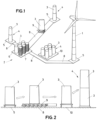
- a first object of the present invention relates to a method for manufacturing and assembling concrete towers (1), particularly indicated for the construction of towers (1) on wind farms (2) with multiple wind turbines, wherein said towers (1) are formed by a plurality of prefabricated segments (3).
- Said method is based on a synergistic combination of steps of manufacturing the segments (3), subsequent transport and assembly thereof as part of a shaft (4) of a tower (1), wherein said assembly is performed in the definitive location (5) of the tower (1), considerably reducing the number of segments (3) to be manufactured and a transport compared with the known methods, which results in a simplified manufacture and assembly.
- the method of the invention is based on two main premises:
- each of said towers (1) comprises a plurality of precast concrete segments (3) superimposed in height, forming a shaft (4) of a tower (1).
- each tower (1) occupies, after its assembly, a definitive location (5) corresponding to the operating or working location of the wind turbine.
- the method of the invention comprises performing the following steps a)-b), in an indifferent order:
- the location of the point of manufacture (6) on the wind farm (2) allows ensuring the absence of height and width restrictions characteristic of the general road network, by preferably being limited to travelling on the roads of the wind farm (2), which are narrower, flat and for the most part do not have cables, bridges and other obstacles limiting vertical and horizontal clearance to less than 5.0-6.0 m, as occurs on the road network.
- These characteristics of the roads occur on most wind farms (2), mainly due to the size and weight of the components of the turbine (formed by a nacelle and blades) and of the crane for the assembly of said turbine, which imposes the restrictions corresponding to the clearances and the road surface qualities of the farms.
- the manufacturing point (6) there are a number of vertical formworks, preferably on trestles acting as a lower formwork for each segment (3). Said formworks thus allow prefabricating the segments (3) of a tower (1) in a simple and scalable manner.
- there will be a first phase of premanufacture in which an inner mould is placed on each trestle, and then a volume of rebar is placed in the mould, to then close the mould with an outer formwork and pouring concrete for the part forming the segment (3). After curing of the part, the outer and inner moulds are removed, and the part is taken out to a stockpiling/placement area of the manufacturing point (6).
- the land routes (8) correspond to the paths, roads or routes followed by the transport system (9) for transporting the segments (3), connecting the centralised manufacturing point (6) with the different definitive locations (5) of the towers (1) on the wind farm (2).
- said land routes (8) do not pass under any bridge, tunnel and/or electrical power line.
- the manufacturing point (6) can also be installed in the region of the wind farm (2) with the largest number of wind turbines, and it is possible to define two models of towers (1), one with fewer segments (3) but which are taller, and another one with more segments (3) but which are not as tall, such that they can be transported without any impediments to the other side of the wind farm (2).
- the method of the invention further comprises performing the following steps c)-g): c) Prefabricating in a substantially vertical position at least one segment (3) of a tower (1), the height of said segment (3) being greater than 6.0 m.
- the prefabricated segments (3) are preferably cylindrical (or approximately cylindrical or prismatic, even slightly frustoconical or truncated pyramid-shaped) elements making up the tower (1) or sections thereof, with the same simplicity of manufacture as that used in ring towers (1), but being significantly taller and also sometimes larger in diameter.
- segments (3) of a tower up to 6.0 m in diameter could be made, whereas conventional ring towers do not use annular parts with a diameter greater than 4.0 m by manufacturing, for larger widths, half-rings which are later attached to one another in the definitive location of the tower on the wind farm (2) to form a complete ring.
- This means that the method for manufacturing and assembling this tower will reduce the elements to be manufactured, transported and assembled to less than a third of those for current ring towers on the market.
- the height of the different segments (3) will be adapted based on the target weight of each segment (3), so that one and the same crane configuration will allow the rapid assembly of all the segments (sections). This means that the lower segments (3) of the tower (1), which have a larger diameter, will be lower than the upper segments (3), having a smaller diameter and lower weight per linear metre of height.
- the land transport system (9) comprises a modular trailer, an SPT and/or an SPMT.
- the SPMTs and the modular trailers are generally more expensive and usually slower (especially SPMTs) than the conventional trucks or smaller and simpler modular vehicles commonly used to transport prefabricated tower elements according to known methods.
- This theoretical drawback is by far offset by the lower number of segments (3) to be transported, as well as by the smaller distance between the manufacturing point (6) and the definitive locations (5) characteristic of the towers (1).
- the use of SPTs/SPMTs further allows guaranteeing the lateral stability in transporting such slender segments (3) in the vertical position, compared to transporting prefabricated segments (3) and voussoirs having similar heights from known methods, which are transported and stored in the horizontal position.
- step c) and/or step d) are performed on raised supports, adapted such that they allow the land transport system (9) to be positioned under said raised supports, and wherein step d) is performed without using crane or overhead crane type lifting means.
- the land transport system (9) and/or the raised support comprise height-adjustable surfaces, adapted such that they allow performing step d) by adjusting said surfaces until positioning the prefabricated segment (3) on said land transport system (9).
- each segment (3) is prefabricated in a substantially vertical position, it is taken out of its mould to a stockpiling area by means of introducing a transport system assembly (9) located below a raised point (for example, the trestle), and then the height of the transport system (9) is raised such that it raises the prefabricated segment (3) over the legs of the trestle and also takes it, in a substantially vertical position, to the definitive location (5) of the tower (1), where the segment (3) is again placed on trestles such that, with the reverse operation, free of cranes and of overturning operations, the entire logistic management of the segments (3) is done in a substantially vertical position, from the time they are manufactured until they are taken to the vicinity of the tower (1), where they will be incorporated in the shaft (4).
- a transport system assembly (9) located below a raised point (for example, the trestle)
- the height of the transport system (9) is raised such that it raises the prefabricated segment (3) over the legs of the trestle and also takes it, in a substantially vertical
- the time of use of each formwork can be reduced if a continuous and level standby position of the segment (3) is ensured, such that the final phase of curing the part forming the segment (3) does not produce unwanted deformations caused by leaving the part to rest, even if insufficiently cured, on isolated rather than continuous support elements.
- a single crane movement which places the segment (3) on a level surface (for example, a polished concrete slab) to end up being cured, and after the necessary curing time elapses (for example, 72 hours), with that same crane, the segment (3) is again placed on a transport system (9) which takes it to the definitive location (5) of the tower.
- step d Transporting the segment (3) positioned in step d), in a substantially vertical position on the land transport system (9), from the centralised manufacturing point (6) to a tower stockpiling region (10) or to the definitive location (5) of one of the towers (1), following one of the land routes (8).
- step e) may comprise a step of stockpiling or storing the segment (3) thus transported in the stockpiling region (10) or in the vicinity of the definitive location (5), in a substantially vertical position, up until the transport thereof to said definitive location (5) or up to the assembly thereof, as described in step f) below, respectively.
- steps c)-e) are performed on supports of about 1.5 m of free height.
- the method for manufacturing and assembling the invention can be used to construct a complete concrete tower (1) formed by segments (3) having a height greater than 6.0 m, or also to make a portion of a composite or hybrid tower (1), in which a section of the tower (1) is made with said method, and other portions are made with other materials, designs or processes.
- the upper portion of a tower (1) can be formed by one or more conventional metallic sections, and the lower portion inferior can be made with the design and process herein described.
Landscapes
- Engineering & Computer Science (AREA)
- Architecture (AREA)
- Life Sciences & Earth Sciences (AREA)
- Chemical & Material Sciences (AREA)
- Sustainable Energy (AREA)
- General Engineering & Computer Science (AREA)
- Mechanical Engineering (AREA)
- Combustion & Propulsion (AREA)
- Sustainable Development (AREA)
- Structural Engineering (AREA)
- Civil Engineering (AREA)
- Wood Science & Technology (AREA)
- Materials Engineering (AREA)
- Wind Motors (AREA)
- Conveying And Assembling Of Building Elements In Situ (AREA)
Applications Claiming Priority (2)
| Application Number | Priority Date | Filing Date | Title |
|---|---|---|---|
| ES202131119A ES2942547B2 (es) | 2021-12-01 | 2021-12-01 | Procedimiento de fabricacion y montaje de una pluralidad de torres en un parque eolico |
| PCT/ES2022/070764 WO2023099803A2 (es) | 2021-12-01 | 2022-11-28 | Procedimiento de fabricación y montaje de una pluralidad de torres en un parque eólico |
Publications (2)
| Publication Number | Publication Date |
|---|---|
| EP4442994A2 true EP4442994A2 (de) | 2024-10-09 |
| EP4442994A4 EP4442994A4 (de) | 2026-01-07 |
Family
ID=86547634
Family Applications (1)
| Application Number | Title | Priority Date | Filing Date |
|---|---|---|---|
| EP22900731.5A Pending EP4442994A4 (de) | 2021-12-01 | 2022-11-28 | Verfahren zum transport eines windenergieanlagenturms |
Country Status (7)
| Country | Link |
|---|---|
| US (1) | US20250043771A1 (de) |
| EP (1) | EP4442994A4 (de) |
| JP (1) | JP2024541637A (de) |
| CN (1) | CN118339380A (de) |
| AU (1) | AU2022399967A1 (de) |
| ES (1) | ES2942547B2 (de) |
| WO (1) | WO2023099803A2 (de) |
Families Citing this family (2)
| Publication number | Priority date | Publication date | Assignee | Title |
|---|---|---|---|---|
| EP4617489A1 (de) * | 2024-03-15 | 2025-09-17 | Nordex Energy Spain, S.A.U. | Hybrider windturbinenturm |
| CN119263164A (zh) * | 2024-10-15 | 2025-01-07 | 中国电建集团贵阳勘测设计研究院有限公司 | 一种高耸结构交替式顶升设备 |
Family Cites Families (17)
| Publication number | Priority date | Publication date | Assignee | Title |
|---|---|---|---|---|
| NL1021790C1 (nl) * | 2002-10-30 | 2004-05-06 | Konink Nooteboom Trailers B V | Werkwijze en inrichting voor het op onderstellen afsteunen van zelfdragende lading. |
| ES2326010B2 (es) | 2006-08-16 | 2011-02-18 | Inneo21, S.L. | Estructura y procedimiento de montaje de torres de hormigon para turbinas eolicas. |
| BE1018443A3 (nl) * | 2007-06-15 | 2010-12-07 | Turbowinds S A | Segment voor een toren, uit segmenten opgebouwde toren, element voor een segment voor een toren, werkwijze voor het opbouwen van meerdere segmenten voor een toren,werkwijze voor het opbouwen van een toren uit segmenten. |
| ES2378199B1 (es) * | 2009-06-24 | 2013-06-05 | Acciona Windpower S.A. | Sistema de unión de una góndola con la torre de hormigón de un aerogenerador. |
| ES2371960B1 (es) | 2009-11-30 | 2012-11-19 | Inneo Torres, S.L. | Fábrica para la producción por moldeo de dovelas prefabricadas de hormigón para la construcción de torres de sustentación de aerogenerador. |
| DE102010039796A1 (de) | 2010-06-14 | 2011-12-15 | Max Bögl Bauunternehmung GmbH & Co. KG | Turm mit einem Adapterstück sowie Verfahren zur Herstellung eines Turms mit einem Adapterstück |
| DE102011076648A1 (de) | 2011-05-27 | 2012-11-29 | Max Bögl Wind AG | Verfahren zum Errichten einer Windkraftanlage |
| DE102011078016A1 (de) * | 2011-06-22 | 2012-12-27 | Aloys Wobben | Turmfertigung |
| ES2396087B1 (es) | 2011-06-30 | 2014-05-19 | Acciona Windpower, S.A. | Procedimiento de montaje de un aerogenerador y aerogenerador montado según dicho procedimiento |
| ES2565518B1 (es) * | 2014-09-17 | 2016-12-27 | Pacadar S.A. | Método para la fabricación de segmentos tubulares de hormigón y para la erección de torres mediante dichos segmentos tubulares |
| AU2015341008B2 (en) * | 2014-10-30 | 2020-11-05 | Byo Towers, S.L. | Method for installing a hollow concrete tower made from more than one segment and corresponding hollow concrete tower |
| PL3212862T3 (pl) * | 2014-10-31 | 2020-01-31 | Soletanche Freyssinet | Sposób wytwarzania bloków konstrukcyjnych z betonu dla wieży turbiny wiatrowej i związany z tym system |
| JP6873144B2 (ja) * | 2015-10-01 | 2021-05-19 | ラガウェイ ウインド ベー.フェー.Lagerwey Wind B.V. | 風力タービンの設置のためのホイスティングシステム |
| US20220177281A1 (en) * | 2016-09-29 | 2022-06-09 | Mammoet Holding B.V. | Apparatus for Lifting Heavy Loads |
| DK3856485T3 (da) * | 2018-09-28 | 2023-11-13 | Gen Electric | Fremgangsmåde til fremstilling af en teleskoperende vindmølletårnstruktur |
| EP3744928B1 (de) * | 2019-05-27 | 2022-09-14 | Soletanche Freyssinet | Windturbinenturm und verfahren zur herstellung und montage |
| US12319001B2 (en) * | 2022-11-16 | 2025-06-03 | Ge Vernova Infrastructure Technology Llc | Methods of additively manufacturing tower structures with coiled polymer reinforcement members |
-
2021
- 2021-12-01 ES ES202131119A patent/ES2942547B2/es active Active
-
2022
- 2022-11-28 CN CN202280079659.3A patent/CN118339380A/zh active Pending
- 2022-11-28 JP JP2024532737A patent/JP2024541637A/ja active Pending
- 2022-11-28 AU AU2022399967A patent/AU2022399967A1/en active Pending
- 2022-11-28 US US18/713,657 patent/US20250043771A1/en active Pending
- 2022-11-28 EP EP22900731.5A patent/EP4442994A4/de active Pending
- 2022-11-28 WO PCT/ES2022/070764 patent/WO2023099803A2/es not_active Ceased
Also Published As
| Publication number | Publication date |
|---|---|
| ES2942547A1 (es) | 2023-06-02 |
| WO2023099803A2 (es) | 2023-06-08 |
| CN118339380A (zh) | 2024-07-12 |
| EP4442994A4 (de) | 2026-01-07 |
| ES2942547B2 (es) | 2026-04-06 |
| US20250043771A1 (en) | 2025-02-06 |
| JP2024541637A (ja) | 2024-11-08 |
| AU2022399967A1 (en) | 2024-07-04 |
| WO2023099803A3 (es) | 2023-08-03 |
Similar Documents
| Publication | Publication Date | Title |
|---|---|---|
| EP2886751B1 (de) | Verfahren zur Montage von kegelstumpfförmigen Betontürmen | |
| JP5629316B2 (ja) | 伸縮式タワーアセンブリおよび方法 | |
| EP4442994A2 (de) | Verfahren zum transport eines windenergieanlagenturms | |
| EP2038548B1 (de) | Handhabungssystem für eine windturbinengondel, verfahren zur vertikalen verschiebung einer windturbinengondel und windturbinengondel | |
| US20110239584A1 (en) | Method of building a hybrid tower for a wind generator | |
| US20090276993A1 (en) | Erection method for solar receiver & support tower | |
| US20100162652A1 (en) | Segment for a Tower, Tower Constructed from Tower Segments, Element for a segment for a Tower, Method for the Pre-Assembly of segments for a Tower, Method for the Assembly of a Tower Containing Segments | |
| US20120304588A1 (en) | Method for Erecting a Wind Turbine Tower | |
| US10738499B2 (en) | Concrete towers manufacturing method for wind turbines and concrete tower for wind turbine | |
| CN113738586A (zh) | 具有混凝土底座的设备塔架 | |
| CA1093528A (en) | Transportable bed for industrial equipment | |
| EP2563994B1 (de) | Verfahren zur montage eines windkraftwerkturms auf einem installationsfundament und vorrichtung dafür | |
| EP2350454B1 (de) | Verfahren zur herstellung einer windturbinenturmstruktur | |
| EP3786393A1 (de) | Bewegliches modul zum heben von teleskopischen türmen und verfahren zum heben von teleskopischen türmen | |
| CN121568892A (zh) | 平台和用于装配平台的方法 | |
| WO2010061048A1 (en) | Arrangement and method for erecting tower of wind power plant | |
| US4282696A (en) | Method for fabricating and erecting unitary structural elements | |
| EP4411091A1 (de) | Verfahren zur installation eines turms und mit diesem verfahren installierter turm | |
| EP4151854A1 (de) | Konstruktionsverfahren für teleskopturm | |
| CN209779668U (zh) | 一种定日镜立柱和基础二合一桩基 | |
| CN115893218B (zh) | 一种大型厂房扩建用塔吊的塔臂安装方法 | |
| DK2350454T3 (en) | PROCEDURE FOR THE PREPARATION OF A WINDMILL TOWER STRUCTURE | |
| JPWO2023099803A5 (de) | ||
| Ziółko et al. | Assembly of the steel roof structure for the football stadium in Gdan´ sk |
Legal Events
| Date | Code | Title | Description |
|---|---|---|---|
| STAA | Information on the status of an ep patent application or granted ep patent |
Free format text: STATUS: THE INTERNATIONAL PUBLICATION HAS BEEN MADE |
|
| PUAI | Public reference made under article 153(3) epc to a published international application that has entered the european phase |
Free format text: ORIGINAL CODE: 0009012 |
|
| STAA | Information on the status of an ep patent application or granted ep patent |
Free format text: STATUS: REQUEST FOR EXAMINATION WAS MADE |
|
| 17P | Request for examination filed |
Effective date: 20240627 |
|
| AK | Designated contracting states |
Kind code of ref document: A2 Designated state(s): AL AT BE BG CH CY CZ DE DK EE ES FI FR GB GR HR HU IE IS IT LI LT LU LV MC ME MK MT NL NO PL PT RO RS SE SI SK SM TR |
|
| DAV | Request for validation of the european patent (deleted) | ||
| DAX | Request for extension of the european patent (deleted) | ||
| A4 | Supplementary search report drawn up and despatched |
Effective date: 20251205 |
|
| RIC1 | Information provided on ipc code assigned before grant |
Ipc: F03D 13/40 20160101AFI20251201BHEP Ipc: F03D 13/10 20160101ALI20251201BHEP Ipc: E04H 12/12 20060101ALI20251201BHEP Ipc: E04H 12/34 20060101ALI20251201BHEP Ipc: F03D 13/20 20160101ALI20251201BHEP |