EP4438499A1 - Positionierungssystem und station zur aufnahme und lagerung eines unbemannten luftfahrzeugs - Google Patents
Positionierungssystem und station zur aufnahme und lagerung eines unbemannten luftfahrzeugs Download PDFInfo
- Publication number
- EP4438499A1 EP4438499A1 EP23166064.8A EP23166064A EP4438499A1 EP 4438499 A1 EP4438499 A1 EP 4438499A1 EP 23166064 A EP23166064 A EP 23166064A EP 4438499 A1 EP4438499 A1 EP 4438499A1
- Authority
- EP
- European Patent Office
- Prior art keywords
- unmanned aircraft
- positioning
- arrangement
- beams
- positioning system
- Prior art date
- Legal status (The legal status is an assumption and is not a legal conclusion. Google has not performed a legal analysis and makes no representation as to the accuracy of the status listed.)
- Withdrawn
Links
Images


Classifications
-
- B—PERFORMING OPERATIONS; TRANSPORTING
- B64—AIRCRAFT; AVIATION; COSMONAUTICS
- B64U—UNMANNED AERIAL VEHICLES [UAV]; EQUIPMENT THEREFOR
- B64U70/00—Launching, take-off or landing arrangements
- B64U70/90—Launching from or landing on platforms
- B64U70/99—Means for retaining the UAV on the platform, e.g. dogs or magnets
-
- B—PERFORMING OPERATIONS; TRANSPORTING
- B60—VEHICLES IN GENERAL
- B60L—PROPULSION OF ELECTRICALLY-PROPELLED VEHICLES; SUPPLYING ELECTRIC POWER FOR AUXILIARY EQUIPMENT OF ELECTRICALLY-PROPELLED VEHICLES; ELECTRODYNAMIC BRAKE SYSTEMS FOR VEHICLES IN GENERAL; MAGNETIC SUSPENSION OR LEVITATION FOR VEHICLES; MONITORING OPERATING VARIABLES OF ELECTRICALLY-PROPELLED VEHICLES; ELECTRIC SAFETY DEVICES FOR ELECTRICALLY-PROPELLED VEHICLES
- B60L53/00—Methods of charging batteries, specially adapted for electric vehicles; Charging stations or on-board charging equipment therefor; Exchange of energy storage elements in electric vehicles
- B60L53/30—Constructional details of charging stations
- B60L53/35—Means for automatic or assisted adjustment of the relative position of charging devices and vehicles
- B60L53/36—Means for automatic or assisted adjustment of the relative position of charging devices and vehicles by positioning the vehicle
-
- B—PERFORMING OPERATIONS; TRANSPORTING
- B64—AIRCRAFT; AVIATION; COSMONAUTICS
- B64U—UNMANNED AERIAL VEHICLES [UAV]; EQUIPMENT THEREFOR
- B64U70/00—Launching, take-off or landing arrangements
- B64U70/90—Launching from or landing on platforms
- B64U70/97—Means for guiding the UAV to a specific location on the platform, e.g. platform structures preventing landing off-centre
-
- B—PERFORMING OPERATIONS; TRANSPORTING
- B64—AIRCRAFT; AVIATION; COSMONAUTICS
- B64U—UNMANNED AERIAL VEHICLES [UAV]; EQUIPMENT THEREFOR
- B64U80/00—Transport or storage specially adapted for UAVs
- B64U80/20—Transport or storage specially adapted for UAVs with arrangements for servicing the UAV
- B64U80/25—Transport or storage specially adapted for UAVs with arrangements for servicing the UAV for recharging batteries; for refuelling
-
- B—PERFORMING OPERATIONS; TRANSPORTING
- B64—AIRCRAFT; AVIATION; COSMONAUTICS
- B64U—UNMANNED AERIAL VEHICLES [UAV]; EQUIPMENT THEREFOR
- B64U50/00—Propulsion; Power supply
- B64U50/30—Supply or distribution of electrical power
- B64U50/37—Charging when not in flight
-
- B—PERFORMING OPERATIONS; TRANSPORTING
- B64—AIRCRAFT; AVIATION; COSMONAUTICS
- B64U—UNMANNED AERIAL VEHICLES [UAV]; EQUIPMENT THEREFOR
- B64U70/00—Launching, take-off or landing arrangements
- B64U70/90—Launching from or landing on platforms
- B64U70/95—Means for guiding the landing UAV towards the platform, e.g. lighting means
-
- B—PERFORMING OPERATIONS; TRANSPORTING
- B64—AIRCRAFT; AVIATION; COSMONAUTICS
- B64U—UNMANNED AERIAL VEHICLES [UAV]; EQUIPMENT THEREFOR
- B64U80/00—Transport or storage specially adapted for UAVs
- B64U80/10—Transport or storage specially adapted for UAVs with means for moving the UAV to a supply or launch location, e.g. robotic arms or carousels
Definitions
- the invention pertains to the field of unmanned aircrafts, and more specifically to elements that enable storage, positioning and charging aircrafts upon their landing on a station.
- drone charging stations with platforms on which aircrafts are seated. Homing guidance of such crafts is implemented by means of remote control. The path of the flight, the angles, the flight duration time and capturing of images are controlled in real time. On platforms docking stations with a plurality of interfaces are positioned. Platforms are known that form an assembly with a specifically configured unmanned aircraft where charging is effected by contacting the platform with the aircraft. Also stations are used that offer closed and opened cover to protect the aircraft against bad weather conditions.
- the invention discloses a positioning system implemented for automatic positioning of a landing unmanned aircraft on a landing platform, comprising:
- the positioning arrangement has a form of four beams, and preferably pairs of beams are arranged in parallel to each other, more preferably the two pairs of beams are arranged perpendicularly to each other.
- At least one beam is at its two ends attached to guiding mechanisms that are capable to move along a predetermined track, and preferably the guiding mechanism is a carriage moving on a guide.
- the guiding mechanism is releasably connected to a driving belt driven by an electric motor, preferably a stepper motor.
- the charging arrangement and/or the connector are mounted pivotably.
- the charging arrangement is provided with a battery controller configured to control the state of the battery charge of the unmanned aircraft.
- it comprises at least one decoupling element capable to decouple the unmanned aircraft from the charging arrangement, and preferably the decoupling elements are actuators.
- the invention provides a station arranged for receiving and storage of an unmanned aircraft characterized in that it comprises a positioning arrangement.
- it comprises a movable roof and preferably the roof is capable to be slid over the landing platform, and more preferably the roof is comprised of two roofing portions which are capable to be slid over the landing platform from opposite sides.
- the positioning system is mounted on an elevator which is capable to move vertically and has a t least two fixed positions: the highest one and the lowest one, and preferably it has three positions: the highest one, a safe one, and the lowest one.
- the elevator comprises a frame configured for mounting a positioning system thereon.
- the frame preferably at each of its corners, comprises a screw, preferably a self-locking screw, more preferably a trapezoidal screw.
- the screws are connected via a chain which is driven by a motor.
- a homing guidance is arranged.
- the homing guidance system comprises an infrared, IR or visible light emitter.
- the invention enables safe landing of a unmanned aircraft by extending the elevator to its highest position and this considerably facilitates the landing process. Passing of the elevator to lower positions hides the aircraft and makes it possible to close the roof to protect the aircraft against weather conditions and human actions.
- the invention also enables positioning of an unmanned aircraft on a platform after landing so that its position enables connecting it to a connector and charging.
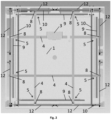
- the first invention provides a positioning system intended for positioning a unmanned aircraft landing on a landing platform 1, as seen in Fig. 1 . It is applicable in the field of stations, machines, landing grounds which are intended to be used by unmanned aircrafts.
- Positioning system comprises a landing platform 1 and a charging arrangement 3. On the landing platform 1 an unmanned aircraft lands and is seated. Upon being seated, the aircraft connects to a charging arrangement 3 and is charged.
- Positioning system comprises a positioning arrangement 2 that seats an unmanned aircraft at a dedicated site on the landing platform 1.
- the dedicated site is the target sire for seating of the unmanned aircraft, and seating the aircraft at such dedicated site enables the aircraft to be connected to a charging arrangement and to have its batteries recharged.
- the positioning system comprises, in a preferable embodiment of the invention, at least one decoupling element 7, which causes decoupling of the aircraft from the charging arrangement 3.
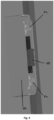
- An embodiment with two decoupling elements 7 embodied as actuators is shown in Fig. 4 , and a person skilled in the art will be aware that it is possible to use other actuators than the ones shown in the embodiment, such as mechanic arrangements controlled by an electric motor or electromagnets that interact with magnets or electromagnets.
- Positioning arrangement 2 comprises at least three beams 4 the movement of which causes seating of an unmanned aircraft at the dedicated site on the landing platform 1. Movement of the beams 4 pushes the aircraft and makes it seat between the beams 4. The beams 4 are connected to guiding mechanisms 5 which make each of the beams 4 move.
- An embodiment of the positioning arrangement 2 can be seen in Figs. 1 and 2 .
- charging arrangement 3 is attached to one beam 4 and comprises a connector 6 to be connected to the unmanned aircraft, preferably via a mechanic-electronic connection. Positioning of the aircraft at the dedicated site by means of the positioning arrangement 2 makes it possible to connect the aircraft to a connector 6 in the charging arrangement 3 arranged on one of the beams 4 of the positioning arrangement 2.
- the dedicated site is located in the middle of the landing platform 1.
- Connection 6, in this embodiment, is intended for charging and controlling an unmanned aircraft, and it can be seen in Fig. 4 .
- the connector 6 that provides a stable connection with the use of the connector and it is also possible to use the connector 6 in a form of a contact which will require permanent pressure of the unmanned aircraft. Pressure may be effected by means of the beams 4 or a decoupling element 7 which also enables holding of the unmanned aircraft. In the first case it is preferable to use at least one decoupling element 7 to enable decoupling of the unmanned aircraft from the connector 6 without any action by the operator.
- the charging arrangement 3 is attached on the beam 4 so that the charging arrangement 3 is in the symmetry axis of the dedicated site on the landing platform 1 and it is configured to be connected to the unmanned aircraft, as shown in Fig. 2 . It should be noted that in the symmetry axis solely one connector 6 may be present.
- the charging arrangement 3, in this embodiment, is mounted pivotably to make the connector 6 self-adjusting. It is also possible to set in self-alignment the connector 6 only.
- the decoupling element 7 are actuators which are arranged at both sides of the connector 6 and are intended to decouple the connected unmanned aircraft from the connector 6. Decoupling elements 7 are visible in Fig. 4 . Preferably, these are electromagnetic actuators.
- the charging arrangement 3 is provided with a battery controller which is configured to control the state of the battery charge of the unmanned aircraft.
- the positioning arrangement 2 comprises three beams 3 that form a triangle, for example an isosceles triangle, but in other embodiments it may comprise four beams 4 or more.
- beams 4 are preferably arranged in parallel to each other, and the two pairs of beams 4 are preferably arranged perpendicularly to each other.
- the beams 4 may form any quadrangle in this embodiment. In an embodiment with four beams 4, they define a quadrangular area, preferably a rectangular area.
- Each of the beams 4 is attached to guiding mechanisms 5.
- at least one beam 4 is at its two ends attached to guiding mechanisms 5 that move along a predetermined track and this causes movement of the beam 4.
- the guiding mechanisms 5 are shown in Fig. 2 and 3 .
- the guiding mechanism 5 is a carriage 8, preferably a linear one, moving on a guide 9, preferably a linear one, as shown in Fig. 3 .
- Guides 9, in this example, are mounted at the extremes of the landing platform 1.
- carriages 8 are connected to a driving belt 12 driven by a motor.
- the driving belt 12 is a cogbelt.
- the driving belt 12 drives the carriages 8 which force the beam 4 to move.
- the beam 4 at its two ends has carriages 8 which are driven by the driving belts 12 and for the purpose of synchronization of both sides a shaft 10 is provided which is positioned in parallel to the beam 4 being moved.
- the driving belts 12 of each of the two carriages 8 of the beam 4 are wound around the same shaft 10 around toothed wheels. Motion of the shaft 10 causes simultaneous movement of the driving belts 12 and thus synchronous movement of the beam 4.
- each of the beams 4 of the positioning arrangement has an individual shaft 10 and operation mechanism as described above, along with its own stepped motor.
- the carriages 8 located at the same end of two different beams 4 parallel to each other have one guide 9 on which they move.
- the other pair of beams 4 operates in a second plane, parallel to the first plane and over the first plane.
- the landing platform 1 has a shape of a rectangular prism and is covered with a plate, preferably made of polycarbonate. In other embodiments, the landing platform 1 has a shape of a cube or a circle.
- the homing guidance system is an infrared, IR or visible light emitter. Graphics is absent in this portion to enable facilitated access of the unmanned aircraft to the homing guidance system.
- a second object of the invention is a station which is arranged for receiving and storage of an unmanned aircraft.
- the station comprises the above described aircraft positioning system.
- the station also comprises a movable roof which covers the unmanned aircraft and protects it against atmospheric conditions and mechanical interactions.
- the roof moves slidably so that in a first extreme position it exposes the landing platform 1, while in a second extreme position it covers the landing platform 1.
- the roof may be comprised of two roofing portions and the two roofing portions slide away in an opposite directions.
- the station has side walls which along with the roof and the base of the station define an enclosed space for the unmanned aircraft.
- the positioning system is mounted on an elevator which is capable to move vertically and has at least two fixed positions: the highest one and the lowest one, and preferably it has three positions: the highest one, a safe one, and the lowest one.
- the range of movement of the elevator is 60 cm.
- the elevator At the highest position, the elevator is extended to its maximum height which enables safe landing of an aircraft on the landing platform 1. Closing with the movable roof is possible at two positions: the safe one and the lowest one. At the safe position, about 20 cm below the highest position, it is to possible to close the movable roof, when no unmanned aircraft is present in the station. The lowest position enables closing of the station with the movable roof with the aircraft therein.
- the elevator may be present in a station that is not equipped with a positioning arrangement comprising beams 4 or a charging arrangement 3, and it may comprise the remaining solutions described earlier.
- the elevator enables raising of the landing platform 1 to the highest position and this facilitates landing of the unmanned aircraft, and after the landing the station enables lowering of the unmanned aircraft and closing of the roof.
- the elevator comprises a frame configured for mounting of a positioning arrangement thereon, wherein the frame has at each of its corners a screw, preferably a self-locking screw, more preferably a trapezoidal screw.
- all the screws are positioned at the bottom, from below the frame, and are coupled with a chain which is driven, via gear transmissions, by a motor.
- at the ends of the screws there are bearings thanks to which the movement of the elevator is effected vertically.
- all the screws are synchronized together.
- the landing platform 1 is mounted being a part of the positioning system.
- Unmanned aircraft is homing guided by GPS and lands on the landing platform 1 so that the landing gear of the aircraft, cooperating with the charging arrangement 3, is oriented towards it. Landing of the aircraft is facilitated because the elevator is extended to its highest position and so the landing platform 1. At this point the beams 4 of the positioning arrangement 2 are located at the extremity of the landing platform 1.
- the aircraft Upon landing the aircraft transmits radio frequency waves to the system to inform it that the station may receive it.
- communication is effected by means of LTE.
- the unmanned aircraft and the station have pre-installed GPS network communication and they communicate with an external system via LTE. The first move is performed by the beam 4 with the attached charging arrangement 3 and it moves by about 30 cm and then returns to the extremity of the landing platform 1.
- This initial movement moves the aircraft if the aircraft landed too close to the charging arrangement 3. Movement of the aircraft may cause damage to the charging arrangement 3 positioned too close.
- the positioning arrangement has four beams 4. Then movement is performed by two beams 4 which are perpendicular to the beam 4, to the charging arrangement 3. Both beams 4 move simultaneously and they locate the unmanned aircraft in the axis of the dedicated site and the charging arrangement 3. Then movement is made by the beam 4 with the charging arrangement and the fourth beam 4 which is parallel thereto. Movement of the two beams 4 is effected at the same time and causes forcing of the unmanned aircraft to the connector 6. The connector 6 becomes coupled and transmits a signal that it is connected.
- the landing gear of the unmanned aircraft has small bearings from below due to which it slides smoothly on the landing platform 1 and at its four corners it has four stops that are pushed by the beams 4.
- the stops Upon seating the aircraft at its dedicated site - at the point when all the beams 4 are abutting the aircraft, in the example with four beams 4, the stops contact the beams 4 at the corners where the beams 4 cross.
- the landing gear is securely connected to the aircraft and it has a predetermined location for a connector which is to be connected to the connector 6 of the positioning system and a predetermined location where the decoupling elements 7 are abutted.
- Decoupling of the unmanned aircraft begins with retracting the beam 4 parallel to the beam 4 with the charging arrangement 3 to a distance of about 3 cm. Then actuators are activated to force the aircraft out of the connector 6. The first beam 4 moved away provides locking movement of the aircraft resulting from decoupling. Upon decoupling the connector 6, all the beams 4 ride away to the extremity of the landing platform 1.
Landscapes
- Engineering & Computer Science (AREA)
- Remote Sensing (AREA)
- Aviation & Aerospace Engineering (AREA)
- Transportation (AREA)
- Power Engineering (AREA)
- Mechanical Engineering (AREA)
- Control Of Position, Course, Altitude, Or Attitude Of Moving Bodies (AREA)
- Navigation (AREA)
Priority Applications (2)
| Application Number | Priority Date | Filing Date | Title |
|---|---|---|---|
| EP23166064.8A EP4438499A1 (de) | 2023-03-31 | 2023-03-31 | Positionierungssystem und station zur aufnahme und lagerung eines unbemannten luftfahrzeugs |
| PL131804U PL74208Y1 (pl) | 2023-03-31 | 2023-11-21 | Układ pozycjonowania do automatycznego pozycjonowania lądującego bezzałogowego statku powietrznego |
Applications Claiming Priority (1)
| Application Number | Priority Date | Filing Date | Title |
|---|---|---|---|
| EP23166064.8A EP4438499A1 (de) | 2023-03-31 | 2023-03-31 | Positionierungssystem und station zur aufnahme und lagerung eines unbemannten luftfahrzeugs |
Publications (1)
| Publication Number | Publication Date |
|---|---|
| EP4438499A1 true EP4438499A1 (de) | 2024-10-02 |
Family
ID=86282705
Family Applications (1)
| Application Number | Title | Priority Date | Filing Date |
|---|---|---|---|
| EP23166064.8A Withdrawn EP4438499A1 (de) | 2023-03-31 | 2023-03-31 | Positionierungssystem und station zur aufnahme und lagerung eines unbemannten luftfahrzeugs |
Country Status (2)
| Country | Link |
|---|---|
| EP (1) | EP4438499A1 (de) |
| PL (1) | PL74208Y1 (de) |
Citations (7)
| Publication number | Priority date | Publication date | Assignee | Title |
|---|---|---|---|---|
| CN108482697A (zh) * | 2018-06-06 | 2018-09-04 | 深圳草莓创新技术有限公司 | 一种无人机自动定位充电装置及其方法 |
| WO2018219226A1 (zh) * | 2017-05-27 | 2018-12-06 | 星逻智能科技(苏州)有限公司 | 无人机停机库 |
| WO2021043524A1 (fr) * | 2019-09-02 | 2021-03-11 | Azur Drones | Procédé de rechargement d'un drone volant, dispositif de centrage et de rechargement, plateau d'atterrissage et station d'accueil munis d'un tel dispositif, drone volant adapté à un tel dispositif |
| CN212827924U (zh) * | 2020-01-20 | 2021-03-30 | 北京京东乾石科技有限公司 | 无人机的被动充电装置 |
| EP3487760B1 (de) * | 2016-07-21 | 2021-07-14 | Percepto Robotics Ltd | Verfahren und systeme zur verankerung eines unbemannten luftfahrzeugs auf einer bodenstation |
| WO2021252385A1 (en) * | 2020-06-07 | 2021-12-16 | Valqari, Llc | Security and guidance systems and methods for parcel-receiving devices |
| US20220073214A1 (en) * | 2020-09-08 | 2022-03-10 | Wing Aviation Llc | Landing Pad with Charging and Loading Functionality for Unmanned Aerial Vehicle |
-
2023
- 2023-03-31 EP EP23166064.8A patent/EP4438499A1/de not_active Withdrawn
- 2023-11-21 PL PL131804U patent/PL74208Y1/pl unknown
Patent Citations (7)
| Publication number | Priority date | Publication date | Assignee | Title |
|---|---|---|---|---|
| EP3487760B1 (de) * | 2016-07-21 | 2021-07-14 | Percepto Robotics Ltd | Verfahren und systeme zur verankerung eines unbemannten luftfahrzeugs auf einer bodenstation |
| WO2018219226A1 (zh) * | 2017-05-27 | 2018-12-06 | 星逻智能科技(苏州)有限公司 | 无人机停机库 |
| CN108482697A (zh) * | 2018-06-06 | 2018-09-04 | 深圳草莓创新技术有限公司 | 一种无人机自动定位充电装置及其方法 |
| WO2021043524A1 (fr) * | 2019-09-02 | 2021-03-11 | Azur Drones | Procédé de rechargement d'un drone volant, dispositif de centrage et de rechargement, plateau d'atterrissage et station d'accueil munis d'un tel dispositif, drone volant adapté à un tel dispositif |
| CN212827924U (zh) * | 2020-01-20 | 2021-03-30 | 北京京东乾石科技有限公司 | 无人机的被动充电装置 |
| WO2021252385A1 (en) * | 2020-06-07 | 2021-12-16 | Valqari, Llc | Security and guidance systems and methods for parcel-receiving devices |
| US20220073214A1 (en) * | 2020-09-08 | 2022-03-10 | Wing Aviation Llc | Landing Pad with Charging and Loading Functionality for Unmanned Aerial Vehicle |
Non-Patent Citations (1)
| Title |
|---|
| MUSA GALIMOV ET AL: "UAV Positioning Mechanisms in Landing Stations: Classification and Engineering Design Review", SENSORS, vol. 20, no. 13, 29 June 2020 (2020-06-29), pages 3648, XP055737196, DOI: 10.3390/s20133648 * |
Also Published As
| Publication number | Publication date |
|---|---|
| PL74208Y1 (pl) | 2025-12-15 |
| PL131804U1 (pl) | 2024-10-07 |
Similar Documents
| Publication | Publication Date | Title |
|---|---|---|
| EP3599165B1 (de) | Fahrzeugdockingsysteme und zugehörige verfahren | |
| US20230166865A1 (en) | Uav retrieval and deployment system and method therefor | |
| CN113830321B (zh) | 一种无人机车载回收平台 | |
| US10259594B2 (en) | Apparatus and method for recovering and launching unmanned aerial vehicle | |
| KR102300172B1 (ko) | 무인 비행기용 착륙 제어장치 | |
| KR101586188B1 (ko) | 무인비행기 착륙 위치 정렬 장치, 정렬 방법 및 상기 장치를 포함하는 지상시스템 | |
| KR20200013352A (ko) | 도킹스테이션 부에서 드론을 원격 조종하여 자동 착륙하는 능동 유도형 도킹스테이션 및 겸용 차량 | |
| CN210316752U (zh) | 一种无人机多机机库 | |
| EP3819215B1 (de) | Station zum aufnehmen, steuern und befehligen einer drohne, die dafür ausgelegt ist, beobachtungsmissionen auf von bahnstrecken durchzogenen gebieten und auf den bahnstrecken selbst sowie auf all den strukturen entlang der strecke durchzuführen | |
| EP4438499A1 (de) | Positionierungssystem und station zur aufnahme und lagerung eines unbemannten luftfahrzeugs | |
| US20210387744A1 (en) | Unmanned aerial vehicle (uav) launching assembly for monitored and stable launching of uavs | |
| CN113335545A (zh) | 停机坪、停机系统及无人机停机方法 | |
| US11905037B2 (en) | Aerial vehicle takeoff and landing system, aerial vehicle takeoff and landing apparatus, and aerial vehicle | |
| CN117508712A (zh) | 一种载具无人机及自动载具无人机机库 | |
| KR102259954B1 (ko) | 카메라를 이용한 항공 드론과 지상 로봇의 도킹 시스템 | |
| KR102559279B1 (ko) | 수소드론의 자동 착륙 및 수소충전을 위한 드론스테이션 | |
| CN216186130U (zh) | 停机坪和停机系统 | |
| CN118651412B (zh) | 一种基于飞行平台的自主式载荷输送装置 | |
| EP4507967B1 (de) | Autonome uav-dienststation zur unterstützung von bvlos uavs und verfahren zu deren betrieb | |
| US12269696B2 (en) | Mobility and apparatus for loading and unloading cargo | |
| JP2025034185A (ja) | 電動アシスト式航空装備品搭載・しゃ下支援装置 | |
| CN116788070A (zh) | 一种船载电池舱自动插拔充电装置、充电方法及船舶 | |
| CN118560742A (zh) | 一种基于齿盘传动的无人机与无人车对接分离系统和方法 | |
| KR102693140B1 (ko) | 비행자동차용 자동차, 무인항공기 및 이를 구비하는 비행자동차 | |
| CN221368911U (zh) | 一种无人机货舱的对接装置 |
Legal Events
| Date | Code | Title | Description |
|---|---|---|---|
| PUAI | Public reference made under article 153(3) epc to a published international application that has entered the european phase |
Free format text: ORIGINAL CODE: 0009012 |
|
| STAA | Information on the status of an ep patent application or granted ep patent |
Free format text: STATUS: THE APPLICATION HAS BEEN PUBLISHED |
|
| AK | Designated contracting states |
Kind code of ref document: A1 Designated state(s): AL AT BE BG CH CY CZ DE DK EE ES FI FR GB GR HR HU IE IS IT LI LT LU LV MC ME MK MT NL NO PL PT RO RS SE SI SK SM TR |
|
| STAA | Information on the status of an ep patent application or granted ep patent |
Free format text: STATUS: THE APPLICATION IS DEEMED TO BE WITHDRAWN |
|
| 18D | Application deemed to be withdrawn |
Effective date: 20250403 |