EP4431792A1 - Système d'alimentation en gaz pour appareils consommateurs de gaz à haute et basse pression - Google Patents
Système d'alimentation en gaz pour appareils consommateurs de gaz à haute et basse pression Download PDFInfo
- Publication number
- EP4431792A1 EP4431792A1 EP24161634.1A EP24161634A EP4431792A1 EP 4431792 A1 EP4431792 A1 EP 4431792A1 EP 24161634 A EP24161634 A EP 24161634A EP 4431792 A1 EP4431792 A1 EP 4431792A1
- Authority
- EP
- European Patent Office
- Prior art keywords
- gas
- pressure
- heat exchanger
- pump
- return line
- Prior art date
- Legal status (The legal status is an assumption and is not a legal conclusion. Google has not performed a legal analysis and makes no representation as to the accuracy of the status listed.)
- Pending
Links
- 238000007667 floating Methods 0.000 claims abstract description 23
- 239000007788 liquid Substances 0.000 claims description 86
- 238000009434 installation Methods 0.000 claims description 7
- 238000000034 method Methods 0.000 claims description 2
- 239000007789 gas Substances 0.000 description 203
- 239000012528 membrane Substances 0.000 description 6
- 238000007789 sealing Methods 0.000 description 6
- 238000005304 joining Methods 0.000 description 5
- 238000011144 upstream manufacturing Methods 0.000 description 5
- 238000001816 cooling Methods 0.000 description 4
- 238000004519 manufacturing process Methods 0.000 description 4
- VNWKTOKETHGBQD-UHFFFAOYSA-N methane Chemical compound C VNWKTOKETHGBQD-UHFFFAOYSA-N 0.000 description 4
- XLYOFNOQVPJJNP-UHFFFAOYSA-N water Substances O XLYOFNOQVPJJNP-UHFFFAOYSA-N 0.000 description 4
- 238000009833 condensation Methods 0.000 description 3
- 230000005494 condensation Effects 0.000 description 3
- 230000001627 detrimental effect Effects 0.000 description 3
- 238000005516 engineering process Methods 0.000 description 3
- 239000000446 fuel Substances 0.000 description 3
- 239000013529 heat transfer fluid Substances 0.000 description 3
- 239000003949 liquefied natural gas Substances 0.000 description 3
- 238000003860 storage Methods 0.000 description 3
- 230000032258 transport Effects 0.000 description 3
- QGZKDVFQNNGYKY-UHFFFAOYSA-N Ammonia Chemical compound N QGZKDVFQNNGYKY-UHFFFAOYSA-N 0.000 description 2
- OTMSDBZUPAUEDD-UHFFFAOYSA-N Ethane Chemical compound CC OTMSDBZUPAUEDD-UHFFFAOYSA-N 0.000 description 2
- VGGSQFUCUMXWEO-UHFFFAOYSA-N Ethene Chemical compound C=C VGGSQFUCUMXWEO-UHFFFAOYSA-N 0.000 description 2
- 239000005977 Ethylene Substances 0.000 description 2
- 238000001704 evaporation Methods 0.000 description 2
- 230000008020 evaporation Effects 0.000 description 2
- 239000012530 fluid Substances 0.000 description 2
- 239000003915 liquefied petroleum gas Substances 0.000 description 2
- 210000000056 organ Anatomy 0.000 description 2
- 239000013535 sea water Substances 0.000 description 2
- 238000009834 vaporization Methods 0.000 description 2
- 230000008016 vaporization Effects 0.000 description 2
- 229910021529 ammonia Inorganic materials 0.000 description 1
- 230000004888 barrier function Effects 0.000 description 1
- 230000033228 biological regulation Effects 0.000 description 1
- 230000007423 decrease Effects 0.000 description 1
- 230000005611 electricity Effects 0.000 description 1
- 230000008030 elimination Effects 0.000 description 1
- 238000003379 elimination reaction Methods 0.000 description 1
- 238000005265 energy consumption Methods 0.000 description 1
- 235000021183 entrée Nutrition 0.000 description 1
- 230000005484 gravity Effects 0.000 description 1
- 239000001257 hydrogen Substances 0.000 description 1
- 229910052739 hydrogen Inorganic materials 0.000 description 1
- 125000004435 hydrogen atom Chemical class [H]* 0.000 description 1
- 238000012423 maintenance Methods 0.000 description 1
- 238000005086 pumping Methods 0.000 description 1
- 230000001105 regulatory effect Effects 0.000 description 1
- 238000010079 rubber tapping Methods 0.000 description 1
Images


Classifications
-
- F—MECHANICAL ENGINEERING; LIGHTING; HEATING; WEAPONS; BLASTING
- F17—STORING OR DISTRIBUTING GASES OR LIQUIDS
- F17D—PIPE-LINE SYSTEMS; PIPE-LINES
- F17D1/00—Pipe-line systems
- F17D1/02—Pipe-line systems for gases or vapours
- F17D1/065—Arrangements for producing propulsion of gases or vapours
- F17D1/07—Arrangements for producing propulsion of gases or vapours by compression
-
- F—MECHANICAL ENGINEERING; LIGHTING; HEATING; WEAPONS; BLASTING
- F17—STORING OR DISTRIBUTING GASES OR LIQUIDS
- F17C—VESSELS FOR CONTAINING OR STORING COMPRESSED, LIQUEFIED OR SOLIDIFIED GASES; FIXED-CAPACITY GAS-HOLDERS; FILLING VESSELS WITH, OR DISCHARGING FROM VESSELS, COMPRESSED, LIQUEFIED, OR SOLIDIFIED GASES
- F17C9/00—Methods or apparatus for discharging liquefied or solidified gases from vessels not under pressure
- F17C9/02—Methods or apparatus for discharging liquefied or solidified gases from vessels not under pressure with change of state, e.g. vaporisation
- F17C9/04—Recovery of thermal energy
-
- B—PERFORMING OPERATIONS; TRANSPORTING
- B63—SHIPS OR OTHER WATERBORNE VESSELS; RELATED EQUIPMENT
- B63H—MARINE PROPULSION OR STEERING
- B63H21/00—Use of propulsion power plant or units on vessels
- B63H21/38—Apparatus or methods specially adapted for use on marine vessels, for handling power plant or unit liquids, e.g. lubricants, coolants, fuels or the like
-
- B—PERFORMING OPERATIONS; TRANSPORTING
- B63—SHIPS OR OTHER WATERBORNE VESSELS; RELATED EQUIPMENT
- B63B—SHIPS OR OTHER WATERBORNE VESSELS; EQUIPMENT FOR SHIPPING
- B63B11/00—Interior subdivision of hulls
- B63B11/04—Constructional features of bunkers, e.g. structural fuel tanks, or ballast tanks, e.g. with elastic walls
-
- B—PERFORMING OPERATIONS; TRANSPORTING
- B63—SHIPS OR OTHER WATERBORNE VESSELS; RELATED EQUIPMENT
- B63B—SHIPS OR OTHER WATERBORNE VESSELS; EQUIPMENT FOR SHIPPING
- B63B25/00—Load-accommodating arrangements, e.g. stowing, trimming; Vessels characterised thereby
- B63B25/02—Load-accommodating arrangements, e.g. stowing, trimming; Vessels characterised thereby for bulk goods
- B63B25/08—Load-accommodating arrangements, e.g. stowing, trimming; Vessels characterised thereby for bulk goods fluid
- B63B25/12—Load-accommodating arrangements, e.g. stowing, trimming; Vessels characterised thereby for bulk goods fluid closed
- B63B25/16—Load-accommodating arrangements, e.g. stowing, trimming; Vessels characterised thereby for bulk goods fluid closed heat-insulated
-
- B—PERFORMING OPERATIONS; TRANSPORTING
- B63—SHIPS OR OTHER WATERBORNE VESSELS; RELATED EQUIPMENT
- B63B—SHIPS OR OTHER WATERBORNE VESSELS; EQUIPMENT FOR SHIPPING
- B63B27/00—Arrangement of ship-based loading or unloading equipment for cargo or passengers
- B63B27/24—Arrangement of ship-based loading or unloading equipment for cargo or passengers of pipe-lines
-
- B—PERFORMING OPERATIONS; TRANSPORTING
- B63—SHIPS OR OTHER WATERBORNE VESSELS; RELATED EQUIPMENT
- B63J—AUXILIARIES ON VESSELS
- B63J2/00—Arrangements of ventilation, heating, cooling, or air-conditioning
- B63J2/12—Heating; Cooling
- B63J2/14—Heating; Cooling of liquid-freight-carrying tanks
-
- F—MECHANICAL ENGINEERING; LIGHTING; HEATING; WEAPONS; BLASTING
- F02—COMBUSTION ENGINES; HOT-GAS OR COMBUSTION-PRODUCT ENGINE PLANTS
- F02M—SUPPLYING COMBUSTION ENGINES IN GENERAL WITH COMBUSTIBLE MIXTURES OR CONSTITUENTS THEREOF
- F02M21/00—Apparatus for supplying engines with non-liquid fuels, e.g. gaseous fuels stored in liquid form
- F02M21/02—Apparatus for supplying engines with non-liquid fuels, e.g. gaseous fuels stored in liquid form for gaseous fuels
- F02M21/0203—Apparatus for supplying engines with non-liquid fuels, e.g. gaseous fuels stored in liquid form for gaseous fuels characterised by the type of gaseous fuel
- F02M21/0209—Hydrocarbon fuels, e.g. methane or acetylene
-
- F—MECHANICAL ENGINEERING; LIGHTING; HEATING; WEAPONS; BLASTING
- F02—COMBUSTION ENGINES; HOT-GAS OR COMBUSTION-PRODUCT ENGINE PLANTS
- F02M—SUPPLYING COMBUSTION ENGINES IN GENERAL WITH COMBUSTIBLE MIXTURES OR CONSTITUENTS THEREOF
- F02M21/00—Apparatus for supplying engines with non-liquid fuels, e.g. gaseous fuels stored in liquid form
- F02M21/02—Apparatus for supplying engines with non-liquid fuels, e.g. gaseous fuels stored in liquid form for gaseous fuels
- F02M21/0218—Details on the gaseous fuel supply system, e.g. tanks, valves, pipes, pumps, rails, injectors or mixers
- F02M21/0245—High pressure fuel supply systems; Rails; Pumps; Arrangement of valves
-
- F—MECHANICAL ENGINEERING; LIGHTING; HEATING; WEAPONS; BLASTING
- F17—STORING OR DISTRIBUTING GASES OR LIQUIDS
- F17C—VESSELS FOR CONTAINING OR STORING COMPRESSED, LIQUEFIED OR SOLIDIFIED GASES; FIXED-CAPACITY GAS-HOLDERS; FILLING VESSELS WITH, OR DISCHARGING FROM VESSELS, COMPRESSED, LIQUEFIED, OR SOLIDIFIED GASES
- F17C13/00—Details of vessels or of the filling or discharging of vessels
-
- F—MECHANICAL ENGINEERING; LIGHTING; HEATING; WEAPONS; BLASTING
- F17—STORING OR DISTRIBUTING GASES OR LIQUIDS
- F17C—VESSELS FOR CONTAINING OR STORING COMPRESSED, LIQUEFIED OR SOLIDIFIED GASES; FIXED-CAPACITY GAS-HOLDERS; FILLING VESSELS WITH, OR DISCHARGING FROM VESSELS, COMPRESSED, LIQUEFIED, OR SOLIDIFIED GASES
- F17C7/00—Methods or apparatus for discharging liquefied, solidified, or compressed gases from pressure vessels, not covered by another subclass
- F17C7/02—Discharging liquefied gases
- F17C7/04—Discharging liquefied gases with change of state, e.g. vaporisation
-
- F—MECHANICAL ENGINEERING; LIGHTING; HEATING; WEAPONS; BLASTING
- F17—STORING OR DISTRIBUTING GASES OR LIQUIDS
- F17C—VESSELS FOR CONTAINING OR STORING COMPRESSED, LIQUEFIED OR SOLIDIFIED GASES; FIXED-CAPACITY GAS-HOLDERS; FILLING VESSELS WITH, OR DISCHARGING FROM VESSELS, COMPRESSED, LIQUEFIED, OR SOLIDIFIED GASES
- F17C9/00—Methods or apparatus for discharging liquefied or solidified gases from vessels not under pressure
- F17C9/02—Methods or apparatus for discharging liquefied or solidified gases from vessels not under pressure with change of state, e.g. vaporisation
-
- F—MECHANICAL ENGINEERING; LIGHTING; HEATING; WEAPONS; BLASTING
- F17—STORING OR DISTRIBUTING GASES OR LIQUIDS
- F17D—PIPE-LINE SYSTEMS; PIPE-LINES
- F17D3/00—Arrangements for supervising or controlling working operations
- F17D3/01—Arrangements for supervising or controlling working operations for controlling, signalling, or supervising the conveyance of a product
-
- F—MECHANICAL ENGINEERING; LIGHTING; HEATING; WEAPONS; BLASTING
- F17—STORING OR DISTRIBUTING GASES OR LIQUIDS
- F17C—VESSELS FOR CONTAINING OR STORING COMPRESSED, LIQUEFIED OR SOLIDIFIED GASES; FIXED-CAPACITY GAS-HOLDERS; FILLING VESSELS WITH, OR DISCHARGING FROM VESSELS, COMPRESSED, LIQUEFIED, OR SOLIDIFIED GASES
- F17C2221/00—Handled fluid, in particular type of fluid
- F17C2221/03—Mixtures
- F17C2221/032—Hydrocarbons
- F17C2221/033—Methane, e.g. natural gas, CNG, LNG, GNL, GNC, PLNG
-
- F—MECHANICAL ENGINEERING; LIGHTING; HEATING; WEAPONS; BLASTING
- F17—STORING OR DISTRIBUTING GASES OR LIQUIDS
- F17C—VESSELS FOR CONTAINING OR STORING COMPRESSED, LIQUEFIED OR SOLIDIFIED GASES; FIXED-CAPACITY GAS-HOLDERS; FILLING VESSELS WITH, OR DISCHARGING FROM VESSELS, COMPRESSED, LIQUEFIED, OR SOLIDIFIED GASES
- F17C2223/00—Handled fluid before transfer, i.e. state of fluid when stored in the vessel or before transfer from the vessel
- F17C2223/01—Handled fluid before transfer, i.e. state of fluid when stored in the vessel or before transfer from the vessel characterised by the phase
- F17C2223/0107—Single phase
- F17C2223/0123—Single phase gaseous, e.g. CNG, GNC
-
- F—MECHANICAL ENGINEERING; LIGHTING; HEATING; WEAPONS; BLASTING
- F17—STORING OR DISTRIBUTING GASES OR LIQUIDS
- F17C—VESSELS FOR CONTAINING OR STORING COMPRESSED, LIQUEFIED OR SOLIDIFIED GASES; FIXED-CAPACITY GAS-HOLDERS; FILLING VESSELS WITH, OR DISCHARGING FROM VESSELS, COMPRESSED, LIQUEFIED, OR SOLIDIFIED GASES
- F17C2223/00—Handled fluid before transfer, i.e. state of fluid when stored in the vessel or before transfer from the vessel
- F17C2223/01—Handled fluid before transfer, i.e. state of fluid when stored in the vessel or before transfer from the vessel characterised by the phase
- F17C2223/0146—Two-phase
- F17C2223/0153—Liquefied gas, e.g. LPG, GPL
- F17C2223/0161—Liquefied gas, e.g. LPG, GPL cryogenic, e.g. LNG, GNL, PLNG
-
- F—MECHANICAL ENGINEERING; LIGHTING; HEATING; WEAPONS; BLASTING
- F17—STORING OR DISTRIBUTING GASES OR LIQUIDS
- F17C—VESSELS FOR CONTAINING OR STORING COMPRESSED, LIQUEFIED OR SOLIDIFIED GASES; FIXED-CAPACITY GAS-HOLDERS; FILLING VESSELS WITH, OR DISCHARGING FROM VESSELS, COMPRESSED, LIQUEFIED, OR SOLIDIFIED GASES
- F17C2223/00—Handled fluid before transfer, i.e. state of fluid when stored in the vessel or before transfer from the vessel
- F17C2223/03—Handled fluid before transfer, i.e. state of fluid when stored in the vessel or before transfer from the vessel characterised by the pressure level
- F17C2223/033—Small pressure, e.g. for liquefied gas
-
- F—MECHANICAL ENGINEERING; LIGHTING; HEATING; WEAPONS; BLASTING
- F17—STORING OR DISTRIBUTING GASES OR LIQUIDS
- F17C—VESSELS FOR CONTAINING OR STORING COMPRESSED, LIQUEFIED OR SOLIDIFIED GASES; FIXED-CAPACITY GAS-HOLDERS; FILLING VESSELS WITH, OR DISCHARGING FROM VESSELS, COMPRESSED, LIQUEFIED, OR SOLIDIFIED GASES
- F17C2223/00—Handled fluid before transfer, i.e. state of fluid when stored in the vessel or before transfer from the vessel
- F17C2223/04—Handled fluid before transfer, i.e. state of fluid when stored in the vessel or before transfer from the vessel characterised by other properties of handled fluid before transfer
- F17C2223/042—Localisation of the removal point
- F17C2223/043—Localisation of the removal point in the gas
-
- F—MECHANICAL ENGINEERING; LIGHTING; HEATING; WEAPONS; BLASTING
- F17—STORING OR DISTRIBUTING GASES OR LIQUIDS
- F17C—VESSELS FOR CONTAINING OR STORING COMPRESSED, LIQUEFIED OR SOLIDIFIED GASES; FIXED-CAPACITY GAS-HOLDERS; FILLING VESSELS WITH, OR DISCHARGING FROM VESSELS, COMPRESSED, LIQUEFIED, OR SOLIDIFIED GASES
- F17C2223/00—Handled fluid before transfer, i.e. state of fluid when stored in the vessel or before transfer from the vessel
- F17C2223/04—Handled fluid before transfer, i.e. state of fluid when stored in the vessel or before transfer from the vessel characterised by other properties of handled fluid before transfer
- F17C2223/042—Localisation of the removal point
- F17C2223/046—Localisation of the removal point in the liquid
- F17C2223/047—Localisation of the removal point in the liquid with a dip tube
-
- F—MECHANICAL ENGINEERING; LIGHTING; HEATING; WEAPONS; BLASTING
- F17—STORING OR DISTRIBUTING GASES OR LIQUIDS
- F17C—VESSELS FOR CONTAINING OR STORING COMPRESSED, LIQUEFIED OR SOLIDIFIED GASES; FIXED-CAPACITY GAS-HOLDERS; FILLING VESSELS WITH, OR DISCHARGING FROM VESSELS, COMPRESSED, LIQUEFIED, OR SOLIDIFIED GASES
- F17C2225/00—Handled fluid after transfer, i.e. state of fluid after transfer from the vessel
- F17C2225/01—Handled fluid after transfer, i.e. state of fluid after transfer from the vessel characterised by the phase
- F17C2225/0107—Single phase
- F17C2225/0123—Single phase gaseous, e.g. CNG, GNC
-
- F—MECHANICAL ENGINEERING; LIGHTING; HEATING; WEAPONS; BLASTING
- F17—STORING OR DISTRIBUTING GASES OR LIQUIDS
- F17C—VESSELS FOR CONTAINING OR STORING COMPRESSED, LIQUEFIED OR SOLIDIFIED GASES; FIXED-CAPACITY GAS-HOLDERS; FILLING VESSELS WITH, OR DISCHARGING FROM VESSELS, COMPRESSED, LIQUEFIED, OR SOLIDIFIED GASES
- F17C2225/00—Handled fluid after transfer, i.e. state of fluid after transfer from the vessel
- F17C2225/03—Handled fluid after transfer, i.e. state of fluid after transfer from the vessel characterised by the pressure level
- F17C2225/035—High pressure, i.e. between 10 and 80 bars
-
- F—MECHANICAL ENGINEERING; LIGHTING; HEATING; WEAPONS; BLASTING
- F17—STORING OR DISTRIBUTING GASES OR LIQUIDS
- F17C—VESSELS FOR CONTAINING OR STORING COMPRESSED, LIQUEFIED OR SOLIDIFIED GASES; FIXED-CAPACITY GAS-HOLDERS; FILLING VESSELS WITH, OR DISCHARGING FROM VESSELS, COMPRESSED, LIQUEFIED, OR SOLIDIFIED GASES
- F17C2225/00—Handled fluid after transfer, i.e. state of fluid after transfer from the vessel
- F17C2225/03—Handled fluid after transfer, i.e. state of fluid after transfer from the vessel characterised by the pressure level
- F17C2225/036—Very high pressure, i.e. above 80 bars
-
- F—MECHANICAL ENGINEERING; LIGHTING; HEATING; WEAPONS; BLASTING
- F17—STORING OR DISTRIBUTING GASES OR LIQUIDS
- F17C—VESSELS FOR CONTAINING OR STORING COMPRESSED, LIQUEFIED OR SOLIDIFIED GASES; FIXED-CAPACITY GAS-HOLDERS; FILLING VESSELS WITH, OR DISCHARGING FROM VESSELS, COMPRESSED, LIQUEFIED, OR SOLIDIFIED GASES
- F17C2225/00—Handled fluid after transfer, i.e. state of fluid after transfer from the vessel
- F17C2225/04—Handled fluid after transfer, i.e. state of fluid after transfer from the vessel characterised by other properties of handled fluid after transfer
- F17C2225/042—Localisation of the filling point
- F17C2225/046—Localisation of the filling point in the liquid
- F17C2225/047—Localisation of the filling point in the liquid with a dip tube
-
- F—MECHANICAL ENGINEERING; LIGHTING; HEATING; WEAPONS; BLASTING
- F17—STORING OR DISTRIBUTING GASES OR LIQUIDS
- F17C—VESSELS FOR CONTAINING OR STORING COMPRESSED, LIQUEFIED OR SOLIDIFIED GASES; FIXED-CAPACITY GAS-HOLDERS; FILLING VESSELS WITH, OR DISCHARGING FROM VESSELS, COMPRESSED, LIQUEFIED, OR SOLIDIFIED GASES
- F17C2227/00—Transfer of fluids, i.e. method or means for transferring the fluid; Heat exchange with the fluid
- F17C2227/01—Propulsion of the fluid
- F17C2227/0128—Propulsion of the fluid with pumps or compressors
- F17C2227/0135—Pumps
-
- F—MECHANICAL ENGINEERING; LIGHTING; HEATING; WEAPONS; BLASTING
- F17—STORING OR DISTRIBUTING GASES OR LIQUIDS
- F17C—VESSELS FOR CONTAINING OR STORING COMPRESSED, LIQUEFIED OR SOLIDIFIED GASES; FIXED-CAPACITY GAS-HOLDERS; FILLING VESSELS WITH, OR DISCHARGING FROM VESSELS, COMPRESSED, LIQUEFIED, OR SOLIDIFIED GASES
- F17C2227/00—Transfer of fluids, i.e. method or means for transferring the fluid; Heat exchange with the fluid
- F17C2227/01—Propulsion of the fluid
- F17C2227/0128—Propulsion of the fluid with pumps or compressors
- F17C2227/0157—Compressors
-
- F—MECHANICAL ENGINEERING; LIGHTING; HEATING; WEAPONS; BLASTING
- F17—STORING OR DISTRIBUTING GASES OR LIQUIDS
- F17C—VESSELS FOR CONTAINING OR STORING COMPRESSED, LIQUEFIED OR SOLIDIFIED GASES; FIXED-CAPACITY GAS-HOLDERS; FILLING VESSELS WITH, OR DISCHARGING FROM VESSELS, COMPRESSED, LIQUEFIED, OR SOLIDIFIED GASES
- F17C2227/00—Transfer of fluids, i.e. method or means for transferring the fluid; Heat exchange with the fluid
- F17C2227/01—Propulsion of the fluid
- F17C2227/0128—Propulsion of the fluid with pumps or compressors
- F17C2227/0171—Arrangement
- F17C2227/0185—Arrangement comprising several pumps or compressors
-
- F—MECHANICAL ENGINEERING; LIGHTING; HEATING; WEAPONS; BLASTING
- F17—STORING OR DISTRIBUTING GASES OR LIQUIDS
- F17C—VESSELS FOR CONTAINING OR STORING COMPRESSED, LIQUEFIED OR SOLIDIFIED GASES; FIXED-CAPACITY GAS-HOLDERS; FILLING VESSELS WITH, OR DISCHARGING FROM VESSELS, COMPRESSED, LIQUEFIED, OR SOLIDIFIED GASES
- F17C2227/00—Transfer of fluids, i.e. method or means for transferring the fluid; Heat exchange with the fluid
- F17C2227/03—Heat exchange with the fluid
- F17C2227/0302—Heat exchange with the fluid by heating
- F17C2227/0306—Heat exchange with the fluid by heating using the same fluid
-
- F—MECHANICAL ENGINEERING; LIGHTING; HEATING; WEAPONS; BLASTING
- F17—STORING OR DISTRIBUTING GASES OR LIQUIDS
- F17C—VESSELS FOR CONTAINING OR STORING COMPRESSED, LIQUEFIED OR SOLIDIFIED GASES; FIXED-CAPACITY GAS-HOLDERS; FILLING VESSELS WITH, OR DISCHARGING FROM VESSELS, COMPRESSED, LIQUEFIED, OR SOLIDIFIED GASES
- F17C2227/00—Transfer of fluids, i.e. method or means for transferring the fluid; Heat exchange with the fluid
- F17C2227/03—Heat exchange with the fluid
- F17C2227/0302—Heat exchange with the fluid by heating
- F17C2227/0309—Heat exchange with the fluid by heating using another fluid
- F17C2227/0316—Water heating
-
- F—MECHANICAL ENGINEERING; LIGHTING; HEATING; WEAPONS; BLASTING
- F17—STORING OR DISTRIBUTING GASES OR LIQUIDS
- F17C—VESSELS FOR CONTAINING OR STORING COMPRESSED, LIQUEFIED OR SOLIDIFIED GASES; FIXED-CAPACITY GAS-HOLDERS; FILLING VESSELS WITH, OR DISCHARGING FROM VESSELS, COMPRESSED, LIQUEFIED, OR SOLIDIFIED GASES
- F17C2227/00—Transfer of fluids, i.e. method or means for transferring the fluid; Heat exchange with the fluid
- F17C2227/03—Heat exchange with the fluid
- F17C2227/0302—Heat exchange with the fluid by heating
- F17C2227/0309—Heat exchange with the fluid by heating using another fluid
- F17C2227/0316—Water heating
- F17C2227/0318—Water heating using seawater
-
- F—MECHANICAL ENGINEERING; LIGHTING; HEATING; WEAPONS; BLASTING
- F17—STORING OR DISTRIBUTING GASES OR LIQUIDS
- F17C—VESSELS FOR CONTAINING OR STORING COMPRESSED, LIQUEFIED OR SOLIDIFIED GASES; FIXED-CAPACITY GAS-HOLDERS; FILLING VESSELS WITH, OR DISCHARGING FROM VESSELS, COMPRESSED, LIQUEFIED, OR SOLIDIFIED GASES
- F17C2227/00—Transfer of fluids, i.e. method or means for transferring the fluid; Heat exchange with the fluid
- F17C2227/03—Heat exchange with the fluid
- F17C2227/0302—Heat exchange with the fluid by heating
- F17C2227/0309—Heat exchange with the fluid by heating using another fluid
- F17C2227/0323—Heat exchange with the fluid by heating using another fluid in a closed loop
-
- F—MECHANICAL ENGINEERING; LIGHTING; HEATING; WEAPONS; BLASTING
- F17—STORING OR DISTRIBUTING GASES OR LIQUIDS
- F17C—VESSELS FOR CONTAINING OR STORING COMPRESSED, LIQUEFIED OR SOLIDIFIED GASES; FIXED-CAPACITY GAS-HOLDERS; FILLING VESSELS WITH, OR DISCHARGING FROM VESSELS, COMPRESSED, LIQUEFIED, OR SOLIDIFIED GASES
- F17C2227/00—Transfer of fluids, i.e. method or means for transferring the fluid; Heat exchange with the fluid
- F17C2227/03—Heat exchange with the fluid
- F17C2227/0337—Heat exchange with the fluid by cooling
-
- F—MECHANICAL ENGINEERING; LIGHTING; HEATING; WEAPONS; BLASTING
- F17—STORING OR DISTRIBUTING GASES OR LIQUIDS
- F17C—VESSELS FOR CONTAINING OR STORING COMPRESSED, LIQUEFIED OR SOLIDIFIED GASES; FIXED-CAPACITY GAS-HOLDERS; FILLING VESSELS WITH, OR DISCHARGING FROM VESSELS, COMPRESSED, LIQUEFIED, OR SOLIDIFIED GASES
- F17C2260/00—Purposes of gas storage and gas handling
- F17C2260/04—Reducing risks and environmental impact
- F17C2260/046—Enhancing energy recovery
-
- F—MECHANICAL ENGINEERING; LIGHTING; HEATING; WEAPONS; BLASTING
- F17—STORING OR DISTRIBUTING GASES OR LIQUIDS
- F17C—VESSELS FOR CONTAINING OR STORING COMPRESSED, LIQUEFIED OR SOLIDIFIED GASES; FIXED-CAPACITY GAS-HOLDERS; FILLING VESSELS WITH, OR DISCHARGING FROM VESSELS, COMPRESSED, LIQUEFIED, OR SOLIDIFIED GASES
- F17C2265/00—Effects achieved by gas storage or gas handling
- F17C2265/03—Treating the boil-off
- F17C2265/032—Treating the boil-off by recovery
- F17C2265/033—Treating the boil-off by recovery with cooling
- F17C2265/034—Treating the boil-off by recovery with cooling with condensing the gas phase
-
- F—MECHANICAL ENGINEERING; LIGHTING; HEATING; WEAPONS; BLASTING
- F17—STORING OR DISTRIBUTING GASES OR LIQUIDS
- F17C—VESSELS FOR CONTAINING OR STORING COMPRESSED, LIQUEFIED OR SOLIDIFIED GASES; FIXED-CAPACITY GAS-HOLDERS; FILLING VESSELS WITH, OR DISCHARGING FROM VESSELS, COMPRESSED, LIQUEFIED, OR SOLIDIFIED GASES
- F17C2265/00—Effects achieved by gas storage or gas handling
- F17C2265/03—Treating the boil-off
- F17C2265/032—Treating the boil-off by recovery
- F17C2265/037—Treating the boil-off by recovery with pressurising
-
- F—MECHANICAL ENGINEERING; LIGHTING; HEATING; WEAPONS; BLASTING
- F17—STORING OR DISTRIBUTING GASES OR LIQUIDS
- F17C—VESSELS FOR CONTAINING OR STORING COMPRESSED, LIQUEFIED OR SOLIDIFIED GASES; FIXED-CAPACITY GAS-HOLDERS; FILLING VESSELS WITH, OR DISCHARGING FROM VESSELS, COMPRESSED, LIQUEFIED, OR SOLIDIFIED GASES
- F17C2265/00—Effects achieved by gas storage or gas handling
- F17C2265/06—Fluid distribution
-
- F—MECHANICAL ENGINEERING; LIGHTING; HEATING; WEAPONS; BLASTING
- F17—STORING OR DISTRIBUTING GASES OR LIQUIDS
- F17C—VESSELS FOR CONTAINING OR STORING COMPRESSED, LIQUEFIED OR SOLIDIFIED GASES; FIXED-CAPACITY GAS-HOLDERS; FILLING VESSELS WITH, OR DISCHARGING FROM VESSELS, COMPRESSED, LIQUEFIED, OR SOLIDIFIED GASES
- F17C2270/00—Applications
- F17C2270/01—Applications for fluid transport or storage
- F17C2270/0102—Applications for fluid transport or storage on or in the water
- F17C2270/0105—Ships
-
- Y—GENERAL TAGGING OF NEW TECHNOLOGICAL DEVELOPMENTS; GENERAL TAGGING OF CROSS-SECTIONAL TECHNOLOGIES SPANNING OVER SEVERAL SECTIONS OF THE IPC; TECHNICAL SUBJECTS COVERED BY FORMER USPC CROSS-REFERENCE ART COLLECTIONS [XRACs] AND DIGESTS
- Y02—TECHNOLOGIES OR APPLICATIONS FOR MITIGATION OR ADAPTATION AGAINST CLIMATE CHANGE
- Y02T—CLIMATE CHANGE MITIGATION TECHNOLOGIES RELATED TO TRANSPORTATION
- Y02T70/00—Maritime or waterways transport
- Y02T70/50—Measures to reduce greenhouse gas emissions related to the propulsion system
- Y02T70/5218—Less carbon-intensive fuels, e.g. natural gas, biofuels
Definitions
- the present invention relates to the field of vessels for storing and/or transporting gas in the liquid state and more particularly concerns a gas supply system for consumer devices included within such vessels.
- a ship comprising a tank of liquid gas intended to be consumed and/or delivered to a destination point
- said ship may be able to use at least part of said liquid gas in order to supply at least one of its engines, via a gas supply system.
- a gas supply system This is the case for ships equipped with a ME-GI type propulsion engine.
- the gas In order to supply this type of engine, the gas must be compressed to very high pressure by special compressors capable of compressing the gas up to 400 bars, but such compressors are expensive, generate significant maintenance costs and induce vibrations within the ship.
- the return line is connected at the output to the first supply circuit at a convergence point arranged between the first pump and the first heat exchanger, the return line comprising a second pump arranged between the first heat exchanger and the convergence point.
- the supply system according to the invention thus makes it possible to avoid returning gas in the vapor state to the tank following its prior expansion.
- the reliquefied gas circulating in the return line is however used to supply the high-pressure gas-consuming device by joining the first supply circuit. As a result, even if the reliquefied gas is not returned to the tank, it is used for useful purposes.
- the first gas supply circuit is used to meet the fuel requirements of the high-pressure gas-consuming device.
- the latter may, for example, be the means of propulsion of the floating structure, for example an ME-GI engine.
- the first supply circuit extends from the tank to the high-pressure gas-consuming device.
- the first pump is installed at the bottom of the tank and ensures the pumping of the gas in the liquid state so that it can circulate in the first supply circuit.
- the high-pressure evaporator ensures the evaporation of the gas before it is supplied to the high-pressure gas-consuming device.
- the high-pressure evaporator is the seat of an exchange of calories between the gas in the liquid state circulating in the first supply circuit and a heat transfer fluid, for example glycolated water, sea water or water vapor. The latter must be at a sufficiently high temperature to create a change of state of the gas so that it passes to the vapor or supercritical state in order to supply the high-pressure gas-consuming device.
- the liquid gas flowing in the first feed circuit Before the liquid gas flowing in the first feed circuit is vaporized by means of the high-pressure evaporator, the liquid gas passes through the first heat exchanger, then the second heat exchanger.
- the first heat exchanger and the second heat exchanger are connected to each other by a portion of the first feed circuit so that the liquid gas can pass through the two heat exchangers successively.
- the temperature of said liquid gas thus tends to increase before it passes through the high-pressure evaporator.
- the gas flowing in the first feed circuit can be in a two-phase state at the outlet of the second heat exchanger.
- the gas contained in the tank can pass naturally, or forced by the floating structure, into the vapor state.
- the gas within the tank passing into the vapor state must be evacuated so as not to create excess pressure within the tank.
- Such a function is provided by the second gas supply circuit of the low-pressure gas-consuming appliance.
- a second supply circuit extends from the tank to the low-pressure gas-consuming appliance.
- the latter may for example be an auxiliary engine such as an electric generator.
- the compressor arranged on the second supply circuit is responsible for sucking up the gas present in the tank headspace in order to be able to both supply the low-pressure gas-consuming appliance and also to regulate the pressure within the tank.
- the gas in vapor state can feed the low-pressure gas-consuming device, or circulate through the return line if the low-pressure gas-consuming device does not require fuel. Since the return line is connected downstream of the compressor, the gas in vapor state sucked in by the compressor can therefore circulate through it.
- the gas in the vapor state circulating in the return line first passes through the second heat exchanger, then the first heat exchanger, before joining the first supply circuit. Thanks to the exchange of calories taking place between the gas in the liquid state circulating in the first supply circuit and the gas in the vapor state circulating in the return line, the temperature of the gas in the vapor state decreases while passing through the heat exchangers, until said gas condenses and returns to the liquid state substantially at the outlet of the first heat exchanger.
- the reliquefied gas circulating in the return line is pumped by the second pump.
- the latter makes it possible to raise the pressure of the reliquefied gas so that it is balanced with the pressure of the gas in the liquid state circulating in the first supply circuit after having been pumped by the first pump.
- the presence of the second pump also makes it possible to limit the increase in the pressure of the gas in the vapor state by the compressor. It would indeed be possible for the compressor to raise the pressure of the gas in the vapor state to a higher pressure to anticipate the pressure balancing between the reliquefied gas circulating in the return line and the gas in the liquid state pumped by the first pump, but such a configuration requires a significant energy supply to the compressor and possibly a pressure regulation system so that the pressure remains compatible with the low-pressure gas-consuming device. The second pump therefore guarantees this function in order to limit an excessive energy supply to the compressor.
- the first heat exchanger and the second heat exchanger are upstream of the high-pressure evaporator along the first feed circuit. This ensures that the gas is in the liquid state in the portion of the first feed circuit that is within the first heat exchanger and within the second heat exchanger.
- the return line comprises a divergence point arranged between the first heat exchanger and the second pump, the supply system comprising a return branch configured to extend between the divergence point and the tank.
- the divergence point is arranged on the return line downstream of the first heat exchanger so that only reliquefied gas circulates in the return branch.
- the reliquefied gas can then continue its circulation in the return line and be pumped by the second pump before joining the first supply circuit, or else circulate in the return branch to return to the tank. It is also possible to implement a configuration such that a portion of the reliquefied gas circulates to the first supply circuit while another portion of the reliquefied gas returns to the tank via the return branch.
- the return branch comprises an expansion member.
- the expansion member makes it possible to lower the pressure of the reliquefied gas circulating in the return branch once it has condensed during its passage through the first heat exchanger. Thanks to the expansion member, the gas in the liquid state is returned to the tank at a temperature close to the liquid-vapor equilibrium temperature of the LNG.
- the expansion organ also makes it possible to regulate the flow rate of reliquefied gas circulating in the return branch. Thus, it is possible to limit this flow rate of reliquefied gas in order to minimize the fraction of gas which vaporizes during expansion by the expansion organ. expansion.
- the expansion member can be completely closed in order to prevent the circulation of reliquefied gas within the return branch. In this configuration, all of the reliquefied gas circulates in the return line to the first supply circuit.
- the first supply circuit comprises an additional pump interposed between the first heat exchanger and the second heat exchanger.
- the additional pump makes it possible to increase the pressure of the gas in the liquid state circulating in the first supply circuit, so that the latter has a pressure compatible with the supply of the high-pressure gas-consuming appliance.
- the positioning of the additional pump between the two heat exchangers is particularly advantageous. Indeed, installing the additional pump upstream of the first heat exchanger results in an increase in the pressure and temperature of the gas in the liquid state as soon as it passes through the first heat exchanger, which is detrimental to the condensation of the gas in the vapor state circulating in the return line and also passing through the first heat exchanger. Furthermore, since the gas circulating in the first supply circuit may be in a two-phase state at the outlet of the second heat exchanger, arranging the additional pump downstream of the second heat exchanger may be detrimental to the proper operation of the latter given that the additional pump can only pump a fluid in the liquid state. The optimal arrangement therefore consists of installing the additional pump between the two heat exchangers.
- the additional pump is configured to raise the pressure of the gas in the liquid state to a value of between 30 and 400 bars. More particularly, the additional pump makes it possible to raise the pressure of the gas in the liquid state to a value of between 30 and 400 bars, in particular for use with ammonia and/or hydrogen, between 30 and 70 bars for use with liquefied petroleum gas, and preferably between 150 and 400 bars for use with ethane, ethylene or even with liquefied natural gas consisting mainly of methane.
- the first heat exchanger is configured to condense the gas circulating within the return line.
- the first heat exchanger is the exchanger crossed by the gas in the liquid state of the first supply circuit when said gas in the liquid state is at its lowest temperature. It is therefore the exchange of calories taking place within the first heat exchanger which will change the state of the gas circulating in the return line to make it pass from the vapor state to the liquid state.
- the second heat exchanger is configured to pre-cool the gas circulating within the return line.
- the gas in the liquid state circulating in the first supply circuit is less cold than at the inlet of the first heat exchanger, a heat exchange having served to condense the gas in the vapor state of the return line.
- the gas in the liquid state is compressed by the additional pump and then passes through the second heat exchanger.
- An exchange of calories also takes place within the second heat exchanger, allowing the pre-cooling of the gas in the vapor state within the return line. Even if the flow rate of gas in the liquid state circulating in the first supply circuit is insufficient to operate a total condensation of the gas in the vapor state circulating in the return line, a cooling is nevertheless carried out within the second heat exchanger.
- the compressor is configured to raise a gas pressure to a value of 8 bars absolute +/- 1 bar.
- This pressure value ensures compatibility of the gas in the vapor state present in the tank head and sucked into the second supply circuit with the low-pressure gas-consuming device. Thanks to the presence of the second pump, it is not necessary to compress the gas circulating in the return line to a pressure equal to that of the gas in the liquid state circulating in the first supply circuit. This limits the energy consumption of the compressor.
- the second pump is configured to raise a pressure of the gas in the liquid state circulating in the return line to a value equivalent to the pressure of the gas in the liquid state generated by the first pump.
- the gas in the vapor state circulating in the second supply circuit is compressed to a pressure of 8 bars absolute +/-1 bar.
- the gas in the vapor or reliquefied state circulating in the return line is therefore at a pressure of approximately 8 bars absolute.
- the gas in the liquid state circulating in the first supply circuit after having been pumped by the first pump is raised to a pressure greater than 8 bars.
- the second pump must therefore further raise the pressure of the reliquefied gas until it reaches a pressure equivalent or substantially equivalent to the pressure of the gas circulating in the first supply circuit between the first pump and the first heat exchanger.
- Such pressure balancing is performed so that the reliquefied gas can join the first supply circuit without circulation difficulties linked to a potential pressure differential between the reliquefied gas and the gas in the liquid state circulating in the first supply circuit.
- the first pump is configured to raise a pressure of the gas in the liquid state to a value between 9 and 17 bars absolute.
- the second heat exchanger and the high-pressure evaporator can form a single heat exchanger.
- the first heat exchanger is then separate and arranged upstream of a single heat exchanger which brings together the second heat exchanger and the high-pressure evaporator.
- Such an alternative can be advantageous, for example, in order to reduce the size of the supply system.
- the invention also covers a floating structure for storing and/or transporting gas in the liquid state, comprising at least one tank of gas in the liquid state, at least one high-pressure gas-consuming device, at least one low-pressure gas-consuming device and at least one gas supply system for these devices.
- the invention also covers a system for loading or unloading a liquid gas which combines at least one onshore and/or port installation and at least one floating structure for storing and/or transporting liquid gas.
- the invention finally covers a method for loading or unloading a liquid gas from a floating gas storage and/or transport structure in which liquid gas loading and/or unloading pipelines arranged on an upper deck of the floating structure can be connected, by means of suitable connectors, to a maritime or port terminal in order to transfer the liquid gas from or to the tank.
- upstream and downstream used in the following description are used to express positions of elements within gas circuits in the liquid state or in the vapor state and refer to the direction of circulation of said gas within said circuit.
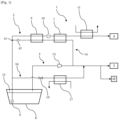
- FIGS. 1 to 3 represent different embodiments of a gas supply system 1 arranged on a floating structure.
- the supply system 1 makes it possible to circulate gas which may be in the liquid state, in the vapor state, in the two-phase state or in the supercritical state, and this from a storage and/or transport tank 8, and up to a high-pressure gas-consuming device 4 and/or a low pressure gas consuming device 5, in order to supply the latter with fuel.
- Said floating structure may for example be a ship capable of storing and/or transporting gas in the liquid state.
- the supply system 1 is in this case capable of using the gas in the liquid state that the floating structure stores and/or transports to supply the high-pressure gas-consuming device 4, which may for example be a propulsion engine, and the low-pressure gas-consuming device 5, which may for example be an electric generator supplying the floating structure with electricity.
- the supply system 1 is provided with a first gas supply circuit 2.
- the first supply circuit 2 comprises a first pump 9 arranged within the tank 8.
- the first pump 9 makes it possible to pump the gas in the liquid state and to circulate it in particular within the first supply circuit 2. By sucking up the gas in the liquid state, the first pump 9 also makes it possible to raise the pressure thereof to a value between 9 and 17 bars.
- the gas in the liquid state in a direction of circulation going from the tank 8 to the high-pressure gas-consuming device 4, passes through a first heat exchanger 6, is pumped by an additional pump 10 and passes through a second heat exchanger 7.
- the details concerning the two heat exchangers 6, 7 will be described later.
- the gas After passing through the second heat exchanger 7, the gas flows to a high-pressure evaporator 11.
- the high-pressure evaporator 11 makes it possible to modify the state of the gas flowing in the first supply circuit 2 in order to change it to the vapor or supercritical state. Such a state makes the gas compatible with supplying the high-pressure gas-consuming appliance 4.
- the evaporation of the gas to the liquid state can, for example, be done by heat exchange with a heat transfer fluid at a temperature high enough to evaporate the gas to the liquid state, here glycolated water, sea water or water vapor.
- the first heat exchanger 6, the second heat exchanger 7 and the high-pressure evaporator 11 are heat exchangers separate from each other.
- Such a configuration makes it possible to design and manufacture each of the heat exchangers in a technology adapted to the pressure of the fluids flowing through them.
- the first heat exchanger 6 can be produced using a less expensive technology than that used to manufacture the second heat exchanger 7, since the pressure within the first exchanger is significantly lower than that present within the second heat exchanger 7.
- the increase in gas pressure is ensured by the additional pump 10 when it pumps the gas in the liquid state.
- the additional pump 10 makes it possible to raise the pressure of the gas in the liquid state to a value between 30 and 70 bars for use with liquefied petroleum gas, and preferably between 150 and 400 bars for use with ethane, ethylene or even with liquefied natural gas consisting mainly of methane.
- the gas is at a pressure and in a state compatible for supplying the high-pressure consumer device 4.
- Such a configuration makes it possible to avoid the installation of high-pressure compressors on the first supply circuit 2 which present cost constraints and generate strong vibrations.
- the gas in the vapor state contained in the tank headspace 12 must be evacuated.
- the first supply circuit 2 is configured to use the gas in the liquid state to supply the high-pressure gas-consuming device 4.
- the supply system 1 therefore comprises a second gas supply circuit 3, which uses the gas in the vapor state to supply the low-pressure gas-consuming device 5.
- the second supply circuit 3 therefore extends between the tank top 12 and the low-pressure gas-consuming device 5.
- the second supply circuit 3 comprises a compressor 13.
- the compressor 13 also makes it possible to raise a pressure of the gas in the vapor state circulating in the second supply circuit 3 to a pressure of 8 bars absolute +/- 1 bar, so that the gas in the vapor state is at a pressure compatible with supplying the low-pressure gas-consuming device 5.
- the second supply circuit 3 thus makes it possible to supply the low-pressure gas-consuming device 5, while regulating the pressure within the tank 8 by sucking in the gas in vapor state present in the tank headspace 12.
- the supply system 1 comprises a return line 14 connected to the second supply circuit 3 downstream of the compressor 13 relative to a direction of circulation of the gas in the vapor state circulating in the second supply circuit 3. Depending on the direction of circulation of the gas in the vapor state circulating in the return line 14, said gas passes through the second heat exchanger 7 first, then passes through the first heat exchanger 6.
- the exchange of calories taking place within the first heat exchanger 6 and the second heat exchanger 7 is therefore between the gas in the liquid state circulating in the first supply circuit 2 and the gas in the vapor state circulating in the return line 14.
- the objective of this exchange of calories is to condense the gas in the vapor state of the return line 14, so that it passes to the liquid state.
- the return line 14 extends to a convergence point 41 arranged at the level of the first supply circuit 2, between the first pump 9 and the first heat exchanger 6.
- the gas circulating in the return line 14 joins the first supply circuit 2 instead of returning to the tank 8.
- the re-circulation in the first supply circuit 2 subsequently makes it possible to supply the high-pressure gas-consuming appliance 4 as described above.
- the return line 14 further comprises a second pump 42 arranged between the first heat exchanger 6 and the convergence point 41.
- the second pump 42 makes it possible to increase the pressure of the gas circulating in the return line 14 in order to achieve pressure balancing with the pressure of the gas in the liquid state circulating in the first supply circuit 2 after having been pressurized by the first pump 9.
- This pressure balancing makes it possible to smooth the circulation of the reliquefied gas from the return line 14 to the first supply circuit 2.
- the second pump 42 also makes it possible to avoid the compressor 13 pressurizing the gas in the vapor state circulating in the second supply circuit 3 at a pressure greater than approximately 8 bars. This limits the energy required to power the compressor 13.
- the gas in the liquid state of the first supply circuit 2 has the lowest temperature.
- the gas circulating in the return line 14 is condensed.
- the gas in the return line 14 is therefore in the vapor state at the inlet of the first heat exchanger 6 and leaves in the liquid state following the exchange of calories taking place within the first heat exchanger 6, and this before being pumped by the second pump 42 and joining the first supply circuit 2.
- the first heat exchanger 6 therefore acts as a condenser.
- the ratio of the amount of condensed vapor gas to the amount of liquid gas flowing within the first feed circuit 2 is approximately 16% +/- 5%. In other words, for approximately six tons per hour of liquid gas flowing in the first feed circuit 2, approximately one ton per hour of vapor gas flowing in the return line is condensed.
- the second heat exchanger 7 is located downstream of the first heat exchanger 6 in the direction of circulation of the gas in the first supply circuit 2, and upstream of the first heat exchanger 6 in the direction of circulation of the gas in the return line 14.
- the second heat exchanger 7 therefore ensures pre-cooling of the gas in the vapor state circulating in the return line 14 before it is condensed within the first heat exchanger 6.
- the gas in the liquid state at the inlet of the second heat exchanger 7 has previously passed through the first heat exchanger 6 and has been pumped by the additional pump 10, which has therefore increased its temperature and pressure. It is thus possible that following the exchange of calories occurring at the second heat exchanger 7, the gas circulating within the first supply circuit 2 exits the second heat exchanger 7 in a two-phase state.
- the temperature of the gas circulating in the return line 14 is therefore lowered after passing through the second heat exchanger 7, implementing the pre-cooling indicated above.
- the additional pump 10 is advantageously arranged between the two heat exchangers 6, 7.
- the presence of the additional pump 10 between the first heat exchanger 6 and the second heat exchanger 7 ensures that only gas in the liquid state circulates through the additional pump 10, and not gas in a two-phase state which risks damaging the latter.
- the presence of the additional pump 10 downstream of the first heat exchanger 6 ensures the increase in pressure of the gas in the liquid state, and this without disturbing the exchange of calories occurring within the first heat exchanger 6.
- the condensation of the gas in the vapor state circulating in the return line 14 is thus carried out optimally.
- the supply system 1 also comprises an auxiliary supply line 16, extending from the first supply circuit 2, via a tapping between the first pump 9 and the first heat exchanger 6, to the second supply circuit 3, connecting to the latter between the compressor 13 and the low-pressure gas-consuming device 5.
- the auxiliary supply line 16 makes it possible to supply the low-pressure gas-consuming device 5 in the event of an insufficient flow rate of gas in the vapor state formed within the tank top 12.
- the gas in the liquid state pumped by the first pump 9 can then circulate within this auxiliary supply line 16 in order to supply the low-pressure gas-consuming appliance 5.
- the auxiliary supply line 16 passes through a low-pressure evaporator 17 so that the gas in the liquid state circulating in the auxiliary supply line 16 changes to the vapor state.
- the operation of the low-pressure evaporator 17 can for example be identical to that of the high-pressure evaporator 11, that is to say that the gas is evaporated by heat exchange with a heat transfer fluid at a temperature high enough to evaporate the gas in the liquid state.
- the gas in the vapor state circulates within the auxiliary supply line 16, then joins the second supply circuit 3 in order to supply the low-pressure gas-consuming appliance 5.
- the auxiliary supply line 16 is only used in the absence of gas in vapor state in sufficient quantity within the tank head 12.
- the auxiliary supply line 16 comprises a valve 19 ensuring the control of the circulation of gas within the auxiliary supply line 16 when the use of the latter is not necessary.
- FIG.2 represents a second embodiment of the supply system 1 according to the invention.
- This second embodiment is distinguished from the first embodiment by the fact that the supply system comprises a return branch 44 extending between a divergence point 43 arranged on the return line 14 and the tank 8.
- the divergence point 43 is more precisely arranged between the first heat exchanger 6 and the second pump 42.
- the return branch 44 offers the alternative to the reliquefied gas by returning the latter to the tank 8 rather than circulating it within the first supply circuit 2.
- the return line 14 may comprise an expansion member 15 which lowers the pressure of the gas to a pressure of between 1 and 3 bars absolute. Once the gas is condensed, it continues its course to the tank 8.
- the reliquefied gas can circulate in a limited manner within the return branch 44.
- the expansion member 15 can also be completely closed so that all of the reliquefied gas circulating in the return line 14 reaches the first supply circuit 2.
- FIG.3 shows a third embodiment of the power supply system 1 in all respects identical to that described in [ Fig.2 ], except for the following.
- the second heat exchanger 7 and the high-pressure evaporator 11 form a single heat exchanger 21.
- the illustration of the third embodiment makes it possible to design and manufacture the single heat exchanger 21 bringing together the second heat exchanger 7 and the high-pressure evaporator 11, these two components being subjected to the same high pressure which dictates the technology used for the manufacture of this common heat exchanger.
- Such a solution can also be justified by a lack of space not allowing the second heat exchanger 7 and the high-pressure evaporator 11 to be installed separately from each other.
- the third embodiment includes the return branch 44, but it is entirely possible to implement a supply system 1 without the return branch 44, as illustrated in the [ Fig.1 ], but whose second heat exchanger 7 and the high pressure evaporator 11 form the single heat exchanger 21 as illustrated in the [ Fig.3 ].
- FIG.4 is a cutaway view of a floating structure 20 which shows the tank 8 which contains the gas in the liquid state and in the vapor state, this tank 8 being of generally prismatic shape mounted in a double shell 22 of the floating structure 20.
- the wall of the tank 8 comprises a primary sealing membrane intended to be in contact with the gas in the liquid state contained in the tank 8, a secondary sealing membrane arranged between the primary sealing membrane and the double shell 22 of the floating structure 20, and two thermally insulating barriers arranged respectively between the primary sealing membrane and the secondary sealing membrane and between the secondary sealing membrane and the double shell 22.
- Pipelines 23 for loading and/or unloading liquid gas arranged on the upper deck of the floating structure 20 can be connected, by means of appropriate connectors, to a maritime or port terminal for transferring the cargo of gas in liquid state from or to tank 8.
- Fig.4 also represents an example of a maritime or port terminal comprising loading and/or unloading equipment 25, an underwater pipeline 26 and a land and/or port installation 27.
- the land and/or port installation 27 may for example be arranged on the quay of a port, or according to another example be arranged on a concrete gravity platform.
- the land and/or port installation 27 comprises liquid gas storage tanks 30 and connecting pipelines 31 connected by the underwater pipeline 26 to the loading and/or unloading equipment 25.
- pumps equipping the land and/or port installation 27 and/or pumps equipping the floating structure 20 are used.
- the invention achieves the aim it set itself, and makes it possible to propose a gas supply system for high-pressure or low-pressure gas-consuming appliances, the high-pressure of which is achieved using pumps and an evaporator, and comprising a means for condensing a gas in the vapor state in order to return it to a circuit supplying one or other of the gas-consuming appliances.
- Variants not described here could be implemented without departing from the context of the invention, provided that, in accordance with the invention, they comprise a supply system in accordance with the invention.
Landscapes
- Engineering & Computer Science (AREA)
- Mechanical Engineering (AREA)
- Chemical & Material Sciences (AREA)
- Combustion & Propulsion (AREA)
- General Engineering & Computer Science (AREA)
- Ocean & Marine Engineering (AREA)
- Chemical Kinetics & Catalysis (AREA)
- General Chemical & Material Sciences (AREA)
- Oil, Petroleum & Natural Gas (AREA)
- Filling Or Discharging Of Gas Storage Vessels (AREA)
- Feeding And Controlling Fuel (AREA)
Applications Claiming Priority (1)
| Application Number | Priority Date | Filing Date | Title |
|---|---|---|---|
| FR2302351A FR3146721B1 (fr) | 2023-03-14 | 2023-03-14 | Système d’alimentation en gaz pour appareils consommateurs de gaz à haute et basse pression |
Publications (1)
| Publication Number | Publication Date |
|---|---|
| EP4431792A1 true EP4431792A1 (fr) | 2024-09-18 |
Family
ID=87036573
Family Applications (1)
| Application Number | Title | Priority Date | Filing Date |
|---|---|---|---|
| EP24161634.1A Pending EP4431792A1 (fr) | 2023-03-14 | 2024-03-06 | Système d'alimentation en gaz pour appareils consommateurs de gaz à haute et basse pression |
Country Status (5)
| Country | Link |
|---|---|
| EP (1) | EP4431792A1 (https=) |
| JP (1) | JP2024147506A (https=) |
| KR (1) | KR20240140006A (https=) |
| CN (1) | CN118654228A (https=) |
| FR (1) | FR3146721B1 (https=) |
Citations (2)
| Publication number | Priority date | Publication date | Assignee | Title |
|---|---|---|---|---|
| WO2022234941A1 (ko) * | 2021-05-03 | 2022-11-10 | 선보공업주식회사 | 베이퍼라이저 및 열교환기 통합형 증발 가스 재액화 시스템 |
| FR3124830A1 (fr) * | 2021-06-30 | 2023-01-06 | Gaztransport Et Technigaz | Système d’alimentation en gaz pour appareils consommateurs de gaz à haute et basse pression |
-
2023
- 2023-03-14 FR FR2302351A patent/FR3146721B1/fr active Active
-
2024
- 2024-03-06 EP EP24161634.1A patent/EP4431792A1/fr active Pending
- 2024-03-13 JP JP2024039466A patent/JP2024147506A/ja active Pending
- 2024-03-13 KR KR1020240035405A patent/KR20240140006A/ko active Pending
- 2024-03-13 CN CN202410284783.4A patent/CN118654228A/zh active Pending
Patent Citations (2)
| Publication number | Priority date | Publication date | Assignee | Title |
|---|---|---|---|---|
| WO2022234941A1 (ko) * | 2021-05-03 | 2022-11-10 | 선보공업주식회사 | 베이퍼라이저 및 열교환기 통합형 증발 가스 재액화 시스템 |
| FR3124830A1 (fr) * | 2021-06-30 | 2023-01-06 | Gaztransport Et Technigaz | Système d’alimentation en gaz pour appareils consommateurs de gaz à haute et basse pression |
Also Published As
| Publication number | Publication date |
|---|---|
| KR20240140006A (ko) | 2024-09-24 |
| CN118654228A (zh) | 2024-09-17 |
| FR3146721A1 (fr) | 2024-09-20 |
| FR3146721B1 (fr) | 2025-02-14 |
| JP2024147506A (ja) | 2024-10-16 |
Similar Documents
| Publication | Publication Date | Title |
|---|---|---|
| WO2019145342A1 (fr) | Procede et systeme de traitement de gaz d'une installation de stockage de gaz pour un navire de transport de gaz | |
| EP3433530B1 (fr) | Installation d'alimentation en gaz combustible d'un organe consommateur de gaz et de liquefaction dudit gaz combustible | |
| EP4281718A1 (fr) | Système d'alimentation en gaz pour appareils consommateurs de gaz à haute et basse pression | |
| FR3077867A1 (fr) | Procede et systeme de traitement de gaz d'une installation de stockage de gaz pour un navire de transport de gaz | |
| WO2021099726A1 (fr) | Système d'alimentation en gaz d'au moins un appareil consommateur de gaz équipant un navire | |
| FR3124830A1 (fr) | Système d’alimentation en gaz pour appareils consommateurs de gaz à haute et basse pression | |
| EP4222366A1 (fr) | Système d'alimentation en gaz pour appareils consommateurs de gaz à haute et basse pression | |
| FR3121504A1 (fr) | Procédé de refroidissement d’un échangeur thermique d’un système d’alimentation en gaz d’un appareil consommateur de gaz d’un navire | |
| EP4431792A1 (fr) | Système d'alimentation en gaz pour appareils consommateurs de gaz à haute et basse pression | |
| WO2023194670A1 (fr) | Système d'alimentation en gaz pour appareils consommateurs de gaz à haute et basse pression et procédé de contrôle d'un tel système | |
| WO2023194669A1 (fr) | Système d'alimentation en gaz pour appareils consommateurs de gaz à haute et basse pression et procédé de contrôle d'un tel système | |
| WO2024084154A1 (fr) | Procede de gestion d'un fluide sous forme liquide contenu dans une cuve | |
| EP4628779A1 (fr) | Système d'alimentation en gaz pour appareils consommateurs de gaz à haute et basse pressions | |
| FR3114797A1 (fr) | Système d’alimentation en gaz pour appareils consommateurs de gaz à haute et basse pression | |
| WO2021032925A1 (fr) | Système de traitement de gaz contenu dans une cuve de stockage et/ou de transport de gaz à l'état liquide et à l'état gazeux équipant un navire | |
| WO2021064319A1 (fr) | Système de traitement d'un gaz contenu dans une cuve de stockage et/ou de transport de gaz à l'état liquide et gazeux | |
| WO2020109607A1 (fr) | Dispositif de generation de gaz sous forme gazeuse a partir de gaz liquefie | |
| FR3116507A1 (fr) | Système d’alimentation en gaz d’au moins un appareil consommateur de gaz équipant un navire | |
| WO2025093827A1 (fr) | Système d'alimentation en gaz d'au moins un appareil consommateur de gaz d'un ouvrage flottant | |
| FR3123717A1 (fr) | Circuit de reliquéfaction d’un fluide et d’alimentation d’un consommateur. |
Legal Events
| Date | Code | Title | Description |
|---|---|---|---|
| PUAI | Public reference made under article 153(3) epc to a published international application that has entered the european phase |
Free format text: ORIGINAL CODE: 0009012 |
|
| STAA | Information on the status of an ep patent application or granted ep patent |
Free format text: STATUS: THE APPLICATION HAS BEEN PUBLISHED |
|
| AK | Designated contracting states |
Kind code of ref document: A1 Designated state(s): AL AT BE BG CH CY CZ DE DK EE ES FI FR GB GR HR HU IE IS IT LI LT LU LV MC ME MK MT NL NO PL PT RO RS SE SI SK SM TR |
|
| STAA | Information on the status of an ep patent application or granted ep patent |
Free format text: STATUS: REQUEST FOR EXAMINATION WAS MADE |
|
| 17P | Request for examination filed |
Effective date: 20250312 |