EP4431584A1 - Verfahren zur herstellung von biostrahlbrennstoff und in diesem verfahren verwendeter biostrahlbrennstoffherstellungskatalysator - Google Patents
Verfahren zur herstellung von biostrahlbrennstoff und in diesem verfahren verwendeter biostrahlbrennstoffherstellungskatalysator Download PDFInfo
- Publication number
- EP4431584A1 EP4431584A1 EP22892835.4A EP22892835A EP4431584A1 EP 4431584 A1 EP4431584 A1 EP 4431584A1 EP 22892835 A EP22892835 A EP 22892835A EP 4431584 A1 EP4431584 A1 EP 4431584A1
- Authority
- EP
- European Patent Office
- Prior art keywords
- catalyst
- bio
- jet fuel
- producing
- group
- Prior art date
- Legal status (The legal status is an assumption and is not a legal conclusion. Google has not performed a legal analysis and makes no representation as to the accuracy of the status listed.)
- Pending
Links
Images


Classifications
-
- B—PERFORMING OPERATIONS; TRANSPORTING
- B01—PHYSICAL OR CHEMICAL PROCESSES OR APPARATUS IN GENERAL
- B01J—CHEMICAL OR PHYSICAL PROCESSES, e.g. CATALYSIS OR COLLOID CHEMISTRY; THEIR RELEVANT APPARATUS
- B01J29/00—Catalysts comprising molecular sieves
- B01J29/04—Catalysts comprising molecular sieves having base-exchange properties, e.g. crystalline zeolites
- B01J29/06—Crystalline aluminosilicate zeolites; Isomorphous compounds thereof
- B01J29/40—Crystalline aluminosilicate zeolites; Isomorphous compounds thereof of the pentasil type, e.g. types ZSM-5, ZSM-8 or ZSM-11, as exemplified by patent documents US3702886, GB1334243 and US3709979, respectively
-
- B—PERFORMING OPERATIONS; TRANSPORTING
- B01—PHYSICAL OR CHEMICAL PROCESSES OR APPARATUS IN GENERAL
- B01J—CHEMICAL OR PHYSICAL PROCESSES, e.g. CATALYSIS OR COLLOID CHEMISTRY; THEIR RELEVANT APPARATUS
- B01J29/00—Catalysts comprising molecular sieves
- B01J29/04—Catalysts comprising molecular sieves having base-exchange properties, e.g. crystalline zeolites
- B01J29/06—Crystalline aluminosilicate zeolites; Isomorphous compounds thereof
- B01J29/40—Crystalline aluminosilicate zeolites; Isomorphous compounds thereof of the pentasil type, e.g. types ZSM-5, ZSM-8 or ZSM-11, as exemplified by patent documents US3702886, GB1334243 and US3709979, respectively
- B01J29/42—Crystalline aluminosilicate zeolites; Isomorphous compounds thereof of the pentasil type, e.g. types ZSM-5, ZSM-8 or ZSM-11, as exemplified by patent documents US3702886, GB1334243 and US3709979, respectively containing iron group metals, noble metals or copper
- B01J29/44—Noble metals
-
- C—CHEMISTRY; METALLURGY
- C10—PETROLEUM, GAS OR COKE INDUSTRIES; TECHNICAL GASES CONTAINING CARBON MONOXIDE; FUELS; LUBRICANTS; PEAT
- C10G—CRACKING HYDROCARBON OILS; PRODUCTION OF LIQUID HYDROCARBON MIXTURES, e.g. BY DESTRUCTIVE HYDROGENATION, OLIGOMERISATION, POLYMERISATION; RECOVERY OF HYDROCARBON OILS FROM OIL-SHALE, OIL-SAND, OR GASES; REFINING MIXTURES MAINLY CONSISTING OF HYDROCARBONS; REFORMING OF NAPHTHA; MINERAL WAXES
- C10G1/00—Production of liquid hydrocarbon mixtures from oil-shale, oil-sand, or non-melting solid carbonaceous or similar materials, e.g. wood, coal
- C10G1/08—Production of liquid hydrocarbon mixtures from oil-shale, oil-sand, or non-melting solid carbonaceous or similar materials, e.g. wood, coal with moving catalysts
-
- C—CHEMISTRY; METALLURGY
- C10—PETROLEUM, GAS OR COKE INDUSTRIES; TECHNICAL GASES CONTAINING CARBON MONOXIDE; FUELS; LUBRICANTS; PEAT
- C10G—CRACKING HYDROCARBON OILS; PRODUCTION OF LIQUID HYDROCARBON MIXTURES, e.g. BY DESTRUCTIVE HYDROGENATION, OLIGOMERISATION, POLYMERISATION; RECOVERY OF HYDROCARBON OILS FROM OIL-SHALE, OIL-SAND, OR GASES; REFINING MIXTURES MAINLY CONSISTING OF HYDROCARBONS; REFORMING OF NAPHTHA; MINERAL WAXES
- C10G3/00—Production of liquid hydrocarbon mixtures from oxygen-containing organic materials, e.g. fatty oils, fatty acids
- C10G3/42—Catalytic treatment
- C10G3/44—Catalytic treatment characterised by the catalyst used
-
- C—CHEMISTRY; METALLURGY
- C10—PETROLEUM, GAS OR COKE INDUSTRIES; TECHNICAL GASES CONTAINING CARBON MONOXIDE; FUELS; LUBRICANTS; PEAT
- C10G—CRACKING HYDROCARBON OILS; PRODUCTION OF LIQUID HYDROCARBON MIXTURES, e.g. BY DESTRUCTIVE HYDROGENATION, OLIGOMERISATION, POLYMERISATION; RECOVERY OF HYDROCARBON OILS FROM OIL-SHALE, OIL-SAND, OR GASES; REFINING MIXTURES MAINLY CONSISTING OF HYDROCARBONS; REFORMING OF NAPHTHA; MINERAL WAXES
- C10G3/00—Production of liquid hydrocarbon mixtures from oxygen-containing organic materials, e.g. fatty oils, fatty acids
- C10G3/42—Catalytic treatment
- C10G3/44—Catalytic treatment characterised by the catalyst used
- C10G3/45—Catalytic treatment characterised by the catalyst used containing iron group metals or compounds thereof
-
- C—CHEMISTRY; METALLURGY
- C10—PETROLEUM, GAS OR COKE INDUSTRIES; TECHNICAL GASES CONTAINING CARBON MONOXIDE; FUELS; LUBRICANTS; PEAT
- C10G—CRACKING HYDROCARBON OILS; PRODUCTION OF LIQUID HYDROCARBON MIXTURES, e.g. BY DESTRUCTIVE HYDROGENATION, OLIGOMERISATION, POLYMERISATION; RECOVERY OF HYDROCARBON OILS FROM OIL-SHALE, OIL-SAND, OR GASES; REFINING MIXTURES MAINLY CONSISTING OF HYDROCARBONS; REFORMING OF NAPHTHA; MINERAL WAXES
- C10G3/00—Production of liquid hydrocarbon mixtures from oxygen-containing organic materials, e.g. fatty oils, fatty acids
- C10G3/42—Catalytic treatment
- C10G3/44—Catalytic treatment characterised by the catalyst used
- C10G3/47—Catalytic treatment characterised by the catalyst used containing platinum group metals or compounds thereof
-
- C—CHEMISTRY; METALLURGY
- C10—PETROLEUM, GAS OR COKE INDUSTRIES; TECHNICAL GASES CONTAINING CARBON MONOXIDE; FUELS; LUBRICANTS; PEAT
- C10G—CRACKING HYDROCARBON OILS; PRODUCTION OF LIQUID HYDROCARBON MIXTURES, e.g. BY DESTRUCTIVE HYDROGENATION, OLIGOMERISATION, POLYMERISATION; RECOVERY OF HYDROCARBON OILS FROM OIL-SHALE, OIL-SAND, OR GASES; REFINING MIXTURES MAINLY CONSISTING OF HYDROCARBONS; REFORMING OF NAPHTHA; MINERAL WAXES
- C10G3/00—Production of liquid hydrocarbon mixtures from oxygen-containing organic materials, e.g. fatty oils, fatty acids
- C10G3/42—Catalytic treatment
- C10G3/44—Catalytic treatment characterised by the catalyst used
- C10G3/48—Catalytic treatment characterised by the catalyst used further characterised by the catalyst support
- C10G3/49—Catalytic treatment characterised by the catalyst used further characterised by the catalyst support containing crystalline aluminosilicates, e.g. molecular sieves
-
- C—CHEMISTRY; METALLURGY
- C10—PETROLEUM, GAS OR COKE INDUSTRIES; TECHNICAL GASES CONTAINING CARBON MONOXIDE; FUELS; LUBRICANTS; PEAT
- C10G—CRACKING HYDROCARBON OILS; PRODUCTION OF LIQUID HYDROCARBON MIXTURES, e.g. BY DESTRUCTIVE HYDROGENATION, OLIGOMERISATION, POLYMERISATION; RECOVERY OF HYDROCARBON OILS FROM OIL-SHALE, OIL-SAND, OR GASES; REFINING MIXTURES MAINLY CONSISTING OF HYDROCARBONS; REFORMING OF NAPHTHA; MINERAL WAXES
- C10G3/00—Production of liquid hydrocarbon mixtures from oxygen-containing organic materials, e.g. fatty oils, fatty acids
- C10G3/50—Production of liquid hydrocarbon mixtures from oxygen-containing organic materials, e.g. fatty oils, fatty acids in the presence of hydrogen, hydrogen donors or hydrogen generating compounds
-
- C—CHEMISTRY; METALLURGY
- C10—PETROLEUM, GAS OR COKE INDUSTRIES; TECHNICAL GASES CONTAINING CARBON MONOXIDE; FUELS; LUBRICANTS; PEAT
- C10L—FUELS NOT OTHERWISE PROVIDED FOR; NATURAL GAS; SYNTHETIC NATURAL GAS OBTAINED BY PROCESSES NOT COVERED BY SUBCLASSES C10G OR C10K; LIQUIFIED PETROLEUM GAS; USE OF ADDITIVES TO FUELS OR FIRES; FIRE-LIGHTERS
- C10L1/00—Liquid carbonaceous fuels
- C10L1/02—Liquid carbonaceous fuels essentially based on components consisting of carbon, hydrogen, and oxygen only
-
- C—CHEMISTRY; METALLURGY
- C11—ANIMAL OR VEGETABLE OILS, FATS, FATTY SUBSTANCES OR WAXES; FATTY ACIDS THEREFROM; DETERGENTS; CANDLES
- C11C—FATTY ACIDS FROM FATS, OILS OR WAXES; CANDLES; FATS, OILS OR FATTY ACIDS BY CHEMICAL MODIFICATION OF FATS, OILS, OR FATTY ACIDS OBTAINED THEREFROM
- C11C3/00—Fats, oils, or fatty acids by chemical modification of fats, oils, or fatty acids obtained therefrom
-
- C—CHEMISTRY; METALLURGY
- C11—ANIMAL OR VEGETABLE OILS, FATS, FATTY SUBSTANCES OR WAXES; FATTY ACIDS THEREFROM; DETERGENTS; CANDLES
- C11C—FATTY ACIDS FROM FATS, OILS OR WAXES; CANDLES; FATS, OILS OR FATTY ACIDS BY CHEMICAL MODIFICATION OF FATS, OILS, OR FATTY ACIDS OBTAINED THEREFROM
- C11C3/00—Fats, oils, or fatty acids by chemical modification of fats, oils, or fatty acids obtained therefrom
- C11C3/12—Fats, oils, or fatty acids by chemical modification of fats, oils, or fatty acids obtained therefrom by hydrogenation
-
- C—CHEMISTRY; METALLURGY
- C10—PETROLEUM, GAS OR COKE INDUSTRIES; TECHNICAL GASES CONTAINING CARBON MONOXIDE; FUELS; LUBRICANTS; PEAT
- C10G—CRACKING HYDROCARBON OILS; PRODUCTION OF LIQUID HYDROCARBON MIXTURES, e.g. BY DESTRUCTIVE HYDROGENATION, OLIGOMERISATION, POLYMERISATION; RECOVERY OF HYDROCARBON OILS FROM OIL-SHALE, OIL-SAND, OR GASES; REFINING MIXTURES MAINLY CONSISTING OF HYDROCARBONS; REFORMING OF NAPHTHA; MINERAL WAXES
- C10G2300/00—Aspects relating to hydrocarbon processing covered by groups C10G1/00 - C10G99/00
- C10G2300/10—Feedstock materials
- C10G2300/1011—Biomass
-
- C—CHEMISTRY; METALLURGY
- C10—PETROLEUM, GAS OR COKE INDUSTRIES; TECHNICAL GASES CONTAINING CARBON MONOXIDE; FUELS; LUBRICANTS; PEAT
- C10G—CRACKING HYDROCARBON OILS; PRODUCTION OF LIQUID HYDROCARBON MIXTURES, e.g. BY DESTRUCTIVE HYDROGENATION, OLIGOMERISATION, POLYMERISATION; RECOVERY OF HYDROCARBON OILS FROM OIL-SHALE, OIL-SAND, OR GASES; REFINING MIXTURES MAINLY CONSISTING OF HYDROCARBONS; REFORMING OF NAPHTHA; MINERAL WAXES
- C10G2300/00—Aspects relating to hydrocarbon processing covered by groups C10G1/00 - C10G99/00
- C10G2300/10—Feedstock materials
- C10G2300/1011—Biomass
- C10G2300/1014—Biomass of vegetal origin
-
- Y—GENERAL TAGGING OF NEW TECHNOLOGICAL DEVELOPMENTS; GENERAL TAGGING OF CROSS-SECTIONAL TECHNOLOGIES SPANNING OVER SEVERAL SECTIONS OF THE IPC; TECHNICAL SUBJECTS COVERED BY FORMER USPC CROSS-REFERENCE ART COLLECTIONS [XRACs] AND DIGESTS
- Y02—TECHNOLOGIES OR APPLICATIONS FOR MITIGATION OR ADAPTATION AGAINST CLIMATE CHANGE
- Y02P—CLIMATE CHANGE MITIGATION TECHNOLOGIES IN THE PRODUCTION OR PROCESSING OF GOODS
- Y02P30/00—Technologies relating to oil refining and petrochemical industry
- Y02P30/20—Technologies relating to oil refining and petrochemical industry using bio-feedstock
Definitions
- the present invention relates to a method of producing a bio-jet fuel for obtaining a bio-jet fuel by reforming a bio-oil derived from a biomass, and to a catalyst for producing a bio-jet fuel.
- a biofuel has been paid attention to as an alternative product to a fossil fuel that can achieve carbon neutrality from the viewpoint of suppressing carbon dioxide emission.
- carbon dioxide in the atmosphere is not increased even by its use because carbon dioxide emitted by its combustion is derived from carbon dioxide absorbed from the atmosphere in a growth process of a biomass.
- carbon neutrality which is a concept that an emission amount of carbon dioxide and an absorption amount of carbon dioxide are the same when production or a biological activity is performed, can be achieved.
- biofuel that achieves carbon neutrality
- a bio-jet fuel in addition to a bioethanol fuel and a biodiesel fuel that have been widely spread in recent years.
- the spread of the bio-jet fuel is in a slower state as compared to that of the bioethanol fuel or the biodiesel fuel due to its strict production standard or the like, but about 1.5 billion barrels to about 1.7 billion barrels (238 Mm 3 to 270 Mm 3 equivalent) of a typical jet fuel is annually consumed in the aviation industry in the world, and hence rapid development of a high-quality bio-jet fuel has been required.
- a method of producing a bio-jet fuel from a biomass resource has heretofore been performed by: subjecting a biomass-derived raw material oil a biomass to decarbonation or deoxidation; subjecting the resultant to hydrogenation treatment to generate a hydrocarbon; and subjecting the hydrocarbon to isomerization and decomposition to generate a C 7-14 isomerized hydrocarbon serving as a bio-jet fuel.
- Patent Literature 2 there is a disclosure of a method of generating a hydrocarbon, including: a first stage of providing a condition, which is sufficient for subjecting an oil of biological origin and a hydrogen gas to hydrodeoxygenation under the presence of a hydrodeoxygenation catalyst, to generate n-paraffin; a second stage of providing a condition, which is sufficient for subjecting n-paraffin and the hydrogen gas to isomerization under the presence of an isomerization catalyst, to generate an isoparaffin and a separated fraction; and a third stage of recirculating a fraction that boils at 200°C or more under the atmospheric pressure obtained between the second stage and reisomerization to perform isomerization under the presence of the isomerization catalyst.
- Patent Literature 3 there is a disclosure of a method of converting a triacylglyceride-containing oil into a crude oil precursor and/or a distilled hydrocarbon fuel, the method including the following operations: subjecting a mixture of the triacylglyceride-containing oil, water, and diatomic hydrogen to a reaction at a temperature in the range of from about 250°C to about 560°C and at a pressure of more than about 75 bar to convert at least part of triacylglyceride, followed by the recovery of a reaction effluent containing water and one or more kinds of an isoolefin, an isoparaffin, a cycloolefin, a cycloparaffin, and aromatic compounds; and subjecting the reaction effluent to hydrogen treatment to form a hydrogen-treated effluent.
- Patent Literatures 1 and 2 each of the methods as described in Patent Literatures 1 and 2 involves a two-stage process including a hydrodeoxygenation treatment step and an isomerization decomposition step. Accordingly, there is a problem in that large energy consumption is involved, and high cost is required in the production of a bio-jet fuel.
- Patent Literature 3 a facility that withstands high pressure and a large amount of hydrogen are required because an oil and fat is subjected to hydrothermal treatment under a high pressure of more than about 75 bar, followed by a hydrogenation reaction. Accordingly, there is a problem in that large energy consumption is involved, and high cost is required in the production of a bio-jet fuel.
- the inventor of the present application has focused on a bio-oil obtained by subjecting a biomass resource to pyrolysis using a superheated steam and on a bifunctional catalyst obtained by causing a solid acid catalyst to support a solid base catalyst.
- the inventor has achieved the inventions of a method of producing a bio-jet fuel and a catalyst for producing a bio-jet fuel of the present application.
- the present invention is directed to provide a method of producing a bio-jet fuel, the method having a high energy-saving property and enabling easy production of a high-quality bio-jet fuel, and a catalyst for producing a bio-jet fuel to be used in the method.
- the invention of claim 1 includes a reforming treatment step of subjecting a biomass-derived oil containing a free fatty acid, a hydrocarbon, and a triacylglycerol to decarbonation, hydrogenation, isomerization, and decomposition using a catalyst, which is obtained by causing a solid acid catalyst to support a solid base catalyst, under the condition of a reaction temperature of from 200°C to 450°C.
- the biomass-derived oil is a bio-oil obtained by heating a biomass resource and cooling the generated pyrolysis gas.
- the bio-oil of claim 2 is obtained by heating the biomass resource at from 200°C to 450°C and cooling the generated pyrolysis gas.
- the bio-oil of claim 2 or 3 is obtained by heating the biomass resource using heating means including jetting a superheated steam and cooling the generated pyrolysis gas.
- the bio-oil of any one of claims 2 to 4 is obtained by heating coconut fruit serving as the biomass resource and cooling the generated pyrolysis gas.
- a usage amount of the catalyst of any one of claims 1 to 5 is from 5 wt% to 15 wt% with respect to the biomass-derived oil.
- the reforming treatment step of any one of claims 1 to 6 is performed in a reaction vessel in which a hydrogen gas is sealed at a pressure of from 0 MPa to 2 MPa.
- the reforming treatment step of any one of claims 1 to 7 is performed for a period of time in the range of from 3 hours to 6 hours.
- the solid acid catalyst of the catalyst of any one of claims 1 to 8 is a zeolite.
- the zeolite serving as the solid acid catalyst of the catalyst of claim 9 is ZSM-5-type zeolite.
- the solid base catalyst of the catalyst of any one of claims 1 to 10 contains a Group 2 metal oxide.
- the Group 2 metal oxide serving as the solid base catalyst of the catalyst of claim 11 is one kind or two or more kinds selected from magnesium oxide, calcium oxide, and barium oxide.
- the solid acid catalyst of the catalyst of any one of claims 1 to 12 is caused to support one or a plurality of metals selected from Group 8, Group 9, and Group 10.
- the one or the plurality of metals selected from Group 8, Group 9, and Group 10 to be supported on the solid acid catalyst of the catalyst of claim 13 are platinum.
- the invention of claim 15 is a catalyst for producing a bio-jet fuel, including: a solid acid catalyst; and a solid base catalyst, wherein the solid acid catalyst is caused to support the solid base catalyst.
- the solid acid catalyst of claim 15 is a zeolite.
- the zeolite of claim 16 is ZSM-5-type zeolite.
- the solid base catalyst of any one of claims 15 to 17 contains a Group 2 metal oxide.
- the Group 2 metal oxide of claim 18 is one kind or two or more kinds selected from magnesium oxide, calcium oxide, and barium oxide.
- the solid acid catalyst of any one of claims 15 to 19 is caused to support one or a plurality of metals selected from Group 8, Group 9, and Group 10.
- the one or the plurality of metals selected from Group 8, Group 9, and Group 10 to be supported on the solid acid catalyst of claim 20 are platinum.
- a reforming treatment step of subjecting a biomass-derived oil containing a free fatty acid, a hydrocarbon, and a triacylglycerol to decarbonation, hydrogenation, isomerization, and decomposition using a catalyst, which is obtained by causing a solid acid catalyst to support a solid base catalyst, under the condition of a reaction temperature of from 200°C to 450°C, and hence a C 7-14 isomerized hydrocarbon serving as a bio-jet fuel can be suitably obtained.
- a bio-oil to be used in the invention of the present application which is obtained by heating a biomass resource and cooling the generated pyrolysis gas, has a small amount of a polymer fraction such as a tar content, and hence a coke deposition amount on a catalyst surface is small and reforming to a biofuel can be efficiently performed.
- the bio-oil is in an emulsion state with moisture generated by pyrolysis of the biomass resource, and hence, in the reforming treatment step, the decarbonation, the hydrogenation, the isomerization, and the decomposition can be performed without supply of water or hydrogen, or with a small amount of supply of moisture or hydrogen. Accordingly, the production of a bio-jet fuel at low cost can be achieved.
- the bio-oil is suitably produced by cooling a pyrolysis gas obtained by heating at a temperature in the range of from 200°C to 450°C.
- a pyrolysis gas obtained by heating at a temperature in the range of from 200°C to 450°C.
- Such bio-oil contains a large amount of a hydrocarbon having 6 to 19 carbon atoms and a free fatty acid, and hence the bio-jet fuel formed of the C 7-14 isomerized hydrocarbon can be efficiently produced.
- a superheated steam is suitably used in the heating of the biomass resource.
- the superheated steam is used, the emulsion state with moisture of the bio-oil can be more securely achieved.
- the ratio of the hydrocarbon in the bio-oil can be increased.
- the bio-oil can be efficiently and securely produced by using coconut fruit, which contains a large amount of an oil and fat and can be stably supplied, as the biomass resource serving as a raw material of the bio-oil.
- a catalyst obtained by causing the solid acid catalyst to support the solid base catalyst is used.
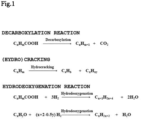
- reforming treatment such as decarboxylation, isomerization, and decomposition
- reforming can be performed at a time.
- reforming can be performed at low pressure. Accordingly, energy can be saved, and production of a bio-jet fuel at low cost can be achieved.
- a zeolite is preferably used, and ZSM-5-type zeolite is more preferably used because the hydrocarbon in the bio-oil can be suitably isomerized to be decomposed.
- a Group 2 metal oxide is preferably used, and one kind or two or more kinds selected from magnesium oxide, calcium oxide, and barium oxide are more preferably used because the free fatty acid or the triacylglycerol in the bio-oil can be suitably decarbonated and hydrogenated.
- the bio-oil when the reforming of the bio-oil is performed under the condition of a reaction temperature of from 200°C to 450°C, the bio-oil can be securely reformed.
- the method of producing a bio-jet fuel the method having a high energy-saving property and enabling easy production of a high-quality bio-jet fuel, and the catalyst for producing a bio-jet fuel to be used in the method.
- the invention of the present application is a method of producing a bio-jet fuel, including reforming a biomass-derived oil containing a free fatty acid, a hydrocarbon, and a triacylglycerol.
- the biomass-derived oil containing the free fatty acid, the hydrocarbon, and the triacylglycerol is not particularly limited, but a bio-oil obtained by heating a biomass resource and cooling the generated pyrolysis gas is suitable.
- the biomass resource is not particularly limited except a fossil fuel as long as the biomass resource is derived from animals and vegetables.
- a plant seed containing a large amount of the oil and fat is suitably used. Suitable examples thereof include bintaro, bengkoang, polon, jatropha, coconut fruit, palm fruit, and date fruit. Of those, coconut fruit is more suitably used because its endosperm contains a large amount of an oil content.
- the bio-oil to be used in the present invention is obtained by heating the biomass resource and cooling the generated pyrolysis gas. As described above, a coke deposition amount on a catalyst surface is small and reforming to a biofuel can be efficiently performed because the bio-oil has a small amount of a polymer fraction such as a tar content.
- a superheated steam is suitably used in the heating of the biomass resource. It is not required that the biomass resource be heated with the superheated steam alone, and the biomass resource may be heated by using the steam in combination with any other heating means.
- the superheated steam used in the heating of the biomass oil is in a mixed state with the pyrolysis gas of the bio-oil.
- the ratio of the hydrocarbon in the bio-oil can be increased. This is probably because the pyrolysis gas generated from the biomass resource is subjected to pyrolysis and steam reforming by being brought into contact with the superheated steam under high temperature.
- a temperature at which the biomass resource is heated is suitably from 200°C to 450°C.
- the bio-oil obtained by heating the biomass resource within the temperature region contains a large amount of a hydrocarbon having 6 to 19 carbon atoms and a free fatty acid, and hence a bio-jet fuel formed of a C 7-14 isomerized hydrocarbon can be efficiently produced.
- a period of time for which the biomass resource is heated is appropriately selected in accordance with, for example, the amount of the biomass resource or the heating temperature, and is not particularly limited.
- the solid acid catalyst to be used for the catalyst there may be used silica alumina, activated alumina, activated clay, or a zeolite.
- the zeolite is suitable because the zeolite shows stable availability and high acidity.
- the zeolite there may be used, for example, mordenite, ⁇ -zeolite, ZSM-based zeolite, A-type zeolite, X-type zeolite, or Y-type zeolite. Of those, ZSM-5-type zeolite is suitably selected.
- an alkali metal an alkali metal hydride, or an alkali metal oxide
- an oxide of a Group 2 alkaline earth metal is suitably used.
- oxides of the Group 2 alkaline earth metals one kind or two or more kinds selected from magnesium oxide, calcium oxide, rubidium oxide, and barium oxide are suitably used.
- the solid acid catalyst may be caused to support one or a plurality of metals selected from Group 8, Group 9, and Group 10. Of the Group 9 and/or Group 10 metals, platinum may be most suitably used.
- the catalyst is produced as follows: a solid base catalyst precursor is dissolved in distilled water; the resultant is impregnated in the solid acid catalyst; the resultant is dried; and the resultant is molded into a pellet shape, and is then fired to provide a catalyst.
- the method of producing the catalyst is not limited to this method, and the catalyst may be produced by any other method.
- the reforming of the bio-oil is performed with a reforming treatment apparatus including a reaction vessel and heating means.
- the reaction vessel preferably includes gas injection means that can inject a gas into the reaction vessel, and gas product recovering means for recovering a gas product generated through the reforming of the bio-oil in the reaction vessel.
- the reforming treatment may be performed by each of a batchwise method and a continuous method.
- the reaction vessel in the reforming treatment apparatus can be sealed.
- a flow type reaction apparatus which can continuously perform the supply of the bio-oil and the take-out of a product, such as an oil or a gas, after the reforming treatment, is used as a reforming apparatus.
- the catalyst to be used may be subjected to hydrogenation reduction as pretreatment before the reforming treatment of the bio-oil.
- the method for the hydrogenation reduction is not particularly limited, but is suitably performed at 400°C for about 3 hours under a hydrogen flow rate of 100 ml/min.
- the reforming treatment using the batchwise method involves accommodating the bio-oil and the catalyst in the reaction vessel of the above-mentioned reforming treatment apparatus and heating the resultant at a reaction temperature of from 200°C to 450°C, to thereby perform reforming of the bio-oil.
- Hydrogen may be sealed in the reaction vessel at a pressure of from 1 MPa to 5 MPa using the gas injection means.
- An amount of the catalyst to be accommodated is from 1 wt% to 20 wt%, preferably from 5 wt% to 15 wt% with respect to the bio-oil.
- the reforming treatment using the continuous method is described.
- the reforming treatment using the continuous method suitably involves reforming using the above-mentioned flow type reaction apparatus at a reaction temperature of from 200°C to 450°C and a weight hourly space velocity of the bio-oil of from about 5 h -1 to about 0.2 h -1 .
- the supply is suitably performed at a hydrogen pressure of from about 0.5 MPa to about 3 MPa and a hydrogen supply amount of from about 100:1 to about 1,200:1 in terms of a volume ratio between hydrogen and the biomass-derived oil.
- a period of time for which the reforming treatment is performed is not particularly limited, but the reforming treatment is suitably performed for from 1 hour to 6 hours.
- the C 7 to C 14 isomerized hydrocarbon serving as a main component of the bio-jet fuel is obtained.
- ZSM-5-type zeolite was used as a solid acid catalyst, and a catalyst obtained by causing the solid acid catalyst to support 5 mass% of magnesium oxide as a solid base catalyst was produced using the above-mentioned method of producing a catalyst.
- ZSM-5-type zeolite was used as a solid acid catalyst, and a catalyst obtained by causing the solid acid catalyst to support 5 mass% of calcium oxide as a solid base catalyst was produced using the above-mentioned method of producing a catalyst.
- ZSM-5-type zeolite was used as a solid acid catalyst, and a catalyst obtained by causing the solid acid catalyst to support 5 mass% of barium oxide as a solid base catalyst was produced using the above-mentioned method of producing a catalyst.
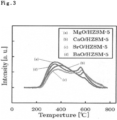
- the base amount was measured by a CO 2 -TPD method using ChemBET Pulser (manufactured by Quantachrome Instruments).
- each of the catalysts of Examples 1 to 3 the base point and the acid point were observed. In addition, it was recognized that each catalyst had a sufficient base amount and a sufficient acid amount as a catalyst.
- a portable reactor Model TPR-1 was used as the reforming apparatus.
- the catalyst of Example 1 was pulverized into a size of from 80 mesh to 120 mesh and dried at 110°C for 1 hour before use.
- the content of the bio-oil to be reformed was set to 10.0 g, and 0.5 g of the catalyst was used.
- a hydrogen gas was sealed in a reaction vessel at a pressure of 1.0 MPa.
- the materials were subjected to a reaction for 3 hours at a reaction temperature of 300°C and a stirring speed of 400 rpm.
- reaction pressure means a pressure at which the hydrogen gas is sealed in the reaction vessel.
- M w represents a molecular weight of each component
- V i represents a volume ratio of each component
- W i yield represents a weight ratio of each component.
- Table 3 Kind M w [g/mol] V i [vol%] W i , yield [wt%] CH 4 16.04 0.52 0.04 C 2 H 6 30.07 0.28 0.04 C 3 H 8 44.10 0.54 0.12 i-C 4 H 10 58.12 0.01 0.00 n-C 4 H 10 58.12 0.07 0.02 neo-C 5 H 12 72.15 0.01 0.00 n-C 5 H 12 72.15 0.05 0.02 n-C 6 H 12 86.18 0.03 0.01 CO 16.04 1.02 0.59 CO 2 44.01 6.34 1.41
- Table 4 Kind M w [g/mol] W i [wt%] W i , yield [wt%] 1-hexene 84.2 0.06 0.045 hexane 86.2 0.10 0.077 hexene
- the gas product contains a large amount of carbon dioxide, and a C 7-14 isohydrocarbon having a side chain, the isohydrocarbon serving as a bio-jet fuel, is generated in the liquid product. It was found that, when the catalyst of Example 1 was used, the bio-oil was hydrogenated, decarboxylated, decomposed, and isomerized.
- Reforming Experiments 1 to 10 for bio-oils different from each other in catalyst, catalyst amount, reaction pressure, and reaction time were performed, and a catalyst, a catalyst amount, a reaction pressure, and a reaction time that were suitable were identified by evaluating the reaction.
- a reforming experiment was performed using 10.0 g of the bio-oil at a reaction temperature of 300°C and a stirring speed of 400 rpm.
- a catalyst adopting magnesium oxide was used as a solid base catalyst.
- a catalyst amount was set to 0.5 g, a hydrogen gas was sealed at a pressure of 1.0 MPa as a reaction pressure, and an experiment was performed for a reaction time of 3 hours.
- a catalyst adopting calcium oxide was used as a solid base catalyst.
- a catalyst amount was set to 0.5 g, a hydrogen gas was sealed at a pressure of 1.0 MPa as a reaction pressure, and an experiment was performed for a reaction time of 3 hours.
- a catalyst adopting barium oxide was used as a solid base catalyst.
- a catalyst amount was set to 0.5 g, a hydrogen gas was sealed at a pressure of 1.0 MPa as a reaction pressure, and an experiment was performed for a reaction time of 3 hours.
- a catalyst adopting magnesium oxide was used as a solid base catalyst.
- a catalyst amount was set to 1.0 g, a hydrogen gas was sealed at a pressure of 1.0 MPa as a reaction pressure, and an experiment was performed for a reaction time of 3 hours.
- a catalyst adopting magnesium oxide was used as a solid base catalyst.
- a catalyst amount was set to 1.0 g, a hydrogen gas was sealed at a pressure of 1.0 MPa as a reaction pressure, and an experiment was performed for a reaction time of 3 hours.
- a catalyst adopting magnesium oxide was used as a solid base catalyst.
- a catalyst amount was set to 1.0 g, a hydrogen gas was sealed at a pressure of 2.0 MPa as a reaction pressure, and an experiment was performed for a reaction time of 3 hours.
- a catalyst adopting magnesium oxide was used as a solid base catalyst.
- a catalyst amount was set to 1.0 g, a hydrogen gas was sealed at a pressure of 1.0 MPa as a reaction pressure, and an experiment was performed for a reaction time of 6 hours.
- Experiment 10 a catalyst obtained by subjecting the same catalyst as the catalyst used in Experiment 9 to hydrogen reduction treatment at a reaction temperature of 400°C for a reaction time of 3 hours was used.
- a catalyst amount was set to 1.0 g, a hydrogen gas was sealed at a pressure of 1.0 MPa as a reaction pressure, and an experiment was performed for a reaction time of 6 hours.
- the fatty acid conversion rate (x FFA ) is used for identifying the degree of conversion of a free fatty acid in the bio-oil to the hydrocarbon.
- the fatty acid decarboxylation rate (S DCO ) is used for identifying the degree of the decarboxylation reaction of the fatty acid in the bio-oil.
- the carbon molar quantity rate (Y JF ) of the C 7-14 hydrocarbon is used for identifying the ratio of the carbon molar quantity of the C 7-14 hydrocarbon serving as a main component of the jet fuel in the liquid product with respect to the carbon molar quantity of all the compounds in the raw material (bio-oil).
- the evaluation enables identification of a suitable catalyst and a suitable method for producing the bio-jet fuel.
- the fatty acid conversion rate (x FFA ), the fatty acid decarboxylation rate (S DCO ), and the carbon molar quantity rate (Y JF ) of the C 7-14 hydrocarbon are calculated by the equation 1, the equation 2, and the equation 3, respectively.
- x FFA 1 ⁇ Fatty acid amount in liquid product mol Fatty acid amount in raw material mol ⁇ 100
- S DCO CO 2 generation amount mol Reacted fatty acid amount mol ⁇ 100
- Y JF Carbon molar quantity of C 7 ⁇ 14 hydrocarbon in liquid product Cmol Carbon molar quantity of all compounds in raw material Cmol ⁇ 100 .
- Evaluations of the respective experiments were performed by measuring the amount of coke on the used catalyst.
- the amount of coke on the used catalyst is small, the catalyst has not lost its activity, and hence can withstand repeated use.
- the amount of coke is large, the catalyst is deactivated at an early stage, and hence there is a risk in that the repeated use cannot be performed, and moreover, sufficient reforming treatment cannot be performed.
- the amount of coke was measured as follows: the remaining used catalyst was washed with tetrahydrofuran; the resultant was dried; and then the resultant was subjected to TG analysis. In the TG analysis, a generation amount of coke generated during the reaction can be measured by analyzing a weight reduction within the analysis temperature range.
- a C 7-14 hydrocarbon is observed in each experiment.
- a C 7-14 hydrocarbon for producing a bio-jet fuel was obtained by reforming a biomass-derived oil containing a free fatty acid, a hydrocarbon, and a triacylglycerol using a catalyst obtained by causing the solid acid catalyst to support a solid base catalyst.
- Experiment 1 In order to obtain an evaluation result when the catalyst amounts were different, contrast was made between Experiment 1, Experiment 4, and Experiment 5 having the same conditions except the catalyst amount.
- the fatty acid conversion rate In Experiment 1, the fatty acid conversion rate is 47.0%. In contrast, in each of Experiment 4 and Experiment 5, the fatty acid conversion rate is more than 85%.
- Experiment 5 is the highest. In view of the foregoing, it was recognized that the ratio of the catalyst with respect to the biomass-derived oil was preferably 5% or more, more preferably 10% or more, most preferably 15% or more.
- Experiment 11 having an amount of the bio-oil of 10.0 g, a catalyst amount of 1.0 g, a reaction pressure of 1.0 MPa, a stirring speed of 400 rpm, a reaction time of 6 hours, and a reaction temperature of 320°C, and a reforming experiment in which a reaction temperature was set to 340°C were performed. Contrast was made between the experiments and Experiment 10, and a suitable reaction temperature was identified by performing the evaluation of the reaction. The same evaluation as the evaluation in Test 3 was used. The results are shown in Table 6. Table 6 Expt. No.
- an isomerization rate of the oil was identified as follows: the catalyst used in Experiment 10, that is, the catalyst obtained by using ZSM-5-type zeolite as the solid acid catalyst and magnesium oxide as a solid base catalyst, causing the catalysts to support platinum, and subjecting the resultant to hydrogen reduction treatment at a reaction temperature of 400°C for a reaction time of 3 hours was used; and a fixed-bed flow type reaction apparatus illustrated in FIG. 5 for continuously supplying the bio-oil to a reaction furnace, and continuously emitting the liquid product and the gas product reformed in the reaction furnace was used.
Landscapes
- Chemical & Material Sciences (AREA)
- Oil, Petroleum & Natural Gas (AREA)
- Engineering & Computer Science (AREA)
- Chemical Kinetics & Catalysis (AREA)
- Organic Chemistry (AREA)
- General Chemical & Material Sciences (AREA)
- Crystallography & Structural Chemistry (AREA)
- Life Sciences & Earth Sciences (AREA)
- Wood Science & Technology (AREA)
- Materials Engineering (AREA)
- Production Of Liquid Hydrocarbon Mixture For Refining Petroleum (AREA)
Applications Claiming Priority (2)
| Application Number | Priority Date | Filing Date | Title |
|---|---|---|---|
| JP2021182575 | 2021-11-09 | ||
| PCT/JP2022/041796 WO2023085337A1 (ja) | 2021-11-09 | 2022-11-09 | バイオジェット燃料製造方法及び該方法に用いるバイオジェット燃料製造用触媒 |
Publications (2)
| Publication Number | Publication Date |
|---|---|
| EP4431584A1 true EP4431584A1 (de) | 2024-09-18 |
| EP4431584A4 EP4431584A4 (de) | 2025-10-01 |
Family
ID=86335752
Family Applications (1)
| Application Number | Title | Priority Date | Filing Date |
|---|---|---|---|
| EP22892835.4A Pending EP4431584A4 (de) | 2021-11-09 | 2022-11-09 | Verfahren zur herstellung von biostrahlbrennstoff und in diesem verfahren verwendeter biostrahlbrennstoffherstellungskatalysator |
Country Status (3)
| Country | Link |
|---|---|
| EP (1) | EP4431584A4 (de) |
| JP (1) | JPWO2023085337A1 (de) |
| WO (1) | WO2023085337A1 (de) |
Families Citing this family (1)
| Publication number | Priority date | Publication date | Assignee | Title |
|---|---|---|---|---|
| KR20250076559A (ko) * | 2022-09-27 | 2025-05-29 | 고꾸리쯔 다이가꾸호우징 도쿄노우코우다이가쿠 | 바이오 제트 연료 제조용 촉매 및 바이오 제트 연료 제조용 촉매를 사용한 바이오 제트 연료 제조 방법 |
Family Cites Families (14)
| Publication number | Priority date | Publication date | Assignee | Title |
|---|---|---|---|---|
| US8329968B2 (en) * | 2008-04-06 | 2012-12-11 | Uop Llc | Production of blended gasoline aviation and diesel fuels from renewable feedstocks |
| JP5317644B2 (ja) * | 2008-11-20 | 2013-10-16 | Jx日鉱日石エネルギー株式会社 | 航空燃料油基材の製造方法 |
| US8377288B2 (en) * | 2009-09-22 | 2013-02-19 | Bp Corporation North America Inc. | Methods and units for mitigation of carbon oxides during hydrotreating |
| JP2011219708A (ja) * | 2010-04-13 | 2011-11-04 | Ggi Japan Kk | ジェットバイオ燃料の製造システム及び製造方法 |
| EP2638129A2 (de) * | 2010-09-14 | 2013-09-18 | IFP Energies nouvelles | Verfahren zur aufwertung von bioöl auf kohlenwassertoff-brennstoffe für den transport |
| CN102513132B (zh) * | 2011-12-06 | 2014-04-30 | 丁以钿 | 一步法生物柴油生产专用的dyd催化剂及其生产方法 |
| US9534181B2 (en) * | 2012-06-19 | 2017-01-03 | Inaeris Technologies, Llc | Method of using renewable fuel composition |
| WO2015181721A1 (en) * | 2014-05-29 | 2015-12-03 | Eni S.P.A. | Process for producing a diesel hydrocarbon fraction starting from a renewable feedstock |
| US10392566B2 (en) * | 2015-04-27 | 2019-08-27 | Gas Technology Institute | Co-processing for control of hydropyrolysis processes and products thereof |
| CN105331387B (zh) * | 2015-11-13 | 2018-04-20 | 北京化工大学 | 生物质热催化转化及精制制备航空燃料的工艺方法 |
| CN112189046B (zh) * | 2018-05-18 | 2023-03-28 | 一般社团法人HiBD研究所 | 生物喷气燃料的制造方法 |
| JP7406203B2 (ja) * | 2019-10-24 | 2023-12-27 | 国立大学法人東京工業大学 | 長鎖直鎖パラフィンの水素化異性化触媒、長鎖直鎖パラフィンの水素化異性化触媒の製造方法、及び長鎖直鎖パラフィンの水素化異性化反応による分岐パラフィンの製造方法 |
| JP7792332B2 (ja) * | 2019-10-31 | 2025-12-25 | 中国石油化工股▲ふん▼有限公司 | 担持触媒、その調製方法およびその適用 |
| JPWO2022004267A1 (de) * | 2020-06-29 | 2022-01-06 |
-
2022
- 2022-11-09 JP JP2023559877A patent/JPWO2023085337A1/ja active Pending
- 2022-11-09 WO PCT/JP2022/041796 patent/WO2023085337A1/ja not_active Ceased
- 2022-11-09 EP EP22892835.4A patent/EP4431584A4/de active Pending
Also Published As
| Publication number | Publication date |
|---|---|
| WO2023085337A1 (ja) | 2023-05-19 |
| JPWO2023085337A1 (de) | 2023-05-19 |
| EP4431584A4 (de) | 2025-10-01 |
Similar Documents
| Publication | Publication Date | Title |
|---|---|---|
| EP2809744B1 (de) | Verfahren zur herstellung von kohlenwasserstoffen durch erhöhung der kohlenwasserstoffkettenlänge | |
| Kiméné et al. | Catalytic decarboxylation of fatty acids to hydrocarbons over non‐noble metal catalysts: the state of the art | |
| Dagle et al. | Syngas conversion to gasoline-range hydrocarbons over Pd/ZnO/Al2O3 and ZSM-5 composite catalyst system | |
| KR102487444B1 (ko) | 바이오제트 연료의 제조 방법 | |
| US20090318740A1 (en) | Method of converting feedstocks from renewable sources to good-quality diesel fuel bases using a zeolite type catalyst | |
| EP2957622A1 (de) | Verfahren zur herstellung monocyclischer aromatischer kohlenwasserstoffe | |
| US11713425B2 (en) | Method for producing renewable fuel | |
| Tanneru et al. | Production of liquid hydrocarbons from pretreated bio-oil via catalytic deoxygenation with syngas | |
| Dundich et al. | Nickel catalysts for the hydrodeoxygenation of biodiesel | |
| FI130651B1 (en) | A method of making a liquid transport fuel component | |
| Zheng et al. | One-pot catalytic hydrocracking of diesel distillate and residual oil fractions obtained from bio-oil to gasoline-range hydrocarbon fuel | |
| EP4431584A1 (de) | Verfahren zur herstellung von biostrahlbrennstoff und in diesem verfahren verwendeter biostrahlbrennstoffherstellungskatalysator | |
| US20140275670A1 (en) | Process for low-hydrogen-consumption conversion of renewable feedstocks to alkanes | |
| EP3666857A1 (de) | Verfahren zur herstellung von flüssigem kohlenwasserstoffbrennstoff | |
| US20150152336A1 (en) | Co-current adiabatic reaction system for conversion of triacylglycerides rich feedstocks | |
| CN108315050B (zh) | 一种使用生物材料生产液体烃的方法、液体烃及航空燃料 | |
| US20180010052A1 (en) | H2 and bio-fuels production from renewable feedstocks | |
| Solymosi et al. | „Motor Fuel Purpose Hydrogenation of Used Cooking Oils” | |
| EP4596105A1 (de) | Biostrahlbrennstoffherstellungskatalysator und verfahren zur herstellung von biostrahlbrennstoff unter verwendung des biostrahlbrennstoffherstellungskatalysators | |
| CN108315051B (zh) | 一种使用生物材料生产烃的方法及其烃、燃料 | |
| EP2918660A1 (de) | Verfahren zur umwandlung mit niedrigem wasserstoffverbrauch von nachwachsenden rohstoffen zu alkanen | |
| US12319881B1 (en) | Converting a renewable fuel intermediate composition to finished transportation fuel | |
| WO2025176518A1 (en) | Producing sustainable caprolactam | |
| Jovicic | Hydroprocessing and catalytic cracking of biowaxes to biokerosene | |
| CN117460806A (zh) | 除去催化抑制剂的将生物原料转化为中间馏分油的方法 |
Legal Events
| Date | Code | Title | Description |
|---|---|---|---|
| STAA | Information on the status of an ep patent application or granted ep patent |
Free format text: STATUS: THE INTERNATIONAL PUBLICATION HAS BEEN MADE |
|
| PUAI | Public reference made under article 153(3) epc to a published international application that has entered the european phase |
Free format text: ORIGINAL CODE: 0009012 |
|
| STAA | Information on the status of an ep patent application or granted ep patent |
Free format text: STATUS: REQUEST FOR EXAMINATION WAS MADE |
|
| 17P | Request for examination filed |
Effective date: 20240520 |
|
| AK | Designated contracting states |
Kind code of ref document: A1 Designated state(s): AL AT BE BG CH CY CZ DE DK EE ES FI FR GB GR HR HU IE IS IT LI LT LU LV MC ME MK MT NL NO PL PT RO RS SE SI SK SM TR |
|
| DAV | Request for validation of the european patent (deleted) | ||
| DAX | Request for extension of the european patent (deleted) | ||
| A4 | Supplementary search report drawn up and despatched |
Effective date: 20250902 |
|
| RIC1 | Information provided on ipc code assigned before grant |
Ipc: C10G 3/00 20060101AFI20250827BHEP Ipc: B01J 29/40 20060101ALI20250827BHEP Ipc: B01J 29/44 20060101ALI20250827BHEP Ipc: C11C 3/10 20060101ALI20250827BHEP Ipc: C10G 1/08 20060101ALI20250827BHEP Ipc: C11C 3/00 20060101ALI20250827BHEP Ipc: C11C 3/12 20060101ALI20250827BHEP Ipc: C10L 1/02 20060101ALI20250827BHEP |