EP4431583A1 - Verfahren zum einspritzen einer wässrigen polymerlösung in eine unterirdische formation - Google Patents
Verfahren zum einspritzen einer wässrigen polymerlösung in eine unterirdische formation Download PDFInfo
- Publication number
- EP4431583A1 EP4431583A1 EP23161906.5A EP23161906A EP4431583A1 EP 4431583 A1 EP4431583 A1 EP 4431583A1 EP 23161906 A EP23161906 A EP 23161906A EP 4431583 A1 EP4431583 A1 EP 4431583A1
- Authority
- EP
- European Patent Office
- Prior art keywords
- solution
- amps
- location
- mobile unit
- polymer
- Prior art date
- Legal status (The legal status is an assumption and is not a legal conclusion. Google has not performed a legal analysis and makes no representation as to the accuracy of the status listed.)
- Withdrawn
Links
Images
Classifications
-
- C—CHEMISTRY; METALLURGY
- C09—DYES; PAINTS; POLISHES; NATURAL RESINS; ADHESIVES; COMPOSITIONS NOT OTHERWISE PROVIDED FOR; APPLICATIONS OF MATERIALS NOT OTHERWISE PROVIDED FOR
- C09K—MATERIALS FOR MISCELLANEOUS APPLICATIONS, NOT PROVIDED FOR ELSEWHERE
- C09K8/00—Compositions for drilling of boreholes or wells; Compositions for treating boreholes or wells, e.g. for completion or for remedial operations
- C09K8/58—Compositions for enhanced recovery methods for obtaining hydrocarbons, i.e. for improving the mobility of the oil, e.g. displacing fluids
- C09K8/588—Compositions for enhanced recovery methods for obtaining hydrocarbons, i.e. for improving the mobility of the oil, e.g. displacing fluids characterised by the use of specific polymers
-
- C—CHEMISTRY; METALLURGY
- C08—ORGANIC MACROMOLECULAR COMPOUNDS; THEIR PREPARATION OR CHEMICAL WORKING-UP; COMPOSITIONS BASED THEREON
- C08F—MACROMOLECULAR COMPOUNDS OBTAINED BY REACTIONS ONLY INVOLVING CARBON-TO-CARBON UNSATURATED BONDS
- C08F120/00—Homopolymers of compounds having one or more unsaturated aliphatic radicals, each having only one carbon-to-carbon double bond, and only one being terminated by only one carboxyl radical or a salt, anhydride, ester, amide, imide or nitrile thereof
- C08F120/02—Monocarboxylic acids having less than ten carbon atoms; Derivatives thereof
- C08F120/52—Amides or imides
- C08F120/54—Amides, e.g. N,N-dimethylacrylamide or N-isopropylacrylamide
- C08F120/56—Acrylamide; Methacrylamide
-
- C—CHEMISTRY; METALLURGY
- C09—DYES; PAINTS; POLISHES; NATURAL RESINS; ADHESIVES; COMPOSITIONS NOT OTHERWISE PROVIDED FOR; APPLICATIONS OF MATERIALS NOT OTHERWISE PROVIDED FOR
- C09K—MATERIALS FOR MISCELLANEOUS APPLICATIONS, NOT PROVIDED FOR ELSEWHERE
- C09K8/00—Compositions for drilling of boreholes or wells; Compositions for treating boreholes or wells, e.g. for completion or for remedial operations
- C09K8/60—Compositions for stimulating production by acting on the underground formation
- C09K8/62—Compositions for forming crevices or fractures
- C09K8/66—Compositions based on water or polar solvents
- C09K8/68—Compositions based on water or polar solvents containing organic compounds
-
- C—CHEMISTRY; METALLURGY
- C09—DYES; PAINTS; POLISHES; NATURAL RESINS; ADHESIVES; COMPOSITIONS NOT OTHERWISE PROVIDED FOR; APPLICATIONS OF MATERIALS NOT OTHERWISE PROVIDED FOR
- C09K—MATERIALS FOR MISCELLANEOUS APPLICATIONS, NOT PROVIDED FOR ELSEWHERE
- C09K8/00—Compositions for drilling of boreholes or wells; Compositions for treating boreholes or wells, e.g. for completion or for remedial operations
- C09K8/60—Compositions for stimulating production by acting on the underground formation
- C09K8/84—Compositions based on water or polar solvents
- C09K8/86—Compositions based on water or polar solvents containing organic compounds
- C09K8/88—Compositions based on water or polar solvents containing organic compounds macromolecular compounds
- C09K8/885—Compositions based on water or polar solvents containing organic compounds macromolecular compounds obtained otherwise than by reactions only involving carbon-to-carbon unsaturated bonds
Definitions
- the invention relates to a method of injecting an aqueous solution of a homopolymer of sodium or potassium or ammonium 2-acrylamido-2-methylpropane sulfonate into a subterranean formation for the assisted extraction of hydrocarbons (oil and/or gas) or hydraulic fracturing.
- the method concerns the preparation of the polymer solution on fields in modular units for its direct injection into the underground formation.
- Patent applications FR2302305 , FR2302307 And FR2302310 of the Applicant highlight the interest of injecting into underground formations saline solutions of polymers of sodium or potassium 2-acrylamido-2-methylpropane sulfonate in crystalline form for the enhanced recovery of hydrocarbons (oil and/or gas) or hydraulic fracturing.
- these polymers have improved properties, particularly in terms of filterability and chemical and thermal stability.
- synthetic polymers based on sodium or potassium 2-acrylamido-2-methylpropanesulfonate provide a very high friction reduction effect while ensuring an improved viscosifying effect in saline solution (brine).
- the good solubility of the polymer in the fracturing fluid combined with its sulfonated anionic character, prevents its adsorption on the rock, which induces an increase in conductivity and therefore an increase in the hydrocarbon production yield (oil and/or gas).
- the physical form of the polymer that provides the highest mass concentration of active material to feed the fields for EOR or hydraulic fracturing is powder.
- this physical form requires specific dissolution units (PSU: Polymer Slicing Unit , maturation tanks, see document WO 2008/071808 ) expensive and energy-intensive.
- the powder is produced by a gel polymerization process which involves a drying operation of the polymer gel to transform it into powder (patent US 5633329 ).
- a gel polymerization process which involves a drying operation of the polymer gel to transform it into powder.
- 1 to 5 volumes of water must be evaporated for one volume of powder, which implies an increase in water and energy consumption and therefore an increase in the carbon footprint of the product.
- the Applicant has thus developed a method for preparing solutions of homopolymers of sodium or potassium or ammonium 2-acrylamido-2-methylpropane sulfonate based on modular units in order to be able to carry out all the preparation steps in fields close to the underground formations to be exploited.
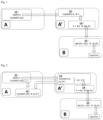
- This method includes (1) preparing sodium or potassium or ammonium 2-acrylamido-2-methylpropane sulfonate in crystalline form at a first location, (2) synthesizing the polymer and preparing a concentrated polymer solution at a second location, and finally (3) diluting this solution for injection into the subterranean formation at a third location.
- This method allows the continuous production of the required quantity of injection solution. In addition, it allows to considerably reduce logistics costs (transport, dissolution of the polymer) with a low water and carbon footprint (no drying) and it can be transposed to any field and all field conditions (salinity, hardness, temperature, etc.) without the need for installations classified as high risk (chemical).
- AMPS 2-acrylamido-2-methylpropanesulfonic acid
- This monomer unlike monomers such as acrylonitrile, acrylamide or acrylic acid, has the advantage of being in solid form and therefore not presenting a risk of leakage. or spreading. In addition, it is not toxic (CMR) and remains stable in the solid state depending on the temperature (not thermosensitive).
- CMR toxic
- Another advantage of AMPS or one of its salts, compared to acrylamide, is that it can be polymerized at a higher concentration and without the need for prior cooling because it is less exothermic, which generates energy savings and makes the claimed method transposable anywhere, including in arid areas or with seasonal water stress.
- 1 volume of acrylamide and/or acrylic acid needs to be polymerized in the presence of at least 3 volumes of water and with prior cooling to 0°C whereas AMPS or one of its salts requires only 1 to 2 volumes of water with the start of polymerization in solution at room temperature.
- Value ranges include lower and upper bounds. Thus, the value ranges "between 0.1 and 1.0" and “from 0.1 to 1" include the values 0.1 and 1.0.
- the uncertainty of peaks in powder X-ray diffraction patterns is usually in the order of +/- 0.1°.
- Location A is advantageously a location comprising at least one mobile storage unit, at least one mobile mixing unit and at least one mobile filtration unit.
- location A advantageously makes it possible to have clean water for the radical polymerization of the APMS.S (for example water from an industrial and/or rainwater treatment process).
- the crystals obtained are in the crystalline form of the sodium salt of 2-acrylamido-2-methylpropanesulfonic acid.
- sodium salt(s) in the aqueous solution or suspension SA 2 is meant at least one inorganic salt(s), for example sodium hydroxide, sodium carbonate, sodium bicarbonate or mixtures thereof.
- the crystals obtained are in the crystalline form of the potassium salt of 2-acrylamido-2-methylpropanesulfonic acid.
- potassium salt(s) in the aqueous solution or aqueous suspension SA K-2 is meant at least one inorganic salt(s), for example potassium hydroxide, potassium carbonate, potassium bicarbonate or mixtures thereof.
- the mobile unit U1 advantageously comprises at least one mixing sub-unit and at least one filtration sub-unit. These sub-units are known to those skilled in the art and may correspond to those described in the document WO 2018/172676 and the patent application FR2302303 .
- This U1 mobile unit is a relocatable modular unit that can be transported by truck or rail.
- This mobile unit U1 contains a mobile storage sub-unit for collecting the AMPS.OS solution S1 .
- This solution S1 comes from the purge of the AMPS.S preparation and is therefore made up of a mixture of the filtrates and the washing solutions of the AMPS.S crystals (crystalline form of the AMPS salt).
- the mobile storage sub-unit is preferably a tank.
- the AMPS.S is prepared from 2-acrylamido-2-methylpropane sulfonic acid in powder form previously stored at location A in a mobile storage unit located near the mobile unit U1 (and therefore distinct from the mobile storage sub-unit).
- This storage unit is resupplied by truck or rail transport from 2-acrylamido-2-methylpropane sulfonic acid production sites that may be several tens or hundreds of kilometers away from the location.
- the mobile storage unit near the mobile unit U1 may have any shape and orientation. For example, it may be cylindrical or rectangular and oriented horizontally or vertically. The volume and dimensions are limited only by the condition that the storage units are movable.
- the 2-acrylamido-2-methylpropanesulfonic acid in powder form stored in the mobile storage unit at location A was previously obtained on its production site by a reaction between acrylonitrile, fuming sulfuric acid and isobutylene containing less than 1000 ppm of butadiene and less than 100 ppm of butene (document WO 201746546 ).
- X-ray powder diffraction patterns for AMPS.S are performed conventionally by X-ray crystallography, X-ray crystallography or X-ray diffractometry.
- An example of equipment is a Rigaku Miniflex II diffractometer equipped with a copper source.
- location A' is a location that allows at least one mobile storage unit, at least one mobile polymerization unit and at least one mobile dilution unit to be installed.
- location A' advantageously allows clean water to be available for the radical polymerization of the APMS.S (for example water from an industrial and/or rainwater treatment process) but also lower quality water for the preparation of aqueous solutions (notably SS1 or SS2 ).
- the mobile unit U3 is advantageously composed of at least one polymerization sub-unit such as a reactor in the form of an inverted conical tubular (cone downwards).
- This polymerization sub-unit makes it possible to discharge the polymer gel by applying air pressure to the surface of the gel or in the form of a rocker which discharges the gel mass by rocking the reactor.
- this mobile unit U3 also contains storage sub-units for the additives required for the gel polymerization (generally one storage unit per additive). These additives are, for example, initiators (oxidant/reducer, azo), polymerization regulators, enzymes (glucose oxidase).
- the polymerization additives and the conditions of the gel polymerization are known to those skilled in the art.
- the characteristics of each storage unit are adapted to the physicochemical properties and the quantities of the different additives.
- the U3 mobile unit is a relocatable modular unit that can be transported by truck or rail.
- the polymerization of the AMPS.S solution S3 in the mobile unit U3 is carried out with an initial concentration of AMPS.S in the solution S3 greater than 20% by weight, even more preferably greater than 30% by weight, and even more preferably greater than 40% by weight.
- the initial concentration of AMPS.S in the solution S3 is advantageously less than 70% by weight.
- the initial polymerization temperature is room temperature, namely between 15 and 30°C
- the final polymerization temperature of the AMPS.S solution S3 in the mobile unit U3 is greater than 80°C.
- a person skilled in the art will be able to adapt the polymerization conditions to reach this temperature.
- the gel polymerization of AMPS.S in the S3 solution within the U3 mobile unit is initiated in the presence of glucose oxidase.
- Radical polymerization requires the absence of traces of oxygen in the polymerization medium.
- the purpose of glucose oxidase is to deoxygenate the S3 solution.
- the use of bubbling with inert gases such as nitrogen or argon is therefore generally unnecessary in the presence of glucose oxidase. This further reduces the need for local production of energy-intensive inert gas and atmospheric emissions, sources of pollution.
- the polymer P resulting from the gel polymerization in the mobile unit U3 is dissolved in a mobile unit U4 in a saline solution SS1 containing at least 1 g/L of alkali and/or alkaline earth salts in water to obtain a solution SM of polymer P.
- the U4 mobile unit is a relocatable modular unit that can be transported by truck or rail.
- the polymer P gel obtained is granulated in a granulation subunit to obtain polymer P gel pieces, which are directly dissolved in solution SS1 to obtain solution SM in mobile unit U4 .
- the size of the aqueous P polymer gel pieces obtained after granulation is not specifically limited.
- the granulated aqueous polyacrylamide gel pieces are advantageously of a size such that at least two dimensions (length and diameter in the case of cylindrical granule-shaped pieces) are not greater than 1 cm, preferably not greater than 0.5 cm.
- three dimensions (width, length and height in the case of parallelepiped-shaped pieces) of the aqueous polyacrylamide gel pieces should be not greater than 1 cm, preferably not greater than 0.5 cm.
- No lower limit is necessary for the aqueous polyacrylamide gel pieces, since the smaller the pieces, the easier the polymer dissolves.
- the aqueous polyacrylamide gel pieces may be of a size such that the three dimensions are as low as 0.1 cm. Often, aqueous polyacrylamide gel pieces tend to have three dimensions ranging from 0.1 cm to 0.5 cm each.
- any type of granulation means can be used to granulate the water-soluble polymer gel into smaller pieces.
- suitable means include cutting devices such as knives or perforated plates, crushers, kneaders, static or dynamic mixers, or water jets. The person skilled in the art will select the appropriate means and its conditions of use to obtain the gel pieces of predetermined sizes and shapes.
- the pieces of polymer gel P obtained at the end of the granulation are directly added to a dissolution tank of the mobile unit U4 .
- the dissolution in the SS1 saline solution is accelerated by means of a stirring blade.
- the gel pieces can also be dissolved in a pipeline equipped or not with static or dynamic mixers. The combination of a pipeline and a dissolution tank is also possible.
- the polymer gel pieces P are not stored between granulation and dissolution.
- the polymer P in gel form is conveyed by a screw conveyor to be granulated in a granulation sub-unit.
- the saline solution SS1 or SS2 contains between 1 g/L and 350 g/L of alkaline and/or alkaline-earth salts in water, even more preferably between 10 g/L and 300 g/L.
- the saline solution SS1 or SS2 is drawn directly from location A.
- this solution SS1 or SS2 can be seawater drawn from an offshore oil platform.
- the saline solution SS1 may optionally be prepared within the mobile unit U4 in a dissolution tank and/or in a pipeline equipped with static and/or dynamic mixers by adding the required quantities of salts to water.
- the solution SS1 or SS2 preferably contains sodium (alkaline salt) and/or calcium (alkaline earth salt), for example a salt chosen from calcium chloride, calcium bromide, sodium chloride, and mixtures thereof.
- the mobile unit U4 comprises at least one dissolution sub-unit, for example a tank provided with a stirring blade and/or a pipe provided with mixers.
- it also comprises a storage tank for the saline solution SS1 .
- Location B is advantageously a location that allows at least one mobile storage unit and at least one mobile dilution unit to be installed.
- Location B in particular allows a fluid to be injected into an underground formation to extract hydrocarbons (oil and/or gas).
- the mobile unit U5 is advantageously a relocatable unit composed of at least one dilution sub-unit, for example a tank equipped with a stirring blade and/or a pipe equipped with static and/or dynamic mixers.
- the mobile unit U5 comprises a storage tank for the SM solution.
- the U5 mobile unit is a relocatable modular unit that can be transported by truck or rail.
- the saline solution SM is diluted by at least a factor of 4 and at most a factor of 60 by the saline solution SS2 to obtain a solution SF containing less than 0.6% by weight of polymer P.
- a dilution by a factor of 4 corresponds to obtaining a solution containing 15% by weight of polymer P.
- the SF solution contains between 0.01% and 0.4% by weight of polymer P , even more preferably between 0.02% and 0.3% by weight of polymer P.
- the SS2 saline solution can be prepared within the U5 mobile unit, for example in a dissolution tank by adding the required quantities of salts to water or by drawing the SS2 solution directly from location B.
- the SF solution is injected into the underground formation in order to extract the hydrocarbons (oil and/or gas).
- the recovery of the hydrocarbons is carried out either by sweeping the underground formation (conventionally assisted extraction of hydrocarbons) or by the natural pressure of the hydrocarbons after a hydraulic fracturing operation (unconventionally).
- the injection of the SF solution into the underground formation is followed by a step of hydrocarbon recovery by assisted extraction by sweeping the underground formation using the SF solution, or by a step of hydrocarbon recovery by hydraulic fracturing of the underground formation using the SF solution.
- the injection method of the invention is carried out with locations A and A' which overlap or are adjacent. In other words, in this configuration the 2 locations become one.
- the transfer of the AMPS.OS S1 solution from the storage sub-unit of the mobile unit U1 to the unit U2 is preferably done via a pipe (duct).
- the polymerization of the AMPS.OS solution S1 in the U2 unit is a solution polymerization known to those skilled in the art to obtain a polymer P' with a weight-average molecular weight advantageously between 500 and 500,000 daltons.
- the addition of the solution S2 of polymer P' to the solution S3 is preferably done before the addition of redox and/or thermal initiators and/or glucose oxidase.
- the U2 unit is a relocatable modular unit that can be transported by truck or rail and which is composed of at least one polymerization sub-unit, for example a tank equipped with a stirring blade.
- the transfer of the SM solution from location A' to location B is done by pipelines or by transport units.
- the distances between locations A' and B can be between 10 and 3000 km, or between 10 and 1500 km, or between 20 and 500 km, or between 30 and 300 km.
- the pipes ensuring the transfer of the SM solution between locations A' and B are preferably rigid and may include static mixers.
- the transport unit may have a volume of 1 m 3 to 40 m 3 , in particular 5 m 3 to 40 m 3 , preferably 10 to 30 m 3 , for example 20 m 3 to 30 m 3 or 15 to 25 m 3 .
- suitable transport units include ships comprising at least one opening or tank containers.
- the transport of the SM solution between locations A' and B can be carried out by any type of means of transport suitable for the transport of the transport unit, for example by trucks, railcars or ships.
- transport unit means one or more separate transport units advantageously such as containers, for example ISO containers or intermediate bulk containers, which are loaded onto suitable means of transport, for example trailers, container wagons or ships.
- means of transport may carry a single transport unit or a plurality of transport units.
- transport unit further includes transport units in which the transport compartment is temporarily or permanently attached to the means of transport, such as tank trucks or tank wagons.
- the transportation is performed by trucks.
- the transportation unit may also be attached to a truck.
- the transportation unit may be an ISO tank container.
- tanks attached to a truck may be used.
- the tank includes an outlet opening at the rear end of the truck and, to facilitate removal of the contents, the tank may be tilted.
- the tank includes an outlet opening on the underside of the tank.
- the tank may include a cone on the underside of the tank and the outlet opening is located at the lower end of the cone. Filling the transport unit with the SM solution may be accomplished by pumping the SM solution into the transport unit.
- the transport time i.e. the transport time of the transport unit filled with SM solution of polymer P
- the transport time can be very different, depending on the distance between locations A' and B . It can vary from a few minutes to several days, for example from 1 h to 28 days, in particular from 2 hours to 14 days, in particular from 5 hours to 7 days.
- a homogenization step as described below can be carried out during transport.
- the transport unit for example a truck, can comprise a rotating drum for carrying out the homogenization.
- the transport unit can comprise a circulation loop equipped with a pump and optionally with mixing units, for example static mixers, so that the SM solution of polymer P can be circulated during transport.
- the SM solution of polymer P at location A' is stored in a maturation and storage unit before being transferred to location B.
- This maturation and storage unit advantageously consists of one or more tanks in series equipped with stirring blades.
Landscapes
- Chemical & Material Sciences (AREA)
- Organic Chemistry (AREA)
- Life Sciences & Earth Sciences (AREA)
- General Life Sciences & Earth Sciences (AREA)
- Engineering & Computer Science (AREA)
- Materials Engineering (AREA)
- Chemical Kinetics & Catalysis (AREA)
- Health & Medical Sciences (AREA)
- Medicinal Chemistry (AREA)
- Polymers & Plastics (AREA)
- Oil, Petroleum & Natural Gas (AREA)
- Addition Polymer Or Copolymer, Post-Treatments, Or Chemical Modifications (AREA)
Priority Applications (5)
| Application Number | Priority Date | Filing Date | Title |
|---|---|---|---|
| EP23161906.5A EP4431583A1 (de) | 2023-03-14 | 2023-03-14 | Verfahren zum einspritzen einer wässrigen polymerlösung in eine unterirdische formation |
| ARP240100578A AR132084A1 (es) | 2023-03-14 | 2024-03-08 | Método de inyección de una solución acuosa de polímero en una formación subterránea |
| EP24710126.4A EP4457296B1 (de) | 2023-03-14 | 2024-03-13 | Verfahren zum einspritzen einer wässrigen polymerlösung in eine unterirdische formation |
| CN202480030784.4A CN121079380A (zh) | 2023-03-14 | 2024-03-13 | 将聚合物水溶液注入地下地层的方法 |
| PCT/EP2024/056692 WO2024189092A1 (en) | 2023-03-14 | 2024-03-13 | Method for injecting an aqueous polymer solution into an underground formation |
Applications Claiming Priority (1)
| Application Number | Priority Date | Filing Date | Title |
|---|---|---|---|
| EP23161906.5A EP4431583A1 (de) | 2023-03-14 | 2023-03-14 | Verfahren zum einspritzen einer wässrigen polymerlösung in eine unterirdische formation |
Publications (1)
| Publication Number | Publication Date |
|---|---|
| EP4431583A1 true EP4431583A1 (de) | 2024-09-18 |
Family
ID=85640954
Family Applications (2)
| Application Number | Title | Priority Date | Filing Date |
|---|---|---|---|
| EP23161906.5A Withdrawn EP4431583A1 (de) | 2023-03-14 | 2023-03-14 | Verfahren zum einspritzen einer wässrigen polymerlösung in eine unterirdische formation |
| EP24710126.4A Active EP4457296B1 (de) | 2023-03-14 | 2024-03-13 | Verfahren zum einspritzen einer wässrigen polymerlösung in eine unterirdische formation |
Family Applications After (1)
| Application Number | Title | Priority Date | Filing Date |
|---|---|---|---|
| EP24710126.4A Active EP4457296B1 (de) | 2023-03-14 | 2024-03-13 | Verfahren zum einspritzen einer wässrigen polymerlösung in eine unterirdische formation |
Country Status (4)
| Country | Link |
|---|---|
| EP (2) | EP4431583A1 (de) |
| CN (1) | CN121079380A (de) |
| AR (1) | AR132084A1 (de) |
| WO (1) | WO2024189092A1 (de) |
Citations (10)
| Publication number | Priority date | Publication date | Assignee | Title |
|---|---|---|---|---|
| FR2302310A1 (fr) | 1975-02-26 | 1976-09-24 | Ruhrchemie Ag | Procede perfectionne de polymerisation de l'ethylene |
| FR2302305A1 (fr) | 1975-02-28 | 1976-09-24 | Charbonnages Ste Chimique | Procede perfectionne de polymerisation et de copolyme |
| FR2302303A1 (fr) | 1975-02-28 | 1976-09-24 | Princeton Biomedix | Procede et composes pour l'analyse des phosphatases |
| FR2302307A1 (fr) | 1975-02-27 | 1976-09-24 | Tenneco Chem | Procede pour enlever le chlorure de vinyle de latex contenant du chlorure de polyvinyle |
| US5633329A (en) | 1995-01-31 | 1997-05-27 | Basf Aktiengesellschaft | Preparation of high molecular weight polymers |
| WO2008071808A1 (en) | 2007-10-12 | 2008-06-19 | S.P.C.M. Sa | Installation for enhanced oil recovery using water-soluble polymers, method implementing same |
| US20130090425A1 (en) | 2010-06-18 | 2013-04-11 | Nippon Shokubai Co, Ltd. | Aqueous poly(meth)acrylic acid-based polymer solution |
| WO2017046546A1 (fr) | 2015-09-18 | 2017-03-23 | S.P.C.M. Sa | Procede d'obtention du monomere acide 2-acrylamido-2-méthylpropanesulphonique et polymere comprenant ledit monomere |
| WO2018172676A1 (fr) | 2017-03-20 | 2018-09-27 | S.P.C.M. Sa | Forme cristalline hydratee de l'acide 2-acrylamido-2-methylpropane sulfonique |
| CN113528113A (zh) * | 2020-04-15 | 2021-10-22 | 爱森(中国)絮凝剂有限公司 | 包含含作为单体的2-丙烯酰胺基-2-甲基丙烷磺酸的(共)聚合物的压裂流体 |
-
2023
- 2023-03-14 EP EP23161906.5A patent/EP4431583A1/de not_active Withdrawn
-
2024
- 2024-03-08 AR ARP240100578A patent/AR132084A1/es active IP Right Grant
- 2024-03-13 EP EP24710126.4A patent/EP4457296B1/de active Active
- 2024-03-13 CN CN202480030784.4A patent/CN121079380A/zh active Pending
- 2024-03-13 WO PCT/EP2024/056692 patent/WO2024189092A1/en active Pending
Patent Citations (14)
| Publication number | Priority date | Publication date | Assignee | Title |
|---|---|---|---|---|
| FR2302310A1 (fr) | 1975-02-26 | 1976-09-24 | Ruhrchemie Ag | Procede perfectionne de polymerisation de l'ethylene |
| FR2302307A1 (fr) | 1975-02-27 | 1976-09-24 | Tenneco Chem | Procede pour enlever le chlorure de vinyle de latex contenant du chlorure de polyvinyle |
| FR2302305A1 (fr) | 1975-02-28 | 1976-09-24 | Charbonnages Ste Chimique | Procede perfectionne de polymerisation et de copolyme |
| FR2302303A1 (fr) | 1975-02-28 | 1976-09-24 | Princeton Biomedix | Procede et composes pour l'analyse des phosphatases |
| US5633329A (en) | 1995-01-31 | 1997-05-27 | Basf Aktiengesellschaft | Preparation of high molecular weight polymers |
| WO2008071808A1 (en) | 2007-10-12 | 2008-06-19 | S.P.C.M. Sa | Installation for enhanced oil recovery using water-soluble polymers, method implementing same |
| US20130090425A1 (en) | 2010-06-18 | 2013-04-11 | Nippon Shokubai Co, Ltd. | Aqueous poly(meth)acrylic acid-based polymer solution |
| WO2017046546A1 (fr) | 2015-09-18 | 2017-03-23 | S.P.C.M. Sa | Procede d'obtention du monomere acide 2-acrylamido-2-méthylpropanesulphonique et polymere comprenant ledit monomere |
| WO2018172676A1 (fr) | 2017-03-20 | 2018-09-27 | S.P.C.M. Sa | Forme cristalline hydratee de l'acide 2-acrylamido-2-methylpropane sulfonique |
| WO2018172684A1 (fr) * | 2017-03-20 | 2018-09-27 | S.P.C.M. Sa | Fluide de fracturation comprenant un (co)polymere d'une forme cristalline hydratee de l'acide 2-acrylamido-2-methylpropane sulfonique et procede de fracturation hydraulique |
| WO2018172682A1 (fr) * | 2017-03-20 | 2018-09-27 | S.P.C.M. Sa | Procede de recuperation assistee du petrole utilisant un (co)polymere d'une forme cristalline hydratee de l'acide 2-acrylamido-2-methylpropane sulfonique |
| EP3601220B1 (de) * | 2017-03-20 | 2021-05-05 | Spcm Sa | Verbessertes ölrückgewinnungsverfahren unter verwendung einer hydrierten kristallinen form von 2-acrylamido-2-methylpropansulfonsäure |
| EP3601222B1 (de) * | 2017-03-20 | 2021-06-02 | Spcm Sa | Fracking-fluid mit einem (co)polymer einer hydratisierten kristallinen form von 2-acrylamido-2-methylpropan-sulfonsäure und verfahren zum hydraulischen fracking |
| CN113528113A (zh) * | 2020-04-15 | 2021-10-22 | 爱森(中国)絮凝剂有限公司 | 包含含作为单体的2-丙烯酰胺基-2-甲基丙烷磺酸的(共)聚合物的压裂流体 |
Also Published As
| Publication number | Publication date |
|---|---|
| WO2024189092A1 (en) | 2024-09-19 |
| CN121079380A (zh) | 2025-12-05 |
| EP4457296C0 (de) | 2025-05-21 |
| EP4457296B1 (de) | 2025-05-21 |
| EP4457296A1 (de) | 2024-11-06 |
| AR132084A1 (es) | 2025-05-21 |
Similar Documents
| Publication | Publication Date | Title |
|---|---|---|
| EP2349522B1 (de) | Verfahren zur behandlung von meerwasser zur herstellung von injektionswasser für unterseeische erdölbohrungen und entsprechende vorrichtungen | |
| KR102479609B1 (ko) | 미네랄 오일 제조 방법 | |
| CA2753317C (fr) | Procede ameliore de recuperation assistee du petrole utilisant la technique dite asp | |
| EP3490940B1 (de) | Verfahren zur aufbereitung von produktionswasser aus einem verfahren zur verbesserten rückgewinnung von öl und/oder gas | |
| CA3130959A1 (fr) | Emulsion inverse pour la fracturation hydraulique | |
| EP3816228B1 (de) | Inverse emulsion für die hydraulische frakturierung | |
| JP2012519591A (ja) | ガスを取り出すための方法およびシステム | |
| CN111793486A (zh) | 一种二氧化碳气热复合解堵剂、制备方法及其应用 | |
| EP4431583A1 (de) | Verfahren zum einspritzen einer wässrigen polymerlösung in eine unterirdische formation | |
| WO2012134255A1 (fr) | Procede et appareil pour l'elimination du phosphore des rejets liquides des unites de production d'engrais par recuperation de cristaux phosphates | |
| EP4382584A1 (de) | Verfahren zum einspritzen einer wässrigen polymerlösung in eine unterirdische formation | |
| EP3585836A1 (de) | Mehrphasige polymersuspension und verwendung davon | |
| EP3874008B1 (de) | Zusammensetzung zur verwendung für die verzögerung der bildung von gashydraten | |
| FR3031110A1 (de) | ||
| FR3031111A1 (de) | ||
| EP3447106A1 (de) | Verfahren zur verbesserten ölrückgewinnung | |
| FR3110912A1 (fr) | Procédé de récupération assistée de pétrole dans une formation souterraine carbonatée | |
| Gambelli et al. | Removal of Glucose from Water Via Gaseous CO2 Injection and Hydrates Formation: Process Feasibility as a Function of the Initial Glucose Concentration in Water | |
| AL-Hemeri et al. | STUDY THE EFFAECT OF TWEEN 80 ON CLTHRATE HYDRATE FORMATION BEHAVIOR FOR R-134A | |
| CN102557158B (zh) | 煤层气田产出水的处理方法 | |
| CN117923683A (zh) | 一种二氧化碳驱采出水预处理工艺 | |
| UA146854U (uk) | Спосіб обробки привибійної зони продуктивного пласта свердловин | |
| UA137330U (uk) | Склад для обробки привибійної зони продуктивного пласта комплексним реагентом hv | |
| WO1999057069A1 (fr) | Procede de traitement de fluide liquide comprenant une fraction volatile | |
| BE671288A (de) |
Legal Events
| Date | Code | Title | Description |
|---|---|---|---|
| PUAI | Public reference made under article 153(3) epc to a published international application that has entered the european phase |
Free format text: ORIGINAL CODE: 0009012 |
|
| STAA | Information on the status of an ep patent application or granted ep patent |
Free format text: STATUS: THE APPLICATION HAS BEEN PUBLISHED |
|
| AK | Designated contracting states |
Kind code of ref document: A1 Designated state(s): AL AT BE BG CH CY CZ DE DK EE ES FI FR GB GR HR HU IE IS IT LI LT LU LV MC ME MK MT NL NO PL PT RO RS SE SI SK SM TR |
|
| STAA | Information on the status of an ep patent application or granted ep patent |
Free format text: STATUS: THE APPLICATION IS DEEMED TO BE WITHDRAWN |
|
| 18D | Application deemed to be withdrawn |
Effective date: 20250319 |