EP4431377A2 - Verbesserungen an oder im zusammenhang mit fahrrädern - Google Patents
Verbesserungen an oder im zusammenhang mit fahrrädern Download PDFInfo
- Publication number
- EP4431377A2 EP4431377A2 EP24191250.0A EP24191250A EP4431377A2 EP 4431377 A2 EP4431377 A2 EP 4431377A2 EP 24191250 A EP24191250 A EP 24191250A EP 4431377 A2 EP4431377 A2 EP 4431377A2
- Authority
- EP
- European Patent Office
- Prior art keywords
- bicycle
- rider
- seat
- crown
- forks
- Prior art date
- Legal status (The legal status is an assumption and is not a legal conclusion. Google has not performed a legal analysis and makes no representation as to the accuracy of the status listed.)
- Withdrawn
Links
Images



Classifications
-
- B—PERFORMING OPERATIONS; TRANSPORTING
- B62—LAND VEHICLES FOR TRAVELLING OTHERWISE THAN ON RAILS
- B62J—CYCLE SADDLES OR SEATS; AUXILIARY DEVICES OR ACCESSORIES SPECIALLY ADAPTED TO CYCLES AND NOT OTHERWISE PROVIDED FOR, e.g. ARTICLE CARRIERS OR CYCLE PROTECTORS
- B62J1/00—Saddles or other seats for cycles; Arrangement thereof; Component parts
- B62J1/08—Frames for saddles; Connections between saddle frames and seat pillars; Seat pillars
-
- B—PERFORMING OPERATIONS; TRANSPORTING
- B62—LAND VEHICLES FOR TRAVELLING OTHERWISE THAN ON RAILS
- B62J—CYCLE SADDLES OR SEATS; AUXILIARY DEVICES OR ACCESSORIES SPECIALLY ADAPTED TO CYCLES AND NOT OTHERWISE PROVIDED FOR, e.g. ARTICLE CARRIERS OR CYCLE PROTECTORS
- B62J17/00—Weather guards for riders; Fairings or stream-lining parts not otherwise provided for
-
- B—PERFORMING OPERATIONS; TRANSPORTING
- B62—LAND VEHICLES FOR TRAVELLING OTHERWISE THAN ON RAILS
- B62K—CYCLES; CYCLE FRAMES; CYCLE STEERING DEVICES; RIDER-OPERATED TERMINAL CONTROLS SPECIALLY ADAPTED FOR CYCLES; CYCLE AXLE SUSPENSIONS; CYCLE SIDE-CARS, FORECARS, OR THE LIKE
- B62K19/00—Cycle frames
- B62K19/02—Cycle frames characterised by material or cross-section of frame members
-
- B—PERFORMING OPERATIONS; TRANSPORTING
- B62—LAND VEHICLES FOR TRAVELLING OTHERWISE THAN ON RAILS
- B62K—CYCLES; CYCLE FRAMES; CYCLE STEERING DEVICES; RIDER-OPERATED TERMINAL CONTROLS SPECIALLY ADAPTED FOR CYCLES; CYCLE AXLE SUSPENSIONS; CYCLE SIDE-CARS, FORECARS, OR THE LIKE
- B62K19/00—Cycle frames
- B62K19/30—Frame parts shaped to receive other cycle parts or accessories
- B62K19/36—Frame parts shaped to receive other cycle parts or accessories for attaching saddle pillars, e.g. adjustable during ride
-
- B—PERFORMING OPERATIONS; TRANSPORTING
- B62—LAND VEHICLES FOR TRAVELLING OTHERWISE THAN ON RAILS
- B62K—CYCLES; CYCLE FRAMES; CYCLE STEERING DEVICES; RIDER-OPERATED TERMINAL CONTROLS SPECIALLY ADAPTED FOR CYCLES; CYCLE AXLE SUSPENSIONS; CYCLE SIDE-CARS, FORECARS, OR THE LIKE
- B62K21/00—Steering devices
- B62K21/02—Front wheel forks or equivalent, e.g. single tine
-
- B—PERFORMING OPERATIONS; TRANSPORTING
- B62—LAND VEHICLES FOR TRAVELLING OTHERWISE THAN ON RAILS
- B62K—CYCLES; CYCLE FRAMES; CYCLE STEERING DEVICES; RIDER-OPERATED TERMINAL CONTROLS SPECIALLY ADAPTED FOR CYCLES; CYCLE AXLE SUSPENSIONS; CYCLE SIDE-CARS, FORECARS, OR THE LIKE
- B62K21/00—Steering devices
- B62K21/04—Fork crowns
-
- B—PERFORMING OPERATIONS; TRANSPORTING
- B62—LAND VEHICLES FOR TRAVELLING OTHERWISE THAN ON RAILS
- B62K—CYCLES; CYCLE FRAMES; CYCLE STEERING DEVICES; RIDER-OPERATED TERMINAL CONTROLS SPECIALLY ADAPTED FOR CYCLES; CYCLE AXLE SUSPENSIONS; CYCLE SIDE-CARS, FORECARS, OR THE LIKE
- B62K21/00—Steering devices
- B62K21/12—Handlebars; Handlebar stems
- B62K21/125—Extensions; Auxiliary handlebars
-
- B—PERFORMING OPERATIONS; TRANSPORTING
- B62—LAND VEHICLES FOR TRAVELLING OTHERWISE THAN ON RAILS
- B62K—CYCLES; CYCLE FRAMES; CYCLE STEERING DEVICES; RIDER-OPERATED TERMINAL CONTROLS SPECIALLY ADAPTED FOR CYCLES; CYCLE AXLE SUSPENSIONS; CYCLE SIDE-CARS, FORECARS, OR THE LIKE
- B62K21/00—Steering devices
- B62K21/18—Connections between forks and handlebars or handlebar stems
-
- B—PERFORMING OPERATIONS; TRANSPORTING
- B62—LAND VEHICLES FOR TRAVELLING OTHERWISE THAN ON RAILS
- B62K—CYCLES; CYCLE FRAMES; CYCLE STEERING DEVICES; RIDER-OPERATED TERMINAL CONTROLS SPECIALLY ADAPTED FOR CYCLES; CYCLE AXLE SUSPENSIONS; CYCLE SIDE-CARS, FORECARS, OR THE LIKE
- B62K3/00—Bicycles
- B62K3/02—Frames
- B62K3/04—Frames having a substantially horizontal top bar
Definitions
- the present invention relates to bicycles.
- the present invention relates to the front forks and/or seat stays and/or seat posts of bicycles.
- a key factor in the performance of racing cyclists is the drag encountered by the cyclist as they travel along the race course or track. Accordingly, many racing cyclists wear clothing and helmets specifically adapted to minimise drag. Similarly, many racing bicycles are adapted to minimise the drag of the bicycle. Typically, many bicycle frames are tested extensively in a wind tunnel before use to fine tune the design so as to minimise drag caused by the frame.
- a typical conventional bicycle comprises a pair of front forks.
- the front forks extend downwardly from a crown to engage opposing ends of the front axle of the bicycle.
- the front forks are relatively thin and closely spaced either side of the plane of the front wheel of the bicycle.
- the forks typically diverge away from the crown.
- One alternative fork arrangement has been proposed in GB 2501894 .
- the bicycle comprises a pair of front forks extending downwards and inclined inwardly from a substantially horizontal member, wherein the ends of the horizontal member are aligned to the middle of the knees of a rider in a normal riding position. This fork design does provide some benefit in reducing drag but has not provided consistent benefits in practice for a sufficiently wide range of riders for regular implementation.
- a bicycle comprising a pair of front forks, each fork extending downwardly and substantially parallel to each other from a crown, the forks widely spaced apart from each other and a wheel mounted therebetween.
- a bicycle according to the present invention provides reduced drag when a rider is positioned in a normal riding position.
- the relatively wide spacing of the forks in the present invention may increase the overall drag produced by the frame, the alignment of the forks with the lower legs of the rider reduces the overall drag of the bicycle and rider combination.
- widely spaced forks may be defined by reference to their alignment with the rider.
- the widely spaced forks are each aligned with the axis of the lower leg of a rider in a normal riding position.
- aligned forks are positioned such that the axis of the fork is coincident with the axis of the lower leg when viewed from a plane perpendicular to the direction of linear forward motion of the bicycle.
- the spacing and alignment of the forks may be selected to match the riding position of a particular rider.
- a deviation of less than say 25mm between the axis of the fork and the axis of the lower leg when viewed from a plane perpendicular to the direction of linear forward motion of the bicycle may be considered aligned.
- the axis of the lower leg may be defined as the average axial position of the lower leg during the cycling motion of the rider. This thereby takes into account deviations in leg axis that occur as part of the cycling motion.
- widely spaced forks may be defined by reference to the pedal crank spacing (typically referred to as the Q-factor).
- the Q-factor, plus the pedal size and the orientation of the connecting cleat on the rider's shoe help define the leg spacing of the rider. Nevertheless, since in many instances riders adopt a riding position with their heels turned inward, the effective leg axis position is slightly inward of what might be expected from adding Q-factor to pedal width.
- the fork spacing may be in the range of Q-factor plus 60-90mm. In other such embodiments, the fork spacing may be in the range of Q-factor plus 60-80mm or Q-factor plus 70-90mm. In further such embodiments, the fork spacing may be in the range of Q-factor plus 60-70mm, Q-factor plus 70-80mm or Q-factor plus 80-90mm.
- widely spaced forks may be defined by reference to absolute fork spacing.
- the fork spacing may be in the range 180-240mm. In some such embodiments, the fork spacing may be in the range 180-220mm. In other such embodiments the fork spacing may be in the range 200-240mm or in the range 205mm to 240mm.
- the fork spacing discussed above may be defined as the spacing between the centres of the respective forks.
- each fork distal from the crown may comprise an axle receiving formation.
- the axle receiving formation may be a slot or hole.
- Each fork may comprise a single substantially linear member extending between the crown and the axle receiving formation.
- the forks may comprise a primary portion extending from the crown, the primary portion comprising a single substantially linear member and a secondary portion connecting the primary portion to the axle receiving formation.
- the secondary portion may be inclined relative to the primary portion.
- the secondary portion may be inclined inwardly relative to the primary portion. The secondary portion can thereby conveniently enable connection between the forks and a conventional bicycle wheel axle.
- the secondary portion may be orientated at a constant angle relative to the axis of the primary portion of the fork. In other embodiments, the orientation of the secondary portion may vary relative to the axis of the primary portion at different positions along the length of the secondary portion.
- the secondary portion may comprise less than 20% of the length of the fork. In other embodiments, the secondary portion may comprise less than 15% of the length of the fork, less than 10% of the length of the fork, or less than 5% of the length of the fork.
- the primary portion extends to a position in range of 80-100mm above the axle receiving formation.
- the above restrictions allow the primary portion to be aligned in with a rider's lower leg to minimise drag of the leg and fork combination and the secondary portion, which does not provide an influence on the airflow experienced by a rider's leg to be adapted to minimise drag on the secondary portion alone.
- Each fork may comprise a single member.
- each fork may comprise two or more fork members.
- Each fork member may be substantially parallel and connected to a common crown and a common axle receiving formation.
- Each fork member may have a substantially similar cross-sectional profile.
- each fork member may have different cross-sectional profile.
- Fork members may be offset relative to each other parallel and/or perpendicular to direction of linear forward motion of the bicycle.
- the crown may comprise one or more lateral members.
- the lateral members may be substantially horizontal.
- the lateral members may be angled or curved upwards or downwards.
- the crown may comprise one or more extension members projecting upwardly from said one or more lateral members.
- the extension members may be in a common alignment with the forks or at least the primary portion of each fork.
- the extension members may comprise a lateral section at their upward end.
- the lateral sections may be substantially horizontal.
- the lateral sections may be angled or curved upwards or downwards.
- the extension members may be connected to one or more lateral members at their upward end.
- the one or more lateral members may comprise a handle bar or the stem of the bicycle.
- the crown may be connected to a steerer tube.
- the crown may be connected to an upwardly extending central member. In this manner, the forms may have a ⁇ bayonet type' form.
- the crown may be connected to a head tube. The connection may be facilitated by a rotating bearing, where necessary.
- the head tube may be a bifurcated head tube.
- the head tube may be a wide head tube. In the present invention a wide head tube may be defined as a head tube wider than say 30mm.
- the forks may be substantially linear or alternatively may be curved when viewed in a vertical or horizontal plane parallel to the direction of linear forward motion of the bicycle.
- the forks and/the crown may be formed from members having a substantially circular, elliptical or airfoil shaped cross-sectional profile. Such profiles may include truncated elliptical or airfoil cross-sectional profiles.
- the trailing edge of the forks and/or crown, relative to the direction of linear forward motion may be substantially concave. This provides a scalloped trailing edge. This can improve performance in the presence of a cross wind or yaw airflow.
- the forks and/or crown may have a cross-sectional chord to thickness ratio of say, 3:1, 6:1 or more.
- the forks and/or crown may have a cross-sectional thickness and/or chord to thickness ratio that complies with governing body regulations.
- the forks and/or crown may have a cross-sectional thickness of at least 10mm.
- the forks and/or crown may have a cross-sectional thickness of at least 15mm.
- the forks and/or crown may have a chord of 80mm or less. This would facilitate conformance with particular governing body regulations.
- the bicycle may be a racing bicycle.
- the racing bicycle may be a track racing bicycle.
- the bicycle may be a time trial bicycle.
- the bicycle may be a road racing bicycle.
- the road racing bicycle may be adapted for use in pure cycling races or for use in cycling races comprising part of a combined race such as a triathlon or duathlon.
- the bicycle may comprise a pair of seat stays, each seat stay extending downwardly and substantially parallel to each other from a crown, the seat stays widely spaced apart from each other and a wheel mounted therebetween.
- widely spaced stays may be defined by reference to their alignment with the rider.
- the widely spaced stays are each aligned with the axis of the lower leg of a rider in a normal riding position.
- aligned stays are positioned such that the axis of the stay is coincident with the axis of the lower leg when viewed from a plane perpendicular to the direction of linear forward motion of the bicycle.
- the spacing and alignment of the stays may be selected to match the riding position of a particular rider.
- a deviation of less than say 25mm between the axis of the stay and the axis of the lower leg when viewed from a plane perpendicular to the direction of linear forward motion of the bicycle may be considered aligned.
- the axis of the lower leg may be defined as the average axial position of the lower leg during the cycling motion of the rider. This thereby takes into account deviations in leg axis that occur as part of the cycling motion.
- widely spaced stays may be defined by reference to the pedal crank spacing (typically referred to as the Q-factor).
- the Q-factor, plus the pedal size and the orientation of the connecting cleat on the rider's shoe help define the leg spacing of the rider. Nevertheless, since in many instances riders adopt a riding position with their heels turned inward, the effective leg axis position is slightly inward of what might be expected from adding Q-factor to pedal width.
- the stay spacing may be in the range of Q-factor plus 40-90mm or Q factor plus 60-90mm. In other such embodiments, the stay spacing may be in the range of Q-factor plus 60-80mm or Q-factor plus 70-90mm. In further such embodiments, the stay spacing may be in the range of Q-factor plus 40-60mm, Q-factor plus 60-70mm, Q-factor plus 70-80mm or Q-factor plus 80-90mm.
- widely spaced stays may be defined by reference to absolute stay spacing.
- the stay spacing may be in the range 170-240mm. In some such embodiments, the stay spacing may be in the range 190-220mm. In other such embodiments the stay spacing may be in the range 200-240mm or in the range 205mm to 240mm.
- the stay spacing discussed above may be defined as the spacing between the centres of the respective stays.
- each stay distal from the crown may comprise an axle receiving formation.
- the axle receiving formation may be a slot or hole.
- Each stay may comprise a single substantially linear member extending between the crown and the axle receiving formation.
- the stays may comprise a primary portion extending from the crown, the primary portion comprising a single substantially linear member and a secondary portion connecting the primary portion to the axle receiving formation
- the secondary portion may be inclined relative to the primary portion.
- the secondary portion may be inclined inwardly relative to the primary portion. The secondary portion can thereby conveniently enable connection between the stays and a conventional bicycle wheel axle.
- the secondary portion may be orientated at a constant angle relative to the axis of the primary portion of the stay. In other embodiments, the orientation of the secondary portion may vary relative to the axis of the primary portion at different positions along the length of the secondary portion.
- the secondary portion may comprise less than 20% of the length of the stay. In other embodiments, the secondary portion may comprise less than 15% of the length of the stay, less than 10% of the length of the stay, or less than 5% of the length of the stay.
- the primary portion extends to a position in range of 80-100mm above the axle receiving slot.
- the above restrictions allow the primary portion to be aligned in with a rider' s lower leg to minimise drag of the leg and stay combination and the secondary portion, which does not provide an influence on the airflow experienced by a rider's leg to be adapted to minimise drag on the secondary portion alone.
- Each stay may comprise a single member.
- each stay may comprise two or more fork members.
- Each stay member may be substantially parallel and connected to a common crown and a common axle receiving formation.
- Each stay member may have a substantially similar cross-sectional profile.
- each stay member may have different cross-sectional profile.
- Stay members may be offset relative to each other parallel and/or perpendicular to the direction of linear forward motion of the bicycle.
- the crown may comprise one or more lateral members.
- the lateral members may be substantially horizontal. In other embodiments, the lateral members may be angled or curved upwards or downwards.
- the crown may comprise one or more extension members projecting upwardly from said one or more lateral members.
- the extension members may comprise a lateral section at their upward end.
- the lateral sections may be substantially horizontal. In other embodiments, the lateral sections may be angled or curved upwards or downwards.
- the extension members may be connected to one or more lateral members at their upward end.
- the one or more lateral members may comprise a saddle, saddle post or saddle support of the bicycle.
- the extension members may be in a common alignment with the stays or at least the primary portion of each stay.
- the stays or extension members may comprise an extendable or telescopic section.
- the crown may be connected to a seat tube of the bicycle.
- the crown may connect to the seat tube at the same vertical location as the seat tube connects to the top tube. Additionally or alternatively, the crown may connect to the seat tube above or below the connection to the top tube.
- the stays may be substantially linear or alternatively may be curved when viewed in a vertical or horizontal plane parallel to the direction of linear forward motion of the bicycle.
- the separation of the stays from the leg in the direction of motion of the stays may be adjusted to match the vortex shed wavelength of the leg for at least some proportion of the rotation of the pedals. This can help further reduce drag on the leg by taking advantage of the splitter plate effect.
- the stays and/or crown may be formed from members having a substantially circular, elliptical or airfoil shaped cross-sectional profile. Such profiles may include truncated elliptical or airfoil cross-sectional profiles.
- the trailing edge of the stays and/or crown, relative to the direction of linear forward motion may be substantially concave. This provides a scalloped trailing edge. This can improve performance in the presence of a cross wind or yaw airflow.
- the stays and/or crown may have a cross-sectional chord to thickness ratio of say, 3:1, 6:1 or more.
- the stays and/or crown may have a cross-sectional thickness and/or chord to thickness ratio that complies with governing body regulations.
- the stays and/or crown may have a cross-sectional thickness of at least 10mm.
- the stays and/or crown may have a cross-sectional thickness of at least 15mm.
- the stays and/or crown may have a chord of 80mm or less. This would facilitate conformance with particular governing body regulations.
- the bicycle may be provided with a saddle.
- the saddle may comprise a seat surface and a seat post wherein the seat post comprises two widely spaced limbs.
- the saddle may comprise a trunk.
- the trunk may comprise an elongate member adapted for fitting to or within a seat tube of a bicycle.
- widely spaced limbs may be defined by reference to their alignment with the rider.
- the widely spaced limbs are at least partially aligned with the axis of the upper leg of a rider in seated riding position.
- the aerodynamic wake generated by each leg impinges on the respective limb.
- the widely spaced limbs may be matched to the rider's hip separation.
- widely spaced limbs may be defined by reference to the saddle width.
- the widely spaced limbs have at least a portion separated by substantially the full width of the saddle.
- widely spaced limbs may be defined by reference to absolute limb spacing.
- the limb spacing may be in the range 120-180mm or from 120-240 mm for at least a portion of their length.
- the widely spaced limbs may extend between the trunk and the seat surface.
- the widely spaced limbs may be connected to the edges of the seat surface. This maximises the spacing width of the widely spaced limbs.
- the limbs may extend linearly between the stem and the seat surface. Such limbs may essentially have a 'V' formation. In other embodiments, the limbs may be curved. Such limbs may essentially have a 'U' formation. Additionally or alternatively, the limbs may be curved when viewed in a plane parallel to the direction of linear forward motion of the bicycle. This can enable the limbs to be shaped so as avoid impeding the rider's normal pedalling action. In some embodiments, the limbs may extend downwardly and be connected to the trunk or the top tube by a lateral member.
- the limbs and the seat surface may be integrally formed.
- the widely spaced limbs and/or the stem may be formed from members having a substantially circular, elliptical or airfoil shaped cross-sectional profile. Such profiles may include truncated elliptical or airfoil profiles.
- the limbs may have a cross-sectional depth to thickness ratio of say, 6:1 or more.
- the limbs may have a cross-sectional thickness that complies with governing body regulations. In some cases, the limbs may have a cross-sectional thickness of at least 10mm. In further cases, the limbs may have a cross-sectional thickness of at least 15mm
- a bicycle comprising a pair of seat stays, each seat stay extending downwardly and substantially parallel to each other from a crown, the seat stays widely spaced apart from each other and a wheel mounted therebetween.
- the bicycle of the second aspect of the present invention may incorporate any or all features of the first aspect of the present invention, as desired or as appropriate.
- a bicycle according to the second aspect of the present invention thus provides reduced drag when a rider is positioned in a normal riding position.
- the relatively wide spacing of the stays in the present invention may increase the overall drag produced by the frame, the alignment of the stays with the lower legs of the rider reduces the overall drag of the bicycle and rider combination.
- a saddle for a bicycle comprising a seat surface and a seat post wherein the seat post comprises two widely spaced limbs.
- the saddle of the third aspect of the present invention may comprise any or all of the features of the first or second aspects of the present invention as are desired or as appropriate.
- a saddle according to the third aspect of the present invention provides reduced drag when a rider is seated on the saddle. This is as a result of the limbs being widely spaced and hence within the wake of the rider's upper leg during forward motion.
- a bicycle comprising a saddle according to a third aspect of the present invention.
- the bicycle of the fourth aspect of the present invention may incorporate any or all features of the first, second or third aspects of the present invention, as desired or as appropriate.
- a method of fitting a bicycle for a rider comprising the steps of measuring the lower leg separation and/or the hip separation of the rider in their normal riding position; and providing a bicycle according to the first aspect of the present invention wherein the fork separation of the bicycle and/or a bicycle according to the first or second aspects of the present invention wherein where the seat stay separation is matched to the measured lower leg separation of the rider and/or a bicycle according to the third aspect of the present invention wherein where the limb separation of the seat post is matched to the measured hip separation of the rider.
- the method of the fifth aspect of the present invention may include any or all features of the previous aspects of the present invention as desired or as appropriate.
- leg separation may be measured in a normal riding position.
- Leg separation may be considered matched to fork or stay separation when there is a deviation of less than 25mm between leg separation and fork or stay or limb separation.
- a pair of conventional bicycle forks 1 comprises a crown 2 which is attached to the headstock of a bicycle (not shown) and a pair of inclined forks 3 extending downwardly from the crown 2.
- axle receiving slots 4 At the lower end of forks 3 are provided axle receiving slots 4. This enables the axle and hence the front wheel (not shown) of the bicycle to be fitted between the forks 3.
- the conventional forks 3 diverge outwardly away from the crown 2. Additionally, such forks 3 are relatively closely spaced with respect to a wheel fitted therebetween.
- the bicycle 12 has a front fork 20, within which the front wheel 16 is mounted, attached to the head tube 14 of the bicycle 12.
- the crown comprises a substantially horizontal member 21 connected to the headstock 14 at the midpoint 22.
- the length of horizontal member 21 is such that its ends are roughly aligned with the leading knee 17 of the cyclist 10, when in the riding position.
- Extending downwardly from each end of the horizontal member 21 are inwardly inclined forks 23.
- the forks 23 comprise a more inwardly inclined secondary portion 25 just above the formations 24.
- the front fork 20 of the bicycle 12 of figure 2 does provide for a drag reduction compared with a racing bicycle using a conventional front fork 1. Nevertheless, the drag reduction can be improved further by use of a fork according to the present invention
- FIG 3 a cyclist 30 is shown in a normal riding position on a bicycle 32 according to one embodiment of the present invention.
- the bicycle 32 has a front fork 40, within which the front wheel 36 is mounted, attached to the head tube 34.
- the crown comprises a lateral member 41.
- the lateral member 41 is substantially horizontal. Nevertheless, the skilled man will appreciate that the lateral member 41 could deviate from the horizontal upwardly or downwardly.
- the lateral member 41 connected to the headstock 34 at the midpoint 42.
- the length of horizontal member 41 is such that its ends are roughly aligned with the leading knee 37 of the cyclist 30, when in the riding position. Extending downwardly from each end of the lateral member 41 are downwardly projecting forks 43.
- axle receiving formations 44 typically slots or holes, for receiving the axle 35 of wheel 36.
- the forks 43 each comprise a primary portion 46, the respective primary portions extending downwardly and substantially parallel to each other and an inwardly inclined secondary portion 45 just above the formations 44. This facilitates fitting conventional bicycle wheels 36 into the front fork 40. Nevertheless, the skilled man will appreciate that the inwardly inclined secondary portions 45 can be omitted if a wheel 36 with a longer axle is fitted or if the axle receiving formations 44 are provided on cross-members projecting perpendicular to the forks 43.
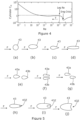
- FIG 4 this comprises an illustration of the drag coefficient C D of a cylinder (a simple approximation of the rider's lower leg) in relation to the Reynolds number Re of the airflow.
- the airflow around the leg will have a laminar boundary layer and the drag coefficient will be determined by this relatively ordered flow, as illustrated by Leg Re on figure 4 .
- the turbulent wake created by the forks 43 pushes the onset of the drag crises (as illustrated by arrow T) where turbulent boundary layer flow reduces drag to lower speeds.
- the wide spaced forks 43 may increase the coefficient of drag of the bicycle frame considered in isolation
- the consequent reduction of the coefficient of drag of the rider's lower legs by pushing the flow around the legs into the drag crises zone reduces the overall coefficient of drag of the rider and bicycle combination.
- the separation of the forks 43 is customised for a particular rider. This optimises benefits for particular riders based on their physical size and/or riding position. Nevertheless, good results can be obtained for a wide range of riders with fork 43 separation in the region of say 180-240mm.
- the forks 43 can have any suitable cross-sectional profile.
- substantially (a) circular, (b) ovoid, (c) airfoil and truncated airfoil based cross-sectional fork profiles are illustrated, relative to airflow direction F. Whilst the profiles illustrated in figure 5 are substantially symmetrical with respect to the airflow direction F, the skilled man will appreciate that the invention equally applies to asymmetrical profiles. The skilled man will further appreciate that the sections illustrated in figure 5 may be differently orientated to the airflow direction F, if desired.
- Figure 5 further illustrates at (e), (f) and (g) that forks 43 can be formed from a pair of fork members 43a, b rather than a single fork member 43.
- the pair of fork members 43a, b can be spaced (e) parallel to (or close to parallel to) the airflow direction F as shown, (f) perpendicular (or close to perpendicular to) the airflow direction F, or (g) offset both parallel to and perpendicular to the airflow direction F.
- Figure 5 further illustrates at (h), (i) and (j) that forks 43 can be provided with a concave or scalloped trailing edge 43z.
- This form of trailing edge can provide an improved drag performance in a given cross-wind or yaw airflow.
- the scalloped trailing edge 43z delays separation of the airflow. Whilst at a small yaw this may have a relatively small effect, at larger yaw angles, it may delay stall, with a corresponding larger effect on overall drag.
- FIG 6a a cyclist 30 is shown in a normal riding position on a bicycle 32 according to an alternative embodiment of the present invention.
- This embodiment differs from the previous embodiment in that the crown comprises extension members 47 projecting upwardly from the lateral crown member 41.
- the extension members 47 comprise a substantially upward projecting section 48 which maintains a substantially common alignment with the main portion 46 of the forks and hence a substantially common alignment with the rider's lower leg 38. Accordingly, the extension members provide further improved drag performance for the combination of the bicycle 32 and rider 30, even if the overall frame drag is increased by the extension members 47. As is shown in figure 6a , the extension members 47 have a horizontal or substantially horizontal section 49 at their upward end. This allows connection to the stem. This may be required to ensure conformance with certain bicycle racing regulations.
- FIG 6b a cyclist 30 is shown in a normal riding position on a bicycle 32 according to a further alternative embodiment of the present invention.
- This embodiment differs from the embodiment of figure 6a in that the upward projecting section 48 of each extension member 47 is terminated at the handle bar 39 rather than a horizontal section 49 of the extension member 50. This can maintain alignment between the extension member 47 and the lower leg 38 right up to the handle bar. This embodiment can therefore provide increased drag reduction benefits, in circumstances where such non-conventional bicycle frames are permitted.
- the forks 43 can have cross-sectional profiles of the type shown in figure 5 .
- the conventional stays 50 comprise a crown 52 which is attached to the seat tube 51 of a bicycle and a pair of inclined stays 53 extending downwardly and rearwardly from the crown 52.
- axle receiving formations 54 typically slots or holes.
- a saddle 59 is provided at the top of seat tube 51. This enables the axle 55 and hence the rear wheel 56 of the bicycle, including gear set 57, to be fitted between the stays 53.
- the conventional stays 53 diverge outwardly away from the crown 52. Additionally, such stays 53 are relatively closely spaced with respect to a wheel fitted therebetween.
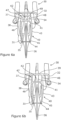
- FIG 8 a schematic view of a pair of bicycle seat stays 60 according to the present invention is shown.
- the stays 60 are adapted to mount rear bicycle wheel 56 therebetween by connections to axle 55.
- the stays 60 comprise a crown formed from a lateral member 61.
- the lateral member 61 is substantially horizontal. Nevertheless, the skilled man will appreciate that the lateral member 61 could deviate from the horizontal upwardly or downwardly.
- the lateral member 61 which is connected to the seat tube 51 at the midpoint 62.
- the length of the lateral member 61 is such its ends are roughly aligned with the axis 31 of the lower leg 38 of a rider 30, when in the riding position. For simplicity, in figure 8 only the axis 31 is illustrated rather than the rider 30.
- each end of the lateral member 61 Extending downwardly from each end of the lateral member 61 are downwardly projecting stays 63. At the lower ends of the stays 63 are axle receiving formations 64 for receiving the axle 55 of wheel 56. As shown in figure 8 , the stays 63 each comprise a primary portion 66, the respective primary portions 66 extending downwardly and substantially parallel to each other and an inwardly inclined secondary portion 65 just above the formations 64. This facilitates fitting conventional bicycle wheels 56 into the stay 60. Nevertheless, the skilled man will appreciate that the inwardly inclined secondary portions 65 can be omitted if a wheel 66 with a longer axle 55 is fitted or if the axle receiving formations 64 are provided on cross-members projecting perpendicular to the stays 63.
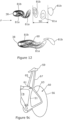
- FIG. 12a a cross-sectional plan of the lower leg 38 (approximated as a cylinder) and vortices 81a, 81b generated by airflow in the direction F is shown. As is shown, vortices of same rotation sense 81a are alternately shed by the 'leg' 38 with vortices of the opposite rotation sense 81b.
- FIG 9a an alternative embodiment of the seat stays 60 is shown.
- the crown comprises extension members 67 projecting upwardly from the lateral crown member 61.
- the extension members 47 maintain a substantially common alignment with the main portion 66 of the stays for much of their length. As such, they maintain a substantially common alignment with the rider's lower leg 38. Accordingly, the extension members 67 provide further improved drag performance for the combination of the bicycle 32 and rider 30, even if the overall frame drag is increased by the extension members 67.
- the extension members 67 can be connected or integrated into saddle 70.
- FIG 9b a further alternative embodiment of the stays 60 is shown. This embodiment differs from the embodiment of figure 9a in that the lateral crown member 61 is omitted.
- FIG 9c a further alternative embodiment of the stays 60 is shown.
- This embodiment differs from the embodiment of figure 9a in that the seat tube 51 ends close to the point where it is connected to the lateral members 61.
- the saddle 59 is thus supported only by the extension members 67 and not by a conventional seat post.
- the stays 63 can have cross-sectional profiles of the type shown in figure 5 .
- the stays may be formed from a pair of parallel stay members, similar to the forks of figure 5 (e)-(g) .
- the main portion 66 of stays 60 and/or the extension members 67 may optionally have telescopic sections. This can facilitate adjustment of the height of saddle 59.
- Each frame 101, 102 comprises a top tube 110, a down tube 120, chain stays 130, a stem 140 and a seat tube 150, as is known in the art.
- Each of the frame members 110-150 may have a cross-sectional profile in accordance with those disclosed in figure 5 .
- the frame 101 comprises a set of front forks 40 similar to the embodiment shown in figure 6a , but where the extension members 47 connect to the stem 140 rather than the head tube and a pair of seat stays 60 according to the embodiment of figure 8 .
- the frame 101 is further provided with a set of handle bars 139 comprising a substantially horizonal section 137 and a drop section 138. The frame 101 thereby provides a set of forks 40 that connect to the stem 141 connected to the head tube 140.
- Track testing of a frame of the type shown in figure 10a has identified a drag reduction of the order of 1.5- 4%.
- the drag reduction achieved in practice is also dependent upon the speed and upon the rider, in particular the rider shape and/or rider position.
- the frame 102 comprises a pair of seat stays 60 according to the embodiment of figure 8 .
- the frame 102 differs from frame 101 in that the front forks 40 are according to the embodiment of figure 6b .
- the handle bars 131 have a different form comprising a substantially horizonal section 132, forward projecting end bars 133 and forward projecting arm bars 134.
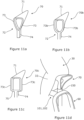
- a saddle 70 comprises a seat surface 71 adapted to support a rider and a seat post 72.
- the seat post 72 comprises a pair of widely spaced limbs 73 and a trunk 74.
- the limbs 73 extend between the trunk 74 and the edges of the seat surface 71.
- the wide spacing is facilitated by the connection of the limbs 73 to the edges of the seat surface 71 rather than to the underside of the seat surface as is conventional. Indeed, in some embodiments, this can facilitate the provision of a saddle where the seat surface 71 and seat post 72 are integrally formed. This can provide a weight saving.
- the trunk 74 may comprise a single integral member or two closely aligned limbs, each aligned limb integral with a respective limb 73.
- the trunk 74 thereby facilitates the adjustable fitting of the saddle 70 to a seat tube 51, 150 of a bicycle as is common in the art.
- the bifurcated limbs 73 and/or the stem 74 can have a cross-sectional profile of the type shown in figure 5 .
- FIG. 1 1b and figure 11c alternative saddles 70b and 70c are shown.
- the alternative saddle 70b differs from saddle 70 only in that the limbs 73b are curved in a 'U' form rather a 'V' form shown in figure 11a .
- the alternative saddle 70c differs from saddle 70 in that the limbs 73c extend downwardly parallel to each other and are joined to the trunk 74 by a lateral member 75 at their lower ends. Whilst a substantially horizontal lateral member 75 is shown, the skilled man will appreciate that the lateral member 75 may be curved or angled upwardly or downwardly as required or as appropriate.
- the saddle 70 of figure 11a is fitted to the seat tube 150 of a bicycle frame 101 or 102.
- the bifurcated limb 73 allows the saddle post 72 to lie close to the axes of the respective upper legs 33 of the rider. In this manner, each bifurcated limb 73 lies within the wake of the upper leg 33 during forward motion. As a result, the drag on the combination of seated rider 30 and saddle 70 is reduced, even if the seat post 72 alone could be expected to have an increased drag compared to a conventional saddle with a singular seat post.
Landscapes
- Engineering & Computer Science (AREA)
- Mechanical Engineering (AREA)
- Steering Devices For Bicycles And Motorcycles (AREA)
Applications Claiming Priority (3)
| Application Number | Priority Date | Filing Date | Title |
|---|---|---|---|
| GB201913619A GB201913619D0 (en) | 2019-09-20 | 2019-09-20 | Improvements in or relating to bicycles |
| PCT/GB2020/052270 WO2021053352A1 (en) | 2019-09-20 | 2020-09-18 | Improvements in or relating to bicycles |
| EP20780305.7A EP4031443B1 (de) | 2019-09-20 | 2020-09-18 | Verbesserungen an oder in zusammenhang mit fahrrädern |
Related Parent Applications (1)
| Application Number | Title | Priority Date | Filing Date |
|---|---|---|---|
| EP20780305.7A Division EP4031443B1 (de) | 2019-09-20 | 2020-09-18 | Verbesserungen an oder in zusammenhang mit fahrrädern |
Publications (2)
| Publication Number | Publication Date |
|---|---|
| EP4431377A2 true EP4431377A2 (de) | 2024-09-18 |
| EP4431377A3 EP4431377A3 (de) | 2024-11-20 |
Family
ID=68425463
Family Applications (2)
| Application Number | Title | Priority Date | Filing Date |
|---|---|---|---|
| EP24191250.0A Withdrawn EP4431377A3 (de) | 2019-09-20 | 2020-09-18 | Verbesserungen an oder im zusammenhang mit fahrrädern |
| EP20780305.7A Active EP4031443B1 (de) | 2019-09-20 | 2020-09-18 | Verbesserungen an oder in zusammenhang mit fahrrädern |
Family Applications After (1)
| Application Number | Title | Priority Date | Filing Date |
|---|---|---|---|
| EP20780305.7A Active EP4031443B1 (de) | 2019-09-20 | 2020-09-18 | Verbesserungen an oder in zusammenhang mit fahrrädern |
Country Status (4)
| Country | Link |
|---|---|
| US (1) | US20220258827A1 (de) |
| EP (2) | EP4431377A3 (de) |
| GB (3) | GB201913619D0 (de) |
| WO (1) | WO2021053352A1 (de) |
Families Citing this family (4)
| Publication number | Priority date | Publication date | Assignee | Title |
|---|---|---|---|---|
| EP4088999A1 (de) * | 2021-05-12 | 2022-11-16 | Cyclesport North Limited | Lenker |
| BE1029697B1 (fr) * | 2021-08-19 | 2023-03-20 | Rutten Energy Snc | Profil aérodynamique |
| EP4265507A1 (de) * | 2022-04-22 | 2023-10-25 | Giant Manufacturing Co., Ltd. | Fahrradrahmensatz |
| CN116923611A (zh) * | 2022-04-22 | 2023-10-24 | 巨大机械工业股份有限公司 | 自行车车架组 |
Citations (1)
| Publication number | Priority date | Publication date | Assignee | Title |
|---|---|---|---|---|
| GB2501894A (en) | 2012-05-09 | 2013-11-13 | Uk Sport | Bicycle fork with wide crown |
Family Cites Families (16)
| Publication number | Priority date | Publication date | Assignee | Title |
|---|---|---|---|---|
| US3811705A (en) * | 1972-05-02 | 1974-05-21 | Ambra M D | Extended front end for a bike |
| US3964765A (en) * | 1973-08-13 | 1976-06-22 | Yamaha International Corporation | Bicycle |
| GB1427477A (en) * | 1974-06-03 | 1976-03-10 | Lassiere Ltd A | Folding bicycle |
| DE3043931A1 (de) * | 1980-11-21 | 1982-07-01 | Odo Prof. 5600 Wuppertal Klose | Fahrradrahmen |
| GB2121740B (en) * | 1982-06-03 | 1985-10-16 | Alan Swarbrick | Cycle seat |
| US5924714A (en) * | 1991-06-11 | 1999-07-20 | Cannondale Corporation | Bicycle suspension system |
| JPH0678186U (ja) * | 1993-04-14 | 1994-11-01 | 株式会社マクロ | 二輪車用長尺物支持具 |
| JP4846116B2 (ja) * | 2001-03-30 | 2011-12-28 | 株式会社 栄技研 | サスペンション型サドル支持構造 |
| ITMI20060196A1 (it) * | 2006-02-06 | 2007-08-07 | Selle Italia Srl | Sella perfezionata provvista di un dispositivo per la sua applicazione a cicli e simili |
| US20070187922A1 (en) * | 2006-02-14 | 2007-08-16 | Boutakis Peter A | Self powered collapsible bicycle |
| US20070228689A1 (en) * | 2006-03-31 | 2007-10-04 | Chun-Hung Lin | Bicycle frame tube structure for enhancing the rigidity of the bicycle frame |
| US8651505B2 (en) * | 2009-05-13 | 2014-02-18 | Marty Williams | Bicycle |
| US9284009B2 (en) * | 2011-10-17 | 2016-03-15 | William J. Raike, III | Sand-rideable bicycle with positive traction gear assembly |
| GB2501896A (en) * | 2012-05-09 | 2013-11-13 | Uk Sport | Aerodynamic fork |
| JP2016034797A (ja) * | 2014-08-02 | 2016-03-17 | 株式会社マルイ | ハンドル構造 |
| IT201600099013A1 (it) * | 2016-10-03 | 2018-04-03 | Verve Design S R L | Bicicletta |
-
2019
- 2019-09-20 GB GB201913619A patent/GB201913619D0/en not_active Ceased
-
2020
- 2020-09-18 EP EP24191250.0A patent/EP4431377A3/de not_active Withdrawn
- 2020-09-18 GB GB2014746.8A patent/GB2589446B/en active Active
- 2020-09-18 WO PCT/GB2020/052270 patent/WO2021053352A1/en not_active Ceased
- 2020-09-18 GB GBGB2014739.3A patent/GB202014739D0/en not_active Ceased
- 2020-09-18 EP EP20780305.7A patent/EP4031443B1/de active Active
-
2022
- 2022-03-11 US US17/692,582 patent/US20220258827A1/en not_active Abandoned
Patent Citations (1)
| Publication number | Priority date | Publication date | Assignee | Title |
|---|---|---|---|---|
| GB2501894A (en) | 2012-05-09 | 2013-11-13 | Uk Sport | Bicycle fork with wide crown |
Also Published As
| Publication number | Publication date |
|---|---|
| GB202014746D0 (en) | 2020-11-04 |
| EP4031443C0 (de) | 2024-07-31 |
| WO2021053352A1 (en) | 2021-03-25 |
| GB202014739D0 (en) | 2020-11-04 |
| EP4031443A1 (de) | 2022-07-27 |
| GB201913619D0 (en) | 2019-11-06 |
| US20220258827A1 (en) | 2022-08-18 |
| GB2589446A (en) | 2021-06-02 |
| EP4031443B1 (de) | 2024-07-31 |
| GB2589446B (en) | 2022-04-27 |
| EP4431377A3 (de) | 2024-11-20 |
Similar Documents
| Publication | Publication Date | Title |
|---|---|---|
| US20220258827A1 (en) | Bicycles | |
| US11530013B2 (en) | Handlebar | |
| EP0274442B1 (de) | Fahrrad und Lenkstangenvorrichtung | |
| EP2612807A1 (de) | Aerodynamischer Fahrradrahmen | |
| US8876137B2 (en) | Frame for a bicycle | |
| US9963187B1 (en) | Aerodynamic bicycle frame | |
| EP3519285B1 (de) | Rennrad | |
| US6098493A (en) | Aero handle and support system for bicycles | |
| US9469362B1 (en) | Bicycle frame | |
| US6092438A (en) | Aerodynamic bicycle steering device | |
| US20080302588A1 (en) | Motorcycle steering using compound leverage | |
| US10407120B2 (en) | Cycle frame fluid reservoir | |
| US20080054594A1 (en) | Aerodynamic bicycle frame with substituted arcuate seat tube | |
| EP3487754B1 (de) | Verbesserungen an der aerodynamik von fahrradrahmen und zugehörige komponenten | |
| US20170334510A1 (en) | Track racing bike | |
| US20110121539A1 (en) | Component for bicycle frame | |
| GB2502599A (en) | Aerodynamic handlebar | |
| US9254882B2 (en) | Tandem bicycle | |
| KR101047730B1 (ko) | 이인승 삼륜자전거 | |
| US20240262453A1 (en) | Aerodynamic profile | |
| US20170259869A1 (en) | Tandem Bicycle | |
| US7744108B2 (en) | Stem front CAP | |
| US7841613B1 (en) | Pedals forward seat post | |
| DE102013008694B4 (de) | Aerolenker | |
| EP4605294A1 (de) | Fahrradrahmen für strassenrennen |
Legal Events
| Date | Code | Title | Description |
|---|---|---|---|
| PUAI | Public reference made under article 153(3) epc to a published international application that has entered the european phase |
Free format text: ORIGINAL CODE: 0009012 |
|
| STAA | Information on the status of an ep patent application or granted ep patent |
Free format text: STATUS: THE APPLICATION HAS BEEN PUBLISHED |
|
| AC | Divisional application: reference to earlier application |
Ref document number: 4031443 Country of ref document: EP Kind code of ref document: P |
|
| AK | Designated contracting states |
Kind code of ref document: A2 Designated state(s): AL AT BE BG CH CY CZ DE DK EE ES FI FR GB GR HR HU IE IS IT LI LT LU LV MC MK MT NL NO PL PT RO RS SE SI SK SM TR |
|
| REG | Reference to a national code |
Ref country code: DE Ref legal event code: R079 Free format text: PREVIOUS MAIN CLASS: B62K0019360000 Ipc: B62K0021020000 |
|
| PUAL | Search report despatched |
Free format text: ORIGINAL CODE: 0009013 |
|
| AK | Designated contracting states |
Kind code of ref document: A3 Designated state(s): AL AT BE BG CH CY CZ DE DK EE ES FI FR GB GR HR HU IE IS IT LI LT LU LV MC MK MT NL NO PL PT RO RS SE SI SK SM TR |
|
| RIC1 | Information provided on ipc code assigned before grant |
Ipc: B62K 19/36 20060101ALI20241015BHEP Ipc: B62J 1/08 20060101ALI20241015BHEP Ipc: B62K 3/04 20060101ALI20241015BHEP Ipc: B62K 21/18 20060101ALI20241015BHEP Ipc: B62K 21/12 20060101ALI20241015BHEP Ipc: B62K 21/04 20060101ALI20241015BHEP Ipc: B62K 19/02 20060101ALI20241015BHEP Ipc: B62J 17/00 20200101ALI20241015BHEP Ipc: B62K 21/02 20060101AFI20241015BHEP |
|
| STAA | Information on the status of an ep patent application or granted ep patent |
Free format text: STATUS: THE APPLICATION IS DEEMED TO BE WITHDRAWN |
|
| 18D | Application deemed to be withdrawn |
Effective date: 20250521 |