EP4427908A2 - Polystyrol-verbundprofil und vorrichtung zur herstellung eines solchen profils - Google Patents
Polystyrol-verbundprofil und vorrichtung zur herstellung eines solchen profils Download PDFInfo
- Publication number
- EP4427908A2 EP4427908A2 EP24189820.4A EP24189820A EP4427908A2 EP 4427908 A2 EP4427908 A2 EP 4427908A2 EP 24189820 A EP24189820 A EP 24189820A EP 4427908 A2 EP4427908 A2 EP 4427908A2
- Authority
- EP
- European Patent Office
- Prior art keywords
- polystyrene
- skin
- composite
- profile according
- range
- Prior art date
- Legal status (The legal status is an assumption and is not a legal conclusion. Google has not performed a legal analysis and makes no representation as to the accuracy of the status listed.)
- Pending
Links
Images




Classifications
-
- B—PERFORMING OPERATIONS; TRANSPORTING
- B29—WORKING OF PLASTICS; WORKING OF SUBSTANCES IN A PLASTIC STATE IN GENERAL
- B29C—SHAPING OR JOINING OF PLASTICS; SHAPING OF MATERIAL IN A PLASTIC STATE, NOT OTHERWISE PROVIDED FOR; AFTER-TREATMENT OF THE SHAPED PRODUCTS, e.g. REPAIRING
- B29C44/00—Shaping by internal pressure generated in the material, e.g. swelling or foaming ; Producing porous or cellular expanded plastics articles
- B29C44/20—Shaping by internal pressure generated in the material, e.g. swelling or foaming ; Producing porous or cellular expanded plastics articles for articles of indefinite length
- B29C44/22—Shaping by internal pressure generated in the material, e.g. swelling or foaming ; Producing porous or cellular expanded plastics articles for articles of indefinite length consisting of at least two parts of chemically or physically different materials, e.g. having different densities
-
- B—PERFORMING OPERATIONS; TRANSPORTING
- B29—WORKING OF PLASTICS; WORKING OF SUBSTANCES IN A PLASTIC STATE IN GENERAL
- B29C—SHAPING OR JOINING OF PLASTICS; SHAPING OF MATERIAL IN A PLASTIC STATE, NOT OTHERWISE PROVIDED FOR; AFTER-TREATMENT OF THE SHAPED PRODUCTS, e.g. REPAIRING
- B29C44/00—Shaping by internal pressure generated in the material, e.g. swelling or foaming ; Producing porous or cellular expanded plastics articles
- B29C44/20—Shaping by internal pressure generated in the material, e.g. swelling or foaming ; Producing porous or cellular expanded plastics articles for articles of indefinite length
- B29C44/22—Shaping by internal pressure generated in the material, e.g. swelling or foaming ; Producing porous or cellular expanded plastics articles for articles of indefinite length consisting of at least two parts of chemically or physically different materials, e.g. having different densities
- B29C44/24—Making multilayered articles
-
- B—PERFORMING OPERATIONS; TRANSPORTING
- B29—WORKING OF PLASTICS; WORKING OF SUBSTANCES IN A PLASTIC STATE IN GENERAL
- B29C—SHAPING OR JOINING OF PLASTICS; SHAPING OF MATERIAL IN A PLASTIC STATE, NOT OTHERWISE PROVIDED FOR; AFTER-TREATMENT OF THE SHAPED PRODUCTS, e.g. REPAIRING
- B29C44/00—Shaping by internal pressure generated in the material, e.g. swelling or foaming ; Producing porous or cellular expanded plastics articles
- B29C44/34—Auxiliary operations
- B29C44/36—Feeding the material to be shaped
- B29C44/46—Feeding the material to be shaped into an open space or onto moving surfaces, i.e. to make articles of indefinite length
- B29C44/50—Feeding the material to be shaped into an open space or onto moving surfaces, i.e. to make articles of indefinite length using pressure difference, e.g. by extrusion or by spraying
-
- B—PERFORMING OPERATIONS; TRANSPORTING
- B29—WORKING OF PLASTICS; WORKING OF SUBSTANCES IN A PLASTIC STATE IN GENERAL
- B29C—SHAPING OR JOINING OF PLASTICS; SHAPING OF MATERIAL IN A PLASTIC STATE, NOT OTHERWISE PROVIDED FOR; AFTER-TREATMENT OF THE SHAPED PRODUCTS, e.g. REPAIRING
- B29C44/00—Shaping by internal pressure generated in the material, e.g. swelling or foaming ; Producing porous or cellular expanded plastics articles
- B29C44/34—Auxiliary operations
- B29C44/60—Measuring, controlling or regulating
- B29C44/605—Calibration following a shaping operation, e.g. extrusion
-
- B—PERFORMING OPERATIONS; TRANSPORTING
- B29—WORKING OF PLASTICS; WORKING OF SUBSTANCES IN A PLASTIC STATE IN GENERAL
- B29C—SHAPING OR JOINING OF PLASTICS; SHAPING OF MATERIAL IN A PLASTIC STATE, NOT OTHERWISE PROVIDED FOR; AFTER-TREATMENT OF THE SHAPED PRODUCTS, e.g. REPAIRING
- B29C48/00—Extrusion moulding, i.e. expressing the moulding material through a die or nozzle which imparts the desired form; Apparatus therefor
- B29C48/001—Combinations of extrusion moulding with other shaping operations
- B29C48/0012—Combinations of extrusion moulding with other shaping operations combined with shaping by internal pressure generated in the material, e.g. foaming
-
- B—PERFORMING OPERATIONS; TRANSPORTING
- B29—WORKING OF PLASTICS; WORKING OF SUBSTANCES IN A PLASTIC STATE IN GENERAL
- B29C—SHAPING OR JOINING OF PLASTICS; SHAPING OF MATERIAL IN A PLASTIC STATE, NOT OTHERWISE PROVIDED FOR; AFTER-TREATMENT OF THE SHAPED PRODUCTS, e.g. REPAIRING
- B29C48/00—Extrusion moulding, i.e. expressing the moulding material through a die or nozzle which imparts the desired form; Apparatus therefor
- B29C48/022—Extrusion moulding, i.e. expressing the moulding material through a die or nozzle which imparts the desired form; Apparatus therefor characterised by the choice of material
-
- B—PERFORMING OPERATIONS; TRANSPORTING
- B29—WORKING OF PLASTICS; WORKING OF SUBSTANCES IN A PLASTIC STATE IN GENERAL
- B29C—SHAPING OR JOINING OF PLASTICS; SHAPING OF MATERIAL IN A PLASTIC STATE, NOT OTHERWISE PROVIDED FOR; AFTER-TREATMENT OF THE SHAPED PRODUCTS, e.g. REPAIRING
- B29C48/00—Extrusion moulding, i.e. expressing the moulding material through a die or nozzle which imparts the desired form; Apparatus therefor
- B29C48/03—Extrusion moulding, i.e. expressing the moulding material through a die or nozzle which imparts the desired form; Apparatus therefor characterised by the shape of the extruded material at extrusion
- B29C48/12—Articles with an irregular circumference when viewed in cross-section, e.g. window profiles
-
- B—PERFORMING OPERATIONS; TRANSPORTING
- B29—WORKING OF PLASTICS; WORKING OF SUBSTANCES IN A PLASTIC STATE IN GENERAL
- B29C—SHAPING OR JOINING OF PLASTICS; SHAPING OF MATERIAL IN A PLASTIC STATE, NOT OTHERWISE PROVIDED FOR; AFTER-TREATMENT OF THE SHAPED PRODUCTS, e.g. REPAIRING
- B29C48/00—Extrusion moulding, i.e. expressing the moulding material through a die or nozzle which imparts the desired form; Apparatus therefor
- B29C48/16—Articles comprising two or more components, e.g. co-extruded layers
- B29C48/18—Articles comprising two or more components, e.g. co-extruded layers the components being layers
- B29C48/21—Articles comprising two or more components, e.g. co-extruded layers the components being layers the layers being joined at their surfaces
-
- B—PERFORMING OPERATIONS; TRANSPORTING
- B29—WORKING OF PLASTICS; WORKING OF SUBSTANCES IN A PLASTIC STATE IN GENERAL
- B29C—SHAPING OR JOINING OF PLASTICS; SHAPING OF MATERIAL IN A PLASTIC STATE, NOT OTHERWISE PROVIDED FOR; AFTER-TREATMENT OF THE SHAPED PRODUCTS, e.g. REPAIRING
- B29C48/00—Extrusion moulding, i.e. expressing the moulding material through a die or nozzle which imparts the desired form; Apparatus therefor
- B29C48/25—Component parts, details or accessories; Auxiliary operations
- B29C48/30—Extrusion nozzles or dies
- B29C48/304—Extrusion nozzles or dies specially adapted for bringing together components, e.g. melts within the die
-
- B—PERFORMING OPERATIONS; TRANSPORTING
- B29—WORKING OF PLASTICS; WORKING OF SUBSTANCES IN A PLASTIC STATE IN GENERAL
- B29C—SHAPING OR JOINING OF PLASTICS; SHAPING OF MATERIAL IN A PLASTIC STATE, NOT OTHERWISE PROVIDED FOR; AFTER-TREATMENT OF THE SHAPED PRODUCTS, e.g. REPAIRING
- B29C48/00—Extrusion moulding, i.e. expressing the moulding material through a die or nozzle which imparts the desired form; Apparatus therefor
- B29C48/25—Component parts, details or accessories; Auxiliary operations
- B29C48/36—Means for plasticising or homogenising the moulding material or forcing it through the nozzle or die
- B29C48/49—Means for plasticising or homogenising the moulding material or forcing it through the nozzle or die using two or more extruders to feed one die or nozzle
-
- B—PERFORMING OPERATIONS; TRANSPORTING
- B29—WORKING OF PLASTICS; WORKING OF SUBSTANCES IN A PLASTIC STATE IN GENERAL
- B29C—SHAPING OR JOINING OF PLASTICS; SHAPING OF MATERIAL IN A PLASTIC STATE, NOT OTHERWISE PROVIDED FOR; AFTER-TREATMENT OF THE SHAPED PRODUCTS, e.g. REPAIRING
- B29C48/00—Extrusion moulding, i.e. expressing the moulding material through a die or nozzle which imparts the desired form; Apparatus therefor
- B29C48/25—Component parts, details or accessories; Auxiliary operations
- B29C48/88—Thermal treatment of the stream of extruded material, e.g. cooling
- B29C48/885—External treatment, e.g. by using air rings for cooling tubular films
-
- B—PERFORMING OPERATIONS; TRANSPORTING
- B29—WORKING OF PLASTICS; WORKING OF SUBSTANCES IN A PLASTIC STATE IN GENERAL
- B29C—SHAPING OR JOINING OF PLASTICS; SHAPING OF MATERIAL IN A PLASTIC STATE, NOT OTHERWISE PROVIDED FOR; AFTER-TREATMENT OF THE SHAPED PRODUCTS, e.g. REPAIRING
- B29C48/00—Extrusion moulding, i.e. expressing the moulding material through a die or nozzle which imparts the desired form; Apparatus therefor
- B29C48/25—Component parts, details or accessories; Auxiliary operations
- B29C48/88—Thermal treatment of the stream of extruded material, e.g. cooling
- B29C48/90—Thermal treatment of the stream of extruded material, e.g. cooling with calibration or sizing, i.e. combined with fixing or setting of the final dimensions of the extruded article
-
- B—PERFORMING OPERATIONS; TRANSPORTING
- B29—WORKING OF PLASTICS; WORKING OF SUBSTANCES IN A PLASTIC STATE IN GENERAL
- B29C—SHAPING OR JOINING OF PLASTICS; SHAPING OF MATERIAL IN A PLASTIC STATE, NOT OTHERWISE PROVIDED FOR; AFTER-TREATMENT OF THE SHAPED PRODUCTS, e.g. REPAIRING
- B29C48/00—Extrusion moulding, i.e. expressing the moulding material through a die or nozzle which imparts the desired form; Apparatus therefor
- B29C48/25—Component parts, details or accessories; Auxiliary operations
- B29C48/92—Measuring, controlling or regulating
-
- B—PERFORMING OPERATIONS; TRANSPORTING
- B32—LAYERED PRODUCTS
- B32B—LAYERED PRODUCTS, i.e. PRODUCTS BUILT-UP OF STRATA OF FLAT OR NON-FLAT, e.g. CELLULAR OR HONEYCOMB, FORM
- B32B27/00—Layered products comprising a layer of synthetic resin
- B32B27/30—Layered products comprising a layer of synthetic resin comprising vinyl (co)polymers; comprising acrylic (co)polymers
- B32B27/302—Layered products comprising a layer of synthetic resin comprising vinyl (co)polymers; comprising acrylic (co)polymers comprising aromatic vinyl (co)polymers, e.g. styrenic (co)polymers
-
- B—PERFORMING OPERATIONS; TRANSPORTING
- B32—LAYERED PRODUCTS
- B32B—LAYERED PRODUCTS, i.e. PRODUCTS BUILT-UP OF STRATA OF FLAT OR NON-FLAT, e.g. CELLULAR OR HONEYCOMB, FORM
- B32B5/00—Layered products characterised by the non- homogeneity or physical structure, i.e. comprising a fibrous, filamentary, particulate or foam layer; Layered products characterised by having a layer differing constitutionally or physically in different parts
- B32B5/18—Layered products characterised by the non- homogeneity or physical structure, i.e. comprising a fibrous, filamentary, particulate or foam layer; Layered products characterised by having a layer differing constitutionally or physically in different parts characterised by features of a layer of foamed material
-
- B—PERFORMING OPERATIONS; TRANSPORTING
- B29—WORKING OF PLASTICS; WORKING OF SUBSTANCES IN A PLASTIC STATE IN GENERAL
- B29C—SHAPING OR JOINING OF PLASTICS; SHAPING OF MATERIAL IN A PLASTIC STATE, NOT OTHERWISE PROVIDED FOR; AFTER-TREATMENT OF THE SHAPED PRODUCTS, e.g. REPAIRING
- B29C2948/00—Indexing scheme relating to extrusion moulding
- B29C2948/92—Measuring, controlling or regulating
- B29C2948/92504—Controlled parameter
- B29C2948/92609—Dimensions
- B29C2948/92647—Thickness
-
- B—PERFORMING OPERATIONS; TRANSPORTING
- B29—WORKING OF PLASTICS; WORKING OF SUBSTANCES IN A PLASTIC STATE IN GENERAL
- B29C—SHAPING OR JOINING OF PLASTICS; SHAPING OF MATERIAL IN A PLASTIC STATE, NOT OTHERWISE PROVIDED FOR; AFTER-TREATMENT OF THE SHAPED PRODUCTS, e.g. REPAIRING
- B29C2948/00—Indexing scheme relating to extrusion moulding
- B29C2948/92—Measuring, controlling or regulating
- B29C2948/92819—Location or phase of control
- B29C2948/92942—Moulded article
-
- B—PERFORMING OPERATIONS; TRANSPORTING
- B29—WORKING OF PLASTICS; WORKING OF SUBSTANCES IN A PLASTIC STATE IN GENERAL
- B29K—INDEXING SCHEME ASSOCIATED WITH SUBCLASSES B29B, B29C OR B29D, RELATING TO MOULDING MATERIALS OR TO MATERIALS FOR MOULDS, REINFORCEMENTS, FILLERS OR PREFORMED PARTS, e.g. INSERTS
- B29K2025/00—Use of polymers of vinyl-aromatic compounds or derivatives thereof as moulding material
- B29K2025/04—Polymers of styrene
- B29K2025/06—PS, i.e. polystyrene
-
- B—PERFORMING OPERATIONS; TRANSPORTING
- B29—WORKING OF PLASTICS; WORKING OF SUBSTANCES IN A PLASTIC STATE IN GENERAL
- B29K—INDEXING SCHEME ASSOCIATED WITH SUBCLASSES B29B, B29C OR B29D, RELATING TO MOULDING MATERIALS OR TO MATERIALS FOR MOULDS, REINFORCEMENTS, FILLERS OR PREFORMED PARTS, e.g. INSERTS
- B29K2209/00—Use of rubber derived from conjugated dienes as reinforcement
- B29K2209/06—SB polymers, i.e. butadiene-styrene polymers
-
- B—PERFORMING OPERATIONS; TRANSPORTING
- B29—WORKING OF PLASTICS; WORKING OF SUBSTANCES IN A PLASTIC STATE IN GENERAL
- B29L—INDEXING SCHEME ASSOCIATED WITH SUBCLASS B29C, RELATING TO PARTICULAR ARTICLES
- B29L2009/00—Layered products
-
- B—PERFORMING OPERATIONS; TRANSPORTING
- B29—WORKING OF PLASTICS; WORKING OF SUBSTANCES IN A PLASTIC STATE IN GENERAL
- B29L—INDEXING SCHEME ASSOCIATED WITH SUBCLASS B29C, RELATING TO PARTICULAR ARTICLES
- B29L2009/00—Layered products
- B29L2009/005—Layered products coated
-
- B—PERFORMING OPERATIONS; TRANSPORTING
- B29—WORKING OF PLASTICS; WORKING OF SUBSTANCES IN A PLASTIC STATE IN GENERAL
- B29L—INDEXING SCHEME ASSOCIATED WITH SUBCLASS B29C, RELATING TO PARTICULAR ARTICLES
- B29L2031/00—Other particular articles
- B29L2031/001—Profiled members, e.g. beams, sections
-
- B—PERFORMING OPERATIONS; TRANSPORTING
- B29—WORKING OF PLASTICS; WORKING OF SUBSTANCES IN A PLASTIC STATE IN GENERAL
- B29L—INDEXING SCHEME ASSOCIATED WITH SUBCLASS B29C, RELATING TO PARTICULAR ARTICLES
- B29L2031/00—Other particular articles
- B29L2031/001—Profiled members, e.g. beams, sections
- B29L2031/003—Profiled members, e.g. beams, sections having a profiled transverse cross-section
-
- B—PERFORMING OPERATIONS; TRANSPORTING
- B32—LAYERED PRODUCTS
- B32B—LAYERED PRODUCTS, i.e. PRODUCTS BUILT-UP OF STRATA OF FLAT OR NON-FLAT, e.g. CELLULAR OR HONEYCOMB, FORM
- B32B2266/00—Composition of foam
- B32B2266/02—Organic
- B32B2266/0214—Materials belonging to B32B27/00
- B32B2266/0221—Vinyl resin
- B32B2266/0228—Aromatic vinyl resin, e.g. styrenic (co)polymers
-
- B—PERFORMING OPERATIONS; TRANSPORTING
- B32—LAYERED PRODUCTS
- B32B—LAYERED PRODUCTS, i.e. PRODUCTS BUILT-UP OF STRATA OF FLAT OR NON-FLAT, e.g. CELLULAR OR HONEYCOMB, FORM
- B32B2307/00—Properties of the layers or laminate
- B32B2307/70—Other properties
- B32B2307/72—Density
Definitions
- the present disclosure relates to polystyrene profiles and an apparatus for manufacturing thereof, especially to very light polystyrene profiles providing enough impact resistance for being used as skirting board.
- Skirting boards are commonly used and can be made from a wide variety of materials. Such materials can for instance be or comprise wood, plastic, metal or polystyrene.
- Polystyrene skirting boards have the advantage of being light, water and fungi resistant and are easy to handle. They can easily be shortened or adapted, for instance by means of standard working tools. Transport is easy and relatively cheap as they have low weight. Being slightly flexible, they can easily be permanently fixed to a wall, for instance by a suitable glue or adhesive layer, while following the surface of the wall.
- Skirting boards need to be resistant to impact from objects such as vacuum cleaners, floor brushes, suitcases, toys (e.g. skateboards, ...), shoes and furniture as e.g. tables or chairs.
- EP2634210 a process for manufacturing composite profiles is disclosed, as well as resulting profiles, which are lightweight.
- a composite polystyrene profile extending longitudinally from a first end to a second end and comprising a front surface and a back surface, comprising
- the profiles provide a comparable or even improved impact resistance with respect to profiles in the prior art which have a skin portion having a uniform thickness in a transversal direction perpendicular to the longitudinal direction.
- the skin portion comprises or consists of the polystyrene copolymer.
- the skin portion comprises or consists of a high impact polystyrene copolymer.
- the high impact polystyrene copolymer comprises or consists of HIPS or ABS.
- HIPS high impact polystyrene
- the used HIPS types typically have a strain at break of at least 20%.
- the quantity and size of the polybutadiene particles determines the final properties.
- ABS acrylonitrile butadiene styrene
- Nitrile is increasing the heat deflection temperature and the butadiene is increasing the toughness.
- ABS types used have a strain at break of at least 20%.
- the core portion or core is foamed and comprises a General Purpose polystyrene material (GPPS) and a High Impact polystyrene material (HIPS).
- GPPS General Purpose polystyrene material
- HIPS High Impact polystyrene material
- the HIPS material preferably constitutes between 5 and 25 % of the core material, more preferably between 10 and 20 %.
- the GPPS material preferably constitutes between 70 and 90% of the core material, more preferably between 75 and 85 %.
- GPPS general purpose polystyrene
- the core portion further comprises a polystyrene copolymer. This provides the advantage that brittle cracking of the core portion can be avoided.
- the polystyrene profile is a skirting board.
- the polystyrene profile has a front surface and a back surface.
- the front surface preferably corresponds to the surface of the profile which is exposed to impact during use.
- the front surface preferable corresponds to the surface of the profile which is visible when installed against a wall, or in the connection between a wall and a floor.
- the back surface is the complement of the front surface.
- the back surface preferably comprises a floor portion for being in contact with a floor, and a wall portion for being in contact with a wall, when suitably installed.
- the front surface preferably comprises sharp details. E.g. it can comprise sharp edges and/or element of detail having small radiuses.
- the polystyrene composite profile may have sharp elements of detail or edges, having a radius R of 1 mm or less.
- a reduced thickness of the skin portion at the back side of the composite polystyrene profile when compared to the front side of the profile can provide enough support to the core layer and can provide a sufficient or improved resistance of the composite substrate against impact on the front surface. While a certain thickness is needed on the front side, which is exposed to impact, the same thickness is not needed at the back side. It was also observed that providing a skin portion on the front side only can result in breaking of the core portion from the back side upon impact on the front side, when bending it too far, or when removing the skirting board back from the wall. Having a reduced thickness of the skin portion or layer at the back side of the profile also results in a relatively more flexible composite profile structure, which is more resilient to impact.
- the core portion is foamed.
- the skin portion is non-foamed. It can for instance have a density between 1000kg/m 3 and 1300kg/m 3 , or between 1040 kg/m 3 and 1300kg/m 3 , or between 1050kg/m 3 and 1300kg/m 3 .
- the skin portion is foamed. It can for instance have a density between 700kg/m 3 and 1050kg/m 3 .
- the skin portion further comprises a filler material, such as for instance talc, CaCO 3 or other fillers known to the skilled person.
- a filler material such as for instance talc, CaCO 3 or other fillers known to the skilled person.
- the back surface comprises a surface, preferably a planar surface, suitable for applying glue.
- the back surface comprises an adhesive strip for attachment to a wall.
- a variation of the non-uniform thickness in the transversal direction of the skin portion between minimal thickness (or constant thickness) at the front surface and a minimal thickness (or constant thickness) at the back surface is more than 15%, or more than 20%, or more than 25%, or more than 30%, the minimal thickness at the back surface being smaller than the minimal thickness at the front surface.
- the thickness of the skin portion at the front surface and/or the thickness of the skin portion at the back surface is constant or substantially constant.
- a thickness of the skin portion at the front surface is between 0.3 to 1.0 mm, more preferably between 0.5 to 0.9 mm and the thickness of the skin portion at the back surface is within the range of, more preferably between 0.1 to 0.7 mm.
- the material of the skin portion comprises a strain at break of more than 30% and a Young's modulus of more than 1800 MPa (at 20°C and 1 Bar).
- the back surface comprises at least two longitudinally extending support portions, the support portions comprising a part of the core portion and a part of the skin portion.
- Each of the support portions can for instance comprise a flat surface for gluing the profile / skirting board to the wall.
- the flat surface can for instance extend longitudinally and have a width within the range of 5 to 20 mm or within the range of 10 to 20mm.
- the support portions are arranged parallel, and are arranged for being installed parallel to a wall surface.
- both or all support portions have respective support surfaces which are coplanar.
- the composite polystyrene profile having at least two longitudinally extending support portions comprises a suspended portion in between two adjacent support portions, the suspended portion having a length within the range of 1 cm to 50 cm, more preferably between 1 and 25 cm, or between 1 and 15 cm, or between 1 and 10 cm. In other words, preferably, the suspended portion bridges a gap between two support portions of about 1 to 50 cm.
- the hollow space in the suspended portion between the wall (or a plane defined by respective coplanar support portions) and the back surface of the profile acts as an elastic deformation zone during a heavy impact. This allows impact energy absorption and prevents larger damage at the front surface.
- the minimal distance between the suspended portion and a plane defined by respective coplanar support portions, or between the suspended portion and a wall (when installed), is at least 0.5 mm or at least 1 mm, or at least 2 mm, or at least 3 mm.
- the distance between the suspended portion and a plane defined by respective coplanar support portions may vary along the extent of the suspended portion, preferably between 0.5-30 mm, or between 0.5-25 mm, or between 0.5-20 mm.
- the suspended portion may comprise a front surface and back surface.
- the back surface can be substantially planar. It can for instance be parallel or substantially parallel with a plane defined by respective coplanar support portions.
- the back surface of the support portion may comprise one or more extensions towards the plane defined by the support portions. For instance, such an extension may be embodied as one or more protrusions. This provides the additional advantage that the suspended portion will receive additional support from the extensions after an initial deformation of the suspended portion, upon impact of an object on the front surface of the suspended portion.
- the composite polystyrene profile comprises a lower surface corresponding to the floor portion, and the suspended portion is arranged at a distance from the lower surface within a range of 1 to 50 cm, or within a range of 1 to 40 cm, or within a range of 1 to 30 cm.
- Having a continuous skin portion on the back side of the profile or skirting board, which extends and connects the respective parts of the core portions of the at least two support portions, renders the composite profile more flexible and resilient to impact. In these type of configurations the benefit of having a more flexible composite profile is enhanced.
- the core portion comprises a constant average foam density, in at least the transversal direction.
- the core portion comprises a constant average foam density along the longitudinal direction. This ensures a constant mechanical strength and initial impact resistance along the front surface of the profile.
- the cell diameter of the core portion is such that 50 % of all cells has a diameter of 100 ⁇ m or less and 95% of all cells has a diameter of 400 ⁇ m or less.
- the core portion comprises a compression strength of at least 2 N/mm 2 , or at least 3 N/mm 2 .
- the core portion further comprises polybutadiene particles which have an average diameter within the range of 1 to 7 micron, more preferably between 1 to 5 micron, even more preferably between 2 and 3 micron.
- the dimension of the polybutadiene particles is an important parameter in defining the mechanical properties of the profile. Indeed, when the polybutadiene particles are too small, impact resistance of the core portion is jeopardised. If the polybutadiene particles are too large, they negatively impact foaming process of the core portion.
- an adhesion strength of the skin portion to the core portion is within the range of 2 to 7 N/mm 2 , more preferably within the range of 3 to 7 N/mm 2 .
- the composite polystyrene profile is manufactured by a coextrusion process.
- the composite polystyrene profile does not comprise residues of oil.
- the composite polystyrene profile further comprises a primer layer on the front surface.
- the non uniform thickness of the skin portion is achieved by providing a difference in flow rate of the skin polymer composition towards the core portion, or towards different portions of the core portion.
- a first flow rate of the skin polymer composition towards a first portion of the core portion can be different from a second flow rate of the skin polymer composition towards a second, different portion of the core portion to provide a skin portion with a first thickness at the first portion of the core portion and a skin portion with a second, different thickness at the second portion of the core portion.
- the design of the co-extrusion mould is thereby predetermined such that it comprises supply channels which are arranged and adapted accordingly.
- step (e) is provided directly after step (d).
- the plastic composite is not allowed to fully freely expand.
- the expansion of the plastic composite is limited to no more than 20%, or no more than 10%, or no more than 5%, in volume.
- the expansion of the plastic composite can be controlled or limited by controlling temperatures of (skin and core) melts and calibration unit and predetermined dimensions of the calibration unit.
- the final foam density of the core portion is substantially constant or constant in at least the transversal direction, and typically also in the longitudinal direction.
- a physical blowing agent is provided in said core polymer composition.
- This physical blowing agent is or comprises preferably CO 2 .
- the CO 2 is present in the core polymer composition in an amount of 0,5 to 2 wt%, preferably 0,6 to 1,5 wt%, more preferably 0,8 to 1,2 wt%.
- the core polymer composition comprises a polystyrene monopolymer and is processed in the coextrusion mould at a temperature within the range of 140°C to 152°C, preferably between 144°C and 148°C, and the skin polymer composition is processed in the coextrusion mould at a temperature within the range of 165°C to 185 °C, more preferably within the range of 170°C to 180 °C.
- plasticizing a core polymer composition in a first extruder is performed at a melt temperature higher than 152°C, or higher than 160°C.
- the method than preferably further comprises a cooling step (b') after step (a) and before step (c), reducing the melt temperature to the processing temperature in the coextrusion mould.
- This can be performed for instance by passing the core polymer composition through a melt cooler, which is preferably separate from the extrusion mould.
- Step (b') preferably occurs in during step (b) or in parallel with step (b).
- comprising using vacuum suction technology in the cooled calibration unit comprising using vacuum suction technology in the cooled calibration unit. This allows manufacturing profiles with sharp edges, e.g. having features with details having a radius R of 1 mm or less.
- the method further comprising controlling and adapting the feedthrough speed of the plasticised core and skin polymer compositions during the manufacturing process.
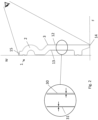
- Figure 1 is a generic illustration of a polystyrene profile, such as a polystyrene skirting board 1 attached to a wall W, at the intersection between a wall surface and a floor surface.
- the skirting board typically rests of the floor F with its lower surface 14.
- the profile or skirting board 1 typically extends longitudinally along an axis A, and typically comprises a constant cross-section perpendicular onto the longitudinal axis. It comprises a first end 10 and a second end 11, a front surface 12, a back surface 13, a top surface 15 and a bottom or lower surface 14.
- the front surface 12 corresponds to the part of the surface of the polystyrene profile which is visible when the skirting board is installed. So, the front surface can comprise the top surface 15.
- the back surface 13, end surfaces, and bottom surface 14 are not visible after installation.
- the lower surface 14 can be considered to be part of the front surface 12, for instance when the profile is used as a door still.
- the lower surface 14 can be considered to be part of the back surface 13.
- Polystyrene skirting boards 1 are typically attached to the wall W by means of an adhesive such as glue or double-sided tape, and have the advantage that no screws, nails or other means for fixation are therefore necessary. They are also relatively flexible such that they can follow and mask irregularities in the wall without leaving any gap in between the skirting board 1 and the wall W.
- a first embodiment of the present disclosure is depicted in Figures 2 and 3 .
- a composite polystyrene profile 1 extends longitudinally from a first end 10 to a second end 11 and comprises a front surface 12 and a back surface 13, comprising
- This skirting board 1 is a relatively low cost, lightweight skirting board that is surprisingly robust against impact.
- the core portion 2 further comprises a polystyrene copolymer, which contributes to reducing the risk of brittle cracking of the core portion 2 upon impact of an object on its front surface.
- the core portion 2 further comprises polybutadiene particles which have an average diameter within the range of 1 to 7 micron.
- the skirting board comprises a skin layer 3, 30, 31 which has a different thickness on the back surface 13 (31) than at the front surface 12 (30).
- the thickness of the skin portion 30 at the front surface 12 and the thickness of the skin portion at the back surface 13 are both constant.
- the front surface 12 also comprises the top surface 15 and the lower surface 14.
- the front surface 12 comprises the top surface 15 but does not comprise the lower surface 14.
- a thickness of the skin portion 3, 30 at the front surface 12 is within the range of 0.3-1.0 mm.
- a thickness of the skin portion (3, 31) at the back surface 13 is within the range of 0.3 to 0.9 mm. It was found that the skin portion 31 at the back surface 13, can be made thinner than the skin portion 3 at the front surface 12, saving weight and costs. Its presence was though found to be needed to improve resistance against brittle braking of the back surface of the skirting board upon impact of an object on its front surface.
- the material of the skin portion 3 comprises a strain at break of more than 30% and a Young's modulus of more than 1800 MPa. These properties also contribute to the resilience of the skirting board against impact.
- the back surface 13 comprises at least two, for instance two, longitudinally extending support portions 1a, the support portions comprising a part of the core portion 2 and part of the skin portion 3,31.
- the support portions which mainly comprise core portion material are locally reinforced by the skin layer, improving resistance and resilience against impact.
- the support portions 1a have a lower surfaces 1e which are coplanar and adapted for being provided with an adhesive for attachment to a wall.
- the lower surfaces may also comprise one or more longitudinally extending grooves 1f to facilitate the application of the glue, installation of the profile, and reduce material cost and weight.
- the skin layer 31 also follows the lower surfaces 1e in the region of the grooves 1f, i.e. the grooves 1f also comprise a portion of the skin layer 3,31.
- the skirting board comprises a suspended portion 1c in between two sadjacent support portions 1a, the suspended portion 1c having a length within the range of 1 cm to 50 cm, for instance having a length of about 10 cm.
- the (reduced thickness) skin layer or portion 31 improves the strength of connection between the support portions 1a and suspended portion 1c.
- a gap 1g is present in between the skirting board 1 and the wall W (or coplanar surface defined by respective surfaces 1e).
- the at least two support portions 1a have respective support surfaces 1e which are coplanar.
- the minimal distance between the suspended portion 1c and a plane defined by respective coplanar support portion surfaces 1e is at least 0.5 mm, but can be larger.
- the distance between the suspended portion and a plane defined by respective coplanar surfaces 1e of support portions 1a varies along the extent of the suspended portion. In this case between for instance 0.5 and 20 mm.
- the suspended portion itself comprises a front surface and back surface.
- the back surface is substantially planar, but comprises an extension 1d (or dynamic support portion 1a') extending towards (but not reaching) a plane defined by the coplanar surfaces 1e of the respective support portions 1a.
- the extension 1d extends also longitudinally, parallel to the support portions 1a.
- such an extension may be continuous in the longitudinal direction, or may be embodied as one or more protrusions of the back surface of the suspended portion, arranged along a line parallel to the longitudinal axis. This provides the additional advantage that the suspended portion will receive additional support from the extensions after an initial deformation of the suspended portion, upon impact of an object on the front surface of the suspended portion.
- the extension 1d comprises a skin layer 3 on both its front and back surfaces.
- the front surface 12, or front surface of the support portion may comprise a recess or groove 1b, which extends longitudinally and which is comprising a corresponding portion of the skin layer 3.
- the skirting board comprises a constant cross-section perpendicular onto the longitudinal axis.
- the cross-section varies in a regular manner. For instance, it can be substantially constant along the length of the skirting board, for instance constant in all features apart from the extension 1d.
- the extension 1d can for instance also comprise a regular repetition of local protrusions of limited length in the longitudinal direction, along the longitudinal direction.
- the suspended portion is positioned at a relevant height for typical impact, for instance it can be arranged at a distance from the lower surface 14 within a range of 1 to 50 cm.
- the core portion 2 comprises a constant average foam density, in both the transversal direction and the longitudinal direction.
- the cell diameter distribution of the core portion 2 is such that 50 % of all cells has a diameter of 100 ⁇ m or less and 95% of all cells has a diameter of 400 ⁇ m or less.
- the core portion 2 comprises a compression strength of al least 2 N/mm 2 .
- the adhesion strength of the skin portion 3 to the core portion 2 is within the range of 2-7 N/mm 2 .
- the back surface of the suspended portion 1c is fully planar, as for instance shown in a further embodiment in relation with Fig. 4 .
- This embodiment is similar to the first embodiment, but does not comprise the extension 1d.
- the back surface of the suspended portion 1c can for instance be parallel or substantially parallel with a plane defined by respective coplanar surfaces 1e of support portions 1a.
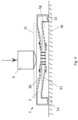
- Fig. 4 illustrates the behaviour embodiments of the present disclosure when exposed to impact loads. It will be appreciated that this is a generic representative of a variety of products having the claimed features, including the embodiments set out in relation with Fig. 2 and Fig. 3 .
- the suspended portion 1c of the skirting board 1 deforms in a more resilient manner when compared to state of the art skirting boards, while having a reduced probability of brittle breaking of the suspended portion.
- the support portions, and thus their respective portions of the skin layer 3 are fixed to a wall W, for instance by gluing.
- the elastic deformation zone or gap 1g can provide space for such a downward movement upon impact. If the gap 1g is relatively small the wall W itself may also provide support for the suspended portion 1c against breaking.
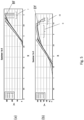
- the claimed profiles thought show a more stabile behaviour, whereby clearly a second zone of displacement behaviour II exists for higher forces, which deviates from the displacement behaviour at lower applied forces, but for which no failure occurs. This corresponds to plastic deformation and the ability to absorb mechanical energy. Also, there is a third zone of displacement behaviour III for even higher applied forces, where a gradual, stepwise increase in failure occurs, a behaviour associated with ductile fracture (Df), which is still better and different from the brittle failure in zone I of the prior art.
- Df ductile fracture
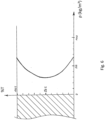
- Fig. 6 and Fig. 7 illustrate respective foam density distribution of the reference product (also without a skin layer) and typical embodiments of the present disclosure.
- the respective graphs show relative depth position within the profile (y-axis) versus material density ⁇ (in kg/m 3 ; x-axis).
- the reference product shows a varying density along the depth of the product, with a density at the centre of about 300kg/m 3 and a density at the outside of the product of about 650 kg/m 3 .
- the products according to embodiments of the present disclosure show the core portion 2 and skin portions 3 (the latter having different thickness at opposite sides of the skirting boards (30, 31)).
- the core portion 2 has a constant material density of about 200 kg/m 3 along its depth profile (as well as along its longitudinal direction).
- the skin portion 3 has a constant material density of about 1040 kg/m 3 along its depth profile. It is believed that these features contribute to the better performance of the profiles according to the present disclosure, at reduced weight.
- Fig. 8 illustrates a typical manufacturing setup and process allowing the manufacturing of the claimed composite polystyrene profiles.
- the process comprises plasticizing a core polymer composition in a first extruder 50, the core polymer composition comprising a polystyrene monopolymer, a nucleating agent and a physical blowing agent.
- the physical blowing agent 51 is added in a dosed manner to the first extruder and is preferably CO 2 .
- CO 2 is present in the core polymer composition in an amount of 0.5 to 2 wt%, preferably 0.6 to 1.5 wt%, more preferably 0.8 to 1.2 wt%.
- the core polymer composition comprises a General Purpose polystyrene material (GPPS) and a High Impact polystyrene material (HIPS).
- GPPS General Purpose polystyrene material
- HIPS High Impact polystyrene material
- the HIPS material preferably constitutes between 5 and 25 % of the core material, more preferably between 10 and 20 %.
- the GPPS material preferably constitutes between 70 and 90% of the core material, more preferably between 75 and 85 %.
- the core portion further comprises a polystyrene copolymer.
- the HIPS core portion comprises a polystyrene copolymer.
- the polystyrene copolymer preferably comprises or consists of polybutadiene.
- a skin polymer composition is extruded in a second or skin extruder 53, the skin polymer composition comprising a polystyrene copolymer.
- the skin polymer composition comprises or consists of a polystyrene copolymer.
- the skin portion comprises or consists of a high impact polystyrene copolymer.
- the high impact polystyrene copolymer comprises or consists of HIPS or ABS.
- the plasticized core polymer composition is fed to a coextrusion mould 52 to form a core portion 2.
- the skin polymer composition is fed to the coextrusion mould 52 so as to form a plastic composite 54 having a core portion 2 and a skin portion 3 made of the skin polymer composition surrounding and welded to the core portion 2.
- the plastic composite 54 obtained at the end of the previous step is passed into a cooled calibration unit 55, to cool and stabilize the shape of the plastic composite 54.
- the product When leaving the calibrator 55, the product has its final shape and properties and can be cut into parts or skirting boards 1.
- the skin portion 3 is thereby provided with a non-uniform thickness in a transversal direction perpendicular on the longitudinal direction. This can be achieved by providing a difference in flow rate of said skin polymer composition towards said core portion 2.
- the core polymer composition comprises a polystyrene monopolymer and is processed in the mould at a temperature within the range of 140°C to 152°C, preferably between 144°C and 148°C, and the skin polymer composition is processed in the mould at a temperature within the range of 165°C to 185 °C, more preferably within the range of 170°C to 180 °C.
- the core polymer composition is plasticised at a temperature substantially higher than 152°C (or 148°C) and cooled before entry in the coextrusion mould.
- vacuum suction technology is used in the cooled calibration unit 55, improving the formation of sharp details in the polystyrene profiles.
Landscapes
- Engineering & Computer Science (AREA)
- Mechanical Engineering (AREA)
- Physics & Mathematics (AREA)
- Thermal Sciences (AREA)
- Manufacturing & Machinery (AREA)
- Laminated Bodies (AREA)
- Molding Of Porous Articles (AREA)
Applications Claiming Priority (2)
| Application Number | Priority Date | Filing Date | Title |
|---|---|---|---|
| BE20215767A BE1029273B1 (nl) | 2021-10-01 | 2021-10-01 | Composiet polystyreenprofiel en werkwijze voor de productie van dergelijke profielen |
| EP22199101.1A EP4159400B1 (de) | 2021-10-01 | 2022-09-30 | Verbundprofil aus polystyrol und verfahren zur herstellung solcher profile |
Related Parent Applications (1)
| Application Number | Title | Priority Date | Filing Date |
|---|---|---|---|
| EP22199101.1A Division EP4159400B1 (de) | 2021-10-01 | 2022-09-30 | Verbundprofil aus polystyrol und verfahren zur herstellung solcher profile |
Publications (2)
| Publication Number | Publication Date |
|---|---|
| EP4427908A2 true EP4427908A2 (de) | 2024-09-11 |
| EP4427908A3 EP4427908A3 (de) | 2024-10-30 |
Family
ID=79171254
Family Applications (2)
| Application Number | Title | Priority Date | Filing Date |
|---|---|---|---|
| EP22199101.1A Active EP4159400B1 (de) | 2021-10-01 | 2022-09-30 | Verbundprofil aus polystyrol und verfahren zur herstellung solcher profile |
| EP24189820.4A Pending EP4427908A3 (de) | 2021-10-01 | 2022-09-30 | Polystyrol-verbundprofil und vorrichtung zur herstellung eines solchen profils |
Family Applications Before (1)
| Application Number | Title | Priority Date | Filing Date |
|---|---|---|---|
| EP22199101.1A Active EP4159400B1 (de) | 2021-10-01 | 2022-09-30 | Verbundprofil aus polystyrol und verfahren zur herstellung solcher profile |
Country Status (5)
| Country | Link |
|---|---|
| US (1) | US20240239026A1 (de) |
| EP (2) | EP4159400B1 (de) |
| BE (1) | BE1029273B1 (de) |
| ES (1) | ES2987386T3 (de) |
| WO (1) | WO2023052618A1 (de) |
Families Citing this family (1)
| Publication number | Priority date | Publication date | Assignee | Title |
|---|---|---|---|---|
| DE102024104154A1 (de) * | 2024-02-14 | 2025-08-14 | Döllken Profiles GmbH | Profilleiste und Verfahren zur Herstellung einer Profilleiste |
Family Cites Families (10)
| Publication number | Priority date | Publication date | Assignee | Title |
|---|---|---|---|---|
| US5508103A (en) * | 1995-01-30 | 1996-04-16 | Marley Mouldings Inc. | Extrusion product with decorative enhancement and process of making the same |
| MXPA04008491A (es) * | 2002-03-07 | 2005-07-13 | Sentinel Products Corp | Espuma de polipropileno y estructura de nucleo de espuma. |
| US8568632B2 (en) * | 2003-11-26 | 2013-10-29 | Owens Corning Intellectual Capital, Llc | Method of forming thermoplastic foams using nano-particles to control cell morphology |
| BRPI0618404A2 (pt) * | 2005-10-12 | 2011-08-30 | Dow Global Technologies Inc | composição de copolìmero aromático de monovinilideno modificado por borracha polimerizada em massa, método para preparar uma composição de copolìmero aromático de monovinilideno modificado por borracha polimerizada em massa, método para produzir um artigo moldado ou extrudado e artigo moldado e extrudado |
| GB0709720D0 (en) * | 2007-05-22 | 2007-06-27 | Orac Holding Nv | Process and apparatus for producing foamed styrenic polymers |
| EP3424667B1 (de) * | 2012-03-02 | 2025-10-29 | Orac Holding NV | Verfahren zur herstellung eines kunststoffverbundmaterialprofils |
| CN103612376B (zh) * | 2013-10-18 | 2015-04-15 | 五行材料科技(江苏)有限公司 | 页岩油气开采用压裂液输送软管及其制造方法及共挤模具 |
| JP6356452B2 (ja) * | 2014-03-25 | 2018-07-11 | 積水化成品工業株式会社 | 熱成形用シート、成形体及び容器 |
| US9970202B2 (en) * | 2015-01-26 | 2018-05-15 | Klaus Kimel | Molding structure |
| BR112023007719A2 (pt) * | 2021-07-14 | 2024-01-23 | Nmc Sa | Espuma de baixa densidade pelo menos parcialmente coberta com um material de película |
-
2021
- 2021-10-01 BE BE20215767A patent/BE1029273B1/nl active IP Right Grant
-
2022
- 2022-09-30 ES ES22199101T patent/ES2987386T3/es active Active
- 2022-09-30 EP EP22199101.1A patent/EP4159400B1/de active Active
- 2022-09-30 EP EP24189820.4A patent/EP4427908A3/de active Pending
- 2022-09-30 WO PCT/EP2022/077349 patent/WO2023052618A1/en not_active Ceased
-
2024
- 2024-03-29 US US18/621,207 patent/US20240239026A1/en active Pending
Also Published As
| Publication number | Publication date |
|---|---|
| ES2987386T3 (es) | 2024-11-14 |
| EP4159400C0 (de) | 2024-08-14 |
| WO2023052618A1 (en) | 2023-04-06 |
| BE1029273B1 (nl) | 2022-10-28 |
| EP4427908A3 (de) | 2024-10-30 |
| EP4159400A1 (de) | 2023-04-05 |
| EP4159400B1 (de) | 2024-08-14 |
| US20240239026A1 (en) | 2024-07-18 |
Similar Documents
| Publication | Publication Date | Title |
|---|---|---|
| US4629650A (en) | Process for producing molded thermoplastic resin | |
| JP4257826B2 (ja) | ポリプロピレン系樹脂発泡成形体の製造方法 | |
| US20080003870A1 (en) | Process for the preparation of extruded thermoplastic boards having enhanced mechanical strength | |
| EP1749635B1 (de) | Geformter Schaumhohlkörper und Verfahren zu deren Herstellung | |
| US20080003869A1 (en) | Extruded thermoplastic boards having enhanced mechanical strength | |
| EP0291764B1 (de) | Verfahren zur Herstellung von geschäumten Polypropylenfolien | |
| CN102762350A (zh) | 用于形成双面成型泡沫制品的方法 | |
| US20240239026A1 (en) | Composite polystryrene profile and method for manufacturing such profiles | |
| MXPA02007500A (es) | Un proceso para producir lamina de espuma termoformable usando un agente fisico de soplado. | |
| WO2012058177A1 (en) | Method of forming a shaped foam laminate article | |
| US8110137B2 (en) | Process for manufacturing a plastic-based cellular structure | |
| US20090152759A1 (en) | Shaping die and its use in a solid state drawing process | |
| RU2834427C2 (ru) | Композитный полистирольный профиль и способ для изготовления таких профилей | |
| EP0579588B1 (de) | Verbundstoff | |
| US5854294A (en) | Process for producing foamed body of polycarbonate resin and foamed body obtained thereby | |
| JP3007943B2 (ja) | ポリカーボネート樹脂押出発泡シート | |
| JP2005028817A (ja) | 熱成形用ポリスチレン系樹脂発泡シートの製造方法、熱成形用ポリスチレン系樹脂発泡シート及び該発泡シートを熱成形してなる成形品 | |
| JP6678459B2 (ja) | スチレン系樹脂発泡シートの製造方法 | |
| US20040001940A1 (en) | Composite siding | |
| JP4195591B2 (ja) | ポリエチレン系樹脂積層発泡板 | |
| CA2592720A1 (en) | Extruded thermoplastic boards having enhanced mechanical strength and a process for the preparation thereof | |
| JP3631820B2 (ja) | ポリカーボネート樹脂押出発泡体及びその製造方法 | |
| WO2000059711A1 (en) | Foamed polymer composition product including support member and process for making same | |
| JP2008056863A (ja) | ポリプロピレン系樹脂発泡シートおよび該発泡シートを加熱成形して得られる成形体 | |
| US20170283574A1 (en) | Smooth milled polymeric foam article |
Legal Events
| Date | Code | Title | Description |
|---|---|---|---|
| PUAI | Public reference made under article 153(3) epc to a published international application that has entered the european phase |
Free format text: ORIGINAL CODE: 0009012 |
|
| STAA | Information on the status of an ep patent application or granted ep patent |
Free format text: STATUS: THE APPLICATION HAS BEEN PUBLISHED |
|
| AC | Divisional application: reference to earlier application |
Ref document number: 4159400 Country of ref document: EP Kind code of ref document: P |
|
| AK | Designated contracting states |
Kind code of ref document: A2 Designated state(s): AL AT BE BG CH CY CZ DE DK EE ES FI FR GB GR HR HU IE IS IT LI LT LU LV MC MK MT NL NO PL PT RO RS SE SI SK SM TR |
|
| REG | Reference to a national code |
Ref country code: DE Ref legal event code: R079 Free format text: PREVIOUS MAIN CLASS: B29C0048920000 Ipc: B29C0044220000 |
|
| PUAL | Search report despatched |
Free format text: ORIGINAL CODE: 0009013 |
|
| AK | Designated contracting states |
Kind code of ref document: A3 Designated state(s): AL AT BE BG CH CY CZ DE DK EE ES FI FR GB GR HR HU IE IS IT LI LT LU LV MC MK MT NL NO PL PT RO RS SE SI SK SM TR |
|
| RIC1 | Information provided on ipc code assigned before grant |
Ipc: B29K 25/00 20060101ALN20240924BHEP Ipc: B29L 9/00 20060101ALN20240924BHEP Ipc: B29L 31/00 20060101ALN20240924BHEP Ipc: B29C 48/92 20190101ALI20240924BHEP Ipc: B29C 48/90 20190101ALI20240924BHEP Ipc: B29C 48/885 20190101ALI20240924BHEP Ipc: B29C 48/49 20190101ALI20240924BHEP Ipc: B29C 48/30 20190101ALI20240924BHEP Ipc: B29C 48/21 20190101ALI20240924BHEP Ipc: B29C 48/12 20190101ALI20240924BHEP Ipc: B29C 48/00 20190101ALI20240924BHEP Ipc: B29C 44/60 20060101ALI20240924BHEP Ipc: B29C 44/50 20060101ALI20240924BHEP Ipc: B29C 44/24 20060101ALI20240924BHEP Ipc: B29C 44/22 20060101AFI20240924BHEP |
|
| STAA | Information on the status of an ep patent application or granted ep patent |
Free format text: STATUS: REQUEST FOR EXAMINATION WAS MADE |
|
| 17P | Request for examination filed |
Effective date: 20250425 |
|
| STAA | Information on the status of an ep patent application or granted ep patent |
Free format text: STATUS: EXAMINATION IS IN PROGRESS |
|
| RIC1 | Information provided on ipc code assigned before grant |
Ipc: B29C 44/22 20060101AFI20250916BHEP Ipc: B29C 44/24 20060101ALI20250916BHEP Ipc: B29C 44/50 20060101ALI20250916BHEP Ipc: B29C 44/60 20060101ALI20250916BHEP Ipc: B29C 48/00 20190101ALI20250916BHEP Ipc: B29C 48/12 20190101ALI20250916BHEP Ipc: B29C 48/21 20190101ALI20250916BHEP Ipc: B29C 48/30 20190101ALI20250916BHEP Ipc: B29C 48/49 20190101ALI20250916BHEP Ipc: B29C 48/885 20190101ALI20250916BHEP Ipc: B29C 48/90 20190101ALI20250916BHEP Ipc: B29C 48/92 20190101ALI20250916BHEP Ipc: B29L 31/00 20060101ALN20250916BHEP Ipc: B29L 9/00 20060101ALN20250916BHEP Ipc: B29K 25/00 20060101ALN20250916BHEP |
|
| 17Q | First examination report despatched |
Effective date: 20251016 |