EP4425643A1 - Verfahren zur verwaltung einer elektrochemischen vorrichtung, system, elektrochemische vorrichtung und elektronische vorrichtung - Google Patents
Verfahren zur verwaltung einer elektrochemischen vorrichtung, system, elektrochemische vorrichtung und elektronische vorrichtung Download PDFInfo
- Publication number
- EP4425643A1 EP4425643A1 EP21961699.2A EP21961699A EP4425643A1 EP 4425643 A1 EP4425643 A1 EP 4425643A1 EP 21961699 A EP21961699 A EP 21961699A EP 4425643 A1 EP4425643 A1 EP 4425643A1
- Authority
- EP
- European Patent Office
- Prior art keywords
- electrochemical apparatus
- soc
- charge
- threshold
- electrochemical
- Prior art date
- Legal status (The legal status is an assumption and is not a legal conclusion. Google has not performed a legal analysis and makes no representation as to the accuracy of the status listed.)
- Pending
Links
Images


Classifications
-
- H—ELECTRICITY
- H01—ELECTRIC ELEMENTS
- H01M—PROCESSES OR MEANS, e.g. BATTERIES, FOR THE DIRECT CONVERSION OF CHEMICAL ENERGY INTO ELECTRICAL ENERGY
- H01M10/00—Secondary cells; Manufacture thereof
- H01M10/05—Accumulators with non-aqueous electrolyte
- H01M10/052—Li-accumulators
- H01M10/0525—Rocking-chair batteries, i.e. batteries with lithium insertion or intercalation in both electrodes; Lithium-ion batteries
-
- H—ELECTRICITY
- H01—ELECTRIC ELEMENTS
- H01M—PROCESSES OR MEANS, e.g. BATTERIES, FOR THE DIRECT CONVERSION OF CHEMICAL ENERGY INTO ELECTRICAL ENERGY
- H01M10/00—Secondary cells; Manufacture thereof
- H01M10/42—Methods or arrangements for servicing or maintenance of secondary cells or secondary half-cells
-
- H—ELECTRICITY
- H01—ELECTRIC ELEMENTS
- H01M—PROCESSES OR MEANS, e.g. BATTERIES, FOR THE DIRECT CONVERSION OF CHEMICAL ENERGY INTO ELECTRICAL ENERGY
- H01M10/00—Secondary cells; Manufacture thereof
- H01M10/42—Methods or arrangements for servicing or maintenance of secondary cells or secondary half-cells
- H01M10/425—Structural combination with electronic components, e.g. electronic circuits integrated to the outside of the casing
-
- H—ELECTRICITY
- H01—ELECTRIC ELEMENTS
- H01M—PROCESSES OR MEANS, e.g. BATTERIES, FOR THE DIRECT CONVERSION OF CHEMICAL ENERGY INTO ELECTRICAL ENERGY
- H01M10/00—Secondary cells; Manufacture thereof
- H01M10/42—Methods or arrangements for servicing or maintenance of secondary cells or secondary half-cells
- H01M10/4285—Testing apparatus
-
- H—ELECTRICITY
- H01—ELECTRIC ELEMENTS
- H01M—PROCESSES OR MEANS, e.g. BATTERIES, FOR THE DIRECT CONVERSION OF CHEMICAL ENERGY INTO ELECTRICAL ENERGY
- H01M10/00—Secondary cells; Manufacture thereof
- H01M10/42—Methods or arrangements for servicing or maintenance of secondary cells or secondary half-cells
- H01M10/44—Methods for charging or discharging
-
- H—ELECTRICITY
- H01—ELECTRIC ELEMENTS
- H01M—PROCESSES OR MEANS, e.g. BATTERIES, FOR THE DIRECT CONVERSION OF CHEMICAL ENERGY INTO ELECTRICAL ENERGY
- H01M10/00—Secondary cells; Manufacture thereof
- H01M10/42—Methods or arrangements for servicing or maintenance of secondary cells or secondary half-cells
- H01M10/48—Accumulators combined with arrangements for measuring, testing or indicating the condition of cells, e.g. the level or density of the electrolyte
-
- H—ELECTRICITY
- H02—GENERATION; CONVERSION OR DISTRIBUTION OF ELECTRIC POWER
- H02J—ELECTRIC POWER NETWORKS; CIRCUIT ARRANGEMENTS OR SYSTEMS FOR SUPPLYING OR DISTRIBUTING ELECTRIC POWER; SYSTEMS FOR STORING ELECTRIC ENERGY
- H02J7/00—Circuit arrangements for charging or discharging batteries or for supplying loads from batteries
-
- H—ELECTRICITY
- H02—GENERATION; CONVERSION OR DISTRIBUTION OF ELECTRIC POWER
- H02J—ELECTRIC POWER NETWORKS; CIRCUIT ARRANGEMENTS OR SYSTEMS FOR SUPPLYING OR DISTRIBUTING ELECTRIC POWER; SYSTEMS FOR STORING ELECTRIC ENERGY
- H02J7/00—Circuit arrangements for charging or discharging batteries or for supplying loads from batteries
- H02J7/60—Circuit arrangements for charging or discharging batteries or for supplying loads from batteries including safety or protection arrangements
- H02J7/63—Circuit arrangements for charging or discharging batteries or for supplying loads from batteries including safety or protection arrangements against overdischarge
-
- H—ELECTRICITY
- H02—GENERATION; CONVERSION OR DISTRIBUTION OF ELECTRIC POWER
- H02J—ELECTRIC POWER NETWORKS; CIRCUIT ARRANGEMENTS OR SYSTEMS FOR SUPPLYING OR DISTRIBUTING ELECTRIC POWER; SYSTEMS FOR STORING ELECTRIC ENERGY
- H02J7/00—Circuit arrangements for charging or discharging batteries or for supplying loads from batteries
- H02J7/80—Circuit arrangements for charging or discharging batteries or for supplying loads from batteries including monitoring or indicating arrangements
- H02J7/82—Control of state of charge [SOC]
-
- H—ELECTRICITY
- H02—GENERATION; CONVERSION OR DISTRIBUTION OF ELECTRIC POWER
- H02J—ELECTRIC POWER NETWORKS; CIRCUIT ARRANGEMENTS OR SYSTEMS FOR SUPPLYING OR DISTRIBUTING ELECTRIC POWER; SYSTEMS FOR STORING ELECTRIC ENERGY
- H02J7/00—Circuit arrangements for charging or discharging batteries or for supplying loads from batteries
- H02J7/80—Circuit arrangements for charging or discharging batteries or for supplying loads from batteries including monitoring or indicating arrangements
- H02J7/84—Control of state of health [SOH]
-
- H—ELECTRICITY
- H01—ELECTRIC ELEMENTS
- H01M—PROCESSES OR MEANS, e.g. BATTERIES, FOR THE DIRECT CONVERSION OF CHEMICAL ENERGY INTO ELECTRICAL ENERGY
- H01M10/00—Secondary cells; Manufacture thereof
- H01M10/42—Methods or arrangements for servicing or maintenance of secondary cells or secondary half-cells
- H01M10/425—Structural combination with electronic components, e.g. electronic circuits integrated to the outside of the casing
- H01M2010/4271—Battery management systems including electronic circuits, e.g. control of current or voltage to keep battery in healthy state, cell balancing
-
- H—ELECTRICITY
- H01—ELECTRIC ELEMENTS
- H01M—PROCESSES OR MEANS, e.g. BATTERIES, FOR THE DIRECT CONVERSION OF CHEMICAL ENERGY INTO ELECTRICAL ENERGY
- H01M10/00—Secondary cells; Manufacture thereof
- H01M10/42—Methods or arrangements for servicing or maintenance of secondary cells or secondary half-cells
- H01M10/425—Structural combination with electronic components, e.g. electronic circuits integrated to the outside of the casing
- H01M2010/4278—Systems for data transfer from batteries, e.g. transfer of battery parameters to a controller, data transferred between battery controller and main controller
-
- Y—GENERAL TAGGING OF NEW TECHNOLOGICAL DEVELOPMENTS; GENERAL TAGGING OF CROSS-SECTIONAL TECHNOLOGIES SPANNING OVER SEVERAL SECTIONS OF THE IPC; TECHNICAL SUBJECTS COVERED BY FORMER USPC CROSS-REFERENCE ART COLLECTIONS [XRACs] AND DIGESTS
- Y02—TECHNOLOGIES OR APPLICATIONS FOR MITIGATION OR ADAPTATION AGAINST CLIMATE CHANGE
- Y02E—REDUCTION OF GREENHOUSE GAS [GHG] EMISSIONS, RELATED TO ENERGY GENERATION, TRANSMISSION OR DISTRIBUTION
- Y02E60/00—Enabling technologies; Technologies with a potential or indirect contribution to GHG emissions mitigation
- Y02E60/10—Energy storage using batteries
Definitions
- This application relates to the field of electrochemistry technologies, and specifically, to an electrochemical apparatus management method, a system, an electrochemical apparatus, and an electronic device.
- Lithium-ion batteries have many characteristics such as large specific energy density and long cycle life, and therefore are widely used in the field of consumer electronics.
- lithium precipitation may occur, and when the risk of battery lithium precipitation is detected, it is necessary to take timely measures to reduce the risk of lithium precipitation to ensure battery safety. Therefore, a new lithium precipitation detection method is required to improve the safety performance of batteries.
- Some embodiments of this application are intended to provide an electrochemical apparatus management method, a system, an electrochemical apparatus, and an electronic device that can improve the safety performance of batteries.
- the technical solutions provided in some embodiments of this application can further reduce the frequency of lithium precipitation detection and detection time. Specific technical solutions are as follows:
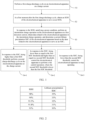
- a first aspect of some embodiments of this application provides an electrochemical apparatus management method including: S1: performing a first charge-discharge cycle on an electrochemical apparatus at a charge current; S2: at a first moment after the first charge-discharge cycle, obtaining an SOH of the electrochemical apparatus to serve as an SOH 1 ; S3: in response to the SOH 1 satisfying a preset condition, performing an intermittent charge operation on the electrochemical apparatus at a first detection current, obtaining data related to the electrochemical apparatus in the intermittent charge operation, and determining a current lithium precipitation SOC of the electrochemical apparatus based on the data related to the electrochemical apparatus to serve as an SOC 1 ; and S4-1: in response to the SOC 1 being higher than a first SOC threshold, performing a second charge-discharge cycle on the electrochemical apparatus at the charge current, S4-2: in response to the SOC 1 being lower than or equal to the first SOC threshold and higher than or equal to a second SOC threshold, controlling the electrochemical apparatus to perform a risk control operation
- the technical effects of some embodiments of this application are as follows.
- the SOH 1 of the electrochemical apparatus may be obtained at the first moment after the first charge-discharge cycle, and lithium precipitation detection analysis can be performed on the electrochemical apparatus when the SOH 1 satisfies the preset condition, thereby reducing the frequency of lithium precipitation detection.
- the intermittent charge operation is performed on the electrochemical apparatus, the data related to the electrochemical apparatus is obtained in the intermittent charge operation, the lithium precipitation SOC of the electrochemical apparatus is determined based on the related data to serve as an SOC 1 , and then based on the relationship between the SOC 1 and the first SOC threshold and second SOC threshold, the electrochemical apparatus is controlled to stop operating or the electrochemical apparatus is controlled to perform a risk control operation. This reduces the safety hazards caused when the electrochemical apparatus is still used after lithium precipitation, thereby improving the safety of the electrochemical apparatus during use.
- the in response to the SOH 1 satisfying a preset condition includes: in response to the SOH 1 not being higher than a first threshold.
- a first threshold when the SOH 1 is not higher than the first threshold, lithium precipitation detection analysis is performed on the electrochemical apparatus, reducing the frequency of lithium precipitation detection and improving the safety of the electrochemical apparatus during use.
- the method further includes: S5: at a second moment after step S4-1 or step S4-2 is executed, obtaining a current SOH of the electrochemical apparatus to serve as an SOH 2 ; and S6: in response to the SOH 2 being not higher than a second threshold, performing an intermittent charge operation on the electrochemical apparatus at a second detection current, obtaining data related to the electrochemical apparatus in the intermittent charge operation, and determining a current lithium precipitation SOC of the electrochemical apparatus based on the data related to the electrochemical apparatus to serve as an SOC 2 , where the second threshold is lower than the first threshold.
- the SOH 2 is used as a determining criterion for performing lithium precipitation detection analysis, reducing the frequency of lithium precipitation detection. Further, lithium precipitation detection analysis may be performed on the electrochemical apparatus throughout the entire life cycle of the electrochemical apparatus, thereby reducing the risk of lithium precipitation of the electrochemical apparatus throughout the entire life cycle.
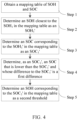
- the second threshold is determined in the following steps, including: obtaining a mapping table of SOH and SOC, where the mapping table includes multiple SOHs and multiple SOCs; determining an SOH in the mapping table that is closest to the SOH 1 as a parameter SOH 1 '; determining an SOC corresponding to the SOH 1 ' in the mapping table as an SOC 1 '; determining, as an SOC 2 ', an SOC that is lower than the SOC 1 ' and whose difference to the SOC 1 ' is a first difference; and determining an SOH corresponding to the SOC 2 ' in the mapping table as the second threshold.
- the second threshold for performing lithium precipitation detection analysis is determined through the mapping table, reducing the frequency of lithium precipitation detection.
- the method further includes: S7-1: in response to the SOC 2 being higher than the SOC 2 ', performing a third charge-discharge cycle on the electrochemical apparatus at the charge current; S7-2: in response to the SOC 2 being lower than or equal to the SOC 2 ' and higher than or equal to the second SOC threshold, controlling the electrochemical apparatus to perform a risk control operation; or S7-3: in response to the SOC 2 being lower than the second SOC threshold, controlling the electrochemical apparatus to stop operating.
- the intermittent charge operation is performed on the electrochemical apparatus, and based on the relationship between the SOH 2 and the SOC 2 ' and second SOC threshold, the electrochemical apparatus is controlled to stop operating or the electrochemical apparatus is controlled to perform a risk control operation. This reduces the safety hazards caused when the electrochemical apparatus is still used after lithium precipitation, thereby improving the safety of the electrochemical apparatus during use.
- the method further includes: at a third moment after step S7-1 or step S7-2 is executed, obtaining a current SOH of the electrochemical apparatus to serve as an SOH 3 ; and in response to the SOH 3 being not higher than a third threshold, performing an intermittent charge operation on the electrochemical apparatus at the detection current, where the third threshold is lower than the second threshold.
- the SOH 3 is used as a determining criterion for performing lithium precipitation detection analysis, reducing the frequency of lithium precipitation detection. Further, lithium precipitation detection analysis may be performed on the electrochemical apparatus throughout the entire life cycle of the electrochemical apparatus, thereby reducing the risk of lithium precipitation of the electrochemical apparatus throughout the entire life cycle.
- the third threshold is determined in the following steps, including: determining, as an SOC 3 ', an SOC that is lower than the SOC 2 ' and whose difference to the SOC 2 ' is a second difference, where the second difference is lower than the first difference; and determining an SOH corresponding to the SOC 3 ' in the mapping table as the third threshold.
- the second difference is lower than the first difference, and the frequency of determining the lithium precipitation SOC of the electrochemical apparatus can be appropriately increased as the use time of the electrochemical apparatus increases, thereby reducing the number of lithium precipitation detection analyses while the safety of the electrochemical apparatus during use is improved.
- the risk control operation includes at least one of: reducing a charge voltage of the electrochemical apparatus, reducing a charge current of the electrochemical apparatus, performing staged charge on the electrochemical apparatus, or generating risk prompt information.
- the electrochemical apparatus when the SOC 1 is lower than or equal to the first SOC threshold, the electrochemical apparatus is controlled to perform at least one of reducing a charge voltage of the electrochemical apparatus, reducing a charge current of the electrochemical apparatus, performing staged charge on the electrochemical apparatus, or generating risk prompt information, thereby reducing the safety hazards caused when the electrochemical apparatus is still used after lithium precipitation and improving the safety of the electrochemical apparatus during use.
- the electrochemical apparatus is a nickel-cobalt-manganese system electrochemical apparatus, and the second SOC threshold is higher than or equal to 10% and lower than or equal to 30%; the electrochemical apparatus is a lithium manganate system electrochemical apparatus, and the second SOC threshold is higher than or equal to 20% and lower than or equal to 40%; or the electrochemical apparatus is a lithium iron phosphate system electrochemical apparatus, and the second SOC threshold is higher than or equal to 10% and lower than or equal to 40%.
- different second SOC thresholds are provided for electrochemical apparatuses of different systems, and therefore, times to stop operating can be more accurately determined for the electrochemical apparatuses of different systems, thereby improving the safety of the electrochemical apparatuses of different systems during use.
- the data related to the electrochemical apparatus includes an SOC of the electrochemical apparatus and an internal resistance of the electrochemical apparatus
- the intermittent charge operation includes multiple charge periods and multiple interruption periods
- the step of obtaining data related to the electrochemical apparatus in the intermittent charge operation, and determining the SOC 1 based on the data related to the electrochemical apparatus includes: in the intermittent charge operation, for each of the multiple interruption periods, obtaining an SOC of the electrochemical apparatus and an internal resistance of the electrochemical apparatus that are corresponding to the interruption period, and obtaining a first curve based on the obtained multiple SOCs of the electrochemical apparatus and the multiple internal resistances of the electrochemical apparatus corresponding to the multiple SOCs, where the first curve is a corresponding mapping curve between the SOCs and internal resistances of the electrochemical apparatus; and determining the SOC 1 based on the first curve.
- the step of determining the SOC 1 based on the first curve includes at least one of method 1 or method 2, where method 1 includes: performing a first-order differential on the first curve to obtain a second curve, and determining, as the SOC 1 , an SOC corresponding to a point at which the second curve first has a negative slope; and method 2 includes: performing a first-order differential on the first curve to obtain a second curve, performing a second-order differential on the second curve to obtain a third curve, and determining, as the SOC 1 , an SOC corresponding to a point at which the third curve first has a vertical coordinate less than zero.
- the intermittent charge operation includes multiple charge periods, each charge cycle includes a charge period and an interruption period, and in each charge cycle, SOC of the electrochemical apparatus increases by a unit amplitude.
- the lithium precipitation SOC of the electrochemical apparatus can be determined based on the intermittent charge operation, reducing the risk of lithium precipitation of the electrochemical apparatus.
- the electrochemical apparatus includes at least one of lithium iron phosphate system electrochemical apparatus, lithium nickel manganese cobalt system electrochemical apparatus, or lithium cobalt oxide system electrochemical apparatus, where in a case that the electrochemical apparatus is a lithium iron phosphate system electrochemical apparatus, the unit amplitude ranges from 0.5% to 10%, and a duration of the interruption period ranges from 1 second to 15 seconds; in a case that the electrochemical apparatus is a lithium nickel manganese cobalt system electrochemical apparatus, the unit amplitude ranges from 0.5% to 10%, and a duration of the interruption period ranges from 1 second to 30 seconds; or in a case that the electrochemical apparatus is a lithium cobalt oxide system electrochemical apparatus, the unit amplitude ranges from 0.5% to 10%, and a duration of the interruption period ranges from 1 second to 30 seconds.
- a more targeted intermittent charge operation can be performed on the electrochemical apparatuses of different systems, so that a more accurate lithium precipitation SOC
- the method satisfies any one of conditions (a) to (f): (a) in a case that the electrochemical apparatus is a lithium iron phosphate system electrochemical apparatus and the electrochemical apparatus is at an ambient temperature of -10°C to 10°C, the unit amplitude ranges from 0.5% to 10%, and a duration of the interruption period ranges from 5 seconds to 15 seconds; (b) in a case that the electrochemical apparatus is a lithium iron phosphate system electrochemical apparatus and the electrochemical apparatus is at an ambient temperature of 10°C to 45°C, the unit amplitude ranges from 0.5% to 10%, and a duration of the interruption period ranges from 1 second to 10 seconds; (c) in a case that the electrochemical apparatus is a lithium nickel manganese cobalt system electrochemical apparatus and the electrochemical apparatus is at an ambient temperature of -10°C to 10°C, the unit amplitude ranges from 0.5% to 10%, and a duration of the interruption period ranges from 10 seconds to 30 seconds; (a) in a case that the electrochemical
- a second aspect of some embodiments of this application provides a system including a processor and a machine-readable storage medium, where the machine-readable storage medium stores a machine-executable instruction capable of being executed by the processor, and when the processor executes the machine-executable instruction, the method according to any one of the foregoing aspects is implemented.
- a third aspect of some embodiments of this application provides an electrochemical apparatus.
- the electrochemical apparatus includes the system according to the third aspect.
- a fourth aspect of some embodiments of this application provides an electronic device.
- the electronic device includes the electrochemical apparatus according to the fourth aspect.
- a fifth aspect of some embodiments of this application provides a computer-readable storage medium.
- the computer-readable storage medium stores a computer program, and when the computer program is run by a processor, the method according to any one of the foregoing aspects is implemented.
- Some embodiments of this application provide an electrochemical apparatus management method, a system, an electrochemical apparatus, and an electronic device.
- Lithium precipitation detection analysis can be performed on the electrochemical apparatus when the SOH 1 of the electrochemical apparatus is obtained at the first moment after the first charge-discharge cycle and when the SOH 1 satisfies the preset condition, thereby reducing the frequency of lithium precipitation detection.
- the intermittent charge operation is performed on the electrochemical apparatus, the data related to the electrochemical apparatus is obtained in the intermittent charge operation, the lithium precipitation SOC of the electrochemical apparatus is determined based on the related data to serve as an SOC 1 , and then based on the relationship between the SOC 1 and the first SOC threshold and second SOC threshold, the electrochemical apparatus is controlled to stop operating or the electrochemical apparatus is controlled to perform a risk control operation.
- a lithium-ion battery is used as an example of an electrochemical apparatus to explain this application.
- the electrochemical apparatus of this application is not limited to the lithium-ion battery.
- Some embodiments of this application provide an electrochemical apparatus management method. As shown in FIG. 1 , the method includes the following steps.
- S1 Perform a first charge-discharge cycle on an electrochemical apparatus at a charge current.
- Some embodiments of this application may be executed by a battery management system.
- the battery management system can manage the electrochemical apparatus, such as managing the charge and discharge processes of the electrochemical apparatus.
- the battery management system can control the charge current during the charge-discharge cycle process of the electrochemical apparatus.
- a charge and discharge apparatus in the battery management system performs a charge-discharge cycle on the electrochemical apparatus at a charge current.
- the charge-discharge cycle in some embodiments of this application can refer to a cycle of charge, discharge, and charge of the electrochemical apparatus during operation.
- the electrochemical apparatus may be charged at the charge current in the charge stage thereof.
- the discharge current in the charge-discharge cycle may be adapted depending on electric device. This is not limited in some embodiments of this application.
- the structure of the charge and discharge apparatus is not particularly limited in some embodiments of this application, for example, including a charge and discharge circuit well known in the art. This is not limited in some embodiments of this application.
- the charge current is not particularly limited in some embodiments of this application. For example, it may be any current between 0.1A and 3A, such as 0.1A, 0.2A, 0.3A, 0.5A, 0.7A, 1A, 1.5A, 2A, 2.5A, or 3A.
- the first moment may be a moment when the first charge-discharge cycle ends, and the SOH (State Of Health, state of health) of the electrochemical apparatus may be a capacity retention rate, battery capacity, performance status, or the like of the electrochemical apparatus.
- the SOH of the electrochemical apparatus may be read in real time by using an SOH reading algorithm.
- S3 In response to the SOH 1 satisfying a preset condition, perform an intermittent charge operation on the electrochemical apparatus at a first detection current, obtain data related to the electrochemical apparatus in the intermittent charge operation, and determine a current lithium precipitation SOC of the electrochemical apparatus based on the data related to the electrochemical apparatus to serve as an SOC 1 .
- the preset condition may be determined depending on actual application scenarios and requirements.
- the SOH 1 when the SOH 1 is not higher than the first threshold, that is, when SOH 1 is lower than or equal to the first threshold, it may be considered that the SOH 1 satisfies the preset condition.
- the first threshold may be set depending on demands or a threshold set in advance.
- the first threshold may be stored in advance in a storage medium connected to the electrochemical apparatus.
- the SOH is a capacity retention rate
- the first threshold may be between 95-100%, such as 98%. In this case, when the SOH 1 is not higher than 98%, the electrochemical apparatus is charged with the first detection current in the intermittent charge operation.
- the intermittent charge operation may refer to a process of intermittently charging the electrochemical apparatus.
- the lithium precipitation SOC (State Of Charge, state of charge) may refer to an SOC related to a lithium precipitation state of the electrochemical apparatus.
- a lithium precipitation SOC analysis apparatus 902 in the battery management system can perform the intermittent charge operation on the electrochemical apparatus.
- the lithium precipitation SOC analysis apparatus is not particularly limited in some embodiments of this application, as long as the intermittent charge operation can be implemented.
- the lithium precipitation SOC analysis apparatus 902 may be a controller unit (Microcontroller Unit, MCU) in the battery management system (Battery Management System, BMS) board.
- MCU Microcontroller Unit
- BMS Battery Management System
- the lithium precipitation SOC analysis apparatus 902 obtains the SOH 1 at the first moment after the first charge-discharge cycle ends, and in response to SOH 1 satisfying the preset condition, performs the intermittent charge operation on the electrochemical apparatus at the first detection current, performs lithium precipitation detection analysis on the electrochemical apparatus during the intermittent charge operation, obtains the data related to the electrochemical apparatus in the intermittent charge operation, and determines, as the SOC 1 , the lithium precipitation SOC of the electrochemical apparatus based on the data related to the electrochemical apparatus.
- the operations in the foregoing process are for the purpose of description only.
- the data related to the electrochemical apparatus may refer to data that can reflect the status of the electrochemical apparatus, including but not limited to data such as charge voltage, charge current, internal resistance, and SOC of the electrochemical apparatus.
- the charge method in the intermittent charge operation is not particularly limited in some embodiments of this application, as long as the purpose of some embodiments of this application can be achieved.
- the charge may be constant voltage charge, constant current charge, constant current and constant voltage charge, or staged constant current charge.
- S4-1 In response to the SOC 1 being higher than a first SOC threshold, perform a second charge-discharge cycle on the electrochemical apparatus at the charge current.
- the first SOC threshold may be an SOC that has a mapping relationship with the SOH 1 in the mapping table of SOH and SOC.
- FIG. 2 shows a mapping table of SOH and SOC according to an embodiment of this application. The mapping table may be obtained by measuring the electrochemical apparatus under experimental conditions in advance. If the SOH 1 is 98%, the first SOC threshold is 39%.
- the electrochemical apparatus is subjected to cyclic charge and discharge at a specified charge current and charge voltage by using a cyclic method including constant current constant voltage continuous cycling or constant current constant voltage conditional cycling, to measure lithium precipitation SOCs mapped to different SOHs, so as to obtain the mapping table of SOH and SOC.
- the mapping table of SOH and SOC corresponding to a current temperature of the electrochemical apparatus may be determined first, and then based on the mapping table of SOH and SOC, the SOC mapped to the SOH 1 is determined as the first SOC threshold.
- mapping table of SOH and SOC may take the form of table, take the form of function relationship, or take the form of algorithm model, as long as an SOH-SOC mapping can be represented.
- the first SOC threshold may be higher than the lithium precipitation SOC at which the electrochemical apparatus has a risk of catching fire.
- the second charge-discharge cycle may be performed on the electrochemical apparatus at the charge current to make the electrochemical apparatus maintain operating. This alleviates the "false killing" problem that the electrochemical apparatus is discarded before its service life is reached.
- the lithium precipitation SOC analysis apparatus 902 performs lithium precipitation detection analysis on the electrochemical apparatus during the intermittent charge operation, and when the SOC 1 is higher than the first SOC threshold, sends a first signal to the charge and discharge apparatus 901. After receiving the first signal, the charge and discharge apparatus 901 performs the second charge-discharge cycle on the electrochemical apparatus at the charge current.
- the number of second charge-discharge cycles may be smaller than or equal to the number of first charge-discharge cycles. This is because as the cycling of the electrochemical apparatus continues, a lithium precipitation window thereof gradually narrows, that is, lithium precipitation is more likely to occur. Therefore, the number of second charge-discharge cycles is set to be smaller than the number of first charge-discharge cycles, so that after the number of second charge-discharge cycles, whether lithium precipitation detection analysis is required on the electrochemical apparatus can be determined again.
- the number of first charge-discharge cycles may be 1 to 500, and the number of second charge-discharge cycles may be 1 to 100.
- the operations of the process shown above are for illustrative purposes only.
- the apparatuses and modules in the battery management system examples in some embodiments of this application are only for illustrative purposes rather than restrictive purposes.
- S4-2 In response to the SOC 1 being lower than or equal to the first SOC threshold and higher than or equal to a second SOC threshold, control the electrochemical apparatus to perform a risk control operation, where the second SOC threshold is lower than the first SOC threshold.
- the second SOC threshold may be a lithium precipitation SOC at which the battery cell inside the electrochemical apparatus will catch fire if it is still used.
- the second SOC threshold is higher than or equal to 10% and lower than or equal to 30%; when the electrochemical apparatus is a lithium manganate system electrochemical apparatus, the second SOC threshold is higher than or equal to 20% and lower than or equal to 40%; or when the electrochemical apparatus is a lithium iron phosphate system electrochemical apparatus, the second SOC threshold is higher than or equal to 10% and lower than or equal to 40%.
- the second SOC threshold is lower than the first SOC threshold.
- the SOC 1 When the SOC 1 is lower than or equal to the first SOC threshold and higher than or equal to the second SOC threshold, it indicates that the electrochemical apparatus has a low risk of lithium precipitation and therefore can still be used. In this case, the risk in continual use of the electrochemical apparatus can be reduced by performing a risk control operation.
- the risk control operation includes an operation that can reduce the safety risk of the battery.
- the risk can be reduced by adjusting the charge current, charge voltage, charge mode, and the like of the electrochemical apparatus.
- the charge mode includes a combination of one or more constant current charge, constant voltage charge, direct current charge, and alternating current charge.
- Example charge modes include constant current-constant voltage charge and multi-stage constant current-constant voltage charge.
- the constant current-constant voltage charge includes at least one constant current-constant voltage charge stage. Charge and discharge parameters of multiple constant current-constant voltage charge stages can be set to the same or different, and are not limited herein.
- the multi-stage constant current-constant voltage charge includes multiple consecutive constant current charge stages and one constant voltage charge stage. Charge and discharge parameters of the multiple constant current charge stages can be set to the same or different, and are not limited herein.
- the lithium precipitation SOC analysis apparatus 902 performs the intermittent charge operation on the electrochemical apparatus, performs lithium precipitation detection analysis during the intermittent charge operation, and when the SOC 1 is lower than or equal to the first SOC threshold and higher than or equal to the second SOC threshold, sends a second signal to a protection apparatus 903. After receiving the second signal, the protection apparatus 903 can perform a risk control operation.
- the risk control operation includes at least one of: reducing a charge voltage of the electrochemical apparatus, reducing a charge current of the electrochemical apparatus, performing staged charge on the electrochemical apparatus, or generating risk prompt information.
- the staged charge includes multiple charge stages. At least two of the multiple charge stages have different charge parameters or charge modes. For example, in different charge stages of the electrochemical apparatus, currents or voltages of different magnitudes or different charge modes may be used to charge the electrochemical apparatus.
- the generating risk prompt information may include generating reminders to replace the electrochemical apparatus, perform maintenance on the electrochemical apparatus, replace the charge method of the electrochemical apparatus, and the like.
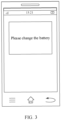
- FIG. 3 is a schematic diagram of risk prompt information according to the embodiments of this application.
- a user is reminded to replace the electrochemical apparatus through the text "Please change the battery".
- the risk prompt information may also take other forms such as videos, pictures, or audios. This is not specifically limited in the embodiments of this application.
- the risk prompt information may be provided in any interactive manner such as text message, application message, email, or phone call.
- the risk prompt information in FIG. 3 may be displayed through an application program.
- Controlling the electrochemical apparatus to perform the risk control operation can reduce the risk of lithium precipitation caused by continual use of the electrochemical apparatus, thereby improving the use safety of the electrochemical apparatus.
- the operations of the process shown above are for illustrative purposes only.
- the apparatuses and modules in the electronic device examples in some embodiments of this application are only for illustrative purposes rather than restrictive purposes.
- the electrochemical apparatus can be disconnected to stop the electrochemical apparatus from working, reduce the risk of lithium precipitation in the electrochemical apparatus caused by continued operation, and improve the use safety of the electrochemical apparatus.
- the lithium precipitation SOC analysis apparatus 902 performs lithium precipitation detection analysis during the intermittent charge operation, and sends a third signal to the protection apparatus 903 when the lithium precipitation SOC 1 is lower than the second SOC threshold. After receiving the third signal, the protection apparatus 903 disconnects the electrical connection to the electrochemical apparatus so as to stop the electrochemical apparatus from operation.
- the operations of the process shown above are for illustrative purposes only.
- the apparatuses and modules in the battery management system examples in some embodiments of this application are only for illustrative purposes rather than restrictive purposes.
- Lithium precipitation detection analysis can be performed on the electrochemical apparatus when the SOH 1 of the electrochemical apparatus is obtained at the first moment after the first charge-discharge cycle and when the SOH 1 satisfies the preset condition, thereby reducing the frequency of lithium precipitation detection.
- the intermittent charge operation is performed on the electrochemical apparatus, the data related to the electrochemical apparatus is obtained in the intermittent charge operation, the lithium precipitation SOC of the electrochemical apparatus is determined based on the related data to serve as an SOC 1 , and then based on the relationship between the SOC 1 and the first SOC threshold and second SOC threshold, the electrochemical apparatus is controlled to stop operating or the electrochemical apparatus is controlled to perform a risk control operation.
- an electrochemical apparatus management method is further provided and includes the following steps.
- step S5 At a second moment after step S4-1 or step S4-2 is executed, obtain a current SOH of the electrochemical apparatus to serve as an SOH 2 .
- step S4-1 or step S4-2 the current SOH of the electrochemical apparatus may be obtained to serve as the SOH 2 .
- S6 In response to the SOH 2 being not higher than a second threshold, perform an intermittent charge operation on the electrochemical apparatus at a second detection current, obtain data related to the electrochemical apparatus in the intermittent charge operation, and determine a current lithium precipitation SOC of the electrochemical apparatus based on the data related to the electrochemical apparatus to serve as an SOC 2 , where the second threshold is lower than the first threshold.
- FIG. 4 is a schematic flowchart of determining a second threshold, which includes the following steps.
- Step 1 Obtain a mapping table of SOH and SOC.
- the mapping table includes multiple SOHs and multiple SOCs. As mentioned above, the mapping table of SOH and SOC may be obtained in advance through measurement. In addition, the mapping table of SOH and SOC may be stored in a storage medium of the electrochemical apparatus in advance. Every time after a charge-discharge cycle, the mapping table may be read from the storage medium.
- mapping table of SOH and SOC corresponding to a current temperature of the electrochemical apparatus may be obtained.
- Step 2 Determine an SOH closest to the SOH 1 in the mapping table as an SOH 1 '.
- mapping table shown in FIG. 2 if the SOH 1 is 100%, the SOH closest to the SOH 1 is 98%, and the SOH 1 ' is 98%.
- Step 3 Determine an SOC corresponding to the SOH 1 ' in the mapping table as an SOC 1 '.
- the SOC corresponding to the SOH 1 ' in the mapping table can be further determined as the SOC 1 '.
- the SOC 1 ' is determined to be 39%.
- Step 4 Determine, as an SOC 2 ', an SOC that is lower than the SOC 1 ' and whose difference to the SOC 1 ' is a first difference.
- the first difference may be determined depending on needs.
- the first difference is higher than or equal to 5%.
- the SOC 1 ' is 39%
- the SOC 2 ' may be 33%.
- Step 5 Determine an SOH corresponding to the SOC 2 ' in the mapping table as a second threshold.
- an SOH corresponding to the SOC 2 ' in the mapping table can be further determined as the second threshold.
- the SOC 2 ' is 33%
- the SOC corresponding to SOC 2 ' is 94%
- the second threshold is determined to be 94%.
- lithium precipitation risk detection may be performed on the electrochemical apparatus.
- an intermittent charge operation is performed on the electrochemical apparatus at a second detection current, data related to the electrochemical apparatus is obtained in the intermittent charge operation, and a current lithium precipitation SOC of the electrochemical apparatus is determined based on the data related to the electrochemical apparatus to serve as an SOC 2 .
- an electrochemical apparatus management method is further provided and includes the following steps.
- S7-1 In response to the SOC 2 being higher than the SOC 2 ', perform a third charge-discharge cycle on the electrochemical apparatus at the charge current.
- the third charge-discharge cycle may be performed on the electrochemical apparatus at the charge current to make the electrochemical apparatus maintain operating. This alleviates the "false killing" problem that the electrochemical apparatus is discarded before its service life is reached.
- the lithium precipitation SOC analysis apparatus 902 performs lithium precipitation detection analysis on the electrochemical apparatus during the intermittent charge operation, and when the SOC 2 is higher than the SOC 2 ', sends a fourth signal to the charge and discharge apparatus 901. After receiving the fourth signal, the charge and discharge apparatus 901 performs the third charge-discharge cycle on the electrochemical apparatus at the charge current.
- the number of third charge-discharge cycles may be smaller than or equal to the number of second charge-discharge cycles. This is because as the cycling of the electrochemical apparatus continues, a lithium precipitation window thereof gradually narrows, that is, lithium precipitation is more likely to occur. Therefore, the number of third charge-discharge cycles is set to be smaller than the number of second charge-discharge cycles, so that after the number of third charge-discharge cycles is reached, whether lithium precipitation detection analysis is required on the electrochemical apparatus can be determined again.
- S7-2 In response to the SOC 2 being lower than or equal to the SOC 2 ' and higher than or equal to the second SOC threshold, control the electrochemical apparatus to perform a risk control operation.
- the SOC 2 When the SOC 2 is lower than or equal to the SOC 2 ' and higher than or equal to the second SOC threshold, it indicates that the electrochemical apparatus has a low risk of lithium precipitation and therefore can still be used. In this case, the risk in continual use of the electrochemical apparatus can be reduced by performing a risk control operation.
- the lithium precipitation SOC analysis apparatus 902 performs lithium precipitation detection analysis during the intermittent charge operation, and when the SOC 2 is lower than or equal to the SOC 2 ' and higher than or equal to the second SOC threshold, sends a fifth signal to a protection apparatus 903. After receiving the fifth signal, the protection apparatus 903 can perform a risk control operation.
- the electrochemical apparatus can be disconnected to stop the electrochemical apparatus from working, reduce the risk of lithium precipitation in the electrochemical apparatus caused by continued operation, and improve the use safety of the electrochemical apparatus.
- the lithium precipitation SOC analysis apparatus 902 performs lithium precipitation detection analysis during the intermittent charge operation, and sends a sixth signal to the protection apparatus 903 when the SOC 2 is lower than the second SOC threshold. After receiving the sixth signal, the protection apparatus 903 disconnects the electrical connection to the electrochemical apparatus so as to stop the electrochemical apparatus from operation.
- the operations of the process shown above are for illustrative purposes only.
- the apparatuses and modules in the battery management system examples in some embodiments of this application are only for illustrative purposes rather than restrictive purposes.
- a current SOH of the electrochemical apparatus is obtained to serve as an SOH 3 ; and in response to the SOH 3 being not higher than a third threshold, an intermittent charge operation is performed on the electrochemical apparatus at the detection current, where the third threshold is lower than the second threshold.
- the third threshold is determined in the following step including: determining, as an SOC 3 ', an SOC that is lower than the SOC 2 ' and whose difference to the SOC 2 ' is a second difference, where the second difference is lower than the first difference; and determining an SOH corresponding to the SOC 3 ' in the mapping table as the third threshold.
- the second difference is lower than 5%, such as 1%.
- the SOC 2 ' is 33%
- the SOC 3 ' is 32%
- the SOH corresponding to 32% in the mapping table is 93.5%. That is, the third threshold is 93.5%.
- lithium precipitation detection analysis needs to be performed on the electrochemical apparatus may be further determined based on the third threshold, so as to monitor the electrochemical apparatus throughout the full life cycle thereof, thereby improving the safety of the electrochemical apparatus throughout the entire life cycle.
- an embodiment of this application further provides an electrochemical apparatus management method including the following steps.
- the electrochemical apparatus is subjected to the first charge-discharge cycle. After the first charge-discharge cycle ends, the current SOH of the electrochemical apparatus is obtained to serve as the SOH 1 .
- Whether the SOH 1 meets the preset condition is determined. If not, X charge-discharge cycles are performed on the electrochemical apparatus. After the electrochemical apparatus has undergone X cycles, the SOH 1 of the electrochemical apparatus is obtained again until the SOH 1 of the electrochemical apparatus meets the preset condition.
- the intermittent charge operation may be performed on the electrochemical apparatus to obtain the current lithium precipitation SOC of the electrochemical apparatus to serve as the SOC 1 , and then the SOC 1 is compared with the first SOC threshold and the second SOC threshold.
- the SOC 1 is higher than the first SOC threshold, it indicates that the chemical apparatus currently has no lithium precipitation and may be used normally. In this case, the electrochemical apparatus enters the normal use procedure.
- the electrochemical apparatus If the SOC 1 is lower than or equal to the first SOC threshold and the SOC 1 is higher than or equal to the second SOC threshold, it indicates that the electrochemical apparatus has lithium precipitation or has a risk of lithium precipitation, but can still be used. In this case, the electrochemical apparatus enters the risk control procedure.
- the electrochemical apparatus is controlled to stop operation.
- the electrochemical apparatus When the SOC 1 is higher than the first SOC threshold, the electrochemical apparatus enters the normal use procedure.
- the electrochemical apparatus is subjected to the (i+1)-th charge-discharge cycle, where i is an integer greater than 0. Optionally, i starts from 1.
- Whether the SOH i+1 is not higher than an SOH i+1 ' is determined. If not, Y charge-discharge cycles are performed on the electrochemical apparatus. After the electrochemical apparatus has undergone Y cycles, the SOH i+1 of the electrochemical apparatus is obtained again until the SOH i+1 of the electrochemical apparatus is not higher than the SOH i+1 '.
- the intermittent charge operation may be performed on the electrochemical apparatus to obtain the current lithium precipitation SOC of the electrochemical apparatus to serve as the SOC i+1 , and then the SOC i+1 is compared with the SOC i+1 ' and the second SOC threshold.
- the electrochemical apparatus If the SOC i+1 is lower than or equal to the SOC i+1 ' and the SOC i+1 is higher than or equal to the second SOC threshold, it indicates that the electrochemical apparatus has lithium precipitation or has a risk of lithium precipitation, but can still be used. In this case, the electrochemical apparatus enters the next risk control procedure.
- the electrochemical apparatus is controlled to stop operation.
- the risk control procedure is executed to perform at least one of reducing the charge voltage of the electrochemical apparatus, reducing the charge current of the electrochemical apparatus, performing staged charge on the electrochemical apparatus, or generating risk prompt information. Reducing the current is used as an example below. After each entry into the risk control procedure, the charge current of the electrochemical apparatus is reduced, with a previous charge current as a base.
- the risk control operation is performed first, and Y charge-discharge cycles are performed after the risk control operation.
- the current SOH of the electrochemical apparatus is obtained to serve as the SOH i+1 .
- Whether the SOH i+1 is not higher than an SOH i+1 ' is determined. If not, Y charge-discharge cycles are performed on the electrochemical apparatus. After the electrochemical apparatus has undergone Y cycles, the SOH i+1 of the electrochemical apparatus is obtained again until the SOH i+1 of the electrochemical apparatus is not higher than the SOH i+1 '.
- the intermittent charge operation may be performed on the electrochemical apparatus to obtain the current lithium precipitation SOC of the electrochemical apparatus to serve as the SOC i+1 , and then the SOC i+1 is compared with the SOC i+1 ' and the second SOC threshold.
- the electrochemical apparatus If the SOC i+1 is lower than or equal to the SOC i+1 ' and the SOC i+1 is higher than or equal to the second SOC threshold, it indicates that the electrochemical apparatus has lithium precipitation or has a risk of lithium precipitation, but can still be used. In this case, the electrochemical apparatus enters the next risk control procedure.
- the electrochemical apparatus is controlled to stop operation.
- determining an (i+2)-th threshold based on the SOC i+1 ' includes the following steps: determining, as an SOCi+2', an SOC that is lower than SOC i+1 " and whose difference to the SOC i+1 ' is the second difference; and determining an SOH corresponding to the SOCi+2' in the mapping table as the (i+2)-th threshold.
- an SOC that is lower than the SOC 2 ' and whose difference to the SOC 2 ' is the second difference is determined as the SOC 3 ', where the second difference is lower than the first difference; and an SOH corresponding to the SOC 3 ' in the mapping table is determined as the third threshold.
- the intermittent charge operation may refer to a process of intermittently charging the electrochemical apparatus.
- the intermittent charge operation includes multiple charge periods and multiple interruption periods.
- the SOC 1 is determined in the following manner.
- Step A In the intermittent charge operation, for each of the multiple interruption periods, obtain an SOC of the electrochemical apparatus and an internal resistance of the electrochemical apparatus that are corresponding to the interruption period.
- Step B Obtain a first curve based on the obtained multiple SOCs of the electrochemical apparatus and the multiple internal resistances of the electrochemical apparatus corresponding to the multiple SOCs.
- multiple data pairs composed of the SOCs and internal resistances may be obtained.
- SOCs of the electrochemical apparatus may be used as horizontal coordinates
- internal resistances of the electrochemical apparatus may be used as vertical coordinates. Points represented by these data pairs are filled in the coordinate system, and fitting is performed to obtain the first curve.
- the first curve is a corresponding mapping curve between to the SOCs and internal resistances of the electrochemical apparatus.
- Step C Determine the SOC 1 based on the first curve.
- the first curve is a curve showing mappings of the SOCs and internal resistances of the electrochemical apparatus, and the SOC 1 may be determined based on the first curve.
- the lithium precipitation SOC may not be measured in real time, but is obtained by using a charge voltage obtained during the intermittent charge operation and the correspondence table of charge voltage and SOC.
- the correspondence table may be stored in advance in the battery management system, electrochemical apparatus, or storage medium of the electronic device.
- the process of determining the SOC 1 based on the first curve may be method 1.
- Method 1 includes the following steps.
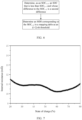
- the second curve represents the change rate of internal resistance with respect to SOC.
- the change rate does not show an abnormal drop in a flat region of the curve, it indicates that no active lithium is precipitated.
- the change rate shows an abnormal drop in the flat region of the curve, since the active lithium is precipitated on the surface of the negative electrode and comes into contact with the negative electrode, which is equivalent to a graphite part of the negative electrode being connected in parallel with a lithium metal device, reducing the impedance of the entire negative electrode.
- the impedance of the electrochemical apparatus abnormally decreases when active lithium is precipitated, and correspondingly, the abnormal decrease occurs in the in flat region of the second curve.
- point B is the first point in the second curve at which the slope is negative.
- an abnormal decrease occurs in the flat region of the second curve for the first time, indicating that the electrochemical apparatus has a tendency to precipitate lithium at point B or has already precipitated lithium.
- the SOC corresponding to point B can be determined as the SOC 1 , so that based on a magnitude relationship between the lithium precipitation SOC and the SOC threshold, the electrochemical apparatus can be protected in a timely manner to improve the use safety of the electrochemical apparatus.
- the steps a to c are only used to describe the order of the steps, but not to limit the order of the steps.
- Method 2 includes:
- the SOC corresponding to the point at which the third curve first has a vertical coordinate less than zero is determined as the SOC 1 .
- the intermittent charge operation in some embodiments of this application includes multiple charge cycles, and each charge cycle includes one charge period and one interruption period.
- a first charge period and a first interruption period form the first charge cycle
- a second charge period and a second interruption period form the second charge cycle
- a third charge period and a third interruption period form the third charge cycle, and so on. It can be understood that a charge cycle is a continuous period of time.
- the electrochemical apparatus is charged during the first charge period, and then the charge is stopped. After the first interruption period elapses, the electrochemical apparatus is continued to be charged in the second charge period. This is repeated until the SOC of the electrochemical apparatus reaches a first critical value. It can be understood that as intermittent charge continues, the SOC of the electrochemical apparatus increases. In some embodiments of this application, the intermittent charge may be stopped when the SOC of the electrochemical apparatus reaches the first critical value, and the intermittent charge operation is completed.
- the first critical value is not particularly limited in some embodiments of this application, as long as the purpose of this application can be achieved. For example, the first critical value may be 60%, 70%, 80%, 90%, or 100%.
- unit amplitudes of SOCs corresponding to different charge cycles may be different.
- the electrochemical apparatus is charged in the first charge period, and after the SOC of the electrochemical apparatus increases by 1%, the charge is stopped. After an interval of 5 seconds, the electrochemical apparatus is charged during the second charge period, and after the SOC of the electrochemical apparatus increases by 5%, the charge is stopped. After an interval of 5 seconds, the electrochemical apparatus is charged during the third charge period, and after the SOC of the electrochemical apparatus increases by 3%, the charge is stopped. This is repeated until the SOC of the electrochemical apparatus reaches the first threshold.
- the intermittent charge operation may be specifically as follows: for any one of multiple charge cycles, the electrochemical apparatus is charged at the first moment until the SOC of the electrochemical apparatus increases by the unit amplitude. Before the third moment, the moment when the charge is stopped is the second moment, and a time interval between the third moment and the second moment is the duration of the interruption period. During the interruption period, the electrochemical apparatus may be in a state of neither being charged nor being discharged, that is, a static state.
- the electrochemical apparatus is charged until the SOC of the electrochemical apparatus increases by the unit amplitude.
- the moment when the charge is stopped is a moment T2.
- the electrochemical apparatus is left standing, and a standing end moment is a moment T3.
- the data related to the electrochemical apparatus can be obtained in the intermittent charge operation by performing the intermittent charge operation on the electrochemical apparatus, and the SOC 1 is determined based on the data, so as to execute the step of charging the electrochemical apparatus at an original charge current or reduced current. This helps to reduce the risk of lithium precipitation of the electrochemical apparatus and prolong the service life of the electrochemical apparatus.
- the electrochemical apparatus includes at least one of lithium iron phosphate system electrochemical apparatus, lithium nickel manganese cobalt system electrochemical apparatus, or lithium cobalt oxide system electrochemical apparatus.
- electrochemical apparatuses of different systems correspond to different unit amplitudes and different interruption period durations. Hence, there are the following cases.
- the unit amplitude ranges from 0.5% to 10%, and a duration of the interruption period cycle ranges from 1 second to 15 seconds.
- the unit amplitude ranges from 0.5% to 10%, and a duration of the interruption period ranges from 1 second to 30 seconds.
- the unit amplitude ranges from 0.5% to 10%, and a duration of the interruption period ranges from 1 second to 30 seconds.
- a more targeted intermittent charge operation can be performed on the electrochemical apparatuses of different systems, so that a more accurate SOC 1 can be obtained for different systems.
- electrochemical apparatuses of a same system correspond to different unit amplitudes and different interruption period durations under different temperatures. Hence, there are the following cases.
- the unit amplitude ranges from 0.5% to 10%, and a duration of the interruption period ranges from 5 seconds to 15 seconds.
- the unit amplitude ranges from 0.5% to 10%, and a duration of the interruption period ranges from 1 second to 10 seconds.
- the positive electrode of the lithium iron phosphate system electrochemical apparatus may further include other positive electrode active materials, but lithium iron phosphate is the main material.
- the lithium iron phosphate accounts for any one of 51%, 60%, 70%, 80%, 90%, and 98% of the total mass of the positive electrode active material.
- the unit amplitude ranges from 0.5% to 10%, and a duration of the interruption period ranges from 10 seconds to 30 seconds.
- the unit amplitude ranges from 0.5% to 10%, and a duration of the interruption period ranges from 1 second to 10 seconds.
- the positive electrode of the lithium nickel manganese cobalt system electrochemical apparatus may further include other positive electrode active materials, but lithium nickel manganese cobalt is the main material.
- the lithium nickel manganese cobalt accounts for any one of 51%, 60%, 70%, 80%, 90%, and 98% of the total mass of the positive electrode active material.
- the unit amplitude ranges from 0.5% to 10%, and a duration of the interruption period ranges from 15 seconds to 30 seconds.
- the unit amplitude ranges from 0.5% to 10%, and a duration of the interruption period ranges from 1 second to 10 seconds.
- the positive electrode of the lithium cobalt oxide system electrochemical apparatus may further include other positive electrode active materials, but lithium cobalt is the main material.
- the lithium cobalt accounts for any one of 51%, 60%, 70%, 80%, 90%, and 98% of the total mass of the positive electrode active material.
- a more targeted intermittent charge operation can be performed on the electrochemical apparatuses in different temperature environments, so that a more accurate SOC 1 can be obtained for different systems.
- the SOC threshold can refer to an SOC corresponding to lithium precipitation of the electrochemical apparatus, and is usually related to the system of the electrochemical apparatus.
- the SOC threshold in some embodiments of this application may be set depending on actual needs.
- the SOC threshold may vary with characteristics of electrochemical apparatuses of different systems.
- the SOC threshold ranges from 30% to 70%, such as 30%, 40%, 50%, 60%, or 70%; when the electrochemical apparatus is a lithium nickel manganese cobalt system electrochemical apparatus, the SOC threshold ranges from 20% to 50%, such as 20%, 30%, 40%, or 50%; and when the electrochemical apparatus is a lithium cobalt oxide system electrochemical apparatus, the SOC threshold ranges from 20% to 50%, such as 20%, 30%, 40%, or 50%.
- the management strategies of electrochemical apparatuses of different systems can be optimized in a more targeted manner, and the safe service life of electrochemical apparatuses of different systems can be prolonged.
- the steps of generating the first curve includes the following steps.
- Step a Obtain a first voltage, first current, and first SOC of the electrochemical apparatus at the second moment, and a second voltage and second current of the electrochemical apparatus at the third moment.
- the second moment is a moment when the charge is stopped.
- the voltage, current, and SOC namely, the first voltage, first current, and first SOC, of the electrochemical apparatus at the second moment may be obtained, which are denoted as V1, I1, and S1, respectively.
- a voltage and current, namely, the second voltage and second current, of the electrochemical apparatus at the third moment may be obtained, which are denoted as V2 and I2, respectively.
- Step b Calculate a voltage change value and current change value of the electrochemical apparatus during the interruption period.
- the duration of the interruption period is the time interval between the third moment and the second moment.
- Step c Calculate a first internal resistance of the electrochemical apparatus during the interruption period based on the voltage change value and current change value, and use the first internal resistance and the first SOC as one of data pairs of the first curve, where the data pair is a correspondence between internal resistance and SOC.
- R1 and S1 are used as one of the data pairs of the first curve.
- Step d Generate the first curve based on the multiple data pairs obtained through calculation.
- SOCs of the electrochemical apparatus are used as horizontal coordinates, and internal resistances of the electrochemical apparatus are used as vertical coordinates. Points represented by these data pairs are filled in the coordinate system, and fitting is performed to obtain the first curve. In some embodiments of this application, after the first curve is obtained, the SOC 1 can be determined through the first curve.
- the step of charging the electrochemical apparatus at an original charge current or reduced current can be executed based on the magnitude relationship between the lithium precipitation SOC and the SOC threshold. This helps to reduce the risk of lithium precipitation of the electrochemical apparatus and prolong the service life of the electrochemical apparatus.
- Some embodiments of this application provide an electrochemical apparatus management method. Lithium precipitation detection analysis can be performed on the electrochemical apparatus when the SOH 1 of the electrochemical apparatus is obtained at the first moment after the first charge-discharge cycle and when the SOH 1 satisfies the preset condition, thereby reducing the frequency of lithium precipitation detection.
- the SOC 1 is determined based on the data related to the electrochemical apparatus obtained during the intermittent charge operation.
- the electrochemical apparatus is charged with a smaller charge current, namely, a target charge current, so that the risk control operations can be performed to reduce the risk of lithium precipitation and improve the safety of the electrochemical apparatus.
- the electronic device 900 includes: a charge and discharge apparatus 901, a lithium precipitation SOC analysis apparatus 902, and a protection apparatus 903.
- the charge and discharge apparatus 901 is configured to perform a first charge-discharge cycle on an electrochemical apparatus at a charge current.
- the lithium precipitation SOC analysis apparatus 902 is configured to: at a first moment after the first charge-discharge cycle, obtain an SOH of the electrochemical apparatus to serve as an SOH 1 ; and in response to the SOH 1 satisfying a preset condition, perform an intermittent charge operation on the electrochemical apparatus at a first detection current, obtain data related to the electrochemical apparatus in the intermittent charge operation, and determine a current lithium precipitation SOC of the electrochemical apparatus based on the data related to the electrochemical apparatus to serve as an SOC 1 .
- the protection apparatus 903 In response to the SOC 1 being higher than a first SOC threshold, the protection apparatus 903 performs a second charge-discharge cycle on the electrochemical apparatus at the charge current. In response to the SOC 1 being lower than or equal to the first SOC threshold and higher than or equal to a second SOC threshold, the protection apparatus 903 controls the electrochemical apparatus to perform a risk control operation. In response to the second SOC threshold being lower than the first SOC threshold, or in response to the SOC 1 being lower than the second SOC threshold, the protection apparatus 903 controls the electrochemical apparatus to stop operating. It can be understood that some or all of functions of the protection apparatus 903 may be integrated into the charge and discharge apparatus 901.
- the lithium precipitation SOC analysis apparatus 902 may send a signal to the charge and discharge apparatus 901.
- the charge and discharge apparatus 901 may perform the second charge-discharge cycle on the electrochemical apparatus at the charge current.
- the system further includes a threshold determining apparatus.
- the threshold determining apparatus is configured to obtain a mapping table of SOH and SOC, where the mapping table includes multiple SOHs and multiple SOCs, and determine an SOH that is closest to the SOH 1 in the mapping table as a parameter SOH 1 '; and determine an SOC corresponding to the SOH 1 ' in the mapping table as an SOC 1 '; determine, as an SOC 2 ', an SOC that is lower than the SOC 1 ' and whose difference to the SOC 1 ' is a first difference; and determine an SOH corresponding to the SOC 2 ' in the mapping table as the second threshold.
- the protection apparatus 903 is further configured to: in response to the SOC 2 being higher than the SOC 2 ', perform a third charge-discharge cycle on the electrochemical apparatus at the charge current; in response to the SOC 2 being lower than or equal to the SOC 2 ' and higher than or equal to the second SOC threshold, control the electrochemical apparatus to perform a risk control operation; or in response to the SOC 2 being lower than the second SOC threshold, control the electrochemical apparatus to stop operating.
- the lithium precipitation SOC analysis apparatus 902 is further configured to: at a third moment after the third charge-discharge cycle or the execution of the risk control operation, obtain a current SOH of the electrochemical apparatus to serve as an SOH 3 ; and in response to the SOH 3 being not higher than a third threshold, perform an intermittent charge operation on the electrochemical apparatus at the detection current, where the third threshold is lower than the second threshold.
- the threshold determining apparatus is further configured to determine, as an SOC 3 ', an SOC that is lower than the SOC 2 ' and whose difference to the SOC 2 ' is a second difference, where the second difference is lower than the first difference; and determine an SOH corresponding to the SOC 3 ' in the mapping table as the third threshold.
- the protection apparatus 903 is further configured to perform at least one of: reducing a charge voltage of the electrochemical apparatus, reducing a charge current of the electrochemical apparatus, performing staged charge on the electrochemical apparatus, or generating risk prompt information.
- the electrochemical apparatus is a nickel-cobalt-manganese system electrochemical apparatus, and the second SOC threshold is higher than or equal to 10% and lower than or equal to 30%; the electrochemical apparatus is a lithium manganate system electrochemical apparatus, and the second SOC threshold is higher than or equal to 20% and lower than or equal to 40%; or the electrochemical apparatus is a lithium iron phosphate system electrochemical apparatus, and the second SOC threshold is higher than or equal to 10% and lower than or equal to 40%.
- the data related to the electrochemical apparatus includes an SOC of the electrochemical apparatus and an internal resistance of the electrochemical apparatus, and the intermittent charge operation includes multiple charge periods and multiple interruption periods.
- the lithium precipitation SOC analysis apparatus 902 is specifically configured to: in the intermittent charge operation, for each of the multiple interruption periods, obtain an SOC of the electrochemical apparatus and an internal resistance of the electrochemical apparatus that are corresponding to the interruption period, and obtain a first curve based on the obtained multiple SOCs of the electrochemical apparatus and the multiple internal resistances of the electrochemical apparatus corresponding to the multiple SOCs, where the first curve is a corresponding mapping curve between the SOCs and internal resistances of the electrochemical apparatus; and determine the SOC 1 based on the first curve.
- the lithium precipitation SOC analysis apparatus 902 is specifically configured to: perform a first-order differential on the first curve to obtain a second curve, and determine, as the SOC 1 , an SOC corresponding to a point at which the second curve first has a negative slope; or perform a first-order differential on the first curve to obtain a second curve, perform a second-order differential on the second curve to obtain a third curve, and determine, as the SOC 1 , an SOC corresponding to a point at which the third curve first has a vertical coordinate less than zero.
- the intermittent charge operation includes multiple charge periods, each charge cycle includes a charge period and an interruption period, and in each charge cycle, SOC of the electrochemical apparatus increases by a unit amplitude.
- the electrochemical apparatus includes at least one of lithium iron phosphate system electrochemical apparatus, lithium nickel manganese cobalt system electrochemical apparatus, or lithium cobalt oxide system electrochemical apparatus, where in a case that the electrochemical apparatus is a lithium iron phosphate system electrochemical apparatus, the unit amplitude ranges from 0.5% to 10%, and a duration of the interruption period ranges from 1 second to 15 seconds; in a case that the electrochemical apparatus is a lithium nickel manganese cobalt system electrochemical apparatus, the unit amplitude ranges from 0.5% to 10%, and a duration of the interruption period ranges from 1 second to 30 seconds; or in a case that the electrochemical apparatus is a lithium cobalt oxide system electrochemical apparatus, the unit amplitude ranges from 0.5% to 10%, and a duration of the interruption period ranges from 1 second to 30 seconds.
- the lithium precipitation SOC analysis apparatus 902 is specifically configured to satisfy any one of conditions (a) to (f):
- Lithium precipitation detection analysis can be performed on the electrochemical apparatus when the SOH 1 of the electrochemical apparatus is obtained at the first moment after the first charge-discharge cycle and when the SOH 1 satisfies the preset condition, thereby reducing the frequency of lithium precipitation detection.
- the intermittent charge operation is performed on the electrochemical apparatus, the data related to the electrochemical apparatus is obtained in the intermittent charge operation, the lithium precipitation SOC of the electrochemical apparatus is determined based on the related data to serve as an SOC 1 , and then based on the relationship between the SOC 1 and the first SOC threshold and second SOC threshold, the electrochemical apparatus is controlled to stop operating or the electrochemical apparatus is controlled to perform a risk control operation. This reduces the safety hazards caused when the electrochemical apparatus is still used after lithium precipitation, thereby improving the safety of the electrochemical apparatus during use.
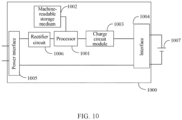
- the system 1000 includes a processor 1001 and a machine-readable storage medium 1002.
- the system 1000 may further include a charge circuit module 1003, an interface 1004, a power interface 1005, and a rectifier circuit 1006.
- the charge circuit module 1003 is configured to receive an instruction issued by the processor 1001 to perform an intermittent charge operation on a lithium-ion battery 1007.
- the charge circuit module 1003 may be further configured to receive an instruction issued by the processor 1001 to reduce a voltage/current of the lithium-ion battery 1007, or disconnect the electrical connection to the lithium-ion battery 1007 so that the lithium-ion battery 1007 stops operating.
- the charge circuit module 1003 may further obtain an SOH parameter, a total operation duration, and other parameters of the lithium-ion battery 1007, and send these parameters to the processor 1001.
- the interface 1004 is configured to electrically connect to the lithium-ion battery 1007.
- the power interface 1005 is configured to connect to an external power supply.
- the rectifier circuit 1006 is configured to rectify an input current.
- the machine-readable storage medium 1002 stores a machine-executable instruction that can be executed by the processor, and when the processor 1001 executes the machine-executable instruction, the steps of the method described in any one of the foregoing implementations are implemented.
- An embodiment of this application further provides an electrochemical apparatus including the system 1000 described in the foregoing implementations.
- An embodiment of this application further provides an electronic device including the electrochemical apparatus described in the foregoing implementations.
- the machine-readable storage medium may include a random access memory (Random Access Memory, RAM for short), or may include a non-volatile memory (non-volatile memory), such as at least one disk storage.
- RAM Random Access Memory
- non-volatile memory such as at least one disk storage.
- the memory may alternatively be at least one storage apparatus located away from the processor.
- the processor may be a general-purpose processor including a central processing unit (Central Processing Unit, CPU for short), a network processor (Network Processor, NP for short), or the like; or may be a digital signal processor (Digital Signal Processing, DSP for short), an application specific integrated circuit (Application Specific Integrated Circuit, ASIC for short), a field-programmable gate array (Field-Programmable Gate Array, FPGA for short) or another programmable logic device, a discrete gate or transistor logic device, or a discrete hardware assembly.
- CPU Central Processing Unit
- NP Network Processor
- DSP Digital Signal Processing
- ASIC Application Specific Integrated Circuit
- FPGA Field-Programmable Gate Array
- system/electrochemical apparatus/electronic device embodiment is essentially similar to the method embodiment, and therefore is described briefly. For related information, refer to the descriptions of the related parts in the method embodiment.
Landscapes
- Engineering & Computer Science (AREA)
- Chemical & Material Sciences (AREA)
- General Chemical & Material Sciences (AREA)
- Manufacturing & Machinery (AREA)
- Chemical Kinetics & Catalysis (AREA)
- Electrochemistry (AREA)
- Power Engineering (AREA)
- Microelectronics & Electronic Packaging (AREA)
- Materials Engineering (AREA)
- Secondary Cells (AREA)
- Charge And Discharge Circuits For Batteries Or The Like (AREA)
- Health & Medical Sciences (AREA)
- General Health & Medical Sciences (AREA)
- Medical Informatics (AREA)
Applications Claiming Priority (1)
| Application Number | Priority Date | Filing Date | Title |
|---|---|---|---|
| PCT/CN2021/126452 WO2023070323A1 (zh) | 2021-10-26 | 2021-10-26 | 电化学装置管理方法、系统、电化学装置及电子设备 |
Publications (2)
| Publication Number | Publication Date |
|---|---|
| EP4425643A1 true EP4425643A1 (de) | 2024-09-04 |
| EP4425643A4 EP4425643A4 (de) | 2025-01-15 |
Family
ID=80659103
Family Applications (1)
| Application Number | Title | Priority Date | Filing Date |
|---|---|---|---|
| EP21961699.2A Pending EP4425643A4 (de) | 2021-10-26 | 2021-10-26 | Verfahren zur verwaltung einer elektrochemischen vorrichtung, system, elektrochemische vorrichtung und elektronische vorrichtung |
Country Status (4)
| Country | Link |
|---|---|
| US (1) | US20240274899A1 (de) |
| EP (1) | EP4425643A4 (de) |
| CN (1) | CN114207909B (de) |
| WO (1) | WO2023070323A1 (de) |
Families Citing this family (1)
| Publication number | Priority date | Publication date | Assignee | Title |
|---|---|---|---|---|
| WO2023197132A1 (zh) * | 2022-04-12 | 2023-10-19 | 东莞新能安科技有限公司 | 电化学装置管理方法、装置、充电装置、电池系统及介质 |
Family Cites Families (12)
| Publication number | Priority date | Publication date | Assignee | Title |
|---|---|---|---|---|
| US8269641B2 (en) * | 2010-06-07 | 2012-09-18 | Lear Corporation | Vehicle power management system |
| JP2017055551A (ja) * | 2015-09-09 | 2017-03-16 | 日立オートモティブシステムズ株式会社 | 蓄電池制御装置 |
| US11088402B2 (en) * | 2017-01-12 | 2021-08-10 | StoreDot Ltd. | Extending cycling lifetime of fast-charging lithium ion batteries |
| US11848427B2 (en) * | 2017-12-07 | 2023-12-19 | Yazami Ip Pte. Ltd. | Non-linear voltammetry-based method for charging a battery and fast charging system implementing this method |
| CN109655760B (zh) * | 2018-12-27 | 2026-04-03 | 深圳市比克动力电池有限公司 | 一种锂离子电池析锂的无损检测方法及其应用方法 |
| US11228195B2 (en) * | 2019-04-21 | 2022-01-18 | StoreDot Ltd. | Lithium ion devices, operated with set operative capacity |
| CN112259813B (zh) * | 2020-01-20 | 2022-03-29 | 蜂巢能源科技有限公司 | 电池充放电功率确定方法、系统及设备 |
| EP4130767B1 (de) * | 2020-04-30 | 2025-07-02 | Shenzhen Yinwang Intelligent Technologies Co., Ltd. | Verfahren und vorrichtung zur erkennung von lithiumplattierung |
| KR102201988B1 (ko) * | 2020-06-17 | 2021-01-12 | 주식회사 나산전기산업 | 배터리의 충방전 특성을 사용하여 배터리를 관리하는 배터리 관리 시스템 |
| CN111638461A (zh) * | 2020-06-27 | 2020-09-08 | 天能帅福得能源股份有限公司 | 一种锂离子电池充电析锂实时检测方法及系统 |
| CN112583066A (zh) * | 2020-09-01 | 2021-03-30 | 骆驼集团新能源电池有限公司 | 一种叉车磷酸铁锂电池充电方法 |
| CN112713323B (zh) * | 2020-12-10 | 2022-08-09 | 欣旺达电动汽车电池有限公司 | 一种锂离子电池快速充电方法和锂离子电池 |
-
2021
- 2021-10-26 EP EP21961699.2A patent/EP4425643A4/de active Pending
- 2021-10-26 WO PCT/CN2021/126452 patent/WO2023070323A1/zh not_active Ceased
- 2021-10-26 CN CN202180004712.9A patent/CN114207909B/zh active Active
-
2024
- 2024-04-26 US US18/647,169 patent/US20240274899A1/en active Pending
Also Published As
| Publication number | Publication date |
|---|---|
| US20240274899A1 (en) | 2024-08-15 |
| WO2023070323A1 (zh) | 2023-05-04 |
| EP4425643A4 (de) | 2025-01-15 |
| CN114207909A (zh) | 2022-03-18 |
| CN114207909B (zh) | 2024-02-27 |
Similar Documents
| Publication | Publication Date | Title |
|---|---|---|
| US12313687B1 (en) | Method of detecting metal plating in intercalation cells | |
| CN109586373B (zh) | 一种电池充电方法和装置 | |
| JP3669673B2 (ja) | 電気化学素子の劣化検出方法、残容量検出方法、並びにこれらを用いた充電器および放電制御装置 | |
| CN108603918B (zh) | 测试电池单体的性能的装置和方法 | |
| CN106324508B (zh) | 电池健康状态的检测装置及方法 | |
| TWI235514B (en) | Detecting method for detecting internal information of a rechargeable battery, detecting apparatus for detecting internal information of a rechargeable battery, apparatus in which said detecting method is applied, apparatus including said detecting a | |
| US6232750B1 (en) | Battery charger with enhanced charging and charge measurement processes | |
| US20220271358A1 (en) | Method and system for determining parameters of battery pulsed heating | |
| EP3293533A1 (de) | Vorrichtung und verfahren zur erkennung eines batteriezellausfalls aufgrund unbekannter entladeströme | |
| JP2020071054A (ja) | 微短絡検知方法、及び微短絡検知装置 | |
| CN108398649A (zh) | 析锂检测方法及装置 | |
| CN110927590A (zh) | 电池剩余电量估算方法和装置、电子设备、计算机可读存储介质 | |
| CN114069077B (zh) | 电化学装置管理方法、电子设备及电池系统 | |
| CN111164824B (zh) | 电池组的管理装置和电池组系统 | |
| JP2016090399A (ja) | 短絡検出方法、短絡検出システムおよび短絡電流値算出方法 | |
| CN114397582B (zh) | 析锂检测方法、电子设备、充电装置及存储介质 | |
| CN107437642A (zh) | 一种智能充电方法及装置 | |
| TW201734493A (zh) | 電池健康狀況偵測方法及其電路 | |
| US20240274899A1 (en) | Electrochemical apparatus management method, electrochemical apparatus, and electronic device | |
| KR20220012747A (ko) | 배터리를 진단하기 위한 장치 및 그 방법 | |
| CN114384426A (zh) | 析锂检测方法、电子设备及电池系统 | |
| EP4421945A1 (de) | Verfahren zur verwaltung einer elektrochemischen vorrichtung, system, elektrochemische vorrichtung und elektronische vorrichtung | |
| CN115993541B (zh) | 磷酸铁锂电池的无损析锂检测方法及相关装置 | |
| US20240297515A1 (en) | Electrochemical apparatus management method, system, and charging apparatus | |
| JP7663360B2 (ja) | 内部短絡検知方法および電源システム |
Legal Events
| Date | Code | Title | Description |
|---|---|---|---|
| STAA | Information on the status of an ep patent application or granted ep patent |
Free format text: STATUS: THE INTERNATIONAL PUBLICATION HAS BEEN MADE |
|
| PUAI | Public reference made under article 153(3) epc to a published international application that has entered the european phase |
Free format text: ORIGINAL CODE: 0009012 |
|
| STAA | Information on the status of an ep patent application or granted ep patent |
Free format text: STATUS: REQUEST FOR EXAMINATION WAS MADE |
|
| 17P | Request for examination filed |
Effective date: 20240524 |
|
| AK | Designated contracting states |
Kind code of ref document: A1 Designated state(s): AL AT BE BG CH CY CZ DE DK EE ES FI FR GB GR HR HU IE IS IT LI LT LU LV MC MK MT NL NO PL PT RO RS SE SI SK SM TR |
|
| A4 | Supplementary search report drawn up and despatched |
Effective date: 20241213 |
|
| RIC1 | Information provided on ipc code assigned before grant |
Ipc: H01M 10/44 20060101AFI20241209BHEP |
|
| DAV | Request for validation of the european patent (deleted) | ||
| DAX | Request for extension of the european patent (deleted) | ||
| RAP1 | Party data changed (applicant data changed or rights of an application transferred) |
Owner name: NINGDE AMPEREX TECHNOLOGY LIMITED |