EP4422409B1 - Oberflächengereiftes veganes nahrungsmittel und verfahren zu seiner herstellung - Google Patents
Oberflächengereiftes veganes nahrungsmittel und verfahren zu seiner herstellung Download PDFInfo
- Publication number
- EP4422409B1 EP4422409B1 EP23715961.1A EP23715961A EP4422409B1 EP 4422409 B1 EP4422409 B1 EP 4422409B1 EP 23715961 A EP23715961 A EP 23715961A EP 4422409 B1 EP4422409 B1 EP 4422409B1
- Authority
- EP
- European Patent Office
- Prior art keywords
- vegan
- food product
- ripened
- envelope
- derived
- Prior art date
- Legal status (The legal status is an assumption and is not a legal conclusion. Google has not performed a legal analysis and makes no representation as to the accuracy of the status listed.)
- Active
Links
Images


Classifications
-
- A—HUMAN NECESSITIES
- A23—FOODS OR FOODSTUFFS; TREATMENT THEREOF, NOT COVERED BY OTHER CLASSES
- A23C—DAIRY PRODUCTS, e.g. MILK, BUTTER OR CHEESE; MILK OR CHEESE SUBSTITUTES; PREPARATION THEREOF
- A23C20/00—Cheese substitutes
- A23C20/02—Cheese substitutes containing neither milk components, nor caseinate, nor lactose, as sources of fats, proteins or carbohydrates
Definitions
- the present invention relates to a surface-ripened vegan food product and a method for producing a surface-ripened vegan food product.
- the present invention further relates to the use of a sheet-like porous material in the manufacture of a surface-ripened vegan food product.
- a variety of vegan food products are known in the art.
- a recipe for aged chickpea cheese is available from https://avegtastefromatoz.com/aged-chickpea-cheese/ (accessed on 24 Feb 2023).
- probiotic capsules are mixed with the cheese paste prior to fermentation. Accordingly, in contrast to surface-ripening, the chickpea cheese is ripened from the inside.
- food products such as cheese
- Ripening occurs through the metabolism of microorganisms such as bacteria, yeasts, and/or moulds that are present on the surface of a precursor food product.
- US 2641545 describes production of a soft surface cured cheese, i.e. a non-vegan dairy product, using a porous fabric.
- the fabric remains on the cheese until it is removed by the consumer. The fabric thus facilitates removal of a mould pad that is formed during ripening.
- EP 3366144 relates to a method for preparation of a vegan cheese, including ripening of a curd. Such ripening may be achieved by spraying Penicillum candidum on the cheese curd.
- Smear-ripening is a well-known method in the field of traditional cheese ripening.
- Traditional smear-ripened cheeses are characterized by a complex microflora, which develops on the surface during ripening.
- the development of the microflora contributes to a red-orange or brownish pigmented surface, which is characteristic for traditional smear-ripened cheese varieties.
- a freshly brined cheese wheel is frequently brushed (smeared) with a smear liquid.
- the cheese is brushed 3-5 times per week until growth of the microorganisms within the smear layer has started. Then, the frequency of brushing can be reduced stepwise to 1-2 times per week until the ripening process is complete. Frequent brushing is typically required in order to prevent growth of undesired moulds.
- Such a process for smear-ripening is either labour-intensive in case of manual brushing or capital-intensive in case brushing is performed by robots. Moreover, frequent brushing usually leads to an at least partial destruction of the primary structure of the cheese, which results from the press mould.
- vegan food products have only a thin rind or no rind at all and are therefore more susceptible to destruction of the surface during mechanically demanding surface-ripening processes such as smear-ripening.
- the destruction or partial destruction of the surface due to brushing is even more pronounced.
- Suitable ripening media for surface ripening of traditional food products such as cheese are known in the art and may also be used for surface ripening of vegan food products, such as cheese analogues or meat analogues.
- a smear liquid used for smear-ripening of cheese typically contains salty water or a whey liquid solution and may or may not contain commercially available microorganisms, e.g. mixed cultures, so called surface starters.
- the salty water contains 2-10% (w/w) sodium chloride.
- Examples of surface starter organisms are Debaryomyces hansenii, Geotrichum candidum, Brevibacterium linens, Brevibacterium casei, Staphylococcus equorum, Microbacterium gubbeenense, Arthrobacter spp., Corynebacterium casei and mixtures thereof.
- Ripening occurs in a climate-controlled environment at a temperature of 8°C to 20°C and a high relative humidity.
- the relative humidity is at least 90% RH.
- the resulting smear in general contains a mixture of microorganisms.
- microorganisms in general are (1) yeasts, (2) Gram-positive bacteria, (3) Gram-negative bacteria, (4) moulds and mixtures thereof.
- Selected moulds such as Bisifusarium domesticum can have a positive effect on the smear by reducing stickiness. Many moulds, however, lead to undesirable discolouration or can even form mycotoxins.
- microorganisms may be present in the smear liquid. Their use for commercial starter cultures is possible after stringent evaluation of their safety for use in food products, e.g. by full genome sequencing followed by sequence analysis.
- composition of the smear typically changes during ripening.
- a packaging material for post-ripening storage, distribution and/or sales.
- Such packaging material is typically air-tight. It is known from traditional smear-ripened cheese (dairy product; non-vegan), that during storage in such a packaging material, the metabolism and/or composition of the microflora changes.
- the smear surface may become sticky and an off-odour may develop.
- Such a sticky surface and/or off-odourous surface is also referred to as a defective or faulty smear.
- the off-odour that may escape the packaging material upon opening is also referred to as off-flavouring.
- the group of substances that contribute to the off-flavour comprises ammonia and low molecular weight sulphur compounds such as methanethiol (CH 3 SH), hydrogen sulphide (H 2 S), dimethyl sulphide (DMS), dimethyl disulphide (DMDS), dimethyl trisulphide (DMTS) and carbonyl sulphide (herein collectively referred to as "off-flavour compounds").
- sulphur compounds may interact with each other and with other compounds in the food product, generating other volatile off-flavour compounds.
- the invention relates to the use of a sheet-like porous material in a method for manufacturing a surface-ripened vegan food product such as a cheese analogue or a meat analogue.
- the invention is set out in the appended set of claims.
- fabric is known in the field and particularly relates to textile materials made from fibres.
- fabric also encompasses the terms "textile fabric”, “textile sheet material”, “fibre aggregate”, “textile surface”, “textile structure”, “textile surface structure”.
- woven fabric is known in the field and relates to a fabric formed by weaving. Woven fabrics are often created on a loom, and made of many threads woven on a warp and a weft. A woven fabric is made by interlacing two or more threads at right angles to one another.
- Knitted fabric is known in the field and relates to a fabric made (i.e. knitted) of thread systems by forming stitches on a knitting machine. Knitted fabrics are commonly used, for example, to make underwear or bedclothes.
- non-woven fabric is known in the field and relates to sheet or web structures bonded together by entangling fiber or filaments (and by perforating films) mechanically, thermally or chemically.
- the term is used to denote fabrics that are neither knitted nor woven.
- biodegradable or “biodegradability” relates to the "cradle to cradle” (C2C) standard.
- C2C certified compostability requirements are specified for example in EN 13432 (alternatively ISO 17088, ISO 18606 or ASTM D6400).
- EN 13432 alternatively ISO 17088, ISO 18606 or ASTM D6400.
- ASTM D6400 ASTM D6400.
- the fabric must be appropriate for home composting, and must not be limited to industrial composting facilities.
- the invention relates to a method for producing a surface-ripened vegan food product, such as a surface-ripened cheese analogue or a surface-ripened meat analogue.
- the inventive method for producing a surface-ripened vegan food product is manifested by the steps
- the envelope is removed after ripening and prior to sale or consumption, preferably prior to sale.
- the microorganisms may be applied either actively or passively.
- Actively applying microorganisms means that a defined mix of microorganisms, so called mixed cultures or surface starters, are applied on the precursor food product.
- mixed cultures or surface starters are commercially available.
- Passively applying microorganisms means that a certain mix of microorganisms, which is generally present at the production site, starts growing on the precursor food product and thereby initiates the ripening process, without the need to actively apply a defined mix of microorganisms.
- the mix of microorganisms that grows on the precursor food product is dependent on the production site. Consequently the particular organoleptic properties of the resulting surface-ripened food product may also depend on the production site.
- the envelope is applied on the vegan precursor food product, e.g. the vegan precursor food product is wrapped in the envelope, and, subsequently, microorganisms are applied on the enveloped precursor food product.
- microorganisms - actively and / or passively - allows growing of the microorganisms on the envelope, thereby allowing surface-ripening of the vegan precursor food product.
- the envelope may be applied on the vegan precursor food product in various manners.
- the envelope is closed (sealed) by sewing the ends of the envelope together after wrapping the vegan precursor food product in the envelope.
- the envelope is closed (sealed) by welding the ends of the envelope together after wrapping the vegan precursor food product in the envelope.
- the envelope is closed (sealed) by tying the ends of the envelope together after wrapping the vegan precursor food product in the envelope, e.g. using a string or cord.
- the envelope is closed (sealed) by taping the ends of the envelope together using glue, wax or resin after the vegan precursor food product has been wrapped in the envelope.
- step c) the thus obtained vegan food product is packaged for transport and/or sale in a subsequent step d).
- the vegan food product and the vegan precursor food product each contain water and at least one of the following components:
- At least one of the polysaccharide component or protein component are present in the vegan food product and its precursor.
- a composition comprising only water and fat component, but no polysaccharide component or protein component, is not suitable as a vegan precursor food product for surface ripening.
- both the precursor and the surface-ripened vegan food product contain 25 - 75% (w/w), preferably 35 - 60% (w/w), water.
- both the precursor and the surface-ripened vegan food product contain 0 - 75% (w/w), preferably 5 - 75%, more preferably 10 - 50% (w/w), of the plant, algae, bacteria or fungus derived polysaccharide component.
- both the precursor and the surface-ripened vegan food product contain 0 - 75% (w/w), preferably, 5 - 75%, more preferably 10 - 50% (w/w), of the plant, algae, bacteria or fungus derived protein component.
- both the precursor and the surface-ripened vegan food product contain 0 - 50% (w/w), preferably 5 - 50%, more preferably 10 - 40% (w/w), of the plant, algae, bacteria or fungus derived fat component.
- the combination of polysaccharide component, protein component and fat component adds up to at least 25% (w/w), preferably up to at least 40% (w/w), of the vegan food product or its precursor.
- Water is present in a quantity such that all components of the vegan precursor food product and vegan food product add up to 100% (w/w).
- a suitable vegan food product and / or its precursor may contain 25% of the polysaccharide component and 75% water.
- a suitable vegan food product and / or its precursor may contain 25% of the protein component and 75% water.
- the water content typically decreases during ripening and thus the water content of the surface-ripened vegan food product is generally lower than the water content of the precursor.
- the difference in the water content between the surface-ripened vegan food product and the respective precursor varies, but is typically in the range of 3 - 30% (w/w).
- the decrease in water content typically results in a firmer texture of the vegan food product.
- the decrease in water content is typically lower than in case surface ripening is performed without an envelope.
- a decrease of the water content in the range of 3 - 30% is considered beneficial since it aids in shaping of the vegan food product during ripening.
- it is also considered beneficial that the decrease in water content is lower compared to surface ripening without an envelope since a larger loss of water typically leads to a less aromatic product and a reduced yield (i.e. lower mass of the food product).
- inventive ripening method may impact the shape of the surface-ripened vegan food product (cf. e.g. examples 4, 5, 10 and 11).
- a paste-like mass e.g. a vegan precursor food product having a dynamic viscosity ( ⁇ ) in the range of between 500 to 100'000 Millipascalseconds (mPa ⁇ s), preferably 2'000 to 20'000 mPa ⁇ s, may be filled into the envelope and be surface-ripened according to the inventive method.
- the inventive ripening method may result in a surface-ripened vegan food product having a firmer texture than the corresponding precursor food product, such that it is solid or semi-solid at 20°C, i.e. the surface-ripened vegan food product so obtained can be cut with a knife (i.e. it is cuttable) and / or is spreadable.
- the envelope may impact the shape of the surface-ripened vegan food product.
- the inventive method thus enables surface-ripening of paste-like vegan precursor food products, e.g. having a dynamic viscosity in the range of between 500 to 100'000 mPa ⁇ s, preferably 2'000 to 20'000 mPa ⁇ s.
- dynamic viscosity ⁇ is measured using a rotational viscometer.
- viscosity measurement is regulated in various DIN standards, in particular DIN 1319 (Fundamentals of Measurement), DIN 1342 (Viscosity) and DIN 53019 (Viscosimetry - Measurement of viscosities and flow curves with rotational viscometers with standard geometry).
- the inventive method yields surface-ripened vegan food products having a thin rind.
- the rind is thick enough so that viscous or paste-like masses retain their shape.
- the rind is typically not too thick so that there is no negative mouthfeel during consumption.
- the thickness of the rind can vary depending on the vegan precursor food product used for surface-ripening.
- a rind as described herein has a mean thickness of between 0.05 mm to 0.2 mm, preferably 0.05 mm to 0.1 mm.
- the colour of such rind (after unwrapping from the envelope) is typically more homogeneous than the colour of a rind that may be present on a vegan food product that was ripened without an envelope.
- the inventive method yields surface-ripened vegan food products having a thin rind although, typically, no rind was present on the corresponding vegan precursor food product.
- the surface of a vegan food product that was surface-ripened according to the inventive method is typically less sticky compared to the surface of the corresponding vegan precursor food product. It is considered a further advantage that the surface of a vegan food product that was surface-ripened according to the inventive method may have a reduced water content compared to the surface of the corresponding vegan precursor food product.
- the vegan food product is a cheese analogue or a meat analogue, more preferably a cheese analogue.
- said method is a method for producing a smear-ripened vegan food product, such as a smear-ripened cheese analogue or a smear-ripened meat analogue, more preferably a smear-ripened cheese analogue.
- a smear-ripened vegan food product such as a smear-ripened cheese analogue or a smear-ripened meat analogue, more preferably a smear-ripened cheese analogue.
- An advantage of the method when used for smear-ripening is that regular brushing with a smear liquid is not required. Instead, immersing the vegan precursor food product in a smear liquid, optionally containing surface starter organisms, preferably directly after step (a), and afterwards keeping the precursor food product humid is sufficient.
- an additional advantage of the inventive method is that it enables mechanically demanding ripening processes for surface-ripening of vegan food products, thus brushing is possible within the scope of the method.
- the envelope aids in shaping of the vegan food product during ripening.
- a surface-ripened vegan food product obtained according to the present invention generally has beneficial properties upon storage in a packaging material. This shall be explained in more detail below.
- surface-ripened The term "surface-ripened” is known in the field of traditional cheese production and is used herein in an analogous way.
- food products such as cheese
- microorganisms such as bacteria, yeasts, and/or moulds that are present on the surface of a precursor food product.
- Said microorganisms generally metabolize organic acids, such as lactic acid, that are present in the precursor food product.
- organic acids are typically present either as a result of fermentation or because of the addition of acidity regulators.
- a typical example of surface-ripening is smear-ripening.
- the precursor food product is typically frequently brushed (smeared) with a smear liquid containing microorganisms, such as bacteria, yeasts, moulds and mixtures thereof.
- a smear liquid containing microorganisms such as bacteria, yeasts, moulds and mixtures thereof.
- Traditional surface-ripened food products such as smear-ripened cheese, are characterized by the ripening method.
- a smear-ripened cheese is characterized by a red-orange coloured surface. This red-orange coloured surface typically harbours a complex mixture of microorganisms.
- organoleptic properties of a surface-ripened food product are dependent on the particular food product and its production site.
- the surface-ripening process generally impacts the texture of the vegan food product which results in different characteristics of the surface-ripened product compared to its precursor prior to ripening.
- the skilled person is aware that the texture of the food product after ripening depends on a complex interplay between different parameters, particularly the water content (decreases during ripening), the change of the pH value (typically increases during ripening) and the degree of proteolysis, each of which may change during ripening. As is known in the field, each of these parameters depends on the specific ripening conditions used (e.g. ripening time, relative humidity, temperature and microorganisms) and the composition of the vegan precursor food product.
- the characteristic ripening process is now applicable to vegan precursor food products to thereby obtain surface-ripened, particularly smear-ripened, vegan food products.
- Polysaccharide component The term "polysaccharide” is known in the field and relates to polymeric carbohydrates composed of monosaccharide units bound together by glycosidic linkages, either linear or branched.
- the polysaccharide component may be any polysaccharide suitable for human consumption that is derived from plants, algae, bacteria or fungi.
- a large variety of plant, algae, bacteria or fungus derived polysaccharide components are known in the field of vegan food products and are also suitable for the present invention.
- the plant, algae, bacteria or fungus derived polysaccharide component is a root or tuber starch, grain starch or algae starch.
- the root or tuber starch of the invention may be of any root or tuber source.
- Root or tuber in this context includes the species of potato ( Solanum tuberosum or Irish potato), sweet potato ( Ipomoea batatas ), manioc ( Manihot esculenta ; tapioca starch), cassava ( Manihot esculenta, syn. M. utilissima ), yuca dulce ( M. palmata, syn. M. dulcis ), yam ( Dioscorea spp.), yautia ( Xanthosoma spp., including X.
- sagittifolium taro ( Colocasia esculenta ), arracacha ( Arracacoa xanthorrhiza ) , arrowroot ( Maranta arundinacea ) ⁇ chufa ( Cyperus esculentus ), sago palm ( Metroxylon spp.), oca and ullucu ( Oxalis tuberosa and Ullucus tuberosus ), yam bean and jicama ( Pachyrxhizus erosus and P. angulatus ), mashua ( Tropaeolum tuberosum ) and Jerusalem artichoke and topinambur (Helianthus tuberosus).
- the root or tuber starch, grain starch or algae starch used in the present invention is a starch which can be gelatinized by heating in water.
- Gelatinization of starch is the disruption and subsequent solubilisation of starch granules into dissolved polysaccharide chains, resulting in increased viscosity of the gelatinized starch mixture, relative to the non-gelatinized starch mixture.
- starch may be a modified starch, such as a degraded, enzymatically modified or stabilized starch, as long as the modification does not fully preclude gelatinization of the starch.
- the starch is a non-modified starch.
- the starch is a native starch.
- Non-modified in this context, means that the starch has not been chemically or enzymatically modified, although it may have been pre-gelatinized.
- Native starch in this context means a native, granular starch, such as obtained from the root or tuber. The advantage of using a non-modified or native starch is that such starches can be applied label-free in vegan food products.
- An example of a grain starch is corn starch.
- Examples of algae starch are agar and alginate.
- the plant, algae, bacteria or fungus derived polysaccharide component is a root or tuber starch, grain starch or algae starch selected from the group consisting of tapioca starch, potato starch, corn starch, agar, alginate and mixtures thereof.
- Fat component The term "fat” is known in the field and relates to esters of fatty acids, in particular to triglycerides, i.e. triple esters of glycerol with fatty acids.
- the fat component may be any type of fat or oil suitable for human consumption that is derived from plants, algae, bacteria or fungi.
- a fat or oil in the present context, is a composition comprising at least 95% (w/w), preferably at least 98% (w/w), di- and triglycerides, and is preferably a composition comprising essentially only triglycerides, wherein the quantity of diglycerides is less than 2% (w/w), preferably less than 1% (w/w).
- the difference between a fat and an oil is that a fat is solid at 20 °C, whereas an oil is liquid at this temperature. Liquid in this context means that the viscosity is such that the oil can flow, even though the liquid may be a viscous liquid.
- the plant, algae, bacteria or fungus derived fat component is selected from the group consisting of avocado oil, canola oil, cocoa butter, coconut oil, corn oil, palm oil, safflower oil, sesame oil, sunflower oil, rapeseed oil, algae oil, a cashew nut derived fat component, an almond derived fat component, a soybean derived fat component, a lupine derived fat component, a pea-derived fat component, a yeast derived fat component, and mixtures thereof.
- the fat or oil component has a bland taste, such as for instance sunflower oil, palm oil, corn oil or soybean oil.
- Protein component The term "protein” is known in the field. Proteins generally consist of one or more long chains of amino acid residues. As is convenient in the field, the term protein also includes peptides such as polypeptides or oligopeptides. Peptides containing two to twenty amino acid units are typically referred to as oligopeptides whereas peptides containing more than twenty amino acids are typically referred to as polypeptides.
- the protein component may be any type protein or peptide suitable for human consumption that is derived from plants, algae, bacteria or fungi.
- the protein component is selected from the group consisting of a cashew nut derived protein component, an almond derived protein component, a soybean derived protein component, a lupine derived protein component, a pea derived protein component, a corn derived protein component, a potato derived protein component, a wheat derived protein component, an algae derived protein component, a pseudocereal derived protein component and a yeast derived protein component, and mixtures thereof, more preferably selected from the group consisting of a cashew nut derived protein component and a lupine derived protein component.
- a pseudocereal is one of any non-grasses that are commonly used in the same way as cereals, whereas true cereals are grasses.
- Pseudocereals can be further distinguished from other non-cereal staple crops, such as potatoes, by their ability to be processed like a cereal, i.e. the seed of pseudocereal can be ground into flour and otherwise be used like a cereal.
- Suitable pseudocereals are for example buckwheat, quinoa and amaranth, preferably buckwheat and quinoa.
- Both the vegan precursor food product and the surface-ripened vegan food product contain water. As described above, the water content typically decreases during ripening. Hence the water content of the surface-ripened vegan product is typically 3 - 30% lower than the water content of the vegan precursor food product.
- Water may be tap water, suitable for use in human food applications. That is, water must be sufficiently clean, and should not contain excess salts, such as table salt, other minerals or trace elements, microorganisms or toxic components. Water may also be microfiltered prior to use in the preparation of the vegan precursor food product. Water is used in a quantity such that all components of the vegan precursor food product and vegan food product add up to 100% (w/w).
- Both the vegan precursor food product and the vegan food product may further comprise various additives, such as flavors, odors and colorants.
- Suitable additives include various salts, such as sodium or potassium chloride, as well as organic flavors and odors such as citric acid and various esters and aldehydes.
- Suitable colorants include annatto (a mix of bixine and norbixine as obtained from Bixa orrelana ) or b-carotene.
- additives are optional and if present must be acceptable to vegans, i.e. being derived from plants, algae, bacteria or fungi.
- Plant, algae, bacteria or fungus derived means that a component present in the vegan food product or in the vegan precursor food product has been obtained from a plants, algae, bacteria or fungi, e.g. by isolation or extraction. However, the term is not limited to an individual pure or substantially pure substance but also includes mixtures of substances obtained from plants, algae, bacteria or fungi or the whole or part of the respective plants, algae, bacteria or fungi. A broad range of plants, algae, bacteria and fungi are known in the field of vegan foods and are also suitable for the present invention.
- Suitable plants or parts of such plants are for example cashew, almond, soybean, lupine, pea, corn, potato and wheat.
- Suitable algae are for example green algae such as Chlorella, e.g. Chlorella vulgaris.
- Suitable bacteria are for example cyanobacteria such as Arthrospira platensis, Arthrospira fusiformis and Arthrospira maxima.
- Suitable fungi are for example Fusarium venenatum.
- plant, algae, bacteria or fungus derived does not include substances that are obtained from animal sources. Nevertheless, substances that can also be found in animal products are included as long as they have been obtained from plants, algae, bacteria or fungi.
- obtained from bacteria also includes substances that are generally present in animal products but have been expressed in bacteria using recombinant gene expression methods.
- vegan food products are foods which are not products of animal origin and which do not contain ingredients of animal origin. Instead, the ingredients are of plant, algae, bacterial or fungus origin, i.e. are derived from plants, algae, bacteria or fungi.
- Typical examples of vegan food products are cheese analogues and meat analogues.
- similar ingredients can be used for the production of both cheese analogues and meat analogues. Differences in organoleptic properties and texture between the two can be achieved through the addition of flavourings or differences in the production process.
- both cheese analogues and meat analogues are suitable vegan precursor food products that can be surface ripened according to the present invention to thereby obtain a surface-ripened vegan food product, such as a smear-ripened cheese analogue.
- suitable surface-ripened vegan food products particularly surface-ripened vegan food products obtained by the inventive method described herein, are solid or semi-solid at 20°C, i.e. they can be cut with a knife (cuttable) and / or are spreadable. Accordingly, such surface-ripened vegan food products retain their given shape at ambient conditions, i.e. not being fluid. This is in contrast to any liquid food products such as beverages.
- vegan precursor food product relates to an intermediate vegan food product that has not yet been subjected to surface-ripening. Such precursor food product may already be consumed prior to surface ripening.
- vegan precursor food products may also be commercially available foods such as commercially available cheese analogues or meat analogues. However, in the context of the present invention, such foods are considered precursor food products unless a surface-ripening has been performed. It is considered advantageous that common commercially available non-surface ripened vegan foods can be used as vegan precursor food products in the context of the present invention.
- surface-ripened vegan food products according to the invention may be obtained by surface ripening commercially available vegan foods that have not been subjected to surface ripening.
- suitable vegan precursor food products are solid or semi-solid, i.e. they can be cut with a knife and / or are spreadable. This is in contrast to any liquid food products such as beverages.
- a suitable vegan precursor food product may also be made by a method comprising the steps:
- the microorganisms are cultured on a removable envelope, which is permeable for metabolites produced by microorganisms and for the microorganisms themselves and for components of the vegan precursor food product and for gaseous elements, in particular surrounding air.
- the envelope is in direct physical contact with the vegan precursor food product, preferably over its entire surface.
- the envelope contains pores and/or micropores, preferably pores having a mean pore size in the range of 0.01 mm - 2.00 mm, preferably in the range of 0.1 mm - 1.0 mm, such as 0.3 mm - 0.7 mm.
- the mean pore size may be measured by clamping the envelope in a tentering frame and applying to the envelope maximum extension in the elastic range of the envelope (no overstretching of the envelope).
- the mean pore size can be measured using a microscope, preferably a digital microscope, e.g. an Olympus DSX110 microscope.
- the mean pore size is determined from the pores that are visible on a 5.8x5.8 mm sized microscopy image with 48 fold magnification or from a suitable multitude of pores, such as 10 pores that are visible on said microscopy image.
- pores can have different shapes.
- a broad range of pore shapes of the envelope is suitable for the inventive method, e.g. a circular shape or an oval shape, such as an ellipse, or a polygonal shape, such as a quadrangle, pentagon, hexagon, heptagon, octagon, nonagon, or decagon.
- the pore size relates to the diameter of the pore.
- the pore size can be determined either by measuring the width or the height of the pore, i.e.
- pore size can be determined by measuring the distance between the most distant points (e.g. of an oval shape) or corners (e.g. of a polygonal shape) of the pore. In each case, the pore size is measured in the extended state of the envelope as described above. However, the exact method of measuring the mean pore size is not critical as long as the mean pore size is measured in the extended state of the envelope as described above.
- the envelope is elastic. Suitable elasticity values are in the range of 10-500%, i.e. the envelope can be elastically extended by 10 - 500% of its size in a non-extended state, measured according to DIN EN 14704-1. More preferably, the envelope is 40-350% elastic, most preferably 50-300% elastic, again measured according to DIN EN 14704-1.
- the envelope may have different elastic properties when measured in different directions.
- the envelope may be 10 - 60% elastic, advantageously 40 - 60% elastic, in one direction and 50 - 300%, advantageously 100 - 200% elastic in the other direction.
- the envelope has a density (g/m ⁇ 2) of 50 - 300 g/m ⁇ 2, more advantageously 100 - 200 g/m ⁇ 2, most advantageously 120 - 150 g/m ⁇ 2.
- the envelope is a fabric sleeve. Suitable fabrics complying with the elasticity and porosity as defined above are known in the field and a broad range of such fabrics is commercially available.
- the envelope contains, particularly consists of, knitted fabrics or woven fabrics or non-woven fabrics, in particular knitted fabrics or woven fabrics, most preferably knitted fabrics.
- the envelope contains materials selected from the group consisting of natural or synthetic polymeric materials and mixtures thereof.
- Natural polymeric materials may be selected from the group consisting of cellulose, cotton, wool, silk, cashmere and mixtures thereof.
- Synthetic materials may be selected from the group consisting of cellulose-derivatives such as cellulose acetate and nitrocellulose, polyamides such as nylon, elastomers, polyurethanes, polyolefins such as polypropylenes, polyesters such as polyethylene terephthalate (PET), polyethylene glycols (PEG), acrylics and mixtures thereof.
- Elastane (synonymously spandex or lycra) is a mixture of polyurethane and polyethylene glycol.
- suitable synthetic materials may also be made from and/or contain natural polymeric materials, in particular cellulose, and/or cellulose-derivatives such as cellulose acetate and nitrocellulose. Such synthetic materials are sometimes also referred to as semi-synthetic materials.
- a suitable example of such a synthetic (or semi-synthetic) material is rayon, particularly lyocell, modal and micromodal.
- Cellulose derivatives include materials containing a characteristic backbone of cellulose wherein one or more of the hydroxyl groups are substituted, e.g. by nitro- or acetate groups.
- the envelope contains cellulose and/or cellulose derivatives such as cellulose acetate and nitrocellulose.
- the envelope contains cellulose or cellulose derivatives that have been obtained from hard wood, in particular obtained from beech tree.
- Modal is a form of rayon and consists of cellulose and/or cellulose derivatives as defined above.
- Micromodal is a finer variant of modal. Micromodal fibres have a diameter of less than 10 ⁇ m (microfibre). The term "micromodal" as used herein is thus synonymous to "modal fibres having a diameter of 0.1 - 10 ⁇ m”.
- the envelope contains modal or micromodal.
- Lyocell is a form of rayon and consists of cellulose and/or cellulose derivatives as defined above.
- the envelope contains lyocell.
- lyocell, modal and micromodal can be made from the same raw materials but differ in their manufacturing process. These differences in the manufacturing process result in different characteristic properties of the so-obtained material.
- the respective manufacturing processes are known in the field.
- the envelope contains a stretch fibre such as elastane (synonymously spandex, lycra) or roica, preferably roica.
- a stretch fibre such as elastane (synonymously spandex, lycra) or roica, preferably roica.
- roica is biodegradable.
- the envelope consists of a mixed fabric containing, preferably consisting of, cellulose or cellulose derivatives, e.g. modal or micromodal, and a stretch fibre, e.g. elastane or roica, preferably roica.
- the envelope consists of a mixed fabric containing, preferably consisting of, (i) modal or micromodal and (ii) a stretch fibre such as elastane or roica, preferably roica.
- the envelope consists of a mixed fabric containing, preferably consisting of, one of the following combinations of materials:
- the envelope consists of a mixed fabric containing, preferably consisting of, (i) 80-95% cellulose or a cellulose-derivative, preferably selected from modal and micromodal, and (ii) 5-20% of a stretch fibre such as elastane or roica, preferably roica.
- a particularly suitable envelope consists of (i) 92% modal or micromodal and (ii) 8% of a stretch fibre such as elastane or roica.
- the envelope consists of one of the following combinations of materials:
- An example of such an envelope is an envelope consisting of the fabric "26319/1, 28 E Single Jersey Micromodal-Elastane”.
- the envelope contains 0-100% polyamide, 0-60% elastane, 0-70% polyurethane, 0-40% polypropylene and 0-70% cotton.
- the envelope contains, more preferably consists of, materials that are biodegradable.
- materials that are biodegradable are modal, micromodal and lyocell.
- the envelope has a thickness of between 0.001 mm - 1.0 mm, preferably 0.01 mm - 0.1 mm.
- the envelope may thus also be a sheet-like material or a thin film.
- the size, i.e. the surface area, of the envelope is adapted to the surface area of the vegan precursor food product to which it is applied.
- the envelope must cover the whole surface of the vegan precursor food product.
- the surface area of the envelope in an elastically extended state, is at least identical to the surface area of the vegan precursor food product, preferably the surface area of the envelope is in an elastically extended state larger than the surface area of the vegan precursor food product.
- the surface area of the envelope is typically smaller than or identical to the surface area of the vegan precursor food product.
- the envelope has a surface area of between 10 cm ⁇ 2 to 20000 cm ⁇ 2, preferably of between 50 cm ⁇ 2 to 5000 cm ⁇ 2.
- the envelope contains knitted or woven-fabrics, preferably knitted fabrics, consisting of yarns having a linear mass density (i.e. the thickness of a yarn in only one dimension; also referred to as linear density) of 5-165 DTEX, preferably 10-120 DTEX, more preferably 15-100 DTEX.
- linear mass density i.e. the thickness of a yarn in only one dimension; also referred to as linear density
- the linear mass density of a yarn can be measured according to DIN EN ISO 2060.
- An alternative unit for expressing the linear mass density of a yarn is "metric count (Nm)".
- the unit "Nm” is defined as the number of meters per gram of fiber or yarn. For example, 50.8 Nm correspond to 50.8 m per gram of yarn.
- the envelope contains knitted or woven-fabrics, preferably knitted fabrics, consisting of yarns having a linear mass density of 2.000-61 Nm, preferably 667-83 Nm, more preferably 667-400 Nm.
- the envelope prevents or at least reduces spread of mould mycelium on the surface of the vegan food product or vegan precursor food product.
- the envelope serves as a physical barrier against the spread of mould mycelium. The inventive method therefore alleviates the need for frequent mechanical brushing of a vegan precursor food product.
- step a) the envelope is elastically extended and applied in step a) in such an at least partially elastically extended state.
- step (b) ripening is achieved by
- step (b2) water, optionally containing 2-10% (w/w) sodium chloride, is sprayed onto the enveloped vegan precursor food product 3-5 times per week until growth of the microorganisms within the smear layer has started. Then, the frequency of spraying can be reduced stepwise to 1-2 times per week until the ripening process is complete.
- a further advantage of the method is that brushing of the surface of the vegan precursor food product with a smear liquid is not required. Nevertheless, brushing is possible within the scope of the method.
- the invention further relates to a surface-ripened vegan food product having a composition as described above that is obtainable or obtained by the manufacturing method described above (first aspect).
- the surface-ripened vegan food product is a surface-ripened cheese analogue or a surface-ripened meat analogue, more preferably a surface-ripened cheese analogue.
- the surface-ripened vegan food product is a smear-ripened vegan food product, such as a smear-ripened cheese analogue or smear-ripened meat analogue, more preferably a smear-ripened cheese analogue.
- the inventive method in particular leads to a surface-ripened vegan food product, particularly a surface-ripened cheese analogue, e.g. a smear-ripened cheese analogue, that is less susceptible to developing an off-odour after storage in a packaging material, in particular an air-tight packaging material, than an otherwise identical surface-ripened food product that was not ripened in an envelope and which was removed prior to packaging.
- a surface-ripened vegan food product particularly a surface-ripened cheese analogue, e.g. a smear-ripened cheese analogue, that is less susceptible to developing an off-odour after storage in a packaging material, in particular an air-tight packaging material, than an otherwise identical surface-ripened food product that was not ripened in an envelope and which was removed prior to packaging.
- a surface-ripened cheese analogue typically maintains, or at least partially maintains, the optical characteristics of a traditional surface-ripened cheese, particularly a traditional smear-ripened cheese.
- a surface-ripened vegan food product particularly a smear-ripened cheese analogue, or a piece of said surface-ripened vegan food product, according to the invention has a red-orange or brownish surface.
- a surface-ripened vegan food product having the same composition as the product in question can be produced by the method of the invention and be used as reference material. Comparison of a surface-ripened vegan food product with this reference material thus offers a possibility to determine if a surface-ripened vegan food was produced by the method of the invention.
- the water content of the so-produced reference surface-ripened vegan food product can be measured after 1, 2, 3 and/or 4 months of ripening and compared to the vegan food product in question.
- the water content can be measured according to Agroscope method 13.8 ME.068 (accredited according to ISO/IEC 17025:2017) as of date 25.02.2019, available from Agroscope upon request.
- the total count of microorganisms calculated based on the surface area of the so-produced reference surface-ripened vegan food product, particularly smear-ripened cheese analogue, can be measured and compared to the vegan food product in question.
- said total count of microorganisms relates to microorganisms selected from the group consisting of anaerobic bacteria, aerobic bacteria, yeasts, moulds and mixtures thereof.
- the surface-ripened vegan food product according to the invention particularly a smear-ripened cheese analogue, or a piece thereof, has a residual smear layer with a mean thickness of between 0.05 mm to 0.2 mm, preferably 0.05 mm to 0.1 mm.
- the mean thickness of the residual smear layer can be measured by microscopy, e.g. using an Olympus DSX110 microscope.
- off-flavour compounds comprises ammonia and low molecular weight sulphur compounds such as methanethiol, hydrogen sulphide, dimethyl sulphide (DMS), dimethyl disulphide (DMDS), dimethyl trisulphide (DMTS) and carbonyl sulphide.
- sulphur compounds may interact with each other and with other compounds in the food product, generating other volatile off-flavour compounds.
- Volatile off-flavour compounds can be determined according to the following methods: The amount of ammonia can be measured according to Agroscope method 13.6.ME.089 (accredited according to ISO/IEC 17025:2017) as of date 20.12.2019, available from Agroscope upon request.
- the vegan food product contains water, preferably in an amount of 25 - 75% (w/w) and at least one of the following components:
- the smear-ripened vegan food product additionally contains a plant, algae, bacteria or fungus derived fat component, preferably in an amount of 5 - 50% (w/w).
- the combination of polysaccharide component, protein component and fat component adds up to at least 25% (w/w) of the vegan food product or its precursor.
- Water is present in a quantity such that all components of the vegan precursor food product and vegan food product add up to 100% (w/w).
- a smear-ripened vegan food product according to the invention may contain 25% of the polysaccharide component and 75% water.
- a smear-ripened vegan food product according to the invention may contain 25% of the protein component and 75% water.
- the vegan food product is solid or semi-solid, i.e. it can be cut with a knife (cuttable) and / or is spreadable.
- the inventive smear-ripened vegan food product complies with the characteristics defined above generally in the context of a surface-ripened vegan food product obtained by the inventive manufacturing method described herein (second aspect and first aspect of the invention, respectively).
- the mean thickness of the smear layer can be measured by microscopy, e.g. using an Olympus DSX110 microscope.
- At least 5 different vegan precursor food products were commercially obtained and surface-ripened according to the inventive method.
- one dairy product was used as a reference and subjected to surface-ripening using the same method.
- At least two of each vegan precursor food products and the reference were subjected to surface-ripening (duplicates).
- the inventive method is likewise applicable to other vegan foods, such as meat analogues, and may be likewise performed using other ripening methods (e.g. different temperature of different relative humidity) and/or microorganisms such as Penicillium camemberti and Penicillium nalgiovense, provided their safety for use in food products has been evaluated, e.g. by full genome sequencing followed by sequence analysis.
- Envelope D with the below listed characteristics was applied on commercially available vegan precursor food products such that the envelope was in direct physical contact with the vegan precursor food product over its entire surface (cf. Fig. 1 ).
- the envelope was permeable for metabolites produced by microorganisms and for microorganisms themselves and for gaseous elements, in particular surrounding air.
- the envelope had a density of 135 g/m ⁇ 2 +/- 5%.
- the envelope was 53% +/- 5% elastic in one direction and 143% +/- 10% elastic in the other direction, as measured according to DIN EN 14704-1, and contained pores with a mean pore size of 0.05 - 0.5 mm (extended state).
- the envelope contained knitted fabrics consisting of yarns having a linear mass density of 100 DTEX.
- the envelope was biodegradable according to the "cradle to cradle" (C2C) standard.
- the envelope was in an elastically extended state before applying on the vegan precursor food product.
- Exemplary types of envelopes and their characteristics are listed in table 1 below. Table 1.
- Exemplary envelopes Specification Envelope A Envelope B Envelope C Envelope D Mean pore size extended state 0.3-0.6 mm 0.2-0.7 mm 0.2-1.0 mm 0.05-0.5 mm Linear mass 17 DTEX 22 DTEX 17 DTEX 100 DTEX density 588 Nm 455 Nm 588 Nm 100 Nm Material Polyamide 90% 100% 79% 0% Elastane 10% 0% 21% 8% Micromodal 0% 0% 0% 92%
- the vegan precursor food products were immersed in a smear liquid containing 5% (w/w) sodium chloride and 1% (w/w) of a standardized mixed culture (OMK 704), available from Agroscope.
- the mixed culture (CFU>10 ⁇ 5 as determined on SC-Agar at 30°C for 5 d under aerobic conditions) contained a combination of Arthrobacter ssp., Corynebacterium ssp., Brevibacterium linens and Debaryomyces hansenii.
- each of the enveloped vegan precursor food products were ripened for 12 days at 14 - 15°C at 90-96% RH (examples 1 to 5).
- each of the enveloped vegan precursor food products and the respective reference dairy product were ripened for 5 weeks (35 days), also at 14 - 15°C at 90-96% RH.
- the vegan precursor food products were sprayed 1-2 times per week with the smear liquid described above.
- control sample for each vegan precursor food product, an identical control sample was stored in its commercial packaging material at 4°C for 12 days (example 6) or 5 weeks (35 days; example 12), respectively (no treatment with smear-liquid).
- the envelope was removed together with thereon adherent part of a smear layer after 12 days of ripening. Approximately 90% (w/w) of the total smear layer was thereby removed (cf. Fig. 3 and 4 ). Although longer ripening times are possible and are typically preferred to achieve better ripening results, ripening for 12 days was already sufficient to obtain surface-ripened vegan food products having a red-orange or brownish-coloured surface as is characteristic for traditional smear-ripened cheese. The obtained surface-ripened vegan products had aromatic and taste characteristics closer to a traditional smear-ripened cheese than the respective precursor food products.
- the surface-ripened vegan products showed a significant difference in the organoleptic properties, particularly the taste, and the texture (firmer texture after ripening) compared to the respective control products (i.e. vegan precursor food products that were stored at 4° C instead of being surface-ripened in an envelope).
- Composition of vegan precursor food product Water, coconut oil (29% w/w), starch, salt, glucono-delta-lactone (acidity regulator), flavourings, olive extract, vitamin B12 (cyanocobalamin).
- This vegan precursor food product is an example of a product that has been acidified through the addition of glucono-delta-lactone as acidity regulator.
- composition of vegan precursor food product Water, coconut oil (24% w/w), modified starch, starch, salt, sunflower seed flour, mature cheddar flavour, lactic acid (acidity regulator), olive extract, colour (beta-carotene), vitamin B12 (cyanocobalamin)
- This vegan precursor food product is an example of a product that has been acidified through the addition of lactic acid as acidity regulator. After 12 days of ripening, the concentration of lactic acid decreased due to metabolism of the surface microorganisms.
- composition of vegan precursor food product Water, potato flakes, coconut oil, chickpea flour, nutritional yeast (11% w/w), salt, natural flavours
- Commercial name Gondino
- Rejuvelac (germinated water, quinoa and fenugreek), coconut oil, cashews, hulled almonds (12.5% w/w), powdered psyllium husk (2% w/w), extra virgin olive oil, salt.
- Rejuvelac germinated water, quinoa and fenugreek
- coconut oil cashews
- hulled almonds (12.5% w/w
- powdered psyllium husk (2% w/w)
- extra virgin olive oil salt.
- Commercial name Fermaggio Mezzarella
- the shape of the vegan food product was significantly impacted by the envelope already after 12 days of ripening.
- composition of vegan precursor food product Cashews (60% w/w), water, salt, vegan cheese cultures
- Commercial name New Roots La Cotta
- the shape of the vegan food product was significantly impacted by the envelope already after 12 days of ripening.
- a vegan precursor food product identical to the one of example 1 and a respective control was used and ripened for 5 weeks as described above (commercial name: Violife Greek White).
- a vegan precursor food product identical to the one of example 2 and respective control was used and ripened for 5 weeks as described above (commercial name: Violife Epic Mature).
- a vegan precursor food product identical to the one of example 4 and respective control was used and ripened for 5 weeks as described above (commercial name: Fermaggio Mezzarella).
- a vegan precursor food product identical to the one of example 5 and respective control was used and ripened for 5 weeks as described above (commercial name: New Roots La Cotta).
- Example 12 (reference cheese, 5 weeks of ripening):
- Example 12 (reference; control) 506 5.57 6.7
- Example 12 (reference; smear-ripened) 424 6.58 25.4 Table 4.
- Example 7 Volatile carboxylic acids measured after 5 weeks of ripening
- Example 7 Total volatile carboxylic acid [mmol/k g] Formic acid [mmol/kg] Acetic acid [mmol/kg] Propionic acid [mmol/kg] n-butyric acid [mmol/kg] n-caproic acid [mmol/kg]
- Example 7 Control 3.24 0.05 1.16 0.20 1.54 0.28
- Example 7 smear-ripened 27.57 5.34 20.81 0.17 0.34 0.28
- Example 8 control 3.88 0.75 0.90 0.38 1.55 0.25
- Example 8 smear-ripened 3.26 0.30 2.30 0.02 0.03 0.60
- Example 9 control 68.95 1.69 44.31 0.21 21.88 0.44
- Example 9 smear-ripened 36.14 1.10 23.0 0.10 10.79 0.86
- Example 10 control 14.04 0.39 13.32 0.12 0.01 0.20
- Example 10 smear-ripened 14.87 0.71 12.24 1.65
- the data clearly shows that the inventive method enables surface-ripening, in particular smear-ripening, of multiple vegan precursor food products to thereby obtain surface-ripened vegan food products.
- the data further shows that while good ripening results are already obtained after 12 days of ripening, longer ripening periods are also compatible with the inventive method. Such longer ripening periods result in surface-ripened vegan food products with different characteristics than those obtained using shorter ripening periods, thereby indicating that the ripening process can be continued over a broad range of ripening periods.
- the surface microflora led to a degradation of lactic acid and proteins (where present) and was thus able to influence the flavour and texture formation.
- the biochemical and biophysical characteristics of surface-ripened vegan food products according to the instant invention depend on the individual vegan precursor food products.
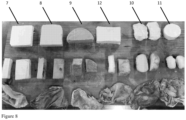
- FIG. 5 A picture of the vegan precursor food products (examples 7 to 11) and the reference product (example 12) after 3 weeks of ripening and 4 weeks of ripening is shown in Figure 5 .
- the surface-ripened vegan food products had a residual smear layer with a mean thickness of about 0.1 mm.
Landscapes
- Life Sciences & Earth Sciences (AREA)
- Chemical & Material Sciences (AREA)
- Engineering & Computer Science (AREA)
- Food Science & Technology (AREA)
- Polymers & Plastics (AREA)
- Dairy Products (AREA)
Claims (15)
- Verfahren zur Herstellung eines oberflächengereiften veganen Lebensmittelprodukts aus einem veganen Vorläuferlebensmittelprodukt, dadurch gekennzeichnet, dassdas Verfahren die Schritte umfasst(a) Bereitstellen eines veganen Vorläuferlebensmittelprodukts, Aufbringen einer Hülle und anschliessendes Aufbringen von Mikroorganismen darauf,
besagter Umschlag• steht in unmittelbarem physischen Kontakt mit der Oberfläche des veganen Vorläuferlebensmittelprodukts, und• ist durchlässig für die von den Mikroorganismen erzeugten Metaboliten und für die Mikroorganismen selbst sowie für Bestandteile des veganen Vorläuferlebensmittelprodukts und für gasförmige Elemente, insbesondere die Umgebungsluft; und(b) Reifung des veganen Vorläuferlebensmittelprodukts in der Hülle; und(c) Entfernen der Hülle, um das vegane Lebensmittel zu erhalten; undwobei das vegane Lebensmittel und das vegane Vorläuferlebensmittelprodukt jeweils Wasser und mindestens einen der folgenden Bestandteile enthalten:• eine aus Pflanzen, Algen, Bakterien oder Pilzen gewonnene Polysaccharidkomponente;• eine aus Pflanzen, Algen, Bakterien oder Pilzen gewonnenen Eiweisskomponente;und gegebenenfalls zusätzlich eine aus Pflanzen, Algen, Bakterien oder Pilzen gewonnene Fettkomponente. - Das Verfahren nach Anspruch 1,
wobei das Verfahren ferner (d) das Verpacken des veganen Lebensmittelprodukts für den Transport und/oder Verkauf umfasst. - Das Verfahren nach Anspruch 1 oder 2,
wobei es sich bei dem oberflächengereiften veganen Lebensmittel um ein oberflächengereiftes Käseanalogon, insbesondere ein schmieregereiftes Käseanalogon handelt. - Das Verfahren nach einem der Ansprüche 1 bis 3,wobei die von Pflanzen, Algen, Bakterien oder Pilzen stammende Polysaccharidkomponente Wurzel- oder Knollenstärke, Getreidestärke, Algenstärke oder eine Mischung davon ist, vorzugsweise ausgewählt aus der Gruppe bestehend aus Tapiokastärke, Kartoffelstärke, Maisstärke, Agar, Alginat und Mischungen davon; undwobei die Proteinkomponente ausgewählt ist aus der Gruppe bestehend aus einer von Cashewnüssen abgeleiteten Proteinkomponente, einer von Mandeln abgeleiteten Proteinkomponente, einer von Sojabohnen abgeleiteten Proteinkomponente, einer von Lupinen abgeleiteten Proteinkomponente, einer von Erbsen abgeleiteten Proteinkomponente, einer von Mais abgeleiteten Proteinkomponente, einer von Kartoffeln abgeleiteten Proteinkomponente, einer von Weizen abgeleiteten Proteinkomponente, einer von Algen abgeleiteten Proteinkomponente, einer von Pseudogetreide abgeleiteten Proteinkomponente, einer von Hefe abgeleiteten Proteinkomponente und Mischungen davon besteht; undwobei die aus Pflanzen, Algen, Bakterien oder Pilzen gewonnene Fettkomponente ausgewählt ist aus der Gruppe bestehend aus Avocadoöl, Canolaöl, Kakaobutter, Kokosnussöl, Maisöl, Palmöl, Distelöl, Sesamöl, Sonnenblumenöl, Rapsöl, Algenöl, einer aus Cashewnüssen gewonnenen Fettkomponente, einer aus Mandeln gewonnenen Fettkomponente, einer aus Sojabohnen gewonnenen Fettkomponente, einer aus Lupinen gewonnenen Fettkomponente, einer aus Erbsen gewonnenen Fettkomponente, einer aus Hefe gewonnenen Fettkomponente und Mischungen davon.
- Das Verfahren nach einem der Ansprüche 1 bis 4,wobei die Hülle Poren mit einer mittleren Grösse im Bereich von 0,01 mm - 2,00 mm enthält, wobei sich die mittlere Grösse bezieht aufa) im Falle einer kreisförmigen Pore bezieht sich die Porengrösse auf den Durchmesser der Pore; oderb) im Falle einer ovalen oder polygonalen Form der Pore bezieht sich die Porengrösse auf den Abstand zwischen den am weitesten entfernten Punkten oder Ecken der Porewie durch Lichtmikroskopie gemessen, vorzugsweise nach folgendem Protokoll:(i) Einspannen des Umschlags in einen Spannrahmen und(ii) Aufbringen einer maximalen Dehnung im elastischen Bereich der Hülle; und(iii) Messung der Grösse einer Vielzahl von Poren, die auf einem 5,8x5,8 mm grossen Mikroskopbild mit 48-facher Vergrößerung sichtbar sind.
- Das Verfahren nach einem der Ansprüche 1 bis 5,
wobei die Hülle Gewirke oder Gewebe oder Vliesstoffe, insbesondere Gewirke oder Gewebe, am meisten bevorzugt Gewirke, enthält. - Das Verfahren nach einem der Ansprüche 1 bis 6, wobei die Hülle Gewirke oder Gestricke, vorzugsweise Gewirke, enthält, die aus Garnen mit einer linearen Massendichte von 5-165 DTEX, vorzugsweise 10-120 DTEX, besonders bevorzugt 15-100 DTEX bestehen.
- Das Verfahren nach einem der Ansprüche 1 bis 7,wobei die Hülle Materialien enthält, die ausgewählt sind aus der Gruppe bestehend aus natürlichen polymeren Materialien, synthetischen polymeren Materialien und Mischungen davon,wobei natürliche polymere Materialien vorzugsweise ausgewählt sind aus der Gruppe bestehend aus Cellulose, Baumwolle, Wolle, Seide, Kaschmir und Mischungen davon, undwobei synthetische polymere Materialien vorzugsweise ausgewählt sind aus der Gruppe bestehend aus Cellulosederivaten, wie Celluloseacetat und Nitrocellulose, Polyamiden, Elastomeren, Polyurethanen, Polyolefinen, wie Polypropylen, Polyestern, wie Polyethylenterephthalat, Polyethylenglykolen, Acrylen und Mischungen davon.
- Das Verfahren nach einem der Ansprüche 1 bis 8, wobei die Hülle Cellulose und/oder Cellulosederivate umfasst, vorzugsweise ausgewählt aus Modal, Mikromodal und Lyocell.
- Veganes Lebensmittelprodukt, erhältlich nach dem Verfahren gemäss einem der Ansprüche 1 bis 9,wobei das vegane Lebensmittel Wasser, vorzugsweise in einer Menge von 25 - 75 % (w/w), und mindestens eine der folgenden Komponenten enthält:• eine aus Pflanzen, Algen, Bakterien oder Pilzen gewonnene Polysaccharidkomponente, vorzugsweise in einer Menge von 5 - 75 % (w/w);• eine aus Pflanzen, Algen, Bakterien oder Pilzen gewonnene Proteinkomponente, vorzugsweise in einer Menge von 5 - 75 % (w/w);
und gegebenenfalls zusätzlich eine aus Pflanzen, Algen, Bakterien oder Pilzen gewonnene Fettkomponente, vorzugsweise in einer Menge von 5 - 50 % (w/w)dadurch gekennzeichnet, dass das vegane Lebensmittelprodukt eine Restschmiereschicht mit einer mittleren Dicke zwischen 0,05 mm und 0,2 mm aufweist, gemessen durch Mikroskopie. - Das vegane Lebensmittelprodukt nach Anspruch 10,
die eines oder mehrere der folgenden Kriterien erfüllen:• die aus Pflanzen, Algen, Bakterien oder Pilzen stammende Polysaccharidkomponente ist eine Wurzelstärke, eine Knollenstärke, eine Getreidestärke, eine Algenstärke oder eine Mischung davon, vorzugsweise ausgewählt aus der Gruppe bestehend aus Tapiokastärke, Kartoffelstärke, Maisstärke, Agar, Alginat und Mischungen davon;• die aus Pflanzen, Algen, Bakterien oder Pilzen gewonnene Fettkomponente ausgewählt ist aus der Gruppe bestehend aus Avocadoöl, Canolaöl, Kakaobutter, Kokosnussöl, Maisöl, Palmöl, Distelöl, Sesamöl, Sonnenblumenöl, Rapsöl, Algenöl, einer aus Cashewnüssen gewonnenen Fettkomponente, einer aus Mandeln gewonnenen Fettkomponente, einer aus Sojabohnen gewonnenen Fettkomponente, einer aus Lupinen gewonnenen Fettkomponente, einer aus Erbsen gewonnenen Fettkomponente, einer aus Hefe gewonnenen Fettkomponente und Mischungen davon;• die von Pflanzen, Algen, Bakterien oder Pilzen stammende Proteinkomponente ausgewählt ist aus der Gruppe bestehend aus einer von Cashewnüssen stammenden Proteinkomponente, einer von Mandeln stammenden Proteinkomponente, einer von Sojabohnen stammenden Proteinkomponente, einer von Lupinen stammenden Proteinkomponente, einer von Erbsen stammenden Proteinkomponente, einer von Mais stammenden Proteinkomponente, einer von Kartoffeln stammenden Proteinkomponente, einer von Weizen stammenden Proteinkomponente, einer von Algen stammenden Proteinkomponente, einer von Pseudogetreide stammenden Proteinkomponente, einer von Hefe stammenden Proteinkomponente und Mischungen davon. - Veganes Lebensmittelprodukt nach einem der Ansprüche 10 bis 11,der ein schmieregereiftes Käseanalogon ist, und/oderdas bei 20°C fest oder halbfest ist.
- Veganes Lebensmittelprodukt nach einem der Ansprüche 10 bis 12, das eine Restschmiereschicht mit einer mittleren Dicke zwischen 0,05 mm und 0,1 mm, gemessen durch Mikroskopie, aufweist.
- Verwendung eines blattartigen porösen Materials bei der Herstellung eines oberflächengereiften veganen Lebensmittels,wobei das blattartige Material Poren mit einer mittleren Grösse im Bereich von 0,01 mm - 2,00 mm enthält, wobei sich die mittlere Grössea) im Falle einer kreisförmigen Pore auf den Durchmesser der Pore bezieht; oderb) im Falle einer ovalen oder polygonalen Form der Pore sich auf den Abstand zwischen den am weitesten entfernten Punkten oder Ecken der Pore bezieht;wobei das blattartige Material auf ein veganes Vorläuferlebensmittelprodukt aufgebracht wird und anschliessend Mikroorganismen darauf aufgebracht werden;
undwobei das vegane Lebensmittelprodukt Wasser und mindestens einen der folgenden Bestandteile enthält:• eine aus Pflanzen, Algen, Bakterien oder Pilzen gewonnene Polysaccharidkomponente, vorzugsweise in einer Menge von 5 - 75 % (w/w);• eine aus Pflanzen, Algen, Bakterien oder Pilzen gewonnene Proteinkomponente, vorzugsweise in einer Menge von 5 - 75 % (w/w);und gegebenenfalls zusätzlich eine aus Pflanzen, Algen, Bakterien oder Pilzen gewonnene Fettkomponente, vorzugsweise in einer Menge von 5 - 50 % (w/w). - Die Verwendung nach Anspruch 14, wobei das vegane Lebensmittelprodukt wie in einem der Ansprüche 10 bis 13 definiert ist; und/oder das blattartige Material eine Hülle ist, wie in einem der Ansprüche 1, 5 bis 9 definiert.
Applications Claiming Priority (2)
| Application Number | Priority Date | Filing Date | Title |
|---|---|---|---|
| EP22168069.7A EP4260708A1 (de) | 2022-04-13 | 2022-04-13 | Oberflächengereiftes veganes nahrungsmittel und verfahren zu seiner herstellung |
| PCT/IB2023/053352 WO2023199163A1 (en) | 2022-04-13 | 2023-04-03 | Surface-ripened vegan food product and method of making thereof |
Publications (3)
| Publication Number | Publication Date |
|---|---|
| EP4422409A1 EP4422409A1 (de) | 2024-09-04 |
| EP4422409B1 true EP4422409B1 (de) | 2025-01-29 |
| EP4422409C0 EP4422409C0 (de) | 2025-01-29 |
Family
ID=81308087
Family Applications (2)
| Application Number | Title | Priority Date | Filing Date |
|---|---|---|---|
| EP22168069.7A Withdrawn EP4260708A1 (de) | 2022-04-13 | 2022-04-13 | Oberflächengereiftes veganes nahrungsmittel und verfahren zu seiner herstellung |
| EP23715961.1A Active EP4422409B1 (de) | 2022-04-13 | 2023-04-03 | Oberflächengereiftes veganes nahrungsmittel und verfahren zu seiner herstellung |
Family Applications Before (1)
| Application Number | Title | Priority Date | Filing Date |
|---|---|---|---|
| EP22168069.7A Withdrawn EP4260708A1 (de) | 2022-04-13 | 2022-04-13 | Oberflächengereiftes veganes nahrungsmittel und verfahren zu seiner herstellung |
Country Status (2)
| Country | Link |
|---|---|
| EP (2) | EP4260708A1 (de) |
| WO (1) | WO2023199163A1 (de) |
Families Citing this family (1)
| Publication number | Priority date | Publication date | Assignee | Title |
|---|---|---|---|---|
| CN120214202A (zh) * | 2025-03-24 | 2025-06-27 | 宿迁市绿港现代农业研究院有限公司 | 一种基于高效催化消解的氮含量测定方法 |
Family Cites Families (4)
| Publication number | Priority date | Publication date | Assignee | Title |
|---|---|---|---|---|
| US2641545A (en) * | 1951-04-11 | 1953-06-09 | Kraft Foods Co | Manufacture of soft surface cured cheese |
| FR2759253B1 (fr) * | 1997-02-10 | 1999-04-30 | Bel Fromageries | Nouveaux fromages affines et procede de fabrication |
| EP2368532A1 (de) * | 2010-03-25 | 2011-09-28 | Ganzoni & Cie AG | Kompressionstextil mit Chitosan bescichtete Fasern |
| EP3366144A1 (de) * | 2017-02-24 | 2018-08-29 | Sympli good food bvba | Verfahren zur herstellung von veganem käse |
-
2022
- 2022-04-13 EP EP22168069.7A patent/EP4260708A1/de not_active Withdrawn
-
2023
- 2023-04-03 EP EP23715961.1A patent/EP4422409B1/de active Active
- 2023-04-03 WO PCT/IB2023/053352 patent/WO2023199163A1/en not_active Ceased
Non-Patent Citations (1)
| Title |
|---|
| DATABASE GNPD [online] MINTEL; 10 October 2019 (2019-10-10), ANONYMOUS: "Joséphine Plant-Based Cheese", XP055633870, retrieved from https://www.gnpd.com/sinatra/recordpage/6926571/ Database accession no. 6926571 * |
Also Published As
| Publication number | Publication date |
|---|---|
| EP4260708A1 (de) | 2023-10-18 |
| EP4422409A1 (de) | 2024-09-04 |
| EP4422409C0 (de) | 2025-01-29 |
| WO2023199163A1 (en) | 2023-10-19 |
Similar Documents
| Publication | Publication Date | Title |
|---|---|---|
| AU2012208975B2 (en) | Cream substitute | |
| CN1085502C (zh) | 保鲜湿面制造技术 | |
| CA3021441C (en) | Heat stable fresh cheese | |
| EP4422409B1 (de) | Oberflächengereiftes veganes nahrungsmittel und verfahren zu seiner herstellung | |
| CN114431302A (zh) | 常温再制干酪及其制备方法 | |
| KR20000050446A (ko) | 상온에서 장기 보존이 가능한 떡볶이용 떡의 제조 방법 | |
| KR101774838B1 (ko) | 콩알이 살아있는 된장의 제조방법 및 이에 따른 된장 | |
| CN103141587A (zh) | 一种西藏灵菇奶酪的制备方法 | |
| AU2002313989B2 (en) | Manufacture of non-standard cheese products | |
| EP0575010B1 (de) | Verfahren zur Herstellung eines Sauermilchproduktes | |
| KR101488471B1 (ko) | 아이스크림 제조용 신선치즈 및 그 제조방법 및 아이스크림 제조용 신선치즈가 함유된 아이스크림의 제조방법 | |
| CN108208569A (zh) | 面条及其生产方法 | |
| CN107212265A (zh) | 一种发酵奶酪米糕及其制作方法 | |
| KR20120085462A (ko) | 활성 유산균을 함유하는 자가 제조용 막걸리 | |
| EP4208033B1 (de) | Verfahren zur schmierreifung von käse und verwendung einer hülle in einem solchen verfahren | |
| JPH08256685A (ja) | ナチュラルチーズおよびその製造方法 | |
| JP5456248B2 (ja) | 風味強化させた硬質系ナチュラルチーズ及びその製造方法 | |
| KR20230114101A (ko) | 쌀누룩 요거트 및 그의 제조 방법 | |
| CN105713839A (zh) | 一株烟色红曲霉菌株及其在制备红曲干酪中的应用 | |
| KR102872127B1 (ko) | 누룩 소금을 이용한 칼국수의 제조 방법 | |
| AU2006278583B2 (en) | Cheese with sodium gluconate to inhibit calcium lactate crystal formation | |
| CN110558357A (zh) | 一种天然复合水果发酵液面包及其制备方法 | |
| CN118104726A (zh) | 一种发酵涂抹酱及其制备方法 | |
| JPH04341152A (ja) | 熟成麺の製造方法 | |
| UA162712U (uk) | Спосіб виробництва соусу |
Legal Events
| Date | Code | Title | Description |
|---|---|---|---|
| STAA | Information on the status of an ep patent application or granted ep patent |
Free format text: STATUS: UNKNOWN |
|
| STAA | Information on the status of an ep patent application or granted ep patent |
Free format text: STATUS: THE INTERNATIONAL PUBLICATION HAS BEEN MADE |
|
| PUAI | Public reference made under article 153(3) epc to a published international application that has entered the european phase |
Free format text: ORIGINAL CODE: 0009012 |
|
| STAA | Information on the status of an ep patent application or granted ep patent |
Free format text: STATUS: REQUEST FOR EXAMINATION WAS MADE |
|
| 17P | Request for examination filed |
Effective date: 20240530 |
|
| AK | Designated contracting states |
Kind code of ref document: A1 Designated state(s): AL AT BE BG CH CY CZ DE DK EE ES FI FR GB GR HR HU IE IS IT LI LT LU LV MC ME MK MT NL NO PL PT RO RS SE SI SK SM TR |
|
| GRAP | Despatch of communication of intention to grant a patent |
Free format text: ORIGINAL CODE: EPIDOSNIGR1 |
|
| STAA | Information on the status of an ep patent application or granted ep patent |
Free format text: STATUS: GRANT OF PATENT IS INTENDED |
|
| INTG | Intention to grant announced |
Effective date: 20240913 |
|
| GRAJ | Information related to disapproval of communication of intention to grant by the applicant or resumption of examination proceedings by the epo deleted |
Free format text: ORIGINAL CODE: EPIDOSDIGR1 |
|
| STAA | Information on the status of an ep patent application or granted ep patent |
Free format text: STATUS: REQUEST FOR EXAMINATION WAS MADE |
|
| GRAP | Despatch of communication of intention to grant a patent |
Free format text: ORIGINAL CODE: EPIDOSNIGR1 |
|
| STAA | Information on the status of an ep patent application or granted ep patent |
Free format text: STATUS: GRANT OF PATENT IS INTENDED |
|
| INTC | Intention to grant announced (deleted) | ||
| GRAS | Grant fee paid |
Free format text: ORIGINAL CODE: EPIDOSNIGR3 |
|
| GRAA | (expected) grant |
Free format text: ORIGINAL CODE: 0009210 |
|
| STAA | Information on the status of an ep patent application or granted ep patent |
Free format text: STATUS: THE PATENT HAS BEEN GRANTED |
|
| INTG | Intention to grant announced |
Effective date: 20241128 |
|
| RIN1 | Information on inventor provided before grant (corrected) |
Inventor name: SCHMIDT, REMO Inventor name: BACHMANN, HANS-PETER Inventor name: STOFFERS, HELENA |
|
| DAV | Request for validation of the european patent (deleted) | ||
| DAX | Request for extension of the european patent (deleted) | ||
| AK | Designated contracting states |
Kind code of ref document: B1 Designated state(s): AL AT BE BG CH CY CZ DE DK EE ES FI FR GB GR HR HU IE IS IT LI LT LU LV MC ME MK MT NL NO PL PT RO RS SE SI SK SM TR |
|
| REG | Reference to a national code |
Ref country code: GB Ref legal event code: FG4D |
|
| REG | Reference to a national code |
Ref country code: CH Ref legal event code: EP |
|
| REG | Reference to a national code |
Ref country code: DE Ref legal event code: R096 Ref document number: 602023001929 Country of ref document: DE |
|
| REG | Reference to a national code |
Ref country code: IE Ref legal event code: FG4D |
|
| U01 | Request for unitary effect filed |
Effective date: 20250225 |
|
| U07 | Unitary effect registered |
Designated state(s): AT BE BG DE DK EE FI FR IT LT LU LV MT NL PT RO SE SI Effective date: 20250304 |
|
| U20 | Renewal fee for the european patent with unitary effect paid |
Year of fee payment: 3 Effective date: 20250307 |
|
| PG25 | Lapsed in a contracting state [announced via postgrant information from national office to epo] |
Ref country code: RS Free format text: LAPSE BECAUSE OF FAILURE TO SUBMIT A TRANSLATION OF THE DESCRIPTION OR TO PAY THE FEE WITHIN THE PRESCRIBED TIME-LIMIT Effective date: 20250429 |
|
| PG25 | Lapsed in a contracting state [announced via postgrant information from national office to epo] |
Ref country code: PL Free format text: LAPSE BECAUSE OF FAILURE TO SUBMIT A TRANSLATION OF THE DESCRIPTION OR TO PAY THE FEE WITHIN THE PRESCRIBED TIME-LIMIT Effective date: 20250129 |
|
| PG25 | Lapsed in a contracting state [announced via postgrant information from national office to epo] |
Ref country code: ES Free format text: LAPSE BECAUSE OF FAILURE TO SUBMIT A TRANSLATION OF THE DESCRIPTION OR TO PAY THE FEE WITHIN THE PRESCRIBED TIME-LIMIT Effective date: 20250129 |
|
| PG25 | Lapsed in a contracting state [announced via postgrant information from national office to epo] |
Ref country code: NO Free format text: LAPSE BECAUSE OF FAILURE TO SUBMIT A TRANSLATION OF THE DESCRIPTION OR TO PAY THE FEE WITHIN THE PRESCRIBED TIME-LIMIT Effective date: 20250429 Ref country code: IS Free format text: LAPSE BECAUSE OF FAILURE TO SUBMIT A TRANSLATION OF THE DESCRIPTION OR TO PAY THE FEE WITHIN THE PRESCRIBED TIME-LIMIT Effective date: 20250529 |
|
| PG25 | Lapsed in a contracting state [announced via postgrant information from national office to epo] |
Ref country code: HR Free format text: LAPSE BECAUSE OF FAILURE TO SUBMIT A TRANSLATION OF THE DESCRIPTION OR TO PAY THE FEE WITHIN THE PRESCRIBED TIME-LIMIT Effective date: 20250129 |
|
| PG25 | Lapsed in a contracting state [announced via postgrant information from national office to epo] |
Ref country code: GR Free format text: LAPSE BECAUSE OF FAILURE TO SUBMIT A TRANSLATION OF THE DESCRIPTION OR TO PAY THE FEE WITHIN THE PRESCRIBED TIME-LIMIT Effective date: 20250430 |
|
| PG25 | Lapsed in a contracting state [announced via postgrant information from national office to epo] |
Ref country code: SM Free format text: LAPSE BECAUSE OF FAILURE TO SUBMIT A TRANSLATION OF THE DESCRIPTION OR TO PAY THE FEE WITHIN THE PRESCRIBED TIME-LIMIT Effective date: 20250129 |
|
| PG25 | Lapsed in a contracting state [announced via postgrant information from national office to epo] |
Ref country code: CZ Free format text: LAPSE BECAUSE OF FAILURE TO SUBMIT A TRANSLATION OF THE DESCRIPTION OR TO PAY THE FEE WITHIN THE PRESCRIBED TIME-LIMIT Effective date: 20250129 |
|
| PG25 | Lapsed in a contracting state [announced via postgrant information from national office to epo] |
Ref country code: SK Free format text: LAPSE BECAUSE OF FAILURE TO SUBMIT A TRANSLATION OF THE DESCRIPTION OR TO PAY THE FEE WITHIN THE PRESCRIBED TIME-LIMIT Effective date: 20250129 |
|
| PLBE | No opposition filed within time limit |
Free format text: ORIGINAL CODE: 0009261 |
|
| STAA | Information on the status of an ep patent application or granted ep patent |
Free format text: STATUS: NO OPPOSITION FILED WITHIN TIME LIMIT |
|
| PG25 | Lapsed in a contracting state [announced via postgrant information from national office to epo] |
Ref country code: MC Free format text: LAPSE BECAUSE OF FAILURE TO SUBMIT A TRANSLATION OF THE DESCRIPTION OR TO PAY THE FEE WITHIN THE PRESCRIBED TIME-LIMIT Effective date: 20250129 |
|
| 26N | No opposition filed |
Effective date: 20251030 |
|
| U20 | Renewal fee for the european patent with unitary effect paid |
Year of fee payment: 4 Effective date: 20260205 |
|
| PG25 | Lapsed in a contracting state [announced via postgrant information from national office to epo] |
Ref country code: IE Free format text: LAPSE BECAUSE OF NON-PAYMENT OF DUE FEES Effective date: 20250403 |