EP4422100A2 - Entwurfsverfahren und -vorrichtung für quasizyklische paritätsprüfung mit niedriger dichte - Google Patents
Entwurfsverfahren und -vorrichtung für quasizyklische paritätsprüfung mit niedriger dichte Download PDFInfo
- Publication number
- EP4422100A2 EP4422100A2 EP24182281.6A EP24182281A EP4422100A2 EP 4422100 A2 EP4422100 A2 EP 4422100A2 EP 24182281 A EP24182281 A EP 24182281A EP 4422100 A2 EP4422100 A2 EP 4422100A2
- Authority
- EP
- European Patent Office
- Prior art keywords
- matrix
- coefficient
- parity check
- coefficient matrices
- quasi
- Prior art date
- Legal status (The legal status is an assumption and is not a legal conclusion. Google has not performed a legal analysis and makes no representation as to the accuracy of the status listed.)
- Pending
Links
Images

Classifications
-
- H—ELECTRICITY
- H03—ELECTRONIC CIRCUITRY
- H03M—CODING; DECODING; CODE CONVERSION IN GENERAL
- H03M13/00—Coding, decoding or code conversion, for error detection or error correction; Coding theory basic assumptions; Coding bounds; Error probability evaluation methods; Channel models; Simulation or testing of codes
- H03M13/03—Error detection or forward error correction by redundancy in data representation, i.e. code words containing more digits than the source words
- H03M13/05—Error detection or forward error correction by redundancy in data representation, i.e. code words containing more digits than the source words using block codes, i.e. a predetermined number of check bits joined to a predetermined number of information bits
- H03M13/11—Error detection or forward error correction by redundancy in data representation, i.e. code words containing more digits than the source words using block codes, i.e. a predetermined number of check bits joined to a predetermined number of information bits using multiple parity bits
-
- H—ELECTRICITY
- H03—ELECTRONIC CIRCUITRY
- H03M—CODING; DECODING; CODE CONVERSION IN GENERAL
- H03M13/00—Coding, decoding or code conversion, for error detection or error correction; Coding theory basic assumptions; Coding bounds; Error probability evaluation methods; Channel models; Simulation or testing of codes
- H03M13/03—Error detection or forward error correction by redundancy in data representation, i.e. code words containing more digits than the source words
- H03M13/05—Error detection or forward error correction by redundancy in data representation, i.e. code words containing more digits than the source words using block codes, i.e. a predetermined number of check bits joined to a predetermined number of information bits
- H03M13/11—Error detection or forward error correction by redundancy in data representation, i.e. code words containing more digits than the source words using block codes, i.e. a predetermined number of check bits joined to a predetermined number of information bits using multiple parity bits
- H03M13/1102—Codes on graphs and decoding on graphs, e.g. low-density parity check [LDPC] codes
- H03M13/1148—Structural properties of the code parity-check or generator matrix
- H03M13/116—Quasi-cyclic LDPC [QC-LDPC] codes, i.e. the parity-check matrix being composed of permutation or circulant sub-matrices
- H03M13/1168—Quasi-cyclic LDPC [QC-LDPC] codes, i.e. the parity-check matrix being composed of permutation or circulant sub-matrices wherein the sub-matrices have column and row weights greater than one, e.g. multi-diagonal sub-matrices
-
- H—ELECTRICITY
- H04—ELECTRIC COMMUNICATION TECHNIQUE
- H04L—TRANSMISSION OF DIGITAL INFORMATION, e.g. TELEGRAPHIC COMMUNICATION
- H04L1/00—Arrangements for detecting or preventing errors in the information received
-
- H—ELECTRICITY
- H04—ELECTRIC COMMUNICATION TECHNIQUE
- H04L—TRANSMISSION OF DIGITAL INFORMATION, e.g. TELEGRAPHIC COMMUNICATION
- H04L1/00—Arrangements for detecting or preventing errors in the information received
- H04L1/004—Arrangements for detecting or preventing errors in the information received by using forward error control
- H04L1/0056—Systems characterized by the type of code used
- H04L1/0057—Block codes
-
- H—ELECTRICITY
- H04—ELECTRIC COMMUNICATION TECHNIQUE
- H04L—TRANSMISSION OF DIGITAL INFORMATION, e.g. TELEGRAPHIC COMMUNICATION
- H04L1/00—Arrangements for detecting or preventing errors in the information received
- H04L1/004—Arrangements for detecting or preventing errors in the information received by using forward error control
- H04L1/0056—Systems characterized by the type of code used
- H04L1/0061—Error detection codes
- H04L1/0063—Single parity check
Definitions
- the present invention relates to the field of communications and, in particular, to a design method and apparatus for quasi-cyclic low-density parity-check encoding, and a computer storage medium.
- a digital communication system in the related art generally includes three parts: a transmitting end, a channel, and a receiving end.
- the transmitting end can perform channel coding on an information sequence to obtain an encoded codeword, interleave the encoded codeword, and map the interleaved bits into modulation symbols, and then process and transmit the modulation symbols according to communication channel information.
- a specific channel response due to factors such as multipath and movement results in distorted data transmission, and noise and interference can further deteriorate the data transmission.
- the receiving end receives the distorted modulation symbol data transmitted through the channel and needs to perform specific processing to restore the original information sequence.
- a structured LDPC code can be uniquely determined by the basic check matrix Hb and the lifting size Z.
- indexes of elements equal to 1 in the first row of the parity check matrix are [1 6 9], indicating that in the structured LDPC code, the first bit, the sixth bit, and the ninth bit constitute one parity check code.
- indexes of elements equal to 1 in the second row are [2 7 10], indicating that the second bit, the seventh bit, and the tenth bit constitute one parity check code.
- the LDPC code is practically a codeword with a large number of parity check codes piled up.
- the number of rows of the parity check matrix must be equal to the number of check columns of the parity check matrix so that effective encoding can be performed.
- the number of rows of the basic matrix is equal to the number of check columns of the basic matrix.
- the parity check matrix H includes [Hs Hp], where Hs is a partial matrix of system columns of the parity check matrix and Hp is a partial matrix of check columns of the parity check matrix;
- the LDPC codeword C can include [Cs Cp], where Cs is a system bit sequence ( information bits, known bits) of the LDPC code and Cp is a check bit sequence (unknown bits) of the LDPC code.
- the partial matrix of check columns of the parity check matrix must be a square matrix and binary reversible so that a quasi-cyclic LDPC encoded sequence is [Cs Cp].
- the quasi-cyclic LDPC encoded sequence can also be obtained through the cyclic shift of all the Z-bit blocks.
- Layered decoding that is, a row parallel decoding method
- the row parallel decoding method can greatly reduce the number of iterations and requires about half the number of iterations of flooding decoding.
- the design of the basic matrix is very important.
- a bad design can result in very poor quasi-cyclic LDPC encoding performance and the error floor.
- No effective solution has been provided for difficulties in designing the basic matrix such as poor performance of the quasi-cyclic LDPC code.
- An embodiment of the present invention provides a design method for quasi-cyclic low-density parity-check (LDPC) encoding.
- the method includes: performing LDPC encoding on a K-bit information sequence to be encoded according to a parity check matrix of a quasi-cyclic LDPC code to obtain an N-bit LDPC encoded sequence, where the parity check matrix is determined according to a basic matrix and a lifting size Z, and the basic matrix is determined according to the lifting size Z and a coefficient matrix, where K is a positive integer, N is an integer greater than K, and Z is a positive integer.
- LDPC low-density parity-check
- the apparatus includes a quasi-cyclic LDPC encoding module.
- the quasi-cyclic LDPC encoding module is configured to perform LDPC encoding on a K-bit information sequence to be encoded according to a parity check matrix of a quasi-cyclic LDPC code to obtain an N-bit LDPC encoded sequence, where the parity check matrix is determined according to a basic matrix and a lifting size Z, and the basic matrix is determined according to the lifting size Z and a coefficient matrix, where K is a positive integer, N is an integer greater than K, and Z is a positive integer.
- Another embodiment of the present invention further provides a storage medium which is configured to store program codes for executing a step described below.
- the parity check matrix is determined according to a basic matrix and a lifting size Z, and the basic matrix is determined according to the lifting size Z and a coefficient matrix, where K is a positive integer, N is an integer greater than K, and Z is a positive integer.
- FIG. 1 is a flowchart of a design method for quasi-cyclic low-density parity-check encoding according to an embodiment of the present invention. As shown in FIG. 1 , the process of the method includes steps described below.
- step S102 a parity check matrix is determined according to a basic matrix coefficient and a lifting size Z.
- step S104 according to the parity check matrix of a quasi-cyclic low-density parity-check (LDPC) code, LDPC encoding is performed on a K-bit information sequence to be encoded to obtain an N-bit LDPC encoded sequence.
- LDPC quasi-cyclic low-density parity-check
- K is a positive integer
- N is an integer greater than K
- Z is a positive integer
- the LDPC encoding is performed on the K-bit information sequence to be encoded according to the parity check matrix of the quasi-cyclic LDPC code, where the parity check matrix is determined according to a basic matrix and the lifting size Z, and the basic matrix is determined according to the lifting size Z and a coefficient matrix.
- the method solves the problem in the related art of poor performance of the quasi-cyclic LDPC code and effectively improves quasi-cyclic LDPC encoding performance.
- a lifting size set Zset exists in this embodiment.
- a coefficient matrix set exists.
- the coefficient matrix is a coefficient matrix in the coefficient matrix set, and all lifting sizes supported by an i-th coefficient matrix in the coefficient matrix set constitute the i-th lifting size subset Zseti.
- the coefficient matrix set includes A coefficient matrices, where A is an integer greater than 1.
- the A coefficient matrices have a same number of rows, a same number of columns, and same positions at which elements of non-"-1" are disposed. All elements in the lifting size set Zset are positive integers.
- all lifting sizes corresponding to parity check matrices with a girth greater than or equal to 6 of all basic matrices determined by each lifting size in the lifting size set Zset and the i-th coefficient matrix in the coefficient matrix set constitute a set ZOseti.
- the set ZOseti includes a number L0i of elements which belong to the i-th lifting size subset Zseti and a number L1i of elements which do not belong to the i-th lifting size subset Zseti, where L0i is a positive integer less than or equal to Li, Li is a number of elements in the i-th lifting size subset Zseti, and L1i ⁇ 2, L1i ⁇ 3, L1i ⁇ 4, L1i ⁇ 5, L1i ⁇ 6, L1i ⁇ 7, L1i ⁇ 8, L1i ⁇ 9, L1i ⁇ 10, or L1i ⁇ 11.
- a first coefficient matrix set (e.g., including the template matrix) exists. All coefficient matrices in the first coefficient matrix set have the same number of rows. All the coefficient matrices have the same number of columns as well. Any coefficient matrix in the first coefficient matrix set has the same number of rows and the same number of columns as the A coefficient matrices in the coefficient matrix set.
- the coefficient matrix set at least includes one coefficient matrix in the first coefficient matrix set. That is, the coefficient matrix set and the first coefficient matrix set share at least one coefficient matrix.
- the coefficient matrix set at least includes one adjusted coefficient matrix obtained by adjusting one coefficient matrix in the first coefficient matrix set.
- row is a number of rows of the coefficient matrix
- col is a number of columns of the coefficient matrix
- kb is equal to a difference between col and row
- M is a non-negative integer less than 10
- Zmax a maximum lifting size supported by the adjusted coefficient matrix
- Zmax is a positive integer.
- an element in an s-th row and a t-th column of the adjusted coefficient matrix is equal to an integer obtained from a modulo calculation result of an element in an s-th row and a t-th column of the original coefficient matrix plus (Xs+Yt) by Zmax.
- Adding a same integer to all elements of non-"-1" in a same row and/or a same column of the coefficient matrix is equivalent to interleaving the quasi-cyclic LDPC code, which does not affect a girth characteristic and a code distance characteristic of the quasi-cyclic LDPC code and thus has no influence on performance of the quasi-cyclic LDPC code.
- the basic matrix of the quasi-cyclic LDPC code has certain characteristics, for example, many zero elements are equivalent to preforming no cyclic shift on the basic matrix, which may reduce encoding and decoding complexity and has no influence on decoding performance; and in certain cases, the performance of the quasi-cyclic LDPC code may be improved, for example, when an LDPC encoded sequence which is an integer multiple of the lifting size Z is not completely selected in a bit selection process, the same integer with better performance may be selected to adjust the LDPC encoded sequence according to different interleaving cases.
- all lifting sizes corresponding to all basic matrices with the girth greater than or equal to 6 and corresponding to a quasi-cyclic LDPC encoding rate of RateO determined by the each lifting size in the lifting size set Zset and the i-th coefficient matrix in the coefficient matrix set constitute the set ZOseti
- all lifting sizes corresponding to all basic matrices with the girth greater than or equal to 6 and corresponding to a quasi-cyclic LDPC encoding rate of Rate1 determined by the each lifting size in the lifting size set Zset and the i-th coefficient matrix in the coefficient matrix set constitute a set Z0set1i, where RateO is less than Rate1, a number of elements in the set Z0set0i is less than or equal to a number of elements in the set Z0set1i, RateO and Rate1 are both real numbers greater than 0 and less than 1, and both the set Z0set0i and the set Z0set1i are non-empty sets.
- the first coefficient matrix set at least includes one of coefficient matrices of 42 rows and 52 columns described below.
- a coefficient matrix 1 is written as:
- a coefficient matrix 2 is written as:
- a coefficient matrix 3 is written as:
- a coefficient matrix 4 is written as:
- a coefficient matrix 5 is written as:
- a coefficient matrix 6 is written as:
- a coefficient matrix 7 is written as:
- a coefficient matrix 8 is written as:
- the coefficient matrices in the present application may be described in tables. For example, positions (including row indexes and column indexes in the coefficient matrix) and values of all the elements of non-"-1" need to be recorded in the tables.
- the first coefficient matrix set at least includes one of coefficient matrices of 42 rows and 52 columns described below.
- the coefficient matrix 1 is written as:
- the coefficient matrix 2 is written as:
- the coefficient matrix 3 is written as:
- the coefficient matrix 4 is written as:
- the coefficient matrix 5 is written as:
- the coefficient matrix 6 is written as:
- the coefficient matrix 7 is written as:
- A is equal to 8
- the first coefficient matrix set at least includes one of coefficient matrices of 46 rows and 68 columns described below.
- the coefficient matrix 1 is written as:
- the coefficient matrix 2 is written as:
- the coefficient matrix 4 is written as:
- the coefficient matrix 5 is written as:
- the coefficient matrix 6 is written as:
- the coefficient matrix 7 is written as:
- the coefficient matrix 8 is written as:
- the first coefficient matrix set at least includes one of coefficient matrices of 46 rows and 68 columns described below.
- the coefficient matrix 1 is written as:
- the coefficient matrix 2 is written as:
- the coefficient matrix 3 is written as:
- the coefficient matrix 4 is written as:
- the coefficient matrix 5 is written as:
- the coefficient matrix 6 is written as:
- the coefficient matrix 7 is written as:
- the coefficient matrix 8 is written as:
- the method in the embodiment described above may be implemented by software plus a necessary general-purpose hardware platform, or may of course be implemented by hardware. However, in many cases, the former is a preferred implementation mode.
- the solutions provided by the present invention substantially, or the part contributing to the related art, may be embodied in the form of a software product.
- the computer software product is stored in a storage medium (such as a read-only memory (ROM)/random access memory (RAM), a magnetic disk or an optical disk) and includes several instructions for enabling a terminal device (which may be a mobile phone, a computer, a server, a network device or the like) to execute the method according to each embodiment of the present invention.
- This embodiment further provides a design apparatus for quasi-cyclic low-density parity-check encoding.
- the apparatus is configured to implement the above-mentioned embodiment and preferred implementation modes. What has been described will not be repeated.
- a term "module" may be software, hardware or a combination thereof capable of implementing predetermined functions.
- the apparatus in the embodiment described below is preferably implemented by software, but implementation by hardware or by a combination of software and hardware is also possible and conceived.
- FIG. 2 is a block diagram of a design apparatus for quasi-cyclic low-density parity-check encoding according to an embodiment of the present invention. As shown in FIG. 2 , the apparatus includes a quasi-cyclic LDPC encoding module 20.
- the quasi-cyclic LDPC encoding module 20 is configured to perform LDPC encoding on a K-bit information sequence to be encoded according to a parity check matrix of a quasi-cyclic LDPC code to obtain an N-bit LDPC encoded sequence.
- the parity check matrix is determined according to a basic matrix coefficient and a lifting size Z, where K is a positive integer, N is an integer greater than K, and Z is a positive integer.
- the apparatus further includes a first storage module and a second storage module.
- the first storage module is configured to store a lifting size set Zset.
- the lifting size Z is an element in the lifting size set Zset
- the second storage module is configured to store a coefficient matrix set.
- the coefficient matrix is a coefficient matrix in the coefficient matrix set, and all lifting sizes supported by an i-th coefficient matrix in the coefficient matrix set constitute an i-th lifting size subset Zseti.
- the coefficient matrix set includes A coefficient matrices, where A is an integer greater than 1.
- the A coefficient matrices have a same number of rows, a same number of columns, and same positions at which elements of non-"-1" are disposed. All elements in the lifting size set Zset are positive integers.
- all lifting sizes corresponding to parity check matrices with a girth greater than or equal to 6 of all basic matrices determined by each lifting size in the lifting size set Zset and the i-th coefficient matrix in the coefficient matrix set constitute a set ZOseti.
- the set ZOseti includes a number LOi of elements which belong to the i-th lifting size subset Zseti and a number L1i of elements which do not belong to the i-th lifting size subset Zseti, where LOi is a positive integer less than or equal to Li, Li is a number of elements in the i-th lifting size subset Zseti, and L1i ⁇ 2, L1i ⁇ 3, L1i ⁇ 4, L1i ⁇ 5, L1i ⁇ 6, L1i ⁇ 7, L1i ⁇ 8, L1i ⁇ 9, L1i ⁇ 10, or L1i ⁇ 11.
- the apparatus further includes a third storage module.
- the third storage module is configured to store a first coefficient matrix set. All coefficient matrices in the first coefficient matrix set have a same number of rows and a same number of columns, and any coefficient matrix in the first coefficient matrix set has a same number of rows and a same number of columns as the A coefficient matrices in the coefficient matrix set stored in the second storage module.
- the coefficient matrix set stored in the second storage module includes at least one coefficient matrix in the first coefficient matrix set.
- the coefficient matrix set stored in the second storage module includes at least one adjusted coefficient matrix obtained by adjusting one coefficient matrix in the first coefficient matrix set.
- row is a number of rows of the coefficient matrix
- col is a number of columns of the coefficient matrix
- kb is equal to a difference between col and row
- M is a non-negative integer less than 10
- Zmax a maximum lifting size supported by the adjusted coefficient matrix
- Zmax is a positive integer.
- an element in an s-th row and a t-th column of the adjusted coefficient matrix is equal to an integer obtained from a modulo calculation result of an element in an s-th row and a t-th column of the original coefficient matrix plus (Xs+Yt) by Zmax.
- A is equal to 8, and the 8 lifting size subsets are respectively as follows:
- A is equal to 8, and the 8 lifting size subsets are respectively as follows:
- all lifting sizes corresponding to all basic matrices with the girth greater than or equal to 6 and corresponding to an encoding rate of RateO determined by the each lifting size in the lifting size set Zset and the i-th coefficient matrix in the coefficient matrix set constitute the set ZOseti
- all lifting sizes corresponding to all basic matrices with the girth greater than or equal to 6 and corresponding to an encoding rate of Rate1 determined by the each lifting size in the lifting size set Zset and the i-th coefficient matrix in the coefficient matrix set constitute a set ZOsetli; where RateO is less than Rate1, a number of elements in the set Z0set0i is less than or equal to a number of elements in the set ZOsetli, RateO and Rate1 are both real numbers greater than 0 and less than 1, and both the set Z0set0i and the set Z0set1i are non-empty sets.
- the various modules described above may be implemented by software or hardware. Implementation by hardware may, but may not necessarily, be performed in the following manners: the various modules described above are located in a same processor, or the various modules described above are located in their respective processors in any combination form.
- This embodiment is an optional embodiment of the present invention, used for supplementing and describing the present application in detail. This embodiment includes examples described below.
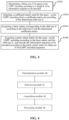
- FIG. 3 is a flowchart of a design method for quasi-cyclic low-density parity-check encoding according to an example 1 of the present invention. As shown in FIG. 3 , the method includes steps described below.
- a lifting size Z for the quasi-cyclic LDPC encoding is determined according to a length K of an information sequence to be encoded.
- a coefficient matrix used for the quasi-cyclic LDPC encoding is selected from a coefficient matrix set according to the determined lifting size Z.
- a basic matrix corresponding to the lifting size Z is obtained according to the lifting size Z and the determined coefficient matrix.
- a parity check matrix for the quasi-cyclic LDPC encoding is acquired according to the basic matrix and the lifting size Z, and the information sequence to be encoded is encoded according to the parity check matrix to obtain an N-bit LDPC encoded sequence, where K is a positive integer, N is an integer greater than K, and Z is a positive integer.
- the step 302 in which the lifting size Z for the quasi-cyclic LDPC encoding is determined according to the length K of the information sequence to be encoded includes: selecting a minimum lifting size greater than or equal to K/kb from a lifting size set Zset as the lifting size used for the current quasi-cyclic LDPC encoding, where kb is the determined maximum number of system columns corresponding to the length K of the information sequence to be encoded, kb is less than or equal to the maximum number kbmax of system columns of the basic matrix.
- the beneficial effect of this operation is that a minimum number of padding bits are required for the quasi-cyclic LDPC encoding and performance losses are prevented.
- the basic matrix corresponding to the lifting size Z may be calculated according to the determined lifting size Z and coefficient matrix.
- the calculation formula may also be a floor operation.
- the parity check matrix for the quasi-cyclic LDPC encoding may be obtained according to the acquired basic matrix and the lifting size Z, and the information sequence of length K to be encoded may be encoded according to the parity check matrix to obtain the LDPC encoded sequence.
- the information sequence to be encoded needs to be filled with kb ⁇ Z-K padding bits to obtain the information sequence to be encoded of kb ⁇ Z bits.
- the quasi-cyclic LDPC encoding is performed on the information sequence of kb ⁇ Z bits filled with the dummy bits to obtain an original LDPC encoded sequence of nb ⁇ Z bits.
- Bit selection is performed on the original LDPC encoded sequence to acquire the N-bit LDPC encoded sequence corresponding to a code rate.
- a bit selection method is to select from a (Z ⁇ 2+1)-th bit and skip the padding bits to cyclically select the N-bit LDPC encoded sequence.
- the filled kb ⁇ Z-K dummy bits are adopted to assist in encoding and are known for both a transmitting end and a receiving end. Therefore, these bits do not need to be transmitted.
- the parity check matrix is not necessarily required for the quasi-cyclic LDPC encoding in the encoding process. Since the quasi-cyclic LDPC encoding has very regular construction and strong structurality, the sequence to be encoded may directly be encoded according to the basic matrix and the lifting size.
- the lifting size subset corresponding to a coefficient matrix 1 is Zset1
- the lifting size subset corresponding to a coefficient matrix 2 is Zset2
- the lifting size subset corresponding to a coefficient matrix 3 is Zset3
- the lifting size subset corresponding to a coefficient matrix 4 is Zset4
- the lifting size subset corresponding to a coefficient matrix 5 is Zset5
- the lifting size subset corresponding to a coefficient matrix 6 is Zset6
- the lifting size subset corresponding to a coefficient matrix 7 is Zset7
- the lifting size subset corresponding to a coefficient matrix 8 is Zset8.
- the method specifically includes steps described below.
- FIG. 4 is a block diagram of a design apparatus for quasi-cyclic low-density parity-check encoding according to an example 2 of the present invention. As shown in FIG. 4 , the apparatus includes a determination module 40, a selection module 42, an acquisition module 44, and a processing module 46.
- the determination module 40 is configured to determine a lifting size Z for the quasi-cyclic LDPC encoding according to a length K of an information sequence to be encoded.
- the selection module 42 is configured to select a coefficient matrix used for the quasi-cyclic LDPC encoding from a coefficient matrix set according to the determined lifting size Z.
- the acquisition module 44 is configured to acquire a basic matrix corresponding to the lifting size Z according to the lifting size Z and the determined coefficient matrix.
- the processing module 46 is configured to acquire a parity check matrix for the quasi-cyclic LDPC encoding according to the basic matrix and the lifting size Z, and perform encoding on the information sequence to be encoded according to the parity check matrix to obtain an N-bit LDPC encoded sequence, where K is a positive integer, N is an integer greater than K, and Z is a positive integer.
- the determination module 40 determines the lifting size Z for the quasi-cyclic LDPC encoding according to the length K of the information sequence to be encoded by selecting a minimum lifting size greater than or equal to K/kb from a lifting size set Zset as the lifting size used for the current quasi-cyclic LDPC encoding, where kb is the determined maximum number of system columns corresponding to the length K of the information sequence to be encoded, kb is less than or equal to the maximum number kbmax of system columns of the basic matrix.
- the beneficial effect of this operation is that a minimum number of padding bits are required for the quasi-cyclic LDPC encoding and performance losses are prevented.
- the basic matrix corresponding to the lifting size Z may be calculated according to the determined lifting size Z and coefficient matrix.
- the calculation formula may also be a floor operation.
- P i,j is related to three variables V i,j , Z , and Z max . Therefore, it may be found that the acquired coefficient matrix is practically a basic matrix corresponding to Zmax, where Zmax is a maximum lifting size supported by the coefficient matrix.
- the parity check matrix for the quasi-cyclic LDPC encoding may be obtained according to the acquired basic matrix and the lifting size Z, and the information sequence of length K to be encoded may be encoded according to the parity check matrix to obtain the LDPC encoded sequence.
- the information sequence to be encoded needs to be filled with kb ⁇ Z-K dummy bits to obtain the information sequence to be encoded of kb ⁇ Z bits.
- the quasi-cyclic LDPC encoding is performed on the information sequence of kb ⁇ Z bits filled with the dummy bits to obtain an original LDPC encoded sequence of nb ⁇ Z bits.
- Bit selection is performed on the original LDPC encoded sequence to acquire the N-bit LDPC encoded sequence corresponding to a code rate.
- a bit selection method is to select from a (Z ⁇ 2+1)-th bit and skip the padding bits to cyclically select the N-bit LDPC encoded sequence.
- the filled kb ⁇ Z-K dummy bits are adopted to assist in encoding and are known for both a transmitting end and a receiving end. Therefore, these bits do not need to be transmitted.
- the parity check matrix is not necessarily required for the quasi-cyclic LDPC encoding in the encoding process. Since the quasi-cyclic LDPC encoding has very regular construction and strong structurality, the sequence to be encoded may directly be encoded according to the basic matrix and the lifting size.
- the lifting size subset corresponding to a coefficient matrix 1 is Zset1
- the lifting size subset corresponding to a coefficient matrix 2 is Zset2
- the lifting size subset corresponding to a coefficient matrix 3 is Zset3, ...
- the lifting size subset corresponding to a coefficient matrix 8 is Zset8
- the method specifically includes steps described below.
- the design method for quasi-cyclic LDPC encoding and the corresponding apparatus may effectively solve the problem of poor performance of a quasi-cyclic LDPC code and improve quasi-cyclic LDPC encoding performance.
- An embodiment of the present invention further provides a storage medium.
- the storage medium may be configured to store program codes for executing a step described below.
- LDPC encoding is performed on a K-bit information sequence to be encoded to obtain an N-bit LDPC encoded sequence.
- the storage medium may include, but is not limited to, a USB flash disk, a read-only memory (ROM), a random access memory (RAM), a mobile hard disk, a magnetic disk, an optical disk or another medium capable of storing program codes.
- ROM read-only memory
- RAM random access memory
- mobile hard disk a magnetic disk
- optical disk another medium capable of storing program codes.
- a processor performs, according to the program codes stored in the storage medium, the following step: according to a parity check matrix of a quasi-cyclic low-density parity-check (LDPC) code, LDPC encoding is performed on a K-bit information sequence to be encoded to obtain an N-bit LDPC encoded sequence.
- LDPC quasi-cyclic low-density parity-check
- each of the above-mentioned modules or steps of the present invention may be implemented by a general-purpose computing apparatus, the modules or steps may be concentrated on a single computing apparatus or distributed on a network composed of multiple computing apparatuses, and alternatively, the modules or steps may be implemented by program codes executable by the computing apparatus, so that the modules or steps may be stored in a storage apparatus and executed by the computing apparatus.
- the illustrated or described steps may be executed in sequences different from those described herein, or the modules or steps may be made into various integrated circuit modules separately, or multiple modules or steps therein may be made into a single integrated circuit module for implementation. In this way, the present invention is not limited to any specific combination of hardware and software.
- the embodiments of the present invention may be provided as methods, systems, or computer program products. Therefore, the present invention may adopt a form of a hardware embodiment, a software embodiment, or a combination of hardware and software embodiments. In addition, the present invention may adopt a form of a computer program product implemented on one or more computer-usable storage media (including, but not limited to, a disk memory, an optical memory, and the like) which include computer-usable program codes.
- a computer-usable storage media including, but not limited to, a disk memory, an optical memory, and the like
- These computer program instructions may also be stored in a computer-readable memory which may direct the computer or another programmable data processing device to operate in a particular manner so that the instructions stored in the computer-readable memory produce a manufactured product including an instructing means.
- the instructing means implements the functions specified in one or more flows in the flowcharts and/or one or more blocks in the block diagrams.
- the LDPC encoding is performed on the K-bit information sequence to be encoded according to the parity check matrix of the quasi-cyclic LDPC code, where the parity check matrix is determined according to the basic matrix and the lifting size Z, and the basic matrix is determined according to the lifting size Z and the coefficient matrix.
- the present invention solves the problem in the related art of poor performance of the quasi-cyclic LDPC code and effectively improves quasi-cyclic LDPC encoding performance.
Landscapes
- Physics & Mathematics (AREA)
- Engineering & Computer Science (AREA)
- Mathematical Physics (AREA)
- Computer Networks & Wireless Communication (AREA)
- Signal Processing (AREA)
- Probability & Statistics with Applications (AREA)
- Theoretical Computer Science (AREA)
- Error Detection And Correction (AREA)
- Medicines That Contain Protein Lipid Enzymes And Other Medicines (AREA)
- Lubricants (AREA)
- Transition And Organic Metals Composition Catalysts For Addition Polymerization (AREA)
- Peptides Or Proteins (AREA)
- Fats And Perfumes (AREA)
- Secondary Cells (AREA)
- Detergent Compositions (AREA)
- Electrotherapy Devices (AREA)
- Photoreceptors In Electrophotography (AREA)
Applications Claiming Priority (3)
| Application Number | Priority Date | Filing Date | Title |
|---|---|---|---|
| CN201710496533.7A CN109120374B (zh) | 2017-06-26 | 2017-06-26 | 准循环低密度奇偶校验编码设计方法及装置 |
| PCT/CN2018/090773 WO2019001263A1 (zh) | 2017-06-26 | 2018-06-12 | 准循环低密度奇偶校验编码设计方法、装置及存储介质 |
| EP18825447.8A EP3648379B1 (de) | 2017-06-26 | 2018-06-12 | Entwurfsverfahren und -vorrichtung für quasizyklische paritätsprüfung mit geringer dichte |
Related Parent Applications (2)
| Application Number | Title | Priority Date | Filing Date |
|---|---|---|---|
| EP18825447.8A Division-Into EP3648379B1 (de) | 2017-06-26 | 2018-06-12 | Entwurfsverfahren und -vorrichtung für quasizyklische paritätsprüfung mit geringer dichte |
| EP18825447.8A Division EP3648379B1 (de) | 2017-06-26 | 2018-06-12 | Entwurfsverfahren und -vorrichtung für quasizyklische paritätsprüfung mit geringer dichte |
Publications (2)
| Publication Number | Publication Date |
|---|---|
| EP4422100A2 true EP4422100A2 (de) | 2024-08-28 |
| EP4422100A3 EP4422100A3 (de) | 2024-11-13 |
Family
ID=64741063
Family Applications (2)
| Application Number | Title | Priority Date | Filing Date |
|---|---|---|---|
| EP24182281.6A Pending EP4422100A3 (de) | 2017-06-26 | 2018-06-12 | Entwurfsverfahren und -vorrichtung für quasizyklische paritätsprüfung mit niedriger dichte |
| EP18825447.8A Active EP3648379B1 (de) | 2017-06-26 | 2018-06-12 | Entwurfsverfahren und -vorrichtung für quasizyklische paritätsprüfung mit geringer dichte |
Family Applications After (1)
| Application Number | Title | Priority Date | Filing Date |
|---|---|---|---|
| EP18825447.8A Active EP3648379B1 (de) | 2017-06-26 | 2018-06-12 | Entwurfsverfahren und -vorrichtung für quasizyklische paritätsprüfung mit geringer dichte |
Country Status (12)
| Country | Link |
|---|---|
| US (2) | US11159178B2 (de) |
| EP (2) | EP4422100A3 (de) |
| JP (1) | JP6990259B2 (de) |
| KR (1) | KR102303379B1 (de) |
| CN (2) | CN115801191B (de) |
| AU (1) | AU2018295221B2 (de) |
| CA (1) | CA3068497C (de) |
| DK (1) | DK3648379T3 (de) |
| ES (1) | ES2985364T3 (de) |
| RU (1) | RU2743857C1 (de) |
| SG (1) | SG11201913212QA (de) |
| WO (1) | WO2019001263A1 (de) |
Families Citing this family (12)
| Publication number | Priority date | Publication date | Assignee | Title |
|---|---|---|---|---|
| EP3682546A4 (de) | 2017-09-11 | 2020-09-23 | ZTE Corporation | Verfahren und vorrichtung zur verarbeitung von ldpc-kodierten daten |
| CN111934692B (zh) * | 2020-08-20 | 2023-03-10 | 西安电子科技大学 | 基于bibd可变码率的量子ldpc码构造方法 |
| CN112511173A (zh) * | 2020-12-23 | 2021-03-16 | 中兴通讯股份有限公司 | 低密度奇偶校验编码、译码方法、编码、译码设备及介质 |
| CN114745617B (zh) * | 2021-01-07 | 2025-01-10 | 华为技术有限公司 | 上行fec编码和解码的方法、装置和光网络设备 |
| CN115549850A (zh) * | 2021-06-29 | 2022-12-30 | 华为技术有限公司 | 发送数据和接收数据的方法以及通信装置 |
| CN114286368B (zh) * | 2021-12-24 | 2023-05-30 | 北京中科晶上科技股份有限公司 | 循环移位的实现方法与装置 |
| CN117749315A (zh) * | 2022-09-13 | 2024-03-22 | 华为技术有限公司 | 编码方法、译码方法、通信装置及计算机可读存储介质 |
| CN119154890A (zh) * | 2023-06-14 | 2024-12-17 | 中兴通讯股份有限公司 | 一种编码方法、译码方法、装置以及存储介质 |
| WO2025053576A1 (ko) * | 2023-09-04 | 2025-03-13 | 삼성전자 주식회사 | 통신 또는 방송 시스템에서 데이터의 부호화 및 복호화 방법 및 장치 |
| KR20250052570A (ko) * | 2023-10-12 | 2025-04-21 | 삼성전자주식회사 | 통신 또는 방송 시스템에서 데이터의 부호화 및 복호화방법 및 장치 |
| US20250202503A1 (en) * | 2023-12-15 | 2025-06-19 | Avago Technologies International Sales Pte. Limited | Systems and methods for block-kronecker based low density parity check (ldpc) code with 1/2 code rate |
| CN121333324A (zh) * | 2024-07-12 | 2026-01-13 | 华为技术有限公司 | 基于ldpc码的通信方法和通信装置 |
Family Cites Families (22)
| Publication number | Priority date | Publication date | Assignee | Title |
|---|---|---|---|---|
| EP1526647B1 (de) * | 2002-07-02 | 2008-10-01 | Mitsubishi Electric Corporation | Erzeugung einer Prüfmatrix für irregulare Low-Density Parity-Check (LDPC) Codes |
| CN102638275B (zh) * | 2004-06-24 | 2015-01-28 | Lg电子株式会社 | 无线通信系统中使用低密度奇偶校验码编码和解码数据的方法和装置 |
| CN100486150C (zh) * | 2005-01-23 | 2009-05-06 | 中兴通讯股份有限公司 | 基于非正则低密度奇偶校验码的编译码器及其生成方法 |
| CN100502245C (zh) * | 2005-10-21 | 2009-06-17 | 中兴通讯股份有限公司 | 支持任何码率/码长的低密度奇偶校验码编码装置和方法 |
| CN100596029C (zh) * | 2006-10-20 | 2010-03-24 | 北京泰美世纪科技有限公司 | Ldpc码校验矩阵构造方法及利用该方法的编码解码装置 |
| CN101217337B (zh) * | 2007-01-01 | 2013-01-23 | 中兴通讯股份有限公司 | 一种支持递增冗余混合自动重传的低密度奇偶校验码编码装置和方法 |
| CN102904583B (zh) * | 2007-01-24 | 2017-06-23 | 高通股份有限公司 | 对可变大小分组进行ldpc编码和译码 |
| KR101502623B1 (ko) * | 2008-02-11 | 2015-03-16 | 삼성전자주식회사 | 저밀도 패리티 검사 부호를 사용하는 통신 시스템에서 채널부호/복호 방법 및 장치 |
| CN101534128A (zh) * | 2009-04-27 | 2009-09-16 | 东南大学 | 低密度奇偶校验码校验矩阵的构造方法 |
| CN102412842B (zh) * | 2010-09-25 | 2016-06-15 | 中兴通讯股份有限公司 | 一种低密度奇偶校验码的编码方法及装置 |
| CN101953335B (zh) | 2010-10-26 | 2012-11-21 | 江苏七洲绿色化工股份有限公司 | 一种嗪草酮胶悬剂及其制备方法 |
| EP2525497A1 (de) | 2011-05-18 | 2012-11-21 | Panasonic Corporation | Bitverschachtelte Codierte Modulation (BICM) mit quasi-zyklischen LDPC Codes |
| US8499218B2 (en) * | 2011-09-30 | 2013-07-30 | Mitsubishi Electric Research Laboratories, Inc. | System and method for determining quasi-cyclic low-density parity-check codes having high girth |
| KR102104937B1 (ko) * | 2013-06-14 | 2020-04-27 | 삼성전자주식회사 | Ldpc 부호의 부호화 장치, 그의 부호화 방법, 복호화 장치 및 그의 복호화 방법 |
| CN104202057B (zh) * | 2014-02-12 | 2019-08-16 | 中兴通讯股份有限公司 | 信息处理方法及装置 |
| US9479289B2 (en) * | 2014-08-14 | 2016-10-25 | Electronics And Telecommunications Research Institute | Low density parity check encoder having length of 16200 and code rate of 5/15, and low density parity check encoding method using the same |
| US9692451B2 (en) | 2014-09-30 | 2017-06-27 | Avago Technologies General Ip (Singapore) Pte. Ltd | Non-binary low density parity check (NB-LDPC) codes for communication systems |
| US10523364B2 (en) | 2015-11-06 | 2019-12-31 | Samsung Electronics Co., Ltd. | Channel coding framework for 802.11AY and larger block-length LDPC codes for 11AY with 2-step lifting matrices and in-place property |
| EP3264611A1 (de) * | 2016-05-12 | 2018-01-03 | MediaTek Inc. | Qc-ldpc-codierungsverfahren und -vorrichtung |
| CN106059595B (zh) * | 2016-05-26 | 2020-07-07 | 北京邮电大学 | 空间耦合低密度奇偶校验码的通用递归编码方法 |
| TWI702800B (zh) * | 2017-05-05 | 2020-08-21 | 聯發科技股份有限公司 | Qc-ldpc編碼方法、裝置及非暫時性電腦可讀介質 |
| US10484013B2 (en) * | 2017-05-12 | 2019-11-19 | Mediatek Inc. | Shift-coefficient table design of QC-LDPC code for smaller code block sizes in mobile communications |
-
2017
- 2017-06-26 CN CN202211429481.9A patent/CN115801191B/zh active Active
- 2017-06-26 CN CN201710496533.7A patent/CN109120374B/zh active Active
-
2018
- 2018-06-12 DK DK18825447.8T patent/DK3648379T3/da active
- 2018-06-12 KR KR1020207002291A patent/KR102303379B1/ko active Active
- 2018-06-12 EP EP24182281.6A patent/EP4422100A3/de active Pending
- 2018-06-12 CA CA3068497A patent/CA3068497C/en active Active
- 2018-06-12 EP EP18825447.8A patent/EP3648379B1/de active Active
- 2018-06-12 RU RU2020102664A patent/RU2743857C1/ru active
- 2018-06-12 JP JP2019572093A patent/JP6990259B2/ja active Active
- 2018-06-12 ES ES18825447T patent/ES2985364T3/es active Active
- 2018-06-12 AU AU2018295221A patent/AU2018295221B2/en active Active
- 2018-06-12 WO PCT/CN2018/090773 patent/WO2019001263A1/zh not_active Ceased
- 2018-06-12 SG SG11201913212QA patent/SG11201913212QA/en unknown
-
2019
- 2019-12-26 US US16/727,714 patent/US11159178B2/en active Active
-
2021
- 2021-10-25 US US17/510,216 patent/US11626888B2/en active Active
Also Published As
| Publication number | Publication date |
|---|---|
| CA3068497A1 (en) | 2019-01-03 |
| WO2019001263A1 (zh) | 2019-01-03 |
| ES2985364T3 (es) | 2024-11-05 |
| DK3648379T3 (da) | 2024-09-02 |
| CA3068497C (en) | 2022-08-30 |
| CN115801191A (zh) | 2023-03-14 |
| US11159178B2 (en) | 2021-10-26 |
| SG11201913212QA (en) | 2020-01-30 |
| EP3648379B1 (de) | 2024-08-14 |
| KR102303379B1 (ko) | 2021-09-24 |
| CN109120374A (zh) | 2019-01-01 |
| JP6990259B2 (ja) | 2022-01-12 |
| EP3648379A1 (de) | 2020-05-06 |
| EP3648379A4 (de) | 2020-07-08 |
| AU2018295221A1 (en) | 2020-02-06 |
| US11626888B2 (en) | 2023-04-11 |
| EP4422100A3 (de) | 2024-11-13 |
| AU2018295221B2 (en) | 2021-06-24 |
| US20220069843A1 (en) | 2022-03-03 |
| US20200145026A1 (en) | 2020-05-07 |
| JP2020526117A (ja) | 2020-08-27 |
| KR20200035023A (ko) | 2020-04-01 |
| CN109120374B (zh) | 2022-11-18 |
| CN115801191B (zh) | 2024-09-13 |
| RU2743857C1 (ru) | 2021-03-01 |
Similar Documents
| Publication | Publication Date | Title |
|---|---|---|
| US11626888B2 (en) | Method and apparatus for quasi-cyclic low-density parity-check | |
| JP7565976B2 (ja) | データ符号化方法及び装置、記憶媒体、並びにプロセッサ | |
| US11139835B2 (en) | Method and apparatus for data processing with structured LDPC codes | |
| KR100739510B1 (ko) | 반구조적 블록 저밀도 패리티 검사 부호 부호화/복호 장치및 방법 | |
| CN102412842B (zh) | 一种低密度奇偶校验码的编码方法及装置 | |
| CN108270448B (zh) | 准循环低密度奇偶校验编码方法及装置 | |
| CN107733440B (zh) | 多边类型结构化ldpc处理方法及装置 | |
| CN107733442B (zh) | 结构化ldpc码的处理方法及装置 | |
| CN119561655A (zh) | 一种数据校验方法、装置、设备及介质 | |
| US11683051B2 (en) | Method and apparatus for data processing with structured LDPC codes | |
| JP4832447B2 (ja) | チャネルコードを用いた復号化装置及び方法 | |
| KR20190000768A (ko) | 통신 또는 방송 시스템에서 채널 부호화/복호화 방법 및 장치 |
Legal Events
| Date | Code | Title | Description |
|---|---|---|---|
| PUAI | Public reference made under article 153(3) epc to a published international application that has entered the european phase |
Free format text: ORIGINAL CODE: 0009012 |
|
| STAA | Information on the status of an ep patent application or granted ep patent |
Free format text: STATUS: THE APPLICATION HAS BEEN PUBLISHED |
|
| AC | Divisional application: reference to earlier application |
Ref document number: 3648379 Country of ref document: EP Kind code of ref document: P |
|
| AK | Designated contracting states |
Kind code of ref document: A2 Designated state(s): AL AT BE BG CH CY CZ DE DK EE ES FI FR GB GR HR HU IE IS IT LI LT LU LV MC MK MT NL NO PL PT RO RS SE SI SK SM TR |
|
| PUAL | Search report despatched |
Free format text: ORIGINAL CODE: 0009013 |
|
| AK | Designated contracting states |
Kind code of ref document: A3 Designated state(s): AL AT BE BG CH CY CZ DE DK EE ES FI FR GB GR HR HU IE IS IT LI LT LU LV MC MK MT NL NO PL PT RO RS SE SI SK SM TR |
|
| RIC1 | Information provided on ipc code assigned before grant |
Ipc: H04L 1/00 20060101AFI20241008BHEP |
|
| STAA | Information on the status of an ep patent application or granted ep patent |
Free format text: STATUS: REQUEST FOR EXAMINATION WAS MADE |
|
| 17P | Request for examination filed |
Effective date: 20250414 |