EP4421133A1 - Wässrige zubereitung enthaltend mindestens ein wässriges hydrophobierungsmittel zur herstellung wässriger beschichtungsmitteln mit verbesserter frühregenbeständigkeit - Google Patents
Wässrige zubereitung enthaltend mindestens ein wässriges hydrophobierungsmittel zur herstellung wässriger beschichtungsmitteln mit verbesserter frühregenbeständigkeit Download PDFInfo
- Publication number
- EP4421133A1 EP4421133A1 EP24158528.0A EP24158528A EP4421133A1 EP 4421133 A1 EP4421133 A1 EP 4421133A1 EP 24158528 A EP24158528 A EP 24158528A EP 4421133 A1 EP4421133 A1 EP 4421133A1
- Authority
- EP
- European Patent Office
- Prior art keywords
- aqueous
- polyquaternium
- cationic polymer
- mol
- poly
- Prior art date
- Legal status (The legal status is an assumption and is not a legal conclusion. Google has not performed a legal analysis and makes no representation as to the accuracy of the status listed.)
- Pending
Links
Images


Classifications
-
- C—CHEMISTRY; METALLURGY
- C09—DYES; PAINTS; POLISHES; NATURAL RESINS; ADHESIVES; COMPOSITIONS NOT OTHERWISE PROVIDED FOR; APPLICATIONS OF MATERIALS NOT OTHERWISE PROVIDED FOR
- C09D—COATING COMPOSITIONS, e.g. PAINTS, VARNISHES OR LACQUERS; FILLING PASTES; CHEMICAL PAINT OR INK REMOVERS; INKS; CORRECTING FLUIDS; WOODSTAINS; PASTES OR SOLIDS FOR COLOURING OR PRINTING; USE OF MATERIALS THEREFOR
- C09D5/00—Coating compositions, e.g. paints, varnishes or lacquers, characterised by their physical nature or the effects produced; Filling pastes
- C09D5/16—Antifouling paints; Underwater paints
- C09D5/1687—Use of special additives
-
- C—CHEMISTRY; METALLURGY
- C08—ORGANIC MACROMOLECULAR COMPOUNDS; THEIR PREPARATION OR CHEMICAL WORKING-UP; COMPOSITIONS BASED THEREON
- C08J—WORKING-UP; GENERAL PROCESSES OF COMPOUNDING; AFTER-TREATMENT NOT COVERED BY SUBCLASSES C08B, C08C, C08F, C08G or C08H
- C08J3/00—Processes of treating or compounding macromolecular substances
- C08J3/02—Making solutions, dispersions, lattices or gels by other methods than by solution, emulsion or suspension polymerisation techniques
- C08J3/03—Making solutions, dispersions, lattices or gels by other methods than by solution, emulsion or suspension polymerisation techniques in aqueous media
- C08J3/07—Making solutions, dispersions, lattices or gels by other methods than by solution, emulsion or suspension polymerisation techniques in aqueous media from polymer solutions
-
- C—CHEMISTRY; METALLURGY
- C09—DYES; PAINTS; POLISHES; NATURAL RESINS; ADHESIVES; COMPOSITIONS NOT OTHERWISE PROVIDED FOR; APPLICATIONS OF MATERIALS NOT OTHERWISE PROVIDED FOR
- C09D—COATING COMPOSITIONS, e.g. PAINTS, VARNISHES OR LACQUERS; FILLING PASTES; CHEMICAL PAINT OR INK REMOVERS; INKS; CORRECTING FLUIDS; WOODSTAINS; PASTES OR SOLIDS FOR COLOURING OR PRINTING; USE OF MATERIALS THEREFOR
- C09D7/00—Features of coating compositions, not provided for in group C09D5/00; Processes for incorporating ingredients in coating compositions
- C09D7/40—Additives
- C09D7/65—Additives macromolecular
-
- C—CHEMISTRY; METALLURGY
- C08—ORGANIC MACROMOLECULAR COMPOUNDS; THEIR PREPARATION OR CHEMICAL WORKING-UP; COMPOSITIONS BASED THEREON
- C08L—COMPOSITIONS OF MACROMOLECULAR COMPOUNDS
- C08L1/00—Compositions of cellulose, modified cellulose or cellulose derivatives
- C08L1/08—Cellulose derivatives
- C08L1/26—Cellulose ethers
- C08L1/28—Alkyl ethers
- C08L1/284—Alkyl ethers with hydroxylated hydrocarbon radicals
-
- C—CHEMISTRY; METALLURGY
- C08—ORGANIC MACROMOLECULAR COMPOUNDS; THEIR PREPARATION OR CHEMICAL WORKING-UP; COMPOSITIONS BASED THEREON
- C08L—COMPOSITIONS OF MACROMOLECULAR COMPOUNDS
- C08L39/00—Compositions of homopolymers or copolymers of compounds having one or more unsaturated aliphatic radicals, each having only one carbon-to-carbon double bond, and at least one being terminated by a single or double bond to nitrogen or by a heterocyclic ring containing nitrogen; Compositions of derivatives of such polymers
- C08L39/02—Homopolymers or copolymers of vinylamine
-
- C—CHEMISTRY; METALLURGY
- C08—ORGANIC MACROMOLECULAR COMPOUNDS; THEIR PREPARATION OR CHEMICAL WORKING-UP; COMPOSITIONS BASED THEREON
- C08L—COMPOSITIONS OF MACROMOLECULAR COMPOUNDS
- C08L79/00—Compositions of macromolecular compounds obtained by reactions forming in the main chain of the macromolecule a linkage containing nitrogen with or without oxygen or carbon only, not provided for in groups C08L61/00 - C08L77/00
- C08L79/02—Polyamines
-
- C—CHEMISTRY; METALLURGY
- C08—ORGANIC MACROMOLECULAR COMPOUNDS; THEIR PREPARATION OR CHEMICAL WORKING-UP; COMPOSITIONS BASED THEREON
- C08L—COMPOSITIONS OF MACROMOLECULAR COMPOUNDS
- C08L83/00—Compositions of macromolecular compounds obtained by reactions forming in the main chain of the macromolecule a linkage containing silicon with or without sulfur, nitrogen, oxygen or carbon only; Compositions of derivatives of such polymers
- C08L83/04—Polysiloxanes
-
- C—CHEMISTRY; METALLURGY
- C09—DYES; PAINTS; POLISHES; NATURAL RESINS; ADHESIVES; COMPOSITIONS NOT OTHERWISE PROVIDED FOR; APPLICATIONS OF MATERIALS NOT OTHERWISE PROVIDED FOR
- C09D—COATING COMPOSITIONS, e.g. PAINTS, VARNISHES OR LACQUERS; FILLING PASTES; CHEMICAL PAINT OR INK REMOVERS; INKS; CORRECTING FLUIDS; WOODSTAINS; PASTES OR SOLIDS FOR COLOURING OR PRINTING; USE OF MATERIALS THEREFOR
- C09D5/00—Coating compositions, e.g. paints, varnishes or lacquers, characterised by their physical nature or the effects produced; Filling pastes
- C09D5/02—Emulsion paints including aerosols
- C09D5/022—Emulsions, e.g. oil in water
-
- C—CHEMISTRY; METALLURGY
- C09—DYES; PAINTS; POLISHES; NATURAL RESINS; ADHESIVES; COMPOSITIONS NOT OTHERWISE PROVIDED FOR; APPLICATIONS OF MATERIALS NOT OTHERWISE PROVIDED FOR
- C09D—COATING COMPOSITIONS, e.g. PAINTS, VARNISHES OR LACQUERS; FILLING PASTES; CHEMICAL PAINT OR INK REMOVERS; INKS; CORRECTING FLUIDS; WOODSTAINS; PASTES OR SOLIDS FOR COLOURING OR PRINTING; USE OF MATERIALS THEREFOR
- C09D5/00—Coating compositions, e.g. paints, varnishes or lacquers, characterised by their physical nature or the effects produced; Filling pastes
- C09D5/02—Emulsion paints including aerosols
- C09D5/024—Emulsion paints including aerosols characterised by the additives
-
- C—CHEMISTRY; METALLURGY
- C09—DYES; PAINTS; POLISHES; NATURAL RESINS; ADHESIVES; COMPOSITIONS NOT OTHERWISE PROVIDED FOR; APPLICATIONS OF MATERIALS NOT OTHERWISE PROVIDED FOR
- C09D—COATING COMPOSITIONS, e.g. PAINTS, VARNISHES OR LACQUERS; FILLING PASTES; CHEMICAL PAINT OR INK REMOVERS; INKS; CORRECTING FLUIDS; WOODSTAINS; PASTES OR SOLIDS FOR COLOURING OR PRINTING; USE OF MATERIALS THEREFOR
- C09D5/00—Coating compositions, e.g. paints, varnishes or lacquers, characterised by their physical nature or the effects produced; Filling pastes
- C09D5/02—Emulsion paints including aerosols
- C09D5/024—Emulsion paints including aerosols characterised by the additives
- C09D5/027—Dispersing agents
-
- C—CHEMISTRY; METALLURGY
- C09—DYES; PAINTS; POLISHES; NATURAL RESINS; ADHESIVES; COMPOSITIONS NOT OTHERWISE PROVIDED FOR; APPLICATIONS OF MATERIALS NOT OTHERWISE PROVIDED FOR
- C09D—COATING COMPOSITIONS, e.g. PAINTS, VARNISHES OR LACQUERS; FILLING PASTES; CHEMICAL PAINT OR INK REMOVERS; INKS; CORRECTING FLUIDS; WOODSTAINS; PASTES OR SOLIDS FOR COLOURING OR PRINTING; USE OF MATERIALS THEREFOR
- C09D5/00—Coating compositions, e.g. paints, varnishes or lacquers, characterised by their physical nature or the effects produced; Filling pastes
- C09D5/16—Antifouling paints; Underwater paints
- C09D5/1606—Antifouling paints; Underwater paints characterised by the anti-fouling agent
- C09D5/1637—Macromolecular compounds
-
- C—CHEMISTRY; METALLURGY
- C09—DYES; PAINTS; POLISHES; NATURAL RESINS; ADHESIVES; COMPOSITIONS NOT OTHERWISE PROVIDED FOR; APPLICATIONS OF MATERIALS NOT OTHERWISE PROVIDED FOR
- C09D—COATING COMPOSITIONS, e.g. PAINTS, VARNISHES OR LACQUERS; FILLING PASTES; CHEMICAL PAINT OR INK REMOVERS; INKS; CORRECTING FLUIDS; WOODSTAINS; PASTES OR SOLIDS FOR COLOURING OR PRINTING; USE OF MATERIALS THEREFOR
- C09D7/00—Features of coating compositions, not provided for in group C09D5/00; Processes for incorporating ingredients in coating compositions
- C09D7/40—Additives
- C09D7/45—Anti-settling agents
Definitions
- the present invention relates to an aqueous preparation comprising at least one aqueous hydrophobizing agent for producing aqueous coating compositions with improved early rain resistance.
- the drying speed of water-based coatings depends on the temperature and humidity. At low humidity, the drying speed is often fast, sometimes even faster than with solvent-based coatings. However, at high humidity and low temperatures, such as in the morning and evening, and before, during and after rainfall, the drying speed is significantly slower because the evaporation of the water is delayed. Such coatings are then only rainproof after very long drying times. A certain early rain resistance or rain resistance of water-based coatings before they are completely dry is particularly desired for outdoor applications, such as paints for buildings, bridges, ships and road markings, as well as for external plasters.
- the coating agent contains an anionically stabilized binder, a polyamine and ammonia as a volatile base, which evaporates after the coating agent has been applied, causing the binder to flocculate during drying ( US$ 5,527,853 , EP0 594 321 , EP0 728 822 , EP0 409 459 ).
- the coating agent also contains an ionically stabilized binder. The flocculation of this is achieved by spraying an acid solution or a salt solution at the same time as the coating agent ( WO 94/29 391 , EP0 200 249 , US 4 571 415 , US$ 5,403,393 ).
- a change in the viscosity of the surface of the coating agent can be achieved by either applying a thickener to the fresh coating, which leads to an increase in viscosity, as in the EP0 721 003 disclosed, or a base is applied to the fresh coating which contains a thickener which is, however, not activated by setting a low pH value.
- the EP0 804 514 describes fast-drying, aqueous coating compositions comprising an aqueous, anionically stabilized emulsion and a polyimine.
- a polyimine to a coating composition based on an aqueous, anionically stabilized emulsion has the disadvantage that the mixture tends to yellow once it has dried. This is particularly the case with emulsions based on vinyl acetate copolymers. For decorative outdoor applications, this yellowing of the coating results in undesirable color shifts.
- the charge of a polyimine depends on the pH. At higher pH values, the charge equilibrium of the polyimine shifts increasingly from the cationic to the neutral range, which leads to a loss of effectiveness.
- modern coating agents are often set to a higher pH in order to be able to reduce the proliferation of microorganisms while at the same time using a small amount of biocides.
- EP1 250 388 which describes a fast-drying, aqueous coating agent containing at least one aqueous binder which additionally contains at least one water-soluble, quaternary poly(allylamine) and a non-ionic surfactant.
- the disadvantage here is the increase in viscosity during storage.
- an aqueous preparation containing at least one aqueous hydrophobizing agent and at least one water-soluble, cationic polymer is proposed.
- the combination of hydrophobic agents and water-soluble, cationic polymers results in an improvement in early rain resistance.
- the coatings produced with the aqueous preparation according to the invention exhibited improved early rain resistance than conventional coatings.
- the aqueous coating agent according to the invention also exhibited a lower increase in viscosity during storage.
- hydrophobicity of a coating can be increased by adding a hydrophobic agent. In this way, coatings and thus also the substrates can be protected against the penetration of water.
- a hydrophobic coating or surface can be characterized by determining the contact angle of a water drop, which should be between 90 and 180° ( Water-based silicone resin coating systems for facades: Basics, formulations, practical application, problem solutions / Wolfgang Schultze, 2nd edition, expert-verlag 2002, p.18 ).
- the contact angle can be determined using an optical contact angle measuring device in combination with a contour analysis system according to DIN 55660.
- the hydrophobic agent is added to the finished dispersion of the ground material in the form of an aqueous emulsion, which has been produced using emulsifiers, into which the binding agent is then also stirred.
- aqueous emulsion which has been produced using emulsifiers, into which the binding agent is then also stirred.
- paints and plasters initially have a relatively high water absorption capacity for a certain period of time ("wash-out period"), so that their initial resistance to water is limited.
- hydrophobic agents are based on organosilicon compounds, which are used individually or in combination. Examples include alkoxysilanes, silicone oils, silicone resins and siliconates (see also: Water-based silicone resin coating systems for facades: Basics, formulations, practical application, problem solutions / Wolfgang Schultze, 2nd edition, expert-verlag 2002, pp. 69-74 ).
- the alkoxysilanes are preferably compounds according to formula (I), R 1 a Si(OR 2 ) b Formula (I) where a is greater than or equal to 0 to less than or equal to 2, b is greater than or equal to 2 to less than or equal to 4 and the sum of a + b is 4.
- Alkyl groups are preferably methyl, ethyl, propyl, isopropyl, n-butyl, s-butyl, t-butyl groups.
- the aromatic group is preferably a phenyl group.
- Preferred substituents R 1 are methyl or phenyl or mixtures of methyl and phenyl radicals.
- Preferred alkyl groups of the radical R 2 are methyl, ethyl, propyl, isopropyl, n-butyl, s-butyl, or t-butyl groups.
- the alkoxysilane is preferably octyltriethoxysilane.
- the silicone oils are preferably compounds according to formula (II), R 3 O(Si(R 4 ) 2 O) n R 3 Formula (II)
- R 3 is, independently of one another, a hydrogen atom, a trimethylsilyl or alkyl group, for example a methyl or ethyl group.
- R 4 is, independently of one another, identical or different, a linear or branched, saturated as well as mono- or polyunsaturated alkyl group consisting of 1 to 20 carbon atoms, or an organic group consisting of 1 to 8 carbon atoms and 1 to 2 nitrogen or oxygen atoms, or an organosilicon group consisting of a silicon atom, 1 to 15 carbon atoms and 1 to 4 oxygen atoms, or an aromatic group having 6 to 20 carbon atoms.
- R 4 is preferably a methyl, a 3-aminopropyl, an N-2-(aminoethyl)-3-aminopropyl, a 2-(trimethoxysilyl)ethyl, a 2-(triethoxysilyl)ethyl, or a phenyl group.
- the degree of polymerization n is between 1 and 10,000, preferably between 3 and 1,000, and most preferably between 5 and 300.
- the silicone resins are preferably polymeric compounds according to formula (III), R 5 c Si(OR 6 ) d O (4-cd)/2 Formula (III) where c is greater than or equal to 0 to less than or equal to 2 and d is greater than or equal to 0 to less than or equal to 4, and the sum of c + d is less than 4.
- the R 5 are independently of one another, identical or different, linear or branched, saturated as well as mono- or polyunsaturated or aromatic hydrocarbon radicals, or an organic group consisting of 1 to 8 carbon atoms and 1 to 2 nitrogen or oxygen atoms.
- R 6 is a hydrogen atom or an alkyl group consisting of 1 to 8 carbon atoms.
- R 5 is preferably a methyl, propyl, phenyl, 3-aminopropyl or octyl group.
- R 6 is preferably a hydrogen atom, a methyl or ethyl group.
- Formula (III) is the smallest unit of the average structural formula of the silicone resin.
- the hydrophobizing agent is preferably an aqueous silicone resin emulsion, a silicone oil emulsion, an emulsion or microemulsion of an amino-functional silicone oil, a silane emulsion, or mixtures thereof.
- the hydrophobizing agent can also be an aqueous emulsion based on two or more organosilicon compounds.
- hydrophobic agents can be used as long as they can be used in aqueous coatings.
- Commercially available hydrophobic agents include: Tego Phobe ® 1401, 1409, 1650, 1659, 6510 and 6600 from Evonik, Silres ® BS45, BS54, BS60, BS6042, BS1001 and BS1306 from Wacker, Dowsil ® IE 2404, IE 6683, IE 6694 and Z-70 Emulsion from Dow, Variphob ® SR 550, SR 580, HP 105, HP 120 from CHT, Bluesil BP 9710, BP 9878, BP 9800, BP 9821, BP 9900, BP 9705, PB 9920 from Elkem Silicones and Silsan ® CC55, HSB, DSH, WS 1800, 1300 and 1350 from Graf Chemicals.
- the water-soluble, cationic polymer has quaternary ammonium groups.
- Preferred water-soluble, cationic polymers are those compounds selected from poly[(dimethylimino)-2-butene-1,4-diyl]chloride (Polyquaternium-1), poly(diallyldimethylammonium chloride) (Polyquaternium-6), copolymer of acrylamide with quaternized dimethylammonium ethyl methacrylate, poly ⁇ bis(2-chloroethyl)ether-alt-1,3-bis[3(dimethylamino)propyl]urea ⁇ (Polyquaternium-2), hydroxyethylcellulosedimethyldiallylammonium chloride copolymer (Polyquaternium-4), poly(acrylamide-methacryloyloxyethyltrimethylammonium methyl sulfate) (Polyquaternium-5), poly(diallyldimethylammonium chloride-co-acrylamide) (Polyquaternium-7), quaternized hydroxyethylcellulose (Pol
- poly(diallyldimethylammonium chloride) and quaternized hydroxyethyl cellulose are particularly preferred.
- poly(diallyldimethylammonium chloride) and quaternized hydroxyethyl cellulose are particularly preferred.
- the water-soluble, cationic polymer preferably contains amino groups. It is particularly preferably polyethyleneimine.
- the weight average molecular weight of the water-soluble, cationic polymer is preferably in the range from 10,000 g/mol to 2,000,000 g/mol, particularly preferably in the range from 20,000 g/mol to 1,000,000 g/mol and very particularly preferably in the range from 30,000 g/mol to 500,000 g/mol
- the aqueous preparation preferably comprises 0.05 wt.% - 5.0 wt.%, preferably 0.1 wt.% - 3.0 wt.%, particularly preferably 0.2 wt.% - 2.0 wt.% of the cationic polymer based on the preparation.
- a further invention is the use of the aqueous preparation according to the invention as an additive for the production of aqueous coating compositions with improved early rain resistance.
- the invention also relates to coating compositions containing an aqueous preparation according to the invention.
- the coating agent contains, in addition to the aqueous preparation according to the invention, optionally also film-forming aids, pigments, fillers, thickeners, leveling agents, dispersants, wetting agents, preservatives, emulsifiers, protective colloids and/or defoamers.
- film-forming aids pigments, fillers, thickeners, leveling agents, dispersants, wetting agents, preservatives, emulsifiers, protective colloids and/or defoamers.
- the coating compositions according to the invention are preferably plasters, paints, primers or wood coatings for outdoor applications.
- the coating compositions according to the invention are particularly preferably synthetic resin plasters, facade paints, road marking paints or wood preservative paints.
- the binding agent can of course also be a mixture of different binding agents.
- the weight proportion of binder (solid) in the coating agent is preferably between 1.0 - 50.0 wt.% and particularly preferably between 3.0 - 25.0 wt.%, based on the weight of dry material in the coating agent.
- the aqueous binder is added as the last ingredient to the mixture if an emulsifier or a mixture of emulsifiers, film-forming aids, pigments, fillers, Thickeners, leveling agents, protective colloids, dispersants, wetting agents, preservatives and/or defoamers are used.
- an emulsifier or a mixture of emulsifiers, film-forming aids, pigments, fillers, Thickeners, leveling agents, protective colloids, dispersants, wetting agents, preservatives and/or defoamers are used.
- the binders are preferably aqueous polymer dispersions based on homo- and/or copolymers.
- Particularly preferred homo- and copolymers contain at least one olefinically unsaturated monomer as a monomer building block.
- copolymers which contain 70 to 99.7% by weight, based on the total amount of monomers, of radically polymerizable olefinically unsaturated compounds from the group of acrylic and methacrylic acid esters of (C1 to C12) monoalcohols, preferably of (C1 to C8) monoalcohols, for example methanol, ethanol, isopropanol, isobutanol, n-butanol and 2-ethylhexyl alcohol, of vinylaromatic monomers, for example styrene, of vinyl esters of (C1 to C12) alkanemonocarboxylic acids, for example vinyl acetate, vinyl propionate, vinyl n-butyrate, vinyl laurate, VeoVa ® 9 and VeoVa ® 10, of vinyl halides, for example vinyl chloride and vinylidene chloride, of ⁇ - and ⁇ -monoolefinically unsaturated nitriles, for example
- the copolymers preferably also contain 0.3 to 10% by weight, particularly preferably 0.5 to 5% by weight, based on the total amount of monomers, of ⁇ - and ⁇ -mono-olefinically unsaturated mono- and dicarboxylic acids, for example acrylic acid, methacrylic acid, itaconic acid, maleic acid and fumaric acid, and their amides optionally substituted on the nitrogen atoms, for example acrylamide, methacrylamide, N-methylolacrylamide and N-butoxymethacrylamide.
- ⁇ - and ⁇ -mono-olefinically unsaturated mono- and dicarboxylic acids for example acrylic acid, methacrylic acid, itaconic acid, maleic acid and fumaric acid, and their amides optionally substituted on the nitrogen atoms, for example acrylamide, methacrylamide, N-methylolacrylamide and N-butoxymethacrylamide.
- hydroxyl-containing monomers such as hydroxyalkyl acrylates and methacrylates, in particular hydroxyethyl methacrylate and hydroxypropyl methacrylate
- monomers which improve wet adhesion and contain acetylacetoxy groups in particular allyl acetoacetate, acetylacetoxyethyl methacrylate and acetylacetoxybutyl methacrylate, and/or monomers which have a crosslinking effect, such as monomers which contain epoxy groups and silane groups, in particular glycidyl acrylate, glycidyl methacrylate, vinyltrimethoxysilane and methacryloxypropyltrimethoxysilane, and/or nitrogen-containing monomers from the group of polymerizable monomers with an
- Self-crosslinking dispersions may contain up to 5% by weight of polymers containing keto groups, based on the total amount of monomers, or of a di- or polyfunctional carboxylic acid hydrazide, for example adipic acid hydrazide.
- the polymer dispersions used as binders are preferably anionically stabilized polymer dispersions or polymer dispersions stabilized with mixtures of nonionic and anionic stabilizers or mixtures of nonionic emulsifiers, anionic emulsifiers and protective colloids.
- Suitable non-ionic emulsifiers include alkyl polyglycol ethers or alkoxylation products of polypropylene oxide.
- Suitable anionic emulsifiers are primarily the alkali or ammonium salts of alkyl, aryl or alkylaryl sulfonates, sulfates, phosphates or phosphonates.
- Suitable protective colloids are natural substances such as gum arabic, starch and alginates, modified natural substances such as cellulose derivatives or synthetic polymers such as polyvinyl alcohol and polyvinylpyrrolidone or mixtures thereof.
- the polymer dispersions may also contain additives, auxiliaries and/or non-copolymerizable crosslinkers.
- an aqueous preparation containing 0.05 wt.% - 5.0 wt.%, preferably 0.1 wt.% - 3.0 wt.%, particularly preferably 0.2 wt.% - 2.0 wt.% of the cationic polymer based on the preparation is used for the process according to the invention.
- the cationic polymer has quaternary ammonium groups.
- Preferred water-soluble, cationic polymers are those compounds selected from poly[(dimethylimino)-2-butene-1,4-diyl]chloride (Polyquaternium-1), poly(diallyldimethylammonium chloride) (Polyquaternium-6), copolymer of acrylamide with quaternized dimethylammoniumethyl methacrylate, poly ⁇ bis(2-chloroethyl)ether-alt-1,3-bis[3(dimethylamino)propyl]urea ⁇ (Polyquaternium-2), hydroxyethylcellulosedimethyldiallylammonium chloride copolymer (Polyquaternium-4), poly(acrylamide-methacryloyloxyethyltrimethylammonium methyl sulfate) (Polyquaternium-5), poly(diallyldimethylammonium chloride-co-acrylamide) (Polyquaternium-7), quaternized hydroxyethylcellulose (Polyquaternium
- Polyquaternium-61 Poly(acrylamide-acrylic acid acryloyloxyethyl trimethyl ammonium chloride) (Polyquaternium-63), 2-Hydroxy-3-methacryloxypropyltrimethylammonium chloride-2-methacryloxyethyl phosphorylcholine Copolymer (Polyquaternium-64), Cellulose, 2-[3-(Dodecyldimethylammonio)-2-hydroxypropoxy]ethyl 3-(.
- the cationic polymer is selected from poly(diallyldimethylammonium chloride) and quaternized hydroxyethyl cellulose. Most preferred is poly(diallyldimethylammonium chloride).
- water-soluble, cationic polymers containing amino groups particularly preferably polyethyleneimine, can be used for the process according to the invention.
- the aqueous binder is added to the mixture as the last ingredient.
- Viscosities were measured according to DIN 53019-1 using an Anton Paar MR301 rheometer with plate-cone geometry at a shear rate of 100 s -1 .
- Table 1 lists the commercially available aqueous cationic polymer solutions used with their weight-average molecular weights Mw determined by GPC (pos. P1 to P4). Quaternized hydroxyethyl cellulose is available as a powder, so an aqueous polymer solution had to be prepared. To do this, the powdered, 100% polymer was mixed manually with deionized water in a 50 mL screw-top jar using a spatula and placed on an RM 10W roller mixer for 24 hours. A homogeneous and clear solution was formed that contained 20 wt.% of the cationic polymer (pos. P5). ⁇ b>Table 1: Cationic polymer solutions used ⁇ /b> Pos. Names Conc.
- Items 1 and 2 from Table 3 were placed in a 180 mL polyethylene beaker and homogenized for 5 minutes at 800 rpm using a Dispermat with a 30 mm dispersing disk. Items 3 to 7 were then added while stirring and incorporated for 10 minutes, with the speed being increased to 1500 rpm. Items 8 to 13 were then added one after the other and dispersed at 2500 rpm. After 30 minutes, the dispersing disk was replaced by a paddle stirrer. The speed was reduced to 800 rpm, items 14 and 15 were added and incorporated. Finally, the binder (item 16) and the thickener (item 17) were added while stirring. The mixture was stirred for a further 10 minutes at 1000 rpm. After 24 hours, the early rain resistance was determined.
- films of the facade paints and the comparison facade paints were applied to black Leneta film at a speed of 15 mm/s.
- the coated films were then placed in a climate cabinet that had already been set to 8 °C and 80% humidity.
- the films were dried in the cabinet for 20 minutes.
- the film was attached at an angle of 45° and sprayed five times with 5.0 mL of deionized water using a spray bottle. The film was left to drain completely.
- the films were dried for 24 hours under standard laboratory conditions and then visually assessed.
- VF1 was prepared according to the recipe in Table 3, whereby neither a hydrophobizing agent nor a cationic polymer was used for item 15.
- VF2 was prepared according to the recipe in Table 3, using only 4.8 wt.% of H1 for position 15, but without cationic polymer.
- VF3 was prepared according to the recipe in Table 3, using an additional 0.10 grams of the cationic polymer solution P4.
- the addition of P4 to the comparison facade paint was carried out according to the procedure in Example 1 of the EP 1 250 388 B1 subsequently while stirring.
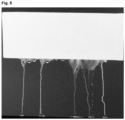
- VF 1 was inhomogeneous, with numerous cracks. In addition, the surface showed numerous thick, white run-off marks that reached the lower edge of the Leneta film (see Fig.1 The early rain resistance of VF 1 was rated as very poor.
- VF 2 was also inhomogeneous, with few cracks. In addition, the surface showed numerous thick, white run-off marks that reached the lower edge of the Leneta film (see Fig. 2 The early rain resistance of VF 2 was rated as poor.
- VF 3 was smooth and homogeneous, without cracks. In addition, the surface showed a few thick, white run-off marks that did not reach the lower edge (see Fig.3 The early rain resistance of VF 3 was rated as medium.
- Table 4 shows the results of the early rain resistance of the facade paints according to the invention. It was found that the surface of the facade paints according to the invention F1 - F3 had a smooth, homogeneous surface without cracks with individual thin, white run-off marks that did not reach the lower edge. F4 and F5 had a smooth, homogeneous surface without cracks, with individual thin, trickle-like, slightly milky-cloudy to transparent run-off marks that did not reach the lower edge. As an example, reference is made to the Fig.4 and Fig.5 referred to.
- Fig. 1 - Fig. 5 show exemplary, photographic images of the surface of the facade paints.
- Table 4 Visual assessment of early rain resistance ⁇ /b> Facade paint preparation Evaluation
- the coatings produced with the aqueous preparations according to the invention had an improved early rain resistance than a coating without hydrophobic agents and without water-soluble, cationic polymer, than a coating with only hydrophobic agents and than a conventionally produced coating with only a water-soluble, cationic polymer.
- the viscosity of the facade paints was measured.
- the facade paint F4 according to the invention and VF3 and VF4 as comparative examples were used to determine the viscosity.
- VF4 was produced without H1, whereby P4 was prepared according to Example 1 of the EP 1 250 388 B1 was subsequently added to the comparison facade color.
Landscapes
- Chemical & Material Sciences (AREA)
- Organic Chemistry (AREA)
- Engineering & Computer Science (AREA)
- Materials Engineering (AREA)
- Wood Science & Technology (AREA)
- Life Sciences & Earth Sciences (AREA)
- Dispersion Chemistry (AREA)
- Health & Medical Sciences (AREA)
- Medicinal Chemistry (AREA)
- Polymers & Plastics (AREA)
- Chemical Kinetics & Catalysis (AREA)
- Oil, Petroleum & Natural Gas (AREA)
- Addition Polymer Or Copolymer, Post-Treatments, Or Chemical Modifications (AREA)
- Paints Or Removers (AREA)
- Compositions Of Macromolecular Compounds (AREA)
Abstract
Die Erfindung betrifft eine wässrige Zubereitung enthaltend mindestens ein wässriges Hydrophobierungsmittel und mindestens ein wasserlösliches, kationisches Polymer.
Description
- Gegenstand der vorliegenden Erfindung ist eine wässrige Zubereitung enthaltend mindestens ein wässriges Hydrophobierungsmittel zur Herstellung wässriger Beschichtungsmitteln mit verbesserter Frühregenbeständigkeit.
- Die Trocknungsgeschwindigkeit wässriger Beschichtungsmittel hängt von der Temperatur und der Luftfeuchtigkeit ab. Bei niedriger Luftfeuchtigkeit ist die Trocknungsgeschwindigkeit oft schnell, manchmal sogar schneller als bei lösungsmittelbasierten Beschichtungsmitteln. Bei hoher Luftfeuchtigkeit und tiefen Temperaturen allerdings, wie z. B. morgens und abends, sowie vor, während und nach Regenfällen, ist die Trocknungsgeschwindigkeit deutlich verlangsamt, da das Verdunsten des Wassers verzögert ist. Solche Beschichtungen sind dann erst nach sehr langen Trocknungszeiten regenfest. Eine bestimmte Frühregenbeständigkeit oder Regenfestigkeit von wässrigen Beschichtungsmitteln bevor diese vollständig getrocknet sind, wird insbesondere für Außenanwendungen, wie z. B. Farben für Gebäude, Brücken, Schiffe und Straßenmarkierungen, sowie für Außenputze gewünscht.
- Für das Erreichen einer solchen Frühregenbeständigkeit oder Regenfestigkeit gibt es verschiedene Prinzipien von praktischer Relevanz.
- Bei einer Variante des sogenannten Flockulierungsprinzips enthält das Beschichtungsmittel ein anionisch stabilisiertes Bindemittel, ein Polyamin und Ammoniak als flüchtige Base, die nach dem Auftragen des Beschichtungsmittels verdampft, wodurch es während der Trocknung zur Flockulierung des Bindemittels kommt (
US 5 527 853 ,EP 0 594 321 ,EP 0 728 822 ,EP 0 409 459 ). Bei einer anderen Variante enthält das Beschichtungsmittel ebenfalls ein ionisch stabilisiertes Bindemittel. Die Flockulierung desselben erfolgt dadurch, dass gleichzeitig mit dem Beschichtungsmittel eine Säurelösung oder eine Salzlösung versprüht wird (WO 94/29 391 EP 0 200 249 ,US 4 571 415 ,US 5 403 393 ). Eine Viskositätsänderung an der Oberfläche der Beschichtungsmittel kann dadurch erreicht werden, dass entweder ein Verdicker auf die frische Beschichtung appliziert wird, wodurch es zu einer Erhöhung der Viskosität kommt, wie z. B. in derEP 0 721 003 offenbart, oder eine Base auf die frische Beschichtung appliziert wird, die einen Verdicker enthält, der jedoch durch Einstellung eines niedrigen pH-Wertes nicht aktiviert ist. - Die
EP 0 804 514 beschreibt schnelltrocknende, wässrige Beschichtungsmittel, umfassend eine wässrige, anionisch stabilisierte Emulsion und ein Polyimin. Der Zusatz eines Polyimins zu einem Beschichtungsmittel auf Basis einer wässrigen, anionisch stabilisierten Emulsion hat den Nachteil, dass die Mischung, sobald sie getrocknet ist, zur Gelbfärbung neigt. Dies ist insbesondere bei Emulsionen auf Basis von Vinylacetatcopolymeren der Fall. Für dekorative Außenanwendungen bringt diese Gelbfärbung der Beschichtung unerwünschte Farbtonverschiebungen mit sich. - Außerdem ist die Ladung eines Polyimins, und damit die Flokkulierung, von der pH abhängig. Bei höheren pH-Werten verschiebt sich das Ladungsgleichgewicht des Polyimins zunehmend von dem kationischen in den neutralen Bereich, was zu einem Verlust der Wirksamkeit führt. Moderne Beschichtungsmittel aber sind des Öfteren auf einen höheren pH eingestellt, um die Vermehrung von Mikroorganismen bei gleichzeitig geringem Einsatz von Bioziden reduzieren zu können.
- Bekannt ist weiterhin die
EP 1 250 388 , in der ein schnelltrocknendes, wässriges Beschichtungsmittel, enthaltend mindestens ein wässriges Bindemittel beschrieben ist, das zusätzlich mindestens ein wasserlösliches, quaternäres Poly(allylamin) und ein nicht-ionisches Tensid enthält. Nachteilig hierbei ist jedoch die Viskositätserhöhung während der Lagerung. - Es ist daher wünschenswert, eine wässrige Zubereitung zur Herstellung eines frühwasserbeständigen Beschichtungsmittels bereitzustellen, ohne die aus dem Stand der Technik bekannten Nachteile.
- Zur Lösung der Aufgabe wird eine wässrige Zubereitung enthaltend mindestens ein wässriges Hydrophobierungsmittel und mindestens ein wasserlösliches, kationisches Polymer vorgeschlagen.
- Völlig unerwartet konnte festgestellt werden, dass durch die Kombination von Hydrophobierungsmitteln und wasserlöslichen, kationischen Polymeren eine Verbesserung der Frühregenbeständigkeit erreicht wird. Die mit der erfindungsgemäßen wässrigen Zubereitung hergestellte Beschichtungen wiesen eine verbesserte Frühregenbeständigkeit als herkömmliche Beschichtungen auf. Vorteilhafterweise zeigte zudem das erfindungsgemäße wässrige Beschichtungsmittel eine geringere Viskositätserhöhung während der Lagerung auf.
- Dem Fachmann ist bekannt, dass durch die Zugabe eines Hydrophobierungsmittels die Hydrophobie einer Beschichtung erhöht werden kann. Auf diese Weise können Beschichtungen und somit auch die Substrate gegen das Eindringen von Wasser geschützt werden. Eine hydrophobe Beschichtung oder Oberfläche kann mittels der Bestimmung des Kontaktwinkels eines Wassertropfens charakterisiert werden, welcher zwischen 90 und 180° liegen soll (Wässrige Siliconharz-Beschichtungssysteme für Fassaden: Grundlagen, Formulierungen, Anwendung in der Praxis, Problemlösungen / Wolfgang Schultze, 2. Auflage, expert-verlag 2002, S.18). Beispielsweise kann der Kontaktwinkel mit Hilfe eines optischen Kontaktwinkelmessgerätes in Kombination mit einem Kontouranalysesystems nach DIN 55660 bestimmt werden.
- Üblicherweise wird das Hydrophobierungsmittel in Form einer wässrigen Emulsion, die unter Verwendung von Emulgatoren hergestellt wurde, in die fertige Dispersion des Mahlguts eingebracht, in die dann zusätzlich das Bindemittel eingerührt wird. Solche Anstrichmittel und Putze weisen nach ihrer Applikation zunächst über eine gewisse Zeit ("Auswaschperiode") noch eine relativ hohe Wasseraufnahmefähigkeit auf, so dass die anfängliche Beständigkeit gegen Wasser eingeschränkt ist.
- Die meisten Hydrophobierungsmitteln basieren auf siliziumorganischen Verbindungen, die einzeln oder in Kombination eingesetzt werden. Beispielsweise seien hier Alkoxysilane, Silikonölen, Silikonharze und Siliconate genannt (siehe auch: Wässrige Siliconharz-Beschichtungssysteme für Fassaden: Grundlagen, Formulierungen, Anwendung in der Praxis, Problemlösungen / Wolfgang Schultze, 2. Auflage, expert-verlag 2002, S. 69-74).
- Bei den Alkoxysilanen handelt es sich vorzugsweise um Verbindungen gemäß Formel (I),
R1 aSi(OR2)b Formel (I)
worin a größer gleich 0 bis kleiner gleich 2 ist, b größer gleich 2 bis kleiner gleich 4 und die Summe von a + b gleich 4 ist. R1 ist eine gesättigte oder ungesättigte Alkylgruppe bestehend aus 1 bis 8 Kohlenstoffatomen, oder eine organische Gruppierung bestehend aus 1 bis 8 Kohlenstoffatomen und 1 bis 2 Stickstoff- oder Sauerstoffatomen, oder eine aromatische Gruppierung mit 6 bis 20 Kohlenstoffatomen und
R2 = eine Alkyl- oder Acylgruppe bestehend aus 1 bis 8 Kohlenstoffatomen. - Alkylgruppen sind bevorzugt Methyl-, Ethyl-, Propyl-, Isopropyl-, n-Butyl-, s-Butyl-, t-Butyl-gruppen. Die aromatische Gruppierung ist bevorzugt eine Phenyl-Gruppierung. Bevorzugte Substituenten R1 sind Methyl- oder Phenyl- bzw. Mischungen aus Methyl- und Phenyl-Resten. Bevorzugte Alkylgruppen des Restes R2 sind Methyl-, Ethyl-, Propyl-, Isopropyl-, n-Butyl-, s-Butyl-, oder t-Butyl-Gruppen. Bevorzugt handelt es sich bei dem Alkoxysilan um Octyltriethoxysilan.
- Bei den Silikonölen handelt es sich vorzugsweise um Verbindungen gemäß Formel (II),
R3O(Si(R4)2O)nR3 Formel (II)
- Bei R3 handelt es sich, unabhängig voneinander, um ein Wasserstoffatom, eine Trimethylsilyl- oder Alkylgruppe, beispielsweise eine Methyl- oder Ethylgruppe. Bei R4 handelt es sich um, unabhängig voneinander, gleich oder verschieden lineare oder verzweigte, gesättigte wie auch ein oder mehrfach ungesättigte Alkylgruppe bestehend aus 1 bis 20 Kohlenstoffatomen, oder eine organische Gruppierung bestehend aus 1 bis 8 Kohlenstoffatomen und 1 bis 2 Stickstoff- oder Sauerstoffatomen, oder eine siliziumorganische Gruppierung bestehend aus ein Siliziumatom, 1 bis 15 Kohlenstoffatomen und 1 bis 4 Sauerstoffatomen, oder eine aromatische Gruppierung mit 6 bis 20 Kohlenstoffatomen. Bevorzugt handelt es sich bei R4 um eine Methyl-, eine 3-Aminopropyl-, eine N-2-(Aminoethyl)-3-aminopropyl-, eine 2-(Trimethoxysilyl)ethyl-, eine 2-(Triethoxysilyl)ethyl-, oder eine Phenylgruppe. Der Polymerisationsgrad n liegt zwischen 1 und 10,000, bevorzugt zwischen 3 und 1,000, und am meisten bevorzugt zwischen 5 und 300.
- Bei den Silikonharzen handelt es sich vorzugsweise um polymere Verbindungen gemäß Formel (III),
R5 cSi(OR6)dO(4-c-d)/2 Formel (III)
worin c größer gleich 0 bis kleiner gleich 2 und d größer gleich 0 bis kleiner gleich 4 sind, und die Summe von c + d kleiner 4 ist. Die R5 sind unabhängig voneinander, gleich oder verschieden lineare oder verzweigte, gesättigte wie auch ein oder mehrfach ungesättigte oder aromatische Kohlenwasserstoffreste, oder eine organische Gruppierung bestehend aus 1 bis 8 Kohlenstoffatomen und 1 bis 2 Stickstoff- oder Sauerstoffatomen. R6 ist ein Wasserstoffatom oder eine Alkylgruppe bestehend aus 1 bis 8 Kohlenstoffatomen. Bevorzugt handelt es bei R5 um eine Methyl-, Propyl-, Phenyl-, 3-Aminopropyl- oder Octylgruppe. Bevorzugt handelt es sich bei R6 um ein Wasserstoffatom, eine Methyl- oder Ethylgruppe. - Bei Formel (III) handelt es sich um die kleinste Einheit der gemittelten Strukturformel des Silikonharzes.
- Bevorzugt handelt es sich bei dem Hydrophobierungsmittel um eine wässrige Silikonharzemulsion, eine Silikonölemulsion, eine Emulsion oder Mikroemulsion eines aminofunktionellen Silikonöls, eine Silanemulsion, oder Gemische daraus.
- Bevorzugt kann es sich bei dem Hydrophobierungsmittel auch um eine wässrige Emulsion basierend auf zwei oder mehr siliziumorganische Verbindungen handeln.
- Generell können alle kommerziell erhältlichen Hydrophobierungsmittel in Frage kommen, sofern sie in wässrigen Beschichtungsmittel verwendet werden können. Handelsübliche Hydrophobierungsmittel sind hierzu nennen: Tego Phobe® 1401, 1409, 1650, 1659, 6510 und 6600 von Evonik, Silres® BS45, BS54, BS60, BS6042, BS1001 und BS1306 von Wacker, Dowsil® IE 2404, IE 6683, IE 6694 und Z-70 Emulsion von Dow, Variphob® SR 550, SR 580, HP 105, HP 120 von CHT, Bluesil BP 9710, BP 9878, BP 9800, BP 9821, BP 9900, BP 9705, PB 9920 von Elkem Silicones und Silsan® CC55, HSB, DSH, WS 1800, 1300 und 1350 von Graf Chemicals.
- Vorzugsweise weist das wasserlösliche, kationische Polymer quaternäre Ammoniumgruppen auf.
- Als wasserlösliches, kationisches Polymer eignen sich bevorzugt solche Verbindungen ausgewählt aus Poly[(dimethylimino)-2-buten-1,4-diyl]chlorid (Polyquaternium-1), Poly(diallyldimethylammoniumchlorid) (Polyquaternium-6), Copolymer aus Acrylamid mit quaternisiertem Dimethylammoniumethylmethacrylate, Poly{bis(2-chlorethyl)ether-alt-1,3-bis[3(dimethylamino) propyl]urea} (Polyquaternium-2), Hydroxyethylcellulosedimethyldiallylammoniumchlorid Copolymer (Polyquaternium-4), Poly(acrylamide-methacryloyloxyethyltrimethylammonium methyl sulfat) (Polyquaternium-5), Poly(diallyldimethylammoniumchlorid-co-acrylamid) (Polyquaternium-7), quaternisierte Hydroxyethyl-cellulose (Polyquaternium-10), Copolymer aus Methyl- und Stearyldimethylaminoethylmethacrylat, quaternisiert mit Dimethylsulfat (Polyquaternium-8), Poly-N,N-(dimethylamino)ethylmethacrylat, quaternisiert mit Bromethan (Polyquaternium-9), Poly(vinylpyrrolidone-co-dimethylaminoethylmethacrylat, quaternisiert) (Polyquaternium-11), Poly(Ethylmethacrylat-co-Abietylmethacrylat-co-Diethylaminoethylmethacrylat) quaternisiert mit Dimethylsulfat (Polyquaternium-12), Poly(Ethylmethacrylat-co-Oleylmethacrylat-co- Diethylaminoethylmethacrylat) quaternisiert mit Dimethylsulfat (Polyquaternium-13), Poly(2-methacryloyloxyethyltrimethylammonium Methylsulfat) (Polyquaternium-14), Poly(Acrylamid-co-Trimethylammoniumchloridethylmethacrylat) (Polyquaternium-15), 3-Methyl-1-vinylimidazoliumchlorid-N-vinylpyrrolidone Copolymer (Polyquaternium-16), Poly[oxy-1,2-ethanediyl(dimethyliminio)-1,3-propanediylimino(1,6-dioxo-1,6-hexanediyl)imino-1,3-propanediyl(dimethyliminio)-1,2-ethanediyl Dichlorid] (Polyquaternium-17), Poly[oxy-1,2-ethanediyl(dimethyliminio)-1,3-propanediylimino(1,9-dioxo-1,9-nonanediyl)imino-1,3-propanediyl(dimethyliminio)-1,2-ethanediyl Chlorid (Polyquaternium-18), Poly(diallyldimethylammoniumchlorid-acrylsäure) (Polyquaternium-22), Cellulose, Ether mit α-[3-(dodecyldimethylammonio)-2-hydroxypropyl]-ω-hydroxypoly(oxy-1,2-ethanediyl), chlorid (Polyquaternium-24), N-Vinyl-2-pyrrolidone-3-methacrylamidopropyltrimethylammoniumchlorid Copolymer (Polyquaternium-28), 2-Propenoic acid, 2-methyl-, methyl ester, Polymer mit N-(carboxymethyl)-N,N-dimethyl-2-[(2-methyl-1-oxo-2-propenyl)oxy]ethanaminium Zwitterion (Polyquaternium-30), 2-Acryloxyethyltrimethylammoniumchlorid-acrylamid Copolymer (Polyquaternium-33), 2-Propensäure, 2-methyl-, methyl ester, Polymer aus 2-(Dimethylamino)ethyl 2-methyl-2-propenoat, Verbindung mit Dimethylsulfat (Polyquaternium-36), Poly(2-methacryloxyethyltrimethylammoniumchlorid) (Polyquaternium-37), Acrylsäure-acrylamiddimethyldiallylammoniumchlorid Copolymer (Polyquaternium-39), Poly[oxyethylene(dimethylamino)ethylen(dimethylamino)ethylendichlorid] (Polyquaternium-42), 3-Methyl-1-vinylimidazolium methylsulfat-N-vinylpyrrolidone Copolymer (Polyquaternium-44), 3-Methyl-N-vinylimidazolium methylsulfat-N-vinylcaprolactam-N-vinyl-2-pyrrolidone Copolymer (Polyquaternium-46), Acrylsäure-methacrylamidopropyl trimethylammoniumchlorid-methylacrylate Copolymer (Polyquaternium-47), N-Methacryloyloxyethyl-N,N-Dimethylammonium α-N-methylcarboxybetaine Polymer (Polyquaternium-50), Butylmethacrylate-2-methacryloyloxyethylphosphorylcholine Copolymer (Polyquaternium-51), N,N-Dimethylacrylamid-dimethylaminoethyl methacrylate diethylsulfate-polyethyleneglycol dimethacrylate Copolymer (Polyquaternium-52), Poly(acrylamid-methacrylamidopropyltrimethylammonium Chlorid-acrylsäure) (Polyquaternium-53), 1-Dodecanaminium, N,N-dimethyl-N-[3-[(2-methyl-1-oxo-2-propenyl)amino]propyl]-, Chlorid, Polymer mit N-[3-(dimethylamino)propyl]-2-methyl-2-propenamid und 1-Ethenyl-2-pyrrolidinone (Polyquaternium-55), 2-(Methacryloyloxy)ethyl-2-(trimethylammonium)ethyl phosphat-stearyl methacrylate Copolymer (Polyquaternium-61), Poly (acrylamid-acrylsäureacryloyloxyethyl trimethyl ammonium chlorid) (Polyquaternium-63), 2-Hydroxy-3-methacryloxypropyltrimethylammonium chlorid-2-methacryloxyethyl phosphorylcholine Copolymer (Polyquaternium-64), Cellulose, 2-[3-(Dodecyldimethylammonio)-2-hydroxypropoxy]ethyl 3-(dodecyldimethylammonio)-2-hydroxypropyl 2-hydroxyethyl 2-[2-hydroxy-3-(trimethylammonio)propoxy]ethyl 2-hydroxy-3-(trimethylammonio)propyl ether, chlorid (Polyquaternium-67), Methacrylamide-N-vinylimidazole-N-vinylimidazole Methosulfate-N-vinyl-2-pyrrolidone Copolymer (Polyquaternium-68), 1-Dodecanaminium, N,N-dimethyl-N-[3-[(2-methyl-1-oxo-2-propenyl)amino]propyl]-, chlorid, Polymer mit N-[3-(dimethylamino)propyl]-2-methyl-2-propenamid, 1-ethenylhexahydro-2H-azepin-2-on und 1-ethenyl-2-pyrrolidinone (Polyquaternium-69), 1-Propanaminium, N,N,N-trimethyl-3-[(1-oxo-2-propen-1-yl)amino]-, chlorid (1:1), Polymer mit N,N-dimethyl-2-propenamid, 2-hydroxyethyl 2-methyl-2-propenoat und N,N,N-trimethyl-2-[(2-methyl-1-oxo-2-propen-1-yl)oxy]ethanaminium chlorid (1:1) (Polyquaternium-84), 1H-Imidazolium, 1-ethenyl-3-methyl-, chlorid (1:1), Polymer mit 1-Ethenyl-1H-imidazol, 1-Ethenyl-2-pyrrolidinone und 2-Methyl-2-propensäure (Polyquaternium-86), Acrylsäure-ethyl acrylat-(3-methacrylamidopropyl)trimethylammonium chlorid Copolymer (Polyquaternium-98), Ethanaminium, N,N,N-trimethyl-2-[(2-methyl-1-oxo-2-propen-1-yl)oxy]-, chlorid (1:1), Polymer mit Butyl 2-methyl-2-propenoate und 2-Ethoxyethyl-2-methyl-2-propenoat (Polyquaternium-99), Poly[(dimethyliminio)(2-hydroxy-1,3-propanediyl)(dimethyliminio)-1,6-hexanediyl Dichlorid] (Polyquaternium-100), 2-Methacryloyloxyethyl phosphorylcholine-3-N,N-dimethylaminopropyl acrylamid-stearyl methacrylate Copolymer (Polyquaternium-107), 2-Propen-1-aminium, N,N-dimethyl-N-2-propen-1-yl-, chlorid (1:1), Polymer mit 2-Hydroxy-1-methylethyl-2-propenoate und 2-Propensäure (Polyquaternium-111), quaternisierte Polysacchariden und Polysaccharidederivaten wie beispielweise Guar Hydroxypropyltrimethylammoniumchlorid und Hydroxypropylguar Hydroxypropyltrimethylammoniumchlorid, Chitosan Hydroxypropyltrimethylammoniumchlorid, Stärke 3-(dodecyldimethylammonio)-2-hydroxypropyl 2-hydroxy-3-(trimethylammonio)propylether Chlorid (Polyquaternium-75) und Hydroxypropyltrimethylammoniumchlorid Stärke.
- Besonders bevorzugt sind Poly(diallyldimethylammoniumchlorid), und quaternisierte Hydroxyethyl-cellulose. Am meisten bevorzugt ist Poly(diallyldimethylammoniumchlorid).
- Bevorzugt weist das wasserlösliche, kationische Polymer Aminogruppen auf. Besonders bevorzugt handelt es sich hierbei um Polyethylenimin.
- Das Gewichtsmittel des Molekulargewichtes des wasserlöslichen, kationischen Polymers liegt bevorzugt im Bereich von 10 000 g/mol bis 2 000 000 g/mol, besonderes bevorzugt im Bereich von 20 000 g/mol bis 1 000 000 g/mol und ganz besonderes bevorzugt im Bereich von 30 000 g/mol bis 500 000 g/mol
- Vorzugsweise weist die wässrige Zubereitung 0,05 Gew.-% - 5,0 Gew.-%, bevorzugt 0,1 Gew.-% - 3,0 Gew.-%, besonders bevorzugt 0,2 Gew.-% - 2,0 Gew.-% des kationischen Polymers bezogen auf die Zubereitung auf.
- Eine weitere Erfindung ist die Verwendung der erfindungsgemäßen, wässrigen Zubereitung als Additiv zur Herstellung wässriger Beschichtungsmitteln mit verbesserter Frühregenbeständigkeit.
- Auch Gegenstand der Erfindung sind Beschichtungsmitteln enthaltend eine erfindungsgemäße, wässrige Zubereitung.
- Vorzugsweise enthält das Beschichtungsmittel neben der erfindungsgemäßen wässrigen Zubereitung, gegebenenfalls noch Filmbildehilfsmittel, Pigmente, Füllstoffe, Verdickungsmittel, Verlaufsmittel, Dispergiermittel, Netzmittel, Konservierungsmittel, Emulgatoren, Schutzkolloide und/oder Entschäumer.
- Bei den erfindungsgemäßen Beschichtungsmitteln handelt es sich bevorzugt um Putze, Farben, Grundierungen oder Holzanstrichmittel für Außenanwendungen. Besonders bevorzugt handelt es sich bei den erfindungsgemäßen Beschichtungsmitteln um Kunstharzputze, Fassadenfarben, Straßenmarkierungsfarben oder Holzschutzfarben.
- Gegenstand der vorliegenden Erfindung ist auch ein Verfahren zur Herstellung eines frühwasserbeständigen Beschichtungsmittels, wobei
- a) zunächst eine wässrige Zubereitung hergestellt wird, bestehend aus mindestens einem wässrigen Hydrophobierungsmittel und mindestens einer wässrigen, kationischen Polymerlösung, wobei dessen gewichtsmittleres Molekulargewicht im Bereich von 10 000 g/mol bis 1 000 000 g/mol liegt,
- b) danach in die nach a) erhaltene Zubereitung mindestens ein wässriges Bindemittel hinzugegeben wird und
- c) gegebenenfalls ein Emulgator oder ein Gemisch von Emulgatoren, Filmbildehilfsmittel, Pigmente, Füllstoffe, Verdickungsmittel, Verlaufsmittel, Schutzkolloide, Dispergiermittel, Netzmittel, Konservierungsmittel und/oder Entschäumer hinzugefügt wird.
- Überraschenderweise wurde nun gefunden, dass die nach dem erfindungsgemäßen Verfahren hergestellte Beschichtung eine verbesserte Frühregenbeständigkeit aufwies als herkömmliche Beschichtungen.
- Bei dem Bindemittel kann es sich selbstverständlich auch um ein Gemisch verschiedener Bindemittel handeln.
- Der Gewichtsanteil an Bindemittel (fest) im Beschichtungsmittel beträgt bevorzugt zwischen 1,0 - 50,0 Gew.-% und besonders bevorzugt zwischen 3,0 - 25,0 Gew.-%, bezogen auf das Gewicht an trockenem Material im Beschichtungsmittel.
- Vorzugsweise wird das wässrige Bindemittel als letzter Bestandteil zu der Mischung gegeben, falls ein Emulgator oder ein Gemisch von Emulgatoren, Filmbildehilfsmittel, Pigmente, Füllstoffe, Verdickungsmittel, Verlaufsmittel, Schutzkolloide, Dispergiermittel, Netzmittel, Konservierungsmittel und/oder Entschäumer eingesetzt wird.
- Bei den Bindemitteln handelt es sich bevorzugt um wässrige Polymerdispersionen auf Basis von Homo- und/oder Copolymerisaten.
- Besonders bevorzugte Homo- und Copolymerisate enthalten mindestens ein olefinisch ungesättigtes Monomer als Monomerbaustein.
- Insbesondere bevorzugt sind Copolymerisate, die 70 bis 99,7 Gew.-%, bezogen auf die Gesamtmenge der Monomere, radikalisch polymerisierbare olefinisch ungesättigte Verbindungen aus der Gruppe der Acryl- und Methacrylsäureester von (C1 bis C12)-Monoalkoholen, vorzugsweise von (C1 bis C8)-Monoalkoholen, beispielsweise Methanol, Ethanol, iso-Propanol, iso-Butanol, n-Butanol und 2-Ethylhexylalkohol, der vinylaromatischen Monomere, beispielweise Styrol, der Vinylester von (C1 bis C12)-Alkanmonocarbonsäuren, beispielsweise Vinylacetat, Vinylpropionat, Vinyl-n-butyrat, Vinyllaurat, VeoVa® 9 und VeoVa® 10, der Vinylhalogenide, beispielsweise Vinylchlorid und Vinylidenchlorid, der α- und β-mono-olefinisch ungesättigten Nitrile, beispielsweise Acrylnitril und Methacrylnitril, sowie der Alkylester von mono-olefinisch ungesättigten Dicarbonsäuren, beispielsweise Malein- und Fumarsäuredi-n-butylester, enthalten. Die Copolymerisate enthalten vorzugsweise außerdem 0,3 bis 10 Gew.-%, besonders bevorzugt 0,5 bis 5 Gew.-%, bezogen auf die Gesamtmenge der Monomere, α- und β-mono-olefinisch ungesättigte Mono- und Dicarbonsäuren, beispielsweise Acrylsäure, Methacrylsäure, Itaconsäure, Maleinsäure und Fumarsäure, sowie deren gegebenenfalls an den Stickstoffatomen substituierte Amide, beispielsweise Acrylamid, Methacrylamid, N-Methylolacrylamid und N-Butoxymethacrylamid.
- Weiterhin können 0 bis 20 Gew.-%, vorzugsweise 0,5 bis 5 Gew.-%, bezogen auf die Gesamtmenge der Monomere, funktionelle Monomere in den Copolymerisaten enthalten sein, wie beispielsweise hydroxylgruppen-haltige Monomere, wie Hydroxyalkylacrylate und -methacrylate, insbesondere Hydroxyethylmethacrylat und Hydroxypropylmethacrylat, und/oder die Naßhaftung verbessernde Acetylacetoxygruppen-haltige Monomere, insbesondere Allylacetoacetat, Acetylacetoxyethylmethacrylat und Acetylacetoxybutylmethacrylat, und/oder vernetzend wirkende Monomere wie Epoxidgruppen-haltige und Silangruppenhaltige Monomere, insbesondere Glycidylacrylat, Glycidylmethacrylat, Vinyltrimethoxysilan und Methacryloxypropyltrimethoxysilan, und/oder stickstoffhaltige Monomere aus der Gruppe der polymerisierbaren Monomere mit einer Amino-, Ureido- oder N-heterocyclischen-Gruppe, beispielsweise Dimethylaminoethylacrylat und -methacrylat, N-(2-Methacryloylethyl)-ethylenharnstoff, und/oder Ketogruppen-haltige Monomere, beispielsweise Diacetonacrylamid, Diacetonmethacrylamid, Acrolein und 2-Butanonmethacrylsäureester.
- In selbstvernetzenden Dispersionen können ketogruppen-haltige Polymerisate noch bis zu 5 Gew.-%, bezogen auf die Gesamtmenge der Monomere, beziehungsweise eines di- oder polyfunktionellen Carbonsäurehydrazids, beispielsweise Adipinsäurehydrazid, enthalten sein.
- Bevorzugt handelt es sich bei den als Bindemittel verwendeten Polymerdispersionen um anionisch stabilisierte Polymerdispersionen oder Polymerdispersionen, die mit Mischungen aus nichtionischen und anionischen Stabilierungsmitteln oder Mischungen aus nichtionischen Emulgatoren, anionischen Emulgatoren und Schutzkolloiden stabilisiert sind.
- Als nichtionische Emulgatoren sind z.B. Alkylpolyglykolether oder Alkoxylierungsprodukte von Polypropylenoxid geeignet. Als anionische Emulgatoren kommen in erster Linie die Alkali- oder Ammoniumsalze von Alkyl-, Aryl- oder Alkylarylsulfonaten, -sulfaten, -phosphaten oder -phosphonaten in Frage.
- Als Schutzkolloide eignen sich Naturstoffe, wie z. B. Gummiarabicum, Stärke und Alginate, modifizierte Naturstoffe, wie z.B. Cellulosederivate, oder synthetische Polymere, wie z.B. Polyvinylalkohol und Polyvinylpyrrolidon, oder Gemische derselben.
- Neben Emulgatoren und Schutzkolloiden können die Polymerdispersionen gegebenenfalls noch Additive, Hilfsstoffe und/oder nichtcopolymerisierbare Vernetzer enthalten.
- Vorzugsweise wird eine wässrige Zubereitung mit 0,05 Gew.-% - 5,0 Gew.-%, bevorzugt 0,1 Gew.-% - 3,0 Gew.-%, besonders bevorzugt 0,2 Gew.-% - 2,0 Gew.-% des kationischen Polymers bezogen auf die Zubereitung für das erfindungsgemäße Verfahren eingesetzt.
- Vorzugsweise weist das kationische Polymer quaternäre Ammoniumgruppen auf.
- Als wasserlösliches, kationisches Polymer eignen sich bevorzugt solche Verbindungen ausgewählt aus Poly[(dimethylimino)-2-buten-1,4-diyl]chlorid (Polyquaternium-1), Poly(diallyldimethylammoniumchlorid) (Polyquaternium-6), Copolymer aus Acrylamid mit quaternisiertem Dimethylammoniumethylmethacrylate, Poly{bis(2-chlorethyl)ether-alt-1,3-bis[3(dimethylamino) propyl]urea} (Polyquaternium-2), Hydroxyethylcellulosedimethyldiallylammoniumchlorid Copolymer (Polyquaternium-4), Poly(acrylamide-methacryloyloxyethyltrimethylammonium methyl sulfat) (Polyquaternium-5), Poly(diallyldimethylammoniumchlorid-co-acrylamid) (Polyquaternium-7), quaternisierte Hydroxyethyl-cellulose (Polyquaternium-10), Copolymer aus Methyl- und Stearyldimethylaminoethylmethacrylat, quaternisiert mit Dimethylsulfat (Polyquaternium-8), Poly-N,N-(dimethylamino)ethylmethacrylat, quaternisiert mit Bromethan (Polyquaternium-9), Poly(vinylpyrrolidone-co-dimethylaminoethylmethacrylat, quaternisiert) (Polyquaternium-11), Poly(Ethylmethacrylat-co-Abietylmethacrylat-co-Diethylaminoethylmethacrylat) quaternisiert mit Dimethylsulfat (Polyquaternium-12), Poly(Ethylmethacrylat-co-Oleylmethacrylat-co- Diethylaminoethylmethacrylat) quaternisiert mit Dimethylsulfat (Polyquaternium-13), Poly(2-methacryloyloxyethyltrimethylammonium Methylsulfat) (Polyquaternium-14), Poly(Acrylamid-co-Trimethylammoniumchloridethylmethacrylat) (Polyquaternium-15), 3-Methyl-1-vinylimidazoliumchlorid-N-vinylpyrrolidone Copolymer (Polyquaternium-16), Poly[oxy-1,2-ethanediyl(dimethyliminio)-1,3-propanediylimino(1,6-dioxo-1,6-hexanediyl)imino-1,3-propanediyl(dimethyliminio)-1,2-ethanediyl Dichlorid] (Polyquaternium-17), Poly[oxy-1,2-ethanediyl(dimethyliminio)-1,3-propanediylimino(1,9-dioxo-1,9-nonanediyl)imino-1,3-propanediyl(dimethyliminio)-1,2-ethanediyl Chlorid (Polyquaternium-18), Poly(diallyldimethylammoniumchlorid-acrylsäure) (Polyquaternium-22), Cellulose, Ether mit α-[3-(dodecyldimethylammonio)-2-hydroxypropyl]-ω-hydroxypoly(oxy-1,2-ethanediyl), chlorid (Polyquaternium-24), N-Vinyl-2-pyrrolidone-3-methacrylamidopropyltrimethylammoniumchlorid Copolymer (Polyquaternium-28), 2-Propenoic acid, 2-methyl-, methyl ester, Polymer mit N-(carboxymethyl)-N,N-dimethyl-2-[(2-methyl-1-oxo-2-propenyl)oxy]ethanaminium Zwitterion (Polyquaternium-30), 2-Acryloxyethyltrimethylammoniumchlorid-acrylamid Copolymer (Polyquaternium-33), 2-Propensäure, 2-methyl-, methyl ester, Polymer aus 2-(Dimethylamino)ethyl 2-methyl-2-propenoat, Verbindung mit Dimethylsulfat (Polyquaternium-36), Poly(2-methacryloxyethyltrimethylammoniumchlorid) (Polyquaternium-37), Acrylsäure-acrylamiddimethyldiallylammoniumchlorid Copolymer (Polyquaternium-39), Poly[oxyethylene(dimethylamino)ethylen(dimethylamino)ethylendichlorid] (Polyquaternium-42), 3-Methyl-1-vinylimidazolium methylsulfat-N-vinylpyrrolidone Copolymer (Polyquaternium-44), 3-Methyl-N-vinylimidazolium methylsulfat-N-vinylcaprolactam-N-vinyl-2-pyrrolidone Copolymer (Polyquaternium-46), Acrylsäure-methacrylamidopropyl trimethylammoniumchlorid-methylacrylate Copolymer (Polyquaternium-47), N-Methacryloyloxyethyl-N,N-Dimethylammonium α-N-methylcarboxybetaine Polymer (Polyquaternium-50), Butylmethacrylate-2-methacryloyloxyethylphosphorylcholine Copolymer (Polyquaternium-51), N,N-Dimethylacrylamid-dimethylaminoethyl methacrylate diethylsulfate-polyethyleneglycol dimethacrylate Copolymer (Polyquaternium-52), Poly(acrylamid-methacrylamidopropyltrimethylammonium Chlorid-acrylsäure) (Polyquaternium-53), 1-Dodecanaminium, N,N-dimethyl-N-[3-[(2-methyl-1-oxo-2-propenyl)amino]propyl]-, Chlorid, Polymer mit N-[3-(dimethylamino)propyl]-2-methyl-2-propenamid und 1-Ethenyl-2-pyrrolidinone (Polyquaternium-55), 2-(Methacryloyloxy)ethyl-2-(trimethylammonium)ethyl phosphat-stearyl methacrylate Copolymer (Polyquaternium-61), Poly (acrylamid-acrylsäureacryloyloxyethyl trimethyl ammonium chlorid) (Polyquaternium-63), 2-Hydroxy-3-methacryloxypropyltrimethylammonium chlorid-2-methacryloxyethyl phosphorylcholine Copolymer (Polyquaternium-64), Cellulose, 2-[3-(Dodecyldimethylammonio)-2-hydroxypropoxy]ethyl 3-(dodecyldimethylammonio)-2-hydroxypropyl 2-hydroxyethyl 2-[2-hydroxy-3-(trimethylammonio)propoxy]ethyl 2-hydroxy-3-(trimethylammonio)propyl ether, chlorid (Polyquaternium-67), Methacrylamide-N-vinylimidazole-N-vinylimidazole Methosulfate-N-vinyl-2-pyrrolidone Copolymer (Polyquaternium-68), 1-Dodecanaminium, N,N-dimethyl-N-[3-[(2-methyl-1-oxo-2-propenyl)amino]propyl]-, chlorid, Polymer mit N-[3-(dimethylamino)propyl]-2-methyl-2-propenamid, 1-ethenylhexahydro-2H-azepin-2-on und 1-ethenyl-2-pyrrolidinone (Polyquaternium-69), 1-Propanaminium, N,N,N-trimethyl-3-[(1-oxo-2-propen-1-yl)amino]-, chlorid (1:1), Polymer mit N,N-dimethyl-2-propenamid, 2-hydroxyethyl 2-methyl-2-propenoat und N,N,N-trimethyl-2-[(2-methyl-1-oxo-2-propen-1-yl)oxy]ethanaminium chlorid (1:1) (Polyquaternium-84), 1H-Imidazolium, 1-ethenyl-3-methyl-, chlorid (1:1), Polymer mit 1-Ethenyl-1H-imidazol, 1-Ethenyl-2-pyrrolidinone und 2-Methyl-2-propensäure (Polyquaternium-86), Acrylsäure-ethyl acrylat-(3-methacrylamidopropyl)trimethylammonium chlorid Copolymer (Polyquaternium-98), Ethanaminium, N,N,N-trimethyl-2-[(2-methyl-1-oxo-2-propen-1-yl)oxy]-, chlorid (1:1), Polymer mit Butyl 2-methyl-2-propenoate und 2-Ethoxyethyl-2-methyl-2-propenoat (Polyquaternium-99), Poly[(dimethyliminio)(2-hydroxy-1,3-propanediyl)(dimethyliminio)-1,6-hexanediyl Dichlorid] (Polyquaternium-100), 2-Methacryloyloxyethyl phosphorylcholine-3-N,N-dimethylaminopropyl acrylamid-stearyl methacrylate Copolymer (Polyquaternium-107), 2-Propen-1-aminium, N,N-dimethyl-N-2-propen-1-yl-, chlorid (1:1), Polymer mit 2-Hydroxy-1-methylethyl-2-propenoate und 2-Propensäure (Polyquaternium-111), quaternisierte Polysacchariden und Polysaccharidederivaten wie beispielweise Guar Hydroxypropyltrimethylammoniumchlorid und Hydroxypropylguar Hydroxypropyltrimethylammoniumchlorid, Chitosan Hydroxypropyltrimethylammoniumchlorid, Stärke 3-(dodecyldimethylammonio)-2-hydroxypropyl 2-hydroxy-3-(trimethylammonio)propylether, Chlorid (Polyquaternium-75) und Hydroxypropyltrimethylammoniumchlorid Stärke.
- Bevorzugt ist das kationische Polymer ausgewählt aus Poly(diallyldimethylammoniumchlorid) und quaternisierte Hydroxyethyl-cellulose. Am meisten bevorzugt ist Poly(diallyldimethylammoniumchlorid).
- Bevorzugt können wasserlösliche, kationische Polymere enthaltend Aminogruppen, besonders bevorzugt Polyethylenimin, für das erfindungsgemäße Verfahren eingesetzt werden.
- Vorzugsweise wird das wässrige Bindemittel als letzter Bestandteil zu der Mischung gegeben.
- Die Erfindung wird im Folgenden von Ausführungsbeispielen näher beschrieben, ohne dadurch jedoch beschränkt zu werden.
- Bei dem beschriebenen Verfahren handelt es sich nicht um ein Absolutverfahren. Vielmehr ist eine Kalibrierung, die mit kommerziell verfügbaren, linear aufgebauten und nach unabhängigen Absolutverfahren charakterisierten Poly-2-vinylpyridin-Standards durchgeführt wird, notwendig. Instrument: Agilent 1100 von Agilent Technologie, Vorsäule: PSS NOVEMA Max, 10µm, Guard, ID 8.00mm x 50.00mm, Säule: PSS NOVEMA Max Ultrahigh, 10µm, ID 8.00mm x 300.00mm, Temperatur 35 °C, Eluent: 0,1 M NaCl, 0,1 vol% TFA (aq.), Fließrate 1 mL/min, Probenkonzentration 3 g/L. RI-Detektor, Auswertung gegen einen Poly-2-vinylpyridin Standard im Molmassenbereich von 620 - 2,890,000 g.mol-1.
- Viskositäten wurden angelehnt an DIN 53019-1 mit einem MR301 Rheometer der Fa. Anton Paar mit Platte-Kegel Geometrie, bei einer Scherung von 100 s-1 gemessen.
- Werden im Rahmen der vorliegenden Erfindung %-Angaben gemacht, so handelt es sich, wenn nicht anderes angegeben, um Angaben in Gewichts-%. Bei Zusammensetzungen beziehen sich die Prozentangaben, sofern nicht anders definiert, auf die Gesamtzusammensetzung. Werden in den nachfolgenden Beispielen Mittelwerte genannt, so handelt es sich, wenn nichts anderes angegeben, um Zahlenmittel. Werden nachfolgend Beschichtungen getrocknet, so geschieht dies, sofern nicht anders definiert, ebenfalls bei einem Druck von 101325 Pa, einer Temperatur von 20 °C und der umgebenden relativen Luftfeuchtigkeit von ca. 40 %.
-
- RM 10W Rollenmischer, Fa. CAT
- Schwarzer PVC-Folie (Leneta)
- Filmaufziehgerät Coatmaster 509 MC, Fa. Erichsen
- ZAF 2010 Kastenrakel, Fa. Zehnter
- Klimaschrank HPP110eco, Fa. Memmert
- Sigma Siloxan All Season Farbe, Fa. PPG
- Sprühflasche mit Pumpzerstäuber, Fa. Technical Treatments
- Dispermat mit 30 mm Dispergierscheibe, Fa. VMA Getzmann
- TEGO Phobe® 1650, Fa. Evonik
- TEGO Phobe® 1409, Fa. Evonik
- Tabelle 1 führt die verwendeten, kommerziell erhältlichen wässrigen kationischen Polymerlösungen mit ihren per GPC ermittelten gewichtsmittleren Molekulargewichte Mw (Pos. P1 bis P4) auf. Quaternisierte Hydroxyethylcellulose ist als Pulver erhältlich, so dass eine wässrige Polymerlösung hergestellt werden musste. Dazu wurde das pulverförmige, 100%ige Polymer mit VE-Wasser in einem 50 mL Schraubdeckelglas manuell mit einem Spatel gemischt und 24 Stunden auf einem RM 10W Rollenmischer gelegt. Es entstand eine homogene und klare Lösung, die 20 Gew.-% des kationischen Polymers enthielt (Pos.P5).
Tabelle 1: Verwendete kationische Polymerlösungen Pos. Namen Konz. Gew.-% Bezugsquelle Mw g/mol P1 Poly(diallyldimethylammoniumchlorid) C40L / Polyquaternium-6 40 Trigon-Chemie 73700 P2 Poly(diallyldimethylammoniumchlorid) C40H / Polyquaternium-6 40 Trigon-Chemie 125000 P3 Poly(diallyldimethylammoniumchlorid) low molecular weight / Polyquaternium-6 35 Sigma-Aldrich 42500 P4 Poly(diallyldimethylammoniumchlorid) medium molecular weight / Polyquaternium-6 20 Sigma-Aldrich 200000 P5 Hydroxyethylcelluloseethoxylate, quaternisiert / Polyquaternium-10 20 Sigma-Aldrich 398000 - Es wurden folgende, handelsübliche Hydrophobierungsmittel verwendet:
- TEGO Phobe® 1650, Fa. Evonik → (H1)
- TEGO Phobe® 1409, Fa. Evonik → (H2)
- Für die Herstellung der erfindungsgemäßen, wässrigen Zubereitung wurde in einem 180 mL Polyethylenbecher 100 g H1 abgewogen. Anschließend wurde die kationische Polymerlösung aus Tabelle 1 entsprechend der Konzentration aus Tabelle 2 unter Rühren mit einem Dispermat bei 500 U/Min tropfenweise zugegeben.
Tabelle 2: Rezeptur der erfindungsgemäßen Zubereitungen mit H1 Zubereitung Kationische Polymerlösung Konz. / % Z 1-H1 P1 2,0 Z 2-H1 P2 2,0 Z 3-H1 P3 2,0 Z 4-H1 P4 2,0 Z 5-H1 P5 2,0 - In einem 180 mL Polyethylenbecher wurden Pos. 1 und 2 der Tabelle 3 gegeben und für 5 Minuten unter Zuhilfenahme eines Dispermats mit 30 mm Dispergierscheibe bei 800 U/Min homogenisiert. Anschließend wurden Pos. 3 bis 7 unter Rühren hinzugegeben und für 10 Minuten eingearbeitet, dabei wurde die Umdrehungszahl auf 1500 U/Min erhöht. Dann wurden die Pos. 8 bis 13 der Reihe nach hinzugegeben und bei 2500 U/Min dispergiert. Nach 30 Minuten wurde die Dispergierscheibe durch einen Flügelrührer ersetzt. Die Drehzahl wurde auf 800 U/Min reduziert, Pos. 14 und 15 hinzugegeben und eingearbeitet. Zuletzt wurden das Bindemittel (Pos. 16) und der Verdicker (Pos. 17) unter Rühren zugegeben. Die Mischung wurde noch 10 Minuten bei 1000 U/Min gerührt. Nach 24 Stunden wurde die Frühregenbeständigkeit bestimmt.
Tabelle 3: Rezeptur der Fassadenfarbe Pos. Rohstoff Hersteller Menge (g) 1 VE-Wasser - 27,95 2 WALOCEL® XM 6000 PV DOW 0,3 3 TEGO® Foamex 24 Evonik 0,2 4 ACTICIDE® MBS Thor 0,15 5 CALGON® N new Reininghaus Chemie 0,05 6 TEGO® Dispers 715 W Evonik 0,3 7 AMP-90™ Angus 0,1 8 KRONOS® 2310 Kronos TITAN 12,5 9 SOCAL® P3 Imerys performance minerals 10,0 10 OMYACARB® 5 GU Omya 15,0 11 OMYACARB® 2 GU Omya 10,0 12 Glimmer Mica TG Aspanger Bergbau 3,0 13 SIPERNAT® 820 A Evonik 2,0 14 DOWANOL® DPnB DOW 1,0 15 Erfindungsgemäße wässrige Zubereitung Evonik 4,8 16 ACRONAL® S790 BASF 12,0 17 RHEOLATE®278 TF Elementis 0,65 Summe 100,0 - Unter Zuhilfenahme eines Kastenrakels mit einem 200 µm Schlitz und eines Coatmaster 509 MC Filmaufziehgerätes wurden Filme der Fassadenfarben sowie der Vergleichsfassadenfarben mit einer Geschwindigkeit von 15 mm/s auf schwarzen Lenetafolie aufgezogen. Die beschichteten Folien wurden anschließend in einem Klimaschrank gelegt, der bereits vorher auf 8 °C und 80% Luftfeuchtigkeit eingestellt war. Die Folien wurden 20 Minuten im Schrank getrocknet. Direkt danach wurde die Folie unter einem Winkel von 45° befestigt und mit Hilfe einer Sprühflasche fünfmal mit je 5,0 mL VE-Wasser bespritzt. Es wurde gewartet, bis das Wasser vollständig abgelaufen war. Die Aufzüge wurden 24 Stunden unter Standard-Laborbedingungen getrocknet, und anschließend visuell bewertet.
- Als Vergleichsbeispiele dienten Vergleichsfassadenfarben VF 1, VF2 und VF 3.
- VF1 wurde gemäß der Rezeptur aus Tabelle 3 hergestellt, wobei für Pos. 15 weder ein Hydrophobierungsmittel noch ein kationisches Polymer verwendet wurde.
- VF2 wurde gemäß der Rezeptur aus Tabelle 3 hergestellt, wobei für Pos. 15 lediglich 4,8 Gew.-% des H1, jedoch ohne kationisches Polymer, verwendet wurde.
- VF3 wurde gemäß der Rezeptur aus Tabelle 3 hergestellt, wobei zusätzlich 0,10 Gramm der kationischen Polymerlösung P4 verwendet wurde. Die Zugabe von P4 zu der Vergleichsfassadenfarbe erfolgte gemäß der Verfahrensführung aus Beispiel 1 der
EP 1 250 388 B1 nachträglich unter Rühren. - Es konnte festgestellt werden, dass die Oberfläche der VF 1 inhomogen war, mit zahlreichen Rissen. Darüber hinaus zeigte die Oberfläche zahlreiche dicke, weiße Ablaufspuren, die bis zum unteren Rand der Leneta-Folie reichten (Siehe
Fig. 1 ). Die Frühregenbeständigkeit von VF 1 wurde als sehr schlecht bewertet. - Es konnte festgestellt werden, dass die Oberfläche der VF 2 ebenfalls inhomogen war, mit wenigen Rissen. Darüber hinaus zeigte die Oberfläche zahlreiche dicke, weiße Ablaufspuren, die bis zum unteren Rand der Leneta-Folie reichten (Siehe
Fig. 2 ). Die Frühregenbeständigkeit von VF 2 wurde als schlecht bewertet. - Es konnte festgestellt werden, dass die Oberfläche der VF 3 glatt und homogen war, ohne Risse. Darüber hinaus zeigte die Oberfläche wenige dicke, weiße Ablaufspuren, die nicht bis zum unteren Rand reichten (Siehe
Fig. 3 ). Die Frühregenbeständigkeit von VF 3 wurde als mittel bewertet. - Es wurde die Frühregenbeständigkeit der erfindungsgemäßen Fassadenfarben mit den Vergleichsfassadenfarben VF1, VF2 und VF3 verglichen. Zur besseren Darstellung wurde VF1 = 1 (sehr schlecht), VF2 = 2 (schlecht) und VF3 = 3 (mittel) gesetzt.
- Tabelle 4 zeigt die Ergebnisse der Frühregenbeständigkeit der erfindungsgemäßen Fassadenfarben auf. Hierbei konnte festgestellt werden, dass die Oberfläche der erfindungsgemäßen Fassadenfarben F1 - F3 eine glatte, homogene Oberfläche ohne Risse mit einzelnen dünnen, weißen Ablaufspuren, die nicht bis zum unteren Rand reichten, aufwiesen. F4 und F5 wiesen eine glatte, homogene Oberfläche ohne Risse, mit einzelnen dünnen, rinnsalartigen, leicht milchig-trüben bis durchsichtigen Ablaufspuren auf, die nicht bis zum unteren Rand reichen. Exemplarisch wird hierfür auf die
Fig. 4 undFig. 5 verwiesen. -
Fig. 1 - Fig. 5 zeigen exemplarische, fotografische Abbildungen der Oberfläche der Fassadenfarben.Tabelle 4: Visuelle Bewertung der Frühregenbeständigkeit Fassadenfarbe Zubereitung Bewertung F1 Z 1-H1 4 F2 Z 2-H1 4 F3 Z 3-H1 4 F4 Z 4-H1 5 F5 Z 5-H1 5 - Es konnte somit gezeigt werden, dass durch die Kombination von Hydrophobierungsmitteln und wasserlöslichen, kationischen Polymeren eine Verbesserung der Frühregenbeständigkeit erreicht wird. Die mit den erfindungsgemäßen, wässrigen Zubereitungen hergestellte Beschichtungen wiesen eine verbesserte Frühregenbeständigkeit auf als eine Beschichtung ohne Hydrophobierungsmittel und ohne wasserlösliches, kationisches Polymer, als eine Beschichtung nur mit Hydrophobierungsmittel und als eine herkömmlich hergestellte Beschichtung nur mit einem wasserlöslichen, kationischen Polymer.
- Analog 1.2 wurden erfindungsgemäße Zubereitungen auf Basis des H2 mit P4 mit zwei Konzentrationen hergestellt, siehe Tabelle 5. Anschließend wurden analog zu 2.1 entsprechende Fassadenfarben gemäß Tabelle 3 hergestellt. Die Ergebnisse der Frühregenbeständigkeitsbestimmung sind aus Tabelle 6 zu entnehmen.
Tabelle 5: Rezeptur der erfindungsgemäßen Zubereitungen mit H2 und P4 Zubereitung Kationische Polymerlösung Konz. % Z 4.1-H2 P4 1,5 Z 4.2-H2 2,0 Tabelle 6: Frühregenbeständigkeit mit weiteren Hydrophobierungsmitteln Fassadenfarbe Zubereitung Einwaage (g) = 4,8 F6 Z 4.1-H2 4 F7 Z 4.2-H2 4 - Hier konnte gezeigt werden, dass der Synergieeffekt auch mit einem anderen Hydrophobierungsmittel auftrat.
- Um die Lagerstabilität zu beurteilen, wurde die Viskosität der Fassadenfarben gemessen. Hierfür wurde die erfindungsgemäße Fassadenfarbe F4 und als Vergleichsbeispiele VF3 und VF4 zur Bestimmung der Viskosität herangezogen. VF4 wurde ohne H1 hergestellt, wobei P4 entsprechend des Beispiels 1 der
EP 1 250 388 B1 nachträglich zu der Vergleichsfassadenfarbe hinzugefügt wurde. - Die Fassadenfarben wurden bei 50 °C gelagert und die Viskosität bei Raumtemperatur nach 24 Stunden, nach einer Woche und nach 2 Wochen gemessen. Die Ergebnisse sind in den Tabelle 7 aufgelistet.
Tabelle 7: Viskosität bei Lagerung Fassadenfarbe Viskosität (mPa.s) 24 h 1 W 2W F4 1134 1280 1291 VF3 1174 1406 1346 VF4 1256 1944 2317 - Es hat sich herausgestellt, dass die Viskosität der erfindungsgemäßen Fassadenfarbe, hergestellt mit der erfindungsgemäßen Zubereitung, während der Lagerung deutlich geringer ansteigt als bei den Vergleichsbeispielen. Somit kann eine positive Aussage über die Lagerstabilität der Fassadenfarbe getroffen werden.
Claims (18)
- Wässrige Zubereitung enthaltend mindestens ein wässriges Hydrophobierungsmittel und mindestens ein wasserlösliches, kationisches Polymer.
- Wässrige Zubereitung nach Anspruch 1, dadurch gekennzeichnet, dass das kationische Polymer quaternäre Ammoniumgruppen trägt.
- Wässrige Zubereitung nach Anspruch 1, dadurch gekennzeichnet, dass das kationische Polymer Aminogruppen trägt.
- Wässrige Zubereitung nach Anspruch 2 oder 3, dadurch gekennzeichnet, dass das kationische Polymer ausgewählt ist aus Poly(diallyldimethylammoniumchlorid), quaternisierte Hydroxyethyl-cellulose und Polyethylenimin.
- Wässrige Zubereitung nach einem der vorgenannten Ansprüche, dadurch gekennzeichnet, dass das gewichtsmittlere Molekulargewicht des wasserlöslichen Polymers im Bereich 10 000 g/mol bis 2 000 000 g/mol, besonderes bevorzugt im Bereich von 20 000 g/mol bis 1 000 000 g/mol und ganz besonderes bevorzugt im Bereich von 30 000 g/mol bis 500 000 g/mol liegt.
- Wässrige Zubereitung nach einem der vorgenannten Ansprüche, dadurch gekennzeichnet, dass sie 0,05 Gew.-% - 5,0 Gew.-%, bevorzugt 0,1 Gew.-% - 3,0 Gew.-%, besonders bevorzugt 0,2 Gew.-% - 2,0 Gew.-% des kationischen Polymers bezogen auf die Zubereitung aufweist.
- Wässrige Zubereitung nach einem der vorgenannten Ansprüche, dadurch gekennzeichnet, dass es sich bei dem Hydrophobierungsmittel um eine wässrige Silikonharzemulsion, eine Silikonölemulsion, eine Emulsion oder Mikroemulsion eines aminofunktionellen Silikonöls, eine Silanemulsion, oder Gemische daraus handelt.
- Verwendung der wässrigen Zubereitung nach einem der vorgenannten Ansprüche als Additiv zur Herstellung wässriger Beschichtungsmitteln mit Frühregenbeständigkeit.
- Beschichtungsmitteln enthaltend eine wässrige Zubereitung nach einem der Ansprüche 1 - 7.
- Beschichtungsmittel nach Anspruch 9, dadurch gekennzeichnet, dass es sich bei dem Beschichtungsmittel um einen Putz, eine Farbe, eine Grundierung oder ein Holzanstrichmittel für Außenanwendungen handelt.
- Verfahren zur Herstellung eines frühwasserbeständigen Beschichtungsmittels, dadurch gekennzeichnet, dassa) zunächst eine wässrige Zubereitung hergestellt wird, bestehend aus mindestens einem wässrigen Hydrophobierungsmittel und mindestens einer wässrigen, kationischen Polymerlösung, wobei dessen gewichtsmittleres Molekulargewicht im Bereich von 10 000 g/mol bis 1 000 000 g/mol liegt,b) danach in die nach a) erhaltene Zubereitung mindestens ein wässriges Bindemittel hinzugegeben wird undc) gegebenenfalls ein Emulgator oder ein Gemisch von Emulgatoren, Filmbildehilfsmittel, Pigmente, Füllstoffe, Verdickungsmittel, Verlaufsmittel, Schutzkolloide, Dispergiermittel, Netzmittel, Konservierungsmittel und/oder Entschäumer hinzugefügt wird.
- Verfahren nach Anspruch 11, dadurch gekennzeichnet, dass der Gewichtsanteil an Bindemittel, bezogen auf das Gewicht an trockenem Material im Beschichtungsmittel, zwischen 1,0 - 50,0 Gew.-% und bevorzugt zwischen 3,0 - 25,0 Gew.-%, beträgt.
- Verfahren nach Anspruch 11 oder 12, dadurch gekennzeichnet, dass die wässrige Zubereitung 0,05 Gew.-% - 5,0 Gew.-%, bevorzugt 0,1 Gew.-% - 3,0 Gew.-%, besonders bevorzugt 0,2 Gew.-% - 2,0 Gew.-% des kationischen Polymers bezogen auf die Zubereitung aufweist.
- Verfahren nach einem der Ansprüche 11 bis 13, dadurch gekennzeichnet, dass das kationische Polymer quaternäre Ammoniumgruppen oder Aminogruppen aufweist.
- Verfahren nach Anspruch 14, dadurch gekennzeichnet, dass das kationische Polymer ausgewählt ist aus Poly(diallyldimethylammoniumchloride), quaternisierte Hydroxyethyl-cellulose und Polyethylenimin.
- Verfahren nach einem der Ansprüche 11 bis 15, dadurch gekennzeichnet, dass es sich bei den Bindemitteln um wässrige Polymerdispersionen basierend auf Homo- und/oder Copolymerisaten handelt.
- Verfahren nach Anspruch 16, dadurch gekennzeichnet, dass die Homo- und Copolymerisate mindestens ein olefinisch ungesättigtes Monomer als Monomerbaustein enthalten.
- Verfahren nach einem der Ansprüche 11 - 17, dadurch gekennzeichnet, dass das wässrige Bindemittel als letzter Bestandteil zu der Mischung gegeben wird, falls ein Emulgator oder ein Gemisch von Emulgatoren, Filmbildehilfsmittel, Pigmente, Füllstoffe, Verdickungsmittel, Verlaufsmittel, Schutzkolloide, Dispergiermittel, Netzmittel, Konservierungsmittel und/oder Entschäumer eingesetzt wird.
Applications Claiming Priority (1)
| Application Number | Priority Date | Filing Date | Title |
|---|---|---|---|
| EP23158689 | 2023-02-27 |
Publications (1)
| Publication Number | Publication Date |
|---|---|
| EP4421133A1 true EP4421133A1 (de) | 2024-08-28 |
Family
ID=85384508
Family Applications (1)
| Application Number | Title | Priority Date | Filing Date |
|---|---|---|---|
| EP24158528.0A Pending EP4421133A1 (de) | 2023-02-27 | 2024-02-20 | Wässrige zubereitung enthaltend mindestens ein wässriges hydrophobierungsmittel zur herstellung wässriger beschichtungsmitteln mit verbesserter frühregenbeständigkeit |
Country Status (6)
| Country | Link |
|---|---|
| US (1) | US20240287324A1 (de) |
| EP (1) | EP4421133A1 (de) |
| JP (1) | JP2024138216A (de) |
| KR (1) | KR20240133606A (de) |
| CN (1) | CN118546559A (de) |
| CA (1) | CA3230162A1 (de) |
Citations (15)
| Publication number | Priority date | Publication date | Assignee | Title |
|---|---|---|---|---|
| DE3441277A1 (de) * | 1983-11-12 | 1985-06-27 | Nippon Paint Co., Ltd., Osaka | Polysiloxan-modifizierte polymere und diese enthaltende beschichtungsmassen |
| US4571415A (en) | 1984-10-01 | 1986-02-18 | Rohm And Haas Company | Washout resistant coatings |
| EP0200249A1 (de) | 1985-04-17 | 1986-11-05 | Akzo N.V. | Verfahren zum Anbringen einer Wegmarkierungszusammensetzung |
| EP0409459A2 (de) | 1989-07-21 | 1991-01-23 | Rohm And Haas Company | Wässerige Überzugszusammensetzungen |
| EP0594321A1 (de) | 1992-10-23 | 1994-04-27 | Rohm And Haas Company | Wässrige Zusammensetzung |
| WO1994029391A1 (de) | 1993-06-10 | 1994-12-22 | Plastiroute S.A. | Verfahren und vorrichtung zum auftragen von horizontalmarkierungen auf strassen oder anderen verkehrsflächen |
| US5403393A (en) | 1994-02-03 | 1995-04-04 | Dubble; William H. | Thick film washout resistant coatings |
| EP0721003A2 (de) | 1994-11-08 | 1996-07-10 | Vianova Resins AG | Wasserverdünnbares Strassenmarkierfarbensystem |
| EP0728822A2 (de) | 1995-02-16 | 1996-08-28 | Rohm And Haas Company | Wässrige Lackzusammensetzung |
| EP0804514A2 (de) | 1995-01-18 | 1997-11-05 | The Dow Chemical Company | Schnellhärtende wässrige beschichtungszusammensetzung und farbe |
| EP1035175A2 (de) * | 1999-03-10 | 2000-09-13 | Wacker-Chemie GmbH | Fällungsmittelkonzentrat, geeignet zur Herstellung schnelltrocknender wässriger Putz- und Beschichtungsmassen, sowie diese Massen |
| EP1250388A2 (de) | 1999-11-23 | 2002-10-23 | Clariant GmbH | Schnelltrocknende, wässrige beschichtungsmittel |
| CN111763453A (zh) * | 2020-07-08 | 2020-10-13 | 湖北嘉德普安涂料股份有限公司 | 瓷砖面无机透明防水涂料 |
| WO2020214945A1 (en) * | 2019-04-18 | 2020-10-22 | North Carolina State University | Substrate coatings: systems, methods, and techniques |
| CN113863047A (zh) * | 2021-09-24 | 2021-12-31 | 海南必凯水性新材料有限公司 | 一种铜版纸用水性喷墨涂布液、其制备方法与应用 |
-
2024
- 2024-02-13 JP JP2024019124A patent/JP2024138216A/ja active Pending
- 2024-02-20 EP EP24158528.0A patent/EP4421133A1/de active Pending
- 2024-02-22 KR KR1020240025437A patent/KR20240133606A/ko active Pending
- 2024-02-26 CA CA3230162A patent/CA3230162A1/en active Pending
- 2024-02-26 US US18/587,215 patent/US20240287324A1/en active Pending
- 2024-02-27 CN CN202410212216.8A patent/CN118546559A/zh active Pending
Patent Citations (17)
| Publication number | Priority date | Publication date | Assignee | Title |
|---|---|---|---|---|
| DE3441277A1 (de) * | 1983-11-12 | 1985-06-27 | Nippon Paint Co., Ltd., Osaka | Polysiloxan-modifizierte polymere und diese enthaltende beschichtungsmassen |
| US4571415A (en) | 1984-10-01 | 1986-02-18 | Rohm And Haas Company | Washout resistant coatings |
| EP0200249A1 (de) | 1985-04-17 | 1986-11-05 | Akzo N.V. | Verfahren zum Anbringen einer Wegmarkierungszusammensetzung |
| EP0409459A2 (de) | 1989-07-21 | 1991-01-23 | Rohm And Haas Company | Wässerige Überzugszusammensetzungen |
| US5527853A (en) | 1989-07-21 | 1996-06-18 | Rohm And Haas Company | Shelf stable fast-cure aqueous coating |
| EP0594321A1 (de) | 1992-10-23 | 1994-04-27 | Rohm And Haas Company | Wässrige Zusammensetzung |
| WO1994029391A1 (de) | 1993-06-10 | 1994-12-22 | Plastiroute S.A. | Verfahren und vorrichtung zum auftragen von horizontalmarkierungen auf strassen oder anderen verkehrsflächen |
| US5403393A (en) | 1994-02-03 | 1995-04-04 | Dubble; William H. | Thick film washout resistant coatings |
| EP0721003A2 (de) | 1994-11-08 | 1996-07-10 | Vianova Resins AG | Wasserverdünnbares Strassenmarkierfarbensystem |
| EP0804514A2 (de) | 1995-01-18 | 1997-11-05 | The Dow Chemical Company | Schnellhärtende wässrige beschichtungszusammensetzung und farbe |
| EP0728822A2 (de) | 1995-02-16 | 1996-08-28 | Rohm And Haas Company | Wässrige Lackzusammensetzung |
| EP1035175A2 (de) * | 1999-03-10 | 2000-09-13 | Wacker-Chemie GmbH | Fällungsmittelkonzentrat, geeignet zur Herstellung schnelltrocknender wässriger Putz- und Beschichtungsmassen, sowie diese Massen |
| EP1250388A2 (de) | 1999-11-23 | 2002-10-23 | Clariant GmbH | Schnelltrocknende, wässrige beschichtungsmittel |
| EP1250388B1 (de) | 1999-11-23 | 2005-03-02 | Celanese Emulsions GmbH | Schnelltrocknende, wässrige beschichtungsmittel |
| WO2020214945A1 (en) * | 2019-04-18 | 2020-10-22 | North Carolina State University | Substrate coatings: systems, methods, and techniques |
| CN111763453A (zh) * | 2020-07-08 | 2020-10-13 | 湖北嘉德普安涂料股份有限公司 | 瓷砖面无机透明防水涂料 |
| CN113863047A (zh) * | 2021-09-24 | 2021-12-31 | 海南必凯水性新材料有限公司 | 一种铜版纸用水性喷墨涂布液、其制备方法与应用 |
Non-Patent Citations (1)
| Title |
|---|
| "Problemlösungen / Wolfgang Schultze", 2002, article "Wässrige Siliconharz-Beschichtungssysteme für Fassaden: Grundlagen, Formulierungen, Anwendung in der Praxis", pages: 69 - 74 |
Also Published As
| Publication number | Publication date |
|---|---|
| JP2024138216A (ja) | 2024-10-08 |
| US20240287324A1 (en) | 2024-08-29 |
| KR20240133606A (ko) | 2024-09-04 |
| CA3230162A1 (en) | 2025-06-17 |
| CN118546559A (zh) | 2024-08-27 |
Similar Documents
| Publication | Publication Date | Title |
|---|---|---|
| EP1070101B1 (de) | Itakonsäure-haltige dispersionsharze zur verbesserung der nassabriebsfestigkeit | |
| EP2920262A1 (de) | Verwendung wässriger polymerisatdispersion in beschichtungsmitteln zur verbesserung der farbtonstabilität (color retention) | |
| DE102006013898A1 (de) | Polymerdispersionen, Verfahren zu deren Herstellung und deren Verwendung | |
| CH631363A5 (en) | Process for producing non-blocking coatings | |
| EP1250388B1 (de) | Schnelltrocknende, wässrige beschichtungsmittel | |
| KR100802372B1 (ko) | 다공성 기재에 차단 특성을 제공하는 방법 | |
| DE19964153A1 (de) | Fällungsmittel-Konzentrat zur Herstellung von schnell trocknenden Putz- und Beschichtungsmassen | |
| EP1276705A1 (de) | Verfahren zur herstellung beschichteter mineralischer formkörper | |
| US20240287324A1 (en) | Aqueous formulation comprising at least one aqueous hydrophobizing agent for production of aqueous coating compositions having improved early rain resistance | |
| EP1732997B2 (de) | Beschichtungsmassen auf basis emissionsarmer bindemittel | |
| EP1957592B1 (de) | Wässrige beschichtungszusammensetzung mit niedrigem voc-gehalt | |
| DE19917235A1 (de) | Anionische Polymerdispersionen, enthaltend nicht flüchtige, protonierte Aminoverbindungen | |
| EP1062186B1 (de) | Verwendung von wässrigen filmbildenden zubereitungen auf der basis von copolymeren von methacrylsaurealkylestern zur beschichtung von mineralischen formkörpern | |
| CA3244005A1 (en) | COATING COMPOSITIONS CONTAINING A LOWER MOLECULAR WEIGHT CHITOSAN COMPOSITION | |
| KR20230062276A (ko) | 수압으로 제거 가능한 해양 구조물용 임시 보호 도료 조성물 및 도막의 처리 방법 | |
| DE20116900U1 (de) | Metallschutzlackzusammensetzung auf Wasserbasis | |
| WO2013182571A1 (de) | Verwendung mehrstufiger polymerisatdispersionen zur beschichtung von metallblechen | |
| DE19945626A1 (de) | Verwendung von wasserlöslichen Zirkonverbindungen als Trocknungsbeschleuniger in wässrigen Beschichtungsmitteln | |
| EP4208024B1 (de) | Beschichtung gegen algen- und pilzbefall | |
| CA3135399C (en) | Low voc multifunctional additives to improve waterborne polymer film properties | |
| EP1134240B1 (de) | Beschichtungszusammensetzung | |
| WO2026005835A1 (en) | Low-voc coalescent for coatings | |
| EP2107091B1 (de) | Formulierung zum semi-permanenten Schutz von Oberflächen und deren Verwendung | |
| JP2025128616A (ja) | 防汚コーティング組成物 | |
| EP2917287A1 (de) | Mischungen für die beschichtung von metallischen oberflächen |
Legal Events
| Date | Code | Title | Description |
|---|---|---|---|
| PUAI | Public reference made under article 153(3) epc to a published international application that has entered the european phase |
Free format text: ORIGINAL CODE: 0009012 |
|
| STAA | Information on the status of an ep patent application or granted ep patent |
Free format text: STATUS: REQUEST FOR EXAMINATION WAS MADE |
|
| 17P | Request for examination filed |
Effective date: 20240220 |
|
| AK | Designated contracting states |
Kind code of ref document: A1 Designated state(s): AL AT BE BG CH CY CZ DE DK EE ES FI FR GB GR HR HU IE IS IT LI LT LU LV MC ME MK MT NL NO PL PT RO RS SE SI SK SM TR |