EP4417751A2 - Öl-, fett- und feuchtigkeitsbeständige pappe mit natürlichem aussehen - Google Patents
Öl-, fett- und feuchtigkeitsbeständige pappe mit natürlichem aussehen Download PDFInfo
- Publication number
- EP4417751A2 EP4417751A2 EP24187062.5A EP24187062A EP4417751A2 EP 4417751 A2 EP4417751 A2 EP 4417751A2 EP 24187062 A EP24187062 A EP 24187062A EP 4417751 A2 EP4417751 A2 EP 4417751A2
- Authority
- EP
- European Patent Office
- Prior art keywords
- coated paperboard
- coating
- paperboard
- binder
- pigment
- Prior art date
- Legal status (The legal status is an assumption and is not a legal conclusion. Google has not performed a legal analysis and makes no representation as to the accuracy of the status listed.)
- Withdrawn
Links
Images



Classifications
-
- D—TEXTILES; PAPER
- D21—PAPER-MAKING; PRODUCTION OF CELLULOSE
- D21H—PULP COMPOSITIONS; PREPARATION THEREOF NOT COVERED BY SUBCLASSES D21C OR D21D; IMPREGNATING OR COATING OF PAPER; TREATMENT OF FINISHED PAPER NOT COVERED BY CLASS B31 OR SUBCLASS D21G; PAPER NOT OTHERWISE PROVIDED FOR
- D21H19/00—Coated paper; Coating material
- D21H19/36—Coatings with pigments
- D21H19/44—Coatings with pigments characterised by the other ingredients, e.g. the binder or dispersing agent
- D21H19/56—Macromolecular organic compounds or oligomers thereof obtained by reactions only involving carbon-to-carbon unsaturated bonds
- D21H19/58—Polymers or oligomers of diolefins, aromatic vinyl monomers or unsaturated acids or derivatives thereof
-
- D—TEXTILES; PAPER
- D21—PAPER-MAKING; PRODUCTION OF CELLULOSE
- D21H—PULP COMPOSITIONS; PREPARATION THEREOF NOT COVERED BY SUBCLASSES D21C OR D21D; IMPREGNATING OR COATING OF PAPER; TREATMENT OF FINISHED PAPER NOT COVERED BY CLASS B31 OR SUBCLASS D21G; PAPER NOT OTHERWISE PROVIDED FOR
- D21H19/00—Coated paper; Coating material
- D21H19/36—Coatings with pigments
- D21H19/38—Coatings with pigments characterised by the pigments
- D21H19/385—Oxides, hydroxides or carbonates
-
- D—TEXTILES; PAPER
- D21—PAPER-MAKING; PRODUCTION OF CELLULOSE
- D21H—PULP COMPOSITIONS; PREPARATION THEREOF NOT COVERED BY SUBCLASSES D21C OR D21D; IMPREGNATING OR COATING OF PAPER; TREATMENT OF FINISHED PAPER NOT COVERED BY CLASS B31 OR SUBCLASS D21G; PAPER NOT OTHERWISE PROVIDED FOR
- D21H19/00—Coated paper; Coating material
- D21H19/36—Coatings with pigments
- D21H19/38—Coatings with pigments characterised by the pigments
- D21H19/40—Coatings with pigments characterised by the pigments siliceous, e.g. clays
-
- D—TEXTILES; PAPER
- D21—PAPER-MAKING; PRODUCTION OF CELLULOSE
- D21H—PULP COMPOSITIONS; PREPARATION THEREOF NOT COVERED BY SUBCLASSES D21C OR D21D; IMPREGNATING OR COATING OF PAPER; TREATMENT OF FINISHED PAPER NOT COVERED BY CLASS B31 OR SUBCLASS D21G; PAPER NOT OTHERWISE PROVIDED FOR
- D21H19/00—Coated paper; Coating material
- D21H19/36—Coatings with pigments
- D21H19/44—Coatings with pigments characterised by the other ingredients, e.g. the binder or dispersing agent
- D21H19/50—Proteins
-
- D—TEXTILES; PAPER
- D21—PAPER-MAKING; PRODUCTION OF CELLULOSE
- D21H—PULP COMPOSITIONS; PREPARATION THEREOF NOT COVERED BY SUBCLASSES D21C OR D21D; IMPREGNATING OR COATING OF PAPER; TREATMENT OF FINISHED PAPER NOT COVERED BY CLASS B31 OR SUBCLASS D21G; PAPER NOT OTHERWISE PROVIDED FOR
- D21H19/00—Coated paper; Coating material
- D21H19/36—Coatings with pigments
- D21H19/44—Coatings with pigments characterised by the other ingredients, e.g. the binder or dispersing agent
- D21H19/56—Macromolecular organic compounds or oligomers thereof obtained by reactions only involving carbon-to-carbon unsaturated bonds
- D21H19/60—Polyalkenylalcohols; Polyalkenylethers; Polyalkenylesters
-
- D—TEXTILES; PAPER
- D21—PAPER-MAKING; PRODUCTION OF CELLULOSE
- D21H—PULP COMPOSITIONS; PREPARATION THEREOF NOT COVERED BY SUBCLASSES D21C OR D21D; IMPREGNATING OR COATING OF PAPER; TREATMENT OF FINISHED PAPER NOT COVERED BY CLASS B31 OR SUBCLASS D21G; PAPER NOT OTHERWISE PROVIDED FOR
- D21H19/00—Coated paper; Coating material
- D21H19/66—Coatings characterised by a special visual effect, e.g. patterned, textured
-
- D—TEXTILES; PAPER
- D21—PAPER-MAKING; PRODUCTION OF CELLULOSE
- D21H—PULP COMPOSITIONS; PREPARATION THEREOF NOT COVERED BY SUBCLASSES D21C OR D21D; IMPREGNATING OR COATING OF PAPER; TREATMENT OF FINISHED PAPER NOT COVERED BY CLASS B31 OR SUBCLASS D21G; PAPER NOT OTHERWISE PROVIDED FOR
- D21H19/00—Coated paper; Coating material
- D21H19/80—Paper comprising more than one coating
- D21H19/82—Paper comprising more than one coating superposed
- D21H19/822—Paper comprising more than one coating superposed two superposed coatings, both being pigmented
-
- D—TEXTILES; PAPER
- D21—PAPER-MAKING; PRODUCTION OF CELLULOSE
- D21H—PULP COMPOSITIONS; PREPARATION THEREOF NOT COVERED BY SUBCLASSES D21C OR D21D; IMPREGNATING OR COATING OF PAPER; TREATMENT OF FINISHED PAPER NOT COVERED BY CLASS B31 OR SUBCLASS D21G; PAPER NOT OTHERWISE PROVIDED FOR
- D21H21/00—Non-fibrous material added to the pulp, characterised by its function, form or properties; Paper-impregnating or coating material, characterised by its function, form or properties
- D21H21/14—Non-fibrous material added to the pulp, characterised by its function, form or properties; Paper-impregnating or coating material, characterised by its function, form or properties characterised by function or properties in or on the paper
-
- D—TEXTILES; PAPER
- D21—PAPER-MAKING; PRODUCTION OF CELLULOSE
- D21H—PULP COMPOSITIONS; PREPARATION THEREOF NOT COVERED BY SUBCLASSES D21C OR D21D; IMPREGNATING OR COATING OF PAPER; TREATMENT OF FINISHED PAPER NOT COVERED BY CLASS B31 OR SUBCLASS D21G; PAPER NOT OTHERWISE PROVIDED FOR
- D21H21/00—Non-fibrous material added to the pulp, characterised by its function, form or properties; Paper-impregnating or coating material, characterised by its function, form or properties
- D21H21/50—Non-fibrous material added to the pulp, characterised by its function, form or properties; Paper-impregnating or coating material, characterised by its function, form or properties characterised by form
- D21H21/52—Additives of definite length or shape
-
- D—TEXTILES; PAPER
- D21—PAPER-MAKING; PRODUCTION OF CELLULOSE
- D21H—PULP COMPOSITIONS; PREPARATION THEREOF NOT COVERED BY SUBCLASSES D21C OR D21D; IMPREGNATING OR COATING OF PAPER; TREATMENT OF FINISHED PAPER NOT COVERED BY CLASS B31 OR SUBCLASS D21G; PAPER NOT OTHERWISE PROVIDED FOR
- D21H27/00—Special paper not otherwise provided for, e.g. made by multi-step processes
- D21H27/10—Packing paper
-
- Y—GENERAL TAGGING OF NEW TECHNOLOGICAL DEVELOPMENTS; GENERAL TAGGING OF CROSS-SECTIONAL TECHNOLOGIES SPANNING OVER SEVERAL SECTIONS OF THE IPC; TECHNICAL SUBJECTS COVERED BY FORMER USPC CROSS-REFERENCE ART COLLECTIONS [XRACs] AND DIGESTS
- Y02—TECHNOLOGIES OR APPLICATIONS FOR MITIGATION OR ADAPTATION AGAINST CLIMATE CHANGE
- Y02W—CLIMATE CHANGE MITIGATION TECHNOLOGIES RELATED TO WASTEWATER TREATMENT OR WASTE MANAGEMENT
- Y02W90/00—Enabling technologies or technologies with a potential or indirect contribution to greenhouse gas [GHG] emissions mitigation
- Y02W90/10—Bio-packaging, e.g. packing containers made from renewable resources or bio-plastics
Definitions
- This disclosure relates to paperboard substrates having oil, grease, and moisture resistance while having a natural appearance and while remaining highly repulpable and without having a tendency toward blocking.
- Oil and grease resistance is one of the top needs for paperboard packages in food and food service industries.
- Several technologies including specialty chemical (wax, fluorochemicals, starch, polyvinyl alcohol (PVOH), sodium alginate, etc.) treatment, polymer extrusion coating (polyethylene, etc.) have been employed to provide oil and grease resistance of paperboard packaging.
- the paper or paperboard treated with wax or coated with polyethylene which is currently used in oil and grease resistant packaging, has difficulties in repulping.
- Paper or paperboard treated with specialty chemicals such as fluorochemicals has potential health, safety and environmental concerns, and scientists have called for a stop to non-essential use of fluorochemicals in common consumer products including packaging materials.
- Aqueous coating is one of the promising solutions to achieve these goals, particularly if the coated paperboard is highly repulpable.
- Packaging and other paper products with a natural, brown appearance have increasingly become preferred by retailers and brand owners to convey an environmental message.
- traditional coatings for application to unbleached kraft paperboard are designed to provide a white surface on which packaging graphics are typically printed. While it is possible to form packages from uncoated stock, the resulting packages will have little or no oil, grease, or moisture resistance.
- polyethylene, fluorochemical or wax-based coatings and the like can allow the unbleached fiber to be seen, but are subject to the various disadvantages discussed above.
- the general purpose of the invention is to provide an oil, grease, and moisture barrier on unbleached paperboard by applying one or more layers of aqueous coating without fluorochemicals or wax.
- the coating can either be applied on a paper machine or by an offline coater.
- Paperboard coated according to the invention provides resistance to oil, grease and moisture, does not have any tendency to block, is compliant to safety and environmental regulations, has good repulpability, exhibits a natural appearance, and can be produced at a low cost.
- a coated unbleached paperboard which includes an unbleached paperboard substrate having a first side and a second side; and a first coating in contact with the first side, the first coating having a coat weight from about 9.77 to 22.79 g/m 2 (6 to 14 lbs per 3000 ft 2 ) and comprising binder and pigment, the first coating containing substantially no fluorochemical or wax.
- the binder to pigment ratio in the first coating may be in a range of 30 to 50 parts binder per 100 parts pigment, by weight.
- the coated paperboard may have a brightness value of less than 40.
- the coated paperboard has a natural appearance wherein substrate fibers are substantially visible through the first coating.
- a second coating may be applied over the first coating, the second coating also containing substantially no fluorochemical or wax.
- the coated paperboard provides barrier properties to at least one of oil, grease, and moisture; and may be at least 98.5% repulpable.
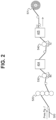
- FIG.1 and FIG 2 illustrate an exemplary on-paper machine method for coating one side of a paperboard web with two layers of aqueous coating.
- a forming wire 110 in the form of an endless belt passes over a breast roll 115 that rotates proximate to a headbox 120.
- the headbox provides an unbleached fiber slurry in water with a fairly low consistency (for example, about 0.5% solids) that passes onto the moving forming wire 110.
- a first distance 230 water drains from the slurry and through the forming wire 110, forming a web 300 of wet fibers.
- the slurry during distance 130 may yet have a wet appearance as there is free water on its surface. At some point as drainage continues the free water may disappear from the surface, and over distance 231, water may continue to drain although the surface appears free from water.
- the web is carried by a transfer felt or press felt through one or more pressing devices such as press rolls 130 that help to further dewatering the web, usually with the application of pressure, vacuum, and sometimes heat.
- the still relatively wet web 300 is dried, for example using dryer or drying sections 401, 402 to produce a dry web ("raw stock") 310 which may then be run through a size press 510 that applies a surface sizing to produce a sized "base stock” 320 which may then be run through additional dryer sections 403 and (on FIG. 2 ) smoothing steps such as calendar 520.
- the unbleached base stock 320 may then be run through one or more coaters.
- coater 530 may apply a first coat ("BC") to a first side ("C1") of the web, and the first coat may be dried in one or more dryer sections 404.
- Coater 540 may apply an optional second coat ("TC") to the first side of the web, and the second coat may be dried in one or more dryer sections 405.
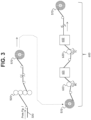
- coating may be applied by an off-machine coater as shown in Fig. 3 .
- the paperboard having been produced on the paper machine and wound onto reel 572 may then be transported (as a reel or as smaller rolls) to an off-machine coater 600, where the paperboard is unwound from reel 572, given a first coating by coater 610, dried in dryer(s) 601, given an optional second coating by coater 620, dried in dryer(s) 602, optionally given further treatment (such as gloss calendaring) and then wound onto reel 573.
- An off-machine coater could instead apply a single coat to one side of the paperboard, or could apply a single coat to each side, or could apply more than one coat to either or both sides. Alternately some coating may be done on the paper machine, with additional coating done on an off-machine coater.
- FIGS. 2-3 Various types of coating devices may be used.
- the coaters illustrated in FIGS. 2-3 are devices where a coating is held in a pan, transferred by a roll to the lower surface of the web (which may be either the first side or the second side depending on the web path), and then the excess coating scraped off by a blade as the web wraps partially around a backing roll.
- other coater types may be used instead, including but not limited to curtain coater, air knife coater, rod coater, film coater, short-dwell coater, spray coater, and metering film size press.
- Unbleached stock is commonly coated with pigmented coatings for the purpose of providing a smooth, white surface suitable for printing.
- a paperboard is CNK ® paperboard manufactured by WestRock Company.
- typical aqueous barrier coatings often use specialty polymer(s), wax, and/or a higher polymer binder level (compared to conventional print coatings). These coatings can cause problems with repulpability of the coated paperboard because the coatings are usually difficult to breakdown to acceptable size or tend to form 'stickies' in paperboard making with the recycled fibers.
- barrier coatings give paperboard a tendency to 'block' (the layers stick together) either in the reel 570, 571, 572, 573 or after it is rewound into rolls.
- the reel 570 there may be residual heat from the dryers, which may dissipate quite slowly because of the large mass of the reel. Higher temperatures may increase the tendency toward blocking.
- paperboard coated with conventional printability coatings usually does not block, and usually is fully repulpable. It would be advantageous if non-blocking and fully repulpable coatings also provided at least some degree of barrier properties.
- conventional printability coatings do not provide satisfactory barrier properties.
- Their formulations have relatively low levels of binder so as to absorb rather than repel fluid (printing ink, for example).
- Binder amounts in conventional printability coatings can range from 15-25 parts per 100 parts of pigment by weight for base coatings, and 10-20 parts per 100 parts pigment by weight for top coatings. Printing grades would tend to be in the lower half of these ranges. Limiting the binder amount in the top coating may allow printing inks or adhesives to absorb readily into the printability coating. Simply increasing the binder to improve barrier properties eventually interferes with printability and causes additional problems, including blocking and repulpability problems.
- conventional printability coatings containing binder(s) and pigment(s) can be expected to have a high level of opacity. This characteristic is highly desirable if the paperboard is intended to provide a white substrate for printing. It is unsuitable for a packaging material intended to have a natural appearance.
- the inventive coatings disclosed in the present application provide a coated unbleached kraft paperboard that maintains its natural brown appearance even with pigment (e.g., clay) in the formulation.
- the resulting coated paperboard shows excellent oil holdout properties and significantly enhanced moisture vapor barrier properties.
- the paperboard does not block at elevated temperature and pressure, and it repulps similarly to or better than the corresponding printable-grade kraft paperboard.
- the coatings use conventional pigments that are low-cost and readily available as coating materials for the paper or paperboard industry.
- pigments are used in the present invention and may include, but are not limited to, kaolin clay, calcium carbonate, etc.
- Pigments used in the examples herein are given the following 'shorthand' designations: "Clay-A” #2 clay, regular brightness, particle size 80-94% ⁇ 2 microns "Clay-B” #1 clay, high brightness, particle size 90-100% ⁇ 2 microns "Clay-C” platy clay with high-aspect ratio "CaCO 3 -A" coarse ground calcium carbonate, particle size 60% ⁇ 2 microns
- binder in the coatings here SBR latex and protein were used.
- the choice of binder in the examples is not meant to be limiting in any way, and may include without limitation at least one of styrene butadiene copolymer, protein, styrene acrylate copolymer, polyvinyl acetate, and vinyl acrylics copolymer.
- Coatings were prepared according to the formulations shown in Table 1, which provides a list of major constituents in dry parts of the aqueous coating formulations used to achieve the oil and grease resistance without blocking or repulpability problems.
- Substantially no fluorochemical was used in the coatings.
- substantially no fluorochemical is meant that fluorochemicals were not deliberately utilized, and that any amount present would have been at most trace amounts. Although fluorochemicals can be excluded in lab experiments, trace amounts of such materials might be present in some paper machine systems due to making various grades of product, or might be introduced into a papermaking system through recycling processes.
- substantially no wax was used in the coatings, with “substantially no wax” having a similar meaning. TABLE 1.
- Paperboard samples were made using unbleached sulfate (kraft) substrate with a caliper of 14 pt (0.014"). The samples were coated on one side (herein termed the "coated side") using a pilot blade coater to apply a single coat or to apply a base coat and then a top coat. The pilot results are expected to be representative of results that might be achieved on a production paper machine or a production off-machine coater.
- Table 2 Test results for the formulations of Table 1 when applied as a single-pass coating are shown in Table 2, with a coat weight of 10.0-10.5 lbs per 3000 ft 2 selected for all samples.
- the samples C-2, C-3, C-4, C-5, and C-9 exhibited a natural appearance in which the brown fiber of the unbleached paperboard stock was clearly visible through the applied coatings, such that the coatings can be considered as having a substantially "transparent” or "translucent” appearance without noticeable whiteness. This is in contrast to the samples C-1, C-6, C-7, and C-8, all of which exhibited some degree of whiteness that prevented or detracted from a natural appearance of the board.
- the samples coated with C-6 and C-7 that contained relatively low binder levels showed mottled whiteness of the coated surface.
- coatings (C-2, C-3, C-4) containing Clay-B, Clay-C, or CaCO 3 respectively, the coating (C-1) with Clay-A did show a whiter appearance.
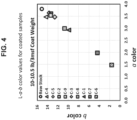
- the color of the samples was measured as L -a-b color space values using a Technidyne Brightimeter Micro S-5 equipment according to TAPPI standard T524, which are shown in Table 2.
- the a color and b color component values are shown graphically in Fig.4 , where it will be noted the samples having a natural appearance are all clustered in the upper right hand corner. Samples exhibiting an acceptable natural appearance had an L value within the color space of less than 72, preferably less than 62, and more preferably less than 60. Values of b for such samples were greater than 6, and preferably greater than 9.5.
- Brightness values for the samples exhibiting an acceptable natural appearance had value of less than 40, preferably less than 30, and more preferably less than 25.
- OGR oil and grease resistance
- the aqueous barrier coating samples C-2, C-3, C-4, C-5, and C-9 with a natural appearance gave 3M kit levels of 4.8 or greater, compared with a print grade CNK ® control having a 3M kit rating less than 1.
- Moisture resistance of the coatings was evaluated by WVTR (water vapor transmission rate) at 38°C and 90% relative humidity (TAPPI Standard T464 OM-12) and water Cobb (TAPPI Standard T441 om-04). WVTR was markedly decreased for the samples having relatively high levels of binder (i.e., in excess of 30 parts), as was the water Cobb rating.
- oil absorptiveness was used to quantify and compare the OGR performance (oil and grease resistance), which measures the mass of oil absorbed in a specific time, e.g., 30 minutes, by 1 square meter of coated paperboard.
- OGR performance oil and grease resistance
- the sample was cut to provide two pieces each 6 inch x 6 inch square.
- Each square sample was weighed just before the test. Then a 4 inch x 4 inch (area of 16 square inches or 0.0103 square meters) square of blotting paper saturated with peanut oil was put on the center of the test specimen (barrier side) and pressed gently to make sure the full area of oily blotting paper was contacting the coated surface.
- the blocking behavior of the samples was tested by evaluating the adhesion between the barrier coated side and the other uncoated side.
- a simplified illustration of the blocking test is shown in FIG. 5 .
- the paperboard was cut into 2" x 2" square samples.
- Several duplicates were tested for each condition, with each duplicate evaluating the blocking between a pair of samples 752, 754. (For example, if four duplicates were test, four pairs - eight pieces - would be used.)
- Each pair was positioned with the 'barrier-coated' side of one piece 752 contacting the uncoated side of the other piece 754.
- the pairs were placed into a stack 750 with a spacer 756 between adjacent pairs, the spacer being foil, release paper, or even copy paper.
- the entire sample stack was placed into the test device 700 illustrated in FIG. 5 .
- the test device 700 includes a frame 710. An adjustment knob 712 is attached to a screw 714 which is threaded through the frame top 716. The lower end of screw 714 is attached to a plate 718 which bears upon a heavy coil spring 720. The lower end of the spring 720 bears upon a plate 722 whose lower surface 724 has an area of one square inch. A scale 726 enables the user to read the applied force (which is equal to the pressure applied to the stack of samples through the one-square-inch lower surface 724).
- the stack 750 of samples is placed between lower surface 724 and the frame bottom 728.
- the knob 712 is tightened until the scale 726 reads the desired force of 100 lbf (100 psi applied to the samples).
- the entire device 700 including samples is then placed in an oven at 50°C for 24 hours.
- the device 700 is then removed from the test environment and cooled to room temperature. The pressure is then released and the samples removed from the device.
- Blocking damage is visible as fiber tear, which if present usually occurs with fibers pulling up from the non-barrier surface of samples 754. If the non-barrier surface was coated with a print coating, then blocking might also be evinced by damage to the print coating.
- samples 752(0)/754(0) might be representative of a "0" blocking (no blocking).
- the circular shape in the samples indicates an approximate area that was under pressure, for instance about one square inch of the overall sample.
- Samples 752(3)/754(3) might be representative of a "3" blocking rating, with up to 25% fiber tear in the area that was under pressure, particularly in the uncoated surface of sample 754(3).
- Samples 752(4)/754(4) might be representative of a "4" blocking rating with more than 25% fiber tear, particularly in the uncoated surface of sample 754(4).
- the depictions in FIG. 5 are only meant to approximately suggest the percent damage to such test samples, rather than showing a realistic appearance of the samples.
- a further series of samples were prepared using the coating formulation C-2 from Table 1. Paperboard samples made using unbleached sulfate (kraft) substrate with a caliper of 14 pt (0.014") were coated on one side (the "coated side") using a pilot blade coater to apply a base coat ("BC") of formulation C-2, and then for some samples, a pilot blade coater was used to apply a top coat ("TC") of formulation C-2. Test results for these samples are shown in Table 4. As before, the oil and grease resistance (OGR) of the samples was measured on the ⁇ coated side' by the 3M kit test and oil Cobb (30 minute). Moisture vapor barrier was also evaluated by measuring WVTR of these samples. TABLE 4.
- OGR oil and grease resistance
- the coated paperboard had a natural appearance.
- Repulpability of the samples in Table 4 was tested using an AMC Maelstrom repulper. 110 grams of coated paperboard, cut into 1"x1" squares, was added to the repulper containing 2895 grams of water (pH of 6.5 ⁇ 0.5, 50°C), soaked for 15 minutes, and then repulped for 30 minutes. 300 mL of the repulped slurry was then screened through a vibrating flat screen (0.006" slot size). Rejects (caught by the screen) and fiber accepts were collected, dried and weighed. The percentage of accepts was calculated based on the weights of accepts and rejects, with 100% being complete repulpability. The samples all achieved repulpability of 98.8% accepts, as compared with 96.3% achieved using the same repulping test performed on a control print grade sample of coated unbleached kraft paperboard.
- a satisfactory natural appearance, along with good oil, grease and moisture resistance, can be obtained with a total binder to pigment ratio (parts of binder, by weight, to 100 parts of pigment) of the coating formulations in a range of 30 to 50, and preferably 35 to 45. This is more than the binder to pigment ratio for typical printability coatings (where rapid absorption of ink is desired) and less than the binder to pigment ratio of typical barrier coatings. Moreover, good results are achieved using a coating comprised at least in part of SBR latex.
- the results show that paperboard having a natural appearance with good oil, grease and moisture resistance is achieved by coating with conventional coating materials.
- the tests described above used a blade coater to apply coating. As previously discussed, various types of coating devices may be used.
- a coated paperboard comprising: an unbleached paperboard substrate having a first side and a second side; a first coating in contact with the first side, the first coating having a coat weight from about 6 to 14 lbs per 3000 ft 2 and comprising binder and pigment, and substantially no fluorochemical or wax; wherein the coated paperboard provides barrier properties to at least one of oil, grease, and moisture; and wherein the coated paperboard has a natural appearance wherein the substrate fibers are substantially visible through the first coating.
- the binder to pigment ratio in the first coating may be in a range of 30 to 50 parts binder per 100 parts pigment, by weight.
- the binder to pigment ratio in the first coating may be in a range of 35 to 45 parts binder per 100 parts pigment, by weight.
- the binder in the first coating may comprise at least one of styrene butadiene copolymer, protein, styrene acrylate copolymer, polyvinyl acetate, and vinyl acrylics copolymer.
- the coated paperboard may further comprise a second coating applied over the first coating, the second coating having a coat weight such that the total coat weight of the first and second coatings is about 10 to 20 lbs per 3000 ft 2 and comprising binder and pigment, and substantially no fluorochemical or wax.
- the binder to pigment ratio in the second coating may be in a range of 30 to 50 parts binder per 100 parts pigment, by weight.
- the binder in the second coating may comprise at least one of styrene butadiene copolymer, protein, styrene acrylate copolymer, polyvinyl acetate, and vinyl acrylics copolymer.
- the 3M kit test value may be at least 4.
- the 3M kit test value may be at least 10.
- the coated paperboard may have a 30-minute oil Cobb test of at most 3 grams per square meter.
- the coated paperboard may have a 30-minute oil Cobb test of at most 1 gram per square meter.
- the coated paperboard may have a water vapor transmission rate of less than 500 grams per square meter per day.
- the coated paperboard may have a water vapor transmission rate of less than 300 grams per square meter per day.
- the coated paperboard may have a water vapor transmission rate of less than 200 grams per square meter per day.
- the coated paperboard may have no tendency toward blocking after being held for 24 hours at 50°C at a pressure of 100 psi.
- the coated paperboard may be repulpable to the extent that after repulping the percentage accepts is at least 98%.
- the pigment may comprise at least one of clay and calcium carbonate.
- the pigment may comprise a clay having a particle size of 90-100% ⁇ 2 microns.
- the pigment may comprise a platy clay having a high aspect ratio.
- the pigment may comprise ground calcium carbonate having a particle size of at least 60% ⁇ 2 microns.
- a coated paperboard comprising: an unbleached paperboard substrate having a first side and a second side; a first coating in contact with the first side, the first coating having a coat weight from about 6 to 14 lbs per 3000 ft 2 and comprising binder and pigment, and substantially no fluorochemical or wax; wherein the coated paperboard provides barrier properties to at least one of oil, grease, and moisture; and wherein the first side of the coated paperboard has an L -a-b color space value in which L is less than 72.
- L may be less than 62.
- L may be less than 60.
- the coated paperboard may further comprise a second coating applied over the first coating, the second coating having a coat weight such that the total coat weight of the first and second coatings is about 10 to 20 lbs per 3000 ft 2 and comprising binder and pigment, and substantially no fluorochemical or wax.
- a coated paperboard comprising: an unbleached paperboard substrate having a first side and a second side; a first coating in contact with the first side, the first coating having a coat weight from about 6 to 14 lbs per 3000 ft 2 and comprising binder and pigment, and substantially no fluorochemical or wax; wherein the coated paperboard provides barrier properties to at least one of oil, grease, and moisture; and wherein the first side of the coated paperboard has an L -a-b color space value in which b is greater than 6.
- b may be greater than 9.5.
- the coated paperboard may further comprise a second coating applied over the first coating, the second coating may have a coat weight such that the total coat weight of the first and second coatings is about 10 to 20 lbs per 3000 ft 2 and comprising binder and pigment, and substantially no fluorochemical or wax.
Landscapes
- Chemical & Material Sciences (AREA)
- Chemical Kinetics & Catalysis (AREA)
- Dispersion Chemistry (AREA)
- Paper (AREA)
Applications Claiming Priority (3)
| Application Number | Priority Date | Filing Date | Title |
|---|---|---|---|
| US201762490920P | 2017-04-27 | 2017-04-27 | |
| EP18725362.0A EP3615731B9 (de) | 2017-04-27 | 2018-04-26 | Öl-, fett- und feuchtigkeitsbeständige pappe mit natürlichem aussehen |
| PCT/US2018/029537 WO2018200790A1 (en) | 2017-04-27 | 2018-04-26 | Oil, grease, and moisture resistant paperboard having a natural appearance |
Related Parent Applications (2)
| Application Number | Title | Priority Date | Filing Date |
|---|---|---|---|
| EP18725362.0A Division EP3615731B9 (de) | 2017-04-27 | 2018-04-26 | Öl-, fett- und feuchtigkeitsbeständige pappe mit natürlichem aussehen |
| EP18725362.0A Division-Into EP3615731B9 (de) | 2017-04-27 | 2018-04-26 | Öl-, fett- und feuchtigkeitsbeständige pappe mit natürlichem aussehen |
Publications (2)
| Publication Number | Publication Date |
|---|---|
| EP4417751A2 true EP4417751A2 (de) | 2024-08-21 |
| EP4417751A3 EP4417751A3 (de) | 2024-10-30 |
Family
ID=62186544
Family Applications (2)
| Application Number | Title | Priority Date | Filing Date |
|---|---|---|---|
| EP18725362.0A Revoked EP3615731B9 (de) | 2017-04-27 | 2018-04-26 | Öl-, fett- und feuchtigkeitsbeständige pappe mit natürlichem aussehen |
| EP24187062.5A Withdrawn EP4417751A3 (de) | 2017-04-27 | 2018-04-26 | Öl-, fett- und feuchtigkeitsbeständige pappe mit natürlichem aussehen |
Family Applications Before (1)
| Application Number | Title | Priority Date | Filing Date |
|---|---|---|---|
| EP18725362.0A Revoked EP3615731B9 (de) | 2017-04-27 | 2018-04-26 | Öl-, fett- und feuchtigkeitsbeständige pappe mit natürlichem aussehen |
Country Status (6)
| Country | Link |
|---|---|
| US (2) | US10844543B2 (de) |
| EP (2) | EP3615731B9 (de) |
| CN (1) | CN110573674A (de) |
| BR (1) | BR112019017836B1 (de) |
| ES (1) | ES2988451T3 (de) |
| WO (1) | WO2018200790A1 (de) |
Families Citing this family (13)
| Publication number | Priority date | Publication date | Assignee | Title |
|---|---|---|---|---|
| US11578462B2 (en) | 2018-04-27 | 2023-02-14 | Westrock Mwv, Llc | Anti-blocking high barrier paperboard structures |
| EP4328379A3 (de) | 2018-04-27 | 2024-04-24 | WestRock MWV, LLC | Heisssiegelbare kartonstrukturen und zugehörige kartonbasierte behälter |
| CA3164981A1 (en) * | 2020-01-17 | 2021-07-22 | Westrock Mwv, Llc | Anti-blocking high barrier paperboard structures |
| US11679921B2 (en) | 2020-02-24 | 2023-06-20 | Menasha Corporation | Plastic-free trapped tray packaging |
| CA3172437A1 (en) * | 2020-03-20 | 2021-09-23 | Westrock Mwv, Llc | Barrier recycled paperboard and method for manufacturing thereof |
| CN111562270B (zh) * | 2020-05-15 | 2023-03-28 | 江苏鼎胜新能源材料股份有限公司 | 一种铝箔表面清洁性快速检测装置及检测方法 |
| USD980069S1 (en) | 2020-07-14 | 2023-03-07 | Ball Corporation | Metallic dispensing lid |
| US11549216B2 (en) * | 2020-11-11 | 2023-01-10 | Sappi North America, Inc. | Oil/grease resistant paper products |
| ES3045610T3 (en) | 2020-12-04 | 2025-11-28 | Agc Chemicals Americas Inc | Treated article, methods of making the treated article, and dispersion for use in making the treated article |
| US12168551B2 (en) | 2021-03-01 | 2024-12-17 | Ball Corporation | Metal container and end closure with seal |
| CN113774710A (zh) * | 2021-08-27 | 2021-12-10 | 上海昶法新材料有限公司 | 一种用于可降解离型纸的复合胶乳 |
| TW202317385A (zh) * | 2021-10-26 | 2023-05-01 | 承康研創股份有限公司 | 可生物分解食品級之pva紙基材製造方法及其pva紙基材 |
| AT526258B1 (de) * | 2022-06-24 | 2025-10-15 | Mondi Ag | Fettabweisendes papier |
Family Cites Families (21)
| Publication number | Priority date | Publication date | Assignee | Title |
|---|---|---|---|---|
| US4265969A (en) * | 1978-05-19 | 1981-05-05 | Mitsubishi Paper Mills, Ltd. | Method for manufacturing cast-coated paper |
| US4898752A (en) * | 1988-03-30 | 1990-02-06 | Westvaco Corporation | Method for making coated and printed packaging material on a printing press |
| US5989724A (en) * | 1993-05-10 | 1999-11-23 | International Paper Company | Recyclable and repulpable ream wrap and related methods of manufacture |
| FI102401B (fi) * | 1997-05-28 | 1998-11-30 | Raisio Chem Oy | Menetelmä transparentin ja läpäisevyyttä vähentävän pinnoitteen aikaan saamiseksi paperille tai kartongille sekä menetelmässä käytettävä pääl lystysaine |
| JP2001355195A (ja) * | 2000-06-13 | 2001-12-26 | Oji Paper Co Ltd | 防湿積層体 |
| US20030039854A1 (en) * | 2001-08-15 | 2003-02-27 | Drewery Michael J. | Copolymeric binder for paperboard coatings with improved glueability and associated methods |
| AU2002335033A1 (en) * | 2002-10-15 | 2004-05-04 | Dow Global Technologies Inc. | Method of producing a multilayer coated substrate having improved barrier properties |
| US6942897B2 (en) | 2003-02-19 | 2005-09-13 | The Board Of Trustees Of Western Michigan University | Nanoparticle barrier-coated substrate and method for making the same |
| US7320825B2 (en) * | 2003-05-27 | 2008-01-22 | International Paper Company | Barrier coatings for oil and grease resistance |
| US7235308B2 (en) * | 2003-10-31 | 2007-06-26 | Appleton Papers Inc. | Recyclable repulpable coated paper stock |
| US7361399B2 (en) * | 2004-05-24 | 2008-04-22 | International Paper Company | Gloss coated multifunctional printing paper |
| CN101228314A (zh) * | 2005-07-22 | 2008-07-23 | 国际纸业公司 | 含有含氟化合物并具有提高的抗油性和粘合性的纸基材 |
| US8142887B2 (en) * | 2008-03-21 | 2012-03-27 | Meadwestvaco Corporation | Basecoat and associated paperboard structure |
| KR101621575B1 (ko) * | 2008-10-10 | 2016-05-16 | 다우 글로벌 테크놀로지스 엘엘씨 | 종이계 기재용 다층 코팅 |
| US8658272B2 (en) | 2009-04-21 | 2014-02-25 | Meadwestvaco Corporation | Basecoat and associated paperboard structure including a pigment blend of hyper-platy clay and calcined clay |
| US9580866B2 (en) * | 2009-06-03 | 2017-02-28 | Solenis Technologies, L.P. | Cationic wet strength resin modified pigments in water-based latex coating applications |
| WO2011109783A1 (en) * | 2010-03-05 | 2011-09-09 | Eco-Friendly Solutions, LLC | Methods for manufacturing recyclable and repulpable packaging materials |
| US9365980B2 (en) * | 2010-11-05 | 2016-06-14 | International Paper Company | Packaging material having moisture barrier and methods for preparing same |
| US9863094B2 (en) * | 2015-02-11 | 2018-01-09 | Westrock Mwv, Llc | Printable compostable paperboard |
| US9771688B2 (en) * | 2015-02-11 | 2017-09-26 | Westrock Mwv, Llc | Oil, grease, and moisture resistant paperboard |
| US10704200B2 (en) * | 2016-11-17 | 2020-07-07 | Westrock Mwv, Llc | Oil and grease resistant paperboard |
-
2018
- 2018-04-26 CN CN201880027674.7A patent/CN110573674A/zh active Pending
- 2018-04-26 ES ES18725362T patent/ES2988451T3/es active Active
- 2018-04-26 EP EP18725362.0A patent/EP3615731B9/de not_active Revoked
- 2018-04-26 BR BR112019017836-8A patent/BR112019017836B1/pt active IP Right Grant
- 2018-04-26 WO PCT/US2018/029537 patent/WO2018200790A1/en not_active Ceased
- 2018-04-26 US US15/963,620 patent/US10844543B2/en active Active
- 2018-04-26 EP EP24187062.5A patent/EP4417751A3/de not_active Withdrawn
-
2020
- 2020-10-16 US US17/072,248 patent/US11519134B2/en active Active
Also Published As
| Publication number | Publication date |
|---|---|
| EP3615731A1 (de) | 2020-03-04 |
| US20190127917A1 (en) | 2019-05-02 |
| US10844543B2 (en) | 2020-11-24 |
| EP3615731C0 (de) | 2024-07-17 |
| EP3615731B1 (de) | 2024-07-17 |
| US20210032817A1 (en) | 2021-02-04 |
| CN110573674A (zh) | 2019-12-13 |
| WO2018200790A1 (en) | 2018-11-01 |
| BR112019017836A2 (pt) | 2020-04-14 |
| ES2988451T3 (es) | 2024-11-20 |
| EP4417751A3 (de) | 2024-10-30 |
| EP3615731B9 (de) | 2024-08-28 |
| US11519134B2 (en) | 2022-12-06 |
| BR112019017836B1 (pt) | 2023-12-05 |
Similar Documents
| Publication | Publication Date | Title |
|---|---|---|
| US11519134B2 (en) | Oil, grease, and moisture resistant paperboard having a natural appearance | |
| US11326308B2 (en) | Oil and grease resistant paperboard | |
| JP7128862B2 (ja) | 耐油性、耐グリース性、及び耐湿性板紙 | |
| US10704200B2 (en) | Oil and grease resistant paperboard | |
| EP3497283B1 (de) | Öl-, fett- und feuchtigkeitsbeständige pappe | |
| US9863094B2 (en) | Printable compostable paperboard | |
| US9670621B2 (en) | Compostable paperboard with oil, grease, and moisture resistance | |
| EP3497282B1 (de) | Kompostierbare pappe mit öl-, fett- und feuchtigkeitsbeständigkeit | |
| CA2973887C (en) | Oil, grease, and moisture resistant paperboard |
Legal Events
| Date | Code | Title | Description |
|---|---|---|---|
| PUAI | Public reference made under article 153(3) epc to a published international application that has entered the european phase |
Free format text: ORIGINAL CODE: 0009012 |
|
| STAA | Information on the status of an ep patent application or granted ep patent |
Free format text: STATUS: THE APPLICATION HAS BEEN PUBLISHED |
|
| AC | Divisional application: reference to earlier application |
Ref document number: 3615731 Country of ref document: EP Kind code of ref document: P |
|
| AK | Designated contracting states |
Kind code of ref document: A2 Designated state(s): AL AT BE BG CH CY CZ DE DK EE ES FI FR GB GR HR HU IE IS IT LI LT LU LV MC MK MT NL NO PL PT RO RS SE SI SK SM TR |
|
| REG | Reference to a national code |
Ref country code: DE Ref legal event code: R079 Free format text: PREVIOUS MAIN CLASS: D21H0021520000 Ipc: D21H0019380000 |
|
| PUAL | Search report despatched |
Free format text: ORIGINAL CODE: 0009013 |
|
| AK | Designated contracting states |
Kind code of ref document: A3 Designated state(s): AL AT BE BG CH CY CZ DE DK EE ES FI FR GB GR HR HU IE IS IT LI LT LU LV MC MK MT NL NO PL PT RO RS SE SI SK SM TR |
|
| RIC1 | Information provided on ipc code assigned before grant |
Ipc: D21H 21/52 20060101ALI20240925BHEP Ipc: D21H 19/82 20060101ALI20240925BHEP Ipc: D21H 19/66 20060101ALI20240925BHEP Ipc: D21H 19/58 20060101ALI20240925BHEP Ipc: D21H 19/50 20060101ALI20240925BHEP Ipc: D21H 19/40 20060101ALI20240925BHEP Ipc: D21H 19/38 20060101AFI20240925BHEP |
|
| STAA | Information on the status of an ep patent application or granted ep patent |
Free format text: STATUS: THE APPLICATION IS DEEMED TO BE WITHDRAWN |
|
| 18D | Application deemed to be withdrawn |
Effective date: 20250501 |