EP4411284A1 - Échangeur de chaleur et dispositif à cycle de réfrigération - Google Patents
Échangeur de chaleur et dispositif à cycle de réfrigération Download PDFInfo
- Publication number
- EP4411284A1 EP4411284A1 EP21959361.3A EP21959361A EP4411284A1 EP 4411284 A1 EP4411284 A1 EP 4411284A1 EP 21959361 A EP21959361 A EP 21959361A EP 4411284 A1 EP4411284 A1 EP 4411284A1
- Authority
- EP
- European Patent Office
- Prior art keywords
- fin
- projections
- projection
- heat transfer
- heat exchanger
- Prior art date
- Legal status (The legal status is an assumption and is not a legal conclusion. Google has not performed a legal analysis and makes no representation as to the accuracy of the status listed.)
- Withdrawn
Links
Images











Classifications
-
- F—MECHANICAL ENGINEERING; LIGHTING; HEATING; WEAPONS; BLASTING
- F28—HEAT EXCHANGE IN GENERAL
- F28D—HEAT-EXCHANGE APPARATUS, NOT PROVIDED FOR IN ANOTHER SUBCLASS, IN WHICH THE HEAT-EXCHANGE MEDIA DO NOT COME INTO DIRECT CONTACT
- F28D1/00—Heat-exchange apparatus having stationary conduit assemblies for one heat-exchange medium only, the media being in contact with different sides of the conduit wall, in which the other heat-exchange medium is a large body of fluid, e.g. domestic or motor car radiators
- F28D1/02—Heat-exchange apparatus having stationary conduit assemblies for one heat-exchange medium only, the media being in contact with different sides of the conduit wall, in which the other heat-exchange medium is a large body of fluid, e.g. domestic or motor car radiators with heat-exchange conduits immersed in the body of fluid
- F28D1/04—Heat-exchange apparatus having stationary conduit assemblies for one heat-exchange medium only, the media being in contact with different sides of the conduit wall, in which the other heat-exchange medium is a large body of fluid, e.g. domestic or motor car radiators with heat-exchange conduits immersed in the body of fluid with tubular conduits
- F28D1/047—Heat-exchange apparatus having stationary conduit assemblies for one heat-exchange medium only, the media being in contact with different sides of the conduit wall, in which the other heat-exchange medium is a large body of fluid, e.g. domestic or motor car radiators with heat-exchange conduits immersed in the body of fluid with tubular conduits the conduits being bent, e.g. in a serpentine or zig-zag
- F28D1/0477—Heat-exchange apparatus having stationary conduit assemblies for one heat-exchange medium only, the media being in contact with different sides of the conduit wall, in which the other heat-exchange medium is a large body of fluid, e.g. domestic or motor car radiators with heat-exchange conduits immersed in the body of fluid with tubular conduits the conduits being bent, e.g. in a serpentine or zig-zag the conduits being bent in a serpentine or zig-zag
-
- F—MECHANICAL ENGINEERING; LIGHTING; HEATING; WEAPONS; BLASTING
- F28—HEAT EXCHANGE IN GENERAL
- F28D—HEAT-EXCHANGE APPARATUS, NOT PROVIDED FOR IN ANOTHER SUBCLASS, IN WHICH THE HEAT-EXCHANGE MEDIA DO NOT COME INTO DIRECT CONTACT
- F28D7/00—Heat-exchange apparatus having stationary tubular conduit assemblies for both heat-exchange media, the media being in contact with different sides of a conduit wall
- F28D7/16—Heat-exchange apparatus having stationary tubular conduit assemblies for both heat-exchange media, the media being in contact with different sides of a conduit wall the conduits being arranged in parallel spaced relation
-
- F—MECHANICAL ENGINEERING; LIGHTING; HEATING; WEAPONS; BLASTING
- F25—REFRIGERATION OR COOLING; COMBINED HEATING AND REFRIGERATION SYSTEMS; HEAT PUMP SYSTEMS; MANUFACTURE OR STORAGE OF ICE; LIQUEFACTION SOLIDIFICATION OF GASES
- F25B—REFRIGERATION MACHINES, PLANTS OR SYSTEMS; COMBINED HEATING AND REFRIGERATION SYSTEMS; HEAT PUMP SYSTEMS
- F25B13/00—Compression machines, plants or systems, with reversible cycle
-
- F—MECHANICAL ENGINEERING; LIGHTING; HEATING; WEAPONS; BLASTING
- F25—REFRIGERATION OR COOLING; COMBINED HEATING AND REFRIGERATION SYSTEMS; HEAT PUMP SYSTEMS; MANUFACTURE OR STORAGE OF ICE; LIQUEFACTION SOLIDIFICATION OF GASES
- F25B—REFRIGERATION MACHINES, PLANTS OR SYSTEMS; COMBINED HEATING AND REFRIGERATION SYSTEMS; HEAT PUMP SYSTEMS
- F25B39/00—Evaporators; Condensers
-
- F—MECHANICAL ENGINEERING; LIGHTING; HEATING; WEAPONS; BLASTING
- F25—REFRIGERATION OR COOLING; COMBINED HEATING AND REFRIGERATION SYSTEMS; HEAT PUMP SYSTEMS; MANUFACTURE OR STORAGE OF ICE; LIQUEFACTION SOLIDIFICATION OF GASES
- F25B—REFRIGERATION MACHINES, PLANTS OR SYSTEMS; COMBINED HEATING AND REFRIGERATION SYSTEMS; HEAT PUMP SYSTEMS
- F25B49/00—Arrangement or mounting of control or safety devices
- F25B49/02—Arrangement or mounting of control or safety devices for compression type machines, plants or systems
-
- F—MECHANICAL ENGINEERING; LIGHTING; HEATING; WEAPONS; BLASTING
- F28—HEAT EXCHANGE IN GENERAL
- F28D—HEAT-EXCHANGE APPARATUS, NOT PROVIDED FOR IN ANOTHER SUBCLASS, IN WHICH THE HEAT-EXCHANGE MEDIA DO NOT COME INTO DIRECT CONTACT
- F28D1/00—Heat-exchange apparatus having stationary conduit assemblies for one heat-exchange medium only, the media being in contact with different sides of the conduit wall, in which the other heat-exchange medium is a large body of fluid, e.g. domestic or motor car radiators
- F28D1/02—Heat-exchange apparatus having stationary conduit assemblies for one heat-exchange medium only, the media being in contact with different sides of the conduit wall, in which the other heat-exchange medium is a large body of fluid, e.g. domestic or motor car radiators with heat-exchange conduits immersed in the body of fluid
- F28D1/04—Heat-exchange apparatus having stationary conduit assemblies for one heat-exchange medium only, the media being in contact with different sides of the conduit wall, in which the other heat-exchange medium is a large body of fluid, e.g. domestic or motor car radiators with heat-exchange conduits immersed in the body of fluid with tubular conduits
- F28D1/047—Heat-exchange apparatus having stationary conduit assemblies for one heat-exchange medium only, the media being in contact with different sides of the conduit wall, in which the other heat-exchange medium is a large body of fluid, e.g. domestic or motor car radiators with heat-exchange conduits immersed in the body of fluid with tubular conduits the conduits being bent, e.g. in a serpentine or zig-zag
-
- F—MECHANICAL ENGINEERING; LIGHTING; HEATING; WEAPONS; BLASTING
- F28—HEAT EXCHANGE IN GENERAL
- F28F—DETAILS OF HEAT-EXCHANGE AND HEAT-TRANSFER APPARATUS, OF GENERAL APPLICATION
- F28F1/00—Tubular elements; Assemblies of tubular elements
- F28F1/10—Tubular elements and assemblies thereof with means for increasing heat-transfer area, e.g. with fins, with projections, with recesses
- F28F1/12—Tubular elements and assemblies thereof with means for increasing heat-transfer area, e.g. with fins, with projections, with recesses the means being only outside the tubular element
- F28F1/24—Tubular elements and assemblies thereof with means for increasing heat-transfer area, e.g. with fins, with projections, with recesses the means being only outside the tubular element and extending transversely
- F28F1/32—Tubular elements and assemblies thereof with means for increasing heat-transfer area, e.g. with fins, with projections, with recesses the means being only outside the tubular element and extending transversely the means having portions engaging further tubular elements
-
- F—MECHANICAL ENGINEERING; LIGHTING; HEATING; WEAPONS; BLASTING
- F25—REFRIGERATION OR COOLING; COMBINED HEATING AND REFRIGERATION SYSTEMS; HEAT PUMP SYSTEMS; MANUFACTURE OR STORAGE OF ICE; LIQUEFACTION SOLIDIFICATION OF GASES
- F25B—REFRIGERATION MACHINES, PLANTS OR SYSTEMS; COMBINED HEATING AND REFRIGERATION SYSTEMS; HEAT PUMP SYSTEMS
- F25B2600/00—Control issues
- F25B2600/02—Compressor control
- F25B2600/021—Inverters therefor
-
- F—MECHANICAL ENGINEERING; LIGHTING; HEATING; WEAPONS; BLASTING
- F25—REFRIGERATION OR COOLING; COMBINED HEATING AND REFRIGERATION SYSTEMS; HEAT PUMP SYSTEMS; MANUFACTURE OR STORAGE OF ICE; LIQUEFACTION SOLIDIFICATION OF GASES
- F25B—REFRIGERATION MACHINES, PLANTS OR SYSTEMS; COMBINED HEATING AND REFRIGERATION SYSTEMS; HEAT PUMP SYSTEMS
- F25B2600/00—Control issues
- F25B2600/25—Control of valves
- F25B2600/2513—Expansion valves
-
- F—MECHANICAL ENGINEERING; LIGHTING; HEATING; WEAPONS; BLASTING
- F28—HEAT EXCHANGE IN GENERAL
- F28D—HEAT-EXCHANGE APPARATUS, NOT PROVIDED FOR IN ANOTHER SUBCLASS, IN WHICH THE HEAT-EXCHANGE MEDIA DO NOT COME INTO DIRECT CONTACT
- F28D21/00—Heat-exchange apparatus not covered by any of the groups F28D1/00 - F28D20/00
- F28D2021/0019—Other heat exchangers for particular applications; Heat exchange systems not otherwise provided for
- F28D2021/0068—Other heat exchangers for particular applications; Heat exchange systems not otherwise provided for for refrigerant cycles
-
- F—MECHANICAL ENGINEERING; LIGHTING; HEATING; WEAPONS; BLASTING
- F28—HEAT EXCHANGE IN GENERAL
- F28F—DETAILS OF HEAT-EXCHANGE AND HEAT-TRANSFER APPARATUS, OF GENERAL APPLICATION
- F28F2225/00—Reinforcing means
- F28F2225/06—Reinforcing means for fins
Definitions
- the present disclosure relates to a heat exchanger and a refrigeration cycle apparatus including the same.
- projections for preventing airflow separation are provided around each heat transfer tube to narrow a dead water region in a wake flow portion of the heat transfer tube to bring about improvement in heat transfer performance.
- the term "dead water region” here means a region into which air does not flow and where there is a decrease in heat transfer coefficient.
- a collision of an airflow with the projections around the heat transfer tube causes air to flow into the wake flow portion of the heat transfer tube, thus narrowing the dead water region in the wake flow portion of the heat transfer tube.
- Patent Literature 1 Japanese Unexamined Patent Application Publication No. 58-158496
- Patent Literature 1 the projections are provided at positions at an angle of ⁇ 70 degrees to ⁇ 80 degrees to a stagnation point directed toward the center of the heat transfer tube, with the result that the projections are sparsely provided around the heat transfer tube. For this reason, in Patent Literature 1, it is hard to secure, around the heat transfer tube, a region in which to provide additional projections for improving the strength of each fin. The incapability of providing additional projections for improving the strength of the fins causes the fin to bend in a longitudinal direction when worked on. Further, the projections of Patent Literature 1 per se cannot bring about sufficient improvement in heat transfer coefficient, as the surface area of the fin is small in enlargement factor.
- the present disclosure was made to solve such problems and has as an object to provide a heat exchanger with improvement in longitudinal strength of each fin and improvement in heat transfer coefficient and a refrigeration cycle apparatus including the same.
- a heat exchanger includes a plurality of fins spaced apart from one another in a first direction and a plurality of heat transfer tubes penetrating through the plurality of fins, the plurality of heat transfer tubes being spaced apart from one another in a second direction crossing the first direction.
- Each of the plurality of fins includes a fin base surface that is flat and a plurality of fin projections.
- the plurality of fin projections include inner fin projections provided to separately surround each of the plurality of heat transfer tubes, the inner fin projections protruding in the first direction from the fin base surface, and outer fin projections provided to separately surround each of the inner fin projections, the outer fin projections protruding in the first direction from the fin base surface.
- a refrigeration cycle apparatus includes the heat exchanger as a condenser or an evaporator.
- the inner fin projections and the outer fin projections are provided around the heat transfer tubes.
- the inner fin projections and the outer fin projections extend in a longitudinal direction of the fin to surround the heat transfer tubes, thus bringing about improvement in longitudinal strength of the fin. This makes it possible to cause the fin to bend less in the longitudinal direction when worked on.
- the inner fin projections and the outer fin projections, which are provided around the heat transfer tubes enlarge the surface area of the fin base surface, thus bringing about improvement in heat transfer coefficient on the surface of the fin 12. This makes it possible to improve the heat transfer performance of the heat exchanger.
- Fig. 1 is a perspective view showing a configuration of a heat exchanger 100 according to Embodiment 1.
- the heat exchanger 100 is a fin-and-tube heat exchanger. As shown in Fig. 1 , the heat exchanger 100 includes a plurality of heat transfer tubes 11 and a plurality of fins 12. The following description uses each of the nouns "heat transfer tube 11" and "fin 12" in either the singular form or the plural form.
- each of the fins 12 is a rectangular flat-plate element. Those fins 12 are placed at regular spacings from one another in a Y direction to form a space through which air flows. In the following, the spacings are called "fin pitches". The fin pitches do not need to be equal to one another but may be different from one another. The fin pitches are each a center-to-center distance between adjacent ones of the fins 12 in a thickness direction. Air flows along principal surfaces of the fins 12 as indicated by an arrow R1 in Fig. 1 .
- the fins 12 are constituted, for example, by aluminum but are not limited to particular materials. It should be noted that the direction in which air flows as indicated by the arrow R1 is called "X direction (third direction)".
- a longitudinal direction of the fins 12 is called “Z direction (second direction)". Furthermore, the direction in which the fins 12 are stacked is called “Y direction (first direction)”. The X direction and the Z direction are orthogonal to each other. Further, the X direction and the Y direction are orthogonal to each other. Furthermore, the Y direction and the Z direction are orthogonal to each other. It should be noted that a transverse direction of the fins 12 is sometimes referred to as "X direction (third direction)". The Z direction is for example a vertical direction.
- the heat transfer tubes 11 are arranged in one column and twelve rows in the example shown in Fig. 1 .
- the column count and row count of heat transfer tubes 11 are not limited to these counts.
- the heat transfer tubes 11 may be arranged in two or more columns through the fins 12.
- Fig. 1 shows a case in which a longitudinal direction of the heat transfer tubes 11 extends in the Y direction.
- the Y direction is for example a horizontal direction.
- this case is not intended to impose any limitation. That is, the longitudinal direction of the heat transfer tubes 11 may extend in a vertical direction. In that case, the longitudinal direction of the fins 12 is a horizontal direction.
- the plurality of heat transfer tubes 11 are disposed to penetrate through the fins 12. Accordingly, the longitudinal direction of the heat transfer tubes 11 is the Y direction. Further, those heat transfer tubes 11 are placed parallel to one another at regular spacings from one another in the Z direction. In the following, the spacings are called "tube pitches".
- the tube pitches do not need to be equal to one another but may be different from one another.
- the tube pitches are each a center-to-center distance between adjacent ones of the heat transfer tubes 11 in the Z direction. As indicated by arrows R2 in Fig. 1 , refrigerant flows through the heat transfer tubes 11.
- Ones of the heat transfer tubes 11 that are adjacent to each other in the Z direction have their ends connected to each other by a U-tube 11a as shown in Fig. 1 .
- This causes the plurality of heat transfer tubes 11 to be combined to make a single tube so that the refrigerant sequentially flows.
- the heat transfer tubes 11 do not need to be combined to make a single tube.
- the heat transfer tubes 11 are constituted a highly thermal conductive metal such as copper or a copper alloy but are not limited to particular materials.
- Fig. 2 is a partial sectional side view showing only a basic configuration of the heat exchanger 100 of Fig. 1 .
- Fig. 2 shows a cross-section taken at one place in the Y direction.
- Fig. 2 shows the principal surface of a fin 12 and cross-sections of heat transfer tubes 11.
- Each of the heat transfer tubes 11 is constituted, for example, by a circular tube or a flat tube.
- Figs. 1 and 2 show a case in which the heat transfer tubes 11 are circular tubes.
- the heat exchanger 100 exchanges heat between air flowing along the principal surfaces of the fins 12 and refrigerant flowing through the heat transfer tubes 11.
- the heat exchanger 100 is placed so that air flows in the X direction.
- Fig. 3 is a refrigerant circuit diagram showing an example of a configuration of the refrigeration cycle apparatus 1 according to Embodiment 1.
- the refrigeration cycle apparatus 1 includes a heat source side unit 2 and a load side unit 3.
- the heat source side unit 2 and the load side unit 3 are connected to each other by a refrigerant pipe 8.
- the heat exchanger 100 can be used in both the heat source side unit 2 and the load side unit 3.
- a heat exchanger 100 disposed in the heat source side unit 2 is called “heat exchanger 100A”
- a heat exchanger 100 disposed in the load side unit 3 is called “heat exchanger 100B”.
- the load side unit 3 includes the heat exchanger 100B, an air-sending device 7B, a controller 9B, and a portion of the refrigerant pipe 8.
- the air-sending device 7B sends air to the heat exchanger 100B.
- the heat exchanger 100B exchanges heat between refrigerant flowing through the heat transfer tubes 11 and air.
- the heat exchanger 100B functions as a condenser
- the heat exchanger 100B functions as an evaporator.
- the air-sending device 7B is for example a propeller fan.
- the air-sending device 7B is constituted by a fan motor 7a and a fan 7b.
- the fan 7b rotates with the fan motor 7a serving as a power source.
- the rotation speed of the air-sending device 7B is controlled by the controller 9B.
- the heat source side unit 2 includes the heat exchanger 100A, a controller 9A, a compressor 4, a flow switching device 5, an expansion valve 6, an air-sending device 7A, and a portion of the refrigerant pipe 8.
- the heat source side unit 2 may further include other components such an accumulator.
- the heat exchanger 100A exchanges heat between refrigerant flowing through the heat transfer tubes 11 and air.
- the heat exchanger 100A functions as an evaporator
- the heat exchanger 100A functions as a condenser.
- the air-sending device 7A sends air to the heat exchanger 100A.
- the air-sending device 7A is for example a propeller fan.
- the air-sending device 7A is constituted by a fan motor 7a and a fan 7b.
- the rotation speed of the air-sending device 7A is controlled by the controller 9A.
- the compressor 4 suctions low-pressure gas refrigerant, compresses the low-pressure gas refrigerant into high-pressure gas refrigerant, and discharges the high-pressure gas refrigerant.
- the compressor 4 is for example an inverter compressor.
- the inverter compressor is enabled by the control of an inverter circuit or other circuits to change the amount of refrigerant that is sent out per unit time.
- the inverter circuit is mounted, for example, in the controller 9A.
- the flow switching device 5 is a valve configured to switch among directions in which refrigerant in the refrigerant pipe 8 flows.
- the flow switching device 5 is constituted, for example, by a four-way valve.
- the flow switching device 5 is switched by the control of the controller 9A between a case in which the refrigeration cycle apparatus 1 performs a cooling operation and a case in which the refrigeration cycle apparatus 1 performs a heating operation.
- the flow switching device 5 is brought into a state indicated by solid lines in Fig. 3 .
- the refrigerant discharged from the compressor 4 flows into the heat exchanger 100A disposed in the heat source side unit 2.
- the expansion valve 6 causes liquid refrigerant flowing thereinto to be decompressed by expanding action and flow out so that refrigerant liquefied in a condenser can be easily evaporated in an evaporator. Further, the expansion valve 6 adjusts the amount of refrigerant to keep the amount of refrigerant appropriate for the load on the evaporator.
- the expansion valve 6 is constituted, for example, by an electronic expansion valve. The opening degree of the expansion valve 6 is controlled by the controller 9A. As shown in Fig. 3 , the expansion valve 6 is connected by the refrigerant pipe 8 between the heat exchanger 100A and the heat exchanger 100B.
- the refrigerant pipe 8 constitutes a refrigerant circuit by connecting the compressor 4, the flow switching device 5, the heat exchanger 100A, the expansion valve 6, and the heat exchanger 100B to one another as shown in Fig. 3 .
- the refrigerant pipe 8 is coupled to the heat transfer tubes 11 of the heat exchanger 100A and the heat transfer tubes 11 of the heat exchanger 100B.
- Fig. 4 is a partial sectional side view showing a fin 12 of the heat exchanger 100 according to Embodiment 1.
- Fig. 4 shows the principal surface of the fin 12.
- Fig. 4 shows cross-sections of heat transfer tubes 11 parallel to the principal surface of the fin 12.
- the heat transfer tubes 11 shown in Fig. 4 are circular tubes and are circular in cross-section. As shown in Fig. 4 , the heat transfer tubes 11 are arranged in a line along the Z direction.
- the fin 12 has a leading edge 12a and a trailing edge 12b. Since air flows in the direction of an arrow R1 of Fig. 4 , the leading edge 12a is disposed further windward than the trailing edge 12b.
- the heat transfer tubes 11 are inserted in through holes 12c formed in the fin 12.
- the outside diameter of each of the heat transfer tubes 11 is equal to the inside diameter of each of the through holes 12c. Accordingly, the heat transfer tubes 11 are in close contact with inner walls of the through holes 12c.
- the principal surface of the fin 12 constitutes a fin base surface 121 that is flat.
- the fin base surface 121 is provided with fin projections 122.
- the fin projections 122 protrude in the Y direction from the fin base surface 121, which is the principal surface of the fin 12.
- the fin projections 122 include inner fin projections 122A provided to separately surround each of the plurality of heat transfer tubes 11.
- the fin projections 122 include outer fin projections 122B provided to separately surround each of the inner fin projections 122A.
- the inner fin projections 122A and the outer fin projections 122B are referred to simply as "fin projections 122" in a case in which there is no particular need to distinguish between them.
- the following description uses each of the nouns "fin projection 122", “inner fin projection 122A ", and “outer fin projection 122B” in either the singular form or the plural form.
- FIG. 4 uses hatching to indicate the fin projections 122 to distinguish them from the fin base surface 121, the fin projections 122 shown in Fig. 4 are not cross-sections.
- Fig. 4 uses solid lines to indicate visible outlines and edge lines of the fin projections 122 in a view of the fin base surface 121 in the Y direction and uses hatching to indicate portions interposed between the visible outlines and the edge lines. This applies to Figs. 8 to 13 , Fig. 15 , Fig. 19 , Fig. 21 , Fig. 23 , Fig. 25 , Fig. 27 , Fig. 29 , and Fig. 31 .
- the fin projections 122 are circular in shape in a view of the principal surface of the fin 12 in the Y direction.
- the heat transfer tubes 11, the inner fin projections 122A, and the outer fin projections 122B are provided in a concentric configuration.
- a relationship among the diameter of each of the heat transfer tubes 11, the diameter of each of the inner fin projections 122A, and the diameter of each of the outer fin projections 122B is expressed as "Diameter of Heat Transfer Tube 11 ⁇ Diameter of Inner Fin Projection 122A ⁇ Diameter of Outer Fin Projection 122B".
- Fig. 5 is a cross-sectional view taken along line A-A in Fig. 4 .
- Fig. 6 is a cross-sectional view taken along line B-B in Fig. 4 .
- the through holes 12c may have fin collars 12d at edges thereof.
- the fin collars 12d protrude in the Y direction from the fin base surface 121, which is the principal surface of the fin 12, along side surfaces of the heat transfer tubes 11 (see Fig. 4 ).
- protruding distal ends of the fin collars 12d have bends, the protruding distal ends do not need to have bends.
- Protruding portions of the fin collars 12d may be linear in shape. It should be noted that although, in Figs. 5 and 6 , the through holes 12c have the fin collars 12d, the through holes 12c do not need to have the fin collars 12d.
- first flat portions 121A In a case in which no first flat portions 121A are provided between the inner fin projections 122A and the outer fin projections 122B, stress concentrates on boundary portions of the inner fin projections 122A and the outer fin projections 122B in the formation of the fin. Concentration of stress in the formation of the fin is avoided by providing the first flat portions 121A.
- the inner fin projections 122A and the outer fin projections 122B are triangular in cross-section. However, the inner fin projections 122A and the outer fin projections 122B do not need to be triangular in cross-section.
- the inner fin projections 122A and the outer fin projections 122B may for example be rectangular, polygonal, or circular in cross-section.
- each of the inner fin projections 122A and the height of each of the outer fin projections 122B are described. Assume that h1 is the height of each of the inner fin projections 122A from the fin base surface 121 and that h2 is the height of each of the outer fin projections 122B from the fin base surface 121. Note here that the height h1 of each of the inner fin projections 122A and the height h2 of each of the outer fin projections 122B may be equal to each other as shown in Figs. 5 and 6 .
- a heat exchanger 100 includes a plurality of fins 12 spaced apart from one another in a first direction Y and a plurality of heat transfer tubes 11 penetrating through the plurality of fins 12, the plurality of heat transfer tubes 11 being spaced apart from one another in a second direction Z crossing the first direction Y.
- Each of the plurality of fins 12 includes a fin base surface 121 that is flat and a plurality of fin projections 122.
- the plurality of fin projections 122 include inner fin projections 122A provided to separately surround each of the plurality of heat transfer tubes 11, the inner fin projections 122A protruding in the first direction Y from the fin base surface 121, and outer fin projections 122B provided to separately surround each of the inner fin projections 122A, the outer fin projections 122B protruding in the first direction Y from the fin base surface 121.
- the inner fin projections 122A and the outer fin projections 122B are provided to surround the heat transfer tubes 11.
- the fin projections 122 have portions extending in the second direction Z of the fin 12. That is, the provision of fin projections 122 having portions along the longitudinal direction of the fin 12 brings about improvement in longitudinal strength of the fin 12. This keeps the fin 12 from bending in the longitudinal direction when worked on, for example when pressed or when stacked. This brings about improvement in producibility of the heat exchanger.
- the provision of the inner fin projections 122A and the outer fin projections 122B around the heat transfer tubes 11 brings about a heat exchange promoting effect that is similar to that which is brought about in a case in which projections are provided in both the longitudinal direction and transverse direction of the fin 12. That is, regardless of whether air flows in from the longitudinal direction or transverse direction of the fin 12, the fin projections 122 are provided in the direction of flow of air. This makes it possible to effectively utilize the inner fin projections 122A and the outer fin projections 122B as heat transfer elements. This results in improvement in heat transfer coefficient on the surface of the fin 12, bringing about improvement in heat transfer performance of the heat exchanger.
- the inner fin projections 122A and the outer fin projections 122B are provided around through holes 12c in which the heat transfer tubes 11 are inserted.
- the material is stretched in a well-balanced manner from all parts of the fin 12, so that distortions in shape due to concentration of stress on the fin base surface 121 can be reduced. This brings about improvement in workability of the fin 12, bringing about improvement in manufacturability of the heat exchanger.
- the plurality of heat transfer tubes 11 are circular in cross-section, and each of the inner fin projections 122A and a corresponding one of the outer fin projections 122B are provided concentrically with a corresponding one of the plurality of heat transfer tubes 11.
- the inner fin projection 122A and the outer fin projection 122B are provided along a circumferential direction of a circular cross-section of the heat transfer tube 11.
- the fin is deformed uniformly in the circumferential direction of the cross-section of the heat transfer tube 11, so that it is hard for stress to concentrate. This brings about improvement in formability of the fin 12, resulting in improvement in manufacturability of the heat exchanger.
- the fin base surface 121 has first flat portions 121A between the inner fin projections 122A and the outer fin projections 122B.
- the first flat portions 121A allows the inner fin projections 122A and the outer fin projections 122B to be provided on the fin 12 without touching each other. This makes it hard for stress to concentrate between the inner fin projections 122A and the outer fin projections 122B in the formation of the fin. This brings about improvement in formability of the fin 12, resulting in improvement in manufacturability of the heat exchanger.
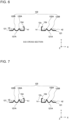
- Fig. 7 is a cross-sectional view showing Modification 1 of a fin 12 of the heat exchanger 100 according to Embodiment 1.
- Fig. 7 shows a portion of Modification 1 that corresponds to a cross-section taken along line B-B in Fig. 4 .
- the fin projections 122 include inner fin projections 122A and outer fin projections 122B.
- the heat exchanger 100 according to Modification 1 is different from Embodiment 1 in relationship between the height h1 of each of the inner fin projections 122A from the fin base surface 121 and the height h2 of each of the outer fin projections 122B from the fin base surface 121.
- the height h1 of each of the inner fin projections 122A and the height h2 of each of the outer fin projections 122B are equal to each other.
- the height h1 of each of the inner fin projections 122A is greater than the height h2 of each of the outer fin projections 122B.
- Other components and workings are not described here, as they are the same as those of Embodiment 1.
- a relationship between the height h1 of each of the inner fin projections 122A and the height h2 of each of the outer fin projections 122B is expressed as h2 ⁇ h1.
- a portion of air colliding with the outer fin projection 122B flows along a slope of the outer fin projection 122B toward an apex of the outer fin projection 122B and passes through the highest part of the outer fin projection 122B.
- the height h2 of the outer fin projection 122B is higher than the height h1 of the inner fin projection 122A, air passing through the highest part of the outer fin projection 122B flows into a space above the highest part of the inner fin projection 122A, that is, a space in which the inner fin projection 122A is not present. Therefore, a portion of air colliding with the outer fin projection 122B does not collide with the inner fin projection 122A. Meanwhile, in a case in which the height h2 of the outer fin projection 122B and the height h1 of the inner fin projection 122A are equal to each other, it is easy for air colliding with the outer fin projection 122B to collide with the inner fin projection 122A.
- Embodiment 1 or Modification 1 in which the relationship between the height h1 of the inner fin projection 122A and the height h2 of the outer fin projection 122B is expressed as h2 ⁇ h1, more air flows into the gap between the outer fin projection 122B and the inner fin projection 122A and the gap between the inner fin projection 122A and the heat transfer tube 11. This increases the area of contact of air with the outer fin projection 122B and the inner fin projection 122A, bringing about improvement in heat transfer coefficient on the surface of the fin 12 and improvement in heat transfer performance of the heat exchanger.
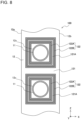
- Fig. 8 is a partial sectional side view showing Modification 2 of a fin 12 of the heat exchanger 100 according to Embodiment 1.
- Fig. 8 shows the surface of the fin 12 and cross-sections of heat transfer tubes 11 parallel to the principal surface of the fin 12.
- the fin projections 122 include inner fin projections 122A and outer fin projections 122B.
- the inner fin projections 122A and the outer fin projections 122B in Modification 2 of Embodiment 1 are provided in rectangular shapes to surround the heat transfer tubes 11. Differences from Embodiment 1 lie in the shapes of the inner fin projections 122A and the outer fin projections 122B. Other components and workings are not described here, as they are the same as those of Embodiment 1.
- the fin projections 122 have portions linearly extending in the Z direction of the fin 12. That is, the provision of fin projections 122 having linear portions along the longitudinal direction of the fin 12 brings about further improvement in longitudinal strength of the fin 12. As in the case of Embodiment 1, this keeps the fin 12 from bending in the longitudinal direction when worked on, for example when pressed or when stacked. This brings about improvement in producibility of the heat exchanger.
- Fig. 9 is a partial sectional side view showing Modification 3 of a fin 12 of the heat exchanger 100 according to Embodiment 1.
- Fig. 9 shows the surface of the fin 12 and cross-sections of heat transfer tubes 11 parallel to the principal surface of the fin 12.
- the fin projections 122 include inner fin projections 122A and outer fin projections 122B.
- the inner fin projections 122A and the outer fin projections 122B in Modification 3 of Embodiment 1 are provided in elliptical shapes to surround the heat transfer tubes 11. Differences from Embodiment 1 lie in the shapes of the inner fin projections 122A and the outer fin projections 122B. Other components and workings are not described here, as they are the same as those of Embodiment 1.
- the inner fin projections 122A and the outer fin projections 122B are larger in diameter in the X direction than in the Z direction. That is, the fin projections 122 have portions elongated in the transverse direction of the fin 12, that is, the direction in which air flows in. This makes it easy for air to make contact with the fin projections 122. As in the case of Embodiment 1, this results in improvement in heat transfer coefficient on the surface of the fin 12.
- Fig. 10 is a cross-sectional view showing Modification 4 of a fin 12 of the heat exchanger 100 according to Embodiment 1.
- Fig. 10 shows the surface of the fin 12 and cross-sections of heat transfer tubes 11 parallel to the principal surface of the fin 12.
- the fin projections 122 include inner fin projections 122A and outer fin projections 122B.
- the inner fin projections 122A and the outer fin projections 122B are different in shape from each other.
- each of the inner fin projections 122A in Modification 4 is provided concentrically with a corresponding one of the heat transfer tubes 11.
- the outer fin projections 122B in Modification 4 are provided in elliptical shapes to surround the heat transfer tubes 11. Differences from Embodiment 1 lie in the shapes of the outer fin projections 122B.
- Other components and workings are not described here, as they are the same as those of Embodiment 1.
- the inner fin projections 122A are in the shapes of circles provided concentrically with the heat transfer tubes 11. Meanwhile, the outer fin projections 122B are in the shapes of ellipses. As shown in Fig. 10 , the outer fin projections 122B are larger in diameter in the X direction than in the Z direction. That is, the outer fin projections 122B have portions elongated in the transverse direction of the fin 12, that is, the direction in which air flows in. This makes it easy for air to make contact with the fin projections 122. As in the case of Embodiment 1, this results in improvement in heat transfer coefficient on the surface of the fin 12.
- Fig. 11 is a cross-sectional view showing Modification 5 of a fin 12 of the heat exchanger 100 according to Embodiment 1.
- Fig. 11 shows the surface of the fin 12 and cross-sections of heat transfer tubes 11 parallel to the principal surface of the fin 12.
- the fin projections 122 include inner fin projections 122A and outer fin projections 122B.
- additional fin projections 122D are provided to surround the outer fin projections 122B. Differences between Embodiment 1 and Modification 5 lie in these additional fin projections 122D. Other components and workings are not described here, as they are the same as those of Embodiment 1.
- one or more additional fin projections 122D are provided concentrically with the heat transfer tubes 11 to surround the outer fin projections 122B.
- the fin projections 122 have portions elongated in the second direction Z of the fin 12. That is, the provision of fin projections 122 having portions along the longitudinal direction of the fin 12 brings about improvement in longitudinal strength of the fin 12. This keeps the fin from bending in the longitudinal direction when worked on, for example when pressed or when stacked. This brings about improvement in producibility of the heat exchanger.
- the provision of the additional fin projections 122D around the outer fin projections 122B brings about an effect that is similar to that which is brought about in a case in which projections are added in both the longitudinal direction and transverse direction of the fin 12. That is, regardless of whether air flows in from the longitudinal direction or transverse direction of the fin 12, projections are added in the direction of flow of air.
- This makes it possible to effectively utilize the additional fin projections 122D as heat transfer elements. Further, this makes it easier for inflow air to make contact with the additional fin projections 122D, thus bringing about improvement in heat transfer coefficient and improvement in heat transfer performance of the heat exchanger.
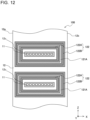
- Fig. 12 is a partial sectional side view showing Modification 6 of a fin 12 of the heat exchanger 100 according to Embodiment 1.
- Fig. 12 shows the surface of the fin 12 and cross-sections of heat transfer tubes 11 parallel to the principal surface of the fin 12.
- the fin projections 122 include inner fin projections 122A and outer fin projections 122B.
- the heat transfer tubes 11 are constituted by flat tubes. Further, the inner fin projections 122A and the outer fin projections 122B are provided in rectangular shapes to surround the heat transfer tubes 11. Differences between Embodiment 1 and Modification 6 lie in the shapes of the heat transfer tubes 11, the inner fin projections 122A, and the outer fin projections 122B. Other components and workings are not described here, as they are the same as those of Embodiment 1.
- the fin projections 122 have portions linearly extending in the Z direction of the fin 12. That is, the provision of fin projections 122 having linear portions along the longitudinal direction of the fin 12 brings about further improvement in longitudinal strength of the fin 12. As in the case of Embodiment 1, this keeps the fin from bending in the longitudinal direction when worked on, for example when pressed or when stacked. This brings about improvement in producibility of the heat exchanger.
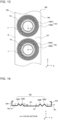
- Fig. 13 is a partial sectional side view showing Modification 7 of a fin 12 of the heat exchanger 100 according to Embodiment 1.
- Fig. 13 shows the surface of the fin 12 and cross-sections of heat transfer tubes 11 parallel to the principal surface of the fin 12.
- the fin projections 122 include inner fin projections 122A and outer fin projections 122B.
- Fig. 14 is a cross-sectional view taken along line A-A in Fig. 13 .
- the fin base surface 121 has no first flat portions 121A. This makes it impossible to bring about an effect of avoiding concentration of stress between the inner fin projections 122A and the outer fin projections 122B in the formation of the fin. However, in terms of improvement in longitudinal strength of the fin 12 and improvement in heat transfer coefficient of the surface of the fin 12, Modification 7 brings about an effect that is similar to that of Embodiment 1.
- Embodiment 1 and Modifications 1 to 7 thereof the shapes of the inner fin projections 122A and the outer fin projections 122B are described with reference to Fig. 4 and Figs. 8 to 14 .
- the plurality of heat transfer tubes 11 are surrounded by inner fin projections 122A of the same shape.
- inner fin projections 122A having different shapes may be provided separately for each of the heat transfer tubes 11.
- the plurality of inner fin projections 122A are surrounded by outer fin projections 122B of the same shape.
- outer fin projections 122B having different shapes may be provided separately for each of the heat transfer tubes 11.
- a basic configuration of a heat exchanger 100 according to Embodiment 2 is not described here, as it is the same as that of the heat exchanger 100 of Embodiment 1.
- a basic configuration of a refrigeration cycle apparatus 1 according to Embodiment 2 is not described here, as it is the same as that of the refrigeration cycle apparatus 1 of Embodiment 1.
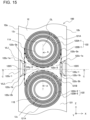
- Fig. 15 is a partial sectional side view showing a fin 12 of the heat exchanger 100 according to Embodiment 2.
- Fig. 15 shows the principal surface of the fin 12 and cross-sections of heat transfer tubes 11.
- the cross-sections of the heat transfer tubes 11 shown in Fig. 15 are cross-sections parallel to the principal surface of the fin 12.
- the heat transfer tubes 11 are arranged in a line along a column-wise direction parallel with the longitudinal direction of the fin 12.
- the fin 12 has a leading edge 12a and a trailing edge 12b.
- first heat transfer tube 11A the upper heat transfer tube 11 as seen from the front of the surface of paper of Fig. 15
- second heat transfer tube 11B the lower heat transfer tube 11 as seen from the front of the surface of paper of Fig. 15
- the principal surface of the fin 12 constitutes a fin base surface 121 that is flat.
- the inner fin projections 122A and the outer fin projections 122B are provided to protrude in the Y direction from the fin base surface 121.
- an inner fin projection 122A provided to surround the first heat transfer tube 11A is called “first inner fin projection 122A-1”.
- an outer fin projection 122B provided to surround the first inner fin projection 122A-1 is called “first outer fin projection 122B-1”.
- an inner fin projection 122A provided to surround the second heat transfer tube 11B is called “second inner fin projection 122A-2”.
- an outer fin projection 122B provided to surround the second inner fin projection 122A-2 is called “second outer fin projection 122B-2”.
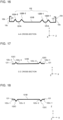
- Fig. 16 is a cross-sectional view taken along line A-A in Fig. 15 .
- Fig. 17 is a cross-sectional view taken along line C-C in Fig. 15 .
- the first inner fin projection 122A-1 and the second inner fin projection 122A-2 are referred to simply as “inner fin projections 122A” in a case in which there is no particular need to distinguish between them.
- the first outer fin projection 122B-1 and the second outer fin projection 122B-2 are referred to simply as "outer fin projections 122B" in a case in which there is no particular need to distinguish between them.
- first outer fin projection 122B-1 and the second outer fin projection 122B-2 There is a gap between the first outer fin projection 122B-1 and the second outer fin projection 122B-2.
- a portion of the gap between the first outer fin projection 122B-1 and the second outer fin projection 122B-2 surrounded by thick dot-and-dash lines in Fig. 15 is called "second flat portion 121B". That is, when viewed from the front of the surface of paper of Fig. 15 , the second flat portion 121B is a portion of the fin base surface 121 interposed between a lower semicircular portion of the first outer fin projection 122B-1 and an upper semicircular portion of the second outer fin projection 122B-2. Further, in Fig.
- a linear portion between the first outer fin projection 122B-1 and the second outer fin projection 122B-2 corresponds to the second flat portion 121 B.
- stress concentrates on boundary portions of the first outer fin projection 122B-1 and the second outer fin projection 122B-2 in the formation of the fin. Concentration of stress in the formation of the fin is avoided by providing the second flat portion 121B.
- the fin base surface 121 is provided with intermediate fin projections 122C.
- the intermediate fin projections 122C protrude in the Y direction from the portion of the fin base surface 121 situated between the first outer fin projection 122B-1 and the second outer fin projection 122B-2. That is, in Embodiment 2, the fin projections 122 include the inner fin projections 122A, the outer fin projections 122B, and the intermediate fin projections 122C. As shown in Figs. 16 and 17 , the inner fin projections 122A, the outer fin projections 122B, and the intermediate fin projections 122C protrude in the same direction from the fin base surface 121 in the Y direction.
- a basic configuration of the fin 12 according to Embodiment 2 is not described, as it is identical to that of Embodiment 1 except for the intermediate fin projections 122C. It should be noted that the number of intermediate fin projections 122C is not limited to 2, although two intermediate fin projections 122C are provided in Fig. 15 . One intermediate fin projection 122C may be provided, or three or more intermediate fin projections 122C may be provided.
- the intermediate fin projections 122C are provided in a space between the first outer fin projection 122B-1 and the second outer fin projection 122B-2 in the longitudinal direction of the fin 12. However, the intermediate fin projections 122C do not need to be wholly located in the space between the first outer fin projection 122B-1 and the second outer fin projection 122B-2. As shown in Fig. 15 , the intermediate fin projections 122C need only be partially located in the space between the first outer fin projection 122B-1 and the second outer fin projection 122B-2. In the present disclosure, the space between the first outer fin projection 122B-1 and the second outer fin projection 122B-2 refers to the portion of the fin base surface 121 that corresponds to the second flat portion 121B.
- a straight line passing through the center of the first heat transfer tube 11A and the center of the second heat transfer tube 11B along the Z direction is called "center line CL".
- a dot-and-dash line indicating the A-A cross-section corresponds to the center line CL.
- the intermediate fin projections 122C are provided at positions not crossing the center line CL.
- Each of the intermediate fin projections 122C includes a first raised portion 122c-1 and a second raised portion 122c-2 that rise from the fin base surface 121.
- the first raised portion 122c-1 and the second raised portion 122c-2 extend parallel along the Z direction of the fin 12.
- the first raised portion 122c-1 is greater in length than the second raised portion 122c-2.
- the distance between the first raised portion 122c-1 and the center line CL is longer than the distance between the second raised portion 122c-2 and the center line CL.
- the first raised portion 122c-1 has two ends in the Z direction. One of the two ends of the first raised portion 122c-1 that is close to the first outer fin projection 122B-1 is called “first end 122c-1a”. Further, one of the two ends of the first raised portion 122c-1that is close to the second outer fin projection 122B-2 is called “second end 122c-1b”. That is, the first raised portion 122c-1 has the first end 122c-1a and the second end 122c-1b. Further, the second raised portion 122c-2 has two ends in the Z direction. One of the two ends of the second raised portion 122c-2 that is close to the first outer fin projection 122B-1 is called “first end 122c-2a”.
- second end 122c-2b one of the two ends of the second raised portion 122c-2 that is close to the second outer fin projection 122B-2. That is, the second raised portion 122c-2 has the first end 122c-2a and the second end 122c-2b.
- first virtual line VL1 is a virtual straight line passing through the first end 122c-1a of the first raised portion 122c-1 and the first end 122c-2a of the second raised portion 122c-2.
- second virtual line VL2 is herein a virtual straight line passing through the second end 122c-1b of the first raised portion 122c-1 and the second end 122c-2b of the second raised portion 122c-2. As shown in Fig.
- the first virtual line VL1 does not cross the first outer fin projection 122B-1. Therefore, a given gap is formed between a portion of the intermediate fin projection 122C connecting the first end 122c-1a of the first raised portion 122c-1 with the first end 122c-2a of the second raised portion 122c-2 and the first outer fin projection 122B-1. Further, the second virtual line VL2 does not cross the second outer fin projection 122B-2. Therefore, a given gap is formed between a portion of the intermediate fin projection 122C connecting the second end 122c-1b of the first raised portion 122c-1 with the second end 122-2b of the second raised portion 122c-2 and the second outer fin projection 122B-2.
- the given gaps here are portions of the fin base surface 121 and flat regions having areas for avoiding concentration of stress around the intermediate fin projection 122C in the formation of the fin. If the areas of the gaps between the intermediate fin projection 122C and the outer fin projections 122B are small, concentration of stress around the intermediate fin projection 122C in the formation of the fin cannot be avoided.
- the intermediate fin projection 122C is provided so that the first virtual line VL1 does not cross the first outer fin projection 122B-1. This makes it possible to secure a flat region on the fin base surface 121 between the intermediate fin projection 122C and the first outer fin projection 122B-1 that can avoid concentration of stress in the formation of the fin.
- the intermediate fin projection 122C is provided so that the second virtual line VL2 does not cross the second outer fin projection 122B-2. This makes it possible to secure a flat region on the fin base surface 121 between the intermediate fin projection 122C and the second outer fin projection 122B-2 that can avoid concentration of stress in the formation of the fin.
- the plurality of heat transfer tubes 11 include a first heat transfer tube 11A and a second heat transfer tube 11B that are adjacent to each other in the second direction Z.
- the inner fin projections 122A include a first inner fin projection 122A-1 provided to surround the first heat transfer tube 11A and a second inner fin projection 122A-2 provided to surround the second heat transfer tube 11B.
- the outer fin projections 122B include a first outer fin projection 122B-1 provided to surround the first inner fin projection 122A-1 and a second outer fin projection 122B-2 provided to surround the second inner fin projection 122A-2.
- the fin base surface 121 has a second flat portion 121B between the first outer fin projection 122B-1 and the second outer fin projection 122B-2.
- the second flat portion 121B allows the first outer fin projections 122B-1 and the second outer fin projection 122B-2 to be provided on the fin 12 without touching each other. This prevents stress from concentrating between the first outer fin projections 122B-1 and the second outer fin projection 122B-2 in the formation of the fin. This brings about improvement in formability of the fin 12, resulting in improvement in manufacturability of the heat exchanger.
- the plurality of fin projections 122 include an intermediate fin projection 122C protruding in the first direction Y from the fin base surface 121, and the intermediate fin projection 122C is provided so that at least part of the intermediate fin projection 122C is located between the first outer fin projection 122B-1 and the second outer fin projection 122B-2 in the second direction Z.
- providing the intermediate fin projection 122C makes it easy for air to make contact with the surface of the fin 12. This results in further improvement in heat transfer coefficient on the surface of the fin 12. Further, locating part of the intermediate fin projection 122C between the first outer fin projection 122B-1 and the second outer fin projection 122B-2 results in reducing a region in which no fin projections 122 are present in the longitudinal direction of the fin 12. This brings about further improvement in longitudinal strength of the fin 12.
- the intermediate fin projection 122C is provided at a position not crossing a center line CL passing through a center of the first heat transfer tube 11A and a center of the second heat transfer tube 11B along the second direction Z. Note here that in the second direction Z of the fin 12, a length between the first outer fin projection 122B-1 and the second outer fin projection 122B-2 is shortest in a portion through which the center line CL passes.
- the intermediate fin projection 122C is provided not at a position where the first outer fin projection 122B-1 and the second outer fin projection 122B-2 are closest to each other but at a place where there is a relatively large gap between the first outer fin projection 122B-1 and the second outer fin projection 122B-2.
- the intermediate fin projection 122C includes a first raised portion 122c-1 extending in the second direction Z, the first raised portion 122c-1 being raised from the fin base surface 121, and a second raised portion 122c-2 extending parallel to the first raised portion 122c-1, the second raised portion 122c-2 raised from the fin base surface 121.
- the first raised portion 122c-1 is greater in length than the second raised portion 122c-2.
- a distance between the first raised portion 122c-1 and the center line CL is longer than a distance between the second raised portion 122c-2 and the center line CL.
- the first raised portion 122c-1 includes a first end 122c-1a provided adjacent to the first outer fin projection 122B-1 and a second end 122c-1b provided adjacent to the second outer fin projection 122B-2.
- the second raised portion 122c-2 includes a first end 122c-2a provided adjacent to the first outer fin projection 122B-1 and a second end 122c-2b provided adjacent to the second outer fin projection 122B-2.
- a first virtual line VL1 passing through the first end 122c-1a of the first raised portion 122c-1 and the first end 122c-2a of the second raised portion 122c-2 does not cross the first outer fin projection 122B-1.
- a second virtual line VL2 passing through the second end 122c-1b of the first raised portion 122c-1 and the second end 122c-2b of the second raised portion 122c-2 does not cross the second outer fin projection 122B-2.
- This configuration makes it possible to secure flat regions on the fin base surface 121 between the intermediate fin projection 122C and the outer fin projections 122B for avoiding concentration of stress between the intermediate fin projection 122C and the outer fin projections 122B in the formation of the fin. This brings about further improvement in formability of the fin 12.
- Fig. 18 is a cross-sectional view showing Modification 1 of a fin 12 of the heat exchanger 100 according to Embodiment 2.
- Fig. 18 shows a portion of Modification 1 that corresponds to a cross-section taken along line C-C in Fig. 15 .
- the fin 12 includes intermediate fin projections 122C.
- a direction in which the inner fin projections 122A protrude from the fin base surface 121 and a direction in which the intermediate fin projection 122C protrudes from the fin base surface 121 are opposite to each other. Accordingly, the inner fin projections 122A are not located in a wake flow portion of the intermediate fin projection 122C. That is, the inner fin projections 122A are not affected by a dead water region of the intermediate fin projection 122C. This can result in maximized utilization of the inner fin projections 122A for heat exchange, bringing about improvement in heat transfer coefficient on the surface of the fin 12.
- a direction in which the outer fin projections 122B protrude from the fin base surface 121 is identical to a direction in which the inner fin projections 122A protrude. That is, the outer fin projections 122B too are not located in a wake flow portion of the intermediate fin projection 122C and are therefore not affected by a dead water region of the intermediate fin projection 122C. This can result in maximized utilization of the outer fin projections 122B for heat exchange, bringing about further improvement in heat transfer coefficient on the surface of the fin 12.
- the center of gravity of the fin 12 is close to the fin base surface 121 in the Y direction, as the inner fin projections 122A and the intermediate fin projection 122C protrude in directions opposite to each other. This brings about improvement in strength of the fin 12.
- Fig. 19 is a partial sectional side view showing Modification 2 of a fin 12 of the heat exchanger 100 according to Embodiment 2.
- Fig. 19 shows the surface of the fin 12 and cross-sections of heat transfer tubes 11 parallel to the principal surface of the fin 12.
- the fin projections 122 include an intermediate fin projection 122C.
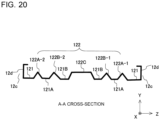
- Fig. 20 is a cross-sectional view taken along line A-A in Fig. 19 .
- the intermediate fin projection 122C is provided between the first outer fin projection 122B-1 and the second outer fin projection 122B-2 to overlap the center line CL.
- the intermediate fin projection 122C when viewed from the Y direction, has the shape of an oblong whose long sides extend in the Z direction. Differences between Modification 2 and Embodiment 2 lie in the position of the intermediate fin projection 122C and the shape of the intermediate fin projection 122C.
- Other components and workings are not described here, as they are the same as those of Embodiment 1.
- the intermediate fin projection 122C overlaps the center line CL between the first outer fin projection 122B-1 and the second outer fin projection 122B-2.
- the distance between the first raised portion 122c-1 and the center line CL and the distance between the second raised portion 122c-2 and the center line CL are equal to each other.
- the first raised portion 122c-1 and the second raised portion 122c-2 are equal in length to each other.
- the first raised portion 122c-1 is the left long side as seen from the front of the surface of paper
- the second raised portion 122c-2 is the right long side as seen from the front of the surface of paper.
- the intermediate fin projection 122c is located in a portion in which the distance between the first outer fin projection 122B-1 and the second outer fin projection 122B-2 is shortest in the Z direction.
- providing an intermediate fin projection 122C as in the case of Modification 2 brings about improvement in longitudinal strength of the fin 12 and improvement in heat transfer coefficient of the surface of the fin 12.
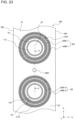
- Fig. 21 is a partial sectional side view showing Modification 3 of a fin 12 of the heat exchanger 100 according to Embodiment 2.
- Fig. 21 shows the surface of the fin 12 and cross-sections of heat transfer tubes 11 parallel to the principal surface of the fin 12.
- the fin projections 122 include an intermediate fin projection 122C.
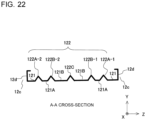
- Fig. 22 is a cross-sectional view taken along line A-A in Fig. 21 .
- the intermediate fin projection 122C is provided between the first outer fin projection 122B-1 and the second outer fin projection 122B-2 to cross the center line CL.
- the intermediate fin projection 122C has a portion elongated in the X direction.
- the intermediate fin projection 122C in the X direction, is larger in diameter than the first outer fin projection 122B-1 and the second outer fin projection 122B-2.
- the intermediate fin projection 122C may be larger in diameter than or equal in diameter to the first outer fin projection 122B-1 and the second outer fin projection 122B-2.
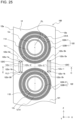
- Fig. 23 is a partial sectional side view showing Modification 4 of a fin 12 of the heat exchanger 100 according to Embodiment 2.
- Fig. 23 shows the surface of the fin 12 and cross-sections of heat transfer tubes 11 parallel to the principal surface of the fin 12.
- the fin projections 122 include an intermediate fin projection 122C.
- Fig. 24 is a cross-sectional view taken along line A-A in Fig. 23 .
- the intermediate fin projection 122C is provided between the first outer fin projection 122B-1 and the second outer fin projection 122B-2 to overlap the center line CL.
- the intermediate fin projection 122C has a circular shape.
- the intermediate fin projection 122C protrudes in a semispherical shape from the fin base surface 121.
- Differences between Modification 4 and Embodiment 2 lie in the position of the intermediate fin projection 122C and the shape of the intermediate fin projection 122C.
- Other components and workings are not described here, as they are the same as those of Embodiment 2.
- the intermediate fin projection 122C overlaps the center line CL between the first outer fin projection 122B-1 and the second outer fin projection 122B-2.
- a portion of the intermediate fin projection 122C in Modification 4 elongated along the longitudinal direction of the fin 12 is not as long as portions of the intermediate fin projections 122C in Embodiment 2 elongated along the longitudinal direction of the fin 12.
- providing the intermediate fin projection 122C brings about improvement in longitudinal strength of the fin 12 and improvement in heat transfer coefficient of the surface of the fin 12.
- Fig. 25 is a partial sectional side view showing Modification 5 of a fin 12 of the heat exchanger 100 according to Embodiment 2.
- Fig. 25 shows the surface of the fin 12 and cross-sections of heat transfer tubes 11 parallel to the principal surface of the fin 12.
- the fin projections 122 include intermediate fin projections 122C.
- Fig. 26 is a cross-sectional view taken along line C-C in Fig. 25 .
- each of the intermediate fin projections 122C is configured such that the first raised portion 122c-1 and the second raised portion 122c-2 are equal in length to each other.
- the first raised portion 122c-1 is greater in length than the second raised portion 122c-2.
- Differences between Modification 5 and Embodiment 2 lie in a relationship in length between the first raised portion 122c-1 and the second raised portion 122c-2.
- Other components and workings are not described here, as they are the same as those of Embodiment 2.
- the first virtual line VL1 crosses the first outer fin projection 122B-1. Further, the second virtual line VL2 crosses the second outer fin projection 122B-2.
- intermediate fin projections 122C shaped as shown in Modification 5 may be provided. Providing the intermediate fin projections 122C of Modification 5 brings about improvement in longitudinal strength of the fin 12 and improvement in heat transfer coefficient of the surface of the fin 12.
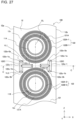
- Fig. 27 is a partial sectional side view showing Modification 6 of a fin 12 of the heat exchanger 100 according to Embodiment 2.
- Fig. 27 shows the surface of the fin 12 and cross-sections of heat transfer tubes 11 parallel to the principal surface of the fin 12.
- the fin projections 122 include intermediate fin projections 122C.
- Fig. 28 is a cross-sectional view taken along line C-C in Fig. 27 .
- the intermediate fin projections 122C when viewed from Y direction, the intermediate fin projections 122C have T shapes laid down 90 degrees. Therefore, as shown in Fig. 28 , the intermediate fin projections 122C have portions elongated in the X direction. Differences between Modification 6 and Embodiment 2 lie in the shapes of the intermediate fin projections 122C. Other components and workings are not described here, as they are the same as those of Embodiment 2.
- the first virtual line VL1 crosses the first outer fin projection 122B-1. Further, the second virtual line VL2 crosses the second outer fin projection 122B-2. Furthermore, portions of the intermediate fin projections 122C elongated in the X direction are located between the first outer fin projection 122B-1 and the second outer fin projection 122B-2.
- Each of the intermediate fin projections 12C of Modification 6 includes a portion linearly extending along the longitudinal direction (Z direction) of the fin 12 and a portion linearly extending along the transverse direction (X direction). Providing the intermediate fin projections 122C of Modification 6 brings about longitudinal strength of the fin 12.
- the intermediate fin projections 122C make it easy for air to make contact with the surface of the fin 12, as the intermediate fin projections 122C have portions elongated in the X direction, in which air flows in. Therefore, Modification 6 can bring about further improvement in heat transfer coefficient on the surface of the fin 12 than Embodiment 2.
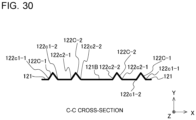
- Fig. 29 is a partial sectional side view showing Modification 7 of a fin 12 of the heat exchanger 100 according to Embodiment 2.
- Fig. 29 shows the surface of the fin 12 and cross-sections of heat transfer tubes 11 parallel to the principal surface of the fin 12.
- the fin projections 122 include intermediate fin projections 122C.
- Fig. 30 is a cross-sectional view taken along line C-C in Fig. 29 .
- the intermediate fin projections 122C include first intermediate fin projections 122C-1 and second intermediate fin projections 122C-2.
- the first intermediate fin projections 122C-1 and the second intermediate fin projections 122C-2 have the shapes of oblongs whose long sides extend in the Z direction when viewed from the Y direction.
- Differences between Modification 7 and Embodiment 2 lie in that in Modification 7, the intermediate fin projections 122C include the first intermediate fin projections 122C-1 and the second intermediate fin projections 122C-2.
- the shapes of the intermediate fin projections 122C in Embodiment 2 and the shapes of the first intermediate fin projections 122C-1 and the second intermediate fin projections 122C-2 in Modification 7 are different from each other. Other components and workings are not described here, as they are the same as those of Embodiment 2.
- first intermediate fin projections 122C-1 and the second intermediate fin projections 122C-2 are referred to simply as “intermediate fin projections 122C” in a case in which there is no particular need to distinguish between them.
- the following description uses the noun “intermediate fin projection 122C” in either the singular form or the plural form.
- first raised portions 122c-1 too, the first raised portions 122c1-1 of the first intermediate fin projections 122C-1 and the first raised portions 122c2-1 of the second intermediate fin projections 122C-2 are referred to simply as "first raised portions 122c-1" in a case in which there is no particular need to distinguish between them.
- second raised portions 122c-2 the second raised portions 122c1-2 of the first intermediate fin projections 122C-1 and the first raised portions 122c2-2 of the second intermediate fin projections 122C-2 are referred to simply as “second raised portions 122c-2" in a case in which there is no particular need to distinguish between them.
- the following description uses each of the nouns "first raised portion 122c-1" and “second raised portion 122c-2" in either the singular form or the plural form.
- the first intermediate fin projections 122C-1 and the second intermediate fin projections 122C-2 are described with reference to Fig. 29 .
- Each of the first intermediate fin projections 122C-1 is configured such that the first raised portion 122c1-1 and the second raised portion 122c1-2 are equal in length to each other.
- each of the second intermediate fin projections 122C-2 is configured such that the first raised portion 122c2-1 and the second raised portion 122c2-2 are equal in length to each other. It should be noted that differences between the intermediate fin projections 122C in Embodiment 2 and the intermediate fin projections 122C in Modification 7 lie in relationships in length between the first raised portions 122c-1 and the second raised portions 122c-2.
- first intermediate fin projections 122C-1 is not limited to 2, although two first intermediate fin projections 122C-1 are provided in Fig. 29 .
- One first intermediate fin projection 122C-1 may be provided, or three or more first intermediate fin projections 122C-1 may be provided.
- second intermediate fin projections 122C-2 is not limited to 2, although two second intermediate fin projections 122C-2 are provided in Fig. 29 .
- One second intermediate fin projection 122C-2 may be provided, or three or more second intermediate fin projections 122C-2 may be provided.
- each of the first intermediate fin projections 122C-1 and the center line CL is longer than the distance between each of the second intermediate fin projections 122C-2 and the center line CL.
- the first raised portions 122c1-1 of the first intermediate fin projections 122C-1 are greater in length than the first raised portions 122c2-1 of the second intermediate fin projections 122C-2. That is, the first intermediate fin projections 122C-1 are larger than the second intermediate fin projections 122C-2.
- the first intermediate fin projections 122C-1 and the second intermediate fin projections 122C-2 which linearly extend along the longitudinal direction of the fin 12, are arranged along the transverse direction of the fin.
- providing the first intermediate fin projections 122C-1 and the second intermediate fin projections 122C-2 brings about improvement in longitudinal strength of the fin 12 and improvement in heat transfer coefficient of the surface of the fin 12.
- Fig. 31 is a partial sectional side view showing Modification 8 of a fin 12 of the heat exchanger 100 according to Embodiment 2.
- Fig. 31 shows the surface of the fin 12 and cross-sections of heat transfer tubes 11 parallel to the principal surface of the fin 12.
- the fin projections 122 include intermediate fin projections 122C.
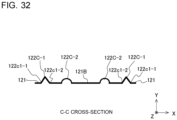
- Fig. 32 is a cross-sectional view taken along line C-C in Fig. 31 .
- the intermediate fin projections 122C include first intermediate fin projections 122C-1 and second intermediate fin projections 122C-2.
- the first intermediate fin projections 122C-1 have the shapes of oblongs whose long sides extend in the Z direction when viewed from the Y direction.
- the second intermediate fin projections 122C-2 have the shapes of circles when viewed from the Y direction.
- Differences between Modification 8 and Embodiment 2 lie in that in Modification 8, the intermediate fin projections 122C include the first intermediate fin projections 122C-1 and the second intermediate fin projections 122C-2.
- the shapes of the intermediate fin projections 122C in Embodiment 2 and the shapes of the first intermediate fin projections 122C-1 and the second intermediate fin projections 122C-2 in Modification 8 are different from each other. Other components and workings are not described here, as they are the same as those of Embodiment 2.
- the first intermediate fin projections 122C-1 and the second intermediate fin projections 122C-2 are described with reference to Fig. 31 .
- Each of the first intermediate fin projections 122C-1 is configured such that the first raised portion 122c1-1 and the second raised portion 122c1-2 are equal in length to each other.
- the distance between each of the first intermediate fin projections 122C-1 and the center line CL is longer than the distance between each of the second intermediate fin projections 122C-2 and the center line CL.
- differences between the intermediate fin projections 122C in Embodiment 2 and the intermediate fin projections 122C in Modification 8 lie in relationships in length between the first raised portions 122c-1 and the second raised portions 122c-2.
- first intermediate fin projections 122C-1 is not limited to 2, although two first intermediate fin projections 122C-1 are provided in Fig. 31 .
- One first intermediate fin projection 122C-1 may be provided, or three or more first intermediate fin projections 122C-1 may be provided.
- second intermediate fin projections 122C-2 is not limited to 2, although two second intermediate fin projections 122C-2 are provided in Fig. 31 .
- One second intermediate fin projection 122C-2 may be provided, or three or more second intermediate fin projections 122C-2 may be provided.
- the first intermediate fin projections 122C-1 which linearly extend along the longitudinal direction of the fin 12, are provided. Further, at positions where the distance between the first outer fin projection 122B-1 and the second outer fin projection 122B2 is relatively short, the circular second intermediate fin projections 122C-2, whose lengths along the longitudinal direction of the fin 12 are relatively short, are provided to reduce the area of a flat portion of the fin 12.
- providing the first intermediate fin projections 122C-1 and the second intermediate fin projections 122C-2 brings about improvement in longitudinal strength of the fin 12 and improvement in heat transfer coefficient of the surface of the fin 12.
- the heat exchanger 100 of any of Embodiment 1, Embodiment 2, and the modifications thereof can be provided in the refrigeration cycle apparatus 1 shown in Fig. 3 .
- the fin projections 122 provided on each of the fins 12 of the heat exchanger 100 brings about an increase in longitudinal direction of the fin 12 and improvement in formability of the fin. This brings about improvement in manufacturability of the heat exchanger 100, resulting in improvement in manufacturability of the refrigeration cycle apparatus 1 as a whole.
- the fin projections 122 provided on each of the fins 12 of the heat exchanger 100 make it easy for air to make contact with the surface of the fin 12. This brings about improvement in heat transfer coefficient of the heat exchanger 100, resulting in improvement in energy efficiency of the refrigeration cycle apparatus 1 as a whole.
- Embodiment 1 has described Embodiment 1, Embodiment 2, and the modifications thereof
- the heat exchanger 100 and the refrigeration cycle apparatus 1 are not limited to Embodiment 1, Embodiment 2, or the modifications thereof and may be altered or applied in various ways without departing from the scope of the disclosure.
- Embodiment 1, Embodiment 2, and the modifications thereof may be combined with one another to such an extent as not to impair the functions or structures of the embodiments or the modifications.
Landscapes
- Engineering & Computer Science (AREA)
- Physics & Mathematics (AREA)
- Mechanical Engineering (AREA)
- Thermal Sciences (AREA)
- General Engineering & Computer Science (AREA)
- Geometry (AREA)
- Heat-Exchange Devices With Radiators And Conduit Assemblies (AREA)
Applications Claiming Priority (1)
| Application Number | Priority Date | Filing Date | Title |
|---|---|---|---|
| PCT/JP2021/036077 WO2023053319A1 (fr) | 2021-09-30 | 2021-09-30 | Échangeur de chaleur et dispositif à cycle de réfrigération |
Publications (2)
| Publication Number | Publication Date |
|---|---|
| EP4411284A1 true EP4411284A1 (fr) | 2024-08-07 |
| EP4411284A4 EP4411284A4 (fr) | 2024-11-13 |
Family
ID=85781582
Family Applications (1)
| Application Number | Title | Priority Date | Filing Date |
|---|---|---|---|
| EP21959361.3A Withdrawn EP4411284A4 (fr) | 2021-09-30 | 2021-09-30 | Échangeur de chaleur et dispositif à cycle de réfrigération |
Country Status (5)
| Country | Link |
|---|---|
| US (1) | US20250044033A1 (fr) |
| EP (1) | EP4411284A4 (fr) |
| JP (1) | JP7592183B2 (fr) |
| CN (1) | CN117980687A (fr) |
| WO (1) | WO2023053319A1 (fr) |
Family Cites Families (11)
| Publication number | Priority date | Publication date | Assignee | Title |
|---|---|---|---|---|
| JPS58158496A (ja) | 1982-03-17 | 1983-09-20 | Matsushita Electric Ind Co Ltd | フイン付熱交換器 |
| JPS61235693A (ja) * | 1985-04-10 | 1986-10-20 | Matsushita Electric Ind Co Ltd | フインチユ−ブ型熱交換器 |
| JP2005321180A (ja) * | 2004-05-10 | 2005-11-17 | Neiwa O | 吸収式冷・温熱発生、カスケード冷・温熱発生とコジェネの方法と装置並びに熱交換器 |
| FR2940422B1 (fr) | 2008-12-19 | 2010-12-03 | Gea Batignolles Technologies T | Echangeur de chaleur comprenant des tubes a ailettes rainurees |
| CN101963472B (zh) | 2010-05-19 | 2012-07-04 | 张家港市恒强冷却设备有限公司 | 套片式换热器的散热片 |
| US9360258B2 (en) | 2013-03-15 | 2016-06-07 | Ormat Technologies, Inc. | Fin configuration for air cooled heat exchanger tubes |
| DE102014108890A1 (de) * | 2014-06-25 | 2015-12-31 | GEA MASCHINENKüHLTECHNIK GMBH | Wärmetauscher |
| CN104596343A (zh) | 2015-01-14 | 2015-05-06 | 海信科龙电器股份有限公司 | 一种换热翅片及换热器 |
| CN106931538A (zh) | 2017-03-10 | 2017-07-07 | 海信(山东)空调有限公司 | 一种翅片换热器组件及空调器 |
| CN109470075B (zh) * | 2017-09-08 | 2024-04-30 | 美的集团股份有限公司 | 翅片和换热器 |
| CN110726325A (zh) | 2019-11-19 | 2020-01-24 | 广东美的暖通设备有限公司 | 用于管翅式换热器的翅片、管翅式换热器及空调器 |
-
2021
- 2021-09-30 EP EP21959361.3A patent/EP4411284A4/fr not_active Withdrawn
- 2021-09-30 US US18/292,503 patent/US20250044033A1/en not_active Abandoned
- 2021-09-30 WO PCT/JP2021/036077 patent/WO2023053319A1/fr not_active Ceased
- 2021-09-30 JP JP2023550886A patent/JP7592183B2/ja active Active
- 2021-09-30 CN CN202180102617.2A patent/CN117980687A/zh not_active Withdrawn
Also Published As
| Publication number | Publication date |
|---|---|
| EP4411284A4 (fr) | 2024-11-13 |
| JPWO2023053319A1 (fr) | 2023-04-06 |
| CN117980687A (zh) | 2024-05-03 |
| JP7592183B2 (ja) | 2024-11-29 |
| US20250044033A1 (en) | 2025-02-06 |
| WO2023053319A1 (fr) | 2023-04-06 |
Similar Documents
| Publication | Publication Date | Title |
|---|---|---|
| US9441890B2 (en) | Heat exchanger fin with corrugated portion and louvers | |
| CN103403487B (zh) | 热交换器及空调机 | |
| JP5397489B2 (ja) | 熱交換器および空気調和機 | |
| EP3279598B1 (fr) | Échangeur de chaleur et climatiseur | |
| EP3650798B1 (fr) | Échangeur de chaleur | |
| CN112204333B (zh) | 制冷剂分配器、热交换器及空气调节装置 | |
| US20160216014A1 (en) | Heat exchanger and air conditioner | |
| EP3064819A1 (fr) | Raccord de tuyaux, échangeur de chaleur et climatiseur | |
| EP3862713A1 (fr) | Échangeur de chaleur et climatiseur | |
| EP3608618B1 (fr) | Échangeur thermique et dispositif à cycle de réfrigération | |
| EP4411284A1 (fr) | Échangeur de chaleur et dispositif à cycle de réfrigération | |
| JP5081881B2 (ja) | 空気調和機 | |
| EP3330637B1 (fr) | Échangeur de chaleur et appareil à cycle de réfrigération | |
| EP4397934B1 (fr) | Échangeur de chaleur et dispositif de climatisation | |
| EP3971507B1 (fr) | Échangeur de chaleur, et dispositif de cycle frigorifique | |
| EP4130634B1 (fr) | Échangeur de chaleur et dispositif à cycle de réfrigération | |
| WO2023032155A1 (fr) | Échangeur de chaleur, dispositif de cycle de réfrigération et procédé de fabrication d'un échangeur de chaleur | |
| CN223121717U (zh) | 一种换热器及制冷设备 | |
| JP2008082619A (ja) | 熱交換器 | |
| WO2025013296A1 (fr) | Échangeur de chaleur et dispositif à cycle de réfrigération | |
| JP2016075450A (ja) | 熱交換器及びこれを用いた空気調和機 | |
| CN118339417A (zh) | 热交换器 | |
| JP2022045108A (ja) | 熱交換器、及び冷凍装置 |
Legal Events
| Date | Code | Title | Description |
|---|---|---|---|
| STAA | Information on the status of an ep patent application or granted ep patent |
Free format text: STATUS: THE INTERNATIONAL PUBLICATION HAS BEEN MADE |
|
| PUAI | Public reference made under article 153(3) epc to a published international application that has entered the european phase |
Free format text: ORIGINAL CODE: 0009012 |
|
| STAA | Information on the status of an ep patent application or granted ep patent |
Free format text: STATUS: REQUEST FOR EXAMINATION WAS MADE |
|
| 17P | Request for examination filed |
Effective date: 20240205 |
|
| AK | Designated contracting states |
Kind code of ref document: A1 Designated state(s): AL AT BE BG CH CY CZ DE DK EE ES FI FR GB GR HR HU IE IS IT LI LT LU LV MC MK MT NL NO PL PT RO RS SE SI SK SM TR |
|
| A4 | Supplementary search report drawn up and despatched |
Effective date: 20241010 |
|
| RIC1 | Information provided on ipc code assigned before grant |
Ipc: F28F 1/32 20060101ALI20241004BHEP Ipc: F28D 1/047 20060101ALI20241004BHEP Ipc: F25B 39/00 20060101AFI20241004BHEP |
|
| DAV | Request for validation of the european patent (deleted) | ||
| DAX | Request for extension of the european patent (deleted) | ||
| STAA | Information on the status of an ep patent application or granted ep patent |
Free format text: STATUS: THE APPLICATION HAS BEEN WITHDRAWN |
|
| 18W | Application withdrawn |
Effective date: 20250228 |