EP4410136B1 - Article production method and machine - Google Patents
Article production method and machine Download PDFInfo
- Publication number
- EP4410136B1 EP4410136B1 EP23220286.1A EP23220286A EP4410136B1 EP 4410136 B1 EP4410136 B1 EP 4410136B1 EP 23220286 A EP23220286 A EP 23220286A EP 4410136 B1 EP4410136 B1 EP 4410136B1
- Authority
- EP
- European Patent Office
- Prior art keywords
- operating cycle
- carriage
- seat
- loading station
- component
- Prior art date
- Legal status (The legal status is an assumption and is not a legal conclusion. Google has not performed a legal analysis and makes no representation as to the accuracy of the status listed.)
- Active
Links
Images


Classifications
-
- A—HUMAN NECESSITIES
- A24—TOBACCO; CIGARS; CIGARETTES; SIMULATED SMOKING DEVICES; SMOKERS' REQUISITES
- A24F—SMOKERS' REQUISITES; MATCH BOXES; SIMULATED SMOKING DEVICES
- A24F40/00—Electrically operated smoking devices; Component parts thereof; Manufacture thereof; Maintenance or testing thereof; Charging means specially adapted therefor
- A24F40/90—Arrangements or methods specially adapted for charging batteries thereof
-
- B—PERFORMING OPERATIONS; TRANSPORTING
- B23—MACHINE TOOLS; METAL-WORKING NOT OTHERWISE PROVIDED FOR
- B23P—METAL-WORKING NOT OTHERWISE PROVIDED FOR; COMBINED OPERATIONS; UNIVERSAL MACHINE TOOLS
- B23P21/00—Machines for assembling a multiplicity of different parts to compose units, with or without preceding or subsequent working of such parts, e.g. with programme control
- B23P21/004—Machines for assembling a multiplicity of different parts to compose units, with or without preceding or subsequent working of such parts, e.g. with programme control the units passing two or more work-stations whilst being composed
-
- A—HUMAN NECESSITIES
- A24—TOBACCO; CIGARS; CIGARETTES; SIMULATED SMOKING DEVICES; SMOKERS' REQUISITES
- A24F—SMOKERS' REQUISITES; MATCH BOXES; SIMULATED SMOKING DEVICES
- A24F40/00—Electrically operated smoking devices; Component parts thereof; Manufacture thereof; Maintenance or testing thereof; Charging means specially adapted therefor
- A24F40/40—Constructional details, e.g. connection of cartridges and battery parts
- A24F40/42—Cartridges or containers for inhalable precursors
-
- A—HUMAN NECESSITIES
- A24—TOBACCO; CIGARS; CIGARETTES; SIMULATED SMOKING DEVICES; SMOKERS' REQUISITES
- A24F—SMOKERS' REQUISITES; MATCH BOXES; SIMULATED SMOKING DEVICES
- A24F40/00—Electrically operated smoking devices; Component parts thereof; Manufacture thereof; Maintenance or testing thereof; Charging means specially adapted therefor
- A24F40/65—Devices with integrated communication means, e.g. wireless communication means
-
- A—HUMAN NECESSITIES
- A24—TOBACCO; CIGARS; CIGARETTES; SIMULATED SMOKING DEVICES; SMOKERS' REQUISITES
- A24F—SMOKERS' REQUISITES; MATCH BOXES; SIMULATED SMOKING DEVICES
- A24F40/00—Electrically operated smoking devices; Component parts thereof; Manufacture thereof; Maintenance or testing thereof; Charging means specially adapted therefor
- A24F40/70—Manufacture
-
- B—PERFORMING OPERATIONS; TRANSPORTING
- B23—MACHINE TOOLS; METAL-WORKING NOT OTHERWISE PROVIDED FOR
- B23P—METAL-WORKING NOT OTHERWISE PROVIDED FOR; COMBINED OPERATIONS; UNIVERSAL MACHINE TOOLS
- B23P19/00—Machines for simply fitting together or separating metal parts or objects, or metal and non-metal parts, whether or not involving some deformation; Tools or devices therefor so far as not provided for in other classes
- B23P19/001—Article feeders for assembling machines
-
- G—PHYSICS
- G05—CONTROLLING; REGULATING
- G05B—CONTROL OR REGULATING SYSTEMS IN GENERAL; FUNCTIONAL ELEMENTS OF SUCH SYSTEMS; MONITORING OR TESTING ARRANGEMENTS FOR SUCH SYSTEMS OR ELEMENTS
- G05B19/00—Programme-control systems
- G05B19/02—Programme-control systems electric
- G05B19/418—Total factory control, i.e. centrally controlling a plurality of machines, e.g. direct or distributed numerical control [DNC], flexible manufacturing systems [FMS], integrated manufacturing systems [IMS] or computer integrated manufacturing [CIM]
-
- B—PERFORMING OPERATIONS; TRANSPORTING
- B65—CONVEYING; PACKING; STORING; HANDLING THIN OR FILAMENTARY MATERIAL
- B65G—TRANSPORT OR STORAGE DEVICES, e.g. CONVEYORS FOR LOADING OR TIPPING, SHOP CONVEYOR SYSTEMS OR PNEUMATIC TUBE CONVEYORS
- B65G2201/00—Indexing codes relating to handling devices, e.g. conveyors, characterised by the type of product or load being conveyed or handled
- B65G2201/02—Articles
- B65G2201/0226—Cigarettes
-
- B—PERFORMING OPERATIONS; TRANSPORTING
- B65—CONVEYING; PACKING; STORING; HANDLING THIN OR FILAMENTARY MATERIAL
- B65G—TRANSPORT OR STORAGE DEVICES, e.g. CONVEYORS FOR LOADING OR TIPPING, SHOP CONVEYOR SYSTEMS OR PNEUMATIC TUBE CONVEYORS
- B65G54/00—Non-mechanical conveyors not otherwise provided for
- B65G54/02—Non-mechanical conveyors not otherwise provided for electrostatic, electric, or magnetic
-
- H—ELECTRICITY
- H01—ELECTRIC ELEMENTS
- H01F—MAGNETS; INDUCTANCES; TRANSFORMERS; SELECTION OF MATERIALS FOR THEIR MAGNETIC PROPERTIES
- H01F41/00—Apparatus or processes specially adapted for manufacturing or assembling magnets, inductances or transformers; Apparatus or processes specially adapted for manufacturing materials characterised by their magnetic properties
- H01F41/02—Apparatus or processes specially adapted for manufacturing or assembling magnets, inductances or transformers; Apparatus or processes specially adapted for manufacturing materials characterised by their magnetic properties for manufacturing cores, coils, or magnets
- H01F41/04—Apparatus or processes specially adapted for manufacturing or assembling magnets, inductances or transformers; Apparatus or processes specially adapted for manufacturing materials characterised by their magnetic properties for manufacturing cores, coils, or magnets for manufacturing coils
- H01F41/06—Coil winding
- H01F41/09—Winding machines having two or more work holders or formers
Definitions
- the invention relates to an article production method and machine.
- the invention is advantageously applied in the tobacco industry to assemble a transponder to be used in a disposable cartridge of an electronic cigarette, to which explicit reference will be made in the description below without because of this losing in generality.
- An electronic cigarette normally comprises a re-usable part, which is used several times and contains, among other things, an electric battery (which provides the power needed for the operation of the electronic cigarette) and an electronic processor, which controls the operation of the electronic cigarette. Furthermore, the electronic cigarette comprises a disposable cartridge (namely to be used one single time and to be then replaced), which is coupled to the re-usable part.
- a disposable cartridge which is provided with a transponder equipped with a memory where the features of the disposable cartridge are stored, particular the features of the (liquid or solid) active substance that is heated in order to release the vapours to be inhaled; in this way, the re-usable part of the electronic cigarette can read the features of the disposable cartridge coupled thereto, accordingly adjusting the heating to the features of the disposable cartridge.
- the transponder comprises one single wound antenna (namely, one single coil serving as antenna); however, in some applications, the transponder can comprise a plurality of wound antennas (namely, a plurality of coils serving as antennas), which have different spatial orientations so as to make sure that the transponder is capable of effectively communicating in all possible positions.
- An automatic machine for manufacturing a disposable cartridge of an electronic cigarette comprises a conveyor, which conveys, along a processing path, a series of carriages, each supporting at least one seat configured to accommodate a support body.
- the processing path extends between a loading station, in which a support body to be processed is supplied to a seat of a carriage standing still in the loading station, and an unloading station, in which a processed support body is removed from a seat of a carriage standing still in the unloading station.
- a supplying device which cyclically inserts the support bodies into the seats of corresponding carriages standing still in the loading station.
- a carriage stops in the loading station to receive a support body and then move on, during the following work cycle, to following stations. It can happen that, during a work cycle, the supplying device of the loading station fails to supply a support body and, hence, the carriage that, in that work cycle, is in the loading station moves on empty (namely, without the support body) to the following stations.
- Handling an empty carriage generally is fairly complicated, in particular when the operations in the stations following the supply of the support body to the carriage involve the interaction with external elements, such as to create undesired situations in the absence of the support body.
- these operations can include filling the support body or part of the electronic cigarette with a liquid or solid substance or winding the wire to be used to build an antenna of the transponder.
- the absence of the support body in the carriage would involve spilling the product onto the surrounding environment, namely also onto parts of the machine, while the second case would lead to the undesired damaging or breaking of the wire.
- US 2019/246697 discloses a method of production of a cartridge for an aerosol-generating device, in which components of said aerosol-generating device are loaded into a carriage that is moved between processing stations along a processing path during subsequent operating cycles.
- the object of the invention is to provide an article production method and machine, said method and machine allowing a failed supply of a component to be handled in a simple and effective fashion.
- reference number 1 indicates, as a whole, a support body of a component to be used to manufacture a disposable cartridge of an electronic cigarette.
- the support body 1 has an approximately parallelepiped-like shape having six walls (faces) and houses a transponder 9, namely an electronic device (of the passive kind, hence without a power supply of its own), which is capable of storing information and is capable of communicating through radio frequency.
- the transponder 9 is a small-sized smart label, which is designed to reply to the interrogation made from a distance by suitable fixed or portable apparatuses, known as readers (or interrogator devices); a reader is capable of reading and/or changing the information contained in the transponder 9 being interrogated by communicating with the transponder 9 through radio frequency.
- the transponder 9 is part of a wireless reading and/or writing system operating according to the so-called RFID (" Radio-Frequency Identification ”) technology.
- the transponder 9 comprises an integrated electronic circuit 10 (namely, a microchip) provided with a non-volatile memory (typically, an EEPROM or a FRAM) and a coil 11, which is connected to the electronic circuit 10; in particular, the electronic circuit 10 has two electrical contacts, to which two ends of the coil 11 are welded.
- the coil 11 is wound and consists of a plurality of turns of an externally insulated conductor wire 13; in the embodiment shown in the accompanying figures there are approximately 10-15 turns.
- the conductor wire 13 is wound around the side walls of the support body 1, whereas the electronic circuit 10 is arranged in a housing obtained in a lower wall of the support body 1.
- the conductor wire 13 has a diameter ranging from 10 to 500 microns and preferably ranging from 20 to 200 microns (even though, in most applications, the diameter ranges from 25 to 150 microns).
- the electronic circuit 10 uses the coil 11 to communicate, through radio frequency, with other electronic devices located nearby.
- the electronic circuit 10 could also use the coil 11 to generate power (used for its own operation and/or to charge its own electric battery) exploiting an electromagnetic field generated by an electronic device located nearby; namely, the electronic circuit 10 could also use the coil to carry out an inductive (namely contact-less) power charging of its own electric battery.
- the coil 11 constitutes an antenna, which can be used to exchange (transmit) information by means of electromagnetic waves (in this case, the antenna is part of a telecommunication device) and/or can be used to exchange power by means of electromagnetic waves (in this case, the antenna is part of a charging device).
- the coil 11 constitutes a wound antenna for electromagnetic interactions, which can be aimed at exchanging (transmitting) information or can be aimed at generating electrical power through electromagnetic induction.
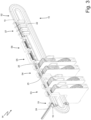
- reference number 14 indicates, as a whole, an automatic machine to assemble the component comprising, among other things, the support body 1 and the transponder 9.
- the automatic machine 14 comprises a support frame, which rests on the ground by means of legs and has, at the front, a vertical wall on which the operating members are mounted. Furthermore, the automatic machine 14 comprises a main conveyor 15, which moves the support bodies 1 being processed along a processing path P, which develops between a loading station S1 (where the main conveyor 15 receives the support bodies 1 to be completed, namely assembled) and an output station S2 (where the main conveyor 15 releases complete, namely assembled support bodies 1); in particular, the processing path P is horizontal and linear, namely substantially develops along a straight line arranged horizontally.
- the processing path P goes through a series of stations S3-S7 (better described below), where the bodies 1 passing by are subjected to processing operations (in particular, assembling operations).
- the main conveyor 15 is normally designed to cyclically move each carriage 16 along the processing path P with an intermittent (step-like) movement, which entails cyclically alternating movement phases, in which the main conveyor 15 moves the carriages 16, and stop phases, in which the main conveyor 15 holds the carriages 16 still.
- the main conveyor 15 comprises an annular guide 19 (namely, closed on itself with a ring shape), which is arranged in a fixed position along the processing path P; in particular, the annular guide 19 consists of one single fixed track (namely, without movement), which is arranged along the processing path P.
- the main conveyor 15 comprises a plurality of slides 20, each supporting a corresponding carriage 16 and being coupled to the guide 19 so as to freely slide along the guide 19.
- the main conveyor 15 is a conveyor belt and comprises (at least) a flexible belt, which supports the carriages 16 and is closed in a ring shape around at least two end pulleys (at least one of them being motor-driven).
- the main conveyor 15 moves a carriage 16 (carrying four seats 18) along the processing path P so as to stop one single carriage 16 in the loading station S1, where four support bodies 1 (to be processed) are placed in the corresponding four seats 18 of the carriage 16.
- the main conveyor 15 moves a carriage 16 (carrying four seats 18) along the processing path P and from the loading station S1 to the application station S3 (arranged between the loading station S1 and a loading station S4), where the carriage 16 stops and an adhesive means (for example, one or more glue drops or a double-sided adhesive tape) designed to cause the electronic circuit 10 to stick to the support body 1 is applied on each support body 1 carried by the carriage 16.
- an adhesive means for example, one or more glue drops or a double-sided adhesive tape
- the main conveyor 15 moves a carriage 16 (carrying four seats 18) along the processing path P and from the application station S3 to the loading station S4 (arranged downstream of the loading station S1), where the carriage 16 stops and each support body 1 carried by the carriage 16 is coupled to an electronic circuit 10 provided with the two electrical contacts.
- each winding station S5 or S6 is configured to operate with two carriages 16 at a time (namely, with eight support bodies 1 at a time), since the winding operation is fairly slow (namely, requires time in order to be carried out with a high quality).
- the two winding stations S5 and S6 are redundant twin stations and are used simultaneously (namely, in parallel) or alternatively (so that a winding station S5 or S6 can be used, while the other winding station S6 or S5 is standing still because it needs to be restored/subjected to maintenance/cleaned).
- each carriage 16 is stopped in only one of the two winding stations S5 or S6 and, hence, the corresponding coil 11 is coupled (wound) around each support body 1 in the winding station S5 or, alternatively, in the winding station S6; in other words, approximately half the support bodies 1 receive the corresponding coil 11 in the winding station S5, whereas the remaining half of the support bodies 1 receive the corresponding coil 11 in the winding station S6 and, as a consequence, approximately half the carriages 16 stop in the winding station S5, whereas the remaining half of the carriages 16 stops in the winding station S6 (namely, the two winding stations S5 and S6, by operating together and in parallel, split the carriages 16 between themselves).
- the main conveyor 15 moves a carriage 16 (carrying four seats 18) along the processing path P and from the winding station S5 and/or S6 to the welding station S7 (arranged downstream of the winding stations S5 and S6), where the carriage 16 stops and, in each support body 1 carried by the carriage 16, the two opposite ends of the wound coil 11 are welded (for example, through ultrasound or through laser) to the two electrical contacts of the electronic circuit 10.
- the welding station S7 is configured to operate with four carriages 16 at a time (namely, with sixteen support bodies 1 at a time), since the welding operation is relatively slow (namely, requires time in order to be carried out with a high quality).
- the main conveyor 15 moves a carriage 16 (carrying four seats 18) along the processing path P and from the welding station S7 to the output station S2 (arranged downstream of the welding station S7), where the carriage 16 stops and the support bodies 1 carried by the carriage 16 (and now provided with the respective transponders 9) are removed from the seats 18 so that they can leave the automatic machine 14.
- each seat 18 of a carriage 16 houses the support body 1 in a projecting manner so that the support body 1 partially protrudes out of the carriage 16 letting a part of a lower wall of the support body 1 (where the electronic circuit 10 with the two electrical contacts has to be placed) free.
- the adhesive means is coupled, from the bottom to the top, to the free part of the lower wall of the support body 1.
- the automatic machine 14 comprises a supplying device 24, which is arranged in the area of the loading station S1 and is configured to insert the support bodies 1 into the seats 18, while a carriage 16 is standing still in the loading station S1; according to a preferred embodiment shown in the accompanying figures, the supplying device 24 is capable of supplying one single support body 1 at a time (namely, it operates in a serial manner and not in a parallel manner) and the carriage 16 is moved so as to align, in succession, each seat 18 with the supplying device 24, thus allowing the supplying device 24 to insert, in (quick) succession, four support bodies 1 into the four seats 18 of the carriage 16.
- the automatic machine 14 comprises (at least) a supplying device 25, which is arranged in the area of the loading station S4 and is configured to insert the electronic circuits 10 into the support bodies 1 carried by the seats 18 of a carriage standing still in the loading station S4 (namely, to indirectly insert the electronic circuits 10 into the seats 18 of a carriage standing still in the loading station S4);
- the supplying device 24 is capable of supplying four electronic circuits 10 at a time (namely, it operates in a parallel manner and not in a serial manner) and the carriage 16 always remains still in the loading station S4 during the simultaneous supply of four electronic circuits 10 at a time into the respective four seats 18.
- the loading station S4 there are two redundant twin supplying devices 25, which are used alternatively (so that a supplying device 25 can be used while the other supplying device 25 is standing still because it needs to be restored/subjected to maintenance/cleaned) or, if necessary, simultaneously (in order to half the speed with which the supplying devices 25 operate and, hence, increase their supplying precision, though reducing the risk of errors and jamming).
- the automatic machine 14 comprises a control unit 26 (schematically shown in figure 2 ), which controls the operation of the entire automatic machine 14.
- the automatic machine 14 operates by means of a succession of operating cycles (also called machine cycles), during each of which the same operations are repeated over and over (obviously, in the absence of unexpected events and faults); in other words, each part of the automatic machine 14 is controlled by the control unit 26 so as to carry out, during each operating cycle, a series of operations that are repeated in the same manner (obviously, in the absence of unexpected events and faults) on different materials (components).
- the control unit 26 controls the main conveyor 15 so as to move, at the beginning of a first operating cycle and along the processing path P, a carriage 16 provided with four empty seats 18 towards the loading station S1 and another carriage 16 provided with four seats 18 containing the respective support bodies 1 towards the loading station S4. Therefore, the control unit 26 controls the main conveyor 15 so as to stop, during the first operating cycle, a carriage 16 in the loading station S1 and the other carriage 16 in the loading station S4.
- control unit 26 controls (in the ways described above) the supplying device 24 so as to insert, during the first operating cycle, four support bodies 1 into the respective four seats 18, while a carriage 16 is standing still in the loading station S1, and controls (in the ways described above) the supplying device 25 so as to insert, during the first operating cycle, four electronic circuits 10 into the respective four seats 18, while another carriage 16 is standing still in the loading station S4.
- the control unit 26 at the end of the first operating cycle, checks for the actual presence of four support bodies 1 in the respective four seats 18 of the carriage 16 standing still in the lading station S1 and checks for the actual presence of four electronic circuits 10 in the respective four seats 18 of the carriage 16 standing still in the loading station S4.
- the control unit 26 at the beginning of the second operating cycle, moves the carriage 16 from the loading station S1 to the application station S3 (namely, the following station), only if, at the end of the first operating cycle, four support bodies 1 are actually present in the respective four seats 18 of the carriage 16, and moves the carriage 16 from the loading station S4 to the winding station S5 or S6 (namely, the following station), only if, at the end of the first operating cycle, four electronic circuits 10 are actually present in the respective four seats 18 of the carriage 16.
- control unit 26 at the beginning of the second operating cycle, holds the carriage 16 in the loading station S 1, if, at the end of the first operating cycle, at least one seat 18 of the carriage is still empty (namely, without the respective support body 1), and holds the carriage 16 in the loading station S4, if, at the end of the first operating cycle, at least one seat 18 of the carriage is still empty (namely, without the respective electronic circuit 10).
- the control unit 26 controls (in the ways described above) the supplying device 24 so as to insert, during the second operating cycle, the missing support bodies 1 into the respective four seats 18, while a carriage 16 is still standing still in the loading station S1 (because it was held still, since the supply of the support bodies 1 was not completed during the preceding operating cycle), and controls (in the ways described above) the supplying device 25 so as to insert, during the second operating cycle, the missing electronic circuits 10 into the respective four seats 18, while another carriage 16 is still standing still in the loading station S4 (because it was held still, since the supply of the electronic circuits 10 was not completed during the preceding operating cycle).
- the process disclosed above namely the one involving checking for the complete supply of the support bodies 1 and of the electronic circuits 10 before allowing the carriages to be transferred from the loading stations S1 and S4 to the following stations, is repeated for a predetermined number of operating cycles so as to try and obtain a complete filling of the seats 18 of the carriages 16; the control unit 26 diagnoses a malfunction if a seat 18 is still empty (namely, without the respective support body 1 or the respective electronic circuit 10) after a predetermined number of operating cycles, during which the carriage 16 remains still in a loading station S1 or S4 trying to complete the filling of the seats 18 of the carriage 16 with every operating cycle.
- control unit 24 holds, at the beginning of each operating cycle, a carriage 16 in a loading station S1 or S4, if, at the end of the preceding operating cycle, at least one seat 18 of the carriage 16 is still empty (namely, without the respective support body 1 or the respective electronic circuit 10), and inserts, during each operating cycle, the missing support bodies 1 or electronic circuits 10 into the seats 18 while the carriage 16 is standing still in the loading station S1 or S4, if, at the end of the preceding operating cycle, at least one seat 18 of the carriage 16 is still empty (namely, without the respective support body 1 or the respective electronic circuit 10).
- each carriage 16 should stop in any station S1-S7 of the processing path P for one single operating cycle.
- control unit 26 stops a carriage 16 in a loading station S1 or S4 for more than one operating cycle due to an incomplete supply of components (the support bodies 1 or the electronic circuits 10), then the control unit 26 also keeps all the other carriages 16 still in the position in which they are for more than one operating cycle, since the carriages 16 need to always move together and in a synchronized manner along the processing path P.
- the processing path P there is at least one parking device (namely, a store for the carriages 16), which allows the carriages 16 to leave the processing path P (namely, the annular guide 19) when, due to a temporary impediment, there is no possibility for the carriages 16 of moving on along the processing path P and, then, allows the carriages 16 to go back to the processing path P (namely, to the annular guide 19) when there is again the possibility for the carriages 16 of moving one along the processing path P.
- a loading station S1 or S4 remains occupied by a carriage 16 that has not completed its filling in one single operating cycle, a carriage 16 can access a parking device in order to allow the other carriages 16 to move.
- the empty carriages 16 can also be stored and kept waiting in the return segment of the processing path P extending between the output station S2 and the loading station S1 (which serves as parking area), when a loading station S1 or S4 remains occupied by a carriage 16 that has not completed its filling in one single operating cycle.
- the loading station S1 or the loading station S4 could comprise a conveyor similar to the main conveyor 15 and, hence, having a linear electric motor, which pushes carriages along a guide; or, according an embodiment which is not shown herein, downstream of the unloading station S2 there is a further conveyor similar to the main conveyor 15 and, hence, having a linear electric motor, which pushes carriages along a guide (in this case, the unloading station S2 of the main conveyor 15 becomes the loading station of the following conveyor).
- conveyors each having a linear electric motor, which pushes carriages along a guide, and arranged one after the other and these conveyors are connected to one another in series (the main conveyor 15 could be arranged in the middle of this series of conveyors); these conveyors connected in series all operate with the same logic disclosed above: a carriage of a conveyor remains still in a loading station of its own (which can be the unloading station of a preceding conveyor) until it receives all the elements to be expected based on its loading capacity.
- the wire 13 is an electrically conductor wire, is externally insulated and is wound so as to form a coil 11, which creates a wound antenna for electromagnetic interactions that can be aimed at exchanging (transmitting) information or can be aimed at generating power through electromagnetic induction.
- the wire 13 is an electrically conductor wire (and, hence, an electric current can flow through it, even though it has a low or very low intensity), but has a textile core (for example, made of cotton), which is caused to become a conductor, for instance through a doping with metal nanoparticles.
- the wire 13 is not an electrically conductor wire, is of the textile kind and the coil 11 creates a wick (or the like) for an electronic cigarette.
- the article comprising the support body 1 and the transponder 9 is part of a disposable cartridge of an electronic cigarette, but the method described above can also be applied to the production of articles of any type (namely, of any product class).
- the method described above can be applied to the production of articles for a machine, a plant, a construction, a product (for example, a payment means), for instance, but not exclusively, of the tobacco, pharmaceutical, food-related or entertainment industry; more in general, the method described above can be applied to the production of articles for applications of any type.
- the method disclosed above helps handle a failed supply of a component in a simple and effective manner, since, even in case of a failed supply of a component, it avoids the rejection of non-defective components and maximizes (as much as possible) productivity.
Landscapes
- Engineering & Computer Science (AREA)
- Mechanical Engineering (AREA)
- General Engineering & Computer Science (AREA)
- Manufacturing & Machinery (AREA)
- Quality & Reliability (AREA)
- Physics & Mathematics (AREA)
- General Physics & Mathematics (AREA)
- Automation & Control Theory (AREA)
- Computer Networks & Wireless Communication (AREA)
- Automatic Assembly (AREA)
- Control Of Conveyors (AREA)
Applications Claiming Priority (1)
| Application Number | Priority Date | Filing Date | Title |
|---|---|---|---|
| IT102023000001785A IT202300001785A1 (it) | 2023-02-03 | 2023-02-03 | Metodo e macchina di produzione di un articolo |
Publications (2)
| Publication Number | Publication Date |
|---|---|
| EP4410136A1 EP4410136A1 (en) | 2024-08-07 |
| EP4410136B1 true EP4410136B1 (en) | 2025-06-18 |
Family
ID=86007186
Family Applications (1)
| Application Number | Title | Priority Date | Filing Date |
|---|---|---|---|
| EP23220286.1A Active EP4410136B1 (en) | 2023-02-03 | 2023-12-27 | Article production method and machine |
Country Status (6)
| Country | Link |
|---|---|
| US (1) | US20240261913A1 (pl) |
| EP (1) | EP4410136B1 (pl) |
| KR (1) | KR20240122345A (pl) |
| CN (1) | CN118436137A (pl) |
| IT (1) | IT202300001785A1 (pl) |
| PL (1) | PL4410136T3 (pl) |
Families Citing this family (1)
| Publication number | Priority date | Publication date | Assignee | Title |
|---|---|---|---|---|
| CN118617070B (zh) * | 2024-08-13 | 2025-07-25 | 林佳琦 | 一种电子烟壳体按钮安装装置 |
Family Cites Families (4)
| Publication number | Priority date | Publication date | Assignee | Title |
|---|---|---|---|---|
| US10238145B2 (en) * | 2015-05-19 | 2019-03-26 | Rai Strategic Holdings, Inc. | Assembly substation for assembling a cartridge for a smoking article |
| IT201600108303A1 (it) * | 2016-10-26 | 2018-04-26 | Gd Spa | Macchina confezionatrice per la realizzazione di cartucce monouso per sigarette elettroniche. |
| IT202000003958A1 (it) * | 2020-02-26 | 2021-08-26 | Gd Spa | Macchina confezionatrice per la fabbricazione di un prodotto |
| KR20240056497A (ko) * | 2021-07-23 | 2024-04-30 | 지.디 쏘씨에타'퍼 아지오니 | 물품의 부품 주위에 코일을 제조하는 방법 및 기계 |
-
2023
- 2023-02-03 IT IT102023000001785A patent/IT202300001785A1/it unknown
- 2023-12-27 PL PL23220286.1T patent/PL4410136T3/pl unknown
- 2023-12-27 EP EP23220286.1A patent/EP4410136B1/en active Active
-
2024
- 2024-01-31 US US18/429,087 patent/US20240261913A1/en active Pending
- 2024-02-01 KR KR1020240015779A patent/KR20240122345A/ko active Pending
- 2024-02-02 CN CN202410151698.0A patent/CN118436137A/zh active Pending
Also Published As
| Publication number | Publication date |
|---|---|
| IT202300001785A1 (it) | 2024-08-03 |
| US20240261913A1 (en) | 2024-08-08 |
| PL4410136T3 (pl) | 2025-09-22 |
| KR20240122345A (ko) | 2024-08-12 |
| EP4410136A1 (en) | 2024-08-07 |
| CN118436137A (zh) | 2024-08-06 |
Similar Documents
| Publication | Publication Date | Title |
|---|---|---|
| US20200207014A1 (en) | Device for the additive manufacturing of three-dimensional objects from powdery building material | |
| EP4410136B1 (en) | Article production method and machine | |
| JPH05192850A (ja) | 生産ラインにおけるデータ管理装置 | |
| CZ384491A3 (en) | Automatic processing equipment | |
| EP4181161B1 (en) | Method and machine to manufacture one or more coils around respective articles | |
| HK40111460A (en) | Article production method and machine | |
| EP3738908A1 (en) | Storage device and storage method | |
| EP3892570B1 (en) | Storage and storage apparatus provided with same | |
| US20250149241A1 (en) | Method and machine to manufacture a coil around a component of an article | |
| EP0913913B1 (en) | Apparatus and method for manufacturing armatures | |
| US20250332633A1 (en) | Method and machine to manufacture windings around respective supports | |
| CN117882083A (zh) | 制造围绕物品的部件的线圈的方法和机器 | |
| EP4374288B1 (en) | Method and machine to assemble a transponder provided with a helical antenna in a component of an article | |
| KR20140051557A (ko) | 무인반송시스템 및 이의 운용방법 | |
| CN101287359A (zh) | 利用导向件进行卷盘容纳格层与元器件供给装置之间的配属 | |
| US12476044B2 (en) | Method and machine for making a coil around a component of an article | |
| EP4174885B1 (en) | Method and machine to manufacture a coil around a component of an article | |
| US20120275108A1 (en) | Machine for the electrical and graphic customisation of portable electronic objects | |
| US12202681B2 (en) | Method and machine to carry out a control on a group of objects | |
| CN117897706A (zh) | 将设置有螺旋天线的应答器组装到物品部件中的方法和机器 | |
| CN109995207B (zh) | 电枢滚浸机及自动上下料装置 | |
| CN118025753A (zh) | 生产系统 |
Legal Events
| Date | Code | Title | Description |
|---|---|---|---|
| PUAI | Public reference made under article 153(3) epc to a published international application that has entered the european phase |
Free format text: ORIGINAL CODE: 0009012 |
|
| STAA | Information on the status of an ep patent application or granted ep patent |
Free format text: STATUS: THE APPLICATION HAS BEEN PUBLISHED |
|
| AK | Designated contracting states |
Kind code of ref document: A1 Designated state(s): AL AT BE BG CH CY CZ DE DK EE ES FI FR GB GR HR HU IE IS IT LI LT LU LV MC ME MK MT NL NO PL PT RO RS SE SI SK SM TR |
|
| STAA | Information on the status of an ep patent application or granted ep patent |
Free format text: STATUS: REQUEST FOR EXAMINATION WAS MADE |
|
| 17P | Request for examination filed |
Effective date: 20241003 |
|
| RBV | Designated contracting states (corrected) |
Designated state(s): AL AT BE BG CH CY CZ DE DK EE ES FI FR GB GR HR HU IE IS IT LI LT LU LV MC ME MK MT NL NO PL PT RO RS SE SI SK SM TR |
|
| REG | Reference to a national code |
Ref country code: HK Ref legal event code: DE Ref document number: 40111460 Country of ref document: HK |
|
| REG | Reference to a national code |
Ref country code: DE Ref legal event code: R079 Free format text: PREVIOUS MAIN CLASS: A24F0040700000 Ipc: B65G0054020000 Ref country code: DE Ref legal event code: R079 Ref document number: 602023004113 Country of ref document: DE Free format text: PREVIOUS MAIN CLASS: A24F0040700000 Ipc: B65G0054020000 |
|
| GRAP | Despatch of communication of intention to grant a patent |
Free format text: ORIGINAL CODE: EPIDOSNIGR1 |
|
| STAA | Information on the status of an ep patent application or granted ep patent |
Free format text: STATUS: GRANT OF PATENT IS INTENDED |
|
| RIC1 | Information provided on ipc code assigned before grant |
Ipc: A24F 40/70 20200101ALI20250117BHEP Ipc: B65G 54/02 20060101AFI20250117BHEP |
|
| INTG | Intention to grant announced |
Effective date: 20250130 |
|
| GRAS | Grant fee paid |
Free format text: ORIGINAL CODE: EPIDOSNIGR3 |
|
| GRAA | (expected) grant |
Free format text: ORIGINAL CODE: 0009210 |
|
| STAA | Information on the status of an ep patent application or granted ep patent |
Free format text: STATUS: THE PATENT HAS BEEN GRANTED |
|
| P01 | Opt-out of the competence of the unified patent court (upc) registered |
Free format text: CASE NUMBER: APP_20612/2025 Effective date: 20250430 |
|
| AK | Designated contracting states |
Kind code of ref document: B1 Designated state(s): AL AT BE BG CH CY CZ DE DK EE ES FI FR GB GR HR HU IE IS IT LI LT LU LV MC ME MK MT NL NO PL PT RO RS SE SI SK SM TR |
|
| REG | Reference to a national code |
Ref country code: GB Ref legal event code: FG4D |
|
| REG | Reference to a national code |
Ref country code: CH Ref legal event code: EP |
|
| REG | Reference to a national code |
Ref country code: DE Ref legal event code: R096 Ref document number: 602023004113 Country of ref document: DE |
|
| REG | Reference to a national code |
Ref country code: CH Ref legal event code: EP |
|
| REG | Reference to a national code |
Ref country code: IE Ref legal event code: FG4D |
|
| REG | Reference to a national code |
Ref country code: NL Ref legal event code: FP |
|
| PG25 | Lapsed in a contracting state [announced via postgrant information from national office to epo] |
Ref country code: FI Free format text: LAPSE BECAUSE OF FAILURE TO SUBMIT A TRANSLATION OF THE DESCRIPTION OR TO PAY THE FEE WITHIN THE PRESCRIBED TIME-LIMIT Effective date: 20250618 |
|
| REG | Reference to a national code |
Ref country code: LT Ref legal event code: MG9D |
|
| PG25 | Lapsed in a contracting state [announced via postgrant information from national office to epo] |
Ref country code: NO Free format text: LAPSE BECAUSE OF FAILURE TO SUBMIT A TRANSLATION OF THE DESCRIPTION OR TO PAY THE FEE WITHIN THE PRESCRIBED TIME-LIMIT Effective date: 20250918 Ref country code: GR Free format text: LAPSE BECAUSE OF FAILURE TO SUBMIT A TRANSLATION OF THE DESCRIPTION OR TO PAY THE FEE WITHIN THE PRESCRIBED TIME-LIMIT Effective date: 20250919 |
|
| PG25 | Lapsed in a contracting state [announced via postgrant information from national office to epo] |
Ref country code: BG Free format text: LAPSE BECAUSE OF FAILURE TO SUBMIT A TRANSLATION OF THE DESCRIPTION OR TO PAY THE FEE WITHIN THE PRESCRIBED TIME-LIMIT Effective date: 20250618 |
|
| PG25 | Lapsed in a contracting state [announced via postgrant information from national office to epo] |
Ref country code: HR Free format text: LAPSE BECAUSE OF FAILURE TO SUBMIT A TRANSLATION OF THE DESCRIPTION OR TO PAY THE FEE WITHIN THE PRESCRIBED TIME-LIMIT Effective date: 20250618 |
|
| PG25 | Lapsed in a contracting state [announced via postgrant information from national office to epo] |
Ref country code: RS Free format text: LAPSE BECAUSE OF FAILURE TO SUBMIT A TRANSLATION OF THE DESCRIPTION OR TO PAY THE FEE WITHIN THE PRESCRIBED TIME-LIMIT Effective date: 20250918 |
|
| PG25 | Lapsed in a contracting state [announced via postgrant information from national office to epo] |
Ref country code: LV Free format text: LAPSE BECAUSE OF FAILURE TO SUBMIT A TRANSLATION OF THE DESCRIPTION OR TO PAY THE FEE WITHIN THE PRESCRIBED TIME-LIMIT Effective date: 20250618 |
|
| PG25 | Lapsed in a contracting state [announced via postgrant information from national office to epo] |
Ref country code: PT Free format text: LAPSE BECAUSE OF FAILURE TO SUBMIT A TRANSLATION OF THE DESCRIPTION OR TO PAY THE FEE WITHIN THE PRESCRIBED TIME-LIMIT Effective date: 20251020 |
|
| REG | Reference to a national code |
Ref country code: AT Ref legal event code: MK05 Ref document number: 1804029 Country of ref document: AT Kind code of ref document: T Effective date: 20250618 |