EP4410091A1 - Gartenwerkzeug - Google Patents
Gartenwerkzeug Download PDFInfo
- Publication number
- EP4410091A1 EP4410091A1 EP22871682.5A EP22871682A EP4410091A1 EP 4410091 A1 EP4410091 A1 EP 4410091A1 EP 22871682 A EP22871682 A EP 22871682A EP 4410091 A1 EP4410091 A1 EP 4410091A1
- Authority
- EP
- European Patent Office
- Prior art keywords
- operation switch
- switch
- controller
- electric motor
- state
- Prior art date
- Legal status (The legal status is an assumption and is not a legal conclusion. Google has not performed a legal analysis and makes no representation as to the accuracy of the status listed.)
- Pending
Links
- 238000010413 gardening Methods 0.000 title claims description 4
- 238000000034 method Methods 0.000 claims description 28
- 230000008569 process Effects 0.000 claims description 28
- 230000001960 triggered effect Effects 0.000 description 56
- 238000001514 detection method Methods 0.000 description 50
- 244000025254 Cannabis sativa Species 0.000 description 6
- 230000005540 biological transmission Effects 0.000 description 6
- 230000008878 coupling Effects 0.000 description 6
- 238000010168 coupling process Methods 0.000 description 6
- 238000005859 coupling reaction Methods 0.000 description 6
- 230000004044 response Effects 0.000 description 6
- 239000003086 colorant Substances 0.000 description 4
- 239000010409 thin film Substances 0.000 description 4
- 238000013138 pruning Methods 0.000 description 3
- 239000004677 Nylon Substances 0.000 description 2
- 229920001778 nylon Polymers 0.000 description 2
- 238000009966 trimming Methods 0.000 description 2
- 239000002023 wood Substances 0.000 description 2
- 239000002390 adhesive tape Substances 0.000 description 1
- 230000000694 effects Effects 0.000 description 1
Images
Classifications
-
- A—HUMAN NECESSITIES
- A01—AGRICULTURE; FORESTRY; ANIMAL HUSBANDRY; HUNTING; TRAPPING; FISHING
- A01G—HORTICULTURE; CULTIVATION OF VEGETABLES, FLOWERS, RICE, FRUIT, VINES, HOPS OR SEAWEED; FORESTRY; WATERING
- A01G3/00—Cutting implements specially adapted for horticultural purposes; Delimbing standing trees
- A01G3/08—Other tools for pruning, branching or delimbing standing trees
- A01G3/085—Motor-driven saws for pruning or branching
-
- A—HUMAN NECESSITIES
- A01—AGRICULTURE; FORESTRY; ANIMAL HUSBANDRY; HUNTING; TRAPPING; FISHING
- A01G—HORTICULTURE; CULTIVATION OF VEGETABLES, FLOWERS, RICE, FRUIT, VINES, HOPS OR SEAWEED; FORESTRY; WATERING
- A01G3/00—Cutting implements specially adapted for horticultural purposes; Delimbing standing trees
- A01G3/04—Apparatus for trimming hedges, e.g. hedge shears
- A01G3/047—Apparatus for trimming hedges, e.g. hedge shears portable
- A01G3/053—Apparatus for trimming hedges, e.g. hedge shears portable motor-driven
-
- A—HUMAN NECESSITIES
- A01—AGRICULTURE; FORESTRY; ANIMAL HUSBANDRY; HUNTING; TRAPPING; FISHING
- A01G—HORTICULTURE; CULTIVATION OF VEGETABLES, FLOWERS, RICE, FRUIT, VINES, HOPS OR SEAWEED; FORESTRY; WATERING
- A01G3/00—Cutting implements specially adapted for horticultural purposes; Delimbing standing trees
- A01G3/04—Apparatus for trimming hedges, e.g. hedge shears
- A01G3/047—Apparatus for trimming hedges, e.g. hedge shears portable
- A01G3/053—Apparatus for trimming hedges, e.g. hedge shears portable motor-driven
- A01G3/0535—Apparatus for trimming hedges, e.g. hedge shears portable motor-driven with rotatable knives
-
- A—HUMAN NECESSITIES
- A01—AGRICULTURE; FORESTRY; ANIMAL HUSBANDRY; HUNTING; TRAPPING; FISHING
- A01G—HORTICULTURE; CULTIVATION OF VEGETABLES, FLOWERS, RICE, FRUIT, VINES, HOPS OR SEAWEED; FORESTRY; WATERING
- A01G3/00—Cutting implements specially adapted for horticultural purposes; Delimbing standing trees
- A01G3/08—Other tools for pruning, branching or delimbing standing trees
- A01G3/085—Motor-driven saws for pruning or branching
- A01G3/086—Chain saws
-
- A—HUMAN NECESSITIES
- A01—AGRICULTURE; FORESTRY; ANIMAL HUSBANDRY; HUNTING; TRAPPING; FISHING
- A01D—HARVESTING; MOWING
- A01D34/00—Mowers; Mowing apparatus of harvesters
- A01D34/835—Mowers; Mowing apparatus of harvesters specially adapted for particular purposes
- A01D34/90—Mowers; Mowing apparatus of harvesters specially adapted for particular purposes for carrying by the operator
- A01D2034/907—Control levers for portable mowing machines
-
- A—HUMAN NECESSITIES
- A01—AGRICULTURE; FORESTRY; ANIMAL HUSBANDRY; HUNTING; TRAPPING; FISHING
- A01D—HARVESTING; MOWING
- A01D34/00—Mowers; Mowing apparatus of harvesters
- A01D34/01—Mowers; Mowing apparatus of harvesters characterised by features relating to the type of cutting apparatus
- A01D34/412—Mowers; Mowing apparatus of harvesters characterised by features relating to the type of cutting apparatus having rotating cutters
- A01D34/63—Mowers; Mowing apparatus of harvesters characterised by features relating to the type of cutting apparatus having rotating cutters having cutters rotating about a vertical axis
- A01D34/82—Other details
- A01D34/828—Safety devices
-
- A—HUMAN NECESSITIES
- A01—AGRICULTURE; FORESTRY; ANIMAL HUSBANDRY; HUNTING; TRAPPING; FISHING
- A01D—HARVESTING; MOWING
- A01D34/00—Mowers; Mowing apparatus of harvesters
- A01D34/835—Mowers; Mowing apparatus of harvesters specially adapted for particular purposes
- A01D34/90—Mowers; Mowing apparatus of harvesters specially adapted for particular purposes for carrying by the operator
Definitions
- Examples of the present application relate to the technical field of power tools and, in particular, to a garden tool.
- a pruner As a garden tool, a pruner is widely used for pruning vegetation such as shrubs and hedges.
- the pruner typically includes a housing.
- the housing is formed with or connected to a rear handle and a front handle for a user to hold.
- Each of the front handle and the rear handle is provided with a handle switch.
- the user needs to press the two handle switches at the same time so that the pruner can be started.
- the user binds the front handle switch with another tool (for example, an adhesive tape, a tie, or a rope) and then presses the rear handle switch to start the pruner.
- this operation manner has certain security risks.
- Examples of the present application provide a garden tool, which can improve the operation security of the garden tool.
- Technical solutions are described below.
- examples of the present application provide a garden tool.
- the garden tool includes: an electric motor; a housing formed with or connected to a front handle and a rear handle for a user to hold, where the front handle is held by one hand of the user, and the rear handle is held by the other hand of the user; a first operation switch disposed on the front handle; a second operation switch disposed on the rear handle; and a controller configured to control, according to a sequence in which the first operation switch and the second operation switch are turned on, the electric motor to start.
- examples of the present application provide a garden tool.
- the garden tool includes: an electric motor; a housing formed with or connected to a front handle and a rear handle for a user to hold, where the front handle is held by one hand of the user, and the rear handle is held by the other hand of the user; a first operation switch disposed on the front handle; and a second operation switch disposed on the rear handle.
- the first operation switch is a pressure sensing switch, where the pressure sensing switch is in the on state when being held, and the pressure sensing switch is in the off state when being released.
- the electric motor is controlled according to the sequence in which the first operation switch controlled by the front handle and the second operation switch controlled by the rear handle are turned on. Compared with the related art in which two operation switches only need to be turned on so that an electric motor can be started, the electric motor needs to be controlled, according to the sequence in which the two operation switches are turned on, to start in the examples of the present application, thereby improving the operation security of the garden tool.
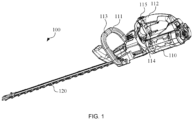
- FIG. 1 is a schematic view of a garden tool according to an example of the present application.
- FIG. 1 is a schematic view of a garden tool 100 according to an example of the present application.
- the garden tool 100 includes an electric motor (not shown in the figure) and a housing 110.
- the garden tool 100 further includes an operation assembly 120.
- the garden tool 100 includes any one of a pruner, a string trimmer, a chain saw, and the like.
- the pruner is one of the main "members” of garden tools.
- the pruner is used for pruning branches and hedges to make them grow healthily and be more neat and graceful so that ornamental values are improved.
- the pruner is an indispensable tool for the greening of courtyards, parks, roads, and the like.
- the string trimmer may be used for mowing lawns.
- the string trimmer may directly drive, through a motor rotating at a high speed, a nylon line or a blade on a trimmer head to rotate, thereby cutting grass and achieving a mowing object.
- the chain saw may be used for sawing wood, branches, and trunks in ground working places or trimming and sawing branches and trunks of various tall trees.
- the housing 110 is used for forming an accommodating cavity which accommodates the electric motor.
- the electric motor is configured to drive the operation assembly 120 to implement functions of a garden tool.
- the garden tool 100 further includes a transmission assembly.
- the accommodating cavity may be further used for accommodating the transmission assembly.
- the transmission assembly is used for implementing power transfer between the electric motor and the operation assembly so that the operation assembly is driven to move.
- the electric motor further includes the shaft of the electric motor which is rotatable about the axis of the electric motor. Part of the operation assembly is accommodated in the accommodating cavity of a housing, and the other part of the operation assembly extends out of the housing along the direction of a longitudinal axis.
- the operation assembly 120 includes a blade assembly and the electric motor is configured to drive the blade assembly to implement a cutting function.
- the operation assembly 120 includes a grass cutting line and the electric motor is configured to drive the grass cutting line to implement a cutting function.
- the operation assembly 120 includes a chain and the electric motor is configured to drive the chain to implement a cutting function.
- the garden tool further includes a power supply apparatus.
- the power supply apparatus is configured to supply power to the electric motor.
- the power supply apparatus may be a DC power supply.
- the power supply apparatus includes a battery pack which can be detachably mounted to the housing.
- the housing may further include a coupling portion. The coupling portion is used for detachably coupling the battery pack to the housing along the direction of the longitudinal axis.
- the housing 110 is further formed with or connected to a front handle 111 and a rear handle 112 for a user to hold.
- the front handle 111 is held by one hand of the user, and the rear handle 112 is held by the other hand of the user.
- the front handle 111 and the rear handle 112 are two different handles.
- the front handle 111 is connected to the outer wall of the housing 110, and the rear handle 112 is extended from the housing 110.
- the housing 110 extends upward to form the rear handle 112.
- the front handle 111 is fixedly mounted to the housing 110. That is, the rear handle 112 is formed by the housing 110, and the front handle 111 is independent of the housing 110 and is fixed to the housing 110 through fasteners.
- the front handle 111 and the housing 110 may be integrally formed, which is not limited in the example of the present application.
- the front handle 111 is disposed on the front side of the rear handle 112 to enable the user to hold the front handle 111 and the rear handle 112 simultaneously with both hands when operating the garden tool, thereby implementing more stable operation.
- the front handle 111 is closer to the operation assembly 120 than the rear handle 112, and the front handle 111 is spaced a certain distance from the rear handle 112 in the direction of the longitudinal axis so that the user can control the garden tool more stably.
- the garden tool 100 further includes a first operation switch 113.
- the first operation switch 113 is controlled by the front handle 111, which refers to that the user may control the first operation switch 113 by operating the front handle 111.
- the first operation switch 113 is disposed on the front handle 111.
- the front handle 111 and the first operation switch 113 are independently disposed, that is, the first operation switch 113 may not be disposed on the front handle 111.
- a position where the first operation switch 113 is disposed is not limited in the example of the present application and may be configured according to a specific situation.
- the garden tool 100 further includes a second operation switch 114.
- the second operation switch 114 is controlled by the rear handle 112, which refers to that the user may control the second operation switch 114 by operating the rear handle 112.
- the second operation switch 114 is disposed on the rear handle 112.
- the rear handle 112 and the second operation switch 114 are independently disposed, that is, the second operation switch 114 may not be disposed on the rear handle 112.
- a position where the second operation switch 114 is disposed is not limited in the example of the present application and may be configured according to the specific situation.
- the first operation switch 113 is a pressure sensing switch, where the pressure sensing switch is in the on state when sensing that the pressure sensing switch is held, and the pressure sensing switch is in the off state when sensing that the pressure sensing switch is released.
- a pressure sensing switch refers to a switch sensing pressure or a hold. The pressure sensing switch is in the on state when the pressure or the hold is sensed and is in the off state when no pressure or hold is sensed. For example, when the user holds the front handle 111, the first operation switch 113 is in the on state. When the user releases the front handle 111, the first operation switch 113 is in the off state.
- the pressure sensing switch includes a pressing portion and a flexible thin-film pressure sensor which is connected to the pressing portion, and the pressure sensing switch may detect, through the flexible thin-film pressure sensor, pressure acting on the pressing portion.
- the pressing portion may be held by the user.
- the pressing portion may be disposed separately from the front handle.
- the pressing portion may be disposed outside the front handle and the user may directly contact the pressing portion; or the pressing portion and the front handle may be integrally formed and the user holds the pressing portion while holding the front handle, which is not limited in the example of the present application.
- the second operation switch 114 may be a pressure sensing switch.
- the second operation switch may form a rotatable connection with the rear handle.
- the second operation switch may form a slidable connection with the rear handle.
- the type of the second operation switch is not limited in the example of the present application. In the case where the second operation switch 114 is the pressure sensing switch, when the user holds the rear handle 112, the second operation switch 114 is in the on state, and when the user releases the rear handle 112, the second operation switch 114 is in the off state.
- the garden tool further includes a controller (not shown in the figure), and the controller is configured to control the electric motor according to a sequence in which the first operation switch and the second operation switch are turned on.
- the sequence in which the first operation switch and the second operation switch are turned on refers to a time sequence in which the first operation switch is in the on state and the second operation switch is in the on state.
- the sequence in which the first operation switch and the second operation switch are turned on may include any one of the following sequences: the first operation switch is in the on state first and the second operation switch is in the on state later; the second operation switch is in the on state first and the first operation switch is in the on state later; and the first operation switch and the second operation switch are in the on state at the same time.
- the controller is configured to control the start and stop of the electric motor.
- the controller may control the start and stop of the electric motor according to the on/off state of the first operation switch and the on/off state of the second operation switch.
- the controller may control the electric motor in the following manner: when the first operation switch is in the on state first and the second operation switch is in the on state later, the controller controls the electric motor to start, when the second operation switch is in the on state first and the first operation switch is in the on state later, the controller does not control the electric motor to start, and when the first operation switch and the second operation switch are in the on state at the same time, the controller does not control the electric motor to start.
- sequence in which the first operation switch and the second operation switch are turned on refers to a sequence in which the first operation switch changes from the off state to the on state and the second operation switch changes from the off state to the on state, instead of a sequence in which one operation switch is always in the on state and the other operation switch changes from the off state to the on state.
- the controller is configured to, in the case where the first operation switch is in the on state first and the second operation switch is in the on state later, control the electric motor to start.
- the controller controls the electric motor to start.
- the controller may detect the sequence in which the first operation switch and the second operation switch are turned on.
- the controller may determine, in the following manner, the sequence in which the first operation switch and the second operation switch are turned on: after the first operation switch or the second operation switch is turned on, the controller is powered on and may record the identifier of the switch at this time (the identifier of the switch is used for identifying the switch and may be used for indicating that the switch is the first operation switch or the second operation switch) and a turn-on trigger time point of the switch, then, the controller may receive a turn-on trigger signal of another switch and record the identifier of the switch and a turn-on trigger time point at which the turn-on trigger signal is received, and the controller may determine, according to the turn-on trigger time point of the first operation switch and the turn-on trigger time point of the second operation switch, the sequence in which the first operation switch and the second operation switch are turned on.
- the identifier of the first operation switch is 01
- the identifier of the second operation switch is 10.
- the user turns on the first operation switch at 10: 00, the first operation switch is triggered by the turn-on, the controller is powered on, and the controller records the following content: 01 and 10: 00.
- the user turns on the second operation switch at 10: 02, the second operation switch is triggered by the turn-on, the second operation switch sends the turn-on trigger signal to the controller, and the controller records the following content: 10 and 10: 02.
- the controller determines, according to 10: 00 and 10: 02, that the first operation switch is turned on first and the second operation switch is turned on later.
- the controller may determine, in the following manner, the sequence in which the first operation switch and the second operation switch are turned on: after the first operation switch or the second operation switch is triggered by the turn-on, the controller is powered on and may record the identifier of the switch at this time and turn-on trigger order corresponding to the switch, then, the controller may receive a turn-on trigger signal of another switch and record the identifier of the switch and turn-on trigger order at the time when the turn-on trigger signal is received, and the controller may determine, according to the turn-on trigger order of the first operation switch and the turn-on trigger order of the second operation switch, the sequence in which the first operation switch and the second operation switch are turned on.
- the identifier of the first operation switch is 01
- the identifier of the second operation switch is 10.
- the user turns on the second operation switch at 11: 00, the second operation switch is triggered by the turn-on, the controller is powered on, and the controller records the following content: 10 and 1.
- the user turns on the first operation switch at 11: 02, the first operation switch is triggered by the turn-on, the first operation switch sends the turn-on trigger signal to the controller, and the controller records the following content: 01 and 2.
- the controller determines, according to the turn-on trigger order, 1 and 2, that the second operation switch is turned on first and the first operation switch is turned on later.
- the turn-on trigger signals sent by the first operation switch and the second operation switch to the controller include the identifiers of the switches. Therefore, the controller may determine, according to the received turn-on trigger signals, that the first operation switch is triggered by the turn-on or the second operation switch is triggered by the turn-on at present so that the identifiers of the switches and the turn-on trigger time points/turn-on trigger order of the switches are recorded correspondingly.
- the turn-on trigger signal is used for indicating that the switch is turned on.
- the controller After the controller is powered off, the identifiers of the switches and the turn-on trigger time points/turn-on trigger order corresponding to the switches previously stored in the controller are cleared. After the controller is powered on next time, the controller records the identifiers of the switches and the turn-on trigger time points/turn-on trigger order corresponding to the switches again, so as to determine the sequence in which the first operation switch and the second operation switch are turned on.
- the garden tool includes a first detection circuit and a second detection circuit, where the first detection circuit is configured to detect that the first operation switch is turned on/off, and the second detection circuit is configured to detect that the second operation switch is turned on/off.
- the first detection circuit After determining that the first operation switch is triggered by the turn-on, the first detection circuit sends the turn-on trigger signal to the controller.
- the controller records the identifier of the first operation switch (the identifier of the first operation switch is used for indicating the first operation switch, and the first detection circuit corresponds to the first operation switch) and the turn-on trigger time point/turn-on trigger order of the first operation switch.
- the second detection circuit After determining that the second operation switch is triggered by the turn-on, the second detection circuit sends the turn-on trigger signal to the controller.
- the controller records the identifier of the second operation switch (the identifier of the second operation switch is used for indicating the second operation switch, and the second detection circuit corresponds to the second operation switch) and the turn-on trigger time point/turn-on trigger order of the second operation switch.
- the controller determines, according to the turn-on trigger time points/turn-on trigger order, the sequence in which the first operation switch and the second operation switch are turned on.
- the turn-on trigger signals sent by the first detection circuit and the second detection circuit to the controller include the identifiers of the operation switches. Therefore, the controller may determine, according to the received turn-on trigger signals, that the first operation switch is triggered by the turn-on or the second operation switch is triggered by the turn-on at present so that the identifiers of the operation switches and the turn-on trigger time points/turn-on trigger order of the operation switches are recorded correspondingly.
- the controller After the controller is powered off, the identifiers of the operation switches and the turn-on trigger time points/turn-on trigger order corresponding to the operation switches previously stored in the controller are cleared. After the controller is powered on next time, the controller records the identifiers of the operation switches and the turn-on trigger time points/turn-on trigger order corresponding to the operation switches again, so as to determine the sequence in which the first operation switch and the second operation switch are turned on.
- the electric motor is controlled according to the sequence in which the first operation switch controlled by the front handle and the second operation switch controlled by the rear handle are turned on.
- the electric motor needs to be controlled, according to the sequence in which the two operation switches are turned on, to start in the examples of the present application, thereby improving the operation security of the garden tool.
- the garden tool further includes a lock switch 115 controlled by the front handle 111 or the rear handle 112, that is, the user may control the lock switch 115 by operating the front handle 111 or the rear handle 112.
- the lock switch 115 may be disposed on the front handle 111 or the rear handle 112.
- a lock switch and the front handle or the rear handle are independently disposed, that is, the lock switch may not be disposed on the front handle or the rear handle.
- a position where the lock switch is disposed is not limited in the example of the present application and may be configured according to a specific situation.
- the lock switch 115 is used for improving the operation security of the garden tool.
- the lock switch 115 may be disposed on the front handle 111 or the rear handle 112. Generally, for ease of operation, the lock switch 115 is typically disposed on the rear handle 112.
- the controller may control the electric motor in the manners below.
- the controller is further configured to control the electric motor according to the on/off states of the first operation switch, the second operation switch, and the lock switch.
- the controller is configured to, in the case where the first operation switch, the second operation switch, and the lock switch are sequentially in the on state in a specific sequence, control the electric motor to start.
- the specific sequence refers to a sequence specified by a technician in advance.
- the controller detects the sequence in which the first operation switch, the second operation switch, and the lock switch are turned on. In the case where it is determined that the first operation switch, the second operation switch, and the lock switch are turned on in the specific sequence, the controller controls the electric motor to start.
- the controller is powered on and may record the identifier of the switch at this time (the identifier of the switch is used for identifying the switch and may be used for indicating that the switch is the first operation switch, the second operation switch, or the lock switch) and a turn-on trigger time point of the switch, then, the controller may receive a turn-on trigger signal of another switch and record the identifier of the switch and a turn-on trigger time point at which the turn-on trigger signal is received, and the controller may determine, according to the turn-on trigger time points of the first operation switch, the second operation switch, and the lock switch, whether the sequence in which the first operation switch, the second operation switch, and the lock are turned on matches the specific sequence.
- the identifier of the first operation switch is 01
- the identifier of the second operation switch is 10
- the identifier of the lock switch is 11.
- the user turns on the first operation switch at 10: 00
- the first operation switch is triggered by the turn-on
- the controller is powered on, and the controller records the following content: 01 and 10: 00.
- the user turns on the lock switch at 10: 01
- the lock switch is triggered by the turn-on
- the lock switch sends the turn-on trigger signal to the controller, and the controller records the following content: 11 and 10: 01.
- the user turns on the second operation switch at 10: 02, the second operation switch is triggered by the turn-on, the second operation switch sends the turn-on trigger signal to the controller, and the controller records the following content: 10 and 10: 02.
- the controller determines, according to the turn-on trigger time points, 10: 00, 10:01, and 10: 02, that the first operation switch is turned on first, the lock switch is turned on later, and the second operation switch is turned on finally.
- the controller may determine, in the following manner, the sequence in which the first operation switch, the lock switch, and the second operation switch are turned on: after the first operation switch, the second operation switch, or the lock switch is triggered by the turn-on, the controller is powered on and may record the identifier of the switch at this time and turn-on trigger order corresponding to the switch, then, the controller may receive a turn-on trigger signal of another switch and record the identifier of the switch and turn-on trigger order at the time when the turn-on trigger signal is received, and the controller may determine, according to the turn-on trigger order of the first operation switch, the lock switch, and the second operation switch, the sequence in which the first operation switch, the lock switch, and the second operation switch are turned on.
- the identifier of the first operation switch is 01
- the identifier of the second operation switch is 10
- the identifier of the lock switch is 11.
- the user turns on the second operation switch at 11: 00
- the second operation switch is triggered by the turn-on
- the controller is powered on, and the controller records the following content: 10 and 1.
- the user turns on the lock switch at 11: 01
- the lock switch is triggered by the turn-on
- the lock switch sends the turn-on trigger signal to the controller
- the controller records the following content: 11 and 2.
- the user turns on the first operation switch at 11: 02, the first operation switch is triggered by the turn-on, the first operation switch sends the turn-on trigger signal to the controller, and the controller records the following content: 01 and 3.
- the controller determines, according to the turn-on trigger order, 1, 2, and 3, that the second operation switch is turned on first, the lock switch is turned on later, and the first operation switch is turned on finally.
- the turn-on trigger signals sent by the first operation switch, the lock switch, and the second operation switch to the controller include the identifiers of the switches. Therefore, the controller may determine, according to the received turn-on trigger signals, that the first operation switch, the second operation switch, or the lock switch is triggered by the turn-on at present so that the identifiers of the switches and the turn-on trigger time points/turn-on trigger order of the switches are recorded correspondingly.
- the controller After the controller is powered off, the identifiers of the switches and the turn-on trigger time points/turn-on trigger order corresponding to the switches previously stored in the controller are cleared. After the controller is powered on next time, the controller records the identifiers of the switches and the turn-on trigger time points/turn-on trigger order corresponding to the switches again, so as to determine the sequence in which the first operation switch, the lock switch, and the second operation switch are turned on.
- the garden tool includes a first detection circuit, a second detection circuit, and a third detection circuit, where the first detection circuit is configured to detect that the first operation switch is turned on/off, the second detection circuit is configured to detect that the second operation switch is turned on/off, and the third detection circuit is configured to detect that the lock switch is turned on/off.
- the first detection circuit After determining that the first operation switch is triggered by the turn-on, the first detection circuit sends the turn-on trigger signal to the controller.
- the controller records the identifier of the first operation switch (the identifier of the first operation switch is used for indicating the first operation switch, and the first detection circuit corresponds to the first operation switch) and the turn-on trigger time point/turn-on trigger order of the first operation switch.
- the second detection circuit After determining that the second operation switch is triggered by the turn-on, the second detection circuit sends the turn-on trigger signal to the controller.
- the controller records the identifier of the second operation switch (the identifier of the second operation switch is used for indicating the second operation switch, and the second detection circuit corresponds to the second operation switch) and the turn-on trigger time point/turn-on trigger order of the second operation switch.
- the third detection circuit After determining that the lock switch is triggered by the turn-on, the third detection circuit sends the turn-on trigger signal to the controller.
- the controller records the identifier of the lock switch (the identifier of the lock switch is used for indicating the lock switch, and the third detection circuit corresponds to the lock switch) and the turn-on trigger time point/turn-on trigger order of the lock switch.
- the controller determines, according to the turn-on trigger time points/turn-on trigger order, the sequence in which the first operation switch, the second operation switch, and the lock switch are turned on.
- the turn-on trigger signals sent by the first detection circuit, the second detection circuit, and the third detection circuit to the controller include the identifiers of the switches. Therefore, the controller may determine, according to the received turn-on trigger signals, that the first operation switch, the second operation switch, or the lock switch is triggered by the turn-on at present so that the identifiers of the switches and the turn-on trigger time points/turn-on trigger order of the switches are recorded correspondingly.
- the controller After the controller is powered off, the identifiers of the switches and the turn-on trigger time points/turn-on trigger order corresponding to the switches previously stored in the controller are cleared. After the controller is powered on next time, the controller records the identifiers of the switches and the turn-on trigger time points/turn-on trigger order corresponding to the switches again, so as to determine the sequence in which the first operation switch, the lock switch, and the second operation switch are turned on.
- the controller controls the electric motor to start, and the gardening tool may start to work.
- the user needs to sequentially turn on the switches in the specific sequence strictly, thereby improving the operation security of the garden tool.
- the lock switch is additionally disposed, thereby further improving the operation security of the garden tool.
- the controller is configured to, in the case where the first operation switch, the lock switch, and the second operation switch are sequentially in the on state, control the electric motor to start.
- the specific sequence refers to that the first operation switch is the first, the lock switch is the second, and the second operation switch is the last.
- the controller controls the electric motor to start.
- the garden tool further includes a work indicator, where the work indicator is used for indicating that a switch of the garden tool is triggered and the controller is powered on.
- the work indicator In response to the first operation switch being triggered, the work indicator is on; in response to the lock switch being triggered, the work indicator is on; or in response to the second operation switch being triggered, the work indicator is on.
- the garden tool further includes a light for displaying battery pack power, and the light for displaying the battery pack power is used for indicating the battery pack power.
- the battery pack power when the battery pack power is in a first power range (the power is greater than or equal to a first threshold and less than or equal to a second threshold), the light for displaying the battery pack power displays a first color
- the battery pack power when the battery pack power is in a second power range (the power is greater than the second threshold and less than or equal to a third threshold), the light for displaying the battery pack power displays a second color.
- Values of the first threshold, the second threshold, and the third threshold may be set by the technician.
- the first threshold may be 0, the second threshold may be 50, and the third threshold may be 100.
- the ranges between which the color of the light for displaying the battery pack power changes may be other ranges, which is not limited in the example of the present application.
- the light for displaying the battery pack power displays only two colors, and the colors of the light for displaying the battery pack power correspond to only two power ranges.
- the controller is configured to, in the case where the first operation switch, the second operation switch, and the lock switch are sequentially in the on state, control the electric motor to start.
- the specific sequence refers to that the first operation switch is the first, the second operation switch is the second, and the lock switch is the last.
- the controller controls the electric motor to start.
- the controller in the process where the electric motor runs, if the first operation switch changes from the on state to the off state, the controller is configured to control the electric motor to stop.
- the electric motor runs.
- the user releases the first operation switch, that is, the first operation switch changes from the on state to the off state.
- the controller receives a turn-off trigger signal from the first operation switch, and the controller controls the electric motor to stop.
- the turn-off trigger signal is used for indicating that the switch is turned off.
- the controller controls the electric motor to stop, if the first operation switch changes from the off state to the on state, the controller is still configured to control the electric motor to stop.
- the user turns on the first operation switch again. That is, after the first operation switch changes from the off state to the on state, the controller still controls the electric motor to stop.
- the controller controls the electric motor to stop, if the first operation switch, the lock switch, and the second operation switch are sequentially in the on state again in the specific sequence, the controller is configured to control the electric motor to start.
- the user turns on the first operation switch, the lock switch, and the second operation switch in the specific sequence, that is, the first operation switch, the lock switch, and the second operation switch are sequentially in the on state in the specific sequence again, and the controller controls the electric motor to start.
- the first operation switch In the process where the electric motor runs, the first operation switch is turned off, and the electric motor stops. The user turns on the first operation switch again, and the electric motor still does not start. The electric motor does not restart until the user turns on the first operation switch, the second operation switch, and the lock switch in the specific sequence again.
- the controller in the process where the electric motor runs, if the second operation switch changes from the on state to the off state, the controller is configured to control the electric motor to stop.
- the electric motor runs.
- the user releases the second operation switch, that is, the second operation switch changes from the on state to the off state.
- the controller receives a turn-off trigger signal from the second operation switch, and the controller controls the electric motor to stop.
- the first operation switch or the second operation switch is turned off, and the electric motor stops.
- the controller controls the electric motor to stop, if the second operation switch changes from the off state to the on state and the first operation switch and the lock switch are in the on state, the controller is configured to control the electric motor to start.
- the controller controls the electric motor to stop.
- the user turns on the second operation switch again.
- the first operation switch and the lock switch are still in the on state. In this case, the controller controls the electric motor to start.
- the second operation switch is turned off, and the electric motor stops. After the user restarts the second operation switch, the electric motor starts.
- the controller in the process where the electric motor runs, if the lock switch changes from the on state to the off state, the controller is configured to control the electric motor to start.
- the electric motor runs.
- the lock switch changes from the on state to the off state.
- the controller still controls the electric motor to start, that is, the electric motor is still in the running state.
- the controller in the process where the electric motor runs, if the lock switch changes from the on state to the off state, the controller is configured to control the electric motor to stop.
- the electric motor runs.
- the lock switch changes from the on state to the off state.
- the controller controls the electric motor to stop.
- FIG. 1 is a schematic view of a garden tool 100 according to an example of the present application.
- the garden tool 100 includes an electric motor (not shown in the figure) and a housing 110.
- the garden tool 100 further includes an operation assembly 120.
- the garden tool 100 includes any one of a pruner, a string trimmer, a chain saw, and the like.
- the pruner is one of the main "members” of garden tools.
- the pruner is used for pruning branches and hedges to make them grow healthily and be more neat and graceful so that ornamental values are improved.
- the pruner is an indispensable tool for the greening of courtyards, parks, roads, and the like.
- the string trimmer may be used for mowing lawns.
- the string trimmer may directly drive, through a motor rotating at a high speed, a nylon line or a blade on a trimmer head to rotate, thereby cutting grass and achieving a mowing object.
- the chain saw may be used for sawing wood, branches, and trunks in ground working places or trimming and sawing branches and trunks of various tall trees.
- the housing 110 is used for forming an accommodating cavity which accommodates the electric motor.
- the electric motor is configured to drive the operation assembly 120 to implement functions of a garden tool.
- the garden tool 100 further includes a transmission assembly.
- the accommodating cavity may be further used for accommodating the transmission assembly.
- the transmission assembly is used for implementing power transfer between the electric motor and the operation assembly so that the operation assembly is driven to move.
- the electric motor further includes the shaft of the electric motor which is rotatable about the axis of the electric motor. Part of the operation assembly is accommodated in the accommodating cavity of a housing, and the other part of the operation assembly extends out of the housing along the direction of a longitudinal axis.
- the operation assembly 120 includes a blade assembly and the electric motor is configured to drive the blade assembly to implement a cutting function.
- the operation assembly 120 includes a grass cutting line and the electric motor is configured to drive the grass cutting line to implement a cutting function.
- the operation assembly 120 includes a chain and the electric motor is configured to drive the chain to implement a cutting function.
- the garden tool further includes a power supply apparatus.
- the power supply apparatus is configured to supply power to the electric motor.
- the power supply apparatus may be a DC power supply.
- the power supply apparatus includes a battery pack which can be detachably mounted to the housing.
- the housing may further include a coupling portion. The coupling portion is used for detachably coupling the battery pack to the housing along the direction of the longitudinal axis.
- the housing 110 is further formed with or connected to a front handle 111 and a rear handle 112 for a user to hold.
- the front handle 111 is held by one hand of the user, and the rear handle 112 is held by the other hand of the user.
- the front handle 111 and the rear handle 112 are two different handles.
- the front handle 111 is connected to the outer wall of the housing 110, and the rear handle 112 is extended from the housing 110.
- the housing 110 extends upward to form the rear handle 112.
- the front handle 111 is fixedly mounted to the housing 110. That is, the rear handle 112 is formed by the housing 110, and the front handle 111 is independent of the housing 110 and is fixed to the housing 110 through fasteners.
- the front handle 111 and the housing 110 may be integrally formed, which is not limited in the example of the present application.
- the front handle 111 is disposed on the front side of the rear handle 112 to enable the user to hold the front handle 111 and the rear handle 112 simultaneously with both hands when operating the garden tool, thereby implementing more stable operation.
- the front handle 111 is closer to the operation assembly 120 than the rear handle 112, and the front handle 111 is spaced a certain distance from the rear handle 112 in the direction of the longitudinal axis so that the user can control the garden tool more stably.
- the garden tool 100 further includes a first operation switch 113.
- the first operation switch 113 is controlled by the front handle 111, which refers to that the user may control the first operation switch 113 by operating the front handle 111.
- the first operation switch 113 is disposed on the front handle 111.
- the front handle 111 and the first operation switch 113 are independently disposed, that is, the first operation switch 113 may not be disposed on the front handle 111.
- a position where the first operation switch 113 is disposed is not limited in the example of the present application and may be configured according to a specific situation.
- the garden tool 100 further includes a second operation switch 114.
- the second operation switch 114 is controlled by the rear handle 112, which refers to that the user may control the second operation switch 114 by operating the rear handle 112.
- the second operation switch 114 is disposed on the rear handle 112.
- the rear handle 112 and the second operation switch 114 are independently disposed, that is, the second operation switch 114 may not be disposed on the rear handle 112.
- a position where the second operation switch 114 is disposed is not limited in the example of the present application and may be configured according to the specific situation.
- the first operation switch 113 is a pressure sensing switch, where the pressure sensing switch is in the on state when sensing that the pressure sensing switch is held, and the pressure sensing switch is in the off state when sensing that the pressure sensing switch is released.
- a pressure sensing switch refers to a switch sensing pressure or a hold. The pressure sensing switch is in the on state when the pressure or the hold is sensed and is in the off state when no pressure or hold is sensed.
- the first operation switch 113 is in the on state.
- the first operation switch 113 is in the off state.
- the pressure sensing switch includes a pressing portion and a flexible thin-film pressure sensor which is connected to the pressing portion, and the pressure sensing switch may detect, through the flexible thin-film pressure sensor, pressure acting on the pressing portion.
- the pressing portion may be held by the user.
- the pressing portion may be disposed separately from the front handle.
- the pressing portion may be disposed outside the front handle and the user may directly contact the pressing portion; or the pressing portion and the front handle may be integrally formed and the user holds the pressing portion while holding the front handle, which is not limited in the example of the present application.
- the second operation switch 114 may be a pressure sensing switch.
- the second operation switch may form a rotatable connection with the rear handle.
- the second operation switch may form a slidable connection with the rear handle.
- the type of the second operation switch is not limited in the example of the present application. In the case where the second operation switch 114 is the pressure sensing switch, when the user holds the rear handle 112, the second operation switch 114 is in the on state, and when the user releases the rear handle 112, the second operation switch 114 is in the off state.
- the operation switch disposed on the front handle of the garden tool is configured to be the pressure sensing switch. Since the user must hold the front handle when operating the garden tool, the pressure sensing switch is more convenient to operate, which provides better user experience and reduces the probability that the user binds a front handle switch to start the garden tool quickly, thereby improving the operation security of the garden tool.
- the garden tool further includes a controller (not shown in the figure).
- the controller is configured to control the electric motor according to a sequence in which the first operation switch and the second operation switch are turned on.
- the sequence in which the first operation switch and the second operation switch are turned on refers to a time sequence in which the first operation switch is in the on state and the second operation switch is in the on state.
- the sequence in which the first operation switch and the second operation switch are turned on may include any one of the following sequences: the first operation switch is in the on state first and the second operation switch is in the on state later; the second operation switch is in the on state first and the first operation switch is in the on state later; and the first operation switch and the second operation switch are in the on state at the same time.
- the controller is configured to control the start and stop of the electric motor.
- the controller may control the start and stop of the electric motor according to the on/off state of the first operation switch and the on/off state of the second operation switch.
- the controller may control the electric motor in the following manner: when the first operation switch is in the on state first and the second operation switch is in the on state later, the controller controls the electric motor to start, when the second operation switch is in the on state first and the first operation switch is in the on state later, the controller does not control the electric motor to start, and when the first operation switch and the second operation switch are in the on state at the same time, the controller does not control the electric motor to start.
- sequence in which the first operation switch and the second operation switch are turned on refers to a sequence in which the first operation switch changes from the off state to the on state and the second operation switch changes from the off state to the on state, instead of a sequence in which one operation switch is always in the on state and the other operation switch changes from the off state to the on state.
- the controller is configured to, in the case where the first operation switch is in the on state first and the second operation switch is in the on state later, control the electric motor to start.
- the controller controls the electric motor to start.
- the controller may detect the sequence in which the first operation switch and the second operation switch are turned on.
- the controller may determine, in the following manner, the sequence in which the first operation switch and the second operation switch are turned on: after the first operation switch or the second operation switch is turned on, the controller is powered on and may record the identifier of the switch at this time (the identifier of the switch is used for identifying the switch and may be used for indicating that the switch is the first operation switch or the second operation switch) and a turn-on trigger time point of the switch, then, the controller may receive a turn-on trigger signal of another switch and record the identifier of the switch and a turn-on trigger time point at which the turn-on trigger signal is received, and the controller may determine, according to the turn-on trigger time point of the first operation switch and the turn-on trigger time point of the second operation switch, the sequence in which the first operation switch and the second operation switch are turned on.
- the identifier of the first operation switch is 01
- the identifier of the second operation switch is 10.
- the user turns on the first operation switch at 10: 00, the first operation switch is triggered by the turn-on, the controller is powered on, and the controller records the following content: 01 and 10: 00.
- the user turns on the second operation switch at 10: 02, the second operation switch is triggered by the turn-on, the second operation switch sends the turn-on trigger signal to the controller, and the controller records the following content: 10 and 10: 02.
- the controller determines, according to 10: 00 and 10: 02, that the first operation switch is turned on first and the second operation switch is turned on later.
- the controller may determine, in the following manner, the sequence in which the first operation switch and the second operation switch are turned on: after the first operation switch or the second operation switch is triggered by the turn-on, the controller is powered on and may record the identifier of the switch at this time and turn-on trigger order corresponding to the switch, then, the controller may receive a turn-on trigger signal of another switch and record the identifier of the switch and turn-on trigger order at the time when the turn-on trigger signal is received, and the controller may determine, according to the turn-on trigger order of the first operation switch and the turn-on trigger order of the second operation switch, the sequence in which the first operation switch and the second operation switch are turned on.
- the identifier of the first operation switch is 01
- the identifier of the second operation switch is 10.
- the user turns on the second operation switch at 11: 00, the second operation switch is triggered by the turn-on, the controller is powered on, and the controller records the following content: 10 and 1.
- the user turns on the first operation switch at 11: 02, the first operation switch is triggered by the turn-on, the first operation switch sends the turn-on trigger signal to the controller, and the controller records the following content: 01 and 2.
- the controller determines, according to the turn-on trigger order, 1 and 2, that the second operation switch is turned on first and the first operation switch is turned on later.
- the turn-on trigger signals sent by the first operation switch and the second operation switch to the controller include the identifiers of the switches. Therefore, the controller may determine, according to the received turn-on trigger signals, that the first operation switch is triggered by the turn-on or the second operation switch is triggered by the turn-on at present so that the identifiers of the switches and the turn-on trigger time points/turn-on trigger order of the switches are recorded correspondingly.
- the turn-on trigger signal is used for indicating that the switch is turned on.
- the controller After the controller is powered off, the identifiers of the switches and the turn-on trigger time points/turn-on trigger order corresponding to the switches previously stored in the controller are cleared. After the controller is powered on next time, the controller records the identifiers of the switches and the turn-on trigger time points/turn-on trigger order corresponding to the switches again, so as to determine the sequence in which the first operation switch and the second operation switch are turned on.
- the garden tool includes a first detection circuit and a second detection circuit, where the first detection circuit is configured to detect that the first operation switch is turned on/off, and the second detection circuit is configured to detect that the second operation switch is turned on/off.
- the first detection circuit After determining that the first operation switch is triggered by the turn-on, the first detection circuit sends the turn-on trigger signal to the controller.
- the controller records the identifier of the first operation switch (the identifier of the first operation switch is used for indicating the first operation switch, and the first detection circuit corresponds to the first operation switch) and the turn-on trigger time point/turn-on trigger order of the first operation switch.
- the second detection circuit After determining that the second operation switch is triggered by the turn-on, the second detection circuit sends the turn-on trigger signal to the controller.
- the controller records the identifier of the second operation switch (the identifier of the second operation switch is used for indicating the second operation switch, and the second detection circuit corresponds to the second operation switch) and the turn-on trigger time point/turn-on trigger order of the second operation switch.
- the controller determines, according to the turn-on trigger time points/turn-on trigger order, the sequence in which the first operation switch and the second operation switch are turned on.
- the turn-on trigger signals sent by the first detection circuit and the second detection circuit to the controller include the identifiers of the operation switches. Therefore, the controller may determine, according to the received turn-on trigger signals, that the first operation switch is triggered by the turn-on or the second operation switch is triggered by the turn-on at present so that the identifiers of the operation switches and the turn-on trigger time points/turn-on trigger order of the operation switches are recorded correspondingly.
- the controller After the controller is powered off, the identifiers of the operation switches and the turn-on trigger time points/turn-on trigger order corresponding to the operation switches previously stored in the controller are cleared. After the controller is powered on next time, the controller records the identifiers of the operation switches and the turn-on trigger time points/turn-on trigger order corresponding to the operation switches again, so as to determine the sequence in which the first operation switch and the second operation switch are turned on.
- the electric motor is controlled according to the sequence in which the first operation switch controlled by the front handle and the second operation switch controlled by the rear handle are turned on.
- the electric motor needs to be controlled, according to the sequence in which the two operation switches are turned on, to start in the example of the present application, thereby improving the operation security of the garden tool.
- the garden tool further includes a lock switch 115 controlled by the front handle 111 or the rear handle 112, that is, the user may control the lock switch 115 by operating the front handle 111 or the rear handle 112.
- the lock switch 115 may be disposed on the front handle 111 or the rear handle 112.
- a lock switch and the front handle or the rear handle are independently disposed, that is, the lock switch may not be disposed on the front handle or the rear handle.
- a position where the lock switch is disposed is not limited in the example of the present application and may be configured according to a specific situation.
- the lock switch 115 is used for improving the operation security of the garden tool.
- the lock switch 115 may be disposed on the front handle 111 or the rear handle 112. Generally, for ease of operation, the lock switch 115 is typically disposed on the rear handle 112.
- the controller may control the electric motor in the manners below.
- the controller is further configured to control the electric motor according to the on/off states of the first operation switch, the second operation switch, and the lock switch.
- the controller is configured to, in the case where the first operation switch, the second operation switch, and the lock switch are sequentially in the on state in a specific sequence, control the electric motor to start.
- the specific sequence refers to a sequence specified by a technician in advance.
- the controller detects the sequence in which the first operation switch, the second operation switch, and the lock switch are turned on. In the case where it is determined that the first operation switch, the second operation switch, and the lock switch are turned on in the specific sequence, the controller controls the electric motor to start.
- the controller is powered on and may record the identifier of the switch at this time (the identifier of the switch is used for identifying the switch and may be used for indicating that the switch is the first operation switch, the second operation switch, or the lock switch) and a turn-on trigger time point of the switch, then, the controller may receive a turn-on trigger signal of another switch and record the identifier of the switch and a turn-on trigger time point at which the turn-on trigger signal is received, and the controller may determine, according to the turn-on trigger time points of the first operation switch, the second operation switch, and the lock switch, whether the sequence in which the first operation switch, the second operation switch, and the lock are turned on matches the specific sequence.
- the identifier of the first operation switch is 01
- the identifier of the second operation switch is 10
- the identifier of the lock switch is 11.
- the user turns on the first operation switch at 10: 00
- the first operation switch is triggered by the turn-on
- the controller is powered on, and the controller records the following content: 01 and 10: 00.
- the user turns on the lock switch at 10: 01
- the lock switch is triggered by the turn-on
- the lock switch sends the turn-on trigger signal to the controller, and the controller records the following content: 11 and 10: 01.
- the user turns on the second operation switch at 10: 02, the second operation switch is triggered by the turn-on, the second operation switch sends the turn-on trigger signal to the controller, and the controller records the following content: 10 and 10: 02.
- the controller determines, according to the turn-on trigger time points, 10: 00, 10:01, and 10: 02, that the first operation switch is turned on first, the lock switch is turned on later, and the second operation switch is turned on finally.
- the controller may determine, in the following manner, the sequence in which the first operation switch, the lock switch, and the second operation switch are turned on: after the first operation switch, the second operation switch, or the lock switch is triggered by the turn-on, the controller is powered on and may record the identifier of the switch at this time and turn-on trigger order corresponding to the switch, then, the controller may receive a turn-on trigger signal of another switch and record the identifier of the switch and turn-on trigger order at the time when the turn-on trigger signal is received, and the controller may determine, according to the turn-on trigger order of the first operation switch, the lock switch, and the second operation switch, the sequence in which the first operation switch, the lock switch, and the second operation switch are turned on.
- the identifier of the first operation switch is 01
- the identifier of the second operation switch is 10
- the identifier of the lock switch is 11.
- the user turns on the second operation switch at 11: 00
- the second operation switch is triggered by the turn-on
- the controller is powered on, and the controller records the following content: 10 and 1.
- the user turns on the lock switch at 11: 01
- the lock switch is triggered by the turn-on
- the lock switch sends the turn-on trigger signal to the controller
- the controller records the following content: 11 and 2.
- the user turns on the first operation switch at 11: 02, the first operation switch is triggered by the turn-on, the first operation switch sends the turn-on trigger signal to the controller, and the controller records the following content: 01 and 3.
- the controller determines, according to the turn-on trigger order, 1, 2, and 3, that the second operation switch is turned on first, the lock switch is turned on later, and the first operation switch is turned on finally.
- the turn-on trigger signals sent by the first operation switch, the lock switch, and the second operation switch to the controller include the identifiers of the switches. Therefore, the controller may determine, according to the received turn-on trigger signals, that the first operation switch, the second operation switch, or the lock switch is triggered by the turn-on at present so that the identifiers of the switches and the turn-on trigger time points/turn-on trigger order of the switches are recorded correspondingly.
- the controller After the controller is powered off, the identifiers of the switches and the turn-on trigger time points/turn-on trigger order corresponding to the switches previously stored in the controller are cleared. After the controller is powered on next time, the controller records the identifiers of the switches and the turn-on trigger time points/turn-on trigger order corresponding to the switches again, so as to determine the sequence in which the first operation switch, the lock switch, and the second operation switch are turned on.
- the garden tool includes a first detection circuit, a second detection circuit, and a third detection circuit, where the first detection circuit is configured to detect that the first operation switch is turned on/off, the second detection circuit is configured to detect that the second operation switch is turned on/off, and the third detection circuit is configured to detect that the lock switch is turned on/off.
- the first detection circuit After determining that the first operation switch is triggered by the turn-on, the first detection circuit sends the turn-on trigger signal to the controller.
- the controller records the identifier of the first operation switch (the identifier of the first operation switch is used for indicating the first operation switch, and the first detection circuit corresponds to the first operation switch) and the turn-on trigger time point/turn-on trigger order of the first operation switch.
- the second detection circuit After determining that the second operation switch is triggered by the turn-on, the second detection circuit sends the turn-on trigger signal to the controller.
- the controller records the identifier of the second operation switch (the identifier of the second operation switch is used for indicating the second operation switch, and the second detection circuit corresponds to the second operation switch) and the turn-on trigger time point/turn-on trigger order of the second operation switch.
- the third detection circuit After determining that the lock switch is triggered by the turn-on, the third detection circuit sends the turn-on trigger signal to the controller.
- the controller records the identifier of the lock switch (the identifier of the lock switch is used for indicating the lock switch, and the third detection circuit corresponds to the lock switch) and the turn-on trigger time point/turn-on trigger order of the lock switch.
- the controller determines, according to the turn-on trigger time points/turn-on trigger order, the sequence in which the first operation switch, the second operation switch, and the lock switch are turned on.
- the turn-on trigger signals sent by the first detection circuit, the second detection circuit, and the third detection circuit to the controller include the identifiers of the switches. Therefore, the controller may determine, according to the received turn-on trigger signals, that the first operation switch, the second operation switch, or the lock switch is triggered by the turn-on at present so that the identifiers of the switches and the turn-on trigger time points/turn-on trigger order of the switches are recorded correspondingly.
- the controller After the controller is powered off, the identifiers of the switches and the turn-on trigger time points/turn-on trigger order corresponding to the switches previously stored in the controller are cleared. After the controller is powered on next time, the controller records the identifiers of the switches and the turn-on trigger time points/turn-on trigger order corresponding to the switches again, so as to determine the sequence in which the first operation switch, the lock switch, and the second operation switch are turned on.
- the controller controls the electric motor to start, and the gardening tool may start to work.
- the user needs to sequentially turn on the switches in the specific sequence strictly, thereby improving the operation security of the garden tool.
- the lock switch is additionally disposed, thereby further improving the operation security of the garden tool.
- the controller is configured to, in the case where the first operation switch, the lock switch, and the second operation switch are sequentially in the on state, control the electric motor to start.
- the specific sequence refers to that the first operation switch is the first, the lock switch is the second, and the second operation switch is the last.
- the controller controls the electric motor to start.
- the garden tool further includes a work indicator, where the work indicator is used for indicating that a switch of the garden tool is triggered and the controller is powered on.
- the work indicator In response to the first operation switch being triggered, the work indicator is on; in response to the lock switch being triggered, the work indicator is on; or in response to the second operation switch being triggered, the work indicator is on.
- the garden tool further includes a light for displaying battery pack power, and the light for displaying the battery pack power is used for indicating the battery pack power.
- the battery pack power when the battery pack power is in a first power range (the power is greater than or equal to a first threshold and less than or equal to a second threshold), the light for displaying the battery pack power displays a first color
- the battery pack power when the battery pack power is in a second power range (the power is greater than the second threshold and less than or equal to a third threshold), the light for displaying the battery pack power displays a second color.
- Values of the first threshold, the second threshold, and the third threshold may be set by the technician.
- the first threshold may be 0, the second threshold may be 50, and the third threshold may be 100.
- the ranges between which the color of the light for displaying the battery pack power changes may be other ranges, which is not limited in the example of the present application.
- the light for displaying the battery pack power displays only two colors, and the colors of the light for displaying the battery pack power correspond to only two power ranges.
- the controller is configured to, in the case where the first operation switch, the second operation switch, and the lock switch are sequentially in the on state, control the electric motor to start.
- the specific sequence refers to that the first operation switch is the first, the second operation switch is the second, and the lock switch is the last.
- the controller controls the electric motor to start.
- the controller in the process where the electric motor runs, if the first operation switch changes from the on state to the off state, the controller is configured to control the electric motor to stop.
- the electric motor runs.
- the user releases the first operation switch, that is, the first operation switch changes from the on state to the off state.
- the controller receives a turn-off trigger signal from the first operation switch, and the controller controls the electric motor to stop.
- the turn-off trigger signal is used for indicating that the switch is turned off.
- the controller controls the electric motor to stop, if the first operation switch changes from the off state to the on state, the controller is still configured to control the electric motor to stop.
- the user turns on the first operation switch again. That is, after the first operation switch changes from the off state to the on state, the controller still controls the electric motor to stop.
- the controller controls the electric motor to stop, if the first operation switch, the lock switch, and the second operation switch are sequentially in the on state again in the specific sequence, the controller is configured to control the electric motor to start.
- the user turns on the first operation switch, the lock switch, and the second operation switch in the specific sequence, that is, the first operation switch, the lock switch, and the second operation switch are sequentially in the on state in the specific sequence again, and the controller controls the electric motor to start.
- the first operation switch In the process where the electric motor runs, the first operation switch is turned off, and the electric motor stops. The user turns on the first operation switch again, and the electric motor still does not start. The electric motor does not restart until the user turns on the first operation switch, the second operation switch, and the lock switch in the specific sequence again.
- the controller in the process where the electric motor runs, if the second operation switch changes from the on state to the off state, the controller is configured to control the electric motor to stop.
- the electric motor runs.
- the user releases the second operation switch, that is, the second operation switch changes from the on state to the off state.
- the controller receives a turn-off trigger signal from the second operation switch, and the controller controls the electric motor to stop.
- the first operation switch or the second operation switch is turned off, and the electric motor stops.
- the controller controls the electric motor to stop, if the second operation switch changes from the off state to the on state and the first operation switch and the lock switch are in the on state, the controller is configured to control the electric motor to start.
- the controller controls the electric motor to stop.
- the user turns on the second operation switch again.
- the first operation switch and the lock switch are still in the on state. In this case, the controller controls the electric motor to start.
- the second operation switch is turned off, and the electric motor stops. After the user restarts the second operation switch, the electric motor starts.
- the controller in the process where the electric motor runs, if the lock switch changes from the on state to the off state, the controller is configured to control the electric motor to start.
- the electric motor runs.
- the lock switch changes from the on state to the off state.
- the controller still controls the electric motor to start, that is, the electric motor is still in the running state.
- the controller in the process where the electric motor runs, if the lock switch changes from the on state to the off state, the controller is configured to control the electric motor to stop.
- the electric motor runs.
- the lock switch changes from the on state to the off state.
- the controller controls the electric motor to stop.
Landscapes
- Life Sciences & Earth Sciences (AREA)
- Biodiversity & Conservation Biology (AREA)
- Ecology (AREA)
- Forests & Forestry (AREA)
- Environmental Sciences (AREA)
- Harvester Elements (AREA)
Applications Claiming Priority (2)
| Application Number | Priority Date | Filing Date | Title |
|---|---|---|---|
| CN202111133972 | 2021-09-27 | ||
| PCT/CN2022/112668 WO2023045624A1 (zh) | 2021-09-27 | 2022-08-16 | 园林工具 |
Publications (2)
| Publication Number | Publication Date |
|---|---|
| EP4410091A1 true EP4410091A1 (de) | 2024-08-07 |
| EP4410091A4 EP4410091A4 (de) | 2025-01-08 |
Family
ID=85720025
Family Applications (1)
| Application Number | Title | Priority Date | Filing Date |
|---|---|---|---|
| EP22871682.5A Pending EP4410091A4 (de) | 2021-09-27 | 2022-08-16 | Gartenwerkzeug |
Country Status (4)
| Country | Link |
|---|---|
| US (1) | US20240188504A1 (de) |
| EP (1) | EP4410091A4 (de) |
| CN (1) | CN117677283A (de) |
| WO (1) | WO2023045624A1 (de) |
Family Cites Families (19)
| Publication number | Priority date | Publication date | Assignee | Title |
|---|---|---|---|---|
| DE19926375A1 (de) * | 1999-06-10 | 2000-12-14 | Gardena Kress & Kastner Gmbh | Motorbetriebenes Gartenwerkzeug, insbesondere Heckenschere |
| GB2379372B (en) * | 2001-09-05 | 2003-11-19 | Graham John Wilson | Cutting device |
| US7240756B2 (en) * | 2004-05-21 | 2007-07-10 | Textron Inc. | Method of operator presence control on walk behind powered equipment |
| CN201119318Y (zh) * | 2007-11-23 | 2008-09-24 | 叶晓波 | 修枝机刹车双按钮控制机构 |
| EP2158805B1 (de) * | 2008-08-26 | 2011-11-02 | Robert Bosch GmbH | Schneidwerkzeug für Pflanzen |
| RU2522527C2 (ru) * | 2010-02-25 | 2014-07-20 | Макита Корпорейшн | Приводной инструмент |
| EP2747948B1 (de) * | 2011-08-26 | 2018-05-09 | Husqvarna AB | Führungs- und steueranordnung |
| JP6070072B2 (ja) * | 2012-10-31 | 2017-02-01 | 日立工機株式会社 | 動力工具 |
| CN104267620A (zh) * | 2014-08-28 | 2015-01-07 | 东莞市大忠电子有限公司 | 双手启动电路 |
| EP3031315B1 (de) * | 2014-12-09 | 2021-09-01 | Robert Bosch GmbH | Gartengerätehandgriffvorrichtung |
| CN107427939B (zh) * | 2015-03-11 | 2020-06-02 | 合宝公司 | 具有激活锁定件的触发器激活工具 |
| CN207269427U (zh) * | 2017-09-30 | 2018-04-27 | 南京德朔实业有限公司 | 修枝机 |
| JP2019134693A (ja) * | 2018-02-05 | 2019-08-15 | 株式会社マキタ | ヘッジトリマ |
| CN110491699B (zh) * | 2018-05-14 | 2024-03-08 | 天佑电器(苏州)有限公司 | 开关组件及具有其的园林工具、启动方法 |
| CN211682566U (zh) * | 2018-12-11 | 2020-10-16 | 南京德朔实业有限公司 | 链锯 |
| JP7209597B2 (ja) * | 2019-07-18 | 2023-01-20 | 株式会社マキタ | 電動作業機 |
| CN112449839A (zh) * | 2019-09-10 | 2021-03-09 | 丰疆智能科技股份有限公司 | 割草机械的电控方法和割草机械 |
| US11345011B2 (en) * | 2020-06-08 | 2022-05-31 | Jenn Feng New Energy Co., Ltd. | Trigger switch device of power tool for preventing accidental triggering |
| CN114365636A (zh) * | 2020-10-15 | 2022-04-19 | 创科无线普通合伙 | 一种切割装置 |
-
2022
- 2022-08-16 WO PCT/CN2022/112668 patent/WO2023045624A1/zh not_active Ceased
- 2022-08-16 CN CN202280011233.4A patent/CN117677283A/zh active Pending
- 2022-08-16 EP EP22871682.5A patent/EP4410091A4/de active Pending
-
2024
- 2024-02-22 US US18/584,691 patent/US20240188504A1/en active Pending
Also Published As
| Publication number | Publication date |
|---|---|
| EP4410091A4 (de) | 2025-01-08 |
| WO2023045624A1 (zh) | 2023-03-30 |
| CN117677283A (zh) | 2024-03-08 |
| US20240188504A1 (en) | 2024-06-13 |
Similar Documents
| Publication | Publication Date | Title |
|---|---|---|
| EP3277070B1 (de) | Griff mit drahtloser steuerung | |
| EP3273767B1 (de) | In zwei richtungen drehender trimmer mit selbsterkennungskapazität | |
| US7185478B1 (en) | Automated lawn cutting and vacuum system | |
| EP3669628B1 (de) | Gartenwerkzeug und steuerkasten dafür | |
| CN113439526A (zh) | 一种全自动园林草坪修剪机及带有草坪修剪机的修剪系统 | |
| US5809758A (en) | Riding mower apparatus | |
| CN218868715U (zh) | 园林工具 | |
| US11503760B2 (en) | Garden tool | |
| US9769990B2 (en) | Power tool | |
| CN114902856B (zh) | 园林工具及割草机 | |
| US20040148918A1 (en) | Trimmer | |
| NO314972B1 (no) | Redskapssystem med elektrisk gressklipper som hovedenhet | |
| US7992308B1 (en) | Extended reach hedge trimmer | |
| EP4410091A1 (de) | Gartenwerkzeug | |
| CN110731162B (zh) | 手推式园林工具及其控制方法 | |
| KR101766400B1 (ko) | 가지치기용 가지절단장치 | |
| EP1415524B1 (de) | Fadenschneider | |
| CN118973382A (zh) | 景观美化装置 | |
| CN2563916Y (zh) | 电动园艺剪 | |
| CN110447375B (zh) | 一种旋转式链锯打草机 | |
| CN207201331U (zh) | 一种环保节能便携式割草机 | |
| CN221010835U (zh) | 割草机器人 | |
| CN210987161U (zh) | 一种改进的林业防虫修枝去皮器 | |
| CN114246051B (zh) | 割草机及其控制方法 | |
| CN219761989U (zh) | 一种刀头可调式的绿篱机 |
Legal Events
| Date | Code | Title | Description |
|---|---|---|---|
| STAA | Information on the status of an ep patent application or granted ep patent |
Free format text: STATUS: THE INTERNATIONAL PUBLICATION HAS BEEN MADE |
|
| PUAI | Public reference made under article 153(3) epc to a published international application that has entered the european phase |
Free format text: ORIGINAL CODE: 0009012 |
|
| STAA | Information on the status of an ep patent application or granted ep patent |
Free format text: STATUS: REQUEST FOR EXAMINATION WAS MADE |
|
| 17P | Request for examination filed |
Effective date: 20240222 |
|
| AK | Designated contracting states |
Kind code of ref document: A1 Designated state(s): AL AT BE BG CH CY CZ DE DK EE ES FI FR GB GR HR HU IE IS IT LI LT LU LV MC MK MT NL NO PL PT RO RS SE SI SK SM TR |
|
| DAV | Request for validation of the european patent (deleted) | ||
| DAX | Request for extension of the european patent (deleted) | ||
| A4 | Supplementary search report drawn up and despatched |
Effective date: 20241209 |
|
| RIC1 | Information provided on ipc code assigned before grant |
Ipc: A01G 3/053 20060101ALI20241203BHEP Ipc: A01G 3/08 20060101AFI20241203BHEP |