EP4408728B1 - Motorrad-hinterradschwinge, motorrad mit schwinge und herstellungsverfahren - Google Patents
Motorrad-hinterradschwinge, motorrad mit schwinge und herstellungsverfahren Download PDFInfo
- Publication number
- EP4408728B1 EP4408728B1 EP22857025.5A EP22857025A EP4408728B1 EP 4408728 B1 EP4408728 B1 EP 4408728B1 EP 22857025 A EP22857025 A EP 22857025A EP 4408728 B1 EP4408728 B1 EP 4408728B1
- Authority
- EP
- European Patent Office
- Prior art keywords
- composite material
- motorcycle
- swingarm
- assembly
- carbon fibers
- Prior art date
- Legal status (The legal status is an assumption and is not a legal conclusion. Google has not performed a legal analysis and makes no representation as to the accuracy of the status listed.)
- Active
Links
Images

Classifications
-
- B—PERFORMING OPERATIONS; TRANSPORTING
- B29—WORKING OF PLASTICS; WORKING OF SUBSTANCES IN A PLASTIC STATE IN GENERAL
- B29C—SHAPING OR JOINING OF PLASTICS; SHAPING OF MATERIAL IN A PLASTIC STATE, NOT OTHERWISE PROVIDED FOR; AFTER-TREATMENT OF THE SHAPED PRODUCTS, e.g. REPAIRING
- B29C43/00—Compression moulding, i.e. applying external pressure to flow the moulding material; Apparatus therefor
- B29C43/02—Compression moulding, i.e. applying external pressure to flow the moulding material; Apparatus therefor of articles of definite length, i.e. discrete articles
-
- B—PERFORMING OPERATIONS; TRANSPORTING
- B29—WORKING OF PLASTICS; WORKING OF SUBSTANCES IN A PLASTIC STATE IN GENERAL
- B29C—SHAPING OR JOINING OF PLASTICS; SHAPING OF MATERIAL IN A PLASTIC STATE, NOT OTHERWISE PROVIDED FOR; AFTER-TREATMENT OF THE SHAPED PRODUCTS, e.g. REPAIRING
- B29C43/00—Compression moulding, i.e. applying external pressure to flow the moulding material; Apparatus therefor
- B29C43/32—Component parts, details or accessories; Auxiliary operations
- B29C43/36—Moulds for making articles of definite length, i.e. discrete articles
-
- B—PERFORMING OPERATIONS; TRANSPORTING
- B29—WORKING OF PLASTICS; WORKING OF SUBSTANCES IN A PLASTIC STATE IN GENERAL
- B29C—SHAPING OR JOINING OF PLASTICS; SHAPING OF MATERIAL IN A PLASTIC STATE, NOT OTHERWISE PROVIDED FOR; AFTER-TREATMENT OF THE SHAPED PRODUCTS, e.g. REPAIRING
- B29C65/00—Joining or sealing of preformed parts, e.g. welding of plastics materials; Apparatus therefor
- B29C65/48—Joining or sealing of preformed parts, e.g. welding of plastics materials; Apparatus therefor using adhesives, i.e. using supplementary joining material; solvent bonding
-
- B—PERFORMING OPERATIONS; TRANSPORTING
- B29—WORKING OF PLASTICS; WORKING OF SUBSTANCES IN A PLASTIC STATE IN GENERAL
- B29C—SHAPING OR JOINING OF PLASTICS; SHAPING OF MATERIAL IN A PLASTIC STATE, NOT OTHERWISE PROVIDED FOR; AFTER-TREATMENT OF THE SHAPED PRODUCTS, e.g. REPAIRING
- B29C65/00—Joining or sealing of preformed parts, e.g. welding of plastics materials; Apparatus therefor
- B29C65/48—Joining or sealing of preformed parts, e.g. welding of plastics materials; Apparatus therefor using adhesives, i.e. using supplementary joining material; solvent bonding
- B29C65/4805—Joining or sealing of preformed parts, e.g. welding of plastics materials; Apparatus therefor using adhesives, i.e. using supplementary joining material; solvent bonding characterised by the type of adhesives
- B29C65/483—Reactive adhesives, e.g. chemically curing adhesives
-
- B—PERFORMING OPERATIONS; TRANSPORTING
- B29—WORKING OF PLASTICS; WORKING OF SUBSTANCES IN A PLASTIC STATE IN GENERAL
- B29C—SHAPING OR JOINING OF PLASTICS; SHAPING OF MATERIAL IN A PLASTIC STATE, NOT OTHERWISE PROVIDED FOR; AFTER-TREATMENT OF THE SHAPED PRODUCTS, e.g. REPAIRING
- B29C66/00—General aspects of processes or apparatus for joining preformed parts
- B29C66/01—General aspects dealing with the joint area or with the area to be joined
- B29C66/05—Particular design of joint configurations
- B29C66/10—Particular design of joint configurations particular design of the joint cross-sections
- B29C66/11—Joint cross-sections comprising a single joint-segment, i.e. one of the parts to be joined comprising a single joint-segment in the joint cross-section
- B29C66/112—Single lapped joints
- B29C66/1122—Single lap to lap joints, i.e. overlap joints
-
- B—PERFORMING OPERATIONS; TRANSPORTING
- B29—WORKING OF PLASTICS; WORKING OF SUBSTANCES IN A PLASTIC STATE IN GENERAL
- B29C—SHAPING OR JOINING OF PLASTICS; SHAPING OF MATERIAL IN A PLASTIC STATE, NOT OTHERWISE PROVIDED FOR; AFTER-TREATMENT OF THE SHAPED PRODUCTS, e.g. REPAIRING
- B29C66/00—General aspects of processes or apparatus for joining preformed parts
- B29C66/50—General aspects of joining tubular articles; General aspects of joining long products, i.e. bars or profiled elements; General aspects of joining single elements to tubular articles, hollow articles or bars; General aspects of joining several hollow-preforms to form hollow or tubular articles
- B29C66/51—Joining tubular articles, profiled elements or bars; Joining single elements to tubular articles, hollow articles or bars; Joining several hollow-preforms to form hollow or tubular articles
- B29C66/53—Joining single elements to tubular articles, hollow articles or bars
-
- B—PERFORMING OPERATIONS; TRANSPORTING
- B29—WORKING OF PLASTICS; WORKING OF SUBSTANCES IN A PLASTIC STATE IN GENERAL
- B29C—SHAPING OR JOINING OF PLASTICS; SHAPING OF MATERIAL IN A PLASTIC STATE, NOT OTHERWISE PROVIDED FOR; AFTER-TREATMENT OF THE SHAPED PRODUCTS, e.g. REPAIRING
- B29C66/00—General aspects of processes or apparatus for joining preformed parts
- B29C66/70—General aspects of processes or apparatus for joining preformed parts characterised by the composition, physical properties or the structure of the material of the parts to be joined; Joining with non-plastics material
- B29C66/71—General aspects of processes or apparatus for joining preformed parts characterised by the composition, physical properties or the structure of the material of the parts to be joined; Joining with non-plastics material characterised by the composition of the plastics material of the parts to be joined
-
- B—PERFORMING OPERATIONS; TRANSPORTING
- B29—WORKING OF PLASTICS; WORKING OF SUBSTANCES IN A PLASTIC STATE IN GENERAL
- B29C—SHAPING OR JOINING OF PLASTICS; SHAPING OF MATERIAL IN A PLASTIC STATE, NOT OTHERWISE PROVIDED FOR; AFTER-TREATMENT OF THE SHAPED PRODUCTS, e.g. REPAIRING
- B29C66/00—General aspects of processes or apparatus for joining preformed parts
- B29C66/70—General aspects of processes or apparatus for joining preformed parts characterised by the composition, physical properties or the structure of the material of the parts to be joined; Joining with non-plastics material
- B29C66/72—General aspects of processes or apparatus for joining preformed parts characterised by the composition, physical properties or the structure of the material of the parts to be joined; Joining with non-plastics material characterised by the structure of the material of the parts to be joined
- B29C66/721—Fibre-reinforced materials
- B29C66/7212—Fibre-reinforced materials characterised by the composition of the fibres
-
- B—PERFORMING OPERATIONS; TRANSPORTING
- B29—WORKING OF PLASTICS; WORKING OF SUBSTANCES IN A PLASTIC STATE IN GENERAL
- B29C—SHAPING OR JOINING OF PLASTICS; SHAPING OF MATERIAL IN A PLASTIC STATE, NOT OTHERWISE PROVIDED FOR; AFTER-TREATMENT OF THE SHAPED PRODUCTS, e.g. REPAIRING
- B29C66/00—General aspects of processes or apparatus for joining preformed parts
- B29C66/70—General aspects of processes or apparatus for joining preformed parts characterised by the composition, physical properties or the structure of the material of the parts to be joined; Joining with non-plastics material
- B29C66/72—General aspects of processes or apparatus for joining preformed parts characterised by the composition, physical properties or the structure of the material of the parts to be joined; Joining with non-plastics material characterised by the structure of the material of the parts to be joined
- B29C66/721—Fibre-reinforced materials
- B29C66/7214—Fibre-reinforced materials characterised by the length of the fibres
- B29C66/72141—Fibres of continuous length
-
- B—PERFORMING OPERATIONS; TRANSPORTING
- B29—WORKING OF PLASTICS; WORKING OF SUBSTANCES IN A PLASTIC STATE IN GENERAL
- B29C—SHAPING OR JOINING OF PLASTICS; SHAPING OF MATERIAL IN A PLASTIC STATE, NOT OTHERWISE PROVIDED FOR; AFTER-TREATMENT OF THE SHAPED PRODUCTS, e.g. REPAIRING
- B29C66/00—General aspects of processes or apparatus for joining preformed parts
- B29C66/70—General aspects of processes or apparatus for joining preformed parts characterised by the composition, physical properties or the structure of the material of the parts to be joined; Joining with non-plastics material
- B29C66/72—General aspects of processes or apparatus for joining preformed parts characterised by the composition, physical properties or the structure of the material of the parts to be joined; Joining with non-plastics material characterised by the structure of the material of the parts to be joined
- B29C66/721—Fibre-reinforced materials
- B29C66/7214—Fibre-reinforced materials characterised by the length of the fibres
- B29C66/72143—Fibres of discontinuous lengths
-
- B—PERFORMING OPERATIONS; TRANSPORTING
- B29—WORKING OF PLASTICS; WORKING OF SUBSTANCES IN A PLASTIC STATE IN GENERAL
- B29C—SHAPING OR JOINING OF PLASTICS; SHAPING OF MATERIAL IN A PLASTIC STATE, NOT OTHERWISE PROVIDED FOR; AFTER-TREATMENT OF THE SHAPED PRODUCTS, e.g. REPAIRING
- B29C70/00—Shaping composites, i.e. plastics material comprising reinforcements, fillers or preformed parts, e.g. inserts
- B29C70/04—Shaping composites, i.e. plastics material comprising reinforcements, fillers or preformed parts, e.g. inserts comprising reinforcements only, e.g. self-reinforcing plastics
- B29C70/06—Fibrous reinforcements only
- B29C70/08—Fibrous reinforcements only comprising combinations of different forms of fibrous reinforcements incorporated in matrix material, forming one or more layers, and with or without non-reinforced layers
- B29C70/081—Combinations of fibres of continuous or substantial length and short fibres
-
- B—PERFORMING OPERATIONS; TRANSPORTING
- B29—WORKING OF PLASTICS; WORKING OF SUBSTANCES IN A PLASTIC STATE IN GENERAL
- B29C—SHAPING OR JOINING OF PLASTICS; SHAPING OF MATERIAL IN A PLASTIC STATE, NOT OTHERWISE PROVIDED FOR; AFTER-TREATMENT OF THE SHAPED PRODUCTS, e.g. REPAIRING
- B29C70/00—Shaping composites, i.e. plastics material comprising reinforcements, fillers or preformed parts, e.g. inserts
- B29C70/04—Shaping composites, i.e. plastics material comprising reinforcements, fillers or preformed parts, e.g. inserts comprising reinforcements only, e.g. self-reinforcing plastics
- B29C70/06—Fibrous reinforcements only
- B29C70/10—Fibrous reinforcements only characterised by the structure of fibrous reinforcements, e.g. hollow fibres
- B29C70/12—Fibrous reinforcements only characterised by the structure of fibrous reinforcements, e.g. hollow fibres using fibres of short length, e.g. in the form of a mat
-
- B—PERFORMING OPERATIONS; TRANSPORTING
- B29—WORKING OF PLASTICS; WORKING OF SUBSTANCES IN A PLASTIC STATE IN GENERAL
- B29C—SHAPING OR JOINING OF PLASTICS; SHAPING OF MATERIAL IN A PLASTIC STATE, NOT OTHERWISE PROVIDED FOR; AFTER-TREATMENT OF THE SHAPED PRODUCTS, e.g. REPAIRING
- B29C70/00—Shaping composites, i.e. plastics material comprising reinforcements, fillers or preformed parts, e.g. inserts
- B29C70/04—Shaping composites, i.e. plastics material comprising reinforcements, fillers or preformed parts, e.g. inserts comprising reinforcements only, e.g. self-reinforcing plastics
- B29C70/28—Shaping operations therefor
- B29C70/40—Shaping or impregnating by compression not applied
- B29C70/42—Shaping or impregnating by compression not applied for producing articles of definite length, i.e. discrete articles
- B29C70/46—Shaping or impregnating by compression not applied for producing articles of definite length, i.e. discrete articles using matched moulds, e.g. for deforming sheet moulding compounds [SMC] or prepregs
-
- B—PERFORMING OPERATIONS; TRANSPORTING
- B29—WORKING OF PLASTICS; WORKING OF SUBSTANCES IN A PLASTIC STATE IN GENERAL
- B29C—SHAPING OR JOINING OF PLASTICS; SHAPING OF MATERIAL IN A PLASTIC STATE, NOT OTHERWISE PROVIDED FOR; AFTER-TREATMENT OF THE SHAPED PRODUCTS, e.g. REPAIRING
- B29C70/00—Shaping composites, i.e. plastics material comprising reinforcements, fillers or preformed parts, e.g. inserts
- B29C70/04—Shaping composites, i.e. plastics material comprising reinforcements, fillers or preformed parts, e.g. inserts comprising reinforcements only, e.g. self-reinforcing plastics
- B29C70/28—Shaping operations therefor
- B29C70/54—Component parts, details or accessories; Auxiliary operations, e.g. feeding or storage of prepregs or SMC after impregnation or during ageing
- B29C70/545—Perforating, cutting or machining during or after moulding
-
- B—PERFORMING OPERATIONS; TRANSPORTING
- B29—WORKING OF PLASTICS; WORKING OF SUBSTANCES IN A PLASTIC STATE IN GENERAL
- B29C—SHAPING OR JOINING OF PLASTICS; SHAPING OF MATERIAL IN A PLASTIC STATE, NOT OTHERWISE PROVIDED FOR; AFTER-TREATMENT OF THE SHAPED PRODUCTS, e.g. REPAIRING
- B29C70/00—Shaping composites, i.e. plastics material comprising reinforcements, fillers or preformed parts, e.g. inserts
- B29C70/68—Shaping composites, i.e. plastics material comprising reinforcements, fillers or preformed parts, e.g. inserts by incorporating or moulding on preformed parts, e.g. inserts or layers, e.g. foam blocks
- B29C70/86—Incorporated in coherent impregnated reinforcing layers, e.g. by winding
-
- B—PERFORMING OPERATIONS; TRANSPORTING
- B62—LAND VEHICLES FOR TRAVELLING OTHERWISE THAN ON RAILS
- B62K—CYCLES; CYCLE FRAMES; CYCLE STEERING DEVICES; RIDER-OPERATED TERMINAL CONTROLS SPECIALLY ADAPTED FOR CYCLES; CYCLE AXLE SUSPENSIONS; CYCLE SIDE-CARS, FORECARS, OR THE LIKE
- B62K19/00—Cycle frames
- B62K19/02—Cycle frames characterised by material or cross-section of frame members
- B62K19/16—Cycle frames characterised by material or cross-section of frame members the material being wholly or mainly of plastics
-
- B—PERFORMING OPERATIONS; TRANSPORTING
- B62—LAND VEHICLES FOR TRAVELLING OTHERWISE THAN ON RAILS
- B62K—CYCLES; CYCLE FRAMES; CYCLE STEERING DEVICES; RIDER-OPERATED TERMINAL CONTROLS SPECIALLY ADAPTED FOR CYCLES; CYCLE AXLE SUSPENSIONS; CYCLE SIDE-CARS, FORECARS, OR THE LIKE
- B62K25/00—Axle suspensions
- B62K25/04—Axle suspensions for mounting axles resiliently on cycle frame or fork
- B62K25/28—Axle suspensions for mounting axles resiliently on cycle frame or fork with pivoted chain-stay
- B62K25/283—Axle suspensions for mounting axles resiliently on cycle frame or fork with pivoted chain-stay for cycles without a pedal crank, e.g. motorcycles
-
- B—PERFORMING OPERATIONS; TRANSPORTING
- B29—WORKING OF PLASTICS; WORKING OF SUBSTANCES IN A PLASTIC STATE IN GENERAL
- B29C—SHAPING OR JOINING OF PLASTICS; SHAPING OF MATERIAL IN A PLASTIC STATE, NOT OTHERWISE PROVIDED FOR; AFTER-TREATMENT OF THE SHAPED PRODUCTS, e.g. REPAIRING
- B29C2793/00—Shaping techniques involving a cutting or machining operation
- B29C2793/009—Shaping techniques involving a cutting or machining operation after shaping
-
- B—PERFORMING OPERATIONS; TRANSPORTING
- B29—WORKING OF PLASTICS; WORKING OF SUBSTANCES IN A PLASTIC STATE IN GENERAL
- B29L—INDEXING SCHEME ASSOCIATED WITH SUBCLASS B29C, RELATING TO PARTICULAR ARTICLES
- B29L2031/00—Other particular articles
- B29L2031/30—Vehicles, e.g. ships or aircraft, or body parts thereof
- B29L2031/3091—Bicycles
Definitions
- the present invention relates to a motorcycle component made of a composite material, preferably of carbon fiber.
- the present invention further relates to a method of manufacturing a motorcycle component made from a material comprising short carbon fibers.
- pre-pregs fiber-reinforced composite materials
- the most suitable fibers for each application can be used, such as long carbon fibers which ensure better mechanical properties.
- the pre-preg autoclave process allows obtaining the best mechanical performance in low-thickness components, but it is not suitable for manufacturing solid inserts or parts which require to be machined with machine tools.
- the swingarms for motorcycles comprise a main body having a shell made of carbon fiber, to which metal inserts, e.g., made of aluminum alloy, steel, or titanium, are glued or co-laminated, which are preliminarily milled or turned from billet.
- metal inserts e.g., made of aluminum alloy, steel, or titanium
- XP093027439 Retrieved from the lnternet:URL:https://www.reinforcedplastics.com/content/features/motorcycle-swingarm-redesigned-in-carbon-composite/ .
- a first object of the present invention consisting of a motorcycle assembly comprising a first element and a second element bonded together by a structural adhesive.
- the first element consists of a first composite material comprising one or more fabrics of carbon fibers linked together by means of a polymeric resin.
- the second element consists of a second composite material comprising chopped and randomly arranged carbon fibers linked together by means of a polymeric resin.
- the result is thus an indissoluble assembly, which couples together a first element, which is lightweight and has optimal mechanical properties, and a second element, which is lighter and more easily machinable than a metal body having the same volume and shape. Furthermore, the material of the second element is more isotropic than the material of the first element, thus being more versatile in terms of use in combination with the latter.
- the first element can be a hollow body comprising a shell made of said first composite material.
- said shell can comprise a plurality of layers made of said carbon fiber fabric. The first element thus formed is highly light and mechanically strong.
- the second element can be a solid body entirely made of said second composite material. Since the second element is a solid body and due to the composition and internal architecture thereof, it is machinable with machine tools, such as milling cutters. The second element is much easier to machine than the first element because of the chopped and randomly arranged carbon fibers.
- the first element is a motorcycle swingarm.
- Making a swingarm of a motorcycle from a carbon fiber fabric makes the motorcycle much lighter and better performing.
- the second element is constrained to the swingarm and comprises one or more of: a swing arm slider constrained to the swingarm, a motorcycle suspension support constrained to the swingarm, or a bushing constrained to the swingarm.
- the chopped carbon fibers of the second composite material can be between 5 and 50 mm, or between 15 mm and 30 mm long. This length of the chopped carbon fibers makes the second element highly strong from the mechanical point of view, also allowing it to be more easily machined with machine tools.
- the polymeric resin of said first and/or second composite materials can be an epoxy resin
- said structural adhesive can be an epoxy, acrylic, or urethane adhesive.
- said chopped carbon fibers can comprise offcuts of carbon fiber fabric.
- offcut means pieces or scraps of carbon fiber fabric.
- a second object of the present invention is represented by a motorcycle comprising a swingarm of a rear wheel made of a first composite material comprising a fabric of carbon fibers linked together by means of a polymeric resin, and a pair of swing arm sliders and/or a support of a suspension of the motorcycle and/or a bushing made of a second composite material comprising chopped and randomly arranged carbon fibers linked together by means of a polymeric resin, wherein the sliders and/or the support and/or the bushing are fixed to the swingarm by means of a structural adhesive.
- a motorcycle thus designed is lighter than a motorcycle comprising a swingarm made of aluminum alloy or made of carbon fiber but with swing arm sliders made of metal.
- a third object of the present invention is represented by a manufacturing method for making a motorcycle assembly comprising the steps of:
- said method can comprise the preliminary step of curing a carbon fiber fabric with a polymeric resin to obtain said first element and/or a subsequent step of mechanical machining the assembly comprising the first and second elements. This allows obtaining a stronger assembly with optimized geometric tolerances.
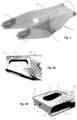
- Figure 1 shows an embodiment of a motorcycle assembly with reference numeral 1.
- the assembly 1 comprises a swingarm 2', representing the first element 2, and some second elements 3,4,5 highlighted in a darker color.
- the second elements identified by reference numeral 3 are the rear wheel-holder swing arm sliders
- the second element identified by reference numeral 4 is the rear suspension support
- the second elements identified by reference numeral 5 are bearing-holder bushings inserted into the hole 9 of swingarm 2' to accommodate the hinge axle of motorcycle 20.
- the assembly can have only one slider 3 and only one bushing 5.
- the swingarm 2' is a first element of the hollow type, i.e., comprising an outer shell 11, as better shown in Figures 3A,3B,3C , in which there is no material.
- the second elements 3,4,5 are full bodies.
- the swingarm 2' is made of a carbon fiber fabric pre-impregnated (pre-preg) in a polymeric resin matrix which is cured.
- the swingarm 2' is made by arranging a plurality of layers of pre-impregnated carbon fiber fabric, otherwise referred to as skins, on top of one another. These layers are then cured together to form a shell 11 inside an autoclave.
- the shell 11 can have a thickness typically ranging from 1 to 5 mm.
- the thus-obtained swingarm 2' is highly lightweight but with optimal mechanical properties.
- the carbon fibers in the fabric are long continuous fibers, which ensure better mechanical properties than shorter fibers, especially along the extension of the fibers themselves.
- One or more of said second elements 3,4,5 are permanently and indissolubly connected to the swingarm 2' thus described.
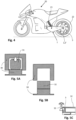
- a block of a second composite material comprising chopped and randomly arranged carbon fibers linked together by means of a polymeric resin, referred to as a pre-impregnated blank 31 for simplicity, is inserted into the component of a mold 30.
- the blank 31 is of the type referred to as SMC (sheet molding compound), but it can also be of the BMC (bulk molding compound) type.
- a second portion of the mold 30 cooperates with the first portion of the mold 30 forming a closed chamber, as shown in Figure 5A .
- the chamber thus created is then pressurized by approaching the two portions of mold 30. Therefore, the blank 31 is first pressurized by the high pressure present in the chamber and then pressed by the upper portion of mold 30, which forges the blank 31 inside the mold 30.
- the thus-forged component 32 shown in Figure 5B , is ready for subsequent mechanical machining steps.
- the forged piece 32 is then machined by means of a machine tool 33 of the chip removal type, e.g., milling, in order to obtain the finished component, i.e., the second elements 3,4,5, as shown in Figure 5C .
- a machine tool 33 of the chip removal type e.g., milling
- the forging occurs at a pressure between 10 and 150 bar and at a temperature comprised between 50° C and 200°C.
- the second element 3,4,5 thus obtained has breaking properties comparable to those of aluminum alloys but with approximately half the density.
- the second element thus obtained here the swing arm slider 3, is firmly connected to the swingarm 2' by means of a structural adhesive 8.
- the usable structural adhesive 8 depends on the polymeric resin of the first and second elements.
- the resins of the first element 2 and second element 3 are epoxy resins, therefore the structural adhesive 8 is also an epoxy adhesive. Since the substances are mutually compatible, the union of the first element 2 with the second element 3 becomes monolithic and indissoluble.
- the resin of the second element 3,4,5 can be a vinyl ester resin or another thermosetting resin.
- the resin of the first element 2 can be an epoxy, polyurethane, vinyl ester, or phenolic resin.
- the structural adhesive 8 can be an acrylic or urethane adhesive.
- the first element 2 i.e., the swingarm 2'
- the texture of the second element i.e., the swing arm slider 3
- the chopped carbon fibers do not create an organic pattern as in the case of the first element 2.
- the chopped carbon fibers are fibers between 5 mm and 50 mm long, preferably between 15 mm and 30 mm, which are embedded in a polymeric resin matrix. Said chopped fibers have a random arrangement, and for this reason they create the marbled aesthetic effect.
- the disorganized arrangement and short length of the carbon fibers of the second element 3,4,5 make it more easily moldable and machinable.
- the overall surface finishing of the second element 3,4,5 when extracted from the mold 30 is significantly better than the overall surface finish of the first element obtained from pre-preg. Having an optimized surface finish on the entire surface of the second element allows creating precision mechanical couplings with the first element or other components. Therefore, the time for manufacturing the second element 3,4,5 is shorter than that of the first element 2.
- the thickness of the solid part of the second element 3,4,5 is greater, at least 4-5 times greater, than that of the solid part of the first element 2. This results from the fact that the starting blank 31 has a considerably greater thickness than that of a conventional pre-preg.
- the thickness of the solid portion of the second element 3,4,5 can range between 25 mm and 50 mm.
- the swing arm slider 3 has a through-slot 7 in which the rear wheel hub is housed.
- the swing arm slider 3 further comprises a threaded metal element 6 glued into a cavity of the swing arm slider 3 itself.
- a bolt for adjusting the position of the wheel hub with respect to the swingarm 2' is connected to this threaded element 6.
- the swing arm slider 3 further comprises a plurality of lightening portions 10, i.e., a series of hollowed-out portions (cavities) which further reduce the weight of the component.
- the shell 11 surrounds the swing arm sliders 3, joining with them at the contact points by means of structural adhesive 8.
- the support 4 preferably supports a bracket (not shown), to which the spring suspension 21 of the motorcycle 20 connects.
- the suspension 21 can pass through a hole in the swingarm 2', shown in Figure 3B .
- the support 4 preferably comprises protuberances 12 in which threaded elements (not shown) are arranged, which are used to connect said bracket of suspension 21.
- the support 4 is connected to the swingarm 2' by means of a structural adhesive 8.
- the bushings 5 are hollow cylindrical bodies provided with a flange, which are inserted into the swingarm 2' and are connected thereto by means of the structural adhesive 8.
Landscapes
- Engineering & Computer Science (AREA)
- Mechanical Engineering (AREA)
- Chemical & Material Sciences (AREA)
- Composite Materials (AREA)
- Textile Engineering (AREA)
- Chemical Kinetics & Catalysis (AREA)
- General Chemical & Material Sciences (AREA)
- Axle Suspensions And Sidecars For Cycles (AREA)
- Moulding By Coating Moulds (AREA)
- Steering Devices For Bicycles And Motorcycles (AREA)
- Tires In General (AREA)
- Handcart (AREA)
Claims (11)
- Baugruppe (1) für ein Motorrad (20), umfassend:- ein erstes Element (2), das aus einem ersten Verbundwerkstoff besteht, der ein oder mehrere Netzgewebe aus Kohlenstofffasern umfasst, die mittels eines Polymerharzes miteinander verbunden sind; und- ein zweites Element (3,4,5),wobei:- das erste Element (2) mittels eines strukturellen Klebstoffs (8) mit an das zweiten Element (3, 4, 5) gebunden ist;- das erste Element (2) eine Schwinge (2') ist und das zweite Element (3, 4, 5) an der Schwinge (2') befestigt ist und eines oder mehrere der Folgenden umfasst: einen Schieber (3), eine Stütze (4) einer Federung (21) des Motorrads (20), eine Buchse (5), dadurch gekennzeichnet, dass das zweite Element (3, 4, 5) aus einem zweiten Verbundwerkstoff besteht, der gehackte und zufällig angeordnete Kohlenstofffasern umfasst, die mittels eines Polymerharzes miteinander verbunden sind.
- Baugruppe (1) nach Anspruch 1, wobei das erste Element (2) ein Hohlkörper ist, der eine Hülle (11) aus dem ersten Verbundwerkstoff umfasst, wobei die Hülle (11) vorzugsweise eine Vielzahl von Schichten umfasst, die das Kohlenstofffasergewebe umfasst.
- Baugruppe (1) nach Anspruch 1 oder 2, wobei das zweite Element (3, 4, 5) ein fester Körper ist, der vollständig aus dem zweiten Verbundwerkstoff besteht.
- Baugruppe (1) nach einem der vorhergehenden Ansprüche, wobei die gehackten Kohlenstofffasern des zweiten Verbundwerkstoffs eine Länge aufweisen, die zwischen 5 mm und 50 mm, vorzugsweise zwischen 15 mm und 30 mm, umfasst.
- Baugruppe (1) nach einem der vorhergehenden Ansprüche, wobei das Polymerharz des ersten und/oder zweiten Verbundwerkstoffs ein Epoxidharz ist.
- Baugruppe (1) nach einem der vorhergehenden Ansprüche, wobei der strukturelle Klebstoff (8) ein Epoxid-, Acryl- oder Urethanklebstoff ist.
- Baugruppe (1) nach einem der vorhergehenden Ansprüche, wobei die zerhackten Kohlenstofffasern Verschnitte von Netzgewebe aus Kohlenstofffasern umfassen.
- Motorrad (20), umfassend eine Schwinge (2') eines Hinterrads (22) aus einem ersten Verbundwerkstoff, der ein Netzgewebe aus Kohlenstofffasern umfasst, die mittels eines Polymerharzes miteinander verbunden sind, und ein Paar Schwingenschieber (3) und/oder eine Stütze (4) für eine Federung (21) des Motorrads (20) und/oder eine Buchse (5) aus einem zweiten Verbundwerkstoff,
wobei der Schwingenschieber (3) und/oder die Stütze (4) und/oder die Buchse (5) mittels eines strukturellen Klebstoffs (8) an der Schwinge (2') befestigt sind, dadurch gekennzeichnet, dass der zweite Verbundwerkstoff gehackte und zufällig angeordnete Kohlenstofffasern umfasst, die mittels eines Polymerharzes miteinander verbunden sind. - Verfahren zur Herstellung einer Baugruppe (1) eines Motorrads (20), umfassend die folgenden Schritte:- Bereitstellen eines vorimprägnierten Rohlings (31) aus einem zweiten Verbundwerkstoff in einer Form (30);- Schmieden des Rohlings (31) in der Form (30), um ein Schmiedestück (32) zu erhalten;- Ausführen von mechanischen Bearbeitungen an dem Schmiedestück (32), um ein zweites Element (3, 4, 5) zu erhalten, wobei das zweite Element (3, 4, 5) ein Schieber (3) oder eine Stütze (4) für eine Federung (21) des Motorrads (20) oder eine Buchse (5) ist;- Verkleben des zweiten Elements (3, 4, 5) mit einem ersten Element (2), das aus einem ersten Verbundwerkstoff besteht, der ein Netzgewebe aus Kohlenstofffasern umfasst, die mittels eines Polymerharzes miteinander verbunden sind, wobei das erste Element (2) eine Schwinge (2') ist, dadurch gekennzeichnet, dass der zweite Verbundwerkstoff gehackte und zufällig angeordnete Kohlenstofffasern umfasst, die mittels eines Polymerharzes miteinander verbunden sind.
- Verfahren nach Anspruch 12, das ferner den einleitenden Schritt des Aushärtens eines Kohlenstofffaser-Netzgewebes mit einem Polymerharz umfasst, um das erste Element (2) zu fertigen.
- Herstellungsverfahren nach Anspruch 9 oder 10, umfassend die anschließende Phase der mechanischen Bearbeitung einer Baugruppe (1), die die ersten und zweiten Elemente (2, 3, 4, 5) umfasst.
Applications Claiming Priority (2)
| Application Number | Priority Date | Filing Date | Title |
|---|---|---|---|
| IT102021000025118A IT202100025118A1 (it) | 2021-09-30 | 2021-09-30 | Assieme per motocicletta, motocicletta e relativo metodo di fabbricazione dell’assieme |
| PCT/IB2022/058915 WO2023052911A1 (en) | 2021-09-30 | 2022-09-21 | Motorcycle rear swingarm, motorcycle with swingarm and manufacturing method |
Publications (3)
| Publication Number | Publication Date |
|---|---|
| EP4408728A1 EP4408728A1 (de) | 2024-08-07 |
| EP4408728C0 EP4408728C0 (de) | 2025-01-29 |
| EP4408728B1 true EP4408728B1 (de) | 2025-01-29 |
Family
ID=79019069
Family Applications (1)
| Application Number | Title | Priority Date | Filing Date |
|---|---|---|---|
| EP22857025.5A Active EP4408728B1 (de) | 2021-09-30 | 2022-09-21 | Motorrad-hinterradschwinge, motorrad mit schwinge und herstellungsverfahren |
Country Status (5)
| Country | Link |
|---|---|
| US (1) | US20240391553A1 (de) |
| EP (1) | EP4408728B1 (de) |
| JP (1) | JP2024537032A (de) |
| IT (1) | IT202100025118A1 (de) |
| WO (1) | WO2023052911A1 (de) |
Family Cites Families (10)
| Publication number | Priority date | Publication date | Assignee | Title |
|---|---|---|---|---|
| JPS55148674A (en) * | 1979-05-04 | 1980-11-19 | Yamaha Motor Co Ltd | Rear arm of autobicycle |
| US5803476A (en) * | 1995-08-25 | 1998-09-08 | Gt Bicycles, Inc. | Composite bicycle frame and method of manufacturing |
| EP2110302A1 (de) * | 2003-06-11 | 2009-10-21 | CAMPAGNOLO S.r.l. | Fahrradkomponente |
| DE102013223298A1 (de) * | 2013-11-15 | 2015-05-21 | Bayerische Motoren Werke Aktiengesellschaft | Rahmen für ein Motorrad |
| WO2015095966A1 (en) * | 2013-12-23 | 2015-07-02 | Industries Rad Inc. | Composite bicycle frame and method of manufacturing same |
| US11091217B2 (en) * | 2017-01-26 | 2021-08-17 | Giant Manufacturing Co., Ltd. | Joint structure of a composite bicycle frame and manufacturing method thereof |
| WO2018170084A1 (en) * | 2017-03-16 | 2018-09-20 | Guerrilla Industries LLC | Composite structures and methods of forming composite structures |
| JP7136633B2 (ja) * | 2017-10-02 | 2022-09-13 | スズキ株式会社 | 繊維強化樹脂材の板状部材 |
| JP6648097B2 (ja) * | 2017-12-07 | 2020-02-14 | 本田技研工業株式会社 | 鞍乗り型車両のスイングアーム |
| EP3778173B1 (de) * | 2018-03-30 | 2023-09-27 | Toray Industries, Inc. | Verfahren zur herstellung eines pressformartikels |
-
2021
- 2021-09-30 IT IT102021000025118A patent/IT202100025118A1/it unknown
-
2022
- 2022-09-21 US US18/697,172 patent/US20240391553A1/en active Pending
- 2022-09-21 WO PCT/IB2022/058915 patent/WO2023052911A1/en not_active Ceased
- 2022-09-21 JP JP2024518728A patent/JP2024537032A/ja active Pending
- 2022-09-21 EP EP22857025.5A patent/EP4408728B1/de active Active
Also Published As
| Publication number | Publication date |
|---|---|
| JP2024537032A (ja) | 2024-10-10 |
| EP4408728C0 (de) | 2025-01-29 |
| US20240391553A1 (en) | 2024-11-28 |
| WO2023052911A1 (en) | 2023-04-06 |
| EP4408728A1 (de) | 2024-08-07 |
| IT202100025118A1 (it) | 2023-03-30 |
Similar Documents
| Publication | Publication Date | Title |
|---|---|---|
| EP2386472B1 (de) | Fahrradgabel | |
| US5944932A (en) | Bicycle front forks and methods of making same | |
| US20030019325A1 (en) | Bicycle crank and method for manufacturing said crank | |
| US10513302B2 (en) | Composite bicycle frame and method of manufacturing same | |
| CN105730174B (zh) | 一种碳纤维复合材料麦弗逊悬架控制臂及其制备方法 | |
| US20150130261A1 (en) | Method of Designing and Producing Carbon Fiber Wheels | |
| EP1056587A1 (de) | Verfahren und vorrichtung zum herstellen von schwimmkörpern aus endlosfaserverstärktem kunststoff mit einer wickelmaschine | |
| US7464950B2 (en) | Continuous fiber carbon fork | |
| US20240083123A1 (en) | Reinforce carbon fiber structures and manufacturing processes | |
| US20200354016A1 (en) | Method for producing a bicycle component, bicycle component and bicycle chainset | |
| WO2012052219A1 (de) | Bauweise für pkw / nfz leichtbaukammerfelgen umfassend bauweise, materialkonzept, konstruktionsmerkmale und herstellverfahren | |
| EP4408728B1 (de) | Motorrad-hinterradschwinge, motorrad mit schwinge und herstellungsverfahren | |
| US20100117330A1 (en) | Bicycle Forks, Crown, and Steerer Tube Assembly | |
| CN115122672B (zh) | 一种预浸料预制体高精度加工工艺及其制作的产品 | |
| KR101394875B1 (ko) | 일체형 탄소섬유 복합체 휠의 제조방법 및 그로부터 제조된 일체형 휠 | |
| JP3367425B2 (ja) | ステアリングホイールおよびその製法 | |
| JP2018187821A (ja) | 繊維強化樹脂部品の製造方法 | |
| WO2012038747A1 (en) | Net edge method | |
| CN108437488A (zh) | 一种碳纤维复合材料离心机转子的制作方法 | |
| CN221819244U (zh) | 格栅结构的飞行器罩体的成型模具 | |
| CN102029510A (zh) | 一种热锻成型的自行车肘接件制法 | |
| KR101830705B1 (ko) | 자동차용 복합소재 리어 캐리어 제조방법 및 이에 의한 리어 캐리어 | |
| Octeau et al. | Design of a lightweight composite bicycle fork | |
| Black | Designing for Manufacturing Processes and Materials | |
| KR20210084159A (ko) | 프리폼을 이용한 차량용 너클의 제조방법 |
Legal Events
| Date | Code | Title | Description |
|---|---|---|---|
| STAA | Information on the status of an ep patent application or granted ep patent |
Free format text: STATUS: UNKNOWN |
|
| STAA | Information on the status of an ep patent application or granted ep patent |
Free format text: STATUS: THE INTERNATIONAL PUBLICATION HAS BEEN MADE |
|
| PUAI | Public reference made under article 153(3) epc to a published international application that has entered the european phase |
Free format text: ORIGINAL CODE: 0009012 |
|
| STAA | Information on the status of an ep patent application or granted ep patent |
Free format text: STATUS: REQUEST FOR EXAMINATION WAS MADE |
|
| 17P | Request for examination filed |
Effective date: 20240311 |
|
| AK | Designated contracting states |
Kind code of ref document: A1 Designated state(s): AL AT BE BG CH CY CZ DE DK EE ES FI FR GB GR HR HU IE IS IT LI LT LU LV MC MK MT NL NO PL PT RO RS SE SI SK SM TR |
|
| GRAP | Despatch of communication of intention to grant a patent |
Free format text: ORIGINAL CODE: EPIDOSNIGR1 |
|
| STAA | Information on the status of an ep patent application or granted ep patent |
Free format text: STATUS: GRANT OF PATENT IS INTENDED |
|
| GRAS | Grant fee paid |
Free format text: ORIGINAL CODE: EPIDOSNIGR3 |
|
| DAV | Request for validation of the european patent (deleted) | ||
| DAX | Request for extension of the european patent (deleted) | ||
| INTG | Intention to grant announced |
Effective date: 20241121 |
|
| GRAA | (expected) grant |
Free format text: ORIGINAL CODE: 0009210 |
|
| STAA | Information on the status of an ep patent application or granted ep patent |
Free format text: STATUS: THE PATENT HAS BEEN GRANTED |
|
| AK | Designated contracting states |
Kind code of ref document: B1 Designated state(s): AL AT BE BG CH CY CZ DE DK EE ES FI FR GB GR HR HU IE IS IT LI LT LU LV MC MK MT NL NO PL PT RO RS SE SI SK SM TR |
|
| REG | Reference to a national code |
Ref country code: GB Ref legal event code: FG4D |
|
| REG | Reference to a national code |
Ref country code: CH Ref legal event code: EP |
|
| REG | Reference to a national code |
Ref country code: DE Ref legal event code: R096 Ref document number: 602022010305 Country of ref document: DE |
|
| REG | Reference to a national code |
Ref country code: IE Ref legal event code: FG4D |
|
| U01 | Request for unitary effect filed |
Effective date: 20250129 |
|
| U07 | Unitary effect registered |
Designated state(s): AT BE BG DE DK EE FI FR IT LT LU LV MT NL PT RO SE SI Effective date: 20250205 |
|
| PG25 | Lapsed in a contracting state [announced via postgrant information from national office to epo] |
Ref country code: RS Free format text: LAPSE BECAUSE OF FAILURE TO SUBMIT A TRANSLATION OF THE DESCRIPTION OR TO PAY THE FEE WITHIN THE PRESCRIBED TIME-LIMIT Effective date: 20250429 |
|
| PG25 | Lapsed in a contracting state [announced via postgrant information from national office to epo] |
Ref country code: PL Free format text: LAPSE BECAUSE OF FAILURE TO SUBMIT A TRANSLATION OF THE DESCRIPTION OR TO PAY THE FEE WITHIN THE PRESCRIBED TIME-LIMIT Effective date: 20250129 |
|
| PG25 | Lapsed in a contracting state [announced via postgrant information from national office to epo] |
Ref country code: ES Free format text: LAPSE BECAUSE OF FAILURE TO SUBMIT A TRANSLATION OF THE DESCRIPTION OR TO PAY THE FEE WITHIN THE PRESCRIBED TIME-LIMIT Effective date: 20250129 |
|
| PG25 | Lapsed in a contracting state [announced via postgrant information from national office to epo] |
Ref country code: IS Free format text: LAPSE BECAUSE OF FAILURE TO SUBMIT A TRANSLATION OF THE DESCRIPTION OR TO PAY THE FEE WITHIN THE PRESCRIBED TIME-LIMIT Effective date: 20250529 Ref country code: NO Free format text: LAPSE BECAUSE OF FAILURE TO SUBMIT A TRANSLATION OF THE DESCRIPTION OR TO PAY THE FEE WITHIN THE PRESCRIBED TIME-LIMIT Effective date: 20250429 |
|
| PG25 | Lapsed in a contracting state [announced via postgrant information from national office to epo] |
Ref country code: HR Free format text: LAPSE BECAUSE OF FAILURE TO SUBMIT A TRANSLATION OF THE DESCRIPTION OR TO PAY THE FEE WITHIN THE PRESCRIBED TIME-LIMIT Effective date: 20250129 |
|
| PG25 | Lapsed in a contracting state [announced via postgrant information from national office to epo] |
Ref country code: GR Free format text: LAPSE BECAUSE OF FAILURE TO SUBMIT A TRANSLATION OF THE DESCRIPTION OR TO PAY THE FEE WITHIN THE PRESCRIBED TIME-LIMIT Effective date: 20250430 |
|
| U20 | Renewal fee for the european patent with unitary effect paid |
Year of fee payment: 4 Effective date: 20250725 |
|
| PG25 | Lapsed in a contracting state [announced via postgrant information from national office to epo] |
Ref country code: SM Free format text: LAPSE BECAUSE OF FAILURE TO SUBMIT A TRANSLATION OF THE DESCRIPTION OR TO PAY THE FEE WITHIN THE PRESCRIBED TIME-LIMIT Effective date: 20250129 |
|
| PG25 | Lapsed in a contracting state [announced via postgrant information from national office to epo] |
Ref country code: CZ Free format text: LAPSE BECAUSE OF FAILURE TO SUBMIT A TRANSLATION OF THE DESCRIPTION OR TO PAY THE FEE WITHIN THE PRESCRIBED TIME-LIMIT Effective date: 20250129 |
|
| PG25 | Lapsed in a contracting state [announced via postgrant information from national office to epo] |
Ref country code: SK Free format text: LAPSE BECAUSE OF FAILURE TO SUBMIT A TRANSLATION OF THE DESCRIPTION OR TO PAY THE FEE WITHIN THE PRESCRIBED TIME-LIMIT Effective date: 20250129 |
|
| PLBE | No opposition filed within time limit |
Free format text: ORIGINAL CODE: 0009261 |
|
| STAA | Information on the status of an ep patent application or granted ep patent |
Free format text: STATUS: NO OPPOSITION FILED WITHIN TIME LIMIT |
|
| 26N | No opposition filed |
Effective date: 20251030 |