EP4408000A1 - Informationsverarbeitungsvorrichtung, informationsverarbeitungsverfahren, programm und informationsverarbeitungssystem - Google Patents
Informationsverarbeitungsvorrichtung, informationsverarbeitungsverfahren, programm und informationsverarbeitungssystem Download PDFInfo
- Publication number
- EP4408000A1 EP4408000A1 EP22872708.7A EP22872708A EP4408000A1 EP 4408000 A1 EP4408000 A1 EP 4408000A1 EP 22872708 A EP22872708 A EP 22872708A EP 4408000 A1 EP4408000 A1 EP 4408000A1
- Authority
- EP
- European Patent Office
- Prior art keywords
- preference
- tags
- broadcast content
- score
- tag
- Prior art date
- Legal status (The legal status is an assumption and is not a legal conclusion. Google has not performed a legal analysis and makes no representation as to the accuracy of the status listed.)
- Pending
Links
Images




Classifications
-
- H—ELECTRICITY
- H04—ELECTRIC COMMUNICATION TECHNIQUE
- H04N—PICTORIAL COMMUNICATION, e.g. TELEVISION
- H04N21/00—Selective content distribution, e.g. interactive television or video on demand [VOD]
- H04N21/40—Client devices specifically adapted for the reception of or interaction with content, e.g. set-top-box [STB]; Operations thereof
- H04N21/43—Processing of content or additional data, e.g. demultiplexing additional data from a digital video stream; Elementary client operations, e.g. monitoring of home network or synchronising decoder's clock; Client middleware
- H04N21/442—Monitoring of processes or resources, e.g. detecting the failure of a recording device, monitoring the downstream bandwidth, the number of times a movie has been viewed, the storage space available from the internal hard disk
- H04N21/44213—Monitoring of end-user related data
- H04N21/44222—Analytics of user selections, e.g. selection of programs or purchase activity
-
- H—ELECTRICITY
- H04—ELECTRIC COMMUNICATION TECHNIQUE
- H04N—PICTORIAL COMMUNICATION, e.g. TELEVISION
- H04N21/00—Selective content distribution, e.g. interactive television or video on demand [VOD]
- H04N21/40—Client devices specifically adapted for the reception of or interaction with content, e.g. set-top-box [STB]; Operations thereof
- H04N21/45—Management operations performed by the client for facilitating the reception of or the interaction with the content or administrating data related to the end-user or to the client device itself, e.g. learning user preferences for recommending movies, resolving scheduling conflicts
- H04N21/466—Learning process for intelligent management, e.g. learning user preferences for recommending movies
- H04N21/4667—Processing of monitored end-user data, e.g. trend analysis based on the log file of viewer selections
-
- G—PHYSICS
- G06—COMPUTING OR CALCULATING; COUNTING
- G06F—ELECTRIC DIGITAL DATA PROCESSING
- G06F16/00—Information retrieval; Database structures therefor; File system structures therefor
- G06F16/40—Information retrieval; Database structures therefor; File system structures therefor of multimedia data, e.g. slideshows comprising image and additional audio data
- G06F16/48—Retrieval characterised by using metadata, e.g. metadata not derived from the content or metadata generated manually
-
- H—ELECTRICITY
- H04—ELECTRIC COMMUNICATION TECHNIQUE
- H04N—PICTORIAL COMMUNICATION, e.g. TELEVISION
- H04N21/00—Selective content distribution, e.g. interactive television or video on demand [VOD]
- H04N21/40—Client devices specifically adapted for the reception of or interaction with content, e.g. set-top-box [STB]; Operations thereof
- H04N21/43—Processing of content or additional data, e.g. demultiplexing additional data from a digital video stream; Elementary client operations, e.g. monitoring of home network or synchronising decoder's clock; Client middleware
- H04N21/433—Content storage operation, e.g. storage operation in response to a pause request, caching operations
- H04N21/4334—Recording operations
-
- H—ELECTRICITY
- H04—ELECTRIC COMMUNICATION TECHNIQUE
- H04N—PICTORIAL COMMUNICATION, e.g. TELEVISION
- H04N21/00—Selective content distribution, e.g. interactive television or video on demand [VOD]
- H04N21/40—Client devices specifically adapted for the reception of or interaction with content, e.g. set-top-box [STB]; Operations thereof
- H04N21/43—Processing of content or additional data, e.g. demultiplexing additional data from a digital video stream; Elementary client operations, e.g. monitoring of home network or synchronising decoder's clock; Client middleware
- H04N21/434—Disassembling of a multiplex stream, e.g. demultiplexing audio and video streams, extraction of additional data from a video stream; Remultiplexing of multiplex streams; Extraction or processing of SI; Disassembling of packetised elementary stream
- H04N21/4345—Extraction or processing of SI, e.g. extracting service information from an MPEG stream
-
- H—ELECTRICITY
- H04—ELECTRIC COMMUNICATION TECHNIQUE
- H04N—PICTORIAL COMMUNICATION, e.g. TELEVISION
- H04N21/00—Selective content distribution, e.g. interactive television or video on demand [VOD]
- H04N21/40—Client devices specifically adapted for the reception of or interaction with content, e.g. set-top-box [STB]; Operations thereof
- H04N21/43—Processing of content or additional data, e.g. demultiplexing additional data from a digital video stream; Elementary client operations, e.g. monitoring of home network or synchronising decoder's clock; Client middleware
- H04N21/442—Monitoring of processes or resources, e.g. detecting the failure of a recording device, monitoring the downstream bandwidth, the number of times a movie has been viewed, the storage space available from the internal hard disk
- H04N21/44213—Monitoring of end-user related data
- H04N21/44222—Analytics of user selections, e.g. selection of programs or purchase activity
- H04N21/44224—Monitoring of user activity on external systems, e.g. Internet browsing
-
- H—ELECTRICITY
- H04—ELECTRIC COMMUNICATION TECHNIQUE
- H04N—PICTORIAL COMMUNICATION, e.g. TELEVISION
- H04N21/00—Selective content distribution, e.g. interactive television or video on demand [VOD]
- H04N21/40—Client devices specifically adapted for the reception of or interaction with content, e.g. set-top-box [STB]; Operations thereof
- H04N21/45—Management operations performed by the client for facilitating the reception of or the interaction with the content or administrating data related to the end-user or to the client device itself, e.g. learning user preferences for recommending movies, resolving scheduling conflicts
- H04N21/4508—Management of client data or end-user data
- H04N21/4532—Management of client data or end-user data involving end-user characteristics, e.g. viewer profile, preferences
-
- H—ELECTRICITY
- H04—ELECTRIC COMMUNICATION TECHNIQUE
- H04N—PICTORIAL COMMUNICATION, e.g. TELEVISION
- H04N21/00—Selective content distribution, e.g. interactive television or video on demand [VOD]
- H04N21/40—Client devices specifically adapted for the reception of or interaction with content, e.g. set-top-box [STB]; Operations thereof
- H04N21/45—Management operations performed by the client for facilitating the reception of or the interaction with the content or administrating data related to the end-user or to the client device itself, e.g. learning user preferences for recommending movies, resolving scheduling conflicts
- H04N21/466—Learning process for intelligent management, e.g. learning user preferences for recommending movies
- H04N21/4668—Learning process for intelligent management, e.g. learning user preferences for recommending movies for recommending content, e.g. movies
-
- H—ELECTRICITY
- H04—ELECTRIC COMMUNICATION TECHNIQUE
- H04N—PICTORIAL COMMUNICATION, e.g. TELEVISION
- H04N21/00—Selective content distribution, e.g. interactive television or video on demand [VOD]
- H04N21/40—Client devices specifically adapted for the reception of or interaction with content, e.g. set-top-box [STB]; Operations thereof
- H04N21/47—End-user applications
- H04N21/472—End-user interface for requesting content, additional data or services; End-user interface for interacting with content, e.g. for content reservation or setting reminders, for requesting event notification, for manipulating displayed content
- H04N21/47214—End-user interface for requesting content, additional data or services; End-user interface for interacting with content, e.g. for content reservation or setting reminders, for requesting event notification, for manipulating displayed content for content reservation or setting reminders; for requesting event notification, e.g. of sport results or stock market
-
- H—ELECTRICITY
- H04—ELECTRIC COMMUNICATION TECHNIQUE
- H04N—PICTORIAL COMMUNICATION, e.g. TELEVISION
- H04N21/00—Selective content distribution, e.g. interactive television or video on demand [VOD]
- H04N21/40—Client devices specifically adapted for the reception of or interaction with content, e.g. set-top-box [STB]; Operations thereof
- H04N21/47—End-user applications
- H04N21/482—End-user interface for program selection
- H04N21/4826—End-user interface for program selection using recommendation lists, e.g. of programs or channels sorted out according to their score
-
- H—ELECTRICITY
- H04—ELECTRIC COMMUNICATION TECHNIQUE
- H04N—PICTORIAL COMMUNICATION, e.g. TELEVISION
- H04N21/00—Selective content distribution, e.g. interactive television or video on demand [VOD]
- H04N21/80—Generation or processing of content or additional data by content creator independently of the distribution process; Content per se
- H04N21/83—Generation or processing of protective or descriptive data associated with content; Content structuring
- H04N21/84—Generation or processing of descriptive data, e.g. content descriptors
Definitions
- the present disclosure relates to an information processing device, an information processing method, a program, and an information processing system for estimating user preferences from the viewing history of broadcast content viewed by the user.
- Patent Literature (PTL) 1 discloses an information processing device.
- the information processing device includes an obtainer, an analyzer, an evaluator, a visualizer, and a display.
- the obtainer obtains program information of a program (audience rating, program description, keywords, broadcast start time and end time, information about performers, impressions of the program, the number of the impressions, the number of reuse of program introduction information, the number of comments that are sent to the official site of program P1, and usage history).
- the analyzer quantifies program information.
- the evaluator evaluates the program based on the numerical value obtained by the analyzer.
- the visualizer collectively converts the results of the evaluation performed by the evaluator into graphical representation.
- the display presents the evaluation results that are graphically represented by the visualizer.
- the present disclosure provides an information processing system and the like which is capable of easily increasing the accuracy of estimating user preferences.
- An information processing device includes: an obtainer that obtains a viewing history of one or more items of broadcast content viewed by a user in a past predetermined period; a first evaluator that assigns a first score related to a preference tag assigned to each of a plurality of items of broadcast content among a plurality of preference tags of different kinds corresponding to a plurality of preferences of different kinds of a viewer; a second evaluator that assigns a second score related to a combined preference tag or a single preference tag corresponding to each of the plurality of items of broadcast content among a plurality of combined preference tags of different patterns and a plurality of single preference tags of different patterns, each of the plurality of combined preference tags being a combination of two or more of the plurality of preference tags, each of the plurality of single preference tags being one of the plurality of preference tags solely assigned to the broadcast content; a first preference information table that stores the first score calculated for each of the one or more items of broadcast content included in the viewing history obtained; a first evaluator that assign
- An information processing method includes: obtaining a viewing history of one or more items of broadcast content viewed by a user in a past predetermined period; assigning a first score related to a preference tag assigned to each of a plurality of items of broadcast content among a plurality of preference tags of different kinds corresponding to a plurality of preferences of different kinds of a viewer; assigning a second score related to a combined preference tag or a single preference tag corresponding to each of the plurality of items of broadcast content among a plurality of combined preference tags of different patterns and a plurality of single preference tags of different patterns, each of the plurality of combined preference tags being a combination of two or more of the plurality of preference tags, each of the plurality of single preference tags being one of the plurality of preference tags solely assigned to the broadcast content; storing the first score calculated for each of the one or more items of broadcast content included in the viewing history obtained; storing the second score calculated for each of the one or more items of broadcast content included in the viewing history obtained; and referring to
- a program according to one aspect of the present disclosure causes one or more processors to execute the information processing method.
- An information processing system includes: the information processing device; a matching device that selects one or more items of broadcast content to be presented to the user, based on the preference information outputted; an evaluation level calculator that calculates an evaluation level that is based on each of the one or more items of broadcast content selected and the preference information; and a graphic generator that generates an image including, along with the one or more items of broadcast content selected, information about details of each of the one or more items of broadcast content, the evaluation level calculated for the broadcast content, and tag information that matches the preference information of the user, the tag information including one or more tags among (i) the plurality of preference tags, (ii) the plurality of combined preference tags, and (iii) the plurality of single preference tags.
- the information processing system and the like according to the present disclosure is capable of easily increasing the accuracy of estimating user preferences.
- FIG. 1 is a schematic diagram illustrating a configuration of an information processing device and the like according to the embodiment.
- Information processing device 100 is a device for estimating user preferences based on the viewing history of broadcast content viewed by the user.
- tag assignment device 150, content storage device 200, matching device 300, and presentation device 400 are combined with information processing device 100, so that broadcast content that matches the user preferences estimated by information processing device 100 can be presented from among a plurality of items of broadcast content.
- information processing device 100 is mounted in recording device 2 that records television programs as broadcast content. Recording device 2 is connected to television receiver 3, and is capable of recording television programs received by television receiver 3 in response to a timer setting operation or the like made by a user. Information processing device 100 may be mounted in a television receiver with a recording function for recording television programs. Information processing device 100 may also be mounted in, for example, a server.
- the broadcast content is terrestrial broadcast television programs.
- the present embodiment is not limited to such an example, but may include broadcasting satellites (BS) television programs, or communication satellites (CS) television programs, etc.
- the broadcasting content handled by information processing device 100 is not limited to television broadcasting content, but may include, for example, Internet broadcasting content provided by video sharing services.
- information processing device 100 includes obtainer 11, evaluator 13, storage 15, outputter 17, evaluation level calculator 19, and graphic generator 21.
- Obtainer 11 obtains a viewing history of broadcast content viewed by the user in a past predetermined period.
- broadcast content viewed by the user here includes broadcast content viewed by the user in real time on television receiver 3 without being recorded on recording device 2 and/or broadcast content for which timer recording was set to recording device 2 (i.e., broadcast content for which timer recording was set in the past and which broadcast in the past or which is to be broadcast in the future).
- predetermined period refers to the period of time required for sufficient amount of broadcast content to be accumulated to estimate user preferences. Accordingly, the predetermined period may be a variable period determined by the number of items of broadcast content, or may be a fixed period, such as one day, one week, or one month, in which a statistically sufficient amount of broadcast content is considered to be accumulated.
- the term “viewing history” here includes the number of times the user has viewed the broadcast content and/or the date and time of the user's viewing of the broadcast content.
- the “viewing history” here also includes, for example, electronic program guide (EPG) information and/or service information (SI) each of which is program information, when the broadcast content is a television program.
- EPG electronic program guide
- SI service information
- the “viewing history” includes the details of the broadcast content, the number of times the broadcast content was viewed, and/or the date and time of the viewing.
- the “details of the broadcast content” can include, for example, the genre, title, cast, voice actors and actresses, producer, director, original writer, and name of creator, etc. of the broadcast content.
- the genre can include, for example, documentary, news, variety, drama, and animation.
- the details of the "broadcast content” can include, for example, character strings describing the details of the broadcast content.
- the "viewing history" can include, for example, keywords entered by the user for searching for the broadcast content and/or the user evaluation on the broadcast content.
- the viewing history of the broadcast content viewed by the user is stored in storage 15 when the user views the broadcast content in real time on TV receiver 3 or when the user makes an input for timer recording to recording device 2. Accordingly, in the present embodiment, obtainer 11 obtains the viewing history by reading the viewing history from storage 15.
- Evaluator 13 assigns, based on the viewing history obtained by obtainer 11, a first score and a second score indicating the user preferences for the broadcast content to each item of the broadcast content included in the viewing history and viewed by the user in the past predetermined period.
- evaluator 13 includes the functions of both a first evaluator and a second evaluator, and is an example of the first evaluator as well as an example of the second evaluator.
- the first score includes evaluation values related to preference tags assigned to each item of broadcast content among a plurality of preference tags of different kinds corresponding to a plurality of preferences of different kinds of the viewer.
- the first score is a set of numerical values assigned to respective preference tags for each item of broadcast content. Accordingly, when ten kinds of preference tags are set in information processing device 100, a first score including ten numerical values is assigned to one item of broadcast content by evaluator 13.
- the second score includes evaluation values related to combined preference tags and single preference tags for broadcast content among a plurality of combined preference tags of different patterns and a plurality of single preference tags of different patterns.
- Each of the combined preference tags is a combination of two or more preference tags.
- Each of the single preference tags is one kind of preference tag solely assigned to the broadcast content.
- a single preference tag is information that differs from a combined preference tag in that only a given preference tag is included and no other preference tags are included.
- broadcast content with the preference tag of tag A assigned may include several combined preference tags including tag A, such as tag A and tag B, tag A and tag C, ....
- the broadcast content with a single preference tag corresponding to the preference tag of tag A does not include any other preference tags (i.e., does not include any combined preference tags).
- evaluator 13 assigns a first score based on the preference tags assigned to the broadcast content, and also assigns a second score that indicates further details based on whether or not the broadcast content includes combined preference tags and single preference tags.
- the assignment of the first and second scores by evaluator 13 will be described below, along with a description of an operation of information processing device 100.
- preference tags may be set as appropriate for estimating user preferences using information processing device 100.
- preference tags are described as information corresponding to the above mentioned broadcast content genres (including documentary, news, variety, drama, animation, etc.).
- Storage 15 is a storage device in which information (computer programs, etc.) necessary for each unit of information processing system 100 to perform various functions is stored.
- Storage 15 is realized, for example, by a semiconductor memory.
- storage 15 is not particularly limited to such an example, and any known unit of electronic information storage can be used for storage 15.
- Storage 15 stores, for example, viewing history.
- storage 15 stores (accumulates) the first score and the second score of each item of broadcast content evaluated by evaluator 13. More specifically, storage 15 includes a first preference information table that stores the first scores and a second preference information table that stores the second scores.
- the first preference information table and the second preference information table stored in storage 15 as described above include information about the preference tags of the broadcast content viewed by the user in a predetermined period, as well as the combined preference tags and the single preference tags. Accordingly, by referring to the first preference information table and the second preference information table, it is possible to recognize user preferences for the broadcast content in the predetermined period.
- the first preference information table includes the first scores related to the preference tags only for the broadcast content viewed in a predetermined period.
- the second preference information table includes the second scores related to the combined preference tags and the single preference tags only for the broadcast content viewed in the predetermined period.
- the first preference information table and the second preference information table it is possible not only to estimate user preferences based on the preference tags alone, but also to estimate user preferences based on the combined preference tags and the single preference tags.
- the combined preference tags and the single preference tags indicate user preferences in such a detailed manner that two or more kinds of preference tags are combined or there are no preference tags to be combined.
- the combined preference tags and the single preference tags are further used for more detailed estimation, so that the estimated result approaches the actual user preferences. This makes it possible to estimate user preferences that match the actual user preferences even with a relatively small number of samples.
- Outputter 17 refers to the first preference information table and the second preference information table to output preference information that matches user preferences in the predetermined period.
- the preference information includes one or more preference tags among (i) a plurality of kinds of preference tags, (ii) a plurality of patterns of combined preference tags, and (iii) a plurality of patterns of single preference tags.
- Outputter 17 is a processor realized by a processor, a memory, and a program stored in the memory. Outputter 17 outputs the preference information to matching device 300 and the like to be described later.
- Tag assignment device 150 is a device that assigns preference tags to broadcast content. In the present embodiment, an example will be described in which tag assignment device 150 assigns preference tags to be used in the processing of information processing device 100. However, the preference tags may be assigned by an external entity (e.g., a broadcast content distribution provider).
- Tag assignment device 150 is a processor realized by a processor, a memory, and a program stored in the memory.
- Tag assignment device 150 includes AI models trained by learning for each kind of preset preference tag. For example, when twenty kinds of preference tags are set, tag assignment device 150 includes twenty AI models corresponding to the twenty kinds of preference tags.
- Tag assignment device 150 receives input of EPG information and SI information, etc., for broadcast content. Then, by inputting the received EPG information and SI information, etc.
- tag assignment device 150 outputs information about whether or not one preference tag set to each AI model is to be assigned to the broadcast content with the EPG information, SI information, and the like assigned.
- Tag assignment device 150 assigns a preference tag to be assigned to the broadcast content based on the result output from the AI model. Subsequently, evaluator 13 obtains information about the broadcast content after the assignment of the preference tag output from tag assignment device 150.
- Content storage device 200 is a device for storing broadcast content, and is realized by semiconductor memory, etc. Content storage device 200 records and stores, for example, all broadcast content simultaneously broadcast by terrestrial broadcasting. The user is able to select and view any broadcast content from among the broadcast content stored in content storage device 200.
- Matching device 300 is a device that uses the user preference information output from information processing device 100 to select broadcast content that matches user preferences from among the broadcast content stored in content storage device 200.
- Matching device 300 is a processor realized by a processor, a memory, and a program stored in the memory. For example, matching device 300 inputs broadcast content stored in content storage device 200 to tag assignment device 150 for assignment of preference tags. Based on the user preference information output from outputter 17, matching device 300 calculates the degree of matching between the preference tags (as well as combined preference tags and single preference tags) assigned to the broadcast content and the preference tags (as well as combined preference tags and single preference tags) in the preference information. Matching device 300, for example, selects the broadcast content with a highest matching degree calculated, or selects the broadcast content with a matching degree calculated that is higher than a threshold value.
- Evaluation level calculator 19 refers to the first score stored in the first preference information table and the second score stored in the second preference information table in storage 15 to calculate the evaluation level for the broadcast content selected from content storage device 200 by matching device 300 based on the preference tags (as well as the combined preference tags and the single preference tags) in the preference information.
- the evaluation level is, for example, obtained by calculating the sum of the matching degree for the first score and the matching degree for the second score for each of 50 items of broadcast content (e.g., the top 50 in order of the highest matching degree with the user preference information) to be presented by the information processing system as recommendations to the user, and determining the ratio of the calculated sum to a given score total as an approximate value.
- This approximate value indicates, to the user, the degree of matching of the broadcast content calculated by information processing system 100. Accordingly, the user is able to recognize the degree of matching of the broadcast content with his or her preferences simply by looking at the approximate value. As a result, the approximate value can be used by the user as an index for selecting broadcast content that matches his or her preferences.
- the degree of matching for the first score is calculated from the total number of preference tags that match among the preference tags assigned to the broadcast content and the preference tags in the user preference information. For example, the degree of matching for the first score is calculated by multiplying the total number of matching preference tags by a predetermined coefficient.
- the degree of matching for the second score is calculated from the total number of combined preference tags and single preference tags that match among the combined preference tags and the single preference tags assigned to the broadcast content and the combined preference tags and the single preference tags in the user preference information. For example, the degree of matching for the second score is calculated by multiplying the total number of matching combined preference tags and single preference tags by a predetermined coefficient.
- the total of the matching degrees for the first and second scores for the first ranked broadcast content among the broadcast content presented by the information processing system is 83 and the total score for the second ranked broadcast content is 68.
- the approximate values are calculated to be 80 (matching degree of 80% with user preference information) as the evaluation level of the first-ranked broadcast content and 70 (matching degree of 70% with user preference information) as the evaluation level of the second-ranked broadcast content.
- Presentation device 400 reads the broadcast content selected by matching device 300 and presents the broadcast content that matches user preferences by playing the broadcast content on the display of television receiver 3, or by listing the selected broadcast content, etc.
- Presentation device 400 includes, for example, a controller that reads broadcast content information from content storage device 200 and a decoder that performs conversion for projection on the display.
- the image includes, along with the selected broadcast content, information about the details of the broadcast content, the evaluation level calculated for the broadcast content, and tag information that matches the user preference information.
- the tag information includes at least one or more preference tags among (i) a plurality of kinds of preference tags assigned to the broadcast content, (ii) a plurality of patterns of combined preference tags assigned to the broadcast content, and (iii) a plurality of patterns of single preference tags assigned to the broadcast content.
- the image presented by presentation device 400 is generated by graphic generator 21. Graphic generator 21 collectively generates an image including the selected broadcast content, information about the details of the broadcast content, the calculated evaluation levels, and the tag information. The image allows the user to recognize the information at a glance.
- FIG. 6 illustrates an example of a display screen when the image generated by graphic generator 21 is presented by presentation device 400.
- the information about the image indicating the details of the broadcast content and text information indicating the details of the broadcast content from content storage device 200 are presented.
- the EPG information and/or SI information attached to the broadcast content may be used for the text information here.
- the evaluation level calculated by evaluation calculator 19 as the basis for recommending the broadcast content, and the preference tags, combined preference tags, and single preference tags that match between the broadcast content and preference information as the reason that the evaluation level is high are displayed as icons. By displaying such information, the user is able to check his or her own preference information used as a basis for the broadcast content recommendation, which motivates the user to view the broadcast content.
- FIG. 2 is a flowchart illustrating an example of processes performed by the information processing device according to the embodiment.
- obtainer 11 obtains the viewing history of the user stored in storage 15 by accessing storage 15 (obtaining step S101).
- evaluator 13 selects one item of the broadcast content among the broadcast content viewed by the user included in the obtained viewing history (step S102).
- the broadcast content includes preference tags assigned in advance by tag assignment device 150.
- Evaluator 13 assigns a first score related to the preference tags to the one broadcast content selected (first evaluation step S103).
- Evaluator 13 stores the assigned first score in the first preference information table in storage 15 (first storage step S104).
- FIG. 3A illustrates an example of first scores stored according to the embodiment.
- the first row indicates the kinds of preference tags (tag A, tag B, ...) and the first column indicates the identification numbers of the broadcast content (content 1, content 2, ...), and the corresponding cell indicates the numerical value indicating whether or not the preference tag has been assigned to the broadcast content.
- the first score is expressed by "1" (an example of a first value) indicating that the preference tag has been assigned, and "0" (an example of a second value) indicating that the preference tag has not been assigned.
- the preference tag of tag A has been assigned to content 1
- the preference tags of tag B, tag C and tag D have not been assigned to content 1.
- the first score includes information about whether or not each preference tag has been assigned for each broadcast content.
- the number of preference tags of tags A and B assigned is relatively large. Hence, in terms of preference tags, it can be said that the user tends to prefer broadcast content with tag A and tag B assigned.
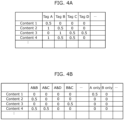
- FIG. 4A illustrates another example of the first scores stored according to the embodiment.
- FIG. 4A is similar to FIG. 3A , but differs from the example in FIG. 3A in that the numerical values of the first score are not binary values of "0" and "1".
- the first score may be expressed by multilevel evaluation values including three or more numerical values.
- the first score is expressed by "1" (an example of the first value), indicating that the preference tag has been assigned, a numerical value between "1" and "0.1” (an example of a third value), corresponding to the relevance between the broadcast content and the preference tag, and "0" (an example of the second value), indicating that the preference tag has not been assigned.
- the third value is not limited to the above “0.1”, but may be a number as far away from the first value as possible and as close to the second value as possible, such as "0.01" or "0.001".
- the numerical value of the first score matching any of the third values above means that the preference tag has been assigned.
- a value close to the first value or close to the third value, etc. is assigned based on the relevance between the broadcast content and the preference tag (e.g., the frequency of occurrence of a specific word, or the relationship of a specific word itself with the preference tag).
- the preference tag assigned by tag assignment device 150 may include information about the relevance.
- Evaluator 13 assigns a second score related to combined preference tags and single preference tags to the one item of broadcast content selected (second evaluation step S105). Evaluator 13 stores the assigned second score in the second preference information table in storage 15 (second storage step S106).
- FIG. 3B illustrates an example of second scores stored according to the embodiment.
- the first row indicates patterns of the combined preference tag (A&B, A&C, ...) and patterns of the single preference tag (A only, B only, 7)
- the first column indicates the identification numbers of the broadcast content (content 1, content 2, 7)
- the corresponding cell indicates the numerical value indicating whether or not the broadcast content includes the combined preference tag or the single preference tag.
- the second score is expressed by "1" (an example of the first value), indicating that the broadcast content includes the combined preference tag or the single preference tag, and "0" (an example of the second value) indicating that the broadcast content does not include the combined preference tag and the single preference tag.
- content 2 includes a combined preference tag of A & B (combination of tag A and tag B) and does not include combined preference tags of A & C, A & D and B & C.
- content 2 does not include single preference tags of A only and B only.
- evaluator 13 assigns "1" as the second score to the combined preference tag.
- evaluator 13 assigns "0" as the second score to each of single preference tags among a plurality of patterns of single preference tags.
- Each of the single preference tags is one of the two or more preference tags in the one pattern of combined preference tag assigned solely to the one item of broadcast content.
- content 1 includes the single preference tag of A only (does not include any other preference tags other than tag A only).
- content 1 does not include combined preference tags of A & B, A & C, and A & D.
- evaluator 13 assigns "0" as the second score to the combined preference tag, and assigns a numerical value as the second score to each of single preference tags among a plurality of patterns of single preference tags.
- Each of the single preference tags is one of the two or more preference tags in the one pattern of combined preference tag solely assigned to the one item of broadcast content.
- the numerical value is a value assigned as the first score to a corresponding preference tag.
- FIG. 4B illustrates another example of the second scores stored according to the embodiment.
- FIG. 4B is similar to FIG. 3B , but differs from the example in FIG. 3B in that each of the numerical values of the second score is not a binary value of "0" and "1".
- each second score may be a multilevel evaluation value including three or more numerical values.
- the second score is expressed by "1" (an example of the first value) indicating that the combined preference tag or the single preference tag has been assigned, a numerical value between "1" and "0.1” (an example of a third value) corresponding to the relevance between the broadcast content and the combined preference tag or the single preference tag, and "0" (an example of the second value) indicating that the combined preference tag and the single preference tag have not been assigned.
- evaluator 13 assigns, as the second score, a smallest numerical value among the numerical values of the first score to the one pattern of combined preference tag, and assigns the second value as the second score to each of single preference tags among the plurality of patterns of single preference tags.
- Each of the single preference tags is one of the two or more preference tags in the one pattern of combined preference tag solely assigned to the one item of broadcast content.
- evaluator 13 assigns the second value as the second score to the one pattern of combined preference tag, and assigns a numerical value as the second score to each of the single preference tags.
- the numerical value is a value assigned as the first score to a corresponding preference tag.
- Evaluator 13 determines whether all items of broadcast content in the viewing history has been selected (step S107). When evaluator 13 determines that all items of broadcast content has not been selected (No in step S107), evaluator 13 returns to step S102, selects another item of broadcast content, and repeats first evaluation step S103 to second storage step S106. When evaluator 13 determines that all items of broadcast content has been selected (Yes in step S107), evaluator 13 ends the processing. Outputter 17 then refers to the first preference information table and the second preference information table to output preference information that matches user preferences in a predetermined period.
- the preference information includes one or more preference tags among a plurality of preference tags, a plurality of patterns of combined preference tags, and a plurality of patterns of single preference tags (output step S108).
- FIG. 5 is a flowchart illustrating an example of a process for outputting preference information and presenting broadcast content according to the embodiment.
- FIG. 5 illustrates the process of outputting preference information performed by outputter 17 and the process of presenting broadcast content.
- the outputter calculates the sum of the first scores (step S201).
- Calculating the sum of the first scores is the process of calculating the sum of the first scores for each preference tag for all items of broadcast content in a predetermined period. Accordingly, for the predetermined period, the number of the sums calculated corresponds to the number of kinds of preference tags set in advance.
- Outputter 17 selects the preference tag with the largest sum (step S202).
- Outputter 17 also calculates the sum of the second scores of the broadcast content viewed within a predetermined period (step S203). Calculating the sum of the second scores is the process of calculating the sum of the second scores for each combined preference tag and each single preference tag for all items of broadcast content in the predetermined period. Accordingly, for the predetermined period, the number of sums calculated corresponds to the number of patterns of combined preference tags and the number of patterns of single preference tags set in advance. Outputter 17 then selects the combined preference tag or the single preference tag with the largest sum (step S204).
- Outputter 17 determines whether the selected tag in step S204 is the single preference tag among the combined preference tag and the single preference tag (step S205). When outputter 17 determines that the single preference tag was not selected (in other words, the combined preference tag was selected) (No in step S205), outputter 17 further determines whether the preference tag corresponds to the combined preference tag (step S206). Here, outputter 17 determines whether the preference tag selected in step S202 is included in the preference tags in the combined preference tag selected in step S204.
- outputter 17 determines that the preference tag does not correspond to the combined preference tag (No in step S206).
- outputter 17 outputs preference information including the selected preference tag and the selected combined preference tag (step S207).
- outputter 17 determines that the preference tag corresponds to the combined preference tag (Yes in step S206).
- outputter 17 determines whether the single preference tag was selected (Yes in step S205)
- outputter 17 further determines whether the preference tag corresponds to the single preference tag (step S209).
- outputter 17 determines whether the preference tag corresponding to the single preference tag selected in step S204 matches the preference tag selected in step S202.
- outputter 17 determines that the preference tag does not correspond to the single preference tag (No in step S209), outputter 17 outputs preference information including the selected preference tag and the selected single preference tag (step S210). On the other hand, when outputter 17 determines that the preference tag corresponds to the single preference tag (Yes in step S209), outputter 17 outputs preference information including the selected combined preference tag (step S211).
- Presentation device 400 then presents the broadcast content based on the output preference information (step S212). Specifically, when a preference tag is included in the output preference information, matching device 300 first selects the broadcast content with the preference tag assigned from among the broadcast content stored in content storage device 200. Matching device 300 then further selects the broadcast content with the combined preference tag or single preference tag, from among the selected broadcast content, and outputs the selection information related to the selection to presentation device 400. Based on the selection information, presentation device 400 reads the broadcast content from content storage device 200, performs decoding and the like on the read broadcast content, and displays the broadcast content on the display of television receiver 3 or the like. Moreover, when the output preference information does not include any preference tags, matching device 300 selects the broadcast content with a combined preference tag or single preference tag from among the broadcast content stored in content storage device 200, and outputs selection information related to the selection to presentation device 400.
- preference tags are preferentially used to select broadcast content over the combined preference tags and single preference tags.
- the combined preference tags and single preference tags may be preferentially used to select the broadcast content over the preference tags.
- information processing device 100 is realized as a single device, but may be realized by a plurality of devices.
- the structural elements included in information processing device 100 may be distributed to the devices in any manner.
- the present disclosure may be realized by cloud computing, or by edge computing.
- all or part of the structural elements included in information processing device 100 may be configured by a dedicated hardware, or may be realized by executing a software program suitable for each structural element.
- each structural element may be realized by a central processing unit (CPU) or a program execution unit such as a processor reading the software program recorded on a recording medium such as a hard disk drive (HDD) or semiconductor memory and executing the software program.
- CPU central processing unit
- HDD hard disk drive
- the structural elements included in information processing device 100 may be formed by a single electronic circuit or a plurality of electronic circuits.
- the single electronic circuit or each of the plurality of electronic circuits may be a general-purpose circuit or a dedicated circuit.
- the single electronic circuit or the plurality of electronic circuits may include, for example, a semiconductor device, an integrated circuit (IC), or a large scale integration (LSI).
- the IC or LSI may be integrated into a single chip or a plurality of chips.
- the name used here is IC or LSI, but it may also be called system LSI, very large scale integration (VLSI), or ultra large scale integration (ULSI) depending on the degree of integration.
- VLSI very large scale integration
- ULSI ultra large scale integration
- a field programmable gate array (FPGA) that can be programmed after manufacturing an LSI can be used for the same purpose.
- the general or specific aspects of the present disclosure may be realized by a system, a device, a method, an integrated circuit, or a computer program.
- the general or specific aspects may be realized by a computer-readable non-transitory recording medium such as an optical disk, HDD, or semiconductor memory in which the computer program is stored.
- the present disclosure may be realized as a program for causing a computer to execute the control method according to the embodiment.
- the program may be recorded in a non-transitory recording medium such as a computer-readable CD-ROM, or be distributed via a communication path such as the Internet.
- information processing device 100 includes: obtainer 11 that obtains a viewing history of one or more items of broadcast content viewed by a user in a past predetermined period; a first evaluator (one of the functions of evaluator 13) that assigns a first score related to a preference tag assigned to each of a plurality of items of broadcast content among a plurality of preference tags of different kinds corresponding to a plurality of preferences of different kinds of a viewer; a second evaluator (one of the functions of evaluator 13) that assigns a second score related to a combined preference tag or a single preference tag corresponding to each of the plurality of items of broadcast content among a plurality of combined preference tags of different patterns and a plurality of single preference tags of different patterns, each of the plurality of combined preference tags being a combination of two or more of the plurality of preference tags, each of the plurality of single preference tags being one of the plurality of preference tags solely assigned to the broadcast content; a first evaluator (one of the functions of e
- information processing device 100 is capable of estimating user preferences in a more detailed manner than before. Accordingly, it is possible to reflect user preferences, for example, in the selection of broadcast content with higher precision.
- information processing device 100 is information processing device 100 according to the first aspect in which, for one item of broadcast content, the first evaluator (evaluator 13) assigns a first value as the first score to a preference tag assigned to the one item of broadcast content among the plurality of preference tags, and the first evaluator assigns a second value different from the first value as the first score to a preference tag that is not assigned to the one item of broadcast content among the plurality of preference tags.
- the preference tags assigned to one item of broadcast content can be quantified according to which of the first value or the second value is assigned, and user preference information can be generated in view of the presence or absence of the preference tags.
- information processing device 100 is information processing device 100 according to the second aspect in which, for the one item of broadcast content, when each of numerical values of the first score assigned to two or more preference tags in one pattern of combined preference tag among the plurality of combined preference tags is the first value, the second evaluator (evaluator 13) assigns the first value as the second score to the one pattern of combined preference tag, and assigns the second value as the second score to each of single preference tags among the plurality of single preference tags, each of the single preference tags being one of the two or more preference tags in the one pattern of combined preference tag solely assigned to the one item of broadcast content, and when at least one of the numerical values of the first score of the two or more preference tags in the one pattern of combined preference tag assigned to the one item of broadcast content is the second value, the second evaluator (evaluator 13) assigns the second value as the second score to the one pattern of combined preference tag, and assigns a numerical value as the second score to each of the single preference tags,
- the combined preference tags and single preference tags assigned to one item of broadcast content can be quantified according to which of the first value or the second value is assigned, and the quantified information can be used for generating user preference information.
- information processing device 100 is information processing device 100 according to the first aspect in which, for one item of broadcast content, the first evaluator (evaluator 13) assigns, as the first score, a numerical value between a first value and a third value to a preference tag assigned to the one item of broadcast content among the plurality of preference tags, the third value being different from the first value, the numerical value corresponding to a relevance between the one item of broadcast content and the preference tag, and the first evaluator (evaluator 13) assigns a second value as the first score to a preference tag that is not assigned to the one item of broadcast content among the plurality of preference tags, the second value being a numerical value that is not between the first value and the third value.
- the preference tags assigned to one item of broadcast content can be quantified according to which one of the first value, the third value, or the second value is assigned, and how much the preference tags are related to the broadcast content can be included in the numerical values.
- information processing device 100 is information processing device 100 according to the fourth aspect in which, for the one item of broadcast content, when each of numerical values of the first score assigned to two or more preference tags in one pattern of combined preference tag among the plurality of combined preference tags is not the second value, the second evaluator (evaluator 13) assigns, as the second score, a smallest numerical value among the numerical values of the first score to the one pattern of combined preference tag, and assigns the second value as the second score to each of single preference tags among the plurality of single preference tags, each of the single preference tags being one of the two or more preference tags in the one pattern of combined preference tag solely assigned to the one item of broadcast content, and when at least one of the numerical values of the first score of the two or more preference tags in the one pattern of combined preference tag assigned to the one item of broadcast content is the second value, the second evaluator (evaluator 13) assigns the second value as the second score to the one pattern of combined preference tag, and assigns a
- the combined preference tags or the single preference tags assigned to one item of broadcast content can be quantified according to which one of the first value, the third value, or the second value is assigned, and how much the combined preference tags or single preference tags are related to the broadcast content can be included in the numerical values.
- information processing device 100 is information processing device 100 according to any one of the first aspect to the fifth aspect in which outputter 17: calculates, for each of the plurality of preference tags stored in the first preference information table, a sum of the first scores of the one or more items of broadcast content included in the viewing history obtained; calculates, for each of the plurality of combined preference tags and the plurality of single preference tags stored in the second preference information table, a sum of the second scores of the one or more items of broadcast content included in the viewing history obtained; and outputs, based on the sum of the first scores calculated and the sum of the second scores calculated, the preference information including one or more preference tags among (i) the plurality of preference tags, (ii) the plurality of combined preference tags, and (iii) the plurality of single preference tags.
- an information processing method includes: obtaining a viewing history of one or more items of broadcast content viewed by a user in a past predetermined period; assigning (S103) a first score related to a preference tag assigned to each of a plurality of items of broadcast content among a plurality of preference tags of different kinds corresponding to a plurality of preferences of different kinds of a viewer; assigning (S105) a second score related to a combined preference tag or a single preference tag corresponding to each of the plurality of items of broadcast content among a plurality of combined preference tags of different patterns and a plurality of single preference tags of different patterns, each of the plurality of combined preference tags being a combination of two or more of the plurality of preference tags, each of the plurality of single preference tags being one of the plurality of preference tags solely assigned to the broadcast content; storing (S104) the first score calculated for each of the one or more items of broadcast content included in the viewing history obtained; storing (S106) the second score calculated for each
- a program according to an eight aspect of the embodiment causes one or more processors to execute the information processing method according to the seventh aspect.
- an information processing system includes: information processing device 100 according to any one of the first to sixth aspects described above; matching device 300 that selects one or more items of broadcast content to be presented to the user, based on the preference information outputted; evaluation level calculator 19 that calculates an evaluation level that is based on each of the one or more items of broadcast content selected and the preference information; and graphic generator 21 that generates an image including, along with the one or more items of broadcast content selected, information about details of each of the one or more items of broadcast content, the evaluation level calculated for the broadcast content, and tag information that matches the preference information of the user, the tag information including one or more tags among (i) the plurality of preference tags, (ii) the plurality of combined preference tags, and (iii) the plurality of single preference tags.
- Such an information processing system is capable of presenting broadcast content that matches the preference information output by information processing device 100.
- the information processing system is capable of generating and presenting an image.
- the image includes, along with the broadcast content, information about the details of the broadcast content, the evaluation levels calculated for the broadcast content, and tag information that matches with user preference information.
- the tag information includes at least one or more tags among (i) a plurality of kinds of preference tags, (ii) a plurality of patterns of combined preference tags, and (iii) a plurality of patterns of single preference tags assigned to the broadcast information.
- the user is capable of recognizing, at a glance, the information, i.e., how the broadcast content being presented was selected.
- the present disclosure is applicable to, for example, a system for estimating user preferences based on the viewing history of broadcast content viewed by a user.
Landscapes
- Engineering & Computer Science (AREA)
- Multimedia (AREA)
- Databases & Information Systems (AREA)
- Signal Processing (AREA)
- Health & Medical Sciences (AREA)
- General Health & Medical Sciences (AREA)
- Social Psychology (AREA)
- Computer Networks & Wireless Communication (AREA)
- Theoretical Computer Science (AREA)
- Human Computer Interaction (AREA)
- Strategic Management (AREA)
- Finance (AREA)
- Software Systems (AREA)
- Library & Information Science (AREA)
- Data Mining & Analysis (AREA)
- Physics & Mathematics (AREA)
- General Engineering & Computer Science (AREA)
- General Physics & Mathematics (AREA)
- Business, Economics & Management (AREA)
- Two-Way Televisions, Distribution Of Moving Picture Or The Like (AREA)
- Information Retrieval, Db Structures And Fs Structures Therefor (AREA)
Applications Claiming Priority (2)
| Application Number | Priority Date | Filing Date | Title |
|---|---|---|---|
| JP2021154872 | 2021-09-22 | ||
| PCT/JP2022/033506 WO2023047952A1 (ja) | 2021-09-22 | 2022-09-07 | 情報処理装置、情報処理方法、プログラム、及び情報処理システム |
Publications (2)
| Publication Number | Publication Date |
|---|---|
| EP4408000A4 EP4408000A4 (de) | 2024-07-31 |
| EP4408000A1 true EP4408000A1 (de) | 2024-07-31 |
Family
ID=85720567
Family Applications (1)
| Application Number | Title | Priority Date | Filing Date |
|---|---|---|---|
| EP22872708.7A Pending EP4408000A1 (de) | 2021-09-22 | 2022-09-07 | Informationsverarbeitungsvorrichtung, informationsverarbeitungsverfahren, programm und informationsverarbeitungssystem |
Country Status (4)
| Country | Link |
|---|---|
| US (1) | US20240388765A1 (de) |
| EP (1) | EP4408000A1 (de) |
| JP (1) | JP7546226B2 (de) |
| WO (1) | WO2023047952A1 (de) |
Family Cites Families (14)
| Publication number | Priority date | Publication date | Assignee | Title |
|---|---|---|---|---|
| US6851090B1 (en) * | 2000-10-30 | 2005-02-01 | Koninklijke Philips Electronics N.V. | Method and apparatus for displaying program recommendations with indication of strength of contribution of significant attributes |
| JP4396446B2 (ja) | 2004-08-20 | 2010-01-13 | ソニー株式会社 | 情報処理装置および方法、並びにプログラム |
| US20110041157A1 (en) * | 2009-08-13 | 2011-02-17 | Tandberg Television Inc. | Systems and Methods for Selecting Content For a Subscriber of a Content Service Provider |
| JP2012070175A (ja) * | 2010-09-22 | 2012-04-05 | Toshiba Corp | コンテンツ推薦装置 |
| WO2013121470A1 (ja) * | 2012-02-15 | 2013-08-22 | パナソニック株式会社 | コンテンツ提示装置、端末、システム、プログラム、および、方法 |
| JP2013229724A (ja) * | 2012-04-25 | 2013-11-07 | Sony Corp | 情報処理装置、情報処理方法、コンピュータプログラム、端末および情報処理システム |
| JP6202791B2 (ja) * | 2012-08-30 | 2017-09-27 | 株式会社東芝 | 嗜好番組データ管理装置及び方法及びテレビジョン受信装置 |
| JP5945982B2 (ja) * | 2014-04-07 | 2016-07-05 | Necパーソナルコンピュータ株式会社 | 情報処理装置、情報処理方法、及びプログラム |
| US9986299B2 (en) * | 2014-09-22 | 2018-05-29 | DISH Technologies L.L.C. | Scheduled programming recommendation system |
| JP2016118813A (ja) * | 2014-12-18 | 2016-06-30 | 三星電子株式会社Samsung Electronics Co.,Ltd. | コンテンツ再生装置 |
| JP6504695B2 (ja) * | 2015-01-21 | 2019-04-24 | 株式会社ナイルワークス | 動画配信システム |
| US10191990B2 (en) * | 2016-11-21 | 2019-01-29 | Comcast Cable Communications, Llc | Content recommendation system with weighted metadata annotations |
| JP6568665B2 (ja) * | 2019-01-11 | 2019-08-28 | 楽天株式会社 | サーバ及びその制御方法、並びにコンピュータプログラム |
| US10863242B1 (en) * | 2019-05-28 | 2020-12-08 | Rovi Guides, Inc. | Systems and methods for generating a playback timeline |
-
2022
- 2022-09-07 WO PCT/JP2022/033506 patent/WO2023047952A1/ja not_active Ceased
- 2022-09-07 US US18/693,081 patent/US20240388765A1/en active Pending
- 2022-09-07 JP JP2023549460A patent/JP7546226B2/ja active Active
- 2022-09-07 EP EP22872708.7A patent/EP4408000A1/de active Pending
Also Published As
| Publication number | Publication date |
|---|---|
| WO2023047952A1 (ja) | 2023-03-30 |
| JP7546226B2 (ja) | 2024-09-06 |
| US20240388765A1 (en) | 2024-11-21 |
| JPWO2023047952A1 (de) | 2023-03-30 |
| EP4408000A4 (de) | 2024-07-31 |
Similar Documents
| Publication | Publication Date | Title |
|---|---|---|
| CN106649848B (zh) | 视频推荐方法及装置 | |
| CN106326391B (zh) | 多媒体资源推荐方法及装置 | |
| US8868692B1 (en) | Device configuration based content selection | |
| CN109753601B (zh) | 推荐信息点击率确定方法、装置及电子设备 | |
| US20140123179A1 (en) | Zoomable content recommendation system | |
| US20120136814A1 (en) | Music recommendation method and apparatus | |
| CN106294830A (zh) | 多媒体资源的推荐方法及装置 | |
| CN112487300B (zh) | 一种视频推荐方法、装置、电子设备及存储介质 | |
| CN112182281B (zh) | 一种音频推荐方法、装置及存储介质 | |
| CN111107416A (zh) | 一种弹幕屏蔽方法、装置及电子设备 | |
| US11589131B1 (en) | Techniques for moderating state changes of live event streams | |
| CN110019948B (zh) | 用于输出信息的方法和装置 | |
| CN109255073B (zh) | 一种个性化推荐方法、装置及电子设备 | |
| Assi et al. | Llm-cure: Llm-based competitor user review analysis for feature enhancement | |
| US20110161838A1 (en) | Virtual space providing apparatus and method | |
| CN117171406A (zh) | 应用程序功能的推荐方法、装置、设备和存储介质 | |
| US20150006664A1 (en) | Information processor, information processing method, and computer program product | |
| CN111164591B (zh) | 内容推荐装置、内容推荐方法及内容推荐系统 | |
| EP4408000A1 (de) | Informationsverarbeitungsvorrichtung, informationsverarbeitungsverfahren, programm und informationsverarbeitungssystem | |
| WO2022163204A1 (ja) | 情報処理装置 | |
| US12432418B2 (en) | Information processing device, information processing method, and recording medium | |
| CN110569447B (zh) | 一种网络资源的推荐方法、装置及存储介质 | |
| US9355173B1 (en) | User keywords as list labels | |
| CN110555135B (zh) | 内容推荐方法、内容推荐装置和电子设备 | |
| CN118916477A (zh) | 推荐语生成方法、装置、电子设备和存储介质 |
Legal Events
| Date | Code | Title | Description |
|---|---|---|---|
| STAA | Information on the status of an ep patent application or granted ep patent |
Free format text: STATUS: THE INTERNATIONAL PUBLICATION HAS BEEN MADE |
|
| PUAI | Public reference made under article 153(3) epc to a published international application that has entered the european phase |
Free format text: ORIGINAL CODE: 0009012 |
|
| STAA | Information on the status of an ep patent application or granted ep patent |
Free format text: STATUS: REQUEST FOR EXAMINATION WAS MADE |
|
| 17P | Request for examination filed |
Effective date: 20240314 |
|
| A4 | Supplementary search report drawn up and despatched |
Effective date: 20240613 |
|
| AK | Designated contracting states |
Kind code of ref document: A1 Designated state(s): AL AT BE BG CH CY CZ DE DK EE ES FI FR GB GR HR HU IE IS IT LI LT LU LV MC MK MT NL NO PL PT RO RS SE SI SK SM TR |
|
| DAV | Request for validation of the european patent (deleted) | ||
| DAX | Request for extension of the european patent (deleted) |