EP4404243A1 - Substratherstellungsverfahren und sublimationstrocknungsverfahren - Google Patents
Substratherstellungsverfahren und sublimationstrocknungsverfahren Download PDFInfo
- Publication number
- EP4404243A1 EP4404243A1 EP22869883.3A EP22869883A EP4404243A1 EP 4404243 A1 EP4404243 A1 EP 4404243A1 EP 22869883 A EP22869883 A EP 22869883A EP 4404243 A1 EP4404243 A1 EP 4404243A1
- Authority
- EP
- European Patent Office
- Prior art keywords
- sublimable
- solvent
- film
- substrate
- film formation
- Prior art date
- Legal status (The legal status is an assumption and is not a legal conclusion. Google has not performed a legal analysis and makes no representation as to the accuracy of the status listed.)
- Withdrawn
Links
Images

Classifications
-
- H10P52/00—
-
- H10P70/20—
-
- F—MECHANICAL ENGINEERING; LIGHTING; HEATING; WEAPONS; BLASTING
- F26—DRYING
- F26B—DRYING SOLID MATERIALS OR OBJECTS BY REMOVING LIQUID THEREFROM
- F26B5/00—Drying solid materials or objects by processes not involving the application of heat
- F26B5/04—Drying solid materials or objects by processes not involving the application of heat by evaporation or sublimation of moisture under reduced pressure, e.g. in a vacuum
- F26B5/041—Drying solid materials or objects by processes not involving the application of heat by evaporation or sublimation of moisture under reduced pressure, e.g. in a vacuum for drying flowable materials, e.g. suspensions, bulk goods, in a continuous operation, e.g. with locks or other air tight arrangements for charging/discharging
Definitions
- the present invention relates to a method for producing a substrate and a sublimation drying method.
- the sublimation drying method is one of drying methods employed in a step of cleaning fine semiconductor structures, that is, patterns.
- the sublimation drying method is used to suppress pattern collapse by forming a film formed of a sublimable substance on a pattern formed on a substrate surface and removing the film by volatilization.
- Patent Document 1 describes a technique related to the sublimation drying method described above.
- Patent Document 1 describes a substrate drying method for drying a substrate by removing a liquid on the substrate on the surface of which an uneven pattern is formed, the method being provided with a sublimable substance filling step of supplying a sublimable substance solution to the substrate to fill the solution in recessed portions of the pattern, a solvent drying step of drying the solvent in the solution and filling the inside of the recessed portions of the pattern with the sublimable substance in a solid state, and a sublimable substance removal step of removing the sublimable substance from the substrate by heating the substrate to a temperature higher than the sublimation temperature of the sublimable substance (claim 1 of Patent Document 1).
- Patent Document 1 Japanese Unexamined Patent Publication No. 2012-243869
- the method for producing a substrate and the sublimation drying method below are provided.
- a method for producing a substrate that has excellent stability in suppressing pattern collapse during sublimation drying and a sublimation drying method is provided.
- the method for producing a substrate according to the present embodiment includes a preparation step of preparing a substrate that has an uneven structure on a surface, an arrangement step of arranging the substrate in a chamber with a cleaning liquid held in at least recessed portions of the uneven structure, a supply step of supplying a sublimable substance in a liquid state or supplying a sublimable film formation composition in a liquid state that includes a sublimable substance to at least the recessed portions of the substrate arranged in the chamber, and a sublimation drying step of coagulating, sublimating, and thereby removing a film formed of the sublimable substance or the sublimable film formation composition that has been supplied, in which, when the dew point temperature of the atmosphere inside the chamber at 1 atm is T dp °C and the minimum temperature of the surface of the film during a coagulation process is T min °C, the sublimation drying step is controlled such that T dp and T min satisfy T min > T dp .
- the minimum temperature on the film surface to be higher than the dew point temperature in the chamber, it is possible to suppress water absorption and dew condensation on the film surface, thereby making it possible to suppress coagulation defects in a sublimable film and, as a result, it is presumed that it will be possible for the sublimable film to stably exhibit the ability to suppress pattern collapse.
- the collapse rate which is an indicator for evaluating the collapse status of an uneven pattern can be calculated, for example, when the shape is a convex columnar shape that makes it easy to determine collapse from an overhead image, by observing a test piece with a pattern formed thereon using a scanning electron microscope (SEM), counting the collapsed convex portions (pattern collapse) in the uneven structure, and calculating the ratio (collapse rate) with respect to the number of convex shapes within the observed range. It may be said that it is possible to stably suppress pattern collapse in a case where a test result, in which the collapse rate obtained by observation of a SEM image is 30% or less, is obtained with a probability of 50% or more. In addition, the test result in which the collapse rate is 30% or less may be preferably obtained with a probability of 70% or more and more preferably 80% or more.
- each SEM image was measured at observation points separated by 1 mm or more from each other.
- the magnification of the SEM was adjusted such that 500 to 600 patterns were observed in each SEM image.
- An example of the method for producing a substrate according to the present embodiment includes a preparation step, an arrangement step, a supply step, and a sublimation drying step.
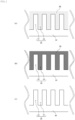
- a description will be given of the method for producing a substrate using Fig. 1(a) to (c) , taking the case of producing a semiconductor chip as an example.
- a fine uneven pattern is formed on the substrate (wafer) surface through film deposition, lithography, etching, and the like, then a wet treatment such as a cleaning step using water or organic solvents is performed to make the wafer surface clean, and a drying step is generally also performed to remove liquids such as cleaning liquids and rinsing liquids attached to the wafer by the wet treatment.
- a wet treatment such as a cleaning step using water or organic solvents is performed to make the wafer surface clean
- a drying step is generally also performed to remove liquids such as cleaning liquids and rinsing liquids attached to the wafer by the wet treatment.
- a step is performed in which a residual liquid such as a cleaning liquid remaining in the uneven pattern is replaced by a treatment liquid including the sublimable substance.
- a substrate 10 having an uneven structure 20 on the surface thereof is prepared (preparation step).
- the following method which is an example of a method for forming the uneven structure 20 on the surface of the substrate 10, may be used.
- the resist is exposed through a resist mask and the exposed resist or the unexposed resist is removed to produce a resist having a desired uneven pattern.
- the wafer is etched.
- the substrate surface corresponding to the recessed portions of the resist pattern is selectively etched.
- a wafer (substrate 10) having the uneven structure 20 on the surface is obtained.
- the wafer on which the uneven structure 20 is formed and the material of the uneven structure 20 are not particularly limited and, as a wafer, it is possible to use various types of wafers such as silicon wafers, silicon carbide wafers, wafers formed of a plurality of components including silicon elements, sapphire wafers, various compound semiconductor wafers, and plastic wafers.
- silicon-based materials such as silicon oxide, silicon nitride, polycrystalline silicon, and single-crystal silicon
- metal-based materials such as titanium nitride, tungsten, ruthenium, tantalum nitride, and tin, materials combining the above, resist (photoresist) materials, and the like.
- Fig. 1(a) is a cross-sectional view showing an example of the uneven structure 20.
- the cross-sectional structure (in the substrate thickness direction) of the pattern of the uneven structure 20 at least one pattern dimension of the width and height, or, in the three-dimensional structure (three-dimensional coordinates of XYZ) of the pattern of the uneven structure 20, at least one pattern dimension of the width (length in the X-axis direction), height (length in the Y-axis direction), and depth (length in the Z-axis direction) may be, for example, 30 nm or less, 20 nm or less, or 10 nm or less. It is possible to reduce the pattern collapse rate by using the sublimation drying method of the present embodiment even in a case of using the substrate 10 having the fine uneven structure 20 like this.
- the slope of the uneven structure 20 is parallel to (does not intersect with) the substrate thickness direction; however, it is possible to suitably use the drying composition of the present embodiment even in cases where the slope of the uneven structure 20 is not parallel to the substrate thickness direction.
- the "not parallel" cases described above mean that suitable use is also possible, for example, in cases in which, in the cross-sectional structure of Fig. 1 , the slope of the uneven structure 20 is perpendicular to the substrate thickness direction, cases in which the slope of the uneven structure 20 intersects (excluding perpendicularly) with the substrate thickness direction, or the like.
- the lower limit of the aspect ratio of a convex portion 22 may be, for example, 3 or more, 5 or more, or 10 or more. It is possible to suppress pattern collapse even in the uneven structure 20 having the convex portion 22 with a fragile structure.
- the upper limit of the aspect ratio of the convex portion 22 is not particularly limited, but may be 100 or less.
- the aspect ratio of the convex portion 22 is expressed as the value obtained by dividing the height of the convex portion 22 by the width of the convex portion 22.
- the substrate 10 is set in a state of being arranged in a chamber with a cleaning liquid held in at least recessed portions 24 of the uneven structure 20 (arrangement step).
- a method is used in which the substrate 10 is arranged in a chamber 1 of a processing apparatus 100 in Fig. 2 and a cleaning liquid is supplied to the recessed portions 24 of the substrate 10 inside the chamber 1.
- Fig. 2 is a cross-sectional view schematically showing the configuration of the processing apparatus 100 that processes the surface of the substrate 10.
- the processing apparatus 100 in Fig. 2 is provided with the chamber 1, a rotation mechanism 3, a table 2, a nozzle 4, a nozzle 5, a gas inlet 6, and a gas outlet 7.
- the substrate 10 is removably installed on the table 2.
- the table 2 is provided with a substrate holding mechanism such as a holding pin or a spin chuck (not shown). It is possible to rotate the table 2 around the thickness direction axis of the table 2 using the rotation mechanism 3.
- a cleaning liquid from the nozzle 4 to the surface of the substrate 10 installed on the table 2 and to supply a sublimable substance in a liquid state or a sublimable film formation composition in a liquid state from the nozzle 5.
- the arrangement positions and orientations of the nozzle 4 and the nozzle 5 are not particularly limited as long as it is possible to efficiently supply the liquid to the surface of the substrate 10.
- the sublimable substance since it is possible for the sublimable substance to be in a solid state, when the sublimable substance is cooled in a state of remaining at the nozzle tip or the like, the sublimable substance will coagulate and become a coagulated substance, and when the coagulated substance is unintentionally mixed into the surface of the substrate 10, there is a concern that this may influence the stability in suppressing pattern collapse. From this point of view, the temperature of the nozzle and the tip of the nozzle may be adjusted, or a shielding member or the like may be installed which is able to suppress residual sublimable substances in a liquid state, coagulated substances, and the like from mixing into the surface of the substrate 10.
- the substrate 10 may have one or more gas supply ports that supply gas directly to the surface of the substrate 10.
- the gas supply port may eject gas so as to collide with the surface of the substrate 10, or may eject gas along the surface of the substrate 10.
- the gas inlet 6 may also serve as a gas supply port.
- a temperature adjustment device capable of raising or lowering the temperature of the atmosphere or the substrate 10 in the chamber 1 may be installed in the chamber 1, along with sensors such as a surface thermometer or a dew point thermometer.
- the cleaning liquid water, an organic solvent, or the like is used and it is usually preferable to use at least one cleaning liquid selected from alcohols with 3 or fewer carbon atoms, such as methanol, 1-propanol, and 2-propanol. Due to this, it is possible to comparatively easily replace the cleaning liquid remaining on the uneven structure 20 of the substrate 10 with a sublimable substance in a liquid state or a sublimable film formation composition in a liquid state.
- a sublimable substance in a liquid state or a sublimable film formation composition in a liquid state 30 is supplied to at least the recessed portions 24 of the substrate 10 in the chamber 1 (supply step).
- the sublimable substance and the sublimable film formation composition 30 during the supply step are preferably liquid in an environment of 20°C to 30°C and more preferably a solution.
- the supply may be carried out to fill part or all of the recessed portions 24 of the uneven structure 20 (may be described as "a step of supplying the sublimable film formation composition", or simply “filling step” or “supply step”).
- the supply may be carried out, for example, in an environment of 20°C to 30°C.
- a single-wafer method represented by a spin method, in which, while holding and rotating wafers one by one almost horizontally, a composition is supplied near the center of rotation to replace a cleaning liquid or the like held in an uneven pattern on the substrate and fill the composition therein
- a batch method in which a plurality of wafers are immersed in a tank of the composition and a cleaning liquid or the like held in the uneven pattern of the wafer is replaced and the composition is filled therein, or the like may be used.
- the sublimable substance to be used may be purified in advance.
- a separation method using sublimation purification, filter purification, distillation, or the like is used.
- a film 50 formed from the supplied sublimable substance or sublimable film formation composition is coagulated in the chamber 1, and, as shown in Fig. 1(c) , the sublimable film formed by coagulating the film 50 is removed by sublimation (sublimation drying step).
- the film 50 formed of a sublimable substance or a sublimable film formation composition refers to both a coating film and a sublimable film. At this time, the film 50 has the same composition as the sublimable substance or the sublimable film formation composition 30 immediately after supply, however, the components from the sublimable substance or the sublimable film formation composition 30 may be volatilized such that the component ratio may become different from that of the original composition.
- the term "sublimable film” refers to a sublimable substance formed in the form of a film on the substrate 10. This sublimable film does not have fluidity like a liquid and may have a not volatile solvent or the like in the film.
- the sublimable substance in a liquid state or the sublimable film formation composition in a liquid state 30 is supplied onto the substrate 10 and spread into a film shape.
- a film in a liquid state is formed on the substrate 10.
- the liquid film is referred to as a "coating film.”
- a sublimable substance or a sublimable substance in the sublimable film formation composition in a liquid state 30 is coagulated and the film 50 including a coagulated substance of the sublimable substance is formed on the uneven structure 20 (may be referred to below as “step of forming a sublimable film” or simply “coagulation step” for the purpose of explanation). Due to this, it is possible to suppress the pattern collapse of the uneven structure 20 using the film 50 filled inside the recessed portions 24 of the uneven structure 20.
- the formed film 50 is preferably placed such that the surface of the film 50 covers at least the convex portion 22 of the uneven structure 20 in order to more stably suppress pattern collapse.
- the film 50 may be present in the recessed portions 24 to the extent that it is possible to suppress pattern collapse and may not necessarily completely fill the recessed portions 24.
- a solid sublimable substance may be precipitated by cooling, but, particularly in the case of the sublimable film formation composition 30, the solvent may be volatilized by heating or applying appropriate environmental conditions and the solid sublimable substance may be precipitated by the heat of vaporization.
- the sublimable film formation composition 30 preferably includes a sublimable substance and a solvent.
- a solvent included in the sublimable film formation composition 30, it is also possible to volatilize (dry) the solvent, for example, at room temperature and normal pressure (20°C to 25°C, 1 atm).
- the lower limit of the coagulation point of the sublimable substance is, for example, 5°C or higher, preferably 20°C or higher, and more preferably 50°C or higher under 1 atm.
- the volatilization of the solvent may be accelerated, as necessary, by, for example, a method for rotating the substrate 10, a method for blowing an inert gas onto the substrate 10, or the like.
- T dp the dew point temperature at 1 atm of the atmosphere in the chamber 1 in which the film 50 is arranged
- T min °C the minimum temperature of the surface of the film 50
- T dp and T min are controlled to satisfy T min > T dp .
- T min > T dp is preferably satisfied at least until the surface of the film 50 is coagulated, and T min > T dp may be satisfied until the coagulation of the film 50 is completed and a sublimable film is obtained, which is more preferable.
- the "coagulation process” may be a period during which the coagulation phenomenon of the film 50 is occurring (progressing). Alternatively, as will be described below, the “coagulation process” may refer to the period from the time when the surface temperature of the film 50 begins to decrease to the time when no increase in the surface temperature of the film 50 is observed.
- the "atmosphere" of the atmosphere that is in contact with the film 50 usually refers to the air, gas, or the like that comes into contact with the surface of the film 50 during the coagulation process, but when the surface of the film 50 is used as a reference, the “atmosphere” may refer to a fluid present up to a position separated from the reference by 10 mm to the outside of the film.
- the dew point temperature T dp is the dew point temperature of the atmosphere described above under 1 atm (atmospheric pressure) and is measurable using a dew point meter or the like.
- the dew point meter is able to evaluate whether T dp is an appropriate value, it is possible to use any known method and, specifically, possible examples thereof include a chilled mirror dew point meter or an electrostatic capacity type dew point meter.
- a method of measuring relative humidity or absolute humidity for conversion into the dew point temperature may be used. It is possible to use a known method to measure relative humidity or absolute humidity, and a specific example thereof is an electric hygrometer.
- the dew point temperature of the fluid at the time of supply may be regarded as the dew point temperature T dp of the atmosphere in the chamber 1.
- a known gas drying method is used as a method for adjusting the dew point temperature to be low and specific examples thereof include a treatment of supplying dry gas to the interior of the chamber 1 or replacing a gas in the interior of the chamber 1 with dry gas in a step before the supply step, a treatment of bringing a dry gas into contact with the surface of the film 50 during the coagulation process, a treatment of heating the substrate 10 during the coagulation process, and the like.
- the coagulation process of the film in the sublimation drying step may include one or two or more treatments selected from the group consisting of these treatments.
- the dry gas is preferably supplied not only to the region near the film 50 but also to the entire chamber in which the film 50 is installed, and more preferably fills the entire chamber. This makes it possible to stably maintain the environmental state near the film 50 during the coagulation process.
- the adjustment completion time is not limited, but may be until the coagulation is completed and the sublimable film is formed.
- the sublimation drying step may include a treatment of supplying dry gas to the interior of the chamber 1 and discharging the gas from the interior of the chamber 1, at least during the coagulation process of the film 50.
- the dew point temperature may continue to be adjusted to a low value.
- a treatment may be carried out in which the gas is blown toward the surface of the substrate 10 or the dry gas may be made to flow or blown to be parallel to the surface, or the inside of the chamber may be filled with dry gas.
- evacuation may also be performed at the same time and new dry gas may be continuously supplied.
- dry gas is supplied and the inside of the chamber 1 is evacuated at the same time and new dry gas is preferably constantly supplied into the chamber 1 at least until the coagulation of the film 50 is completed.
- the dry gas may be any gas that does not interfere with sublimation drying, for example, dry air, dry inert gas, or the like, with dry inert gas being particularly preferable, without being limited thereto.
- Specific examples of the gas type of the dry inert gas include rare gases such as nitrogen gas and argon gas.
- the surface temperature of the film 50 decreases after the sublimable substance or the sublimable film formation composition 30 is supplied to the substrate 10, and in a case where the substrate 10 is not heated after reaching the minimum temperature T min , the temperature increases to approximately the temperature of the atmosphere inside the chamber 1 and the temperature increasing stops.
- the surface temperature of the film 50 when the temperature increasing stops in this manner is set as T up .
- the rate at which the surface temperature decreases or increases is not particularly limited, but may proceed gradually and the rate does not need to be constant.
- T dp and T min are preferably controlled to satisfy, for example, T min -T dp ⁇ 10, preferably T min -T dp ⁇ 20, and more preferably T min -T dp ⁇ 30. Due to this, it is also possible to reduce variations in the ability to suppress collapse depending on the type of sublimable substance.
- T dp and T up may be controlled to satisfy, for example, T up > T dp , and preferably controlled to satisfy T up -T dp ⁇ 20 and more preferably T up -T dp ⁇ 30. Due to this, it is possible to further increase the stability in suppressing pattern collapse during sublimation drying.
- the dew point temperature T dp may be relatively lowered by increasing the temperature of the coating film and the sublimable film.
- examples thereof include heating the sublimable substance and the sublimable film formation composition to be supplied onto the substrate 10 in advance before use in the coating film forming step, heating the substrate 10 to be dried in advance, heating the substrate 10 to be dried and/or the composition in the coating film and/or sublimable film forming step, and the like.
- the sublimable film formed by coagulating the film 50 is sublimated and removed. That is, the solid sublimable substance is sublimated to remove the film 50 on the uneven structure 20 (for the purpose of explanation, this step may be referred to below as a "step of removing a sublimable film” or simply a “removal step”).
- the sublimable substance may be sublimated under normal temperature and normal pressure, but heating or depressurization may be used as necessary.
- the coagulation step and the removal step are described separately for ease of explanation, but do not need to be clearly separated and the coagulation of the film, and the removal of the sublimable film may occur continuously or occur in such a short time that separation is difficult.
- the production method shown in Fig. 1 has a wafer pattern as a target, but the present invention is not limited thereto.
- the method for producing a substrate according to the present embodiment is also able to suppress the collapse of the resist pattern by using the sublimable film formation composition of the present invention in the cleaning and drying steps thereof with the resist pattern as a target.
- the supply step described above may be carried out after various treatments carried out on the uneven structure 20.
- the supply step may be performed after a treatment with a chemical solution for forming a water-repellent protective film on the uneven structure 20.
- the method for producing a substrate may also use one or two or more known treatments in combination.
- a surface treatment such as a plasma treatment may be performed.
- the sublimation drying method includes a sublimation drying step in which a film formed of a sublimable substance or a sublimable film formation composition including a sublimable substance described below is coagulated and removed by sublimation, and, as described above, in the sublimation drying step, when the dew point temperature of the atmosphere in the vicinity of the film at 1 atm is T dp °C and the minimum temperature of the surface temperature of the film during the coagulation process is T min °C, T dp and T min are controlled to satisfy T min > T dp .
- the sublimable film formation composition includes one or two or more sublimable substances.
- the sublimable substance may be a substance in which the entire film disappears due to a predetermined heat treatment, or may be a substance that disappears when the film is left at 23°C under 1 atm.
- the sublimable film is not a permanent film that remains permanently on the substrate, but is used as a sacrificial film to be removed in subsequent steps. Accordingly, it is possible to use the sublimable film formation composition as a composition for forming a sublimable sacrificial film.
- the lower limit of the content of the sublimable substance is, for example, 0.1% by mass or more in the sublimable film formation composition, preferably 0.5% by mass or more, and more preferably 0.8% by mass or more. Due to this, in the sublimable film formation composition, there is a tendency for the sublimable substance to uniformly coagulate more easily.
- the upper limit of the content of the sublimable substance is, for example, 80% by mass or less in the sublimable film formation composition, preferably 50% by mass or less, and more preferably 40% by mass or less. Due to this, the cooling effect due to the heat of vaporization of the solvent is obtained more easily and there is a tendency for the coagulation of the sublimable substance to accelerate more easily, which is preferable. In addition, it is easier to keep the time required for sublimation (sublimation time) short, which is preferable.
- the sublimable film formation composition 30 does not contain water or contains water in an amount of 10% by mass or less with respect to 100% by mass of the sublimable substance. Due to this, it is possible to improve the ability of the sublimable film formation composition 30 to suppress pattern collapse.
- the sublimable substance has a polar moiety
- the mass ratio is less than 10 per 100 parts of the sublimable substance, it is possible to stably suppress pattern collapse even when the sublimable film formation composition includes moisture.
- the sublimable film formation composition in a case where the sublimable substance is non-polar, or a case where water is not a good solvent for the sublimable substance, it is desirable for the sublimable film formation composition to include as little moisture as possible. Although the specific mechanism is not clear, it is presumed that, when the sublimable substance is non-polar, the sublimable substance and water undergo phase separation such that it is no longer possible to stably suppress pattern collapse as a result. Although it is desirable for the sublimable film formation composition to include as little moisture as possible, the mass ratio of the moisture content may be less than 0.01 per 100 parts to the sublimable substance, for example.
- the first sublimable film formation composition (described below as the "sublimable film formation composition of the first embodiment") may include a solvent A1 having an appropriate ability to dissolve a sublimable substance and an appropriate volatility
- the second sublimable film formation composition (described below as the "sublimable film formation composition of the second embodiment”) may include a solvent A2 having an appropriate ability to dissolve a sublimable film and a solvent B2 having an appropriate volatility.
- sublimed substance refers to a substance having a vapor pressure in a solid state.
- the sublimable substance in principle, it is possible to use the sublimable substance as long as the substance is solid and has a vapor pressure at a specific temperature.
- the lower limit of the coagulation point of the sublimable substance is, for example, 5°C or higher under 1 atm, preferably 20°C or higher, and more preferably 50°C or higher. Due to this, in a case of being applied to the method for producing a substrate, it is unnecessary to treat the sublimable substance at an extremely low temperature for coagulation and the production stability of the semiconductor substrate is increased.
- the upper limit of the coagulation point of the sublimable substance is, for example, 220°C or lower under 1 atm, preferably 200°C or lower, and more preferably 180°C or lower. Due to this, in a case of being applied to the method for producing a substrate, it is unnecessary to treat the sublimable substance at an extremely high temperature for sublimation and the production stability of the semiconductor substrate is increased.
- the lower limit of the coagulation heat of the sublimable substance is not particularly limited, but may be, for example, 1 J/g or more, preferably 5 J/g or more, and more preferably 10 J/g or more.
- the upper limit of the coagulation heat of the sublimable substance is, for example, 200 J/g or less, preferably 100 J/g or less, and more preferably 50 J/g or less. Due to this, it is possible to suppress the occurrence of striated collapse.
- striated collapse refers to a state in which a pattern collapses continuously in a predetermined direction.
- a case where collapse occurs around a region where there is no pattern collapse may be referred to as a striated collapse.
- the sublimable substance may be formed such that not volatile substances becoming residues after sublimation are substantially not included. It is possible to remove not volatile substances from the sublimable substance by separation methods such as sublimation refining or distillation. Substantially not included means 1% by mass or less in 100% by mass of the sublimable substance, preferably 0.5% by mass or less, or that a case of unavoidable mixing in may be acceptable.
- the lower limit of the boiling point of the sublimable substance is, for example, 60°C or higher under 1 atm, preferably 100°C or higher, and more preferably 110°C or higher. Due to this, it is possible to stably form sublimable films including sublimable substances.
- the upper limit of the boiling point of the sublimable substance is, for example, 300°C or lower under 1 atm, preferably 280°C or lower, and more preferably 250°C or lower. Due to this, refining of the sublimable substance is easy. In addition, in a normal temperature and normal pressure process, the sublimation of the sublimable substance is easy and the production efficiency is increased.
- the boiling point or sublimation point of a sublimable substance including a plurality of substances As the boiling point or sublimation point of a sublimable substance including a plurality of substances, the boiling point or sublimation point of the component with the highest content ratio (% by mass) among the components included in the sublimable substance is adopted (however, in a case where there are two or more components with the highest content ratio, the boiling point or sublimation point which is the highest temperature is adopted).
- the sublimation point is typically used for a substance. In cases where the sublimation point is typically used for a substance, the sublimation point is used.
- the coagulation start temperature determined using DSC under a condition of -10°C/min is adopted.
- the coagulation point of a sublimable substance including a plurality of substances the coagulation point of the component with the highest content ratio (% by mass) among the components included in the sublimable substance is adopted (however, in a case where there are two or more components with the highest content ratio, the coagulation point which is the higher temperature is adopted).
- the temperature range at which the sublimable substance is solid and has a vapor pressure (also referred to below as “sublimation temperature range”) may, for example, be 10°C or higher. Due to this, even when used in an environment of 20°C to 25°C, which is a typical room temperature in a clean room, it is possible to coagulate the sublimable substance by cooling due to the heat of vaporization of the solvent in the sublimable film formation composition.
- sublimation acceleration treatments such as heating and depressurization are not necessary and it is possible to sublimate the sublimable substances comparatively easily and to remove the sublimable film while adopting the current conditions for the substrate production process as they are.
- the vapor pressure when defining the sublimation temperature range is, for example, 10 Pa or more and preferably 50 Pa or more.
- Sublimable substances are not limited as long as application is possible to substrate materials such as semiconductors, and examples thereof include non-halogenated sublimable substances S1 with a comparatively low coagulation heat, non-halogenated sublimable substances S2 with a comparatively high coagulation heat, sublimable substances S3 where the difference between the coagulation point and boiling point is comparatively small, halogen-containing sublimable substances S4 including halogen elements, and the like.
- the above may be used alone or in a combination of two or more.
- the coagulation heat of the non-halogenated sublimable substance S1 is preferably 50 J/g or less and more preferably 40 J/g or less.
- S1 the difference between the coagulation point and the boiling point tends to be comparatively large, thus, distillation and refining as a liquid are possible.
- the use of S1 makes it possible to suppress the occurrence of striated collapse.
- the coagulation heat of the non-halogenated sublimable substance S2 is preferably over 50 J/g.
- the difference between the coagulation point and the boiling point of the sublimable substance S3 is, for example, 50°C or less, preferably 40°C or less, and more preferably 30°C or less.
- halogen-containing sublimable substance S4 a fluorine-containing sublimable substance including a fluorine element as a halogen element may be used.
- the sublimable substances S1 to S3 are preferably used from the viewpoint of pattern collapse suppression.
- sublimable substances include norbornene, norbornane, camphor, pyrazine, 2,3-dichloropyrazine, 2,6-dichloropyrazine, 2,6-dichloropyridine, tetrahydrodicyclopentadiene, dimethyl oxalate, isoborneol, neopentyl alcohol, neopentyl glycol, ethylene carbonate, and the like.
- neopentyl alcohol, camphor, pyrazine, tetrahydrodicyclopentadiene, dimethyl oxalate, isoborneol, and ethylene carbonate may be used.
- the above may be used alone or used in a combination of two or more.
- optical isomers are present, one or both may be used.
- the sublimable film formation composition of the present embodiment preferably includes one or two or more solvents A in which the saturation solubility of the sublimable substance is more than 10% by mass.
- Solvent A is defined to encompass the solvent A1 and the solvent A2 described above.
- the solvent A having the ability to dissolve the sublimable substance when the sublimable film formation composition is supplied onto the substrate through a nozzle, it is possible to suppress the occurrence of coagulation of the sublimable substance at the tip of the nozzle.
- the saturation solubility is determined from the saturation concentration (% by mass) of the sublimable substance dissolved in the solvent.
- the saturation solubility the saturation concentration of the sublimable substance with the highest content ratio (% by mass) in the composition is adopted (however, in a case where two or more kinds of sublimable substance with the highest content are present, the largest saturation concentration value is adopted).
- the lower limit of the saturation solubility of the sublimable substance with respect to the solvent A is, for example, more than 10% by mass, preferably 30% by mass or more, more preferably 40% by mass or more, even more preferably 50% by mass or more, and yet more preferably 60% by mass or more. Due to this, it is possible to reduce the pattern collapse ratio.
- the upper limit of the saturation solubility of the sublimable substance with respect to the solvent A may be, for example, 99% by mass or less or 95% by mass or less.
- the sublimable film formation composition may use the solvent A compatible with respect to the residual liquid remaining on the substrate surface. Due to this, in the supply step, it is possible for the residual liquid to be efficiently replaced by the sublimable film formation composition and for a residual liquid drying treatment to be stably performed.
- examples of the residual liquid include common solvents used in the semiconductor cleaning step, specifically, water, alcohols with 3 or fewer carbon atoms (for example, methanol, 1-propanol, 2-propanol, and the like), mixtures thereof, and the like.
- Having compatibility means that the dissolved amount of the solvent used in the cleaning step with respect to 1 part by mass of the solvent A at 25°C and 1 atm is, for example, 0.05 parts by mass or more.
- composition including one or two or more of the solvent A1 for which the saturation solubility of the sublimable substance is more than 10% by mass and the boiling point is lower by 5°C or more than the boiling point of the sublimable substance at 1 atm will be referred to as the sublimable film formation composition of the first embodiment.
- the solvent A1 is selected from solvents A that satisfy a condition (1) that the boiling point thereof is lower by 5°C or more than the boiling point of the sublimable substance at 1 atm.
- the (boiling point of the sublimable substance at 1 atm - boiling point of the solvent A1) may be 5°C or more, preferably 50°C or more, and more preferably 80°C or more and may be 200°C or less and preferably 180°C or less.
- the azeotropic point is adopted in a case of an azeotropic solvent.
- the boiling point specified for each solvent is adopted individually.
- the highly soluble solvent A1 suppresses excessive early-stage precipitation of the sublimable substance and the solvent A1 which is more highly volatile than the sublimable substance is able to accelerate film formation (coagulation of the sublimable substance) of the sublimable film due to the heat of vaporization. Due to this, after forming and removing the sublimable film, it is also possible to reduce the pattern collapse rate and to suppress striated collapse.
- the sublimable film formation composition of the present embodiment may include one or two or more of the solvents B in which the boiling point is lower than the boiling point of the sublimable substance at 1 atm.
- the solvent B is defined to encompass the solvent B1 and the solvent B2 described above.
- the sublimable film formation composition of the first embodiment may include one or two or more of the solvent A1 described above and one or two or more of the solvent B1 in which the boiling point is lower than the boiling point of the solvent A1.
- the saturation solubility of the sublimable substance in the solvent B1 is not particularly limited and use is possible even when lower than the saturation solubility of the solvent A1.
- the difference between the boiling point of the solvent A1 and the boiling point of the solvent B1 is, for example, 5°C or more, preferably 10°C or more, and more preferably 15°C or more and may be 200°C or less or may be 150°C or less.
- the boiling point of the solvent B1 is, for example, 15°C to 85°C, preferably 20°C to 80°C, and more preferably 25°C to 70°C.
- the lower limit of the content of the solvent A1 is, for example, 0.5% by mass or more in the sublimable film formation composition, preferably 0.8% by mass or more, and more preferably 0.9% by mass or more.
- the content of the solvent A1 in the sublimable film formation composition may be 50% by mass or more, more preferably 80% by mass or more, and even more preferably 90% by mass or more.
- the solvent B1 is preferably used as the solvent. In such a case, the content of the solvent A1 in the sublimable film formation composition may be a value greater than the solvent B1.
- the upper limit of the content of the solvent A1 may be, for example, 99.9% by mass or less, preferably 99.5% by mass or less, and more preferably 99.2% by mass or less.
- the content of the solvent A1 in the sublimable film formation composition may be, for example, less than 50% by mass, preferably 30% by mass or less, and more preferably 15% by mass or less.
- the composition including one or two or more of the solvents A2, in which the saturation solubility of the sublimable substance is more than 10% by mass, and one or two or more of the solvent B2, in which the content in the sublimable film formation composition is greater than the content of the solvent A2 and the boiling point is lower than the boiling point of the sublimable substance at 1 atm and is lower than the boiling point of the solvent A2 will be referred to as the sublimable film formation composition of the second embodiment.
- the solvent A2 is selected from the solvents A described above.
- the boiling point of the sublimable substance at 1 atm - boiling point of the solvent A2 may be 0°C, may be 0°C or more and less than 5°C, or may be 5°C or more and 200°C or less.
- it may be that 0°C or more and 200°C or less is preferable and 5°C or more and 200°C or less is more preferable.
- the solvent B2 is a solvent capable of accelerating the film formation of the sublimable film by volatilizing before the solvent A2, and, as long as the boiling point is lower than the boiling point of the solvent A2 and the boiling point of the sublimable substance, the saturation solubility of the sublimable substance is not particularly limited and use is possible even when lower than the saturation solubility of the sublimable substance in solvent A2.
- the content of the solvent B2 in the sublimable film formation composition is greater than the content of the solvent A2.
- the solvent B2 may be included as the main component in the sublimable film formation composition.
- the main component means that the lower limit of the content of the solvent B2 in the sublimable film formation composition is, for example, 50% by mass or more, preferably 70% by mass or more, and more preferably 90% by mass or more.
- the upper limit of the content of the solvent B2 may be, for example, 99.8% by mass or less, 99.5% by mass or less, or 99% by mass or less.
- the content of the solvent A2 is, for example, 0.1% by mass to 30% by mass and preferably 0.5% by mass to 10% by mass.
- the formation of the sublimable film (the coagulation of the sublimable substance) is accelerated by the relative volatilization and the heat of vaporization of the solvent B2.
- the solvent A2 is able to dissolve the sublimable substance, thus, it is possible to suppress excessive early-stage precipitation of the sublimable substance. Due to this, after the sublimable film has been formed and removed, it is also possible to reduce the pattern collapse rate as well as to suppress striated collapse.
- Including the solvent B2 as a main component in the sublimable film formation composition of the second embodiment makes it possible to reduce the film forming time of the sublimable film and also to keep the production costs of the substrate described above low.
- the difference between the boiling point of the solvent A2 and the boiling point of the solvent B2 is not particularly limited, as long as the solvent A2 is able to remain after the solvent B2 has volatilized, and may be for example, 5°C or more, preferably 10°C or more, more preferably 15°C or more, and even more preferably more than 20°C and may be 200°C or less or 150°C or less.
- the upper limit of the boiling point of the solvent B2 is, for example, 85°C or lower, preferably 80°C or lower, and more preferably 70°C or lower.
- the lower limit of the boiling point of the solvent B2 may be, for example, 15°C or higher, preferably 20°C or higher, and more preferably 25°C or higher.
- the second and subsequent solvents A1 may be selected from solvents for which a saturation solubility of the sublimable substance with respect to the solvent A1 is 40% by mass or more and which have a boiling point of 200°C or lower and are preferably selected from solvents for which a saturation solubility of the sublimable substance is 75% by mass or more and which have a boiling point of 180°C or lower.
- the second and subsequent solvents A2 may be selected from solvents for which a saturation solubility of the sublimable substance with respect to the solvent A2 is 40% by mass or more and which have a boiling point which is the boiling point of the sublimable substance or lower, preferably selected from solvents for which a saturation solubility of the sublimable substance is 50% by mass or more and which have a boiling point of 210°C or lower, more preferably selected from solvents for which a saturation solubility of the sublimable substance is 60% by mass or more and which have a boiling point of 200°C or lower, and even more preferably selected from solvents for which a saturation solubility of the sublimable substance is 75% by mass or more and which have a boiling point of 180°C or lower.
- the boiling point difference described above is not particularly limited as long as it is possible to exhibit the effects as the solvent A2, but, for example, it may be that the difference between the highest boiling point and lowest boiling point of the two or more solvents A2 is preferably 20°C or less, more preferably 15°C or less, and even more preferably 10°C or less.
- the second and subsequent solvents A2 may have a difference in boiling point from the first solvent A1 of 10°C or less, 15°C or less, or 20°C or less, for example.
- the boiling point of the solvent B2 is lower than the lowest boiling point of the solvent A2.
- the second and subsequent solvents B2 may be selected from solvents having a boiling point of, for example, 83°C or lower, preferably 80°C or lower, and more preferably 70°C or lower.
- solvents used in the sublimable film formation composition include hydrocarbons, ethers, alcohols, ketones, esters, sulfoxides, nitrogen-containing compounds, and the like. Each of these solvent types may have one or more halogen atoms such as fluorine atoms and chlorine atoms in the molecule. The above may be used alone or in a combination of two or more.
- hydrocarbons for example, it is possible to use alkanes or cycloalkanes with 4 to 10 carbon atoms, alkenes or cycloalkenes with 4 to 10 carbon atoms, aromatic hydrocarbons with 6 to 10 carbon atoms, and the like.
- hydrocarbons include pentane, 3-methylpentane, hexane, heptane, octane, nonane, decane, isododecane, cyclopentane, cyclohexane, methylcyclohexane, 1,1-dichloroethane, 1,2-dichloroethane, 1,2-dichloroethylene, cis-1-chloro-3,3,3-trifluoropropene (1233Z), trans-1-chloro-3,3,3-trifluoropropene (1233E), toluene, benzene, xylene, and the like.
- ethers for example, it is possible to use chained or cyclic ether compounds with 3 to 10 carbon atoms.
- ethers include tetrahydrofuran, diethyl ether, dipropyl ether, diisopropyl ether, dibutyl ether, tert-butyl methyl ether, dioxane, 1,1,1,2,2,3,3,4,4-nonafluorobutyl methyl ether (Novec 7100), ethylene glycol monomethyl ether, ethylene glycol dimethyl ether, diethylene glycol dimethyl ether, propylene glycol monomethyl ether, propylene glycol dimethyl ether, and the like.
- alcohols for example, it is possible to use primary, secondary, and tertiary alcohols with 1 to 10 carbon atoms, and the like.
- alcohols include methanol, ethanol, 1-propanol, 2-propanol (IPA), 1-butanol, 2-butanol, cyclopentanol, cyclohexanol, 2-methyl-2-butanol, 4-methyl-2-pentanol, ethylene glycol, propylene glycol, 2,2,2-trifluoroethanol, 1,1,1,3,3,3-hexafluoro-2-propanol, 1,3-propanediol, and the like.
- IPA 1-propanol
- 2-butanol 2-butanol
- cyclopentanol cyclohexanol
- 2-methyl-2-butanol 4-methyl-2-pentanol
- ethylene glycol propylene glycol
- 2,2,2-trifluoroethanol 1,1,1,3,3,3-hexafluoro-2-propanol
- 1,3-propanediol 1,3-propanediol
- ketones for example, it is possible to use ketone compounds with 3 to 6 carbon atoms.
- ketones include acetone, acetylacetone, methyl ethyl ketone, methyl propyl ketone, methyl butyl ketone, and the like.
- esters include chained or cyclic ester compounds with 3 to 6 carbon atoms and the like.
- esters include methyl acetate, ethyl acetate, n-propyl acetate, isopropyl acetate, butyl acetate, methyl lactate, ethyl lactate, ethyl acetoacetate, ethyl trifluoroacetate, ⁇ -butyrolactone, ethylene glycol acetate, propylene glycol acetate, ethylene glycol monomethyl ether acetate, propylene glycol monomethyl ether acetate, and the like.
- sulfoxides examples include dimethyl sulfoxide and the like.
- nitrogen-containing compounds examples include formamide, N,N-dimethylformamide, N,N-dimethylacetamide, N-methyl-2-pyrrolidone, pyridine, and the like.
- the solvent A1, the solvent A2, the solvent B1, and the solvent B2, respectively it is possible to select one or two or more of the solvents described above according to the sublimable substance included in the sublimable film formation composition.
- the solvent A1 and the solvent A2 it is particularly preferable to include at least one selected from the group consisting of ethers, alcohols, ketones, esters, and hydrocarbons having one or more halogen atoms such as fluorine atoms and chlorine atoms in the molecule.
- Possible specific examples thereof include tetrahydrofuran, methanol, ethanol, 1-propanol, 2-propanol, 1-butanol, 2-butanol, 2-methyl-2-butanol, acetone, methyl acetate, ethyl acetate, 1,1-dichloroethane, 1,2-dichloroethane, 1,2-dichloroethylene, cis-1-chloro-3,3,3-trifluoropropene, trans-1-chloro-3,3,3-trifluoropropene, and the like.
- more preferable examples thereof include methanol, ethanol, 1-propanol, 2-propanol, 2-butanol, 2-methyl-2-butanol, acetone, methyl acetate, cis-1-chloro-3,3,3-trifluoropropene, trans-1-chloro-3,3,3-trifluoropropene, and the like.
- an alcohol with 3 or fewer carbon atoms, or the like, which are often used as the residual liquid remaining on the substrate surface, as the solvents B1 and B2 it is preferable to include at least one selected from the group consisting of hydrocarbons, ethers, alcohols, ketones, and esters.
- Possible specific examples thereof include pentane, 3-methylpentane, hexane, heptane, cyclopentane, cyclohexane, methylcyclohexane, 1,1-dichloroethane, 1,2-dichloroethane, 1,2-dichloroethylene, cis-1-chloro-3,3,3-trifluoropropene, trans-1-chloro-3,3,3-trifluoropropene, toluene, benzene, xylene, diethyl ether, dipropyl ether, diisopropyl ether, tetrahydrofuran, methanol, ethanol, 1-propanol, 2-propanol, 1-butanol, 2-butanol, acetone, methyl acetate, ethyl acetate, and the like.
- more preferable examples thereof include pentane, hexane, cyclopentane, cyclohexane, methylcyclohexane, cis-1-chloro-3,3,3-trifluoropropene, trans-1-chloro-3,3,3-trifluoropropene, diethyl ether, tetrahydrofuran, methanol, ethanol, 1-propanol, 2-propanol, acetone, methyl acetate, and the like.
- the sublimable film formation composition may also include a solvent C for a purpose such as adjusting the wettability to the substrate and/or the uneven pattern, in a range in which the effect of the present invention is not impaired, or the sublimable film formation composition may be formed to substantially not include the solvent C.
- solvent C examples include water, hydrocarbons, esters, ethers, ketones, sulfoxide solvents, alcohols, derivatives of polyhydric alcohols, nitrogen-containing compounds, and the like, and solvents which do not fall under the solvents described above.
- hydrocarbons described above are toluene, benzene, xylene, pentane, 3-methylpentane, hexane, heptane, octane, nonane, decane, cyclopentane, cyclohexane, methylcyclohexane, 1,1-dichloroethane, 1,2-dichloroethane, 1,2-dichloroethylene, cis-1-chloro-3,3,3-trifluoropropene (1233Z), trans-1-chloro-3,3,3-trifluoropropene (1233E), and the like
- examples of the esters described above are ethyl acetate, butyl acetate, methyl acetate, n-propyl acetate, isopropyl acetate, butyl acetate, methyl lactate, ethyl lactate, ethyl acetoacetate, ethyl trifluor
- the suitable lower limit of the total content of solvents in the sublimable film formation composition is, for example, 20% by mass or more, preferably 50% by mass or more, and even more preferably 60% by mass or more. Due to this, the cooling effect due to the heat of vaporization of the solvent is obtained more easily and there is a tendency for the coagulation of the sublimable substance to proceed more easily, which is preferable.
- the suitable upper limit of the total content of solvent in the sublimable film formation composition is, for example, 99.9% by mass or less, preferably 99.5% by mass or less and even more preferably 99.2% by mass or less. Due to this, there is a tendency for the sublimable substance to uniformly coagulate more easily on the substrate, which is preferable.
- the sublimable film formation composition is in a liquid state, preferably a solution, at least when supplied to the substrate surface.
- the sublimable film formation composition being liquid (preferably a solution) at -15°C to 50°C is preferable and being liquid (preferably a solution) at 0°C to 50°C is more preferable.
- the sublimable film formation composition being liquid (preferably a solution) at 20°C to 50°C such that no heat retention or heating is necessary for the liquid transfer mechanism for carrying out the supply to the storage container and the nozzles 4 and 5 is particularly preferable.
- the sublimable film formation composition may be liquid (preferably a solution) at -15°C to 50°C and is more preferably liquid (preferably a solution) at 0°C to 40°C.
- liquid (preferably a solution) at 20°C to 30°C such that no heat retention or heating is necessary for the liquid transfer mechanism or storage container is particularly preferable.
- a silicon substrate in which an uneven structure having a plurality of approximately columnar convex portions with an aspect ratio of 22 in a cross-sectional view and a pattern width of 19 nm with a pitch of 90 nm (total distance of the width of the convex portion and the interval of the adjacent convex portions) was formed on a surface was cut out to dimensions of 1 cm ⁇ 1.5 cm to prepare a substrate for evaluation (preparation step).
- the spin bowl of the spin coater was covered with a polyethylene glove bag having a gas inlet and outlet.
- the glove bag is formed such that it is possible to control the atmosphere in the interior of the glove bag.
- the substrate for evaluation was placed in the spin coater in the glove bag and 2-propanol was supplied thereto such that the liquid (2-propanol) was in a state of being held in the recessed portions in the uneven structure (arrangement step).
- the pressure inside the glove bag was made equal to atmospheric pressure (approximately 1 atm).
- the atmosphere inside the glove bag was adjusted to the conditions of any one of the following atmospheres A, B, and C.
- the relative humidity of the gas supplied into the glove bag was measured and converted into the dew point temperature. Specifically, using the temperature-water saturated vapor pressure correspondence table shown in JIS Z 8806:2001, first, the relative humidity of the gas supplied into the glove bag was converted into water vapor pressure, then the temperature at which the water vapor pressure reached the saturated vapor pressure was set as the dew point temperature of the gas supplied into the glove bag.
- Nitrogen gas (dew point temperature -20°C) supplied from a pressure swing adsorption type nitrogen gas supply device was supplied to the interior of the glove bag from the gas inlet under conditions of a flow rate of 20 L/min for approximately 30 to 60 minutes.
- the dew point temperature inside the glove bag was made equal to that of the supplied nitrogen gas.
- the substrate for evaluation was rotated at a rotation speed of 100 revolutions per minute using the spin coater and, after 5 to 10 seconds of rotation, the sublimable film formation composition described below was dropped at 23°C in a solution state onto the surface of the uneven structure while maintaining the rotation speed and the residual liquid of 2-propanol described above was replaced with the sublimable film formation composition (supply step).
- any one of the sublimable film formation compositions 1 to 4 below was used as the sublimable film formation composition.
- Saturation solubility signifies the saturation concentration of the sublimable substance dissolved in the solvent and was measured as follows.
- a mixture was prepared by mixing a sublimable substance and solvent at a mass ratio of approximately 3:1, heating to 40°C once, and cooling to room temperature (approximately 25°C).
- 10 ⁇ L of the liquid part was collected with a micro syringe, diluted 100 times (volume ratio) with a dilution solvent, and then analyzed by gas chromatography and converted to a mass ratio to determine the saturation solubility (% by mass).
- the same operation was performed by increasing the amount of sublimable substance with respect to the solvent.
- the same operation was performed by increasing the amount of solvent with respect to the sublimable substance.
- the calculation of the mass ratio based on gas chromatography was performed using a Shimadzu Corporation model GC-2010 gas chromatograph with a capillary column (model TC-1, manufactured by G.L. Sciences Inc., length 30 m, liquid phase thickness 5 ⁇ m, inner diameter 0.32 mm) attached thereto and an area ratio detected by an FID detector was converted to a mass ratio based on an area ratio of a diluent solution dissolving the sublimable substance and solvent at 1% by mass each.
- the dilution solvent used in the gas chromatography prefferably be selected from solvents for which a sufficiently separated peak is obtained by gas chromatography from the sublimable substance and the solvent which is the measurement target, specifically, a solvent that is 0.1 minutes or more apart in the development time on the chromatogram was selected.
- the temperature of the surface of the coating film and sublimable film was measured under atmospheric pressure (approximately 1 atm) using a non-contact radiation thermometer (Mother Tool Co., Ltd., MT-11).
- a non-contact radiation thermometer Mother Tool Co., Ltd., MT-11.
- the surface temperature of the film formed of the sublimable film formation composition 1 began to decrease from the start of volatilization of the solvent and, after decreasing to a minimum of approximately 12°C (the minimum temperature T min ), gradually rose as the sublimable substance coagulated such that the final surface temperature of the sublimable film reached approximately 20°C (final temperature T up ).
- the obtained substrate was observed using a scanning electron microscope (SEM) (SU8010, manufactured by Hitachi High-Tech Corporation) and the ratio (pattern collapse rate) of convex portion collapse (pattern collapse) in the uneven structure was evaluated.
- SEM scanning electron microscope
- the "pattern collapse rate” was calculated by taking an electron microscope image (secondary electron image) using an SEM at a magnification with 500 to 600 convex portions in the field of view, counting the number of convex portions in the obtained image where a collapse occurred, and calculating the ratio of the convex portions in the field of view as a percentage.
- multiple electron microscope images were taken while changing the shooting location of the substrate for evaluation and the pattern collapse rate was calculated for each image.
- the numerical values were rounded according to JIS Z 8401 with a rounding width of 10 by rounding off.
- Table 1 The obtained results are shown in Table 1.
- Table 1 lists the number of images corresponding to a pattern collapse rate of 0 to 30%, the number of images corresponding to 40 to 60%, and the number of images corresponding to 70 to 100%, respectively.
- the method for producing a substrate in Examples 1 to 5 obtained test results in which the pattern collapse rate obtained by observing SEM images is 30% or less with a probability of 50% or more and exhibited results in which it was possible to stably suppress pattern collapse in comparison with Comparative Examples 1 to 4.
Landscapes
- Engineering & Computer Science (AREA)
- Life Sciences & Earth Sciences (AREA)
- Molecular Biology (AREA)
- Mechanical Engineering (AREA)
- General Engineering & Computer Science (AREA)
- Health & Medical Sciences (AREA)
- Cleaning Or Drying Semiconductors (AREA)
- Physics & Mathematics (AREA)
- General Physics & Mathematics (AREA)
- Manufacturing & Machinery (AREA)
- Computer Hardware Design (AREA)
- Microelectronics & Electronic Packaging (AREA)
- Power Engineering (AREA)
- Condensed Matter Physics & Semiconductors (AREA)
- Drying Of Solid Materials (AREA)
Applications Claiming Priority (2)
| Application Number | Priority Date | Filing Date | Title |
|---|---|---|---|
| JP2021150186 | 2021-09-15 | ||
| PCT/JP2022/033662 WO2023042736A1 (ja) | 2021-09-15 | 2022-09-08 | 基板の製造方法および昇華乾燥方法 |
Publications (2)
| Publication Number | Publication Date |
|---|---|
| EP4404243A1 true EP4404243A1 (de) | 2024-07-24 |
| EP4404243A4 EP4404243A4 (de) | 2025-09-24 |
Family
ID=85602156
Family Applications (1)
| Application Number | Title | Priority Date | Filing Date |
|---|---|---|---|
| EP22869883.3A Withdrawn EP4404243A4 (de) | 2021-09-15 | 2022-09-08 | Substratherstellungsverfahren und sublimationstrocknungsverfahren |
Country Status (7)
| Country | Link |
|---|---|
| US (1) | US20240371627A1 (de) |
| EP (1) | EP4404243A4 (de) |
| JP (1) | JPWO2023042736A1 (de) |
| KR (1) | KR20240067920A (de) |
| IL (1) | IL311467A (de) |
| TW (1) | TW202332994A (de) |
| WO (1) | WO2023042736A1 (de) |
Families Citing this family (1)
| Publication number | Priority date | Publication date | Assignee | Title |
|---|---|---|---|---|
| JP2025125474A (ja) * | 2024-02-15 | 2025-08-27 | 株式会社Screenホールディングス | 基板処理方法、基板処理装置及び基板処理液 |
Family Cites Families (5)
| Publication number | Priority date | Publication date | Assignee | Title |
|---|---|---|---|---|
| JP5681560B2 (ja) | 2011-05-17 | 2015-03-11 | 東京エレクトロン株式会社 | 基板乾燥方法及び基板処理装置 |
| JP6022829B2 (ja) * | 2012-07-03 | 2016-11-09 | 株式会社Screenホールディングス | 基板乾燥方法および基板乾燥装置 |
| JP7265879B2 (ja) * | 2019-02-14 | 2023-04-27 | 株式会社Screenホールディングス | 基板乾燥方法および基板処理装置 |
| WO2020189688A1 (ja) * | 2019-03-19 | 2020-09-24 | セントラル硝子株式会社 | 凹凸パターン乾燥用組成物、及び表面に凹凸パターンを有する基板の製造方法 |
| JP2021150186A (ja) | 2020-03-19 | 2021-09-27 | 東芝ライテック株式会社 | 推定装置、推定システム、推定方法および推定プログラム |
-
2022
- 2022-09-08 US US18/685,849 patent/US20240371627A1/en active Pending
- 2022-09-08 IL IL311467A patent/IL311467A/en unknown
- 2022-09-08 WO PCT/JP2022/033662 patent/WO2023042736A1/ja not_active Ceased
- 2022-09-08 KR KR1020247012086A patent/KR20240067920A/ko active Pending
- 2022-09-08 JP JP2023548436A patent/JPWO2023042736A1/ja active Pending
- 2022-09-08 EP EP22869883.3A patent/EP4404243A4/de not_active Withdrawn
- 2022-09-14 TW TW111134772A patent/TW202332994A/zh unknown
Also Published As
| Publication number | Publication date |
|---|---|
| JPWO2023042736A1 (de) | 2023-03-23 |
| KR20240067920A (ko) | 2024-05-17 |
| WO2023042736A1 (ja) | 2023-03-23 |
| US20240371627A1 (en) | 2024-11-07 |
| TW202332994A (zh) | 2023-08-16 |
| EP4404243A4 (de) | 2025-09-24 |
| IL311467A (en) | 2024-05-01 |
Similar Documents
| Publication | Publication Date | Title |
|---|---|---|
| TWI741635B (zh) | 基板處理方法及基板處理裝置 | |
| JP2013042094A (ja) | ウェハの洗浄方法 | |
| KR102048154B1 (ko) | 기판 처리 방법, 기판 처리액 및 기판 처리 장치 | |
| TWI677022B (zh) | 基板處理方法及基板處理裝置 | |
| JP2013042093A (ja) | ウェハの洗浄方法 | |
| JP7018792B2 (ja) | 基板処理方法及び基板処理装置 | |
| KR20210001994A (ko) | 기판 처리액 | |
| TW201306117A (zh) | 基板處理方法及基板處理裝置 | |
| TWI729423B (zh) | 基板處理裝置及基板處理方法 | |
| EP3940749B1 (de) | Zusammensetzung zum trocknen von ungleichmässigen mustern und verfahren zur herstellung von substraten mit ungleichmässigen mustern auf der oberfläche | |
| EP4404243A1 (de) | Substratherstellungsverfahren und sublimationstrocknungsverfahren | |
| EP4120324A1 (de) | Sublimierbare filmbildende zusammensetzung und verfahren zur herstellung eines substrats | |
| TWI829142B (zh) | 基板處理方法及處理液 | |
| TWI859911B (zh) | 基板處理方法、基板處理裝置及基板處理液 | |
| TW202534427A (zh) | 基板處理方法、基板處理裝置以及基板處理液 | |
| TW202531363A (zh) | 基板處理方法、基板處理裝置以及基板處理液 |
Legal Events
| Date | Code | Title | Description |
|---|---|---|---|
| STAA | Information on the status of an ep patent application or granted ep patent |
Free format text: STATUS: THE INTERNATIONAL PUBLICATION HAS BEEN MADE |
|
| PUAI | Public reference made under article 153(3) epc to a published international application that has entered the european phase |
Free format text: ORIGINAL CODE: 0009012 |
|
| STAA | Information on the status of an ep patent application or granted ep patent |
Free format text: STATUS: REQUEST FOR EXAMINATION WAS MADE |
|
| 17P | Request for examination filed |
Effective date: 20240226 |
|
| AK | Designated contracting states |
Kind code of ref document: A1 Designated state(s): AL AT BE BG CH CY CZ DE DK EE ES FI FR GB GR HR HU IE IS IT LI LT LU LV MC MK MT NL NO PL PT RO RS SE SI SK SM TR |
|
| DAV | Request for validation of the european patent (deleted) | ||
| DAX | Request for extension of the european patent (deleted) | ||
| REG | Reference to a national code |
Ref country code: DE Ref legal event code: R079 Free format text: PREVIOUS MAIN CLASS: H01L0021304000 Ipc: H01L0021020000 |
|
| A4 | Supplementary search report drawn up and despatched |
Effective date: 20250826 |
|
| RIC1 | Information provided on ipc code assigned before grant |
Ipc: H01L 21/02 20060101AFI20250820BHEP |
|
| STAA | Information on the status of an ep patent application or granted ep patent |
Free format text: STATUS: THE APPLICATION HAS BEEN WITHDRAWN |
|
| 18W | Application withdrawn |
Effective date: 20251216 |