EP4403756A1 - Verfahren zur herstellung einer anorganischen fasermatte und anorganische fasermatte - Google Patents
Verfahren zur herstellung einer anorganischen fasermatte und anorganische fasermatte Download PDFInfo
- Publication number
- EP4403756A1 EP4403756A1 EP23874061.7A EP23874061A EP4403756A1 EP 4403756 A1 EP4403756 A1 EP 4403756A1 EP 23874061 A EP23874061 A EP 23874061A EP 4403756 A1 EP4403756 A1 EP 4403756A1
- Authority
- EP
- European Patent Office
- Prior art keywords
- inorganic
- inorganic fiber
- mat
- fibers
- fiber mat
- Prior art date
- Legal status (The legal status is an assumption and is not a legal conclusion. Google has not performed a legal analysis and makes no representation as to the accuracy of the status listed.)
- Granted
Links
Images


Classifications
-
- D—TEXTILES; PAPER
- D04—BRAIDING; LACE-MAKING; KNITTING; TRIMMINGS; NON-WOVEN FABRICS
- D04H—MAKING TEXTILE FABRICS, e.g. FROM FIBRES OR FILAMENTARY MATERIAL; FABRICS MADE BY SUCH PROCESSES OR APPARATUS, e.g. FELTS, NON-WOVEN FABRICS; COTTON-WOOL; WADDING ; NON-WOVEN FABRICS FROM STAPLE FIBRES, FILAMENTS OR YARNS, BONDED WITH AT LEAST ONE WEB-LIKE MATERIAL DURING THEIR CONSOLIDATION
- D04H1/00—Non-woven fabrics formed wholly or mainly of staple fibres or like relatively short fibres
- D04H1/70—Non-woven fabrics formed wholly or mainly of staple fibres or like relatively short fibres characterised by the method of forming fleeces or layers, e.g. reorientation of fibres
- D04H1/72—Non-woven fabrics formed wholly or mainly of staple fibres or like relatively short fibres characterised by the method of forming fleeces or layers, e.g. reorientation of fibres the fibres being randomly arranged
-
- D—TEXTILES; PAPER
- D04—BRAIDING; LACE-MAKING; KNITTING; TRIMMINGS; NON-WOVEN FABRICS
- D04H—MAKING TEXTILE FABRICS, e.g. FROM FIBRES OR FILAMENTARY MATERIAL; FABRICS MADE BY SUCH PROCESSES OR APPARATUS, e.g. FELTS, NON-WOVEN FABRICS; COTTON-WOOL; WADDING ; NON-WOVEN FABRICS FROM STAPLE FIBRES, FILAMENTS OR YARNS, BONDED WITH AT LEAST ONE WEB-LIKE MATERIAL DURING THEIR CONSOLIDATION
- D04H1/00—Non-woven fabrics formed wholly or mainly of staple fibres or like relatively short fibres
- D04H1/40—Non-woven fabrics formed wholly or mainly of staple fibres or like relatively short fibres from fleeces or layers composed of fibres without existing or potential cohesive properties
- D04H1/42—Non-woven fabrics formed wholly or mainly of staple fibres or like relatively short fibres from fleeces or layers composed of fibres without existing or potential cohesive properties characterised by the use of certain kinds of fibres insofar as this use has no preponderant influence on the consolidation of the fleece
- D04H1/4209—Inorganic fibres
-
- C—CHEMISTRY; METALLURGY
- C04—CEMENTS; CONCRETE; ARTIFICIAL STONE; CERAMICS; REFRACTORIES
- C04B—LIME, MAGNESIA; SLAG; CEMENTS; COMPOSITIONS THEREOF, e.g. MORTARS, CONCRETE OR LIKE BUILDING MATERIALS; ARTIFICIAL STONE; CERAMICS; REFRACTORIES; TREATMENT OF NATURAL STONE
- C04B38/00—Porous mortars, concrete, artificial stone or ceramic ware; Preparation thereof
-
- D—TEXTILES; PAPER
- D04—BRAIDING; LACE-MAKING; KNITTING; TRIMMINGS; NON-WOVEN FABRICS
- D04H—MAKING TEXTILE FABRICS, e.g. FROM FIBRES OR FILAMENTARY MATERIAL; FABRICS MADE BY SUCH PROCESSES OR APPARATUS, e.g. FELTS, NON-WOVEN FABRICS; COTTON-WOOL; WADDING ; NON-WOVEN FABRICS FROM STAPLE FIBRES, FILAMENTS OR YARNS, BONDED WITH AT LEAST ONE WEB-LIKE MATERIAL DURING THEIR CONSOLIDATION
- D04H1/00—Non-woven fabrics formed wholly or mainly of staple fibres or like relatively short fibres
- D04H1/40—Non-woven fabrics formed wholly or mainly of staple fibres or like relatively short fibres from fleeces or layers composed of fibres without existing or potential cohesive properties
- D04H1/42—Non-woven fabrics formed wholly or mainly of staple fibres or like relatively short fibres from fleeces or layers composed of fibres without existing or potential cohesive properties characterised by the use of certain kinds of fibres insofar as this use has no preponderant influence on the consolidation of the fleece
- D04H1/4274—Rags; Fabric scraps
-
- D—TEXTILES; PAPER
- D04—BRAIDING; LACE-MAKING; KNITTING; TRIMMINGS; NON-WOVEN FABRICS
- D04H—MAKING TEXTILE FABRICS, e.g. FROM FIBRES OR FILAMENTARY MATERIAL; FABRICS MADE BY SUCH PROCESSES OR APPARATUS, e.g. FELTS, NON-WOVEN FABRICS; COTTON-WOOL; WADDING ; NON-WOVEN FABRICS FROM STAPLE FIBRES, FILAMENTS OR YARNS, BONDED WITH AT LEAST ONE WEB-LIKE MATERIAL DURING THEIR CONSOLIDATION
- D04H1/00—Non-woven fabrics formed wholly or mainly of staple fibres or like relatively short fibres
- D04H1/40—Non-woven fabrics formed wholly or mainly of staple fibres or like relatively short fibres from fleeces or layers composed of fibres without existing or potential cohesive properties
- D04H1/44—Non-woven fabrics formed wholly or mainly of staple fibres or like relatively short fibres from fleeces or layers composed of fibres without existing or potential cohesive properties the fleeces or layers being consolidated by mechanical means, e.g. by rolling
- D04H1/46—Non-woven fabrics formed wholly or mainly of staple fibres or like relatively short fibres from fleeces or layers composed of fibres without existing or potential cohesive properties the fleeces or layers being consolidated by mechanical means, e.g. by rolling by needling or like operations to cause entanglement of fibres
- D04H1/48—Non-woven fabrics formed wholly or mainly of staple fibres or like relatively short fibres from fleeces or layers composed of fibres without existing or potential cohesive properties the fleeces or layers being consolidated by mechanical means, e.g. by rolling by needling or like operations to cause entanglement of fibres in combination with at least one other method of consolidation
- D04H1/488—Non-woven fabrics formed wholly or mainly of staple fibres or like relatively short fibres from fleeces or layers composed of fibres without existing or potential cohesive properties the fleeces or layers being consolidated by mechanical means, e.g. by rolling by needling or like operations to cause entanglement of fibres in combination with at least one other method of consolidation in combination with bonding agents
-
- D—TEXTILES; PAPER
- D04—BRAIDING; LACE-MAKING; KNITTING; TRIMMINGS; NON-WOVEN FABRICS
- D04H—MAKING TEXTILE FABRICS, e.g. FROM FIBRES OR FILAMENTARY MATERIAL; FABRICS MADE BY SUCH PROCESSES OR APPARATUS, e.g. FELTS, NON-WOVEN FABRICS; COTTON-WOOL; WADDING ; NON-WOVEN FABRICS FROM STAPLE FIBRES, FILAMENTS OR YARNS, BONDED WITH AT LEAST ONE WEB-LIKE MATERIAL DURING THEIR CONSOLIDATION
- D04H1/00—Non-woven fabrics formed wholly or mainly of staple fibres or like relatively short fibres
- D04H1/40—Non-woven fabrics formed wholly or mainly of staple fibres or like relatively short fibres from fleeces or layers composed of fibres without existing or potential cohesive properties
- D04H1/58—Non-woven fabrics formed wholly or mainly of staple fibres or like relatively short fibres from fleeces or layers composed of fibres without existing or potential cohesive properties by applying, incorporating or activating chemical or thermoplastic bonding agents, e.g. adhesives
- D04H1/587—Non-woven fabrics formed wholly or mainly of staple fibres or like relatively short fibres from fleeces or layers composed of fibres without existing or potential cohesive properties by applying, incorporating or activating chemical or thermoplastic bonding agents, e.g. adhesives characterised by the bonding agents used
-
- D—TEXTILES; PAPER
- D04—BRAIDING; LACE-MAKING; KNITTING; TRIMMINGS; NON-WOVEN FABRICS
- D04H—MAKING TEXTILE FABRICS, e.g. FROM FIBRES OR FILAMENTARY MATERIAL; FABRICS MADE BY SUCH PROCESSES OR APPARATUS, e.g. FELTS, NON-WOVEN FABRICS; COTTON-WOOL; WADDING ; NON-WOVEN FABRICS FROM STAPLE FIBRES, FILAMENTS OR YARNS, BONDED WITH AT LEAST ONE WEB-LIKE MATERIAL DURING THEIR CONSOLIDATION
- D04H1/00—Non-woven fabrics formed wholly or mainly of staple fibres or like relatively short fibres
- D04H1/70—Non-woven fabrics formed wholly or mainly of staple fibres or like relatively short fibres characterised by the method of forming fleeces or layers, e.g. reorientation of fibres
- D04H1/72—Non-woven fabrics formed wholly or mainly of staple fibres or like relatively short fibres characterised by the method of forming fleeces or layers, e.g. reorientation of fibres the fibres being randomly arranged
- D04H1/732—Non-woven fabrics formed wholly or mainly of staple fibres or like relatively short fibres characterised by the method of forming fleeces or layers, e.g. reorientation of fibres the fibres being randomly arranged by fluid current, e.g. air-lay
-
- D—TEXTILES; PAPER
- D06—TREATMENT OF TEXTILES OR THE LIKE; LAUNDERING; FLEXIBLE MATERIALS NOT OTHERWISE PROVIDED FOR
- D06M—TREATMENT, NOT PROVIDED FOR ELSEWHERE IN CLASS D06, OF FIBRES, THREADS, YARNS, FABRICS, FEATHERS OR FIBROUS GOODS MADE FROM SUCH MATERIALS
- D06M11/00—Treating fibres, threads, yarns, fabrics or fibrous goods made from such materials, with inorganic substances or complexes thereof; Such treatment combined with mechanical treatment, e.g. mercerising
- D06M11/77—Treating fibres, threads, yarns, fabrics or fibrous goods made from such materials, with inorganic substances or complexes thereof; Such treatment combined with mechanical treatment, e.g. mercerising with silicon or compounds thereof
-
- D—TEXTILES; PAPER
- D06—TREATMENT OF TEXTILES OR THE LIKE; LAUNDERING; FLEXIBLE MATERIALS NOT OTHERWISE PROVIDED FOR
- D06M—TREATMENT, NOT PROVIDED FOR ELSEWHERE IN CLASS D06, OF FIBRES, THREADS, YARNS, FABRICS, FEATHERS OR FIBROUS GOODS MADE FROM SUCH MATERIALS
- D06M15/00—Treating fibres, threads, yarns, fabrics, or fibrous goods made from such materials, with macromolecular compounds; Such treatment combined with mechanical treatment
- D06M15/19—Treating fibres, threads, yarns, fabrics, or fibrous goods made from such materials, with macromolecular compounds; Such treatment combined with mechanical treatment with synthetic macromolecular compounds
- D06M15/21—Macromolecular compounds obtained by reactions only involving carbon-to-carbon unsaturated bonds
- D06M15/263—Macromolecular compounds obtained by reactions only involving carbon-to-carbon unsaturated bonds of unsaturated carboxylic acids; Salts or esters thereof
-
- D—TEXTILES; PAPER
- D06—TREATMENT OF TEXTILES OR THE LIKE; LAUNDERING; FLEXIBLE MATERIALS NOT OTHERWISE PROVIDED FOR
- D06M—TREATMENT, NOT PROVIDED FOR ELSEWHERE IN CLASS D06, OF FIBRES, THREADS, YARNS, FABRICS, FEATHERS OR FIBROUS GOODS MADE FROM SUCH MATERIALS
- D06M15/00—Treating fibres, threads, yarns, fabrics, or fibrous goods made from such materials, with macromolecular compounds; Such treatment combined with mechanical treatment
- D06M15/693—Treating fibres, threads, yarns, fabrics, or fibrous goods made from such materials, with macromolecular compounds; Such treatment combined with mechanical treatment with natural or synthetic rubber, or derivatives thereof
-
- D—TEXTILES; PAPER
- D21—PAPER-MAKING; PRODUCTION OF CELLULOSE
- D21B—FIBROUS RAW MATERIALS OR THEIR MECHANICAL TREATMENT
- D21B1/00—Fibrous raw materials or their mechanical treatment
- D21B1/04—Fibrous raw materials or their mechanical treatment by dividing raw materials into small particles, e.g. fibres
-
- D—TEXTILES; PAPER
- D21—PAPER-MAKING; PRODUCTION OF CELLULOSE
- D21B—FIBROUS RAW MATERIALS OR THEIR MECHANICAL TREATMENT
- D21B1/00—Fibrous raw materials or their mechanical treatment
- D21B1/04—Fibrous raw materials or their mechanical treatment by dividing raw materials into small particles, e.g. fibres
- D21B1/12—Fibrous raw materials or their mechanical treatment by dividing raw materials into small particles, e.g. fibres by wet methods, by the use of steam
-
- D—TEXTILES; PAPER
- D21—PAPER-MAKING; PRODUCTION OF CELLULOSE
- D21H—PULP COMPOSITIONS; PREPARATION THEREOF NOT COVERED BY SUBCLASSES D21C OR D21D; IMPREGNATING OR COATING OF PAPER; TREATMENT OF FINISHED PAPER NOT COVERED BY CLASS B31 OR SUBCLASS D21G; PAPER NOT OTHERWISE PROVIDED FOR
- D21H13/00—Pulp or paper, comprising synthetic cellulose or non-cellulose fibres or web-forming material
- D21H13/36—Inorganic fibres or flakes
-
- F—MECHANICAL ENGINEERING; LIGHTING; HEATING; WEAPONS; BLASTING
- F01—MACHINES OR ENGINES IN GENERAL; ENGINE PLANTS IN GENERAL; STEAM ENGINES
- F01N—GAS-FLOW SILENCERS OR EXHAUST APPARATUS FOR MACHINES OR ENGINES IN GENERAL; GAS-FLOW SILENCERS OR EXHAUST APPARATUS FOR INTERNAL-COMBUSTION ENGINES
- F01N3/00—Exhaust or silencing apparatus having means for purifying, rendering innocuous, or otherwise treating exhaust
- F01N3/08—Exhaust or silencing apparatus having means for purifying, rendering innocuous, or otherwise treating exhaust for rendering innocuous
- F01N3/10—Exhaust or silencing apparatus having means for purifying, rendering innocuous, or otherwise treating exhaust for rendering innocuous by thermal or catalytic conversion of noxious components of exhaust
- F01N3/24—Exhaust or silencing apparatus having means for purifying, rendering innocuous, or otherwise treating exhaust for rendering innocuous by thermal or catalytic conversion of noxious components of exhaust characterised by constructional aspects of converting apparatus
- F01N3/28—Construction of catalytic reactors
-
- D—TEXTILES; PAPER
- D10—INDEXING SCHEME ASSOCIATED WITH SUBLASSES OF SECTION D, RELATING TO TEXTILES
- D10B—INDEXING SCHEME ASSOCIATED WITH SUBLASSES OF SECTION D, RELATING TO TEXTILES
- D10B2101/00—Inorganic fibres
- D10B2101/02—Inorganic fibres based on oxides or oxide ceramics, e.g. silicates
Definitions
- the present invention relates to a method of producing an inorganic fiber mat and an inorganic fiber mat.
- Such exhaust gas purification apparatuses include an exhaust gas treatment body including a porous ceramic material such as silicon carbide or cordierite, a casing for housing the exhaust gas treatment body, and an inorganic fiber mat material (a holding sealing material) arranged between the exhaust gas treatment body and the casing.
- the mat material is arranged mainly for, for example, preventing the exhaust gas treatment body from being damaged by contact with the casing that covers the outer periphery of the exhaust gas treatment body due to vibrations and impacts caused by the operation of automobiles or the like, and preventing exhaust gas leakage from a space between the exhaust gas treatment body and the casing.
- Such an inorganic fiber mat material is prepared by punching or cutting a large inorganic fiber mat sheet into a predetermined shape. This causes the edges of the sheet to be offcuts. In response to recent demands for reduction of industrial waste, offcuts generated during production are required to be reused instead of being discarded.
- Patent Literature 1 discloses a method of producing an insulating molding, the method including: defibrating a waste material of an inorganic fiber insulator; mixing the defibrated insulator with new inorganic fibers to prepare a cotton-like product; mixing the cotton-like product with a binder; and molding the mixture.
- Patent Literature 2 discloses a method of producing a fiber molding, the method including: mixing ceramic fibers with ionic organic binder powder; adding water containing a heat resistant inorganic binder to the mixture and mixing them so that the mixture is almost wet as a whole; filling a mold with the wet mixture; and molding the wet mixture under pressure. In the method, part of the ceramic fibers is replaced by a finely crushed used fiber product.
- Patent Literatures 1 and 2 however have a problem in that the formability into the product is insufficient.
- the present invention has been made in view of the above problem, and aims to provide a method of producing an inorganic fiber mat capable of easily forming a mat even when an inorganic fiber molding is used as an inorganic fiber material.
- the present inventors have conducted extensive studies and found that use of inorganic fibers including an organic binder attached thereto and derived from a needle-punched mat can facilitate the formability into a new inorganic fiber mat.
- a method of producing an inorganic fiber mat of the present invention includes a preparing step of preparing a first inorganic fiber molding including an organic binder attached thereto and derived from a needle-punched mat; a defibrating step of defibrating the first inorganic fiber molding to obtain defibrated inorganic fibers; and a papermaking step of forming the inorganic fiber mat by papermaking using a slurry containing the defibrated inorganic fibers.
- inorganic fibers including an organic binder attached thereto and derived from a needle-punched mat are used.
- the inorganic fibers are not excessively defibrated and an inorganic fiber mat with excellent formability is produced.
- a second inorganic fiber molding derived from a papermaking mat is further used.
- an inorganic fiber mat having both resilience and wrapability can be produced.
- the first inorganic fiber molding and the second inorganic fiber molding each contain an inorganic binder.
- the first inorganic fiber molding and the second inorganic fiber molding each containing an inorganic binder can provide an inorganic fiber mat in which the inorganic binder is highly dispersed.
- the first inorganic fiber molding and the second inorganic fiber molding include offcuts.
- offcuts as an inorganic fiber material enables the effective use of the offcuts instead of discarding thereof.
- an average fiber length of inorganic fibers constituting the needle-punched mat is 3.0 to 100 mm.
- the production method of the present invention can provide an inorganic fiber mat having both higher resilience and higher wrapability.
- the defibrating includes only wet defibration.
- the needle-punched mat is formed by folding a thin layer sheet of an inorganic fiber precursor multiple times into a layered body with a predetermined width, and firing the layered body.
- An offcut of such a needle-punched mat has a high proportion of inorganic fibers with long fiber lengths.
- the production method of the present invention can provide an inorganic fiber mat with a high surface pressure.
- the first inorganic fiber molding and the second inorganic fiber molding are each cut before the defibrating step.
- the defibrating step can proceed smoothly.
- the slurry further contains new inorganic fibers, and the new inorganic fibers and the defibrated inorganic fibers have the same composition and are alumina-silica fibers containing 60 to 80% by weight of Al 2 O 3 .
- the production method of the present invention can provide an inorganic fiber mat having desired properties.
- the new inorganic fibers and the defibrated inorganic fibers have the same composition, they have the same thermal expansion coefficient.
- the surface pressure can be maintained without shifting the adhesion between the fibers at high temperature.
- the inorganic fibers are alumina-silica fibers containing 60 to 80% by weight of Al 2 O 3 , they can provide an inorganic fiber mat having high resilience and high heat resistance.
- the method of producing an inorganic fiber mat further includes a firing step of firing the first inorganic fiber molding and the second inorganic fiber molding before the defibrating step.
- the defibrating can proceed smoothly.
- the firing is performed at 700°C to 1000°C for one to eight hours.
- the organic binder can be more reliably removed.
- an inorganic binder and an organic binder are added to the slurry.
- the production method of the present invention can provide an inorganic fiber mat with a higher surface pressure.
- the production method of the present invention can provide an inorganic fiber mat with excellent formability.
- the inorganic fiber mat formed by papermaking in the papermaking step is heated and dried at a temperature of 150°C to 210°C for five minutes to one hour.
- An inorganic fiber mat of the present invention includes: inorganic fibers derived from a needle-punched mat; inorganic fibers derived from a papermaking mat; an inorganic binder; and an organic binder.
- the inorganic fiber mat of the present invention including inorganic fibers derived from a needle-punched mat and inorganic fibers derived from a papermaking mat has both resilience and wrapability.
- the inorganic fiber mat of the present invention may contain a particle obtained by firing an inorganic binder derived from at least one of the needle-punched mat or the papermaking mat; and a mixture of an unfired inorganic binder and an organic binder.
- the inorganic fiber mat of the present invention contains a particle obtained by firing an inorganic binder derived from the needle-punched mat.
- the inorganic fiber mat of the present invention contains a mixture of an unfired inorganic binder and an organic binder.
- the inorganic binder is silica sol
- the inorganic binder in the mixture is unfired amorphous silica
- the inorganic binder is alumina sol
- the inorganic binder in the mixture is unfired amorphous alumina.
- the particle obtained by firing has a major axis of 0.01 to 4 um and the mixture has a major axis of 5 to 20 ⁇ m.
- the particle obtained by firing is a glassy particle or a particle including a crystal and a glass.
- the inorganic binder derived from at least one of the needle-punched mat or the papermaking mat is silica sol
- no crystals are formed under the firing conditions in the production method of the present invention (700°C to 1000°C, one to eight hours), and the particle obtained by firing is silica glass.
- the inorganic binder derived from at least one of the needle-punched mat or the papermaking mat is alumina sol
- crystals are formed by firing at 500°C or higher
- the particle obtained by firing an inorganic binder is alumina glass partly including ⁇ -alumina crystals under the firing conditions in the production method of the present invention.
- the particle obtained by firing is adhered to a surface of the inorganic fibers; and the mixture coats a contact area between the inorganic fibers and a surface of the inorganic fibers or the mixture in the form of a lump is adhered to the surface of the inorganic fibers.
- a first inorganic fiber molding including an organic binder attached thereto and derived from a needle-punched mat is used as a material of an inorganic fiber mat.
- a needle-punched mat is produced by needling a mat containing inorganic fibers.
- the needling refers to a treatment in which a fiber entangling means such as a needle is inserted into and pulling out from a mat containing inorganic fibers.
- the needle-punched mat used as the first inorganic fiber molding includes multiple intertwined portions formed by needling on at least one of the front surface or the back surface.
- the average fiber length of the inorganic fibers constituting the needle-punched mat needs to be a certain length for forming an intertwined structure.
- the average fiber length of the inorganic fibers constituting the needle-punched mat is preferably 3.0 to 100 mm.
- the production method of the present invention can provide an inorganic fiber mat having both higher resilience and higher wrapability.
- the average fiber size (diameter) of the inorganic fibers constituting the needle-punched mat is preferably 2 to 10 ⁇ m, more preferably 3 to 7 um.
- the average fiber length and average fiber diameter of inorganic fibers are determined by observing randomly selected 100 inorganic fibers of a holding sealing material in the field of a scanning electron microscope (SEM) .
- the inorganic fibers constituting the first inorganic fiber molding are not limited.
- the inorganic fibers include at least one selected from the group consisting of alumina fibers, silica fibers, alumina-silica fibers, mullite fibers, biosoluble fibers, and glass fibers.
- the inorganic fibers include at least one selected from the group consisting of alumina fibers, silica fibers, alumina-silica fibers, and mullite fibers, which have excellent heat resistance, an exhaust gas treatment body does not undergo deterioration or the like even when the exhaust gas treatment body is exposed to sufficiently high temperature, and can provide a mat material sufficiently having its function.
- the inorganic fibers are biosoluble fibers, they do not damage the health of workers even if the workers inhale scattered inorganic fibers during production of an exhaust gas purification apparatus using a mat material. This is because the biosoluble fibers are dissolved in the body.
- the alumina fibers may contain additives such as calcia, magnesia, and zirconia, in addition to alumina.
- alumina-silica fibers examples include those containing 60 to 80% by weight of Al 2 O 3 .
- An organic binder is attached to the first inorganic fiber molding.
- the organic binder include acrylic latex and rubber latex.
- a second inorganic fiber molding derived from a papermaking mat may be used together with the first inorganic fiber molding.
- a papermaking mat is produced by subjecting a mat containing inorganic fibers to papermaking treatment.
- the papermaking treatment herein refers to a treatment in which inorganic fibers are defibrated, a slurry of the defibrated fibers is prepared, and the fibers are formed into a mat.
- the average fiber length of the inorganic fibers constituting the papermaking mat is preferably about 0.01 to 5.0 mm.
- a preferred average fiber size (diameter) of the inorganic fibers constituting the papermaking mat is the same as that of the inorganic fibers constituting the needle-punched mat.
- an inorganic fiber mat having both resilience and wrapability can be produced.
- the inorganic fibers of the first inorganic fiber molding and the inorganic fibers of the second inorganic fiber molding may have the same composition or different compositions.
- the proportions of the first inorganic fiber molding and the second inorganic fiber molding are not limited.
- the proportion of the first inorganic fiber molding based on the total weight of the first inorganic fiber molding and the second inorganic fiber molding is preferably 5 to 95% by weight, more preferably 70 to 90% by weight.
- An organic binder may be attached to the second inorganic fiber molding.
- the composition of the organic binder may be the same as that of the organic binder for the first inorganic fiber molding.
- the first inorganic fiber molding and the second inorganic fiber molding each contain an inorganic binder.
- the method of the present invention can provide a new inorganic fiber mat in which the inorganic binder is highly dispersed.
- the inorganic binder may be contained in either the first inorganic fiber molding or the second inorganic fiber molding, or in each of the first inorganic fiber molding and the second inorganic fiber molding.
- the organic binder is contained in each of the first inorganic fiber molding and the second inorganic fiber molding.
- the inorganic binder may be any suitable hard ceramic material such as at least one of alumina, silica, silicon carbide, zirconia, boron nitride, diamond, or pumice, or a combination thereof. Preferred are alumina sol and silica sol.
- the first inorganic fiber molding and the second inorganic fiber molding include offcuts.
- Offcuts refer to the remaining pieces of a material from which the necessary parts have been removed.
- a holding sealing material or the like for an exhaust gas purification apparatus is prepared by punching or cutting a large inorganic fiber material mat sheet into a predetermined shape. This causes the edges of the sheet to be offcuts.
- Use of such offcuts as an inorganic fiber material is preferred in that the offcuts can be effectively used instead of being discarded.
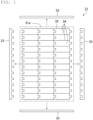
- FIG. 1 shows a plan view including holding sealing materials for an exhaust gas purification apparatus and offcuts cut from an inorganic fiber mat material.
- multiple holding sealing materials are cut out from a single large inorganic fiber mat material.
- an inorganic fiber mat material 31 is divided into a holding sealing material forming portion 32 and offcuts 33.
- the inorganic fiber mat material 31 before cutting is outlined by an outer edge 31a of the inorganic fiber mat material.
- the holding sealing material forming portion 32 is divided into individual holding sealing materials 34.
- the pattern of cutting of the holding sealing material forming portion 32 is designed so as to increase the number of linear portions for efficient cutting and reduce the offcuts 33 as much as possible.
- each offcut 33 may have irregularities.
- such offcuts of different shapes, with at least one of the offcuts having irregularities are used as inorganic fiber materials.
- an offcut 33 having a frame shape is obtained.
- the offcut 33 having a frame shape may be used as it is in the production method of the present invention.
- the offcut 33 may be cut in the vertical direction and the horizontal direction to obtain offcuts 33 of various shapes.
- the needle-punched mat is formed by folding a thin layer sheet of an inorganic fiber precursor multiple times into a layered body with a predetermined width, and firing the layered body.
- a needle-punched mat is also referred to as a needle-punched mat folded into a layered body.
- FIG. 2A shows a schematic diagram of a production example of a needle-punched mat folded into a layered body.
- FIG. 2B shows a cross-sectional view of the needle-punched mat folded into a layered body produced as shown in FIG. 2A , taken along the line A-A.
- a needle-punched mat 31A before firing is formed by folding a thin layer sheet 35 of an inorganic fiber precursor multiple times into a layered body with a predetermined width. As shown in FIG. 2A , the thin layer sheet 35 of the inorganic fiber precursor is folded while the sheet is continuously shifted in the direction perpendicular to the direction of folding.
- the width of each fold and number of folds may be, but not limited to, 1000 mm or more and five times or more, respectively, for example.
- folded portions 36 have a high proportion of long inorganic fibers.
- the production method of the present invention can provide an inorganic fiber mat with a high surface pressure.
- the needle-punched mat folded into a layered body can be produced, for example, by the method described in JP 2008-7933 A .
- the method of producing an inorganic fiber mat of the present invention includes: a defibrating step of defibrating the first inorganic fiber molding to obtain defibrated inorganic fibers; and a papermaking step of forming the inorganic fiber mat by papermaking using a slurry containing the defibrated inorganic fibers.
- the second inorganic fiber molding when used, may be defibrated together with the first inorganic fiber molding or may be defibrated separately from the first inorganic fiber molding to obtain inorganic fibers.
- the first inorganic fiber molding and the second inorganic fiber molding contain an organic binder
- the first inorganic fiber molding and the second inorganic fiber molding are preferably fired in a firing step before the defibrating step.
- the firing is performed, for example, at 700°C to 1000°C for one to eight hours.
- the firing temperature is preferably 800°C to 950°C.
- the defibration in the defibrating step can be performed by a single treatment of wet defibration only, or by a two-step treatment including dry defibration and wet defibration.
- the defibrating step is preferably performed only by wet defibration.
- the wet defibration can be performed using a wet defibrating apparatus such as a pulper or a mixer.
- the wet defibration can be performed by putting the first inorganic fiber molding and an optional second inorganic fiber molding into water and stirring the contents.
- the first inorganic fiber molding and the second inorganic fiber molding are added in any order.
- the first inorganic fiber molding is first put into water, followed by stirring, and then the second inorganic fiber molding is put thereinto, followed by stirring, or the first inorganic fiber molding and the second inorganic fiber molding are simultaneously put into water, followed by stirring.
- the first inorganic fiber molding is first put into water, followed by stirring, and then the second inorganic fiber molding is put thereinto, followed by further stirring.
- the dry defibration When the dry defibration is performed, it is performed before wet defibration.
- the dry defibration may be performed using an apparatus such as a feather mill.
- the first inorganic fiber molding and the second inorganic fiber molding may each be cut into pieces each having desired dimensions in advance.
- the defibrating step can proceed smoothly.
- each offcut may be used as it is without cutting before the defibrating step.
- the average fiber length of the inorganic fibers to be obtained can be adjusted by changing the treatment conditions of wet defibration and dry defibration (e.g., stirring speed, stirring time).
- the treatment conditions for wet defibration include a stirring speed of 500 to 1000 rpm and a stirring time of 200 to 900 seconds.
- the stirring speed is 650 to 850 rpm and the stirring time is 500 to 700 seconds, and more preferably, the stirring speed is 700 to 800 rpm and the stirring time is 500 to 650 seconds.
- inorganic fibers having a desired fiber length distribution can be obtained. Whether the inorganic fibers have a desired fiber length distribution can be confirmed by determining the bulk density.
- a papermaking step of forming an inorganic fiber mat by papermaking is performed using a slurry containing the defibrated inorganic fibers.
- the slurry can be prepared, for example, as follows.
- a liquid containing water and defibrated inorganic fibers is prepared so that the concentration of inorganic fibers is about 0.5 to 2.0% by weight.
- additional water or additional defibrated inorganic fibers are added to the liquid during slurry preparation, they are stirred with a stirrer for about 20 to 120 seconds.
- an organic binder is added to the liquid in an amount of about 0.5 to 10% by weight relative to the weight of the inorganic fibers, and the contents are stirred for about one to five minutes.
- an inorganic binder is added to the liquid in an amount of about 0.5 to 3% by weight relative to the weight of the inorganic fibers, and the contents are stirred for about one to five minutes.
- a flocculant is added to the liquid in an amount of about 0.01 to 1.0% by weight relative to the weight of the inorganic fibers, and the contents are stirred for about two minutes at most to prepare a slurry.
- the slurry preferably further contains new inorganic fibers.
- new inorganic fibers refer to fibers that have been formed for the first time as inorganic fibers and have never been used as a product.
- the average fiber length of new inorganic fibers can be adjusted depending on target properties, and is preferably about 0.01 mm to 100 mm.
- a preferred average fiber size (diameter) of the new inorganic fibers is the same as that of the inorganic fibers constituting the needle-punched mat or that of the inorganic fibers constituting the papermaking mat.
- the composition of the new inorganic fibers may be the same as those exemplified as the inorganic fibers constituting the first inorganic fiber molding and the inorganic fibers constituting the second inorganic fiber molding.
- the composition of the new inorganic fibers is the same as the composition of the inorganic fibers constituting the first inorganic fiber molding and the composition of the inorganic fibers constituting the second inorganic fiber molding.
- these inorganic fibers have the same composition, they have the same thermal expansion coefficient. Thus, the surface pressure can be maintained without shifting the adhesion between the fibers at high temperature.
- the new inorganic fibers, the inorganic fibers constituting the first inorganic fiber molding, and the inorganic fibers constituting the second inorganic fiber molding are alumina-silica fibers containing 65 to 80% by weight of Al 2 O 3 . This is because such inorganic fibers can provide an inorganic fiber mat having improved resilience and improved heat resistance.
- the inorganic binder to be added during slurry preparation may be the same as the inorganic binder contained in the first inorganic fiber molding and the second inorganic fiber molding.
- the organic binder may be latex or the like, and the flocculant may be any of known ones.
- an inorganic binder is added during slurry preparation.
- an inorganic binder may not be additionally added in the papermaking step.
- the amount thereof may be smaller than the amount of the initial inorganic binder.
- an inorganic binder in the same amount as described above may be added to the slurry.
- the production method of the present invention can provide an inorganic fiber mat having a higher surface pressure.
- the material of the inorganic binder to be added in the papermaking step may be the same as or different from the material of the inorganic binder contained in the first inorganic fiber molding and the second inorganic fiber molding.
- an organic binder is added during slurry preparation.
- the production method of the present invention can provide an inorganic fiber mat with excellent formability.
- an inorganic binder and an organic binder are added during slurry preparation.
- an inorganic fiber mat by papermaking using a slurry can be performed, for example, as follows.
- the prepared slurry is poured into a mold of a desired shape, a raw material sheet is molded, and water is removed from the sheet.
- the molding machine is equipped with a filtration wire mesh (mesh size: 30 mesh) at its bottom. Through the filtration wire mesh, water in the slurry poured into the molding machine is discharged.
- a filtration wire mesh mesh size: 30 mesh
- water in the slurry poured into the molding machine is discharged.
- Use of such a molding machine enables molding of a raw material sheet and removal of water from the raw material sheet at the same time. If necessary, water may be forcibly sucked from the bottom of the molding machine through the filtration wire mesh using a suction pump, a vacuum pump, or the like.
- the obtained raw material sheet is taken out from the molding machine.
- the raw material sheet is compressed using a press or the like so that the thickness thereof is reduced to about 0.3 to 0.5 times the original thickness, while the raw material sheet is heated and dried at a temperature of 150°C to 210°C for five minutes to one hour, for example. Thereby, an inorganic fiber mat can be obtained.
- the inorganic fiber mat obtained by the production method of the present invention may be cut into pieces each having a desired shape, which may be used as holding sealing materials for an exhaust gas purification apparatus.
- the inorganic fiber mat of the present invention contains inorganic fibers derived from a needle-punched mat, inorganic fibers derived from a papermaking mat, an inorganic binder, and an organic binder.
- the inorganic fiber mat of the present invention is a papermaking mat and is formed by papermaking using a slurry containing inorganic fibers derived from a needle-punched mat, inorganic fibers derived from a papermaking mat, an inorganic binder, and an organic binder.
- the needle-punched mat, the papermaking mat, the inorganic fibers, the inorganic binder, and the organic binder may be the same as those exemplified in the method of producing an inorganic fiber mat of the present invention.
- the inorganic fibers derived from a needle-punched mat and the inorganic fibers derived from a papermaking mat may be obtained by any method.
- An example of the method is the same method as the defibrating step in the method of producing an inorganic fiber mat of the present invention.
- the inorganic fiber mat of the present invention preferably contains, particles obtained by firing an inorganic binder and an unfired (a mixture of a dried inorganic binder and an organic binder) inorganic binder.
- the particles obtained by firing an inorganic binder are formed by firing an inorganic binder derived from at least one of the needle-punched mat or the papermaking mat. At least one of the needle-punched mat or the papermaking mat contains an inorganic binder and an organic binder.
- glassy particles and/or particles containing a crystal and a glass are formed from the inorganic binder.
- the inorganic binder is silica sol
- few crystals are formed under the firing conditions in the production method of the present invention (e.g., 700°C to 1000°C, one to eight hours), and silica glass particles are formed.
- the inorganic binder is alumina sol
- crystals are formed by firing at 500°C or higher, and alumina glass particles partly including crystalline ⁇ -alumina are formed under the firing conditions in the production method of the present invention (e.g., 700°C to 1000°C, one to eight hours) .
- the particles obtained by firing each preferably have a major axis of 0.01 to 4 ⁇ m.
- an inorganic binder other than the inorganic binder derived from a needle-punched mat and/or the inorganic binder derived from a papermaking mat is attached to the inorganic fiber mat of the present invention.
- the inorganic binder is an amorphous inorganic binder that has not undergone the firing step.
- the inorganic fiber mat of the present invention contains an organic binder.
- the unfired amorphous inorganic binder and the organic binder form a mixture.
- the mixture preferably has a major axis of 5 to 20 ⁇ m.
- FIG. 3 shows an example of an enlarged electron microscope image of an inorganic fiber mat of the present invention.
- particle obtained by firing 42 are adhered to surfaces of inorganic fibers 41.
- a mixture 43 of an unfired amorphous inorganic binder and an organic binder coats the contact areas between the inorganic fibers 41 and the surfaces of the inorganic fibers 41, or the mixture 43 in the form of a lump is adhered to the surfaces of the inorganic fibers 41.
- the inorganic fiber mat of the present invention including inorganic fibers derived from a needle-punched mat and inorganic fibers derived from a papermaking mat has both resilience and wrapability.
- the inorganic fiber mat of the present invention can be produced, for example, by the method of producing an inorganic fiber mat of the present invention, and may be produced by any production method.
- the present disclosure (1) encompasses a method of producing an inorganic fiber mat, the method including: a preparing step of preparing a first inorganic fiber molding including an organic binder attached thereto and derived from a needle-punched mat; a defibrating step of defibrating the first inorganic fiber molding to obtain defibrated inorganic fibers; and a papermaking step of forming the inorganic fiber mat by papermaking using a slurry containing the defibrated inorganic fibers.
- the present disclosure (2) encompasses the method of producing an inorganic fiber mat according to the present disclosure (1), wherein a second inorganic fiber molding derived from a papermaking mat is further used.
- the present disclosure (3) encompasses the method of producing an inorganic fiber mat according to the present disclosure (2), wherein the first inorganic fiber molding and the second inorganic fiber molding each contain an inorganic binder.
- the present disclosure (4) encompasses the method of producing an inorganic fiber mat according to the present disclosure (2) or (3), wherein the first inorganic fiber molding and the second inorganic fiber molding include offcuts.
- the present disclosure (5) encompasses the method of producing an inorganic fiber mat according to any one of the present disclosures (1) to (4), wherein an average fiber length of inorganic fibers constituting the needle-punched mat is 3.0 to 100 mm.
- the present disclosure (6) encompasses the method of producing an inorganic fiber mat according to any one of the present disclosures (1) to (5), wherein the defibrating includes only wet defibration.
- the present disclosure (7) encompasses the method of producing an inorganic fiber mat according to any one of the present disclosures (1) to (6), wherein the needle-punched mat is formed by folding a thin layer sheet of an inorganic fiber precursor multiple times into a layered body with a predetermined width, and firing the layered body.
- the present disclosure (8) encompasses the method of producing an inorganic fiber mat according to any one of the present disclosures (2) to (4), wherein the first inorganic fiber molding and the second inorganic fiber molding are each cut before the defibrating step.
- the present disclosure (9) encompasses the method of producing an inorganic fiber mat according to any one of the present disclosures (1) to (8), wherein the slurry further contains new inorganic fibers, and the new inorganic fibers and the defibrated inorganic fibers have the same composition and are alumina-silica fibers containing 60 to 80% by weight of Al 2 O 3 .
- the present disclosure (10) encompasses the method of producing an inorganic fiber mat according to the present disclosure (3), further including a firing step of firing the first inorganic fiber molding and the second inorganic fiber molding before the defibrating step.
- the present disclosure (11) encompasses the method of producing an inorganic fiber mat according to the present disclosure (10), wherein the firing is performed at 700°C to 1000°C for one to eight hours.
- the present disclosure (12) encompasses the method of producing an inorganic fiber mat according to any one of the present disclosures (1) to (11), wherein an inorganic binder and an organic binder are added to the slurry.
- the present disclosure (13) encompasses the method of producing an inorganic fiber mat according to the present disclosure (12), wherein the inorganic fiber mat formed by papermaking in the papermaking step is heated and dried at a temperature of 150°C to 210°C for five minutes to one hour.
- the present disclosure (14) encompasses an inorganic fiber mat including: inorganic fibers derived from a needle-punched mat; inorganic fibers derived from a papermaking mat; an inorganic binder; and an organic binder.
- the present disclosure encompasses the inorganic fiber mat according to the present disclosure (14), further including: a particle obtained by firing an inorganic binder derived from at least one of the needle-punched mat or the papermaking mat; and a mixture of an unfired inorganic binder and an organic binder.
- the present disclosure (16) encompasses the inorganic fiber mat according to the present disclosure (15), wherein the particle obtained by firing has a major axis of 0.01 to 4 um and the mixture has a major axis of 5 to 20 ⁇ m.
- the present disclosure (17) encompasses the inorganic fiber mat according to the present disclosure (15) or (16), wherein the particle obtained by firing is a glassy particle or a particle including a crystal and a glass.
- the present disclosure (18) encompasses the inorganic fiber mat according to any one of the present disclosures (15) to (17), wherein the particle obtained by firing is adhered to a surface of the inorganic fibers; and the mixture coats a contact area between the inorganic fibers and a surface of the inorganic fibers or the mixture in the form of a lump is adhered to the surface of the inorganic fibers.
Landscapes
- Engineering & Computer Science (AREA)
- Chemical & Material Sciences (AREA)
- Textile Engineering (AREA)
- Mechanical Engineering (AREA)
- Chemical Kinetics & Catalysis (AREA)
- Life Sciences & Earth Sciences (AREA)
- Wood Science & Technology (AREA)
- Inorganic Chemistry (AREA)
- Ceramic Engineering (AREA)
- Combustion & Propulsion (AREA)
- Toxicology (AREA)
- General Engineering & Computer Science (AREA)
- Health & Medical Sciences (AREA)
- Materials Engineering (AREA)
- Structural Engineering (AREA)
- Organic Chemistry (AREA)
- Paper (AREA)
- Nonwoven Fabrics (AREA)
- Exhaust Gas After Treatment (AREA)
- Porous Artificial Stone Or Porous Ceramic Products (AREA)
- Chemical Or Physical Treatment Of Fibers (AREA)
- Treatments For Attaching Organic Compounds To Fibrous Goods (AREA)
Priority Applications (1)
| Application Number | Priority Date | Filing Date | Title |
|---|---|---|---|
| EP25215829.0A EP4671437A3 (de) | 2022-12-09 | 2023-12-06 | Anorganische fasermatte |
Applications Claiming Priority (3)
| Application Number | Priority Date | Filing Date | Title |
|---|---|---|---|
| JP2022197140 | 2022-12-09 | ||
| JP2023086218A JP7441997B1 (ja) | 2022-12-09 | 2023-05-25 | 無機繊維マットの製造方法、及び、無機繊維マット |
| PCT/JP2023/043608 WO2024122568A1 (ja) | 2022-12-09 | 2023-12-06 | 無機繊維マットの製造方法、及び、無機繊維マット |
Related Child Applications (2)
| Application Number | Title | Priority Date | Filing Date |
|---|---|---|---|
| EP25215829.0A Division EP4671437A3 (de) | 2022-12-09 | 2023-12-06 | Anorganische fasermatte |
| EP25215829.0A Division-Into EP4671437A3 (de) | 2022-12-09 | 2023-12-06 | Anorganische fasermatte |
Publications (3)
| Publication Number | Publication Date |
|---|---|
| EP4403756A1 true EP4403756A1 (de) | 2024-07-24 |
| EP4403756A4 EP4403756A4 (de) | 2025-02-26 |
| EP4403756B1 EP4403756B1 (de) | 2026-03-11 |
Family
ID=90038537
Family Applications (2)
| Application Number | Title | Priority Date | Filing Date |
|---|---|---|---|
| EP25215829.0A Pending EP4671437A3 (de) | 2022-12-09 | 2023-12-06 | Anorganische fasermatte |
| EP23874061.7A Active EP4403756B1 (de) | 2022-12-09 | 2023-12-06 | Verfahren zur herstellung einer anorganischen fasermatte und anorganische fasermatte |
Family Applications Before (1)
| Application Number | Title | Priority Date | Filing Date |
|---|---|---|---|
| EP25215829.0A Pending EP4671437A3 (de) | 2022-12-09 | 2023-12-06 | Anorganische fasermatte |
Country Status (5)
| Country | Link |
|---|---|
| US (4) | US12428763B2 (de) |
| EP (2) | EP4671437A3 (de) |
| JP (2) | JP7441997B1 (de) |
| CN (2) | CN118574982B (de) |
| WO (1) | WO2024122568A1 (de) |
Family Cites Families (15)
| Publication number | Priority date | Publication date | Assignee | Title |
|---|---|---|---|---|
| JP2878638B2 (ja) | 1996-02-07 | 1999-04-05 | 日本ジャケット株式会社 | 断熱成形体の製造方法 |
| JP2008007933A (ja) | 1998-07-07 | 2008-01-17 | Mitsubishi Chemicals Corp | アルミナ繊維シートの製造方法 |
| US6602369B2 (en) | 1998-07-07 | 2003-08-05 | Mitsubishi Chemical Corporation | Process for producing laminated sheet comprising alumina fiber precursor |
| JP3451568B2 (ja) | 2000-05-24 | 2003-09-29 | イソライト工業株式会社 | ファイバー成形体の製造方法 |
| JP4373691B2 (ja) * | 2003-03-18 | 2009-11-25 | ニチアス株式会社 | 電子部品焼成用耐熱構造体及びその製造方法 |
| JP4672522B2 (ja) | 2005-06-16 | 2011-04-20 | 花王株式会社 | 鋳物製造用構造体 |
| JP4863828B2 (ja) | 2006-09-29 | 2012-01-25 | イビデン株式会社 | シート材、その製造方法および排気ガス処理装置 |
| JP4268182B2 (ja) * | 2006-09-29 | 2009-05-27 | イビデン株式会社 | 排気ガス処理装置およびその製造方法 |
| JP2009059694A (ja) * | 2007-08-07 | 2009-03-19 | Toyota Motor Corp | 燃料電池用触媒インクとその製造方法およびそれを用いた燃料電池電極 |
| JP5183296B2 (ja) | 2008-05-15 | 2013-04-17 | イビデン株式会社 | 保持シール材、保持シール材の製造方法及び排ガス浄化装置 |
| JP5347595B2 (ja) * | 2009-03-12 | 2013-11-20 | 三菱樹脂株式会社 | 無機質繊維ブランケットの製造方法 |
| JP5680490B2 (ja) * | 2010-06-25 | 2015-03-04 | 花王株式会社 | 鋳物製造用構造体 |
| KR101291964B1 (ko) | 2011-11-16 | 2013-08-09 | 이비덴 가부시키가이샤 | 유지 시일재, 그 제조 방법 및 배기 가스 정화 장치 |
| JP5927064B2 (ja) * | 2012-06-29 | 2016-05-25 | イビデン株式会社 | マット材の製造方法 |
| US20210339515A1 (en) | 2020-05-02 | 2021-11-04 | Hamilton Sundstrand Corporation | Ceramic matrix composite laminate tube sheet and method for making the same |
-
2023
- 2023-05-25 JP JP2023086218A patent/JP7441997B1/ja active Active
- 2023-12-06 CN CN202380013806.1A patent/CN118574982B/zh active Active
- 2023-12-06 CN CN202510588812.0A patent/CN120444112A/zh active Pending
- 2023-12-06 EP EP25215829.0A patent/EP4671437A3/de active Pending
- 2023-12-06 EP EP23874061.7A patent/EP4403756B1/de active Active
- 2023-12-06 WO PCT/JP2023/043608 patent/WO2024122568A1/ja not_active Ceased
- 2023-12-06 US US18/700,263 patent/US12428763B2/en active Active
-
2024
- 2024-02-19 JP JP2024022651A patent/JP7514406B2/ja active Active
- 2024-10-11 US US18/912,600 patent/US20250034770A1/en active Pending
-
2025
- 2025-04-28 US US19/190,799 patent/US20250257506A1/en active Pending
- 2025-07-07 US US19/262,022 patent/US20250333887A1/en active Pending
Also Published As
| Publication number | Publication date |
|---|---|
| CN120444112A (zh) | 2025-08-08 |
| EP4671437A3 (de) | 2026-03-11 |
| US20250257506A1 (en) | 2025-08-14 |
| CN118574982A (zh) | 2024-08-30 |
| JP7514406B2 (ja) | 2024-07-10 |
| US20250034770A1 (en) | 2025-01-30 |
| US20250333887A1 (en) | 2025-10-30 |
| JP2024083326A (ja) | 2024-06-20 |
| US20240337053A1 (en) | 2024-10-10 |
| EP4403756A4 (de) | 2025-02-26 |
| CN118574982B (zh) | 2025-05-27 |
| WO2024122568A1 (ja) | 2024-06-13 |
| EP4671437A2 (de) | 2025-12-31 |
| EP4403756B1 (de) | 2026-03-11 |
| US12428763B2 (en) | 2025-09-30 |
| JP2024083211A (ja) | 2024-06-20 |
| JP7441997B1 (ja) | 2024-03-01 |
Similar Documents
| Publication | Publication Date | Title |
|---|---|---|
| EP4317112B1 (de) | Matte, abgasreinigungsvorrichtung und verfahren zur herstellung der matte | |
| US20250109536A1 (en) | Inorganic fiber mat | |
| JP2016108987A (ja) | 保持シール材、排ガス浄化装置及び保持シール材の製造方法 | |
| EP4471260A1 (de) | Blattbildungsmatte und verfahren zur herstellung einer blattbildungsmatte | |
| EP2301907B1 (de) | Verfahren zur Herstellung eines Körpers mit Wabenstruktur | |
| EP4403756A1 (de) | Verfahren zur herstellung einer anorganischen fasermatte und anorganische fasermatte | |
| WO2006006667A1 (ja) | 多孔質ハニカム構造体の製造方法 | |
| JP2024147439A (ja) | 抄造マット、巻き付け体及び抄造マットの製造方法 | |
| CN104903506B (zh) | 韧性无机纤维的处理及其在用于废气处理装置的安装垫中的用途 | |
| JP7488981B1 (ja) | 抄造マット及び抄造マットの製造方法 | |
| JP7514408B1 (ja) | 抄造マット及び抄造マットの製造方法 | |
| EP0593278B1 (de) | Filter für Metallschmelzen und Verfahren zu seiner Herstellung | |
| JP2003328235A (ja) | セラミック繊維集合体 | |
| WO2003072876A1 (en) | Ceramic fiber aggregate | |
| WO2015186528A1 (ja) | 保持シール材及び保持シール材の製造方法 |
Legal Events
| Date | Code | Title | Description |
|---|---|---|---|
| STAA | Information on the status of an ep patent application or granted ep patent |
Free format text: STATUS: UNKNOWN |
|
| STAA | Information on the status of an ep patent application or granted ep patent |
Free format text: STATUS: THE INTERNATIONAL PUBLICATION HAS BEEN MADE |
|
| PUAI | Public reference made under article 153(3) epc to a published international application that has entered the european phase |
Free format text: ORIGINAL CODE: 0009012 |
|
| STAA | Information on the status of an ep patent application or granted ep patent |
Free format text: STATUS: REQUEST FOR EXAMINATION WAS MADE |
|
| 17P | Request for examination filed |
Effective date: 20240409 |
|
| AK | Designated contracting states |
Kind code of ref document: A1 Designated state(s): AL AT BE BG CH CY CZ DE DK EE ES FI FR GB GR HR HU IE IS IT LI LT LU LV MC ME MK MT NL NO PL PT RO RS SE SI SK SM TR |
|
| REG | Reference to a national code |
Ref country code: DE Ref legal event code: R079 Free format text: PREVIOUS MAIN CLASS: F01N0003280000 Ipc: D04H0001420900 Ref document number: 602023013541 Country of ref document: DE |
|
| A4 | Supplementary search report drawn up and despatched |
Effective date: 20250123 |
|
| RIC1 | Information provided on ipc code assigned before grant |
Ipc: F01N 3/28 20060101ALI20250117BHEP Ipc: D21H 13/36 20060101ALI20250117BHEP Ipc: D04H 1/732 20120101ALI20250117BHEP Ipc: D04H 1/587 20120101ALI20250117BHEP Ipc: D04H 1/488 20120101ALI20250117BHEP Ipc: D04H 1/4274 20120101ALI20250117BHEP Ipc: D04H 1/4209 20120101AFI20250117BHEP |
|
| GRAP | Despatch of communication of intention to grant a patent |
Free format text: ORIGINAL CODE: EPIDOSNIGR1 |
|
| STAA | Information on the status of an ep patent application or granted ep patent |
Free format text: STATUS: GRANT OF PATENT IS INTENDED |
|
| RIC1 | Information provided on ipc code assigned before grant |
Ipc: D04H 1/4209 20120101AFI20250905BHEP Ipc: D04H 1/4274 20120101ALI20250905BHEP Ipc: D04H 1/488 20120101ALI20250905BHEP Ipc: D04H 1/587 20120101ALI20250905BHEP Ipc: D04H 1/732 20120101ALI20250905BHEP Ipc: D21H 13/36 20060101ALI20250905BHEP Ipc: F01N 3/28 20060101ALI20250905BHEP Ipc: D21B 1/04 20060101ALI20250905BHEP Ipc: D21B 1/12 20060101ALI20250905BHEP |
|
| DAV | Request for validation of the european patent (deleted) | ||
| DAX | Request for extension of the european patent (deleted) | ||
| INTG | Intention to grant announced |
Effective date: 20251001 |
|
| P01 | Opt-out of the competence of the unified patent court (upc) registered |
Free format text: CASE NUMBER: UPC_APP_0016281_4403756/2025 Effective date: 20251209 |
|
| GRAS | Grant fee paid |
Free format text: ORIGINAL CODE: EPIDOSNIGR3 |
|
| GRAA | (expected) grant |
Free format text: ORIGINAL CODE: 0009210 |
|
| STAA | Information on the status of an ep patent application or granted ep patent |
Free format text: STATUS: THE PATENT HAS BEEN GRANTED |
|
| AK | Designated contracting states |
Kind code of ref document: B1 Designated state(s): AL AT BE BG CH CY CZ DE DK EE ES FI FR GB GR HR HU IE IS IT LI LT LU LV MC ME MK MT NL NO PL PT RO RS SE SI SK SM TR |
|
| GRAT | Correction requested after decision to grant or after decision to maintain patent in amended form |
Free format text: ORIGINAL CODE: EPIDOSNCDEC |
|
| REG | Reference to a national code |
Ref country code: CH Ref legal event code: F10 Free format text: ST27 STATUS EVENT CODE: U-0-0-F10-F00 (AS PROVIDED BY THE NATIONAL OFFICE) Effective date: 20260311 Ref country code: GB Ref legal event code: FG4D |
|
| REG | Reference to a national code |
Ref country code: CH Ref legal event code: W10 Free format text: ST27 STATUS EVENT CODE: U-0-0-W10-W00 (AS PROVIDED BY THE NATIONAL OFFICE) Effective date: 20260318 |
|
| REG | Reference to a national code |
Ref country code: CH Ref legal event code: Q17 Free format text: ST27 STATUS EVENT CODE: U-0-0-Q10-Q17 (AS PROVIDED BY THE NATIONAL OFFICE) Effective date: 20260325 Ref country code: DE Ref legal event code: R081 Ref document number: 602023013541 Country of ref document: DE Owner name: IBIDEN CO., LTD., OGAKI-SHI, JP Free format text: FORMER OWNER: IBIDEN CO., LTD., OGAKI-SHI, GIFU, JP |