EP4398249A2 - Dekodierung einer abtastgenauen darstellung eines audiosignals - Google Patents
Dekodierung einer abtastgenauen darstellung eines audiosignals Download PDFInfo
- Publication number
- EP4398249A2 EP4398249A2 EP24178296.0A EP24178296A EP4398249A2 EP 4398249 A2 EP4398249 A2 EP 4398249A2 EP 24178296 A EP24178296 A EP 24178296A EP 4398249 A2 EP4398249 A2 EP 4398249A2
- Authority
- EP
- European Patent Office
- Prior art keywords
- data
- audio data
- information
- audio
- decoder
- Prior art date
- Legal status (The legal status is an assumption and is not a legal conclusion. Google has not performed a legal analysis and makes no representation as to the accuracy of the status listed.)
- Pending
Links
Images




Classifications
-
- G—PHYSICS
- G10—MUSICAL INSTRUMENTS; ACOUSTICS
- G10L—SPEECH ANALYSIS TECHNIQUES OR SPEECH SYNTHESIS; SPEECH RECOGNITION; SPEECH OR VOICE PROCESSING TECHNIQUES; SPEECH OR AUDIO CODING OR DECODING
- G10L19/00—Speech or audio signals analysis-synthesis techniques for redundancy reduction, e.g. in vocoders; Coding or decoding of speech or audio signals, using source filter models or psychoacoustic analysis
-
- G—PHYSICS
- G10—MUSICAL INSTRUMENTS; ACOUSTICS
- G10L—SPEECH ANALYSIS TECHNIQUES OR SPEECH SYNTHESIS; SPEECH RECOGNITION; SPEECH OR VOICE PROCESSING TECHNIQUES; SPEECH OR AUDIO CODING OR DECODING
- G10L19/00—Speech or audio signals analysis-synthesis techniques for redundancy reduction, e.g. in vocoders; Coding or decoding of speech or audio signals, using source filter models or psychoacoustic analysis
- G10L19/04—Speech or audio signals analysis-synthesis techniques for redundancy reduction, e.g. in vocoders; Coding or decoding of speech or audio signals, using source filter models or psychoacoustic analysis using predictive techniques
- G10L19/16—Vocoder architecture
- G10L19/167—Audio streaming, i.e. formatting and decoding of an encoded audio signal representation into a data stream for transmission or storage purposes
Definitions
- Embodiments of the invention relate to the field of source coding of an audio signal. More specifically, embodiments of the invention relate to a method for encoding information on the original valid audio data and an associated decoder. More specifically, embodiments of the invention provide the recovery of the audio data with their original duration.
- Embodiments of the invention provide a method for providing information on the validity of encoded audio data, the encoded audio data being a series of coded audio data units, wherein each coded audio data unit can contain information on the valid audio data, the method comprising:
- the decoder For all of the available signaling mechanisms (i.e., implicit signaling, backward compatible explicit signaling, or hierarchical explicit signaling) if the decoder is HE-AAC then it must convey to Systems any additional delay incurred by SBR processing, otherwise the lack of an indication from the decoder indicates that the decoder is AAC. Hence, Systems can adjust the time stamp so as to compensate for the additional SBR delay.
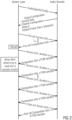
- [1] shows how pre-roll of data can be handled by using ISO FF (ISO File Format) sample groups [3].
- Pre-roll does not mark which data is valid but how many Access Units (or samples in the ISO FF nomenclature) are to be decoded prior to decoder output at an arbitrary point in time. For AAC this is always one sample (i.e., one Access Unit) in advance due to overlapping windows in the MDCT domain, hence the value for pre-roll is -1 for all Access Units.
- Trimming may lead to signal discontinuities, which can cause signal distortion. Hence, trimming information should only be inserted into the bitstream at the beginning or the end of the entire encoding. If two streams are spliced together, these discontinuities can not be avoided except by an encoder that carefully sets the values of trim_from_end and trim_from_beginning so that the two output time-domain signals fit together without discontinuities.
- Trimmed Access Units may lead to unexpected computational requirements. Many implementations assume constant processing time for Access Units with constant duration, which is no more valid if the duration changes due to trimming but the computational requirements for an Access Unit remain. Hence, decoders with constrained computational resources should be assumed and trimming should hence be used rarely, preferably by encoding data in a way that it is aligned to the Access Unit boundaries and only trimming at the end of an encoding is used, as described in [ISO/IEC 14496-24:2007 Annex B.2].
- the teachings disclosed herein also relate to the industrial standard ISO/IEC 14496-24:2007. According to the teachings disclosed herein, the following is proposed relative to an audio decoder interface for sample-accurate Access: An audio decoder will always create one Composition Unit (CU) from one Access Unit (AU). The required amount of pre-roll and post-roll AUs is constant for a serial set of AUs by one encoder.
- CU Composition Unit
- AU Access Unit
- the decoder When the decoding operation starts, the decoder is initialized with an AudioSpecificConfig (ASC). After the decoder has processed this structure, the most relevant parameters can be requested from the decoder.
- the Systems layer conveys parameters that are in general independent from the type of stream, be it audio or video or other data. This includes timing information, pre-roll and post-roll data.
- the decoder needs r pre pre-roll AUs before the AU, that contains the requested sample.
- r post post-roll are needed, this depends however on the decoding mode (decoding an extension may require post-roll AUs whereas the basic decoding operation is defined as not requiring a post-roll AU).
- Encoders should have consistent timing behavior. An encoder should align the input signal so that after decoding r pre pre-roll AUs the original input signal would result, without initial loss and without heading samples. Especially for file-based encoder operations this would require that the encoder's additional look-ahead samples and additionally inserted silence samples are an integer multiple of the audio frame size and can thus be discarded at the encoder's output.
- the encoder should insert trimming information so that the decoder is enabled to erase accidentally inserted look-ahead samples with the post-decoder trimming tool.
- encoders should insert post-decoder trimming information for trailing samples. These shall be signaled in the Access Unit that precedes the last r post post-roll AUs.
- the timing information set at the encoder shall be set assuming that the post-decoder trimming tool is available.
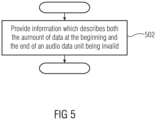
- the information describing the amount of data within the audio data unit being invalid may be obtained from an encoding process that generates the encoded audio data.
- an encoding algorithm may consider an input range of audio samples that extends over a boundary (beginning or end) of an audio signal to be encoded.
- Typical encoding processes gather a plurality of audio samples in "blocks" or "frames” so that a block or frame that is not completely filled with actual audio samples may be filled up with "dummy" audio samples that typically have a zero amplitude.
- decoded output data is provided which only contains the samples not marked as invalid.
- a consumer of the decoded output data downstream of an element executing the method for receiving encoded data may use the provided decoded output data without having to deal with the issue of the validity of portions of the output data, such as single samples.
- Information about the performed modification may be obtained from the encoding algorithm or an entity of the encoder 800 performing the conditioning of the input audio data. From this modification information, an information may be derived which describes the amount of information at a beginning and/or an end of an audio data unit that is invalid.
- the encoder 800 may for example comprise a counter for counting samples marked as invalid by the encoding algorithm or the input audio data conditioning entity.
- the information describing the amount of information at the beginning and/or the end of the audio data unit being invalid is provided at an output of the encoder 800 along with the encoded audio data.
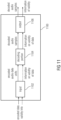
- Fig. 9 shows a schematic input/output diagram of an encoder 900 according to another embodiment of the teachings disclosed herein. Compared to the encoder 800 shown in Fig.
- the method for providing the information on the validity of encoded audio data may use various pieces information in order to determine the amount of data of an audio data unit that is invalid. Also the encoder may use these pieces of information.
- the following sections describe a number of pieces of information that may be used to this end: amount of pre-roll data, amount of extra artificial data added by the encoder, length of original uncompressed input data, and amount of post-roll.
- pre-roll data is the amount of compressed data which has to be decoded before the compressed data unit corresponding to the beginning of the original uncompressed data.
- an encoding and decoding of a set of uncompressed data units is explained. Given a frame-size of 1024 samples and the amount of pre-roll also 1024 samples, an original uncompressed PCM audio data set consisting of 2000 samples will be encoded as three encoded data units. The first encoded data unit will be the pre-roll data unit with a duration of 1024 samples. The second encoded data unit will result in the original 1024 samples of the source signal (given no other encoding artifacts).
- the third encoded data unit will result in 1024 samples, consisting of the remaining 976 samples of the source signal and 48 trailing samples introduced by the frame granularity.
- the pre-roll can not be avoided and is essential for the decoder to reconstruct the entire original signal.
- the amount of pre-roll data is coding-dependent and fixed for a coding mode and constant over time. Therefore it is required also for randomly accessing compressed data units.
- the pre-roll is also required to get the decoded uncompressed output data corresponding to the uncompressed input data.
- Another piece of information is the amount of extra artificial data added by the encoder.
- This extra data typically results from a preview of future samples within the encoder so that smarter decisions on encoding can be made, like switching from short filter banks to long filter banks. Only the encoder knows this look-ahead value and it is different between encoder implementations of a specific vendor for the same coding mode, although constant over time.
- the length of this extra data is difficult to detect by a decoder and often heuristics are applied, e.g. the amount of silence in the beginning is assumed to be extra encoder delay or a magic value if a certain encoder is detected by some other heuristics.
- Post-roll defines how much data must be given to a decoder after the coded data unit so that the decoder can provide the uncompressed data corresponding to the uncompressed original data.
- post-roll can be exchanged with pre-roll and vice-versa.
- the sum of post-roll and pre-roll is not constant for all decoder modes.
- Current specifications such as [ISO/IEC 14496-24:2007] assume a fixed pre-roll for all decoder modes and ignore mentioning post-roll in favor of defining additional delay which has an equivalent value to post-roll.
- embodiments of the invention provide information on the validity of the data at the output of the encoder within the coded audio data.
- the pieces of information are attached to the coded audio data units which are affected.
- artificial extra data at the beginning is marked as invalid data and trailing data used to fill a frame is also marked as invalid data which has to be trimmed.
- the marking allows the distinction of valid vs. invalid data within a coded data unit, so that a decoder can erase the invalid data before it provides data to the output or can alternatively mark the data, e.g. in a similar manner to the representation within the coded data unit, so that appropriate actions can happen at other processing elements.
- the other relevant data which is the pre-roll and post-roll is defined within the system and understood by both the encoder and decoder, so that for a given decoder mode the values are known.
- the resolution of the trimming operation should be related to the original sampling frequency, which is typically encoded as the higher-rate component.
- Several resolutions for the trimming operation are imaginable, e.g. a fixed resolution in microseconds, the lowest-rate sampling frequency, or the highest-rate sampling frequency.
- the format of the trimming information could be represented as a syntax like the following:
- aspects of the invention were described in the context of an apparatus, it is noted that these aspects also represent a description of the corresponding method, i.e., a block or device corresponds to a method step or a feature of a method step. Analogously, aspects described in the context of a method step also represent a description of a corresponding block or item or feature of a corresponding apparatus.
- embodiments of the invention may be implemented as a computer program product with a program code, the program code being operative for performing one of the methods when the computer program product runs on a computer.
- the program code may for example be stored on a machine readable carrier.
- Other embodiments comprise the computer program for performing one of the methods described herein, stored on a machine readable carrier.
Landscapes
- Engineering & Computer Science (AREA)
- Physics & Mathematics (AREA)
- Signal Processing (AREA)
- Health & Medical Sciences (AREA)
- Audiology, Speech & Language Pathology (AREA)
- Human Computer Interaction (AREA)
- Computational Linguistics (AREA)
- Acoustics & Sound (AREA)
- Multimedia (AREA)
- Compression, Expansion, Code Conversion, And Decoders (AREA)
- Signal Processing For Digital Recording And Reproducing (AREA)
- Two-Way Televisions, Distribution Of Moving Picture Or The Like (AREA)
- Compression Or Coding Systems Of Tv Signals (AREA)
Applications Claiming Priority (4)
| Application Number | Priority Date | Filing Date | Title |
|---|---|---|---|
| US32344010P | 2010-04-13 | 2010-04-13 | |
| EP11713836.2A EP2559029B1 (de) | 2010-04-13 | 2011-04-12 | Verfahren sowie kodierer und dekodierer für lückenlose wiedergabe eines tonsignals |
| EP19154231.5A EP3499503B1 (de) | 2010-04-13 | 2011-04-12 | Decodierung zur sample-genauen repräsentation eines audiosignals |
| PCT/EP2011/055728 WO2011128342A1 (en) | 2010-04-13 | 2011-04-12 | Method and encoder and decoder for gap - less playback of an audio signal |
Related Parent Applications (3)
| Application Number | Title | Priority Date | Filing Date |
|---|---|---|---|
| EP19154231.5A Division EP3499503B1 (de) | 2010-04-13 | 2011-04-12 | Decodierung zur sample-genauen repräsentation eines audiosignals |
| EP19154231.5A Division-Into EP3499503B1 (de) | 2010-04-13 | 2011-04-12 | Decodierung zur sample-genauen repräsentation eines audiosignals |
| EP11713836.2A Division EP2559029B1 (de) | 2010-04-13 | 2011-04-12 | Verfahren sowie kodierer und dekodierer für lückenlose wiedergabe eines tonsignals |
Publications (2)
| Publication Number | Publication Date |
|---|---|
| EP4398249A2 true EP4398249A2 (de) | 2024-07-10 |
| EP4398249A3 EP4398249A3 (de) | 2024-07-24 |
Family
ID=44146452
Family Applications (3)
| Application Number | Title | Priority Date | Filing Date |
|---|---|---|---|
| EP19154231.5A Active EP3499503B1 (de) | 2010-04-13 | 2011-04-12 | Decodierung zur sample-genauen repräsentation eines audiosignals |
| EP11713836.2A Active EP2559029B1 (de) | 2010-04-13 | 2011-04-12 | Verfahren sowie kodierer und dekodierer für lückenlose wiedergabe eines tonsignals |
| EP24178296.0A Pending EP4398249A3 (de) | 2010-04-13 | 2011-04-12 | Dekodierung einer abtastgenauen darstellung eines audiosignals |
Family Applications Before (2)
| Application Number | Title | Priority Date | Filing Date |
|---|---|---|---|
| EP19154231.5A Active EP3499503B1 (de) | 2010-04-13 | 2011-04-12 | Decodierung zur sample-genauen repräsentation eines audiosignals |
| EP11713836.2A Active EP2559029B1 (de) | 2010-04-13 | 2011-04-12 | Verfahren sowie kodierer und dekodierer für lückenlose wiedergabe eines tonsignals |
Country Status (15)
| Country | Link |
|---|---|
| US (1) | US9324332B2 (de) |
| EP (3) | EP3499503B1 (de) |
| JP (1) | JP5719922B2 (de) |
| KR (1) | KR101364685B1 (de) |
| CN (1) | CN102971788B (de) |
| AU (1) | AU2011240024B2 (de) |
| BR (1) | BR112012026326B1 (de) |
| CA (1) | CA2796147C (de) |
| ES (2) | ES2986126T3 (de) |
| MX (1) | MX2012011802A (de) |
| PL (2) | PL2559029T3 (de) |
| PT (1) | PT2559029T (de) |
| RU (1) | RU2546602C2 (de) |
| TR (1) | TR201904735T4 (de) |
| WO (1) | WO2011128342A1 (de) |
Families Citing this family (13)
| Publication number | Priority date | Publication date | Assignee | Title |
|---|---|---|---|---|
| CN103918029B (zh) | 2011-11-11 | 2016-01-20 | 杜比国际公司 | 使用过采样谱带复制的上采样 |
| CN104065963B (zh) * | 2014-06-27 | 2018-03-06 | 广东威创视讯科技股份有限公司 | 编解码系统及其快速切换分辨率的方法、装置 |
| EP2996269A1 (de) | 2014-09-09 | 2016-03-16 | Fraunhofer-Gesellschaft zur Förderung der angewandten Forschung e.V. | Audiospleißkonzept |
| CN107667400B (zh) | 2015-03-09 | 2020-12-18 | 弗劳恩霍夫应用研究促进协会 | 片段对准的音频编码 |
| US10225814B2 (en) | 2015-04-05 | 2019-03-05 | Qualcomm Incorporated | Conference audio management |
| BR112020021832A2 (pt) | 2018-04-25 | 2021-02-23 | Dolby International Ab | integração de técnicas de reconstrução de alta frequência |
| KR102852659B1 (ko) | 2018-08-21 | 2025-08-29 | 돌비 인터네셔널 에이비 | 즉시 재생 프레임(ipf)의 생성, 전송 및 처리를 위한 방법, 장치 및 시스템 |
| CN109495776B (zh) * | 2018-12-20 | 2021-02-05 | 海信视像科技股份有限公司 | 一种音频发送、播放的方法及智能终端 |
| WO2020125076A1 (zh) | 2018-12-20 | 2020-06-25 | 青岛海信电器股份有限公司 | 音频播放、发送方法和装置 |
| CN111179970B (zh) * | 2019-08-02 | 2023-10-20 | 腾讯科技(深圳)有限公司 | 音视频处理方法、合成方法、装置、电子设备及存储介质 |
| BR112022003440A2 (pt) | 2019-09-03 | 2022-05-24 | Dolby Laboratories Licensing Corp | Codec de efeitos de baixa latência, baixa frequência |
| CN117495750A (zh) * | 2022-07-22 | 2024-02-02 | 戴尔产品有限公司 | 用于视频重构的方法、电子设备和计算机程序产品 |
| CN116796685B (zh) * | 2023-08-07 | 2024-02-09 | 深圳云豹智能有限公司 | 数据拼接模块及数据传递方法、介质、电子设备、芯片 |
Family Cites Families (35)
| Publication number | Priority date | Publication date | Assignee | Title |
|---|---|---|---|---|
| US5784532A (en) | 1994-02-16 | 1998-07-21 | Qualcomm Incorporated | Application specific integrated circuit (ASIC) for performing rapid speech compression in a mobile telephone system |
| FR2739995B1 (fr) * | 1995-10-13 | 1997-12-12 | Massaloux Dominique | Procede et dispositif de creation d'un bruit de confort dans un systeme de transmission numerique de parole |
| JP3707116B2 (ja) | 1995-10-26 | 2005-10-19 | ソニー株式会社 | 音声復号化方法及び装置 |
| JPH09261070A (ja) * | 1996-03-22 | 1997-10-03 | Sony Corp | ディジタルオーディオ信号処理装置 |
| EP1021044A1 (de) * | 1999-01-12 | 2000-07-19 | Deutsche Thomson-Brandt Gmbh | Verarbeitungsverfahren und Kodierungsvorrichtung für Audio- oder Videorahmendaten |
| US20020040388A1 (en) * | 2000-08-15 | 2002-04-04 | Lockheed Martin Corporation | Method and apparatus for delivering services in a constrained environment |
| JP2002101395A (ja) * | 2000-09-21 | 2002-04-05 | Sony Corp | 多重化装置及び方法、並びに、復号装置及び方法 |
| JP3734696B2 (ja) * | 2000-09-25 | 2006-01-11 | 松下電器産業株式会社 | 無音圧縮音声符号化復号化装置 |
| DE10102159C2 (de) * | 2001-01-18 | 2002-12-12 | Fraunhofer Ges Forschung | Verfahren und Vorrichtung zum Erzeugen bzw. Decodieren eines skalierbaren Datenstroms unter Berücksichtigung einer Bitsparkasse, Codierer und skalierbarer Codierer |
| CN1251177C (zh) | 2001-05-02 | 2006-04-12 | 皇家菲利浦电子有限公司 | 反滤波法,合成滤波法,反滤波器装置,合成滤波器装置和包括这类滤波器装置的装置 |
| US7043677B1 (en) * | 2001-07-19 | 2006-05-09 | Webex Communications, Inc. | Apparatus and method for separating corrupted data from non-corrupted data within a packet |
| KR100546398B1 (ko) * | 2003-11-25 | 2006-01-26 | 삼성전자주식회사 | 압축된 오디오 비트스트림에서 싱크 워드를 찾는 방법 및상기 방법을 기록한 기록 매체 |
| RU2386179C2 (ru) * | 2005-04-01 | 2010-04-10 | Квэлкомм Инкорпорейтед | Способ и устройство для кодирования речевых сигналов с расщеплением полосы |
| WO2007066814A1 (ja) * | 2005-12-09 | 2007-06-14 | Nec Corporation | フレーム処理方法及びフレーム処理装置 |
| US8204740B2 (en) * | 2006-02-06 | 2012-06-19 | Telefonaktiebolaget Lm Ericsson (Publ) | Variable frame offset coding |
| JP4371127B2 (ja) | 2006-07-14 | 2009-11-25 | ソニー株式会社 | 再生装置、再生方法、プログラム |
| US8260609B2 (en) * | 2006-07-31 | 2012-09-04 | Qualcomm Incorporated | Systems, methods, and apparatus for wideband encoding and decoding of inactive frames |
| US8532984B2 (en) | 2006-07-31 | 2013-09-10 | Qualcomm Incorporated | Systems, methods, and apparatus for wideband encoding and decoding of active frames |
| US8190441B2 (en) | 2006-09-11 | 2012-05-29 | Apple Inc. | Playback of compressed media files without quantization gaps |
| US8126721B2 (en) * | 2006-10-18 | 2012-02-28 | Fraunhofer-Gesellschaft Zur Foerderung Der Angewandten Forschung E.V. | Encoding an information signal |
| US8417532B2 (en) * | 2006-10-18 | 2013-04-09 | Fraunhofer-Gesellschaft Zur Foerderung Der Angewandten Forschung E.V. | Encoding an information signal |
| US8041578B2 (en) * | 2006-10-18 | 2011-10-18 | Fraunhofer-Gesellschaft Zur Foerderung Der Angewandten Forschung E.V. | Encoding an information signal |
| HUE068022T2 (hu) * | 2006-10-25 | 2024-12-28 | Fraunhofer Ges Forschung | Eljárás audiójel feldolgozására |
| JP4379471B2 (ja) | 2006-12-29 | 2009-12-09 | ソニー株式会社 | 再生装置および再生制御方法 |
| US8180283B2 (en) | 2007-02-14 | 2012-05-15 | Alcatel Lucent | Method of providing feedback to a media server in a wireless communication system |
| JP5119239B2 (ja) * | 2007-03-26 | 2013-01-16 | パナソニック株式会社 | デジタル放送受信装置 |
| US7778839B2 (en) * | 2007-04-27 | 2010-08-17 | Sony Ericsson Mobile Communications Ab | Method and apparatus for processing encoded audio data |
| EP2186090B1 (de) * | 2007-08-27 | 2016-12-21 | Telefonaktiebolaget LM Ericsson (publ) | Übergangsdetektor und verfahren zur unterstützung der kodierung eines audiosignals |
| JP5368988B2 (ja) | 2008-02-22 | 2013-12-18 | パナソニック株式会社 | 音楽再生装置、音楽再生方法、音楽再生プログラム、及び集積回路 |
| JP4977777B2 (ja) * | 2008-03-18 | 2012-07-18 | パイオニア株式会社 | 符号化装置及び符号化方法並びに符号化用プログラム |
| JP5244971B2 (ja) * | 2008-07-11 | 2013-07-24 | フラウンホーファー−ゲゼルシャフト・ツール・フェルデルング・デル・アンゲヴァンテン・フォルシュング・アインゲトラーゲネル・フェライン | オーディオ信号合成器及びオーディオ信号符号器 |
| KR101395252B1 (ko) * | 2008-07-11 | 2014-05-15 | 프라운호퍼 게젤샤프트 쭈르 푀르데룽 데어 안겐반텐 포르슝 에. 베. | 스펙트럼 포락선의 수를 산출하기 위한 장치 및 그 방법 |
| JP2010123225A (ja) * | 2008-11-21 | 2010-06-03 | Toshiba Corp | 記録再生装置及び記録再生方法 |
| EP2288056A3 (de) * | 2009-07-22 | 2012-07-11 | Yamaha Corporation | Audiosignalverarbeitungssystem mit einer Mehrzahl durch ein Audionetzwerk verbundenen Geräten |
| JP2011209412A (ja) * | 2010-03-29 | 2011-10-20 | Renesas Electronics Corp | 圧縮装置、圧縮方法、再生装置および再生方法 |
-
2011
- 2011-04-12 EP EP19154231.5A patent/EP3499503B1/de active Active
- 2011-04-12 PL PL11713836T patent/PL2559029T3/pl unknown
- 2011-04-12 JP JP2013504246A patent/JP5719922B2/ja active Active
- 2011-04-12 CA CA2796147A patent/CA2796147C/en active Active
- 2011-04-12 AU AU2011240024A patent/AU2011240024B2/en active Active
- 2011-04-12 BR BR112012026326-9A patent/BR112012026326B1/pt active IP Right Grant
- 2011-04-12 EP EP11713836.2A patent/EP2559029B1/de active Active
- 2011-04-12 MX MX2012011802A patent/MX2012011802A/es active IP Right Grant
- 2011-04-12 EP EP24178296.0A patent/EP4398249A3/de active Pending
- 2011-04-12 WO PCT/EP2011/055728 patent/WO2011128342A1/en not_active Ceased
- 2011-04-12 RU RU2012148132/08A patent/RU2546602C2/ru active
- 2011-04-12 CN CN201180029225.4A patent/CN102971788B/zh active Active
- 2011-04-12 PT PT11713836T patent/PT2559029T/pt unknown
- 2011-04-12 PL PL19154231.5T patent/PL3499503T3/pl unknown
- 2011-04-12 ES ES19154231T patent/ES2986126T3/es active Active
- 2011-04-12 ES ES11713836T patent/ES2722224T3/es active Active
- 2011-04-12 KR KR1020127029696A patent/KR101364685B1/ko active Active
- 2011-04-12 TR TR2019/04735T patent/TR201904735T4/tr unknown
-
2012
- 2012-10-11 US US13/649,298 patent/US9324332B2/en active Active
Non-Patent Citations (3)
| Title |
|---|
| "ISO/IEC 14496-12:2008 Information Technology", CODING OF AUDIO-VISUAL OBJECTS |
| "ISO/IEC 14496-3:2009 Information Technology", CODING OF AUDIO-VISUAL OBJECTS |
| "ISO/IEC TR 14496-24:2007", INFORMATION TECHNOLOGY - CODING OF AUDIO-VISUAL OBJECTS |
Also Published As
| Publication number | Publication date |
|---|---|
| BR112012026326A8 (pt) | 2018-07-03 |
| AU2011240024B2 (en) | 2014-09-25 |
| PL3499503T3 (pl) | 2024-11-04 |
| US9324332B2 (en) | 2016-04-26 |
| EP3499503A1 (de) | 2019-06-19 |
| CA2796147C (en) | 2016-06-07 |
| AU2011240024A1 (en) | 2012-11-08 |
| EP3499503B1 (de) | 2024-07-03 |
| RU2546602C2 (ru) | 2015-04-10 |
| EP2559029A1 (de) | 2013-02-20 |
| PL2559029T3 (pl) | 2019-08-30 |
| JP5719922B2 (ja) | 2015-05-20 |
| CN102971788A (zh) | 2013-03-13 |
| WO2011128342A1 (en) | 2011-10-20 |
| EP3499503C0 (de) | 2024-07-03 |
| KR101364685B1 (ko) | 2014-02-19 |
| KR20130006691A (ko) | 2013-01-17 |
| EP4398249A3 (de) | 2024-07-24 |
| ES2722224T3 (es) | 2019-08-08 |
| CA2796147A1 (en) | 2011-10-20 |
| US20130041672A1 (en) | 2013-02-14 |
| RU2012148132A (ru) | 2014-05-20 |
| TR201904735T4 (tr) | 2019-04-22 |
| CN102971788B (zh) | 2017-05-31 |
| ES2986126T3 (es) | 2024-11-08 |
| EP2559029B1 (de) | 2019-01-30 |
| PT2559029T (pt) | 2019-05-23 |
| JP2013528825A (ja) | 2013-07-11 |
| BR112012026326A2 (pt) | 2017-12-12 |
| MX2012011802A (es) | 2013-02-26 |
| BR112012026326B1 (pt) | 2021-05-04 |
Similar Documents
| Publication | Publication Date | Title |
|---|---|---|
| EP2559029B1 (de) | Verfahren sowie kodierer und dekodierer für lückenlose wiedergabe eines tonsignals | |
| EP2863386A1 (de) | Audiodecodierer, Vorrichtung zur Erzeugung von codierten Audioausgangsdaten und Verfahren zur Initialisierung eines Decodierers | |
| CN112369042B (zh) | 用于自适应流传输对齐的帧转换 | |
| CA2978835C (en) | Fragment-aligned audio coding | |
| JP6728154B2 (ja) | オーディオ信号のエンコードおよびデコード | |
| US9111524B2 (en) | Seamless playback of successive multimedia files | |
| KR102948021B1 (ko) | 오디오 인코딩 방법, 오디오 디코딩 방법, 관련 장치, 및 컴퓨터 판독가능 저장 매체 | |
| HK40109503A (en) | Decoding sample-accurate representation of an audio signal | |
| HK40004396A (en) | Decoding sample-accurate representation of an audio signal | |
| HK40004396B (en) | Decoding sample-accurate representation of an audio signal | |
| HK1182519A (en) | Method and encoder and decoder for gap-less playback of an audio signal | |
| HK1182519B (en) | Method and encoder and decoder for gap-less playback of an audio signal | |
| JP4862136B2 (ja) | 音声信号処理装置 | |
| Murtaza | Personalized and Seamless Ad-Insertion using the TV 3.0 Audio System | |
| HK40020053A (en) | Method and apparatus for encoding and decoding audio data | |
| CN120077434A (zh) | 用于音频比特流和关联回声参考信号的编码和解码的方法、装置和介质 |
Legal Events
| Date | Code | Title | Description |
|---|---|---|---|
| PUAI | Public reference made under article 153(3) epc to a published international application that has entered the european phase |
Free format text: ORIGINAL CODE: 0009012 |
|
| STAA | Information on the status of an ep patent application or granted ep patent |
Free format text: STATUS: THE APPLICATION HAS BEEN PUBLISHED |
|
| PUAL | Search report despatched |
Free format text: ORIGINAL CODE: 0009013 |
|
| AC | Divisional application: reference to earlier application |
Ref document number: 2559029 Country of ref document: EP Kind code of ref document: P Ref document number: 3499503 Country of ref document: EP Kind code of ref document: P |
|
| AK | Designated contracting states |
Kind code of ref document: A2 Designated state(s): AL AT BE BG CH CY CZ DE DK EE ES FI FR GB GR HR HU IE IS IT LI LT LU LV MC MK MT NL NO PL PT RO RS SE SI SK SM TR |
|
| AK | Designated contracting states |
Kind code of ref document: A3 Designated state(s): AL AT BE BG CH CY CZ DE DK EE ES FI FR GB GR HR HU IE IS IT LI LT LU LV MC MK MT NL NO PL PT RO RS SE SI SK SM TR |
|
| RIC1 | Information provided on ipc code assigned before grant |
Ipc: G10L 19/16 20130101AFI20240617BHEP |
|
| REG | Reference to a national code |
Ref country code: HK Ref legal event code: DE Ref document number: 40109503 Country of ref document: HK |
|
| STAA | Information on the status of an ep patent application or granted ep patent |
Free format text: STATUS: REQUEST FOR EXAMINATION WAS MADE |
|
| 17P | Request for examination filed |
Effective date: 20250124 |
|
| STAA | Information on the status of an ep patent application or granted ep patent |
Free format text: STATUS: EXAMINATION IS IN PROGRESS |
|
| 17Q | First examination report despatched |
Effective date: 20250623 |