EP4391069A1 - Speicheranordnung mit grossen kontaktflächen zwischen leitungskanal und kontaktbereichen - Google Patents
Speicheranordnung mit grossen kontaktflächen zwischen leitungskanal und kontaktbereichen Download PDFInfo
- Publication number
- EP4391069A1 EP4391069A1 EP23218847.4A EP23218847A EP4391069A1 EP 4391069 A1 EP4391069 A1 EP 4391069A1 EP 23218847 A EP23218847 A EP 23218847A EP 4391069 A1 EP4391069 A1 EP 4391069A1
- Authority
- EP
- European Patent Office
- Prior art keywords
- zones
- semiconductor layer
- dielectric
- portions
- layer
- Prior art date
- Legal status (The legal status is an assumption and is not a legal conclusion. Google has not performed a legal analysis and makes no representation as to the accuracy of the status listed.)
- Granted
Links
Images




Classifications
-
- H—ELECTRICITY
- H10—SEMICONDUCTOR DEVICES; ELECTRIC SOLID-STATE DEVICES NOT OTHERWISE PROVIDED FOR
- H10B—ELECTRONIC MEMORY DEVICES
- H10B53/00—Ferroelectric RAM [FeRAM] devices comprising ferroelectric memory capacitors
- H10B53/30—Ferroelectric RAM [FeRAM] devices comprising ferroelectric memory capacitors characterised by the memory core region
-
- H—ELECTRICITY
- H10—SEMICONDUCTOR DEVICES; ELECTRIC SOLID-STATE DEVICES NOT OTHERWISE PROVIDED FOR
- H10B—ELECTRONIC MEMORY DEVICES
- H10B51/00—Ferroelectric RAM [FeRAM] devices comprising ferroelectric memory transistors
- H10B51/20—Ferroelectric RAM [FeRAM] devices comprising ferroelectric memory transistors characterised by the three-dimensional [3D] arrangements, e.g. with cells on different height levels
-
- H—ELECTRICITY
- H10—SEMICONDUCTOR DEVICES; ELECTRIC SOLID-STATE DEVICES NOT OTHERWISE PROVIDED FOR
- H10B—ELECTRONIC MEMORY DEVICES
- H10B51/00—Ferroelectric RAM [FeRAM] devices comprising ferroelectric memory transistors
- H10B51/30—Ferroelectric RAM [FeRAM] devices comprising ferroelectric memory transistors characterised by the memory core region
-
- H—ELECTRICITY
- H10—SEMICONDUCTOR DEVICES; ELECTRIC SOLID-STATE DEVICES NOT OTHERWISE PROVIDED FOR
- H10B—ELECTRONIC MEMORY DEVICES
- H10B63/00—Resistance change memory devices, e.g. resistive RAM [ReRAM] devices
- H10B63/30—Resistance change memory devices, e.g. resistive RAM [ReRAM] devices comprising selection components having three or more electrodes, e.g. transistors
-
- H—ELECTRICITY
- H10—SEMICONDUCTOR DEVICES; ELECTRIC SOLID-STATE DEVICES NOT OTHERWISE PROVIDED FOR
- H10B—ELECTRONIC MEMORY DEVICES
- H10B63/00—Resistance change memory devices, e.g. resistive RAM [ReRAM] devices
- H10B63/80—Arrangements comprising multiple bistable or multi-stable switching components of the same type on a plane parallel to the substrate, e.g. cross-point arrays
-
- H—ELECTRICITY
- H10—SEMICONDUCTOR DEVICES; ELECTRIC SOLID-STATE DEVICES NOT OTHERWISE PROVIDED FOR
- H10D—INORGANIC ELECTRIC SEMICONDUCTOR DEVICES
- H10D62/00—Semiconductor bodies, or regions thereof, of devices having potential barriers
- H10D62/10—Shapes, relative sizes or dispositions of the regions of the semiconductor bodies; Shapes of the semiconductor bodies
- H10D62/117—Shapes of semiconductor bodies
- H10D62/118—Nanostructure semiconductor bodies
- H10D62/119—Nanowire, nanosheet or nanotube semiconductor bodies
- H10D62/121—Nanowire, nanosheet or nanotube semiconductor bodies oriented parallel to substrates
-
- H—ELECTRICITY
- H10—SEMICONDUCTOR DEVICES; ELECTRIC SOLID-STATE DEVICES NOT OTHERWISE PROVIDED FOR
- H10D—INORGANIC ELECTRIC SEMICONDUCTOR DEVICES
- H10D62/00—Semiconductor bodies, or regions thereof, of devices having potential barriers
- H10D62/10—Shapes, relative sizes or dispositions of the regions of the semiconductor bodies; Shapes of the semiconductor bodies
- H10D62/13—Semiconductor regions connected to electrodes carrying current to be rectified, amplified or switched, e.g. source or drain regions
- H10D62/149—Source or drain regions of field-effect devices
- H10D62/151—Source or drain regions of field-effect devices of IGFETs
-
- H—ELECTRICITY
- H10—SEMICONDUCTOR DEVICES; ELECTRIC SOLID-STATE DEVICES NOT OTHERWISE PROVIDED FOR
- H10D—INORGANIC ELECTRIC SEMICONDUCTOR DEVICES
- H10D64/00—Electrodes of devices having potential barriers
- H10D64/01—Manufacture or treatment
- H10D64/017—Manufacture or treatment using dummy gates in processes wherein at least parts of the final gates are self-aligned to the dummy gates, i.e. replacement gate processes
-
- H—ELECTRICITY
- H10—SEMICONDUCTOR DEVICES; ELECTRIC SOLID-STATE DEVICES NOT OTHERWISE PROVIDED FOR
- H10D—INORGANIC ELECTRIC SEMICONDUCTOR DEVICES
- H10D64/00—Electrodes of devices having potential barriers
- H10D64/60—Electrodes characterised by their materials
- H10D64/62—Electrodes ohmically coupled to a semiconductor
-
- H—ELECTRICITY
- H10—SEMICONDUCTOR DEVICES; ELECTRIC SOLID-STATE DEVICES NOT OTHERWISE PROVIDED FOR
- H10D—INORGANIC ELECTRIC SEMICONDUCTOR DEVICES
- H10D99/00—Subject matter not provided for in other groups of this subclass
-
- B—PERFORMING OPERATIONS; TRANSPORTING
- B82—NANOTECHNOLOGY
- B82Y—SPECIFIC USES OR APPLICATIONS OF NANOSTRUCTURES; MEASUREMENT OR ANALYSIS OF NANOSTRUCTURES; MANUFACTURE OR TREATMENT OF NANOSTRUCTURES
- B82Y10/00—Nanotechnology for information processing, storage or transmission, e.g. quantum computing or single electron logic
-
- H—ELECTRICITY
- H10—SEMICONDUCTOR DEVICES; ELECTRIC SOLID-STATE DEVICES NOT OTHERWISE PROVIDED FOR
- H10D—INORGANIC ELECTRIC SEMICONDUCTOR DEVICES
- H10D64/00—Electrodes of devices having potential barriers
- H10D64/20—Electrodes characterised by their shapes, relative sizes or dispositions
- H10D64/27—Electrodes not carrying the current to be rectified, amplified, oscillated or switched, e.g. gates
- H10D64/311—Gate electrodes for field-effect devices
- H10D64/411—Gate electrodes for field-effect devices for FETs
- H10D64/511—Gate electrodes for field-effect devices for FETs for IGFETs
- H10D64/517—Gate electrodes for field-effect devices for FETs for IGFETs characterised by the conducting layers
- H10D64/518—Gate electrodes for field-effect devices for FETs for IGFETs characterised by the conducting layers characterised by their lengths or sectional shapes
Definitions
- the invention relates to the field of microelectronic devices applied to advanced CMOS technologies.
- the invention relates in particular to memory devices, for example of the 1T1R, 1T1C, 2T1R, 2T1C type, of the OxRAM type (“Oxide Random Access Memory” in English, or resistive memory based on oxide) or FeRAM (“Ferroelectric Random Access Memory” in English, or ferroelectric layer random access memory) or CBRAM (“Conductive-Bridging Random Access Memory” in English, or conductive bridge random access memory), and the production of such memory devices.
- OxRAM Oxide Random Access Memory
- FeRAM Feroelectric Random Access Memory
- CBRAM Conductive-Bridging Random Access Memory
- contact regions conductive regions through which the conduction channel of the device is electrically accessible, and corresponding for example to the source and drain in the case of a transistor
- these regions it is possible to form these regions not on the upper face of the 2D material layer, but against the sides of the 2D material layer.
- This configuration called “side contact”, is however problematic because the contact surface between the 2D material layer and the contact regions is small, which generates significant contact resistances at the interfaces between the 2D material layer and the contact regions. contact regions.
- microelectronic devices other than FET transistors such as for example memory devices including a transistor.
- the proposed memory device is based on an architecture not including a “side contact” type interface between the channel and the contact regions thanks to the second zones of the semiconductor layer carrying out the electrical coupling between the channel formed by the first areas of the semiconductor layer and contact regions.
- These second zones of the semiconductor layer which extend against at least part of the side walls, or flanks, of the contact regions, form a large contact surface with the contact regions, which makes it possible to reduce the contact resistances of these contact regions.
- the electric current flowing in the channel is not reduced because of these contact resistances, which does not reduce the performance of the device.
- the semiconductor layer can be produced after the electrostatic control gate and before the production of the contact regions.
- the semiconductor layer whose first zones are intended to form the conduction channel is not damaged by the steps linked to the production of the electrostatic control grid. This is particularly advantageous when the semiconductor layer comprises a 2D material.
- One or more of these contact regions may be common to several memory devices produced on the same substrate.
- the semiconductor layer may comprise a two-dimensional material or any other semiconductor material deposited by MOCVD (“Metal Organic Chemical Vapor Deposition” in English, or chemical vapor deposition with organometallics), CVD (“Chemical Vapor Deposition” in English, or chemical deposition in value phase) or ALD (“Atomic Layer Deposition” in English, or atomic layer deposition).
- MOCVD Metal Organic Chemical Vapor Deposition
- CVD Chemical Vapor Deposition” in English, or chemical deposition in value phase
- ALD Atomic Layer Deposition” in English, or atomic layer deposition
- the selection transistor may further comprise internal dielectric spacers arranged against the sides of one or more parts of the electrostatic control gate. Such internal spacers are advantageous because they make it possible to reduce parasitic capacitances within the device.
- the memory stack may include a layer of ferroelectric material or an oxide layer or an ionic layer.
- step i) can be implemented such that the first zones of the semiconductor layer cover the walls of the locations formed by the etching of portions of the second material, and the method can include Furthermore, between steps i) and j), a production of dielectric portions in remaining spaces of the locations and such that each of the dielectric portions are surrounded by the first zones of the semiconductor layer.
- step i) can be implemented such that the first zones of the semiconductor layer fill the locations formed by the etching of portions of the second material.
- the method may further comprise, between steps d) and e), an etching of parts of the portions of the first material arranged directly above the dielectric spacers, and a production of internal dielectric spacers in place of the etched parts of the portions. of the first material.
- the terms “over” and “under” are used without distinction of the orientation in space of the element to which this term relates.
- this face of the first substrate is not necessarily oriented upwards but can correspond to a face oriented in any direction.
- the arrangement of a first element on a second element must be understood as being able to correspond to the arrangement of the first element directly against the second element, without any intermediate element between the first and second elements, or as being able to correspond to the arrangement of the first element on the second element with one or more intermediate elements arranged between the first and second elements.
- the term “layer” can refer to a single layer or a stack of several layers.
- electrically coupled is used to designate an electrical connection which may be direct or which may be indirect (that is to say carried out through one or more intermediate electrical elements).
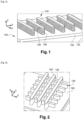
- FIG. 1 An example of a method for producing a memory device 100 comprising at least one memory stack 158 electrically connected in series to a selection transistor, according to a particular embodiment is described below in connection with the figures 1 to 16 .
- the simultaneous production of several memory devices 100 is shown, these devices forming part of an electronic component 1000.
- first and second materials correspond respectively to Si and SiGe.
- Other pairs of first and second materials are also possible: SiGe and Ge, Ge and GeSn, SiO 2 and amorphous silicon (a-Si). More generally, it can be envisaged to use, to form this alternation of layers of the first and second materials, two semiconductors capable of being etched selectively with respect to one another, or a dielectric material and a semiconductor. amorphous conductor.
- the layer stack depends on the number of levels of semiconductor material desired to form the channel of the device 100.
- the layer stack comprises four layers of silicon stacked alternately with three layers of SiGe.
- the number of layers of the first material is between 2 and 10
- the number of layers of the second material is between 1 and 10.
- each of the layers of the stack has a thickness of between 5 nm and 25 nm, and for example equal to 12 nm.
- the substrate 102 corresponds to an SOI substrate, that is to say comprising a surface layer of silicon forming the first layer of the stack produced and which is placed on a buried dielectric layer 130 comprising for example SiO 2 .
- the buried dielectric layer 130 is placed on a support layer 132 comprising, for example, silicon.
- the substrate 102 can correspond to a substrate of a type other than SOI, for example a “bulk” substrate, or massive substrate, of semiconductor (for example of silicon).
- An etching of the stack of layers produced is then carried out in order to form, on the substrate 102 (on the buried dielectric layer 130 in this example), at least one alternating stack 134 of portions 136 of the first material and portions 138. of the second material.
- the substrate 102 on the buried dielectric layer 130 in this example
- at least one alternating stack 134 of portions 136 of the first material and portions 138. of the second material On the figure 1 , six distinct stacks 134 are shown, each comprising four portions 136 and three portions 138 stacked alternately on top of each other.
- Each of the stacks 134 has a substantially elongated shape, that is to say, has a length (dimension along the X axis) greater than its width (dimension along the Y axis).
- the width of each stack 134 is for example between 20 nm and 200 nm, and the length of each stack 134 is for example greater than 100 nm.
- a thin dielectric layer 140 is then deposited conformally over the entire structure, that is to say by covering the upper faces and the side faces of the stacks 134 and the parts of the substrate 102 (of the buried dielectric layer 130 in the embodiment described) not covered by the stacks 134.
- the dielectric layer 140 comprises for example SiO 2 , which can be obtained from TEOS.
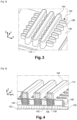
- At least one temporary grid 142 is then produced, covering part of an upper face and the side faces of the stacks 134.
- a material suitable for making temporary grids is deposited over the entire structure.
- the material deposited is polycrystalline silicon.
- the thickness of deposited material is greater than the sum of the thicknesses of one of the stacks 134 and of the dielectric layer 140, for example equal to 380 nm.
- a planarization, for example a CMP (mechano-chemical planarization) of the deposited material is then implemented so that a given thickness, for example equal to 70 nm, is preserved above the stacks 134.
- a hard mask 144 is then produced on the material remaining after planarization, the pattern of this hard mask defining that of the temporary grid(s) 142 to be produced.
- the hard mask 144 comprises a semiconductor nitride/semiconductor oxide bilayer such than SiN/SiO 2 .
- the remaining material suitable for producing the temporary grids is then engraved in accordance with the pattern defined by the hard mask 144, forming the temporary grid(s) 142.
- several temporary grids 142 are produced (three temporary grids 142 are visible on the figure 2 , each formed by covering the six stacks 134).
- each temporary grid 142 is for example between 10 nm and several hundred nm, and the length (dimension along the Y axis visible on the figure 2 ) of each temporary grid 142 depends on the number of stacks 134 on which the temporary grids 142 must be produced, and for example equal to several tens of nm.
- Dielectric spacers 114 are then produced against the sides of the temporary grids 142.
- a layer of material suitable for producing these spacers 114 is deposited in a conformal manner over the entire structure, that is to say by covering the upper faces and the side faces of the stacks 134, the temporary grids 142 and the hard masks 144 and the parts of the substrate 102 (of the buried dielectric layer 130 in the example of embodiment described) not covered by the stacks 134 and temporary grids 142.
- This material suitable for producing dielectric spacers 114 corresponds for example to SiN, SiCO or SiBCN. The thickness of this layer is for example between 5 nm and 15 nm.
- Anisotropic etching of this layer is then carried out such that remaining portions of this layer placed against the sides of the temporary gates 142 form the dielectric spacers 114 (see Figure 3 ). Remaining portions 146 of this layer placed against the sides of the stacks 134 can be retained at the end of this etching, or else be advantageously deleted.
- the anisotropic etching is implemented so as to remove the material located on the upper faces of the temporary grids 142 and the stacks 134. In addition, this etching also removes the parts of the layer 140 which are not covered by the temporary grids 142 and the dielectric spacers 114.
- the parts of the stacks 134 not covered by the temporary grids 142, by the dielectric spacers 114 or by the remaining portions 146 are etched. This engraving is stopped on the buried dielectric layer 130.
- the remaining parts of the portions 136 are then partially and selectively etched with respect to the remaining parts of the portions 138, so as to form, directly above the dielectric spacers 114, spaces 148. above and below the ends of the remaining parts of portions 138 (see Figure 4 ).
- the depth (dimension along the X axis on the Figure 4 ) etched in the remaining parts of portions 136 is for example between 5 nm and 15 nm.
- the internal dielectric spacers 115 are then made in the spaces 148 previously formed. These internal dielectric spacers 115 are obtained by depositing a dielectric material, for example SiN, SiBCN or SiCO so as to at least fill the spaces 148. The material deposited outside the spaces 148 is etched isotropically so as not to retain than the internal dielectric spacers 115 (see Figure 5 ).
- a dielectric material for example SiN, SiBCN or SiCO
- the dielectric insulation material 128 is deposited with a high thickness, then planarization is implemented until reach the hard mask 144.
- the hard mask 144 is then removed for example by wet etching, for example using a diluted H 3 PO 4 solution and used at a temperature of 110°C.
- the temporary gates 142 are then removed, for example by etching using a 0.5% diluted HF solution combined with a 1% diluted HCl solution and a 5% TMAH solution. This etching is stopped when the remaining parts of the dielectric layer 140 are reached (see Figure 6 ).
- the remaining parts of the dielectric layer 140 are then etched, then the remaining parts of the portions 136 are etched selectively with respect to the remaining parts of the portions 138, for example by carrying out wet etching.
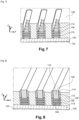
- the structure obtained at this stage is represented on the Figure 7 .
- At least one layer 112 intended to form the gate dielectrics of the selection transistors of the memory devices 100 is then deposited in a conformal manner, in particular in the spaces formed by the etching of the temporary gates 142 by covering the walls formed by the dielectric spacers 114 and the remaining parts of the portions 138.
- this layer comprises for example a material high-K dielectric (with high dielectric permittivity) such as HfO 2 .
- this layer 112 intended to form the gate dielectrics may comprise SiO 2 or Al 2 O 3 or any other suitable material or combination of materials.
- Electrostatic control gates 110 of the selection transistors of the memory devices 100 are produced by depositing one or more conductive materials on the layer 112 intended to form the gate dielectrics of the selection transistors, by a first deposition of a thin layer of TiN (thickness for example equal to 3 nm) on which is stacked a layer of tungsten with a thickness for example equal to 200 nm.
- each of the grids 110 comprises an upper part 106 and other parts 108 surrounding the remaining parts of the portions 138.
- the grids 110 comprise one or more materials different from TiN and W, such as for example polysilicon doped or any other metal (Mo, etc.).
- a planarization with stopping on the dielectric insulation material 128 is implemented to remove the material(s) of the layer 112 intended to form the gate dielectrics and the electrostatic control gates 110 deposited outside the spaces formed by the etching of the temporary grids 142.
- cavities 150 comprising side walls formed by the dielectric spacers 114, the internal dielectric spacers 115 and, in the example described here, remaining portions of the dielectric insulation material 128 (see Figure 9 ). These cavities 150 form locations for producing the contact regions of the devices 100.
- the portions 138 are then etched, for example by carrying out chemical etching using a solution of Hf-H 2 O 2 (see figures 10 And 11 ) when the portions 138 comprise SiGe.
- this etching forms spaces in the form of tunnels in which the transistor channels are intended to be produced.
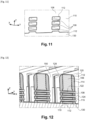
- a semiconductor layer 120 is then deposited over the entire structure produced at this stage of the process (see figures 12 And 13 ). First zones 122 of this semiconductor layer 120 which are located in the tunnel-shaped spaces previously formed are intended to form the channels of the selection transistors and are arranged against the gate dielectrics.
- Second zones 124 of this semiconductor layer 120 which cover the walls (side walls and bottom walls in the example described here) of the cavities 150 are intended to be in contact with the contact regions which will then be produced.
- the deposition is carried out without discontinuity, or without interruption, between the first and second zones 122 and 124.
- the semiconductor layer 120 comprises at least one 2D semiconductor material, for example a transition metal dichalcogenide such as MoS 2 , or WSe 2 , or WS 2 , or MoTe 2 . It is also possible that the material of the semiconductor layer 120 corresponds to IGZO, In 2 O 3 , IWO, ITO, or an amorphous semiconductor oxide, or any other suitable semiconductor material.
- a transition metal dichalcogenide such as MoS 2 , or WSe 2 , or WS 2 , or MoTe 2 .
- the material of the semiconductor layer 120 corresponds to IGZO, In 2 O 3 , IWO, ITO, or an amorphous semiconductor oxide, or any other suitable semiconductor material.
- One or more dielectric layers comprising for example Al 2 O 3 (or HfO 2 ) and/or SiO 2 (or a low-k dielectric, or a low dielectric permittivity), are then deposited and then etched in a manner isotropic in order to retain only portions 126 located in tunnel-shaped spaces (see figures 14 And 15 ). These portions 126 form dielectric bars each surrounded by one of the first zones 122 of the semiconductor layer 120.
- the semiconductor layer 120 comprises several first zones 122 superimposed one above the other by the via a succession of bars 126 and parts 108 of the gate 110 and gate dielectrics.
- contact regions 116, 118 are produced by depositing, in the example described, one or more metallic materials in the cavities 150 (see Figure 16 ). Before this or these metal deposits, it is possible to deposit a layer of graphene in the cavities 150, this or these metals then being deposited on the graphene layer.
- the contact regions 116, 118 comprise at least one metallic material such as gold, palladium, TiN, W, Ni, etc.
- each of the contact regions 116, 118 comprises a layer of TiN on which a portion of tungsten is formed.
- contact regions 116, 118 can be used to promote low resistances of contact, such as: S, Bi, Sn, Pd, Ru, Cu, Ni, Ti, TiN, W, Au, etc. These materials can also be modified subsequently (to improve their properties), by a doping step for example.
- These contact regions 116, 118 form the source/drain regions of the selection transistors of the memory devices 100.
- the contact region 118 includes a memory stack 158, that is to say a stack of materials in which it is possible to store information.
- This memory stack 158 can correspond to a stack of FeRAM type materials including in this case a layer of ferroelectric material, or OxRAM including in this an oxide layer, or CBRAM including in this case an ionic layer, for example a stack of MIM type (metal - insulator - metal).
- This memory stack 158 is arranged within the metallic material(s) forming the remainder of the contact region 118. A portion of the metallic material(s) is interposed between the memory stack 158 and the parts of the semiconductor layer 120 located in the cavity 150 in which the contact region 118 is made. Thus, the memory stack 158 finds itself interposed between a first conductive portion 157 of the contact region 118, electrically connecting the memory stack 158 to the semiconductor layer 120, and a second conductive portion 156 of the contact region 118 forming an electrical contact of the memory stack 158.
- These contact regions 116 and 118 find themselves electrically coupled to the first zones 122 of the semiconductor layer 120 via the second zones 124 of the semiconductor layer 120 which extend between the contact regions 116, 118 and the dielectric spacers 114 as well as against the other walls of the contact regions 116, 118 located in the cavities 150.
- the material of these regions deposited outside the cavities 150 is removed by implementing a planarization with stopping on the dielectric insulation material 128.
- the devices obtained at the end of this process correspond to the devices 100 represented on the Figure 16 .
- the semiconductor layer 120 does not completely fill the spaces formed by the etching of the portions 138, and the Dielectric portions 126 are produced in the spaces remaining after the deposition of the semiconductor layer 120.
- the dielectric portions 126 it is possible not to produce the dielectric portions 126, the semiconductor layer 120 filling in this case, during its deposition, the remaining spaces formed by the etching of the portions 138.
- these air-gaps do not do not prevent continuity between the first zones 122 and the second zones 124 of the semiconductor layer 120.
- the layer 112 forming the gate dielectric of the selection transistor of the memory device 100 is not deposited just before the production of the gate 110 as previously described, but that this layer is deposited in the spaces formed by the etching of the portions 138 and in the cavities 1150, just before the deposition of the semiconductor layer 120.
- the layer 112 covers the different walls on which the material of the semiconductor layer 120 is intended to be deposited, thus homogenizing the surfaces, and therefore the interfaces, against which the semiconductor layer 120 is then deposited.
- the layer 112 is deposited during two different stages: firstly just before the production of the grid 110 as previously described in link with the figure 8 , then in the spaces formed by the etching of the portions 138 and in the cavities 150, just before the deposition of the semiconductor layer 120.
- the parts of the layer 112 located directly above the grid 110 are thicker than the other parts of layer 112 because these parts combine the thicknesses of material deposited during the two deposition stages.
- all the side walls of the cavities 150 are covered by the second zones 124 of the semiconductor layer 120.
- the layer 112 forming the gate dielectrics is deposited on all of the structure (see Figure 17 ). Parts of this layer 112 are located in the tunnel-shaped spaces previously formed, thus forming the gate dielectrics, and other parts of this layer 112 cover the walls of the cavities 150.
- the semiconductor layer 120 is then deposited over the entire structure, covering the layer 112 forming the gate dielectrics (see Figure 18 ), so as to completely fill the remaining tunnel-shaped spaces.
- the cavities 150 are not completely filled by the deposition of the semiconductor layer 120 and the layer 112 forming the gate dielectrics.
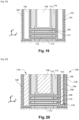
- the contact regions 116, 118 are then produced, for example by making a first deposit (for example ALD) of TiN (designated by the reference 154 on the Figure 19 ), then filling the rest of the available space with tungsten (designated by the reference 156 on the Figure 20 ). In the example described here, this deposition of tungsten also completes the production of the control grid 110. In addition, during the deposition of tungsten, it is stopped to produce the memory stack 158 within the region of contact 118, then resumed to complete the production of the contact regions 116, 118.
- ALD first deposit
- tungsten designated by the reference 156 on the Figure 20
- One of the above variants can be implemented without the other being implemented.
- the dielectric portions 126 can be produced as previously described in connection with the figures 14 And 15 .
- control grid 110 is common to several devices 100, that is to say simultaneously controls these different devices, the contact regions 116, 118 of which are electrically isolated from those of the other neighboring devices 100 by the portions of the dielectric material insulation 128.
- the grids 110 produced are not common to the different devices 100 produced.
- each of the first zones 122 of the semiconductor layer 120 can be surrounded by the same electrostatic control grid 110, as is the case in the examples previously described, or by an electrostatic control grid different from that surrounding the other first zones 122 of the semiconductor layer 120.
- each of the contact regions 116, 118 is arranged in a cavity comprising side walls formed by the dielectric spacers 114, 115 and by a dielectric insulation material 128.
- the second zones 124 of the semi-layer conductor 120 cover the side walls and the bottom walls of the cavities in which the contact regions 116, 118 are arranged.
- contact regions are common to several devices 100.
- the dielectric insulation material 128 is not present so that the same contact region , for example the contact region 118 including the memory stack 158, is electrically coupled to the channels of these two neighboring devices 100.
- Such a configuration allows for example the production of 2T1R or 2T1C type memory devices.
Landscapes
- Semiconductor Memories (AREA)
- Non-Volatile Memory (AREA)
- Thin Film Transistor (AREA)
Applications Claiming Priority (1)
| Application Number | Priority Date | Filing Date | Title |
|---|---|---|---|
| FR2214257A FR3144405B1 (fr) | 2022-12-22 | 2022-12-22 | Dispositif memoire comprenant d’importantes surfaces de contact entre le canal de conduction et les regions de contact |
Publications (2)
| Publication Number | Publication Date |
|---|---|
| EP4391069A1 true EP4391069A1 (de) | 2024-06-26 |
| EP4391069B1 EP4391069B1 (de) | 2025-06-11 |
Family
ID=86942492
Family Applications (1)
| Application Number | Title | Priority Date | Filing Date |
|---|---|---|---|
| EP23218847.4A Active EP4391069B1 (de) | 2022-12-22 | 2023-12-20 | Speicheranordnung mit grossen kontaktflächen zwischen leitungskanal und kontaktbereichen |
Country Status (6)
| Country | Link |
|---|---|
| US (1) | US20240215263A1 (de) |
| EP (1) | EP4391069B1 (de) |
| JP (1) | JP2024091575A (de) |
| CN (1) | CN118251015A (de) |
| FR (1) | FR3144405B1 (de) |
| TW (1) | TW202441598A (de) |
Citations (5)
| Publication number | Priority date | Publication date | Assignee | Title |
|---|---|---|---|---|
| US20170092541A1 (en) * | 2009-10-12 | 2017-03-30 | Monolithic 3D Inc. | 3d semiconductor device and structure |
| US20210408227A1 (en) * | 2020-06-26 | 2021-12-30 | Intel Corporation | Transition metal dichalcogenide nanowires and methods of fabrication |
| US20220045176A1 (en) | 2020-08-07 | 2022-02-10 | Taiwan Semiconductor Manufacturing Co., Ltd. | 2d-Channel Transistor Structure with Source-Drain Engineering |
| US20220199783A1 (en) * | 2020-12-23 | 2022-06-23 | Intel Corporation | Transition metal dichalcogenide nanosheet transistors and methods of fabrication |
| EP4092750A1 (de) * | 2021-05-20 | 2022-11-23 | Commissariat à l'énergie atomique et aux énergies alternatives | 1t1r-speicher mit 3d-struktur |
-
2022
- 2022-12-22 FR FR2214257A patent/FR3144405B1/fr active Active
-
2023
- 2023-12-19 TW TW112149562A patent/TW202441598A/zh unknown
- 2023-12-20 EP EP23218847.4A patent/EP4391069B1/de active Active
- 2023-12-21 JP JP2023215864A patent/JP2024091575A/ja active Pending
- 2023-12-21 US US18/393,200 patent/US20240215263A1/en active Pending
- 2023-12-22 CN CN202311790252.4A patent/CN118251015A/zh active Pending
Patent Citations (5)
| Publication number | Priority date | Publication date | Assignee | Title |
|---|---|---|---|---|
| US20170092541A1 (en) * | 2009-10-12 | 2017-03-30 | Monolithic 3D Inc. | 3d semiconductor device and structure |
| US20210408227A1 (en) * | 2020-06-26 | 2021-12-30 | Intel Corporation | Transition metal dichalcogenide nanowires and methods of fabrication |
| US20220045176A1 (en) | 2020-08-07 | 2022-02-10 | Taiwan Semiconductor Manufacturing Co., Ltd. | 2d-Channel Transistor Structure with Source-Drain Engineering |
| US20220199783A1 (en) * | 2020-12-23 | 2022-06-23 | Intel Corporation | Transition metal dichalcogenide nanosheet transistors and methods of fabrication |
| EP4092750A1 (de) * | 2021-05-20 | 2022-11-23 | Commissariat à l'énergie atomique et aux énergies alternatives | 1t1r-speicher mit 3d-struktur |
Non-Patent Citations (1)
| Title |
|---|
| K. P. O'BRIEN ET AL.: "Advancing 2D Monolayer CMOS Through Contact, Channel and Interface Engineering", 2021 IEEE INTERNATIONAL ELECTRON DEVICES MEETING (IEDM), 2021, pages 1 - 4 |
Also Published As
| Publication number | Publication date |
|---|---|
| EP4391069B1 (de) | 2025-06-11 |
| FR3144405B1 (fr) | 2024-12-20 |
| TW202441598A (zh) | 2024-10-16 |
| FR3144405A1 (fr) | 2024-06-28 |
| CN118251015A (zh) | 2024-06-25 |
| US20240215263A1 (en) | 2024-06-27 |
| JP2024091575A (ja) | 2024-07-04 |
Similar Documents
| Publication | Publication Date | Title |
|---|---|---|
| FR3086456A1 (fr) | Procede de realisation de transistors superposes | |
| CN113889480A (zh) | 三维存储器器件及其制造方法 | |
| US11024636B1 (en) | Vertical 3D stack NOR device | |
| FR3016237A1 (fr) | Dispositif a nanofils de semi-conducteur partiellement entoures par une grille | |
| FR3060839A1 (fr) | Procede de realisation d'un dispositif semi-conducteur a nanofil et espaceurs externe et interne alignes | |
| EP4092750A1 (de) | 1t1r-speicher mit 3d-struktur | |
| WO2014016147A2 (fr) | Procédé pour la réalisation d'une capacité | |
| EP1999786A2 (de) | Verfahren zur herstellung eines feldeffekttransistors mit selbstjustierten gates | |
| FR2818439A1 (fr) | Procede de fabrication d'un ilot de matiere confine entre des electrodes, et applications aux transistors | |
| EP4391081B1 (de) | Mikroelektronische vorrichtung mit kontaktflächen zwischen leitungskanal und source- und drain-bereichen | |
| EP3404723A1 (de) | Herstellung eines mos-transistors auf der basis eines 2d-halbleitermaterials | |
| JP7838907B2 (ja) | 二次元チャネルを有する半導体構造 | |
| EP3079178B1 (de) | Herstellungsverfahren eines integrierten schaltkreises, in den ein fet-transistor und ein oxram-speicherpunkt integriert sind | |
| EP4639635A1 (de) | Mikroelektronische fet-vorrichtung mit grossen kontaktflächen zwischen dem leitungskanal und den source- und drain-regionen | |
| EP4391069B1 (de) | Speicheranordnung mit grossen kontaktflächen zwischen leitungskanal und kontaktbereichen | |
| EP3046143A1 (de) | Verfahren zur herstellung eines dreidimensionalen integrierten schaltkreises | |
| FR3144408A1 (fr) | Dispositif microelectronique comprenant d’importantes surfaces de contact entre le canal de conduction et les regions de source et drain | |
| EP4391078A2 (de) | Fet-mikroelektronische vorrichtung mit grossen kontaktflächen zwischen leitungskanal und source- und drain-bereichen | |
| FR2947384A1 (fr) | Procede de realisation d'un transistor a source et drain metalliques | |
| EP4507005B1 (de) | Verfahren zur herstellung einer vorrichtung mit übereinanderliegenden transistoren | |
| EP4507004B1 (de) | Mikroelektronische vorrichtung mit einem mantelgitter und verfahren zur herstellung einer solchen vorrichtung | |
| CN120035124B (zh) | 半导体结构及其制备方法 | |
| CN118248728A (zh) | 导电通道与源极漏极区域间包括大接触表面的微电子器件 | |
| FR3166241A1 (fr) | Dispositif microélectronique comprenant une grille enrobante et procédé de réalisation | |
| EP4507006A1 (de) | Verfahren zur herstellung einer mikroelektronischen vorrichtung mit einem integrierten gate |
Legal Events
| Date | Code | Title | Description |
|---|---|---|---|
| PUAI | Public reference made under article 153(3) epc to a published international application that has entered the european phase |
Free format text: ORIGINAL CODE: 0009012 |
|
| STAA | Information on the status of an ep patent application or granted ep patent |
Free format text: STATUS: REQUEST FOR EXAMINATION WAS MADE |
|
| 17P | Request for examination filed |
Effective date: 20231220 |
|
| AK | Designated contracting states |
Kind code of ref document: A1 Designated state(s): AL AT BE BG CH CY CZ DE DK EE ES FI FR GB GR HR HU IE IS IT LI LT LU LV MC ME MK MT NL NO PL PT RO RS SE SI SK SM TR |
|
| RAP3 | Party data changed (applicant data changed or rights of an application transferred) |
Owner name: COMMISSARIAT A L'ENERGIE ATOMIQUE ET AUX ENERGIESALTERNATIVES |
|
| REG | Reference to a national code |
Ref country code: DE Free format text: PREVIOUS MAIN CLASS: H01L0029060000 Ref country code: DE Ref legal event code: R079 Ref document number: 602023003972 Country of ref document: DE Free format text: PREVIOUS MAIN CLASS: H01L0029060000 Ipc: H10B0063000000 |
|
| RIC1 | Information provided on ipc code assigned before grant |
Ipc: H10D 64/27 20250101ALN20250213BHEP Ipc: H10D 30/43 20250101ALN20250213BHEP Ipc: H10D 30/01 20250101ALN20250213BHEP Ipc: B82Y 10/00 20110101ALN20250213BHEP Ipc: H10B 53/30 20230101ALI20250213BHEP Ipc: H10B 53/20 20230101ALI20250213BHEP Ipc: H10B 51/20 20230101ALI20250213BHEP Ipc: H10D 99/00 20250101ALI20250213BHEP Ipc: H10D 64/62 20250101ALI20250213BHEP Ipc: H10D 64/01 20250101ALI20250213BHEP Ipc: H10D 62/80 20250101ALI20250213BHEP Ipc: H10D 62/13 20250101ALI20250213BHEP Ipc: H10D 62/10 20250101ALI20250213BHEP Ipc: H10D 30/69 20250101ALI20250213BHEP Ipc: H10D 30/67 20250101ALI20250213BHEP Ipc: H10D 30/47 20250101ALI20250213BHEP Ipc: H10B 63/00 20230101AFI20250213BHEP Ipc: H10B 51/30 20230101ALI20250213BHEP |
|
| GRAP | Despatch of communication of intention to grant a patent |
Free format text: ORIGINAL CODE: EPIDOSNIGR1 |
|
| STAA | Information on the status of an ep patent application or granted ep patent |
Free format text: STATUS: GRANT OF PATENT IS INTENDED |
|
| INTG | Intention to grant announced |
Effective date: 20250327 |
|
| RIN1 | Information on inventor provided before grant (corrected) |
Inventor name: REBOH, SHAY Inventor name: COQUAND, REMI Inventor name: BARRAUD, SYLVAIN |
|
| GRAS | Grant fee paid |
Free format text: ORIGINAL CODE: EPIDOSNIGR3 |
|
| GRAA | (expected) grant |
Free format text: ORIGINAL CODE: 0009210 |
|
| STAA | Information on the status of an ep patent application or granted ep patent |
Free format text: STATUS: THE PATENT HAS BEEN GRANTED |
|
| AK | Designated contracting states |
Kind code of ref document: B1 Designated state(s): AL AT BE BG CH CY CZ DE DK EE ES FI FR GB GR HR HU IE IS IT LI LT LU LV MC ME MK MT NL NO PL PT RO RS SE SI SK SM TR |
|
| REG | Reference to a national code |
Ref country code: GB Ref legal event code: FG4D Free format text: NOT ENGLISH |
|
| REG | Reference to a national code |
Ref country code: CH Ref legal event code: EP |
|
| REG | Reference to a national code |
Ref country code: DE Ref legal event code: R096 Ref document number: 602023003972 Country of ref document: DE |
|
| REG | Reference to a national code |
Ref country code: IE Ref legal event code: FG4D Free format text: LANGUAGE OF EP DOCUMENT: FRENCH |
|
| PG25 | Lapsed in a contracting state [announced via postgrant information from national office to epo] |
Ref country code: ES Free format text: LAPSE BECAUSE OF FAILURE TO SUBMIT A TRANSLATION OF THE DESCRIPTION OR TO PAY THE FEE WITHIN THE PRESCRIBED TIME-LIMIT Effective date: 20250611 Ref country code: FI Free format text: LAPSE BECAUSE OF FAILURE TO SUBMIT A TRANSLATION OF THE DESCRIPTION OR TO PAY THE FEE WITHIN THE PRESCRIBED TIME-LIMIT Effective date: 20250611 |
|
| REG | Reference to a national code |
Ref country code: LT Ref legal event code: MG9D |
|
| PG25 | Lapsed in a contracting state [announced via postgrant information from national office to epo] |
Ref country code: GR Free format text: LAPSE BECAUSE OF FAILURE TO SUBMIT A TRANSLATION OF THE DESCRIPTION OR TO PAY THE FEE WITHIN THE PRESCRIBED TIME-LIMIT Effective date: 20250912 Ref country code: NO Free format text: LAPSE BECAUSE OF FAILURE TO SUBMIT A TRANSLATION OF THE DESCRIPTION OR TO PAY THE FEE WITHIN THE PRESCRIBED TIME-LIMIT Effective date: 20250911 |
|
| REG | Reference to a national code |
Ref country code: NL Ref legal event code: MP Effective date: 20250611 |
|
| PG25 | Lapsed in a contracting state [announced via postgrant information from national office to epo] |
Ref country code: BG Free format text: LAPSE BECAUSE OF FAILURE TO SUBMIT A TRANSLATION OF THE DESCRIPTION OR TO PAY THE FEE WITHIN THE PRESCRIBED TIME-LIMIT Effective date: 20250611 |
|
| PG25 | Lapsed in a contracting state [announced via postgrant information from national office to epo] |
Ref country code: HR Free format text: LAPSE BECAUSE OF FAILURE TO SUBMIT A TRANSLATION OF THE DESCRIPTION OR TO PAY THE FEE WITHIN THE PRESCRIBED TIME-LIMIT Effective date: 20250611 |
|
| PG25 | Lapsed in a contracting state [announced via postgrant information from national office to epo] |
Ref country code: RS Free format text: LAPSE BECAUSE OF FAILURE TO SUBMIT A TRANSLATION OF THE DESCRIPTION OR TO PAY THE FEE WITHIN THE PRESCRIBED TIME-LIMIT Effective date: 20250911 |
|
| PG25 | Lapsed in a contracting state [announced via postgrant information from national office to epo] |
Ref country code: LV Free format text: LAPSE BECAUSE OF FAILURE TO SUBMIT A TRANSLATION OF THE DESCRIPTION OR TO PAY THE FEE WITHIN THE PRESCRIBED TIME-LIMIT Effective date: 20250611 |
|
| PG25 | Lapsed in a contracting state [announced via postgrant information from national office to epo] |
Ref country code: NL Free format text: LAPSE BECAUSE OF FAILURE TO SUBMIT A TRANSLATION OF THE DESCRIPTION OR TO PAY THE FEE WITHIN THE PRESCRIBED TIME-LIMIT Effective date: 20250611 |
|
| PG25 | Lapsed in a contracting state [announced via postgrant information from national office to epo] |
Ref country code: PT Free format text: LAPSE BECAUSE OF FAILURE TO SUBMIT A TRANSLATION OF THE DESCRIPTION OR TO PAY THE FEE WITHIN THE PRESCRIBED TIME-LIMIT Effective date: 20251013 |
|
| REG | Reference to a national code |
Ref country code: AT Ref legal event code: MK05 Ref document number: 1803293 Country of ref document: AT Kind code of ref document: T Effective date: 20250611 |
|
| PG25 | Lapsed in a contracting state [announced via postgrant information from national office to epo] |
Ref country code: IS Free format text: LAPSE BECAUSE OF FAILURE TO SUBMIT A TRANSLATION OF THE DESCRIPTION OR TO PAY THE FEE WITHIN THE PRESCRIBED TIME-LIMIT Effective date: 20251011 |
|
| PG25 | Lapsed in a contracting state [announced via postgrant information from national office to epo] |
Ref country code: AT Free format text: LAPSE BECAUSE OF FAILURE TO SUBMIT A TRANSLATION OF THE DESCRIPTION OR TO PAY THE FEE WITHIN THE PRESCRIBED TIME-LIMIT Effective date: 20250611 Ref country code: SM Free format text: LAPSE BECAUSE OF FAILURE TO SUBMIT A TRANSLATION OF THE DESCRIPTION OR TO PAY THE FEE WITHIN THE PRESCRIBED TIME-LIMIT Effective date: 20250611 |
|
| PGFP | Annual fee paid to national office [announced via postgrant information from national office to epo] |
Ref country code: FR Payment date: 20251222 Year of fee payment: 3 |
|
| PG25 | Lapsed in a contracting state [announced via postgrant information from national office to epo] |
Ref country code: CZ Free format text: LAPSE BECAUSE OF FAILURE TO SUBMIT A TRANSLATION OF THE DESCRIPTION OR TO PAY THE FEE WITHIN THE PRESCRIBED TIME-LIMIT Effective date: 20250611 |
|
| PG25 | Lapsed in a contracting state [announced via postgrant information from national office to epo] |
Ref country code: PL Free format text: LAPSE BECAUSE OF FAILURE TO SUBMIT A TRANSLATION OF THE DESCRIPTION OR TO PAY THE FEE WITHIN THE PRESCRIBED TIME-LIMIT Effective date: 20250611 |
|
| PG25 | Lapsed in a contracting state [announced via postgrant information from national office to epo] |
Ref country code: EE Free format text: LAPSE BECAUSE OF FAILURE TO SUBMIT A TRANSLATION OF THE DESCRIPTION OR TO PAY THE FEE WITHIN THE PRESCRIBED TIME-LIMIT Effective date: 20250611 |
|
| PG25 | Lapsed in a contracting state [announced via postgrant information from national office to epo] |
Ref country code: SK Free format text: LAPSE BECAUSE OF FAILURE TO SUBMIT A TRANSLATION OF THE DESCRIPTION OR TO PAY THE FEE WITHIN THE PRESCRIBED TIME-LIMIT Effective date: 20250611 |
|
| PG25 | Lapsed in a contracting state [announced via postgrant information from national office to epo] |
Ref country code: RO Free format text: LAPSE BECAUSE OF FAILURE TO SUBMIT A TRANSLATION OF THE DESCRIPTION OR TO PAY THE FEE WITHIN THE PRESCRIBED TIME-LIMIT Effective date: 20250611 |
|
| REG | Reference to a national code |
Ref country code: DE Ref legal event code: R097 Ref document number: 602023003972 Country of ref document: DE |
|
| PG25 | Lapsed in a contracting state [announced via postgrant information from national office to epo] |
Ref country code: DK Free format text: LAPSE BECAUSE OF FAILURE TO SUBMIT A TRANSLATION OF THE DESCRIPTION OR TO PAY THE FEE WITHIN THE PRESCRIBED TIME-LIMIT Effective date: 20250611 |
|
| PGFP | Annual fee paid to national office [announced via postgrant information from national office to epo] |
Ref country code: DE Payment date: 20251222 Year of fee payment: 3 |
|
| PG25 | Lapsed in a contracting state [announced via postgrant information from national office to epo] |
Ref country code: IT Free format text: LAPSE BECAUSE OF FAILURE TO SUBMIT A TRANSLATION OF THE DESCRIPTION OR TO PAY THE FEE WITHIN THE PRESCRIBED TIME-LIMIT Effective date: 20250611 |
|
| PLBE | No opposition filed within time limit |
Free format text: ORIGINAL CODE: 0009261 |
|
| STAA | Information on the status of an ep patent application or granted ep patent |
Free format text: STATUS: NO OPPOSITION FILED WITHIN TIME LIMIT |
|
| REG | Reference to a national code |
Ref country code: CH Ref legal event code: L10 Free format text: ST27 STATUS EVENT CODE: U-0-0-L10-L00 (AS PROVIDED BY THE NATIONAL OFFICE) Effective date: 20260423 |
|
| 26N | No opposition filed |
Effective date: 20260312 |
|
| PG25 | Lapsed in a contracting state [announced via postgrant information from national office to epo] |
Ref country code: LT Free format text: LAPSE BECAUSE OF FAILURE TO SUBMIT A TRANSLATION OF THE DESCRIPTION OR TO PAY THE FEE WITHIN THE PRESCRIBED TIME-LIMIT Effective date: 20250611 |
|
| PG25 | Lapsed in a contracting state [announced via postgrant information from national office to epo] |
Ref country code: MC Free format text: LAPSE BECAUSE OF FAILURE TO SUBMIT A TRANSLATION OF THE DESCRIPTION OR TO PAY THE FEE WITHIN THE PRESCRIBED TIME-LIMIT Effective date: 20250611 |
|
| PG25 | Lapsed in a contracting state [announced via postgrant information from national office to epo] |
Ref country code: SE Free format text: LAPSE BECAUSE OF FAILURE TO SUBMIT A TRANSLATION OF THE DESCRIPTION OR TO PAY THE FEE WITHIN THE PRESCRIBED TIME-LIMIT Effective date: 20250611 |