EP4389990A1 - System zur steuerung einer manipulationsreaktionskraft und verfahren zur steuerung einer manipulationsreaktionskraft - Google Patents
System zur steuerung einer manipulationsreaktionskraft und verfahren zur steuerung einer manipulationsreaktionskraft Download PDFInfo
- Publication number
- EP4389990A1 EP4389990A1 EP22875425.5A EP22875425A EP4389990A1 EP 4389990 A1 EP4389990 A1 EP 4389990A1 EP 22875425 A EP22875425 A EP 22875425A EP 4389990 A1 EP4389990 A1 EP 4389990A1
- Authority
- EP
- European Patent Office
- Prior art keywords
- manipulation
- reaction force
- perceived
- controlling
- remote
- Prior art date
- Legal status (The legal status is an assumption and is not a legal conclusion. Google has not performed a legal analysis and makes no representation as to the accuracy of the status listed.)
- Pending
Links
Images



Classifications
-
- E—FIXED CONSTRUCTIONS
- E02—HYDRAULIC ENGINEERING; FOUNDATIONS; SOIL SHIFTING
- E02F—DREDGING; SOIL-SHIFTING
- E02F9/00—Component parts of dredgers or soil-shifting machines, not restricted to one of the kinds covered by groups E02F3/00 - E02F7/00
- E02F9/20—Drives; Control devices
- E02F9/22—Hydraulic or pneumatic drives
- E02F9/2203—Arrangements for controlling the attitude of actuators, e.g. speed, floating function
-
- E—FIXED CONSTRUCTIONS
- E02—HYDRAULIC ENGINEERING; FOUNDATIONS; SOIL SHIFTING
- E02F—DREDGING; SOIL-SHIFTING
- E02F9/00—Component parts of dredgers or soil-shifting machines, not restricted to one of the kinds covered by groups E02F3/00 - E02F7/00
- E02F9/20—Drives; Control devices
- E02F9/2004—Control mechanisms, e.g. control levers
- E02F9/2012—Setting the functions of the control levers, e.g. changing assigned functions among operations levers, setting functions dependent on the operator or seat orientation
-
- E—FIXED CONSTRUCTIONS
- E02—HYDRAULIC ENGINEERING; FOUNDATIONS; SOIL SHIFTING
- E02F—DREDGING; SOIL-SHIFTING
- E02F9/00—Component parts of dredgers or soil-shifting machines, not restricted to one of the kinds covered by groups E02F3/00 - E02F7/00
- E02F9/20—Drives; Control devices
- E02F9/2025—Particular purposes of control systems not otherwise provided for
- E02F9/205—Remotely operated machines, e.g. unmanned vehicles
-
- G—PHYSICS
- G05—CONTROLLING; REGULATING
- G05G—CONTROL DEVICES OR SYSTEMS INSOFAR AS CHARACTERISED BY MECHANICAL FEATURES ONLY
- G05G25/00—Other details or appurtenances of control mechanisms, e.g. supporting intermediate members elastically
-
- G—PHYSICS
- G05—CONTROLLING; REGULATING
- G05G—CONTROL DEVICES OR SYSTEMS INSOFAR AS CHARACTERISED BY MECHANICAL FEATURES ONLY
- G05G5/00—Means for preventing, limiting or returning the movements of parts of a control mechanism, e.g. locking controlling member
- G05G5/03—Means for enhancing the operator's awareness of arrival of the controlling member at a command or datum position; Providing feel, e.g. means for creating a counterforce
-
- G—PHYSICS
- G05—CONTROLLING; REGULATING
- G05G—CONTROL DEVICES OR SYSTEMS INSOFAR AS CHARACTERISED BY MECHANICAL FEATURES ONLY
- G05G9/00—Manually-actuated control mechanisms provided with one single controlling member co-operating with two or more controlled members, e.g. selectively, simultaneously
- G05G9/02—Manually-actuated control mechanisms provided with one single controlling member co-operating with two or more controlled members, e.g. selectively, simultaneously the controlling member being movable in different independent ways, movement in each individual way actuating one controlled member only
- G05G9/04—Manually-actuated control mechanisms provided with one single controlling member co-operating with two or more controlled members, e.g. selectively, simultaneously the controlling member being movable in different independent ways, movement in each individual way actuating one controlled member only in which movement in two or more ways can occur simultaneously
- G05G9/047—Manually-actuated control mechanisms provided with one single controlling member co-operating with two or more controlled members, e.g. selectively, simultaneously the controlling member being movable in different independent ways, movement in each individual way actuating one controlled member only in which movement in two or more ways can occur simultaneously the controlling member being movable by hand about orthogonal axes, e.g. joysticks
-
- G—PHYSICS
- G05—CONTROLLING; REGULATING
- G05G—CONTROL DEVICES OR SYSTEMS INSOFAR AS CHARACTERISED BY MECHANICAL FEATURES ONLY
- G05G9/00—Manually-actuated control mechanisms provided with one single controlling member co-operating with two or more controlled members, e.g. selectively, simultaneously
- G05G9/02—Manually-actuated control mechanisms provided with one single controlling member co-operating with two or more controlled members, e.g. selectively, simultaneously the controlling member being movable in different independent ways, movement in each individual way actuating one controlled member only
- G05G9/04—Manually-actuated control mechanisms provided with one single controlling member co-operating with two or more controlled members, e.g. selectively, simultaneously the controlling member being movable in different independent ways, movement in each individual way actuating one controlled member only in which movement in two or more ways can occur simultaneously
- G05G9/047—Manually-actuated control mechanisms provided with one single controlling member co-operating with two or more controlled members, e.g. selectively, simultaneously the controlling member being movable in different independent ways, movement in each individual way actuating one controlled member only in which movement in two or more ways can occur simultaneously the controlling member being movable by hand about orthogonal axes, e.g. joysticks
- G05G2009/04766—Manually-actuated control mechanisms provided with one single controlling member co-operating with two or more controlled members, e.g. selectively, simultaneously the controlling member being movable in different independent ways, movement in each individual way actuating one controlled member only in which movement in two or more ways can occur simultaneously the controlling member being movable by hand about orthogonal axes, e.g. joysticks providing feel, e.g. indexing means, means to create counterforce
Definitions
- the present invention relates to a technique for causing manipulation reaction force against manipulation force to act on a manipulation mechanism operated in positive/negative manipulation directions by an operator in order to operate a work machine or a component thereof in positive/negative operation directions.
- a manipulation lever device in which a cross switch including front, rear, left, and right switch portions pressed and manipulated by a finger of an operator is provided on a holding portion of a manipulation lever of a construction machine has been proposed (for example, see Patent Literature 2). This makes it possible to reduce fatigue of an arm of the operator manipulating the construction machine.
- An object of the present invention is to provide a system and the like that can improve operability of the manipulation mechanism for the operator.
- a system for controlling manipulation reaction force is a system for controlling manipulation reaction force configured to control operation of an actuator to cause a manipulation reaction force to act on a manipulation mechanism in a direction corresponding to a manipulation direction detected by an operating manner detection sensor, the manipulation reaction force being of strength corresponding to a manipulation amount detected by the operating manner detection sensor of the manipulation mechanism operated by an operator in a positive manipulation direction and a negative manipulation direction, which are opposite to each other, for a purpose of operating a work machine to be controlled or a component of the work machine in a positive operation direction and a negative operation direction, which are opposite to each other.
- the system for controlling manipulation reaction force is configured to control the operation of the actuator to cause a manipulation reaction force corresponding to the manipulation amount of the manipulation mechanism to act on the manipulation mechanism in the positive manipulation direction and the negative manipulation direction, such that a perceived reaction force is realized in at least partially a symmetrical manner about a manipulation amount of zero of the manipulation mechanism, the perceived reaction force being a manipulation reaction force perceived by the operator through the manipulation mechanism based on the manipulation amount of the manipulation mechanism in the positive manipulation direction and the negative manipulation direction.
- the operation of the actuator is controlled based on the manipulation amount of the manipulation mechanism in each of the positive manipulation direction and the negative manipulation direction, which are opposite to each other.
- the manipulation reaction force acts on the manipulation mechanism.
- the operation of the actuator, and furthermore, the manipulation reaction force acting on the manipulation mechanism is controlled such that the reaction force (perceived reaction force) perceived by the operator through the manipulation mechanism at least partially realizes symmetry about the manipulation amount of zero within a manipulation amount rage in the positive manipulation direction (positive definition range) and a manipulation amount range in the negative manipulation direction (negative definition range).
- a manipulation reaction force f(X) is controlled such that perceived reaction forces F(+X) and F(-X) respectively corresponding to a manipulation amount +X in the positive manipulation direction and a manipulation amount -X in the negative manipulation direction equal in absolute value to the manipulation amount +X are equal to each other.
- the manipulation amount of the manipulation mechanism and the perceived reaction force by the operator are made equal to or matched with each other, which makes it possible to improve operability of the manipulation mechanism for the operator.
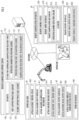
- a system for controlling manipulation reaction force 110 as an embodiment of the present invention illustrated in FIG. 1 is implemented as a remote manipulation support server 10 for supporting remote manipulation of a work machine 40 by a remote manipulation apparatus 20.
- the remote manipulation support server 10 and the remote manipulation apparatus 20 are configured to communicate with each other through a first network.
- the remote manipulation support server 10 and the work machine 40 are configured to communicate with each other through a second network.
- the first network and the second network may be networks common in communication standard and the like, or may be networks different in communication standard and the like.
- the remote manipulation support server 10 comprises a database 102, the system for controlling manipulation reaction force 110, a first support processing element 121, and a second support processing element 122.
- the database 102 stores and holds captured image data and the like.
- the database 102 may be implemented as a database server different from the remote manipulation support server 10.
- Each of the support processing elements includes a calculation processing device (single core processor, multi core processor, or processor core constituting one of single core processor and multi core processor), reads necessary data and software from a storage device such as a memory, and performs calculation processing described below on the data based on the software.
- the system for controlling manipulation reaction force 110 comprises an operating manner recognition element 111, a perceived reaction force recognition element 112, and a manipulation reaction force recognition element 114.
- Each of the elements includes a calculation processing device (single core processor, multicore processor, or processor core constituting one of single core processor and multi core processor), reads necessary data and software from a storage device such as a memory, and performs calculation processing described below on the data based on the software.
- the remote manipulation apparatus 20 comprises a remote control device 200, a remote input interface 210, and a remote output interface 220.
- the remote control device 200 includes a calculation processing device (single core processor, multi core processor, or processor core constituting one of single core processor and multi core processor), reads necessary data and software from a storage device such as a memory, and performs calculation processing on the data based on the software.
- the remote input interface 210 comprises a remote manipulation mechanism 211.
- the remote output interface 220 comprises a remote image output device 221 and a remote wireless communication device 224.
- the remote output interface 220 may comprise, as an information transmission unit, a sound output device in addition to the remote image output device 221.
- the remote manipulation mechanism 211 includes a traveling manipulation device, a turning manipulation device, a boom manipulation device, an arm manipulation device, a bucket manipulation device, an operating manner detection sensor 212, and actuators 214.
- Each of the manipulation devices includes a manipulation lever receiving rotating manipulation.
- the manipulation lever of the traveling manipulation device (traveling lever) is manipulated to move a lower travelling body 410 of the work machine 40.
- the traveling lever may also serve as a traveling pedal.
- the manipulation lever of the turning manipulation device (turning lever) is manipulated to move a hydraulic turning motor constituting a turning mechanism 430 of the work machine 40.
- the manipulation lever of the boom manipulation device (boom lever) is manipulated to move a boom cylinder 442 of the work machine 40.
- the manipulation lever of the arm manipulation device (arm lever) is manipulated to move an arm cylinder 444 of the work machine 40.
- the manipulation lever of the bucket manipulation device (bucket lever) is manipulated to move a bucket cylinder 446 of the work machine 40.
- each of the manipulation levers constituting the remote manipulation mechanism 211 is arranged around a seat St on which an operator sits.
- the seat St has a form of a high-back chair with armrests; however, the seat St may be a seat portion having an optional form on which the operator can sit, such as a form of a low-back chair without a headrest and a form of a chair without a backrest.
- manipulation levers 2111 and 2112 are cross manipulation levers, and are each configured to be displaceable or tiltable in a forward manipulation direction and a rearward manipulation direction (upward direction and downward direction in drawing), which are opposite to each other, and in a leftward manipulation direction and a rightward manipulation direction (leftward direction and rightward direction in drawing) that are perpendicular to the forward manipulation direction and the rearward manipulation direction and are opposite to each other.
- Each of the manipulation levers 2111 and 2112 may be formed from an omnidirectional manipulation lever tilted to diagonally forward right, diagonally forward left, diagonally rearward right, and diagonally rearward left directions, in addition to the front-rear direction and the right-left direction.
- each of the manipulation levers 2111 and 2112 is tilted diagonally forward left (simultaneously manipulated in forward manipulation direction and leftward manipulation direction)
- each of the manipulation levers 2111 and 2112 is tilted diagonally rearward right (simultaneously manipulated in rearward manipulation direction and rightward manipulation direction)
- each of the manipulation levers 2111 and 2112 is tilted diagonally rearward left (simultaneously manipulated in rearward manipulation direction and leftward manipulation direction)
- Paired right and left traveling levers 2110 corresponding to right and left crawlers are laterally arranged side by side in front of the seat St.
- One manipulation lever may also serve as a plurality of manipulation levers.
- the left manipulation lever 2111 provided in front of a left frame of the seat St illustrated in FIG. 2 may function as the arm lever in a case of being manipulated in a front-rear direction and may function as the turning lever in a case of being manipulated in a right-left direction.
- the right manipulation lever 2112 provided in front of a right frame of the seat St illustrated in FIG. 2 may function as the boom lever in a case of being manipulated in the front-rear direction and may function as the bucket lever in a case of being manipulated in the right-left direction.
- a lever pattern may be optionally changed by a manipulation instruction from the operator.
- the operating manner detection sensor 212 includes, for example, a contact or non-contact angular sensor.
- the operating manner detection sensor 212 is configured to output a signal corresponding to any of the forward manipulation direction and the rearward manipulation direction (paired manipulation directions opposite to each other) and the leftward manipulation direction and the rightward manipulation direction (paired manipulation directions opposite to each other) as the manipulation direction or the tilting direction of each of the left manipulation lever 2111 and the right manipulation lever 2112, and a signal corresponding to a size or an absolute value of the tilting angle as the manipulation amount of each of the left manipulation lever 2111 and the right manipulation lever 2112.
- the output signals are input to the remote control device 200, and are stored and held in the storage device of the remote control device 200.
- a slide switch slidable forward, rearward, rightward, and leftward constitutes the remote manipulation mechanism 211 in place of or in addition to each of the manipulation levers 2111 and 2112
- a slide direction and a slide amount (displacement amount) of the switch may be recognized as an operating manner of the remote manipulation mechanism 211.
- the tilting angles of the paired right and left traveling levers 2110, or turning angles or displacement amounts of members coupled thereto may be detected as manipulation amounts.
- the actuators 214 each include, for example, an electric motor.
- the paired actuators 214 are coupled to the left manipulation lever 2111 and the right manipulation lever 2112 through different power transmission mechanisms.
- Each of the actuators 214 is configured to cause manipulation reaction forces corresponding to the manipulation amounts to act on the left manipulation lever 2111 and the right manipulation lever 2112 in directions opposite to the manipulation directions.
- the operation of the actuators 214 is controlled by the remote control device 200.
- the remote image output device 221 includes a center remote image output device 2210, a left remote image output device 2211, and a right remote image output device 2212 each having a substantially rectangular screen and respectively arranged in front of, in left oblique front of, and in right oblique front of the seat St.
- Shapes and sizes of the screens (image display regions) of the center remote image output device 2210, the left remote image output device 2211, and the right remote image output device 2212 may be the same as or different from one another.
- a right edge of the left remote image output device 2211 is adjacent to a left edge of the center remote image output device 2210 such that the screen of the center remote image output device 2210 and the screen of the left remote image output device 2211 form an inclination angle ⁇ 1 (for example, 120° ⁇ ⁇ 1 ⁇ 150°).
- a left edge of the right remote image output device 2212 is adj acent to a right edge of the center remote image output device 2210 such that the screen of the center remote image output device 2210 and the screen of the right remote image output device 2212 form an inclination angle ⁇ 2 (for example, 120° ⁇ ⁇ 2 ⁇ 150°).
- the inclination angles ⁇ 1 and ⁇ 2 may be equal to or different from each other.
- the screen of each of the center remote image output device 2210, the left remote image output device 2211, and the right remote image output device 2212 may be parallel to a vertical direction, or may be inclined to the vertical direction. At least one of the center remote image output device 2210, the left remote image output device 2211, and the right remote image output device 2212 may include a plurality of divided image output devices.
- the center remote image output device 2210 may include paired image output devices vertically adjacent to each other and each including a substantially rectangular screen.
- the work machine 40 comprises an actual machine control device 400, an actual machine input interface 41, an actual machine output interface 42, and a work mechanism 440.
- the actual machine control device 400 includes a calculation processing device (single core processor, multicore processor, or processor core constituting one of single core processor and multi core processor), reads necessary data and software from a storage device such as a memory, and performs calculation processing on the data based on the software.
- the work machine 40 is, for example, a crawler shovel (construction machine) of hydraulic type, electric type, or hybrid driven type including hydraulic type and electric type in combination.
- the work machine 40 comprises the crawler lower travelling body 410, and an upper turning body 420 turnably mounted on the lower travelling body 410 through a turning mechanism 430.
- a cab 424 (operation room) is provided on a front left part of the upper turning body 420.
- the work mechanism 440 is provided on a front center part of the upper turning body 420.
- the actual machine input interface 41 comprises an actual machine manipulation mechanism 411, an actual machine imaging device 412, and an actual machine state sensor group 414.
- the actual machine manipulation mechanism 411 comprises a plurality of manipulation levers arranged in a manner similar to the remote manipulation mechanism 211, around a seat disposed inside the cab 424.
- a driving mechanism or a robot that receives signals corresponding to operating manners of the remote manipulation levers and moves the actual machine manipulation levers based on the received signals is provided in the cab 424.
- the actual machine imaging device 412 is installed, for example, inside the cab 424, and images an environment including at least a part of the work mechanism 440 through a front window and paired right and left side windows.
- the actual machine state sensor group 414 comprises angular sensors measuring a rotating angle (derrick angle) of a boom 441 relative to the upper turning body 420, a rotating angle of an arm 443 relative to the boom 441, and a rotating angle of a bucket 445 relative to the arm 443, a turning angle sensor measuring a turning angle of the upper turning body 420 relative to the lower travelling body 410, an external force sensor measuring external force acting on the bucket 445, a triaxial acceleration sensor measuring triaxial acceleration acting on the upper turning body 420, and the like.
- the actual machine output interface 42 comprises an actual machine image output device 421 and an actual machine wireless communication device 422.
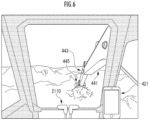
- the actual machine image output device 421 is disposed, for example, at a position near the front window inside the cab 424 (see FIG. 6 ).
- the actual machine image output device 421 may be omitted.
- the work mechanism 440 comprises the boom 441 mounted on the upper turning body 420 so as to derrick, the arm 443 rotatably coupled to a front end of the boom 441, and the bucket 445 rotatably coupled to a front end of the arm 443.
- the boom cylinder 442, the arm cylinder 444, and the bucket cylinder 446 each including an expandable hydraulic cylinder are mounted on the work mechanism 440.
- an attachment such as a nibbler, a cutter, and a magnet may be used besides the bucket 445.
- the boom cylinder 442 is interposed between the boom 441 and the upper turning body 420 so as to expand/contract by receiving supply of hydraulic oil to rotate the boom 441 in a derricking direction.
- the arm cylinder 444 is interposed between the arm 443 and the boom 441 so as to expand/contract by receiving supply of hydraulic oil to rotate the arm 443 around a horizontal axis relative to the boom 441.
- the bucket cylinder 446 is interposed between the bucket 445 and the arm 443 so as to expand/contract by receiving supply of hydraulic oil to rotate the bucket 445 around a horizontal axis relative to the arm 443.
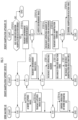
- a remote manipulation support system including the remote manipulation support server 10, the remote manipulation apparatus 20, and the work machine 40 configured as described above are described with reference to a flowchart illustrated in FIG. 5 .
- the functions include functions of the system for controlling manipulation reaction force 110 as the embodiment of the present invention.
- a block "C ⁇ " is used to simplify description, means transmission and/or reception of data, and means a conditional branch in which processing in a branch direction is performed on condition of transmission and/or reception of the data.
- the remote manipulation apparatus 20 determines whether designation manipulation has been performed by the operator through the remote input interface 210 ( FIG. 5 /STEP210).
- the "designation manipulation” is manipulation such as tapping on the remote input interface 210 for designating the work machine 40 to be remotely operated by the operator. In a case where a determination result is negative ( FIG. 5 /STEP210, NO), the series of processing ends. In contrast, in a case where the determination result is positive ( FIG. 5 /STEP210, YES), an environment confirmation request is transmitted to the remote manipulation support server 10 through the remote wireless communication device 224 ( FIG. 5 /STEP212).
- the first support processing element 121 transmits the environment confirmation request to the corresponding work machine 40 ( FIG. 5 /C10).
- the actual machine control device 400 acquires a captured image through the actual machine imaging device 412 ( FIG. 5 /STEP410).
- the actual machine control device 400 transmits captured image data indicating the captured image to the remote manipulation support server 10 through the actual machine wireless communication device 422 ( FIG. 5 /STEP412).
- the second support processing element 122 transmits environment image data corresponding to the captured image to the remote manipulation apparatus 20 ( FIG. 5 /STEP110).
- the environment image data includes, in addition to the captured image data itself, image data indicating a simulated environment image generated based on the captured image.
- the remote control device 200 outputs the environment image corresponding to the environment image data to the remote image output device 221 ( FIG. 5 /STEP214).
- the environment image including the boom 441, the arm 443, and the bucket 445 that are parts of the work mechanism 440 is output to the remote image output device 221.
- the remote control device 200 recognizes the operating manner of the remote manipulation mechanism 211 ( FIG. 5 /STEP216), and transmits a remote manipulation command corresponding to the operating manner to the remote manipulation support server 10 through the remote wireless communication device 224 ( FIG. 5 /STEP218).
- the first support processing element 121 transmits the remote manipulation command to the work machine 40 ( FIG. 5 /C12).
- the actual machine control device 400 of the work machine 40 receives the manipulation command through the actual machine wireless communication device 422 ( FIG. 5 /C41), operation of the work mechanism 440 and the like is controlled ( FIG. 5 /STEP414).
- operation of the work mechanism 440 and the like is controlled ( FIG. 5 /STEP414).
- a work in which the bucket 445 scoops soil in front of the work machine 40, and the soil is dropped from the bucket 445 after the upper turning body 420 is turned is performed.
- the operating manner recognition element 111 of the system for controlling manipulation reaction force 110 recognizes (estimates) each of the manipulation directions of the left manipulation lever 2111 and the right manipulation lever 2112 constituting the remote manipulation mechanism 211, as the operating manners of the remote manipulation mechanism 211 reflected on the remote manipulation command ( FIG. 5 /STEP111).
- the tilting angle ⁇ of each of the manipulation levers 2111 and 2112 at a neutral position is defined as "zero"
- the tilting angle ⁇ in a case where each of the manipulation levers 2111 and 2112 is tilted forward is defined as positive (0 ⁇ ⁇ )
- the tilting angle ⁇ in a case where each of the manipulation levers 2111 and 2112 is tilted rearward is defined as negative ( ⁇ ⁇ 0).
- the tilting angle ⁇ of each of the manipulation levers 2111 and 2112 at the neutral position is defined as "zero"
- the tilting angle ⁇ in a case where each of the manipulation levers 2111 and 2112 is tilted leftward is defined as positive (0 ⁇ ⁇ )
- the tilting angle ⁇ in a case where each of the manipulation levers 2111 and 2112 is tilted rightward is defined as negative ( ⁇ ⁇ 0).
- the perceived reaction force recognition element 112 recognizes perceived reaction force that is reaction force perceived by the operator ( FIG. 5 /STEP112). For example, as illustrated by a solid line in FIG. 7 , a first perceived reaction force F 1 is recognized based on a first perceived reaction force characteristic curve F 1 ( ⁇ ) using, as a main variable, the tilting angle ⁇ in the frontward/rearward manipulation direction of each of the manipulation levers 2111 and 2112.
- a first perceived reaction force characteristic curve F 1 ( ⁇ ) using, as a main variable, the tilting angle ⁇ in the frontward/rearward manipulation direction of each of the manipulation levers 2111 and 2112.
- the first perceived reaction force characteristic curve F 1 ( ⁇ ) corresponding to the manipulation amount ⁇ of each of the manipulation levers 2111 and 2112 in the forward manipulation direction and the rearward manipulation direction and a second perceived reaction force curve F 2 ( ⁇ ) corresponding to the manipulation amount ⁇ of each of the manipulation levers 2111 and 2112 in the leftward manipulation direction and the rightward manipulation direction may be functions common in at least a part of the definition ranges.
- the first perceived reaction force characteristic curve F 1 ( ⁇ ) in the forward/rearward manipulation direction may be defined so as to have symmetry in the whole of the negative definition range [- ⁇ , 0] and the positive definition range [0, ⁇ ] (for example, ⁇ is about +25 degrees) as illustrated in FIG. 7 , or may be defined so as to have symmetry in partial ranges [- ⁇ 2 , - ⁇ 1 ] and [ ⁇ 1 , ⁇ 2 ] (for example, ⁇ 1 is about +5 degrees, and ⁇ 2 is about +20 degrees).
- the first perceived reaction force characteristic curve F 1 ( ⁇ ) may be defined by, in addition to a linear function, an exponential function, a logarithmic function, an n-order function (2 ⁇ _ n), or a combination thereof within at least ranges having symmetry in the positive and negative definition ranges.
- the first perceived reaction force characteristic curve F 1 ( ⁇ ) (dependent variable) is defined such that the value is continuously increased as an absolute value
- the second perceived reaction force characteristic curve F 2 ( ⁇ ) in the rightward/leftward manipulation direction may be defined so as to have symmetry in the whole of the negative definition range [- ⁇ , 0] and the positive definition range [0, ⁇ ] (for example, ⁇ is about +25 degrees), or may be defined so as to have symmetry in partial ranges [- ⁇ 2 , - ⁇ 1 ] and [ ⁇ 1 , ⁇ 2 ] (for example, ⁇ 1 is about +10 degrees, and ⁇ 2 is about +25 degrees) (see FIG. 7 ).
- the second perceived reaction force characteristic curve F 2 ( ⁇ ) may be defined by, in addition to a linear function, an exponential function, a logarithmic function, an n-order function (2 ⁇ n), or a combination thereof within at least ranges having symmetry in the positive and negative definition ranges.
- the second perceived reaction force characteristic curve F 2 ( ⁇ ) (dependent variable) is defined such that the value is continuously increased as an absolute value
- each of a first manipulation reaction force f 1 ( ⁇ ) and/or a second manipulation reaction force f 2 ( ⁇ ) or a control command signal representing the first manipulation reaction force f 1 ( ⁇ ) and/or the second manipulation reaction force f 2 ( ⁇ ) is recognized by the manipulation reaction force recognition element 114, and is transmitted to the remote manipulation apparatus 20 ( FIG. 5 /STEP114).
- the remote manipulation apparatus 20 FIG. 5 /STEP114.
- the first manipulation reaction force f 1 is recognized based on a first manipulation reaction force characteristic curve f 1 ( ⁇ ) using, as a main variable, the tilting ⁇ in the forward/rearward manipulation direction of each of the manipulation levers 2111 and 2112.
- the first manipulation reaction force characteristic curve f 1 ( ⁇ ) corresponding to the manipulation amount ⁇ of each of the manipulation levers 2111 and 2112 in the forward manipulation direction and the rearward manipulation direction and the second manipulation reaction force curve f 2 ( ⁇ ) corresponding to the manipulation amount ⁇ of each of the manipulation levers 2111 and 2112 in the leftward manipulation direction and the rightward manipulation direction may be functions common in at least a part of the definition ranges.
- the first manipulation reaction force characteristic curve f 1 ( ⁇ ) and the first perceived reaction force characteristic curve F 1 ( ⁇ ) have fixed correlation.
- the correlation is defined, for example, based on a relational expression (01).
- f 1 ⁇ ⁇ 1 logF 1 ⁇ + ⁇ 1
- the correlation may be defined based on a relational expression (11) using a coefficient c 1 ( ⁇ ) that depends on the manipulation amount ⁇ in the forward/rearward manipulation direction.
- f 1 ⁇ c 1 ⁇ ⁇ F 1 ⁇
- the first manipulation reaction force characteristic curve f 1 ( ⁇ ) in the forward/rearward manipulation direction may be defined so as to have symmetry in at least partial ranges [- ⁇ 2 , - ⁇ 1 ] and [ ⁇ 1 , ⁇ 2 ] (for example, ⁇ 1 is about +5 degrees, and ⁇ 2 is about +20 degrees) of the negative definition range [- ⁇ , 0] and the positive definition range [0, ⁇ ] (for example, ⁇ is about +25 degrees).
- the first manipulation reaction force characteristic curve f 1 ( ⁇ ) may be defined by, in addition to a linear function, an exponential function, a logarithmic function, an n-order function (2 ⁇ n), or a combination thereof.
- the first manipulation reaction force characteristic curve f 1 ( ⁇ ) (dependent variable) is defined such that the value is continuously increased as an absolute value
- the second manipulation reaction force characteristic curve f 2 ( ⁇ ) and the second perceived reaction force characteristic curve F 2 ( ⁇ ) have fixed correlation.
- the correlation is defined, for example, based on a relational expression (02).
- f 2 ⁇ ⁇ 2 logF 2 ⁇ + ⁇ 2
- the correlation may be defined based on a relational expression (12) using a coefficient c 2 ( ⁇ ) that depends on the manipulation amount ⁇ in the rightward/leftward manipulation direction.
- f 2 ⁇ c 2 ⁇ ⁇ F 2 ⁇
- the second manipulation reaction force characteristic curve f 2 ( ⁇ ) in the rightward/leftward manipulation direction may be defined so as to have symmetry in at least partial ranges [- ⁇ 2 , - ⁇ 1 ] and [ ⁇ 1 , ⁇ 2 ] (for example, ⁇ 1 is about +10 degrees, and ⁇ 2 is about +25 degrees) of the negative definition range [- ⁇ , 0] and the positive definition range [0, ⁇ ] (for example, ⁇ is about +25 degrees).
- the second manipulation reaction force characteristic curve f 2 ( ⁇ ) may be defined by, in addition to a linear function, an exponential function, a logarithmic function, an n-order function (2 ⁇ n), or a combination thereof.
- the second manipulation reaction force characteristic curve f 2 ( ⁇ ) (dependent variable) is defined such that the value is continuously increased as an absolute value
- the remote manipulation apparatus 20 receives the first manipulation reaction force f 1 ( ⁇ ) and/or the second manipulation reaction force f 2 ( ⁇ ) or the control command signal representing the first manipulation reaction force f 1 ( ⁇ ) and/or the second manipulation reaction force f 2 ( ⁇ ) through the remote wireless communication device 224 ( FIG. 5 /C22)
- the operation of the actuator 214 is controlled by the remote control device 200 such that the first manipulation reaction force f 1 ( ⁇ ) and/or the second manipulation reaction force f 2 ( ⁇ ) (force pushing back tilted manipulation lever 2111 or 2112 in opposite direction) acts on the corresponding manipulation lever 2111 or 2112 in the direction opposite to the manipulation direction ( FIG. 5 /STEP219).
- the operation of the actuator 214 is controlled based on the manipulation amount ⁇ of each of the left manipulation lever 2111 and/or the right manipulation lever 2112 constituting the remote manipulation mechanism 211 in each of the forward manipulation direction (positive manipulation direction) and the rearward manipulation direction (negative manipulation direction), which are opposite to each other.
- the first manipulation reaction force f 1 ( ⁇ ) acts on the left manipulation lever 2111 and/or the right manipulation lever 2112 in the direction opposite to the manipulation direction (see FIG. 7 /dashed line).
- the operation of the actuator 214 is controlled based on the manipulation amount ⁇ of each of the left manipulation lever 2111 and/or the right manipulation lever 2112 constituting the remote manipulation mechanism 211 in each of the leftward manipulation direction (positive manipulation direction) and the rightward manipulation direction (negative manipulation direction), which are opposite to each other.
- the second manipulation reaction force f 2 ( ⁇ ) acts on the left manipulation lever 2111 and/or the right manipulation lever 2112 in the direction opposite to the manipulation direction.
- the operation of the actuator 214, and furthermore, the first manipulation reaction force F 1 ( ⁇ ) acting on the left manipulation lever 2111 and/or the right manipulation lever 2112 is controlled such that the reaction force (first perceived reaction force F 1 ( ⁇ )) in the rearward manipulation direction and the forward manipulation direction perceived by the operator through the left manipulation lever 2111 and/or the right manipulation lever 2112 (manipulation mechanism) realizes symmetry about the manipulation amount of zero within the manipulation amount range in the forward manipulation direction (positive manipulation direction) (positive definition range [0, ⁇ ]) and the manipulation amount range in the negative manipulation direction (negative definition range [- ⁇ , 0]) (see FIG. 7 /solid line).
- the operation of the actuator 214, and furthermore, the second manipulation reaction force F 2 ( ⁇ ) acting on the left manipulation lever 2111 and/or the right manipulation lever 2112 is controlled such that the reaction force (second perceived reaction force F 2 ( ⁇ )) in the rightward manipulation direction and the leftward manipulation direction perceived by the operator through the left manipulation lever 2111 and/or the right manipulation lever 2112 (manipulation mechanism) realizes symmetry about the manipulation amount of zero within the manipulation amount range in the leftward manipulation direction (positive manipulation direction) (positive definition range [0, ⁇ ]) and the manipulation amount range in the negative manipulation direction (negative definition range [- ⁇ , 0]) (see FIG. 7 /solid line).
- the manipulation amounts ⁇ and ⁇ of the left manipulation lever 2111 and/or the right manipulation lever 2112 and the perceived reaction forces F 1 ( ⁇ ) and F 2 ( ⁇ ) by the operator are made equal to or matched with each other, which makes it possible to improve operability of the left manipulation lever 2111 and/or the right manipulation lever 2112 for the operator.
- the first manipulation reaction force f 1 ( ⁇ ) is controlled such that the first perceived reaction forces F 1 (+ ⁇ ) and F 1 (- ⁇ ) respectively corresponding to the manipulation amount + ⁇ in the forward manipulation direction (positive manipulation direction) and the manipulation amount - ⁇ in the rearward manipulation direction (negative manipulation direction) equal in absolute value to the manipulation amount + ⁇ are equal to each other and linearly varied (see FIG. 7 /solid line and dashed line).
- the second manipulation reaction force f 2 ( ⁇ ) is controlled such that the second perceived reaction forces F 2 (+ ⁇ ) and F 2 (- ⁇ ) respectively corresponding to the manipulation amount + ⁇ in the leftward manipulation direction (positive manipulation direction) and the manipulation amount - ⁇ in the rightward manipulation direction (negative manipulation direction) equal in absolute value to the manipulation amount + ⁇ are equal to each other and linearly varied.
- This enables the operator to easily grasp the relationship between the manipulation amounts ⁇ and ⁇ of the manipulation levers 2111 and 2112 and the perceived reaction forces F 1 and F 2 through the manipulation levers 2111 and 2112, in each of the positive manipulation direction and the negative manipulation direction, which are opposite to each other. This further improves operability of the manipulation levers 2111 and 2112 for the operator.
- the system for controlling manipulation reaction force 110 is formed from the remote manipulation support server 10; however, the system for controlling manipulation reaction force 110 may be formed from the remote manipulation apparatus 20 and/or the work machine 40 as another embodiment.
- the remote manipulation apparatus 20 and/or the work machine 40 may include functions as the operating manner recognition element 111, the perceived reaction force recognition element 112, and the manipulation reaction force recognition element 114.
- the work machine 40 may not be remotely manipulated by the operator through the remote manipulation mechanism 211 constituting the remote manipulation apparatus 20, but the work machine 40 may be actually manipulated by the operator getting on the work machine 40 through the actual machine manipulation mechanism 411.
- the remote manipulation support server 10 and the remote manipulation apparatus 20 may be omitted.
- the system for controlling manipulation reaction force 110 may be mounted on the work machine 40 together with the operating manner detection sensor 212 for detecting the operating manner (manipulation direction and manipulation amount) by the operator, of the actual machine manipulation levers constituting the actual machine manipulation mechanism 411.
- the system for controlling manipulation reaction force 110 may comprise the actual machine manipulation mechanism 411 (or actual machine manipulation levers constituting actual machine manipulation mechanism 411), and the operating manner detection sensor 212.
- the system for controlling manipulation reaction force 110 may be configured to control the operation of the actuators 214 based on the perceived reaction force estimated from an attribute factor that indicates an attribute of the operator input through the remote input interface 210 (for example, touch panel device).
- the "attribute factor” may include a factor or a parameter indicating, for example, a physical attribute such as a body height, lengths of extremities, grip strength, arm strength, leg strength, visual acuity, hearing acuity, a body-fat percentage, and/or a weight of the operator, and a social attribute such as residence, years of operator experience (work experience), and exercise history.
- the above-described first perceived reaction force characteristic curve F 1 ( ⁇ ) is estimated from a multivariable function F 1 ( ⁇ , ⁇ 1 , ⁇ 2 , ..., ⁇ n ), and/or the second perceived reaction force characteristic curve F 2 ( ⁇ ) is estimated from a multivariable function F 2 ( ⁇ , ⁇ 1 , ⁇ 2 , ..., ⁇ n ).
- the manipulation amounts ⁇ of the manipulation levers 2111 and 2112 in the forward/rearward manipulation direction, and the first manipulation reaction force f 1 ( ⁇ ), a ⁇ dependence of each of coefficients ⁇ 1 ( ⁇ ), and ⁇ 1 ( ⁇ ) is determined from a relational expression (21).
- the manipulation amounts ⁇ of the manipulation levers 2111 and 2112 in the rightward/leftward manipulation direction, and the second manipulation reaction force f 2 ( ⁇ ), a ⁇ dependence of each of coefficients ⁇ 2 ( ⁇ ) and ⁇ 2 ( ⁇ ) is determined from a relational expression (22).
- the ⁇ dependence of at least one of the coefficients ⁇ 1 , ⁇ 1 , a 1 , and b 1 is determined from a relational expression (31).
- the coefficients ⁇ 2 ( ⁇ ) and ⁇ 2 ( ⁇ ) the ⁇ dependence of at least one of the coefficients ⁇ 2 , ⁇ 2 , a 2 , and b 2 is determined from a relational expression (32).
- the coefficient c 1 ( ⁇ ), and furthermore, the first manipulation reaction force f 1 ( ⁇ ) is recognized and controlled (see relational expression (11)).
- the coefficient c 2 ( ⁇ ), and furthermore, the first manipulation reaction force f 2 ( ⁇ ) is recognized and controlled (see relational expression (12)).
- the manipulation amounts of the manipulation levers 2111 and 2112 and the perceived reaction forces estimated from the attribute of the operator are made equal to or matched with each other while individual difference of the perceived reaction force among operators is reflected, which makes it possible to improve operability of the manipulation levers 2111 and 2112 for the operator.
- the system for controlling manipulation reaction force 110 may be configured to control the operation of the actuator 214 based on the perceived reaction force perceived by the operator through the left manipulation lever 2111 and/or the right manipulation lever 2112 on which the manipulation reaction force acts, input through the remote input interface 210 (for example, touch panel device).
- reference manipulation reaction force f f 0 ( ⁇ 0) acts on the manipulation levers 2111 and 2112.
- one or a plurality of test manipulation reaction forces f ⁇ 1 f 0 , ⁇ 2 f 0 , ..., ⁇ m f 0 (0 ⁇ ⁇ 1 ⁇ ⁇ 2 ⁇ ... ⁇ ⁇ m ) act on the manipulation levers 2111 and 2112
- the reaction forces F ⁇ 1 , ⁇ 2 , ..., ⁇ m perceived through the manipulation levers 2111 and 2112 are input to the remote input interface 210 by the operator.
- the coefficients ( ⁇ 1 , ⁇ 1 ) in the relational expression (01) and/or the coefficients ( ⁇ 2 , ⁇ 2 ) in the relational expression (02), or the coefficient c 1 ( ⁇ ) in the relational expression (11) and/or the coefficient c 2 ( ⁇ ) in the relational expression (12) are determined.
- the first manipulation reaction force characteristic curve f 1 ( ⁇ ) is estimated (see relational expressions (01) and (11), and FIG. 7 /dashed line).
- the coefficients ( ⁇ 2 , ⁇ 2 ) or the coefficient c 2 ( ⁇ ) in addition to the second perceived reaction force characteristic curve F 2 ( ⁇ ) is estimated (see FIG. 7 /solid line).
- the second manipulation reaction force characteristic curve f 2 ( ⁇ ) is estimated (see relational expressions (02) and (12), and FIG. 7 /dashed line). Further, the operation of the actuator 214 is controlled so as to realize the manipulation reaction force f 1 ( ⁇ ) and/or f 2 ( ⁇ ).
- the system for controlling manipulation reaction force 110 configured as described above is preferably configured to control operation of the actuator to linearly vary the perceived reaction forces based on the manipulation amount of the manipulation mechanism realizing the symmetry.
- the system for controlling manipulation reaction force according to the present invention is preferably configured to control the operation of the actuator based on the perceived reaction force estimated from the attribute factor indicating the attribute of the operator input through the input interface.
- the system for controlling manipulation reaction force according to the present invention is preferably configured to control the operation of the actuator based on the perceived reaction force as a manipulation reaction force perceived by the operator through the manipulation mechanism on which the manipulation reaction force acts, input through the input interface.
- the system for controlling manipulation reaction force according to the present invention preferably further comprises the actuator and the operating manner detection sensor.
- the system for controlling manipulation reaction force configured as described above may be disposed in an operation manipulation environment of the operator, together with the actuator and the operating manner detection sensor.
Landscapes
- Engineering & Computer Science (AREA)
- Mining & Mineral Resources (AREA)
- Civil Engineering (AREA)
- General Engineering & Computer Science (AREA)
- Structural Engineering (AREA)
- Physics & Mathematics (AREA)
- General Physics & Mathematics (AREA)
- Automation & Control Theory (AREA)
- Operation Control Of Excavators (AREA)
- Mechanical Control Devices (AREA)
Applications Claiming Priority (2)
| Application Number | Priority Date | Filing Date | Title |
|---|---|---|---|
| JP2021159281A JP7610337B2 (ja) | 2021-09-29 | 2021-09-29 | 操作反力制御システムおよび操作反力制御方法 |
| PCT/JP2022/016663 WO2023053542A1 (ja) | 2021-09-29 | 2022-03-31 | 操作反力制御システムおよび操作反力制御方法 |
Publications (2)
| Publication Number | Publication Date |
|---|---|
| EP4389990A1 true EP4389990A1 (de) | 2024-06-26 |
| EP4389990A4 EP4389990A4 (de) | 2025-03-12 |
Family
ID=85782209
Family Applications (1)
| Application Number | Title | Priority Date | Filing Date |
|---|---|---|---|
| EP22875425.5A Pending EP4389990A4 (de) | 2021-09-29 | 2022-03-31 | System zur steuerung einer manipulationsreaktionskraft und verfahren zur steuerung einer manipulationsreaktionskraft |
Country Status (5)
| Country | Link |
|---|---|
| US (1) | US20240392537A1 (de) |
| EP (1) | EP4389990A4 (de) |
| JP (1) | JP7610337B2 (de) |
| CN (1) | CN118043524A (de) |
| WO (1) | WO2023053542A1 (de) |
Families Citing this family (1)
| Publication number | Priority date | Publication date | Assignee | Title |
|---|---|---|---|---|
| JP7740858B2 (ja) * | 2023-08-24 | 2025-09-17 | 三菱ロジスネクスト株式会社 | フォークリフト、推定システムおよび推定プログラム |
Family Cites Families (11)
| Publication number | Priority date | Publication date | Assignee | Title |
|---|---|---|---|---|
| JP2000204599A (ja) | 1999-01-14 | 2000-07-25 | Hitachi Constr Mach Co Ltd | 建設機械の操作レバ―装置 |
| JP2003184128A (ja) | 2001-12-25 | 2003-07-03 | Hitachi Constr Mach Co Ltd | 建設機械の操作レバー装置 |
| JP2010066962A (ja) | 2008-09-10 | 2010-03-25 | Hitachi Constr Mach Co Ltd | 操作装置 |
| JP2010248867A (ja) | 2009-04-20 | 2010-11-04 | Caterpillar Sarl | 作業機械の制御装置 |
| KR101183823B1 (ko) * | 2010-03-31 | 2012-09-18 | 주식회사 도담시스템스 | 조종 반력 제어 시스템 및 방법 |
| JP5621559B2 (ja) | 2010-12-02 | 2014-11-12 | 日産自動車株式会社 | 移動体の操舵反力調整装置 |
| JP5919798B2 (ja) | 2011-12-19 | 2016-05-18 | マツダ株式会社 | 車両用入力装置 |
| JP6373812B2 (ja) * | 2015-09-10 | 2018-08-15 | 日立建機株式会社 | 建設機械 |
| WO2017209058A1 (ja) | 2016-05-31 | 2017-12-07 | 株式会社小松製作所 | 作業車両および作業車両の制御方法 |
| JP7212461B2 (ja) * | 2018-06-06 | 2023-01-25 | 株式会社小松製作所 | 作業車両 |
| KR102708684B1 (ko) * | 2018-06-19 | 2024-09-20 | 스미토모 겐키 가부시키가이샤 | 굴삭기, 정보처리장치 |
-
2021
- 2021-09-29 JP JP2021159281A patent/JP7610337B2/ja active Active
-
2022
- 2022-03-31 WO PCT/JP2022/016663 patent/WO2023053542A1/ja not_active Ceased
- 2022-03-31 US US18/694,019 patent/US20240392537A1/en active Pending
- 2022-03-31 EP EP22875425.5A patent/EP4389990A4/de active Pending
- 2022-03-31 CN CN202280065461.XA patent/CN118043524A/zh active Pending
Also Published As
| Publication number | Publication date |
|---|---|
| JP7610337B2 (ja) | 2025-01-08 |
| WO2023053542A1 (ja) | 2023-04-06 |
| CN118043524A (zh) | 2024-05-14 |
| EP4389990A4 (de) | 2025-03-12 |
| US20240392537A1 (en) | 2024-11-28 |
| JP2023049505A (ja) | 2023-04-10 |
Similar Documents
| Publication | Publication Date | Title |
|---|---|---|
| EP3922775B1 (de) | Fernbetriebssystem und fernbetriebsserver | |
| JP7012698B2 (ja) | 掘削機の掘削を制御するための方法及び装置 | |
| CN113167054B (zh) | 包括作业机械的系统、由计算机执行的方法及学习用数据 | |
| EP4050163B1 (de) | Arbeitsassistenzserver, arbeitsassistenzverfahren und arbeitsassistenzsystem | |
| EP4389990A1 (de) | System zur steuerung einer manipulationsreaktionskraft und verfahren zur steuerung einer manipulationsreaktionskraft | |
| US20250052033A1 (en) | Image display system, remote operation assistance system, and image display method | |
| EP4130400B1 (de) | Vorrichtung zur unterstützung einer fernbedienung und verfahren zur unterstützung einer fernbedienung | |
| JP7441733B2 (ja) | 実機状態監視システムおよび実機状態監視方法 | |
| WO2023026568A1 (ja) | 遠隔操作システムおよび遠隔操作複合システム | |
| EP4044591A1 (de) | Arbeitsunterstützungsserver, arbeitsunterstützungsverfahren und arbeitsunterstützungssystem | |
| JP2022121138A (ja) | 遠隔操作支援システム、遠隔操作支援方法および遠隔操作支援複合システム | |
| JP7581996B2 (ja) | 遠隔操作支援システムおよび遠隔操作支援方法 | |
| US12123175B2 (en) | Remote operation device, remote operation assistance server, remote operation assistance system, and remote operation assistance method | |
| CN118901077A (zh) | 远程操纵系统 | |
| JP2023032998A (ja) | 作業支援システムおよび作業支援複合システム | |
| EP4692468A1 (de) | Betriebsvorrichtung und damit ausgestattetes betriebssystem | |
| WO2021106281A1 (ja) | 作業支援サーバ、作業支援方法および作業支援システム | |
| WO2023234025A1 (ja) | 遠隔操作支援システムおよび遠隔操作装置 | |
| CN119913942A (zh) | 挖土机、挖土机的声音输出系统及挖土机的远程控制系统 | |
| CN114730411A (zh) | 作业支援服务器、作业支援方法以及作业支援系统 |
Legal Events
| Date | Code | Title | Description |
|---|---|---|---|
| STAA | Information on the status of an ep patent application or granted ep patent |
Free format text: STATUS: THE INTERNATIONAL PUBLICATION HAS BEEN MADE |
|
| PUAI | Public reference made under article 153(3) epc to a published international application that has entered the european phase |
Free format text: ORIGINAL CODE: 0009012 |
|
| STAA | Information on the status of an ep patent application or granted ep patent |
Free format text: STATUS: REQUEST FOR EXAMINATION WAS MADE |
|
| 17P | Request for examination filed |
Effective date: 20240319 |
|
| AK | Designated contracting states |
Kind code of ref document: A1 Designated state(s): AL AT BE BG CH CY CZ DE DK EE ES FI FR GB GR HR HU IE IS IT LI LT LU LV MC MK MT NL NO PL PT RO RS SE SI SK SM TR |
|
| DAV | Request for validation of the european patent (deleted) | ||
| DAX | Request for extension of the european patent (deleted) | ||
| A4 | Supplementary search report drawn up and despatched |
Effective date: 20250210 |
|
| RIC1 | Information provided on ipc code assigned before grant |
Ipc: G05G 5/03 20080401ALI20250204BHEP Ipc: G05G 25/00 20060101ALI20250204BHEP Ipc: G05G 9/047 20060101ALI20250204BHEP Ipc: E02F 9/20 20060101AFI20250204BHEP |