EP4387315A1 - Verfahren zur einstellung eines mediumsynchronisationsverzögerungstimers und zugehörige vorrichtung - Google Patents
Verfahren zur einstellung eines mediumsynchronisationsverzögerungstimers und zugehörige vorrichtung Download PDFInfo
- Publication number
- EP4387315A1 EP4387315A1 EP22866322.5A EP22866322A EP4387315A1 EP 4387315 A1 EP4387315 A1 EP 4387315A1 EP 22866322 A EP22866322 A EP 22866322A EP 4387315 A1 EP4387315 A1 EP 4387315A1
- Authority
- EP
- European Patent Office
- Prior art keywords
- mld
- access point
- link
- station
- nstr
- Prior art date
- Legal status (The legal status is an assumption and is not a legal conclusion. Google has not performed a legal analysis and makes no representation as to the accuracy of the status listed.)
- Granted
Links
Images


Classifications
-
- H—ELECTRICITY
- H04—ELECTRIC COMMUNICATION TECHNIQUE
- H04W—WIRELESS COMMUNICATION NETWORKS
- H04W74/00—Wireless channel access
- H04W74/08—Non-scheduled access, e.g. ALOHA
- H04W74/0808—Non-scheduled access, e.g. ALOHA using carrier sensing, e.g. carrier sense multiple access [CSMA]
- H04W74/0816—Non-scheduled access, e.g. ALOHA using carrier sensing, e.g. carrier sense multiple access [CSMA] with collision avoidance
-
- H—ELECTRICITY
- H04—ELECTRIC COMMUNICATION TECHNIQUE
- H04W—WIRELESS COMMUNICATION NETWORKS
- H04W24/00—Supervisory, monitoring or testing arrangements
- H04W24/02—Arrangements for optimising operational condition
-
- H—ELECTRICITY
- H04—ELECTRIC COMMUNICATION TECHNIQUE
- H04W—WIRELESS COMMUNICATION NETWORKS
- H04W56/00—Synchronisation arrangements
- H04W56/001—Synchronization between nodes
-
- H—ELECTRICITY
- H04—ELECTRIC COMMUNICATION TECHNIQUE
- H04W—WIRELESS COMMUNICATION NETWORKS
- H04W56/00—Synchronisation arrangements
- H04W56/004—Synchronisation arrangements compensating for timing error of reception due to propagation delay
-
- H—ELECTRICITY
- H04—ELECTRIC COMMUNICATION TECHNIQUE
- H04W—WIRELESS COMMUNICATION NETWORKS
- H04W76/00—Connection management
- H04W76/10—Connection setup
- H04W76/15—Setup of multiple wireless link connections
-
- H—ELECTRICITY
- H04—ELECTRIC COMMUNICATION TECHNIQUE
- H04W—WIRELESS COMMUNICATION NETWORKS
- H04W84/00—Network topologies
- H04W84/02—Hierarchically pre-organised networks, e.g. paging networks, cellular networks, WLAN [Wireless Local Area Network] or WLL [Wireless Local Loop]
- H04W84/10—Small scale networks; Flat hierarchical networks
- H04W84/12—WLAN [Wireless Local Area Networks]
Definitions
- This application relates to the field of wireless communication technologies, and in particular, to a medium synchronization delay timer setting method and a related apparatus.
- a continuous technical goal of development and evolution of a wireless local area network (wireless local area network, WLAN) or a cellular network is to continuously improve a throughput.
- a protocol of a WLAN system is mainly discussed and researched in the institute of electrical and electronics engineers (institute of electrical and electronics engineers, IEEE) standard group.
- a next-generation standard 802.11be uses an extremely high throughput (extremely high throughput, EHT) as a technical goal.
- EHT extremely high throughput
- One of key technologies of 802.1The is to improve the throughput through multi-link (multi-link, ML) communication.
- a core idea of the multi-link communication is that a WLAN device that supports the next-generation standard 802.11be, that is, an EHT device, has multi-band (multi-band) transmitting and receiving capabilities, and therefore uses a larger bandwidth for data transmission, to significantly improve the throughput.
- a multi-band includes but is not limited to a 2.4 GHz Wi-Fi frequency band, a 5 GHz Wi-Fi frequency band, and a 6 GHz Wi-Fi frequency band.
- a WLAN device that supports the multi-link communication is referred to as a multi-link device (Multi-link device, MLD).
- the multi-link device may perform parallel communication by using a plurality of links (or a plurality of frequency bands), so that a transmission rate is greatly improved.
- the multi-link device When a frequency spacing between the plurality of frequency bands supported by the multi-link device (MLD) is small, sending of a signal in one frequency band affects receiving of a signal in another frequency band. For example, the multi-link device sends a signal on a link 1. Because a frequency spacing between the link 1 and a link 2 is small, the signal sent on the link 1 causes channel interference to the link 2, and affects channel access and information receiving on the link 2. Therefore, to avoid mutual interference, the device cannot independently perform sending and receiving operations in the plurality of frequency bands at the same time.
- the multi-link device may have a simultaneous transmitting and receiving (Simultaneous transmitting and receiving, STR) capability and a non-simultaneous transmitting and receiving (Non-Simultaneous transmitting and receiving, NSTR) capability.
- STR simultaneous transmitting and receiving
- NSTR non-simultaneous transmitting and receiving
- NSTR link pair due to a problem of signal interference between links, when a signal is sent on one link (for example, the link 1), a signal may not be received on the other link (for example, the link 2). In this case, if a data packet needs to be received on the link 2, the data packet may not be received, resulting in a packet loss. Consequently, network allocation vector (network allocation vector, NAV) update is missed. In this case, if a station on the link 2 directly participates in channel contention (for example, enhanced distributed channel access (enhanced distributed channel access, EDCA) contention), a fairness problem is caused to another station. This technical problem needs to be resolved urgently.
- channel contention for example, enhanced distributed channel access (enhanced distributed channel access, EDCA) contention
- Embodiments of this application provide a medium synchronization delay timer setting method and a related apparatus, to properly set a value of a medium synchronization delay timer. In this way, a fairness problem caused to another station because a station that has lost medium synchronization (lost medium synchronization) participates in channel contention can be resolved, and impact of an unnecessary limitation on station performance can be reduced, in other words, the station performance can be improved.
- this application provides a medium synchronization delay timer setting method.
- the method includes: When transmission of a second station in a non-access point station (non-access point station, non-AP STA) multi-link device non-AP MLD ends, a first station in the non-AP MLD starts a medium synchronization delay (MediumSyncDelay) timer and sets an initial value.
- the first station in the non-AP MLD receives a physical layer protocol data unit (physical layer Protocol Data Unit, PPDU) carrying a medium access control protocol data unit (Medium Access Control Protocol Data Unit, MPDU), where the MPDU includes a request to send (request to send, RTS) frame.
- PPDU physical layer Protocol Data Unit
- MPDU medium access control protocol data unit
- the first access point may be an access point associated with the first station, or the first access point may be another access point in a multiple (multiple) basic service set identifier (basic service set identifier, BSSID) in which the access point associated with the first station is located.
- BSSID basic service set identifier
- the initial value is set by an AP, or is a default value specified in a standard.
- the first station after receiving an RTS frame, the first station determines, by determining whether a link on which a sending station of the RTS frame operates belongs to an NSTR link pair, whether the count value of the MediumSyncDelay timer needs to be set to 0, and may perform different processing on the MediumSyncDelay timer based on different sending stations of RTS frames.
- a fairness problem caused to another station because the station that has lost medium synchronization participates in channel contention can be resolved, and therefore a probability of collision is reduced and fairness of the channel contention is improved.
- impact of an unnecessary limitation on station performance can be reduced, in other words, the station performance can be improved.
- a link pair of the AP MLD may be an NSTR link pair. Otherwise, all link pairs of the AP MLD need to be STR link pairs.
- the NSTR mobile AP MLD has only two links, and the only two links are NSTR links. Therefore, that a link on which the first access point operates does not belong to any NSTR link pair of an AP MLD with which the first access point is affiliated may also be understood as that the AP MLD with which the first access point is affiliated is not an NSTR mobile AP MLD, and any two links included in the NSTR mobile AP MLD are NSTR links.
- the method further includes: If the RTS frame is sent by the first access point, and the AP MLD with which the first access point is affiliated is an NSTR mobile AP MLD, the first station in the non-AP MLD does not reset the count value of the medium synchronization delay timer to 0.
- the method further includes: If the RTS frame is sent by the first access point, and the link on which the first access point operates belongs to any NSTR link pair of the AP MLD with which the first access point is affiliated, the first station in the non-AP MLD does not reset the count value of the medium synchronization delay timer to 0.
- this application provides a communication apparatus.
- the communication apparatus may be a non-AP MLD or a chip in the non-AP MLD, for example, a Wi-Fi chip.
- the communication apparatus includes: a processing unit, configured to: when transmission of a second station in the non-AP MLD ends, start a medium synchronization delay timer and set an initial value, where a link pair formed by a link on which the communication apparatus operates and a link on which the second station operates is an NSTR link pair; and a transceiver unit, configured to receive a PPDU, where the PPDU carries an MPDU, and the MPDU includes an RTS frame, where the processing unit is further configured to: when the RTS frame is sent by a first access point, and a link on which the first access point operates does not belong to any NSTR link pair of an AP MLD with which the first access point is affiliated, reset a count value of the medium synchronization delay timer to 0.
- the first access point is an access point associated with the communication apparatus, or
- the initial value is set by an AP, or is a default value specified in a standard.
- a link on which the first access point operates does not belong to any NSTR link pair of an AP MLD with which the first access point is affiliated may also be understood as that the AP MLD with which the first access point is affiliated is not an NSTR mobile AP MLD, and any two links included in the NSTR mobile AP MLD are NSTR links.
- the processing unit is further configured to: when the RTS frame is sent by the first access point, and the AP MLD with which the first access point is affiliated is the NSTR mobile AP MLD, skip resetting the count value of the medium synchronization delay timer to 0.
- the processing unit is further configured to: when the RTS frame is sent by the first access point, and the link on which the first access point operates belongs to any NSTR link pair of the AP MLD with which the first access point is affiliated, skip resetting the count value of the medium synchronization delay timer to 0.
- this application provides a medium synchronization delay timer setting method.
- the method includes: When transmission of a second access point in an AP MLD ends, a first access point in the AP MLD starts a medium synchronization delay timer and sets an initial value.
- the first access point in the AP MLD receives a PPDU carrying an MPDU, and the MPDU includes an RTS frame. If the RTS frame is sent by a first station associated with the first access point, and a link on which the first station operates does not belong to any NSTR link pair of a non-AP MLD with which the first station is affiliated, the first access point in the AP MLD resets a count value of the medium synchronization delay timer to 0.
- a link pair formed by a link on which the first access point operates and a link on which the second access point operates is an NSTR link pair, in other words, the first access point and the second access point in the AP MLD have an NSTR capability.
- the AP MLD herein may be an NSTR mobile AP MLD. At least one link pair in a link pair of the NSTR mobile AP MLD is an NSTR link pair.
- the first access point herein may be referred to as an AP that has lost medium synchronization or an AP in a blind state.
- the initial value is set by an AP, or is a default value specified in a standard.
- the method further includes: If the RTS frame is sent by the first station associated with the first access point, and the link on which the first station operates belongs to an NSTR link pair of the non-AP MLD with which the first station is affiliated, the first access point in the AP MLD does not reset the count value of the medium synchronization delay timer to 0.
- this application provides a communication apparatus.
- the communication apparatus may be an AP MLD or a chip in the AP MLD, for example, a Wi-Fi chip.
- the communication apparatus includes: a processing unit, configured to: when transmission of a second access point in the AP MLD ends, start a medium synchronization delay timer and set an initial value, where a link pair formed by a link on which the communication apparatus operates and a link on which the second access point operates is an NSTR link pair; and a transceiver unit, configured to receive a PPDU, where the PPDU carries an MPDU, and the MPDU includes an RTS frame, where the processing unit is further configured to: when the RTS frame is sent by a first station associated with the communication apparatus, and a link on which the first station operates does not belong to any NSTR link pair of a non-AP MLD with which the first station is affiliated, reset a count value of the medium synchronization delay timer to 0.
- the initial value is set by an AP, or is a default value specified in a standard.
- the processing unit is further configured to: when the RTS frame is sent by the first station associated with the communication apparatus, and the link on which the first station operates belongs to an NSTR link pair of the non-AP MLD with which the first station is affiliated, skip resetting the count value of the medium synchronization delay timer to 0.
- this application provides a communication apparatus.
- the apparatus is specifically a non-AP MLD, and includes a processor and a transceiver.
- the processor is configured to: when transmission of a second station in the non-AP MLD ends, start a medium synchronization delay timer and set an initial value, where a link pair formed by a link on which the communication apparatus operates and a link on which the second station operates is a non-simultaneous transmitting and receiving NSTR link pair.
- the transceiver is configured to receive a PPDU, where the PPDU carries an MPDU, and the MPDU includes an RTS frame.
- the processor is further configured to: when the RTS frame is sent by a first access point, and a link on which the first access point operates does not belong to any NSTR link pair of an access point multi-link device AP MLD with which the first access point is affiliated, reset a count value of the medium synchronization delay timer to 0.
- the first access point is an access point associated with the communication apparatus, or the first access point is another access point in a multiple BSSID in which the access point associated with the communication apparatus is located.
- this application provides a communication apparatus.
- the apparatus is specifically an AP MLD, and includes a processor and a transceiver.
- the processor is configured to: when transmission of a second access point in the AP MLD ends, start a medium synchronization delay timer and set an initial value, where a link pair formed by a link on which the communication apparatus operates and a link on which the second access point operates is an NSTR link pair.
- the transceiver is configured to receive a PPDU, where the PPDU carries an MPDU, and the MPDU includes an RTS frame.
- the processor is further configured to: when the RTS frame is sent by a first station associated with the communication apparatus, and a link on which the first station operates does not belong to any NSTR link pair of a non-AP MLD with which the first station is affiliated, reset a count value of the medium synchronization delay timer to 0.
- this application provides an apparatus.
- the apparatus is implemented in a product form of a chip, and includes an input/output interface and a processing circuit.
- the apparatus is a chip in a non-AP MLD.
- the processing circuit is configured to: when transmission of a second station in the non-AP MLD ends, start a medium synchronization delay timer and set an initial value, where a link pair formed by a link on which a first station operates and a link on which the second station operates is a non-simultaneous transmitting and receiving NSTR link pair.
- the input/output interface is configured to receive a PPDU through an antenna and a radio frequency circuit, where the PPDU carries an MPDU, and the MPDU includes an RTS frame.
- the processing circuit is further configured to: when the RTS frame is sent by a first access point, and a link on which the first access point operates does not belong to any NSTR link pair of an AP MLD with which the first access point is affiliated, reset a count value of the medium synchronization delay timer to 0.
- the first access point is an access point associated with the first station, or the first access point is another access point in a multiple BSSID in which the access point associated with the first station is located.
- this application provides an apparatus.
- the apparatus is implemented in a product form of a chip, and includes an input/output interface and a processing circuit.
- the apparatus is a chip in an AP MLD.
- the processing circuit is configured to: when transmission of a second access point in the AP MLD ends, start a medium synchronization delay timer and set an initial value, where a link pair formed by a link on which a first access point operates and a link on which the second access point operates is an NSTR link pair.
- the input/output interface is configured to receive a PPDU through an antenna and a radio frequency circuit, where the PPDU carries an MPDU, and the MPDU includes an RTS frame.
- the processing circuit is further configured to: when the RTS frame is sent by a first station associated with the first access point, and a link on which the first station operates does not belong to any NSTR link pair of a non-AP MLD with which the first station is affiliated, reset a count value of the medium synchronization delay timer to 0.
- this application provides a computer-readable storage medium.
- the computer-readable storage medium stores program instructions.
- the program instructions When the program instructions are run on a computer, the computer is enabled to perform the medium synchronization delay timer setting method according to the first aspect or the third aspect.
- this application provides a computer program product including program instructions.
- the computer program product runs on a computer, the computer is enabled to perform the medium synchronization delay timer setting method according to the first aspect or the third aspect.
- a fairness problem caused to another station because a station that has lost medium synchronization (lost medium synchronization) participates in channel contention can be resolved, and in another aspect, impact of an unnecessary limitation on station performance can be reduced, in other words, the station performance can be improved.
- A/B may mean A or B.
- And/or in this specification describes only an association relationship between associated objects and represents that three relationships may exist.
- a and/or B may represent the following three cases: Only A exists, both A and B exist, and only B exists.
- at least one means one or more, and "a plurality of” means two or more.
- At least one of the following items (pieces) or a similar expression thereof refers to any combination of these items, including any combination of singular items (pieces) or plural items (pieces).
- At least one of a, b, or c may represent a, b, c, a and b, a and c, b and c, or a, b, and c.
- a, b, and c may be singular or plural.
- example for example, or the like is used to represent giving an example, an illustration, or a description. Any embodiment or design scheme described with “example”, “in an example”, or “for example” in this application should not be explained as being more preferred or having more advantages than another embodiment or design scheme. Exactly, use of the term “example”, “in an example”, “for example”, or the like is intended to present a related concept in a specific manner.
- a next-generation 802.11 standard station device that simultaneously supports communication on a plurality of links is referred to as a multi-link device, and an internal entity responsible for any link is referred to as a station (station, STA).
- station station
- STA station
- all stations inside an MLD are access points (access points, APs)
- the MLD may be further referred to as an AP MLD.
- all stations inside an MLD are non-access point stations (non-access point stations, non-AP STAs)
- the MLD may be further referred to as a non-AP MLD.
- the multi-link device includes one or more affiliated stations (affiliated STAs).
- the affiliated station is a logical station and may operate on a link, a frequency band, or a channel.
- the affiliated station may be an access point (access point, AP) or a non-access point station (non-access point station, non-AP STA).
- access point access point
- non-access point station non-access point station
- 802. 11be a multi-link device whose affiliated station is an AP is referred to as an AP multi-link device (AP multi-link device, AP MLD), and a multi-link device whose affiliated station is a non-AP STA is referred to as a non-AP multi-link device (non-AP multi-link device, non-AP MLD).
- one multi-link device may include a plurality of logical stations, each logical station operates on one link, but a plurality of logical stations are allowed to operate on a same link.
- a link identifier may be used to identify a link or a station on a link.
- the AP MLD and the non-AP MLD may first negotiate or communicate for a correspondence between a link identifier and a link or a station on a link. Therefore, during data transmission, the link identifier is carried without a need to transmit a large amount of signaling information to indicate the link or the station on the link. This reduces signaling overheads and improves transmission efficiency.
- the multi-link device may implement wireless communication in compliance with the IEEE 802.11 series protocols.
- a station in compliance with the extremely high throughput or a station in compliance with IEEE 802.11be or is compatible with IEEE 802.11be implements communication with another device.
- the another device may be a multi-link device, or may not be a multi-link device.
- the technical solutions provided in this application may be applied to a scenario in which one node communicates with one or more nodes, a scenario of single-user uplink/downlink communication, a scenario of multi-user uplink/downlink communication, and a scenario of device-to-device (device-to-device, D2D) communication.
- the term “communication” may also be described as "data transmission”, “information transmission”, or “transmission”.
- the term “transmission” may generally refer to sending and receiving.
- any one of the foregoing nodes may be an AP MLD, or may be a non-AP MLD.
- the scenario may be a scenario in which one AP MLD communicates with one or more non-AP MLDs, a scenario in which one non-AP MLD communicates with one or more AP MLDs, a scenario in which an AP MLD communicates with an AP MLD, or a scenario in which a non-AP MLD communicates with a non-AP MLD.
- the foregoing communication scenario may also include a conventional station that supports transmission only on a single link.
- At least one node having a non-simultaneous transmitting and receiving capability that is, having the NSTR capability.
- FIG. 1 is a schematic diagram of an architecture of a wireless communication system according to an embodiment of this application.
- the wireless communication system includes at least one AP MLD (for example, an AP MLD 100 in FIG. 1 ) and at least one non-AP MLD (for example, a non-AP MLD 200 and a non-AP MLD 300 in FIG. 1 ).
- FIG. 1 further includes a legacy station (for example, a single-link non-AP STA 400 in FIG. 1 , which is also referred to as a STA 400) that supports transmission only on a single link.
- a legacy station for example, a single-link non-AP STA 400 in FIG. 1 , which is also referred to as a STA 400
- the AP MLD is a device that provides a service for the non-AP MLD, and the non-AP MLD may communicate with the AP MLD on a plurality of links, to improve a throughput.
- a STA in the non-AP MLD may also communicate with an AP in the AP MLD on a link. It may be understood that quantities of AP MLDs and non-AP MLDs in FIG. 1 are merely an example.
- the wireless communication system includes at least one MLD having an NSTR capability.
- FIG. 2 is a schematic diagram of multi-link communication according to an embodiment of this application.
- an AP MLD includes n stations, which are separately an AP 1, an AP 2, ..., and an AP n; and a non-AP MLD also includes n stations, which are separately a STA 1, a STA 2, ..., and a STA n.
- Communication between MLDs is multi-link communication.
- a link 1 to a link n in FIG. 2 form a multi-link.
- the AP MLD and the non-AP MLD may perform parallel communication on the link 1, a link 2, ..., and the link n.
- An AP in the AP MLD may establish an association relationship with a STA in the non-AP MLD.
- the STA 1 in the non-AP MLD establishes an association relationship with the AP 1 in the AP MLD
- the STA 2 in the non-AP MLD establishes an association relationship with the AP 2 in the AP MLD
- the STA n in the non-AP MLD establishes an association relationship with the AP n in the AP MLD.
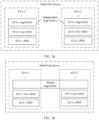
- FIG. 3a is a schematic diagram of a structure of a multi-link device according to an embodiment of this application.
- the 802.11 standard focuses on an 802.11 physical layer (physical layer, PHY) part and a medium access control (medium access control, MAC) layer part in a multi-link device.
- a plurality of STAs included in the multi-link device are independent of each other at a low MAC (low MAC) layer and a PHY layer, and are also independent of each other at a high MAC (high MAC) layer.
- FIG. 3b is a schematic diagram of another structure of a multi-link device according to an embodiment of this application. As shown in FIG.
- a non-AP MLD may use a structure with independent high MAC layers, and an AP MLD may use a structure with a shared high MAC layer.
- a non-AP MLD may use a structure with a shared high MAC layer, and an AP MLD may use a structure with independent high MAC layers.
- both a non-AP MLD and an AP MLD may use a structure with a shared high MAC layer.
- both a non-AP MLD and an AP MLD may use a structure with independent high MAC layers.
- a schematic diagram of an internal structure of the multi-link device is not limited in embodiments of this application.
- FIG. 3a and FIG. 3b are merely examples for description.
- the high MAC layer or the low MAC layer may be implemented by one processor in a chip system of the multi-link device, or may be implemented by different processing modules in a chip system.
- the multi-link device in embodiments of this application may be a single-antenna device, or may be a multi-antenna device.
- the multi-link device may be a device with more than two antennas.
- a quantity of antennas included in the multi-link device is not limited in embodiments of this application.
- the multi-link device (which may be a non-AP MLD or an AP MLD herein) is an apparatus having a wireless communication function.
- the apparatus may be an integrated device, or may be a chip, a processing system, or the like installed in the integrated device.
- a device on which the chip or the processing system is installed may implement, under control of the chip or the processing system, the method and functions in embodiments of this application.
- the non-AP MLD has a wireless transceiver function, may support the 802.11 series protocols, and may communicate with an AP MLD, a single-link device, or another non-AP MLD.
- the non-AP MLD is any user communication device that allows a user to communicate with an AP and further communicate with a WLAN.
- the non-AP MLD may be user equipment that can connect to a network, for example, a tablet computer, a desktop computer, a laptop computer, a notebook computer, an ultra-mobile personal computer (ultra-mobile personal computer, UMPC), a handheld computer, a netbook, a personal digital assistant (personal digital assistant, PDA), or a mobile phone, an internet of things node in an internet of things, a vehicle-mounted communication apparatus in an internet of vehicles, or the like.
- the non-AP MLD may alternatively be a chip and a processing system in the foregoing terminals.
- the AP MLD may be an apparatus that provides a service for a non-AP MLD, and may support the 802.11 series protocols.
- the AP MLD may be a communication entity, for example, a communication server, a router, a switch, or a bridge, or the AP MLD may include a macro base station, a micro base station, a relay station, and the like in various forms.
- the AP MLD may alternatively be a chip and a processing system in the devices in the various forms. In this way, the method and functions in embodiments of this application are implemented.
- An 802.11 protocol may be a protocol that supports 802.1The or is compatible with 802.11be.
- the multi-link device may support high-rate and low-latency transmission.
- the multi-link device may be further applied to more scenarios, for example, a sensor node (for example, a smart meter, a smart electricity meter, or a smart air detection node) in a smart city, a smart device (for example, a smart camera, a projector, a display, a TV set, a stereo, a refrigerator, or a washing machine) in a smart home, a node in an internet of things, an entertainment terminal (for example, wearable devices such as an AR and a VR), a smart device (for example, a printer or a projector) in a smart office, an internet of vehicles device in an internet of vehicles, and some infrastructures (for example, a vending machine, a self-service navigation station of a supermarket, a self-service cash register device, or a self-service ordering machine) in daily life scenarios.
- a sensor node for example, a smart meter, a smart electricity meter,
- NSTR link pair When a station on an NSTR link pair (NSTR link pair) in a non-AP MLD sends a signal, another station on the NSTR link pair may not be able to receive a signal.
- 802.1The considers that the station that cannot receive the signal due to uplink interference (due to UL interference) has lost medium synchronization (have lost medium synchronization).
- a station on the another link in a sending process on a link (for example, a link 1) of an NSTR MLD, packet receiving cannot be normally performed on another link (for example, a link 2).
- a station on the another link is considered to be medium synchronization lost (medium synchronization lost).
- the station on the another link is in a blind (blindness) state.
- the station that is, a station on the link 2 that has lost medium synchronization may miss NAV update.
- the station directly participates in EDCA contention, a fairness problem is caused to another station.
- EDCA contention of the another station has succeeded, and a period of time (where the period of time is referred to as a transmission opportunity (transmission opportunity, TXOP)) is reserved for communication.
- TXOP transmission opportunity
- communication of the another station may be interfered (for example, a collision occurs) by a frame sent by the station (that is, the station on the link 2) that has lost medium synchronization.
- a “link pair” mentioned in this application may refer to two different links (links) of an MLD.
- one MLD has three links in total: a link 1, a link 2, and a link 3.
- the link 1 and the link 2 are a link pair
- the link 2 and the link 3 are another link pair
- the link 1 and the link 3 are still another link pair.
- An "NSTR link pair” mentioned in this application means that an MLD cannot simultaneously perform sending and receiving operations on the link pair, or the MLD has an NSTR capability on the link pair.
- an NAV may be understood as a countdown timer and gradually decreases as time elapses. When a countdown is 0, a medium is considered to be in an idle state. Specifically, after a station receives a frame, if a receive address of the frame is not the station, the station may update an NAV based on a duration (duration) field in the received frame. If the receive address of the frame is the station, it indicates that the station is a receive station. In this case, the station cannot update the NAV. Before updating the NAV, the station may further determine whether a value of the duration field in the current frame is greater than a current NAV value of the station.
- the station updates the NAV. If the value of the duration field in the current frame is less than or equal to the current NAV value of the station, the station does not update the NAV.
- the NAV value is calculated from an end moment of receiving the frame.
- the 802.11be standard requires the station (for example, the station on the link 2) that has lost medium synchronization to maintain a medium synchronization delay (MediumSyncDelay) timer.
- a count value of the timer is not 0, the station that has lost medium synchronization is limited in channel contention.
- section 35.3.15.7 medium access recovery procedure, Medium access recovery procedure
- a station that has lost medium synchronization due to transmission of another station affiliated with a same MLD needs to start a MediumSyncDelay timer at the end of a transmission event.
- a STA that has lost medium synchronization due to transmission by another STA affiliated with the same MLD shall start a MediumSyncDelay timer at the end of that transmission event.
- the MediumSyncDelay timer sets an initial frame at an end moment of a frame sent on the link 1 and starts countdown.
- An initial value of the MediumSyncDelay timer may be set by an AP, or may be a default value specified in the standard.
- the MediumSyncDelay timer may be reset (reset) to 0. (The MediumSyncDelay timer resets to zero when any of the following events occur: The STA receives a PPDU with a valid MPDU.)
- the valid MPDU carries an NAV, and the station that has lost medium synchronization sets the NAV after receiving the valid MPDU.
- the station that has lost medium synchronization does not directly participate in EDCA contention, but performs EDCA contention after a countdown of the NAV is 0. In this way, no fairness problem is caused to another station, in other words, communication of the another station (on the link 2) is not interfered.
- the valid MPDU may mean that the station that has lost medium synchronization can parse the MPDU, and the MPDU has corresponding content.
- the station that has lost medium synchronization may normally perform channel contention, in other words, is not limited in channel contention.
- NSTR link pair a station that has lost medium synchronization
- another station that is, a station that has lost medium synchronization, for example, a station 2
- the station 2 may normally perform receiving (because there is no interference from the station 1 to the station 2 in this case).
- the station that has lost medium synchronization may receive a physical layer protocol data unit (physical protocol data unit, PPDU) after starting the MediumSyncDelay timer.
- PPDU physical protocol data unit
- an RTS frame is also a valid MPDU, according to the current 802.11be protocol, if the station that has lost medium synchronization receives an RTS frame sent by another station, the station resets (resets) the count value of the MediumSyncDelay timer to 0. However, in some cases, even if the station that has lost medium synchronization receives the RTS frame sent by the another station, the count value of the MediumSyncDelay timer needs not to be reset to 0. For example, an RTS frame received by a station (denoted as a station 1 for ease of description) that has lost medium synchronization is from another station in the blind state (that is, another station that has lost medium synchronization, denoted as a station 2 for ease of description).
- the another station attempts to contend for a TXOP by using the RTS frame as an initial frame, and the RTS frame is just received by the station 1.
- the station 2 also has lost medium synchronization, and channel contention of the station 2 may fail. If the channel contention of the station 2 fails, it indicates that a channel is busy (busy) in this case.
- the station 1 receives the RTS frame sent by the station 2, the station 1 resets a count value of a MediumSyncDelay timer to 0. In other words, because the station 1 receives the RTS frame sent by the station 2, a limitation on channel contention of the station 1 is removed. Therefore, the station 1 may perform normal channel contention.
- the channel is busy (to be specific, the channel is occupied by a station or is in a TXOP of a station). If the station 1 performs normal channel contention, a fairness problem is still caused to another station. For example, data sent by the station 1 may collide with data transmitted by the another station.
- exception processing is considered for the RTS frame.
- it is restricted that the station that has lost medium synchronization cannot reset the count value of the MediumSyncDelay timer to 0 by using an RTS frame. Specifically, when the count value of the MediumSyncDelay timer is not 0, if the station that has lost medium synchronization receives a PPDU carrying a valid MPDU, and the valid MPDU does not include an RTS frame, the count value of the MediumSyncDelay timer may be reset (reset) to 0.
- the MediumSyncDelay timer is reset to 0 when the following event occurs:
- the station that has lost medium synchronization receives a PPDU carrying a valid MPDU, and the valid MPDU does not include an RTS frame.
- the MediumSyncDelay timer resets to zero when the following event occurs:
- the STA receives a PPDU with a valid MPDU that does not contain an RTS frame.
- the RTS frame received by the station that has lost medium synchronization may alternatively be sent by a station that is not in the blind state (or a station that has not lost medium synchronization). Therefore, if the station that has lost medium synchronization is directly restricted not to reset the count value of the MediumSyncDelay timer to 0 after receiving the RTS frame, RTS frames sent by some stations that are not in the blind state (or stations that have not lost medium synchronization) are also limited. In other words, when the station that has lost medium synchronization receives an RTS frame sent by a station that is not in the blind state (or a station that has not lost medium synchronization), an unnecessary limitation is caused, and therefore performance of the station that has lost medium synchronization is affected.
- embodiments of this application provide a medium synchronization delay timer setting method, to properly set a value of a medium synchronization delay timer by distinguishing between sending stations that send RTS frames.
- a fairness problem caused to another station because a station that has lost medium synchronization (lost medium synchronization) participates in channel contention can be resolved, and therefore a probability of collision is reduced and fairness of the channel contention is improved.
- impact of an unnecessary limitation on station performance can be reduced, in other words, the station performance can be improved.
- Embodiment 1 describes a method for setting a medium synchronization delay timer when at least one link pair of a non-AP MLD is an NSTR link pair.
- Embodiment 2 describes a method for setting a medium synchronization delay timer when at least one link pair of an AP MLD is an NSTR link pair. It should be understood that the technical solutions described in Embodiment 1 and Embodiment 2 of this application may be combined to form a new embodiment, and parts that have same or similar concepts or solutions may be mutually referenced or combined. The following describes each embodiment in detail.
- both the AP MLD and the non-AP MLD in this application support the 802.11be protocol (or referred to as the Wi-Fi 7 or the EHT protocol), and may further support another WLAN communication protocol, for example, protocols such as 802.11ax and 802.11ac. It should be understood that the AP MLD and the non-AP MLD in this application may further support a next-generation protocol of 802.11be. In other words, the methods provided in this application are applicable to not only the 802.11be protocol, but also the next-generation protocol of 802.11be.
- the AP MLD and the non-AP MLD in this application each have at least one link pair (link pair), in other words, the AP MLD and the non-AP MLD in this application each include at least two links.
- the non-AP MLD in this application there is at least one STA associated with an AP in the AP MLD.
- Embodiment 1 of this application mainly describes a method for setting a medium synchronization delay timer when a station that has lost medium synchronization is a non-AP STA.
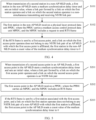
- FIG. 4 is a schematic flowchart of a medium synchronization delay timer setting method according to an embodiment of this application. As shown in FIG. 4 , the medium synchronization delay timer setting method includes but is not limited to the following steps:
- one non-AP MLD may include a plurality of stations, and a station of the non-AP MLD operates on a link (an affiliated STA (if any) of the non-AP MLD that operates on a link).
- the non-AP MLD in this embodiment of this application includes at least two stations: the first station and the second station. It is assumed that the link on which the first station operates is a first link, and the link on which the second station operates is a second link. The first link and the second link form a link pair (link pair), and the link pair is an NSTR link pair. In other words, the first station of the non-AP MLD cannot receive a signal when the second station sends a signal.
- the first station of the non-AP MLD has lost medium synchronization (have lost medium synchronization).
- the first station of the non-AP MLD may also be referred to as a station that has lost medium synchronization or a station that has experienced a medium synchronization loss.
- the first station of the non-AP MLD starts the medium synchronization delay (MediumSyncDelay) timer and sets the initial value.
- the station (that is, the first station) that has lost medium synchronization due to transmission of another station (that is, the second station) affiliated with the same MLD starts the MediumSyncDelay timer at the end of a transmission event.
- a STA that has lost medium synchronization due to transmission by another STA affiliated with the same MLD shall start a MediumSyncDelay timer at the end of that transmission event.
- the initial value of the MediumSyncDelay timer may be set by an AP, or may be a default value specified in a standard.
- the first station (that is, the station that has lost medium synchronization) of the non-AP MLD receives a PPDU, where the PPDU carries an MPDU, and the MPDU includes an RTS frame.
- the station knows a quantity of links of the AP MLD associated with the station, and whether each link pair (link pair) of the AP MLD is an STR or NSTR link pair.
- the first station in the non-AP MLD resets (resets) or sets the count value of the medium synchronization delay (MediumSyncDelay) timer to 0. That the link on which the first access point operates does not belong to any NSTR link pair of the AP MLD with which the first access point is affiliated may be understood as that the first access point does not operate on a link of any NSTR link pair of the AP MLD with which the first access point is affiliated.
- MediumSyncDelay medium synchronization delay
- any link pair formed by the first link on which the first access point operates and any link other than the first link in the AP MLD with which the first access point is affiliated is an STR link pair.
- the AP MLD with which the first access point is affiliated has three links in total, which are separately a link 1 to a link 3. It is assumed that the first link on which the first access point operates is the link 1. Because the link 1 and the link 2 form a link pair, the link 2 and the link 3 form another link pair, and the link 1 and the link 3 form still another link pair, the link 1 and the link 2 are STR links, and the link 1 and the link 3 are also STR links.
- a link on which the first access point is located does not belong to a link in any NSTR link pair of the AP MLD with which the first access point is affiliated. Alternatively, it may also be understood as that the first access point is not on a link of any NSTR link pair.
- the first station in the non-AP MLD does not reset the count value of the medium synchronization delay (MediumSyncDelay) timer to 0.
- MediumSyncDelay medium synchronization delay
- the first access point is an access point associated with the first station.
- the access point associated with the first station is referred to as an associated AP in this specification.
- the medium synchronization delay timer setting method may also be described as follows: After the station (that is, the first station) that has lost medium synchronization receives an RTS frame, if the RTS frame is sent by the associated AP (that is, the access point associated with the first station), and the associated AP does not belong to any NSTR link pair, the count value of the MediumSyncDelay timer may be reset to 0 (based on the RTS frame). Otherwise, the count value of the MediumSyncDelay timer is not allowed to be reset to 0 based on the RTS frame.
- a link pair of the AP MLD may be an NSTR link pair. Otherwise, all link pairs of the AP MLD need to be STR link pairs.
- the NSTR mobile AP MLD has only two links, and the only two links are NSTR links.
- the medium synchronization delay timer setting method may also be described as follows: After the station (that is, the first station) that has lost medium synchronization receives an RTS frame, if the RTS frame is sent by the associated AP (that is, the access point associated with the first station), and an AP MLD with which the associated AP is affiliated is not an NSTR mobile AP MLD, the count value of the MediumSyncDelay timer may be reset to 0 (based on the RTS frame). Otherwise, the count value of the MediumSyncDelay timer is not allowed to be reset to 0 based on the RTS frame.
- (the count value of) the MediumSyncDelay timer is reset to 0 when the following event occurs:
- the station (that is, the first station) that has lost medium synchronization receives a PPDU carrying a valid MPDU, and the valid MPDU does not include an RTS frame, except the RTS frame is sent by the associated AP (that is, the AP associated with the first station) affiliated with the AP MLD and the AP MLD is not an NSTR mobile AP MLD.
- the MediumSyncDelay timer resets to zero when the following event occurs:
- the STA receives a PPDU with a valid MPDU that does not contain an RTS frame, except the RTS frame is transmitted by the associated AP affiliated with an AP MLD that is not an NSTR mobile AP MLD.
- the NSTR mobile AP MLD in this embodiment of this application may be extended to more links, and at least a part of link pairs are NSTR link pairs.
- any two links included in the NSTR mobile AP MLD are NSTR links, or all link pairs included in the NSTR mobile AP MLD are NSTR link pairs.
- an access point in the 802.11be standard further supports a multiple (multiple) basic service set (basic service set, BSS) identifier (identifier, ID) feature.
- BSS basic service set
- a plurality of APs in a multiple BSSID may share a radio frequency, and operate on a same channel/frequency band in a time division manner. Therefore, an AP (referred to as an associated AP) associated with the first station and another AP in a multiple BSSID in which the associated AP is located operate on a same link in the time division manner. Therefore, when the multiple BSSID is considered, the first access point may alternatively be another access point in the multiple BSSID in which the access point (that is, the associated AP) associated with the first station is located.
- BSS basic service set
- the medium synchronization delay timer setting method may also be described as follows: After the station (that is, the first station) that has lost medium synchronization receives an RTS frame, if the RTS frame is sent by the another AP in the multiple BSSID in which the associated AP (that is, the access point associated with the first station) is located, and the another AP (and/or the associated AP) does not belong to any NSTR link pair, the count value of the MediumSyncDelay timer may be reset to 0 (based on the RTS frame). Otherwise, the count value of the MediumSyncDelay timer is not allowed to be reset to 0 based on the RTS frame.
- the medium synchronization delay timer setting method may also be described as follows: After the station (that is, the first station) that has lost medium synchronization receives an RTS frame, if the RTS frame is sent by the associated AP (that is, the access point associated with the first station) or the another AP in the multiple BSSID in which the associated AP is located, and an AP MLD with which the associated AP is affiliated is not an NSTR mobile AP MLD, the count value of the MediumSyncDelay timer may be reset to 0 (based on the RTS frame). Otherwise, the count value of the MediumSyncDelay timer is not allowed to be reset to 0 based on the RTS frame.
- (the count value of) the MediumSyncDelay timer is reset to 0 when the following event occurs:
- the station (that is, the first station) that has lost medium synchronization receives a PPDU carrying a valid MPDU, and the valid MPDU does not include an RTS frame, except the RTS frame is sent by the associated AP (that is, the AP associated with the first station) or the another AP in the same multiple BSSID as the associated AP, and the AP MLD with which the associated AP is affiliated is not an NSTR mobile AP MLD.
- the MediumSyncDelay timer resets to zero when the following event occurs:
- the STA receives a PPDU with a valid MPDU that does not contain an RTS frame, except the RTS frame is transmitted by the associated AP or another AP in the same multiple BSSID of the associated AP, and the associated AP affiliated with an AP MLD that is not an NSTR mobile AP MLD.
- the station after receiving an RTS frame, the station (referring to the first station) that has lost medium synchronization determines, by determining a sending station of the RTS frame and whether a link on which the sending station operates belongs to an NSTR link pair, whether the count value of the MediumSyncDelay timer needs to be set to 0, and may perform different processing on the MediumSyncDelay timer based on different sending stations (stations in a broad sense, which refer to APs herein) of RTS frames.
- the count value of the MediumSyncDelay timer is not allowed to be reset to 0; or if the sending station of the RTS frame is not in the blind state or has not lost medium synchronization, the count value of the MediumSyncDelay timer is reset to 0.
- Embodiment 1 mainly considers a case in which a station receiving an RTS frame is a non-AP STA, but an AP included in an NSTR mobile AP MLD may also lose medium synchronization. Therefore, Embodiment 2 of this application mainly describes a method for setting a medium synchronization delay timer when a station that has lost medium synchronization is an AP. Embodiment 2 of this application may be separately implemented, or may be implemented in combination with Embodiment 1. This is not limited in this application.
- FIG. 5 is another schematic flowchart of a medium synchronization delay timer setting method according to an embodiment of this application. As shown in FIG. 5 , the medium synchronization delay timer setting method includes but is not limited to the following steps:
- the AP MLD in this embodiment of this application may be an NSTR mobile AP MLD.
- at least one link pair in a link pair of the NSTR mobile AP MLD is an NSTR link pair.
- One AP MLD may include a plurality of APs, one AP of the AP MLD operates on one link, and one AP may be associated with one STA.
- the AP MLD in this embodiment of this application includes at least two access points: the first access point and the second access point. It is assumed that the link on which the first access point operates is a first link, and the link on which the second access point operates is a second link.
- the first link and the second link form a link pair (link pair), and the link pair is an NSTR link pair.
- the first access point of the AP MLD cannot receive a signal when the second access point sends a signal.
- the first access point of the AP MLD has lost medium synchronization (have lost medium synchronization).
- the first access point of the AP MLD may also be referred to as an AP that has lost medium synchronization or an AP that has experienced a medium synchronization loss.
- the first access point of the AP MLD starts the medium synchronization delay (MediumSyncDelay) timer and sets the initial value.
- the AP that is, the first access point
- the initial value of the MediumSyncDelay timer may be set by the AP, or may be a default value specified in a standard.
- the first access point (that is, the AP that has lost medium synchronization) of the AP MLD receives a PPDU, where the PPDU carries an MPDU, and the MPDU includes an RTS frame.
- the first access point knows a quantity of links of the non-AP MLD associated with the first access point, and whether each link pair (link pair) of the non-AP MLD is an STR or NSTR link pair.
- the first access point in the AP MLD resets the count value of the medium synchronization delay timer to 0.
- the first station associated with the first access point is referred to as an associated STA. That the link on which the first station operates does not belong to any NSTR link pair of the non-AP MLD with which the first station is affiliated may be understood as that the first station does not operate on a link of any NSTR link pair of the non-AP MLD with which the first station is affiliated.
- any link pair formed by the first link on which the first station operates and any link other than the first link in the non-AP MLD with which the first station is affiliated is an STR link pair.
- a link on which the first station is located does not belong to a link in any NSTR link pair of the non-AP MLD with which the first station is affiliated.
- the first station is not on a link of any NSTR link pair.
- the first access point in the AP MLD does not reset the count value of the medium synchronization delay timer to 0.
- the medium synchronization delay timer setting method may also be described as follows:
- an AP that is, the first access point
- the medium synchronization delay timer setting method may also be described as follows:
- an AP that is, the first access point
- the RTS frame is sent by a STA associated with the AP, and a link on which the STA is located does not belong to a link in any NSTR link pair
- a count value of a MediumSyncDelay timer may be reset to 0 (based on the RTS frame). Otherwise, the count value of the MediumSyncDelay timer is not allowed to be reset to 0 based on the RTS frame.
- (the count value of) the MediumSyncDelay timer is reset to 0 when the following event occurs:
- the station that has lost medium synchronization receives a PPDU carrying a valid MPDU, and the valid MPDU does not include an RTS frame, except the station that has lost medium synchronization is an AP (that is, the first access point) affiliated with an NSTR mobile AP MLD, the RTS frame is sent by the associated STA (that is, the STA associated with the first access point) affiliated with the MLD, and the associated STA is not on a link of any NSTR link pair.
- the MediumSyncDelay timer resets to zero when the following event occurs:
- the STA receives a PPDU with a valid MPDU that does not contain an RTS frame, except the STA is an AP affiliated with an NSTR mobile AP MLD, and the RTS is transmitted by an associated STA which is affiliated with an MLD and the associated STA is not on a link of any NSTR link pair(s).
- a method for setting a MediumSyncDelay timer on a station side is extended to an AP side.
- the AP that is, the first access point
- the count value of the MediumSyncDelay timer is reset to 0.
- a fairness problem caused to another station because the AP side directly participates in channel contention due to a medium synchronization loss can be resolved, and therefore a probability of collision is reduced and fairness of the channel contention is improved.
- impact of an unnecessary limitation on performance of the NSTR mobile AP MLD can be reduced, in other words, the performance can be improved.
- a count value of) a MediumSyncDelay timer is reset to 0 when the following event occurs:
- a station that has lost medium synchronization receives a PPDU carrying a valid MPDU, and the valid MPDU does not include an RTS frame, except the station that has lost medium synchronization is a non-AP STA (that is, the first station), the RTS frame is sent by an associated AP (that is, the AP associated with the first station) affiliated with an AP MLD, and the AP MLD is not an NSTR mobile AP MLD; or the station that has lost medium synchronization is an AP (that is, the first access point) affiliated with an NSTR mobile AP MLD, the RTS frame is sent by an associated STA (that is, the STA associated with the first access point) affiliated with the MLD, and the associated STA is not on a link of any NSTR link pair.
- the MediumSyncDelay timer resets to zero when the following event occurs:
- the STA receives a PPDU with a valid MPDU that does not contain an RTS frame, except the STA is a non-AP STA, and the RTS frame is transmitted by the associated AP affiliated with an AP MLD that is not an NSTR mobile AP MLD, or the STA is an AP affiliated with an NSTR mobile AP MLD, and the RTS is transmitted by an associated STA which is affiliated with an MLD and the associated STA is not on a link of any NSTR link pair(s).
- a MediumSyncDelay timer is reset to 0 when the following event occurs:
- a station that has lost medium synchronization receives a PPDU carrying a valid MPDU, and the valid MPDU does not include an RTS frame, except the station that has lost medium synchronization is a non-AP STA (that is, the first station), the RTS frame is sent by an associated AP (that is, the access point associated with the first station) or another AP in a multiple BSSID in which the associated AP is located, and an AP MLD with which the associated AP is affiliated is not an NSTR mobile AP MLD; or the station that has lost medium synchronization is an AP (that is, the first access point) affiliated with an NSTR mobile AP MLD, the RTS frame is sent by an associated STA (that is, the STA associated with the first access point) affiliated with the MLD, and the associated STA is not on a link of any NSTR link pair.
- the MediumSyncDelay timer resets to zero when the following event occurs:
- the STA receives a PPDU with a valid MPDU that does not contain an RTS frame, except the STA is a non-AP STA, and the RTS frame is transmitted by the associated AP or another AP in the same multiple BSSID of associated AP, and the associated AP affiliated with an AP MLD that is not an NSTR mobile AP MLD, or the STA is an AP affiliated with an NSTR mobile AP MLD, and the RTS is transmitted by an associated STA which is affiliated with an MLD and the associated STA is not on a link of any NSTR link pair(s).
- the AP MLD and the non-AP MLD may be divided into functional modules based on the foregoing method examples.
- each functional module may be obtained through division based on each function, or two or more functions may be integrated into one processing module.
- the integrated module may be implemented in a form of hardware, or may be implemented in a form of a software functional module.
- division into the modules is an example and is merely logical function division, and may be other division during actual implementation.
- Communication apparatuses in embodiments of this application are described below in detail with reference to FIG. 6 and FIG. 7 .
- the communication apparatus is an AP MLD or a non-AP MLD. Further, the communication apparatus may be an apparatus in the AP MLD, or the communication apparatus is an apparatus in the non-AP MLD.
- FIG. 6 is a schematic diagram of a structure of a communication apparatus according to an embodiment of this application.
- the communication apparatus includes a processing unit 11 and a transceiver unit 12.
- the communication apparatus may be a non-AP MLD or a chip in the non-AP MLD, for example, a Wi-Fi chip.
- the processing unit 11 is configured to: when transmission of a second station in the non-AP MLD ends, start a medium synchronization delay timer and set an initial value, where a link pair formed by a link on which the communication apparatus operates and a link on which the second station operates is an NSTR link pair.
- the transceiver unit 12 is configured to receive a PPDU, where the PPDU carries an MPDU, and the MPDU includes an RTS frame.
- the processing unit 11 is further configured to: when the RTS frame is sent by a first access point, and a link on which the first access point operates does not belong to any NSTR link pair of an AP MLD with which the first access point is affiliated, reset a count value of the medium synchronization delay timer to 0.
- the first access point is an access point associated with the communication apparatus, or the first access point is another access point in a multiple BSSID in which the access point associated with the communication apparatus is located.
- a link on which the first access point operates does not belong to any NSTR link pair of an AP MLD with which the first access point is affiliated includes:
- the AP MLD with which the first access point is affiliated is not an NSTR mobile AP MLD, and any two links included in the NSTR mobile AP MLD are NSTR links.
- the processing unit 11 is further configured to: when the RTS frame is sent by the first access point, and the AP MLD with which the first access point is affiliated is the NSTR mobile AP MLD, skip resetting the count value of the medium synchronization delay timer to 0.
- the processing unit 11 is further configured to: when the RTS frame is sent by the first access point, and the link on which the first access point operates belongs to any NSTR link pair of the AP MLD with which the first access point is affiliated, skip resetting the medium synchronization delay timer to 0.
- the communication apparatus in this design may correspondingly perform Embodiment 1, and the foregoing operations or functions of the units in the communication apparatus are used to implement corresponding operations of the non-AP MLD in Embodiment 1.
- the communication apparatus in this design may correspondingly perform Embodiment 1, and the foregoing operations or functions of the units in the communication apparatus are used to implement corresponding operations of the non-AP MLD in Embodiment 1.
- the communication apparatus in this design may correspondingly perform Embodiment 1, and the foregoing operations or functions of the units in the communication apparatus are used to implement corresponding operations of the non-AP MLD in Embodiment 1.
- the communication apparatus may be an AP MLD or a chip in the AP MLD, for example, a Wi-Fi chip.
- the processing unit 11 is configured to: when transmission of a second access point in the AP MLD ends, start a medium synchronization delay timer and set an initial value, where a link pair formed by a link on which the communication apparatus operates and a link on which the second access point operates is an NSTR link pair.
- the transceiver unit 12 is configured to receive a PPDU, where the PPDU carries an MPDU, and the MPDU includes an RTS frame.
- the processing unit 11 is further configured to: when the RTS frame is sent by a first station associated with the communication apparatus, and a link on which the first station operates does not belong to any NSTR link pair of a non-AP MLD with which the first station is affiliated, reset a count value of the medium synchronization delay timer to 0.
- the processing unit 11 is further configured to: when the RTS frame is sent by the first station associated with the communication apparatus, and the link on which the first station operates belongs to an NSTR link pair of the non-AP MLD with which the first station is affiliated, skip resetting the count value of the medium synchronization delay timer to 0.
- the communication apparatus in this design may correspondingly perform Embodiment 2, and the foregoing operations or functions of the units in the communication apparatus are used to implement corresponding operations of the AP MLD in Embodiment 2.
- the communication apparatus in this design may correspondingly perform Embodiment 2, and the foregoing operations or functions of the units in the communication apparatus are used to implement corresponding operations of the AP MLD in Embodiment 2.
- the communication apparatus in this design may correspondingly perform Embodiment 2, and the foregoing operations or functions of the units in the communication apparatus are used to implement corresponding operations of the AP MLD in Embodiment 2.
- the AP MLD and the non-AP MLD described in embodiments of this application may be implemented by using a general bus architecture.
- FIG. 7 is a schematic diagram of a structure of a communication apparatus 1000 according to an embodiment of this application.
- the communication apparatus 1000 may be an AP MLD or a non-AP MLD, or a chip in the AP MLD or the non-AP MLD.
- FIG. 7 shows only main components in the communication apparatus 1000.
- the communication apparatus may further include a memory 1003 and an input/output apparatus (not shown in the figure).
- the processor 1001 is mainly configured to: process a communication protocol and communication data, control the entire communication apparatus, execute a software program, and process data of the software program.
- the memory 1003 is mainly configured to store the software program and data.
- the transceiver 1002 may include a control circuit and an antenna.
- the control circuit is mainly configured to perform conversion between a baseband signal and a radio frequency signal and process the radio frequency signal.
- the antenna is mainly configured to receive and send radio frequency signals in a form of an electromagnetic wave.
- the input/output apparatus for example, a touchscreen, a display, or a keyboard, is mainly configured to receive data input by a user and output data to the user.
- the processor 1001 may read the software program in the memory 1003, interpret and execute instructions of the software program, and process the data of the software program.
- the processor 1001 performs baseband processing on the to-be-sent data, and outputs a baseband signal to the radio frequency circuit.
- the radio frequency circuit performs radio frequency processing on the baseband signal, and then sends a radio frequency signal to the outside through the antenna in a form of an electromagnetic wave.
- the radio frequency circuit receives a radio frequency signal through the antenna, converts the radio frequency signal into a baseband signal, and outputs the baseband signal to the processor 1001.
- the processor 1001 converts the baseband signal into data, and processes the data.
- the radio frequency circuit and the antenna may be disposed independent of the processor that performs baseband processing.
- the radio frequency circuit and the antenna may be remotely disposed independent of the communication apparatus.
- the processor 1001, the transceiver 1002, and the memory 1003 may be connected through a communication bus.
- the communication apparatus 1000 may be configured to perform the functions of the non-AP MLD in Embodiment 1.
- the processor 1001 may be configured to perform step S101 and step S103 in FIG. 4 , and/or configured to perform another process of the technology described in this specification.
- the transceiver 1002 may be configured to perform step S102 in FIG. 4 , and/or configured to perform another process of the technology described in this specification.
- the communication apparatus 1000 may be configured to perform the functions of the AP MLD in Embodiment 2.
- the processor 1001 may be configured to perform step S201 and step S203 in FIG. 5 , and/or configured to perform another process of the technology described in this specification.
- the transceiver 1002 may be configured to perform step S202 in FIG. 5 , and/or configured to perform another process of the technology described in this specification.
- the processor 1001 may include a transceiver configured to implement receiving and sending functions.
- the transceiver may be a transceiver circuit, an interface, or an interface circuit.
- the transceiver circuit, the interface, or the interface circuit configured to implement the receiving and sending functions may be separated, or may be integrated.
- the transceiver circuit, the interface, or the interface circuit may be configured to read and write code/data.
- the transceiver circuit, the interface, or the interface circuit may be configured to transmit or transfer a signal.
- the processor 1001 may store instructions.
- the instructions may be a computer program.
- the computer program is run on the processor 1001, so that the communication apparatus 1000 is enabled to perform the method described in any one of the foregoing method embodiments.
- the computer program may be fixed in the processor 1001. In this case, the processor 1001 may be implemented by hardware.
- the communication apparatus 1000 may include a circuit.
- the circuit may implement the sending, receiving, or communication function in the foregoing method embodiments.
- the processor and the transceiver described in this application may be implemented on an integrated circuit (integrated circuit, IC), an analog IC, a radio frequency integrated circuit (radio frequency integrated circuit, RFIC), a mixed-signal IC, an application-specific integrated circuit (application-specific integrated circuit, ASIC), a printed circuit board (printed circuit board, PCB), an electronic device, or the like.
- the processor and the transceiver may alternatively be manufactured by using various IC technologies, for example, a complementary metal oxide semiconductor (complementary metal oxide semiconductor, CMOS), an N-type metal oxide semiconductor (N-type metal oxide semiconductor, NMOS), a P-type metal oxide semiconductor (P-type metal oxide semiconductor, PMOS), a bipolar junction transistor (bipolar junction transistor, BJT), a bipolar CMOS (BiCMOS), silicon germanium (SiGe), and gallium arsenide (GaAs).
- CMOS complementary metal oxide semiconductor
- N-type metal oxide semiconductor N-type metal oxide semiconductor
- PMOS P-type metal oxide semiconductor
- BJT bipolar junction transistor
- BiCMOS bipolar junction transistor
- SiGe silicon germanium
- GaAs gallium arsenide
- the communication apparatus may be an independent device or may be a part of a larger device.
- the communication apparatus may be:
- the AP MLD and the non-AP MLD described in embodiments of this application may be implemented by a general-purpose processor.
- a general-purpose processor that implements the non-AP MLD includes a processing circuit and an input/output interface that is internally connected to and communicates with the processing circuit.
- the general-purpose processor may be configured to perform the functions of the non-AP MLD in Embodiment 1.
- the processing circuit may be configured to perform step S101 and step S103 in FIG. 4 , and/or another process of the technology described in this specification.
- the input/output interface may be configured to perform step S102 in FIG. 4 , and/or another process of the technology described in this specification.
- a general-purpose processor that implements the AP MLD includes a processing circuit and an input/output interface that is internally connected to and communicates with the processing circuit.
- the general-purpose processor may be configured to perform the functions of the AP MLD in Embodiment 2.
- the processing circuit may be configured to perform step S201 and step S203 in FIG. 5 , and/or another process of the technology described in this specification.
- the input/output interface may be configured to perform step S202 in FIG. 5 , and/or another process of the technology described in this specification.
- An embodiment of this application further provides a computer-readable storage medium.
- the computer-readable storage medium stores computer program code.
- an electronic device performs the method in any one of the foregoing embodiments.
- An embodiment of this application further provides a computer program product.
- the computer program product runs on a computer, the computer is enabled to perform the method in any one of the foregoing embodiments.
- An embodiment of this application further provides a communication apparatus.
- the apparatus may exist in a product form of a chip.
- a structure of the apparatus includes a processor and an interface circuit.
- the processor is configured to communicate with another apparatus through a receive circuit, so that the apparatus performs the method in any one of the foregoing embodiments.
- An embodiment of this application further provides a wireless communication system.
- the system includes an AP MLD and a non-AP MLD.
- the AP MLD and the non-AP MLD may perform the method in any one of the foregoing embodiments.
- the software instructions may include a corresponding software module.
- the software module may be stored in a random access memory (Random Access Memory, RAM), a flash memory, an erasable programmable read-only memory (Erasable Programmable ROM, EPROM), an electrically erasable programmable read-only memory (Electrically EPROM, EEPROM), a register, a hard disk, a removable hard disk, a compact disc read-only memory (CD-ROM), or any other form of storage medium well-known in the art.
- RAM Random Access Memory
- EPROM erasable programmable read-only memory
- EPROM electrically erasable programmable read-only memory
- CD-ROM compact disc read-only memory
- the storage medium is coupled to the processor, so that the processor can read information from the storage medium or write information into the storage medium.
- the storage medium may alternatively be a component of the processor.
- the processor and the storage medium may be located in an ASIC.
- the ASIC may be located in a core network interface device.
- the processor and the storage medium may alternatively exist in the core network interface device as discrete components.
- the functions described in this application may be implemented by using hardware, software, firmware, or any combination thereof.
- the foregoing functions may be stored in a computer-readable medium or transmitted as one or more instructions or code in the computer-readable medium.
- the computer-readable medium includes a computer-readable storage medium and a communication medium, where the communication medium includes any medium that enables a computer program to be transmitted from one place to another.
- the storage medium may be any available medium accessible to a general-purpose or dedicated computer.
Landscapes
- Engineering & Computer Science (AREA)
- Computer Networks & Wireless Communication (AREA)
- Signal Processing (AREA)
- Mobile Radio Communication Systems (AREA)
- Television Signal Processing For Recording (AREA)
- Communication Control (AREA)
- Electrophonic Musical Instruments (AREA)
- Synchronisation In Digital Transmission Systems (AREA)
Applications Claiming Priority (2)
| Application Number | Priority Date | Filing Date | Title |
|---|---|---|---|
| CN202111052538.3A CN115776683A (zh) | 2021-09-08 | 2021-09-08 | 介质同步时延计时器设置方法及相关装置 |
| PCT/CN2022/111750 WO2023035848A1 (zh) | 2021-09-08 | 2022-08-11 | 介质同步时延计时器设置方法及相关装置 |
Publications (3)
| Publication Number | Publication Date |
|---|---|
| EP4387315A1 true EP4387315A1 (de) | 2024-06-19 |
| EP4387315A4 EP4387315A4 (de) | 2024-12-18 |
| EP4387315B1 EP4387315B1 (de) | 2025-11-26 |
Family
ID=85387484
Family Applications (1)
| Application Number | Title | Priority Date | Filing Date |
|---|---|---|---|
| EP22866322.5A Active EP4387315B1 (de) | 2021-09-08 | 2022-08-11 | Verfahren zur einstellung eines mediumsynchronisationsverzögerungstimers und zugehörige vorrichtung |
Country Status (5)
| Country | Link |
|---|---|
| EP (1) | EP4387315B1 (de) |
| CN (1) | CN115776683A (de) |
| ES (1) | ES3059194T3 (de) |
| TW (1) | TWI816522B (de) |
| WO (1) | WO2023035848A1 (de) |
Family Cites Families (10)
| Publication number | Priority date | Publication date | Assignee | Title |
|---|---|---|---|---|
| US9300713B2 (en) * | 2013-08-16 | 2016-03-29 | Qualcomm Incorporated | Clock synchronization for multi-processor/multi-chipset solution |
| ES3016789T3 (en) * | 2019-07-10 | 2025-05-09 | Zte Corp | Multi-link communications of a wireless network |
| US11889435B2 (en) * | 2019-07-12 | 2024-01-30 | Mediatek Singapore Pte. Ltd. | Enhanced high-throughput synchronous and constrained multi-link transmissions in WLAN |
| US11877321B2 (en) * | 2020-01-02 | 2024-01-16 | Mediatek Singapore Pte. Ltd. | Constrained multi-link device operations in wireless communications |
| EP4080986B1 (de) * | 2020-01-08 | 2024-10-02 | LG Electronics Inc. | Signalisierung für mehrgelenkübertragung |
| CN113114430B (zh) * | 2020-01-11 | 2023-06-23 | 华为技术有限公司 | 一种数据帧的接收状态确定方法及通信装置 |
| US12225519B2 (en) * | 2020-02-12 | 2025-02-11 | Mediatek Singapore Pte. Ltd. | Group addressed frame wireless transmission for constrained multi-link operation |
| US11792829B2 (en) * | 2020-02-23 | 2023-10-17 | Nxp Usa, Inc. | Method and apparatus for multi-link operations |
| CN112040551B (zh) * | 2020-09-11 | 2024-02-20 | 腾讯科技(深圳)有限公司 | 多链路设备的信号传输方法、装置、设备及存储介质 |
| CN112714472A (zh) * | 2020-12-22 | 2021-04-27 | 中兴通讯股份有限公司 | 参数反馈、更新、关联方法、通信节点、通信系统及介质 |
-
2021
- 2021-09-08 CN CN202111052538.3A patent/CN115776683A/zh active Pending
-
2022
- 2022-08-11 EP EP22866322.5A patent/EP4387315B1/de active Active
- 2022-08-11 ES ES22866322T patent/ES3059194T3/es active Active
- 2022-08-11 WO PCT/CN2022/111750 patent/WO2023035848A1/zh not_active Ceased
- 2022-08-22 TW TW111131570A patent/TWI816522B/zh active
Also Published As
| Publication number | Publication date |
|---|---|
| WO2023035848A1 (zh) | 2023-03-16 |
| ES3059194T3 (en) | 2026-03-19 |
| EP4387315B1 (de) | 2025-11-26 |
| TWI816522B (zh) | 2023-09-21 |
| CN115776683A (zh) | 2023-03-10 |
| TW202312766A (zh) | 2023-03-16 |
| EP4387315A4 (de) | 2024-12-18 |
Similar Documents
| Publication | Publication Date | Title |
|---|---|---|
| EP4199598A1 (de) | Verfahren zur anzeige einer verbindung in der mehrverbindungskommunikation und zugehörige vorrichtung | |
| AU2023222203B2 (en) | Link state indication method in emlsr mode and related apparatus | |
| US12323865B2 (en) | Method of indicating changes by an access point | |
| US12550192B2 (en) | Channel contention method and related apparatus | |
| US12302212B2 (en) | Communication method and apparatus | |
| AU2024220057A1 (en) | Channel access method for multi-link device and related apparatus | |
| US20240187168A1 (en) | Communication method and related apparatus | |
| AU2025202056A1 (en) | Beacon frame transmission method in emlsr mode, and related apparatus | |
| EP4387315B1 (de) | Verfahren zur einstellung eines mediumsynchronisationsverzögerungstimers und zugehörige vorrichtung |
Legal Events
| Date | Code | Title | Description |
|---|---|---|---|
| STAA | Information on the status of an ep patent application or granted ep patent |
Free format text: STATUS: THE INTERNATIONAL PUBLICATION HAS BEEN MADE |
|
| PUAI | Public reference made under article 153(3) epc to a published international application that has entered the european phase |
Free format text: ORIGINAL CODE: 0009012 |
|
| STAA | Information on the status of an ep patent application or granted ep patent |
Free format text: STATUS: REQUEST FOR EXAMINATION WAS MADE |
|
| 17P | Request for examination filed |
Effective date: 20240315 |
|
| AK | Designated contracting states |
Kind code of ref document: A1 Designated state(s): AL AT BE BG CH CY CZ DE DK EE ES FI FR GB GR HR HU IE IS IT LI LT LU LV MC MK MT NL NO PL PT RO RS SE SI SK SM TR |
|
| A4 | Supplementary search report drawn up and despatched |
Effective date: 20241115 |
|
| DAV | Request for validation of the european patent (deleted) | ||
| DAX | Request for extension of the european patent (deleted) | ||
| RIC1 | Information provided on ipc code assigned before grant |
Ipc: H04W 74/08 20240101ALI20241111BHEP Ipc: H04W 24/02 20090101AFI20241111BHEP |
|
| GRAP | Despatch of communication of intention to grant a patent |
Free format text: ORIGINAL CODE: EPIDOSNIGR1 |
|
| STAA | Information on the status of an ep patent application or granted ep patent |
Free format text: STATUS: GRANT OF PATENT IS INTENDED |
|
| INTG | Intention to grant announced |
Effective date: 20250703 |
|
| GRAS | Grant fee paid |
Free format text: ORIGINAL CODE: EPIDOSNIGR3 |
|
| GRAA | (expected) grant |
Free format text: ORIGINAL CODE: 0009210 |
|
| STAA | Information on the status of an ep patent application or granted ep patent |
Free format text: STATUS: THE PATENT HAS BEEN GRANTED |
|
| AK | Designated contracting states |
Kind code of ref document: B1 Designated state(s): AL AT BE BG CH CY CZ DE DK EE ES FI FR GB GR HR HU IE IS IT LI LT LU LV MC MK MT NL NO PL PT RO RS SE SI SK SM TR |
|
| REG | Reference to a national code |
Ref country code: CH Ref legal event code: F10 Free format text: ST27 STATUS EVENT CODE: U-0-0-F10-F00 (AS PROVIDED BY THE NATIONAL OFFICE) Effective date: 20251126 Ref country code: GB Ref legal event code: FG4D |
|
| REG | Reference to a national code |
Ref country code: IE Ref legal event code: FG4D |
|
| REG | Reference to a national code |
Ref country code: DE Ref legal event code: R096 Ref document number: 602022025849 Country of ref document: DE |
|
| REG | Reference to a national code |
Ref country code: ES Ref legal event code: FG2A Ref document number: 3059194 Country of ref document: ES Kind code of ref document: T3 Effective date: 20260319 |
|
| REG | Reference to a national code |
Ref country code: NL Ref legal event code: MP Effective date: 20251126 |
|
| REG | Reference to a national code |
Ref country code: LT Ref legal event code: MG9D |
|
| PG25 | Lapsed in a contracting state [announced via postgrant information from national office to epo] |
Ref country code: NO Free format text: LAPSE BECAUSE OF FAILURE TO SUBMIT A TRANSLATION OF THE DESCRIPTION OR TO PAY THE FEE WITHIN THE PRESCRIBED TIME-LIMIT Effective date: 20260226 |
|
| PG25 | Lapsed in a contracting state [announced via postgrant information from national office to epo] |
Ref country code: FI Free format text: LAPSE BECAUSE OF FAILURE TO SUBMIT A TRANSLATION OF THE DESCRIPTION OR TO PAY THE FEE WITHIN THE PRESCRIBED TIME-LIMIT Effective date: 20251126 Ref country code: HR Free format text: LAPSE BECAUSE OF FAILURE TO SUBMIT A TRANSLATION OF THE DESCRIPTION OR TO PAY THE FEE WITHIN THE PRESCRIBED TIME-LIMIT Effective date: 20251126 Ref country code: AT Free format text: LAPSE BECAUSE OF FAILURE TO SUBMIT A TRANSLATION OF THE DESCRIPTION OR TO PAY THE FEE WITHIN THE PRESCRIBED TIME-LIMIT Effective date: 20251126 |
|
| REG | Reference to a national code |
Ref country code: AT Ref legal event code: MK05 Ref document number: 1862420 Country of ref document: AT Kind code of ref document: T Effective date: 20251126 |
|
| PG25 | Lapsed in a contracting state [announced via postgrant information from national office to epo] |
Ref country code: NL Free format text: LAPSE BECAUSE OF FAILURE TO SUBMIT A TRANSLATION OF THE DESCRIPTION OR TO PAY THE FEE WITHIN THE PRESCRIBED TIME-LIMIT Effective date: 20251126 |
|
| PG25 | Lapsed in a contracting state [announced via postgrant information from national office to epo] |
Ref country code: RS Free format text: LAPSE BECAUSE OF FAILURE TO SUBMIT A TRANSLATION OF THE DESCRIPTION OR TO PAY THE FEE WITHIN THE PRESCRIBED TIME-LIMIT Effective date: 20260226 |
|
| PG25 | Lapsed in a contracting state [announced via postgrant information from national office to epo] |
Ref country code: IS Free format text: LAPSE BECAUSE OF FAILURE TO SUBMIT A TRANSLATION OF THE DESCRIPTION OR TO PAY THE FEE WITHIN THE PRESCRIBED TIME-LIMIT Effective date: 20260326 |
|
| PG25 | Lapsed in a contracting state [announced via postgrant information from national office to epo] |
Ref country code: PT Free format text: LAPSE BECAUSE OF FAILURE TO SUBMIT A TRANSLATION OF THE DESCRIPTION OR TO PAY THE FEE WITHIN THE PRESCRIBED TIME-LIMIT Effective date: 20260326 |
|
| PG25 | Lapsed in a contracting state [announced via postgrant information from national office to epo] |
Ref country code: PL Free format text: LAPSE BECAUSE OF FAILURE TO SUBMIT A TRANSLATION OF THE DESCRIPTION OR TO PAY THE FEE WITHIN THE PRESCRIBED TIME-LIMIT Effective date: 20251126 |
|
| PG25 | Lapsed in a contracting state [announced via postgrant information from national office to epo] |
Ref country code: LV Free format text: LAPSE BECAUSE OF FAILURE TO SUBMIT A TRANSLATION OF THE DESCRIPTION OR TO PAY THE FEE WITHIN THE PRESCRIBED TIME-LIMIT Effective date: 20251126 |